2011 年 6 月大学英语六级(CET-6)真题试卷
PartⅠ Writing (30minutes)
注意:此部分试题在答题卡 1上。
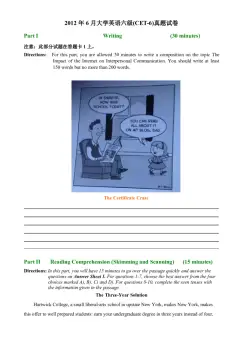
Directions: For this part, you areallowed 30minutes towriteashort essay entitledThe
CertificateCraze.Youshould writeatleast 150wordsfollowing theoutlinegiven
below.
1.现在许多人热衷于各类证书考试
2.其目的各不相同
3.在我看来……
TheCertificateCraze
PartII Reading Comprehension(Skimming andScanning) (15 minutes)
Directions:In thispart,you willhave 15 minutes to goover thepassagequickly andanswer the
questionsonAnswer Sheet 1.For questions 1-7, choose thebest answer fromthefour
choices marked A), B), C)andD). For questions 8-10, completethe seen tenses with
theinformationgiven in thepassage.
MinorityReport
American universities are accepting more minoritiesthan ever. Graduating themis another
matter.
Barry Mills,thepresident ofBowdoin College, was justifiably proud ofBowdoin's efforts to
recruitminority students. Since 2003thesmall,elite liberal arts school inBrunswick, Maine, has
boostedthe proportion ofso-called under-represented minoritystudents inentering freshman
classes from 8% to 13%."It is ourresponsibilityto reach out and attract students to cometo our
kindsof places," he tolda NEWSWEEK reporter. But Bowdoin has notdone quiteas well when it
comes to actually graduating minorities. While 9out of10whitestudents routinely get their
diplomaswithin sixyears, only 7out of10black students madeit to graduation day inseveral
recent classes.
"If you look at who enters college, it nowlookslikeAmerica," says Hilary Pennington,
directorof postsecondary programs for theBill & MelindaGates Foundation, which has closely
studiedenrollment patterns inhighereducation. "But ifyou look at who walks across thestage for a
diploma,it's still largely thewhite, upper-income population."
The United Statesonce had thehighest graduation rate ofany nation. Nowit stands 10th. For
thefirst timein American history, there is therisk that therising generation willbe less well
educated than theprevious one. Thegraduation rate among 25-to 34-year-olds isnobetter thanthe
ratefor the55-to 64-year-olds who were going to collegemore than 30years ago. Studies show
thatmore and more poorand non-whitestudentswant to graduatefrom college –but their
graduation rates fall far short oftheir dreams. The graduation rates for blacks, Latinos, and Native
Americans lag far behind thegraduation rates for whites and Asians. As theminoritypopulation
grows in theUnited States, lowcollegegraduation rates become athreat tonational prosperity.
The problem is pronounced at publicuniversities. In 2007theUniversity of
Wisconsin-Madison –oneof thetop fiveorso prestigious publicuniversities –graduated 81% ofitswhitestudents within sixyears, but only 56%ofits blacks. At less-selectivestateschools, the
numbers get worse. During thesame timeframe, theUniversity ofNorthern Iowa graduated 67% of
itswhitestudents, but only 39%ofitsblacks. Community colleges have lowgraduation rates
generally–but rock-bottom rates for minorities. Arecent review ofCalifornia communitycolleges
found that whileathird oftheAsian students picked uptheir degrees, only 15%of
African-Americans did so as well.
Privatecolleges and universities generally dobetter, partly because they offer smallerclasses
and morepersonal attention. But when it comes to asignificant graduation gap,Bowdoin has
company. Nearby Colby College logged an 18-point difference between whiteandblack graduates
in2007and 25pointsin 2006.Middlebury College in Vermont, another top school, had a 19-point
gap in 2007anda22-point gap in2006.The mostselective private schools –Harvard, Yale, and
Princeton –showalmostnogap between black and whitegraduation rates. But that may have more
todowith theirability to select thebest students.According to data gathered byHarvard Law
Schoolprofessor Lain Gainer, themostselective schools are more likelyto choose blacks who have
at least oneimmigrant parent from Africa or theCaribbean than black students who are descendants
ofAmerican slaves.
"Higher education has been able to duck this issueforyears, particularly themore selective
schools, bysaying the responsibilityis ontheindividualstudent," says Pennington ofthe Gates
Foundation. "If they fail, it's theirfault." Somecritics blameaffirmativeaction –studentsadmitted
withlower test scores and grades from shaky high schools often struggle at eliteschools. But a
bigger problem may be that poorhigh schools often send theirstudentsto colleges for which they
are"under matched": they could get intomore elite, richer schools, but instead go to community
colleges andlow-rated stateschools that lack the resources to help them. Someschools out for
profit cynically increasetuitions and count onstudent loans and federal aidto foot thebill–
knowing fullwell that the studentswon't make it."The school keeps the money, but thekid leaves
withloads of debt and nodegree and noability toget abetterjob. Colleges are not holding uptheir
end," says Amy Wilkinsof theEducation Trust.
Acollege education isgetting ever moreexpensive. Since 1982tuitions havebeen rising at
roughly twice therate of inflation.In 2008thenet cost ofattending a four-year publicuniversity –
after financial aid –equaled 28% ofmedian (中间的)family income, whilea four-year private
universitycost 76% ofmedian family income. Moreand morescholarships are based onmerit,not
need. Poorer students are not always thebest-informed consumers. Often they wind updeeply in
debt orsimplyunable topay after ayear or two and must dropout.
There once was a timewhen universities took pride intheirdropout rates. Professors would
begin theyear bysaying, "Look to theright and look to theleft. One ofyou is not going to be here
by theendoftheyear." But such aDarwinian spirit is beginning togive way asat least afew
colleges faceuptothegraduation gap. At the University ofWisconsin-Madison, thegap has been
roughly halved over thelast threeyears. Theuniversity has poured resources into peer counseling
tohelp students from inner-city schools adjust to therigor (严格要求)and faster pace ofa
universityclassroom –and also to help minority students overcome thestereotype that they are less
qualified. Wisconsinhas a "laser likefocus" onbuildingupstudent skillsin thefirst three months,
according tovice provost (教务长)Damon Williams.
Stateand federal governments could sharpen that focus everywhere bybroadly publishing
minoritygraduation rates. For years private colleges such as Princeton and MIT have hadsuccess
bringing minorities onto campus in thesummerbefore freshman year togive them someprepare
Tory courses. Thenewer trend isto start recruiting poor and non-white studentsas early as the
seventh grade, using innovativetoolsto identify kids withsophisticated verbal skills. Such
programs can beexpensive, ofcourse, but cheap compared with themillions already invested in
scholarships and grants forkids who have littlechance tograduate withoutspecial support.
With effort and money, thegraduation gap can be closed. Washington and Lee is asmall,
selectiveschool in Lexington, Va. Its student bodyisless than 5% black and less than 2%Latino.
Whiletheschool usually graduated about 90%of itswhites, thegraduation rate of itsblacks and
Latinoshad dippedto 63%by2007."We went through adramatic shift," says Dawn Watkins,thevicepresident forstudent affairs. The school aggressively pushed mentoring (辅导)ofminorities
by otherstudents and "partnering" with parents at a special pre-enrollment session.The school had
itsfirst-ever black homecoming. Last spring theschool graduated thesameproportion of minorities
as itdidwhites. If theUnited States wants to keep upin theglobal economicrace, it willhave to
pay systematicattention to graduating minorities, not justenrolling them.
注意:此部分试题请在答题卡 1上作答。
1. Whatis theauthor's main concern about American highereducation?
A) Thesmall proportion ofminority students.
B) The lowgraduation rates ofminority students.
C) The growing conflicts among ethnic groups.
D) Thepooracademic performance ofstudents.
2. Whatwas the prideof President Barry Millsof Bowdoin College?
A) Theprestige ofitsliberal arts programs.
B) Its ranking among universitiesin Maine.
C) The high graduation rates ofitsstudents.
D) Its increased enrollment ofminority students.
3. Whatis therisk facing America?
A) Its schools willbe overwhelmed bythegrowing number ofillegal immigrants.
B) The risinggeneration will beless well educated than theprevious one.
C) Morepoor andnon-white students willbedenied access to college.
D) It is going toloseitscompetitiveedge in highereducation.
4. HowmanyAfrican-American students earned theirdegrees in Californiacommunitycolleges
according toa recent review?
A) Fifty-six percent. B) Thirty-nine percent.
C)Fifteen percent D)Sixty-seven percent.
5. Harvard, Yale, and Princeton show almostnogap between black and whitegraduation rates
mainlybecause .
A) Theirstudents work harder B) They recruit thebest students
C)Theirclasses are generally smaller D)They give studentsmore attention
6. Howdoes Amy Wilkins oftheEducation Trust viewminority students'failure to get a degree?
A) Universities are toblame.
B) Studentsdon't work hard.
C) The government fails to providethe necessary support.
D) Affirmative action shouldbe held responsible.
7. Whydosomestudents dropout after ayear or two according to theauthor?
A) They have lostconfidence in themselves.
B) They cannot afford thehigh tuition.
C) They cannot adapt to therigor oftheschool.
D) They fail to develop interest in theirstudies.
8. Totackle theproblem ofgraduationgap, theUniversity of Wisconsin-Madison helps minority
studentsget over thestereotype that _______.
9. Foryears, private colleges such as Princeton and MIT have provided minority students with
_______duringthe summerbefore freshman year.
10. Washington and Lee University is cited as an exampletoshowthat the gap ofgraduation
rates between whites and minorities can _______.
PartIII ListeningComprehension (35minutes)
SectionA
Directions:In thissection, you willhear 8short conversationsand2long conversations. Atthe
end of each conversation, oneor more questionswillbe asked about what wassaid.
Boththeconversation andthequestions willbespoken onlyonce. After each question
therewillbeapause. During thepause, youmust read thefour choices marked A), B),C)andD), anddecide which thebest answer is. Then markthecorrespond in letter
onAnswerSheet 2with asinglelinethroughthecentre.
注意:此部分试题请在答题卡 2上作答。
11. A)Shewillgive himthereceipt later.
B) Theman should makehis own copies.
C) Shehas notgot theman's copies ready.
D) Theman forgot to makethecopies forher.
12. A)Shephoned Fred about thebook.
B) Shewas latefor theappointment.
C)Sheran into Fred onher way here.
D)Sheoften keeps otherpeople waiting.
13. A)Mark isnot fit to takecharge oftheStudent Union.
B) Mark is thebest candidate for thepost ofchairman.
C) It won't be easy for Mark to win theelection.
D) Females are more competitivethan males inelections.
14. A)It failed toarrive at itsdestination in time.
B) It got seriously damaged onthe way.
C) It got lost at theairport inParis.
D) It was left behind in thehotel.
15. A)Justmake useof whatever information is available.
B) Putmoreeffort into preparing for thepresentation.
C) Find morerelevant information fortheirwork.
D) Simply raise theissuein theirpresentation.
16. A)theman has decided tochoose Language Studies as his major.
B) Thewoman isn't interested in thepsychology oflanguage.
C) Theman is stilltrying tosign upfor thecourse heis interested in.
D) Thewoman isn't qualified totake thecourse the man mentioned.
17. A)They are bothto blame.
B) They are both easy toplease.
C) They can manage to get along.
D) They will make peace in time.
18. A)They are indesperate need offinancial assistance.
B) They hopeto domiracles withlimited resources.
C) They want to borrow ahuge sumfrom thebank.
D) They plan tobuyout theirbusiness partners.
Questions19to 22are basedon theconversation youhavejustheard.
19. A)Wesimplycannot help reacting instinctively that way.
B) Wewish to hideourindifference totheirmisfortune.
C) Wederive somehumorous satisfaction from theirmisfortune.
D)Wethinkit serves them right for being mean to otherpeople.
20. A)They want to showtheirgenuinesympathy.
B) They have had similarpersonal experiences.
C) They don't knowhowto cope with thesituation.
D)They don't want to reveal theirown frustration.
21. A)They themselves would liketo doitbut don't dare to.
B) Its an opportunityfor relieving theirtension.
C) it’s a rare chance forthem to see theboss loseface.
D)They have seen thismany times in oldfilms.
22. A)to irritatethem. B) Toteach them a lesson.
C)Torelieve herfeelings. D)Toshowher courage.
Questions23to 25are basedon theconversation youhavejustheard.
23. A)Smuggling drugs into Hong Kong.B) Having committed armed robbery.
C)Stealing afellow passenger's bag.
D) Bringing a handgun into Hong Kong.
24. A)He said nota single word during the entireflight.
B) Hetookaway Kumar's baggage whilehe was asleep.
C) Hewas travelling ona scholarship from Delhi University.
D) Heis suspected ofhaving slipped somethingin Kumar's bag.
25. A)Givehim alift. B) Find Alfred Foster.
C)Check thepassenger list. D)Search all suspicious cars.
SectionB
Directions:In thissection, you willhear 3short passages. At theend ofeach passage, you will
hear somequestions. Both thepassageand thequestions willbe spokenonlyonce. After you hear a
question,you must choosethebest answerfromthe fourchoices marked A), B), C)andD). Then
markthecorresponding letter onAnswer Sheet 2with asinglelinethroughthecentre.
注意:此部分试题请在答题卡2上作答。
Passage One
Questions26to 28are basedon thepassageyou havejustheard.
26. A)they think travel has become atrend.
B) They thinktravel gives them theirmoney's worth.
C) They findmany of thebanks untrustworthy.
D) They lack theexpertisetomake capital investments.
27. A)Lower theirprices toattract more customers.
B) Introduce travel packages for young travelers.
C) Design programs targeted at retired couples.
D) Launch a newprogram ofadventure trips.
28. A)therole oftravel agents. B) Thewaypeople travel.
C)The numberoflast-minutebookings. D)Theprices of polarexpeditions.
Passage Two
Questions29to 31are basedon thepassageyou havejustheard.
29. A)theold stereotypes about men and women.
B) The changing roles played bymen andwomen.
C) The division oflaborbetween men and women.
D) Thewidespread prejudice against women.
30. A)Offermore creativeand practical ideas than men.
B) Ask questions that often lead tocontroversy.
C) Speak loudly enoughto attract attention.
D) Raiseissuesonbehalf of women.
31. A)to provethat she couldearn herliving as a gardener.
B) To showthat women are more hardworking than men.
C) To showthat women are capable ofdoing what men do.
D) Toprove that she was really irritated with her husband.
Passage Three
Questions32to 35are basedon thepassageyou havejustheard.
32. A)Covering majorevents oftheday inthecity.
B) Reporting criminal offenses inGreenville.
C) Hunting news for thedaily headlines.
D) Writingarticles onfamily violence.
33. A)It is amuch safer place than itused to be.
B) Rapes rarely occur inthedowntown areas.
C) Assaults often happen onschool campuses.
D) It has fewerviolent crimes thanbig cities.
34. A)there are awiderange ofcases.
B) They are very destructive.C) There has been a risein such crimes.
D) They have aroused fear among the residents.
35. A)Writeabout somethingpleasant. C)Offer help tocrimevictims.
B) Do someresearch onlocal politics? D)Work as anewspaper editor.
SectionC
Directions:In thissection, you willhear apassage threetimes. When thepassageis readfor thef
irsttime, you shouldlisten carefullyfor itsgeneral idea. When thepassageis read for
thesecond time, you arerequired tofill inthe blanksnumbered from36to 43withthe
exact words you have just heard.For blanks numbered from44to46you arerequired
tofillinthemissing information.For these blanks, you caneither usetheexact words
you have justheard or writedown themain pointsinyour own words.Finally, when
thepassageisread forthe thirdtime, you shouldcheck what you havewritten.
注意:此部分试题请在答题卡 2上作答。
In America, peopleare faced with moreand moredecisions every day, whether it's picking
oneof31ice cream (36) _____ordeciding whether and when to get married. That sounds likea
great thing. But as arecent study has shown, toomany choices can make us(37) _____,unhappy –
even paralyzed with indecision.
That's (38)_____true when it comes to theworkplace, says Barry Schwartz, an author ofsix
booksabout human (39)_____.Students are graduating with a(40) _____ofskills andinterests,
butoften find themselves (41) _____whenit comes to choosing an ultimatecareer goal.
In astudy, Schwartz observed decision-making among college students during their(42) _____
year. Based onanswers toquestionsregarding theirjob-hunting (43)_____and career decisions, he
dividedthe studentsinto two groups: "maximizes" who consider every possibleoption, and
"satisfiers" who look untilthey find an optionthat is good enough.
You might expect that thestudents (44) _________________________________.But it turns out
that's not true. Schwartz found that whilemaximizes ended upwith better paying jobsthan
satisfiers onaverage, they weren't as happy withtheir decision.
Thereason (45) _________________________________.Whenyou look at every possibleoption,
you tend tofocus moreonwhat was given upthan what was gained. After surveying every option,
(46)_________________________________.
PartIV Reading Comprehension(Reading inDepth) (25minutes)
SectionA
Directions:In thissection, thereis ashortpassage with 5questions orincomplete statements.
Read thepassagecarefully. Then answer thequestionsor completethestatements in
thefewest possiblewords. Pleasewriteyour answers onAnswer Sheet 2.
Questions47to 51are basedon thefollowing passage.
Howgood are you at saying "no"? For many, it's surprisingly difficult. This is especially true
ofeditors, who bynature tend to beeager and engaged participants in everything they do.Consider
thesescenarios:
It's latein theday. That front-page package you'vebeen working onisnearly complete; one
lastedit and it's finished. Enter theexecutiveeditor, who makes a suggestion requiring a
more-than-modest rearrangement ofthedesign and theaddition ofan information box.You want to
scream:"No! It's done!" What doyou do?
The firstrule ofsaying noto theboss is doing sayno.Sheprobably has somethingin mind
whenshemakes suggestions, and it's uptoyou to find out what. The second rule is doingraise the
stakes bychallenging her authority. That issueis already decided. The thirdrule isto be ready to
citeoptionsand consequences. Theboss's suggestions might beappropriate, butthere are always
consequences. Shemight notknow about thepages backing upthat need attention, orabout the
designerwho had to go homesick. Tell her shecan havewhat shewants, but explaintheconsequences. Understand what she's trying toaccomplish andpropose aPlan B that willmake it
happen without destroying what you've donesofar.
Here's another case. Your least-favoritereporter suggestsa dumb story idea. This oneshould
beeasy, but it's not. If you say no,even politely, you risk inhibiting further ideas, not just from that
reporter, but from others who heard that you turned down the idea. This scenario is commonin
newsrooms that lack a systematicway tofilter story suggestions.
Two steps are necessary. First, you need a system forhowstories are proposed and reviewed.
Reporters can tolerate rejection oftheirideas ifthey believethey were given afair hearing.
Yourgut reaction (本能反应) and dismissiverejection, even ofaworthless idea, might notqualify
as systematic orfair.
Second, thepeople you work withneed to negotiatea "What if...?" agreement covering
"What ifmyidea is turned down?" Howare people expected to react? Is there an appeal process?
Canthey refine the idea and resubmit it? By anticipating "What if...?" situations before they happen,
you can reach understanding that will help ease you out ofconfrontations.
47.Instead ofdirectly saying notoyour boss, you should find out __________.
48.Theauthor's second warning isthat we should avoid running agreater risk by__________.
49.Oneway ofresponding to your boss's suggestion isto explain the__________to herand offer
an alternative solution.
50.Toensure fairness toreporters, it is important to setupa system forstories to __________.
51.Peoplewho learn toanticipate "What if...?"situationswill beable toreach understanding and
avoid __________.
SectionB
Directions:There are2passages in thissection. Each passage isfollowedby somequestions or
unfinished statements. For each of themthere arefour choices marked A), B), C)and
D). Youshould decide onthebest choice andmarkthecorresponding letter onAnswer
Sheet 2with asinglelinethrough thecentre.
Passage One
Questions52to 56are basedon thefollowing passage.
At theheart ofthedebate overillegal immigration lies one key question: are immigrants good
orbad for theeconomy? TheAmerican publicoverwhelmingly thinksthey're bad. Yet the
consensus among most economists isthat immigration, bothlegal andillegal, provides a smallnet
boostto theeconomy. Immigrants providecheap labor, lowerthe prices of everything from farm
produceto new homes, andleave consumers with alittlemore money intheirpockets. Sowhy is
theresuch adiscrepancy between theperception ofimmigrants' impact ontheeconomy andthe
reality?
There are a numberof familiartheories. Someargue that people are anxiousand feel
threatened byan inflowof newworkers. Others highlight thestrain that undocumented immigrants
placeonpublicservices, likeschools, hospitals, and jails. Still others emphasizetherole ofrace,
arguing that foreigners add to thenation's fears and insecurities. There's some truthto all these
explanations, but they aren't quitesufficient.
To get a betterunderstanding ofwhat's going on; consider theway immigration's impact is
felt. Though itsoverall effect may be positive, itscosts and benefits are distributed unevenly. David
Card, an economist at UC Berkeley, notes that the ones who profit most directly from immigrants'
low-cost laborare businesses and employers –meatpacking plants in Nebraska, forinstance, or
agricultural businesses inCalifornia. Granted, theseproducers' savings probably translate into
lowerprices at thegrocery store, but howmany consumers makethat mental connection at the
checkout counter? As forthe drawbacks ofillegal immigration, these, too, are concentrated. Native
low-skilledworkers suffer mostfrom the competitionof foreign labor. According toastudy by
George Boras, aHarvard economist, immigration reduced thewages ofAmerican high-school
dropouts by9%between 1980-2000.
Among high-skilled, better-educated employees, however, oppositionwas strongest in states
withboth high numbers ofimmigrants and relatively generous social services. What worried them
most,in otherwords, was thefiscal (财政的)burden ofimmigration. That conclusion wasreinforced byanother finding: that theiroppositionappeared tosoften when that fiscal burden
decreased, as occurred withwelfare reform in the1990s, which curbed immigrants' access to
certain benefits.
The ironyis that for all theoverexcited debate, thenet effect ofimmigration is minimal. Even
forthosemost acutely affected –say, low-skilled workers, orCaliforniaresidents –theimpact isn't
allthat dramatic. "The unpleasant voices have tended to dominateourperceptions," says Daniel
Michener, apolitical science professor at theUniversity ofOregon. "But when all thosefactors are
puttogether and theeconomists calculate thenumbers, it ends upbeing a net positive, buta small
one." Toobad most peopledon't realizeit.
注意:此部分试题请在答题卡 2上作答。
52. Whatcan welearn from the first paragraph?
A) Whether immigrants are good or bad forthe economy has been puzzling economists.
B) The American economy usedto thrive onimmigration but nowit's a different story.
C) The consensus among economists is that immigration should notbe encouraged.
D) Thegeneral publicthinks differently from most economists ontheimpact ofimmigration.
53. In what way does theauthor thinkordinary Americans benefit from immigration?
A) They can access all kinds ofpublicservices.
B) They canget consumer goods at lower prices.
C) They canmix with peopleofdifferent cultures.
D) They can avoid doing much ofthemanual labor.
54. Whydonativelow-skilled workers suffer most from illegal immigration?
A) They have greater difficulty getting welfare support.
B) They are morelikely toencounter interracial conflicts.
C) They haveaharder timegettinga jobwith decent pay.
D) They are nomatch for illegal immigrants in labor skills.
55. Whatis thechief concern of nativehigh-skilled, better-educated employees about theinflowof
immigrants?
A) It may change theexisting social structure.
B) It may posea threat to their economicstatus.
C) It may lead to social instability inthe country.
D) It may place agreat strain onthestatebudget.
56. Whatis theirony about thedebate over immigration?
A) Even economists can't reach aconsensus about itsimpact.
B) Thosewho are opposed to itturn out to benefit mostfrom it.
C) Peopleare making too big afuss about something ofsmall impact.
D) Thereis no essential difference between seemingly oppositeopinions.
Passage Two
Questions57to 61are basedon thefollowing passage.
Picturea typical MBA lecture theatretwenty years ago. In it themajority ofstudents will
haveconformed to thestandard model ofthetime: male, middleclass and Western. Walk intoa
class today, however, and you'll get a completely different impression. For astart, you willnowsee
plentymore women –theUniversity of Pennsylvania's Wharton School, forexample, boasts that
40%ofitsnew enrolment isfemale. You will also see awide range ofethnicgroups and nationals
ofpractically every country.
It might be tempting, therefore, to think that theold barriers have been broken down and
equal opportunity achieved. But, increasingly, thisapparent diversity is becoming amask for anew
type ofconformity. Behind thedifferences in sex,skin tones and mothertongues, there are
commonattitudes, expectations and ambitionswhich risk creating a set ofclones among the
businessleaders of thefuture.
Diversity, it seems, has nothelped to address fundamental weaknesses inbusiness leadership.
Sowhat can be doneto createmore effectivemanagers ofthecommercial world? According to
Valerie Gauthier, associate dean at HEC Paris, the key lies in theprocess bywhich MBA
programmers recruit their students. At themoment candidates are selected ona fairly narrow set ofcriteria such as prior academic and career performance, and analytical and problem solving abilities.
Thisis thencoupled toa school's pictureof what a diverseclass should looklike, with theresult
thatpassport, ethnicorigin and sex can all become influencing factors. But schools rarely digdown
tofind out what really makes an applicant succeed, to createa class which also contains diversity of
attitudeand approach –arguably theonly diversity that, in abusiness context,really matters.
Professor Gauthier believes schools shouldnot justbe selecting candidates from traditional
sectors such as banking,consultancy and industry. They should also beseeking individualswho
havebackgrounds in areas such as political science, thecreative arts, history orphilosophy, which
willallowthem to put business decisions intoa widercontext.
Indeed,there does seem to beademand forthe morerounded leaders suchdiversity might
create. Astudy byManna, aleadership development company, suggests that, whilethebully-boy
chiefexecutive ofoldmay not have been eradicated completely, there is adefinite shiftin emphasis
towards less tough styles ofmanagement –at least in America and Europe. Perhaps most
significant, according toManna, is theincreasing interest large companies have in more
collaborativemanagement models, such as thoseprevalent in Scandinavia, which seek tointegrate
thehard and soft aspects ofleadership andencourage delegated responsibility and accountability.
注意:此部分试题请在答题卡 2上作答。
57. Whatcharacterizes thebusiness school student population oftoday?
A) Greaterdiversity. B) Intellectual maturity.
C)Exceptional diligence. D)Higher ambition.
58. Whatis theauthor's concern about current business school education?
A) It will arouse students' unrealistic expectations.
B) It willproduce business leaders ofauniform style.
C) It focuses ontheory rather than onpractical skills.
D) It stresses competition rather than cooperation.
59. Whataspect ofdiversity does Valerie Gauthierthink is mostimportant?
A) Age and educational background.
B) Social andprofessional experience.
C)Attitudeand approach to business.
D) Ethnicorigin and gender.
60. Whatapplicants does theauthorthink MBA programmers shouldconsider recruiting?
A) Applicants withprior experience in business companies.
B) Applicants with sound knowledgein math and statistics.
C) Applicants from outsidethetraditional sectors.
D) Applicants from less developed regions and areas.
61. Whatdoes Manna say about thecurrent management style?
A) It is eradicating the tough aspects ofmanagement.
B) It encourages maleandfemale executives to work sidebyside.
C) It adopts thebully-boy chief executivemodel.
D) It is shifting towards morecollaborativemodels.
Part Cloze (15 minutes)
Directions:There are20blanks in thefollowing passage. For each blankthereare fourchoices
marked A), B), C)andD) ontherightsideof thepaper. Youshould choose theONE
thatbest fitsinto thepassage. Then mark thecorresponding letter onAnswer
Sheet 2with asinglelinethrough thecentre.
注意:此部分试题请在答题卡 2上作答。
Organized volunteering and work experience has long been avital companion to university
degree courses. Usually it isleft to__62__to deduce thepotential from alistof extracurricular
adventures onagraduate's resume, __63__nowtheUniversity of Bristol has launched an award to
formalizetheachievements ofstudents who __64__timeto activities outsidetheircourses. BristolPlusaimsto boost students inan increasingly __65__job market byhelping them acquire work and
lifeskills alongside__66__qualifications.
"Ourstudents are a pretty active bunch,but wefound thatthey didn't __67__appreciate the
valueofwhat theydid __68__thelecture hall,"says Jeff Goodman, director ofcareers and
employabilityat theuniversity. "Employers are much more__69__than they used to be. They used
tolook for __70__andsawit as part oftheir jobto extract thevalue ofanapplicant's skills. Now
they want students to beable toexplain why thoseskillsare __71__to thejob."
Studentswho sign __72__fortheaward will beexpected tocomplete 50hours ofwork
experience or__73__work, attend four workshops onemploy-ability skills,take part inan
intensiveskills-related activity __74__,crucially, writea summary oftheskillsthey havegained.
__75__ efforts will gain an OutstandingAchievement Award. Thosewho __76__best onthesports
field cantake theSporting plusAward which fosters employer-friendly sports accomplishments.
The experience does nothave to be __77__organized. "We're not justinterested in easily
identifiableskills," says Goodman. “__78__,onestudent took thelead indealing with adifficult
landlord and so__79__negotiation skills.Wetry to maketheexperience relevant toindividual
lives."
Goodman hopes the__80__will enable active studentsto fill in anygaps in theirexperience and
encouragetheirless-active__81__to take upactivities outsidetheiracademicarea ofwork.
62.A)advisors B) specialists C)critics D)employers
63.A)which B) but C)unless D)since
64.A)divide B) devote C)deliver D)donate
65.A)harmonious B) competitive C)Resourceful D)prosperous
66.A)artistic B) technical C)academic D)interactive
67.A)dominantly B) earnestly C)necessarily D)gracefully
68.A)outside B) along C)over D)through
69.A)generous B) considerate C)enlightening D)demanding
70.A)origin B) initial C)popularity D)potential
71.A)relevant B) responsive C)reluctant D)respective
72.A)out B) off C)away D)up
73.A)casual B) elective C)domestic D)voluntary
74.A)or B) thus C)so D)and
75.A)Occasional B) Exceptional C)Informative D)Relative
76.A)perform B) convey C)circulate D)formulate
77.A)roughly B) randomly C)formally D)fortunately
78.A)for instance B) In essence C)In contrast D)Ofcourse
79.A)demonstrated B) determined C)operated D)involved
80.A)device B) section C)scheme D)distraction
81.A)attendants B) agents C)members D)peers
Pactiv Translation (5 minutes)
Directions:Complete thesentences by translatinginto English theChinesegiven in brackets.
Pleasewriteyour translation onAnswer Sheet 2.
注意:此部分试题请在答题卡 2上作答,只需写出译文部分。
82. Even though they were already late, they ____________________(宁愿停下来欣赏美丽的景
色)than justgo on.
83. No agreement was reached in thediscussion between thetwo parties, as
____________________(任何一方都不肯放弃自己的立场).
84. Thepills____________________(本来可以治愈那位癌症病人的), but hedidn't followthe
doctor's advice and take them regularly.
85. It is ____________________(你真好,给了我那么多帮助); Ireally feel obliged to you.
86. Thewar left thefamily scattered all overtheworld, and it was thirty years
____________________(他们才得以重聚).