2013 年 6 月六级考试真题(第二套)
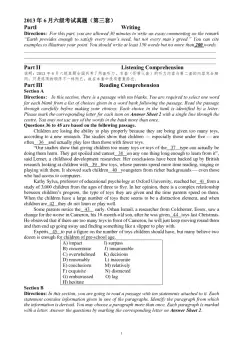
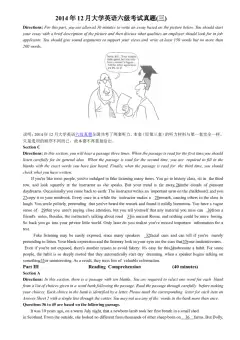
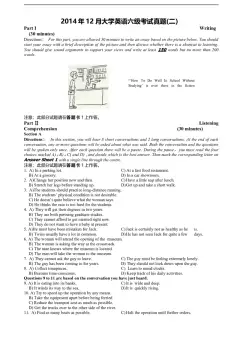
PartⅠ Writing
Directions: For thispart, you are allowed 30minutes towritean essay commenting ontheremark
“Goodhabits result from resisting temptation.” You can cite examples to illustrateyour point You
shouldwrite at least 150words but nomore than 200words.
_______________________________________________________________________________
_______________________________________________________________________________
_______________________________________________________________________________
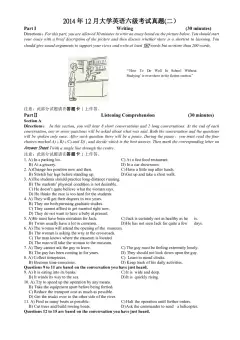
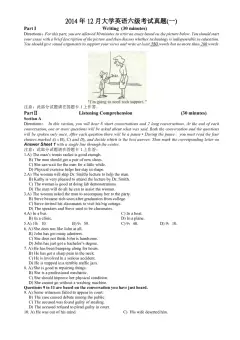
PartⅡ Listening Comprehension
SectionA
Directions:In thissection,you willhear8shortconversationsand2longconversations. Attheend
ofeach conversation, oneor morequestions willbeasked about whatwas said. Both the
conversation andthequestions willbespoken onlyonce. After each question therewillbeapause.
Duringthepause,youmustreadthefourchoicesmarkedA),B),C)andD),anddecidewhichisthe
bestanswer. Then markthecorresponding letter onAnswer Sheet 1with asinglelinethroughthe
centre.
1.A)Whyhis phonehad been disconnected. C)Whyhedidn’t leave her amessage.
B) Whyshecould not get through to him. D)Whyhe refused toanswer her call.
2.A)Thehouses withinhis price range are soldout.
B) Mostpeople inthis city want toown a home.
C) Hehas difficulty finding affordable housing.
D)Thewoman shouldrent anicer apartment.
3.A)Thewoman would liketheman to takecare ofher mail.
B) Thewoman has putthe numberintoeveryone^ mailbox.
C) Thenewcopy machine can meet everyone’sneeds.
D) Acode numberis necessary to run thecopy machine.
4.A)He willstop work to take care ofthebaby. C)Hiswife is going to give birth to ababy.
B) Hewill find ajob near his homenextyear. D)His wife willleave her work soon.
5.A)Theshopping centre is flooded with people. C)Parkingin this city is ahorrible
nightmare.
B) They willcome to themall someotherday. D)Shewillwaitforthemanatthesouthgate.
6.A)He willbeback in a minuteto repairthecomputers.
B) It will take longer toreconnect thecomputers totheNet.
C) Hehas tackled morecomplicated problems than this.
D)Alot ofcool stuffwill beavailable onlinetomorrow.
7.A)Sheforgot to call her mother. C)Shedidsee ProfSmith onTV.
B) ProfSmithgives lectures regularly onTV. D)Her motheris afriend ofProfSmith’s.
8.A) Theman has to wait to get his medicine.
B) Thestoredoesn’t have theprescribed medicine.
C) Theman has to go tosee hisdoctor again.
D)Theprescription is not written clearly enough.
Questions9to 11are basedon theconversation youhavejustheard.
9.A)It is advertising electronicproducts. C)It is sponsoring aTV programme.
B) It is planning to tourEast Asia. D)It is giving performances intown.
10. A)Alot ofgood publicity. C)Long-term investments.
B) Talented artists towork for it. D)Adecrease in production costs.
11. A)Promiselong-term cooperation with theCompany.
B) Explainfrankly their own current financial situation.
C) Pay fortheprinting oftheperformance programme.
D)Bear thecost ofpublicising theCompany’s performance.
Questions12to 15are basedon theconversation youhavejustheard.
12. A)He has been seeing doctors and counselors. C)Hewas caught abusing drugs.
B) Hehas found anew way to train his voice. D)He might give upconcert tours.13. A)Singers may become addicted to it. C)Singers useittostay away from colds.
B) It helps singers warm themselves up. D)It can doharm to singers’ vocal chords.
14. A)They are eager to become famous. C)Few willbecome successful.
B) Many lack professional training. D)They livea glamorous life.
15. A) Harm tosingers donebysmoky atmospheres.
B) Sideeffects ofsomecommon drugs.
C) Voiceproblems among popsingers.
D)Hardships experienced bymany young singers.
SectionB
Directions:Inthissection, youwillhear3shortpassages.Attheendofeachpassage,youwillhear
somequestions. Both thepassageandthequestions willbespoken onlyonce. After you hear a
question,you must choosethebest answerfromthe fourchoices marked A), B), C)andD). Then
markthecorresponding letter onAnswer Sheet 1with asinglelinethroughthecentre.
Passage One
Questions16to 19are basedon thepassageyou havejustheard.
16.A)It has not been very successful. C)It has met with strong resistance.
B) It has long become anewtrend. D)It has attracted a lotof users.
17.A)It saves time. C)It ensures drivers’safety.
B) It increases parking capacity. D)It reduces car damage.
18.A)Collect moneyand help newusers. C)Stayalert to any emergency.
B) Maintainthe automated system. D)Walkaround and guard against car theft.
19.A)They will vary withthe sizeof vehicles.
B) They willbe discountableto regular customers.
C) They willbe lower than conventional parking.
D)They will bereduced ifpaid in cash.
Passage Two
Questions20to 22are basedon thepassageyou havejustheard.
20. A)Half ofthemethane in theatmosphere isfrom animals.
B) Methanehas becomethe chiefsource ofgreenhouse gas.
C) Consumerbehaviour may beinfluenced bytheenvironment.
D)Meat consumption has an adverse effect ontheenvironment.
21. A)It takes timefor thehuman bodyto get used toit.
B) It lacks thevitamins and minerals essential for health.
C) It enhances immunity to certain diseases.
D)It helps people tolivea much longerlife.
22. A)Produce green food. C)Quiteating meats.
B) Wastenofood. D)Grow vegetables.
Passage Three
Questions23to 25are basedon thepassageyou havejustheard.
23. A)They donot knowany solution. C)They donot behave in publicplaces.
B) They donot give updrunk driving. D)They donot admit being alcohol addicts.
24. A)Tostop them from fighting back. C)Toteach them theEuropean lifestyle.
B) Tothank them fortheir hospitality. D)Torelieve theirpains and sufferings.
25. A) Without intervention they will bea headacheto thenation.
B) Withsupport they can be brought back toa normal life.
C) They readily respond to medical treatment.
D)They pose aserious threat to social stability.
SectionC
Directions:Inthissection,youwillhearapassagethreetimes.Whenthepassageisreadforthefirst
time, youshould listen carefully forits general idea. When thepassageis read for the second time,
you arerequired to fillin theblanks with theexact wordsyou have justheard. Finally, when the
passageisread forthethird time, you shouldcheck whatyou havewritten.
Self-imageisthepictureyouhaveofyourself,thesortofpersonyoubelieveyouare 26 inour
2self-imagearethecategoriesinwhichyouplaceyourself,therolesyouplay,andother 27 scriptors
you usetoidentify yourself. If you tellan 28 you are agrandfather who recently losthiswife and
who does 29 work onweekends, several elements of your self-image are brought to light —the
roles ofgrandparent, widower, and 30 citizen.
Butself-imageismorethanhowyoupictureyourself;italsoinvolveshowothersseeyou.Three
types of feedback from others 31 howthey seeus: confirmation, rejection,and disconfirmation.
Confirmationoccurswhenotherstreatyouinamannerconsistentwithwhoyoubelieveyouare.You
believeyou have leadership abilities and your boss put you incharge ofa newwork team. On the
otherhand,rejection occurswhen others treat you in amannerthat 32 your self-definition.Pierre
Salinger was appointed senatorfrom Californiabut 33 losthis first election. Hethought hewas a
good publicofficial, but thevoters obviouslythought otherwise—their votewas inconsistent with
his 34 .The thirdtype offeedback isdisconfirmation, which occurs when others fail to respond to
your notionof selfbyresponding neutrally. Astudent writes what he thinks isan excellent
composition,but theteacher writes noencouraging remarks. Rather than 35 howothers classify
you,considerhowyouidentifyyourself.Thewayinwhichyouidentifyyourselfisthebestreflection
ofyour self-image.
Part Ⅲ Reading Comprehension
SectionA
Directions:Inthissection, thereisapassagewithtenblanks. Youarerequired toselect oneword
fareach blankfromalistof choices given inawordbankfollowing thepassage. Read thepassage
throughcarefully beforemaking your choices. Each choice in thebankis identified byaletter.
PleasemarkthecorrespondingletterforeachitemonAnswerSheet2withasinglelinethroughthe
centre. You maynot use anyof thewordsin thebank morethan once.
Questions36to 45are basedon thefollowing passage.
Properstreet behaviourintheUnited Statesrequiresanicebalanceofattentionandinattention.
Youaresupposedtolookatapasserbyjustenoughtoshowthatyouareawareofhis 36 Ifyoulook
toolittle, you appear haughty(目中无人的),too much and you are inquisitive(过分好奇
地).Usuallywhathappensisthatpeopleeyeeachotheruntiltheyareabouteightfeetapart,atwhich
pointboth cast down their eyes.Sociologist Erving Goffman describes thisas “akindof 37 of
lights”.
Much ofeye behaviour isso 38 that we react to itonly ontheintuitive level. The next time
youhaveaconversationwithsomeonewhomakes youfeel liked,noticewhathedoes withhiseyes.
Chances arehelooksat you moreoften than isusualwith 39 alittlelongerthan thenormal. You
40 thisasasign—apoliteone— thatheisinterestedinyouasapersonratherthanjustinthetopic
ofconversation. Probably you also feel thathe is both self-confident and sincere.
Allthishas been demonstrated in 41 experiments. Subjectssit andtalk inthepsychologist’s
laboratory, 42 ofthefact thattheireye behaviour isbeing observed from aoneway visionscreen.
In onefairly typical experiment,subjects were 43 to cheat whileperforming atask, then were
interviewed and observed. It was found that thosewho had cheated met theinterviewer’s eyes less
oftenthanwas 44 ,anindicationthat“shiftyeyes”— tousethemysterywriters’stockphrase—
can 45 be atip-off(表明)to an attempt todeceive orto feelings of guilt.
A)innocent I) actually
B) interpret J) subtle
C)sights K)induced
D)dimming L) hiding
E)normal M)presence
F)deceived N)doubtfully
G)glances O) elaborate
H)obscure
SectionB
Directions:In thissection, you aregoing toread apassagewithten statements attached to it.Each
statement contains informationgiven in one ofthe paragraphs.Identify theparagraph fromwhichtheinformationisderived.Youmaychooseaparagraphmorethanonce.Eachparagraphismarked
with aletter. Answer thequestions bymarking the corresponding letter onAnswer Sheet 2.
ANation That’sLosing Its Toolbox
[A]The scene insidetheHomeDepot onWeyman Avenue here would give theold-timeAmerican
craftsmanpause. In Aisle34is precut plasticflooring, theglue already inplace. In Aisle26are
prefabricated windows. Stacked near thecheckout counters, and as colourful as aFisher-Price
toy, is anot-so-serious-looking power tool:abattery-operated saw-and-drill combination. And
ifyou don’t want to doityourself, head toAisle 23orAisle35,where a help desk will arrange
foran installer.
[B] It’s all very handy stuff, I guess, aconvenient way tobe ado-it-yourselferwithout being all that
goodwithtools.ButatatimewhentheAmericanfactoryseemstobeashrinkingpresence,and
whengood manufacturing jobs have vanished, perhaps never toreturn, there issomething
deeply troubling about thisdilutionof American craftsmanship.
[C]Thisisn’t a lament(伤感)—ornot merely a lament —for bygone times. It’s asocial and
cultural issue, as well as an economic one.The HomeDepot approach to craftsmanship—
simplify it,dumbit down, hirea contractor—is onesignal that mastering tools and working
withone’shandsisrecedinginAmericaasahobby,asavaluedskill,asaculturalinfluencethat
shaped thinkingand behaviour in vastsections ofthecountry.
[D]Thatshouldbeamatterofconcerninapresidentialelectionyear.YetneitherBarackObamanor
MittRomneypromotes himselfas tool-savvy(使用工具很在行的)presidential timber, inthe
moldofaJimmyCarter,askilledcarpenterandcabinetmaker.TheObamaadministrationdoes
worry publicly about manufacturing, afirst cousin ofcraftsmanship. WhentheFord Motor
Company, for example, recentlyannounced that itwas bringing someproduction home, the
WhiteHousecheered. “Whenyou seethings likeFord movingnewproductionfrom Mexicoto
Detroit, instead oftheother way around, you knowthings are changing,” says Gene Sperling,
directorof theNational EconomicCouncil.
[E]Ask theadministration ortheRepublicans ormost academics why America needs more
manufacturing, and they respond thatmanufacturing gives birth toinnovation, brings downthe
tradedeficit, strengthens thedollar, generates jobs, arms themilitary and brings about a
recovery from recession. But rarely, ifever,dothey publiclytake theargument astep further,
assertingthatagrowingmanufacturingsectorencouragescraftsmanshipandthatcraftsmanship
is,ifnot abirthright, then a vitalingredient oftheAmerican self-imageas acan-do, inventive,
we-can-make-anything people.
[F]Traditionalvocational traininginpublichigh schoolsisgraduallydeclining, strandingthousands
ofyoung peoplewhoseek training for acraft without going tocollege. Colleges, for theirpart,
havesince 1985graduated fewerchemical, mechanical, industrialand metallurgical(冶金的)
engineers,partlyinresponsetothereducedroleofmanufacturing,abigemployer ofthem.The
declinestartedinthe1950s,whenmanufacturinggeneratedasturdy28%ofthenationalincome,
orgross domesticproduct, and employed one-third of theworkforce. Today, factory output
generates just12% ofGDP and employs barely 9% ofthenation’s workers.
[G]Masslayoffsandplantclosingshavedrawnplentyofheadlinesandpublicdebateovertheyears,
and theystilloccasionally do.But the damagetoskilland craftsmanship —what’s needed to
buildacomplex airlineroratractor, orforaworker tomoveupfrom assemblertomachinistto
supervisor—went largely unnoticed.
[H]“In an earliergeneration, welost ourconnection tothe land, and now weare losing our
connection tothe machinery we depend on,”says Michael Hout, asociologist at theUniversity
ofCalifornia, Berkeley. “Peoplewho work with theirhands,”hewent on,“are doing things
today that wecall servicejobs, in restaurants and laundries, or inmedical technology and the
like.”
[I]That’soneexplanationforthedeclineintraditionalcraftsmanship.Lackofinterestisanother.The
bigmoneyisinfieldslikefinance.Startinginthe1980s,skillinfinancegrewinimportance,and,
as depicted in thenews mediaand the movies, became amore appealing source ofincome. By
lastyear, Wall Street traders, bankers and thosewho deal in real estategenerated 21% ofthe
4national income, doubletheirshare in the1950s.And Warren Buffett, thegood-natured
financier, became a homespunfolk hero, without thetools andoveralls (工作服).
[J]“Young peoplegrow upwithoutdeveloping the skillsto fix things around thehouse,” says
RichardCurtin,directoroftheThomsonReuters/UniversityofMichiganSurveysofConsumers.
“They knowabout computers, ofcourse, butthey don’tknow howto buildthem.”
[K]Manufacturing’s shrinking presence undoubtedly helps explain thedeclineincraftsmanship, if
onlybecausemanyofthenation’sassemblylineworkerswereskilledincraftwork,ifnotonthe
jobthen in theirspare time. In alate1990s study ofblue-collar employees at a General Motors
plant(nowclosed)inLinden,NJ,thesociologistRuthMilkmanofCityUniversityofNewYork
foundthatmanylineworkers,intheiroff-hours,didhomerenovationandotherskilledwork.“I
haveoften thought,” MsMilkman says, “that theseextracurricular jobswere an effort onthe
part oftheworkers toregain theirdignity after suffering thedegradation ofrepetitiveassembly
linework in thefactory.”
[L] Craft work has higher status in nationslikeGermany, which investsin apprenticeship(学徒)
programmes for high school students. “Corporations in Germany realised that there was an
interesttobeservedeconomicallyandpatrioticallyinbuildingupaskilledlabourforceathome;
weneverhadthatethos(风气),”saysRichardSennett,aNewYorkUniversitysociologistwho
has written about theconnection ofcraft and culture.
[M]Thedamage to American craftsmanship seems toparallel thesteep slideinmanufacturing
employment. Though the declinestarted inthe 1970s, itbecame much steeper beginning in
2000.Sincethen, some5.3million jobs,or one-third of theworkforce in manufacturing, have
been lost. Astated goal of theObama administrationis to restore abigchunk of this
employment, alongwith themultitude ofskillsthat manyof thejobsrequired.
[N]As for craftsmanship itself, theissueis howtopreserveit as a valued skillin thegeneral
population.Ms Milkman, thesociologist, argues that American craftsmanship isn’t
disappearingasquicklyassomewouldargue—thatithasinsteadshiftedtoimmigrants.“Pride
incraft, it is alivein theimmigrant world,”she says.
[O]Sol Axelrod, 37,themanager oftheHomeDepot here, fittingly learned tofix hisowncar as a
teenager, even changing thebrakes. Nowhefinds immigrant craftsmen. gathered in abundance
outsidehis storein theearly morning, waiting for itto open sothey can buysupplies for the
day’sworkascontractors.Skilleddaylaborers,alsomostlyimmigrants,waitquietlyinhopesof
being hired bythecontractors. Mr Axelrodalso says therecession and persistently high
unemployment have forced many people to try to save moneybydoingmore themselves, and
HomeDepot inresponse offers classes in fixingwater taps andothersimplerepairs. The
teachers are storeemployees, many of themolder andsemi-retired from askilled trade, orlaid
off.“Ourcustomersmaynotbebuildingcabinetsoroutdoordecks;wetrytodothatforthem,’’
MrAxelrod says, “but someare trying tobuild upskillso they candomore forthemselves in
thesehard times.”
46.Mastering toolsand working with one’shands shapes people’s thinkingand behaviour.
47.Thefactorthat people can earn more money infields otherthan manufacturing contributes tothe
declineintraditional craftsmanship.
48.According to theauthor, manufacturing encourages craftsmanship.
49.According to Ruth Milkman,American craftsmanship,instead ofdisappearing, is being taken up
byimmigrants.
50.TheWhiteHouse welcomed Ford’s announcement to bring someproduction back to America.
51.According to MrAxelrod of HomeDepot, people are trying to rideout therecession bydoing
morethemselves.
52.America’s manufacturing in the1950s constituted 28%ofthegross domesticproduct.
53.In RuthMilkman’s opinion, many assembly lineworkers didhomerenovationand otherskilled
work in theiroff-hours inorder to regain theirdignity.
54.Theauthorfelt troubled about theweakening of American craftsmanship.
55.Compared with that inAmerica, thestatus ofcraft work inGermany ishigher.
SectionCDirections:There are2passages in thissection. Each passage isfollowedby somequestions or
unfinishedstatements.ForeachofthemtherearefourchoicesmarkedA),B),C)andD).Youshould
decideonthe best choice andmarkthecorresponding letter onAnswer Sheet2with asingleline
throughthecentre.
Passage One
Questions56to 60are basedon thefollowing passage.
Thereport from theBureau ofLabour Statistics was justas gloomy as anticipated.
Unemployment inJanuary jumped to a 16-year high of 7.6percent, as 598,000jobs were slashed
from U.S. payrolls in theworst single-month decline sinceDecember, 1974.With 1.8million jobs
lostin thelast three months,there is urgent desire toboost the economy as quickly as possible. But
Washington would dowell to takeadeep breath before reacting to thegrim numbers.
Collectively, we rely onthe unemployment figures and other statisticsto frame oursense of
reality. They are avital part ofan array ofdata that we usetoassess ifwe’re doingwell or doing
badly, andthat in turn shapes government policies and corporatebudgets and personal spending
decisions. Theproblem is that thestatisticsaren’t anobjective measure ofreality; they aresimply a
bestapproximation. Directionally, they capture thetrends, but theidea that weknow precisely how
many are unemployed is amyth. That makes finding a solutionall themoredifficult.
First, there isthe way thedata isassembled. Theofficial unemployment rate is theproduct of a
telephonesurvey ofabout 60,000homes. There isanother survey, sometimesreferred to as the
“payroll survey”,that assesses 400,000businesses based ontheir reported payrolls. Both surveys
haveproblems.Thepayrollsurveycan easilydouble-countsomeone:ifyouareoneperson withtwo
jobs,you showupas two workers. Thepayroll survey also doesn’tcapture thenumberof self-
employed, and so says little about howmany people are generating an independent income.
Thehouseholdsurveyhasalargerproblem.Whenaskedstraightforwardly,peopletendtolieor
shadethetruth when thesubject is sex,money oremployment. If you get a call and are asked if
you’reemployed, and you say yes, you’re employed. If you sayno,however, it may surprise you to
learn that you are only unemployed if you’vebeen actively lookingfor work in thepast four weeks;
otherwise, you are “marginally attached to thelabourforce”and not actually unemployed.
Theurge toquantify isembedded in oursociety. But theidea that statisticians can thencapture
an objectivereality isn’tjust impossible. It alsoleads to serious misjudgments. Democrats and
Republicanscanandwilltakesidesonanumberofissues,butamorecrucialconcernisthatbothare
basingmajorpolicydecisionsonguesstimatesratherthanlookingatthevastwealthofrawdatawith
acritical eye and an open mind.
56.Whatdowe learn from thefirst paragraph?
A)TheUS economic situationis going from bad to worse.
B) Washington istaking drastic measures toprovidemore jobs.
C) TheUS government is slashing morejobs from its payrolls.
D)Therecent economiccrisis has taken theUS bysurprise.
57.Whatdoes theauthor think oftheunemployment figures and otherstatistics?
A)They form asolid basis forpolicy making. C)They signal future economictrends.
B) They represent thecurrent situation. D)They donot fully reflect thereality.
58. Oneproblem with thepayroll survey is that .
A) itdoes not includeall thebusinesses C)itmagnifies thenumber ofthe jobless
B) itfails to count in theself-employed D)itdoes not treat all companies equally
59. Thehousehold survey canbe faulty in that .
A)peopletend toliewhen talking onthephone
B) noteverybody is willingor ready to respond
C) somepeople won’tprovide truthful information
D)thedefinition ofunemployment is too broad
60. At theendofthepassage, theauthorsuggests that .
A)statisticians improvetheirdata assembling methods
B) decision makers view thestatistics witha critical eye
C) politicians listen morebefore making policy decisions
6D)Democrats and Republicans cooperateoncrucial issues
Passage Two
Questions61to 65are basedon thefollowing passage.
At somepoint in 2008,someone, probably in eitherAsiaor Africa, made thedecision to move
from thecountryside tothe city. Thisnameless person pushed thehuman race overa historic
threshold,foritwasinthatyearthatmankindbecame,forthefirsttimeinitshistory,apredominantly
urban species.
It is a trend that shows nosign ofslowing. Demographers(人 口统计学家)reckon that
three-quarters ofhumanity could becity-dwelling by2050,with most oftheincrease comingin the
fast-growing towns of Asiaand Africa. Migrants to citiesare attracted byplentifuljobs, access to
hospitalsand education, and theabilityto escapethe boredom ofa farmer’sagricultural life. Those
factorsaremorethanenoughtomakeupforthesqualor(肮脏)diseaseandspectacularpovertythat
thosesame migrants mustoften at first endure when they become urban dwellers.
It is thecity that inspires the latestbookfrom PeterSmith. Hismain thesis is that thebuzzof
urbanlife, andtheopportunitiesitoffersforcooperationandcollaboration,iswhatattractspeopleto
thecity, which in turn makes cities into theengines ofart, commerce, science and progress. This is
hardly revolutionary, butit is presented in acharming format. MrSmith has written abreezy
guidebook, witha series of short chapters dedicated to specific aspects of urbanity —parks, say, or
thevariousschemesthathavebeenputforwardovertheyearsforbuildingtheperfectcity.Theresult
isasortofhigh-quality, unusuallyrigorouscoffee-tablebook,designedtobedipped intoratherthan
read from beginning to end.
In thechapter onskyscrapers, for example, MrSmith touches onconstruction methods, the
revolutionary invention oftheautomaticlift, the practicalitiesof livingin theskyand the likelihood
that,as cities become morecrowded, apartment living willbecome thenorm. But there isalso time
forbrief diversions onto bizarreground, such as adiscussion ofthe skyscraper index (which holds
thata boom inskyscraper construction is afoolproof sign ofan imminent recession).
Oneobvious criticism isthat theprice of breadth isdepth: many of MrSmith’s essays raise as
manyquestionsastheyanswer.Althoughthatcanindeedbefrustrating,thisisprobablytheonlyway
totreatsograndatopic.Thecityisthebuildingblockofcivilisationandofalmosteverythingpeople
do;aguidebooktothecityisreally,therefore,aguidebooktohowalargeandever-growingchunkof
humanitychooses to live.Mr Smiths bookserves as an excellent introduction to avast subject, and
willsuggest plenty offurther lines of inquiry.
61. In what way isthe year 2008historic?
A)For thefirst timein history, urban people outnumbered rural people.
B) An influential figure decided to movefrom thecountrysideto thecity.
C) It is in this year thaturbanisation made astart in Asiaand Africa.
D)Thepopulation increase incities reached a newpeak in Asiaand Africa.
62. Whatdoes theauthor say about urbanisation?
A)Its impact is not easy to predict. C)It is a milestonein human progress.
B) Its process will not slowdown. D)It aggravates the squalorofcities.
63. Howdoes theauthor comment onPeter Smith’snew book?
A)It is butan ordinary coffee-tablebook. C)It serves as aguide to art and commerce.
B) It is flavoured with humorous stories. D) It is written ina lively and interesting style.
64. Whatdoes theauthor say in thechapter onskyscrapers?
A)Theautomatic liftis indispensable inskyscrapers.
B) Peopleenjoy livingin skyscrapers with aview.
C) Skyscrapers are asure sign ofacity’s prosperity.
D)Recession closely follows askyscraperboom.
65. Whatmay be onecriticism ofMrSmith’sbook?
A)It does not really touch onanything serious.
B) It is too long forpeople to read from cover to cover.
C) It does not deal with any aspect ofcity life in depth.
D)It fails toprovidesound advice to city dwellers.Part IV Translation
Directions:For this part, you areallowed 30minutes totranslateapassage fromChineseinto
English.Youshould writeyour answer onAnswer Sheet 2.
明朝第三位皇帝朱棣在夺取(usurp)帝位后,从南京迁都北京,于1406年开始建造紫禁
城这座宫殿,至明永乐十八年( 1420年)落成。随着1924年清朝的最后一位皇帝溥仪退位
(abdication)后被驱逐出皇宫,它失去了原有的功能。在这五百余年中,共有 24位皇帝曾
在此居住,统治全国。今天,紫禁城是一个博物院,也是世界上最受欢迎的旅游景点之 一。
游客们可以看到传统的宫殿建筑,可以欣赏保存在宫殿里的珍宝,还可以听到一些关于皇族
和朝廷的传说和轶事。
8