2013年12月六级考试真题(第二套)
2013 年 12 月六级考试真题(第二套)
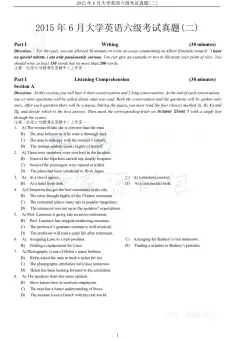
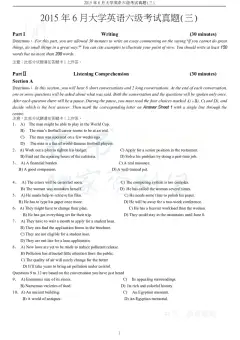
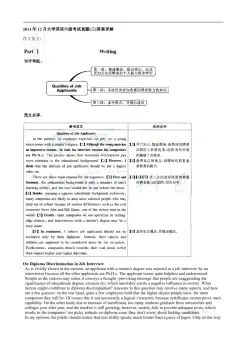
PartⅠ Writing
Directions:Forthispartyouareallowed30minutestowriteanessayonhappinessbyreferringtothesaying“Happiness
isnottheabsenceofproblems,buttheabilitytodealwiththem.”Youcanciteexamplestoillustrateyour
point and then explain how you can develop your ability to deal with problems and be happy. You
shouldwriteatleast150wordsbutnomorethan200words.
Part II Listening Comprehension
Section A
Directions:Inthissection,youwillhear8shortconversationsand2longconversations.Attheendofeachconversation,one
ormorequestionswillbeaskedaboutwhatwassaid.Boththeconversationandthequestionswillbespoken
only once. After each question there will be a pause. During the pause, you must read the four choices
marked A). B), C) and D), and decide which is the best answer. Then mark the corresponding letter on
AnswerSheet1withasinglelinethroughthecentre.
1. A)Therockbandneedsmorehoursofpractice.
B) Therockbandisgoingtoplayhereforamonth.
C) Heappreciatesthewoman’shelpwiththeband.
D) Theirhardworkhasresultedinabigsuccess.
2. A)Traveloverseasonhisown. C)GoonadivingtourinEurope.
B) JoinapackagetourtoMexico. D)Add300dollarstohisbudget.
3.A)Somethingunexpectedhashappened. C)Toavoidmoreworklateron.
B) Incasesomeproblemshouldoccur. D)Tomakebetterpreparations.
4. A)Themanisgoingtorenewhismembershipinafitnesscenter.
B) Thewomanaskedforafreepasstotryoutthefacilities.
C) Themancantryoutthefacilitiesbeforehebecomesamember.
D) Thewomancangivethemanadiscountifhejoinstheclubnow.
5. A)Heisnotfittostudyscience. C)Heisworriedaboutthetest.
B)Heisnotafraidofchallenge. D)Heisgoingtodropthephysicscourse.
6.A)BuysomethingspecialforGary. C)Payforpartofthepicnicfood.
B)InviteGary’sfamilytodinner. D)Takesomefoodtothepicnic.
7.Alabordisputeatabuscompany. C)Acorporatetakeover.
B)Busdrivers’workingconditions. D)Publictransportation.
8.A)Theirsalesoverseas. C)Thecheckjustdeposited.
B)Thebankstatement. D)Thepaymentforanorder.
Questions9to11arebasedontheconversationyouhavejustheard.
9.A)Aprivatesecretary. C)Ashopassistant.
B)Ahotelreceptionist. D)Asalesmanager.
10.A)Appearance. C)Voice.
B)Intelligence. D)Manners.
11.A)Arrangeonemoreinterview. C)OfferthejobtoDavidWallace.2013年12月六级考试真题(第二套)
B)Reportthemattertotheirboss. D)HireBarbaraJonesonatrailbasis.
Questions12to15arebasedontheconversationyouhavejustheard.
12.A)Heinventedtherefrigerator. C)Hewasadmittedtouniversity.
B)Hepatentedhisfirstinvention. D)HegotadegreeinMathematics.
13.A)Hestartedtoworkonrefrigeration.
B)HebecameaprofessorofMathematics.
C)HefellinlovewithNatashaWilloughby.
D)Hedistinguishedhimselfinlowtemperaturephysics.
14.A)Findingthetruenatureofsubatomicparticles.
B)Theirdiscoveryofthelawsofcauseandeffect.
C)Layingthefoundationsofmodemmathematics.
D)Theirworkonveryhighfrequencyradiowaves.
15.A)Tohaveathree-weekholiday. C)Topatenthisinventions.
B)Tospendhisremainingyears. D)Toteachatauniversity.
Section B
Directions:Inthissection,youwillhear3shortpassages.Attheendofeachpassage,youwillhearsomequestions.Boththe
passage and the questions will be spoken only once. After you hear a question, you must choose the best
answerfromthefourchoicesmarkedA),B),C)andD).ThenmarkthecorrespondingletteronAnswerSheet
1withasinglelinethroughthecentre.
PassageOne
Questions16to18arebasedonthepassageyouhavejustheard.
16.A)Theyhavefallenpreytowolves.
B)Theyhavebecomeatouristattraction.
C)Theyhavecausedlotsofdamagetocrops.
D)Theyhavebecomeaheadachetothecommunity.
17.A)Tocelebratetheirvictory. C)Toscarethewolves.
B)Tocheerupthehunters. D)Toalertthedeer.
18.A)Theywouldhelptospreadafataldisease.
B) Theywouldposeathreattothechildren.
C) Theywouldendangerdomesticanimals.
D) Theywouldeventuallykilloffthedeer.
PassageTwo
Questions19to22arebasedonthepassageyouhavejustheard.
19.A) Sheisaninterpreter. C)Sheisadomesticservant.
B) Sheisatouristguide. D) She isfromtheroyalfamily.
20.A)Itwasusedbythefamilytoholddinnerparties.
B) Itissituatedatthefootofabeautifulmountain.
C) Itwasfrequentlyvisitedbyheadsofstate.
D) Itisfurnishedlikeoneinaroyalpalace.
22013年12月六级考试真题(第二套)
21.A) Itiselaboratelydecorated. C)Itisverybig,withonlysixslimlegs.
B)Ithassurvivedsome2,000years. D)ItisshapedlikeanancientSpanishboat.
22.A)Theyareuncomfortabletositinforlong.
B)Theydonotmatchtheovaltableatall.
C)Theyhavelostsomeoftheirlegs.
D)Theyareinterestingtolookat.
PassageThree
Questions23to25arebasedonthepassageyouhavejustheard.
23.A)Itisanuncommoninfectiousdisease.
B)Itdestroysthepatient’sabilitytothink.
C)Itisadiseaseverydifficulttodiagnose.
D)Itisthebiggestcripplerofyoungadults.
24.A)Searchforthebestcure. C)Writeabookaboutherlife.
B)Hurryupandlivelife. D)Exercisemoreandworkharder.
25.A)Aggressive. C)Sophisticated.
B)Adventurous. D)Self-centered.
SectionC
Directions:Inthissection,youwillhearapassagethreetimes.Whenthepassageisreadforthefirsttime,youshouldlisten
carefully for its general idea. When thepassage is read for the second time, you are required to fill in the
blanks with the exact words youhave just heard. Finally, when thepassage is read for thethirdtime, you
shouldcheckwhatyouhavewritten.
It’sdifficulttoestimatethenumberofyoungstersinvolvedinhomeschooling,wherechildrenarenotsent
toschoolandreceivetheirformaleducationfromoneorbothparents. 26 andcourtdecisionshavemadeit
legallypossibleinmoststatesforparentstoeducatetheirchildrenathome,andeachyearmorepeopletake
advantageofthatopportunity.Somestatesrequireparentsorahometutortomeetteachercertificationstandards,
andmanyrequireparentstocompletelegalformstoverifythattheirchildrenarereceiving 27 in
state-approvedcurricula.
Supportersofhomeeducationclaimthatit’slessexpensiveandfarmore 28 thanmasspubliceducation.
Moreover,they cite several advantages: alleviation of school overcrowding, strengthened family relationships,
lower 29 rates,thefactthatstudentsareallowedtolearnattheirownrate,increased 30 ,higherstandardized
testscores,andreduced 31 problems.
Critics of the home schooling movement 32 that it creates as many problems as it solves. They
acknowledge that, in a few cases, home schooling offers educational opportunities superior to those found in
mostpublicschools,butfewparentscanprovidesucheducationaladvantages.Someparentswhowithdrawtheir
children from the schools 33 home schooling have an inadequate educational background and insufficient
formaltrainingtoprovideasatisfactoryeducationfortheirchildren.Typically,parentshavefewertechnological
resources 34 than do schools. However, the relatively inexpensive computer technology that is readily
available today is causing some to challenge the notion that home schooling is in any way 35 more highly
structuredclassroomeducation.
Part III ReadingComprehension
Section A
Directions: Inthissection,thereisapassagewithtenblanks.Youarerequiredtoselectonewordforeachblankfromalist
ofchoicesgiveninawordbankfollowingthepassage.Readthepassagethroughcarefullybeforemaking
yourchoices.Eachchoiceinthebankisidentifiedbyaletter.Pleasemarkthecorrespondingletterforeach
32013年12月六级考试真题(第二套)
itemonAnswerSheet2withasinglelinethroughthecentre.Youmaynotuseanyofthewordsinthebank
morethanonce.
QuestionsJ6to45arebasedonthefollowingpassage.
Cellphonesprovideinstantaccesstopeople.Theyarecreatingamajor 36 inthesocialexperiencesofbothchildren
and adolescents. In one recent U.S. survey, about half the teens polled said that their cell phone had 37 their
communicationswithfriends.Almostallsaidthattheircellphonewasthewaytheystayedintouchwithpeers,one-thirdhad
usedthecellphonetohelpapeerinneed,andabout80%saidthephonemadethemfeelsafer.TeenagersinAustralia, 38 ,
saidthattheirmobilephonesprovidednumerousbenefitsandwerean
39 part oftheir lives; some were so 40 to theirphones thattheresearchersconsidered it an addiction.In Japan,too,
researchersareconcernedaboutcellphoneaddiction.ResearchersinonestudyinTokyofoundthatmorethanhalfofjunior
highschoolstudentsusedtheirphonestoexchangee-mailswithschoolmatesmorethan10timesaday.
Cell phones 41 social connections with peers across time and space. They allow young people to exchange
moment-by-momentexperiencesintheirdailyliveswithspecialpartnersandthustohaveamore 42 senseofconnection
with friends. Cell phones also can 43 social tolerance because they reduce children’s interactions with others who are
different from them. In addition to connecting peers, cell phones connect children and parents. Researchers studying
teenagersinIsraelconcludedthat,inthat 44 environment,mobilephoneswereregardedas“securityobjects”inparent-teen
relationships—importantbecausetheyprovidedthepossibilityof 45 andcommunicationatalltimes.
A)affiliated I)hazardous
B)attached J)improved
C)contact K)instantaneous
D)contend L)intrinsic
E)continuous M)relatively
F)diminish N)shift
G)endurance O)similarly
H)foster
Section B
Directions: In this section, you are going to read a passage with ten statements attached to it. Each statement contains
informationgiveninoneoftheparagraphs.Identify theparagraphfrom whichtheinformationisderived.
Youmaychooseaparagraphmorethanonce.Eachparagraphismarkedwithaletter.Answerthequestions
bymarkingthecorrespondingletteronAnswerSheet2.
WasteNot,WantNot
Feedingthe9Billion:TheTragedyofWaste
[A] By2075, theUnitedNations’ mid-rangeprojectionfor global populationisabout 9.5billion. Thismeans that there
could be an extra three billion mouths to feed by the end of the century, a period in which substantial changes are
anticipated in thewealth, calorie intake and dietary preferences of people in developing countries across theworld.
Suchaprojectionpresentsmankindwithwide-rangingsocial,economic,environmentalandpoliticalissuesthatneedto
beaddressedtodaytoensureasustainablefutureforall.Onekeyissueishowtoproducemorefoodinaworldoffinite
resources.
[B] Today,weproduceaboutfourbillionmetrictonesoffoodperyear.Yetduetopoorpracticesinharvesting,storageand
transportation,aswellasmarketandconsumerwastage,itisestimatedthat30-50%ofallfoodproducedneverreaches
42013年12月六级考试真题(第二套)
ahumanstomach.Furthermore,thisfiguredoesnotreflectthefactthatlargeamountsofland,energy,fertilisersand
water have also been lost in the production of foodstuffs which simply end up as waste. This level of wastage is a
tragedythatcannotcontinueifwearetosucceedinthechallengeofsustainablymeetingourfuturefooddemands.
WhereFoodWasteHappens
[C] In2010,theInstitutionofMechanicalEngineersidentifiedthreeprincipalemergingpopulationgroupsacrosstheworld,
basedoncharacteristicsassociatedwiththeircurrentandprojectedstageofeconomicdevelopment.
• Fully developed, mature, post-industrial societies, such as those in Europe, characterised by stable or declining
populationswhichareincreasinginage.
• Late-stage developingnationsthatarecurrentlyindustrialisingrapidly, for exampleChina, which will experience
decliningratesofpopulationgrowth,coupledwithincreasingaffluence (富裕)andageprofile.
• Newlydevelopingcountriesthatarebeginningtoindustrialise,primarilyinAfrica,withhightoveryhighpopulation
growthrates,andcharacterisedbyapredominantlyyoungageprofile.
[D] Each groupover thecomingdecadeswill needtoaddressdifferent issuessurrounding foodproduction,storageand
transportation,aswellasconsumerexpectations,ifwearetocontinuetofeedallourpeople.
[E] Inless-developedcountries,suchasthoseofsub-SaharanAfricaandSouth-EastAsia,wastagetendstooccurprimarily
at the farmer-producer end of the supply chain. Inefficient harvesting, inadequate local transportation and poor
infrastructure(基础设施)meanthatproduceisfrequentlyhandledinappropriatelyandstoredunderunsuitablefarm
siteconditions.
[F] Inmature,fullydevelopedcountriessuchastheUK,more-efficientfanningpracticesandbettertransport,storageand
processing facilities ensurethat a larger proportion of thefood produced reaches markets and consumers. However,
characteristics associated with modem consumer culture mean produce is often wasted through retail and customer
behaviour.
[G] Major supermarkets, in meeting consumer expectations, will often reject entire crops of perfectly edible fruit and
vegetablesatthefarmbecausetheydonotmeetexactingmarketingstandardsfortheirphysicalcharacteristics,suchas
sizeandappearance.
[H] Oftheproducethatdoesappearinthesupermarket,commonlyusedsalespromotionsfrequentlyencouragecustomers
topurchaseexcessivequantitieswhich,inthecaseofperishablefoodstuffs,inevitablygeneratewastageinthehome.
Overallbetween30%and50%ofwhathasbeenboughtindevelopedcountriesisthrownawaybythepurchaser.
BetterUseofOurFiniteResources
[I] Wastingfoodmeans losingnot onlylife-supportingnutritionbut alsoprecious resources,including land,water and
energy. As a global society, therefore, tackling food waste will helpcontribute towards addressinga number ofkey
resourceissues.
[J] LandUsage: Over thelastfivedecades,improvedfarmingtechniquesandtechnologieshavehelpedtosignificantly
increase crop yields along with a 12% expansion of. farmed land use. However, a further increase in farming area
withoutimpactingunfavourablyonwhatremainsoftheworldsnaturalecosystemsappearsunlikely.Thechallengeis
thatanincreaseinanimal-basedproductionwillrequiremoreland,andresources,aslivestock(牲畜)farmingdemands
extensivelanduse.
[K] WaterUsage:Overthepastcentury,humanuseoffreshwaterhasincreasedatmorethandoubletherateofpopulation
growth.Currentlyabout3.8trillionm3of water isusedbyhumansperyear.About70%ofthisisconsumedbythe
globalagriculturesector,andthelevelofusewillcontinuetoriseoverthecomingdecades.
[L] Better irrigationcan dramatically improve cropyield andabout 40%of theworldsfood supplyiscurrentlyderived
from irrigated land. However, water used in irrigation is often sourced unsustainably. In processing foods after the
52013年12月六级考试真题(第二套)
agriculturalstage,therearelargeadditionalusesofwaterthatneedtobetackledinaworldofgrowingdemand.Thisis
particularlycrucialinthecaseofmeatproduction,wherebeefusesabout50timesmorewaterthanvegetables.Inthe
future, more effective washing techniques, management procedures, and recycling and purification of water will be
neededtoreducewastage.
[M] Energy Usage: Energy is an essential resource across the entire food production cycle, with estimates showing an
average of 7-10 calories of input being required in the production of one calorie of food. This varies dramatically
dependingoncrop,fromthreecaloriesforplantcropsto35caloriesintheproductionofbeef.Sincemuchofthisenergy
comesfromtheutilisationoffossilfuels,wastageoffoodpotentiallycontributestounnecessaryglobalwarmingaswell
asinefficientresourceutilisation.
[N]Inthemodernindustrialisedagriculturalprocess—whichdevelopingnationsaremovingtowardsinordertoincrease
futureyields—energyusageinthemakingandapplicationoffertilisersandpesticidesrepresentsthesinglebiggest
component. Wheat production takes 50% of its energy input for these two items alone. Indeed, on a global scale,
fertilisermanufacturingconsumesabout3-5%oftheworld’sannualnaturalgassupply.Withproductionanticipatedto
increaseby25%betweennowand2030,sustainableenergysourcingwillbecomeanincreasinglymajorissue.Energy
to power machinery, both on the farm and in the storage and processing facilities, adds to the energy total, which
currentlyrepresentsabout3.1%ofannualglobalenergyconsumption.
Recommendations
[O]Risingpopulationcombinedwithimprovednutritionstandardsandshiftingdietarypreferenceswillexertpressurefor
increasesinglobalfoodsupply.Engineers,scientistsandagriculturalistshavetheknowledge,toolsandsystemsthat
will assist in achieving productivity increases. However, pressure will grow on finite resources of land, energy and
water.Thepotentialtoprovide60-100%morefoodbysimplyeliminatinglosses,whilesimultaneouslyfreeingupland,
energyandwaterresourcesforotheruses,isanopportunitythatshouldnotbeignored.Inordertobegintacklingthe
challenge,theInstitutionrecommendsthat:
• The UN Food and Agriculture Organisation work with the international engineering community to ensure
governmentsofdevelopednationsputinplaceprogrammesthattransferengineeringknowledge,designknow-how,
andsuitabletechnologytonewlydevelopingcountries.Thiswillhelpimproveproducehandlingintheharvest,and
immediatepost-harveststagesoffoodproduction.
• Governments of rapidly developing countries incorporate waste minimisation thinking into the transport
infrastructureandstoragefacilitiescurrentlybeingplanned,engineeredandbuilt.
• Governmentsindevelopednationsdeviseandimplementpolicythatchangesconsumerexpectations.Theseshould
discourageretailersfromwastefulpracticesthatleadtotherejectionoffoodonthebasisofcosmeticcharacteristics,
andlossesinthehomeduetoexcessivepurchasingbyconsumers.
46. Eliminationofwastealonecanpotentiallyprovideoversixtypercentmorefoodforthegrowingworldpopulation.
47. The production andapplication of fertilisers and pesticides account for the largest part of energy use inthe modem
industrialisedagriculturalprocess.
48. Consumersindevelopedcountriesthrowawaynearlyhalfoftheirfoodpurchasesbecausetheytendtobuyinexcessive
quantities.
49. It is recommended that engineering knowledge and suitable technology in developed countries be introduced to
developingcountriestoimproveproducehandlingintheharvest.
50. Thepredictedglobalpopulationgrowthmeansthatwayshavetobefoundtoproducemorefoodwithfiniteresources.
62013年12月六级考试真题(第二套)
51. Afurtherexpansionoffarmingareawilladverselyimpactontheworldsnaturalecosystems.
52. Perfectlyeatablefruitandvegetablecropsoftenfailtoreachsupermarketsduetotheirsizeorphysicalappearance.
53. Poorpracticesinharvesting,storageandtransportationhaveresultedinawasteofmuchofthefoodweproduceand
thusawasteoflandandresources.
54. Foodwasteinless-developedcountrieshappensmainlyattheproducers’end.
55. Beefconsumesfarmorewatertoproducethanvegetables.
SectionC
Directions:Thereare2passagesinthissection.Eachpassageisfollowedbysomequestionsorunfinishedstatements.For
eachofthemtherearefourchoicesmarkedA),B),C)andD).Youshoulddecideonthebestchoiceandmark
thecorrespondingletteronAnswerSheet2withasinglelinethroughthecentre.
PassageOne
Questions56to60arebasedonthefollowingpassage.
Callitthe“learningparadox”:themoreyoustruggleandevenfailwhileyou’retryingtolearnnewinformation,the
betteryou’relikelytorecallandapplythatinformationlater.
Thelearningparadoxisattheheartof“productivefailure,”aphenomenonidentifiedbyresearcherManuKapur.Kapur
pointsoutthatwhilethemodeladoptedbymanyteacherswhenintroducingstudentstonewknowledge—providinglotsof
structureandguidanceearlyon,untilthestudentsshowthattheycandoitontheirown—makesintuitivesense,itmaynot
bethebestwaytopromotelearning.Rather,it5sbettertoletthelearnerswrestle(较劲)withthematerialontheirownfor
awhile,refrainingfromgivingthemanyassistanceatthestart.Inapaperpublishedrecently,Kapurappliedtheprincipleof
productivefailuretomathematicalproblemsolvinginthreeschools.
Withonegroupofstudents,theteacherprovidedstrong“scaffolding”—instructionalsupport一 andfeedback.
Withtheteacher’shelp,thesepupilswereabletofindtheanswerstotheirsetofproblems.Meanwhile,asecondgroupwas
directed to solve thesame problems by collaboratingwith one another, without any promptsfrom their instructor. These
studentsweren’tabletocompletetheproblemscorrectly.Butinthecourseoftryingtodoso,theygeneratedalotofideas
aboutthenatureoftheproblemsandaboutwhatpotentialsolutionswouldlooklike.Andwhenthetwogroupsweretestedon
whatthey’dlearned,thesecondgroup“significantlyoutperformed”thefirst.
Theapparentstrugglesofthefloundering(挣扎的)grouphavewhatKapurcallsa“hiddenefficacy”:theyleadpeople
to understand the deep structure of problems, not simply their correct solutions. When these students encounter a new
problemofthesametypeonatest,they’reabletotransfertheknowledgethey’regatheredmoreeffectivelythanthosewho
werethepassiverecipientsofsomeoneelse’sexpertise.
Intherealworld,problemsrarelycomeneatlypackaged,sobeingabletodiscerntheirdeepstructureiskey.But,Kapur
notes,noneofusliketofail,nomatterhowoftenSiliconValleyentrepreneurspraisethebeneficialeffectsofanideathatfails
orastart-upcompanythatcrashesandbums.Soweneedto“designforproductivefailure”bybuildingitintothelearning
process.Kapurhasidentifiedthreeconditionsthatpromotethiskindofbeneficialstruggle.First,chooseproblemstoworkon
that“challengebutdonotfrustrate.”Second,providelearnerswithopportunitiestoexplainandelaborateonwhatthey’re
doing.Third,givelearnersthechancetocompareandcontrastgoodandbadsolutionstotheproblems.Andtothosestudents
whoprotestthistough-loveteachingstyle:you’llthankmelater.
56. Whydoestheauthorcallthelearningprocessaparadox?
A) Painsdonotnecessarilyleadtogains.
B) Whatislearnedisrarelyapplicableinlife.
C) Failuremoreoftenthannotbreedssuccess.
72013年12月六级考试真题(第二套)
D) Themoreistaught,thelessislearnt.
82013年12月六级考试真题(第二套)
57. WhatdoesKapurdisapproveofinteaching?
A) Askingstudentstofindandsolveproblemsontheirown.
B) Developingstudents’abilitytoapplywhattheylearn.
C) Givingstudentsdetailedguidanceandinstruction.
D) Allowingstudentsafreehandinproblemsolving.
58. Whatdopeopletendtothinkofprovidingstrong“scaffolding”inteaching?
A) Itwillmaketeachingeasier.
B) Itisasensiblewayofteaching.
C) Itcanmotivateaveragestudents.
D) Itwillenhancestudents’confidence.
59. WhatkindofproblemshouldbegiventostudentstosolveaccordingtoKapur?
A) Itshouldbeabletoencouragecollaborativelearning.
B) Itshouldbeeasyenoughsoasnottofrustratestudents.
C) Itshouldbesolvablebyaveragestudentswithease.
D) Itshouldbedifficultenoughbutstillwithintheirreach.
60. Whatcanbeexpectedof“thistough-loveteachingstyle”(Lines8-9,Para.5)?
A) Studentswillbegratefulinthelongrun.
B) Teacherswillmeetwithalotofresistance.
C) Parentswillthinkittooharshontheirkids.
D) Itmaynotbeabletoyieldthedesiredresults.
PassageTwo
Questions61to65arebasedonthefollowingpassage.
VernonBowman,a75-year-oldfarmerfromruralIndiana,didsomethingthatgothimsued.Heplantedsoybeans(大
豆)soldascattlefeed.ButMonsanto,theagriculturalgiant,insistsithasapatentonthekindofgeneticallymodifiedseeds
Bowmanused—andthatthepatentcontinuestoalloftheprogeny(后代)ofthoseseeds.
Havewereallygottentothepointthatplantingaseedcanleadtoahigh-stakesSupremeCourtpatentlawsuit?We
have, and that case is Bowman vs. Monsanto, which is being argued on Tuesday. Monsanto’s critics have attacked the
companyforits“mercilesslegalbattlesagainstsmallfarmers,”andtheyarehopingthiswillbethecasethatputsitinits
place. Theyarealsohopingthecourt’srulingwill reininpatentlaw,whichisincreasinglybeingusedtoclaimnewlife
formsasprivateproperty.
Monsanto and its supporters, not surprisingly, see the case very differently. They argue that when a company like
Monsantogoestogreatexpensetocreateavaluablenewgeneticallymodifiedseed,itmustbeabletoprotectitsproperty
interests.IffarmerslikeBowmanareabletousetheseseedswithoutpayingthedesignatedfee,itwillremovetheincentives
forcompanieslikeMonsantotoinnovate.
MonsantoaccusedBowmanofpatentinfringementandwonan$84,456damageaward.Ratherthanpayuporwork
outasettlement,Bowmandecidedtoappeal—allthewaytotheSupremeCourt.Hesaid“Monsantoshouldnotbeable,just
because they’ve got billions of dollars to spend on legal fees, to try to terrify farmers into obeying their agreements by
massiveforceandthreats.”
Thecentralissueinthecaseiswhetherpatentrightstolivingthingsextendtotheprogenyofthosethings.Monsanto
arguesthatitspatentsextendtolatergenerations.ButBowman’ssupportersarguethatMonsantoistryingtoexpandthe
scopeofpatentsinwaysthatwouldenrichbigcorporationsandhurtsmall farmers.TheysaythatifMonsantowins,the2013年12月六级考试真题(第二套)
impactwillextendfarbeyondagriculture—lockinguppropertyrightsinanarrayofimportantareas.KnowledgeEcology
InternationalcontendsthattheSupremeCourt’srulingcouldhave“profoundeffects”onotherbiotechindustries.
IfthiswereaHollywoodmovie,thecourageousoldIndianafarmerwouldbeattheprofit-mindedcorporationbefore
thecreditsrolled.Butthisisareal-lifeargumentbeforeaSupremeCourtthathasawell-earnedreputationforlookingout
fortheinterestsoflargecorporations.Thiscasegivesthecourtanopportunitytoreininthegrowinguseofpatentstoprotect
genetically engineered crops and other life forms — but the court may well use it to give this trend a powerful new
endorsement.
61. WhydidVernonBowmangetsued?
A) Heusedgeneticallymodifiedseedstofeedhiscattle.
B) Heplantedsoybeanswithoutpayingforthepatent.
C) HemadeaprofitoutofMonsanto’scommercialsecrets.
D) HeobtainedMonsanto’spatentedseedsbyillegalmeans.
62. WhatareMonsanto’scriticshopingtheSupremeCourtwilldo?
A) Allowsmallfarmerstogrowgeneticallymodifiedsoybeans.
B) PunishMonsantoforinfringingonsmallfarmer’sinterests.
C) RuleagainstMonsanto’sexcessiveextensionofitspatentrights.
D) Abolishthepatentlawconcerninggeneticallyengineeredseeds.
63. WhatistheargumentofMonsantoanditssupporters?
A) Patentrightsshouldbeprotectedtoencourageinnovation.
B) BowmancannotplanttheseedswithoutMonsanto’sconsent.
C) Monsantohastherighttorecoverthecostsofitspatentedseeds.
D) Patentlawongeneticallymodifiedseedsshouldnotbechallenged.
64. WhatisthekeyissueintheBowmanvs.Monsantocase?
A) Whetherpatentforseedsisharmfultoagriculturalproduction.
B) Whetherthebiotechindustryshouldtakepriorityoveragriculture.
C) Whethermeasuresshouldbeintroducedtoprotectsmallfarmers.
D) Whetherpatentforlivingthingsappliestotheirgenerations.
65. Whatdowelearnfromthelastparagraph?
A) Hollywoodmoviesusuallyhaveanunexpected,dramaticimpactonreal-lifearguments.
B) TheSupremeCourtwilltrytochangeitsreputationforsupportinglargecorporations.
C) TheSupremeCourtislikelytopersuadethepartiesconcernedtoworkoutasettlement.
D) TherulingwouldbeinBowman’sfavorifthecasewerearguedinaHollywoodmovie.
Part Ⅳ Translation
Directions:Forthispart,youareallowed30minutestotranslateapassagefromChineseintoEnglish.Youshouldwrite
youransweronAnswerSheet2.
中国园林(the Chinesegarden )是经过三千多年演变而成的独具一格的园林景观 (landscape ) 。它既包括
为皇室成员享乐而建造的大型花园,也包括学者、商人和卸任的政府官员为摆脱嘈杂的外部世界而建造的私家花
园。这些花园构成了一种意在表达人与自然之间应有的和谐关系的微缩景观。典型的中国园林四周有围墙,园内
有池塘、假山(rockwork)、树木、花草以及各种各样由蜿蜒的小路和走廊连接的建筑。漫步在花园中,人们可以
看到一系列精心设计的景观犹如山水画卷(scroll) 一般展现在面前。