2012 年 12 月大学英语四级真题(2)
PartⅠ Writing (30 minutes)
注意:此部分试题在答题卡1上,请在答题卡1上作答。
Direction: Forthis part,youareallowed30minutestowriteacompositionentitledEducation
Pays based on the statistics provided in the chart below (Weekly earnings of 2010).
Pleasewriteat least 120words butnomorethan 180words.
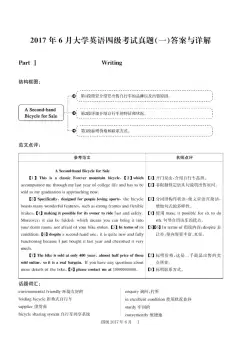
Education:AWorthyInvestment
Weeklyearningsin2010($)
Doctoraldegree 1,550
Master’sdegree 1,272
Bachelor’sdegree 1,038
Somecollege,nodegree 712
Highschooldiploma 626
Lessthanhighschooldegree 444
Source:U.S.BureauofLaborStatistics
EducationPays
Part Ⅱ Reading Comprehension (Skimming and Scanning) (15 minutes)
Directions:
Inthispart,youwillhave15minutestogooverthepassagequicklyandanswerthe
questions on Answer sheet 1. For questions 1-7, choose the best answer from the four
choices marked A), B), C) and D). For questions 8-10, complete the sentences with the
informationgiveninthepassage.
TheMagician
TherevolutionthatSteveJobsledisonlyjustbeginning
When it came to putting on a show, nobody else in the computer industry, or any other
industry for that matter, could match Steve Jobs. His product launches, at which he would stand
aloneonablackstage andproduceasif bymagic an“incredible”newelectronicgadget(小器具)
in front of an amazed crowd, were the performances of a master showman. All computers do is
fetch and work with numbers, he once explained, but do it fast enough and “the results appear to
1be magic”. Mr Jobs, who died recently aged 56, spenthis life packaging thatmagic into elegantly
designed,easy-to-useproducts.
The reaction to his death, with people leaving candles and flowers outsideApple stores and
politicianssingingpraisesontheinternet,isproofthatMrJobshadbecomesomethingmuchmore
significant than just a clever money-maker. He stood out in three ways-as a technologist, as a
corporate (公司的) leader and as somebody who was able to make people love what had
previously been impersonal, functional gadgets. Strangely, it is this last quality that may have the
deepest effect on the way people live. The era of personal technology is in many ways just
beginning.
As a technologist, Mr Jobs was different because he was not an engineer-and that was his
great strength. Instead he was keenly interested in product design and aesthetics (美学), and in
making advanced technology simple to use. He repeatedly took an existing but half-formed
idea-themouse-drivencomputer,thedigitalmusic player,thesmartphone,thetabletcomputer(平
板电脑) — andshowedtherestoftheindustryhowtodoitproperly.Rivalfirms competedwith
each other to follow where he led. In the process he brought about great changes in computing,
music, telecoms and the news business that were painful for existing firms but welcomed by
millionsofconsumers.
Within the wider business world, a man who liked to see himself as a hippy (嬉皮士),
permanently in revolt against big companies, ended up being hailed by many of those corporate
giants as one of the greatest chief executives of his time. That was partly due to his talents:
showmanship, strategic vision, an astonishing attention to detail and a dictatorial management
style whichmany bossesmust have envied. Butmostof allitwas theextraordinarytrajectory (轨
迹)of his life. His fall from grace in the 1980s, followed by his return to Apple in 1996 after a
period in the wilderness, is an inspiration to any businessperson whose career has taken a turn for
theworse.ThewayinwhichMrJobsrevivedthefailingcompanyhehadco-foundedandturnedit
into the world’s biggest tech firm (bigger even than Bill Gates’s Microsoft, the company that had
outsmartedApplesodramaticallyinthe1980s),soundslikesomethingfromaHollywoodmovie.
ButwhatwasperhapsmostastonishingaboutMr Jobswasthe absolute loyaltyhe managed
to inspire in customers. Many Apple users feel themselves to be part of a community, with Mr
Jobsas its leader.Andthere was indeeda personallink.Apple’s products were designed to accord
with theboss’stastes andtomeethisextremelyhigh standards.EveryiPhone orMacBookhas his
fingerprints all over it. His great achievement was to combine an emotional spark with computer
technology, and make the resulting product feel personal. And that is what put Mr Jobs on the
right side of history,as technologicalinnovation (创新)has moved into consumer electronics over
thepastdecade.
Asourspecialreportinthisissue(printedbeforeMr Jobs’sdeath)explains,innovationused
to spill over from military and corporate laboratories to the consumer market, but lately this
process has gone into reverse. Many people’s homes now have more powerful, and more flexible,
devices than their offices do; consumer gadgets and online services are smarter and easier to use
than most companies’ systems. Familiar consumer products are being adopted by businesses,
government and the armed forces. Companies are employing in-house versions of Facebook and
creatingtheir own“appstores”to deliver software to employees. Doctors usetabletcomputers for
their work in hospitals. Meanwhile, the number of consumers hungry for such gadgets continues
to swell. Apple’s products are now being snapped up in Delhi and Dalian just as in Dublin and
2Dallas.
Mr Jobs had a reputation as a control freak (怪人), and his critics complained that the
products and systems he designed were closed and inflexible, in the name of greater ease of use.
Yet he also empowered millions of people by giving them access to cutting-edge technology. His
insistence on putting users first, and focusingon elegance and simplicity,hasbecome deep-rooted
inhis owncompany,andisspreadingtorivalfirms too.Itisno longerjustatApplethatdesigners
ask:“WhatwouldSteveJobsdo?”
The gap between Apple and other tech firms is now likely to narrow. This week’s
announcementofanewiPhonebyamanagementteamledbyTimCook,whoreplacedMrJobsas
chief executive inAugust, was generally regarded as competent but uninspiring. Without Mr Jobs
to shower his star dust on the event, it felt like just another product launch from just another
technology firm. At the recent unveiling of a tablet computer by Jeff Bezos of Amazon, whose
companyisdoingthebestjoboffollowingApple’s leadincombininghardware,software,content
andservicesinaneasy-to-usebundle,therewereseveralattacks atApple.Butbydoinghisbestto
imitateMrJobs,MrBezosalsoflattered(抬举)him.WithMrJobsgone,Appleisjustoneofmany
technologyfirmstryingtoarousehisuncontrollablespiritinnewproducts.
Mr Jobs was said by an engineer in the early years ofApple to emit a “reality distortion (扭
曲)field”, such were his powers of persuasion. But in the end he created a reality of his own,
channeling the magic of computing into products that reshaped entire industries. The man who
saidinhisyouththathewantedto“putadingintheuniverse”didjustthat.
注意: 此部分试题请在答题卡1上作答。
1.WelearnfromthefirstparagraphthatnobodycouldmatchSteveJobsin .
[A]intelligence [B]showmanship [C]magicpower [D]persuasionskills
2.WhatdidSteveJobsdothatmostdeeplyaffectedpeople’swayoflife?
[A]Heinventedlotsoffunctionalgadgets.
[B]Hekeptimprovingcomputertechnology.
[C]Hestartedtheeraofpersonaltechnology.
[D]Heestablishedanewstyleofleadership.
3.WheredidMrJobs’sgreatstrengthlie?
[A]Hisprofoundinsightaboutconsumers’needsingeneral.
[B]Hiskeeninterestindesigningelegantanduser-friendlygadgets.
[C]Hisfirmdeterminationtowininthecompetitionagainsthisrivals.
[D]Hisrichknowledgeasacomputerscientistandelectronicengineer.
4.ManycorporategiantssawSteveJobsas .
[A]oneofthegreatestchiefexecutivesofhistime
[B]adictatorinthecontemporarybusinessworld
[C]anunbeatablerivalinthecomputerindustry
[D]themostadmirablehippyintoday’sworld
35.Forthosewhohavesufferedfailuresinbusiness,SteveJobs’slifeexperienceservesas.
[A]asymbol [B]astandard [C]anideal [D]aninspiration
6.WhatwasthemostastonishingpartofMrJobs’ssuccess?
[A]Heturnedafailingcompanyintoaprofitablebusiness.
[B]Hesetuppersonallinkswithmanyofhiscustomers.
[C]HecommandedabsoluteloyaltyfromAppleusers.
[D]HelefthisfingerprintsalloverAppleproducts.
7.Whatismentionedinthisissue’sspecialreportaboutinnovationnowadays?
[A]Itbenefitsciviliansmorethanthemilitary.
[B]Newproductsarefirstusedinthemilitary.
[C]Manynewideasfirstappearontheinternet.
[D]Itoriginatesintheconsumermarket.
8.Inspiteoftheuser-friendlinessofAppleproducts,criticscomplainedthattheywere
.
9.Amazon,byhavinghardware,software,contentandservices
inaneasy-to-usebundle,didthebestjobinfollowingApple’slead.
10.Bychannellingthemagicofcomputingintoproducts,SteveJobshadsucceededin
.
Part Ⅲ ListeningComprehension (35 minutes)
SectionA
Directions: In this section, you will hear 8 short conversations and2 long conversations.At the
end of each conversation, one or more questions will be asked about what was said. Both the
conversation and the question will be spoken only once. After each question there will be a
pause. During the pause, you must read the four choices markedA),B),C) and D), and decide
which is the best answer. Then mark the corresponding letter on Answer Sheet 2 with a
singlelinethroughthecenter.
注意:此部分试题请在答题卡2上作答。
11.[A]Heneedsanotherweekforthepainting. [B]Thepaintingwascompletedjustintime.
[C]Thebuildingwon’topenuntilnextweek. [D]Hisartisticworkhasbeenwellreceived.
12.[A]Gocamping. [B]Rentatent.
[C]Decoratehishouse. [D]organizeaparty.
13.[A]ShetalkedwithMr.Wrightonthephone. [B]SheisabouttocallMr.Wright’ssecretary.
[C]ShewillseeMr.Wrightatlunchtime. [D]ShefailedtoreachMr.Wright.
14.[A]Heisactuallyveryhardworking. [B]Hehasdifficultyfinishinghisproject.
4[C]Heneedstospendmoretimeinthelab. [D]Heseldomtellsthetruthabouthimself.
15.[A]Rulesrestrictingsmoking. [B]Waystoquitsmoking.
[C]Smokers’healthproblems. [D]Hazardsofpassivesmoking.
16.[A]Heisoutoftownallmorning. [B]Heistiedupinfamilymatters.
[C]Hehasbeenwritingareport. [D]Hehasgotmeetingstoattend.
17.[A]Heisnoteasy-going. [B]Heisthespeakers’boss.
[C]Heisnotathomethisweekend. [D]Heseldominvitespeopletohishome.
18.[A]Takeabreak. [B]Refuelhiscar.
[C]Asktheway. [D]Haveacupofcoffee.
Questions19to 21arebased on thepassageyou havejustheard.
19.[A]Theyareasgoodashistoricalfilms. [B]Theygiveyoungstersathrill.
[C]Theyhavegreatlyimproved. [D]Theyarebetterthancomicsonfilm.
20.[A]Theeffectswereverygood. [B]Theactingwasjustso-so.
[C]Theplotwastoocomplicated. [D]Thecharacterswerelifelike.
21.[A]Theytriumphedultimatelyoverevilinthebattle.
[B]TheyplayedthesameroleinWaroftheWorlds.
[C]Theyarepopularfiguresamongyoungpeople.
[D]Theyaretwoleadingcharactersinthefilm.
Questions22to 25arebased on thepassageyou havejustheard.
22.[A]ItisscheduledonThursdaynight. [B]Itissupposedtolastnineweeks.
[C]Ittakesplaceonceaweek. [D]Itusuallystartsatsix.
23.[A]Tomakegooduseofhersparetimeintheevening.
[B]Tomeettherequirementsofherin-servicetraining.
[C]Toimproveherdrivingskillsasquicklyaspossible.
[D]Togetsomebasicknowledgeaboutcarmaintenance.
24.[A]Participateingroupdiscussions. [B]Taketurnstomakepresentations.
[C]Listentotheteacher’sexplanation. [D]Answertheteacher’squestions.
25.[A]Mostofthemarefemale. [B]Somehaveapart-timejob.
[C]Theyplantobuyanewcar. [D]Afewofthemareoldchaps.
Section B
Direction: In this section, you will hear 3 short passages. At the end of each passage, you will
5hear some questions. Both the passage and the questions will be spoken only once. After you
hearaquestion,youmustchoosethebestanswerfromthefourchoicesmarkedA),B), C)and
D). Then mark the corresponding letter on the Answer Sheet with a single line through the
center.
注意:此部分试题请在答题卡2上作答。
PassageOne
Questions26to 29arebased on thepassageyou havejustheard.
26.[A]Sheisnotgoodatmakingfriends. [B]Sheisnotwelloff.
[C]Sheenjoyscompany. [D]Shelikestogotoconcertsalone.
27.[A]Theirsimilarsocialstatus. [B]Theirinterdependence.
[C]Theircommoninterest. [D]Theiridenticalcharacter.
28.[A]InvitePattoaliveconcert. [B]BuysomegiftsforPat’skids.
[C]HelptakecareofPat’skids. [D]PayforPat’sseasontickets.
29.[A]Itcandevelopbetweenpeoplewithabigdifferentinincome.
[B]Itcanbemaintainedamongpeopleofdifferentagegroups.
[C]Itcannotlastlongwithoutsimilarfamilybackground.
[D]Itcannotbesustainedwhenfriendsmovefarapart.
PassageTwo
Questions30o32arebased on thepassageyou havejust heard.
30.[A]Priorityofstudents’academicachievements.
[B]Equaleducationopportunitiestoallchildren.
[C]Socialequalitybetweenteachersandstudents.
[D]Respectforstudents’individuality.
31.[A]Efficient. [B]Complicated.
[C]Lengthy. [D]Democratic.
32.[A]Tohelpthemacquirehands-onexperience.
[B]Totrytocutdownitsoperationalexpenses.
[C]Toprovidepart-timejobsforneedystudents.
[D]Toenablethemtolearntotakeresponsibility.
PassageThree
Questions33to 35arebased on thepassageyou havejustheard.
33.[A]Thebestwaytoworkthroughafingermaze.
[B]Individualdoingbetterinfrontofanaudience.
6[C]Researchershavingcontributedgreatlytopsychology.
[D]Improvementsontheclassificationofhumanbehavior.
34.[A]Whenyoufeelencouragedbytheaudience.
[B]Whenyoutrytofigureoutaconfusinggame.
[C]Whenyoualreadyknowhowtodosomething.
[D]Whenyoucompetewithotherpeopleinagroup.
35.[A]Practicingconstantly. [B]Workingbyoneself.
[B]Learningbydoing. [D]Usingprovenmethods.
Section C
Directions:Inthissection,youwillhearapassagethreetimes.Whenthepassageisreadforthe
first time, you should listen carefully for its general idea. When the passage is read for the
second time, you are required to fill in the blanks numbered from 36 to 43 with the exact
words you have just heard. For blanks numbered from 44 to 46 you are required to fill in the
missing information. For these blank, you can either use the exact words you have just heard
or write down the main points in your own words. Finally, when the passage is read for the
thirdtime,youshouldcheckwhatyouhavewritten.
注意:此部分试题在答题卡2上作答。
Americantodayhavedifferenteatinghabitsthantheyhadinthepast.Thereisawide(36)
of food available. They have a broader (37) of nutrition (营养), so they buy
morefreshfruitand(38) thaneverbefore.Atthesametime,Americans(39)
increasingquantitiesofsweetsandsodas.
Statistics showthatthe way people live (40) the way theyeat.American lifestyles
have changed. There are now growing numbers of people who live alone, (41) parents
and children, and double-income families. These changing lifestyles are (42) for the
increasingnumberofpeoplewhomust(43) mealsorsometimessimplygowithoutthem.
ManyAmericanshavelesstimethaneverbeforetospendpreparingfood.(44)
. Moreover, Americans eat out nearly four
timesaweekonaverage.
Itiseasytostudytheamountsandkindsoffoodthatpeopleconsume.(45)
. This
information not only tells us what people eating, but also tells us about the changes in attitudes
andtastes.(46)
. Instead, chicken, turkey andfish have become more popular.Sales of
thesefoodshavegreatlyincreasedinrecentyears.
PartⅣ Reading Comprehension(Reading inDepth) (25 minutes)
SectionA
Direction: Inthis section,thereis apassagewith 10blanks.Youarerequiredtoselectoneword
for each blank from a list of choices given in a word blank following the passage. Read the
passage through carefully before making your choices. Each choice in the blank is identified
7by a letter. Please make the corresponding letter for each item on Answer sheet 2 with a
single line through the center. You may not use any of the words in the bank more
UU
thanonce.
Questions47to 56arebased on thefollowing passage.
French fries, washed down with a pint of soda, are a favorite part of fast-food lunches and
dinnersformillionsofAmericanyoungsters.But 47 acuefromhealthexperts,agroupof19
UU UU
restaurant companies are pledging to offer more-healthful menu options for children at a time
when 48 isgrowingovertheroleoffastfoodinchildhoodobesity(肥胖症).
UU UU
BurgerKing, thenation’ssecond-largestfastfoodchain,forinstance,will 49 automatically
UU UU
including French fries and soda in its kids’meals starting this month, although they will still be
UU
50 . Instead, the company said Tuesday, its employees will ask parents whether they 51
UU UU UU
suchoptionsasmilk orsliced applesbeforeassemblingthemeals. “We’reasking thecustomers to
52 what they want,” said Craig Prusher, the chain’s vice president of government relations.
UU UU
Otherparticipatingchains,witha 53 ofmenuoptions,includingDenny’s,Chili’s,Friendly’s
UU UU
andChevy’s.
As partofthe Kids LiveWellcampaign-expected to beannounced 54 Wednesday —
UU UU
participating restaurantsmustpromise to offeratleastonechildren’s mealthathasfewer than 600
calories(卡路里), nosoftdrinks andatleasttwo 55 fromthe followingfoodgroups:fruits,
UU UU
vegetables, whole grains, lean proteins or low-fat dairy. Among other requirements, they must
offera sidedish thatmeets similar 56 ;with fewerthan200caloriesandless than35%ofits
UU UU
caloriesfromsugar.
注意:此部分试题请在答题卡2上作答。
A)adapt I)prefer
B)available J)recommending
C)begin K)species
D)concern L)specify
E)criteria M)stop
F)items N)taking
G)nationwide O)variety
H)possible
Section B
Directions: Thereare2passagesin this section.Eachpassageis followed bysome questionsor
unfinished statements. For each of them there are four choices marked A),B),C) and D).You
shoulddecideonthe bestchoiceandmarkthe correspondingletter onAnswer sheet 2with
asinglelinethroughthecenter.
PassageOne
Questions 57to 61arebased onthe followingpassage.
8As you are probably aware, the latest job markets news isn’t good: Unemployment is still
more than 9 percent, and new job growth has fallen close to zero. That’s bad for the economy, of
course.And it may be especially discouraging if you happen to be looking for a job or hoping to
changecareersrightnow.Butitactuallyshouldn’tmattertoyounearlyasmuchasyouthink.
That’s because job growth numbers don’t matter to job hunters as much as job turnover
(人员更替) data. After all, existing jobs open up every day due to promotions, resignations,
terminations(解雇),andretirements.(Yes,peopleareretiringeveninthiseconomy.)Inbothgood
times andbad, turnover creates more openings than economic growth does.Even in Juneof 2007,
when the economy was still moving ahead, job growth was only 132,000, while turnover was 4.7
million!
Andasitturnsout,eventoday — withjobgrowthnearzero — over4millionjobhunters
arebeinghiredeverymonth.
Idon’tmeantoimplythatoveralljobgrowthdoesn’thaveanimpactonone’sabilitytoland
a job. It’s true that if total employment were higher, it would mean more jobs for all of us to
choose from (and compete for). And it’s true that there are currently more people applying for
eachavailablejobopening,regardlessofwhetherit’sanewoneornot.
But what often distinguishes those who land jobs from those who don’t is their ability to
staymotivated.They’re willingtodothehardworkofidentifyingtheirvaluableskills;becreative
about where and how to look; learn how to present themselves to potential employers; and keep
going, even after repeated rejections. The Bureau of Labor Statistics data shows that 2.7 million
peoplewhowantedandwereavailableforworkhadn’tlookedwithinthelastfourweeksandwere
nolongerevenclassifiedasunemployed.
So don’t let the headlines fool you into giving up. Four million people get hired every
monthintheU.S.Youcanbeoneofthem.
注意:此部分试题请在答题卡2上作答。
57.Theauthortendstobelievethathighunemploymentrate .
[A]deprivesmanypeopleofjobopportunities
[B]preventsmanypeoplefromchangingcareers
[C]shouldnotstoppeoplefromlookingforajob
[D]doesnotmeantheU.S.economyisworsening
58.Wheredomostjobopeningscomefrom?
[A]Jobgrowth. [B]Jobturnover. [C]Improvedeconomy. [D]Businessexpansion.
59.Whatdoestheauthorsayaboutoveralljobgrowth?
[A]Itdoesn’thavemucheffectonindividualjobseekers.
[B]Itincreasespeople’sconfidenceintheeconomy.
[C]Itgivesarayofhopetotheunemployed.
[D]Itdoesn’tmeangreaterjobsecurityfortheemployed.
60.Whatisthekeytolandingajobaccordingtotheauthor?
[A]Education. [B]Intelligence. [C]Persistence. [D]Experience.
961.WhatdowelearnfromthepassageabouttheunemploymentfiguresintheU.S.?
[A]Theyclearlyindicatehowhealthytheeconomyis.
[B]Theyprovidethepublicwiththelatestinformation.
[C]Theywarnofthestructuralproblemsintheeconomy.
[D]Theyexcludethosewhohavestoppedlookingforajob.
PassageTwo
Questions 62to 66arebased onthe followingpassage.
Ourrisk ofcancerrises dramatically as weage. So itmakes sense thattheelderly shouldbe
routinelyscreenedfornewtumors—ordoesn’tit?
While such vigilant (警觉的) tracking of cancer is a good thing in general, researchers are
increasingly questioning whether all of this testing is necessary for the elderly. With the
percentage of people over age 65 expected to nearly double by 2050, it’s important to weigh the
healthbenefitsofscreeningagainsttherisksandcostsofroutinetesting.
In many cases, screening can lead to surgeries to remove cancer, while the cancers
themselvesmaybeslow-growingandmaynotposeserioushealthproblems inpatients’remaining
years.Butthemessage thateveryonemustscreenforcancerhasbecomesodeep-rootedthatwhen
health care experts recommended that women under 50 and over 74 stop screening for breast
cancer,itcausedariotousreactionamongdoctors,patientsandadvocacygroups.
It’s hard to uprootdeeply held beliefs aboutcancer screeningwith scientific data. Certainly,
there are people over age 75 who have had cancers detected by routine screening, and gained
several extra years of life because of treatment. And clearly, people over age 75 who have other
risk factors for cancer, such as a family history or prior personal experience with the disease,
should continue to get screened regularly. But for the remainder, the risk of cancer, while
increasedattheendoflife, mustbebalancedwith otherfactors likeremaininglife expectancy(预
期寿命).
Arecent study suggests that doctors start to make more objective decisions about who will
truly benefit from screening- especially considering the explosion of the elderly that will soon
swellourpopulation.
It’s not an easy calculation to make, but one that makes sense for all patients. Dr. Otis
Brawleysaid, “Manydoctorsareorderingscreeningtestspurelytocoverthemselves.Weneedto
thinkabouttherationaluseofhealthcare.”
That means making some difficult decisions with elderly patients, and going against the
misguidedbeliefthatwhenitcomestohealthcare,moreisalwaysbetter.
注意:此部分试题请在答题卡2上作答。
62.Whydodoctorsrecommendroutinecancerscreeningforelderlypeople?
[A]Itisbelievedtocontributetolonglife.
[B]Itispartoftheirhealthcarepackage.
[C]Theelderlyaremoresensitiveabouttheirhealth.
[D]Theelderlyareingreaterdangeroftumorgrowth.
1063.Howdosomeresearchersnowlookatroutinecancerscreeningfortheelderly?
[A]Itaddstoomuchtotheirmedicalbills. [B]Ithelpsincreasetheirlifeexpectancy.
[C]Theyaredoubtfulaboutitsnecessity. [D]Theythinkitdoesmoreharmthangood.
64.Whatistheconventionalviewaboutwomenscreeningforbreastcancer?
[A]Itappliestowomenover50. [B]Itisamustforadultwomen.
[C]Itisoptionalforyoungwomen. [D]Itdoesn’tapplytowomenover74.
65.Whydomanydoctorsprescriberoutinescreeningforcancer?
[A]Theywanttoprotectthemselvesagainstmedicaldisputes.
[B]Theywanttotakeadvantageofthemedicalcaresystem.
[C]Theywantdataformedicalresearch.
[D]Theywanttheirpatientstosufferless.
66.Whatdoestheauthorsayisthegeneralviewabouthealthcare?
[A]Themore,thebetter. [B]Preventionisbetterthancure.
[C]Betterearlythanlate. [D]Bettercare,longerlife.
Part Ⅴ Cloze (15minutes)
Directions:Thereare20 blanksin the followingpassage. Foreach blanktherearefour choices
marked A),B),C) and D) on the right side of the paper. You should choose the ONE
that best fits into the passage. Then mark the corresponding letter on Answer
sheet 2withasinglelinethroughthecenter.
注意:此部分试题请在答题卡2上作答。
Strong emotional bonds between betsandriskygambles — abondwitha
mothers and infants increase children’s
willingness to explore the world — an effect
that has been observed 67 the animal
UU UU
kingdom, in people, monkeys and even 67.[A]by [B]up
spiders. The more secure we are in our 68 [C]above [D]across
UU
to Mom, the more likely we are to try new 68.[A]concern [B]attachment
UU
things and take risks. Now researchers are [C]treatment [D]appeal
discovering that this effect continues into
adulthood. A 69 reminder of Mom’s
UU UU
touch or the sound of her voice on the phone 69.[A]bare [B]unique
is 70 tochangepeople’smindsand [C]mere [D]just
UU UU
70.[A]enough [B]ready
moods, 71 their decision making in [C]easy [D]quick
UU UU
measurableways. 71.[A]generating [B]regulating
In a study 72 online in April in [C]affecting [D]refining
UU UU
Psychological Science, undergraduate 72.[A]exhibited [B]published
business students had to choose between safe [C]appeared [D]advertised
11guaranteed 4 percent yearly 73 or a
UU UU
riskierstockoption,forexample.Inhalfthe 73.[A]return [B]expense
cases, the experimenters patted the students [C]cost [D]prize
UU
74 onthebackoftheshoulderforabout
UU
74.[A]seemingly [B]strongly
onesecond 75 providingverbal(口头的) [C]partly [D]lightly
UU UU
instructions about the study. Both male and 75.[A]if [B]so
femalestudentswhoweretouchedbyafemale [C]while [D]whereas
experimenterwere 76 morelikelyto
UU UU
76.[A]rather [B]far
choose the risky alternative 77 were [C]further [D]pretty
UU UU
those who had not been touched or were 77.[A]than [B]as
patted by male experimenters. The reassuring [C]which [D]that
(宽慰的)touch of a woman may have induced
earlyassociations, 78 thesame openness
UU UU
to exploration that is observed in young 78.[A]intending [B]inferring
children of 79 mothers, explains [C]inspiring [D]instructing
UU UU
Jonathan Levav, a business professor at 79.[A]supportive [B]lively
Columbia University and lead author of the [C]strict [D]respectful
study.
Tofurther 80 thatawoman’stouchlinks 80.[A]enable [B]ensure
UU UU
[C]consent [D]confirm
feelingsofsecurity 81 risk 81.[A]beyond [B]with
UU UU
[C]for [D]along
taking, the researchers asked a 82 group 82.[A]relative [B]competitive
UU UU
of undergraduates to make financial decisions [C]different [D]successive
after a writing exercise. Half of them wrote
about a time they felt secure and supported,
whereasthe 83 halfwroteaboutfeeling 83.[A]next [B]other
UU UU
[C]minor [D]opposite
insecureandalone.Evoking(唤起)a 84 84.[A]hint [B]clue
UU UU
of insecurity made students in the latter group [C]chain [D]sense
85 receptive to the gentle shoulder pats 85.[A]especially [B]specially
UU UU
from female experimenters and much more [C]securely [D]entirely
willing to take a risk—just as a child leaving
for a field trip might steal one last reassuring
hug 86 Mombeforesteppingonthebus. 86.[A]toward [B]into
UU UU
[C]of [D]from
Part Ⅵ Translation (5minutes)
Directions: Complete the sentences by translating into English the Chinese given in
brackets. Pleasewriteyour translation onAnswer Sheet 2.
注意:此部分试题请在答题卡2上作答,只需写出译文部分。
1287.IfinallygotthejobIdreamedabout.Neverbeforeinmylife .
(我感到如此激动)!
88.YesterdayJaneleftthemeetingearly.Otherwise,she .
(可能会说一些后来会懊悔的话).
89.Withthenoisegoingonoutsidetheclassroom,Ihadgreatdifficulty .
(集中注意力复习功课).
90.ThisisthefirsttimeI (听到他们用法语交流).
91.Alltheinformationyouneedtoapplyforyourvisais .
(可以免费获取).
132012 年 12 月大学英语四级(CET-4)参考答案
作文范文
Education Pay
What is shown in the chart above is that those people with high degree earn more than
those with lower. For example, staff with master’s degree receive a better payment
than those with bachelor’s degree, according to a survey of the payment to the
employee. These survey indicates that education degree does have a relationship with
earnings, contrary to therecent theory of useless education.
Recently, there is a heated discussion about the significance of the education. Some
people hold a view that higher education is useless since college education cannot
mesh with the social needs. Some think that higher education is indispensable if you
want to go far in both your studies and life. Now that survey has proved which part is
wiser.
As for me, I definitely support the view that education is necessary for people’s
life. Reading can not only make me survive well in this society with fierce
competitionbut also helpme makesense oflife. I pursuefor itfor my wholelife.
1-5 BCBAD 6-7 CD 8. closed and inflexible 9. combined 10. creating a reality
ofhis own
11-15 BADAA 16-20 DBBCA 21-25 DCDCA 26-30 BCDAC
31-35DDBCB
36. selection 37. knowledge 38. vegetables 39. purchase 40.
determines
41.single 42.responsible 43.rush
44. Partly as a result of this limited time, over half of all American homes now have
microwave ovens
45. The United States Department of Agriculture and the food industry collect sales
statisticsand keep accurate records
46. Red meat, which used to be the most popular choice for dinner ,is no longer an
American favorite.
47. N 48. D 49. M 50 B 51. I 52. L 53. O 54. G 55. F 56.
E
57-61CBACD 62-66 DCBAA
67-71DBCAC 72-76 BADCB 77-81ACADB 82-86 CBDAD
87.had Ifelt so excited
1488.would have said somethingshe would regret later
89.(in)concentrating onreviewing / going over mylessons
90.have heard themcommunicating / talking in French
91.available forfree
听力原文
Part III Listening Comprehension
SectionAConversations
ShortConversations
11.-W:Haveyoufinishedthatpaintingforthenewstudentcenter?
M: Just this morning, I’ve been working extra hours all week, you know the building opens
tomorrow.
Q:Whatdoesthemanmean?
12.M:Doyousellcampinggear?
W:Yes,wehavetents,sleepingbags,justabouteverythingyoumightneed,includingstoves.
Q:Whatisthemanprobablygoingtodo?
13.M:HiJennyhaveyoutalkedtoMrWrightaboutthenewsportsprogram?
W: well, I contacted his office half an hour ago, and his secretary said he was out for lunch
until2:00.
Q:Whatdoesthewomanmean?
14.M:Billsayshe’snotworkingsohardonhisbiologyproject.
W:Buthespendsalotoftimeinthelab,doesn’the?
Q:WhatdoesthewomanimplyaboutBill?
15.M:Ihavetosayifindthenewsmokingregulationstoostrict.
W:Well,theyareforeveryone’shealth.Ihavenocomplaints.
Q:Whatarethespeakerstalkingabout?
16.W:Jackaskedmetodropoffthisreport.He’stightupinmeetingsallmorning.
M:Iwashopinghebringsitinhimself,Ineedtotalkwithhimaboutit.
Q:Whycan’tJackcomeinperson?
17.M: Should we invite Mr.Smith to join us for dinner this weekend,he has just come back
15fromEngland.
W:Youcanhaveatry,butasfarasiknow,heseldomacceptsinvitationsfromhisemployees
Q:WhatcanweinferaboutMr.Smith?
18.W:Thisplacedoesn’tlookfamiliaratall,wemustbelost.
M:Yes,itseemsso.Let’spullinhere,whilei’mfillinginthetank,yougoaskthewayand
getmesomethingtodrinkplease.
Q:Whatdoesthemangoingtodofirst?
LongConversation1
M:Well,didyouenjoyit?
W:Yes,IenjoyitmuchmorethatIthoughtIwould.
M:Really?
W: Yes, I don’t usually go to science fiction films.I don’t think they are much better than
comicsonfilm,ifyouknowwhatImean.
M :Yes, sure.And a few years ago,they were certainly like that. But they’ve got a lot better
now.
W:Yes, and historical films, that’s what I really like. I never miss a good film set in middle
ages.Oh,andlovestories,InevermissoneonTV.
M: Fondly enough, I don’t like those kinds of films at all. But to come back to this one, I
personally didn’t think it was very good . It certainly wasn’t as good as other science fiction films
I’veeverseen.
W:Wasn’tit?
M:No,notatall.Oh,theeffectswereverygood.
W:Yes,Ithoughttheyweremarvelous.Especiallythebattleinspace,incredable.
M:Yes,butIwasgoingtosayIthoughttheactingwasterrible.
W:Yes.IsupposeJasonwastoogoodtobetrue.AndwhatwasthenameoftheBaddy?
M:Cargon?
W: Yeah. Cargon was really evil, wasn’t he? But I suppose that’s what these films are all
about—goodtriumphingoverevil.Andthecharactershavetobeblackandwhite.
M:Well,yes,butnotalways.Worththewellwasn’tlikeforexample.Anyway,you enjoythe
film.That’sthemostimportant.
16W:Yes,Idid.Thanksfortakingme.
Q:
19.Whatdoesthemansayaboutthesciencefictionfilms?
20.Whatopiniondidthespeakersshareaboutthefilmtheyjustseen?
21.WhattobelearnedaboutJasonandCargon?
LongConversation2
M:CanIaskyouaboutyoureveningclass?Whatclassdoyougoto?
W:Carmaintance.
M:Whatnightoftheweekiton?
W:Wednesdaynight.
M:Andhowlongdoesitlast?
M: Well, it supposed to start at 6, but that’s a bit of problem because people have difficulty
gettingthroughthetraffic.Sowestartat6:30andthenitgoesonuntilthe9o’clock.
M:Andwhatwasyourreasonforwantingtodotheclass?
W:Well, I justbought my first car and Idon’tknow anything aboutcars. So I thought itwas
agoodopportunitytolearn.Iguessmostofthepeoleintheclassareinthesamesituation.
M:Um,andwhatdoyouactuallydo?Doyoubringthecaralongtotheclass?
W:Yes, we do.And in the first part of the lesson, the first half hour, the man who runs the
class will go though some particular part of the car, and we’ll learn about it. And then we spend
therestofthetime,actuallyworkingonmyowncars,thesameproblem.
M:Andhowmanypeoplearethereintheclass?
W:Mm,Ithink16,but3quartersofthemarewomen.It’squiteinteresingbecausethemanis
obiously used to teaching man.And he always starts his sentence by saying, ” Wow, your chops
wereslow.”Andthenhestopsandsays“Oh,anywoman,youladies,but...ur..”
M:Mm..soundsfunny.
Q:
22.Whatdoesthewomansayabouthereveningclass?
23.Whydidthewmanwanttoattendtotheclass?
24.Whatdothepeoplewhoattendtheclassdointhefirstpartofthelesson?
25.Whatdowelearnaboutparticipantsintheclass?
17Section BPassages
Passage1
We don’t choose friends on the basis of how much money they have, of course, but lots of
differences can be disturbing to both sides.Aaron, for example,was single, and earns a very good
salary. Her friend, Pat, the divorced mother of three, is struggling to make ends meet. “We are
bothfrequenttheater-goers,”Aaronexplains,“andI’llgladlypayfortwotickets,justtohavepass
companyitplaysinconcerts,butshewon’tgoanywhereunlessshecanpayherownway.Ihateto
go alone, so we both stay home. It all seems so silly.” Pat sees the situation differently.After her
unhappy marrige to a man who was trying to control her without considering her wishes and
feelings ,shesays, “it’s very importantto me to carrymyown weight. I’m notcomfortable inany
relationshipwhereallIdoistake.”
The difficult situation finally changed whenAaron moved recently. Pat’s children were with
their father, so she took a picnik lunch to her friends new plays, then spend the day helping her
unpackandgetsettled.“Iwassograteful,”Aaronssays,“butIpersuadedPattoletmereturnthe
favour in my own way with season tickets to our little theater group. I think she’s beginning to
recognizethatshecontributesasmuchtoourfriendship,butIdo”
26.WhatdowelearnaboutPat?
27.WhatdrawsAaronandPattogether?
28.WhatdoesAarondotoreturnPat’sfavor?
29.Whatdowelearnfriendshipfromthepassage?
Passage2
Sun School in the town ofAshbert in England is a day school for children age 10 to 18.It is
based on the value of social equality between students and stuff, and has few rules.Sun School
believes that the healthy growth of the child is more important than academic success. It offers a
variety of lessons and activities for students to choose from. In free time for children to follow
their own interests.Classes are small,and based on the individual needs of each child. The
timetable is fixed.But democratically decided and students are expected to attend.The weekly
schoolmeetingisatthecenterofthewaysunschoolisorgnized.Itmixallthedecisionsthataffect
theschool,including rules, the timetable and accepting or rejecting new students and
teachers.Participating in thease meetings gives children an understand of democratic decision
18making and helps them develops their skills of argument and persuasion.The most import
advantage of the school meeting is that it shows the children that the school is really their’s.They
havetherighttodecideonchanges.Andtheschool’ssuccessorfailure dependsontheirdecisions
and their behavior.Sun School employs no cooking or cleaning stuff,these jobs are done by
students and teachers.Decorating and simple repairs are also done by students, it is believed that
schooltrulybelongstowhouseit,theymusttakeresponsibilityforitsmaintenance.
30.whatvalueisSunSchoolbasedon?
31.whatischaracteristicoftheschooldecisionmakingprocessurprogram?
32.whydoessunschoolaskthestudentstodothemaintainance?
Passage3
Well, to continue, as i mentioned earlier, there is also research that demonstrates that
individuals perform worse, not better on tasks when other people are there. R.W.Harburt did an
interesting experiment. He had his sujects learn a finger maze. This is a game in which you
indicate with your finger the way through a complex system of passages or paths.The subjects
whohadanaudiencedidworsethanthesubjectswhodidalone.
Now how can we explain these very different results? It seemed very confusing for a long
time. Social psychologist, John Roberts, finally cleared up the confusion about why people
sometimes perform better and sometimes worse in front of an audience. Roberts found that the
presence of an audience facilitates what you already know how to do. That is, if you know what
you are doing, having an audience helps you do it better.But if you don’t already know how to do
something,youwillprobablymakesomemistakesandyouwillmakemistakesforalongertimeif
you have an audience. That’s exactly what happened to the subjects who were learning the finger
maze.
So, if you were doing well, having an audience increases the chances that you will continue
to do well. If you were doing badly, having an audience increases the chances that you will
continueto dobadly.Robertscleverly pointedoutthatwhen youare first learningsomething, you
arebetteroffworkingalonethanpracticingwithotherpeople.
33.Whatdidthespeakerprobablydiscussbeforecomingtothispartofthetalk?
34.WhendoesthepresenceofanaudiencefacilitateyourperformanceaccordingtoRoberts?
35.WhatdoesRobertsthinkasabetterwaytolearnnewthings?
19Section CCompoundDictation
Americans today have different eating habits than they had in the past. There is a wide
selection of food available. They have a broader knowledge of nutrition, so they buy more fresh
fruit and vegetables than ever before.At the same time,Americans purchase increasing quantities
ofsweetsandsodas.
Statistics show that the way people live determines the way they eat. American life-styles
have changed. There are now growing numbers of people who live alone, single parents and
children, and double-income families. These changing life styles are responsible for the incresing
number of people who must rush meals or sometimes simply go without them. Many Americans
have less time than ever before to spend preparing food. Partly as a consequence of this limited
time, over half of allAmerican homes now have microwave ovens. Moreover,Americans eat out
nearlyfour times a week onaverage. Itis easy tostudy the amounts and kinds of foodthatpeople
consume. The United States Department of Agriculture and the food industry collect sales
statistics and keep accurate records. This information not only tells us what people are eating but
alsotellsusaboutthechangesinattitudesandtastes.Redmeat,whichusedtobethemostpopular
choice for dinner, is no longer an American favorite. Instead, chicken, turkey, and fish have
becomemorepopular.Salesofthesefoodshavegreatlyincreasedinrecentyears.
20