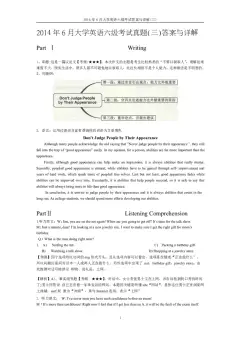
2013年 6月六级考试真题(第三套)
PartⅠ Writing
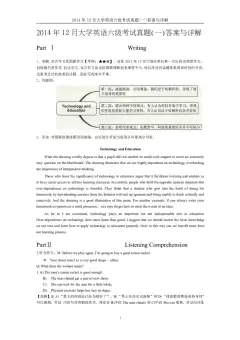
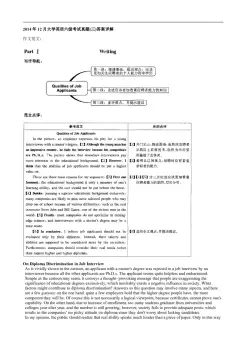
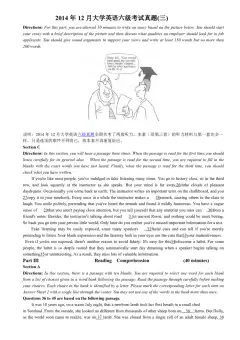
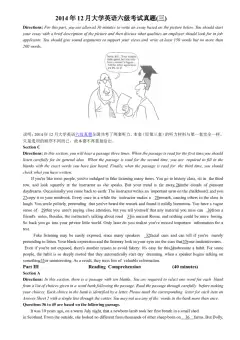
Directions: For this part, you are allowed 30 minutes to write an essay commenting on the remark
“Earth provides enough to satisfy every man’s need, but not every man’s greed.” You can cite
examples to illustrateyour point.You should writeat least 150wordsbut nomore than 200words.
_______________________________________________________________________________
_______________________________________________________________________________
_______________________________________________________________________________
Part II Listening Comprehension
说明:2013年6月六级真题全国共考了两套听力。本套(即第三套)的听力内容与第二套的内容完全相
同,只是选项的顺序不一样而已,故在本套中没有重复给出。
Part Ⅲ Reading Comprehension
SectionA
Directions: In this section, there isapassage withten blanks. You arerequired to select one word
far each blank from a list of choices given in a word bank following the passage. Read the passage
through carefully before making your choices. Each choice in the bank is identified by a letter.
Pleasemarkthecorrespondingletter foreach itemonAnswerSheet 2withasinglelinethroughthe
centre. You maynot use anyof thewordsin thebank morethan once.
Questions36to 45are basedon thefollowing passage.
Children are losing the ability to play properly because they are being given too many toys,
according to a new research. The studies show that children — especially those under five — are
often 36 and actually play less than thosewith fewer toys.
“Our studies show that giving children too many toys or toys of the 37 type can actually be
doing them harm. They get spoiled and cannot 38 on any one thing long enough to learn from it”,
said Lerner, a childhood development researcher. Her conclusions have been backed up by British
research looking at children with 39 few toys, whose parents spend more time reading, singing or
playing with them. It showed such children 40 youngsters from richer backgrounds —even those
who hadaccess to computers.
KathySylva,professorofeducationalpsychologyatOxfordUniversity,reachedher 41 froma
study of3,000 children from the ages of three to five. In her opinion, there is a complex relationship
between children’s progress, the type of toys they are given and the time parents spend on them.
When the children have a large number of toys there seems to be a distraction element, and when
children are 42 theydonot learn orplay well.
Some parents notice the 43 early. Orhan Ismail, a researcher from Colchester, Essex, saw a
changefortheworseinCameron,his10-month-oldson,afterhewasgiven 44 toys lastChristmas.
HeobservedthatiftherearetoomanytoysinfrontofCameron,hewilljustkeepmovingroundthem
and thenend upgoing away and finding somethinglikeaslipperto play with.
Experts 45 to put a figure onthe number of toys children should have, but many believe two
dozenis enough for children of pre-school age.
A)impact I) surpass
B) concentrate J) innumerable
C)overwhelmed K)decisions
D)reasonably L) inaccurate
E)conclusions M)relatively
F)exquisite N) distracted
G)embarrassed O)lag
H)hesitate
SectionB
Directions: In this section, you are going to read a passage with ten statements attached to it. Each
statement contains information given in one of the paragraphs. Identify the paragraph from which
theinformationisderived. Youmaychooseaparagraphmorethanonce.Eachparagraphismarked
with aletter. Answer thequestions bymarking the corresponding letter onAnswer Sheet 2.
1Norman Borlaug: “Father ofthe Green Revolution”
[A] Few people have quietly changed the world for the better more than this rural lad from the
midwestemstateofIowaintheUnitedStates.ThemaninfocusisNormanBorlaug,the“Father
of the Green Revolution”, who died on 12 September 2009 at age 95. Norman Borlaug spent
most of his 60 working years in the farmlands of Mexico, South Asia and later in Africa,
fighting world hunger, and saving by some estimates up to a billion lives in the process. An
achievement, fitfor a Nobel Peace Prize.
Early Years
[B] “I’m a product of the great depression” is how Borlaug described himself. A great-grandson of
Norwegian immigrants to the United States, Borlaug was born in 1914 and grew up on a small
farm in the northeastern comer of Iowa in a town called Cresco. His family had a 40-hectrare
(公顷)farm on which they grew wheat, maize (玉米)and hay and raised pigs and cattle.
Norman spent most of his time from age 7-17 on the farm, even as he attended a one-room,
one-teacher school at New Oregon inHoward County.
[C] Borlaug didn’t have money to go to college. But through a Great Depression era programme,
known as the National Youth Administration, Borlaug was able to enroll in University of
MinnesotaatMinneapolistostudyforestry. HeexcelledinstudiesandreceivedhisPhDinplant
pathology (病理学)and genetics in 1942.
[D] From 1942 to 1944, Borlaug was employed as a microbiologist at DuPont in Wilmington.
However, following the December 1941 attack on Pearl Harbor, Borlaug tried to join the
military, but was rejected underwartime labour regulations.
In Mexico
[E] In 1944, many experts warned of mass starvation in developing nations where populations were
expanding faster than crop production. Borlaug began work at a Rockefeller Foundation-
funded project in Mexico to increase wheat production by developing higher-yielding varieties
ofthecrop.Itinvolvedresearchingenetics,plantbreeding,plantpathology,entomology(昆虫
学),agronomy(农艺学),soilscience,andcerealtechnology.Thegoaloftheprojectwasto
boostwheat production inMexico,which at thetimewas importing alarge portionofitsgrain.
[F] Borlaug said that his first couple of years in Mexico were difficult. He lacked trained scientists
and equipment. Native farmers were hostile towards the wheat programme because of serious
crop losses from 1939to 1941due tostem rust.
[G]WheatvarietiesthatBorlaugworkedwithhadtall,thinstalks.Whiletallerwheatcompetedbetter
for sunlight, they had a tendency to collapse under the weight of extra grain — a trait called
lodging. Toovercomethis,Borlaug worked onbreeding wheat withshorterand strongerstalks,
which could hold on larger seed heads. Borlaug’s new semi-dwarf, disease-resistant varieties,
called Pitic 62and Penjamo 62, changed thepotential yield of Mexican wheat dramatically. By
1963wheat production in Mexico stoodsix times morethan thatof1944.
Green Revolution inIndia
[H] During the 1960s, South Asia experienced severe drought condition and India had been
importing wheat on a large scale from the United States. Borlaug came to India in 1963 along
with Dr Robert Anderson to duplicate his Mexican success in the sub-continent. The
experiments began with planting a few of the high-yielding variety strains in the fields of the
Indian Agricultural Research Institute at Pusa in New Delhi, under the supervision of Dr M. S.
Swaminathan. These strains were subsequently planted in test plots at Ludhiana, Pantnagar,
Kanpur,PuneandIndore.Theresultswerepromising,butlarge-scalesuccess,however,wasnot
instant. Cultural opposition to new agricultural techniques initially prevented Borlaug from
going ahead with planting of new wheat strains in India. By 1965, when the drought situation
turned alarming, the Government took the lead and allowed wheat revolution to move forward.
By employing agricultural techniques he developed in Mexico, Borlaug was able to nearly
doubleSouthAsian wheat harvests between 1965and 1970.
[I]IndiasubsequentlymadeahugecommitmenttoMexicanwheat,importingsome18,000tonnesof
seed. By 1968, it was clear that the Indian wheat harvest was nothing short of revolutionary. It
was so productive that there was a shortage of labour to harvest it, of bull carts to haul it to the
2threshingfloor(打谷场)ofjute(黄麻)bagstostoreit.Localgovernmentsinsomeareaswere
forced to shutdownschools temporarily tousethem as store houses.
[J] United Nation’s Food and Agriculture Organisation (FAO) observed that in 40 years between
1961and2001,“Indiamorethandoubleditspopulation,from452milliontomorethan1billion.
At the same time, it nearly tripled its grain production from 87 million tonnes to 231 million
tonnes.Itaccomplishedthisfeatwhileincreasingcultivatedgrainacreage(土地面积)amere
8 percent.” It was in India that Norman Borlaug’s work was described as the “Green
Revolution.”
InAfrica
[K] Africa suffered widespread hunger and starvation through the 70s and 80s. Food and aid poured
in from most developed countries into the continent, but thanks to the absence of efficient
distribution system, the hungry remained empty-stomach. The then Chairman of the Nippon
Foundation, Ryoichi Sasakawa wondered why the methods used in Mexico and India were not
extended to Africa. He called up Norman Borlaug, nowleading a semi-retired life, for help. He
managed to convince Borlaug to help with his new effort and subsequently founded the
Sasakawa Africa Association. Borlaug later recalled, “but after I saw the terrible circumstances
there, I said, ‘Let’s juststart growing’”.
[L] The success in Africa was not as spectacular as it was in India or Mexico. Those elements that
allowedBorlaug’sprojectstosucceed,suchaswell-organisedeconomiesandtransportationand
irrigation systems, were severely lacking throughout Africa. Because of this, Borlaug’s initial
projects were restricted to developed regions of the continent. Nevertheless, yields of maize,
sorghum(高粱)and wheat doubled between 1983and 1985.
Nobel Prize
[M] For his contributions to the world food supply, Borlaug was awarded the Nobel Peace Prize in
1970.Norwegian officials notified hiswife inMexicoCityat 4:00am, but Borlaug hadalready
leftforthetestfieldsintheTolucavalley,about65kmwestofMexicoCity.Achauffeur(司机)
took her to the fields to inform her husband. In his acceptance speech, Borlaug said, “the first
essentialcomponentofsocialjusticeisadequatefoodforallmankind.Foodisthemoralrightof
allwho are born into thisworld. Yet, 50percent oftheworld populationgoes hungry.”
Green Revolutionvs Environmentalists
[N] Borlaug’s advocacy of intensive high-yield agriculture came under severe criticism from
environmentalistsinrecentyears.Hisworkfacedenvironmentalandsocio-economiccriticisms,
including charges that his methods have created dependence on monoculture crops,
unsustainablefanningpractices,heavyindebtednessamongsubsistencefarmers,andhighlevels
ofcancer among thosewho work with agriculture chemicals. There are also concerns about the
long-term sustainability of fanning practices encouraged by the Green Revolution in both the
developed and thedeveloping world.
[O] In India, the Green Revolution is blamed for the destruction of India crop diversity, drought
vulnerability, dependence on agro-chemicals that poison soils but reap large-scale benefits
mostly to the American multi-national corporations. What these critics overwhelmingly
advocate is a global movement towards “organic” or “sustainable” farming practices that avoid
usingchemicalsandhightechnologyinfavourofnaturalfertilisers,cultivationandpest-control
porgrammes.
46.Farmers’ rejection of his planting techniques initially prevented Borlaug from achieving large-
scalesuccess in India.
47.In bothdeveloped and developing countries there are concerns whether in the long run Borlaug’s
farming practice willbesustainable.
48.Borlaug’s Pitic62and Penjamo62has short and strong stems andcan resist to diseases.
49.Borlaug’ssuccessinAfricawasnotasspectacularasinIndiaorMexicobecauseAfricalackedthe
necessary supporting facilities.
50.In India, critics attributethedestruction ofIndian crop diversity tothe Green Revolution.
51.Borlaugemphasisedthatadequatefoodforallmankindisessentialinensuringsocialjusticeinhis
Nobel Prizeacceptance speech.
352.In recent years Borlaug’s Green Revolutionhas been attacked byenvironmentalists.
53.Borlaug’swheat programme hadbeen stuckin troubleduringhis firstcouple ofyears inMexico.
54.According to United Nation’s Food and Agriculture Organisation, in 40 years between 1961 and
2001India’s grain production increased nearly three times.
55.Norman Borlaug wona Nobel Prizeforhis 60years work oncombating world hunger.
SectionC
Directions: There are 2 passages in this section. Each passage is followed by some questions or
unfinishedstatements.Foreachofthemtherearefourchoices markedA),B),C)andD).Youshould
decide on the best choice and mark the corresponding letter on Answer Sheet 2 with a single line
throughthecentre.
Passage One
Questions56to 60are basedon thefollowing passage.
“Depression”is more than a serious economic downturn. What distinguishes a depression from
a harsh recession is paralysing fear — fear of the unknown so great that it causes consumers,
businesses, andinvestors toretreat and panic. They save upcash and desperately cut spending. They
sell stocks and other assets. A shattering loss of confidence inspires behaviour that overwhelms the
normal self-correcting mechanisms that usually prevent a recession from becoming deep and
prolonged: adepression.
Comparing 1929 with 2007-09, Christina Romer, the head of President Obama’s Council of
EconomicAdvisers, findstheinitial blowtoconfidencefargreaternowthan then.True, stock prices
fell a third from September to December 1929, but fewer Americans then owned stocks. Moreover,
home prices barely dropped. From December 1928 to December 1929, total household wealth
declined only3%. Bycontrast, theloss in household wealth between December 2007and December
2008 was 17%. Both stocks and homes, more widely held, dropped more. Thus traumatised (受到
创伤),theeconomymighthavegoneintoafreefallendingindepression.Indeed,itdidgointofree
fall. Shoppers refrained from buying cars, appliances, and other big- ticket items. Spending on such
“durables” dropped at a 12% annual rate in 2008’s third quarter, a 20% rate in the fourth. And
businesses shelved investment projects.
That these huge declines didn’t lead to depression mainly reflects, as Romer argues,
counter-measures taken bythegovernment. Privatemarkets forgoods, services, labor, andsecurities
do mostly self-correct, but panic feeds on itself and disarms these stabilising tendencies. In this
situation, only the government can protect the economy as a whole, because most individuals and
companies are involved in theself-defeating behaviour ofself-protection.
Government’s failure to perform this role in the early 1930s transformed recession into
depression. Scholars will debate which interventions this time — the Federal Reserve’s support of a
failing credit system, guarantees of bank debt, Obama’s “stimulus” plan and bank “stress test” 一
counted most in preventing a recurrence. Regardless, all these complex measures had the same
psychologicalpurpose:toreassurepeoplethatthefreefallwouldstopand,thereby, curbdiefearthat
would perpetuate( 使持久)afree fall.
All this improved confidence. But the consumer sentiment index remains weak, and all the
rebound has occurred in Americans’ evaluation of future economic conditions, not the present.
Unemployment (9.8%) is abysmal(糟透的), the recovery’s strength unclear. Here, too, there is an
echo from the 1930s. Despite bottoming out in 1933, the Depression didn’t end until World War II.
Some government policies aided recovery; some hindered it. The good news today is that the bad
news is not worse.
56.Whydoconsumers, businesses and investors retreat and panicin times ofdepression?
A)They suffer great losses instocks, property and other assets.
B) They find theself-correcting mechanisms dysfunctioning.
C)They are afraid thenormal social order willbe paralysed.
D)They don’tknow what is going tohappen in thefuture.
57.Whatdoes ChristinaRomersayabout the current economic recession?
A)Its severity is nomatch fortheGreat Depression of 1929.
B) Its initial blowtoconfidence far exceeded that of1929.
4C)It has affected houseowners morethan stock holders.
D)It has resulted in afree fall oftheprices ofcommodities.
58.Whydidn’t thecurrent recession turn into adepression according toChristinaRomer?
A)Thegovernment intervened effectively.
B) Privatemarkets corrected themselves.
C)Peoplerefrained from buying durables and big-ticket items.
D)Individuals and companies adopted self-protection measures.
59.Whatis thechief purposeof all thecounter measures taken?
A)Tocreate job opportunities. C)Tostimulatedomesticconsumption.
B) Tocurb thefear ofalasting free fall. D)To rebuild thecredit system.
60.Whatdoes theauthor think oftoday’s economic situation?
A)It may worsen without further stimulation. C)It has not gone from bad to worse.
B) It will see arebound sooner orlater. D)It does not give people reason forpessimism.
Passage Two
Questions61to 65are basedon thefollowing passage.
“Usually when we walk through-the rain forest we hear a soft sound from all the moist leaves
and organic debris on the forest floor,” says ecologist Daniel Nepstad. “ Now we increasingly get
rustleandcrunch. That’sthe sound ofadying forest.”
Predictions of the collapse of the tropical rain forests have been around for years. Yet until
recently the worst forecasts were almost exclusively linked to direct human activity, such as dear-
cutting and burning for pastures or farms. Left alone, it was assumed, the world’s rain forests would
not only flourish but might even rescue us from disaster by absorbing the excess carbon dioxide and
other planet-warming greenhouse gases. Now it turns out that may be wishful thinking. Some
scientists believe that the rise in carbon levels means that the Amazon and other rain forests in Asia
and Africa may go from being assets in the battle against rising temperatures to liabilities. Amazon
plants,forinstance,holdmorethan100billionmetrictonsofcarbon,equalto15yearsoftailpipeand
chimney emissions. If the collapse of the rain forests speeds up dramatically, it could eventually
release 3.5-5 billion metric tons of carbon into the atmosphere each year 一 making forests the
leading source ofgreenhousegases.
Uncommonly severe droughts brought on by global climate change have led to forest-eating
wildfires from Australia to Indonesia, but nowhere more acutely than in the Amazon. Some experts
say that therain forest is already at thebrink of collapse.
Extreme weather and reckless development are plotting against the rain forest in ways that
scientists have never seen. Trees need more water as temperatures rise, but the prolonged droughts
haverobbedthemofmoisture,makingwholeforestseasilyclearedoftreesandturnedintofarmland.
The picture worsens with each round of El Nino, the unusually warm currents in the Pacific Ocean
that drive up temperatures and invariably presage(预示)droughts and fires in the rain forest.
Runaway fires pour even more carbon into the air, which increases temperatures, starting the whole
viciouscycle all over again.
More than paradise lost, a perishing rain forest could trigger a domino effect—sending winds
and rains kilometres off course and loading the skies with even greater levels of greenhouse gases—
that will be felt far beyond theAmazon basin. In a sense, we are already getting a glimpse of what’s
tocome.EachburningseasonintheAmazon,firesdeliberatelysetbyfrontiersettlersanddevelopers
hurl up almost half a billion metric tons of carbon a year, placing Brazil among the top five
contributors togreenhouse gases inthe world.
61.Welearn from thefirst paragraph that .
A)dead leaves and tree debris make thesamesound
B) trees that are dying usually give out asoft moan
C)organicdebris echoes thesounds ina rain forest
D)thesoundofa forest signifies its health condition
62.In thesecond paragraph, the authorchallenges theviewthat .
A)thecollapse ofrain forests is caused by direct human interference
B) carbon emissions are theleading cause ofcurrent global warming
5C)theconditionof rain forests has been rapidly deteriorating
D)rain forests should notbe converted into pastures or farms
63.Theauthorargues that therising carbon levels inrain forests may .
A)turn them into amajorsource ofgreenhouse gases
B) change theweather patterns throughout theworld
C)poseathreat to wildlife
D)accelerate theircollapse
64.Whathas made iteasier toturn some rain forests intofarmland?
A) Rapid riseincarbon levels. C)Lackofrainfallresultingfromglobalwarming.
B) Reckless land development. D) The unusualwarm currents in thePacific Ocean.
65.Whatmakes Brazil oneoftheworld’s top fivecontributors togreenhouse gases?
A)Thedomino effect triggered bytheperishing rain forests.
B) Its practice ofburning forests forsettlement and development.
C)Thechanged patterns ofwinds andrains in theAmazon area.
D)Its inabilitytocurb thecarbon emissions from industries.
Part IV Translation
Directions: For this part, you are allowed 30 minutes to translate a passage from Chinese into
English.Youshould writeyour answer onAnswer Sheet 2.
中国是最早生产丝绸的国家。考古学家们认为,中国的桑蚕丝织技术,至少有4000多年
的历史。丝绸很早就成为了古代宫廷贵族的主要衣料和对外贸易的重要商品。中国古代丝绸
品种丰富多彩。西方人十分喜爱中国丝绸。据说,公元1世纪,一位古罗马皇帝曾穿着中国
的丝绸袍去看戏,顿时轰动了整个剧场。从此,人们都希望能穿上中国的丝绸衣服,中国也
因此被称为“丝国”。丝绸美化了人们的生活,也促进了中国和世界各国的友好往来。
6