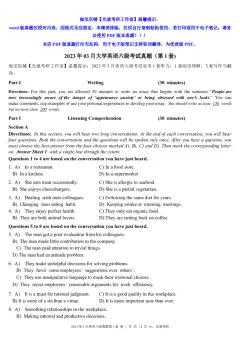
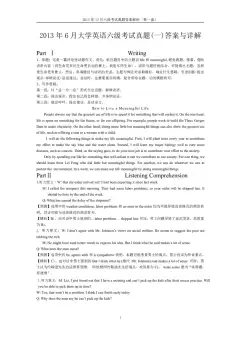
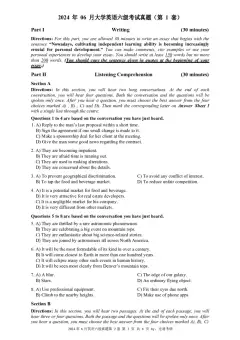
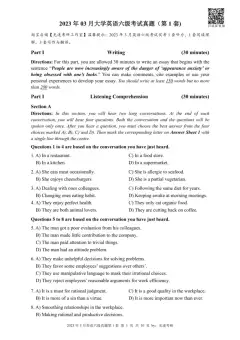
2012 年 6 月大学英语六级(CET-6)真题试卷
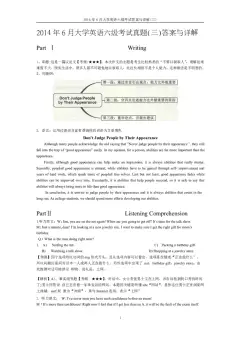
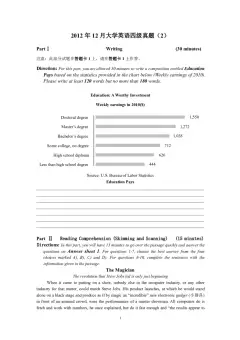
Part Ⅰ Writing (30 minutes)
注意:此部分试题在答题卡 1上。
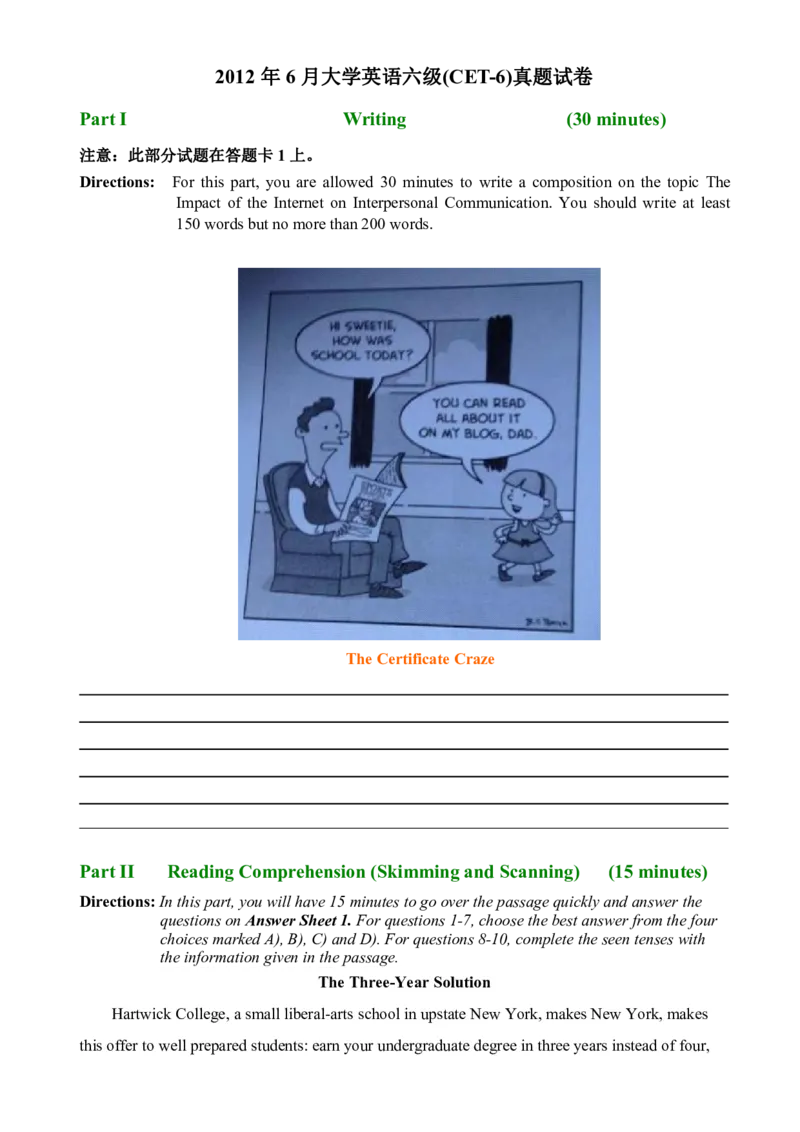
Directions: For this part, you are allowed 30 minutes to write a composition on the topic The
Impact of the Internet on Interpersonal Communication. You should write at least
150words but nomorethan 200words.
TheCertificateCraze
Part II Reading Comprehension (Skimming and Scanning) (15 minutes)
Directions:In thispart,you willhave 15 minutes to goover thepassagequickly andanswer the
questionsonAnswer Sheet 1.For questions 1-7, choose thebest answer fromthefour
choices marked A), B), C)andD). For questions 8-10, completethe seen tenses with
theinformationgiven in thepassage.
TheThree-YearSolution
Hartwick College, asmallliberal-arts school inupstate New York, makes New York, makes
thisoffer towell prepared students:earn your undergraduate degree in three years instead of four,and saveabout 543,000—theamount ofoneyear’s tuition and fees. Anumber ofinnovative
colleges are making thesame offer to students anxious about saving timeand money. That’sboth an
opportunityand a warning forthebest higher-education system inthe world.
TheUnited States has almost all oftheworld’s best universities. Arecent Chinese survey ranks
35 American universities among thetop 50,eight among thetop 10.Ourresearch universitieshave
been thekey to developing thecompetitiveadvantages that help Americans produce 25%ofall the
world’s wealth. In 2007,623,805oftheworld’s brightest studentswere attracted to American
universities.
Yet, there are signs of peril(危险)within American highereducation. U.S. colleges haveto
competeinthemarketplace. Studentsmay choose among 6,000public, private, nonprofit, for profit,
orreligious institutionsofhigher learning. In addition, almostall of the532billion thefederal
government provides for university research is awarded competitively.
But manycolleges and universities are stuck in thepast. For instance, theidea ofthe
fall-to-spring“school year”hasn’t changed much sincebefore theAmerican Revolution,when we
were asummerstretch nolonger makes sense. Former George Washington University president
Stephen Trachtenberg estimates that atypical college uses its facilities for academicpurposes alittle
morethan half thecalendar year.“Whilecollege facilities sit idle, they continuetogenerate
maintenance expenses thatcontribute to thehigh cost ofrunning a college,”hehas written.
Withinacademic departments, tenure(终身职位),combined with age-discriminationlaws,
makes faculty turnover—critical fora university to remain current inchanging times—difficult.
Instead ofprotecting speech and encouraging diversity and innovativethinking, thetenure system
often stifles(压制)them: younger professors must win theapproval ofestablished colleagues for
tenure, encouraging like-mindedness and sometimes inhibiting thefree flowofideas.
Meanwhile, tuitionhas soared, leaving graduating students withunprecedented loan debt.
Strongcampus presidents to manage theseproblems are becoming harder to find, and tokeep. In
fact, students nowstay oncampus almost as longas theirpresidents. The average amount oftime
studentsnow taketo completean undergraduate degree has stretched to six years and seven months
as studentsinterrupted bywork, inconvenienced byunavailable classes, orlured byonemore
footballseason find it hardto graduate.
Congress has tried tohelp students with college costs through Pell Grants and otherforms of
tuitionsupport. But someof theirfixes have made theproblem worse. Thestack ofcongressionalregulations governing federal studentgrants and loans now stands twiceas tallas Ido.Filling out
theseforms consumes 7%ofeverytuition dollar.
Forall of thesereasons, somecolleges likeHartwick are rethinking theoldway ofdoing things
and questioningdecades-old assumptions about what acollege degree means. For instance, why
does ithave to takefour years to earn adiploma?This fall, 16first-year studentsand four
second-year studentsat Hartwick enrolled in theschool’s new three year degree program.
According to thecollege, theplan isdesigned forhigh-ability, highly motivated student whowish to
savemoney or tomove along morerapidly toward advanced degrees.
Byeliminating that extrayear, there year degree students save25%in costs. Instead oftaking
30 credits ayear, thesestudents take40.During January, Hartwick runs afour week course during
which students may earn three tofour credits onoroff campus, including anumber ofinternational
sites.Summercourses are not required, but astudent may enroll in them—and pay extra. Three year
studentsget first crack at course registration. There are nochanges inthe numberofcourses
professors teach or in theirpay.
The three-year degree isn’t a new idea. Geniuses have always breezed through. Judson College,
a350-student institution inAlabama, has offered students a three-year optionfor 40years. Students
attend “short terms” in Mayand Junetoearn thecredits required for graduation. Bates College in
Maineand Ball StateUniversity inIndiana are among othercolleges offering three-year options.
Changes at thehigh-school level are also helping tomake it easier for many students toearn
theirundergraduate degrees in less time. One offive students arrives at college today with
Advanced Placement (AP) credits amounting to asemester ormore ofcollege level work. Many
universities,including large schools liketheUniversity ofTexas, make it easy for theseAP students
tograduatefaster.
Forstudents who don’t plan tostopwith an undergraduate degree, thethree-year planmay
havean evengreater appeal. Dr. John Sergent, head of Vanderbilt University Medical School’s
residency (住院医生)program, enrolled in Vanderbilt’s undergraduate college in 1959.Heentered
medical school after only three years as did fouror fiveofhis classmates.”Myfirst year of medical
schoolcounted as my senior year, which meant I hadto takethree to four labsa week to get all my
sciences in.I basically skipped my senioryear,” says Sergent. He stillhad timeto be astudent
senatorand meet his wife.
There are, however, drawbacks tomoving through school at such abrisk pace. For one, it
deprives students oftheluxury oftimetoroam (遨游)intellectually. Compressing everything intothreeyears also leaves less timeforgrowing up,engaging in extracurricular activities, and studying
abroad. On crowded campuses itcould mean fewer opportunitiesto get into aprized professor’s
class. Iowa’s WaldorfCollege has graduated several hundred students in itsthree-year degree
program, but it nowphasing out theoption.Most Waldorfstudents wanted thefull four-year
experience—academically, socially, and athletically. And faculty members willbe wary ofany
change that threatens thecore curriculum in thename ofmoving students intotheworkforce.
“Most high governmental officials seem to conceiveof education in this light—as away to
ensureeconomic competitiveness and continued economic growth,”Derek Bok, former president of
Harvard, told TheWashington Post. “Istrongly disagree with this approach.”Another risk: thenew
campus schedules might eventually produce less revenue for theinstitutionand longerworking
hours forfaculty members.
Adoptinga three-year option willnot comeeasily to most school. Thosethat wish to tackle
traditionand makeAmerican campus morecost-conscious may find it easier to take Trachtenberg’s
advice: open campuses year-round.“You could run two completecolleges, with two complete
faculties,”hesays.“That’s without cuttingthe length of students’ vacations, increasing class sizes, or
requiring faculty toteach more.”
Whethertheyexperimentwith three-year degrees, offer year-round classes, challenge the
tenuresystem—orall of theabove—universitiesare slowlyrealizing that to stay competitiveand
relevant they mustadapt to arapidly changing world.
Expanding thethree-year optionmay bedifficult, but it may beless difficult than asking
Congress foradditional financial help, asking legislators for morestate support, orasking students
even higher tuition payments. Campuses willing toadopt convenient schedules along with more
focused, less-expensive degrees may find that they have a competitive advantage in attracting bright,
motivatedstudents. These sorts ofinnovations can help American universities avoid theperils of
success.
注意:此部分试题请在答题卡 1上作答。
1. Whydid Hartwick College start three-year degreeprograms?
A) Tocreate chances forthe poor. C)Toenroll morestudents.
B) To cut students’expenses. D)Tosolveits financial problems.
2. Byquoting Stephen Trachtenberg theauthor wants tosay that .
A) American universities are resistant tochange
B) thesummervacation contributes to student growthC)collegefacilities could beput to more effectiveuse
D) thecosts ofrunning auniversity are soaring
3. Theauthorthinks thetenure system in American universities .
A)suppresses creative thinking C)guarantees academic freedom
B) creates conflicts amongcolleagues D)is asign ofage discrimination
4. Whatis said about thenew three-year degreeprogram at Hartwick?
A) Its studentshave to earn morecredits each year.
B) Non-credit courses are eliminated altogether.
C)Its faculty members teach more hours aweek.
D) Somesummer courses are offered free of charge.
5. Whatdowe learn about Judson College’s three-year degree program?
A) It has been running forseveral decades. B) It is open tothe brighteststudents only.
C)It is themostsuccessful inthecountry. D)It has manypractical courses onoffer.
6. Whatchanges inhigh schools helpstudentsearn undergraduate degrees inthreeyears?
A) Curriculums havebeen adapted to students’ needs.
B) Morestudents have Advanced Placement credits.
C)Moreelective courses are offered in high school.
D) Theoverallquality of education bas improved.
7. Whatis said to beadrawback ofthe three-year collegeprogram?
A) Students have tocope with too heavy aworkload.
B) Studentsdon’t havemuch timeto roam intellectually.
C)Studentshave littletimeto gainpractical experience.
D)Students don’thave prized professors to teach them.
8. Collegefaculty members are afraid that thepretext ofmovingstudents into theworkforce might
poseathreat to .
9. Universities are increasingly aware that they must adapt to a rapidly changing world in order to .
10. Convenientacademic schedules with more-focused, less-expensive degrees willbe more
attractiveto .
SectionA
Directions: In this section, you will hear 8 short conversations and 2 long conversations.At the
end of each conversation, one or more questions will be asked about what was said. Both the
conversation and the questions will be spoken only once. After each question there will be a pause.During the pause, you must read the four choices markedA), B) ,C) and D), and decide which is the
best answer. Then mark the corresponding letter on Answer Sheet 2 with a single line through the
centre.
注意:此部分试题请在答题卡 2上作答.
11.A)Theserious accident may leaveAnna paralyzed.
B)Theman happened to seeAnna fall onherback.
C)Theinjury willconfineAnna to bed for quiteawhile.
D)The doctor’s therapy has been very successful.
12.A)Theman could watch theballet with her. B) Shehappened tohave bought two tickets.
C)Shecan get aballet ticket for theman. D)Her schedule conflicts with her sister’s.
13.A) Hewill send someoneright away. B) He has to doother repairs first.
C)Thewoman can call later thatday. D)The woman can try tofix itherself.
14.A)Takeupcollection nextweek. B) Givehiscontribution sometimelater.
C)Buy an expensivegift forGemma. D)Borrowsome money from thewoman.
15.A) Declinethe invitation as early as possible. B)AskTonyto convey thanks to his mother.
C)TellTony’s motherthat she eats nomeat. D)Add morefruits and vegetables to herdiet.
16.A)Theincreasing crime rate. B)Theimpact ofmass media.
C)Thecirculation ofnewspapers. D)The coverage ofnewspapers.
17.A) Limit thenumberof participants in theconference.
B) Check thenumberofpeople who have registered.
C)Providepeople with adviceoncareer development.
D) Movetheconferenceto a morespacious place.
18.A)Theapartment is still available. B)Theapartment is closeto thecampus.
C)Theadvertisement is outdated. D)On-campus housing ishard to secure.
Questions19to 21arebased ontheconversation youhavejust heard.
19.A)Totesthow responsivedolphins are to various signals.
B)Tofind out ifthefemale dolphin iscleverer than themaleone.
C)Tosee ifdolphins canlearn to communicate witheach other.
D)Toexaminehow longit takes dolphinsto acquire askill.
20.A) Producetheappropriate sound. B) Pressthe right-hand lever first.
C)Raisetheir heads above thewater. D)Swimstraight into thesametank.
21.A) Only onedolphinwas ableto see thelight. B)Themale dolphinreceived morerewards.C)Both dolphins were put inthesametank. D)The leverwas beyond thedolphins’reach.
Questions22to 25arebased ontheconversation youhavejust heard.
22.A) In abotanical garden. B) In alecture room.
C)In a resort town. D)On a cattlefarm.
23.A) It is an ideal place forpeople to retire to.
B) It is at thecentre of thefashion industry.
C)It remains very attractivewith itsmineral waters.
D) It has kept manytraditions fromVictorian times.
24.A) It was named after aland owner in theold days.
B) It is located intheeastern part ofHarrogate.
C)It is protected as parkland byaspecial law.
D) It will beused as a centre forathletic training.
25.A)Thebeautiful flowers. B)Therefreshing air.
C)Themineral waters. D)The vast grassland.
SectionB
Directions: In this section, you will hear 3 short passages. At the end of each passage, you will hear
some questions. Both the passage and the questions will be spoken only once. After you hear a
question, you must choose the best answer from the four choices marked A), B), C) and D). Then
markthecorresponding letter onAnswer Sheet 2with asinglelinethrough thecenter.
Passage one
Questions26to 29arebased onthepassageyou havejustheard.
26.A)He specializes for University students. B) Hestart specialized sinseUniversity.
C)Hespecialized ininterpersonal relationship. D)He specializes in interpersonal relationship.
27.A) Studentswhoscored lowstandardized tests.
B) Black freshmen with high standardized test scores.
C)Studentswho are accustomed toliving in dorms.
D) Black studentsfrom families with lowincomes.
28.A)They at the college dorms at theend ofthesemester.
B)They were oftheuniversity’s housing policy.
C)They generally spendmoretimetogether that whitepairs.
D)They broke upmoreoften than same-race roommates.
29.A)Theirracial attitudes improved. B)Theirtest scores rose gradually.C)They grew bored ofeach other. D)They started doing similaractivities.
Passage two
Questions30to 32arebased onthepassageyou havejustheard.
30.A) It will become popular gradually. B) It will change theconcept offood.
C)It has attracted worldwide attention. D)It can help solveglobal flood crises.
31.A) It has been increased over theyears. B) It has been drastically cut byNASA.
C)It is still far from being sufficient. D)It comes regularly from itsdonors.
32.A)They are less healthy than weexpected. B)They are not as expensiveas believe.
C)They are morenutritiousand delicious. D)They are notas natural as webelieved.
PassageThree
Questions33to 35arebased onthepassageyou havejustheard.
33.A) Hehas better memories of childhood. B) Hewas accused offamily violence.
C)Heis a habitual criminal. D)He was wrongly imprisoned.
34.A)Thejury’s prejudice against his race. B)Theevidence found at thecrime scene.
C)Thetwo victims’identification. D)The testimonyofhis two friends.
35.A)TheUS judicial system has much room for improvement.
B) Frightened victims can rarely makecorrect identification.
C)Eyewitnesses are often misled bythelayer’s questions.
D) Manyfactors influence theaccuracy ofwitness testimony.
SECTIONB
Directions: In this section, you will hear a passage three times. When the passage is read for the
first time, you should listen carefully for its general idea. When the passage is read for the second
time, you are required to fill in the blanks numbered from 36 to 43 with the exact words you have
just heard. For blanks numbered 44 to 46 you are required to fill in the missing information. For
these blanks, you can either use the exact words you have just heard or write down the main points
in your own words. Finally, when the passage is read for the third time, you should check what you
havewritten.
注意:此部分的试题请在答题卡2 上作答。
About 700,000 children in Mexico dropped out of school last year as recession-stricken
families pushed kids to work, and a weak economic recovery will allow only a
(36)_________improvement in thedrop-out rate in2010,atop education (37) _________said.
Mexico’s economy suffered more than any other in LatinAmerica last year, (38) _________anestimated 7percent dueto a(39) _________in U.S.demand for Mexican exportssuchas cars.
The (40) _________led to a 4 percent increase in the number of kids who left (41)
_________or middle school in 2009, said Juan de Dios Castro, who (42) _________the nation’s
adulteducation program andkeeps aclose watch ondrop-out rates.
“(43) _________rose and that is a factor that makes our job more difficult.” Castro told Reuters
inan interviewearlier thismonth.
(44)_____________________________________________________________________________
______________________.As a result, drop-out rates will not improve much, Castro said. “There
willbesomeimprovement, butnot significant,” Castro said.
(45)_____________________________________________________________________________
___________.Andchildren often sell candy andcrafts inthestreets orword inrestaurants.
(46)_____________________________________________________________________________
______________________. Mexico’s politicians have resisted mending the country’s tax, energy
and laborlaws fordecades, leaving its economy behind countries such as Braziland Chile.
PartⅣ Reading Comprehension(Reading in Depth) (25minutes)
SectionA
Directions: In this section, there is a short passage with 5 questions or incomplete statements. Read
the passage carefully. Then answer the questions or complete the statements in the fewest possible
words. Pleasewrite your answers onAnswer Sheet 2
Questions47to 51arebased onthefollowing passage.
In face of global warming, much effort has been focused onreducing greenhouse gas emissions
through a variety of strategies. But while much of the research and innovation has concentrated on
finding less-polluting energy alternatives, it may be decades before clean technologies like wind and
solarmeet a significant portionof ourenergy needs.
In the meantime, the amount of CO2 in the air is rapidly approaching the limits proposed by
the Intergovernmental Panel on Climate Change (IPCC). “As long as we’re consuming fossil fuels,
we’re putting out CO2,”says Klaus Lackner, a geophysicist at Columbia, University” We cannot let
theCO2in theatmosphere rise indefinitely.”That sense of urgency has increased interest in capturing and storing CO2, which the IPCC
says could provide the more than 50% reduction in emissions thought needed to reduce global
warming.“We see the potential for capture and storage to play an integral role in reducing
emissions,” says Kim Corley, Shell’s senior advisor of CO2 and environmental affairs. That forward
thinking strategy is gaining support. The U.S. Department of Energy recently proposed putting $1
billion into a new $2.4 billion coal-burning energy plant. The plant’s carbon-capture technologies
would serveas apilotproject for othernew coal-burning plants.
But what do you do with the gas once you’ve captured it? One option is to put it to new uses.
Dakota Gasification of North Dakota captures CO2 at a plant that converts coal into synthetic
natural gas. It then ships the gas 200 miles by pipeline to Canada, where it is pumped underground
in oil recovery operations. In the Netherlands, Shell delivers CO2 to farmers who pipe it into their
greenhouses, increasing theiryield offruits and vegetables.
However, scientists say that the scale of CO2 emissions will require vast amounts of long-term
storage. Some propose storing the CO2 in coal mines or liquid storage in the ocean, Shell favors
storing CO2 in deep geological structures such as saline(盐的) formations and exhausted oil and gas
fields that existthroughout theworld.
注意:此部分试题请在答题卡2上作答。
47.What are suggested as renewable and less-pollutingenergy alternatives?
48. What does the author say is a forward thinking strategy concerning the reduction of CO2
emissions?
49.Oneway ofhanding thecaptured CO2as suggested bytheauthor isto store itand .
50.Through using CO2, Dutch farmers havebeen ableto .
51.Long-term storage ofCO2 is noeasy jobbecause of.
SectionB
Directions: There are 2 passages in this section. Each passage is followed by some questions or
unfinished statements. For each of them there are four choices marked A), B), C) and D). You
should decide on the best choice and mark the corresponding letter on Answer sheet 2 with a single
linethrough thecentre.
Passage One
Questions52to 56arebased onthefollowing passage.
As anyone who has tried to lose weight knows, realistic goal-setting generally produces the
best results. That's partially because it appears people who set realistic goals actually work moreefficiently,andexert more effort, to achieve thosegoals.
What's far less understood by scientists, however, are the potentially harmful effects of
goal-setting.
Newspapers relay daily accounts of goal-setting prevalent in industries and businesses up and
down both Wall Street and Main Street , yet there has been surprisingly little research on how the
long-trumpeted practice of setting goals may have contributed to the current economic crisis , and
unethical (不道德的)behavioringeneral.
“Goals are widely used and promoted as having really beneficial effects. And yet, the same
motivation that can push people to exert more effort in a constructive way could also motivate
people to be more likely to engage in unethical behaviors,” says Maurice Schweitzer, an associate
professor at Penn’sWhartonSchool.
“It turns out there’s no economic benefit to just having a goal—you just get a psychological
benefit” Schweitzer says. “But in many cases, goals have economic rewards that make them more
powerful.”
A prime example Schweitzer and his colleagues cite is the 2004 collapse of energy-trading
giant Enron, where managers used financial incentives to motivate salesmen to meet specific
revenue goals.Theproblem, Schweitzersays, is theactual trades were not profitable.
Other studies have shown that saddling employees with unrealistic goals can compel them to
lie, cheat or steal. Such was the case in the early 1990s when Sears imposed a sales quota on its auto
repair staff. It prompted employees to overcharge for work and to complete unnecessary repairs on a
companywidebasis.
Schweitzer concedes his research runs counter to a very large body of literature that commends
the many benefits of goal-setting. Advocates of the practice have taken issue with his team’s use of
such evidence as news accounts to support hisconclusion thatgoal-setting iswidely over-prescribed
In a rebuttal ( 反 驳 ) paper, Dr. Edwin Locke writes:“Goal-setting is not going away.
Organizations cannot thrive without being focused on their desired end results any more than an
individualcan thrivewithout goals toprovide asense ofpurpose.”
But Schweitzer contends the “mounting causal evidence” linking goal-setting and harmful
behavior should be studied to help spotlight issues that merit caution and further investigation.
“Even a fewnegative effects could beso largethat they outweigh many positiveeffects,” hesays.
“Goal-setting does help coordinate and motivate people. My idea would be to combine that
with careful oversight, a strong organizational culture, and make sure the goals that you use aregoing to beconstructive and notsignificantly harm the organization,”Schweitzer says.
注意:此部分试题请在答题卡2上作答。
52.What message does theauthor try to convey about goal-setting?
A)Its negative effects have long been neglected.
B)Thegoal increase people’s work efficiency.
C)Its rolehas been largely underestimated.
D)The goals mostpeople set are unrealistic.
53.What does MauriceSchweitzer want to showbyciting theexampleofEnron?
A)Settingrealisticgoals can turn afailing business intosuccess.
B) Businesses are less likely tosucceed withoutsetting realisticgoals.
C)Financial incentives ensure companies meet specific revenue goals.
D)Goals with financial rewards have strong motivational power.
54. Howdid Sears’goal-setting affect itsemployees?
A)They were obliged towork more hours to increase their sales.
B)They competed with oneanother to attract more customers.
C)They resorted to unethical practice to meet theirsales quota.
D)They improved theircustomer service onacompanywide basis.
55.What doadvocates of goal-setting thinkof Schweitzer’s research?
A)Its findings are not ofmuch practical value.
B) It exaggerates thesideeffects of goal-setting.
C)Its conclusion isnot based onsolidscientific evidence.
D)It runs counter totheexisting literatureonthe subject.
56.What is Schweitzer’scontention against Edwin Locke?
A)The linkbetween goal-setting and harmful behavior deserves further study.
B) Goal-setting has become toodeep-rooted incorporate culture.
C)Thepositiveeffects of goal-setting outweigh itsnegative effects.
D)Studying goal-setting can throwmore light onsuccessful business practices.
PassageTwo
Questions57to 61arebased onthefollowing passage.
For most of the 20th century,Asia asked itself what it could learn from the modern, innovating
West. Now the question must be reversed. What can the West’s overly indebted and sluggish (经济
滞长的)nations learn from aflourishingAsia?Just a few decades ago, Asia’s two giants were stagnating(停滞不前) under faulty economic
ideologies. However, once China began embracing free-market reforms in the 1980s, followed by
India in the 1990s, both countries achieved rapid growth. Crucially, as they opened up their markets,
they balanced market economy with sensible government direction. As the Indian economist
Amartya Sen has wisely said, “The invisible hand of the market has often relied heavily on the
visiblehand of government.”
Contrast this middle path with America and Europe, which have each gone ideologically
over-board in their own ways. Since the 1980s, America has been increasingly clinging to the
ideology of uncontrolled free markets and dismissing the role of government—following Ronald
Regan’s idea that “government is not the solution to our problem; government is the problem. “Of
course, when the markets came crashing down in 2007, it was decisive government intervention that
saved theday.Despite thisfact, manyAmericans are stillstrongly opposed to “big government.”
IfAmericans could only free themselves from their antigovernment doctrine, they would begin
to see that the America’s problems are not insoluble.A few sensible federal measures could put the
country back on the right path.Asimple consumption tax of, say, 5% would significantly reduce the
country’s huge government deficit without damaging productivity.A small gasoline tax would help
free America from its dependence on oil imports and create incentives for green energy
development. In the same way, a significant reduction of wasteful agricultural subsidies could also
lower the deficit. But in order to take advantage of these common-sense solutions, Americans will
have to put aside their own attachment to the idea of smaller government and less regulation.
American politicians will have to develop the courage to follow what is taught in all American
public-policy schools: that there are good taxes and bad taxes. Asian countries have embraced this
wisdom,and have built sound long-term fiscal (财政的)policies as a result.
Meanwhile, Europe has fallen prey to a different ideological trap: the belief that European
governments would always have infinite resources and could continue borrowing as if there were no
tomorrow. Unlike the Americans, who felt that the markets knew best, the Europeans failed to
anticipate how the markets would react to their endless borrowing. Today, the European Union is
creating a $580 billion fund to ward off sovereign collapse. This will buy the EU time, but it will
notsolvethebloc’s larger problem.
57.What has contributed totherapid economic growth in ChinaandIndia?
A)Copying western-style economicbehavior.
B) Heavy reliance onthehand of government.C)Timely reform ofgovernment at all levels.
D)Free market plus government intervention.
58.What does RonaldReagan mean bysaying “government is theproblem” (line4,Para. 3)?
A)Many social evils are caused bywrong government policies.
B) Many social problems arise from government’sinefficiency.
C)Government action iskey to solvingeconomic problems.
D)Government regulation hinders economicdevelopment.
59.What stopped theAmerican economy from collapsing in2007?
A)Self-regulatory repairmechanisms ofthefree market.
B) Cooperation between thegovernment andbusinesses.
C)Abandonment of big government bythepublic.
D)Effective measures adopted bythegovernment.
60.What is theauthor’s suggestion to theAmerican publicin face ofthepublicgovernment deficit?
A)They urge thegovernment to revise itsexisting publicpolicies.
B)They develop green energy to avoid dependence onoilimport.
C)They give upthe ideaofsmaller government and less regulation.
D)They putupwith theinevitablesharp increase ofdifferent taxes.
61.What’s theproblem with theEuropean Union?
A)Conservative ideology. B) Shrinkingmarket.
C)Lack of resources. D)Excessiveborrowing.
Part V Close
Directions: There are 20 blanks in the following passage. For each blank there are four choices
markedA),B),C)and D)on the right side of paper.You shouldchoose the ONE that best fits into the
passage. Then mark the corresponding letter on Answer Sheet 2 with a single line through the
centre.
注意:此部分试题请在答题卡2上作答.
Music produces profound and lasting changes in the brain. Schools should add music classes,
not cut them. Nearly 20 years ago, a small study advanced the 62 that listening to Mozart’s Sonata
forTwo Pianos in D Major could boost mental functioning. It was not long 63 trademarked “Mozart
effect” products began to appeal to anxious parents aiming to put toddlers (刚学步的孩子) 64 the
fast track to prestigious universities like Harvard andYale. Georgia’s governor even 65 giving everynewborn there aclassical CDor cassette.
The 66 for Mozart therapy turned out to be weak, perhaps nonexistent, although the 67 study
never claimed anything more than a temporary and limited effect. In recent years, 68 , scientists
have examined the benefits of a concerted 69 to study and practice music, as 70 to playing a Mozart
CDor acomputer-based“brain fitness” game 71ina while.
Advanced monitoring 72 have enabled scientists to see what happens 73 your head when you
listen to your mother and actually practice the violin for an hour every afternoon. And they have
found that music 74 can produce profound and lasting changes that 75 the general ability to learn.
These results should 76 public officials that music classes are not a mere decoration, ripe for
discarding in thebudget crises that constantly 77publicschools.
Studies have shown that 78 instrument training from an early age can help the brain to 79
sounds better, making it easier to stay focused when absorbing other subjects, from literature to
mathematics. The musically adept (擅长的)are better able to 80 on a biology lesson despite the
noise in the classroom 81 , a few years later, to finish a call with a client when a colleague in the
next office starts screaming a subordinate. They can attend to several things at once in the mental
scratch pad called working memory,an essential skillin thisera ofmultitasking.
62.A)notice B)note C)notion D)notification
63.A)that B)until C)since D)Before
64.A)up B)by C)on D)at
65.A)propelled B) proposed C)submitted D)subjected
66.A)witness B) evidence C)symptom D)context
67.A)subtle B) elementary C)sensitive D)original
68.A)however B)moreover C)then D)therefore
69.A)effort B)impulse C)object D)attention
70.A)opposed B)accustomed C)related D)devoted
71.A)quite B)once C)often D)much
72.A)organisms B)techniques C)mechanisms D)mechanics
73.A)upon B)amid C)among D)inside
74.A)subjects B)models C)causes D)lessons
75.A)enhance B)introduce C)accelerate D)elaborate
76.A)contend B) convey C)conceive D)convince
77.A)trouble B)transform C)distract D)disclose78.A)urgent B)casual C)diligent D)solemn
79.A)proceed B)process C)prefer D)predict
80.A)count B)concentrate C)insist D)depend
81.A)but B)or C)for D)so
Part Ⅵ Translation (5 minutes)
Directions: Complete the sentences by translating into English the Chinese given in brackets.
Pleasewriteyour translation onAnswer Sheet 2.
注意:此部分试题请在答题卡2上作答,只需写出译文部分。
82.Ithinkthat themeal iswell ______________________(没有折扣的情况下值80美元).
83. ______________________ ( 面 对 来 自 其 他 公 司 的 激 烈 竞 争 ), the automobile
manufacturer isconsidering launching apromotion campaign.
84.As far as hobbies are concerned, Jane and her sister ______________________ (几乎没有
什么共同之处).
85. Only after many failures______________________ (我才认识到仅凭运气是不能成功
的).
86. But for the survival instinct which nearly all creatures have, ______________________ (更多
的物种就可能已经在地球上灭绝了).