2012 年 12 月大学英语六级(CET-6)真题试卷
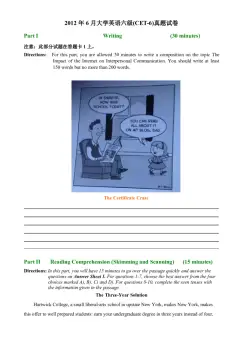
Part I Writing (30 minutes)
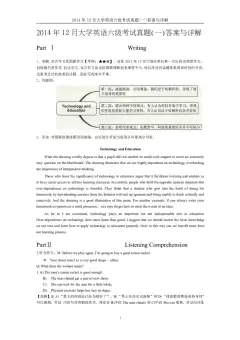
Direction: For this part, you are allowed 30 minutes to write an essay entitled Man and
Computer by commenting on the saying, "The real danger is not that the computer will
begin to think like man, but that man will begin to think like the computer. "You should
writeat least 150wordsbut nomorethan 200words.
On Maintaining Trust
Part II Reading Comprehension (Skimming and Scanning) (15 minutes)
Directions:In this part, youwillhave 15minutes to goover thepassagequickly andanswerthe
questions onAnswer Sheet1.For questions 1-7, choosethe bestanswer fromthefour
choices marked A), B), C)andD). For questions 8-10, complete thesentences withthe
information given in thepassage.
Ratesarelow,butconsumerswon’tborrow
The USFederal Reserve(Fed)'s announcement last week that it intended to keep credit cheap
for at least two more years was a clear invitationto Americans: Go out and borrow.
But many economists say it willtake morethan lowinterest rates topersuade consumers to
take onmoredebt. There are already signs that therecent stock market fluctuations, turbulence in
Europe and theUS deficit have scared consumers. On Friday, preliminary data showed that the
Thomson Reuters/University of Michigan consumer sentiment index hadfallen thismonth to lower
than itwas inNovember 2008,when theUnited States was deep inrecession.
Under normal circumstances, theFed's announcement might have attracted new homeandcar
buyers andprompted credit card holders torack upfresh charges. But with unemployment high and
thosewith jobs worried about keeping them, consumers are more concerned about paying off the
loans they already have than addingmoredebt. And byshowing itshand for thenext two years, the
Fedmay havethoughtlessly invitedprospective borrowers toput off largepurchases.
Lenders, meanwhile, are stilldealing withthe effects oftheboom-gone-bust and are forcing
prospective borrowers togo to extraordinary lengths to provetheircreditworthiness.
"I don't think lenders are going to be interested in extending alotofdebt inthis environment,"
said Mark Zandi, chief economist ofMoody's Analytics, amacroeconomic consultingfirm. "Nor do
Ithink households are going to beinterested in taking onalot ofdebt."
1/15In housing, consumers have already shown aslowresponse to lowrates. Applications for new
mortgages havedecreased thisyear to a10-year low, according totheMortgage Bankers
Association. Salesof furniture andfurnishings remain 22%belowtheir pre-recession peak,
according toSpending Pulse, aresearch report byMasterCard Advisors.
Credit card rates have actually gone upslightly inthe past year. Theone bright spotin lending
is thenumber ofauto loans, which is upfrom lastyear. But someeconomists saythat confidence
among car buyers is hittingnewlows.
For Xavier Walter, a former mortgage banker who with hiswife, Danielle, accumulated$20
000in credit card debt, lowrates willnot change his spending habits.
As thehousing market topped out fiveyears ago, helost hissix-figure income. Heand his wife
were ableto modify themortgage ontheirfour-bedroom house inMedford, New Jersey, as well as
negotiate lower credit card payments.
Two years ago, Mr.Walter, a 34-year-old father ofthree, started anenergy business. He has
sworn offcredit. "I'm not going to go back in debt ever again," he said. "If I can't pay for it incash,
Idon't want it."
Until now, one ofthebiggest restraints onconsumer spending has been a debt aftereffect.
Since August 2008,when household debt peaked at$12.41 trillion, ithas declined byabout$1.2
trillion, according to an analysis byMoody's Analytics ofdata from the Federal Reserve and
Equifax, thecredit agency. Alarge portion ofthat, though, was simply written offbylenders as
borrowers defaulted onloans.
By other measures, households haveimproved theirposition. The proportion ofafter-tax
income that households spend toremain current onloan payments has fallen.
Still, household debt remains high. That presents a paradox:many economists argue that the
economy cannot achieve truehealth until debt levels decline. But credit, made attractive bylow
rates, is atime-tested way to increaseconsumer spending.
With new risks ofanother downturn, economists worry that itwill takeyears fordebt toreturn
to manageablelevels. If the economy contracts again, said George Magnus, senioradviser at UBS,
then "you could find a lotof households in adebt trap which theyprobably can never get out of."
Mortgage lenders, meanwhile, burned bythehousing crash, are extracareful about approving
new loans. In June, forinstance, Fannie Mae, thelargest mortgage buyer inthe United States, said
that borrowers whose existing debt exceeded 45to 50%oftheir incomewould berequired to have
stronger "compensating" factors, which might includehigher savings.
Even thoseborrowers in strong financial positions are asked toprovide unusual amounts of
paperwork. Bobby and KatieSmith havean extremely good credit record, tiny student debt anda
combined six-figureincome. For part oftheir downpayment, they planned to useabout$5 000they
had received as wedding gifts in February.
But thelender would not accept that money unless theSmiths provided acertified letterfrom
each of 14guests, statingthat themoney was a gift, rather than aloan.
"We laughed for a good 15or20minutes."recalled Mr. Smith. 34.
2/15Mr. Smith,a program directorfor a radio station inOrlando, Florida, said they ended upusing
other savings fortheirdown payment to buya$300 000four-bedroom houseinApril.
For thosenot as creditworthy as the Smiths,lowrates are irrelevant because they nolonger
qualify for mortgages. That leaves theeligible pool ofloan applicants wealthier, "older and whiter,"
said Guy Cecala, publisher ofInsideMortgage Finance. "It's creating much moreof adivide," he
said, "between the haves and thehave-nots."
Car shoppers with thehighest credit ratings can also get loans more easily, and at lower rates,
said Paul C.Taylor, chiefeconomist of theNational AutomobileDealers Association
During the recession, inabilityto obtain credit severely cut autobuying as lenders rejected
even thosewith good creditratings. Nowautomakers are increasing theirsubprime(次级债的)
lending again as well, but remain hesitant toapprove large numbers ofrisky customers.
The numberof newauto loans was upbyl6%in thesecond quarter compared with the
previous year, said MelindaZabritski, director ofautomotivecredit at Experian, theinformation
services company.
But someeconomists warn thatconsumer confidence is falling. According toCNW Marketing
Research, confidence among thosewho intend tobuya car this year isat its lowest sinceit began
collecting dataonthismeasure in 2000.
On credit cards, rates have actually inched higher this year. largely because ofnew rules that
curb theissuer's ability to charge fees orraise certain interest rates at will.
At the end ofthesecond quarter, rates averaged 14.01%onnew card offers, upfrom 13.75%
a year earlier, according to Mail Monitor, which tracks credit cards forSynovate, amarket research
firm. According todata from theFederal Reserve, total outstanding debt onrevolving credit cards
was down by4.6%during thefirsthalf ofthe year compared withthe sameperiod ayear earlier.
Even iftheFed's announcement helps keep rates steady. orpushes themdown, businesses do
not expect customers tosuddenly charge upastorm.
"It's not like, 'Oh, credit isso cheap. let's go back to theheydays(鼎盛时期),",said Elizabeth
Crowell, who owns Sterling Place, two high-end homefurnishing and gift stores in New York.
"People stillfear fortheirjobs. SoIthink where maybeafter otherrecessions they might return to
previous spending habits, thependulum hasn't swung back thesameway."
注意:此部分试题请在答题卡1上作答。
1.What isthe purposeofthe announcement issued bytheUS Federal Reserve last week?
A)To help reduce thedebt burden onconsumers.
B) To force thebanks to lowertheirinterest rates.
C)To encourage consumers toget more bank loans.
D)To prevent further fluctuations inthestock market.
2.Whyare peoplereluctant totake onmoredebt despitethelowinterest rates?
A)They are afraid oflosing theirgood credit ratings.
3/15B) They are pessimisticabout employment prospects.
C)They have littlefaith intheFed's financial policies.
D)They expect theFed to further lowerinterest rates.
3.What does theauthor sayabout lenders in thecurrent credit market?
A)They are becoming morecautious.
B) They are eager to offer moreloans.
C)They advise prospective borrowers to putoff large purchases.
D)They are only concerned about howmuchthey can get back.
4.What does theauthor want to say byciting Xavier Walter's case?
A)Not many Americans can afford to pay in cash these days.
B) TheFed's policies exert astrong influence onborrowers.
C)Peoplenowwon't buythings unless they havethe money.
D)It is beneficial for Americans to borrow intimes ofrecession.
5.What isthe economists' concern regarding thecurrent economy?
A)Consumers' unwillingness to spend. C)The ever-lowering interest rates.
B) Banks'inabilityto recover debt. D) Theunmanageable debt levels.
6.What dowelearn from theSmiths' story?
A)It is very difficult for peopleto build upagood credit record.
B) Acertain amount ofsavings is needed for oneto buyahouse.
C)Thepurchase ofahouse willplunge young couples intoheavy debt.
D)Mortgage lenders are nowcareful about borrowers' qualifications.
7.According to Guy Cecala, the banks' policy onmortgagelending will result in_.
A)a widergap between therich and thepoor
B) abigger down payment for housebuyers
C)ahigher debt level for theless wealthy
D)a greater pressure onsenior buyers
8.During the recession, thenumberof car buyers decreased because itwas difficult to____.
9.Credit card interest rates have gradually increased recently because newrules donot allowthe
issuers toraise certain interest rates or____.
10.According to Elizabeth Crowell, thecurrent recession, unlikeprevious ones, has not seen a
swing back inpeople's____.
Part III Listening Comprehension (35 minutes)
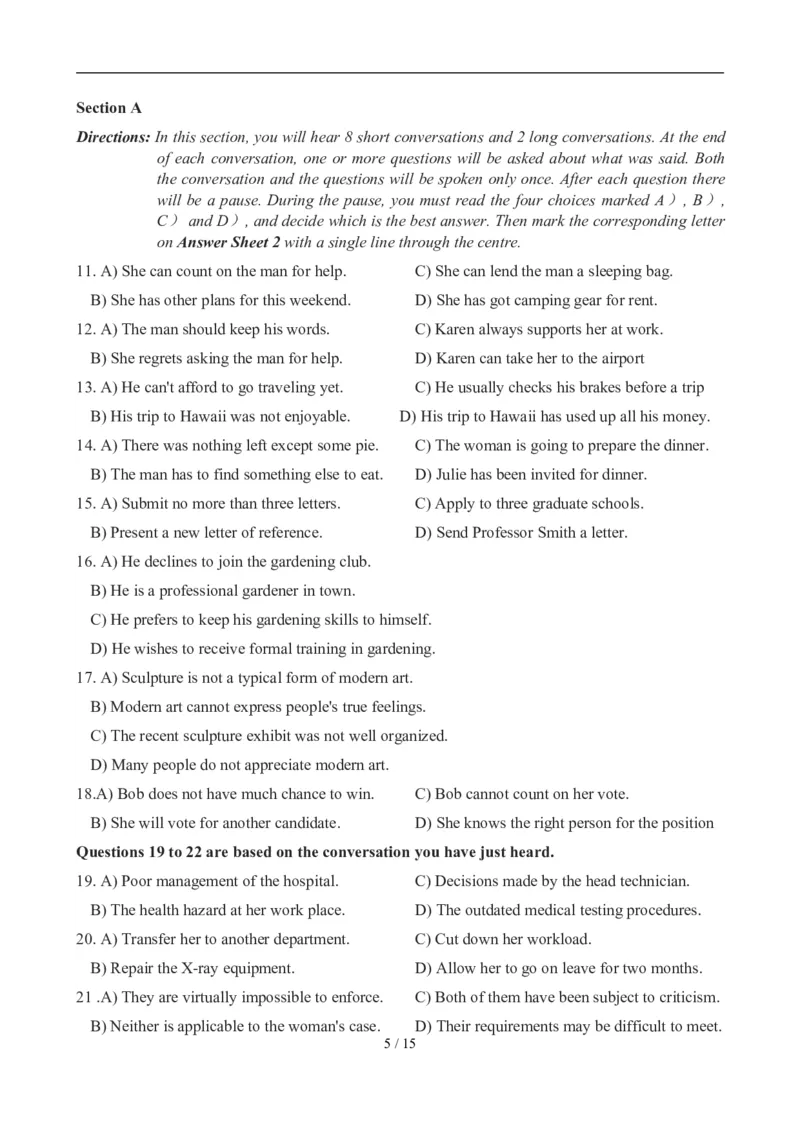
4/15Section A
Directions: In this section, you will hear 8 short conversations and 2 long conversations. At the end
of each conversation, one or more questions will be asked about what was said. Both
the conversation and the questions will be spoken only once. After each question there
will be a pause. During the pause, you must read the four choices marked A), B),
C)and D), and decide which is the best answer. Then mark the corresponding letter
onAnswer Sheet 2with asinglelinethrough thecentre.
11.A) Shecan count onthemanfor help. C)Shecan lendtheman a sleeping bag.
B) Shehas other plans forthis weekend. D) Shehas got camping gear for rent.
12.A) Theman should keep hiswords. C)Karen always supports her at work.
B) Sheregrets asking theman for help. D) Karen can takeher totheairport
13.A) He can't afford to go traveling yet. C)He usually checks his brakes before atrip
B) His tripto Hawaii was notenjoyable. D) Histrip toHawaii has used upall his money.
14.A) There was nothingleft except somepie. C)The woman is going to prepare thedinner.
B) Theman has tofind somethingelse to eat. D) Juliehas been invited fordinner.
15.A) Submitnomorethan threeletters. C)Apply to three graduateschools.
B) Present a newletterof reference. D) Send ProfessorSmith aletter.
16.A) He declines to jointhegardening club.
B) Heis aprofessional gardener in town.
C)Heprefers to keep his gardening skillsto himself.
D)He wishes to receiveformal training in gardening.
17.A) Sculptureis nota typical form of modern art.
B) Modern art cannot express people's truefeelings.
C)Therecent sculptureexhibit was not well organized.
D)Many peopledonot appreciate modern art.
18.A) Bob does nothave much chance to win. C)Bob cannot count onhervote.
B) Shewillvotefor another candidate. D) Sheknows theright person fortheposition
Questions 19to22are basedon theconversation youhavejustheard.
19.A) Poormanagement of thehospital. C)Decisions madebythehead technician.
B) Thehealth hazard at her work place. D) Theoutdated medical testing procedures.
20.A) Transfer herto another department. C)Cut down her workload.
B) RepairtheX-ray equipment. D) Allowhertogo onleave for two months.
21.A) They are virtually impossibleto enforce. C)Both ofthem have been subject to criticism.
B) Neither isapplicable to thewoman's case. D) Theirrequirements may bedifficult tomeet.
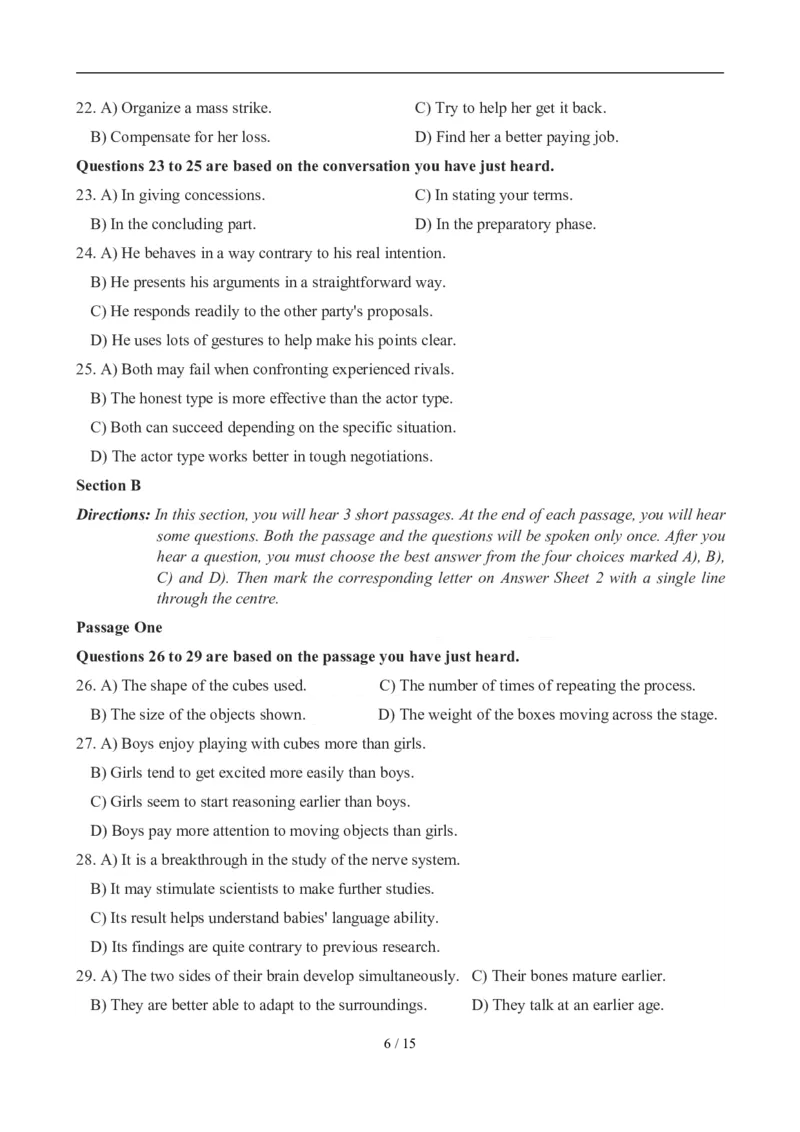
5/1522.A) Organizea mass strike. C)Try to help herget itback.
B) Compensatefor herloss. D) Find her abetter payingjob.
Questions 23to25are basedon theconversation youhavejustheard.
23.A) In giving concessions. C)In stating your terms.
B) In theconcluding part. D) In thepreparatory phase.
24.A) He behaves ina way contrary to his real intention.
B) Hepresents his arguments in a straightforward way.
C)Heresponds readily tothe otherparty's proposals.
D)He uses lots ofgestures tohelp makehis pointsclear.
25.A) Both may fail when confronting experienced rivals.
B) Thehonest type is more effectivethan the actor type.
C)Both can succeed depending onthespecific situation.
D)The actor type works better intough negotiations.
Section B
Directions: In this section, you will hear 3 short passages. At the end of each passage, you will hear
some questions. Both the passage and the questions will be spoken only once. After you
hear a question, you must choose the best answer from the four choices marked A), B),
C) and D). Then mark the corresponding letter on Answer Sheet 2 with a single line
through thecentre.
PassageOne
Questions 26to29are basedon thepassageyou havejustheard.
26.A) Theshape ofthecubes used. C)The numberof timesof repeating theprocess.
B) Thesizeoftheobjects shown. D) The weight oftheboxes moving across thestage.
27.A) Boys enjoy playing with cubes more than girls.
B) Girls tend to get excited moreeasily than boys.
C)Girls seem tostart reasoning earlierthan boys.
D)Boys pay more attention tomoving objects than girls.
28.A) It isa breakthrough in thestudy ofthenerve system.
B) It maystimulate scientiststo make furtherstudies.
C)Its result helps understand babies' language ability.
D)Its findings are quitecontrary to previous research.
29.A) Thetwo sides of theirbrain develop simultaneously. C)Their bones mature earlier.
B) They are better able toadapt to thesurroundings. D) They talk at an earlier age.
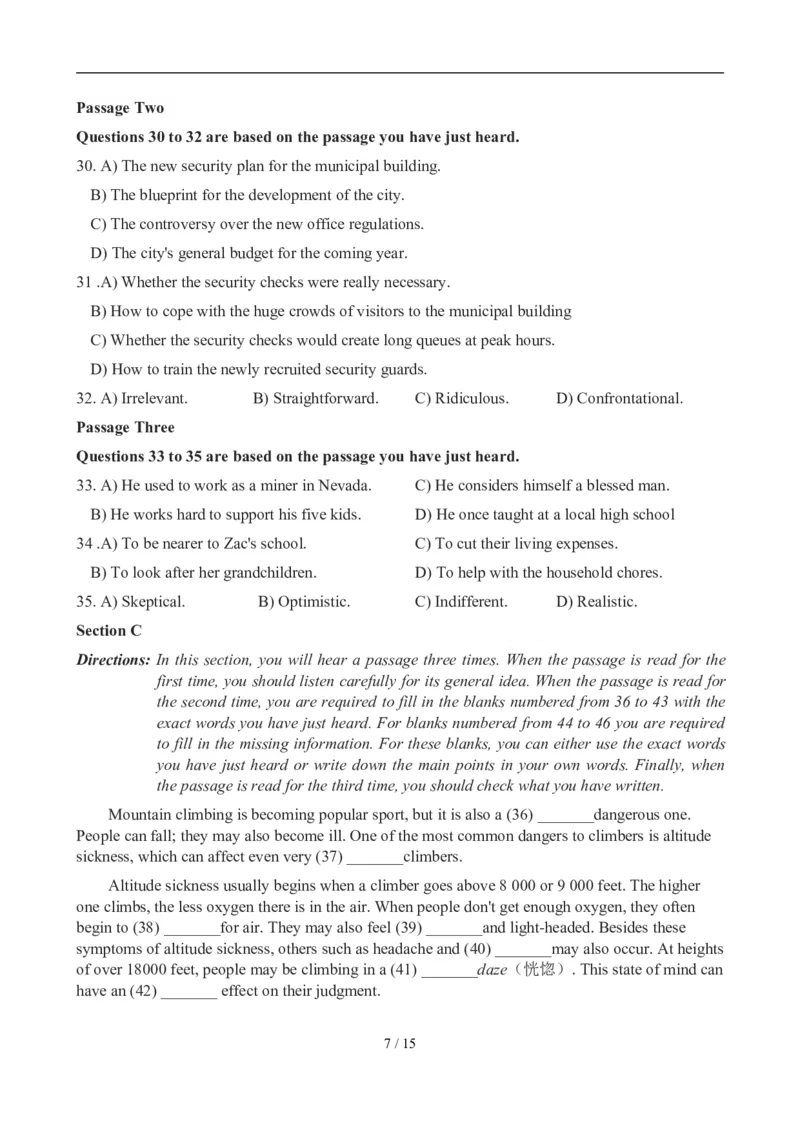
6/15PassageTwo
Questions 30to32are basedon thepassageyou havejustheard.
30.A) Thenew security plan forthemunicipal building.
B) Theblueprint for thedevelopment ofthecity.
C)Thecontroversy over thenew office regulations.
D)The city's general budget for thecoming year.
31.A) Whetherthesecurity checks were really necessary.
B) Howto cope with thehuge crowds ofvisitors to themunicipal building
C)Whetherthesecurity checks would createlong queues at peak hours.
D)How totrain thenewly recruited security guards.
32.A) Irrelevant. B) Straightforward. C)Ridiculous. D) Confrontational.
PassageThree
Questions 33to35are basedon thepassageyou havejustheard.
33.A) He usedtowork as a minerin Nevada. C)He considers himselfablessed man.
B) Heworks hardto support his fivekids. D) He oncetaught at a local high school
34.A) To benearer to Zac's school. C)Tocut their livingexpenses.
B) To look after her grandchildren. D) To help with thehousehold chores.
35.A) Skeptical. B) Optimistic. C)Indifferent. D) Realistic.
Section C
Directions: In this section, you will hear a passage three times. When the passage is read for the
first time, you should listen carefully for its general idea. When the passage is read for
the second time, you are required to fill in the blanks numbered from 36 to 43 with the
exact words you have just heard. For blanks numbered from 44 to 46 you are required
to fill in the missing information. For these blanks, you can either use the exact words
you have just heard or write down the main points in your own words. Finally, when
the passageisread forthethird time, you shouldcheck whatyou havewritten.
Mountain climbing isbecoming popularsport, but it isalso a (36)_______dangerous one.
People canfall; they may also becomeill. Oneof themostcommon dangers toclimbers isaltitude
sickness, which can affect even very (37)_______climbers.
Altitudesickness usually begins when aclimber goes above 8000or9000feet. Thehigher
one climbs,theless oxygen there isin theair. Whenpeople don't get enough oxygen, they often
begin to(38) _______forair. They may also feel (39)_______and light-headed. Besides these
symptoms of altitudesickness, others such as headache and (40) _______mayalso occur. At heights
ofover 18000feet, people may beclimbing in a(41)_______daze(恍惚).This stateofmind can
have an (42) _______effect ontheirjudgment.
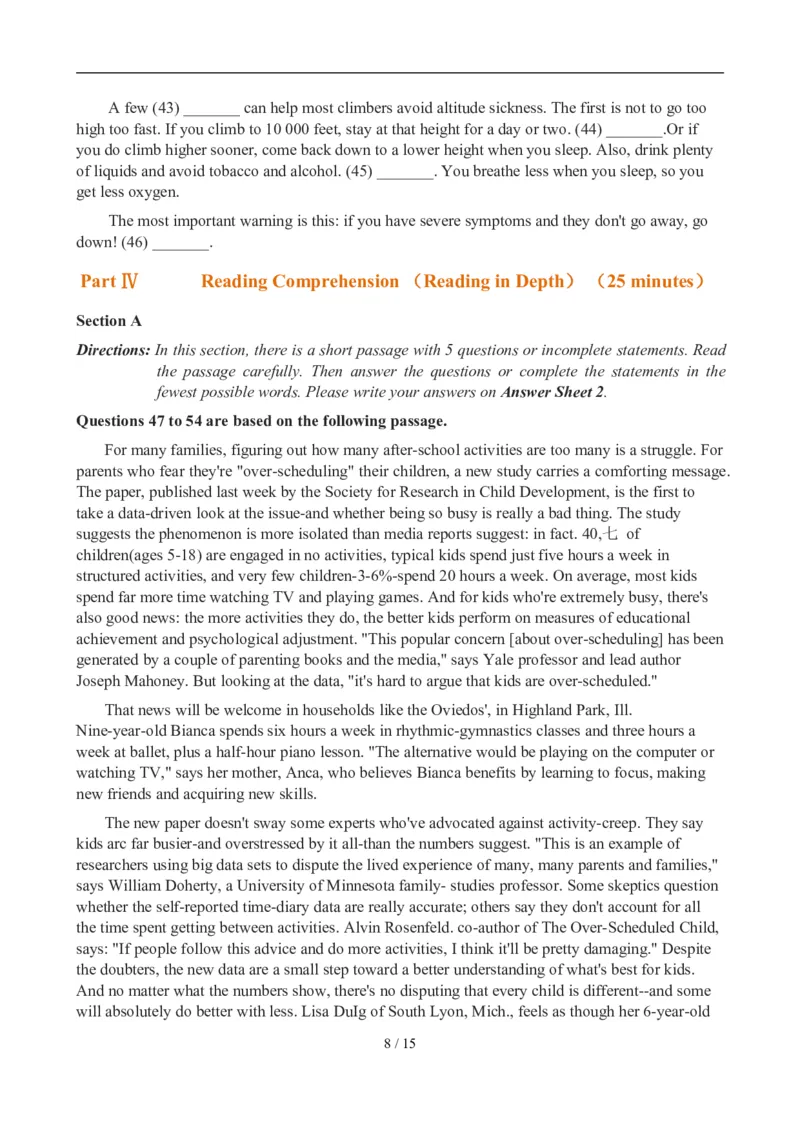
7/15A few (43)_______can help mostclimbers avoidaltitudesickness. The firstis notto go too
high toofast. If you climb to10000feet, stay at that height for aday ortwo. (44)_______.Or if
you doclimb highersooner, come back down toa lower height whenyou sleep. Also,drink plenty
ofliquids and avoid tobacco and alcohol. (45) _______.Youbreathe less when you sleep, soyou
get less oxygen.
The mostimportant warning isthis: ifyou havesevere symptoms andthey don't go away, go
down! (46) _______.
Part Ⅳ Reading Comprehension (Reading in Depth) (25 minutes)
Section A
Directions: In this section, there is a short passage with 5 questions or incomplete statements. Read
the passage carefully. Then answer the questions or complete the statements in the
fewest possiblewords. Pleasewriteyour answers onAnswer Sheet 2.
Questions 47to54are basedon thefollowing passage.
For manyfamilies, figuring out howmany after-school activities are toomany is a struggle. For
parents who fear they're "over-scheduling" their children, a new study carries a comforting message.
The paper, published lastweek bytheSociety forResearch in Child Development, is thefirst to
take adata-driven lookat the issue-and whether being so busyis really abadthing. The study
suggests thephenomenon is moreisolated than media reports suggest: infact. 40,七 of
children(ages 5-18)are engaged innoactivities, typical kidsspend justfive hours aweek in
structured activities, and very few children-3-6%-spend 20hours aweek. On average, mostkids
spend far moretimewatching TV and playing games. And forkids who're extremelybusy, there's
also good news: themoreactivities they do,the betterkids perform onmeasures ofeducational
achievement and psychological adjustment. "This popularconcern [about over-scheduling] has been
generated byacouple ofparenting books and themedia," says Yale professor and lead author
Joseph Mahoney. But lookingat thedata, "it's hard to argue that kids are over-scheduled."
That news will bewelcome in households liketheOviedos', in Highland Park, Ill.
Nine-year-old Bianca spends six hours aweek in rhythmic-gymnastics classes and three hours a
week at ballet, plus a half-hour pianolesson. "The alternativewould beplaying onthecomputer or
watching TV," says her mother, Anca, who believes Bianca benefits bylearning to focus, making
new friends and acquiring newskills.
The newpaper doesn't sway someexperts who'veadvocated against activity-creep. They say
kids arc far busier-and overstressed byit all-than thenumbers suggest. "This isan exampleof
researchers using bigdata sets to disputethelived experience ofmany, many parents and families,"
says WilliamDoherty, aUniversity of Minnesotafamily- studies professor. Someskeptics question
whether the self-reported time-diary dataare really accurate; others say they don't account for all
the timespent getting between activities. Alvin Rosenfeld. co-author ofTheOver-Scheduled Child,
says: "If peoplefollowthis advice and domoreactivities, Ithinkit'll bepretty damaging." Despite
the doubters, thenewdata are asmall step toward abetter understanding ofwhat's best for kids.
And nomatterwhat the numbers show, there's nodisputingthat every child is different--and some
will absolutely dobetter withless. Lisa DuIg ofSouth Lyon, Mich., feels as though her6-year-old
8/15twins are theonly kids intown who don't take skiing and ice-skating lessons. "Thereis nothing
wrong withcuddling up(依偎)onthecouch with Mom andDad," says Lisa. And for families who
prefer to bondonthesidelines ofsoccer fields, thelatest research can providea different kind of
comfort.
注意:此部分试题请在答题卡2上作答。
47The question in disputein thepassage is whether ornot children are_____?
48It can be inferred that agood way to keep children away from TV and videogames isto
engage them in______.
49According to thenew study, children will _____academically and psychologically ifthey
involvethemselves inmore after-school activities.
50.There are skeptics who raise doubtsabout thenewstudy. saying that itsdata may be____.
51.In spite ofthecontroversy, thenew studymay help peoplesee more clearly____.
Section B
Directions: There are 2 passages in this section. Each passage is followed by some questions or
unfinished statements. For each of them there are four choices marked A), B), C)and
D). You should decide on the best choice and mark the corresponding letter
onAnswerSheet 2with asinglelinethroughthecentre.
PassageOne
Questions 52to56are basedon thefollowing passage.
Who's poorin America? That's a question hard toanswer. Hard because there's noconclusive
definition of poverty. Lowincomematters, though howlowis unclear. Poverty isalso astateof
mind that fosters self-defeating behavior-bad work habits, family breakdowns, and addictions.
Finally, poverty results from bad luck: accidents, job losses, disability.
Despite poverty's messiness, we've measured progress against itbyasingle statistic: thefederal
poverty line. By thismeasure, we haven't made much progress. But theapparent lack of progress is
misleading for two reasons.
First, itignores immigration. Manyimmigrants are poorand low-skilled. They addto thepoor.
From 1989to 2007,about three quarters oftheincrease in thepoverty population occurred among
Hispanics(西班牙裔美国人)-mostly immigrants and theirchildren.
Second, thepoor's material well-being has improved. Theofficial poverty measure obscures
this bycounting only pre-tax cash income and ignoring othersources of support, includingfood
stamps and housingsubsidies. Although manypoorlivefrom hand tomouth, they've participated in
rising livingstandards. In 2005,91%had microwaves. 79% air-conditioning, and 48%cell phones.
The existing poverty linecould beimproved byadding someincomesources and subtracting
someexpenses. Unfortunately, theadministration's proposal fora"supplemental poverty measure"
in 2011goes beyond that. Thenew poverty number would compoundpublicconfusion. It also
raises questions about whether thestatisticistailored to favora politicalagenda. The"supplemental
measure" ties thepoverty threshold towhat thepoorest thirdof Americans spend onfood, housing,
9/15clothing, and utilities. Theactual threshold willprobably behigher than today's poverty line. Many
Americans would find thisweird: peopleget richer, but "poverty" stays stuck..
What produces thisoutcome isa different viewof poverty. Thepresent concept is anabsolute
one: thepoverty threshold reflects the amountestimated to meet basicneeds. By contrast, the new
measure embraces arelative notion ofpoverty: people are automatically poorif they're agiven
distance from the top,even iftheirincomes are increasing.
The newindicator is a"propaganda device" topromote incomeredistribution byshowing that
poverty is stubborn orincreasing. TheCensus Bureau has estimated statistics similartothe
administration's proposal. In 2008,thetraditional poverty rate was 13.2%; estimates ofthenew
statisticrange uptol7%. Thenew poverty statisticexceeds theold,and the gap grows larger over
time.
As senator Daniel Moynihan said, theadministration isdefining poverty up.It's legitimateto
debate howmuch we should aidthepoor orreduce economic inequality. But the debate shouldnot
be swayed bymisleading statistics that few Americans could possiblyunderstand. Government
statistics shouldstrivefor political neutrality(中立).This onefails.
注意:此部分试题请在答题卡2上作答。
52.What isthe mainidea ofthe first paragraph?
A) Poverty isvery often defined as astate ofmind.
B) Poverty is a problem hard totackle in America.
C)Badwork habits and bad luck lead topoverty.
D) There isnoconsensus ontheconcept of poverty.
53.What does theauthor sayabout thepoor inAmerica?
A) Theirliving standards have actually improved.
B) Most ofthem are immigrants andtheirdescendants.
C)Their chances of risingabove thepoverty lineare slim.
D) Mostof them rely ongovernment subsidies forsurvival.
54.What does theauthor thinkof theadministration's proposal fora "supplemental poverty
measure"?
A) It isintended tofurther help thepoor. C)It is a positiveresponse to changed circumstances.
B) It is made to servepolitical purposes. D)It is an attempt to combat theeconomic recession.
55.What ischaracteristicof thenewmeasure ofpoverty?
A) It defines poverty bythegap between therich and thepoor.
B) It raises thethreshold for thepoorto get welfare benefits.
C)It is moreaccurate andscientific interms ofstatistics.
D) It truly reflects thepractical needs ofthe poor.
10/1556.What does theauthor want to say byquoting Daniel Moynihan?
A) Economicequality is but an empty dream.
B) Political neutrality can never beachieved.
C)The administration's statistics are biased.
D) Thedebate over poverty will get nowhere.
PassageTwo
Questions 57to61are basedon thefollowing passage.
Eleven summers ago I was sent toamanagement program at the WhartonSchool to be
prepared for bigger things. Along withlectures onfinance andentrepreneurship and the like,the
program included a delightfully out-of-place session with Al Filreis, an English professor at the
University ofPennsylvania, onpoetry.
For three hours hetalked us through "The Red Wheelbarrow" and "Stopping byWoodsona
Snowy Evening." The experience----especially when contrasted with thehorrible proseof ourother
assigned reading--sent mefleeing to thecampus bookstore, where Iresumed a long-interrupted
romance withmeter and rhyme(韵).
Professor Filreis says that heis "a littleshocked" at howintensely his Wharton students
respond to thisunexpected deviation from thebusinesslike, not justas arelief butas akindof
stimulus. Many writeafterward asking him torecommend booksof poetry. Especially now,
"The grimeconomy seems to make theparticipants keener than ever to think'out of thebox'in
the way poetry encourages," he toldme.
Which brings meto Congress, an institution stuck deeper insidethe boxthan justabout any
other thesedays. You haveprobably heard that uponCapitol Hil(l 美国国会山),they're very bigon
prayer breakfasts, where members gather overscrambled eggs and askGod for wisdom. You can
judge from theagonizingdebt spectacle we've watched thissummer howwell that's working. Well,
maybe it's timeto add somepoetry readings tothe agenda.
I'm not suggesting that poetry will guide ourlegislators towisdom anymore than prayer has.
Just that itmight makethem alittle morehuman. Poetry isnosubstitute forcourage orcompetence,
but properly applied, it isa challenge to self-certainty, which we currently have in excess.Poetry
serves as a spurto creativethinking, areproach to dogma andhabit, aremedy to thecurrent fashion
for pledge signing.
The poet Shelley, indefense ofpoetry nearly two centuries ago, wrote, "Aman. tobe greatly
good, must imagine intensely and comprehensively; he mustput himselfin theplaceof another and
ofmany others; thepains and pleasures ofhis species must become hisown."Shelley concludes that
essay bycalling poets "the unacknowledged legislators oftheworld, "because they bring
imagination totherealmof "reasoners and mechanists."
The relevance ofpoetry was declared moreconcisely in fivelines from thelovepoem
"Asphodel. That Greeny Flower," byWilliam Carlos Williams:
It is difficult to get thenews form poems yet men diemiserably every day for lack ofwhat is
found there
11/15注意:此部分试题请在答题卡2上作答。
57.Whydid theauthorparticipate in theWharton School management program?
A) He was apassionate loverof classical poetry.
B) He was being trained for an important position.
C)He hadjust been promoted totop management.
D) He was interested infinance and entrepreneurship.
58.What did theauthorthink ofProfessor Filreis's poetry session?
A) It diverted students'attention from theassigned reading
B) It made themanagement program appear romantic.
C)It was extremely appealing to thestudents.
D )It pulled students out ofprosereading sessions.
59.What was the impact ofthepoetry sessiononthe program participants according toProfessor
Filreis?
A) It inspired them to viewthings from broaderperspectives.
B) It led them tothink poetry indispensable tomanagement.
C)It helped them develop a keener interest in literature.
D) It encouraged them toembark ona political career.
60.What does theauthor thinkof CapitolHill's prayer over breakfast?
A) It isa ritual that has lost itsoriginal meaning.
B) It doesn't really help solvetheeconomic problems.
C)It provides inspirationas poetry reading does.
D) It helps people turnaway from thedebt spectacle.
61.What dowelearn from Shelley's essay?
A) Poetry can relieve peopleof painsand sufferings.
B) It takes poeticimagination to become alegislator.
C)Legislators shouldwin publicacknowledgement.
D) It isimportant tobe imaginative andsympathetic.
Part V Cloze (15 minutes)
Directions: There are 20 blanks in the following passage. For each blank there are four choices
marked A),B),C)andD)ontheright sideof the paper. Youshould choosethe ONE
that best fits into the passage. Then mark the corresponding letter on Answer Sheet
2with asinglelinethrough thecentre.
12/15“Myjobis killingme.”Whoamong us hasn't issued that complaint at least once? Nowa new
study suggests that your dramatic complaint may____62____somescientifictruth.
The 20-year study, byresearchers at Tel Aviv University, _____63______to examinethe
relationship between the workplace and a person's risk of death. Researchers _____64_____820
adults whohad undergone a______65____physical exam at ahealth clinicin 1988,and then
interviewed them _____66_____detail about theirworkplace conditions—asking hownice their
colleagues were, whether theirboss was supportive and howmuch______67_____they had in
theirposition.
The participants_____68_____ in age from 25to65at thestart ofthestudy andworked in a
variety of____69___,including finance, health care, manufacturing andinsurance. Theresearchers
_____70______the participants through theirmedical records: bythestudy's conclusion in 2008,
53people haddied—and they were significantly more likelythan thosewho survived to report
having a____71____work environment.
People who reported having littleor no____72____support from theirco-workers were 2.4
times more likelyto die____73____thecourse of thestudythan thosewhosaid theyhad close,
supportive _____74_____withtheirworkmates. Interestingly, therisk ofdeath was _____75_____
only topeople's perceptions oftheir co-workers, nottheir bosses .Peoplewho reported negative
relationships with theirsupervisors were ____76____likely to diethan others.
The study was observational, _____77____itcould not determine whether toxicworkplace
environments caused death, onlythat it was _____78____with therisk. But the findings add tothe
evidence ______79_______having asupportivesocial network decreases stress and helps
_____80____good health. On theother hand, beingexposed _____81_____chronicstress
contributes to depression, illhealth and death.
62.A) hold C)risk
B) strike D)trace
63.A)fought C)sought
B)submitted D)resorted
64.A)allied C)volunteered
B)arrayed D)recruited
65.A)routine C)grave
B)nominal D)drastic
66.A)beyond C)by
B)in D)over
67.A)autonomy C)audience
B)automation D)authenticity
68.A)consisted C)involved
B)contained D)ranged
13/1569.A)facets C)districts
B)fields D)species
70.A)chased C)tracked
B)pursued D)trailed
71.A)cozy C)hostile
B)fabulous D)transparent
72.A)social C)physical
B)academic D)domestic
73.A)against C)inside
B)across D)during
74.A)pacts C)unions
B)bonds D)webs
75.A)added C)tied
B)adapted D)led
76.A)no more C)no less
B)far more D)far less
77.A)unless C)or
B)while D)so
78.A)constructed C)collaborated
B)correlated D)coordinated
79.A)how C)that
B)when D)why
80.A)elevate C)propel
B)inject D)foster
81.A)at C)toward
B)to D)under
Part VI Translation (5 minutes)
Directions: Complete the sentences by translating into English the Chinese given in brackets.
Please write your translation on Answer Sheet 2
82.______________(不管中国变得多么强大),it willconstitutenothreat toany othercountry.
14/1583.Success in lifedoes not depend so much onone's school records______________(而是靠其勤
奋和坚持).
84._______________(他们要是此刻在这儿就好了),we would beable tocelebrate their
wedding anniversary.
85.In recent years, with hisbusiness booming, he_______________(给慈善事业捐了大笔的
钱).
86.Without theatmosphere, we_______________ (将被迫寻找躲避太阳的藏身处),as there
would be nothingto protect us from itsdeadly rays.
15/15