2012 年 12 月大学英语六级(CET-6)真题试卷
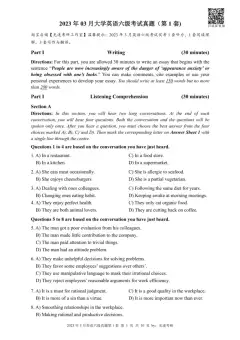
Part I Writing (30 minutes)
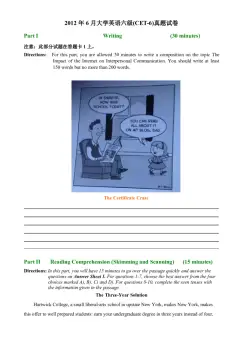
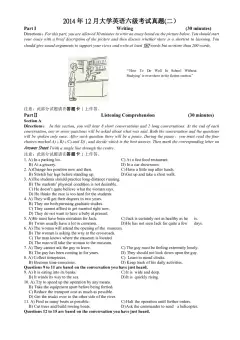
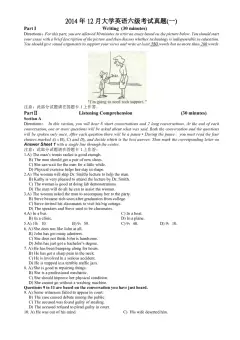
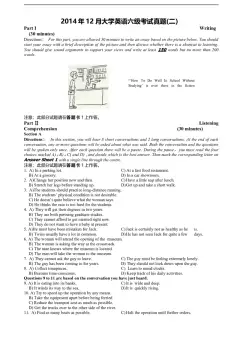
Direction: For this part, you are allowed 30 minutes to write an essay entitled Man and
Computer by commenting on the saying, “The real danger is not that the computer will
begin to think like man, but that man will begin to think like the computer.” You should
writeat least 150wordsbut nomorethan 200words.
Man andComputer
Part II Reading Comprehension (Skimming and Scanning)
Directions: Inthispart,youwillhave15minutestogooverthepassagequicklyandanswerthe
questionsonAnswerSheet1.Forquestions1-7,choosethebestanswerfromthefourchoicesmarked
A),B),C)andD).Forquestions8-10,completethesentenceswiththeinformationgiveninthepassage.
InaDigitalAge,StudentsStillClingtoPaperTextbooks
They texttheirfriends all daylong. At night, theydoresearch fortheirterm papers onlaptops
and communewith theirparents onSkype. But as they walk thepaths of Hamilton College, a
poster-perfect liberal arts school in this upstatevillage, students are stillhauling around bulky,
old-fashioned textbooks-and lovingit.
"The screen won't go blank," said Faton Begolli, ajunior from Boston. "There can't bea virus.
It wouldn't be thesamewithout books. They've defined 'academia' (学术) forathousand years."
Thoughtheworld ofprint is receding before a tideofdigital books, blogs and other Web sites,
a generation ofcollege studentsgrowing upwith technology appears to be holdingfast to traditional
textbooks. That loyalty comes at aprice. Textbooksare expensive-a year's worth can cost$700
to$900-and students' frustrations with theexpense, as well as theemergence ofnew technology,
have producedaperplexing array of optionsfor obtainingthem.
Internet retailers likeAmazon andTextbooks.comare sellingnew and used books. They have
been joined byseveral Webservices that rent textbooks to students bythesemester. Some1500
college bookstores are also offering rentals thisfall, upfrom 300last year. Here at Hamilton,
students this year havea newway to avoidthemiddleman: anonprofit Website, created bythe
college's Entrepreneur Club,that lets them sell used books directly toone another.
The explosion ofoutlets and formats-including digital books, which are rapidly becoming
more sophisticated-has left somestudents bewildered. After completing thedifficult job ofcourse
selection, they are forced to weigh costversus convenience, analyze theirown studyhabits and
guess which texts they willwant for years to come and which they willnot miss.
1/14"It depends onthecourse," said Victoria Adesoba, astudent at New York University who was
standing outsidethat school's bookstore, a powder-blue bookbag slungover her shoulder“Last
semester, Irented for psychology, and it was cheaper. But forsomething likeorganic chemistry, I
need to keep the book.E-textbooks are good, but it's tempting to go onFacebook, and itcan strain
your eyes."
For all thetalk that her generation is themosttechnologically knowledgeablein history,
paper-and-ink textbooks donot seem destined to disappear anytime soon
According to theNational Association ofCollege Stores, digital books makeupjustunder 3%
oftextbook sales, although theassociation expects that share to growto10-15% by2012as more
titles are madeavailable as e-books.
In two recent studies-onebytheassociation and another bytheStudent PublicInterest
Research Groups-three- quarters ofthestudents surveyed said they stillpreferred a boundbooktoa
digital version.
Many students are reluctant togive uptheability to flip quickly between chapters, writein the
margins and highlight passages, although newsoftware applications are beginning to allowstudents
to usee-textbooks that way.
"Students grew uplearning from printbooks." said Nicole Allen. thetextbooks campaign
director for theresearch groups, "so as they transition tohighereducation, it's notsurprising that
they prefer aformat that they are most accustomed to."
Indeed, many Hamiltonstudents growpassionate about theweighty volumes they still carry
from dorm room to lecture hall tolibrary, even as they compulsively(克制不住地)check their
smartphones fortextmessages and c-mails.
"I believe that thecodex is oneofmankind's best inventions," said Jonathan Piskor, ajunior
from North Carolina, using theLatin term for book.
That passion may beone reason that Barnes & NobleCollege Booksellers is working so hard
to market itsnew software application, NOOKstudy, which allows students to navigatec-textbooks
onMacs andPCs. Thecompany, which operates 636campus bookstores nationwide, introduced the
free application last summerin hopes ofluring more students tobuyits electronic textbooks.
"The real obstacle is gettingthem totry it," said Tracey Weber, thecompany's executive
vicepresident.
The company is giving away "College Kick-Start Kits"to students who download NOOKstudy
in thefall semester, with adozen classic c-books likeTheCanterbury Tales and TheScarlet Letter.
CourseSrnart is lettingstudents try any c-textbook free for two weeks.
But not every textbook isavailable in digital or rental format. At Hamilton,for instance, only
about one-fifth ofthe titles are soldas c-textbooks thisfall. A strollthrough thecampus store
revealed theprice difference. Abookonconstitutional law,for instance, was$189.85 new$142.40
used and$85.45 for rent. (Typically, ane-textbookis cheaper than a usedbook,though more
expensivethan a rental.)
The expenseofcollege textbooks, which is estimated tohave risen fourtimes theinflation rate
in recent years, has become suchaconcern that somepoliticians are taking upthecause. Last
2/14month, SenatorCharles E. Schumerof NewYork urged morecollege stores to rent books, after a
survey of38campus bookstores in NewYork Cityand onLong Island byhis office foundthat 16
did not offer theoption.
On Thursday, students at morethan 40colleges nationwide are planning anAffordable
Textbooks Day ofAction toencourage faculty members to assign texts that are less expensive, or
offered free online.
For now,buying books theold-fashioned way-new orused-prevails. Charles Schmidt, the
spokesman fortheNational Association ofCollege Stores, said that ifa campus storesold a new
bookfor$100, it would typically buythe book back for$50 at semester's end and sellit to thenext
student for$75.
The buy-back price plunges, however, iftheprofessor drops the bookfrom thesyllabus orif
the bookstorehas bought enough books to meet demand. When Louis Boguchwal, majoring in
economics and math, tried to sell a$100 linearalgebra(线性代数)textbookback tothe college
bookstore, hewas offered$15.
"It was insulting," he said. "They give you next to nothing."
Thus, the creation ofHamilton's newnonprofit Web site, get my textbooks. org. So far, traffic
has been light: onlyabout 70books have been sold thisfall. But JasonMariasis, president ofthe
Entrepreneur Club, said heexpected sales to pick upas word spread.
Mr. Begolli. amember oftheclub, recentlysold three German novels for$17 onthesite. "If I
had soldthem back to thebookstore, I would havegotten$7 or$8,"he said. "The bookstore isking
when it comes totextbooksales. Wefelt there shouldbe something forstudents, bystudents."
Yet somestudentshave to go italone. Rosemary Rocha, an N.Y.U.student pursuing a degree
in hospitalityand tourismmanagement, added upher required reading for thesemester: $600."It's
harsh," shesaid. "I'm currently collecting unemployment, sothat's not going tohappen."
Instead, shewaits toborrow thefew copies herprofessors leave onreserve at thelibrary, or
relies onthekindness ofclassmates. "My friends will let meborrow theirbooks in exchange for
coffee ora sliceofpizza," shesaid. "I very seldom buythetextbooks, but I'm always likeachicken
without ahead."
注意:此部分试题请在答题卡1上作答。
1.How dostudents viewpaper textbooks inthis digital age?
A)They are indispensableto writing term papers.
B) They play an irreplaceable role intheir study.
C)They are inferior to c-books inmany ways.
D)They willbe replaced byc-books someday.
2.In what way are printed books frustrating to students?
A)They are too heavy tocarry. C)They cost too much money.
C)They take uptoo much space. D) They often go out ofprint.
3/143.What can students dowith thecreation of thenonprofit Web siteat Hamilton?
A)They can rent new booksfor a nominalfee.
B) They can buybooks,both used andnew, at a lowerprice.
C)They can read onlinebypayingasmall fee.
D)They can sellbooks to eachother withouta middleman
4.What can we learn about textbooks from VictoriaAdesoba's case?
A)Printed textbooks will notdisappear any timesoon.
B) Theircost is students' chief consideration
C)E-books are thefirst choice oflow-income students.
D)Science students preferprinted textbooks.
5.Whydomoststudents stillpreferthe traditional paper-and-ink textbooks?
A)They can form good learning habitswith printed textbooks.
B) They have been used to theirformat ever sincechildhood.
C)They can protect theireyesight using printed textbooks.
D)They are passionate about theirphysical presence.
6.What does Tracey Weber think isthebest wayto expand c-textbooksales?
A)Invite studentsto try c-book applications forfree.
B) Update c-book software tomeet students' needs.
C)Open more c-book stores onuniversity campuses.
D)Make theprice ofe-textbooks moreattractive.
7.Tocombat thesoaring price oftextbooks, Senator Charles E.Schumer suggeststhat __________.
A)publishers offer moretextbooks online B) college stores rent books to students
C)collegestores rent books to students D) studentsbuycheaper used books
8.Louis Boguchwal thought themoney he was offered forhis linear algebra textbook was
________________________________.
9.Despite thelight trafficonHamilton's nonprofit Website, Jason Mariasis was confident that its
bookbusiness would________________________________.
10.Living onunemployment benefits. Rosemary Rochacannot but borrow textbooks
from________________________________.
Part III Listening Comprehension (35 minutes)
Section A
Directions: In this section, you will hear 8 short conversations and 2 long conversations. At the end
of each conversation, one or more questions will be asked about what was said. Both
4/14the conversation and the questions will be spoken only once. After each question there
will be a pause. During the pause, you must read the four choices marked A), B),
C)and D), and decide which is the best answer. Then mark the corresponding letter
onAnswer Sheet 2with asinglelinethrough thecentre.
11.A) Shecan count onthemanfor help. C)Shecan lendtheman a sleeping bag.
B) Shehas other plans forthis weekend. D) Shehas got camping gear for rent.
12.A) Theman should keep hiswords. C)Karen always supports her at work.
B) Sheregrets asking theman for help. D) Karen can takeher totheairport
13.A) He can't afford to go traveling yet. C)He usually checks his brakes before atrip
B) His tripto Hawaii was notenjoyable. D) Histrip toHawaii has used upall his money.
14.A) There was nothingleft except somepie. C)The woman is going to prepare thedinner.
B) Theman has tofind somethingelse to eat. D) Juliehas been invited fordinner.
15.A) Submitnomorethan threeletters. C)Apply to three graduateschools.
B) Present a newletterof reference. D) Send ProfessorSmith aletter.
16.A) He declines to jointhegardening club.
B) Heis aprofessional gardener in town.
C)Heprefers to keep his gardening skillsto himself.
D)He wishes to receiveformal training in gardening.
17.A) Sculptureis nota typical form of modern art.
B) Modern art cannot express people's truefeelings.
C)Therecent sculptureexhibit was not well organized.
D)Many peopledonot appreciate modern art.
18.A) Bob does nothave much chance to win. C)Bob cannot count onhervote.
B) Shewillvotefor another candidate. D) Sheknows theright person fortheposition
Questions 19to22are basedon theconversation youhavejustheard.
19.A) Poormanagement of thehospital. C)Decisions madebythehead technician.
B) Thehealth hazard at her work place. D) Theoutdated medical testing procedures.
20.A) Transfer herto another department. C)Cut down her workload.
B) RepairtheX-ray equipment. D) Allowhertogo onleave for two months.
21.A) They are virtually impossibleto enforce. C)Both ofthem have been subject to criticism.
B) Neither isapplicable to thewoman's case. D) Theirrequirements may bedifficult tomeet.
22.A) Organizea mass strike. C)Try to help herget itback.
B) Compensatefor herloss. D) Find her abetter payingjob.
5/14Questions 23to25are basedon theconversation youhavejustheard.
23.A) In giving concessions. C)In stating your terms.
B) In theconcluding part. D) In thepreparatory phase.
24.A) He behaves ina way contrary to his real intention.
B) Hepresents his arguments in a straightforward way.
C)Heresponds readily tothe otherparty's proposals.
D)He uses lots ofgestures tohelp makehis pointsclear.
25.A) Both may fail when confronting experienced rivals.
B) Thehonest type is more effectivethan the actor type.
C)Both can succeed depending onthespecific situation.
D)The actor type works better intough negotiations.
Section B
Directions: In this section, you will hear 3 short passages. At the end of each passage, you will hear
some questions. Both the passage and the questions will be spoken only once. After you
hear a question, you must choose the best answer from the four choices marked A), B),
C) and D). Then mark the corresponding letter on Answer Sheet 2 with a single line
through thecentre.
PassageOne
Questions 26to29are basedon thepassageyou havejustheard.
26.A) Theshape ofthecubes used. C)The numberof timesof repeating theprocess.
B) Thesizeoftheobjects shown. D) The weight oftheboxes moving across thestage.
27.A) Boys enjoy playing with cubes more than girls.
B) Girls tend to get excited moreeasily than boys.
C)Girls seem tostart reasoning earlierthan boys.
D)Boys pay more attention tomoving objects than girls.
28.A) It isa breakthrough in thestudy ofthenerve system.
B) It maystimulate scientiststo make furtherstudies.
C)Its result helps understand babies' language ability.
D)Its findings are quitecontrary to previous research.
29.A) Thetwo sides of theirbrain develop simultaneously. C)Their bones mature earlier.
B) They are better able toadapt to thesurroundings. D) They talk at an earlier age.
PassageTwo
Questions 30to32are basedon thepassageyou havejustheard.
6/1430.A) Thenew security plan forthemunicipal building.
B) Theblueprint for thedevelopment ofthecity.
C)Thecontroversy over thenew office regulations.
D)The city's general budget for thecoming year.
31.A) Whetherthesecurity checks were really necessary.
B) Howto cope with thehuge crowds ofvisitors to themunicipal building
C)Whetherthesecurity checks would createlong queues at peak hours.
D)How totrain thenewly recruited security guards.
32.A) Irrelevant. B) Straightforward. C)Ridiculous. D) Confrontational.
PassageThree
Questions 33to35are basedon thepassageyou havejustheard.
33.A) He usedtowork as a minerin Nevada. C)He considers himselfablessed man.
B) Heworks hardto support his fivekids. D) He oncetaught at a local high school
34.A) To benearer to Zac's school. C)Tocut their livingexpenses.
B) To look after her grandchildren. D) To help with thehousehold chores.
35.A) Skeptical. B) Optimistic. C)Indifferent. D) Realistic.
Section C
Directions: In this section, you will hear a passage three times. When the passage is read for the
first time, you should listen carefully for its general idea. When the passage is read for
the second time, you are required to fill in the blanks numbered from 36 to 43 with the
exact words you have just heard. For blanks numbered from 44 to 46 you are required
to fill in the missing information. For these blanks, you can either use the exact words
you have just heard or write down the main points in your own words. Finally, when
the passageisread forthethird time, you shouldcheck whatyou havewritten.
Mountain climbing isbecoming popularsport, but it isalso a (36)_______dangerous one.
People canfall; they may also becomeill. Oneof themostcommon dangers toclimbers isaltitude
sickness, which can affect even very (37)_______climbers. Altitudesickness usually begins when
a climbergoes above 8000or9000feet. The higheroneclimbs, the less oxygen there isin theair.
When peopledon't get enough oxygen, they often begin to (38) _______forair. They mayalso feel
(39) _______andlight-headed. Besides these symptoms ofaltitudesickness, others such as
headache and (40)_______may also occur. At heights ofover 18000feet, people may beclimbing
in a (41)_______daze(恍惚).This stateof mindcan have an(42) _______effect ontheir
judgment.
A few (43)_______can help mostclimbers avoidaltitudesickness. The firstis notto go too
high toofast. If you climb to10000feet, stay at that height for aday ortwo. (44)_______.Or if
you doclimb highersooner, come back down toa lower height whenyou sleep. Also,drink plenty
7/14ofliquids and avoid tobacco and alcohol. (45) _______.Youbreathe less when you sleep, soyou
get less oxygen. Themost importantwarning is this:ifyou have severe symptoms and they don't go
away, go down! (46)_______.
Part Ⅳ Reading Comprehension (Reading in Depth) (25 minutes)
Section A
Directions: In this section, there is a short passage with 5 questions or incomplete statements. Read
the passage carefully. Then answer the questions or complete the statements in the
fewest possiblewords. Pleasewriteyour answers onAnswer Sheet 2.
Questions47to51arebasedonthefollowingpassage.
America continues toget fatter, according toa new report onthe nation's weight crisis.
Statistics for 2008-2010show that 16states are experiencing steep increases in adult obesity, and
none has seen a notabledownturn inthe lastfour years.
Even Coloradans, long thenation's slimmestcitizens, are gaining excess pounds. Withan
obese population of19.8%, it is theonly statewithan adult obesity ratebelow 20%.But injust the
last four years, theranks of theobese even inColorado havegrown 0.7%.
Getting out oftheproblem willnot be simple, said Jeffrey Levi, executivedirector ofthe Trust
for America's Health. Thereport emphasized theneed fora range ofmeasures, including boosting
physical activity inschools, encouraging adults to get out andexercise, broadening access to
affordable healthy foods and using "pricing strategies" to encourage Americans tomake betterfood
choices.
"Until thegovernment takes onthefood industry, we'll continue to seetheappalling numbers
in this report," said Kelly Brownell, directorof YaleUniversity's RuddCenter for FoodPolicy and
Obesity. "Government could start bychanging agricultural subsidies,bynot making it financially
attractivefor companies to market unhealthy foods, byplacing serious restrictions onmarketing to
children, and with financial policies that make healthy foods cost less and unhealthy foods cost
more."
About 30years after the United States started seeing asteep risein theweight ofchildren and
adults, theillnesses most closely linked toobesity havebegun adramatic upturn. Diabete(糖尿
病)rates in 12states have jumped significantly, nowaffecting as manyas 12.2%of adults in
Alabama--the statewith thehighest obesity rates.
Obesity remains acondition disproportionately affecting those with pooreducation andlow
income, and closely tied to minoritystatus. Among African American adults,obesity topped 40/ain
15states. Among Latinos, ittopped 30%in23states.
In contrast, among white adults,obesity rates were higher than 3O%inonly fourstates, and in
nostatetopped 32.1%. Nearly athird of high school dropouts are obese, compared with 21.5% of
thosewho graduated from college ortechnical school.
8/14For children, thepicture from thereport is slightly better, said Dr. Francine Kaufman, an
obesity specialist at Children's Hospital Los Angeles. "Children are forthemost part holding
steady." shesaid.
Kaufman added that thereport's clear message-that obesity takes itsgreatest tollinlow-income
and minoritycommunities-underscores that "assistanceprograms are definitely required" to help
thosepopulations.
注意:此部分试题请在答题卡2上作答。
47.Compared with peoplein otherstates. Coloradans have longbeen considered relatively____.
48.The newreport advises encouraging Americans tobuyhealthy foods byadopting____.
49.Tocurb theincreasing obesity rate, thegovernment should firstof all adjustits____.
50.What has happened intheUS shows that there is ____between diabetes and obesity.
51.Whoare mostaffected byobesity in theUnited States according to Francine Kaufman?
Section B
Directions: There are 2 passages in this section. Each passage is followed by some questions or
unfinished statements. For each of them there are four choices marked A), B), C)and
D). You should decide on the best choice and mark the corresponding letter
onAnswerSheet 2with asinglelinethroughthecentre.
PassageOne
Questions 52to56are basedon thefollowing passage.
Is 20th-century capitalism failing 21st-century society? Members of theglobal elitedebated
that unusual question at the annual World EconomicForum
It is encouraging that more than three years sincetheglobal financial crisis, abelated (迟到的)
process ofsoul-searching has begun in search oftheright lessons tolearn from it.
There is a great difference, however, between being willing totalk about an issueandbeing
ready to act.
It is a difference between thosewho stillbelieve that all governments can dois get out ofthe
way andthosewho believethere is areal role forgovernments infirst reviving oureconomies, and
then settingtheright rules forfuture success.
If welearned anything from the1930s, it was that governments cannot shrug theirshoulders
and watch as theirown people are being laid off.
Nor should weforget thecauses ofthecurrent growth and debt crisisas weseek toput our
economies onamore sustainablefooting
Both theUnited States and Britain suffered because their economies were overly reliant on the
financial sector's artificial profits;living standards for themany worsened whilethe economic
rewards went to thetop 1percent; acapitalist model encouraged short-term decision-making
oriented toward quarterly profits rather than long-term health; and interest groups likegiant banks
were deemed too bigto fail ortoo powerful to challenge. Weneed torecognizethat the
9/14trickle-down promise(benefits given to therich willeventually bepassed onto thepoor)of
conservativetheorists has turned into agravity-defying realityin which wealth has flowed upward
disproportionately and. toooften, undeservedly. To address the problemrequires fresh thinking
from governments about howpeople train for theirworking lives and what aliving wage should be
Governments can set better-not necessarily more-rules to encourage productivebusinesses that
make andsell real products and services. Weneed rules that discourage thepredatory(掠夺的)
behavior ofthose seeking thefast buckthrough hostiletakeovers andasset-stripping thatdonot
have theinterests oftheshareholders, the employees ortheeconomy at heart. Andgovernments
must remember they are elected toserve thepeople, not thepowerful lobbies who can pay for
access or influence. Too often thereal enemies ofmarket capitalism are someofthe leading
beneficiaries ofthe current model, which favors big monopoliesand consumerexploitation. I
believe that changing the rules ofcapitalism will require a change inwhat citizens expect and ask of
politics. Thequestion is notso much whether 20th-century capitalismis failing 21st-century society
but whether politics can rise tothe challenge ofchanging a flawed economic model.
注意:此部分试题请在答题卡2上作答。
52.What importantlesson could bedrawn from the 1930s?
A)The government should play a rolein reviving theeconomy.
B) Thegovernment should providesubsidies fortheunemployed.
C)Thegovernment should notignore theroleof economists in thenation's economy.
D)The government should not brush asideideas from theWorld EconomicForum.
53.What isone ofthefactors contributing to therecent financial crisis in theUnited States and
Britain?
A)Their business giants'neglect of attending to long-term planning.
B) Theirgovernments' unnecessary intervention ineconomic affairs.
C)Theirgovernments failing to provideassistance for thepoorandneedy.
D)Their economies relying heavily ontheoperations ofthefinancial sector.
54.What does theauthor sayabout theso-called trickle-down promise?
A)It defies conventional wisdom.
B) It has failed to materialize.
C)It willbenefit both therich and thepooronce realized.
D)It will prove fatal to capitalist economy once broken.
55.What rules does theauthorsay governments should set to guarantee sustainableeconomic
development?
A)Rules that help businesses to expand fast but in ahealthy way.
B) Rulesthat discourage businesses from making quick money.
C)Rulesthat encourage businesses tomake and sell real products and services.
10/14D)Rules that ensure theincrease ofshareholders' dividends and employees' pay.
56.What shouldthe government doabout the current economy according tothe author?
A)Eliminatethereal enemies ofmarket capitalism.
B) Undertaketo repairtheflaws in theeconomic model.
C)Prevent thelobbies from exertingtoo muchinfluence.
D)Diminishthe rolepolitics plays innational economy.
PassageTwo
Questions 57to61are basedon thefollowing passage.
Women are halfthe populationbut only 15%ofboard members at bigAmerican firms, and
l0%in Europe. Companies that fish inonly half thetalent pool willlose outto thosethat cast their
net morewidely. There is also evidence that mixed boards makebetter decisions.
Mindful ofthis, European countries are passing laws that would force companies to promote
more women to theexecutivesuite. Anew French law requires listed firms toreserve 40% ofboard
seats forwomen by2017.Norway and Spain have similarlaws; Germany isconsidering one. The
European Parliament declared this monththat such quotas shouldbe applied throughout the
European Union.
There are two main arguments forcompulsory quotas. Oneis that themen who dominate
corporate boards are hopelessly sexist:theypromote peoplelikethemselves and ignoreany female
talent.
The second argument is moresubtle. Talented executives need mentors (导师)to helpthem
climb theladder. Maledirectors mentoryoung men butare reluctant to get friendly with young
women, lestthe relationship bemisinterpreted. Quotas will break thisvicious cycle byputtinglots
ofwomen at thetop, who can then offer theirsisters aleg up.
There may be something inboth arguments, but inmost rich countries sexismis nolonger the
main obstacle towomen's careers. Children are. Most women takecareer breaks tolook after them.
Many care for elderly relatives, too.One studyfound thattwo-thirds of American women had at
somepoint switched from full-timework to part-timeor flexibletimetobalance work andfamily.
Such choices make itharder forwomen togain the experience necessary tomake itto thevery top.
What ismore, big companies are increasingly global. Many want aboss who has worked in
more than onecountry. Such foreign postings disrupt families; many women turn them down. And
many, anticipating acareer break at somepoint in thefuture, enter fields where theirskillswill not
quickly become outdated, such as lawor human resources. Somelawyers make good chief
executives. But firms often want peoplewith financial oroperational experience for thetop jobs,
and thesefields are stillmale-dominated.
Quotas are too blunt atool forsuch atangled problem. Thewomen companies are compelled
to put onboards are unlikelyto beas useful as thosethey place there voluntarily. Quotas force firms
either topad theirboards with token non-executivedirectors, or toallocate real power onthebasis
ofsex rather than merit. Enforcing quotas for women has led to large numbers ofinexperienced
women being appointed to boards, and seriously damaged thosefirms' performance.
11/14注意:此部分试题请在答题卡2上作答。
57.What will happento acompany ifmen dominateits executiveboard?
A)Its talent poo1will dry out sooner. C)Its women employees will complain.
B) Its competitiveness will beweakened. D) It isboundtomake unwisedecisions.
58.What seems to prevent women from becoming board members apart from sexism?
A)Many ofthem lack thecourage to facethechallenge inthe board room.
B) Maledirectors are afraid of women's potential threat to theirauthority.
C)Few ofthem have thetraining and qualifications needed for executiveduties.
D)Male directors refrain from giving them guidance to avoidmisunderstanding.
59.What does theauthor sayis thereal barrier to women's careers?
A)An apparent lack of necessary legislation. C)The burden of taking care oftheir family.
B) Fierce competitionfrom malecolleagues. D) Thewidespread sexismin theworkplace.
60.Whydomany women choose to enter such fields as law orhuman resources?
A)They allowwomen career breaks if need be.
B) They can bring a woman's talent intofull play.
C)They offer high salaries and attractive benefits.
D)They pave thewayfor women to become CEOs.
61.What does theauthor thinkof thepractice ofenforcing quotas forwomen executives?
A)It is asimplesolutionto a tangled problem. C)It helps filltheexecutiveboard with talents.
B) It isan effective toolto combat sexism. D) It adversely affects a firm's performance.
Part V Cloze (15 minutes)
Directions: There are 20 blanks in the following passage. For each blank there are four choices
marked A),B),C)andD)ontheright sideof the paper. Youshould choosethe ONE
that best fits into the passage. Then mark the corresponding letter on Answer Sheet
2with asinglelinethrough thecentre.
American presidents seem to age before oureyes. But common beliefthat high-office stress
grays ourleaders faster than___62___may beamyth, newresearch finds. In fact, themajority of
American presidents have lived longerthan___63___men of theirtimes.
That's not to___64___that chronic stress has noeffect onaperson's lifespan, but__65__does
high social standing. Thefindings___66___to abodyof research linkinghigh status to better
health:___67___,Oscarwinners livelonger than thosewho were only___68___; and the longevity
(长寿) effect is also seen in Nobel Prizewinners. The newstudy, which was published in the
Journal oftheAmerican Medical Association___69___ thedates ofbirth, inauguration and death of
12/14all 34past presidents who diedof natural causes.The___70___lifespan for thesemen shouldhave
been 68years,___71___they'd aged twiceas fast during their years in___72___as thepopular
wisdom suggests they do.___73___,thestudy found, these presidents lived an average 73years.
And indeed, 23ofthe 34presidents who died of natural causes lived longer than___74___,
compared withother men theirage during theirlifetimes. Somepresidents___75___an
exceptionally long time:Gerald Ford died at 93.5years, and Ronald Reagan at 93.3.
All___76___livingpresidents havealready exceeded theirlife___77___,or are likelyto doso. So
why dopeople___78___thetop ofthe hierarchy fare betterthan thosebelow? ___69___to wealth,
education and thebest health care oftheirtimeswould seem to beobvious factors
___80___medical attention seems to have actually killed President Garfield, who died from a
fatal___81___introduced byhis doctors' unsterile(未消过毒的)treatment techniques after hewas
shot byanassassin.
62.A) usual B) regular C)typical D) standard
63.A) similar B) popular C)typical D) standard
64.A) tell B) say C)utter D) exclaim
65.A) else B) rather C)so D) thus
66.A) tend B) point C)devote D) add
67.A) for instance B) bycontrast C)in essence D) above all
68.A) formulated B) nominated C)engaged D) specified
69.A) signified B) regulated C)testified D) analyzed
70.A) ultimate B) average C)appropriate D) maximum
71.A) if B) lest C)for D) until
72.A) duty B) place C)office D) force
73.A) Instead B) Therefore C)Hence D) Meanwhile
74.A) suspected B) expected C)identified D) confirmed
75.A) survived B) covered C)lasted D) extended
76.A) persistently B) virtually C)formally D) currently
77.A) ceiling B) extent C)boundary D) expectancy
78.A) above B) by C)at D) over
79.A) Appeal B) Access C)Entrance D) Channel
80.A) unless B) because C)although D) since
81.A) syndrome B) diagnosis C)prescription D) infection
Part VI Translation (5 minutes)
Directions: Complete the sentences by translating into English the Chinese given in brackets.
Please write your translation on Answer Sheet 2
13/1482.Through years of hard work, they_________________(已经把那片荒地变成了肥沃的农田).
83.It was long sinceIlast saw her, and ifshehad notgreeted me first_____(我几乎认不出她来)
84.Our defense at thecourt hearing finally __________________(使法官确信我们是清白的).
85.____________________________(你可以放心) wewill fulfill ourtask ahead of time.
86.Man should livein harmony with nature, and _______________(试图征服它是不明智的).
14/14