重难语法 04 动词时态语态
目录
题型综述.............................................................................................................................................2
解题攻略.............................................................................................................................................2
考点01 动词时态........................................................................................................................5
考点02 动词语态........................................................................................................................9
高考练场...........................................................................................................................................15高考英语语法填空对时态和语态的考查主要集中在句子的逻辑、语境理解以及动词形式的正确运用上。
一般来说,高考英语语法填空的时态语态考点聚焦在依据语境精准判断时间、动作关系,准确运用相应时
态语态形式来确保语法正确、表意清晰。
时态考点
时间参照与对应时态
需依据语境里明确的时间标志词(如 yesterday 对应一般过去时、tomorrow 对应一般将来时等),或
是上下文隐含的时间逻辑(如叙述过去经历中先后发生的事,涉及先后顺序判断时态),准确匹配相应时
态,像一般现在时用于客观真理、习惯性动作等。
特殊情况的时态运用
一些动词的特殊用法,如瞬间动词用于现在完成时要注意转化为延续性动词(buy 转 have had);还
有像 come、go 等移动动词用现在进行时表将来等情况,考查能否在特定语境中灵活运用正确时态。
复合句中的时态协调
在主从复合句里,从句时态常要与主句时态配合,像条件状语从句中 “主将从现” 原则,以及时间
状语从句中不同时间词引导下的时态呼应等,重点考查对这种时态关联关系的把握。
语态考点
主被动关系判断
核心是分清主语在动作中是执行者还是承受者,以此确定用主动还是被动语态,比如物作主语且是动
作的被作用对象,就大概率要用被动语态,关键看能否精准分析这种关系。
被动语态结构与时态结合
被动语态基本结构 “be + 过去分词” 要与具体时态结合,不同时态里 “be” 动词形式不同,要考
查能否依据语境的时态要求准确写出对应结构,例如一般过去时被动就是 “was/were + 过去分词”。
特殊结构与被动变化
对于含感官动词、使役动词的结构以及短语动词,在变为被动时存在特殊规则,像感官动词被动要加
“to”,短语动词整体变化等,考查是否熟知这些特殊点并能正确运用到填空当中。
考点01 动词时态
一、基本用法
1. 常见的十种动词时态有:一般现在时、现在完成时、现在进行时、现在完成进行时、一般将来时、
将来进行时、过去将来时、一般过去时、过去进行时和过去完成时。2. 动词的语态有两种:主动语态和被动语态。主动语态表示主语是动作的执行者,被动语态表示主语
是动作的承受者。不及物动词或不及物动词短语不能用于被动语态。
People speak English all over the world. (主动语态)
English is spoken all over the world. (被动语态)
现在时 过去时 将来时 过去将来时
一般 ask/asks asked shall/will ask should/would ask
进行 am/is/are asking was/were asking shall/will be asking should/would be asking
完成 have/has asked had asked shall/will have asked should/would have asked
完成 shall/will have been
have/has been asking had been asking should/would have been asking
进行 asking
二、 常考时态的用法
1. 一般现在时
(1)表示经常性或习惯性的动作。
Tom often goes to school by bike.
(2)表示自然现象、客观事实或普遍真理。
Spring follows winter.
(3)表示现有的性质、能力或状态。
The flowers look beautiful.
(4)表示按计划安排好了将要发生的动作,这种情况仅限于少数有“开始”或“移动”意义的词,例如
come, go, leave, start, arrive, begin, meet, fall, close, open, end, stop, return, take off等。
The party begins at 7 o’clock.
(5)在时间、条件、让步状语从句中,常用一般现在时表示将来的动作或状态。
I’ll write you a letter as soon as I get there.
If I have enough time, I’ll travel around the world.
Wherever you go, you will see the same thing.
2. 现在进行时
(1)表示此时此刻或现阶段正在进行的动作或存在的状态。
Are you working hard this term?
The car is being repaired.
(2)come, go, leave, do, send, take off, sail, arrive, return等表示方位移动的短暂性动词常用进行时表将来。
We are going hiking this Sunday.
(3)与always, often, all the time, constantly, continuously, forever等连用表示频繁反复发生的动作或状态,
常含有批评、抱怨、不满或赞扬等感情色彩,但并非强调动作正在进行。
He is always getting angry with me.
3. 现在完成时
(1)表示过去的动作现已结束,但对现在产生影响,常带有already, just, ever, never等副词。
He has already obtained a scholarship.(2)表示动作或状态从过去开始,一直持续到现在。此时,通常用延续性动词,并常与表示一段时间的状
语连用,例如for ten minutes, since 1980, in recent years, so far。
The film has been on for half an hour.
(3)表示到目前为止的一段时间内,第……次做某事。
It’s the third time that I’ve seen the film.
4. 现在完成进行时
(1)发生在过去的动作或状态,持续到现在或将继续下去,可以译成“一直”。现在完成时侧重持续或影
响到现在,不强调将来的延续。
I have been cleaning the house all the afternoon.
(2)到目前为止,多次重复发生的动作或状态。
I have been telephoning him several times this morning.
5. 一般将来时
(1)表示将要发生的动作或存在的状态。
The football game will begin soon.
(2)表示事物固有的属性或必然趋势。
Fish will die without water.
(3)表示临时的决定。
— We don’t have any milk in our fridge.
— I’ll go and buy some.
(4)其他表示将来的结构
① be going to do表示主观打算或有迹象将要发生某事。
I’m going to have my hair cut after work.
Look at the clouds in the sky. It is going to rain.
② be+to do表示按计划、安排将要发生的动作,还可表示命令或注定要发生的事。
There is to be an English exam next Monday.
Father warned his son,“You are to be back by ten.”
The worst is still to come.
③ be about to do表示正要去做某事,但不与表将来的时间状语连用。
I am about to go shopping.
注意:if条件句中一般不用将来时,如果使用will,其意义为“愿意”。
If you will give her another chance, she will surprise you.
6. 过去将来时
表示对过去某一时刻而言将要发生的动作或存在的状态。
He said he would come to our school.
7. 一般过去时
(1)表示过去某个时间发生的动作或存在的状态,常与表示过去的时间状语连用。
I bought a new bike last week.(2)表示过去经常或反复发生的动作。
He often watched TV at night.
8. 过去进行时
(1)表示过去某段时间里或某一时刻正在进行的动作或存在的状态。
I was playing computer games when my parents came home.
He slipped out of the classroom when the teacher was not noticing him.
(2)表示过去频繁发生的动作或习惯,常与always等副词连用。
Mrs. Black was always having dinner with her old parents.
9. 过去完成时
(1)表示过去某时间或某动作之前完成的动作或存在的状态,即“过去的过去”。
When I came back, he had eaten all the sweets.
(2)在hardly/scarcely... when, no sooner... than, It was the first/second... time (that)... 等句型中。
We had hardly/scarcely left the house when it began to rain.
No sooner had we left the house than it began to rain.
It was the third time he had been out of work that year.
(3)表希望、想法、打算、意图的动词用过去完成时,表示未曾实现的愿望,意为“本打算……,本希
望……”。这类动词有mean, intend, expect, hope, want, plan, think, suppose等。
They had wanted to help but could not get there in time.
三、几组时态的区别
一般过去时只涉及一个纯过去的动
Were you at school yesterday?昨天你在学校
作,凡有明确的过去时间的均用过去时,一
一般过去时 吗?(问的是昨天的事情。但对今天没什么影
般过去时强调的是动作发生在“过去”,
响。)
和现在毫无关系
I have just finished my homework.我刚刚写完
现在完成时强调的是对“现在”的
作业。(看上去好像是过去才发生的事情,但是对
现在完成时 影响和结果,动作到现在刚完成或还在继
我现在有了影响。因为写完了作业,就可以做自
续
己想做的事情。)
过去完成时指的是相对于过去的某
When he came in,I had had my supper.他进来
一特定时间更早发生的动作,发生在“过
过去完成时 时,我就已经吃完晚餐了。(吃在进来之前,所以用
去的过去”,即过去完成时至少涉及两个
过去完成时。)
过去的动作
四、固定结构中的时态
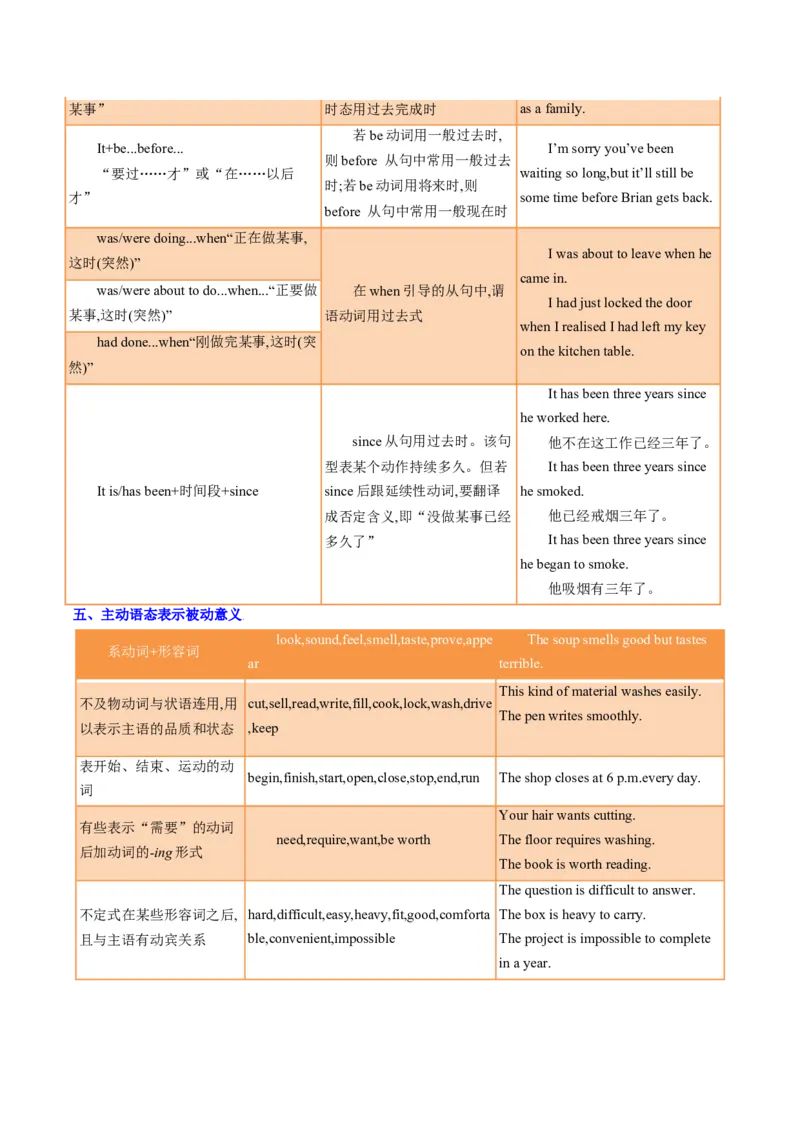
hardly...when...,no 主句时态用过去完成时,从 Hardly had I opened the door
sooner...than...“一……就……” 句时态用一般过去时 when Tom came in.
This/That/It is/was the 若主句中为is,则从句时态 This is the first time we have
first/second...time+that从句“是……次做 用现在完成时;若为was,则从句 seen a film in the cinema together某事” 时态用过去完成时 as a family.
若be动词用一般过去时,
It+be...before... I’m sorry you’ve been
则before 从句中常用一般过去
“要过……才”或“在……以后 waiting so long,but it’ll still be
时;若be动词用将来时,则
才” some time before Brian gets back.
before 从句中常用一般现在时
was/were doing...when“正在做某事,
I was about to leave when he
这时(突然)”
came in.
was/were about to do...when...“正要做 在when引导的从句中,谓
I had just locked the door
某事,这时(突然)” 语动词用过去式
when I realised I had left my key
had done...when“刚做完某事,这时(突
on the kitchen table.
然)”
It has been three years since
he worked here.
since从句用过去时。该句 他不在这工作已经三年了。
型表某个动作持续多久。但若 It has been three years since
It is/has been+时间段+since since后跟延续性动词,要翻译 he smoked.
成否定含义,即“没做某事已经 他已经戒烟三年了。
多久了” It has been three years since
he began to smoke.
他吸烟有三年了。
五、主动语态表示被动意义
look,sound,feel,smell,taste,prove,appe The soup smells good but tastes
系动词+形容词
ar terrible.
This kind of material washes easily.
不及物动词与状语连用,用 cut,sell,read,write,fill,cook,lock,wash,drive
The pen writes smoothly.
以表示主语的品质和状态 ,keep
表开始、结束、运动的动
begin,finish,start,open,close,stop,end,run The shop closes at 6 p.m.every day.
词
Your hair wants cutting.
有些表示“需要”的动词
need,require,want,be worth The floor requires washing.
后加动词的-ing形式
The book is worth reading.
The question is difficult to answer.
不定式在某些形容词之后, hard,difficult,easy,heavy,fit,good,comforta The box is heavy to carry.
且与主语有动宾关系 ble,convenient,impossible The project is impossible to complete
in a year.考点02 动词语态
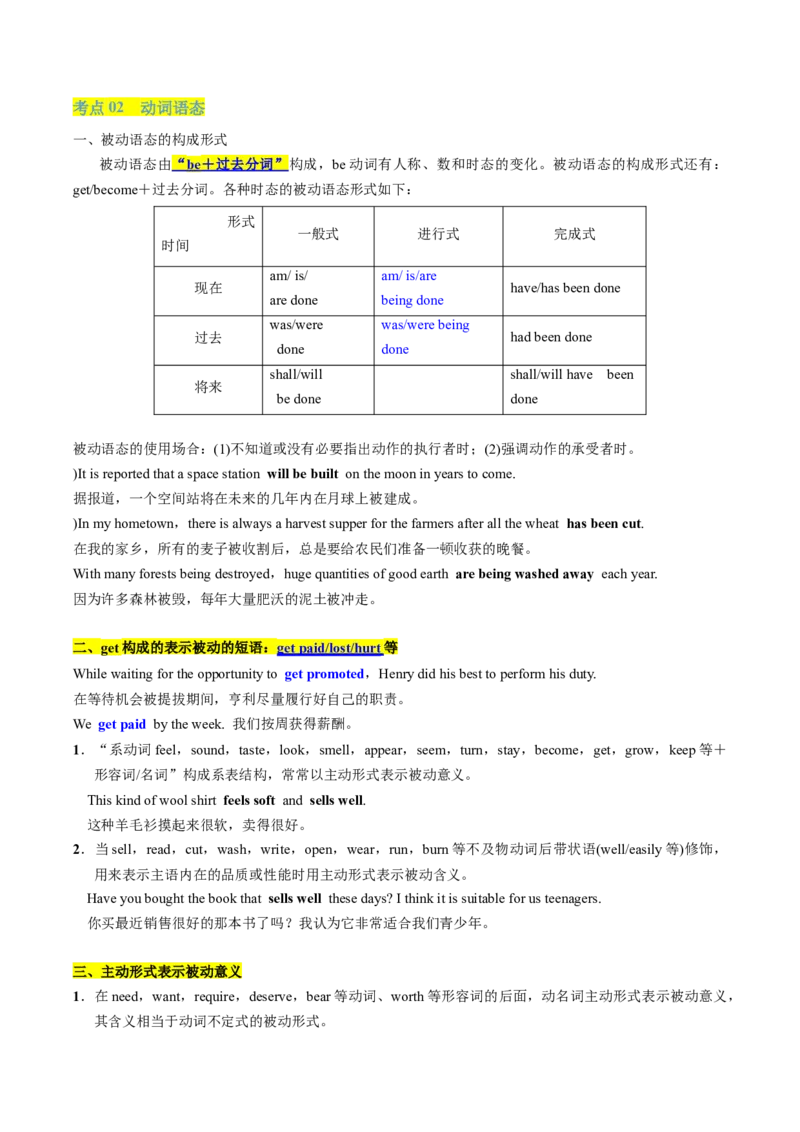
一、被动语态的构成形式
被动语态由 “ b e +过去分词” 构成,be动词有人称、数和时态的变化。被动语态的构成形式还有:
get/become+过去分词。各种时态的被动语态形式如下:
形式
一般式 进行式 完成式
时间
am/ is/ am/ is/are
现在 have/has been done
are done being done
was/were was/were being
过去 had been done
done done
shall/will shall/will have been
将来
be done done
被动语态的使用场合:(1)不知道或没有必要指出动作的执行者时;(2)强调动作的承受者时。
)It is reported that a space station will be built on the moon in years to come.
据报道,一个空间站将在未来的几年内在月球上被建成。
)In my hometown,there is always a harvest supper for the farmers after all the wheat has been cut.
在我的家乡,所有的麦子被收割后,总是要给农民们准备一顿收获的晚餐。
With many forests being destroyed,huge quantities of good earth are being washed away each year.
因为许多森林被毁,每年大量肥沃的泥土被冲走。
二、get构成的表示被动的短语:get paid/lost/hurt 等
While waiting for the opportunity to get promoted,Henry did his best to perform his duty.
在等待机会被提拔期间,亨利尽量履行好自己的职责。
We get paid by the week. 我们按周获得薪酬。
1.“系动词feel,sound,taste,look,smell,appear,seem,turn,stay,become,get,grow,keep等+
形容词/名词”构成系表结构,常常以主动形式表示被动意义。
This kind of wool shirt feels soft and sells well.
这种羊毛衫摸起来很软,卖得很好。
2.当sell,read,cut,wash,write,open,wear,run,burn等不及物动词后带状语(well/easily等)修饰,
用来表示主语内在的品质或性能时用主动形式表示被动含义。
Have you bought the book that sells well these days? I think it is suitable for us teenagers.
你买最近销售很好的那本书了吗?我认为它非常适合我们青少年。
三、主动形式表示被动意义
1.在need,want,require,deserve,bear等动词、worth等形容词的后面,动名词主动形式表示被动意义,
其含义相当于动词不定式的被动形式。The house needs repairing/to be repaired. 这房子需要修理。
2.be to rent/blame/let主动形式表被动意义。
Who is to blame for the mistake? 谁应为此错误接受谴责?
The house is to let. 此房出租。
一、单句语法填空
1.Doing exercise in the morning (be)good for our health. (所给词的适当形式填空)
2.Christmas is the most important festival in the western world. It (fall) on December 25. (所给词的适
当形式填空)
3.For example, I (order) a digital camera online the other day and saved about $50. (所给词的适当形
式填空)
4.The woman looked down, (shake) her head and said: “Not so good.” (所给词的适当形式填空)
5.By the window (sit) a young man with a magazine in his hand. (所给词的适当形式填空)
6.They had to wait and (hope) that someone would come and help them. (所给词的适当形式填
空)
7.At present, the remarkable development of digital economy (transform) our modern way of life.(所
给词的适当形式填空)
8.Because of climate change, the ice that polar bears depend on for survival (disappear) slowly. (所给词的
适当形式填空)
9.I (translate) the poems of the Tang Dynasty these days. It is very interesting but a little hard. (所给词
的适当形式填空)
10.I (search) the Internet for the relevant information when my cellphone rang. (所给词的适
当形式填空)
11.Some children (slide) on the ice happily when they heard someone crying for help. (所给词的适
当形式填空)
12.One day Gene and Hannah Bortnick heard piano music coming from their living room. They thought their 3-
year-old son Ethan (listen) to a CD.(所给词的适当形式填空)
13.Family-friendly facilities (develop) in the following years. (所给词的适当形式填空)
14.Sooner or later those dishonest people (pay) a price for their acts; on the contrary, when we are
honest, we are truly free. (所给词的适当形式填空)
15.The plan they paid much attention to (discuss) at tomorrow’s meeting. (所给词的适当形式填空)
16.As long as you put in more effort, you progress in your schoolwork.(make) (所给词的适当形式填
空)
17.Last Sunday he promised he (come) but he hasn’t arrived until now. (所给词的适当形式填空)18.I hoped Tina (come) to my birthday party on time the next Wednesday. (所给词的适当形式填
空)
19.Jason set up a plan that in five years he (show) his work in the top gallery in that area of the
country. (所给词的适当形式填空)
20.So far, our country (make) great achievements in many fields. (所给词的适当形式填空)
21.If you have kids, and they (not see) this film yet, it’s safe to say they’d enjoy it. (所给词的适当形
式填空)
22.Since it drew recent media attention, Woon (hear) from resorts and restaurants in 10 countries,
including the United States. (所给词的适当形式填空)
23.While online shopping (change) our life, not all of its effects have been positive. (所给词的适当
形式填空)
24.Due to the hard training they (do) before, their performances were very impressive. (所给词的适当
形式填空)
25.The news came as no surprise to me. I (know) for some time that the factory was going to shut
down.(所给词的适当形式填空)
26.Tom (work) in the library every night over the last three months. (所给词的适当形式填空)
27.If the trend continues, by 2020, the world (lose) two-thirds of its vertebrate biodiversity. (所给词的
适当形式填空)
28.By the time Jane gets home, her aunt (leave) for London to attend a meeting. (所给词的适当
形式填空)
29.You’d better not phone the manager between 7 and 8 tomorrow evening; he (have) an important
meeting then. (所给词的适当形式填空)
30.Don’t call Mr. Wang at nine tomorrow. He (listen) to a lecture on the reform of the college entrance
examination. (所给词的适当形式填空)
31.Don’t call me at nine tomorrow because I (study) at the library then. (所给词的适当形式填空)
32.While drone delivery is new to Beijing, the technology (exist) in other parts of China for several
years. (所给词的适当形式填空)
33.Marty (work) really hard on his book and thinks he’ll have finished it by Friday. (所给词的
适当形式填空)
34.Cleaning must be done before the holiday, typically in January or February, since sweeping after the festivities
(see) as removing good luck. (所给词的适当形式填空)
35.According to current regulations, visitors (require) to switch off their camera flashes in the
museum. (所给词的适当形式填空)
36.If the project (complete) on time, the company will receive a bonus. (所给词的适当形式填空)
37.The plan that (approve) by the committee last week will be implemented next month. (所给词的
适当形式填空)38.My life (save) many years ago by a St John ambulance and it’s a marvelous feeling repaying back
that kindness. (用所给词的适当形式填空)
39.The sports meeting that the students have been looking forward to (hold) tomorrow. (所给词的适当
形式填空)
40.More expressways (build) in Sichuan soon to promote the local economy. (所给词的适当形式
填空)
41.I'll have to push the car to the side of the road because we (fine)if we leave it here.(所给词的适当
形式填空)
42.He was not sure whether his thesis paper (approve) by the professor tomorrow. (所给词的适当形式
填空)
43.Mo Yan is the only one of the writers who (award) the Nobel Prize for Literature in China. (所给
词的适当形式填空)
44.But no evidence of life (discover) in any of these planet so far. (所给词的适当形式填空)
45.With the help of high technology, more and more new substances in the past years. (discover)
(所给词的适当形式填空)
46.In recent years many football clubs as business to make a profit. (run) (所给词的适当形式填
空)
47.When I got to the theatre, I found that the tickets (sell out) and I didn’t get one. (所给词的适当
形式填空)
48.It was said that the flight to New York (cancel) due to the foggy weather. (所给词的适当形式
填空)
49.Students are not allowed to use the art centre at the moment because it (decorate). (所给词的
适当形式填空)
50.The church tower which (restore) at present will be open to tourists soon. The work is almost
finished.(所给词的适当形式填空)
51.The gym which (build) will be open to tourists soon. The work is almost finished.(所给词的适当
形式填空)
52.The church tower which (restore) will be open to tourists soon. The work is almost finished. (所给词
的适当形式填空)
53.It so happened that my mobile phone (repair) when you called me yesterday. (所给词的适当形
式填空)
54.He went home in a hurry,never once looking back to see if he (follow). (所给词的适当形式填
空)
55.The baby should (take) good care of by the baby-sitter. (所给词的适当形式填空)
56.The beauty of the views couldn’t (imagine) and they left me with many great memories. (所给词
的适当形式填空)
57.His proposal that the system (improve) got rejected by the boss. (所给词的适当形式填空)58.This kind of desk can (adjust) to the height you need. Besides, it’s not expensive at all. (所给词
的适当形式填空)
59.The large board in the corner had been replaced by a big screen, where customers’ comments on the month’s
best-seller (display). (所给词的适当形式填空)
60.It is announced that many a new house (build) at present in the disaster area. (所给词的适当形式
填空)
二、语篇语法填空
阅读下面材料,在空白处填入1个适当的单词或括号内单词的正确形式。
The China Cultural Center in Malta launched its 2024-2025 term on Tuesday, introducing a fresh lineup of
classes in Chinese language, traditional Chinese painting, and calligraphy, offering 1 (local) new ways to
immerse (沉浸) themselves in Chinese culture.
The Chinese language classes, 2 (teach) by instructors from the Confucius Institute at the
University of Malta, range from beginner to intermediate levels and 3 (tailor) to different age groups and
skill levels. 4 the first time, the center has introduced a dedicated Chinese reading class for children
under eight, a reflection of the rising interest in the language among Malta’s younger learners.
Among the students 5 (be) 66-year-old Ray Magri, 6 has been studying Chinese for
five years, driven by his passion for Chinese culture. Citing the old Chinese saying, “Never too old to learn,” Magri
7 (share) with one newcomer his intention to continue learning for as long as he can.
Another student, Piero Di Meglio, 8 (true) hopes to become fluent in Chinese, including speaking,
reading, and writing. 9 experienced traveler to China, Di Meglio has reached HSK Level 3, the
international benchmark for Chinese proficiency, and aims 10 (advance) to Levels 4 and 5 in the
coming years. Newcomer Jonathan Xuereb embraced the challenge of learning Chinese, acknowledging its
complexity but calling it “one of the hardest yet most rewarding languages to learn”.
阅读下面短文,在空白处填入1个适当的单词或括号内单词的正确形式。
Shanghai-based language and literature magazine Yaowen Jiaozi, literally meaning “biting phrases and
chewing characters,” recently unveiled its Top 10 Chinese Buzzwords for 2024. Released on December 2, the list
spotlights linguistic trends 11 reflect societal changes.
The selection includes terms like “digital intelligence” and “AI for good,” 12 (showcase) the
influence of artificial intelligence (AI). “Digital intelligence” refers to the integration of advanced intelligent
technologies into digital systems 13 (boost) productivity, streamline resource management and foster
innovation. Meanwhile, “AI for good” underscores the ethical responsibility of developing AI to benefit humanity,
fuel industrial 14 (transform), drive the economy, and promote sustainability.
Huang Anjing, Editor in Chief of Yaowen Jiaozi, told Dazhong Daily newspaper that 15 annual
buzzword selection aims to capture wide-ranging 16 (shift) in politics, the economy, culture and daily life.
Huang also brought up the rising influence of Generation Z. The strong performance of Chinese Gen Zathletes at the 2024 Paris Olympic and Paralympic Summer Games, 17 (couple) with their confident
attitude, gave rise to affectionate terms like “kid-bro/kid-sis,” now widely used as a mark of respect.
According to Huang, the linguistic creativity on short-video platforms 18 (reach) unprecedented
levels, particularly among younger generations. The ease of posting content on these platforms allows 19
the swift exchange of ideas, leading to the spontaneous creation and popularization of new terms. On the downside,
it’s harder to regulate 20 (potential) problematic language.
阅读下面短文,在空白处填入1个适当的单词或括号内单词的正确形式。
“X Virtual Gathering: Honey”, a new project of X Museum’s digital art platform X Virtual, 21
(launch) on Thursday in Beijing with an exhibition and a video game designed by multiple creatives from home
and abroad.
Upon entering the exhibition, visitors are grabbed by the electronic music 22 (mix) with a buzzing
noise playing in the game, the interface (界面) of which is projected on the wall. They are invited to pick up the
controller to start the game, becoming a bee busy gathering honey.
Depicted in a 23 (future), robotic and metallic style, the worker bee 24 (fly) through
various landscapes, including a mysterious jungle and an erupting volcano. Eight music pieces, each of which
represents a specific event, are triggered as it moves through different levels within the game, immersing the player
in 25 adventure with a bee’s perspective. As an abstract medium, music alters and challenges the
participants’ senses, urging us 26 (rethink) ecological justice and species justice.
According to the curators (策展人), this project explores the vast, interconnected world of bees 27
how it influences ideas around ecology, human civilization, and capitalism. It is an urgent response 28
crises such as resource exhaustion and a net loss of biodiversity 29 we humans are faced with, as well as
the slowly widening 30 (divide) between civilization and nature through technological revolutions.
阅读下面短文,在空白处填入1个适当的单词或括号内单词的正确形式。
“It is an outstanding conclusion to a great Beethoven cycle. Frank Peter Zimmermann and Martin Helmchen
finish their project in fine style,” says Julian Haylock.
We are 31 (current) experiencing one of the most exciting periods in recording. We have been
especially lucky over the last decade or so, 32 charming recordings of Beethoven’s violin sonatas that
make some older ones sound ordinary.
Frank Peter Zimmermann and Martin Helmchen are an outstanding team, 33 latest release brings
their three-disc survey to 34 uplifting conclusion. The “little” No.8 is kept light-as-air, with some music
jokes occasionally thrown off from magical hands. One of the trickiest movements in the cycle 35 (be)
the central Minuetto (小步舞曲), yet here it is kept flowing and dancing, gently 36 (mix) with delicate
precision.
These are the readings that also have their great arms firmly on the music. The 37 (distinguish)
players create a sense of anticipation in the introduction to Kreutzer Sonata’s opening movement, which 38
(play) completely with Zimmermann over the wonderful music pauses.Finest of all is a reading of the Op.96 Sonata that allows listeners 39 (dream) a little and feel the
40 (composer) undervalued silence in all its charm.
阅读下面短文,在空白处填入1个适当的单词或括号内单词的正确形式。
If you’ve ever spent time in China during the summer, you probably recall seeing people on the streets 41
(wave) their handheld fans in an attempt to beat the heat. But the traditional Chinese folding fan is not just a tool
for cooling down. It’s an important part of the Chinese culture 42 has over 3, 000 years of history from the
Shang Dynasty.
The fan-making industry in China 43 (primary) consisted of family-run businesses that produced
their designs in small 44 (quantity) and sold them from the front of their workshops. The city of Hangzhou
was the center of the industry during the Southern Song dynasty.
Composed of panels and ribs, folding fans 45 (design) to spin around the rivet (铆钉) at the head.
Panels, as the main surface of the fan, provided a canvas for craftspeople and artists 46 (add) calligraphy
and painted scenes. Fans decorated with paintings and calligraphy became known 47 “scholars’ fans” and
often reflected a person’s status. Artwork featuring birds and flowers symbolized beauty and gracefulness, making
them 48 popular subject among young women. Mythical creatures were also popular choices — dragons
were painted frequently onto 49 (man) fans while ladies typically preferred phoenixes.
From its beginning during the Shang Dynasty to having over 500 kinds of fans in China today, folding fans
50 (stand) the test of time and are still widely popular — not only in China but around the world.