外刊读写营第8期 公众号/B站:三言两语杂货社 Unit 3
Unit 3
美食与文化
精读预习
步骤 任务
听录音,填空(每空填写一个单词,含连字符的单词算一个)。如无听力练习需求,
Step 1
可跳过本练习,直接查看参考答案补充原文。
请阅读全文,完成阅读选择题。首次阅读全文时请勿查单词,可通过上下文或猜词
Step 2
理解原文,模拟阅读考试。
完成阅读题后,请使用课程附送的专业词典(牛津、朗文等)再次阅读原文,查询
Step 3
生词。请标记出表达、句法、背景知识的费解之处,观看视频讲解时可重点留意。
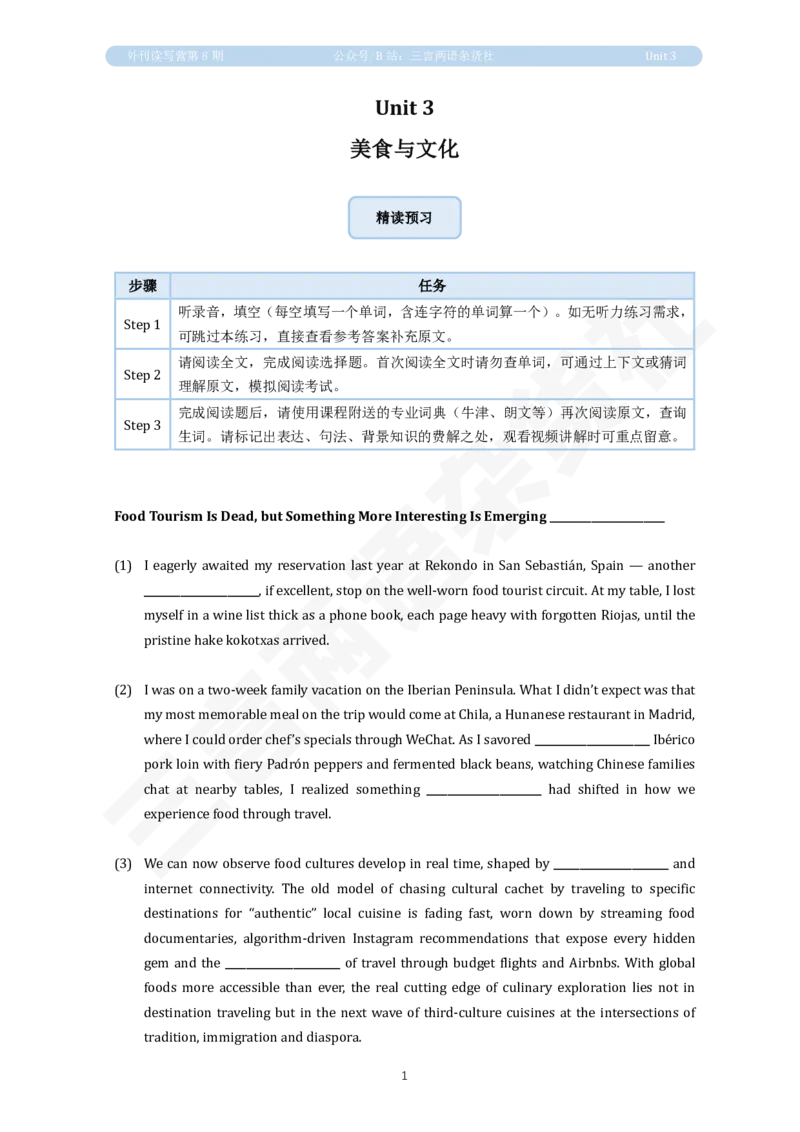
Food Tourism Is Dead, but Something More Interesting Is Emerging ______________________
(1) I eagerly awaited my reservation last year at Rekondo in San Sebastián, Spain — another
______________________, if excellent, stop on the well-worn food tourist circuit. At my table, I lost
myself in a wine list thick as a phone book, each page heavy with forgotten Riojas, until the
pristine hake kokotxas arrived.
(2) I was on a two-week family vacation on the Iberian Peninsula. What I didn’t expect was that
my most memorable meal on the trip would come at Chila, a Hunanese restaurant in Madrid,
where I could order chef’s specials through WeChat. As I savored ______________________ Ibérico
pork loin with fiery Padrón peppers and fermented black beans, watching Chinese families
chat at nearby tables, I realized something ______________________ had shifted in how we
experience food through travel.
(3) We can now observe food cultures develop in real time, shaped by ______________________ and
internet connectivity. The old model of chasing cultural cachet by traveling to specific
destinations for “authentic” local cuisine is fading fast, worn down by streaming food
documentaries, algorithm-driven Instagram recommendations that expose every hidden
gem and the ______________________ of travel through budget flights and Airbnbs. With global
foods more accessible than ever, the real cutting edge of culinary exploration lies not in
destination traveling but in the next wave of third-culture cuisines at the intersections of
tradition, immigration and diaspora.
1外刊读写营第8期 公众号/B站:三言两语杂货社 Unit 3
(4) Food tourism as we’ve known it has become a victim of its own success. You no longer need
to visit Paris for macarons from Ladurée when you can find them at shops in major U.S. cities
or have them delivered to your home via Goldbelly, a service that specializes in ________________
restaurant dishes and regional specialties. Even Tokyo’s Tsukiji market experience has gone
global: The chefs at Masa in New York and Sushi Zo in Los Angeles have told me that the same
fish being auctioned in the famous bazaar arrives daily in their restaurants.
(5) The obscure treasures in back alleys are now ______________________ on TikTok, with Uber
dropping tourists at their doorstep. Patrons study menus before going to restaurants, they
know the chef’s story, and they arrive at already rated “secret” spots through geotagging.
(6) But here’s where it gets interesting: What we’re witnessing isn’t just the decline of traditional
food tourism; it’s the birth of something far more fascinating.
(7) Take Chila in Madrid. The storefront could have been plucked straight from Hunan’s spice-
loving heartland. It serves as both a cultural ______________________ for Chinese expatriates in
Spain and as an introduction to regional Chinese cooking for curious Madrileños. Diners
there can wash down their meals with sangria or baijiu from Guizhou — a perfect
______________________ of Spanish and Chinese drinking traditions.
(8) Or consider a staple of German cuisine. You don’t need to travel to Germany for Oktoberfest
and bratwurst anymore; you can get that in Cincinnati at the giant Zinzinnati festival or at the
Wurstfest in New Braunfels, Texas. But what you will find in Germany is how the culinary
______________________ has been transformed by the nearly three million Turks (both
immigrants and members of the diaspora) who have been developing their own food identity
there since the 1960s.
(9) In Lima, chifa (Chinese Peruvian) and Nikkei (Japanese Peruvian) dishes are redefining
Peruvian cuisine to reflect a 150-year history of Asian immigration. While tourists
______________________ to the latest New Nordic hot spots in Copenhagen, there’s an emerging
African diaspora cuisine in Stockholm, where restaurants like Jebena serve injera. These
immigrant-owned establishments are quietly reshaping Nordic cuisine in ways that could
make Noma — the ______________________ restaurant in Denmark that put foraging and
fermentation at the heart of fine dining — seem traditional.
(10) In Toronto, West Indian-inspired innovations are producing completely new flavor profiles.
In London, Nigerian suya — the spicy, skewered street meat known for its distinct blend of
ground peanuts and spices — is being ______________________ in ways that could influence the
next generation of British cuisine.
2外刊读写营第8期 公众号/B站:三言两语杂货社 Unit 3
(11) What was once celebrated as a mosaic of distinct ethnic enclaves has become a laboratory for
the future of global cuisine. Yes, you can still line up at Katz’s Deli or grab a bagel at Russ &
Daughters, but the real culinary excitement is happening in places like Tatiana and Dept of
Culture, where chefs with West African roots are reimagining their cuisine through a fine-
dining ______________________. These aren’t just fusion restaurants or immigrant adaptations;
they’re entirely new cultural expressions.
(12) One exciting aspect of this evolution is that it’s impossible to experience it through delivery
apps or social media. You can’t truly understand how immigrant communities are reshaping
French identity without walking through Paris’s 13th Arrondissement, home to the city’s
Chinatown and a large Asian community. You can’t grasp Singapore’s culinary innovation by
ordering from a ______________________ kitchen. The most innovative Italian dish might come
from a chef in Tokyo who never set foot in Italy but understands the essence of the cuisine
through a global lens. A _____________________ in Toronto might be defining the future of Mexican
street food by incorporating techniques and ingredients that would be unthinkable in Oaxaca.
(13) The world’s next great cuisine isn’t hidden in some undiscovered corner of the globe. It’s
being created right now, in the spaces where cultures, traditions and technologies
_____________________. That’s where the real food adventure begins.
文章来源:2025年1月《纽约时报》
请根据原文,选择正确的选项。
1. How does the author contrast his experiences at Rekondo and Chila?
(A) Rekondo was overly traditional, while Chila pushed the boundaries of innovation too far.
(B) Rekondo was a classic experience, while Chila offered an unexpected cultural fusion that
stood out.
(C) Rekondo was ordinary, and Chila's meal was so much better that it overshadowed the rest of
the trip.
(D) Rekondo was more enjoyable because of its focus on traditional Spanish dishes, while Chila's
fusion of flavors made it harder to appreciate.
2. Which of the following statements is NOT true according to paragraph 3?
(A) Global foods have become more accessible due to the influence of budget travel options and
social media.
(B) The rise of food documentaries and social media has reinforced the value of traveling to
specific locations for authentic cuisine.
3外刊读写营第8期 公众号/B站:三言两语杂货社 Unit 3
(C) Culinary exploration now focuses more on cultural intersections than on travel to traditional
destinations.
(D) Immigrant communities are reshaping global cuisines through cultural blending.
3. Why does the author mention Noma in the discussion about African diaspora cuisine?
(A) To show that Noma is a better example of cultural fusion than immigrant-run restaurants.
(B) To compare Noma's focus on traditional Nordic ingredients to the use of new techniques by
immigrant chefs.
(C) To emphasize that Noma and African diaspora cuisine are both equally groundbreaking in the
food world.
(D) To highlight how African diaspora cuisine is truly revolutionizing Nordic food.
4. Which statement is true about the chef in Tokyo creating innovative Italian dishes?
(A) The chef’s innovation is based on a deep personal understanding of Italy's food culture.
(B) The chef in Tokyo is reinterpreting Italian cuisine using traditional methods passed down
through Italian generations.
(C) The chef in Tokyo only serves Italian dishes that are commonly found in Italy.
(D) The chef’s creations are authentic Italian dishes, as he learned them from Italian immigrants
living in Japan.
精读(1)
Food Tourism Is Dead, but Something More Interesting Is Emerging
(1) I eagerly awaited my reservation last year at Rekondo in San Sebastián, Spain — another
predictable, if excellent, stop on the well-worn food tourist circuit. At my table, I lost myself in
a wine list thick as a phone book, each page heavy with forgotten Riojas, until the pristine hake
kokotxas arrived.
4外刊读写营第8期 公众号/B站:三言两语杂货社 Unit 3
(2) I was on a two-week family vacation on the Iberian Peninsula. What I didn’t expect was that
my most memorable meal on the trip would come at Chila, a Hunanese restaurant in Madrid,
where I could order chef’s specials through WeChat. As I savored premium Ibérico pork loin
with fiery Padrón peppers and fermented black beans, watching Chinese families chat at
nearby tables, I realized something fundamental had shifted in how we experience food
through travel.
(3) We can now observe food cultures develop in real time, shaped by migration and internet
connectivity. The old model of chasing cultural cachet by traveling to specific destinations for
“authentic” local cuisine is fading fast, worn down by streaming food documentaries,
algorithm-driven Instagram recommendations that expose every hidden gem and the
democratization of travel through budget flights and Airbnbs. With global foods more
accessible than ever, the real cutting edge of culinary exploration lies not in destination
traveling but in the next wave of third-culture cuisines at the intersections of tradition,
immigration and diaspora.
(4) Food tourism as we’ve known it has become a victim of its own success. You no longer need to
visit Paris for macarons from Ladurée when you can find them at shops in major U.S. cities or
have them delivered to your home via Goldbelly, a service that specializes in iconic restaurant
dishes and regional specialties. Even Tokyo’s Tsukiji market experience has gone global: The
chefs at Masa in New York and Sushi Zo in Los Angeles have told me that the same fish being
auctioned in the famous bazaar arrives daily in their restaurants.
5外刊读写营第8期 公众号/B站:三言两语杂货社 Unit 3
(5) The obscure treasures in back alleys are now bookmarked on TikTok, with Uber dropping
tourists at their doorstep. Patrons study menus before going to restaurants, they know the
chef’s story, and they arrive at already rated “secret” spots through geotagging.
(6) But here’s where it gets interesting: What we’re witnessing isn’t just the decline of traditional
food tourism; it’s the birth of something far more fascinating.
(7) Take Chila in Madrid. The storefront could have been plucked straight from Hunan’s spice-
loving heartland. It serves as both a cultural lifeline for Chinese expatriates in Spain and as an
introduction to regional Chinese cooking for curious Madrileños. Diners there can wash down
their meals with sangria or baijiu from Guizhou — a perfect blend of Spanish and Chinese
drinking traditions.
精读(1)练习
1. 请根据中文写出对应英文表达。
(1) 充满了…… __________________________________________________
(2) 实时地 __________________________________________________
(3) 廉价航班 __________________________________________________
(4) 算法驱动的 __________________________________________________
6外刊读写营第8期 公众号/B站:三言两语杂货社 Unit 3
2. 请根据首字母和英文释义写出对应单词。
(1) a_________________________: real, true, what people say it is, not a copy;
(2) o________________________: not known to many people;
(3) g________________________: the act of attaching a location to a post or comment on social media.
3. 请将以下原文句子译为中文。
I eagerly awaited my reservation last year at Rekondo in San Sebastián, Spain — another
predictable, if excellent, stop on the well-worn food tourist circuit.
4. 请使用指定表达用英文写出以下句子。
(1) 这个研究所的研究者们走在生物科技的前端,致力于开发针对遗传性疾病的开创性治疗方
法。(cutting edge, biotechnology, genetic disorder)
(2) 他们试图将价格调低50%来拖垮我们,但是持续的价格战最终让他们筋疲力尽。(wear sb.
down )
7外刊读写营第8期 公众号/B站:三言两语杂货社 Unit 3
精读(2)
(1) Or consider a staple of German cuisine. You don’t need to travel to Germany for Oktoberfest
and bratwurst anymore; you can get that in Cincinnati at the giant Zinzinnati festival or at the
Wurstfest in New Braunfels, Texas. But what you will find in Germany is how the culinary
landscape has been transformed by the nearly three million Turks (both immigrants and
members of the diaspora) who have been developing their own food identity there since the
1960s.
(2) In Lima, chifa (Chinese Peruvian) and Nikkei (Japanese Peruvian) dishes are redefining
Peruvian cuisine to reflect a 150-year history of Asian immigration. While tourists flock to the
latest New Nordic hot spots in Copenhagen, there’s an emerging African diaspora cuisine in
Stockholm, where restaurants like Jebena serve injera. These immigrant-owned
establishments are quietly reshaping Nordic cuisine in ways that could make Noma — the
revolutionary restaurant in Denmark that put foraging and fermentation at the heart of fine
dining — seem traditional.
(3) In Toronto, West Indian-inspired innovations are producing completely new flavor profiles. In
London, Nigerian suya — the spicy, skewered street meat known for its distinct blend of
ground peanuts and spices — is being reimagined in ways that could influence the next
generation of British cuisine.
8外刊读写营第8期 公众号/B站:三言两语杂货社 Unit 3
(4) What was once celebrated as a mosaic of distinct ethnic enclaves has become a laboratory for
the future of global cuisine. Yes, you can still line up at Katz’s Deli or grab a bagel at Russ &
Daughters, but the real culinary excitement is happening in places like Tatiana and Dept of
Culture, where chefs with West African roots are reimagining their cuisine through a fine-
dining lens. These aren’t just fusion restaurants or immigrant adaptations; they’re entirely
new cultural expressions.
(5) One exciting aspect of this evolution is that it’s impossible to experience it through delivery
apps or social media. You can’t truly understand how immigrant communities are reshaping
French identity without walking through Paris’s 13th Arrondissement, home to the city’s
Chinatown and a large Asian community. You can’t grasp Singapore’s culinary innovation by
ordering from a ghost kitchen. The most innovative Italian dish might come from a chef in
Tokyo who never set foot in Italy but understands the essence of the cuisine through a global
lens. A pop-up in Toronto might be defining the future of Mexican street food by incorporating
techniques and ingredients that would be unthinkable in Oaxaca.
(6) The world’s next great cuisine isn’t hidden in some undiscovered corner of the globe. It’s being
created right now, in the spaces where cultures, traditions and technologies mingle. That’s
where the real food adventure begins.
9外刊读写营第8期 公众号/B站:三言两语杂货社 Unit 3
精读(2)练习
1. 请根据中文写出对应英文表达。
(1) 是……的故乡 __________________________________________________
(2) 融合菜馆 __________________________________________________
(3) 外卖应用程序 __________________________________________________
(4) 热门地点 __________________________________________________
2. 请根据首字母和英文释义写出对应单词。
(1) r_________________________: to change the meaning of something, or the how people see it;
(2) s________________________: a basic type of food that is used a lot;
(3) u________________________: so shocking that it cannot be imagined as possible.
3. 请将以下原文句子译为中文。
These immigrant-owned establishments are quietly reshaping Nordic cuisine in ways that could
make Noma — the revolutionary restaurant in Denmark that put foraging and fermentation at the
heart of fine dining — seem traditional.
4. 请使用指定表达用英文写出以下句子。
(1) 我一踏入这家初创公司的办公室,就被团队散发出的活力四射的氛围迷住了。(set foot in)
(2) 这所大学以多样性为核心教育理念,重新调整了招生政策,以招收不同背景的学生。(at
the heart of, enroll)
10外刊读写营第8期 公众号/B站:三言两语杂货社 Unit 3
写作练习
请按照「总结与写作」课要求,完成相应造句练习。
11外刊读写营第8期 公众号/B站:三言两语杂货社 Unit 3
泛读
步骤 任务
请阅读全文,完成阅读选择题。首次阅读全文时请勿查单词,可通过上下文或猜词
Step 1
理解原文,模拟阅读考试。
Step 2 跟随课程计划,阅读泛读(1)和泛读(2)文字解析,疏通理解障碍,学习词句。
Step 3 听录音,跟读。如无听说练习需求,可跳过此步骤。
The Creatives Fueling Tulum’s Food Renaissance
(1) Tulum, long synonymous with boho-chic aesthetics and beach clubs packed with the
beautiful and well-to-do, has in recent years earned a less-than-flattering reputation—a
paradise turned touristy gimmick, its very real magic dimmed by faux shamans and heinously
overpriced plates of fruit. These things may or may not be true, but they don’t stop throngs
of visitors from flocking to the small beachside city, and it’s for more than the idyllic views.
(2) A new class of culinary artisans is reimagining what Tulum tastes like. It’s a cuisine in flux,
tending toward hyperlocal ingredients and convenience while acknowledging the steady
stream of expats (and palates) arriving from places like Germany, Argentina, and Canada,
among others. The best food in Tulum all depends on who you ask: and there’s no shortage
of opinions in this haven for those who move to the beat of their own drum.
(3) “I want to be known for the great food, and not just because it’s a beautiful or trendy place,”
says Jesús Ortiz Jimenez, executive chef at Motmot, a luxe hotel restaurant and bar nestled in
the La Veleta neighborhood. Motmot, however, can’t help but be Instagram-friendly; the space
seamlessly combines the raw, ornamental beauty of the environment with richly
embroidered seating and eye-catching stoneware.
12外刊读写营第8期 公众号/B站:三言两语杂货社 Unit 3
(4) Chef Jesús’ approach is all about invention, centering traditional Mexican flavors in the most
playful, progressive way possible. First, a deconstructed Caesar salad on toast with sweet
onion and velvety anchovy dressing comes out of the kitchen. It’s followed by an impossibly
bright sea bass aguachile made with lacto-fermented serrano cucumber water and basil oil.
Old-school desserts like arroz con leche and banana bread are upgraded with lemon ganache,
edible gold leaf and cocoa ground with black pepper by pastry chef Montserrat Torres.
(5) “I’m inspired by my Mexican roots, of course,” shares Ortiz. “But it’s also a long road full of
learning. It’s very important to my whole team that we’re constantly evolving. Cooking is just
like any other profession—you should always be looking for new sources of inspiration and
methods of transformation.”
(6) While some restaurant patrons in Tulum want a taste of the unknown, there are others who
prefer a reminder of home. There’s a sizable Argentine community in Tulum and nearby Playa
del Carmen, and a host of sandwich shops and bakeries have popped up to address the market.
Guido Berdulari, owner of El Abasto, explains that he “wants people to feel like they’re in a
small deli shop in Buenos Aires when they walk in.”
(7) “The most important aspect is how you feel when you take a bite,” says Berdulari. “If you’re
from Argentina, it should be like you are tasting a memory. We take our time to source the
proper products to recreate that.” Berdulari has close connections with a bakery in a
neighboring town that delivers fresh bread every morning at seven. There are mountains of
croissants filled with pastry cream and achingly good dulce de leche. Savory pies loaded with
roasted vegetables and boiled eggs line the display window, allowing customers to lust a
while before placing their order.
13外刊读写营第8期 公众号/B站:三言两语杂货社 Unit 3
(8) Community is Tulum’s greatest asset; for every interest, sport or zodiac sign, there is a
WhatsApp group and weekly meeting. And for soul food enthusiasts, a Highly Catered event
hosted by Glodie Bakajika is a requirement. Known as Chef Gee, she hails from Toronto and
settled in Mexico to create private dining experiences that center infused dishes like shrimp
and grits, baked mac and cheese, cinnamon rolls and cheesecake. Bakajika routinely
organizes yacht dinners, birthday soirees and one of the best brunches in town.
(9) “My first vacation to Tulum was in July 2020, and three days into the trip I decided that this
was home,” explains the chef. Gee was a flight attendant before the pandemic, but found
herself furloughed and uninspired prior to Highly Catered’s inception. “The business went
from a concept to a reality, then to the current dream I’m living. Tulum is definitely a spiritual
portal, and I feel an ancestral call to stay here and step outside of the norm.”
(10) In a place often dismissed as a fleeting trend, the food scene proves that substance still
matters. And for every ripoff, there’s a revelatory bite waiting to be unveiled. Whether it’s
found in a deli, palm-flanked restaurant or private residence, there is world-class food in
Tulum. And that alone is worth the trip.
文章来源:2024年12月《福布斯》
14外刊读写营第8期 公众号/B站:三言两语杂货社 Unit 3
请根据原文,选择正确的选项。
1. Based on the first paragraph, which of the following is NOT true about Tulum?
(A) Tulum is known for its boho-chic aesthetics and upscale beach clubs.
(B) Tulum’s reputation has remained unchanged, with no negative perceptions emerging in
recent years.
(C) Tulum is becoming more commercialized, with some people criticizing its transformation.
(D) Despite criticisms, Tulum continues to attract large numbers of visitors.
2. According to the article, which of the following is NOT true about Motmot?
(A) Motmot is a luxurious restaurant located in the La Veleta neighborhood.
(B) The restaurant is known for its Instagram-friendly design, blending raw beauty with elegant
details.
(C) Motmot is focused primarily on serving traditional Mexican food without any modern twists.
(D) Traditional desserts like arroz con leche and banana bread are creatively updated with new
ingredients.
3. What is the primary goal of Guido Berdulari, the owner of El Abasto, in running his
business?
(A) To offer a modern dining experience that blends Argentine flavors with international trends.
(B) To create an atmosphere that evokes nostalgia for the traditional Argentine way of life.
(C) To introduce new, innovative dishes to the Argentine community in Tulum.
(D) To make people feel like they are in a small deli shop in Buenos Aires when they walk in.
4. According to the article, which of the following is NOT true about Chef Gee and Highly
Catered?
(A) Chef Gee organizes private dining experiences featuring dishes like shrimp and grits, baked
mac and cheese, and cheesecake.
(B) Chef Gee was previously a flight attendant before founding Highly Catered.
(C) Highly Catered's events are exclusively focused on upscale, fine-dining experiences for elite
clientele.
(D) Chef Gee’s decision to move to Tulum was inspired by her first vacation there in 2020.
15