六级听力讲义目 录
CONTENTS
第一部分 基础必备知识 �����������������������������������������������������������������������������������������001
一、语音基础必备知识.................................................................................................001
二、解题基础必备知识.................................................................................................
007
第二部分 技巧精讲&专项训练& 真题演练 ��������������������������������������������������015
一、长对话技巧精讲&专项训练&真题演练 ..........................................................015
二、篇章技巧精讲&专项训练&真题演练 ..............................................................039
三、讲话/报导/讲座技巧精讲&专项训练&真题演练 ........................................059
四、附录:答案速查.....................................................................................................087
001第一部分 基础必备知识
一、语音基础必备知识
(一)易错易混发音讲解
对于中国学生来说,英语中的一些音素发音非常相近,听起来十分容易混淆,同
时许多考生在听力考试中误把此单词听成彼单词,造成考试中的误听,导致失分。
【知识精讲1】[e]-[æ]
The old man gave her a loving pet.
The old man gave her a loving pat.
【知识精讲2】字母组合“th”的发音
和“th”字母组合相应的一组清浊辅音是[θ]与[ð],它们的共同特点是发音时都
要将舌尖含在上下齿之间。
【知识精讲3】[w]与[v]的发音区别
汉语中,尤其是在北方话中,这两个发音经常混在一起,但不会产生语义上的区
别。所以,中国学生很少注意两者的区别。而在英语中,这两个音是截然不同的。[w]
是半元音,发音时首先双唇收圆,然后可以随后面元音的不同而过渡到不同的口型;
而[v]是摩擦音,发音时上齿接触下唇,气流通过时产生摩擦,无论同什么样的元音组
合,首先都能听到明显的摩擦。第一部分 基础必备知识
第一部分 基础必备知识
一、语音基础必备知识
(一)易错易混发音讲解
对于中国学生来说,英语中的一些音素发音非常相近,听起来十分容易混淆,同
时许多考生在听力考试中误把此单词听成彼单词,造成考试中的误听,导致失分。
【知识精讲1】[e]-[æ]
The old man gave her a loving pet.
The old man gave her a loving pat.
【知识精讲2】字母组合“th”的发音
和“th”字母组合相应的一组清浊辅音是[θ]与[ð],它们的共同特点是发音时都
要将舌尖含在上下齿之间。
【知识精讲3】[w]与[v]的发音区别
汉语中,尤其是在北方话中,这两个发音经常混在一起,但不会产生语义上的区
别。所以,中国学生很少注意两者的区别。而在英语中,这两个音是截然不同的。[w]
是半元音,发音时首先双唇收圆,然后可以随后面元音的不同而过渡到不同的口型;
而[v]是摩擦音,发音时上齿接触下唇,气流通过时产生摩擦,无论同什么样的元音组
合,首先都能听到明显的摩擦。
001六级听力讲义
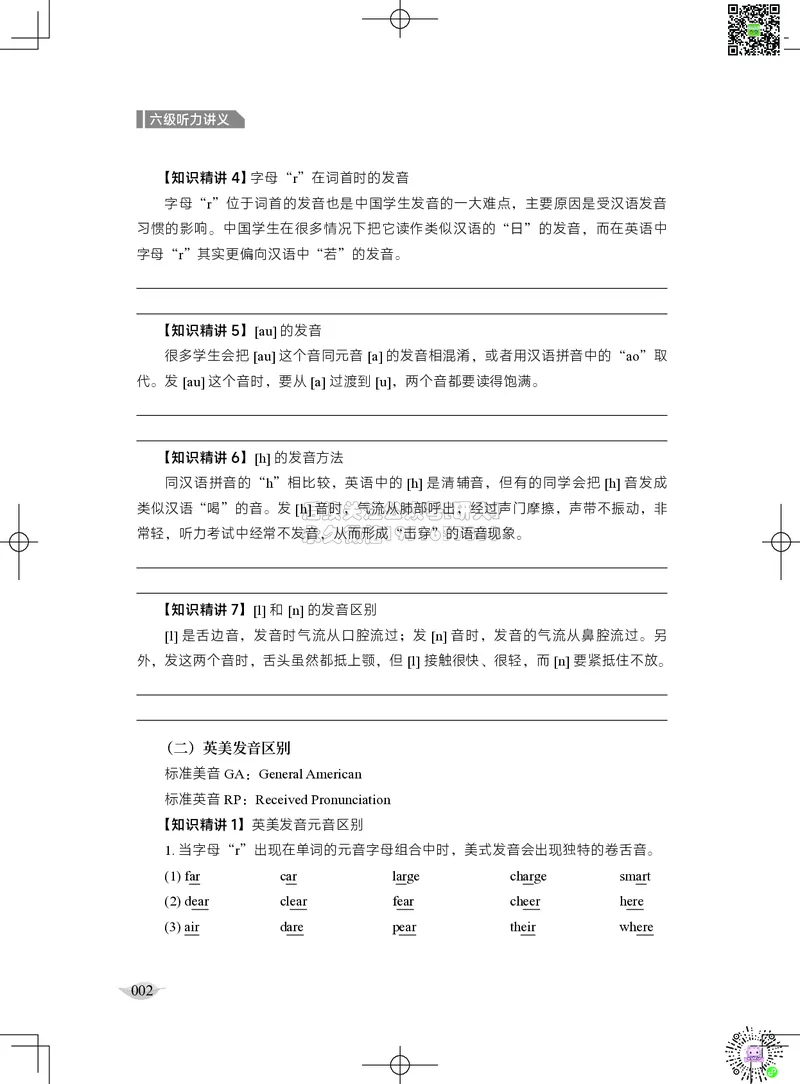
【知识精讲4】 字母“r”在词首时的发音
字母“r”位于词首的发音也是中国学生发音的一大难点,主要原因是受汉语发音
习惯的影响。中国学生在很多情况下把它读作类似汉语的“日”的发音,而在英语中
字母“r”其实更偏向汉语中“若”的发音。
【知识精讲5】[au] 的发音
很多学生会把[au]这个音同元音[a]的发音相混淆,或者用汉语拼音中的“ao”取
代。发[au] 这个音时,要从[a]过渡到[u],两个音都要读得饱满。
【知识精讲6】[h]的发音方法
同汉语拼音的“h”相比较,英语中的[h]是清辅音,但有的同学会把[h]音发成
类似汉语“喝”的音。发[h]音时,气流从肺部呼出,经过声门摩擦,声带不振动,非
常轻,听力考试中经常不发音,从而形成“击穿”的语音现象。
【知识精讲7】[l]和[n]的发音区别
[l]是舌边音,发音时气流从口腔流过;发[n]音时,发音的气流从鼻腔流过。另
外,发这两个音时,舌头虽然都抵上颚,但[l]接触很快、很轻,而[n]要紧抵住不放。
(二)英美发音区别
标准美音GA:General American
标准英音RP:Received Pronunciation
【知识精讲1】英美发音元音区别
1. 当字母“r”出现在单词的元音字母组合中时,美式发音会出现独特的卷舌音。
(1) far car large charge smart
(2) dear clear fear cheer here
(3) air dare pear their where
002第一部分 基础必备知识
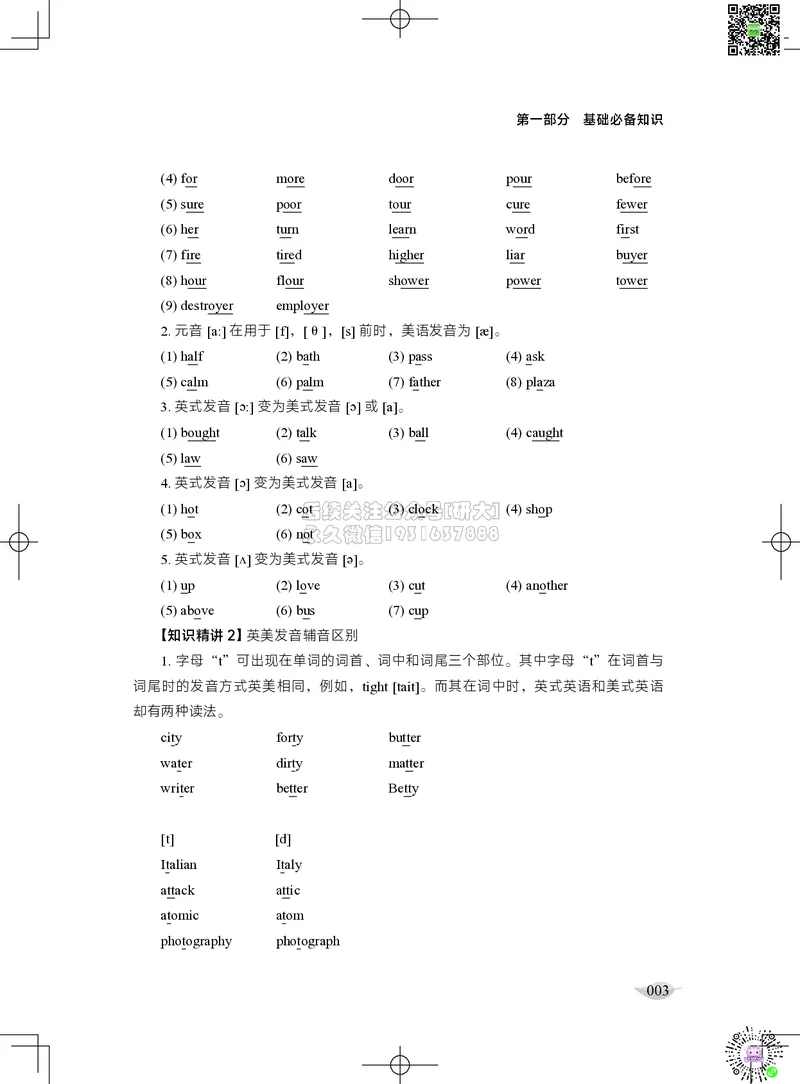
(4) for more door pour before
(5) sure poor tour cure fewer
(6) her turn learn word first
(7) fire tired higher liar buyer
(8) hour flour shower power tower
(9) destroyer employer
2. 元音[a:]在用于[f],[θ],[s]前时,美语发音为[æ]。
(1) half (2) bath (3) pass (4) ask
(5) calm (6) palm (7) father (8) plaza
3. 英式发音[ɔ:]变为美式发音[ɔ]或[a]。
(1) bought (2) talk (3) ball (4) caught
(5) law (6) saw
4. 英式发音[ɔ]变为美式发音[a]。
(1) hot (2) cot (3) clock (4) shop
(5) box (6) not
5. 英式发音[ʌ]变为美式发音[ə]。
(1) up (2) love (3) cut (4) another
(5) above (6) bus (7) cup
【知识精讲2】 英美发音辅音区别
1. 字母“t”可出现在单词的词首、词中和词尾三个部位。其中字母“t”在词首与
词尾时的发音方式英美相同,例如,tight [tait]。而其在词中时,英式英语和美式英语
却有两种读法。
city forty butter
water dirty matter
writer better Betty
[t] [d]
Italian Italy
attack attic
atomic atom
photography photograph
003六级听力讲义
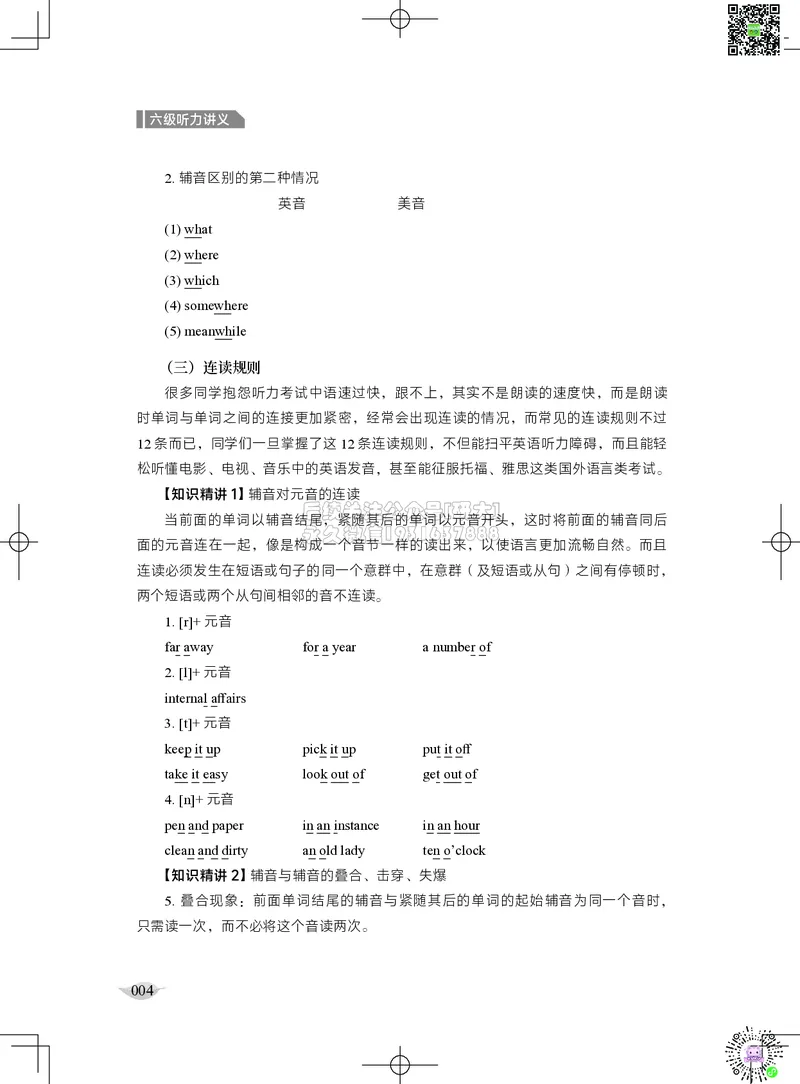
2. 辅音区别的第二种情况
英音 美音
(1) what
(2) where
(3) which
(4) somewhere
(5) meanwhile
(三)连读规则
很多同学抱怨听力考试中语速过快,跟不上,其实不是朗读的速度快,而是朗读
时单词与单词之间的连接更加紧密,经常会出现连读的情况,而常见的连读规则不过
12条而已,同学们一旦掌握了这12条连读规则,不但能扫平英语听力障碍,而且能轻
松听懂电影、电视、音乐中的英语发音,甚至能征服托福、雅思这类国外语言类考试。
【知识精讲1】 辅音对元音的连读
当前面的单词以辅音结尾,紧随其后的单词以元音开头,这时将前面的辅音同后
面的元音连在一起,像是构成一个音节一样的读出来,以使语言更加流畅自然。而且
连读必须发生在短语或句子的同一个意群中,在意群(及短语或从句)之间有停顿时,
两个短语或两个从句间相邻的音不连读。
1. [r]+元音
far away for a year a number of
2. [l]+元音
internal affairs
3. [t]+元音
keep it up pick it up put it off
take it easy look out of get out of
4. [n]+元音
pen and paper in an instance in an hour
clean and dirty an old lady ten o’clock
【知识精讲2】 辅音与辅音的叠合、击穿、失爆
5. 叠合现象:前面单词结尾的辅音与紧随其后的单词的起始辅音为同一个音时,
只需读一次,而不必将这个音读两次。
004第一部分 基础必备知识
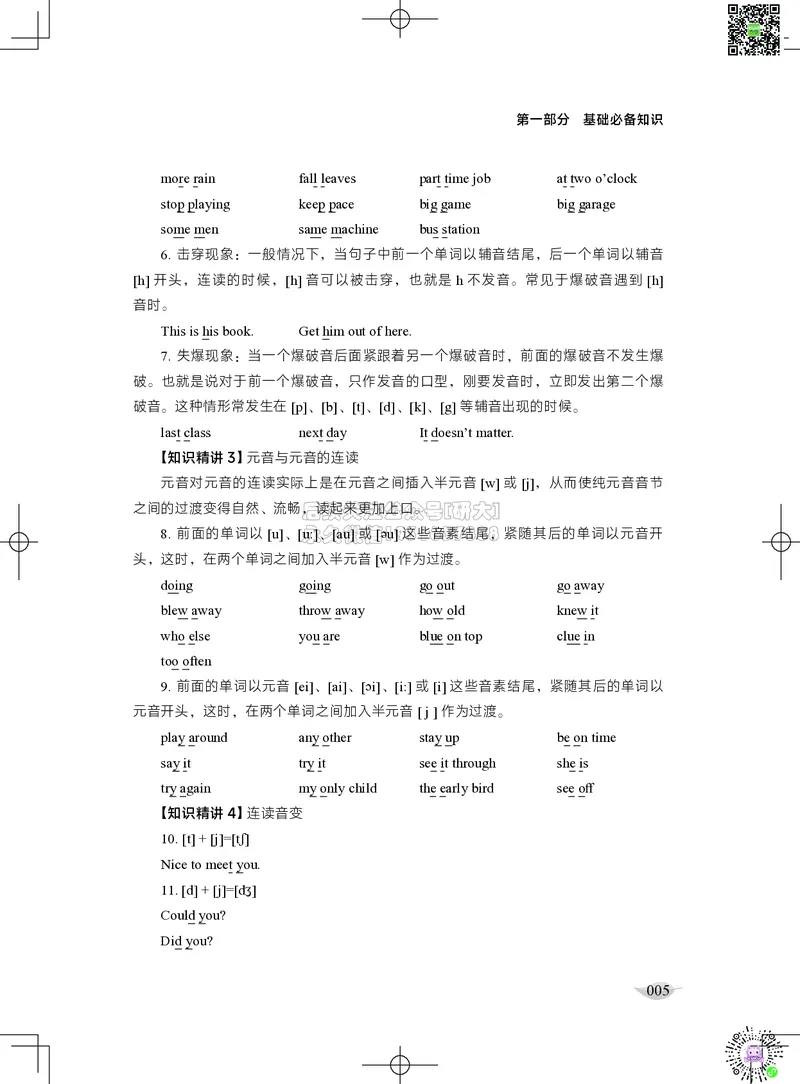
more rain fall leaves part time job at two o’clock
stop playing keep pace big game big garage
some men same machine bus station
6. 击穿现象:一般情况下,当句子中前一个单词以辅音结尾,后一个单词以辅音
[h]开头,连读的时候,[h]音可以被击穿,也就是h不发音。常见于爆破音遇到[h]
音时。
This is his book. Get him out of here.
7. 失爆现象:当一个爆破音后面紧跟着另一个爆破音时,前面的爆破音不发生爆
破。也就是说对于前一个爆破音,只作发音的口型,刚要发音时,立即发出第二个爆
破音。这种情形常发生在[p]、[b]、[t]、[d]、[k]、[g]等辅音出现的时候。
last class next day It doesn’t matter.
【知识精讲3】 元音与元音的连读
元音对元音的连读实际上是在元音之间插入半元音[w]或[j],从而使纯元音音节
之间的过渡变得自然、流畅,读起来更加上口。
8. 前面的单词以[u]、[u:]、[au]或[əu]这些音素结尾,紧随其后的单词以元音开
头,这时,在两个单词之间加入半元音[w]作为过渡。
doing going go out go away
blew away throw away how old knew it
who else you are blue on top clue in
too often
9. 前面的单词以元音[ei]、[ai]、[ɔi]、[i:]或[i]这些音素结尾,紧随其后的单词以
元音开头,这时,在两个单词之间加入半元音[ j ]作为过渡。
play around any other stay up be on time
say it try it see it through she is
try again my only child the early bird see off
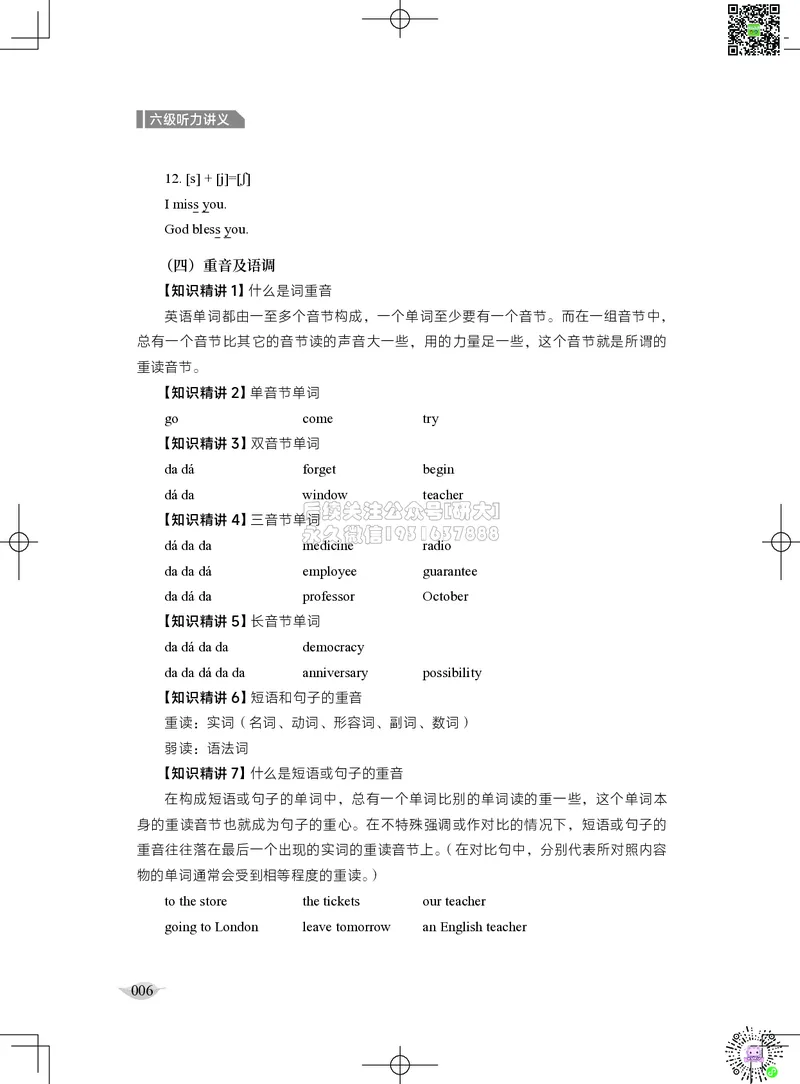
【知识精讲4】 连读音变
10. [t] + [j]=[tʃ]
Nice to meet you.
11. [d] + [j]=[dʒ]
Could you?
Did you?
005六级听力讲义
12. [s] + [j]=[ʃ]
I miss you.
God bless you.
(四)重音及语调
【知识精讲1】 什么是词重音
英语单词都由一至多个音节构成,一个单词至少要有一个音节。而在一组音节中,
总有一个音节比其它的音节读的声音大一些,用的力量足一些,这个音节就是所谓的
重读音节。
【知识精讲2】 单音节单词
go come try
【知识精讲3】 双音节单词
da dá forget begin
dá da window teacher
【知识精讲4】 三音节单词
dá da da medicine radio
da da dá employee guarantee
da dá da professor October
【知识精讲5】 长音节单词
da dá da da democracy
da da dá da da anniversary possibility
【知识精讲6】 短语和句子的重音
重读:实词(名词、动词、形容词、副词、数词)
弱读:语法词
【知识精讲7】 什么是短语或句子的重音
在构成短语或句子的单词中,总有一个单词比别的单词读的重一些,这个单词本
身的重读音节也就成为句子的重心。在不特殊强调或作对比的情况下,短语或句子的
重音往往落在最后一个出现的实词的重读音节上。(在对比句中,分别代表所对照内容
物的单词通常会受到相等程度的重读。)
to the store the tickets our teacher
going to London leave tomorrow an English teacher
006第一部分 基础必备知识
Will you mail it? She is studying English.
Does she speak it? I need a book.
I need pencil and paper. Do you want coffee or tea?
【知识精讲8】 实义重读
在进行语言表达时,通常讲话人会在一句话中所要强调的内容上加大音量。即在
句子中代表讲话人所强调内容的单词会受到重读,也就是通常所说的“强调什么,重
读什么”。
Tom likes to play soccer.(不特殊强调)
Tom likes to play soccer.(强调“玩”)
Tom likes to play soccer.(强调“喜欢”)
Tom likes to play soccer.(强调“人”)
二、解题基础必备知识
大学英语六级考试的听力理解部分由长对话、篇章和讲话/报道/讲座三种题型构
成。试题采用单选题形式。录音材料用标准的英式或美式英语朗读,语速约为每分钟
140-160词。所有录音材料均只播放一遍,每个问题后留有13秒答题时间。听力理解
部分占整张试卷的分值比例为35%,考试时间为30分钟。
试卷结构 题型分布 文章个数 题目个数 分值比例
长对话 2 8 8%
听力理解 篇章 2 7 7%
讲话/报导/讲座 3 10 20%
总计 7 25 35%
(一)解题思路
1. 错位听音, 。
2. 预览选项, 。
3. 题文同序, 。
4. 标志词与常设考点, 。
007六级听力讲义
(1)错位听音
简单的讲,“错位听音法”就是 ,把每一组考题提问的时间用
来预览后面一组考题的选项。
播放 预览
Section A考试说明
Conversation 1文章
Conversation 1问题
Conversation 2文章
Conversation 2 问题+ Section B考试说明
……依次类推 ……依次类推
(2)预览选项
1. 预览速度: 。
2. 先纵向,后横向: 。
3. 如果阅读速度较慢: 。
4. 分析不同题干下相关联的选项。
5. 用笔将预判的结果直接标注在卷纸上。
例1. do;to do;doing: 。
选项预览:
1. A) Find as many boats as possible.
B) Cut trees and build rowing boats.
C) Halt the operation until further orders.
D) Ask the commander to send a helicopter.
Q: What do the speakers decide to do finally?
选项预览:
2. A) To illustrate the importance of extrinsic values.
B) To explain Aristotle’s views about the importance of teaching.
008第一部分 基础必备知识
C) To explain why people change what they value.
D) To discuss Aristotle’s views about human happiness.
Q: What is the main purpose of the lecture?
选项预览:
3. A) Getting acquainted with the human resources personnel.
B) Finding out why the company provides the job opening.
C) Figuring out what benefits the company is able to offer them.
D) Tailoring their expectations to the company’s long-term goal.
Q: What other important preparations should job seekers make before an interview?
例2. by doing,with: 。
选项预览:
4. A) By consulting their own department managers.
B) By emailing questions to the man or the woman.
C) By exploring various channels of communication.
D) By visiting the company’s own computer network.
Q: How can the staff learn more about the company’s restructuring?
例3. 并列名词、形容词、词组: 。
选项预览:
5. A) Biography. B) Nature. C) Philosophy. D) Beauty.
听力原文:I’m really more interested in nature than beauty.
Q: What is the man really more interested in?
选项预览:
6. A) They seem positive. B) They are illustrative.
C) They seem intuitive. D) They are conclusive.
009六级听力讲义
听力原文:But the findings seem intuitive to me.
Q: What does the speaker think of the researchers’ findings?
选项预览:
7. A) Infants’ facial expressions. B) Babies’ emotions.
C) Babies’ interaction with adults. D) Infants’ behaviors.
听力原文:Our final study is from 1980, but it’s still relevant today. In fact, it’s one of
the most famous pieces of research about infant emotion ever published.
Q: What is the 1980 study about?
例4. 地点: 。
选项预览:
8. A) Beside a beautifully painted wall in Arles.
B) Beside the gate of an ancient Roman city.
C) At the site of an ancient Roman mansion.
D) At the entrance to a reception hall in Rome.
Q: Where is the speaker standing?
选项预览:
9. A) In a bus. B) In a clinic. C) In a boat. D) In a plane.
Q: Where does the conversation most probably take place?
例5. 数字、时间、价钱: 。
选项预览:
10. A) 10: 10. B) 9: 50. C) 9: 40. D) 9: 10.
Q: When is the train arriving?
选项预览:
11. A) $30-$40. B) $40-$50. C) $50-$60. D) Around $150.
Q: What is the price range of wine the man will consider?
010第一部分 基础必备知识
例6. 分清男女
选项预览:
12. A) She left her own car in Manchester.
B) Something went wrong with her car.
C) She wants to go traveling on the weekend.
D) Her car won’t be back in a week’s time.
Q: Why does the woman want to hire a car?
选项预览:
13. A) He talked to her on the phone.
B) He had a quarrel with Marsha.
C) He made a business trip.
D) He resolved a budget problem.
Q: What did the man do before he came to see the woman?
例7. 代词转名词
选项预览:
14. A) It is eating into its banks.
B) It winds its way to the sea.
C) It is wide and deep.
D) It is quickly rising.
Q: What do the speakers say about the river beyond the trees?
选项预览:
15. A) They are thin, tall, and unlike real human beings.
B) They have more than twenty different hair textures.
C) They have twenty-four different body shapes in total.
D) They represent people from virtually all walks of life.
Q: What do we know about the original Barbie dolls?
011六级听力讲义
(3)题文同序
大部分听力题目的出题顺序与所听文章内容顺序保持一致:基本上都是从前往后
出题。至于文章主旨类问题,例如“What is the talk mainly about?”,主旨通常在文章一
开始就会提到,但需要听完全文进行总结。根据题文同序原则听音时,如果已经出现
下一题选项的关键词,就要迅速扫读该题的选项是否与所听到的文章内容匹配,以
免错过题目。
(4)标志词与常设考点
1. 段首、段尾处
不管是长对话、篇章,还是讲话/报道/讲座,录音的第一句话或者段首句、段尾
句,历来是设题重点。有时文章的最后一句话会体现主旨大意,经常用来考查对听力
材料主旨大意的理解与把握。
2. 转折处
标志词:but,however,yet,instead,today,now,although,though,even though,
despite,in spite of,in fact,actually,practically,not... but...等。
3. 对比处
标志词:while,instead,in contrast,on the other hand,unexpected,unexpectedly,
unfortunately,fortunately,whereas,rather than,as... as,more than any other等。
4. 因果关系处
标志词:because,cause,for,as,since,owing to,be due to,lead to,thanks to,
contribute to,attribute to,consequently,result from,result in,as a result...,so,now
that等。
5. 总结处
标志词:in brief,in short,all in all,generally speaking,conclude,conclusion,in
a word,as a result,in short,you see,we can say,OK,anyway...等。
6. 表示重复、强调、顺序处
1)如果某一实词在文章中 ,其往往就是正确答案。
2)某些常见标志词的 会发生变化,有些词的语气会变得
强硬。
3)形容词和副词的最高级,表示唯一的词( )的出现。
4)常见表示顺序的标志词: 等。
012第一部分 基础必备知识
7. 定义、解释说明、建议处
标志词:according to,be known as,be defined/called as something,the definition of...,
which means,show/find/suspect/reveal that,suggest,advice,had better等。
8. 设问句处
1)一般疑问句升调处
2)特殊疑问句、特殊疑问词处
标志词: 等。
9. 特殊修辞处
排比、举例、比喻、虚拟语气处
标志词: 等。
10. 人名、数字、专有名词处
标志词: 等。
(二)解题技巧
1. 视听一致
六级听力考试中,超半数题目均可运用视听一致选出答案。视:看到的选项,听:
听到的录音。所谓视听一致就是 。
在听到与选项相关的关键词,或者常设考点的标志词之后,原文听到什么就到选
项中找与之相关或相似的答案, 或者 选
项,是正确选项的可能性更大。
例1. 选项预览:
A) He was recognized as a genius in the world of sports.
B) He competed in all major skiing events in the world.
C) He won three gold medals in one Winter Olympics.
D) He broke three world skiing records in three years.
听力原文:In 1966 and 1967 he captured virtually every major skiing trophy. The next
year he won three gold medals in the Winter Olympics, a record in ski racing that has never
been topped.
Q: What is said to be Killy’s biggest honor in his skiing career?
013六级听力讲义
2. 同义替换
六级听力考试中,至少有一半的正确选项和对应的原文答案句之间存在同义替换。
常见的同义替换形式有两种:
第二部分 技巧精讲 & 专项训练 & 真题演练
1) :词性的替换、短语表达的替换、否定词(双重否定
表肯定)的替换等。例如creation = creative tasks(词根不变,词性变化);flooded =
submerged in water;no longer listen to = stopped listening to。
2) :主被动语态的替换、因果关系的对调、肯否定替换,
一、长对话技巧精讲 & 专项训练 & 真题演练
以及详述和概括的替换等。
【解题技巧】
例2.选项预览: 长对话题型通常考查两篇对话,每篇对话后设置4个小题,一共8道小题,分值
A) A proper mindset. B) An ambitious plan. 比例8%。文章篇幅大约280-320个词。
C) An optimistic attitude. D) A keen interest. 长对话采用问答形式,对话双方 。把握
原则,第二、四、六、八段往往是答案所在的段落。
听力原文:Always keep that 20% goal in mind, prevent yourself from becoming 答题时,首先要分析选项之间的逻辑关系,找出不同题干下相关联的选项,推测
complacent. It can be challenging to stick to such a strict plan. But if you adopt the right 对话中男女二人的人物关系以及他们想要表达的信息。
mindset, you should be apt to make it work for you. 听音时,第一回合的对话通常就可以透露出对话的话题与场景,也常常是对话的
Q: What does the speaker think is important for achieving financial security? 主题所在,是回答主旨、场景等问题的依据。录音结尾处往往会涉及到对话者的建议、
正在或将要采取的行动,是回答有关下一步行动等问题的依据。
例3.选项预览:
A) It was memorable B) It was unbearable. 长对话考查的场景包括:
C) It was uneventful. D) It was fruitful.
1) 。通常是围绕某个社会话题展开,说话者双方谈论
各自对该话题的理解与看法,从而触及某一社会现象或者揭示某一问题。例如:时尚
听力原文:M: So overall, was the journey unsuccessful?
购物、休闲娱乐、家庭生活、社会热点、买卖商品、售后服务等。
W: Absolutely not. We gathered a massive amount of data about the local plant life.
2) 。通常是在校园内的一些话题,与学生的学习和生
Q: What does the woman think of the journey?
活密切相关。例如:专业的选择、课程与教学情况、宿舍的管理、作业或论文、假期
安排、学生中普遍存在的现象、师生对话或者学习中出现的问题等。
※注意:
3) 。通常涉及求职、招聘、面试、工作安排、工作交
1)听力题目几乎每个选项都带有原文词,干扰项通常就是由原文词+错误的修饰
流、兼职或在工作中出现的问题等。
词构成。而那些看起来找不到对应原文的同义替换,反而是正确答案。
4) 。通常包括时事报道和人物采访。所涉及的报道内
2)越简单越常见的单词,越容易被替换。
容较为广泛,其中尤以社会问题和政治事件为主,或者是针对某一人物的经历以及代
3)正确选项往往同时包含了视听一致与同义替换。
表作展开相关问答。
4)如果某两个选项存在局部相反现象,那这两个选项包含正确选项的可能性较大。
014第二部分 技巧精讲&专项训练&真题演练
第二部分 技巧精讲 & 专项训练 & 真题演练
一、长对话技巧精讲 & 专项训练 & 真题演练
【解题技巧】
长对话题型通常考查两篇对话,每篇对话后设置4个小题,一共8道小题,分值
比例8%。文章篇幅大约280-320个词。
长对话采用问答形式,对话双方 。把握
原则,第二、四、六、八段往往是答案所在的段落。
答题时,首先要分析选项之间的逻辑关系,找出不同题干下相关联的选项,推测
对话中男女二人的人物关系以及他们想要表达的信息。
听音时,第一回合的对话通常就可以透露出对话的话题与场景,也常常是对话的
主题所在,是回答主旨、场景等问题的依据。录音结尾处往往会涉及到对话者的建议、
正在或将要采取的行动,是回答有关下一步行动等问题的依据。
长对话考查的场景包括:
1) 。通常是围绕某个社会话题展开,说话者双方谈论
各自对该话题的理解与看法,从而触及某一社会现象或者揭示某一问题。例如:时尚
购物、休闲娱乐、家庭生活、社会热点、买卖商品、售后服务等。
2) 。通常是在校园内的一些话题,与学生的学习和生
活密切相关。例如:专业的选择、课程与教学情况、宿舍的管理、作业或论文、假期
安排、学生中普遍存在的现象、师生对话或者学习中出现的问题等。
3) 。通常涉及求职、招聘、面试、工作安排、工作交
流、兼职或在工作中出现的问题等。
4) 。通常包括时事报道和人物采访。所涉及的报道内
容较为广泛,其中尤以社会问题和政治事件为主,或者是针对某一人物的经历以及代
表作展开相关问答。
015六级听力讲义
【大纲样题】
Conversation 1选项预览:
1. A) He invented the refrigerator. B) He patented his first invention
C) He was admitted to university.. D) He got a degree in Mathematics.
2. A) He started to work on refrigeration.
B) He became a professor of Mathematics.
C) He fell in love with Natasha Willoughby.
D) He distinguished himself in low temperature physics.
3. A) Discovering the true nature of subatomic particles.
B) Their explanation of the laws of cause and effect.
C) Their work on very high frequency radio waves.
D) Laying the foundations of modern mathematics.
4. A) To have a three-week holiday. B) To spend his remaining years.
C) To patent his inventions. D) To teach at a university.
听力原文:
W: Hello.
M: Hello. Is that the reference library?
W: Yes. Can I help you?
M: I hope so. I rang earlier and asked for some information about Denys Hawtin, the
scientist. You asked me to ring back.
W: Oh, yes. I have found something.
M: Good. I’ve got a pencil and paper. Perhaps you could read out what it says.
W: Certainly. Hawtin, Denys. Born: Darlington, 1836, died New York, 1920.
M: Yes, got that.
W: Inventor and physicist, the son of a farm worker. He was admitted to the University
of London at the age of 15.
M: Yes.
W: He graduated at 17 with the first-class degree in Physics and Mathematics. All right?
M: Yes, all right.
W: He made his first notable achievement at the age of 18. It was a method of
016第二部分 技巧精讲&专项训练&真题演练
refrigeration which arose from his work in low temperature physics. He became
professor of Mathematics at the University of Manchester at 24, where he remained for
twelve years. During that time, he married one of his students, Natasha Willoughby.
M: Yes, go on.
W: Later, working together in London, they laid the foundations of modern Physics by
showing that normal laws of cause and effect do not apply at the level of subatomic
particles. For this he and his wife received the Nobel Prize for physics in 1910,
and did so again in 1912 for their work on very high frequency radio waves. In his
lifetime, Hawtin patented 244 inventions. Do you want any more?
M: Yes, when did he go to America?
W: Let me see. In 1920 he went to teach in New York and died there suddenly after only
three weeks. Still he was a good age.
M: Yes, I suppose so. Well, thanks.
Questions 1 to 4 are based on the conversation you have just heard.
Q1: What do we learn about Denys Hawtin when he was 15?
Q2: What did Denys Hawtin do at the age of 24?
Q3: For what were Denys Hawtin and his wife awarded the Nobel Prize a second time?
Q4: Why did Denys Hawtin go to New York?
必备词汇:
Conversation 2选项预览:
5. A) The injury of some students.
B) A school bus crash on the way.
C) The collapse of a school building.
D) A fire that broke out on a school campus.
6. A) Teaching. B) On vacation.
C) Having lunch. D) Holding a meeting.
7. A) A malfunctioning stove. B) Cigarettes butts left by workers.
C) Violation of traffic rules. D) Negligence in school maintenance.
017六级听力讲义
8. A) Sent a story to the local newspaper. B) Threw a small Thanksgiving party.
C) Baked some cookies as a present. D) Wrote a personal letter of thanks.
听力原文:
W: This is Lisa Meyer in the WBZ newsroom, talking with Mike Bassichis, who is the
director of the Gifford School, about the cleanup from last week’s fire and what the
possible cause of that blaze may have been.
M: We’re getting ready for our entire staff to return early from vacation tomorrow
whereupon we are going to move into temporary classrooms. And the other buildings
that did not burn are being de-smoked. As to the cause of the fire, all we know is
that we were having trouble with the pilot lights since we bought the stove in July
and it had been serviced three times. Well, as a matter of fact, we think it was a
malfunctioning stove that may have caused the fire. Nothing definite yet has been
determined.
W: Have you heard from other schools or other institutional users of this stove that have
had the same problem?
M: No. I wouldn’t know anything more about the stove itself. All I know is that this fire
went up so quickly that there’s been a suspicion about why it went up so quickly.
And it may be that there was a gas blast. But, again, this has not been determined
officially by anybody.
W: I got you. When do kids come back to school?
M: Next Monday, and we will be ready for them. Monday January 4. We’re just
extremely thrilled that no one was hurt and that’s because of the fire fighters that
were here, nine of them. They’re wonderful.
W: And I’m sure you send your thanks out to them, uh?
M: Well, we’re sending out thanks to them in a letter or in any other way we can. I heard
a story today where one of our kids actually baked some cookies and is taking it to
the fire department, to give it to them.
Questions 5 to 8 are based on the conversation you have just heard.
Q5: What were the speakers talking about?
018第二部分 技巧精讲&专项训练&真题演练
Q6: What were the school staff doing at the time of the accident?
Q7: What was supposed to be the cause of the accident?
Q8: What did one of the kids do to show gratitude?
必备词汇:
【真题预览】
Section A
Directions: In this section, you will hear three news reports. At the end of each news
report, you will hear two or three questions. Both the news report and the questions will be
spoken only once. After you hear a question, you must choose the best answer from the four
choices marked A), B),C) and D). Then mark the corresponding letter on Answer Sheet 1 with
a single line through the center.
Questions 1 to 4 are based on the conversation you have just heard.
1. A) He is going to leave his present job.
B) He is going to attend a job interview.
C) He will meet his new manager in two weeks.
D) He will tell the management how he really feels.
2. A) It should be carefully analyzed.
B) It should be kept private.
C) It can be quite useful to senior managers.
D) It can improve interviewees’ job prospects.
3. A) It may do harm to his fellow employees.
B) It may displease his immediate superiors.
C) It may adversely affect his future career prospects.
D) It may leave a negative impression on the interviewer.
4. A) Pour out his frustrations on a rate-your-employer website.
B) Network with his close friends to find a better employer.
C) Do some practice for the exit interview.
D) Prepare a comprehensive exit report.
019六级听力讲义
听力原文:
M: It’s my last day at work tomorrow. I’ll start my new job in two weeks. My human
resources manager wants to conduct an interview with me before I leave.
W: Ah, an exit interview. Are you looking forward to it?
M: I’m not sure how I feel about it. I resigned because I’ve been unhappy at that
company for a long time, but I’m not sure if I should tell them how I really feel.
W: To my way of thinking, there are two main potential benefits that come from
unleashing an agitated stream of truth during an exit interview. The first is release.
Unburdening yourself of frustration, and perhaps even anger to someone who isn’t a
friend or close colleague can be wonderfully freeing.
M: And let me guess. The second is that the criticism will, theoretically, help the
organization I’m leaving to improve, making sure employees of the future are less
likely to encounter what I did?
W: That’s right. But the problem with the company improvement part is that very often
it doesn’t happen. An exit interview is supposed to be private, but often isn’t. In my
company, the information gained from these interviews is often not confidential. The
information is used as dirt against another manager, or can be traded among senior
managers.
M: Now you’ve got me rethinking what I’ll disclose in the interview. There is always a
chance that it could affect my reputation and my ability to network in the industry. It
is a pretty small industry after all.
W: Anything you initially gained from the instant satisfaction of telling it like it is, you
might lose down the track by injuring your future career prospects.
M: Right. Perhaps I would be better getting things off my chest by going to one of those
rate-your-employer websites.
W: You could. And don’t do the interview at all. Exit interviews are not mandatory.
Questions 1 and 4 are based on the news report you have just heard.
Q1: What do we learn about the man from the conversation?
Q2: What does the woman think about the information gained from an exit interview?
Q3: Why does the man want to rethink what he will say in the coming exit interview?
020第二部分 技巧精讲&专项训练&真题演练
Q4: What does the man think he had better do?
必备词汇:
Questions 5 to 8 are based on the conversation you have just heard.
5. A) Her career as a botanist. B) Her latest documentary.
C) Her month-long expedition. D) Her unsuccessful journey.
6. A) She was caught in a hurricane. B) She had to live like a vegetarian.
C) She suffered from water shortage. D) She had to endure many hardships.
7. A) They could no longer bear the humidity.
B) They had no more food in the canoe.
C) A flood was approaching.
D) A hurricane was coming.
8. A) It was memorable. B) It was unbearable.
C) It was fruitful. D) It was uneventful.
听力原文:
M: Today, I’m talking to the renowned botanist, Jane Forster.
W: Thank you for inviting me to join you on the show, Henry.
M: Recently, Jane, you’ve become quite a celebrity, since the release of your latest
documentary. Can you tell us a little about it?
W: Well, it follows my expedition to study the vegetation indigenous to the rain forest in
equatorial areas of southeast Asia.
M: You certainly get to travel to some very exotic locations.
W: It was far from glamorous, to be honest. The area we visited was accessible only by
canoe and the living conditions in the hut were primitive, to say the least. There was
no electricity. And our water supply was a nearby stream.
M: How were the weather conditions while you were there?
W: The weather was not conducive to our work at all, since the humidity was almost
unbearable. At midday, we stayed in the hut and did nothing. It was too humid to
either work or sleep.
021六级听力讲义
M: How long did your team spend in the jungle?
W: Originally, we planned to be there for a month. But in the end, we stayed for only 2
weeks.
M: Why did you cut the expedition short?
W: Halfway through the trip, we received news that a hurricane was approaching. And
we had to evacuate at very short notice.
M: That sounds like a fascinating anecdote.
W: It was frightening. The fastest evacuation route was through river rapids. We had to
navigate them carrying all of our equipment.
M: So overall, was the journey unsuccessful?
W: Absolutely not. We gathered a massive amount of data about the local plant life.
M: Why do you put up with such adverse conditions?
W: Botany is an obsession for me. Many of the destinations I visit have a stunning
scenery. And I get to meet a variety of people from all over the world.
M: So where will your next destination be?
W: I haven’t decided yet.
M: Then we can leave it for another vacation. Thanks.
Questions 5 and 8 are based on the news report you have just heard.
Q5: What does the man want Jane Forster to talk about?
Q6: Why does the woman describe her experience as“ far from glamorous”?
Q7: Why did the woman and those who went with her end their trip halfway?
Q8: What does the woman think of the journey?
必备词汇:
【长对话专项训练】
(一)读选项推断问题
例1.选项预览:
A) To teach at a university. B) To patent his inventions.
022第二部分 技巧精讲&专项训练&真题演练
C) To spend his remaining years. D) To have a three-week holiday.
听力原文:
M: Yes, when did he go to America?
W: Let me see. In 1920 he went to teach in New York and died there suddenly after only
three weeks. Still he was a good age.
M: Yes, I suppose so. Well, thanks.
Q: Why did Denys Hawtin go to New York?
例2. 选项预览:
A) Irresponsible. B) Unsatisfactory. C) Aggressive. D) Conservative.
听力原文:
M: Do sit down.
W: Thank you.
M: I’m glad you’re interested in our job. Now, let me explain it. We plan to increase our
advertising considerably. At present, an advertising agency handles our account, but
we haven’t been too pleased with the results lately and we may give our account to
another agency.
Q: What does the man think of their present advertising agency?
例3.选项预览:
A) Prepare for his exams. B) Catch up on his work.
C) Attend the concert. D) Go on a vacation.
听力原文:
W: Can you come to the concert with me this weekend? Or do you have to prepare for
exams?
M: I still have a lot to do, but maybe a break would do me good.
Q: What will the man probably do?
023六级听力讲义
例4.选项预览:
A) Extra costs might eat up their profits abroad.
B) More workers will be needed to do packaging.
C) They might lose to foreign bike manufacturers.
D) It is very difficult to find suitable local agents.
听力原文:
M: What you are really saying is that we’d make more profit by selling bikes abroad,
where we have a cost advantage and can charge higher prices.
W: Exactly.
M: But, wait a minute. Packaging, shipping, financing, etc. will push up our cost and we
could end up no better off, maybe worse off.
W: OK. Now there are extra costs involved. But if we do it right, they can be built into
the price of the bike and we can still be competitive.
Q: What is the man’s concern about selling bikes abroad?
例5.选项预览:
A) At a travel agency. B) At a hotel front desk.
C) At a checkout counter. D) At a commercial bank.
听力原文:
M: I’d like to transfer money from my checking account to my savings account.
W: OK. Give me the numbers of both accounts and some identification, please.
Q: Where does the conversation most probably take place?
例6.选项预览:
A) She is attracted to the beauty of modern buildings.
B) She is preoccupied with her dream to be an architect.
C) She is influenced by her father who teaches architecture.
D) She is drawn to its integration of design and engineering.
024第二部分 技巧精讲&专项训练&真题演练
例7.选项预览:
A) Through hard work. B) With the professor’s help.
C) By studying the subject online. D) By taking prerequisite courses.
听力原文:
M: Have you decided what you wish to study?
W: Yes, professor. I wish to study architecture.
M: Ah, that’s a wonderful profession. Why did you choose it?
W: I gave a lot of thought to things you said during our last discussion, and I decided
architecture made the most sense for me. In particular, I’m attracted to the marriage
of design and engineering.
M: That’s great, but I seem to remember you were preoccupied with all the lofty
mathematics. You no longer think this aspect will be too hard for you?
W: No. I was doing some online research and I think I should be able to manage. Math
might be the toughest subject I encounter in the curriculum, but I’ll simply put in the
work required. I’m certain the fruits of my labor will pay off.
Q1: Why does the woman wish to study architecture?
Q2: How does the woman say she will overcome the difficulty in learning mathematics?
例8.选项预览:
A) It was spacious and tranquil. B) It was warm and comfortable.
C) It was shabby and solitary. D) It was tiny and noisy.
听力原文:
M: Hi, Lily, how’s the new apartment?
W: It’s okay.
M: What? How can it be just okay when last week you were thrilled about the place and
kept posting photos of it online?
W: Well, last week when I moved in, the apartment seemed cozy, just the right size for
one person. But now it just seems tiny, shabby and solitary.
Q: What was the woman’s first impression of the apartment?
025六级听力讲义
例9.选项预览:
A) Prescribe some medication for him.
B) Give him another physical check-up.
C) Explain to him the common consequence of stress.
D) Buy some sleeping pills for him from the drugstore.
听力原文:
M: But what about my feeling tired all the time and not being able to sleep well at night?
W: Those are common consequences of stress. And if you don’t sleep well, then of
course you will feel fatigued. I’m going to prescribe some special sleeping pills
for you. They have a soft, gentle effect and are made from natural ingredients, so
your stomach should tolerate them fine, and there shouldn’t be any negative side
effects. Take one with your dinner and come see me after a month. If there is no
improvement, I’ll give you something stronger.
M: Thank you, doctor.
Q: What does the woman say she will do for the man?
(二)读选项锁定关注目标
例1.选项预览:
A) She has the motivation to do the job. B) She knows the tricks of advertising.
C) She is not so easy to get along with. D) She is not suitable for the position.
听力原文:
M: Before you get carried away with your little scene, Miss Wenzmore, I regret to have
to tell you again that we are not planning to go into television.
W: That’s a shame. I’ve been doing a lot of television work lately and it interests me
enormously.
M: Then I really don’t think that this is quite the right job for you here, Miss Wenzmore.
Q: What does the man think of the woman applicant?
026第二部分 技巧精讲&专项训练&真题演练
例2.选项预览:
A) He was out of his mind. B) He was unemployed.
C) His wife deserted him. D) His children were sick.
听力原文:
M: Well, the reasons were a little muddied. Probably at least it seemed in a trial that he
did it to get some money to feed his family. You see, he’d been out of work for some
time.
W: Well, he’d been out of work and he chose to break into a house to get money for his
family and apparently in front of people that, er... could see him do it.
Q: What do we learn about the man at the time of the crime?
例3.选项预览:
A) She does not like John at all. B) John has got many admirers.
C) She does not think John is handsome. D) John has just got a bachelor’s degree.
听力原文:
M: John is handsome and wealthy. Believe it or not, he is still a bachelor.
W: He is a notorious guy in many girls’ eyes. I’m sick of hearing his name.
Q: What does the woman mean?
例4.选项预览:
A) They will get their degrees in two years.
B) They are both pursuing graduate studies.
C) They cannot afford to get married right now.
D) They do not want to have a baby at present.
听力原文:
W: Have Lisa and Eric started a family yet? They’ve been married for two years now.
M: Eric told me that they postponed having children until he gets his doctoral degree.
027六级听力讲义
Q: What do we learn about Lisa and Eric?
例5.选项预览:
A) The woman will attend the opening of the museum.
B) The woman is asking the way at the crossroads.
C) The man knows where the museum is located.
D) The man will take the woman to the museum.
听力原文:
W: Excuse me. Will it take me long to get to the museum that opens to the public recently?
M: No, it’ s no distance at all. In fact, I’m going in the same direction. Come and I’ll
show you the way when we get to the crossroads.
Q: What do we learn from the conversation?
例6.选项预览:
A) They are interested in fairy tales. B) They are curious and autonomous.
C) They are a headache to their parents. D) They are ignorant of politics.
听力原文:
W: Mr. David Jackson, a staff writer at the New Yorker, is known for his non-fiction
books of adventure. Today, we go on a different kind of adventure: Jackson’s life of
parenting his offspring. David, as a parent of an 11- and a 14-year-old, what is the
most interesting issue you are dealing with right now?
M: It’s easy to focus on the challenges, but so far, I find these ages to be kind of
wonderful. They are independent, and they have their own curiosities and obsessions.
You can talk to them about fairly sophisticated subject matter such as politics.
Q: What does the man think of young teenagers?
例7.选项预览:
A) The man got a poor evaluation from his colleagues.
B) The man made little contribution to the company.
028第二部分 技巧精讲&专项训练&真题演练
C) The man paid attention to trivial things.
D) The man had an attitude problem.
听力原文:
W: How did your annual performance evaluation meeting with your manager go? Did
you get much in the way of praise?
M: Next to zero. When we came to the part about discussing my areas for growth, he
bluntly told me that I had an attitude problem. But he wouldn’t really expand on that
description. He said it’s the little things I do and say.
Q: What was the manager’s reason for giving little praise for the man’s performance?
【长对话真题演练1】
练习1
Questions 1 to 4 are based on the conversation you have just heard.
1. A) It is clear that he is expected to enjoy a healthy life.
B) There is nothing wrong with his digestive system.
C) There is some indication of an issue with his blood circulation.
D) He doesn’t know he has long been suffering from poor health.
2. A) Mistaking symptoms of illness for stress.
B) Complaining they are being overworked.
C) Being unaware of the stress they are under.
D) Suffering from illness without recognising it.
3. A) Prescribe some medication for him.
B) Give him another physical check-up.
C) Explain to him the common consequence of stress.
D) Buy some sleeping pills for him from the drugstore.
4. A) It calls for responsible management.
B) It proves to be quite profitable.
029六级听力讲义
C) It is remarkably promising.
D) It is full of competition.
听力原文:
M: Hello, doctor.
W: Hello, please take a seat. I have your test results here. And it’s good news. The blood
test came back clear. There is no indication of any digestive issues.
M: So then, why do I feel so poorly all the time?
W: It’s probably due to overwork and stress.
M: No, it can’t be. I’ve always been working hard but I’ve never felt stress. Other people
suffering complain about that, but I don’t. It must be something else.
W: What you have just described is a common sentiment. Many people who suffer from
stress fail to recognise it. You told me you often work long into the night, right?
M: Yes, most days, in fact. But I’ve been doing that for about 20 years now.
W: That doesn’t matter. You could have been suffering from stress for 20 years without
knowing it. And now it’s catching up to you.
M: But what about my feeling tired all the time and not being able to sleep well at night?
W: Those are common consequences of stress. And if you don’t sleep well, then of
course you will feel fatigued. I’m going to prescribe some special sleeping pills
for you. They have a soft, gentle effect and are made from natural ingredients. So
your stomach should tolerate them fine, and there shouldn’t be any negative side
effects. Take one with your dinner and come see me after a month. If there is no
improvement, I’ll give you something stronger.
M: Thank you, doctor.
W: That’s not all. You should try and work less. Is there any way you can decrease your
workload?
M: Hmm... I’d have to think about it. [4] I’m a restaurant manager and this industry is
very competitive. There are many things to keep track of and stay on top of.
W: I recommend you think about delegating some responsibilities to someone else. I’m
not asking you to retire, just to slow down a bit. It’s for your own health.
030第二部分 技巧精讲&专项训练&真题演练
Question 1. What do we learn about the man from his test results?
Question 2. What does the woman think is a common phenomenon among many people?
Question 3. What does the woman say she will do for the man?
Question 4. What does the man say about the industry he is engaged in?
练习2
Questions 5 to 8 are based on the conversation you have just heard.
5. A) To avoid being in the limelight.
B) To seek medical help for his injury
C) To pursue a less competitive career.
D) To stay away from his hostile teammates.
6. A) It has ups and downs. B) It proves rewarding.
C) It does not last long. D) It is not so profitable.
7. A) He was a financial advisor. B) He suffered from poor health.
C) He became a basketball coach. D) He was back in the news.
8. A) Study issues of public health. B) Alleviate the obesity problem.
C) Raise sufficient public funding. D) Train young basketball players
听力原文:
W: Today on People in the News, our guest is John Williams. The name may not sound
familiar to you, but John was once an acclaimed basketball player. John, you stunned
fans by leaving the sport at just 25. Why did you retire so early?
M: Meg, I loved being an athlete, but I didn’t love being a celebrity. I was in the
limelight when I was still a high school student and went professional right after high
school graduation, which was a mistake. I was a shy kid and I wasn’t ready for all the
media attention.
W: But walking away from millions of dollars at the height of your career? Most people
wouldn’t be able to resist the lure of such a high salary. When you left the sport, there
031六级听力讲义
was speculation that you were having issues with your teammates or even an injury.
M: Not at all. It was hard to quit. I was tempted to stay in the game, because I loved
basketball and I loved my team. As for money, I turned professional at 18, so I’d
actually earned a lot and saved most of it because l had great financial advisors. I
knew basketball wasn’t a career with a lot of longevity for most players, so I wanted
to change careers while I was still young.
W: Okay, that was 20 years ago, and you’re back in the news. You’ve created a
foundation that works to get more kids playing team sports. Why?
M: I went to university and I studied public health and learned about the seriousness of
the obesity epidemic, particularly among kids and adolescents in poor communities.
[8] I’ve spent the last two decades trying to alleviate the problem. The foundation is
just the latest attempt.
W: The foundation uses private donations to support basketball teams for girls and boys
in primary school, right?
M: Actually, we support teams for secondary school students too, and also have some
public funding.
Question 5. Why did John Williams leave the sport of basketball at just 25?
Question 6. What does the man say about basketball as a career for most players?
Question 7. What do we learn from the woman about John Williams 20 years later?
Question 8. What has the man spent the last two decades trying to do?
练习3
Questions 1 to 4 are based on the conversation you have just heard.
1. A) Read numerous comments users put online.
B) Blended all his food without using a machine.
C) Searched for the state-of-the-art models of blenders.
D) Did thorough research on the price of kitchen appliances.
2. A) Eating any blended food. B) Buying a blender herself.
C) Using machines to do her cooking. D) Making soups and juices for herself.
032第二部分 技巧精讲&专项训练&真题演练
3. A) Cooking every meal creatively in the kitchen.
B) Paying due attention to his personal hygiene.
C) Eating breakfast punctually every morning.
D) Making his own fresh fruit juice regularly
4. A) One-tenth of it is sugar.
B) It looks healthy and attractive.
C) One’s fancy may be tickled by it.
D) It contains an assortment of nutrients.
听力原文:
M: I’ve just bought a new blender.
W: What’s that?
M: A blender, you know, a machine that blends food.
W: Ah, yes. Of course. The electric kitchen appliance.
M: Exactly. This one is state of the art. I’ve been meaning to buy one for a while. And
I did thorough research on which specific model to get. I read through maybe
hundreds of online user reviews. Anyway, it’s amazing!
W: Really? What could be so special about it? I mean it’s just a blender.
M: Well, basically, it’s just a very good one. It feels heavy and sturdy and well-made. It
also has lots of power and can easily cut and crush practically anything. This way, the
soups and juices I make come out really fine and smooth with no lumpy bits.
W: Em, I see. I’ve never thought of getting one myself. It sounds like the kind of thing
that, for me personally, I would rarely use.
M: I’ve never had one before. And now that I do, I use it all the time. I make a fresh fruit
juice in the morning. Maybe not every morning, but 3 or 4 times a week, and it feels
fantastic. It’s a really healthy habit.
W: I can imagine that must feel quite satisfying. I can picture you getting all creative in
the kitchen and trying out a multitude of different ingredients. And it’s obviously
going to be healthier than buying packaged juice from a supermarket.
M: It’s so much healthier. It’s not even close. Did you know that store-bought juice is
033六级听力讲义
like 10% sugar?
W: Right. So then you bought it for the health benefits?
M: Mostly yes. Basically, it allows me to have a more varied diet with a far wider
assortment of nutrients, because it’s not only fruit in my morning juices you see. I
can also throw in vegetables, nuts, yogurt, cereals, anything that tickled my fancy.
Question 1.What does the man say he did before buying the blender?
Question 2.What does the woman say she has never thought of doing?
Question 3.What does the man say is a really healthy habit?
Question 4.What do we learn about store-bought juice from the conversation?
【长对话真题演练2】
练习1
Questions 1 to 4 are based on the conversation you have just heard.
1. A) Spending their holidays in a novel way.
B) Exploring more summer holiday resorts.
C) Surfing online to check out the best deals.
D) Renting a car instead of driving their own.
2. A) He did not like to be locked into one place.
B) He did not find holiday homes appealing.
C) He was well travelled.
D) He once owned a van.
3. A) Generate their own electricity.
B) Drive under any weather condition.
C) Receive instructions via computers.
D) Ensure the safety of passengers.
4. A) Riding one’s mountain bike on vacation.
034第二部分 技巧精讲&专项训练&真题演练
B) Slowing down in one’s increasingly hectic life.
C) Enjoying the freedom to choose where to go and work.
D) Having one’s basic needs covered while away from home.
听力原文:
W: So, I’ve been thinking, this summer, instead of our usual holiday rental, I’d like to try
renting a camper van and exploring a bit more.
M: A camper van? You mean to spend the summer living out of a car?
W: Yes, a camper van. And no, it’s nothing like living out of a car. These are proper vans
with full-size bed to sleep in. Some even have kitchens. This way, we wouldn’t have
to be locked into one place during our holiday. We’d be able to visit so many more
places and travel at our own pace. The rates of most hotels and holiday homes really
soar in the summer anyway. We’d probably save a lot of money as well.
M: I think my grandfather had a van like that. It doesn’t sound that appealing to me.
W: Today’s camper vans are completely different. These days, they’re equipped with all
the modern comforts. I’ve seen quite a few with solar panels that provide electricity
for when you’re stopped. This way you can still use your computer or charge your
phone. And most even have Wi-Fi, so if the weather’s not great, you could stream
videos.
M: I’m warming up to the idea. Keep talking.
W: Loads of people are committing to this trend full time. Check it out online. Lots of
people stream videos of their alternative lifestyles and actually earn a salary. Imagine
having that kind of freedom to go anywhere you want and work from anywhere in
the world.
M: Okay, we can consider it. As long as the basic needs like toilets and showers are
covered, I’m definitely in. Do you think there’ll be enough room for my mountain
bike? What about food delivery? Will we be able to order to the van? Will there be
enough space for the dog? We wouldn’t want to leave him behind.
W: Slow down. Glad you’re excited about it. Let’s start by looking at what’s available
first.
035六级听力讲义
Question 1. What has the woman been thinking of doing for this summer?
Question 2. What do we learn about the man’s grandfather from the conversation?
Question 3. What can many camper vans do nowadays according to the woman?
Question 4. What idea does the woman find attractive?
练习2
Questions 5 to 8 are based on the conversation you have just heard.
5. A) Her physical health has deteriorated these past few weeks.
B) She has lagged behind most of her co-workers in output.
C) Her job performance has worsened over the past month.
D) She has missed several important appointments lately.
6. A) Penalty for curtailed output. B) Some problems at home.
C) Disturbance of her mind. D) Serious health issues.
7. A) The woman’s whole-hearted support. B) The woman’s work proficiency.
C) His management capability. D) His engaging personality.
8. A) The man will help the woman get back to her usual self.
B) The man will be back at his 100% in a couple of weeks.
C) The woman will be off work on the next two Mondays.
D) The woman will resume her work in two weeks.
听力原文:
W: You wanted to see me?
M: Yes, I’ll get straight to the point. Over the past month or so, it has become apparent
that your performance has dipped. You’ve been late to work several times these past
few weeks, which is very uncharacteristic of you. But what really concerns me is
your curtailed output. Lately, you seem to be constantly one step behind. What’s
going on?
W: I’m sorry. I’m going through some unfortunate family issues at the moment.
036第二部分 技巧精讲&专项训练&真题演练
It’s a personal matter. So if you don’t mind, I much prefer we don’t get into it.
Nevertheless, I expect it to have all blown over in another month or so.
M: Do you need some time off?
W: Actually, yes. [8] Would it be possible to take the next two Mondays off? I was
deliberating whether l should ask for this, but now that we’re here…
M: Sure thing! But if you needed some leave, why didn’t you ask for it earlier?
W: I’m not sure why. I guess I kind of felt bad asking for it.
M: You shouldn’t feel bad asking for leave, especially if you need it.
W: I know. You’re right. I’m sorry.
M: Look, you’ve been with us almost five years and I personally really value your
proficiency at your job. It
makes my job far easier. In addition, I can assure you that management as a whole also
holds you in high regard.
W: Thank you.
M: What I need is for you to be back at your 100%. Are you sure taking two Mondays
off will suffice?
W: It’ll be enough. I’m sure of it.
M: Okay, good. So this is what we’re going to do. You will take those days off and I
expect that you will gradually come back to your usual self. Then in two months’
time, we will catch up again to see how you are faring.
W: Sounds good. Thank you for your understanding.
Question 5. What do we learn about the woman from the man’s description?
Question 6. What does the woman say she’s experiencing at the moment?
Question 7. What does the man say makes his job far easier?
Question 8. What agreement have the speakers reached by the end of the conversation?
练习3
Questions 5 to 8 are based on the conversation you have just heard.
5. A) How he has made himself popular as the mayor of Berkton.
B) How the residents will turn Berkton into a tourist attraction.
037六级听力讲义
C) How charming he himself considers the village of Berkton to be.
D) How he has led people of Berkton to change the village radically.
6. A) It was developed only to a limited extent.
B) It was totally isolated as a sleepy village.
C) It was relatively unknown to the outside.
D) It was endowed with rare natural resources.
7. A) All the properties in Berton were designed by the same architect.
B) The majority of residents lived in harmony with their neighbors.
C) The majority of residents enjoyed cosy housing conditions.
D) All the houses in Berkton looked aesthetically similar.
8. A) They have helped boost the local economy.
B) They have made the residents unusually proud.
C) They have contributed considerably to its popularity.
D) They have brought happiness to everyone in the village.
听力原文:
W: Today we have a very interesting guest, Mr. Thomas Benjamin Grimm, the mayor of
Berkton. He’s here to talk about his job and responsibilities overseeing this charming
village. Mr. Grimm, thank you for being here.
M: Thank you for having me.
W: I’d like to start by saying the obvious. Berkton has become one of the most popular
tourist destinations in the country. And this has happened under your watch. Just how
did you achieve this?
M: The achievement belongs to all the residents of Berkton. It was a shared effort where
everybody pitched in for the communal good.
W: But how did this change happen? In about 10 years, Berkton has gone from a
relatively unheard-of sleepy village to a must-see destination.
M: Yes, the change has truly been remarkable. Berkton was always fortunate to be
038