Unit 6 A Day in the Life 第四课时
分层作业
一、单词拼写
1.Sandy keeps writing English about his life. He learns to use English better this way.(每日的)
【答案】daily
【详解】句意:桑迪一直用英语写他的日常生活。他通过这种方式学习更好地使用英语。“每日的”英文
为“daily”,形容词作定语以修饰名词life,故填daily。
2.We should help each other in our .(日常生活)
【答案】daily life/routine
【详解】句意:我们应该在日常生活中互相帮助。daily life“日常生活”,in one’s daily life/routine“在某人
的日常生活中”,故填daily life/routine。
3.Lucy is (只有) seven years old, but she can do much housework.
【答案】only
【详解】句意:Lucy只有七岁,但是她能够做很多家务。only表示“只有;仅仅”,副词。故填only。
4.I usually have a b (休息) after I clean the house.
【答案】(b)reak
【详解】句意:我通常在打扫完房子后休息一下。根据汉语及首字母提示,可知“休息”英文表达用
break,have a break“休息一下”,固定搭配。故填(b)reak。
5.We (结束) our classes at four thirty in the afternoon every day.
【答案】finish
【详解】句意:我们每天下午四点三十分结束我们的课程。观察句子,此处作谓语,又根据提示词可知,
需要填finish,又根据“every day”可知,句子时态为一般现在时态,且主语“We”表复数,所以这里填原
形。故填finish。
6.It is (已经) six o’clock. Let’s make supper.
【答案】already
【详解】句意:现在已经六点了。让我们做晚饭吧。已经:already,副词,放于系动词后面。故填
already。7.The (昏暗的) sky is filled with stars.
【答案】dark
【详解】句意:昏暗的天空繁星点点。根据汉语提示可知本题考查单词dark“昏暗的”,形容词作定语,故
填dark。
8.Some students are (在……外面) the classroom. What are they doing?
【答案】outside
【详解】句意:一些学生在教室外。他们在做什么?介词outside意为“在……外面”,故填outside。
9.Mom (把……准备好) breakfast for our family every morning.
【答案】prepares
【详解】句意:妈妈每天早上为我们全家准备早餐。根据“Mom...breakfast for our family”可知,此处指的
是为全家准备早餐,prepare...for...表示 “为……准备……”;由“Mom”和“every morning”可知,主语
“Mom”为单数,时态为一般现在时,故谓语动词填单三形式。故填prepares。
10.We have many after-school to do every day.(活动)
【答案】activities
【详解】句意:我们每天都有很多课外活动要做。activity“活动”,空格前有many“很多”,后接可数名词
复数。故填activities。
二、单项选择
11.Tom has ________ breakfast every morning. And he always eats ________ good breakfast.
A.the; the B./; a
C.the; a D./; the
【答案】B
【详解】句意:汤姆每天早晨吃早饭,他经常吃一顿好的早餐。have breakfast吃早饭,不定冠词a/an一个,
通常用于泛指,a用于辅音因素开头的单词前,an用于元音因素开头的单词前;定冠词the这个,那个,通
常用于特指;故选B
12.Boys and girls, it’s time ______ class now.
A.to B.for
C.in D.with
【答案】B
【详解】句意:同学们,到了上课时间了。It’s time for sth到了做某事的时间了;it’s time to do sth到了做
某事的时间了;故选B
13.—______ do you usually play the violin?—On weekends.
A.What time B.Why
C.Where D.When
【答案】D
【详解】试题分析:句意:----你通常什么时候拉小提琴?----周末。由答语On weekends.可知是对时间进
行提问的。A.What time什么时间,对时间点提问;B.Why为什么;C.Where在哪儿;D.When什么时候。
故选D。
14.—What’s the English for 9:50?
—It’s ______.
A.nine fifty B.fifty nine
C.ten to nine D.ten past nine
【答案】A
【详解】句意:——9点50的英语是什么?——是 nine fifty 。A. nine fifty 9点50; B. fifty
nine59;C. ten to nine 8点50; D. ten past nine9点10分;故选A
15.—Do you have time ______ soccer with me?
—Yes, I ______.
A.to play; have B.playing; have
C.to play; do D.playing; do
【答案】C
【详解】句意:——你有时间和我踢足球吗?——是的,我有。have time to do sth有时间做某事;用do问,
用do的形式回答;故选C
16.It’s six o’clock in the morning. It’s time ________.
A.get up B.for get up C.to get up D.of getting up
【答案】C
【详解】句意“早晨六点钟了,该起床了”。it is time to do sth到该做某事的时间了。根据句意,故选C。
17.Look at the clock , It ’s six fifteen.
A.fifteen to five B.fifteen past six
C.a quarter to six D.a quarter past five
【答案】B
【详解】试题分析:句意:看表,时间是6:15.6:15可以用两种表达方式six fifteen;或fifteen past six故选
B。考点:考查时间的表达方式。
18.My mother usually gets up five the morning.
A.in;at B.at;in C.on;in D.around;on
【答案】B
【详解】句意“我的母亲通常早晨6:00起床”。在早晨、中午、晚上前用in,在具体的时刻前用at。根据
句意,故选B。
19.What time does Lisa after school?
A.watch TV B.watches TV
C.do her homeworks D.does her homeworks
【答案】A
【详解】句意“丽萨放学后什么时候看电视”。homework为不可数名词,后不加s,排除C和D,助动词
后用动词原形,根据句意,故选A。
20.My mother usually at 5:30 in the afternoon.
A.get home B.get to home
C.gets to home D.gets home
【答案】D
【详解】句意“我的妈妈通常下午5:30到家”。my mother为主语,谓语动词用单数gets,排除A和B。
home为地点副词,不加to,即get home。故选D。
三、补全对话
根据对话内容,选择恰当的句子填入对话相应的空白处,使对话完整,合乎情景 (有两个多余选项)。
A: Hi, Rick. 21
B: I usually get up at 6:30.
A: 22
B: I exercise from 6:40 to 7:00. After that I have breakfast.
A: 23
B: Some cakes and a glass of milk.
A: 24
B: At 8:00. And we have four classes in the morning, and another two in the afternoon.
A: Do you often surf the Internet (上网) after school?
B: 25 It’s fun, isn’t it?
A: Yes. We can learn a lot on the Internet.A.What do you do then?
B.Why do you get up so late?
C.Sure.
D.What time do you usually get up?
E.What do you have for breakfast?
F.I watch TV or play computer games.
G.When do you begin your classes every day?
【答案】21.D 22.A 23.E 24.G 25.C
【导语】本文是A对B日常生活的一些提问。
21.根据“I usually get up at 6:30.”可知是问对方几点起床,选项D“你通常什么时候起床?”符合语境,故
选D。
22.根据“I exercise from 6:40 to 7:00.”可知是问起床后做什么,选项A“然后你做什么?”符合语境,故选
A。
23.根据“Some cakes and a glass of milk.”结合“After that I have breakfast.”可知是问对方早餐吃什么,选项
E“你早餐吃什么?”符合语境,故选E。
24.根据“At 8:00. And we have four classes in the morning,”可知是问对方什么时候开始上课,选项G“你每
天什么时候开始上课?”符合语境,故选G。
25.根据“Do you often surf the Internet (上网) after school?”可知此处是回答对方的询问,结合“It’s fun,
isn’t it?”可知应作肯定回答,选项C“当然。”符合语境,故选C。
四、完形填空
请通读下面短文,掌握其大意,从每小题所给的四个选项中选出一个最佳答案。
Fun Life is a show on WABC Radio Station. Paul is the DJ (唱片节目主持人) of this show. Many people
26 him. That’s because he is funny and he often listens to what they say 27 . Some of them often
write letters to him and they thank him for his interesting 28 , so there are lots of letters for him every
week.
Paul 29 at 6:40 every morning. He does sports and has breakfast. He often runs for 15 minutes
because he wants to be 30 . He doesn’t usually have a big breakfast. He only has an egg and some milk.He usually 31 home at 7:30 and he gets to his office at 7:50.
The show begins at 8:20. Paul’s 32 is to play new songs and help listeners in need. He usually
listens to the 33 in their lives and tries to give some advice (建议) to them. People feel 34 and
happy after they talk with Paul. Paul finishes his work at 10:30 and then goes back home by car. He usually does
some reading in the afternoon because he thinks 35 can help him learn a lot. And he usually goes to bed
early in the evening.
26.A.like B.forget C.tell D.need
27.A.easily B.carefully C.luckily D.difficultly
28.A.games B.stores C.classes D.shows
29.A.gets up B.gets down C.gets on D.gets off
30.A.tall B.tired C.special D.healthy
31.A.rides B.cleans C.leaves D.arrives
32.A.work B.information C.mind D.news
33.A.answers B.weekends C.problems D.names
34.A.sorry B.relaxed C.angry D.nervous
35.A.songs B.movies C.cards D.books
【答案】
26.A 27.B 28.D 29.A 30.D 31.C 32.A 33.C 34.B 35.D
【导语】本文主要介绍了Paul一天的生活。
26.句意:很多人喜欢他。
like喜欢;forget忘记;tell告诉;need需要。根据下文“That’s because he is funny and he often listens to
what they say...”可知,他有趣,且他经常会听人们的倾诉,所以很多人应是喜欢他的。故选A。
27.句意:那是因为他很有趣,并且他经常会很认真地去聆听他们所说的话。
easily轻易地;carefully认真地;luckily幸运地;difficultly困难地。根据“he is funny and he often listens to
what they say...”可知,此处应是表示他会认真聆听别人所说的话。故选B。
28.句意:他们中的一些人经常写信给他,感谢他精彩的演出。
games游戏;stores商店;classes课程;shows表演。根据上文“Paul is the DJ (唱片节目主持人) of this
show.”可知,Paul是节目的主持人,所以人们感谢的是他精彩的演出。故选D。
29.句意:Paul每天早上6点40分起床。
gets up起床;gets down下来,使沮丧;gets on上车;gets off下车。根据“Paul...at 6:40 every morning.”可
知,早上的6点40分应是起床的时间。故选A。30.句意:他经常会跑步15分钟,因为他想要健康。
tall高的;tired疲惫的;special特别的;healthy健康的。根据“He often runs for 15 minutes because he wants
to be...”可知,经常跑步,应是想要健康。故选D。
31.句意:他通常在7点30分离开家,然后在7点50时到达他的办公室。
rides骑;cleans清洁;leaves离开;arrives到达。根据“He usually...home at 7:30 and he gets to his office at
7:50.”可知,他应是在7点30分时离开家去上班。故选C。
32.句意:Paul的工作就是播放新歌,帮助有需要的听众。
work工作;information信息;mind智慧,心思;news新闻。根据上文“Paul is the DJ (唱片节目主持人) of
this show.”可知,Paul是唱片节目的主持人,所以播放新歌和帮助有需要的听众应是他的工作。故选A。
33.句意:他通常聆听他们生活中的问题,然后试着给他们一些建议。
answers答案;weekends周末;problems问题;names名字。根据“He usually listens to the...in their lives and
tries to give some advice (建议) to them.”可知,此处应是表示聆听问题,给出建议。故选C。
34.句意:人们在和Paul聊天之后会感到放松且开心。
sorry很抱歉;relaxed轻松的;angry生气的;nervous焦虑的。根据“People feel...and happy after they talk
with Paul.”可知,和Paul聊天后,人们应是感到放松且开心。故选B。
35.句意:他通常会在下午读一些书,因为他认为书可以帮助他学到很多东西。
songs歌;movies电影;cards卡片;books书。根据“He usually does some reading in the afternoon because
he thinks...can help him learn a lot.”可知,与阅读有关的应是书本。故选D。
五、阅读理解
A
Hello, my name is Lorna Adams and I’m 12. I live in England with my father Sam, my mother Jenny, my
brother Ben, my cats, Fluffy and Snow, and my dog, Scruffy. I like my school days very much.
Time Activities
7:00 a.m. Get up
7:10—7:20 a.m. Take a shower
7:30—8:00 a.m. Have breakfast & Brush my teeth
8:00—8:20 a.m. Walk to school
8:30—11:50 a.m Have four lessons
11:50 a.m.—1:20 p.m. Have lunch at school1:30—3:00 p.m. Have two lessons
School finishes early, so I have time to go to some after-school clubs: art on Mondays, violin on Wednesdays
and chess on Fridays. When I get home, I do my homework. After dinner, I help my mom clean the table. Then I
feed (喂) my cats and walk my dog. It’s nice.
36.There are ________ people in Lorna’s family.
A.three B.four C.five D.six
37.At 7:30 a.m. on school days, Lorna ________.
A.gets up B.takes a shower C.has breakfast D.walks to school
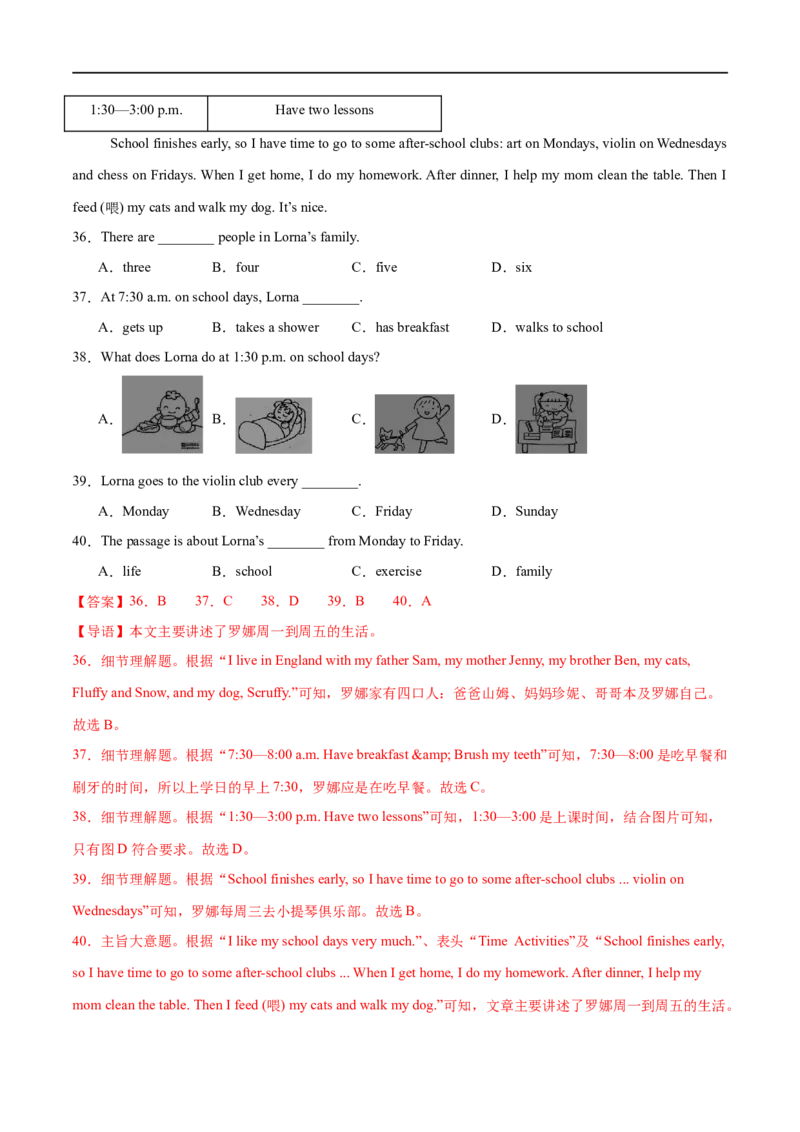
38.What does Lorna do at 1:30 p.m. on school days?
A. B. C. D.
39.Lorna goes to the violin club every ________.
A.Monday B.Wednesday C.Friday D.Sunday
40.The passage is about Lorna’s ________ from Monday to Friday.
A.life B.school C.exercise D.family
【答案】36.B 37.C 38.D 39.B 40.A
【导语】本文主要讲述了罗娜周一到周五的生活。
36.细节理解题。根据“I live in England with my father Sam, my mother Jenny, my brother Ben, my cats,
Fluffy and Snow, and my dog, Scruffy.”可知,罗娜家有四口人:爸爸山姆、妈妈珍妮、哥哥本及罗娜自己。
故选B。
37.细节理解题。根据“7:30—8:00 a.m. Have breakfast & Brush my teeth”可知,7:30—8:00是吃早餐和
刷牙的时间,所以上学日的早上7:30,罗娜应是在吃早餐。故选C。
38.细节理解题。根据“1:30—3:00 p.m. Have two lessons”可知,1:30—3:00是上课时间,结合图片可知,
只有图D符合要求。故选D。
39.细节理解题。根据“School finishes early, so I have time to go to some after-school clubs ... violin on
Wednesdays”可知,罗娜每周三去小提琴俱乐部。故选B。
40.主旨大意题。根据“I like my school days very much.”、表头“Time Activities”及“School finishes early,
so I have time to go to some after-school clubs ... When I get home, I do my homework. After dinner, I help my
mom clean the table. Then I feed (喂) my cats and walk my dog.”可知,文章主要讲述了罗娜周一到周五的生活。故选A。
B
Sophia is 11 years old and she lives in England. She usually gets up at 7:45. She has a shower and gets
dressed. Then she brushes her teeth because she likes them white and healthy. After that, she goes downstairs and
has breakfast.
Then she takes her schoolbag and goes to the bus stop to catch the school bus. Classes start at 8:30 and finish
at 4:30. She usually has lunch at school with her classmates at about twelve o’clock. Her best friend is Amy, and
Sophia always sits next to her at lunch. They usually eat rice soup, salads, and meat.
After school, she goes back home and usually listens to music and watches TV to relax. But before that, she
must finish her homework first.
At 7:30, it is time for dinner. She has a sandwich with strawberry juice. Then she usually reads a book. Finally,
she goes to bed at about ten o’clock. But before that, she brushes her teeth. Such is Sophia’s daily routine.
41.What does Sophia do after getting dressed? ______
A.She has a shower. B.She brushes her teeth. C.She goes to school. D.She
goes downstairs.
42.How many hours does Sophia stay at school on school days? ______
A.Nine B.Ten C.Six D.Eight
43.The underline words “daily routine” means ______.
A.everyday life B.school life C.school rules D.everyday rules
44.Which is the right order of Sophia’s daily routine? ______
a. She catches the bus to school. b. She has lunch at school.
c. She listens to music. d. She gets up. e. She does her homework.
A.d-c-a-b-e B.d-a-b-e-c C.d-a-b-e-c D.d-b-a-c-e
【答案】41.B 42.D 43.A 44.C
【导语】本文主要介绍了Sophia的日常生活。
41.细节理解题。根据“She has a shower and gets dressed. Then she brushes her teeth ...”可知,Sophia穿好衣
服后刷牙。故选B。
42.细节理解题。根据“Classes start at 8:30 am and finish at 4:30 pm.”可知,Sophia学习日在学校的时长为
八小时。故选D。
43.词义猜测题。通读全文可知,本文主要介绍了Sophia的日常生活,因此“daily routine”的含义为“日
常生活”。故选A。44.细节理解题。根据“She usually gets up at 7:45.”可知,首先是起床,即d;根据“Then she takes her
schoolbag and goes to the bus stop to catch the school bus.”可知,其次是赶公交车去上学,即a;根据“She
usually has lunch at school with her classmates at about twelve o’clock.”可知,接下来是和朋友在学校吃午饭,
即b;根据“After school, she goes back home and she must finish her homework first.”可知,然后是做作业,
即e;根据“And after that, she usually listens to music and watches TV for an hour.”可知,最后是听音乐,即
c。综上,正确的顺序为d-a-b-e-c。故选C。
C
根据短文内容,从所给的选项中选出能填入空白处的最佳选项,其中有一项多余。
I’m Maria. I am a Chinese girl. I am at No. 3 Middle School now. I usually get up at 6:30 in the morning and
then I take a shower. 45 We have the first class at 8:10 in the morning. At 12:00 I eat lunch at school.
46 They are my favorite food. We finish school at 3:30 in the afternoon. After school, I either go to the library
or play tennis with my friends. 47 I usually go to bed early at 9:00 in the evening.
Mike is my father. He gets up early every day, at about 5:30. 48 After a quick breakfast, he goes to
work. He works on the computer at home. He usually works until (直到) about 12:00. 49 After that, he
continues (继续) to work on the computer until about 6:00. In the evening, he always takes a walk after dinner.
A.He always has a big lunch.
B.And then he runs for half an hour.
C.After a good breakfast, I go to school at 7:30.
D.I never watch TV on school days.
E.I am good with my classmates and teachers.
F.For lunch, I usually have hamburgers.
【答案】45.C 46.F 47.D 48.B 49.A
【导语】本文主要是介绍Maria的日常生活情况和他爸爸Mike的日常生活。
45. 根据“I usually get up at 6:30 in the morning and then I take a shower.”和“We have the first class at 8:10
in the morning.”可知,起床后和上学之前要吃早餐,可推测空格处跟早餐有关,选项C“吃完一顿丰盛的早
餐后,我7:30去上学。”符合语境,故选C。
46.根据“At 12:00 I eat lunch at school.”和“They are my favorite food.”可知,介绍午餐食物。选项F“午餐,
我通常吃汉堡包。”符合语境,故选F。
47.根据“I usually go to bed early at 9:00 in the evening.”可知,晚上睡觉早。选项D“我上学的时候从来不
看电视。”符合语境,故选D。48.根据“He gets up early every day, at about 5:30...After a quick breakfast, he goes to work”可知,介绍起来
这么早的原因。选项B“然后他跑半个小时。”符合语境。故选B。
49.根据“He usually works until (直到) about 12:00. ”可知,空格处跟午餐有关,选项A“他总是吃一顿丰盛
的午餐。”符合语境,故选A。
六、任务型阅读
Every day Tim gets up at five thirty and then goes to take a shower. After that, he makes breakfast for himself
and his wife (妻子) Betty. For breakfast, Tim has milk and bread and Betty has an egg and some salad. After
breakfast, Tim goes to work. He is a train driver (列车司机) and he loves his job.
Tim starts working at seven o’clock and drives trains on the London Underground. He usually works from
Monday to Friday, but he sometimes works on weekends, too. At about one o’clock he has lunch. He eats
sandwiches (三 明治). After lunch he works to four o’clock and then he goes home.
In the evening Tim watches TV with Betty and plays games with his baby son, Ben. At ten he goes to bed. He
usually reads books for half an hour in bed. He thinks reading is a good habit.
根据短文内容,完成下列各题。
50.What does Tim have for breakfast?
51.What’s Tim’s job?
52.How many days does Tim usually work a week?
53.When does Tim finish his work?
54.How long does Tim read books in bed in the evening?
【答案】50.He has milk and bread. 51.A train driver. 52.5 days. 53.At 4 o’clock. 54.
Half an hour.
【导语】本文主要介绍了Tim的日常生活。
50.根据“Tim has milk and bread”可知他早餐吃牛奶和面包。故填He has milk and bread.51.根据“He is a train driver”可知他是一名列车司机。故填A train driver.
52.根据“He usually works from Monday to Friday”可知他一周工作5天。故填5 days.
53.根据“After lunch he works to four o’clock”可知他的工作在4点结束。故填At 4 o’clock.
54.根据“He usually reads books for half an hour in bed”可知他读半个小时的书。故填Half an hour.
七、短文填空
请用适当的词完成下面的短文,并把所缺单词填写在答题卡指定的位置上,每空一词。
Linda is a student in Happy School. She has a brother. His 55 is Bob. Every morning, Bob 56
up at six twenty. Then he runs 57 half an hour. At about seven o’clock, he has breakfast. He usually eats
some salad and 58 egg for breakfast. After that, he goes to 59 at eight o’clock. He often 60
his bike to school. He has three lessons in the morning and three lessons in the 61 .
At noon, he always has lunch at school 62 his classmates. He can play football, 63 he
can’t play it well. Look! He and his classmates are 64 it on the playground.
【答案】
55.name 56.gets 57.for 58.an 59.school 60.rides 61.afternoon 62.with
63.but 64.playing
【导语】本文介绍了琳达的弟弟鲍勃的相关信息。
55.句意:他的名字是鲍勃。根据“Bob”可知是他的名字,name“名字”,此处用名词单数。故填name。
56.句意:每天早上,鲍勃在六点二十起床。get up“起床”,句子用一般现在时,主语是Bob,谓语动词
用单三。故填gets。
57.句意:然后他跑步半个小时。空后是时间段,此处用介词for。故填for。
58.句意:他早餐通常吃一些沙拉和一个鸡蛋。此处泛指“一个鸡蛋”,egg以元音音素开头,用不定冠
词an。故填an。
59.句意:之后,他八点钟去上学。根据“at eight o’clock”可知是八点钟去上学,go to school“去上学”。
故填school。
60.句意:他经常骑自行车上学。ride his bike“骑自行车”,句子用一般现在时,主语是He,谓语动词用
单三。故填rides。
61.句意:他上午三节课,下午三节课。根据“He has three lessons in the morning and three lessons in the”可
知此处指下午有三节课,in the afternoon“在下午”。故填afternoon。
62.句意:中午,他总是和同学们在学校吃午饭。根据“has lunch at school...his classmates”可知是和同学
一起吃午饭,用介词with。故填with。
63.句意:他会踢足球,但踢得不好。前后是转折关系,用but连接。故填but。64.句意:他和他的同学正在操场上玩。根据“it on the playground”可知是在操场上踢足球,此处用动词
play,用现在分词和be动词构成现在进行时。故填playing。
八、读写综合
A.根据短文内容,回答问题。
Cheng Na, 15, is one of the best students in Shanghai. She writes computer games and all of her family work
her business, but she still goes to school.
6:00 a.m. I get up at six o’clock, wash and put on my school uniform. After 30 minutes I have breakfast with
my parents. Every morning we discuss business at breakfast.
7:30 a.m. Every day, my driver drives me to school in my own car. I sometimes make phone calls to
clients(客户) on the way to school.
8:00 a.m. I start school. I enjoy seeing my school friends. I usually get A grades in all my subjects.
12:30 p.m. About twice a week my driver picks me up from school. I go and have lunch with a client. Then I
come back to school.
4:15 p.m. After school I usually go to a club(俱乐部). On Mondays and Thursdays I play basketball. I have
piano lessons every Friday. I do my homework for an hour or two before dinner.
7:00 p.m. I always have dinner with my parents. We discuss our business. Then I work on my games. I usually
go to bed at 11: 00 p.m.
65.What does Cheng Na do at 6: 00 a.m.?
66.How does she go to school?
67.When does Cheng Na play basketball?
68.What does Cheng Na do after school on Friday?
69.How long does it take Cheng Na to do her homework?
B.书面表达
70.假定你是Li Ming,收到来自英国笔友Harry的邮件,他想了解你的生活。请你用英语回复他。
内容包括:
1.你一天的作息情况;
2.你的感受。
作文要求:
1.不能照抄原文;不得在作文中出现学校的真实名称和学生的真实姓名。
2.语句连贯,词数70个左右。5邮件的开头和结尾已给出,不计入总词数。Dear Harry,
I’m very glad to get your e-mail. Here is something about my timetable for a day.
Best wishes!
Yours,
Li Ming
【答案】
65.She gets up at six o’clock, washes and puts on her school uniform. 66.Her driver drives her to school in
her own car. 67.On Mondays and Thursdays she plays basketball. 68.She has piano lessons every
Friday. 69.For an hour or two.
70.例文:
Dear Harry,
I’m very glad to get your e-mail. Here is something about my timetable for a day.
In the morning, I get up at 6 am, then I dress myself and have breakfast. I usually walk to school at 6:45 am. It
only takes me 15 minutes to get to school. From 7:15 am to 11:30 am, I have 4 lessons. At around 12, I have lunch
at school and I love to eat vegetables and fruits. In the afternoon, I have three lessons from 2 pm to 4:30 pm. After
school, I usually play football with my classmates for almost an hour. I usually arrive home before 6 pm. Before 9
pm, I will go to sleep.
This is my timetable for a day.
Best wishes!
Yours,
Li Ming
【导语】本文主要介绍了程娜一天的作息安排。65.根据第二段的“ I get up at six o’clock, wash and put on my school uniform. ”可知我六点钟起床,洗漱穿
上校服。故填She gets up at six o’clock, washes and puts on her school uniform.
66.根据第三段的“Every day, my driver drives me to school in my own car. ”可知每天,我的司机都开着自己
的车送我去学校。故填Her driver drives her to school in her own car.
67.根据倒数的二段的“On Mondays and Thursdays I play basketball. ”可知周一和周四我打篮球。故填On
Mondays and Thursdays she plays basketball.
68.根据倒数的二段的“I have piano lessons every Friday. ”可知我每周五都有钢琴课。故填She has piano
lessons every Friday.
69.根据倒数的二段的“I do my homework for an hour or two before dinner”可知我在晚餐前做一两个小时的
作业。故填For an hour or two.
70.[总体分析]
①题材:本文是一篇话题作文,围绕“作息”展开;
②时态:一般现在时;
③提示:写作要点提示已经给出,考生应注意不要遗漏,并适当补充发挥,注意语句的通顺,使用正确的
词汇和句型,使得行文连贯有逻辑。
[写作步骤]
①表明写作意图,引出下文对自己作息的介绍;
②介绍自己一天的作息,注意时态应为一般现在时,注意介绍时候应有逻辑,可按照时间顺序来介绍;
③总结全文,并注意书信的结尾。
[亮点词汇]
①dress myself自己穿衣服
②get to到达
③play football踢足球
④go to sleep去睡觉
[高分句型]
① It only takes me 15 minutes to get to school. (it充当形式主语)
②At around 12, I have lunch at school and I love to eat vegetables and fruits. (连词and连接两个并列句子)