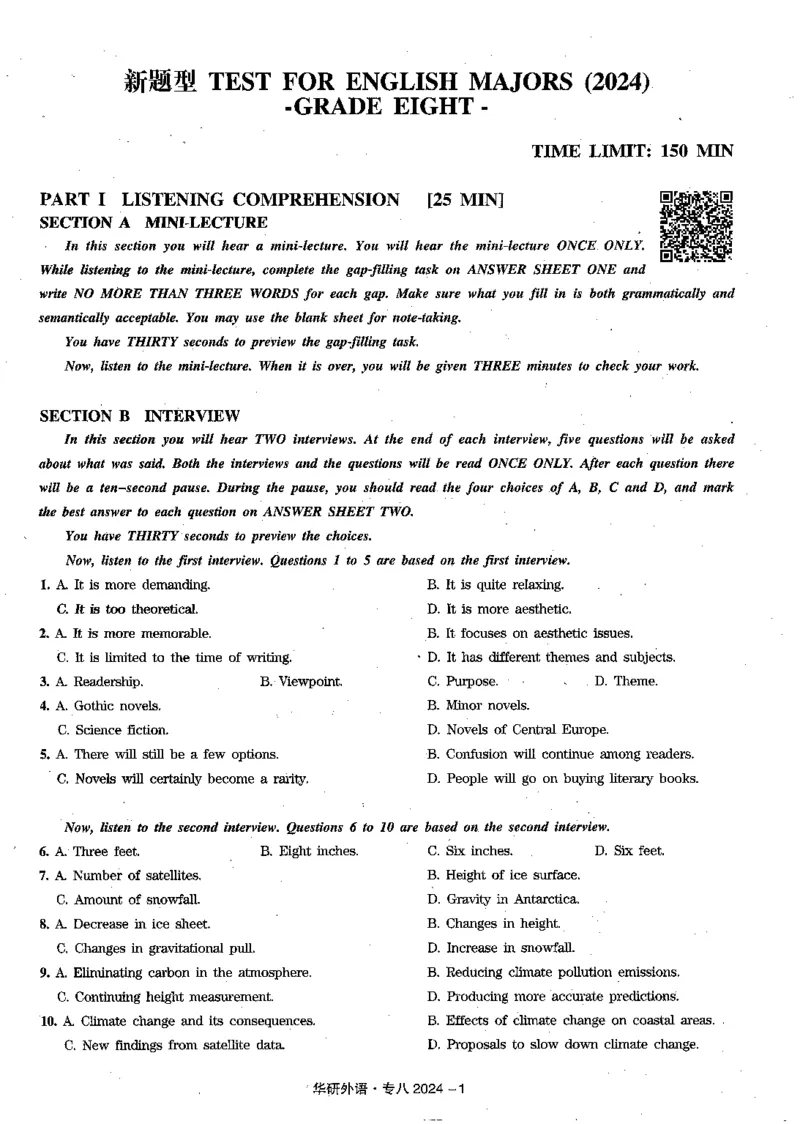
TEST FOR ENGLISH MAJ—ORS ( 2016)
GRADE EIGHT
TIME LIMIT: 150 MIN
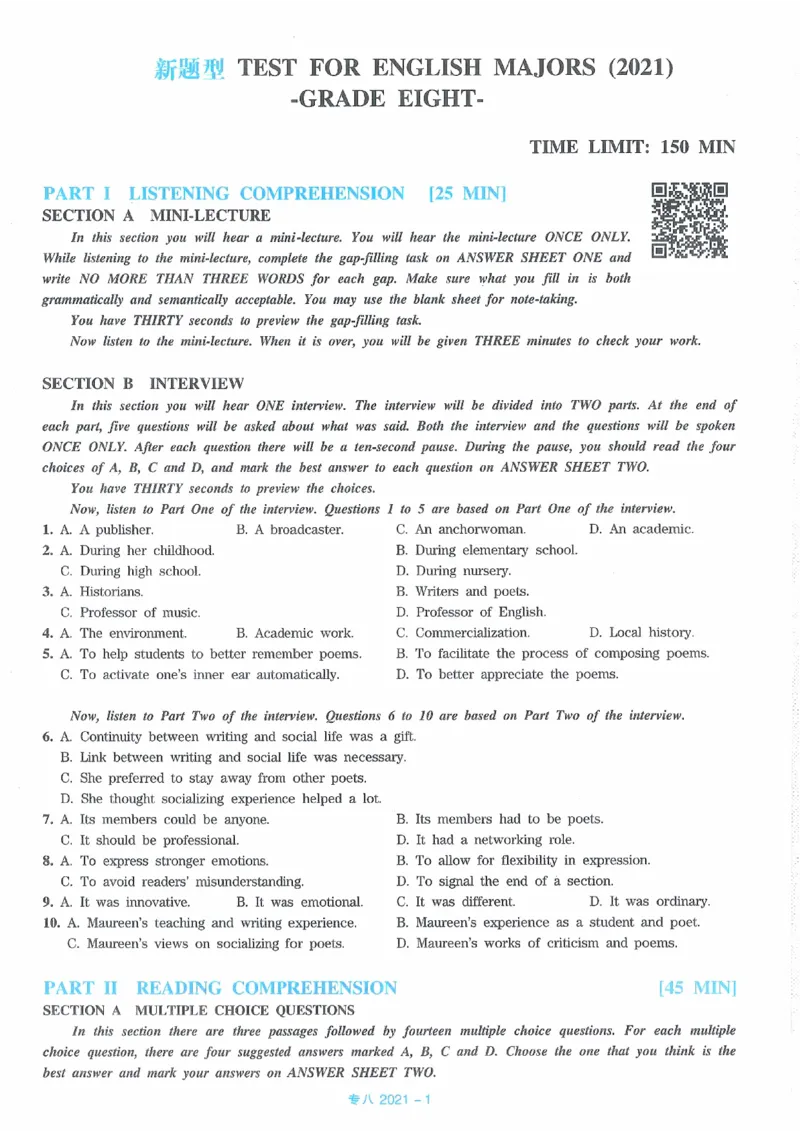
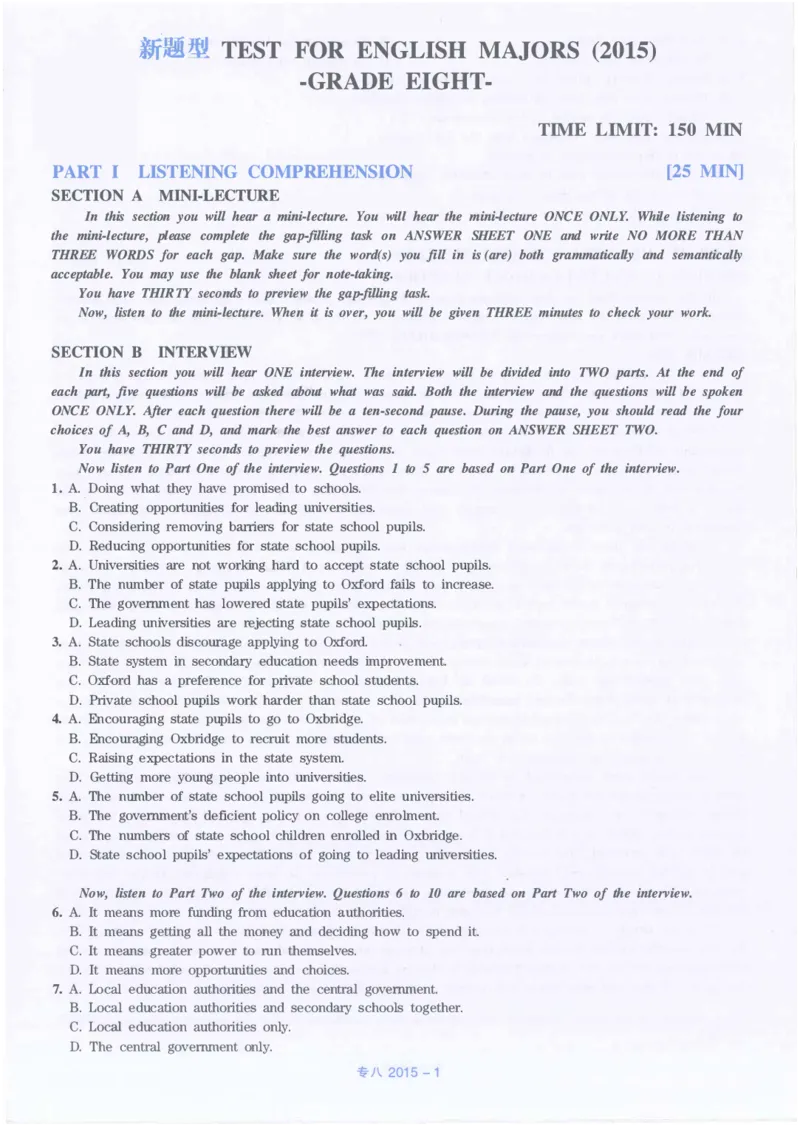
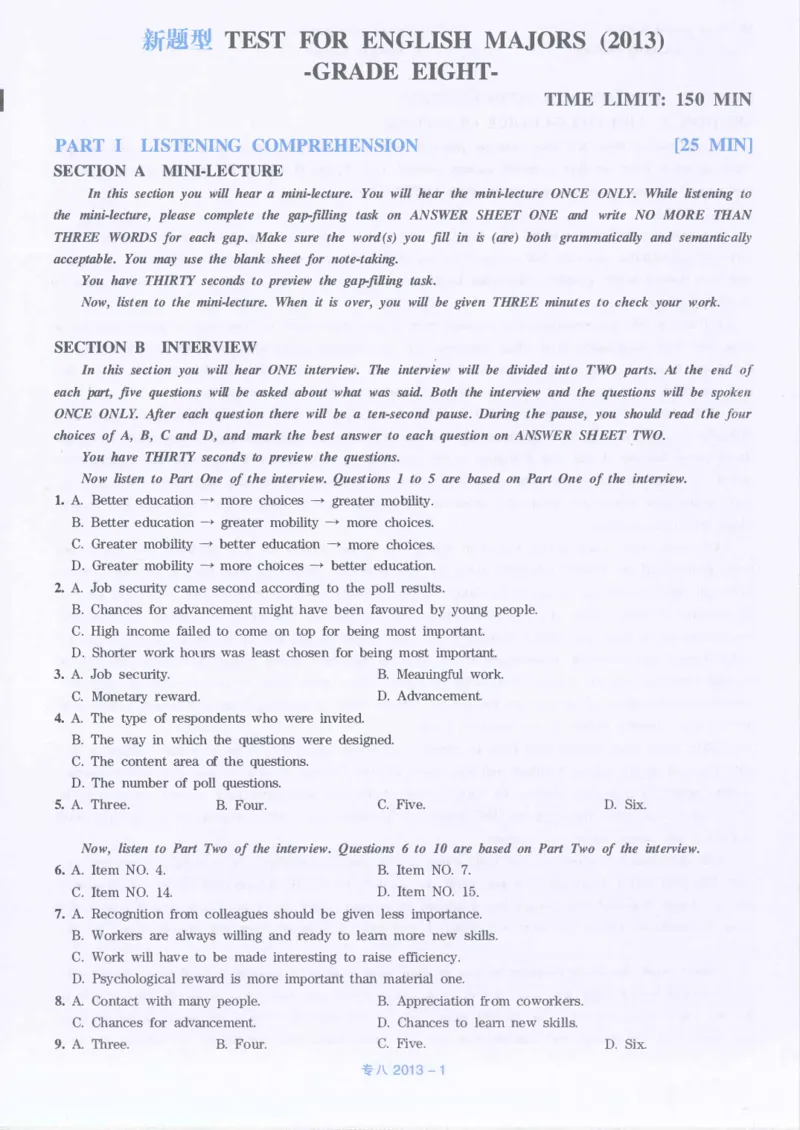
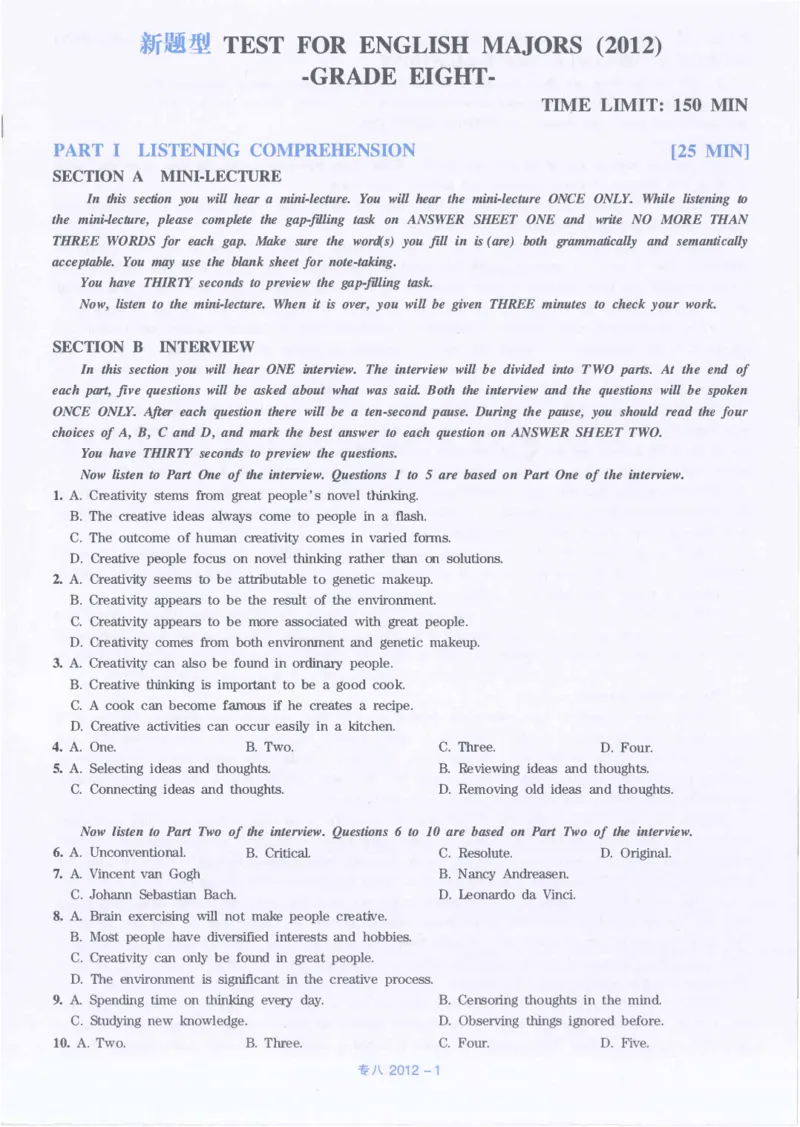
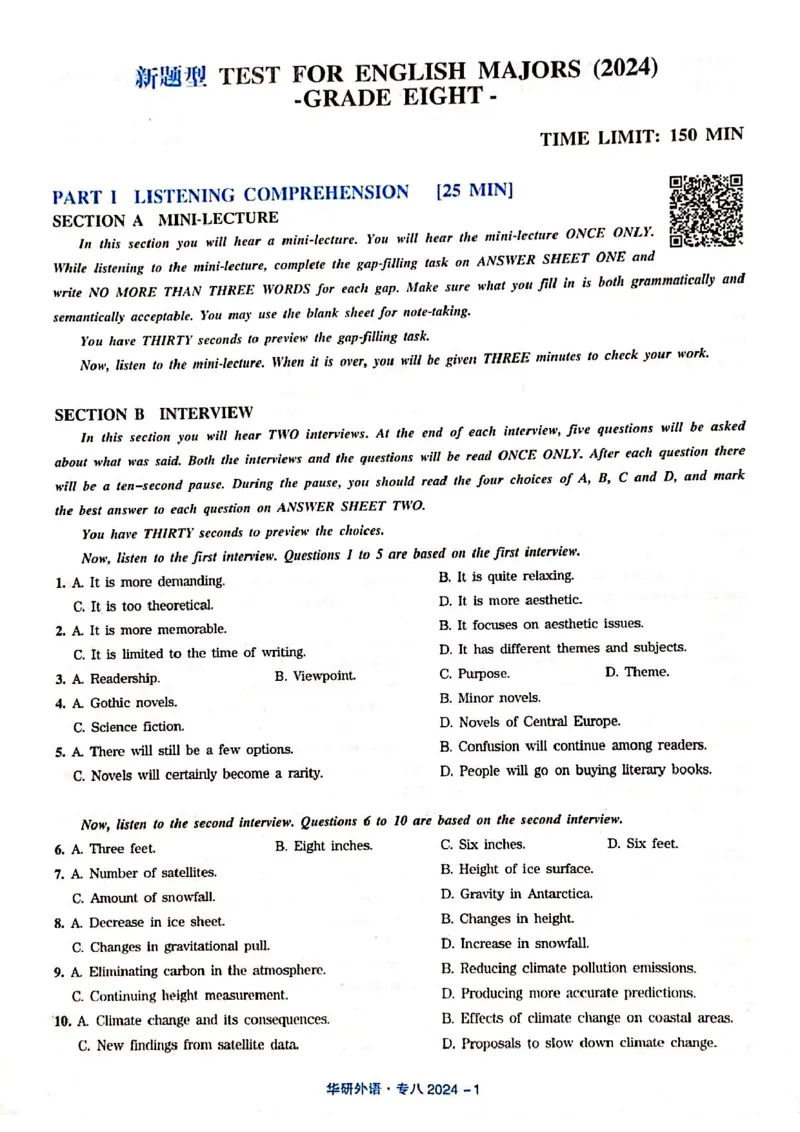
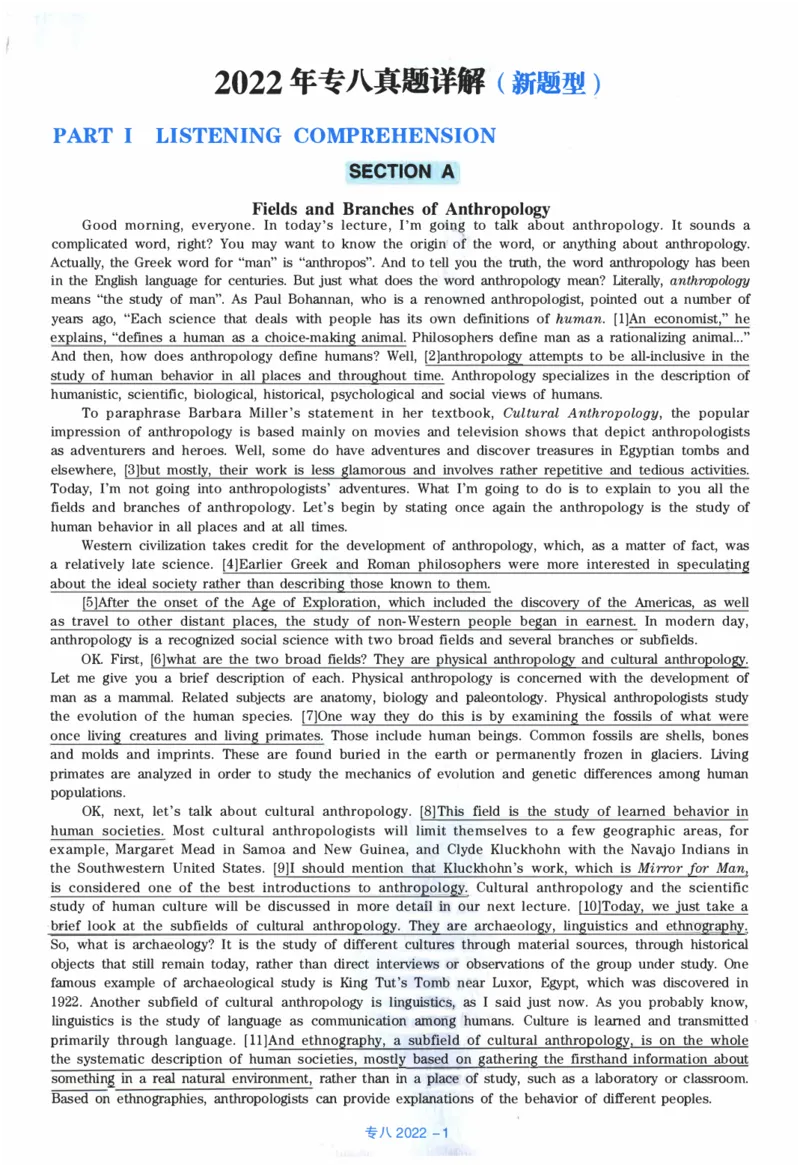
PART I LISTENING COMPREHENSION [25 MIN]
SECTION A MINI-LECTURE
In this section you will hear a mini-lecture. You will hear the mini-lecture ONCE ONLY. While
listening to the mini-lecture, please complete the gap-filling task on ANSWER SHEET ONE and write
NO MORE THAN THREE WORDS for each gap. Make sure the word(s) you fill in is (are) both
grammatically and semantically acceptable. You may use the blank sheetf or note-taking.
You have THIRTY seconds to preview the gap-filling task.
Now listen to the mini-lecture. When it is over, you will be given THREE minutes to check your work.
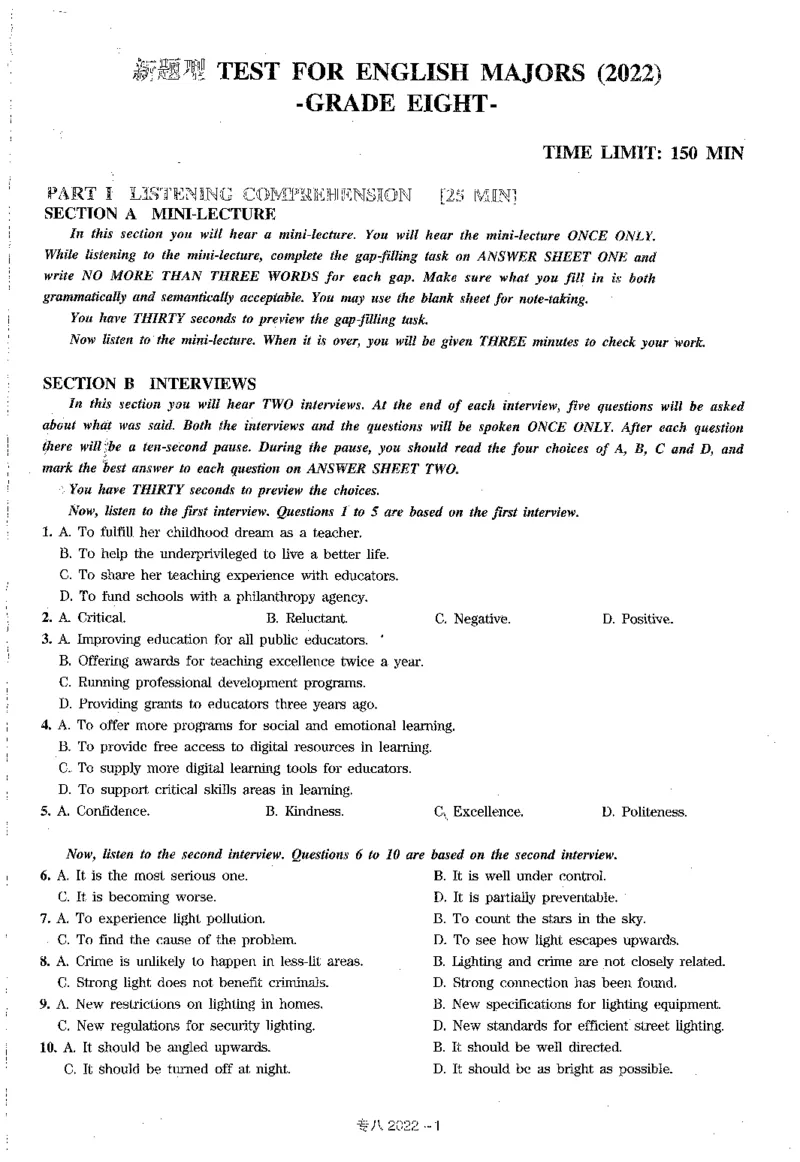
SECTION B INTERVIEW
In this section you will hear TWO interviews. At the end of each interview, five questions will be
asked about what was said. Both the interviews and the questions will be spoken ONCE ONLY. After
each question there will be a ten-second pause. During the pause, you should read the four choices ofA ,
B, C and D, and mark the best answer to each question on ANSWER SHEETTWO.
You have THIRTY seconds to preview the choices.
Now, listen to thef irst interview. Questions I to 5 are based on thef irst interview.
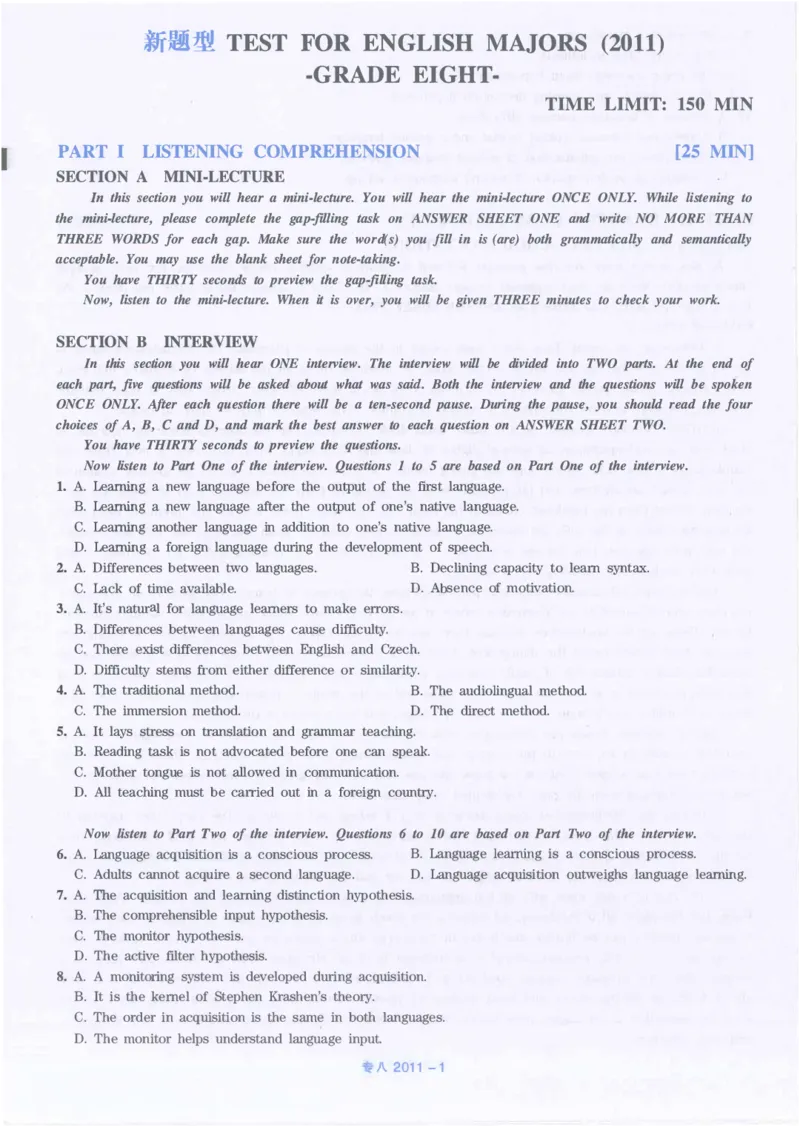
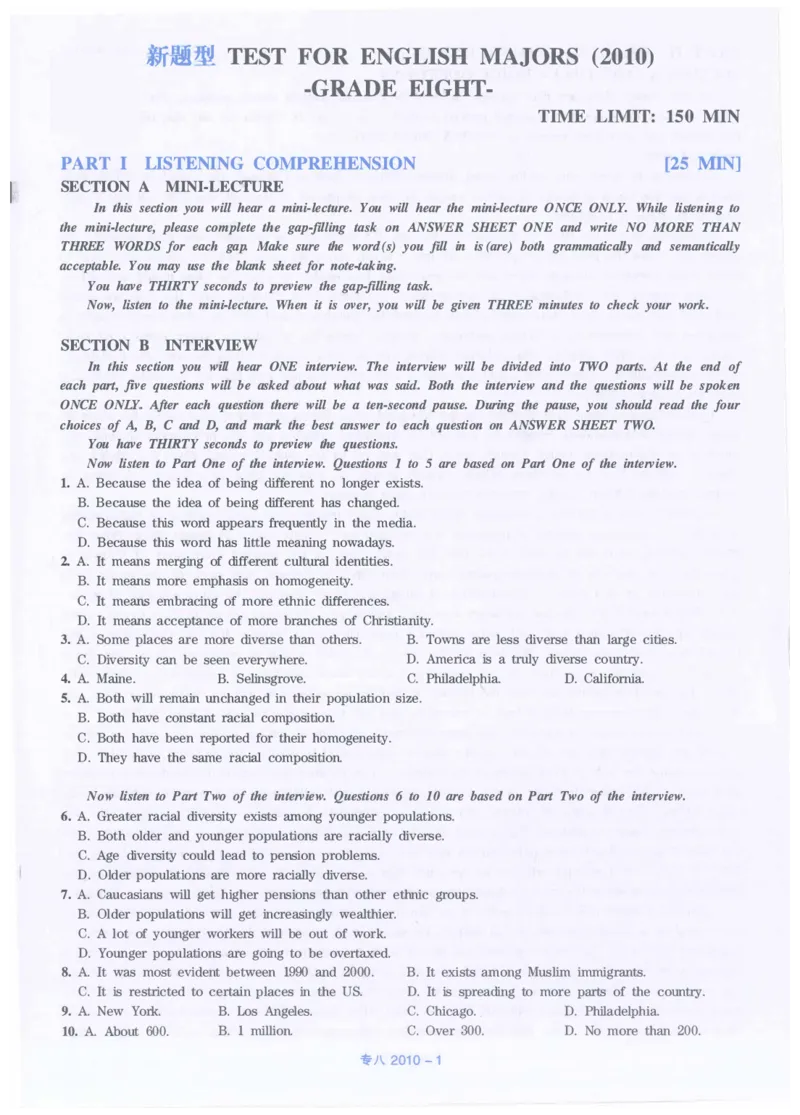
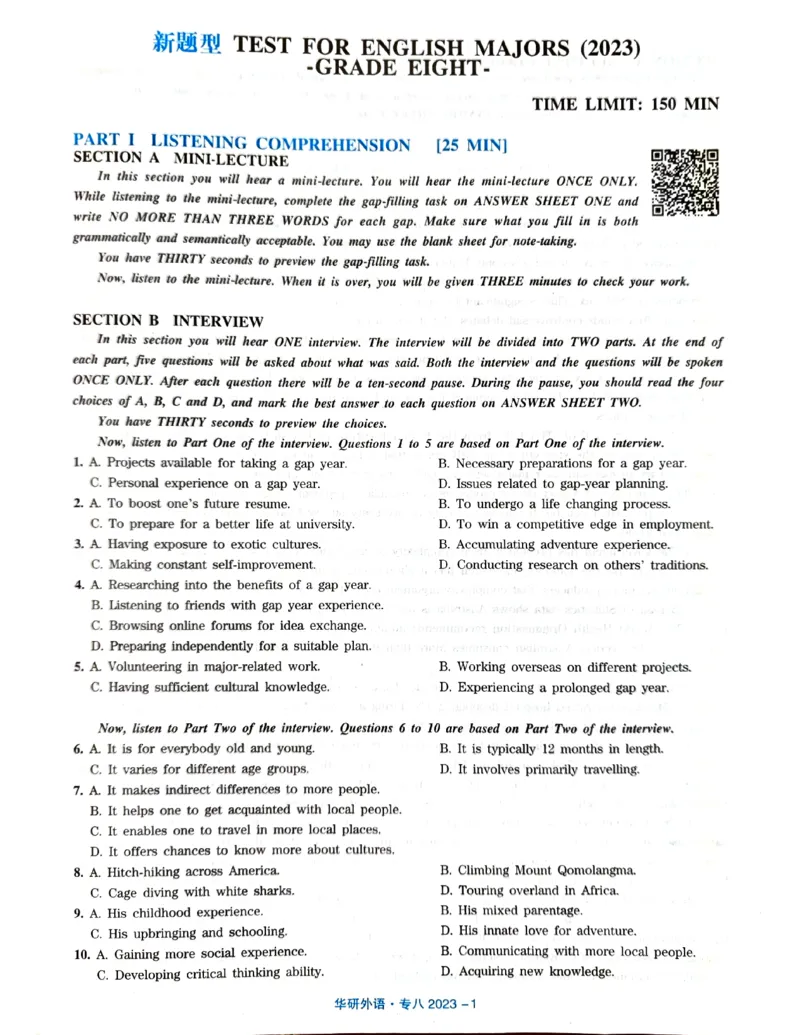
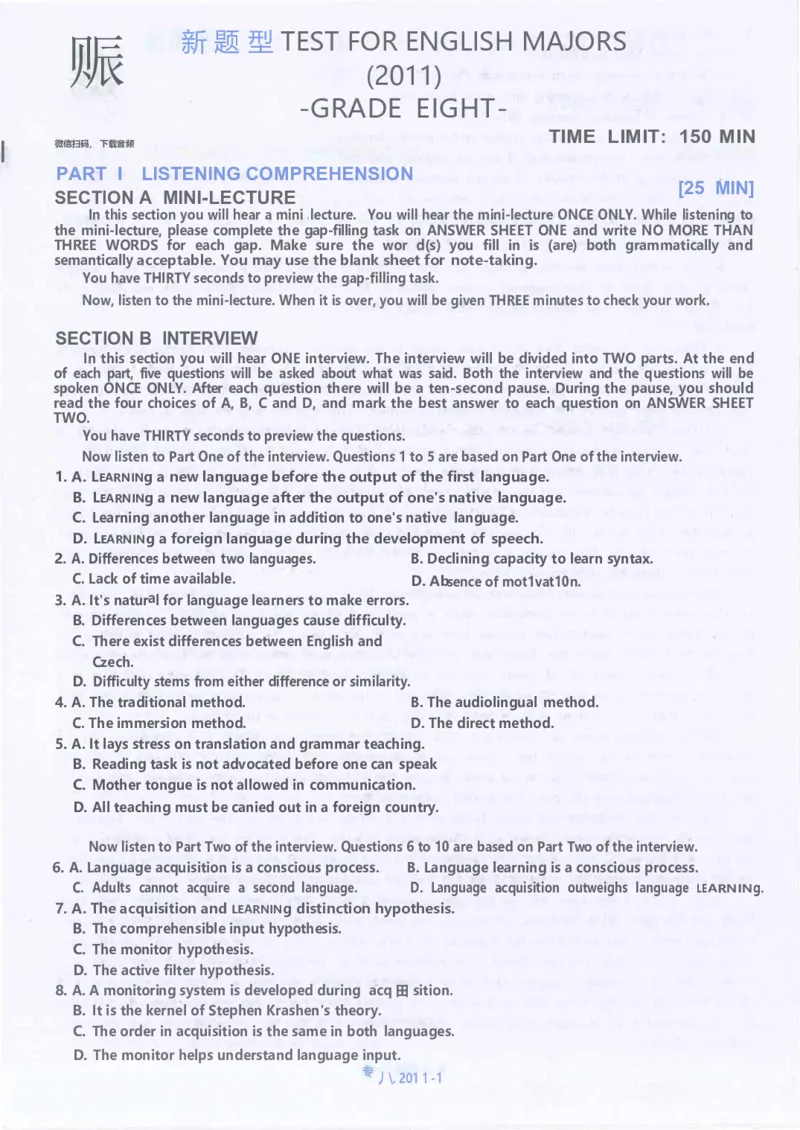
1. A. Maggie's university life. B. Her mom's life at Harvard.
C. Maggie's view on studying with Mom. D. Maggie's opinion on her mom's major.
2. A. They take exams in the same weeks. B. They have similar lecture notes.
C. They apply for the same internship. D. They follow the same fashion.
3. A. Having roommates. B. Practicing court trails.
C. Studying together. D. Taking notes by hand.
4. A. Protection. B. Imagination.
C. Excitement. D. Encouragement.
5. A. Thinking of ways to comfort Mom. B. Occasional interference from Mom.
C. Ultimately calls when Maggie is busy. D. Frequent check on Maggie's grades.
Now, listen to the second interview. Questions 6 to 10 are based on the second interview.
6. A. Because parents need to be ready for new jobs.
B. Because parents love to return to college.
C. Because kids require their parents to do so.
D. Because kids find it hard to adapt to college life.
7. A. Real estate agent. B. Financier. C. Lawyer. D. Teacher.
8. A. Delighted. B. Excited. C. Bored. D. Frustrated.
9. A. How to make a cake. B. How to make omelets.
C. To accept what is taught. D. To plan a future career.
10. A. Unsuccessful. B. Gradual. C. Frustrating. D. Passionate.PART II READING COMPREHENSION [45 MIN]
SECTION A MULTIPLE CHOICE QUESTIONS
In this section there are three passages followed by fourteen multiple choice questions. For each
multiple choice question, there are four suggested answers marked A, B, C and D. Choose the one that
you think is the best answer and mark your answers on ANSWER SHEET TWO.
PASSAGE ONE
(1) There was music from my neighbor's house through the summer nights. In his blue gardens
men and girls came and went like moths among the whisperings and the champagne and the stars. At
high tide in the afternoon I watched his guests diving from the tower of his raft or taking the sun on the
hot sand of his beach while his two motor-boats slit the waters of the Sound, drawing aquaplanes (滑水
板) over cataracts of foam. On weekends Mr. Gatsby's Rolls-Royce became an omnibus, bearing parties
to and from the city between nine in the morning and long past midnight, while his station wagon
scampered like a brisk yellow bug to meet all trains. And on Mondays eight servants, including an extra
gardener, toiled all day with scrubbing-brushes and hammer and garden-shears, repairing the ravages of
the night before.
(2) Every Friday five crates of oranges and lemons arrived from a fruiterer in New York一 every
Monday these same oranges and lemons left his back door in a pyramid of pulpless halves. There was a
machine in the kitchen which could extract the juice of two hundred oranges in half an hour, if a little
button was pressed two hundred times by a butler's thumb.
(3) At least once a fortnight a corps of caterers came down with several hundred feet of canvas and
enough colored lights to make a Christmas tree of Gatsby's enormous garden. On buffet tables,
garnished with glistening hors-d'oeuvre (冷盘),spicedbaked hams crowded against salads of harlequin
designs and pastry pigs and turkeys bewitched to a dark gold. In the main hall a bar with a real brass rail
was set up, and stocked with gins and liquors and with cordials (加香甜酒) so long forgotten that most
of his female guests were too young to know one from another.
—
(4) By seven o'clock the orchestra has arrived no thin five-piece affair but a whole pitful of oboes
and trombones and saxophones and viols and comets and piccolos and low and high drums. The last
swimmers have come in from the beach now and are dressing upstairs; the cars from New York are
parked five deep in the drive, and already the halls and salons and verandas are gaudy with primary
colors and hair shorn in strange new ways, and shawls beyond the dreams of Castile. The bar is in full
swing, and floating rounds of cocktails permeate the garden outside until the air is alive with chatter and
laughter and casual innuendo and introductions forgotten on the spot and enthusiastic meetings between
women who never knew each other's names.
(5) The lights grow brighter as the earth lurches away from the sun, and now the orchestra is
playing yellow cocktail music, and the opera of voices pitches a key higher. Laughter is easier, minute
by minute, spilled with prodigality, tipped out at a cheerful word.
(6) The groups change more swiftly, swell with new arrivals, dissolve and form in the same breath
—
already there are wanderers, confident girls who weave here and there among the stouter and more
stable, become for a sharp joyous moment the center of a group, and then, excited with triumph, glide on
through the sea-change of faces and voices and color under the constantly changing light.
(7) Suddenly one of these gypsies in trembling opal, seizes a cocktail out of the air, dumps it down
for courage and, moving her hands like Frisco, dances out alone on the canvas platform. A momentary
2hush; the orchestra leader varies his rhythm obligingly for her, and there is a burst of chatter as the
erroneous news goes around that she is Gilda Gray's understudy from the Folies. The party has begun.
(8) I believe that on the first night I went to Gatsby's house I was one of the few guests who had
actually been invited. People were not invited-they went there. They got into automobiles which bore
them out to Long Island, and somehow they ended up at Gatsby's door. Once there they were introduced
by somebody who knew Gatsby, and after that they conducted themselves according to the rules of
behavior associated with amusement parks. Sometimes they came and went without having met Gatsby
at all, came for the party with a simplicity of heart that was its own ticket ofadmission.
(9) I had been actually invited. A chauffeur in a uniform crossed my lawn early that Saturday
—
morning with a surprisingly formal note from his employer the honor would be entirely Gatsby's, it
said, if I would attend his "little party" that night. He had seen me several times and had intended to call
—
on me long before but a peculiar combination of circumstances had prevented it signed Jay Gatsby in a
majestic hand.
(10) Dressed up in white flannels I went over to his lawn a little after seven and wandered around
—
rather ill-at-ease among swirls and eddies of people I didn't know though here and there was a face I
had noticed on the commuting train. I was immediately struck by the number of young Englishmen
dotted about; all well dressed, all looking a little hungry and all talking in low earnest voices to solid and
prosperous Americans. I was sure that they were selling something: bonds or insurance or automobiles.
They were, at least, agonizingly aware of the easy money in the vicinity and convinced that it was theirs
for a few words in the right key.
(11) As soon as I arrived I made an attempt to find my host but the two or three people of whom I
asked his whereabouts stared at me in such an amazed way and denied so vehemently any knowledge of
—
his movements that I slunk off in the direction of the cocktail table the only place in the garden where
a single man could linger without looking purposeless and alone.
11. It can be inferred form Para. 1 that Mr. Gatsby through the summer.
A. entertained guests from everywhere every weekend
B. invited his guests to ride in his Rolls-Royce at weekends
C. liked to show off by letting guests ride in his vehicles
D. indulged himself in parties with people from everywhere
12. In Para. 4, the word''permeate" probably means .
A. perish B. push
C. penetrate D. perpetrate
13. It can be inferred form Para. 8 that .
A. guests need to know Gatsby in order to attend his parties
B. people somehow ended up in Gatsby's house as guests
C. Gatsby usually held garden parties for invited guests
D. guests behaved themselves in a rather formal manner
14. According to Para. 10, the author felt at Gatsby's party.
A. dizzy B. dreadful
C. furious D. awkward
15. What can be concluded from Para.11 about Gatsby?
A. He was not expected to be present at the parties.
B. He was busy receiving and entertaining guests.
C. He was usually out of the house at the weekend.
D. He was unwilling to meet some of the guests.
3PASSAGE TWO
(1) The Term "CYBERSPACE" was coined by William Gibson, a science-fiction writer. He first
used it in a short story in 1982, and expanded on it a couple of years later in a novel, "Neuromancer",
whose main character, Henry Dorsett Case, is a troubled computer hacker and drug addict. In the book
Mr Gibson describes cyberspace as "a consensual hallucination experienced daily by billions of
legitimate operators" and "a graphic representation of data abstracted from the banks of every computer
in the human system."
(2) His literary creation turned out to be remarkably prescient (有先见之明的) . Cyberspace has
become symbolic for the computing devices, networks, fibre-optic cables, wireless links and other
infrastructure that bring the internet to billions of people around the world. The myriad connections
forged by these technologies have brought tremendous benefits to everyone who uses the web to tap into
humanity's collective store of knowledge every day.
(3) But there is a darker side to this extraordinary invention. Data breaches are becoming ever
bigger and more common. Last year over 800m records were lost, mainly through such attacks. Among
the most prominent recent victims has been Target, whose chief executive, Gregg Steinhafel, stood down
from his job in May, a few months after the giant American retailer revealed that online intruders had
stolen millions of digital records about its customers, including credit- and debit-card details. Other well
known firms such as Adobe, a tech company, and eBay, an online marketplace, have also been hit.
(4) The potential damage, though, extends well beyond such commercial incursions. Wider
concerns have been raised by the revelations about the mass surveillance carried out by Western
intelligence agencies made by Edward Snowden, a contractor to America's National Security Agency
(NSA), as well as by the growing numbers of cyber-warriors being recruited by countries that see
cyberspace as a new domain of warfare. America's president, Barack Obama, said in a White House
press release earlier this year that cyber-threats "pose one of the gravest national-security dangers" the
country is facing.
(5) Securing cyberspace is hard because the architecture of the internet was designed to promote
connectivity, not security. Its founders focused on getting it to work and did not worry much about
threats because the network was affiliated with America's military. As hackers turned up, layers of
security, from antivirus programs to firewalls, were added to try to keep them at bay. Gartner, a research
firm, reckons that last year organizations around the globe spent $67 billion on information security.
(6) On the whole, these defenses have worked reasonably well. For all the talk about the risk of a
"cyber 9/11", the internet has proved remarkably resilient. Hundreds of millions of people tum on their
computers every day and bank online, shop at virtual stores, swap gossip and photos with their friends
on social networks and send all kinds of sensitive data over the web without ill effect. Companies and
governments are shifting ever more services online.
(7) But the task is becoming harder. Cyber-security, which involves protecting both data and people,
is facing multiple threats, notably cybercrime and online industrial espionage, both of which are growing
rapidly. A recent estimate by the Centre for Strategic and International Studies (CSIS), puts the annual
global cost of digital crime and intellectual-property theft at $445 billion—a sum roughly equivalent to
the GDP of a smallish rich European country such as Austria.
(8) To add to the worries, there is also the risk of cyber-sabotage. Terrorists or agents of hostile
powers could mount attacks on companies and systems that control vital parts of an economy, including
power stations, electrical grids and communications networks. Such attacks are hard to pull off, but not
impossible. One precedent is the destruction in 2010 of centrifuges (离心机) at a nuclear facility in Iran
4by a computer program known as Stuxnet.
(9) But such events are rare. The biggest day-to-day threats faced by companies and government
agencies come from crooks and spooks hoping to steal financial data and trade secrets. For example,
smarter, better-organized hackers are making life tougher for the cyber-defenders, but even so a number
of things can be done to keep everyone safer than they are now.
(10) One is to ensure that organizations get the basics of cyber-security right. All too often breaches
are caused by simple blunders, such as failing to separate systems containing sensitive data from those
that do not need access to them. Companies also need to get better at anticipating where attacks may be
coming from and at adapting their defenses swiftly in response to new threats. Technology can help, as
can industry initiatives that allow firms to share intelligence about risks with each other.
(11) There is also a need to provide incentives to improve cyber-security, be they carrots or sticks.
One idea is to encourage internet-service providers, or the companies that manage internet connections,
to shoulder more responsibility for identifying and helping to clean up computers infected with
malicious software. Another is to find ways to ensure that software developers produce code with fewer
flaws in it so that hackers have fewer security holes to exploit.
(12) An additional reason for getting tech companies to give a higher priority to security is that
cyberspace is about to undergo another massive change. Over the next few years billions of new devices,
from cars to household appliances and medical equipment, will be fitted with tiny computers that
connect them to the web and make them more useful. Dubbed "the internet of things", this is already
making it possible, for example, to control home appliances using smartphone apps and to monitor
medical devices remotely.
(13) But unless these systems have adequate security protection, the internet of things could easily
become the internet of new things to be hacked. Plenty of people are eager to take advantage of any
weaknesses they may spot. Hacking used to be about geeky college kids tapping away in their bedrooms
to annoy their elders. It has grown up with a vengeance.
16. Cyberspace is described by William Gibson as .
A. a function only legitimate computer operators have
B. a representation of data from the human system
C. an important element stored in the human system
D. an illusion held by the common computer users
17. Which of the following statements BEST summarizes the meaning of the first four paragraphs?
A. Cyberspace has more benefits than defects.
B. Cyberspace is like a double-edged sword.
C. Cyberspace symbolizes technological advance.
D. Cyberspace still remains a sci-fi notion.
18. According to Para. 5, the designing principles of the internet and cyberspace security are .
A. controversial B . complimentary
C. contradictory D. congruent
19. What could be the most appropriate title for the passage?
A. Cyber Crime and Its Prevention.
B. The Origin of Cyber Crime.
C. How to Deal with Cyber Crime.
D. D. The Definition ofCyber Crime.
5PASSAGE THREE
(1) You should treat skeptically the loud cries now coming from colleges and universities that the
last bastion of excellence in American education is being destroyed by state budget cuts and mounting
costs. Whatever else it is, higher education is not a bastion of excellence. It is shot through with waste,
lax academic standards and mediocre teaching and scholarship.
— —
(2) True, the economic pressures from the Ivy League to state systems are intense. Last year,
nearly two-thirds of schools had to make midyear spending cuts to stay within their budgets. It is also
true (as university presidents and deans argue) that relieving those pressures merely by raising tuition
and cutting courses will make matters worse. Students will pay more and get less. The university
presidents and deans want to be spared from further government budget cuts. Their case is weak.
(3) Higher education is a bloated enterprise. Too many professors do too little teaching to too many
ill-prepared students. Costs can be cut and quality improved without reducing the number of graduates.
Many colleges and universities should shrink. Some should go out of business. Consider:
• Except for elite schools, admissions standards are low. About 70 percent of freshmen at four
year colleges and universities attend their first-choice schools. Roughly 20 percent go to their
second choices. Most schools have eagerly boosted enrolhnents to maximize revenues (tuition and
state subsidies).
• Dropout rates are high. Half or more of freshmen don't get degrees. A recent study of PhD
programs at 10 major universities also found high dropout rates for doctoralcandidates.
• The attrition among undergraduates is particularly surprising because college standards have
apparently fallen. One study of seven top schools found widespread grade inflation. In 1963, half
of the students in introductory philosophy courses got a B---or worse. By 1986, only 20 percent did.
If elite schools have relaxed standards, the practice is almost surely widespread.
• Faculty teaching loads have fallen steadily since the 1960s. In major universities, senior
faculty members often do less than two hours a day of teaching. Professors are "socialized to
publish, teach graduate students and spend as little time teaching (undergraduates) as possible,"
concludes James Fairweather of Penn State University in a new study. Faculty pay consistently rises
as undergraduate teaching loads drop.
• Universities have encouraged an almost mindless explosion of graduate degrees. Since 1960,
the number of masters'degrees awarded annually has risen more than fourfold to 337,000. Between
1965 and 1989, the annual number of MBAs (masters in business administration) jumped from
7,600 to 73,100.
(4) Even so, our system has strengths. It boasts many top-notch schools and allows almost anyone
to go to college. But mediocrity is pervasive. We push as many freshmen as possible through the door,
regardless of qualifications. Because bachelors'degrees are so common, we create more graduate
degrees of dubious worth. Does anyone believe the MBA explosion has improvedmanagement?
(5) You won't hear much about this from college deans or university presidents. They created this
mess and are its biggest beneficiaries. Large enrollments support large faculties. More graduate students
liberate tenured faculty from undergraduate teaching to concentrate on writing and research: the source
of status. Richard Huber, a former college dean, writes knowingly in a new book ("How Professors Play
the Cat Guarding the Cream: Why We're Paying More and Getting Less in Higher Education"):
Presidents, deans and trustees … call for more recognition of good teaching with prizes and salary
incentives.
(6) The reality is closer to the experience of Harvard University's distinguished paleontologist
Stephen Jay Gould:''To be perfectly honest, though lip service is given to teaching, I have never
6seriously heard teaching considered in any meeting for promotion… Writing is the currency of prestige
and promotion."
(7) About four-fifths of all students attend state-subsidized systems, from community colleges to
prestige universities. How governors and state legislatures deal with their budget pressures will be
decisive. Private schools will, for better or worse, be influenced by state actions. The states need to do
three things.
(8) First, create genuine entrance requirements. Today's low standards tell high school students:
You don't have to work hard to go to college. States should change the message by raising tuitions
sharply and coupling the increase with generous scholarships based on merit and income. To get
scholarships, students would have to pass meaningful entrance exams. Ideally, the scholarships should
be available for use at in-state private schools. All schools would then compete for students on the basis
of academic quality and costs. Today's system of general tuition subsidies provides aid to well-to-do
families that don't need it or to unqualified students who don't deserve it.
(9) Next, states should raise faculty teaching loads, mainly at four-year schools. (Teaching loads at
community colleges are already high.) This would cut costs and reemphasize the primacy of teaching at
most schools. What we need are teachers who know their fields and can communicate enthusiasm to
students. Not all professors can be path-breaking scholars. The excessive emphasis on scholarship
generates many unread books and mediocre articles in academic journals. "You can't do more of one
(research) without less of the other (teaching)," says Fairweather. "People are working hard—it's just
where they're working."
(10) Finally, states should reduce or eliminate the least useful graduate programs. Journalism (now
dubbed "communications"), business and education are prime candidates. A lot of what they teach
can—and should—be learned on the job. If colleges and universities did a better job of teaching
undergraduates, there would be less need for graduate degrees.
(11) Our colleges and universities need to provide a better education to deserving students. This
may mean smaller enrollments, but given today's attrition rates, the number of graduates need not drop.
Higher education could become a bastion of excellence, if we would only吓
20. It can be concluded from Para. 3 that the author was towards the education.
A. indifferent B. neutral
C. positive D. negative
21. The following are current problems facing all American universities EXCEPT .
A. high dropout rates B. 1o w admission standards
C. low undergraduate teaching loads D. explosion of graduate degrees
22. In order to ensure teaching quality, the author suggests that the states do all the following EXCEPT
A. set entrance requirements B. raise faculty teaching loads
C. increase undergraduate programs D. reduce useless graduate programs
23. "Prime candidates" in Para. 10 is used as
A. euphemism B. metaphor
C. analogy D. personification
24. What is the author's main argument in the passage?
A. American education can remain excellent by ensuring state budget.
B. Professors should teach more undergraduates than postgraduates.
C. Academic standard are the main means to ensure educational quality.
D. American education can remain excellent only by raising teaching quality.
7SECTION B SHORT ANSWER QUESTIONS
In this section there are eight short answer questions based on the passages in SECTIONA . Answer
each question in NO MORE THAN TEN WORDS in the space provided on ANSWER SHEET TWO.
PASSAGE ONE
25. From the description of the party preparation, what words can you see to depict Gatby's party?
26. How do you summarize the party scene in Para. 6?
PASSAGE TWO
27. What do the cases of Target, Adobe and eBay in Para. 3 show?
28. Why does the author say the task is becoming harder in Para. 7?
29. What is the conclusion of the whole passage?
PASSAGE THREE
30. What does the author mean by saying "Their case is wea矿 inPara. 2?
31. What does "grade inflation" in Para. 3 mean?
32. What does the author mean when he quotes Richard Huber in Para. 5?
PART III LANGUAGE USAGE [15 MIN]
The passage contains TEN errors. Each indicated line contains a maximum of ONE error. In each case,
only ONE word is involved. You shouldp roofr ead the passage and correct it in the following way:
For a~皿 逞word,
underline the wrong word and write the correct one in the blank provided at the end of the line.
For a missing word,
mark the position of the missing word with a " /\ " sign and write the word you believe to be
missing in the blank provided at the end of the line.
For an unnecessary word,
cross the unnecessary word with a slash "/" and put the word in the blank provided at the end of the
line.
Example
When /\ art museum wants a new exhibit, (1) an
It严~buys things in finished form and hangs (2) never
them on the wall. When a natural history museum
wants an exhibition, it must often build it. (3) exhibit
Proofread the given passage on ANSWER SHEET THREE as instructed.
PARTIV TRANSLATION [20 MIN]
Translate the underlinedp art oft he following text from Chinese into English. Write your translation on
ANSWER SHEET TH邸'E.
流逝,表现了 南国人对时间最早的感觉。 “子在川上曰:逝者如斯夫。 ” 他们发现无论是渴
7 \1
I 、 、 曰 、、、、沪 一、、、、六、折之 I-.、_ /、、 今 / 甘-:-、 / 绊 、
I 、、白感。;;、折 i 曰 土 1 、 旦 1, p p 土 ,曰 只、产、 、 热, 、 I\'尔 ”、玄、 “、、 入访
时警戒后人, 必须急匆匆地行动, 给这个词灌注一种紧张感。
8PARTV WRITING [45 MIN]
The following two excerpts are about Ice Bucket Challenge, an activity initiated to raise money and
awareness for the disease ALS (痀冻症). From the excerpts you can find that the activity seems to have
achieved much success, but there have also been doubt and criticism.
Write an article of NO LESS THAN 300 words, in which you should:
1. Summarize the development of the ice bucket challenge activity, and then
2. Express your opinion towards the activity, especially whether the problems found with this kind
of activity will finally undermine its original purpose.
Marks will be awarded for content relevence, content sufficiency, organization and language quality.
Failure to follow the above instructions may result in a loss of marks.
Write your articles on ANSWER SHEET FOUR.
Excerpt 1
ALS Ice Bucket Challenge Takes U.S. by Strom
In the last two weeks, the Ice Bucket Challenge has quite literally "soaked" the nation. Everyone
from Ethel Kennedy to Justin Tiberlake has poured a bucket of ice water over his or her head and
challenged others to so the same or make a donation to fight ALS within twenty-four hours.
Between July 29th and today, August 12, the ALS Association and its 38 chapters have received an
astonishing $4 million in donations compared with $1.12 million during the same time period last year.
The ALS Association is incredibly grateful for the outpouring of support from those people who have
been doused, made a donation, or both.
"We have never seen anything like this in the history of the disease," said Barbara Newhouse,
President and CEO of the ALS Association.
With only about half of the general public knowledge about amyotrophic lateral sclerosis (ALS),
the Ice Bucket Challenge is making a profound difference. Since July 29, the Association has welcomed
more than 70,000 new donors to the cause.
"W血e the monetary donations are absolutely incredible," said Newhouse, "the visibility that this
disease is getting as a result of the challenge is truly invaluable. People who have never before heard of
ALS are now engaged in the fight to find treatments and a cure for ALS."
Excerpt 2
Ice Bucket challenge: who's pouring cold water on the idea?
The ice bucket challenge has certainly raised awareness. Whether that's primarily of the disease for
which it is raising funds or the speed at which images of swimsuits-clad celebrities will go viral is a
long-term question. More pertinent right now is whether or not the craze has reached a tipping point.
As it lived by social media, so the ice bucket challenge could die by it. The state of California is
currently experiencing one of the worst droughts on record. So gestures such as companies dousing their
staff en masse in hundreds of gallons of icy water, come across more as wasteful PR exercises than
charitable gestures一andare being called out as such on Twitter.
There has been a similar reaction in China. Last week, people in drought-stricken Henan province
raised empty red buckets over their heads, accompanied by the slogan "Henan, please say no to the ice
bucket challenge".
China's ministry for civil affairs, while broadly supportive, has warned citizens against the
practice's "entertainment and con皿ercialtendencies".
But the real dampener could be the risk of bodily harm. Doctors around the world have warned of
risks to elderly people, expectant mothers and people with heart conditions.
9ANSWER SHEET 1 (TEM8)
PART I LISTENING COMPREHENSION
SECTION A MINI-LECTURE
下列各题必须使用黑色字迹签字笔在答题区域内作答,超出红色矩形边框限定区域的答案无效。
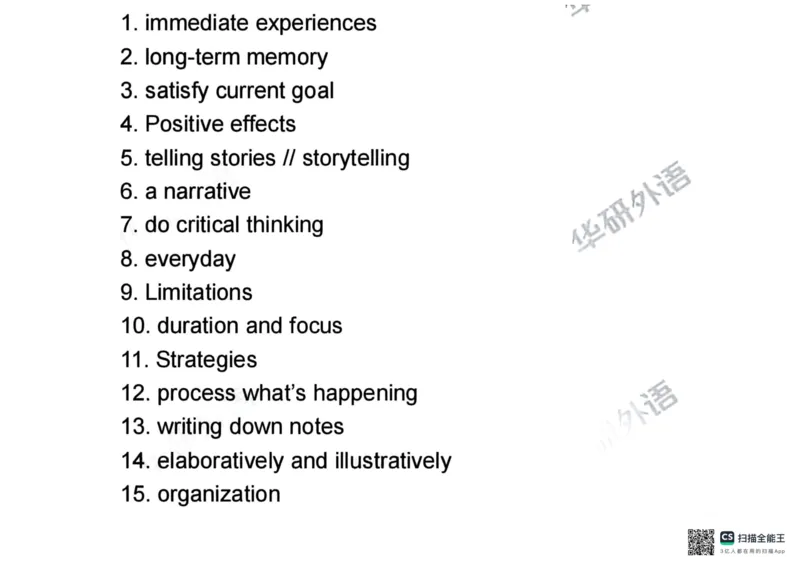
Models for Arguments
I. Three models for arguments
A. the first model for arguing is called (1) : (1)
---arguments are treated as war
---there is much winning and losing
---it is a (2) model for argumg (2)
B. The second model for arguing is arguments as proofs:
---warranted (3) (3)
---valid inferences and conclusions
---no (4) in the adversanal sense (4)
C. the third model for arguing is (5) : (5)
---the audience is (6) in the argument (6)
---arguments must (7) the audience (7)
II. Traits of the argument as war
A. very dominant: it can shape (8) (8)
B. strong arguments are needed
C. negative effects include:
---(9) are emphasized (9)
---winning is the only purpose
---this type of arguments prevent (10) (10)
---the worst thing is (11) (11)
D. implication from arguments as war: (12) (12)
---e.g., one providing reasons and the other raising (13) (13)
---the other one is finally persuaded
II. Suggestions on new ways to (14) of arguments (14)
A. think of new kinds of arguments
B. change roles in arguments
C. (15) (15)
10ANSWER SHEET 3 (TEM8)
PART III LANGUAGE USAGE
下列各题必须使用黑色字迹签字笔在答题区域内作答,超出矩形边框限定区域的答案无效。
All social units develop a culture. Even in two-person relationship,
a culture develops in time. In friendship and romantic relationships, for (1)
example, partners develop their own history, shared experiences,
language patterns, habits and customs give the relationship a special (2)
—
character a character that differs it in various ways from other (3)
relationships. Examples might include special dates, places, songs or
events that come to have a unique and important symbolic meaning for
—
the two individuals. Thus, any social unit whether a relationship, (4)
—
group, organization, or society develops a culture with the passage of
time. While the defining characteristics of each culture are unique, all
cultures share certain same functions. The relationship between (5)
commumcat10n and culture 1s a very complex mtlmate one. (6)
Culture are created through communication; that is, communication
is the means of human interaction, through it cultural characteristics are (7)
created and shared.
It is not so much that individuals set out to create a culture when
they interact in relationships, groups, organizations, or societies, but
rather than that cultures are a natural by-product of social interaction. In (8)
a sense, culture are the "residue" of social communication. Without
communication and communication media, it would be impossible to
base and pass along cultural characteristics from one place and time to (9)
another. One can say, furthermore, that culture is created, shaped, (10)
transmitted, and learned through communication.
11