2015
年专八真题详解
(新题型优化)
PART I LISTENING COMPREHENSION
'sEc�f,oN A
Understanding Academic Lectures
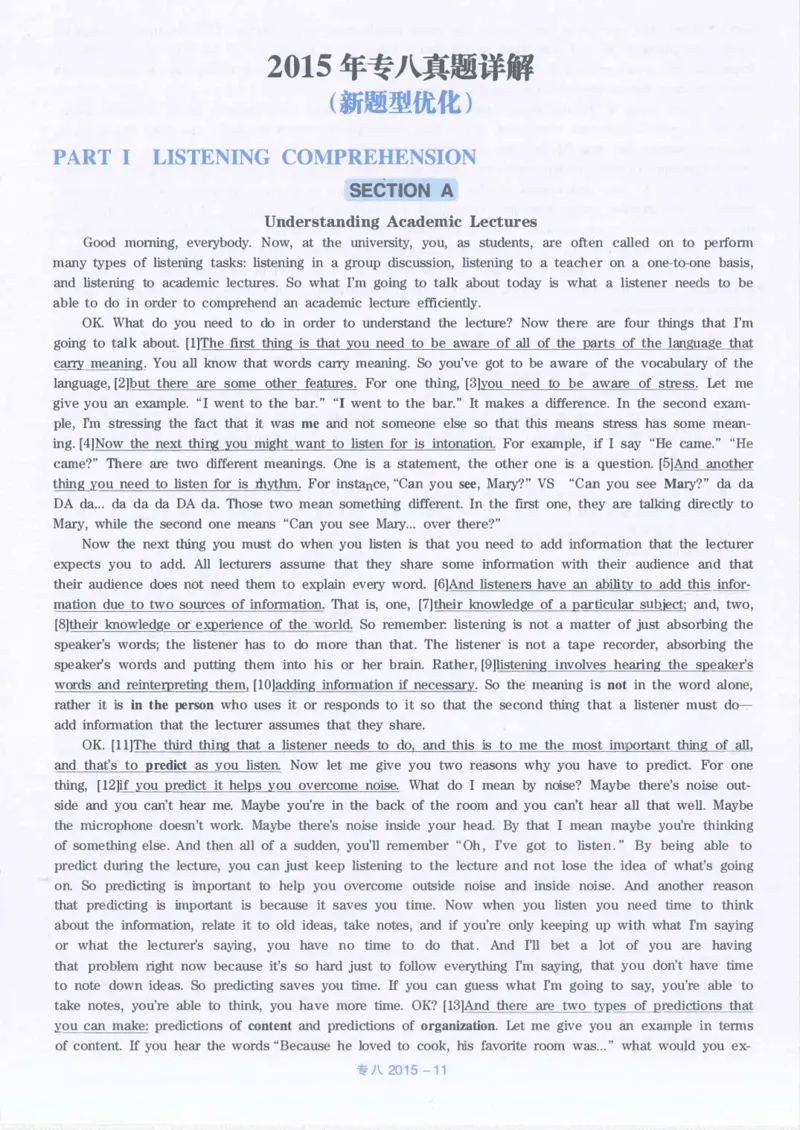
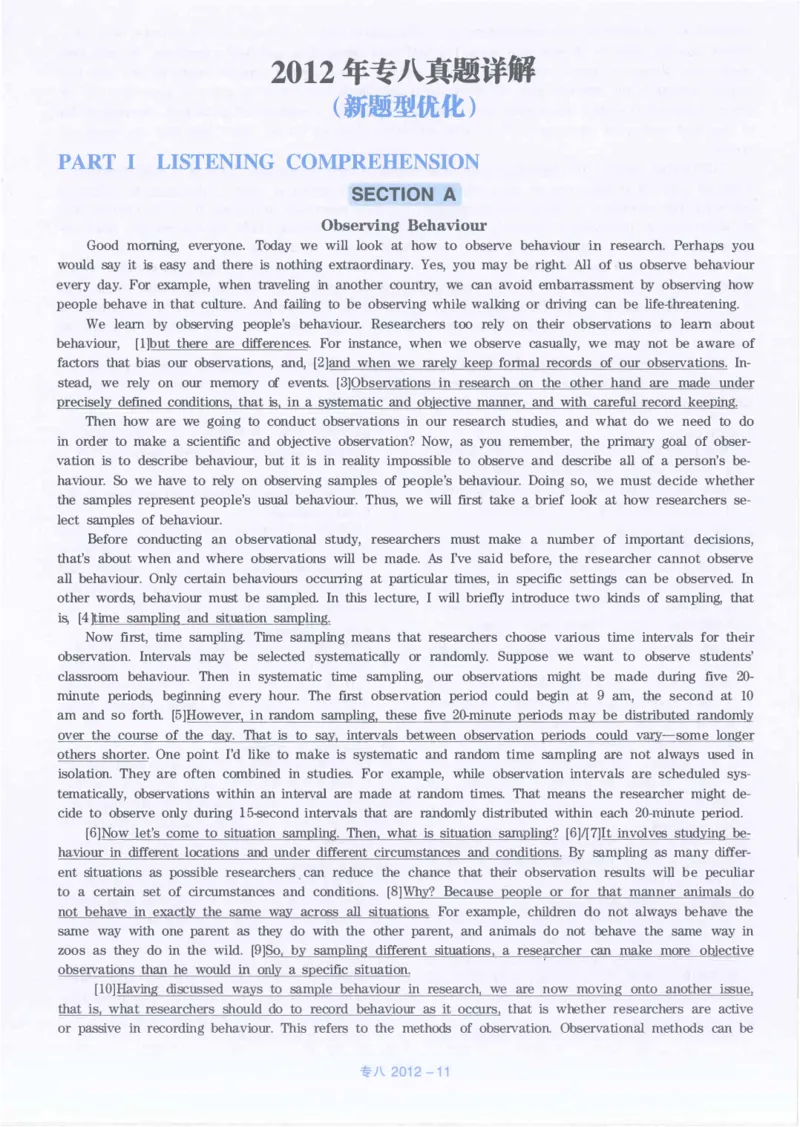
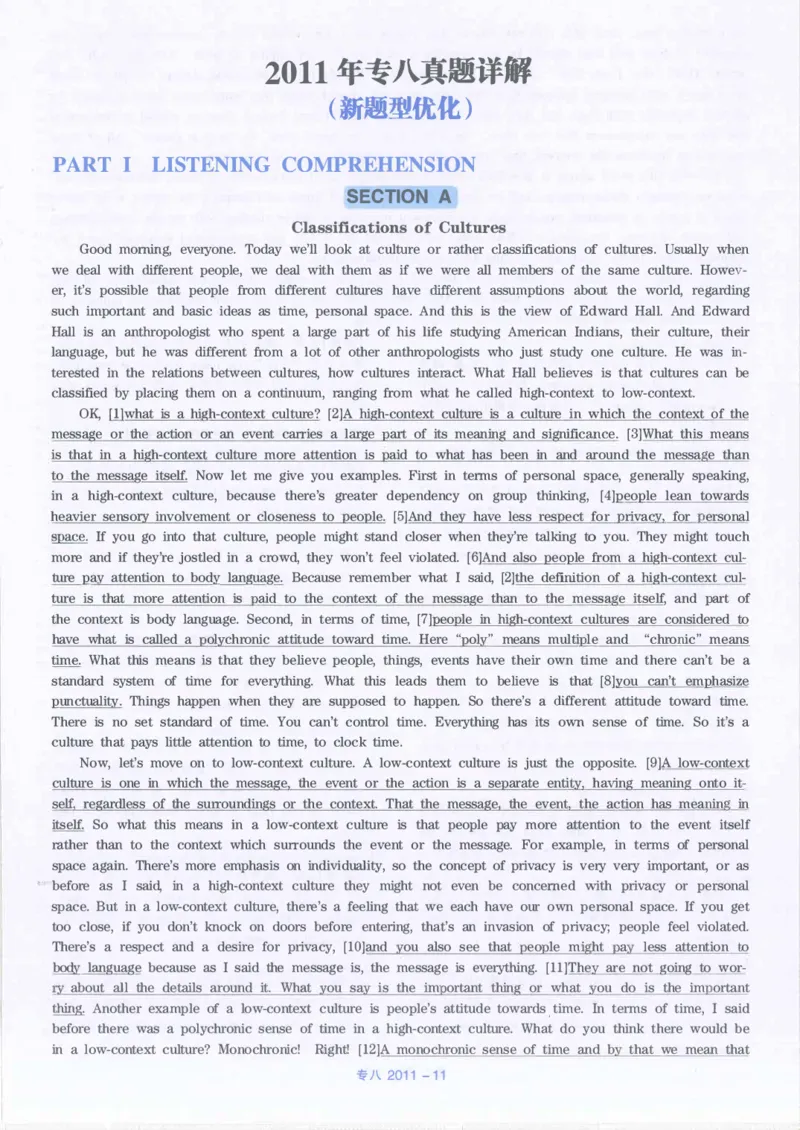
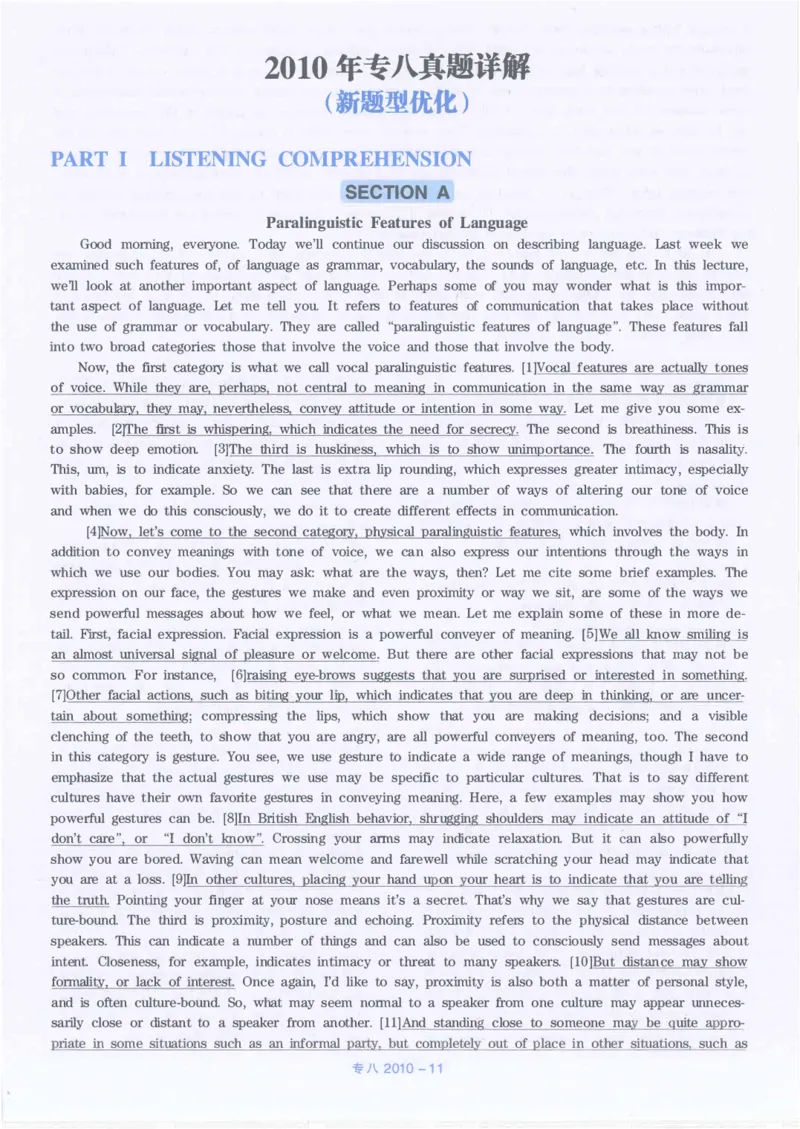
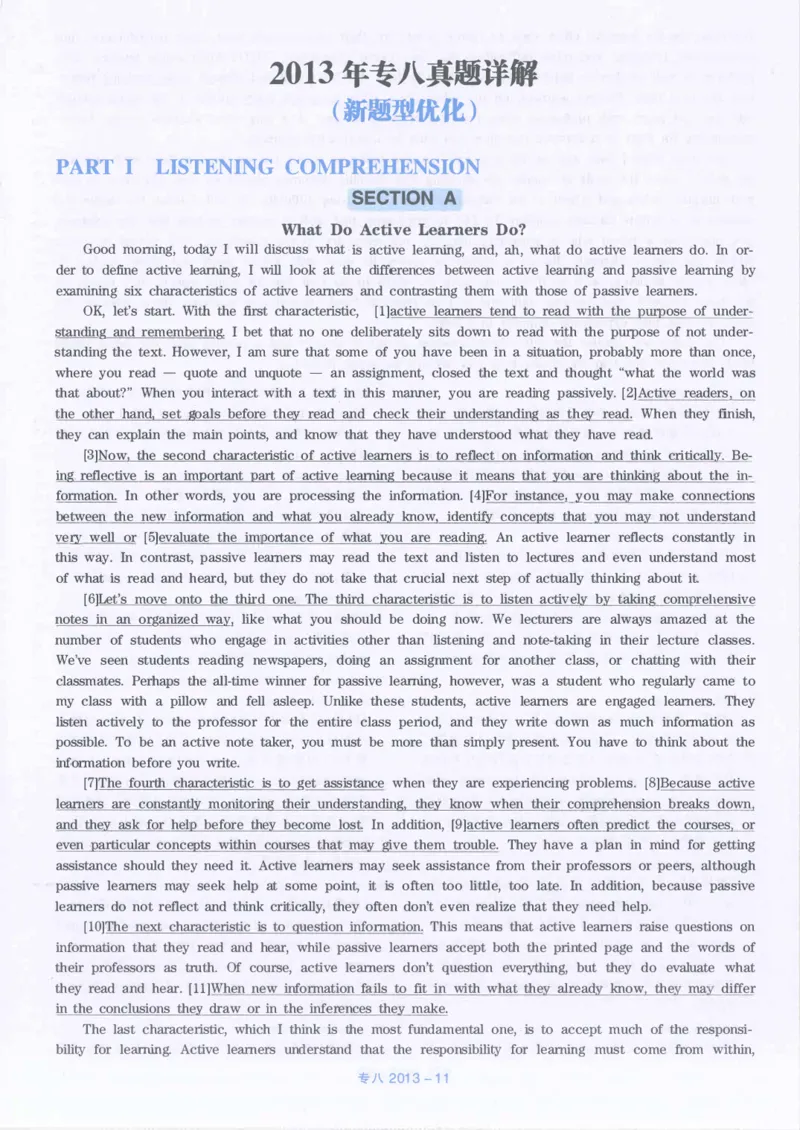
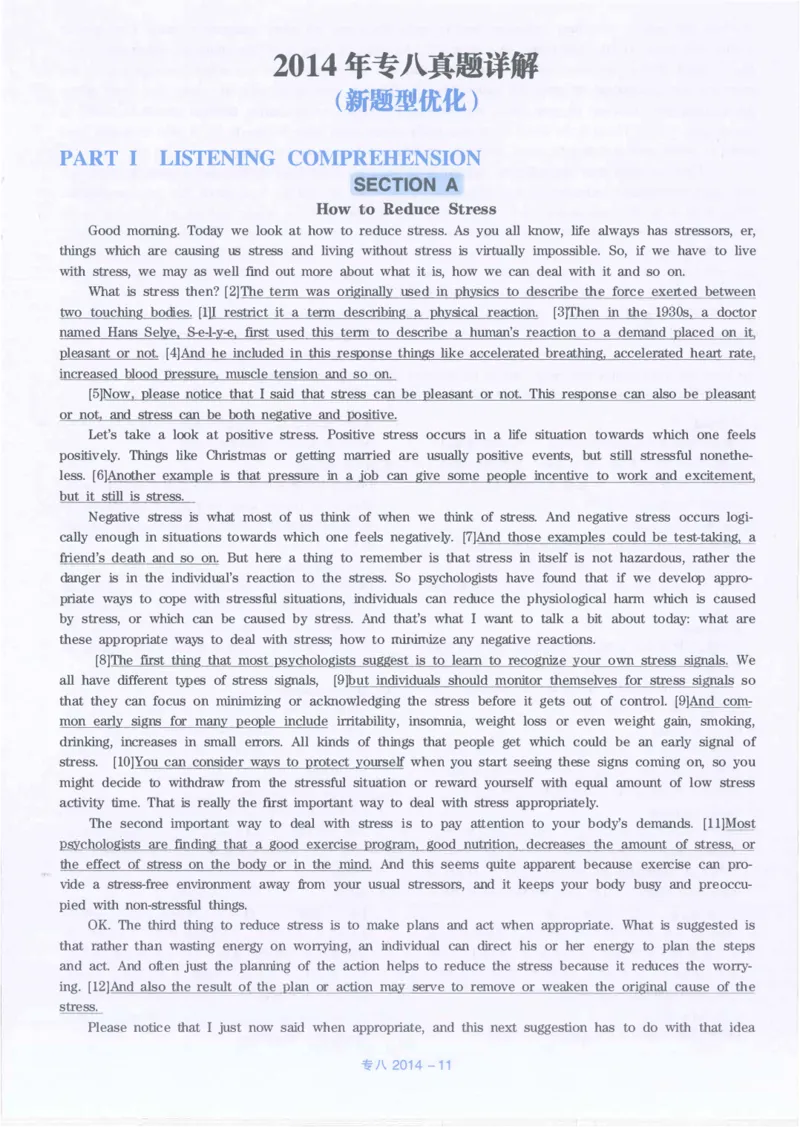
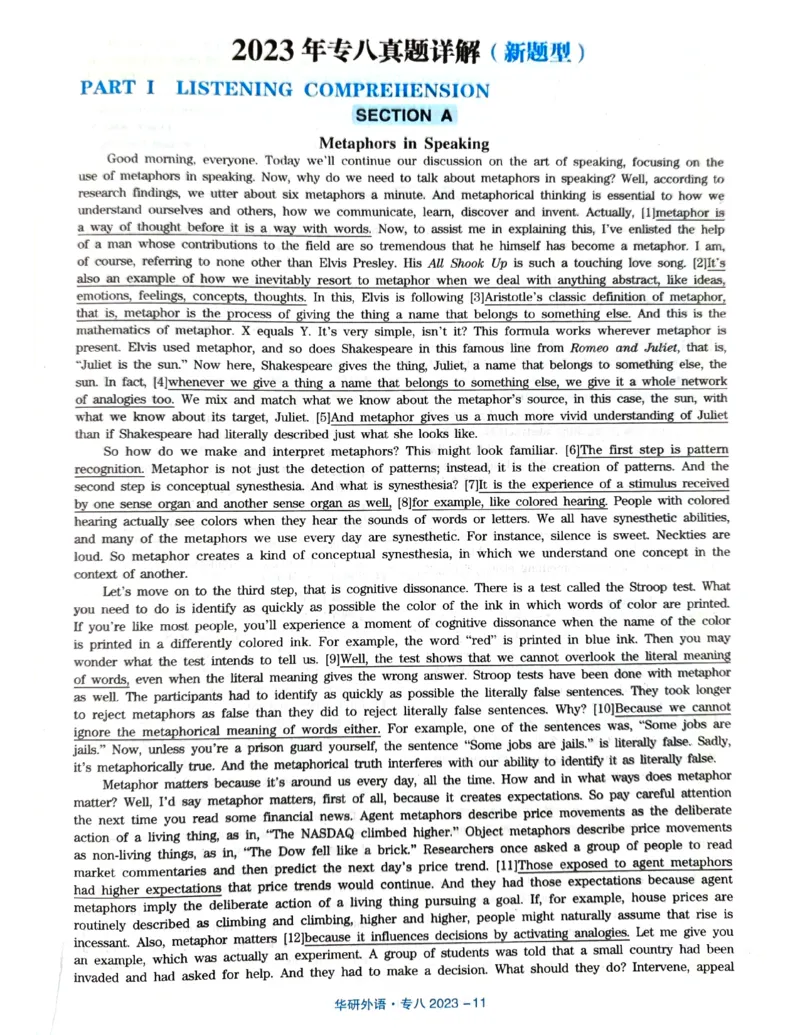
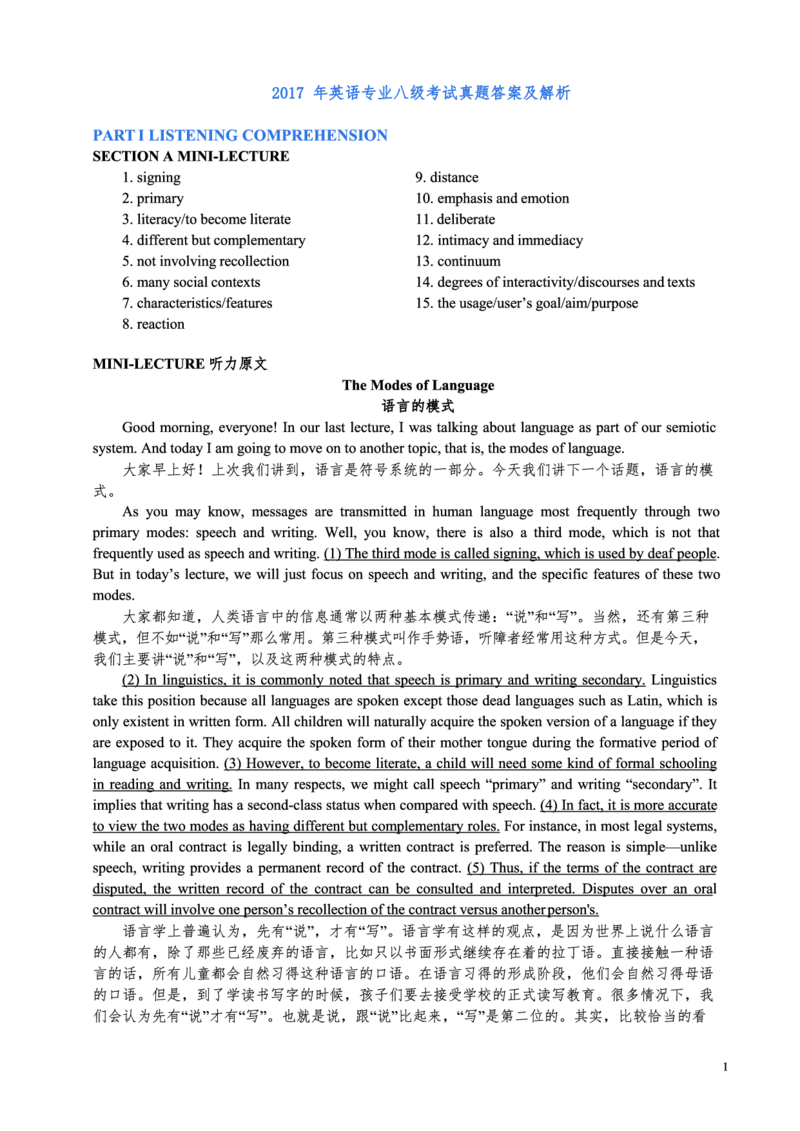
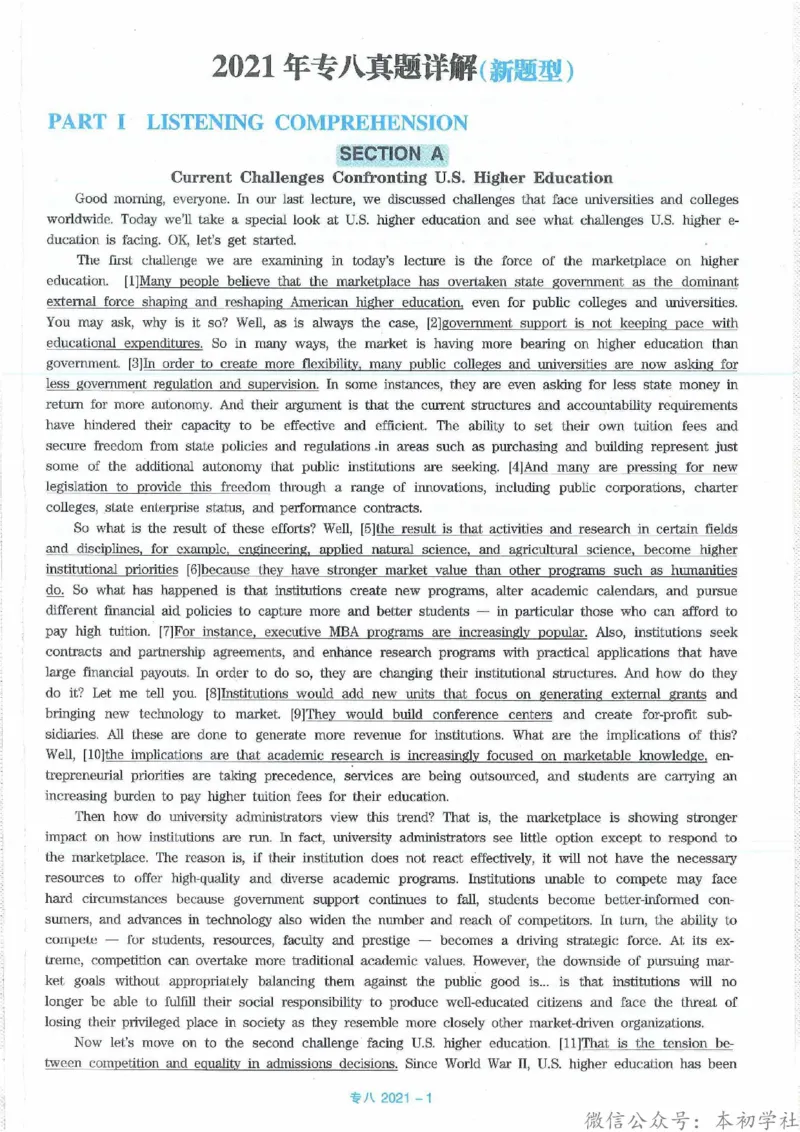
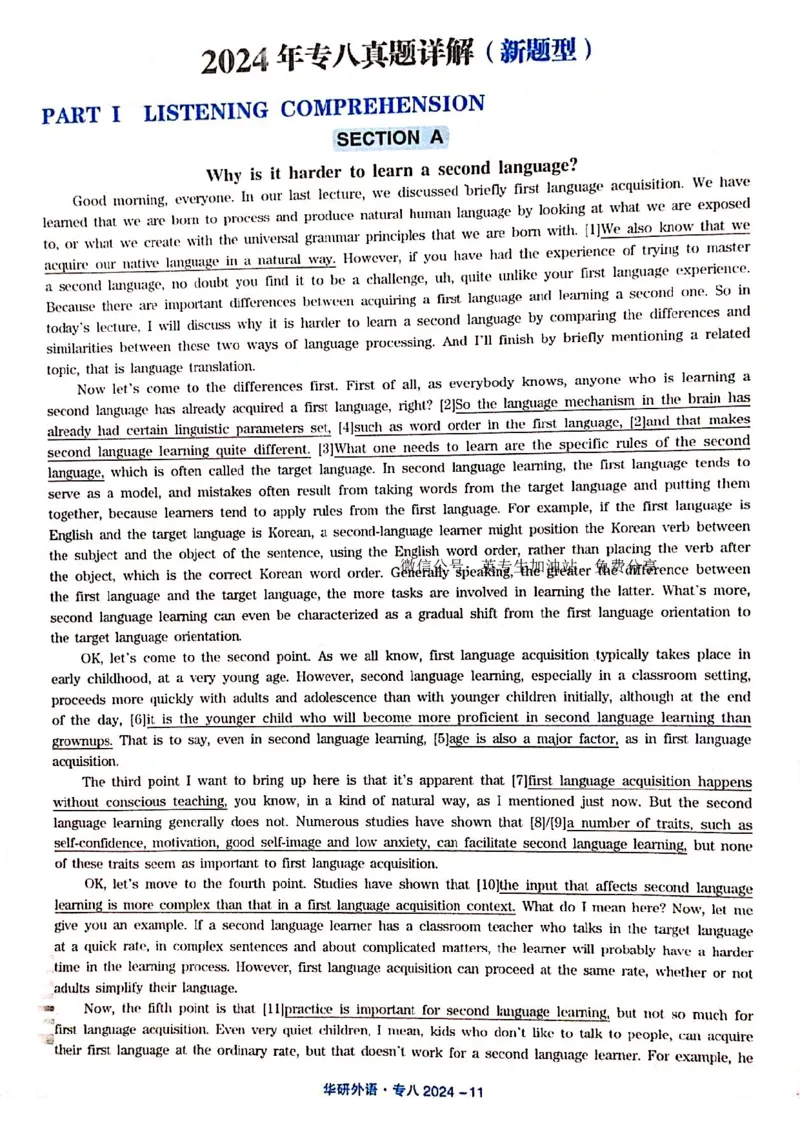
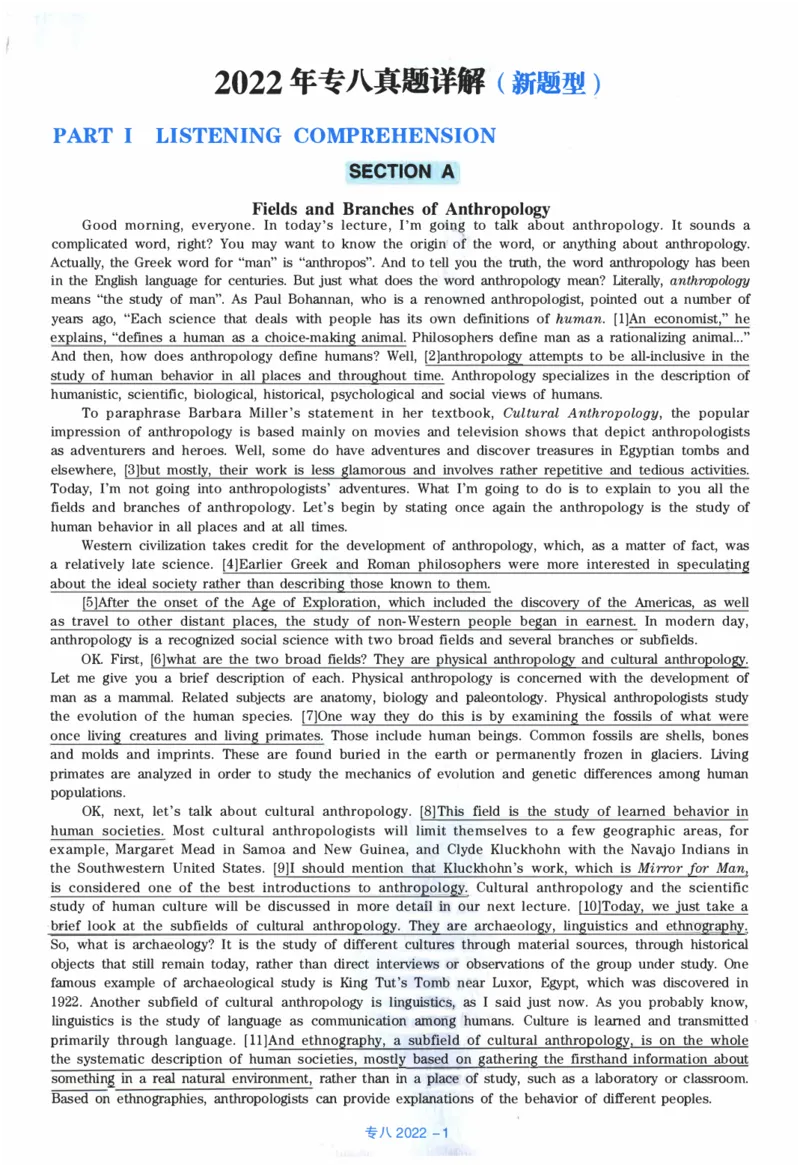
Good morning, everybody. Now, at the university, you, as students, are often _called on to perform
many types of listening tasks: listening in a group discussion, listening to a teacher on a one-to-one basis,
and listening to academic lectures. So what I'm going to talk about today is what a listener needs to be
able to do in order to comprehend an academic lecture efficiently.
OK. What do you need to do in order to understand the lecture? Now there are four things that I'm
going to talk about. [ 1 ]The first thin is that ou need to be aware of all of the arts of the Ian ua e that
carry meaning. You all know that words carry meaning. So you've got to be aware of the vocabulary of the
language, [2]but there are some other features. For one thing, [3]you need to be aware of stress. Let me
give you an ex扣nple. "I went to the bar." "I went to the bar." It makes a difference. In the second exam
ple, I'm stressing the fact that it was me and not someone else so that this means stress has some mean
ing. (4]Now the next thin . ou mi ht want to listen for is intonation. For example, if I say "He came." "He
C扛ne?" There are two different meanings. One is a statement, the other one is a question. [5]And another
thing you need to listen for is rhythm. For instance, "Can you see, Mary?" VS "Can you see Mary?" da da
DA da ... da da da DA da. Those two mean something different. In. the first one, they are talking directly to
Mary, while the second one means "Can you see Mary… over there?"
Now the next thing you must do when you listen is that you need to add information that the lecturer
expects you to add. All lecturers assume that they share some information with their audience and that
their audience does not need them to explain every word. [6]And listeners have an ability to add this infor
mation due to two sources of information. That is, one, [7]their knowledge of a particular subject; and, two,
(8]their knowledge or experience of the world. So remember: listening is not a matter of just absorbing the
speaker's words; the listener has to do more than that. The listener is not a tape recorder, absorbing the
speaker's words and putting them 'into his or her brain. Rather, [9]1istening involves hearing the speaker's
words and reinterpreting them, [lO]adding information if necessary. So the meaning is not in the word alone,
rather it is in the person who uses it or responds to it so that the second thing that a listener must do—
add information that the lecturer assumes that they share.
OK. (ll]The third thin that a listener needs to do and this is to me the most im ortant thin of all
and that's to predict as you listen. Now let me give you two reasons why you have to predict. For one
thing, [12]if you predict it helps you overcome noise. What do I mean by noise? Maybe there's noise out
side and you can't hear me. Maybe you're in the back of the room and you can't hear all that well. Maybe
the microphone doesn't work Maybe there's noise inside your head. By that I mean maybe you're thinking
of something else. And then all of a sudden, you'll remember "Oh, I've got to listen. " By being able to
predict during the lecture, you can just keep listening to the lecture and not lose the idea of what's going
on. So predicting is important to help you overcome outside noise and inside noise. And another reason
that predicting is important is because it saves you time. Now when you listen you need time to think
about the information, relate it to old ideas, take notes, and if you're only keeping up with what I'm saying
or what the lecturer's saying, you have no time to do that. And I'll bet a lot of you are having
that problem right now because it's so hard just to follow everything I'm saying, that you don't have time
to note down ideas. So predicting saves you time. If you can guess what I'm going to say, you're able to
take notes, you're able to think, you have more time. OK? [13]And there are two types of predictions that
you can make: predictions of content and predictions of organization. Let me give you an ex扣nple in terms
of content. If you hear the words "Because he loved to cook, his favorite room was…" what would you ex-
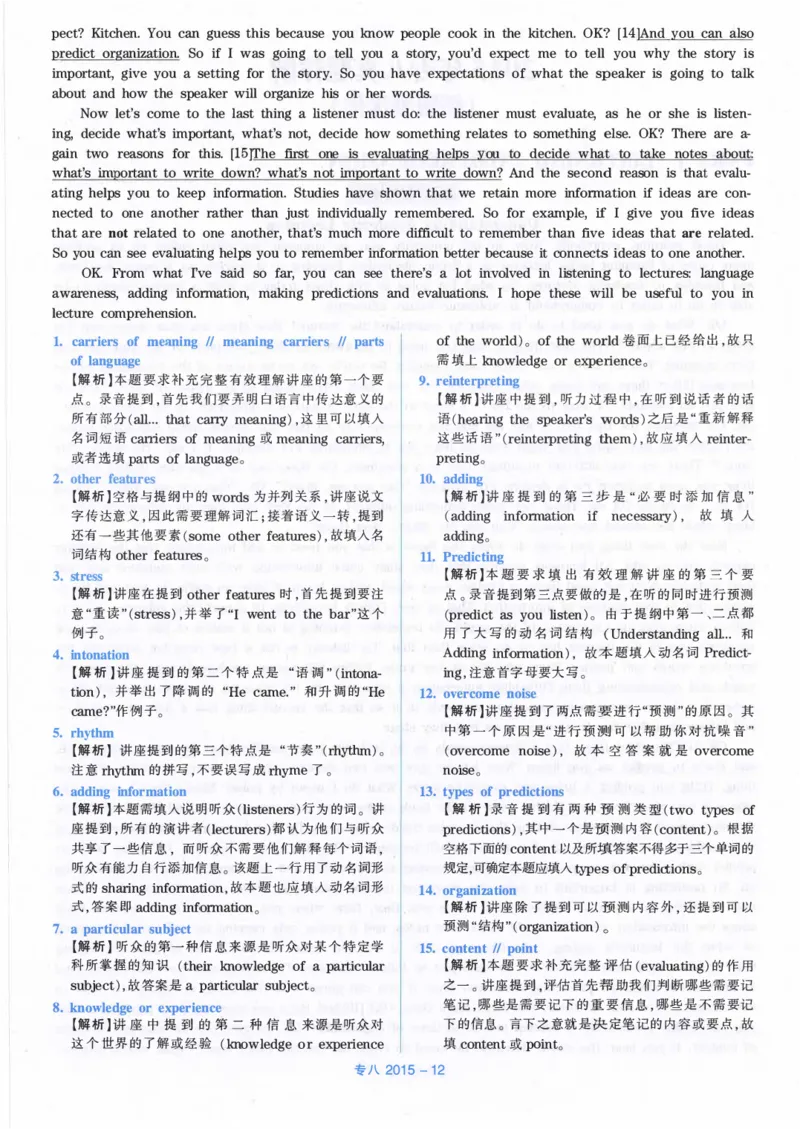
专八2015 -11pect? Kitchen. You can guess this because you know people cook in the kitchen. OK? [14]And you can also
predict organization. So if I was going to tell you a story, you'd expect me to tell you why the story is
important, give you a setting for the story. So you have expectations of what the speaker is going to talk
about and how the speaker will organize his or her words.
Now let's come to the last thing a listener must do: the listener must evaluate, as he or she is listen
ing, decide what's important, what's not, decide how something relates to something else. OK? There are a
gain two reasons for this. [15]The fi江st one is evaluatin hel s ou to decide what to take notes about:
what's irn ortant to write down? what's not irn ortant to write down? And the second reason is that eval让
ating helps you to keep information. Studies have shown that we retain more information if ideas are con
nected to one another rather than just individually remembered. So for example, if I give you five ideas
that are not related to one another, that's much more difficult to remember than five ideas that are related.
So you can see evaluating helps you to remember information be杠er because it connects ideas to one another.
OK. From what I've said so far, you can see there's a lot involved in listening to lectures: language
awareness, adding information, making predictions and evaluations. I hope these will be useful to you in
lecture comprehension.
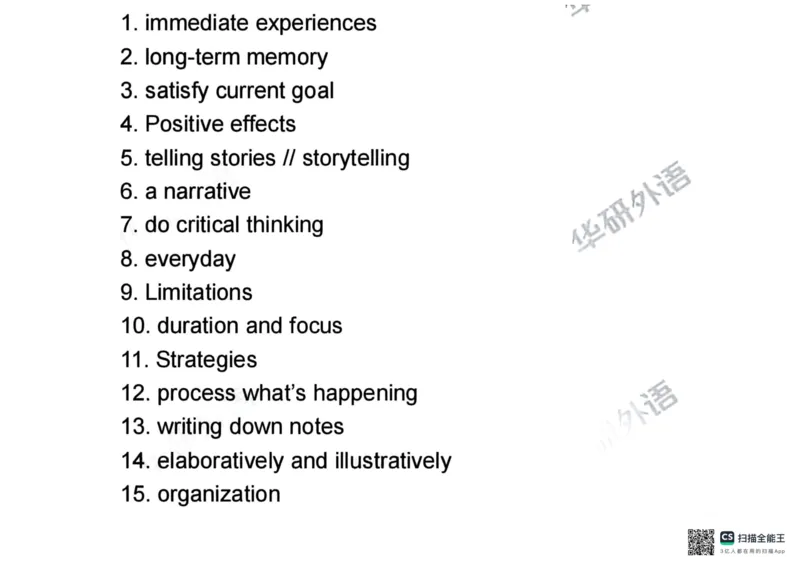
1. carriers of meaning // meaning carriers // parts of the world)。 of the world卷面上已经给出,故只
of language 需填上 knowledge or experience。
【解析】本题要求补充完整有效理解讲座的第一个要 9. reinterpreting
点。 录音提到,首先我们要弄明白语言中传达意义的 【解析】讲座中提到,听力过程中,在听到说话者的话
“
所有部分(all… that carry meaning) , 这里可以填入 语(hearing the speaker's words)之后是 重新解释
名词短语carriers of meaning 或meaning carriers, 这些话语"(reinterpreting them) , 故应填入reinter
或者选填parts of language。 preting。
2. other fe at u res 10. adding
“ ”
(解析】空格与提纲中的 words为并列关系,讲座说文 【解析]讲座提到的第三步是 必要时添加信息
字传达意义,因此需要理解词汇;接着语义一转,提到 (adding information if necessary) , 故 填 人
还有一些其他要素(some other features) , 故填入名 adding。
词结构other features。 11. Predicting
3. stress 【解析】本题要求填 出 有效理解讲座的第三个要
【解析】讲座在提到 other features 时,首先提到要注 点。 录音提到第三点要做的是,在听的同时进行预测
意 ” 重读"(stress),并举了"I went to the bar"这个 (pr�dict 邸 you listen)。 由于提纲中第一、二点都
例子。 用了大写的动名词结构 (Understanding all… 和
4. intonation Adding information) , 故本题填入动名词 Predict
“
(解析]讲座提到的第二个特点是 语调"(intona ing, 注意首字母要大写。
tion), 并举出了降调的 "He came." 和升调的"He 12. overcome noise
“ ”
came?"作例子。 【解析】讲座提到了两点需要进行 预测 的原因。 其
5. rhythm 中第一个原因是 ” 进行预测可以帮助你对抗噪音 ”
“
(解析】 讲座提到的第三个特点是 节奏"(rhythm)。 (overcome noise) , 故本 空答案就是 overcome
注意rhythm的拼写,不要误写成rhyme 了。 n01se。
6. adding information 13. types of predictions
【解析】本题需填入说明听众(listeners)行为的词。 讲 【解析】录音提到有两种预测类型(two types of
座提到,所有的演讲者(lecturers)都认为他们与听众 predictions) , 其中一个是预测内容(content)。 根据
共享了一些信息, 而听众不需要他们解释每个词语, 空格下面的content以及所填答案不得多于三个单词的
听众有能力自行添加信息。 该题上一行用了动名词形 规定,可确定本题应填入typesof predictions。
式的 sharing·information,故本题也应填入动名词形 14. organization
式,答案即adding information。 【解析】讲座除了提到可以预测内容外,还提到可以
”
7. a particular subject 预测 结构"(organization)。
(解析】 听众的第一种信息来源是听众对某个特定学 15. content II point
科所掌握的知识 (their knowledge of a particular 【解析】本题要求补充完整评估(evaluating)的作用
subject),故 答案是a particul釭 subject。 之一。 讲座提到,评估首先帮助我们判断哪些需要记
8 . . knowledge or experience 笔记,哪些是需要记下的重要信息,哪些是不需要记
【解析】讲座 中 提 到 的 第 二 种 信 息 来源是听众对 下的信息。 言下之意就是决定笔记的内容或要点,故
这个世界的了解或经验 (knowledge or experience 填content或point。
专八 2015 -12SECTION B
(T)=THERESA MAY
(!)=Interviewer
Part One:
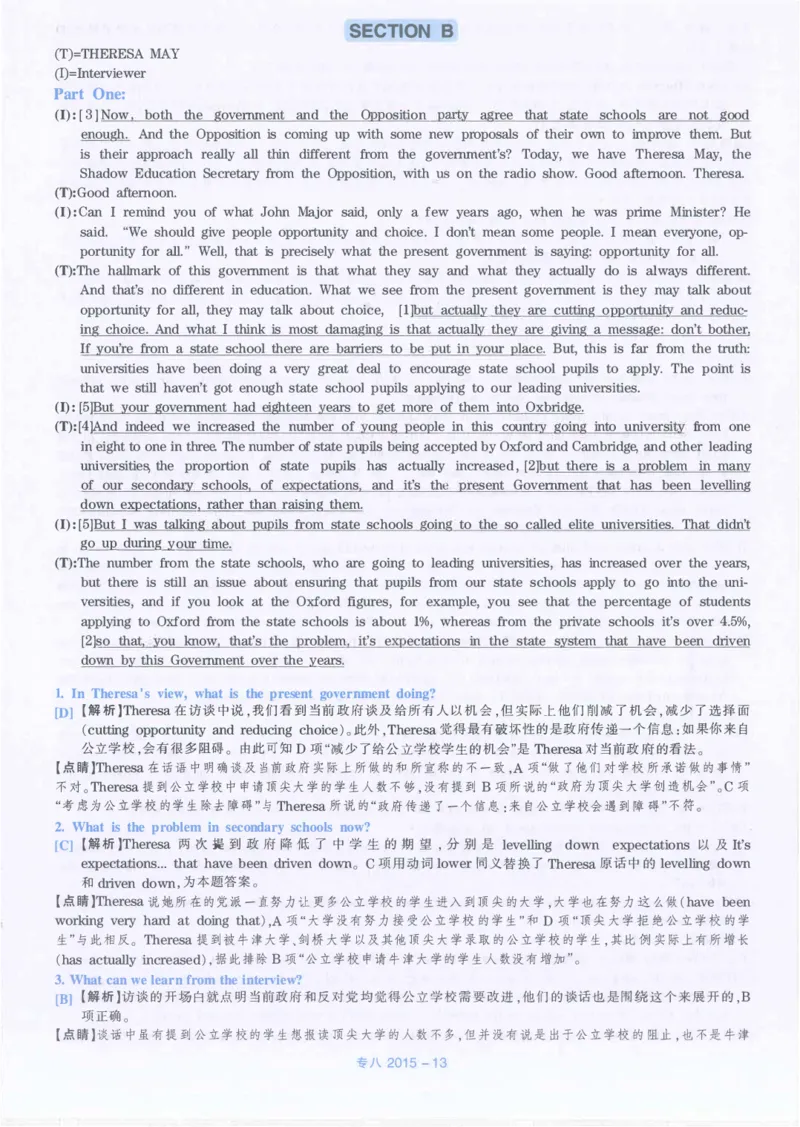
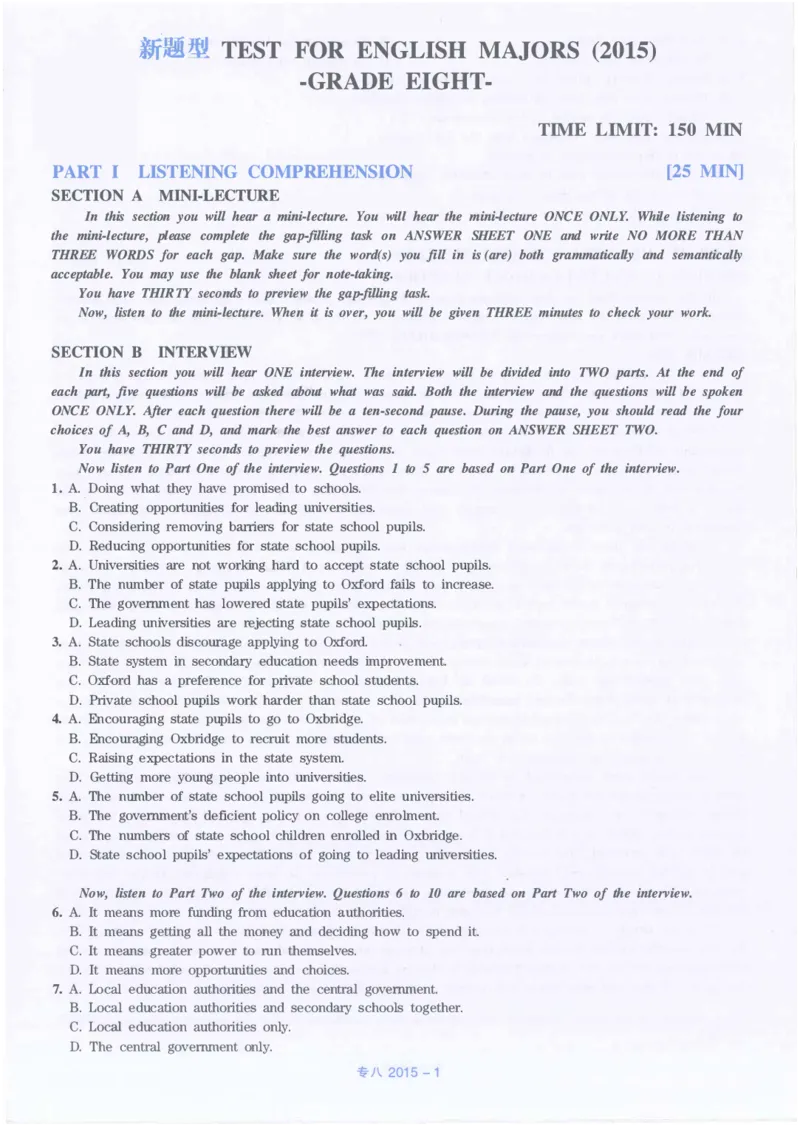
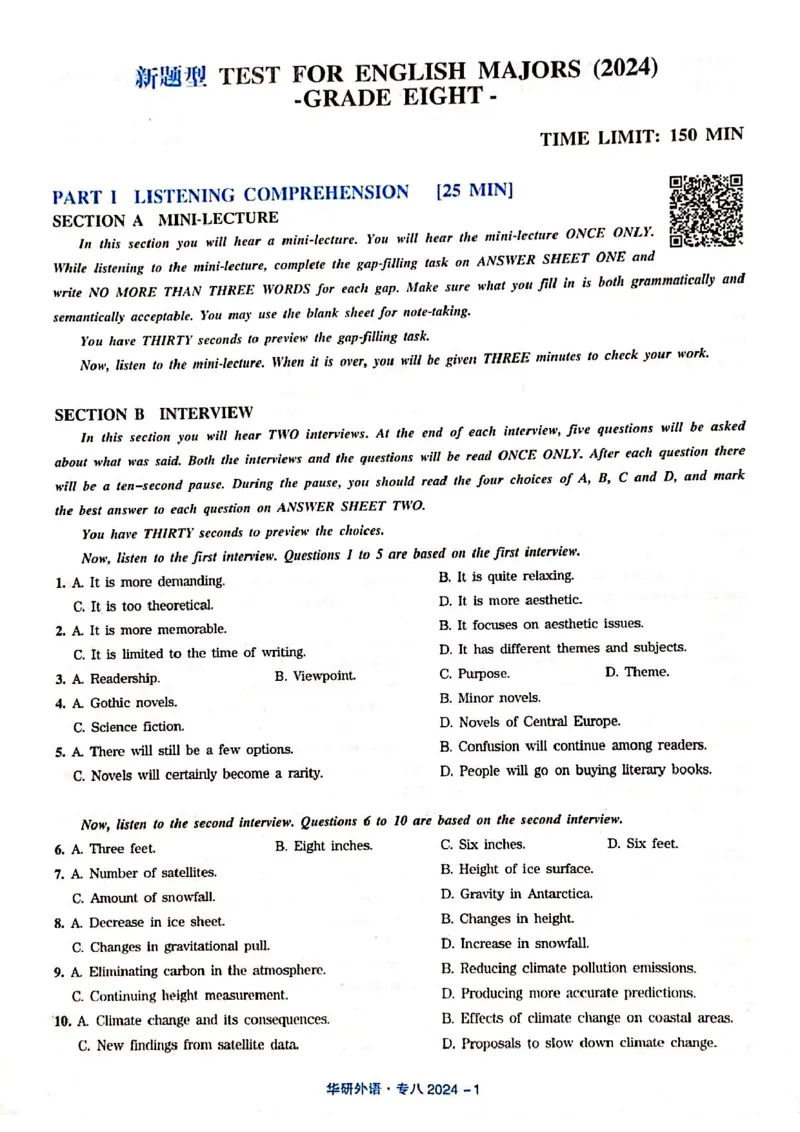
(I): [ 3]N ow both the overnment and the O osition a ree that state schools are not ood
enough. And the Opposition is coming up with some new proposals of their own to improve them. But
is their approach really all thin different from the government's? Today, we have Theresa May, the
Shadow Education Secretary from the Opposition, with郎 on the radio show. Good afternoon. Theresa.
(T):Good afternoon.
(I): Can I remind you of what John Major said, only a few years ago, when he was prime Minister? He
said. "We should give people opportunity and choice. I don't mean some people. I mean everyone, op
portunity for all." Well, that is precisely what the present government is saying: opportunity for all.
(T):The hallmark of this government is that what they say and what they actually do is always different.
And that's no different in education. What we see from the present government is they may talk about
opportunity for all, they may talk about choice, [ 1 ]but actually they are cutting opportuni and reduc
个
in choice. And what I think is most dama in is that actuall the are ivin a messa e: don't bother
If ou're from a state school there are barriers to be ut in our lace. But, this is far from the truth:
universities have been doing a very great deal to encourage state school pupils to apply. The point is
that we still haven't got enough state school pupils applying to our leading universities.
(I): [5]But our overnment had ei hteen ears to et more of them into Oxbrid e.
(T): [4]And indeed we increased the number of oun eo le in this count oin into universi from one
in eight to one in three. The number of state pupils being accepted by Oxford and Cambridge, and other leading
皿versities, the proportion of state pupils has actually increased, [2]but there is a problem in many
of our second schools of e ectations and it's the resent Government that has been levellin
dowri expectations, rather than raising them.
(I): [5]But I was talkin about u ils from state schools oin to the so called elite universities. That didn't
go up during your time.
(T):The number from the state schools, who are going to leading universities, has increased over the years,
but there is still an issue about ensuring that pupils from our state schools apply to go into the uni
versities, and if you look at the Oxford figures, for example, you see that the percentage of students
applying to Oxford from the state schools is about 1%, whereas from the private schools it's over 4.5%,
[2]so that ou know that's the roblem it's e ectations in the state s stem that have been driven
down by this Government over the years.
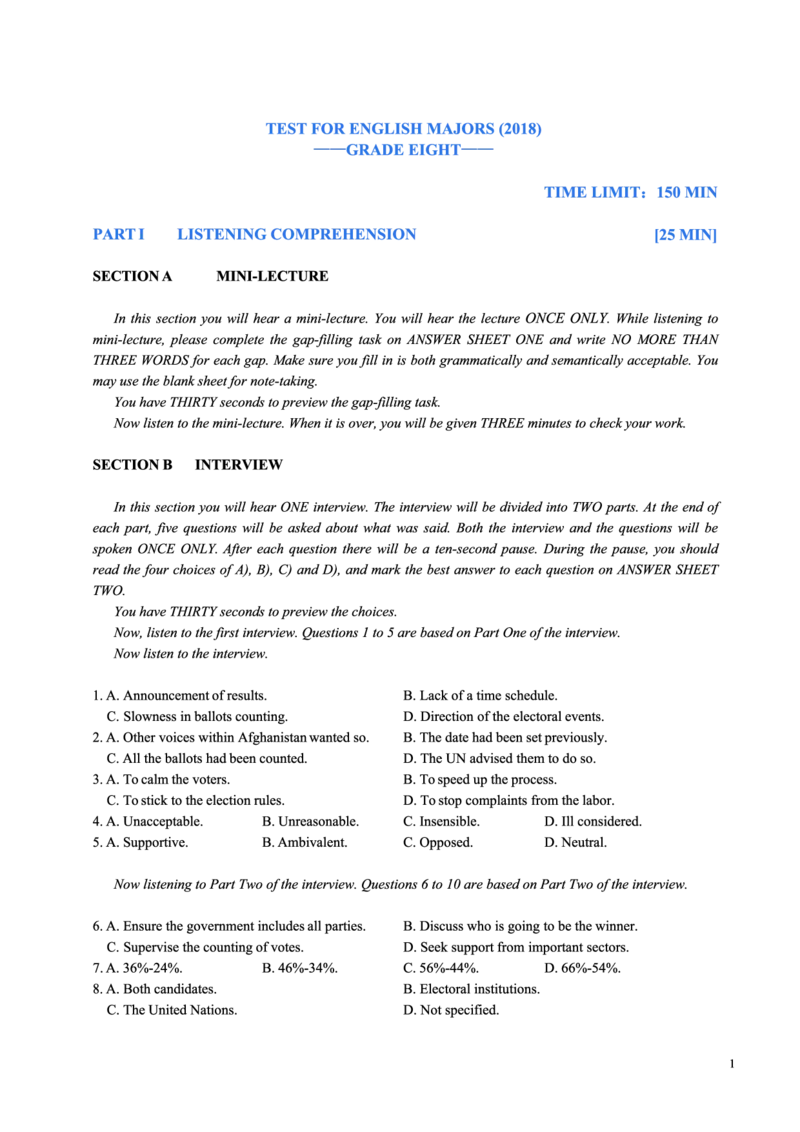
1. In Theresa's view, what is the present govermnent doing?
[D] 【解析】 Theresa 在访谈中说,我们看到当前政府谈及给所有人以机会,但实际上他们削减了机会,减少了选择面
(cutting opportunity and reducing choice) o此外, Theresa 觉得最有破坏性的是政府传递一个信息:如果你来自
D “ ” Theresa
公立学校,会有很多阻碍。 由此可知 项 减少了给公立学校学生的机会 是 对当前政府的看法。
Theresa A “ ”
【点睛】 在话语中明确谈及当前政府实际上所做的和所宣称的不一致, 项 做了他们对学校所承诺做的事情
Theresa B “ ” C
不对。 提到公立学校中 申请顶尖大学的学生人数不够,没有提到 项所说的 政府为顶尖大学创造机会 。 项
“ ” Theresa ” ”
考虑为公立学校的学生除去障碍 与 所说的 政府传递了 一个信息:来自 公立学校会遇到障碍 不符。
2. What is the problem in secondary schools now?
[C] [解析】 Theresa 两 次 提 到 政府 降低 了 中 学 生 的 期 望 , 分别 是 levelling down expectations 以 及 It's
expectations… that have been driven down
。
C
项用动词
lower
同义替换了
Theresa
原话中的
levelling down
和 driven down, 为本题答案。
Theresa (have been
【点睛】 说她所在的党派一直努力让更多公立学校的学生进入到顶尖的大学,大学也在努力这么做
working very hard at doing that) , A “ ” D “
项 大学没有努力接受公立学校的学生 和 项 顶尖大学拒绝公立学校的学
” Theresa
生 与此相反。 提到被牛津大学、剑桥大学以及其他顶尖大学录取的公立学校的学生,其比例实际上有所增长
(has actually increased) , B “ “
据此排除 项 公立学校申请牛津大学的学生人数没有增加 。
3. What can we learn from the interview?
[B] [解析】访谈的开场白就点明当前政府和反对党均觉得公立学校需要改进,他们的谈话也是围绕这个来展开的,B
项正确。
[点睛】谈话中虽有提到公立学校的学生想报读顶尖大学的人数不多 ,但并没有说是出于公立学校的 阻止,也不是牛津
2015 -13
专八有招生偏好,而是由政府的误导所致,所以排除A和 C。 此外,文中没有提到公立学校和私立学校的学生谁更努力 ,D
无原文根据。
4. What contribution does Theresa think her party has made in·education?
[D] (解析)Theresa指出现任政府的误导性行为让公立学校的学生以为申请读大学是有障碍的,从而导致公立学校报
读大学的人数不多。 谈及此,采访者质询了Theresa所在党派在这方面的表现。 从Theresa的回答“增加了上大学的
年轻人数量”中 ,可知答案选 。
D
Theresa
【点睛]虽然 在 回应采访者时提及反对党执政期内报读大学的人数有所增长,牛津和剑桥拟录的公立学校学生
的比例也有提高,但牛津和剑桥在这里相当于一种举例,代表的是顶尖大学,所以不等同于说反对党鼓励公立学校学生
A B Theresa
去读牛津或鼓励牛津扩招,排除 和 。 只指出 了 当前政府降低了公立学校学生的期望,并没有说反对党提高
C
了这些学生的期望,排除 。
5. What's the man's focus in this part of the interview?
[A] (解析]男士就是采访者,他发言的内容不多,除了开场白之外就只说了两旬,且针对的都是公立学校学生去读顶尖
大学的人数情况,由此可见本题答案为 A。
Theresa B
【点睛]一直话病当前政府的教育政策的是 而非采访者,而且她主要针对的并非 项说的大学招生的问题,而
. C
是政府对中学生的不当 引 导。 男士说的是公立学校学生去读国 内顶尖大学的人数,而非只针对牛津和剑桥所招人数,
D Theresa
项不对。 项是 提到 的要点 ,并非男士关注焦点。
Part Two:
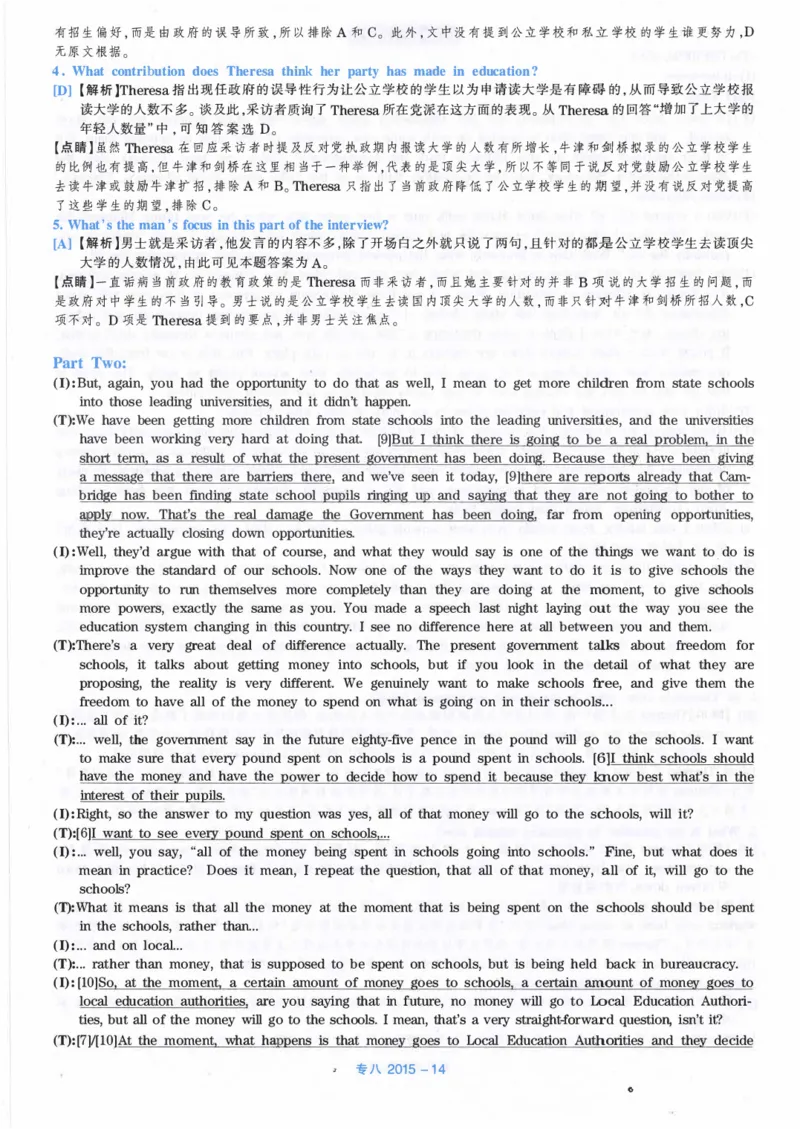
(I):B ut, again, you had the opportunity to do that as well, I mean to get more children from state schools
into those leading universities, and it didn't happen.
(T):'We have been getting more children from state schools into the leading universities, and the universities
have been working very hard at doing that. [9]But I think there is oin to be a real roblem in the
I
short term as a result of what the resent overnment has been doin . Because the have been ivin
a message that there are barriers there, and we've seen it today, [9]there are reports already that Cam
brid e has been findin state school u ils rin in� u and sa · that the are not oin to bother to
a 1 now. That's the real <lama e the Government has been doin far from opening opportunities,
they're actually closing down opportunities.
(I):W ell, they'd argue with that of course, and what they would say is one of the things we want to. do is
improve the standard of our schools. Now one of the ways they want to do it is to give schools the
opp01tunity to run themselves more completely than they are doing at the moment, to give schools
more powers, exactly the same as you. You made a speech last night laying out the way you see the
education system changing in this country. I s�e no difference here at all between you and them.
(T):There's a very great deal of difference actually. The present government talks about freedom for
schools, it talks about getting money into schools, but if you look in the detail of what they are
proposing, the reality is very different. We genuinely want to make schools free, and give them the
freedom to have all of the money to spend on what is going on in their schools. ..
(I):. .. all of it?
(T): … well, the government say in the future eighty-five pence in the pound will go to the schools. I want
to make sure that every pound spent on schools is a pound spent in schools. [6]1 think schools should
have the mone and have the ower to decide how to s end it because the lrnow best what's in the
interest of their pupils.
(I):R ight, so the answer to my question was yes, all of that money will go to the schools, will it?
(T):[6]1 want to see eve ound s ent on schools…
(I): ... well, you say, "all of the money being spent in schools going into schools." Fine, but what does it
mean in practice? Does it mean, I repeat the question, that all of that money, all of it, will go·to the
schools?
(T): What it means is that all the money at the moment that is being spent on the schools should be spent
in the schools, rather than…
(I)七. and on local…
(T):... rather than money, that is supposed to be spent on schools, but is being held back in bureaucracy.
(I): [lO]So at the moment a certain amount of mone oes to schools a certain am.ount of mone oes to
local education authorities are you saying that in future, no money will go to Local Education Authori
ties, but all of the money will go to the schools. I mean, that's a very straight-forward question, isn't it?
(T):[7]/[lO]At the moment what ha ens is that mone oes to Local Education Authorities and the decide
3 专八2015 -14 。(· how much mone is then oin to be s ent on the schools. Mone is held back at those Education
Authorities and is held back initial! at Central Government as well for them to decide how it should
be spent. I want that money to be actually in the schools, for the schools to decide how it should be
spent…
(l):OK, thank you very much, Theresa, for talking to us on the programme.
(T):Pleasure.
6. In Theresa's view, what is school freedom?
[B] [解析】在发表关于学校自由的看法时, Theresa 说她认为学校应该持有经费,并有权决定如何花费,因为他们最明
(all of that money, all of it) , Theresa B
白学生的利益所在。男士确认是不是所有的经费 给予了肯定答复。故 项
“
“得到所有经费并决定如何花费 正确。
【点睛 ]A 项 “ 从教育部门获取更多经费 ” 是 Theresa 认为 当 前政府对 school freedom 的理解,不是她 自 己对 school
freedom 的看法。 C 项 “ 学校应有更多的权利 自 已经营 ” 也是当前政府的看法。 D 项 ” 被赋予更多机会和选择 “ 过于宽泛,
Theresa school freedom
不是 对 的具体理解。
7. According to Theresa, who decides money for schools at the present?
[A]
【解析】
Theresa
说,现在学校的经费都是拨给当地教育部门
(local education authorities)
来决定学校该花多少钱。
(central government)
经费在这些部门滞留,起初也在中央政府 滞留,由他们决定花钱的方式。 因此目前决定学校
“ ”
经费使用的是A项 当地教育部门和中央政府 。
local education authorities C
【点睛】注意在听到 决定学校的经费时切勿匆忙把答案锁定为 项,后文还提及经费也滞
留在中央政府,故决定学校经费的应该是当地教育部门和中央政府。
8. What is the role of the interviewer throughout the talk?
[A] 【解析]本题问采访者在访谈中的作用。 根据常识,采访者的一个重要作用就是引出话题,引导访谈的进行。 因此不
难选出 A。
“ ”
【点睛]男士在访谈中始终是中立的态度,没有偏 向某一方,所以 B 项 支持受访者 不对。 谈话中并没有说到任何新政
” “
策,排除 C"介绍新政策 。 男士的发言屈指可数,其中都没有提到任何具体的数据,所以 D"解释某些数据 不对。
9. Why some state school pupils give up applying to leading universities?
[C] Theresa
【解析】 在指责当前政府误导学生时,引用了关于公立学校学生放弃报读剑桥的报道来当佐证,可见这些学
生是因为受了政府的误导而放弃的,所以本题选 C。
Theresa (b ers)
【点睛】根据 所说,对于公立学校的学生,报读顶尖大学有困难只是政府的误导,此外,这个所谓障碍 扛寸
A B Theresa
也没有特指什么方面, 、 的理解不正确。 虽然 认为导致学生放弃的原 因在于政府,但不等同于说政府反对这
些学生报读顶尖大学,故D 不对。
10. What do we learn about the money being spent on schools at the moment?
[C] 【解析】访谈最后谈到学校经费, 在两人的问答中反复提到了如今学校经费的分配是如何操作的。 男士在听了
Theresa 对学校经费的看法后, 得出的说法是 “ 部分经费分配到学校手中 , 部分去了当地教育部门那里 " ,而
Theresa 随后也基本复述了这种现状。 C 项与原文信息相符。
A Theresa
【点睛】关于学校经费现状的描述,在最后几轮问答中反复出现,不难排除其他三项。 是 希望的分配方案。 根
据录音,当地教育部门现在只拿着一部分经费,并没有拿到所有的经费,故排除 B。 D 说的大学在最后几个话轮中根本
没有提及过。
PART II READING COMPREHENSION
SECTION A
PASSAGE ONE 全文翻译画线点评
(1)2011
年,为躲避狂热的购物人群,很多顾客转而舒适地使用 电脑来为假期做采购。 网络零售商的销量增
长超过 15%,为史上最大的购物季。 但与此同时,退货率也创历 史新高一一-比上一年增长 8%。
(2) (11]
问题出在哪里? 是全球经济危机的残留影响使人们无法接受奢侈的购物消费? 还是因为人们在网购
[11]
时更冲动 更容易做出错误的决定? 两种解释都貌似合理。 但是, 还需考虑笫三个因素:触感。 网购时我们可
能因为喜欢商品的外观而下单 但我们无法感受衣料的质感、外套的形状、褶皱下垂的样子或者耳环的重量。 直
接接触一样商品会使我们更钟爱所购之物。
(3)我的新书《名牌冲击》发行时,我和一家当地书店联合进行了一项实验,以 了 解网购和实体店购物的差
别。我详细告知志愿者采用两种不同的方式推销我的书。笫一种基本是袖手旁观式的。 当有顾客询问我的书时,
20
志愿者将他们带到书架边,将书指给他们看。 在 个询问的顾客中 ,最后仅有六人购买。
(4)笫二种推销方式同样将顾客带到书架边,但这次志愿者拿下书并轻握片刻之后才递到顾客手中。拿到书
\.. 20.5 .5的 20个顾客中有 13人最终买下该书。将书递到顾客手中这一简单的动作却导致了极大的销量差异。其原因何在?
手持一样东西时,我们的感受与拥有感相似。 [25]这也是为什么我们通过与陌生人和朋友握手来建立或继续友
谊。 在本例中 手握一会儿书本后却得让它从手中离去或许会产生一种微妙的失落感 而这可以增加人们的购买欲
(5)[12]班戈大学和英国皇家邮政联合进行的一项新研究揭示了接触的力量。 实验中人们接触的是普通邮
寄的信件。 与 以网络方式送达的信息相比,以信件方式送达的信息能给人留下更深、更� 功能性磁共
振成像研究的结果表明 ,接触纸张时,大脑负 责情感的 中心部位得到激活,从而形成更强的联系。 [12]该实验也
表明 一旦接触成为行动的一部分 它将转化为一种拥有感。换言之,我们触摸商品之后�产生拥有感,并进而激
发购买行为。 这种拥有感绝不是网购经验中的一部分。
(6)由于圣诞前夕 的购物习惯发生改变,我们不仅更少考虑送给我们所爱之人的礼物,而且我们通过电子心
愿单越发控制 了他们给我们买的 东西。 但事实却是,无论我们如何认为数字化确定无疑是正确的发展方向,[13]
购买到真正理想之物却远非轻点几下电脑鼠标就可以实现的。
11. [A]【定位】根据题干中的returning their purchases定位至首段末句和第 2段。
【解析]本题要求选出不属于顾客退货原因的一项。 顾客可能的退货原因主要出现在第 段,包括: 由于经济
2 1)
危机难以接受奢侈的购物消费;2)冲动购物因此做出错误决定;3)网购前没有触摸商品,无法感受衣料的质感、
外套的形状、褶皱下垂的样子或者耳环的重量。 B项“他们最后发现购买的商品太昂贵”中的 too expensive 同
义改写了第一个原因中的 extravagant indulgences; C项”由于不确定而改变主意”中的 uncertainty概括了第
三个原因中的 cannot feel the quality of… or the weight of…;D项”因事前没有多作考虑而后悔”对应了第
二个原因中的shop more impulsively。 没有涉及的原因是A项”对所购买产品的质量不满意”。
【点睛】A 项”对所购买产品 的质量不满意”中的 quality 一词在第 2 段倒数第 2 句有提及,考生容易 因此误认为该项是
退货原 因。 但需注意,文中只是说没法感受到质量如何,据此推断出”对质量不满意“有些tl�,iL M I: f!. ¾Y£i#� a
question of touch 这个因素时提及的其中一个方面,不宜作为退货原 因。
12. [B]【定位】根据题干中的 Bangor University and the Royal Mail Service定位至第 5段。
[解析】题目询问作者引用班戈大学和皇家邮政的研究的目的。 由于作者在描述他在书店的实验及其结果后便
介绍班戈大学和皇家邮政联合进行的研究,且后者的研究结果与作者的实验结果相一致。 因此判断作者在此处
介绍班戈大学和皇家邮政的这一项联合研究的目的是为他的研究提供进一步的证据,B项正确。
【点睛】两项实验单独进行,结果却高度相似,但文中并未对实验结果进行比较,因此 A 项“比较不 同场景下相似的反
应“错误。 针对班戈大学和皇家邮政联合研究所得结果的功能性磁共振成像发现表明 的是接触物体对大脑某个部分的
影响,而不是对大脑功能进行科学描述,C 项错误。 班戈大学和皇家邮政联合研究的是,以网络及信件方式送达的信息
给人留下的印象的比较,与 网购中的情感反应不相干,故 D 项错误。
13. [A]【定位】根据题干直接定位至最后一段。
【解析】本题询问根据文章最后一段可推断出何种信息。 由文章末尾的”购买到真正理想之物却远非轻点几下电
脑鼠标就可以实现的“判断A项正确。
【点睛】由最后一段第 1 句 中 的"... not only do we give less thought to the type of gifts we buy ... "判断我们越
来越不重视礼物的购买,因此 B 项错误。 由最后一段末句 中 的“不管我们大家多么相信数字化是正确的发展方向“判
断,C项“有些人对数字时代持怀疑态度“错误。 由末句 中的“购买到真正理想之物却远非轻点几下电脑鼠标就可以实现
的“判断,D 项“网络购物能使顾客真正满意“错误。
难句分析
• The reality, however, is that no matter how convinced we all are that digital is the way to go, finding
real satisfaction will probably take more than a few simple clicks. (The last paragraph)
【分析】本句为多重复合句,主句为The reality is that…,_t hat引导表语从句表明 reality的 内容。 该表语从句是主从
复合句,主干部分为fmding real satisfaction will… take more than… clicks; no matter how 引导了让步状语从
句,该从句中还包含了宾语从句 that digital is the way to go , 作convinced 的宾语,说明确信的内容。
难词突破
frenetic /fre'nehk/ a. 极度激动的;狂热的 lingering /IIIJQ8rIIJ/ a. 拖延的;逗留不去的
extravagant /1k'str岔vegent/ a. 奢侈的;过度的 indulgence /m1dAld30ns/ n. 放纵,纵容
impulsively /Im1pAls1vl1/ ad. 冲动地 snail mail蜗牛邮件;邮寄信件
PASSAGE TWO 全文翻译画线点评
(1)我和我的教授兄弟对于大脑和心智一直有分歧,这一话题又涉及我是否过于看重情商而他是否过度重
视智商。我们尤其对“你愿意和一个非常聪明的怪物做朋友吗?”这个与人相关的问题作了一番争论,当然这个议
题也适用 于动物。如果我家的狗每天早上都能帮我叨报纸,并且在我喝咖啡的同 时朗读乡合我听,那我真的会很高
兴。但我真正在乎的是它的忠诚以及天真无邪的 内心。 在我们家要考虑的事已经够多 了 并且我们可能花太
[14]
专八2015 -16,多时间去动脑筋 了 我们真正需要的模范是天性良好者 而这也是我们家的狗所带给我们的最大启发
其实我并不是和小狗一起长大的小孩,因此,我大女儿虽然尊重我但却决不妥协的养狗决心对我而言是
(2)
需要时间来适应的。 我常常觉得她是在训练我:从 6 岁到 9 岁 ,她慢慢地给我洗脑,告知我狗的各个品种及其不
同特性;对我们遇到的每只狗都悄声细语,好让它们迷倒并说服我;通过 自律展示她已准备好承担养狗的各种
责任。 就这样Twist 来到 了我家,而我常常把它误当作我的笫三个女儿。
(3)一开始,我以为养狗最大的挑战是训练它坐下、跟从我们的脚步、安静地走在我们身边而不是去追逐邻
居的兔子。 但是我很快发现,我们需要从它身上学习的 东西远多 于它要从我们这里学习的 东西。
(4)举例来说,如果孩子成功的秘密仅仅是自 然状态的坚持而不是极为罕见的天赋,那么[15D]Twist 对 目 标
的持之以恒是我们所有人的最佳典范 尤其是当 它努力想要抓住的是因凤吹树枝而在客厅晃来晃去的光线时
所表现的坚持。 [15D]它从未成功 也从不放弃 [26]即便它因此直接撞上墙壁
(5)[15B]还有就是它的忍耐力。 它只有在发现晚餐时间 已过去 15分钟而我们没有注意到时,它的忍耐力才
会耗尽。 但即使这时,它的渴望还是远大于愤怒,它不因此哀嚎也让我看到它的 自制力,而我 自 己在肚子饿时未
必能有如此的 自 制力。
(6) [15C]但最让我肯定的莫过于它的宽容之心 Twist在很小的时候,就让我看到 了 它的宽宏大量。 它大约
7个月 大时,我们带它去兽医那里切除卵巢。 我们将它交给陌生人,这个陌生人还做了或许让它不太高兴的事。
当兽医将软弱无力的 Twist还给我们时,它没有指责我们,没有做出一副“你们怎么可以这样对我”的样子,好像
它知道我们不会故意让它受苦。 尽管它不了解事发原因 ,但还是原谅了我们,将它小小的脑袋搭在我女儿的膝上。
(7)我想我们可能因此得出结论说它或许只是盲 目 忠诚与服从。但最后我们 了解得更多 :它多次证明 自 已完
全有能力不服从命令。 当周围有更有趣的事物吸引 它时,它会忽略我们 ; 当我们忽略它时,它会责备我们; 当 它
有紧急信息想传达时,它会朝着微亮的天空狂吠。 但它对于我们的过失和变化无常态度的忍耐力以及心甘情愿
给我们笫二次机会的包容心,是我们每天学习感恩的来源。
(8)和狗一起长大的朋友告诉我,在青少年时他们觉得全世界的人都不值得信任,但他们能和狗诉说内心的
秘密。 它就像永远不会八卦和背叛的朋友,在午夜给青少年提供青春期协力破坏的安怼与平静,温柔而不勉强。 在这
个随时成长与 冒险的年纪,他们需要靠山与依赖,在变幻莫测的环境中看到坚定不移的榜样。 [16]有时候,我觉
得 Twist的奉献将我女儿善意地牵制着 她们向前快跑时 安静随行 偶尔又适时将她们拉回安全、踏实之地。
(9)在女儿成长的过程中我们对很多决定都反复权衡—一才亥送他们去哪所学校上学,到哪个教堂做礼拜,何
时给她们手机,给手机前做哪些预先警告。 但说到是谁真正塑造她们的性格 是谁将全家人的心紧紧连在一
[17]
起时 我才意识到 家中最小成员 的功劳如此之大。
14. [C]【定位]根据题干定位至第 1段。
【解析]本题询问作者在第 段中暗示的信息。 第一段一开始作者用自己和教授兄弟的争论作引子,从而引出最
1
后两句所提到的重点话题:在我们家要考虑的事已经够多了,并且我们可能花太多时间去动脑筋了;我们真正
需要的模范是天性良好者,而狗给了我们启发。 从该段的行文方式和侧重点看,作者想表达的信息是“我们需要
随心而动的榜样"'故C项正确。
【点睛]文中没有说明 是否会影响 故 项“人要么 高,要么 低”错误。 项“她的教授兄弟过于关心 是
IQ EQ, A IQ EQ B IQ"
文章第 段中作者和教授兄弟争论的问题之一,并非作者所要暗示的信息。 第 段倒数第 句 中作者表明她更看重狗
1 1 3
的忠诚与天真无邪的心,狗是否聪明的重要性排在忠诚与天真无邪之后,因此 D项“她偏爱聪明且忠诚的狗”不对。
15. [A]【定位】根据题干中的Twist'$ characteristics定位至第4-6段。
【解析】本题要求选出不属于Twist性格特点的一项。根据第4段首句中的 ability to stay on task is a model
for us
all
及倒数第2句中的never gives up, 第 5段首旬中的 patience和第 6段首句中的 forgiveness等信
息,可判断B项“耐心”、C项“宽恕”和 D项”不屈不挠“均是Twist 的性格特点。 第 7段第 3句提到 Twist完全
有能力不顺从,随后列举了一些例子,故A项“顺从“不属于Twist 的性格特点,为本题答案。
[点睛】根据文章内容很容易判断 B项“耐心”和 C 项“原谅”为 Twist 的性格。 D项”不屈不挠”与 never gives up 属于
同义替换, 因此也是Twist 的性格特点之一。
16. [D]【定位】根据题干中的Twist's devotion keeps my girls on a benevolent leash定位至第8段。
[解析】本题要求推断旬意。 结合本段的中心思想“狗与孩子的成长”以及段落中 loyal 和 devotion"忠诚”、leash
“束缚”等词的含义,再根据第8段末句补充说明的内容”她们向前快跑时,安静随行,偶尔又适时地将她们拉回
安全、踏实之地”,可判断D项"Twist 的忠诚帮助女孩们成长“正确。
【点睛】A项"Twist 有能力 照顾女孩们“强调 的重点是“能力",B 项"Twist 和女孩们成 了 朋 友“强调 的重点是”成 了 朋
友”,二者均与第 8 段所谈论的重点“狗与孩子的成长”有出入,不能体现题干语句真正所要传达的意思。 C 项"Twist 知
道如何追 随女孩们 “有 一 定 的 于扰性 ,这是作者 想要表达 的 部 分 内容 ,但未包含作 者 想 表达 的 另 一半 意 思
leash"束缚"。
17.
[C]【定位】根据题干直接定位至最后一段。
[解析】本题询问文章最后一段的中心思想。 作者在最后一段中采用先抑后扬的手法,强调总结了 Twist在她女
专八2015-17儿成长过程中以及在维系她的家庭中所发挥的重要作用,因此 项“感激 所发挥的重要作用“正确。
C Twist
【点睛]结合全文的中心思想、Twist 的优点以及它在家庭中 的重要作用 ,可判断A项“抚养孩子的艰辛”、B 项”为孩子
购物的忧虑”和 D 项“对学校教育和宗教的担忧“均不是作者所要传达的思想。
难句分析
I
• Sometimes think Twist's devotion keeps my girls on a benevolent leash, one that hangs quietly at their
9)
side as they trot along but occasionally yanks them back to safety and solid ground. (Para.
【分析]本句主句为 I think…, 后接省略了引导词的宾语从句 … 。 逗
think Twist's devotion on a benevolent leash
号后的 指代 其后的 至句末为修饰 的定语从句;该定语从句的谓语由 连接两个并列动词
one leash, that one but
和 构成,从句中还包含一个伴随状语从句 其中 意为“小步跑”。
hangs yanks as they trot along, trot along
难词突破
必然结果;推论 流动的 ;徘徊的
corollary /ka'rolan/ n. roving /rauv11)/ a.
哭诉,哀诉 兽医
whine /warn/ v. vet /vet/ n.
指责,非难 爪 浮躁;变化无常
rebuke /n'bju:k/ vt. fickleness kines/ n.
吝惜的;不乐意的 从 不断的变化,变动
begrudging /b1'grAd311)/ a. flux /f ks/ n.
皮带;约束 小跑,快步走
leash /li:J/ n. trot /trot/ v.
. .
PASSAGE THREE 全文翻译画线点评
(1)[19}大多数西非的卡车都称不上凤华正茂 过往的惨痛经历让我知道不能对它们抱太大的期待。 但是来
接我上山的卡车比我以往见过的任何一辆都要糟糕: 它已是凤烛残年 靠变形的轮子支撑着 走得摇摇晃
[27}
晃 爬上这个平缓小坡来到营地就累得气喘吁吁。 我战战兢兢地将自 己的性命和家当都托付给它。 司机是个快
乐的人,[18}/[28]他告诉我在进行两个重要的操作时需要我帮忙:首先 下坡的时候我得把手刹按下来 手刹若
没有按到与地面几乎持平的位置,就会生闷气罢工。 [19}/[28}其次 我要密切注意那个任性的离合器 [19}它会抓
住每个机会 大叫一声从槽中跳出来 就像一只扑杀猎物的豹子一样 很明显, 即使是一名西非的卡车司机
[29}
也不能一边趴在仪表盘下操作 一边开好车。 如果我爱惜 自 己的这条小命 就不得不接手控制这些器械。 因此,
我不时要猫低身子,在浓烈的橡胶燃烧气味中按下刹车,而我们的车子大爷则一成不变地以每小时 20 迈的速度
向山顶颠簸而行。偶尔有下坡路得它欢心时,它就把小心谨慎抛之脑后,以每小时 25迈的速度无畏地猛冲下去。
(2)
前
30
英里的行程中 ,红色的泥路盘旋着穿过低地森林,参天大树沿路挺立,树枝.盘旋交错,树叶在我们
头上交织构成一个拱道。 不知不觉间 ,道路逐渐开始向上攀爬,沿着草木丛生的山丘缓慢一环绕而上。 在卡车的后
面 ,男孩子们高声歌唱:
回家,回家
何时再见我家?
司机轻声地哼着副歌,膘了我一眼,看我是不是有意见。 令他惊讶的是,我也加入跟他一起唱了 。 于是,卡车一路
前行,车后面的男孩子们继续合唱,而司机和我则唱和声 以及歌曲 中复杂的部分。
(3)我们越爬越高,在森林里停车休息变得也越来越频繁了 。 很快我们眼前出现了一种新的灌木: 巨大的树
蕨立在道路两边,树干矮而粗壮,树须茂盛。 这些蕨类植物成了新世界的守卫者,因为山丘像是耸耸肩甩掉了 外
套似的,森林突然消失不见了。 森林停在我们身后的山谷中 ,而我们面前是一路向上的 山路,雄伟壮阔 ,路旁是
齐腰高的草丛。 卡车越爬越高,不习惯于爬坡的发动机气喘如牛,,不停摇晃。 我开始怀疑我们是否要推着这可怜
的家伙爬上最后的二、三百尺路。 但是出乎所有人的意料,卡车居然成功地爬上了山丘的坡顶 ,疲劳得战栗着。
[20]它那散热器像濒死的鲸鱼一样喷出蒸汽。 车子慢慢停了下来,司机关掉了发动机。
(4)他指着卡车的前半部解释说,“我们要等一小会,发动机太热了。”车子的前半部分已被蒸汽完全挡住,根
本看不到 了。我感到非常庆幸,从炽热的驾驶室中爬了下来,在山路漫步,面前的山路一直延伸到下一个山谷中。
此处是附近的高点,可以回首眺望刚经过的 乡村,也可以向前展望我们即将要进入的 乡 村季。
18. [C][定位]根据各单词所在句各自定位。
[解析】题干询问哪个单词使用了字面意思(即原义)。 项 出 自第 1段第 句,该句说司机提醒作者
C operation 4
乘车时需要完成两项”操作”:下坡时按下手刹和防止离合器从盒子中跳出来,"操作”只是取 的字面
operation
意思,并没有使用比喻义,故C项为答案。
【点睛]单词在实际交际中有两层意思:原义 即单词本身 的意思;比喻义 即单
(literal meaning) , (figurative meaning),
词在其原义基础上延伸 出来的意思。 如 中的 就是取其原意,而 中的
a colorful garden colorful a colorful life color
ful就是取其比喻义o
flush
原义为“脸红",
first flush of youth
将其字面义“青年人的第一次脸红”引 申为“年轻力壮,
处于旺盛阶段",故 用 了 比喻义。 原义是“边界,边缘", 而 并非真的是指“老年
flush borders borders of senile decay
衰退的边缘”,只是比喻的说法,说明卡车临近晚年,非常老旧。 原义为“气喘吁吁",该词在文中的逻辑主语是
gasping
卡车”,卡车不会真的喘气,这里是拟人的手法,说明卡车发动机的声响,故 也是取比喻义。
lorry" gasping
专八2015 -1819. [A]【定位】根据题干定位至第 1段。
[解析】题目询问作者如何看待卡车的缺陷。 由第 1 段第 1 旬后半部分的 I
had learnt by bitter experience
过往的惨痛经历让我知道不能对它们抱太大的期待”可看出,作
not to expect anything very much of them"
者认为卡车的缺陷是必然的,不出乎意料,A项中的 必然的”与此相符。 其次,从下文描述离合器的
inevitable"
willful"任性的”以及
leap out of its socket with a noise like a strangling leop
釭
d"
从槽中跳出来,发出扑
杀猎物的豹子一样的噪声”等诙谐的表达,可看出作者认为卡车的缺陷是 有趣的”,因此本题选A。
amusing"
【点睛】由第 1 段第 1 句的 和 可判断 项“新奇且出
bitter experience not to expect anything very much of them C
乎意料”和 项的 受欢迎的“错误; 项是强干扰项,有考生可能会根据第 1 段第 句 中 的 … if
D welcome" B 6 I had to I
如果我爱惜 自 己的这条小命,就不得不……"'认为卡车的缺陷是 危险的”,但注意主句部
valued my life" dangerous"
分的 内容,这里说的是“如果不控制这些器械”是危险的,而非汽车的缺陷是危险的,因此可排除B。
20. [B]【定位]根据题干定位至倒数第2段。
【解析】题目询问文中的哪个词不是对卡车的拟人描写。 项 出现在倒数第 句,该句说 …
B spouting 2 the lorry
这是一种明喻的说法,把车子比喻成鲸鱼。 既然描述
spouting steam from its radiator like a dying whale,
的是鲸鱼的状态,就不是把它当做人来描写了。
【点睛】本题可采用排除法。 战栗”、 发抖“和 爬行”都属于拟人的手法。
trembling" shuddering" crept"
21. [B][定位】综合全篇内容考虑。
[解析】本文描写了作者在西非坐卡车旅行的一段经历。 文中描写了作者所坐的老旧的卡车、行程中种种所见所
为,画面感极强,令人难以忘怀,对比四个选项,A 值得回忆之旅”更能概括本文,因此
journey to remember"
选B。
【点睛】A项“惊恐之旅“推断过度,从文章第一段对卡车的描述可看出乘坐破旧的卡车让作者感到恐惧,但据此不足以
推断出旅途也让作者感到惊恐,途中作者和司机还哼起了歌,说明还是较为轻松欢快的。C 项“狂野的西非卡车“将描述
的重点落在了卡车上,但作者用诙谐的 口 吻对卡车进行描写 ,并将其贯穿于整个旅途的描述中,其 目 的是说明该旅程因
为这辆卡车非同一般;此外,该选项中的 wild也缺乏依据,文中并没有突出来车的“野性”。原文在第一段描述汽车的破
旧时,用词确实诙谐好笑,但下文并无“滑稽好笑”的相关表述,因此 D 项“滑稽好笑的西非旅行”是片面的 ,不足以概括
整篇文章,故排除。
难句分析
嗡 As
it was obvious that not even a West African lorry-driver could be successful in driving while crouched
under the dashboard, I had to take over·control of those instruments if I valued my life. (Para. 1)
【分析]本句的主旬为 主旬后接了条件状语从句
I had to take over control of those instruments, if I valued
此外句首的 引导原因状语从句,也修饰主句,这两个从句都在解释“我”不得不负责控制汽车器械的原
my life; as
因 引导的原因状语从旬为 + 从句的结构,其中 是形式主语, 引导从句充当真正主
o as it was obvious that it that
语;而 从句中含有 引导的分词短语 扛 充当伴随状语。
that while (while crouched under the dashbo d)
难词突破
踏珊;踉跄 /'队 使变形
totter / tot a/ vi. buckle kl/ vt.
wheeze /w1z/ vi. 喘息;呼昧呼咏地响 sullenly /'sAlanlI/ ad. 不高兴地
蹲伏;卑躬屈膝 /'伈 震动的;发抖的
crouch /krautJ / vi. shuddering danl)/ a.
PASSAGE FOUR 全文翻译画线点评
(1)你是否注意到,在西方国家,不同城市中的公共园林和后花园都有一定的相似点? 草坪夹杂着树木的林
地不仅在欧美无所不在,现在甚至遍布全世界。生态学家彼得·格罗夫曼指出 ,就算是一些气候差异极大的地方,
如亚利桑那州的凤凰城和比它要冷得多的美国 东北部城市波士顿,郊区景观却大同小异。 为什么新西兰的公园
里会种植与在地球另一端的英国相同的树木?
(2)[30)19世纪早期的景观设计师从英国和新英格兰 乡村地区获得启发 为城市的公共区域和私人露天场
所创造了一套美学观 其观念延续至今。但在 21世纪,城市绿地的功能远不局限于提供美学欣赏。从处理地表水
排放和污染的 自 然 系统,到绿色廊道以及人们 日 益感兴趣的城市食物生产 ,未未城市公园的设计和建造在重视
美观的同时会以这些功能为 目 的。
(3)设想一下你在 21世纪中期游历 了不同城市,[22)发现了一种独特的城市景观 该景观体现出 了 当地的
特色美景 自 然和文化历 史以及周围环境。 这些景观都具有当地特色,不仅各城市之间不 同 ,同一城市内的景观
也不尽相同。 有些提供树荫纳凉,有些提供当地土产 ,还有些提供通道让居民和本地野生动植物能接触到本地
的 自然环境。 这些景观的功能都处于测量和监控之下,以满足各个城市的食物生产、水的使用、营养物的循环和
栖息地的维持。 没有任何两个绿地完全相同。
(4)设计者已开始朝着这一 目标前进。要给这一设计趋势找个时髦用语的话,就是“超功能”一为有限的空
间提供多种用途的设计。 目 前,城市景观的管理仅限于 自 身空间的最大范围 内 。而未来的“绿色”城市将是包括楼
专八2015 -19宇、道路、铁路和其他建筑物在内的广泛区域。 与现在的城市相比,未来的城市很可能具有更高的绿化率,新增
的绿化面积主要集中在屋顶、垂直墙面、诸如汽车停车场的表面。 但人口稠密的超级大城市仍将到处是高楼大
厦,我们能做的是在有限空间 内设计出一系列不同用途的绿色空间 ,以此来增加绿色空间的用途。 比如说,通过
选择恰当的植物和管理措施,一个公园可以成为超功能绿地,提供食物生产、树荫乘凉、野生动物栖息和污染物
去除等功能。
(5)这意味着我们需要将城市公园的益处和用途最大化,同 时将建造和维护成本控制在最低范围。 目 前,西
方国家的绿色空间和街道绿化非常相似,忽视了 当地气候、地理位置和 自 然历史的差别。 甚至在沙漠城市中 ,街
道旁还是会种植在气候温和地区常见的大树和草坪,这类植物非常耗水和肥料。 在这些干旱地区城市中减少资
源和用水需求的景观设计称作”节水型园艺"(xeriscaping)。 目 前公众对这个概念的反应毁誉参半。司各特·雅比
库及其同事在亚利桑那州凤凰城的项 目 表明 ,初到沙漠地区的人更欢迎节水型园艺,而久居沙漠的人却更偏爱
需水型园艺。 [31]产生这一差别的部分原因可能是节水型园艺的优点主要是降低景观维护开销 这里指水的费
用 而不是诸如提供休闲、降低污染和增加文化价值等人们想要的益处 从这个视角看来,节水型 园 艺更像一
个折中方案,而不是有价值的东西。
(6)但是还有其他的办法能使我们的公园与 自 然空间做出更多贡献。美国生态规划 中心的南·艾林建议用资
产为本的方式来进行城市规划。 [23]生态规划师们在讨论未来的城市规划时 开始着眼于城市 自 身拥有的资源
如自 然和文化资产 而不是设想添加不属于城市本身的东西。 在犹他州的盐湖城,环境规划不再被看作是处理
资源稀缺问题,未来公园被描绘成“山城生活”,将当地居民和周 围山区的 自 然环境紧密联系在一起。 以此为 出
发点,当地的气候、植被、雨雪特点以及山区的地形地貌都被视作 自 然资产 ,为建造城市绿地提供新视角 。 在澳
大利亚凯恩斯,当地的主要规划设计采用“热带都市生活”模式,通过景观特点传达当地特色,同时在当地的热带
气候下提供诸如树荫和纳凉等重要功能。
(7)北至波士顿,南至布里斯班,公园的设计都惊人地相似,全球范围 内的景观美学观都趋于一致。但随着未
来绿地空间对当地价值观和文化美学概念的接纳,这同质化的美学观影响力将逐渐被剥弱。 这将使得如今明显
趋同的城市绿地设计在未来变得更具差异性。 我们已经开始看到城市景观设计的新 目 标在起作用 , 将20世纪
的森林公园转变为以植被来过滤雨水的生态沼泽区、绿色屋顶、野外生物长廊和城市食物园。 但是,直到最近为
止,我们都还缺乏能同时满足各种功能的设计数据集和科学指标。
(8)在纽约市,康奈尔大学的托马斯·维特楼委派他的学生携带可移动的背 包式空气质量监控仪穿行于林荫
道间。 在他家中的实验室里,他将树枝置于风洞中测量树叶上的污染沉积。 [32]结果表明 目 前很多街道上种植
的植物都无法去除空气污染物 反而使污染物滞留于地面附近。 [24]未来的景观设计将不再依赖于城市植被能
改善环境、促进健康这样的假想 而是基于实证数据和模拟状态结果
(9)城市景观绩效的数据集正在改变我们关于未来城市公园外貌和功能的看法。通过准确测量污染物吸收、
水的利用、植物生长速度和温室气体排放水平,我们设计景观时能更好地降低管理密�和管理成本, 同时增加
社会和环境用途。
22. [B]【定位】根据题干中的future urban green space定位至第 2 至4段。
【解析】题目询问未来城市绿地的特征。 第3段首句提到未来的城市设计会突出当地的美景、自然和文化历史
(natural and cultural history),可 见当地美景、自然和文化历史应置于同等重要的地位,文中并没有要重点突
出注重文化历史之意,因此B项错在focus more上,为本题答案。
【点睛】本题可用排除法解题,其他三项均能在文中找到根据。 根据第 3段最后一句“没有任f可两个绿地完全相同“判 断
A项“每个城市的绿地都各具特色“正确。 第 3段倒数第 2句“满足各个城市的食物生产、水的使用 、营养物的循环和栖
息地的维持” 说明未来城市绿地是多功能的, 这与 C 项对应。 第 4 段中提到未来会在屋顶、 垂直墙面 (planting on
roofs, vertical walls)等地方增加绿化,D 项与 此对应。
23. [A]【定位】根据题干中的asset-based approach定位至第6段。
【解析】题目询问以资产为本的规划该如何进行。 第6段第2旬中首次提到了 asset-based approach, 随后的第
3句是对该规划的定义和介绍 (frame… in terms of what they do have—their natural and cultural as
sets), 这表明此种规划设计以当地的 natural and cultural assets为出发点,会在规划设计当中融入当地的自
然和文化资产。 A项同义替换了第 6段第 3旬的内容,故为答案。
【点睛】B项较有迷惑性,但根据第 5 段中 当地居民不接受“节水型园艺”的描述可判断仅考虑 自然资源的设计是不会得
到完全认可的,因此 B 项错误。 C"在设计中将 自然资源和实用功能结合起来“缺少 了对“文化“资产的讨论,过于片面,
故C也排除。 D 项“在设计中为城市绿地设想更多功能”与 asset-based approach 的特点不符飞
专八2015 -2024. [C] [定位】根据题干中的future landscaping designs定位至第8段。
【解析]题目询问未来景观设计的依据。 文章最后两段提到科学研究对未来景观设计的重要性。 其中,第 8段末
尾提到未来景观设计”是基于实证数据和模拟状态结果",C项“科学估算”是对上述内容的概括。
【点睛】由第 8 段末尾的”不再依赖…...这样的假想"(Rather than relying on assumptions about…)判断A项“人类
假想“错误。 B项“实地研究“和D项“实验室研究”均过于片面,文中提到的“实证数据”和“模拟结果“包含了两者,C 项
“科学估算”才是比较全面的概括。
难句分析
• The globally homogemzed landscape aesthetic-which sees parks from Boston to Brisbane looking wo叩
ingly similar—will diminish in importance as future urban green space w诅be more receptive to local
values and cultural perceptions of beauty. (Para. 7)
【分析]本句的主句意为“全球同质化的景观美学观的重要性会降低”。 两个破折号之间的内容为 which 引导的定语
从句,修饰主语landscape aesthetic , 用于解释、说明全球同质化景观美学导致的结果,并用了 worryingly"令人担
忧地”来照应主句中的 diminish"降低”。 句末的as引导状语从旬,修饰主旬。
难词突破
ubiquitous /ju:'切kw1tas/a. 普遍存在的;无所不在的 buzzword /'bAZW3: d/ n. 流行词
xeriscape /'z1enske1p/ n. 节水型园艺 homogenize /ha'mod3ana12/ vt. 使类同
empirical /em'p1nkc)I/ a. 实证的 uptake /'Apte1k/ n. 摄取,吸收
SECTION B
PASSAGE ONE
25. To try to set up a retailer-customer relationship.
[定位】根据题干中的 the experiment in the bookstore定位至第3、4段。
【解析)本题询问作者在书店进行实验的目的。 文章第 3、4段中,作者对两种不同的实验方式进行了详细描述,结果
发现两种促销方式下最终决定购买书本的顾客数量存在较大差异。 第4段倒数第二旬通过“握手建立陌生人和朋
友之间的联系”这个类比来说明实验目的,即把书给到顾客手里是努力建立零售商与顾客之间的关系。该段最后一
句中的 "手握一会儿书本”即为建立零售商与顾客之间的关系。 因此答案应填To try to set up a retailer-cus
tomer relationshi店
PASSAGE TWO
26. Straight.
【定位)根据题干中的square一词定位至第4段末句。
【解析】题目询问 square在文中的含义。 根据上一旬的 never gives up, 可以看出此处意在强调小狗的“坚持“,而
所问单词所在的语境”它甚至 撞上墙壁”是上一句的递进,即推断此处表示”狠狠地撞上墙壁"'"狠狠地撞
上”意即”直直地撞上"'故应填上表示“直直地”的 Straight。
PASSAGE THREE
27. The lorry was very old/broken.
1
【定位)题干中的句子出现在第 段第2句末尾部分。
【解析)it tottered on the boarders of senile decay 的字面义是“卡车徘徊在老年衰退的边缘"'句中的senile与
senior是同根词,指“衰老的,年老的";decay"衰退”是老旧的象征,与首句中的 frrst flush of youth (意为风华正
茂,处于最佳状态)形成了前后对比,故该句强调的是卡车已使用了很长时间,非常破旧。 第 1段后半部分提到的车
轮变形、 爬坡费力以及很多零部件差不多处于失灵状态等描述也印证了这一点, 因此答案应为 The lorry was
very old/broken。
28. Press the hand brake very hard while going downhill //watch the clutch closely.
【定位】根据题干中的help the lorry driver定位到第 1段第 4句。
[解析】 第 1段第4旬提到, 卡车司机提到有两个重要的操作需要我帮忙: 一是 keep the hand brake pressed
down when travelling downhill "下坡的时候我得把手刹狠狠按下来”,二是keep a stern eye on the clutch
“密切注意离合器”。 因此答案只要在这两个要点中选一个, 第一个要点中的 keep… pressed down可用Press…
专八 2015 -21vecy hard 同义替换, 第二个要点中的 keep a stern eye on可用 watch… closely进行同义改写。 故 Press the
hand brake vecy hard while going downhill 或watch the clutch closely为答案。
29. He was a little surprised.
[D]【定位】根据题干中的 helping the lorcy driver定位到第 1 段第4句。
(解析]从第 1 段中的not even a West African lorcy-driver could be successful in driving"即使是一名西非的
卡车司机也不能开好车”,以及two vecy necessacy·operations"两项非常重要的操作“需要作者帮助,可推测作者
惊讶于卡车司机的求助。
PASSAGE FOUR
30. Design principles.
[定位]根据题干中的similar定位至第 1、2段。
(解析]本题询问西方国家城市绿地高度相似的原因。 文章以设问的方式开篇,第 1 段的首尾句就分别提出了类似
疑问,第2段首句则作出回答,指出早期的景观设计师创造了一套美学观(created an aesthetic) , 且该美学观一直
延续至今(persists to this day) , 因此可以说西方国家景观相似是受了这种美学观影响,即设计原理使得西方国家
城市绿地高度相似,因此答案为Design principles。
31. The locals expect more than reducing costs.
【定位】根据题干中的xeriscaping定位至第5段。
(解析]题目询问当地居民反对“节水型园艺"(xeriscaping)的理由。 第 5段倒数第2句中 because 引出了原因,指
出当地人认为 xeriscaping只是单单为了节约管理成本,而“不是诸如提供休闲、降低污染和增加文化价值等人们
想要的益处”,认为这只是折衷方案(a compromise) , 而不是一项有价值的工程(an asset), 故”当地人不仅仅是期
望降低成本,还有更多需求”是反对的理由,因此答案为The locals expect more than reducing costs。
32. Tree branches keep pollutants near the ground rather than removing them.
W
(定位】根据题干中的Thomas 垃tlow of Cornell University定位到倒数第 2段。
【解析]倒数第 2段首句提到了 Thomas W垃tlow of Cornell University, 该段第 2句则提到他将树枝置于风洞中
测量树叶上的污染沉积,第 3句揭示的结果(很多街道上种植的植物都无法去除空气污染物,反而使污染物滞留于
地面附近)即为答案。 该部分内容可概括Tree branches keep pollu尥nts near the ground rather than remov
ing them。
PART III LANGUAGE USAGE
短文大意
本文节选自 Macmillan English Dictiona叩for Advanced Learners 这本书前言的笫一、二段。 笫一段讲
述了作者少年时的一段经历 ,当 时他与一位朋友的母亲进入溜冰场,听她谈及一个生词 plush,就根据语境推测
该词的词义。 笫二段揭示了这次经历的意义:尽管人们可以依靠语境推导或获知一个单词的大概意思,但加以询
问非常必要,尤其是在学习外语的时候;当缺乏母语者这样的询问对象时,词典则能帮人们填补这个空白。
1. Looked-Looking 个分句之间存在的是转折关系,故应将表顺接关系的
一
[解析]本题考查动词的分词形式与逻辑主语之间的 and改为but。
主动或被动关系。 该句主语是my friend's mother, 3. complimentary compliment
她不仅是谓语动词(remarked)的动作发出者,同时也 [解析]本题所在句中的 complimentruy虽与“赞美,
是伴随状语 (look around ...) 的逻辑主语, 且 my 赞许”相关,但它是一个形容词,意为“赞美的,赞许
friend's mother是look around这一动作的发出者, 的”。 根据句中的语境,a complimentruy和 a posi-
二者为主动关系。 因此,这里应将表示”被动关系”的 tive evaluation是同位语诸书是名词性词组,且不定
过去分词Looked改为表示 “主动关系” 的现在分词 冠词 a后面不能单独接形容词, 而应接单数可数名
Looking。 词, 故此处应将形容词 complimentruy 改为名词
2. and-but compliment"赞美,恭维”。
[解析]本题所在的句子由两个分句构成,前一分句指 4. it-jt
出“我不知道她所说的plush是什么意思”,后一分句 【解析】本题所在句与前一句以分号隔开,前后都是独
则讲”出于对自己词汇量的自信,我尝试着从语境中 立的小句,因此,第二个小句开头的that不是连词,而
推断plush一词的含义”。 从上下文的语义来判断,两 应该是代词。 分析第二个小句, 其 “正常” 结构是I
专八 2015-22could tell… from ... (从……中我可以分辨出……), 某一事实之后,列举一个具有代表性的例子,作进一
该结构中,tell是及物动词,后面应该有宾语。 而题目 步强调,一般用 especially 或 particularly,其后可接
中有it做tell 的宾语,因此,乍看起来,这个地方没有 名词、介词短语、从句等。 此处属于陈述事实后的举例
问题。 但是, 问题就在于, 这个小句的开头有一个 强调,故应将specially改为 particularly或 especial
that much, 这指代前一个小句,而这个that much就 ly。
是tell 的宾语。 这样的话,tell就带上了两个宾语,不 8. for- 今 about
符合语法。 改正的办法有两个: 或者是删除 that 【解析]此处解题的关键是辨别 ask about和 ask for
much, 或者是删除it。 因为改错题要求只能对每行中 的含义和用法。 ask about意指”问,询问;打听",而
的一个地方(一个单词)进行处理,因此,只能删除it。 ask for意指”请求;要求”。 此处的句意应是“我本应
5. very--+too 问一下plush的含义, 尤其在……情况下”, 故应将
(解析】后面转折连词but引导的分句”但我从她的表 for改为about。
情看出,我并没有完全理解这个词”提示,上一分句中 9. aspect�case II study
的 correct me"纠正我”这个动作并未发生,故此处应 【解析】根据上文,此处的句意应是”尤其就外语而言
将very改为too,构成too… to… 结构,表示”太…… 是这样"o in the case of是固定短语, 意为 “至于
以致不……", 即“我朋友的妈妈太礼貌而没有纠正 ……;就...…而言”,符合句意。 而aspect虽然有”(事
我” ,符合前后分句的语义逻辑。 物等)方面”的含义,但较少有 in the aspect of这一
6. way A which--+in或识证i 用法, 故应将aspect改为 case。 本题也可以将case
[解析】本题考查 the way后接定语从句的用法。 在 换成 study,形成 in the study of短语,指“在研究
"the way+从句“中,the way是先行词,其后的定语 ……之中",也符合语境。
从句通常由 in which引导,或者可以省略引导词,即 10. . mend�fin II bridge // narrow
本题有两种改法:在which前面加上介词 in,或者直 【解析】上文提到很多时候周围并没有机会接触讲
一
接删去文中的which。 所学语言的人,由此可见,此处提及的词典应该指可
7. specially particularly // especially 以来弥补这一不足之处。 句末的 the gap为“空白、
【解析)本题考查对易混词的掌握。 根据句中的语境, 缺漏”之意,根据语境,mend不宜与 the gap构成
in our own fll'St language是对逗号前面的 fa.mill扛 动宾搭配,常见的习惯搭配有fill the gap , 表示“填
words作进一步的强调和举例。 specially,particu 补缺口”或“消除缺口"'符合此处语境,故将 mend
larly和 especially三者都有“特别”之意,但表示陈述 改为fill,也可改成bridge或narrow。
PART IV TRANSLATION
本文选自《新民晚报》关于2014年上海植物园茶花展的宣传报道,属于应用文体。 全文共有四句话,句子结构不算
复杂,基本没有生僻词汇和植物类专业词汇(茶花一词已给出)。 本文的总体时态应为一般现在时,个别句子需用一般
将来时。
1. 第一句提及了荼花的花期和色系两个内容,翻译时可选取其中一方面作句子的主干,另一部分译为修饰成分。 由于
本篇主题是介绍“茶花展”,为突出重点,译文选取Camellia作主语,而非汉语中的“花期"(the blooming season of
Camellia),将 “茶花花色艳丽”作为主句;关于花期的描述处理为定语从句,即 whose bloom血t season is from…;
将“以红色系为主,另有黄色系和白色系等“处理为with引导的伴随状语,置于句末,与splendid colors相呼应。
2. 第二句包含两个并列谓语动词“展示”和”是",建议采用拆译的方法,考虑到公告的语言要尽量简单明快,故分别译
为两个独立的句子,而不将其译为长句。 ”是……一届茶花展”的主语用 it,指代上半句提到的”本届花展"'即 The
Flower Show this year。 此外,中文四字结构”品种资源”中的“资源”属于范畴词,可以省译。
3. 第三句“布展范围延伸至整个园区“前后分别有”为了”和”为“引导的目的状语,对象基本相同。此处可采取合译法将
这两个目的状语合并翻译。 译文将句末的“带来便利”合并到前面的“有·…..更多机会”,合译为provide more op
portunities and convenience。
4. 最后一句应注意几个关键词的译法,例如花展、展期、亮相等,可分别译作 flower show、session、on display。 为避
免用词重复,使用 show做“花展”时,最好不要再用on show翻译“亮相”了,可用 on display取而代之。
参考译文
Camellia, whose blooming season is from December to next April, boasts splendid colors, with red as
its main category, yellow, white and other colors second叩 The Flower Show this year gives full play _to
the varieties and scientific research level of the camellia. It is the largest show in the city for the past
three years. In order to provide more opportunities and convenience for mass plant lovers to stay close to
专八 2015 -23the camellia, the show area this year is particularly extended to the whole botanical garden.
The Show lasts for two months, and more than 200 varieties of camellia will successively be on dis
play d呻g the session.
PART V WRITING
写作指南
依据题目要求,作文主要由两部分构成,首先总结材料中双方的观点,然后表达自己对网络课程的看法。 根据题目
要求,文章的结构可安排如下:
第一段:简要概括所给材料中双方的观点,具体指出大学和大学生对于“网络开放课程"(MOOCS)所持有的态度
或看法,最后提出 自己的观点:对在线教育持积极态度。
第二段:指出与传统教育相比,在线教育更加灵活。
第三段:进一步与传统教育比较,指出在线教育与传统教育一样对学生要求严格。
第四段:反驳在线教育缺乏师生交流的观点,指出这对学生没有太大影响。
第五段:总结自己的观点,重申在线教育的发展趋势,并说明对其使用要扬长避短。
范文
My v1· ews on Online Education
The influence of online education on traditional·teaching method is so huge that college study doesn't
keep fixed for universities and students. Opinions about this issue vary. Some universities, such as the Uni
versity of Washington are fence-sitters. They deem that online education stands a chance of providing a
)
more efficient learning style for self-directed learners on the positive side, but it might fail to achieve the
same effect of intellectual community. W皿e some students heap praise on its convenience, flexibility, and
independence, others point out that online education is absent of teacher-student interaction, an indispens
able part of learning process. As for myself, I am of the opinion that the advantages of online education
outweigh its disadvantages.
Firstly, compared with traditional ways of learning in college, online education is more flexible. Rather
than being restricted in classrooms, learners can sign up for any course they are interested in as long as
they have the access to the Internet. Besides, learners can take the online courses repeatedly in case they
feel perplexed.
A more important fact is that online education is as demanding as traditional education. On top of the
teaching sessions, the lecturer also assigns homework, which is never less than that assigned in class
rooms. What's more, various quizzes and�exams are taken regularly to assess whether learners seize the
knowledge taught.
Last but not least, contrary to the opponents, as for the demerit of online education, I presume that
lack of teacher-student interaction exerts no major impact on study. "Lack" does not mean "no". As is
mentioned by Chang Hanyi and Yang Yang, the lecturer makes office hours for face-to-face meeting with
students.
All in all, in my view, with the further development of the Internet and mobile clients, online education
will become more popular without question. We shall make the best use of the advantages of online edu
cation and bypass its disadvantages.
亮点词汇
fence-sitter n. 意见中立的人 stand a chance of 有可能
heap praise on 高度赞扬 be absent of 缺乏
.
sign up for 报名参加 become/feel perplexed 感到困惑
on top of 除……之外 exert impact on 对……施加影响
bypass /'ba1pa: s/ vt. 绕过
专八 2015 -24