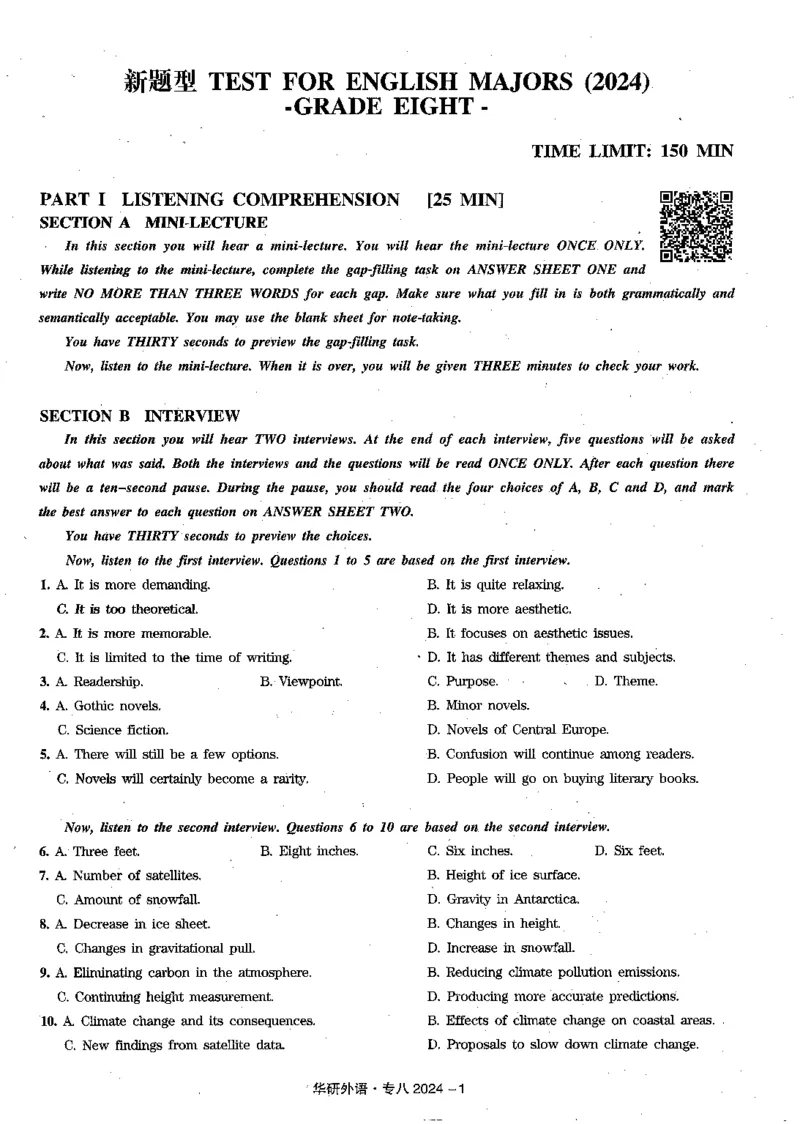
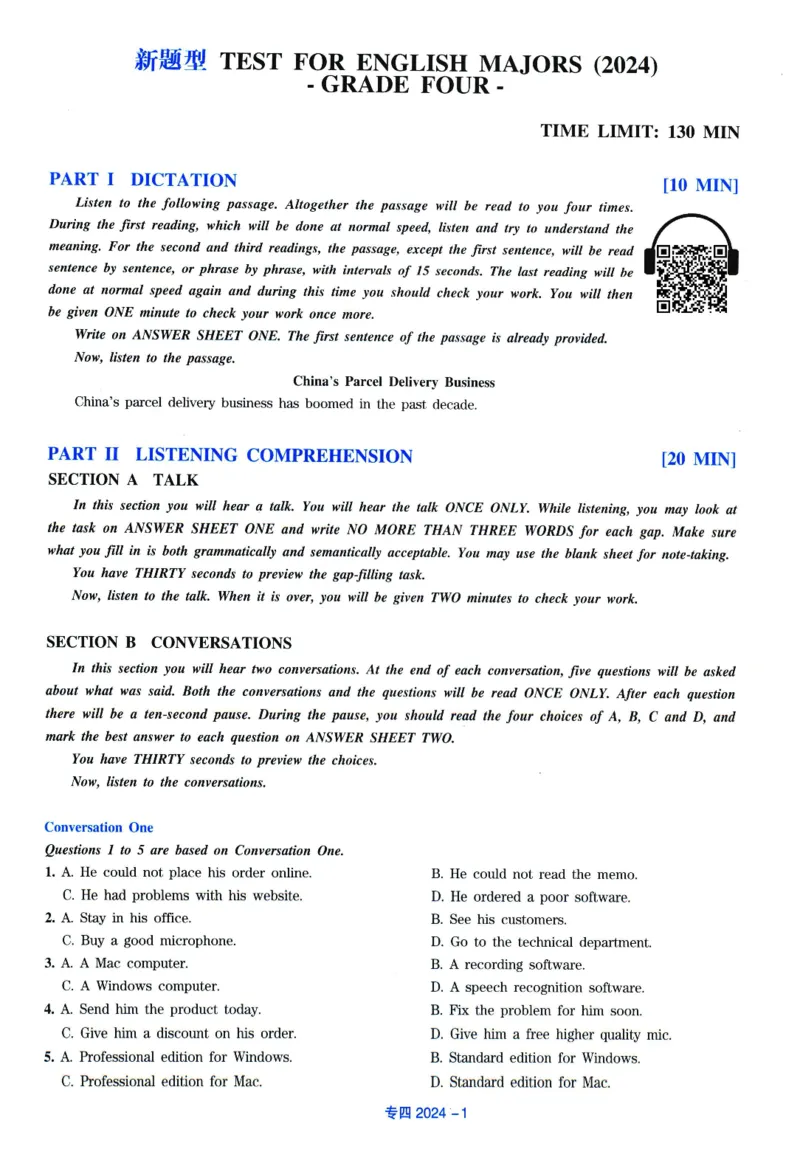
新题型 TEST FOR ENGLISH MAJORS (2015)
-GRADE EIGHT-
TIME LIMIT: 150 MIN
PART I LISTENING COMPREHENSION [25 MIN]
SECTION A MINI-LECTURE
In this section you will hear a mini-lecture. You will hear the mini-lecture ONCE ONLY. While listening to
the mini-lecture, please complete the gap-filling task on ANSWER SHEET ONE and write NO MORE THAN
THREE WORDS for each gap. Make sure the word(s) you fill in is (are) both grammatically and semantically
acceptable. You may use the blank sheet for note-taking.
You have THIRTY seconds to preview the gap-filling task.
Now, listen to the mini-lecture. When it is over, you will be given THREE minutes to check your work.
SECTION B INTERVIEW
In this section you will hear ONE interview. The interview will be divided into TWO parts. At the end of
each part, five questions will be asked about what was said. Both the interview and the questions will be spoken
ONCE ONLY. After each question there will be a ten-second pause. During the pause, you should read the four
choices of A, B, C and D, and mark the best answer to each question on ANSWER SHEET TWO.
You have THIRTY seconds to preview the questions.
Now listen to Part One of the interview. Questions 1 to 5 are based on Part One of the interview.
1. A. . Doing what they have promised to schools.
B. Creating opportunities for leading universities.
C. Considering removing barriers for state school pupils.
D. Reducing opportunities for state school pupils.
2. A. Universities are not working hard to accept state school pupils.
B. The number of state pupils applying to Oxford fails to increase.
C. The government has lowered state pupils' expectations.
D. Leading universities are rejecting state school pupils.
3. A. State schools discourage applying to Oxford. 、
B. State system in secondary education needs improvement.
C. Oxford has a preference for private school students.
D. Private school pupils work harder than state school pupils.
4. A. Encouraging state pupils to go to Oxbridge.
B. Encouraging Oxbridge to recruit more students.
C. Raising expectations in the state system.
D. Getting more young people into universities.
5. A. The number of state school pupils going to elite universities.
B. The government's deficient policy on college enrolment.
C. The numbers of state school children enrolled in Oxbridge.
D. State school pupils' expectations of going to leading universities.
Now, listen to Part Two of the interview. Questions 6 to 10 are based on Part Two of the interview.
6. A. It means more funding from education authorities.
B. It means getting all the money and deciding how to spend it.
C. It means greater power to run themselves.
D. It means more opportunities and choices.
7. A. Local education authorities and the central government.
B. Local education authorities and secondary schools together.
C. Local education authorities only.
D. The central government only.
专八2015 -18. A. To initiate new topics. B. To support the interviewee.
C. To introduce new policies. D. To explain some statistics.
9. A. Because there're difficulties in applying for admission.
B. Because they face financial barriers to higher education.
C. Because they are misled by the government.
D. Because they face opposition from the government.
10. A All of the money goes to schools.
B. All of the money goes·to local education authorities.
C. Some of the money goes to schools.
D. Some of the money goes to colleges and universities.
PART II READING COMPREHENSION [45 MIN]
SECTION A MULTIPLE-CHOICE QUESTIONS
In this section there are four passages followed by fourteen multiple·choice questions. For each multiple
choice question, there are four suggested answers marked A, B, C and D. Choose the one that you think is the
best answer and mark your answers on ANSWER SHEET TWO.
PASSAGE ONE
(l)In 2011, many shoppers opted to avoid the frenetic crowds and do their holiday shopping from the
comfort of their computer. Sales at online retailers gained by more·rth an 15%, making it the biggest season
ever. But people are also returning those purchases at record rates, ·up 8% from last ye釭
(2) What went wrong? Is the lingering shadow of the global financial crisis making it harder to accept
extravagant indulgences? Or do people shop more impulsively-and therefore make bad decisions—when
online? Both arguments are plausible. However, there is a third factor: a question of touch. We can love
the look but, in an online environment, we cannot feel the quality of a texture, the shape of the fit, the
fall of a fold or the weight of an earring. And physically interacting with an object makes you more
committed to your purchase.
(3) When my most recent book Brandwashed was released, I teamed up with a local bookstore to
conduct an experiment about the differences between the online and offline shopping. I carefully instructed
a group of volunteers to promote my book in two different ways. The first was a fairly hands-off approach.
Whenever a customer would inquire about my book, the volunteer would take them over to the shelf and
point to it. Out of 20 such requests, six customers proceeded with the purchase.
(4)The second option also involved going over to the shelf but, this time, removing the book and then
subtly holding onto it for just an extra moment before placing it in the customer's hands. Of the 20 people
who were handed the book, 13 ended up buying it. Just physically passing the book showed a big
difference in sales. Why? We feel something similar to a sense of ownership when we hold things in our
hand. That's why we establish or reestablish connection. by greeting strangers and friends with a handshake.
In this case, having to then let go of the book after holding it might generate a subtle sense of loss, and
motivate us to make the purchase even more.
(5)A recent study conducted by Bangor University together with the United Kingdom's Royal Mail
Senrice also revealed the power of touch, in this case when it came to snail mail. A deeper and longer
lasting impression of a message was formed when delivered in a letter, as opposed to receiving the same
message online. FMRis (功能性磁共振成像) showed that, on touching the paper, the emotional centre of
the brain was activated, thus forming a stronger bond. The study also indicated that once touch becomes
part of the process, it could translate into a sense of possession. In other words, we simply feel more
committed to possess and thus buy·an item when we've first touched it. This sense of ownership is s血ply
not part of the equation in the online shopping experience.
(6)As the rituals of purchase in the lead-up to Christmas change, not only do we give less thought to
the type of gifts we buy for our loved ones but, through our own digital wish lists, we increasingly control
what they buy for us. The reality, however, is that no matter how convinced we all are that digital is the
way to go, tiJlding real satisfaction will probably take more than a few simple clicks.
11. According to the author, shoppers are returning their purchases fo� all the following reasons EXCEPT
that
专八2015 -2A. they are unsatisfied with the quality of the purchase
B. they eventually fmd the purchase too expensive
C. they change their m血 out of uncertainty
D. they regret making the purchase without forethought
12. Why does the author cite the study by Bangor University and the Royal Mail Service?
A. To compare similar responses in different settings.
B. To provide further evidence for his own obseivation.
C. To offer a scientific account of the brain's functions.
D. To describe emotional responses in online shopping.
13. What can be inferred from the last paragraph?
A. Real satisfaction depends on factors other than the computer.
B. Despite online shopping we still attach importance to gift buying.
C. Some people are still uncertain about the digital age.
D. Online shopping offers real satisfaction to shoppers.
PASSAGE TWO
(l)My professor brother and I have an argument about head and heart, about whether he oveivalues IQ
—
while I lean more toward EQ. We typically have this debate about people can you be friends with a really
smartjerk (怪物)?—but there's corollary to animals as well I'd love it if our dog could fetch the morning paper
and then read it to me over coffee, but I actually care much more about her loyal and innocent heart.
There's already enough thinking going on in our house, and we probably spend too much time in our
heads. Where we need some role modeling is in instinct, and that's where a dog is a roving revelation.
(2)1 did not grow up with dogs, which meant that my older daughter's respectful but unyielding deter
mination to get one required some adjustment on my part. I often felt she was training me: from ages of 6
to 9, she gently schooled me in various breeds and their personalities, whispered to the dogs we encoun
tered so they would charm and persuade me, demonstrated by her self-discipline that she was ready for
the responsibility. And thus came our dog Twist, whom I sometimes mistake for a third daughter.
(3)At first I thought the challenge would be to train her to sit, to heel, to walk calmly beside us and
not go wildly chasing the neighborhood rabbits. But I soon discovered how much more we had to learn
from her than she from us.
(4)1f it is true, for example, that the secret to a child's success is less rare genius than raw
persistence, Twist's ability to stay on task is a model for us all, especially if the task is trying to capture
the sunbeam that flicks around the living room as the wind blows through the branches outside. She never
succeeds, and she never gives up. This includes when she runs square into walls.
(5)Then there is her unfailing patience, which breaks down only when she senses that dinnertime was
15 minutes ago and we have somehow failed to notice. Even then she is more eager than indignant, and
her refusal to whine shows a restraint of which I'm not always capable when hungry.
(6)But the lesson I value most is the one in forgiveness, and Twist first offered this when she was
(切除卵巢).
still very young. When she was about 7 m�nths old, we took her to the vet to be spayed We
turned her over to a stranger, who proceeded to pe汀orm a procedure that was probably not pleasant. But
when the vet returned her to us, 血p and tender, there was no rec讨mination (反责), no How could
you do that to me? It was as though she already knew that we would not intentionally cause her pain, and
while she did not understand, she forgave and curled up with her head on my daughter's lap.
(7)1 suppose we could have concluded that she was just blindly loyal and docile. But eventually we
knew better. She is entirely capable of disobedience, as she has proved many funes. She will ignore us
when there are more interesting things to look at, rebuke us when we are careless, bark into the twilight
when she has urgent messages to send. But her patience with our failings and fickleness and her willing
ness to give us a second chance are a daily lesson in gratitude.
(8)M y friends who grew up with dogs tell me how when they were teenagers and trusted no
one in the world, they could tell their dog all their secrets. It was the one friend who would not gossip
or betray, could provide in the middle of the night the soft, unbegrudging comfort and peace that adoles
cence conspires to disrupt. An age that is all about growth and risk needs some anchors and weights, a
model of steadfastness when all else is in flux. Somefunes I think Twist's devotion keeps my girls on a
专八
2015 -3benevolent leash, one that hangs quietly at their side as they trot along but occasionally yanks them back to
safety and solid ground.
(9)We've weighed so many decisions so carefully in raising our daughters—what school to send them
to and what church to attend, when to give them cell phones and with what precautions. But when it
comes to what really shapes their character and binds our family, I never would have thought we would
owe so much to its smallest member.
14. In the first paragraph, the author suggests that ' .
A. a person can either have a high IQ or a low EQ
B. her professor brother cares too much about IQ
C. we need examples of how to follow one's heart
D. she prefers dogs that are clever and loyal
15. According to the passage, all the following are Twist's characteristics EXCEPT .
A. resignation B. patience C. forgiveness D. tenacity
16. That Twist's devotion keeps my girls on a benevolent leash means that .
A. Twist is capable of looking after the girls B. Twist and the girls have become friends
C. Twist knows how to follow the girls D. Twist's loyalty helps the girls grow up
17. What does the author·try to express in the last paragraph?
A. Difficulties in raising her children. B. Worries about what to buy for kids.
C. Gratitude to Twist for her role. D. Concerns about schooling and religion.
PASSAGE THREE
(l)Most West African lorries are not in what one would call the first flush of youth, and I had learnt
by bitter experience not to expect anything very much of them. But the lorry that anived to take me up to
the mountains was worse than anything I had seen before: it tottered on the borders of senile decay. It stood
there on buckled wheels, wheezing and gasping with exhaustion from having to climb up the gentle slope
to the camp, and I consigned myself and my loads to it with some fear. The driver, who was a cheerful
fellow, pointed out that he would require my assistance in two very necessary operations: first, I had to
keep the hand brake pressed down when travelling downhill, for unless it was held thus almost level with
the floor it sullenly refused to function. Secondly, I had to keep a stem eye on the clutch, a willful piece
of mechanism that seized every chance to leap out of its socket with a noise like a strangling leopard. As
it was obvious that not even a West African lorry-driver could be successful in driving while crouched un
der the dashboard, I had to take over control of those instruments if I valued my life. So, while I ducked
at intervals to put on the brake, amid the rich smell of burning rubber, our noble lorry jerked its way to
wards the mountains at a steady twenty miles per hour; sometimes, when 'a downward slope favoured it, it
threw ca�tion to the winds and careered (猛冲) along in a reckless fashion at twenty-five.
(2)For the first thirty m且es the red earth road wound its way through the lowland forest, the giant
trees standing in solid ranks alongside and their branches entwined (盘绕) in an archway of leaves
above us. Slowly and almost imperceptibly the road s�ed to climb upwards, looping its way in languid
cUIVes round the forested hills. In the back of the lorry the boys lifted up their voices in song:
Home again, home again,
When shall I see ma home?
The driver hummed the refrain (副歌) softly to himself glancing at me to see if I would object. To his sur
prise I joined in and so while the lorry rolled onwards, the boys in the back maintained the chorus while
the driver and I harmonized and sang complicated bits.
(3)Breaks in the forest became more frequent the higher we climbed, and presently a new type of un
dergrowth began to appear: massive tree-fems standing at the roadside on their thick, squat, hairy trunks.
These fems were the guardians of a new world, for suddenly, as though the hills had shrugged themselves
free of a cloak, the forest disappeared. It lay behind us in the valley, while above us the hillside rose ma
jestically, covered in a coat of waist-high grass. The lorry crept higher and higher, the engine gasping and
shuddering with this unaccustomed activity. I began to think that we should have to push the wretched
thing up the last two or three hundred feet, but to everyone's surprise we made it, and the lorry crept on
to the brow of the hill, trembling with fatigue, spouting steam from its radiator like a dying whale. We
专八2015-4crawled to a standstill and the driver switched off the engine.
(4) "We must wait small-time, engine get hot," he explained, pointing to the forequarters of the lorry,
which were by now completely invisible under a cloud of steam. Thankfully I descended from the red-hot
inside of the cab and strolled down to where the road dipped into the next valley. From this vantage point
I could see the country we had travelled through and the country we were to enter.
18. W垃ch of the following words in the first paragraph is used literally?
A. Flush. B. Borders. C. Operations. D. Gasping.
19. We learn from the first paragraph that the author regards the inadequacies of the lorry as .
A. inevitable and amusing B. dangerous and frightening
C. novel and unexpected D . welcome and mterestmg
20. All the following words in the last but one paragraph describe the lorry as a human EXCEPT .
A. trembling B. spoutmg C. shuddering D. crept
21. A suitable title for the passage would be .
A. A journey that scared me B. A journey to remember
C. The wild West African lorry D. A comic journey in West 陆rica
PASSAGE FOUR
(l)Have you ever noticed a certain similarity in public parks and back gardens in the cities of the
West? A ubiquitous woodland mix of lawn grasses and trees has found its way throughout Europe and the
United States, and it's now spread to other cities around the world. As ecologist Peter Groffman has noted,
it's increasingly difficult to tell one suburb apart from another, even when they're located in vastly different
climates such as Phoenix, A血ona, or Boston in the much chillier north-east of the US. And why do parks
in New Zealand often feature the same species of trees that grow on the other side of the world in the UK?
(2)Inspired by the English and New England countrysides, early landscape architects of the 19th centu
ry created an aesthetic for urban public and private open space that persisU, to this day. But in the 21st
century, urban green space is tasked with doing far more than simply providing aesthetic appeal. From nat
ural systems to deal with surface water run-off and pollution to green corridors to increasing interest in ur
ban food production, the urban parks of the future w山 be designed and engineered for functionality as
well as for beauty.
(3)Imagine travelling among the cities of the mid-21st century and fmding a unique set of urban land
scapes that capture local beauty, natural and cultural history, and the envirorunental context. They are tuned
to their locality, and diverse within as well as across cities. There are patches that provide shade and cool
ing, places of local food production, and corridors that connect both residents and wildlife to the surrounding
native environment. Their functions are measured and monitored to meet the unique needs of each city for
food production, water use, nutrient recycling, and habitat. No two green spaces are quite the same.
(4)Planners are already starting to work towards this vision. And if this movement has a buzzword it is
"hyperfunctionality"—designs which provide multiple uses in a confined space. At the moment, urban land
scapes are highly managed and limited in their spatial extent. Even the "green" cities of the future will con
tain extensive areas of buildings, roads, railways, and other built structures. These future cities are likely to
contain a higher proportion of green cover than the cities of today, with an increasing focus on planting on
roofs, vertical walls, and surfaces like car parks. But built environments will still be ever-present in dense
megacities. We can greatly enhance the utility of green space through designs that provide a range of dif
ferent uses in a confmed space. A hyperfunctional planting, for example, might be designed to provide food,
shade, w且dlife habitat, and pollution removal all in the same garden with the right choice of plants and
management practices.
(5) What this means is that we have to maximize the benefits and uses of urban parks, while minimiz
ing the costs of building and maintaining them. Currently, green space and street plantings are relatively
similar throughout the Western world, regardless of differences in local climate, geography, and natural his
tory. Even dese兀 cities feature the same sizable street trees and well-watered and well-fertilized lawns that
you might see in more temperate climes. The movement to reduce the resources and water requirements of
such urban landscapes in these arid areas is called "xeriscaping"一a concept that has so-far received m议ed
responses in terms of public acceptance. Scott Yabiku and colleagues at the Central A血ona Phoenix pro-
专八2015 -5ject showed that newcomers to the desert embrace xeriscaping more than long-time residents, who are
more likely to prefer the well-watered aesthetic. In part, this may be because xeriscaping is justified more
by reducing landscaping costs-in this case water costs—than by providing desired benefits like recreation,
pollution mitigation, and cultural value. From this perspective, xeriscaping can seem more like a compro
血se than an asset.
(6)But there are other ways to make our parks and natural spaces do more. Nan Ellin, of the Ecologi
cal Planning ,center in the US, advocates an asset-based approa12h to urbanism. Instead of envisioning cities
in terms of what they can't have, ecological planners are beginning to frame the discussion of future cities
in tem1s of what they do have—their natural and cultural assets. In Utah's Salt Lake City, instead of
couching environmental planning as an issue of resource scarcity, the future park is described as "moun
tain urbanism" and the strong association of local residents with the natural environment of the mountain
ranges near their home. From this starting point, the local climate, vegetation, patterns of rain and snowfall,
and mountain topography are all deemed natural assets that create a new perspective when it comes to
creating urban green space. In Cairns, Australia, the local master plan embraces "tropical urbanism" that
conveys a sense of place through landscaping features, while also providing important functions such as
shading and cooling in this tropical climate.
·
(7)The globally homogenized landscape aesthetic—which sees parks from Boston to Brisbane looking
worryingly similar—will diminish in importance as future urban green space ·will be more receptive to local
values and cultural perceptions of beauty. This will lead to a far greater diversity of urban landscape de
signs than are apparent today. Already, we are seeing new purposes for urban landscaping that are trans
forming the 20th ·century woodland park into bioswales—plantings designed to f"tlter stormwater—green
roofs, wildlife corridors, and urban food gardens. However, until recently we have been lacking the
datasets and science-based specifications for designs that work to serve all of these purposes at once.
(8)In New York City, Thomas Whitlow of Cornell University sends his students through tree-lined streets
with portable, backpack-mounted air quality monitors. At home in his laboratory, he places tree branches in
wind· tunnels to measure pollution deposition onto leaves. It turns out that currently, many street tree
plantings are ineffective at removing air pollutants, and instead may trap pollutants near the ground. Rather
than relying on assumptions about the role of urban vegetation in improving the environment and health,
future landscaping designs w川 be engineered based on empirical data and state of the art of·simulations.
(9)New datasets on the performance of urban landscapes are changing our view of what future urban
parks w让1 look like and what it will do. With precise measurements of pollutant uptake, water use, plant
growth rates, and greenhouse gas emissions, we are better able to design landscapes that require less in
tensive management and are less costly, while providing more social and environmental uses.
22. The following are all features of future urban green space EXCEPT that
A. each city has its distinct style of urban green space
B. urban landscape w山 focus more on cultural history
C. urban green space w山 be designed to serve many uses
D. more green cover will be seen on city roofs and walls
23. According to the passage, if planners adopt an asset-based approach, they will probably .
A. incorporate the area's natural and cultural heritage into their design
B. ·make careful estimation of t);le area's natural resources before designing
C. combine natural resources and practical·functions in their design
D. envision more purposes for urban landscaping in their .design
24. According to the passage, future landscaping designs w诅rely more on .
A. human assumptions B. field work C. scientific estimation D. laboratory work
SECTION B SHORT ANSWER QUESTIONS
In this section there are eight short answer questions based on the passages in SECTION A. Answer each
question in NO more than 10 words in the space provided on ANSWER SHEET TWO.
PASSAGE ONE
25. What is the purpose of the experiment·in the bookstore?
专八2015 -6PASSAGE TWO
26. According to the context, what does the word "square" mean?
PASSAGE THREE
27. What can we learn from the condition of the lony from "it tottered on the borders of senile decay"?
28. How did the author help the lony driver on the, way?
29. How did the author feel when helping the lony driver?
PASSAGE FOUR
30. According to the passage, what makes urban green space look similar throughout the West?
31. Why are some local residents opposed to "xeriscaping"?
32. What did Thomas W垃tlow of Cornell University fmd out about tree branches?
PART III LANGUAGE USAGE [15 MIN]
The passage contains TEN e"ors. Each indicated line contains a maximum of ONE e"or. In each case,
only ONE word is involved. You should proof-read the passage and co汀ect it in the following way:
For a �啊 word, underline the wrong word and write the correct one in the blank provided at
the end of the line.
For a missing word, mark the position of the missing word with a "八" sign and write the word you
believe to be missing in the blank provided at the end of the line.
For an unnecessary word, cross the unnecessary word with a slash "/" and put the word in the blank
provided at the end of the line.
Example
When /\ art museum wants a new exhibit, (1) an
it 胆面 buys things in finished form and hangs (2) never
them on the wall. When a natural history museum
wants an exhibition, it must often build it. (3) exhibit
Proofread the given passage on ANSWER SHEET THREE as instructed.
PART IV TRANSLATION [20 MIN]
Translate the following text from Chinese into English. Write your translation on ANSWER SHEET THREE.
茶花(camellia)的自然花期在 12月至翌年4月 ,以红色系为主,另有黄色系和白色系等,花色艳丽。 本届花展充分
展示了茶花的品种资源和科研水平,是近三年来本市规模最大的一届茶花展。 为了使广大植物爱好者有更多与茶花亲
密接触的机会,本届茶花展的布展范围延伸至整个园区,为赏花游客带来便利。
此次茶花展历时2个月 ,展期内200多个茶花品种将陆续亮相。
PART V WRITING [45 MIN]
With the continued growth of online teaching systems and integration of massive open online courses
(MOOCS) into higher education, college study will never be the same for both professors and students. The
following are opinions from both sides. Read the excerpts carefully and write an article of NO LESS THAN 300
words, in which you should:
1. smnmarize briefly the opinions from both sides;
2. give your comment.
Marks will be awarded for content relevance, content sufficiency, organization and language quality. Failure
to follow the above instructions may result in a loss of marks.
Write your article on ANSWER SHEET FOUR.
University
The University of Washington (UW) in the US isn't shy about the benefits and drawbacks of o咄ne
education. UW concedes online courses may be more effective for self-directed learners, and studen岱 who
专八 2015 -7are not organized and in possession of good time-management sldlls may struggle. Thus, students should
ask themselves whether they are capable of learning independently before signing up for online coursework.
UW also mentions online courses may not be able to· accurately replicate the vibrant sense of
intellectual ·community that has been at the heart of higher education for ages. This might lead some to
,
miss out on learning and networking opportunities.
Students
Jasmine Barta of Arizona State University: I take about half my classes online each semester, and I'll
tell you why: Online classes are the secret to·a happier, fuller and less stressful college experience. Some
students complain about the lack of social interaction and the ease with which they can forget to meet a
u
deadline. But for me these concerns fall flat f the face of the convenience, flexibility . and independence
online learning offers.
Chang Hanyi of Boston University: In order to squeeze in some extra learning without taking the f9cus
away from my major, I enrolled in a pass/fail online reading and . writing workshop. The coursework . is
actually as demanding as my other regular language classes. But what I have learned so far is beyond my
expectations. My professor assigns weekly assignments each Monday, and I am . required to do readings,
write study blogs and take quizzes regularly. I am also required to respond to comments from my professor
and classmates. So, taking online courses doesn't mean zero physical interaction with your instructors. My
professor even invited me to face-to-face meetings four times to address article structure in my writing
assignments. My professor also uploads video clips to review class content and audio ftles to clarify some
thorny points. Despite the hard . work, I still enjoy cyber interaction with my professor and classmates.
Yang Yang of Peking University: With MOOCS, we are no longer confined to a classroom at a certain
time slot. Whenever I feel in the mood to study, I take out my laptop or iPad to watch course videos. I
am now taking Legal Writing and Research on Coursera, a popular MOOCS platform. Each week, four or
six courses videos are released for us students to learn. Apart from the teaching sessions,· there are also
quizzes to assess whether I have grasped the knowledge well. Quiz scores make up 32 percent of my final
score. The great thing about the quizzes is we even have . them before each course. This encourages me to
finish all the reading and preview the clas� early. Although MOOCS are improving my learning experiences,
this new form of teaching cannot compete with traditional ways of learning in terms of teacher-student
interaction. I used to ask questions immediately after class. But with MOOCS, we only have office hours
for question and answer sessions. Most of the time, I won't bother to go.
-THE END-
专八 2015 -8.
1
- - - - - - - - - 圈A一N一S一W一E一R一 一S一HE一E匾T一 一 (一T一E一M一8)一 一 一 一 一 一 一 一 一[1]一
一
注意事项
准 考 证 号
1答题前, 考生务必用黑色字迹签字笔填
学 校: 写自己的准考证号、 姓名和学校; 再用
2B铅笔把对应准考证号码的标号涂黑,
使用其它笔填涂无效。 ,,L
2考生不得填涂缺考、 违纪项, 违者责任 101 IOI COi COi 101 (Ol 「OJ IOI IOI [01 COi [QI (OJ ro
姓 名: 自负。 111 l1l 11 I C"ll 111 (jJ 111 111 111 [11 111 (11 111 (1
3选择题必须用28铅笔填涂, 使用其它笔 ... "' .,. ,,, ,,. ,,, ,,. ,,, ,,, ,,, ,,, ,,,
1
填涂无效, 修改时要用橡皮擦干净; 每 131 (3) 131 131 131 (31 131 [31 131 [31 131 (31 131
此处由监考老师填涂 题只能填涂一个答案, 多填不得分。 r 41 r4】141 141 141 141 141 14J 141 C41 141 !41 141
4.主 观题必须用黑色字迹签字笔 r5 J 1.51 I 5 I l.5 l 「5l I 6 l I 5 I [ 5 1 I 5 l I 5 l I 5 I l51 I 5 l (5)
违纪 lWl (0.5mm) 在答题区域内作答, 超出红 16] [61 161 161 16] !61 16] 顷l 161 161 161 161 161 16
C 错 v/.l 误 � 填 l 涂 lC 方 l c 式 中 缺考 (QJ 5 I 保 色矩 A 持 N 形 S 答 WE 框 题 R 限 卡 SH 定 的 EE 区 清 T 1 域 洁 的 和 I 答 平 - 案 整 无 , 效 不 。 得折叠。 I ! 1 l B 7 9 l ] I l 1 I 7 B 9 1 l I ! 1 I 7 B 9 l 1 I 1 1 I 7 8 9 1 1 l I 1 1 8 9 7 J 1 1 ! £ t 8 7 O J 1 I l ! I 7 B 9 l 1 l 1 ( I 8 7 9 J 1 l f 1 I 7 8 9 ] 1 l 1 1 C 8 9 7 1 1 l 1 1 I 7 8 9 ] 1 I ( [ 1. 7 8 9 1 J 】 1 [ [ 7 8 9 1 J 1 71
LISTENING COMPREHENSION
SECTION A MINI-LECTURE —
下列各题必须使用黑色字迹签字笔在答题区域内作答, 超出红色矩形边框限定区域的答案无效
l
Understanding Academic Lectures
Listening to academic lectures is an important 啦k for university students.
Then, how can we comprehend a lecture efficiently?
I. Understanding all (1) (1)
A. words
B. (2) (2)
-(3) (3)
-(4) (4)
-(5) (5)
II. Adding information
A. lecturers: sharing information with audience
B. listeners: (6) (6)
C. sources of information
-knowledge of (7) (7)
-(8) of the world (8)
D. listening involving three steps:
-hearing
-(9) (9)
-(10) (10)
III. (11) (11)
A. reasons:
-(12) (12)
-save time
B. (13) (13)
-content
-(14) (14)
IV. Evaluating while listening
A. helps to decide the (15) of notes (15)
.,
B. helps to remember information —|
高校外语专业教学测试办公室 监制 FS-TEMB-1601千Beta
专八 2015 -9-
团
ANSWER SHEET3 (TEM8)
匾 圈 - - - - - - - - - - 圈 - - - - - - - - - - - - - - - - - - - 圈 一 一 圈 一
注意事项
1答题前, 考生务必用黑色字迹签字笔填 准 考 证 号
学 校: 写自己的准考证号、 姓名和学校; 再用
2B铅笔把对应准考证号码的标号涂黑,
使用其它笔填涂无效。
2考生不得填涂缺考、 违纪项, 违者责任 I 01 [Q] [01 [01 (OJ tOl [01 tOl 101 [QJ ro1 I OJ £OJ !OJ
姓 名: 自负。 [ 1 J [ 1 J [1] t 1 l [1 J l 1 l [1 J r 1 i [1 l [ 11 l 1 l [1 l £1 l l 1 l
3选择题必须用2B铅笔填涂, 使用其它笔 [21 [2) £21 [2) [21 [2) [2! [21 12] [21 [2] [21 [21 !2J
填涂无效, 修改时要用橡皮擦干净; 每 13l [ 3) (31 t3l (31 [3J [31 [31 13] l3l [31 (3] [31 [3)
填 正确填涂方式 此处由监考老师填涂 题只能填涂一个答案, 多填不得分。 {41 [4) [4] 141 [41 [4] [41 [41 14] [41 [41 C4l [41 (41
4. 主观题必须用黑色字迹签字笔 !51 C 5 l { 5] 15J C 51 15) [51 [5 J [5) lSJ [51 (SJ [51 [51
涂 围蘑' 违纪 CWJ (0.5mm)在答题区域内作答, 超出红 (6_] (6) [6] (61 161 [6J [61 [61 16] [61 [6] [61 [61 [61
要 求 错误填 c 涂 ei 方 c 式 cl1 缺考 [QJ I 5 保 色矩 持 形 答 框 题 限 卡 定 的 区 清 域 洁 I 的 和 答 平 案 整 无 , 效 不 。 得 一 折叠。 I 1 [ 7 8 J l ( [8 71 1 [ r 7 Bl ] [ (8 7 1 1 [ [ 7 8 ) 1 l [ 7 8 1 ) t [ 7 81 1 ( [8 7) ] ( 1 7 81 1 [ ( 7 81 ] [ l7 8 l 1 [ [ 7 8 l 1 £ [ 7 8 1 1 [ ( 7 B 1 l
CM tffJ ANSWER SHEET 3 [9] C 91 [91 {9] [91 (9] [91 f9) [9l r91 [91 [9] [91 (9)
PAR:T Ill 更 LANGUAGE USAGE
下列各题必须使用黑色字迹签字笔在答题区域内作答, 超出红色矩形边框限定区域的答案无效。
When I was in my early teens, I was taken to a spectacular show
on ice by the mother of a friend. Looked around at the luxwy of the (1)
血k, my friend's mother remarked on the "plush" seats we had been
given. I did not 血ow what she meant, and being proud of my (2)
vocabulary, I tried to infer its meaning from the context. "Plush"
was clearly intended as a complimentary, a positive evaluation; that (3)
much I could tell it from the tone of voice and the context. So I (4)
staited to use the word. Yes, I replied, they certainly are plush, and
so e the ice rink and the costumes of the skaters, aren't they? My
扛
friend's mother was very polite to correct me, but I could tell from her (5)
expression that I had not got the word quite right.
Often we can indeed infer from the context what a word roughly
means, and that is in fact the way which we usually acquire both (6)
new words and new meanin耍 for familiar words, specially in our (7)
own 缸st language. But sometimes we need to ask, as I should have
邸ked for plush, and this is particularly true in the (8)
aspect of a foreign language. If you are continually surrounded by (9)
speakers of the language you are learning, you can ask them directly,
.
but often this· opportunity does not exist for the learner of English.
So dictionaries have been develope� to mend the gap. (10)
圈
高校外语专业教学测试办公室 监制 FS-TEMS-1601一企Beta
专八 2015 -10