2024-2025 学年九年级上学期期中模拟卷(贵州专用)
英语
(考试时间:120分钟 试卷满分:150分)
注意事项:
1.答卷前,考生务必将自己的姓名、准考证号填写在答题卡上。
2.回答选择题时,选出每小题答案后,用2B铅笔把答题卡上对应题目的答案标号涂黑。如需改动,用橡
皮擦干净后,再选涂其他答案标号。写在本试卷上无效。
3.回答主观题时,将答案写在答题卡上。写在本试卷上无效。
4. 难度系数:0.65。
5.考生务必保持答题卡的整洁,考试结束时,将答题卡交回。
第一大题 听力 (共五节,30小题;每小题1分,满分30分)
第一节 听对话,选择相应的图片。读一遍。
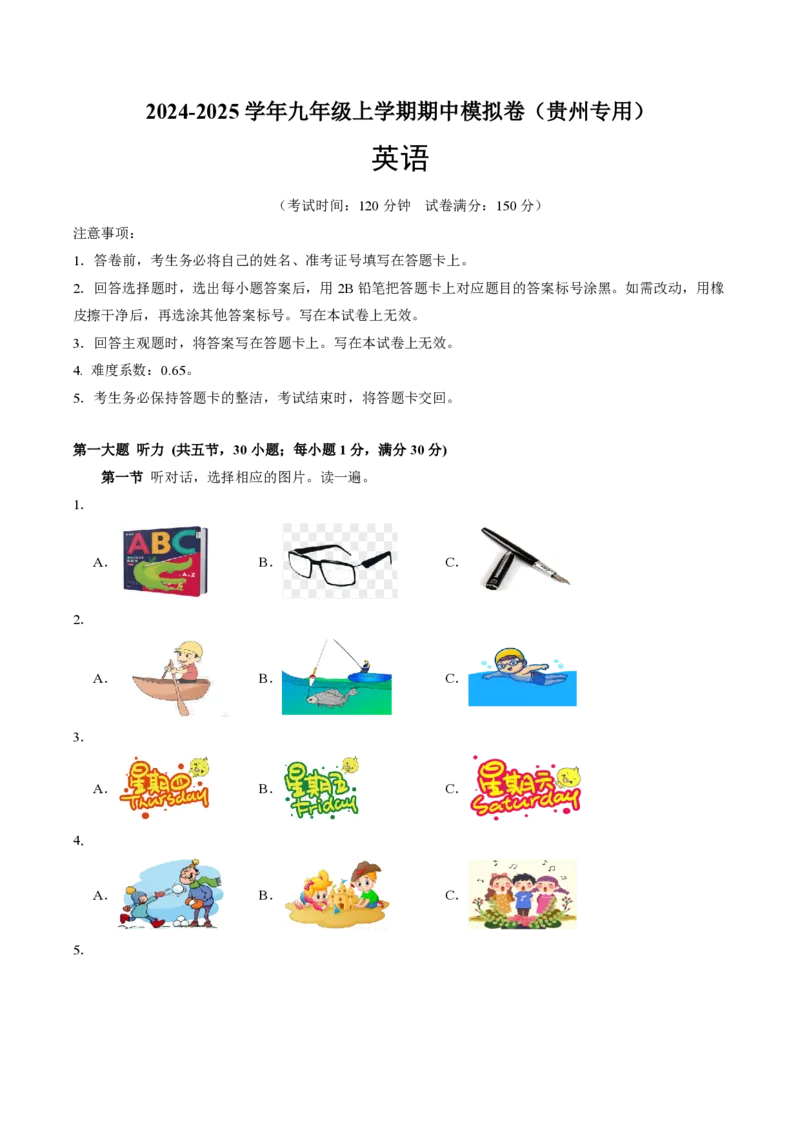
1.
A. B. C.
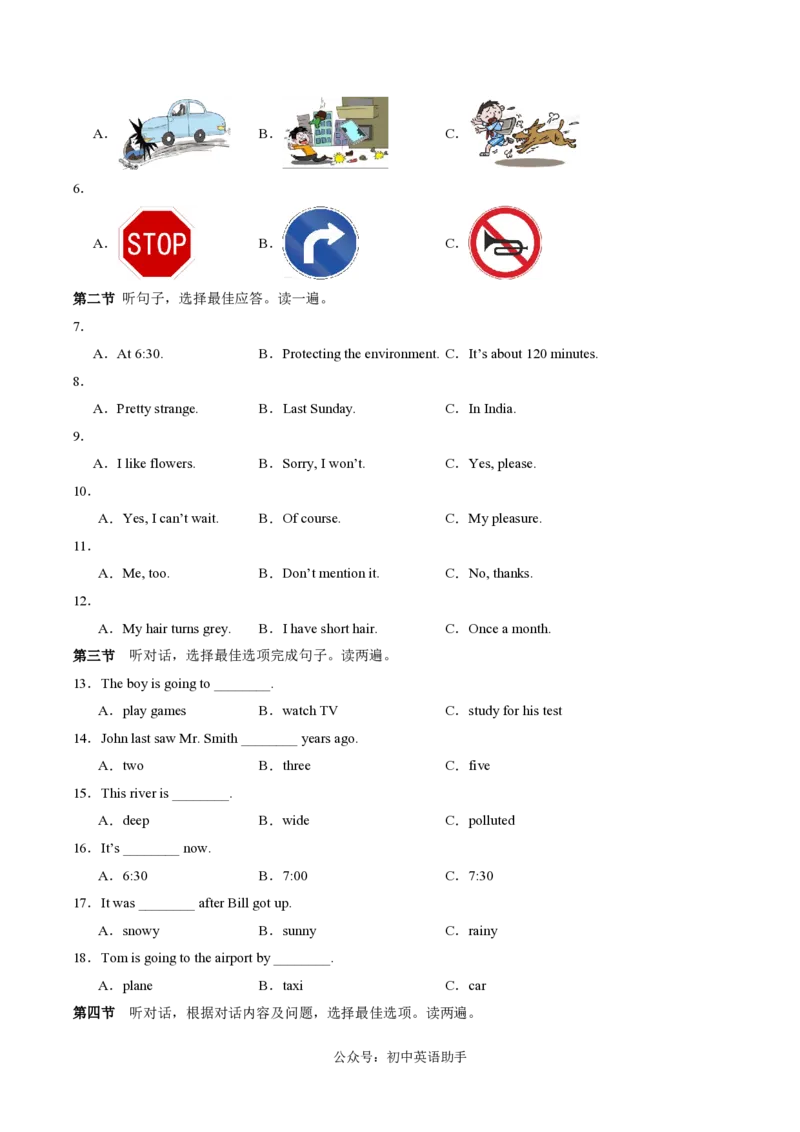
2.
A. B. C.
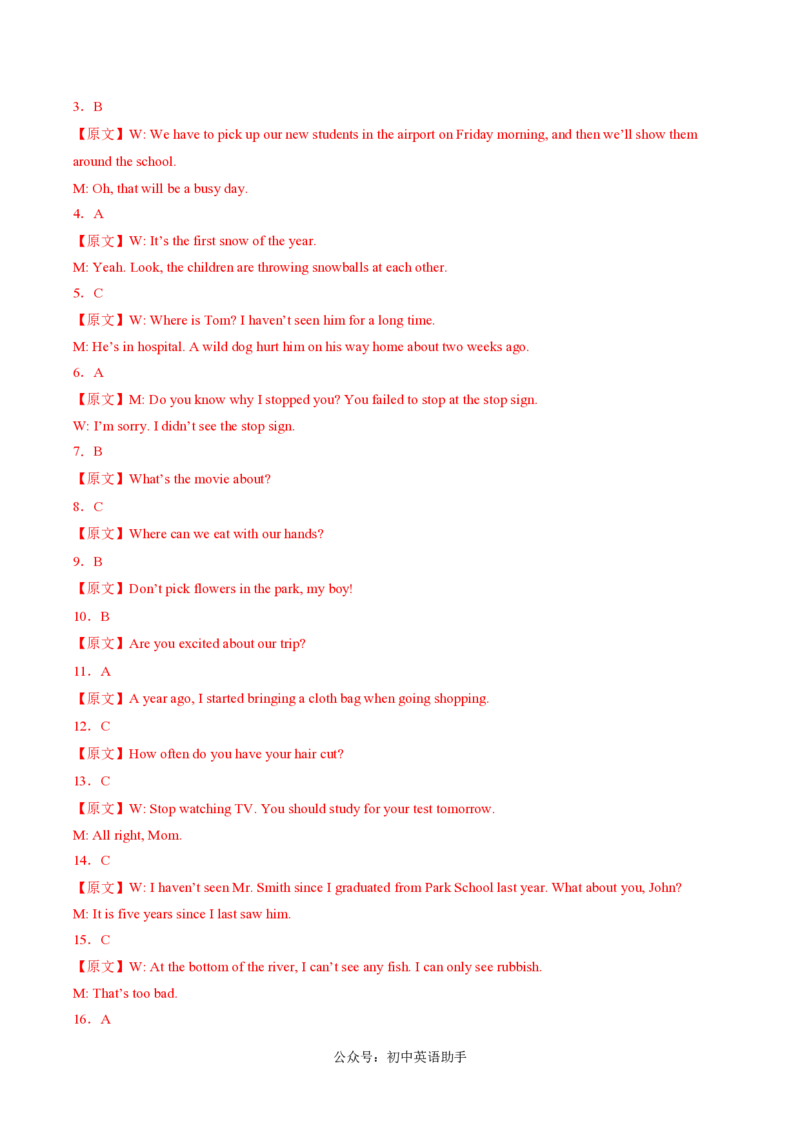
3.
A. B. C.
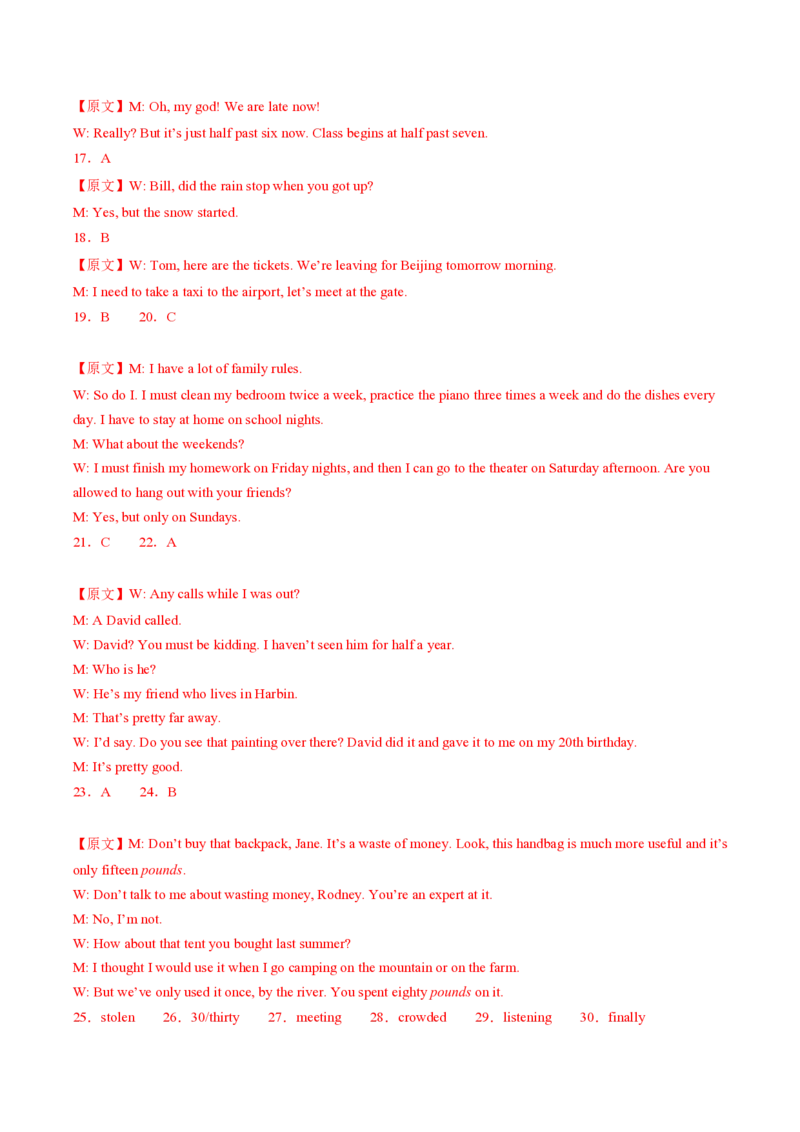
4.
A. B. C.
5.A. B. C.
6.
A. B. C.
第二节 听句子,选择最佳应答。读一遍。
7.
A.At 6:30. B.Protecting the environment. C.It’s about 120 minutes.
8.
A.Pretty strange. B.Last Sunday. C.In India.
9.
A.I like flowers. B.Sorry, I won’t. C.Yes, please.
10.
A.Yes, I can’t wait. B.Of course. C.My pleasure.
11.
A.Me, too. B.Don’t mention it. C.No, thanks.
12.
A.My hair turns grey. B.I have short hair. C.Once a month.
第三节 听对话,选择最佳选项完成句子。读两遍。
13.The boy is going to ________.
A.play games B.watch TV C.study for his test
14.John last saw Mr. Smith ________ years ago.
A.two B.three C.five
15.This river is ________.
A.deep B.wide C.polluted
16.It’s ________ now.
A.6:30 B.7:00 C.7:30
17.It was ________ after Bill got up.
A.snowy B.sunny C.rainy
18.Tom is going to the airport by ________.
A.plane B.taxi C.car
第四节 听对话,根据对话内容及问题,选择最佳选项。读两遍。
公众号:初中英语助手听下面一段对话,回答小题。
19.What does the girl have to do three times a week?
A.Do the dishes. B.Practice the piano. C.Clean the bedroom.
20.When is the boy allowed to hang out with his friends?
A.On Fridays. B.On Saturdays. C.On Sundays.
听下面一段对话,回答小题。
21.When did the woman last see David?
A.One months ago. B.Three months ago. C.Six months ago.
22.What did David give the woman on her 20th birthday?
A.A painting. B.A book. C.A coat.
听下面一段对话,回答小题。
23.What does Rodney think of the backpack?
A.Unnecessary. B.Cheap. C.Useful.
24.Where did Rodney and Jane use the tent?
A.On the farm. B.By the river. C.On the mountain.
第五节 听短文或独白,完成图表中所缺信息,每空仅填一词。(读三遍)
A Bad Experience
Before the ✤ I decided to go to work by bus because my bike was 25 .
journey ✤ I left home 26 minute(s) earlier than usual.
✤ I felt nervous as I was afraid that I would be late for an important 27 .
During the
✤ It was so 28 on the bus that I couldn’t breath. The music the teenager was 29
journey
to was so noisy.
After the
When I 30 got off the bus, I felt much better.
journey
1.B
【原文】M: Have you got everything for your English test?
W: No, I can’t find my glasses.
2.C
【原文】W: What did you do on your vacation?
M: I went to Sanya and I swam every day. I love swimming in the sea.3.B
【原文】W: We have to pick up our new students in the airport on Friday morning, and then we’ll show them
around the school.
M: Oh, that will be a busy day.
4.A
【原文】W: It’s the first snow of the year.
M: Yeah. Look, the children are throwing snowballs at each other.
5.C
【原文】W: Where is Tom? I haven’t seen him for a long time.
M: He’s in hospital. A wild dog hurt him on his way home about two weeks ago.
6.A
【原文】M: Do you know why I stopped you? You failed to stop at the stop sign.
W: I’m sorry. I didn’t see the stop sign.
7.B
【原文】What’s the movie about?
8.C
【原文】Where can we eat with our hands?
9.B
【原文】Don’t pick flowers in the park, my boy!
10.B
【原文】Are you excited about our trip?
11.A
【原文】A year ago, I started bringing a cloth bag when going shopping.
12.C
【原文】How often do you have your hair cut?
13.C
【原文】W: Stop watching TV. You should study for your test tomorrow.
M: All right, Mom.
14.C
【原文】W: I haven’t seen Mr. Smith since I graduated from Park School last year. What about you, John?
M: It is five years since I last saw him.
15.C
【原文】W: At the bottom of the river, I can’t see any fish. I can only see rubbish.
M: That’s too bad.
16.A
公众号:初中英语助手【原文】M: Oh, my god! We are late now!
W: Really? But it’s just half past six now. Class begins at half past seven.
17.A
【原文】W: Bill, did the rain stop when you got up?
M: Yes, but the snow started.
18.B
【原文】W: Tom, here are the tickets. We’re leaving for Beijing tomorrow morning.
M: I need to take a taxi to the airport, let’s meet at the gate.
19.B 20.C
【原文】M: I have a lot of family rules.
W: So do I. I must clean my bedroom twice a week, practice the piano three times a week and do the dishes every
day. I have to stay at home on school nights.
M: What about the weekends?
W: I must finish my homework on Friday nights, and then I can go to the theater on Saturday afternoon. Are you
allowed to hang out with your friends?
M: Yes, but only on Sundays.
21.C 22.A
【原文】W: Any calls while I was out?
M: A David called.
W: David? You must be kidding. I haven’t seen him for half a year.
M: Who is he?
W: He’s my friend who lives in Harbin.
M: That’s pretty far away.
W: I’d say. Do you see that painting over there? David did it and gave it to me on my 20th birthday.
M: It’s pretty good.
23.A 24.B
【原文】M: Don’t buy that backpack, Jane. It’s a waste of money. Look, this handbag is much more useful and it’s
only fifteen pounds.
W: Don’t talk to me about wasting money, Rodney. You’re an expert at it.
M: No, I’m not.
W: How about that tent you bought last summer?
M: I thought I would use it when I go camping on the mountain or on the farm.
W: But we’ve only used it once, by the river. You spent eighty pounds on it.
25.stolen 26.30/thirty 27.meeting 28.crowded 29.listening 30.finally【原文】
Every day I go to work by bike, but yesterday I discovered my bike was stolen. So I decided to take the bus to
work today. I left home 30 minutes earlier than usual but I still hit the morning rush hour.
Sitting in traffic made me really nervous, as I was afraid that I would be late for an important meeting. But this
wasn’t the worst thing. When I got on the bus, it was crowded, so I had to stand up all the way to work. Also, it was
so crowded that I couldn’t breathe. The bus had to stop at every stop, and more and more passengers got on. There
was a teenager standing beside me. The music he was listening to was so loud that I could hear it through his
earphones. When I finally got off the bus, I felt much better. But I started missing my bike.
第二大题 完形填空 (共两节,满分20分)
第一节 阅读下面短文,从短文前的选项中选出能填入空白处的最佳选项。选项中有一个为多余选项。
(共5小题;每小题1分,满分5分)。
A.into B.when C. away D.without E. of F. from
Scientists have always wanted to know more about the other worlds in space. Years ago they knew a lot about
the moon. They knew how big it was and how far it was 31 the earth. But they wanted to know more
about it. They thought and thought. At last they found the only way to know more was to send men to the moon.
The moon is about 384,000 kilometers 32 from the earth. A plane can not fly to the moon because the
air reaches only 240 kilometers high above the earth. Then there is no air. But there’s something that can fly even
33 there is no air. That is a rocket. Rockets can fly out 34 space. Rockets with men in them have
already reached the moon. Some rockets 35 men in them have flown to other parts much farther than the
moon in the universe. One day rockets may be able to go to any place.
31.F 32.C 33.B 34.A 35.D
【导语】本文主要讲述了科学家一直以来对太空的探索进程。
31.句意:他们知道它有多大,它离地球有多远。此处表示从地球到月球的距离有多远,
from“从……(到)”,介词。故选F。
32.句意:月球距离地球约38.4万公里。本句讲述两者之间的距离,away from“远离;相距”。故选C。
33.句意:但有些东西即使在没有空气的情况下也能飞。根据“...there is no air”可知,设空处引导时间状语
从句,when“当……时候”。故选B。
34.句意:火箭可以飞到太空。本句指火箭可以进入太空里面,into“到……里面;进入”,介词。故选A。
35.句意:一些没有载人的火箭已经飞到了宇宙中比月球更远的其他地方。根据“Rockets with men in them
have already reached the moon. Some rockets...men”可知,前文介绍了载人火箭,接下来应介绍不载人火箭的
情况。without“没有;不带”符合。故选D。
第二节 阅读下面短文,从短文后各题所给的A、B、C三个选项中,选出可以填入空白处的最佳选项。
公众号:初中英语助手(共10小题;每小题1.5分,满分15分)
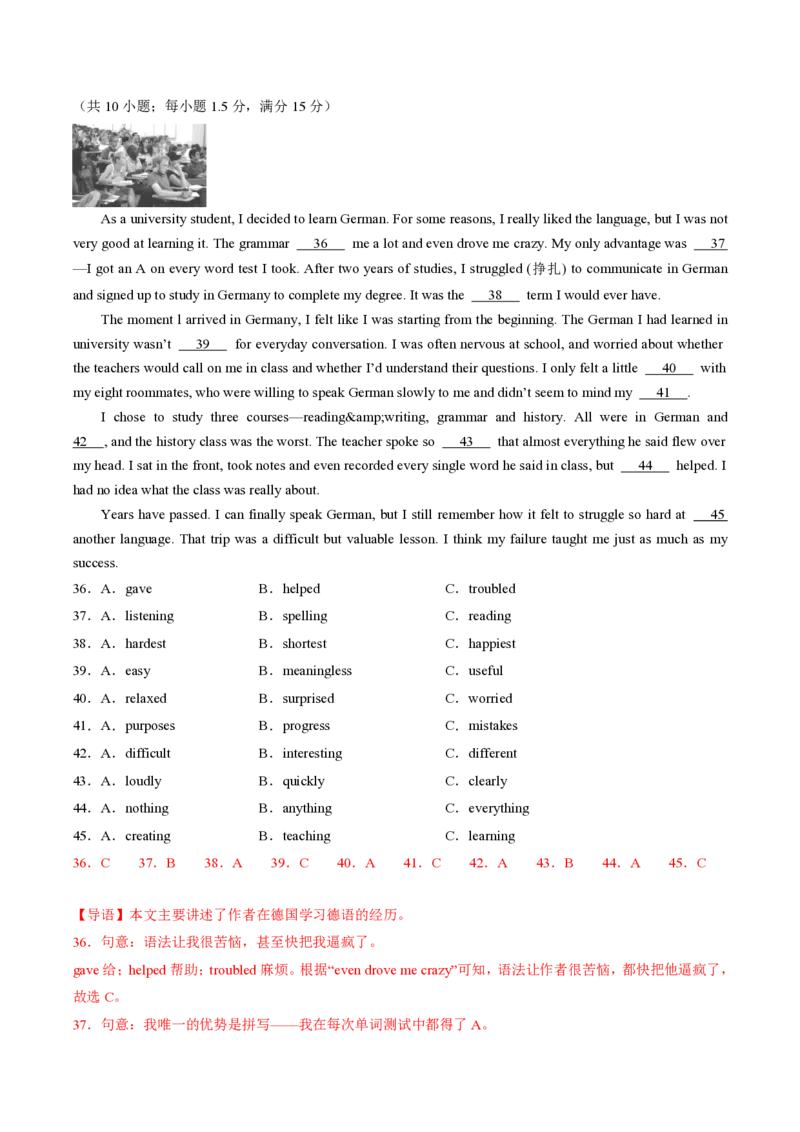
As a university student, I decided to learn German. For some reasons, I really liked the language, but I was not
very good at learning it. The grammar 36 me a lot and even drove me crazy. My only advantage was 37
—I got an A on every word test I took. After two years of studies, I struggled (挣扎) to communicate in German
and signed up to study in Germany to complete my degree. It was the 38 term I would ever have.
The moment l arrived in Germany, I felt like I was starting from the beginning. The German I had learned in
university wasn’t 39 for everyday conversation. I was often nervous at school, and worried about whether
the teachers would call on me in class and whether I’d understand their questions. I only felt a little 40 with
my eight roommates, who were willing to speak German slowly to me and didn’t seem to mind my 41 .
I chose to study three courses—reading&writing, grammar and history. All were in German and
42 , and the history class was the worst. The teacher spoke so 43 that almost everything he said flew over
my head. I sat in the front, took notes and even recorded every single word he said in class, but 44 helped. I
had no idea what the class was really about.
Years have passed. I can finally speak German, but I still remember how it felt to struggle so hard at 45
another language. That trip was a difficult but valuable lesson. I think my failure taught me just as much as my
success.
36.A.gave B.helped C.troubled
37.A.listening B.spelling C.reading
38.A.hardest B.shortest C.happiest
39.A.easy B.meaningless C.useful
40.A.relaxed B.surprised C.worried
41.A.purposes B.progress C.mistakes
42.A.difficult B.interesting C.different
43.A.loudly B.quickly C.clearly
44.A.nothing B.anything C.everything
45.A.creating B.teaching C.learning
36.C 37.B 38.A 39.C 40.A 41.C 42.A 43.B 44.A 45.C
【导语】本文主要讲述了作者在德国学习德语的经历。
36.句意:语法让我很苦恼,甚至快把我逼疯了。
gave给;helped帮助;troubled麻烦。根据“even drove me crazy”可知,语法让作者很苦恼,都快把他逼疯了,
故选C。
37.句意:我唯一的优势是拼写——我在每次单词测试中都得了A。listening听力;spelling拼写;reading阅读。根据“I got an A on every word test I took.”可知,作者在每次单词
测试中都能得到A,可见单词拼写是他的优势,故选B。
38.句意:这是我经历过的最艰难的一个学期。
hardest最困难的;shortest最短的;happiest最快乐的。根据下文“I was often nervous at school, and worried about
whether the teachers would call on me in class and whether I’d understand their questions.”可知,作者在学校很紧
张,担心老师是否会在课堂上提问他,他是否明白他们的问题,由此可见,作者在德国学习的那段时期过
的很艰难,故选A。
39.句意:我在大学里学的德语在日常会话中并不实用。
easy容易的;meaningless无意义的;useful有用的。根据“The moment l arrived in Germany, I felt like I was
starting from the beginning.”可知,作者认为自己到德国后是从头开始,说明他之前在大学里学的东西没有用。
故选C。
40.句意:只有和我的八个室友在一起,我才感到有点放松,他们愿意慢慢地和我说德语,似乎并不介意
我的错误。
relaxed放松的;surprised惊讶的;worried担心的。根据“who were willing to speak German slowly to me”可知,
室友愿意慢慢地跟作者说德语,这让作者感到放松一些,没有在课堂上那么紧张,故选A。
41.句意:只有和我的八个室友在一起,我才感到有点放松,他们愿意慢慢地和我说德语,似乎并不介意
我的错误。
purposes目的;progress进步;mistakes错误。根据“who were willing to speak German slowly to me”可知,作
者室友愿意慢慢地跟作者说德语,并且不介意作者说德语时的错误,故选C。
42.句意:所有科目都是德语,难度很大,历史课是最差的。
difficult困难的;interesting有趣的;different不同的。根据“The teacher spoke so ... that almost everything he said
flew over my head.”可知,老师说的内容都像是从作者头上飞过,说明老师说得太快而作者听不懂,所以三
门课程对于作者而言都很困难。故选A。
43.句意:老师讲得太快了,以至于他说的每句话几乎都像是从我头上飞过。
loudly大声地;quickly快速地;clearly清晰地。根据“almost everything he said flew over my head”可知,老师
说的话像是从作者头上飞过,说明老师讲的语速很快。故选B。
44.句意:我坐在前排,记笔记,甚至录下他在课堂上说的每一个字,但无济于事。
nothing没有什么;anything任何事物;everything一切。根据“I had no idea what the class was really about.”可
知,作者所做的一切努力都没什么用,他不知道这门课到底在讲什么。故选A。
45.句意:多年过去了,我终于会说德语了,但我仍然记得努力学习另一门语言的感觉。
creating创造;teaching教;learning学习。根据“As a university student, I decided to learn German.”及“After two
years of studies, I struggled (挣扎) to communicate in German and signed up to study in Germany to complete my
degree.”可知,此处指学习另一门语言的感觉。故选C。
第三大题 阅读理解 (共三节,满分50分)
公众号:初中英语助手第一节 阅读下面三个语篇,从每题所给的A、B、C、D三个选项中选出最佳选项。 (共12小题;每
小题2.5分,满分30分)
A
Saturday, March 24th We have arrived in the hot, wet city of Bangkok. This is our first trip to Thailand. All
the different smells make us want to try the food. We are going to eat something special for dinner tonight (今晚).
The hotel we are staying in is cheap and very clean. We plan to stay here for a few days, visit some places in the
city, and then travel to Chiang Mai in the North.
Tuesday, March 27th Bangkok is wonderful and surprising! The places are interesting. We visited the
famous market which was on water, and saw a lot of fruits and vegetables. Everything is so colorful, and we have
taken hundreds of photos already! Later today we will leave for Chiang Mai. We will take the train north, stay in
Chiang Mai for two days, and then catch a bus to Chiang Rai.
Friday, March 30th Our trip to Chiang Rai was long and boring. We visited a small village in the mountains.
The village people here love the quiet life, no computers or phones. They are the kindest people I have ever met.
They always smile and say “hello”. Kathy and I can only speak a few words of Thailand, so smiling is the best way
to show our kindness. I feel good here and hope to be able to come back next year.
46.The diaries above show the writer’s ________ days in Thailand.
A.3 B.7 C.15
47.It seems that visitors ________ in Bangkok.
A.often feel hungry B.can always find cheap things C.can enjoy themselves
48.Which of the following is TRUE?
A.Chiang Mai is a beautiful city in the south of Thailand.
B.The writer left Chiang Mai for Chiang Rai by bus.
C.Chiang Rai is a boring city in the mountains.
49.The people in the village ________.
A.are friendly to others B.like to speak English C.are very weak
46.B 47.C 48.B 49.A
【导语】本文是一篇应用文。文章包含三则旅游日记,记录了作者在泰国的旅游经历,包括时间、地点以
及当地的人文风情。
46.推理判断题。根据第一则日记的日期“March 24 th三月二十四日”和第三则日记的日期“March 30 th三月
三十日”可推断出作者在泰国待了7天。故选B。
47.细节理解题。根据“Bangkok is wonderful and surprising! The places are interesting. We visited the famous
market which was on water, and saw a lot of fruits and vegetables. Everything is so colorful, and we have taken
hundreds of photos already!”可知,作者认为曼谷是美妙和令人惊讶的!这些地方很有趣。作者已经拍了数百张照片了!说明作者在曼谷玩的很开心。故选C。
48.细节理解题。根据“We will take the train north, stay in Chiang Mai for two days, and then catch a bus to
Chiang Rai.”可知,作者将乘火车北上,在清迈待两天,然后乘公共汽车去清莱。B选项“作者乘公共汽车离
开清迈去清莱”符合语境。故选B。
49.细节理解题。根据“They are the kindest people I have ever met.”可知,作者认为村子里人是作者所见过的
最善良的人,由此可见那个村子的人对别人很友好。故选A。
B
Wang Fengqin, a 61-year-old woman in Beijing, volunteers to sort (分类) rubbish in her living area in
Beijing’s Chaoyang District.
At 6:30 every morning, while half of Beijing is still in sleeping dreams in bed or enjoying a delicious
breakfast, Wang rushes through her busiest hours in the day. She gets up, gives her face a quick wash, takes a
simple breakfast and rushes to the four rubbish dustbins beside the gate of her living area. There she checks the
waste left by her neighbors to make sure it is sorted correctly.
“Sorting rubbish will improve the environment for all of us and it only takes a minute,” Wang said. “I want to
help my neighbors develop good habits.”
As Wang spoke, an old man came by and threw a plastic bag full of rubbish into the dustbin marked
“recyclable”
“Hey, please, there are some orange peels (皮) and fish bones in your bag, so they are supposed to be put into
the dustbin marked ‘kitchen waste’,” Wang told him.
Learning the old man was in a hurry, Wang let him go, opened the bag herself, picked out the kitchen waste
and threw it in the right dustbin.
Wang has been doing this every day from 7:30 a. m. to 9 a. m. and from 6 p. m. to 8 p. m. since March 10. She
says people usually go downstairs and throw out rubbish at this time.
Most people had no idea about sorting rubbish at first, but now 90 percent can put rubbish in the correct
dustbin, Wang says. However, she plans to keep doing this job until all her neighbors sort correctly.
50.When does Wang Fengqin usually get up in the morning?
A.At 7:30. B.At 6:30. C.At 9.
51.How many rubbish dustbins are there beside the gate of Wang Fengqin’s living area?
A.Four. B.Five. C.Six.
52.The old man didn’t sort his rubbish probably because ________.
A.he was afraid of Wang B.he didn’t know where the dustbin was C.he was in a hurry
53.One shouldn’t put ________ in the dustbin marked “kitchen waste”.
A.orange peels B.broken toys C.fish bones
50.B 51.A 52.C 53.B
【导语】本文是一篇记叙文,主要讲述了北京61岁的志愿者王凤琴在她生活的区域进行垃圾分类,并教她
公众号:初中英语助手的邻居进行垃圾分类。
50.细节理解题。根据第二段中的“At 6:30 every morning, while half of Beijing is still in sleeping dreams in bed
or enjoying a delicious breakfast, Wang rushes through her busiest hours in the day.”可知,每天早上6:30,当大
半个北京还在睡梦中或享用着美味的早餐时,王凤琴就开始了她一天中最忙碌的时刻,由此可知,她6:30
起床,故选B。
51.细节理解题。根据第二段中的“She gets up, gives her face a quick wash, takes a simple breakfast and rushes to
the four rubbish dustbins beside the gate of her living area.”可知,王凤琴生活区的大门边有四个垃圾箱,故选
A。
52.细节理解题。根据倒数第三段“Learning the old man was in a hurry, Wang let him go, opened the bag herself,
picked out the kitchen waste and threw it in the right dustbin.”可知,得知老人着急,所以王凤琴帮他把垃圾扔
到了垃圾箱里,故选C。
53.细节理解题。根据第五段的“Hey, please, there are some orange peels (皮) and fish bones in your bag, so they
are supposed to be put into the dustbin marked ‘kitchen waste’”可知,橘子皮和鱼刺,可放在标有“厨余垃圾”的
垃圾箱里,B项“破损的玩具”不应该放进厨余垃圾箱,故选B。
C
In England, traffic keeps on the left. Cars, buses and bikes all move on the left side of the road. But the traffic
keeps on the right in China. So when you are in England, you must be very careful in the street. Before you cross a
street you must stop and look both ways. Look right and look left and look right again. If the traffic lights are red,
the traffic must stop. Then the people on foot can cross the road. If the traffic lights are green, the traffic can go.
People on foot mustn’t cross.
In the morning and in the evening, when people go to or come back from work, the streets are very busy.
Traffic is very dangerous.
When you go by bus in England, you have to be careful, too. Always remember the traffic moves on the left. If
you don’t have a look first, you will go the wrong way.
In many English cities, there are big buses with two floors. You can sit on the second floor. From there you
can see the city very well. It’s very interesting.
54.When you are in England you must remember that ________.
A.you’d better go by bus
B.the traffic goes on the left
C.the streets are very busy
55.When the traffic lights are ________, the traffic must stop.
A.red B.yellow C.green
56.When you go by bus in England, you must be careful because ________.
A.you may go the wrong way
B.there are too many busesC.there are big buses with two floors
57.Some people like sitting on the second floor of a big bus because ________.
A.it is not dangerous
B.it can make roads safe
C.they can have a good look at the city
54.B 55.A 56.A 57.C
【导语】本文主要介绍了英国的一些交通规则。
54.细节理解题。根据“In England, traffic keeps on the left. Cars, buses and bikes all move on the left side of the
road.”可知在英国,一定要记住交通在左侧, 汽车、公共汽车和自行车都在道路左侧行驶。故选B。
55.细节理解题。根据“If the traffic lights are red, the traffic must stop.”可知如果交通灯是红色的,交通必须
停止。故选A。
56.细节理解题。根据“If you don’t have a look first, you will go the wrong way.”可知如果坐公交车时不小心,
可能会走错方向。故选A。
57.细节理解题。根据“You can sit on the second floor. From there you can see the city very well.”可知你可以坐
在公交车的第二层, 从那里你可以很好地看到这座城市。故选C。
第二节 根据短文内容,从短文后的选项中选出能填入空白处的最佳选项。选项中有一项为多余选项。 (共
5小题;每小题2分,满分10分)
Every year April 22nd is Earth Day. 58 One of the key points of Earth Day is climate change. How
can climate change be bad for us?
The increase in disease
Climate change makes the world get hotter and brings more rain. It means more mosquitoes(蚊子). 59
Wild animals losing their homes
60 That is not only a cause of climate change, but also a cause of epidemics(流行病). In Africa, for
example, people cut down many trees. 61 So they have to live in places that are closer to humans. But
bats carry many viruses(病毒), like Ebola.
Other problems
62 People may have no food to eat because of the dry weather.
A.Lots of bats are losing their homes.
B.This will increase(增加)the spread of diseases(疾病的传播).
C.We need to do something for it.
D.Climate(气候)change also means more bad weather.
E.People are cutting down many trees around the world.
F.It’s a day that makes people think of protecting our Earth.
58.F 59.B 60.E 61.A 62.D
公众号:初中英语助手【导语】本文介绍了地球日其中一个关键点就是气候变化,并介绍了气候变化会如何对我们不利。
58.根据上一句“Every year April 22nd is Earth Day.”可知,每年的4月22日是地球日。此处应是介绍这是一
个关于什么的日子。选项F“这是让人们想到要保护我们的地球的一个日子。”符合语境。故选F。
59.根据“The increase in disease”和“It means more mosquitoes(蚊子).”可知,蚊子的增多会导致疾病的增
加。选项B“这将增加疾病的传播。”符合语境。故选B。
60.根据“Wild animals losing their homes”和“ In Africa, for example, people cut down many trees..”可知,这一
段谈到了野生动物失去家园的话题,选项E“世界各地的人们正在砍伐许多树木。”符合语境。故选E。
61.根据下文“But bats carry many viruses(病毒), like Ebola.”可知,蝙蝠携带像埃博拉这样的病毒,由此可
知,此处应是谈到了蝙蝠的问题。选项A“许多蝙蝠正在失去它们的家园。”符合语境。故选A。
62.根据下一句“People may have no food to eat because of the dry weather.”可知,人们因为干燥的天气可能会
没有食物可吃。由此可知,此处应是谈到不好的天气。选项D“气候变化也意味着更多的恶劣天气。”符合语
境。故选D。
第三节 阅读下面短文,根据其内容填空或回答问题。 (第63-66题每空不超过3个词,第67题回答问
题。) (共5小题;每小题2分,满分10分)
Red, yellow, orange ... in autumn, green leaves turn into many different colors. How does it happen?
Inside a leaf, there are little colored “bags”. The green bags are chlorophyll (叶绿素). The yellow ones are
xanthophyll (叶黄素). The orange ones are carotene (胡萝卜素). In summer, chlorophyll is busy. It makes food for
the trees. It gets sunshine to turn water and carbon dioxide into sugar. There is more chlorophyll than other things
in the leaves. So the leaves are green. In autumn, days are shorter and leaves get less sunshine. So leaves need less
chlorophyll. The other colors, such as yellow and orange, come out. In all, the leaves don’t really “turn” yellow or
red. They just lose their green.
How do we see colors?
We see colors because of light. Sunlight has seven colors inside. For example, you are wearing a red T-shirt.
The light hits your T-shirt. Then the T-shirt sends back the red light and takes in the other colors of light. The red
light then goes into your eyes. A black shirt is black because it takes in all the light. And a white shirt is white
because it sends back all the light.
How do plants and animals use colors?
Call for friends: Bees visit flowers and take away pollen to make honey. And in this way, there will be more
new flowers. They use their colors to call bees for help.
Talk to each other: Some animals have strong colors. They look dangerous to others. Chameleons (变色龙)can change colors to show how they feel.
Hide away: Some animals may look like things around them. Then they can go near their “food” and other
animals can’t see them.
63.After reading Paragraph 2, we know there are little colored “bags” inside a leaf.
64.In autumn, leaves are yellow or orange because they .
65.It mainly talks about that we can see colors because of in Paragraph 4.
66.Many plants and animals use colors in different ways, such as calling for friends, talking to each other
and .
67.Do you think colors are useful for animals and plants? Give an example.
63.3/three 64.lose their green 65.light 66.hiding away 67.Yes. The lizard can take on the colors
of its background to protect itself.
【导语】本文主要介绍了叶子颜色变化背后的奥秘、我们如何看到颜色及动植物如何使用颜色。
63.根据“Inside a leaf, there are little colored ‘bags’. The green bags are chlorophyll (叶绿素). The yellow ones are
xanthophyll (叶黄素). The orange ones are carotene (胡萝卜素).”可知有三种颜色的小袋子。故填3/three。
64.根据“In autumn, days are shorter and leaves get less sunshine. So leaves need less chlorophyll. The other colors,
such as yellow and orange, come out. In all, the leaves don’t really ‘turn’ yellow or red. They just lose their green.”
可知秋天叶子是黄色或橙色是因为它们失去了绿色。故填lose their green。
65.根据“We see colors because of light.”可知我们能看到颜色是因为光。故填light。
66.根据“How do plants and animals use colors? Call for friends ... Talk to each other ... Hide away”可知许多植物
和动物以不同的方式使用颜色,例如呼叫朋友,彼此交谈和躲藏。故填hiding away。
67.主观发挥题,答案合理即可。故填Yes. The lizard can take on the colors of its background to protect itself.
第四大题 语言运用 (共两节,满分25分)
第一节 根据中文意思,补全英语译文。(每空限填一词,缩写算一词) (共5小题;每小题2分,满
分10分)
68.自从2010年以来,我们的家乡发生了很多变化。
Many changes have in our hometown since 2010.
69.这首歌听起来很甜美,使我想起了美好的童年。
This song sounds sweet that it me my wonderful childhood.
70.他没有生气,反而看起来挺高兴。
being annoyed, he seemed quite pleased.
71.我们永远不要拿不属于我们的东西。
We should never take anything that doesn’t us.
公众号:初中英语助手72.学好英语,以便我们能够与世界分享中国故事。
Learn English well we can share Chinese stories with the world.
68. taken place
【详解】“发生”为take place,该句为现在完成时,助动词have后跟动词过去分词,故填taken;place。
69. reminds of
【详解】remind sb of sth表示“使某人想起某事”;由“This song sounds…”可知,本句为一般现在时,主语it
是第三人称单数形式,谓语用第三人称单数形式,故填reminds;of。
70. Instead of
【详解】根据句子结构可知,逗号后是完整的句子,这里应该是一个短语;结合句意和空后的being annoyed
是动名词形式,这里考查短语instead of,意为“代替……,而不是”,后跟名词或动名词形式。故答案为Instead
of。
71. belong to
【详解】根据中英文对比,空格处应填入意为“属于……”的短语。为固定搭配,意为“属于……”,符合句意,
且位于助动词doesn’t后,故动词belong应用原形,故答案为(1). belong (2). to。
72. so that
【详解】根据“以便”可知此处是目的状语,用so that 引导目的状语从句。故答案为so that。
第二节 阅读下面短文,在空白处填入一个适当的词或括号内单词的正确形式。(共10小题;每小题1.5分,
满分15分)
“Dong” is one of China’s 55 ethnic minorities (少数民族), with a population of less than three million,
mainly living in South China. The ethnic group is well known for its 73 (tradition)embroidery (刺
绣), which has long been passed down from generation to generation.
Qin Naishiqing is 74 Dong embroidery master(大师). At the age of 91, she is still good at 75
(cut) paper patterns, which she says is the spirit of the handmade art. “You should be very skillful in embroidery
76 (become) good at paper cutting. When you get a piece of paper, you should form a picture of the patterns in
your mind without 77 (actual) drawing them,” Qin said.
Teaching embroidery is a family tradition, and Qin’s two daughters-in-law usually join 78 (she) in
teaching youngsters. Dong people usually embroider animals and plants on clothes. Phoenixes (凤凰), dragons
and flowers are common patterns featured in folk art. Spider flowers are very important 79 meaningful in
Dong people’s embroidery patterns and they are seen as a symbol of good wishes.Every Dong girl is 80 (encourage) to learn the skill at an early age, around ten years old. When she
gets married, she will traditionally receive a whole set of clothes made 81 her mother. There are now
thousands of 82 (woman) in the country taking up embroidery — an art form that has remained
unchanged over the years. Qin hopes she can help make sure the tradition continues.
73.traditional 74.a 75.cutting 76.to become 77.actually 78.her 79.and
80.encouraged 81.by 82.women
【导语】本文主要介绍了少数民族侗族的传统技艺刺绣的起源和发展。
73.句意:这个少数民族以传统刺绣闻名。traditional“传统的”,形容词修饰名词embroidery。故填
traditional。
74.句意:秦乃诗清是一位侗族刺绣大师。泛指一位大师需用不定冠词。Dong是以辅音音素开头的单词,
应用不定冠词a。故填a。
75.句意:91岁的她依然擅长剪纸图案,她认为这是手工艺术的精神所在。be good at doing“擅长做”,固定
短语。故填cutting。
76.句意:要想精通剪纸,你必须精通刺绣。空处表示目的,应用不定式表示目的,故填to become。
77.句意:当你拿到一张纸时,你应该先在脑海中形成这个图案的画面,而不是真正地画出来。空处修饰
句中的动词,应用副词,actual“真正的”,是形容词,其副词是actually,故填actually。
78.句意:教刺绣是家族传统,她的两个儿媳妇加入她教年轻人刺绣的行列。join是动词,后接宾语,应用
宾格形式,故填her。
79.句意:侗族的刺绣图案中,蜘蛛花非常重要且富有意义,被视为美好祝愿的象征。此处是“ important ”
与“ meaningful”的并列,应用and连接两个并列的词,故填and。
80.句意:侗族鼓励每个女孩在十岁左右学习这项技艺。encourage sb. to do“鼓励某人去做”,此空前有“is”
可知,此处需用过去分词, ,构成被动语态。故填encouraged。
81.句意:当她结婚时,按照传统她会收到母亲亲手制作的一整套衣物。根据“she will traditionally receive a
whole set of clothes made...her mother”可知,此处表示“由某人制作”,应用介词by,故填by。
82.句意:现在全国有成千上万的女性从事刺绣,这一艺术形式多年来一直保持不变。thousands of后面需
用名词复数。故填women。
第五大题 写作 (满分25分)
83.请结合表格内容及提示,以“My changes”为题,根据写作要求,写一篇不少于80词的短文。
My changes
My appearance My study My school life
写作要求:
(1)短文须包含图中所有信息,并适当拓展。
公众号:初中英语助手(2)文中不得出现真实的人名和校名。
____________________________________________________________________________________________
____________________________________________________________________________________________
____________________________________________________________________________________________
___________________________________________________
83.例文
My changes
I have changed a lot. I used to be short when I was young, but now I am tall. I used to have short hair, but now I
have long hair. I used to spend a lot of time playing games with my friends, but now I have to study all the time.
I’m good at all subjects. I used to be so shy that I didn’t dare answer questions in class. But now for me like
answering questions. I used to hate English, but now I like English very much. Now I often take part in different
kinds of after-school activities.
I really have changed a lot, what about you?
【详解】[总体分析]
①题材:本文是一篇记叙文,为材料作文;
②时态:时态为“一般现在时和一般过去时”;
③提示:写作要点已给出,考生应注意不要遗漏,适当增加细节完整表述内容。
[写作步骤]
第一步,以“我改变了许多”为开头;
第二步,从自己的外貌,学习,学校生活等方面介绍自己的变化;
第三步,询问对方的情况。
[亮点词汇]
①used to do sth过去常常做某事
②spend time doing sth花费时间做某事
③take part in参加
[高分句型]
①I used to be so shy that I didn’t dare answer questions in class.(so…that引导结果状语从句)