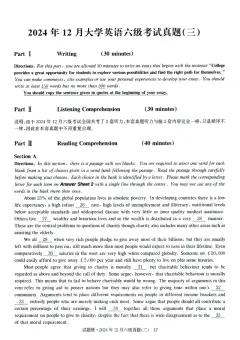
大学英语六级考试 2024 年 6 月真题(第三套)
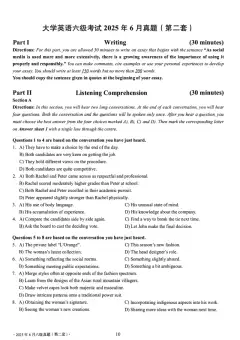
Part I Writing (30 minutes)
Directions:For this part,you are allowed 30 minutes to write an essay that begins with the sentence“Nowadays
cultivating independent learning ability is becoming increasingly crucial for personal development.”You
can make comments,cite examples or use your personal experiences to develop your essay.You should write at
least 150 words but no more than 200 words.
You should copy the sentence given in quotes at thebeginning of your essay .
Part II Listening Comprehension (30
minutes)
特别说明:由于多题多卷,官方第三套真题的听力试题与第一套真题的一致,只是选项顺序不同,因此,
本套试卷不再提供听力部分。
Part III Reading Comprehension (40
minutes)
Section A
Directions: In this section,there is a passage with ten blanks.You are required to select one word for each blank
from a list of choices given in a word bank following the passage.Read the passage through carefully before
making your choices.Each choice in the bank is identified by a letter.Please mark the corresponding letter for
each item on Answer Sheet 2 with a single line through the centre.You may not use anyof the words in the bank
more than once
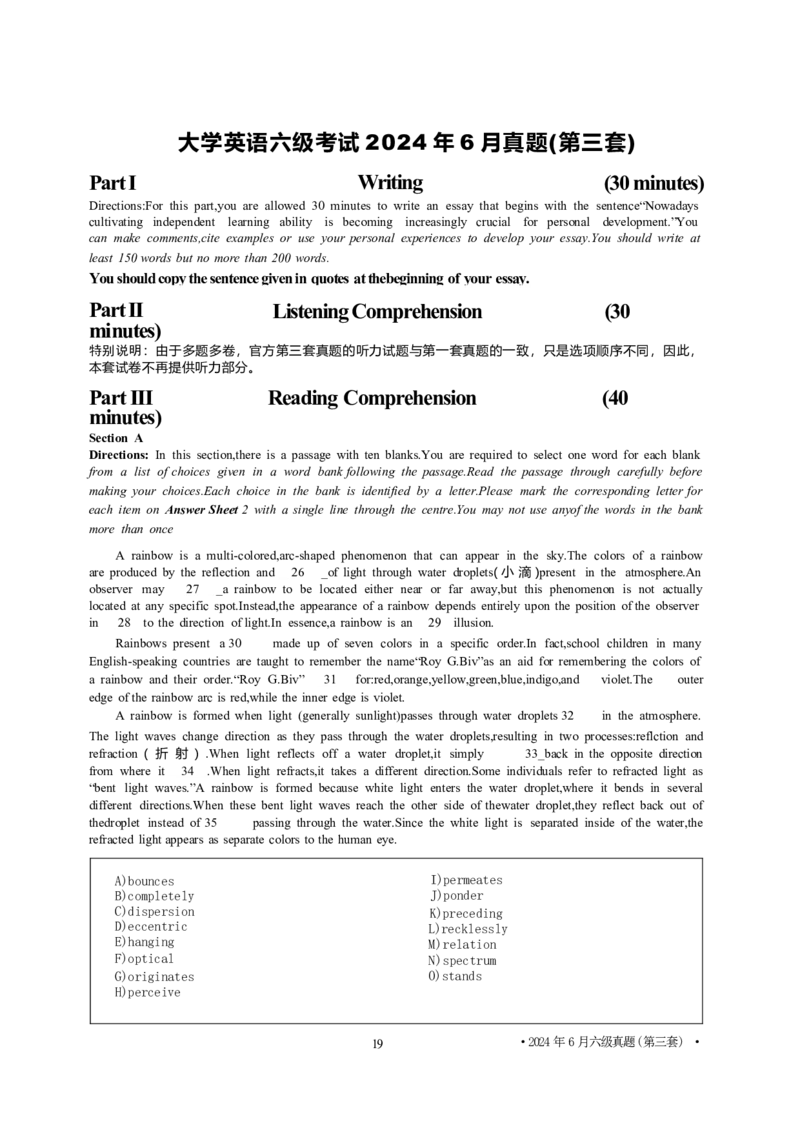
A rainbow is a multi-colored,arc-shaped phenomenon that can appear in the sky.The colors of a rainbow
are produced by the reflection and 26 _of light through water droplets( 小 滴 )present in the atmosphere.An
observer may 27 _a rainbow to be located either near or far away,but this phenomenon is not actually
located at any specific spot.Instead,the appearance of a rainbow depends entirely upon the position of the observer
in 28 to the direction of light.In essence,a rainbow is an 29 illusion.
Rainbows present a 30 made up of seven colors in a specific order.In fact,school children in many
English-speaking countries are taught to remember the name“Roy G.Biv”as an aid for remembering the colors of
a rainbow and their order.“Roy G.Biv” 31 for:red,orange,yellow,green,blue,indigo,and violet.The outer
edge of the rainbow arc is red,while the inner edge is violet.
A rainbow is formed when light (generally sunlight)passes through water droplets 32 in the atmosphere.
The light waves change direction as they pass through the water droplets,resulting in two processes:reflction and
refraction ( 折 射 ) .When light reflects off a water droplet,it simply 33_back in the opposite direction
from where it 34 .When light refracts,it takes a different direction.Some individuals refer to refracted light as
“bent light waves.”A rainbow is formed because white light enters the water droplet,where it bends in several
different directions.When these bent light waves reach the other side of thewater droplet,they reflect back out of
thedroplet instead of 35 passing through the water.Since the white light is separated inside of the water,the
refracted light appears as separate colors to the human eye.
A)bounces I)permeates
B)completely J)ponder
C)dispersion K)preceding
D)eccentric L)recklessly
E)hanging M)relation
F)optical N)spectrum
G)originates O)stands
H)perceive
19 ·2024年6月六级真题(第三套) ·淘宝:谈辰图书企业店Section B
Directions: In this section,you are going to read a passage with ten statements attached to it.Each statement
contains information given in one of theparagraphs.Identify the paragraphfrom which the information is
derived.You may choose a paragraph more than once.Each paragraph is marked with a letter.Answer the
questions by marking the corresponding letteronAnswer Sheet 2.
Blame your worthless workdays on meeting recovery syndrome
A)Phyllis Hartman knows what it's like to make one's way through the depths of office meeting hell.Managers
at one of her former human resources jobs arranged so many meetings that attendees would fall asleep at the
table or intentionally arrive late.With hours of her day blocked up with unnecessary meetings,she was often
forced to make up herwork during overtime.“I was actually working more hoursthan I probably would have
needed to get the work done,”says Hartman,who is founder and president of PGHR Consulting in Pittsburgh,
Pennsylvania
B)She isn't alone in her frustration.Between 11 million and 55 million meetings are held each day in the United
States,costing most organisations between 7%and 15%of their personnel budgets.Every week,employees
spend about six hours in meetings,while the average manager meets for a staggering 23 hours.
C)And though experts agree that traditional meetings are essential for making certain decisions and developing
strategy,some employees view them as one of the most unnecessary parts of the workday.The result is
not only hundreds of billions of wasted dollars,but an annoyance of what organisational psychologists call
“meeting recovery syndrome (MRS)”:time spent cooling off and regaining focus after a useless meeting.
If you run to the office kitchen to get some relief with colleagues after a frustrating meeting,you're likely
experiencing meeting recovery syndrome.
D)Meeting recovery syndrome is a concept that should be familiar to almost anyone who has held a formal
job.It isn't ground-breaking to say workers feel fatigued after a meeting,but only in recent decades have
scientists deemed the condition worthy of further investigation.With its links to organisational efficiency and
employee wellbeing,MRS has atracted the attention of psychologists aware of the need to understand its
precise causes and cures
E)Today,in so far as researchers can hypothesise,MRS is most easily understood as a slow renewal of finite
mental and physical resources.When an employee sits through an ineffective meeting their brain power
is essentially being drained away.Meetings drain vitality if they last too long,fail to engage employees or
turn into one-sided lectures.The conservation of resources theory,originally proposed in 1989 by Dr Stevan
Hobfoll,states that psychological stress occurs when a person's resources are threatened or lost.When
resources are low,a person will shift into defence to conserve their remaining supply.In the case of office
meetings,where some of employees'most valuable resources are their focus,alertness and motivation,this
can mean an abrupt halt in productivity as they take time to recover.
F)As humans,when we transition from one task to another on the job—say from sitting in a meeting to
doing normal work—it takes an effortful cognitive switch.We must detach ourselves from the previous
task and expend significant mental energy to move on.If we are already drained to dangerous levels,
then making the mental switch to the next thing is extra tough.It's common to see people cyber-loafing
after a frustrating meeting,going and getting coffee,interrupting a colleague and telling them about the
meeting,and so on.
G)Each person's ability to recover from horrible meetings is different.Some can bounce back quickly,while
others carry their fatigue until the end of the workday.Yet while no formal MRS studies are currently
underway,one can loosely speculate on the length of an average employee's lag time.Switching tasks in a
non-MRS condition takes about 10 to 15 minutes.With MRS,it may take as long as 45 minutes on
average It's even worse when a worker has several meetings that are separated by 30 minutes.“Not enough
time to transition in a non-MRS situation to get anything done,and in an MRS situation,not quite enough
time to
·2024年6月六级真题(第三套) · 20淘宝:谈辰图书企业店recover for the next meeting,”says researcher Joseph Allen.“Then,add the compounding of back-to-back
bad meetings and we may have an epidemic on our hands.”
H)In an effort to combat the side effects of MRS,Allen,along with researcher Joseph Mroz and colleagues at the
University of Nebraska-Omaha,published a study detailing the best ways to avoid common traps,including a
concise checklist of do's and don'ts applicable to any workplace.Drawing from around 200 papers to compile
their comprehensive list,Mroz and his team may now hold a remedy to the largely undefined problem of
MRS.
I)Mroz says a good place to startis asking ourselves ifour meetings are even necessary in the first place.If all
that's on the agenda is a quick catch-up,or some non-urgent information sharing,it may better suit the group
to send around an email instead.“The second thing I would always recommend is keep the meeting as small
as possible,”says Mroz.“If they don't actually have some kind ofimmediate input,then they can follow up
later.They don't need to be sitting in this hour-long meeting.”Less time in meetingswould ultimately lead to
more employee engagement in the meetings theydo attend,which experts agree is a proven remedy for MRS.
J)Employees also feel taxed when they are invited together to meetings that don't inspire participation,says
Cliff Scott,professor of organisational science.It takes precious time for them to vent their emotions,
complain and try to regain focus after a pointless meeting—one of the main traps of MRS.Over time as
employees find themselves tied up in more and moreunnecessary meetings—and thus dealing with increasing
lag times from MRS—the waste of workday hours can feel insulting.
K)Despite the relative scarcity of research behind the subject,Hartman has taught herself many of the same
tricks suggested in Mroz's study,and has come a long way since her days ofbeing stuck with unnecessary
meetings.The people she invites to meetings today include not just the essential employees,but also
representatives from every department that might have a stake in the issue at hand.Managers like her,who
seek input even from non-experts to shape their decisions,can find greater support and cooperation from their
workforce,she says.
L)If an organisation were to apply all 22 suggestions from Mroz and Allen's findings,the most noticeable
difference would be a stark decrease in the total number of meetings on the schedule,Mroz says.Less time
in meetings would ultimately lead to increased productivity,which is the ultimate objective of convening a
meeting.While none of the counter-MRS ideas have been tested empirically yet,Allen says one trick with
promise is for employees to identify things that quickly change their mood from negative to positive.As
simple as it sounds,finding a personal happy place,going there and then coming straight back to work might
be key to facilitating recovery.
M)Leaders should see also themselves as “stewards of everyone else's valuable time”,adds Steven Rogelberg,
author of The Surprising Science of Meetings.Having the skills to foresee potential trapsand treat employees'
endurance with care allows leaders to provide effective short-term deterrents to MRS.
N)Most important,however,is for organisations to awaken to the concept of meetings being flexible,says Allen.
By reshaping the way they prioritise employees'time,companies can eliminate the very sources of MRS in
their tracks
36.Although employees are said to be fatigued by meetings,the condition has not been considered worthy of
further research until recently.
37.Mroz and his team compiled a list of what to do and what not to do to remedy the problem of
MRS 38.Companies can get rid of the root cause ofMRS if they give priority to workers'time.
39.If workers are exhausted to a dangerous degree,it is extremely hard for them totransition to the next task.
40.Employees in America spend a lot of time attending meetings while the number of hours managers meet is
several times more.
41.Phyllis Hartman has learned by herselfmany of the ways Mroz suggested in his study and made remarkable
success in freeing herself from unnecessary meetings.
·2024年6月六级真题(第三套) ·
21
淘宝:谈辰图书企业店42.When meetings continue too long or don't engage employees,they deplete vitality.
43.When the time of meetings is reduced,employees will be more engaged in the meetings they do participate
in. 44.Some employees considermeetings one of the most dispensable parts of the workday.
45.According to Mroz,if all his suggestions were applied,a very obvious change would be a steep decrease in
the number of meetings scheduled.
Section C
Directions: There are 2 passages in this section.Each passage is followed by some questions or unfinished
statements.For each of them there are four choices marked A),B),C)and D).You should decide on the best
choice and mark the corresponding letter on Answer Sheet 2 with asingle line through the centre.
Passage One
Questions 46 to 50 are based on the followingpassage
Sarcasm andjazzhave something surprisingly in common:You know them when you hear them.Sarcasm is
mostly understood through tone of voice,which is used to portray the opposite of the literal words.For example,
when someone says,“Well,that's exactly what I need right now,”their tone can tell you it's not what they need
at all.
Most frequently,sarcasm highlights an irritation or is,quite simply,mean
If you want to be happier and improve your relationships,cut out sarcasm.Why?Because sarcasm is
actually hostility disguised as humor.
Despite smiling outwardly,many people who receive sarcastic comments feel put down and often think the
sarcastic person is rude,or contemptible.Indeed,it's not surprising that the origin of the word sarcasm derives
from the Greek word“sarkazein”which literally means “to tear or strip the flesh off.”Hence,it's no wonder that
sarcasm is often preceded by the word“cutting”and that it hurts.
What's more,since actions strongly determine thoughts and feelings,when a person consistently acts
sarcastically it may only serve to heighten their underlying hostility and insecurity.After all,when you come
right down to it,sarcasm can be used as a subtle form of bullying—and most bullies are angry,insecure,or
cowardly.
Alternatively,when a person stops voicing negative comments,especially sarcastic ones,they may soon
start to feel happier and more self-confident.Also,other people in their life benefit even more because they no
longer have to hear the emotionally hurtful language of sarcasm.
Now,I'm not saying all sarcasm is bad.Itmay just be betterused sparingly—like a potent spice in cooking.
Too much of the spice,and the dish will be overwhelmed by it.Similarly,an occasional dash of sarcastic wit can
spice up a chat and add an element ofhumor to it.But a big or steady serving of sarcasm will overwhelm the
emotional flavor of any conversation and can taste very bitter to its recipient.
So,tone down the sarcasm and work on clever wit instead,which is usually without any hostility and thus
more appreciated by those you're communicating with.In essence,sarcasm is easy while true,harmless wit takes
talent.
Thus,the main difference between wit and sarcasm is that,as already stated,sarcasm is often hostility
disguised as humor.It can be intended to hurt and is often bitter and biting.Witty statements are usually in
response to someone's unhelpful remarks or behaviors,and the intent is to untangle and clarify the issue by
emphasizing its absurdities.Sarcastic statements are expressed in a cutting manner;witty remarks are delivered
with undisguised and harmless humor.
46.Why does the author say sarcasm and jazz have something surprisingly in common?
A)Both are recognized when heard. C)Both mean the opposite of what they appear to.
B)Both have exactly the same tone. D)Both have hidden in them an evident irritation
·2024年6月六级真题(第三套) · 22
淘宝:谈辰图书企业店47.How do many people feel when they hear sarcastic comments?
A)They feel hostile towards the sarcastic person. C)They feel a strong urge to retaliate.
B)They feel belittled and disrespected. D)They feel incapable of disguising their irritation.
48.What happens when a person consistently acts sarcastically?
A)They feel their dignity greatly heightened.
B)They feel increasingly insecure and hostile.
C)They endure hostility under the disguise of humor
D)They taste bitterness even in pleasant interactions
49.What does the author say about people quitting sarcastic comments?
A)It makes others happier and more self-confident
B)It restrains them from being irritating and bullying.
C)It benefits not only themselves but also those around them.
D)It shields them from negative comments and outright hostility.
50.What is the chief difference between a speaker's wit and sarcasm?
A)Their clarity. C)Their emphasis.
B)Their appreciation D)Their intention.
Passage Two
Questions 51 to 55 are based on the following passage.
Variability is crucially important for learning new skills.Consider learning how to serve in tennis.Should
you always practise serving from the exactly same location on the court,aiming at the same spot?Although
practising in more variable conditions will be slower at first,it will likely make you a better tennis player in the
end.This is because variability leads to better generalisation of what is learned.
This principle is found in many domains,including speech perception and learning categories.For instance,
infants will struggle to learn the category“dog”if they are only exposed to Chihuahuas,instead of many different
kinds of dogs
“There are over ten different names for this basic principle,”says Limor Raviv,the senior investigator of a
recent study.“Learning from less variable input is often fast,but may fail to generalise to new stimuli.”
To identify key patterns and understand the underlying principles of variability effects,Raviv and her
colleagues reviewed over 150 studies on variability and generalisation across fields,including computer science,
linguistics,categorisation,visual perception and formal education.
The researchers discovered that,across studies,the term variability can refer to at least four different
kinds of variability,such as set size and scheduling.“These four kinds of variability have never been directly
compared—which means that we currently don't know which is most effective forlearning,”says Raviv.
The impact of variability depends on whether it is relevant to the task or not.But according to the ‘Mr.
Miyagiprinciple',practising seemingly unrelated skills may actuallybenefit learningof other skills.
But why does variability impact learning and generalisation?One theory is that more variable input can
highlight which aspects of atask are relevant and which are not.
Another theory is that greater variability leads to broader generalisations.This is because variability will
represent therealworld better,including atypical(非典型的)examples
A third reason has to do with the way memory works:when training is variable,learners are forced to
actively reconstruct their memories
“Understanding the impact of variability is important for literally every aspect ofour daily life.Beyond
affecting the way we learn language,motor skills,and categories,it even has an impact on our social lives,”
explains Raviv.“For example,face recognition is affected by whether people grew up in a small community or
in a larger community.Exposure to fewer faces during childhood is associated with diminished face memory.”
·2024年6月六级真题(第三套) ·
23
淘宝:谈辰图书企业店“We hope this work will spark people's curiosity and generate more work on the topic,”concludes Raviv.
“Our paper raises a lot of open questions.Can we find similar effects ofvariability beyond the brain,for instance,
in the immune system?”
51.What does the passage say about infants learning the category “dog”if they are exposed to Chihuahuas only?
A)They will encounter some degree of difficulty.
B)They will try to categorise other objects first
C)They will prefer Chihuahuas to other dog species.
D)They will imagine Chihuahuas in various conditions
52.What does Raviv say about the four different kinds ofvariability?
A)Which of them is most relevant to the task at hand is to be confirmed.
B)Why they have an impact on learning is far from being understood.
C)Why they have neverbeen directly compared remains a mystery
D)Which of them is most conducive to learning is yet to be identified.
53.How does one of the theories explain the importance of variability for learning new
skills? A)Learners regard variable training as typical of what happens in the real world.
B)Learners receiving variable training are compelled to reorganise their memories.
C)Learners pay attention to the relevant aspects of a task and ignore those irrelevant.
D)Learners focus on related skills instead of wasting time and effort on unrelated
ones. 54.What does the passage say about face recognition?
A)People growing up in a small community may find it easy to remember familiar faces.
B)Face recognition has a significant impact on literally every aspect of our social lives.
C)People growing up in a large community can readily recognise any individual faces.
D)The size of the community people grow up in impacts their face recognition ability.
55.What does Raviv hope to do with their research work?
A)Highlight which aspects of a task are relevant and which are not to learning a skill.
B)Use the principle of variability in teaching seemingly unrelated skills in education.
C)Arouse people's interest in variability and stimulate more research on the topic.
D)Apply the principle of variability to such fields of study as the immune system.
Part IV Translation (30 minutes)
Directions: For this part,you are allowed 30 minutes to translate a passage from Chinese into English.You
should write youransweron AnswerSheet 2.
扇子自古以来就深受中国人喜爱,但现在已不只是消暑纳凉的工具,而更多地作为艺术品供人欣赏。
许多扇子造型优美、做工精良,并绘有山水、花鸟、人物等精美图案,具有很高的艺术价值。中国许多
著名画家和书法家喜欢在扇子上作诗绘画,展示其艺术品味。扇子常作为礼物赠予他人,表达美好的祝
福和真挚的情感。如今,扇子的实用功能已大为减弱,但作为一种文化符号和艺术形式,扇子仍然在中
国传统文化中扮演着重要角色。
·2024年6月六级真题(第三套) · 24
淘宝:谈辰图书企业店