2024年 12月大学英语六级考试真题(一)
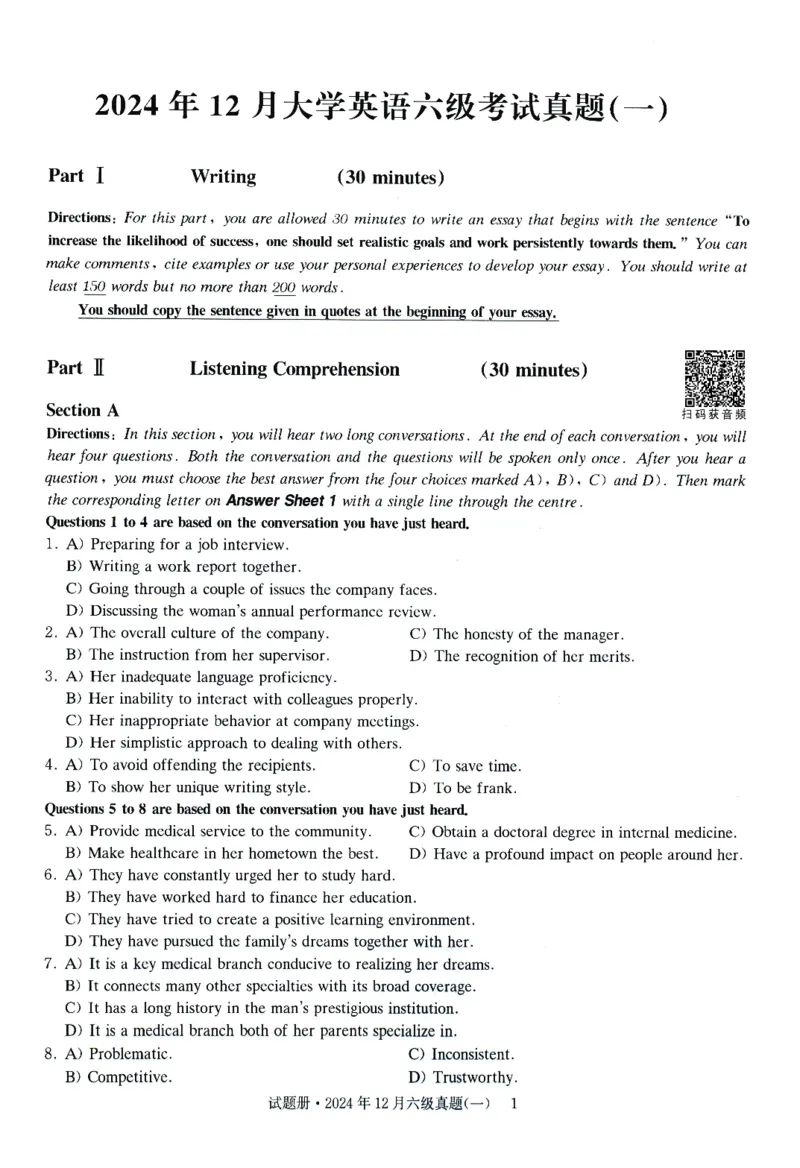
Part I Writing (30 minutes)
Directions: For this part, you are allowed 30 minutes to write an essay that begins with the sentence "To
increase the likelihood of success, one should set realistic goals and work persistently towards them. " You can
make comments, cite examples or use your personal experiences to develop your essay. You should write at
least 150 words but no more than 200 words.
You should copy the sentence given in quotes at the beginning of your essay.
Listening Comprehension (30 minutes)
Section A
扫码获音频
Directions : In this section, you will hear two long conversations. At the end of each conversation, you will
hear four questions. Both the conversation and the questions will be spoken only once. After you hear a
question, you must choose the best answer from the four choices marked A ), B), C) and Q). Then mark
the corresponding letter on Answer Sheet 1 with a single line through the centre.
Questions 1 to 4 are based on the conversation you have just heard.
1. A) Preparing for a job interview.
B) Writing a work report together.
C) Going through a couple of issues the company faces.
D) Discussing the woman's annual performance review.
2. A) The overall culture of the company. C) The honesty of the manager.
B) The instruction from her supervisor. D) The recognition of her merits.
3. A) Her inadequate language proficiency.
B) Her inability to interact with colleagues properly.
C) Her inappropriate behavior at company meetings.
D) Her simplistic approach to dealing with others.
4. A) To avoid offending the recipients. C) To save time.
B) To show her unique writing style. D) To be frank.
Questions 5 to 8 are based on the conversation you have just heard.
5. A) Provide medical service to the community. C) Obtain a doctoral degree in internal medicine.
B) Make healthcare in her hometown the best. D) Have a profound impact on people around her.
6. A) They have constantly urged her to study hard.
B) They have worked hard to finance her education.
C) They have tried to create a positive learning environment.
D) They have pursued the family's dreams together with her.
7. A) It is a key medical branch conducive to realizing her dreams.
B) It connects many other specialties with its broad coverage.
C) It has a long history in the man's prestigious institution.
D) It is a medical branch both of her parents specialize in.
8. A) Problematic. C) Inconsistent.
B) Competitive. D) Trustworthy.
试题册-2024年12月六级真题(一)1Section B
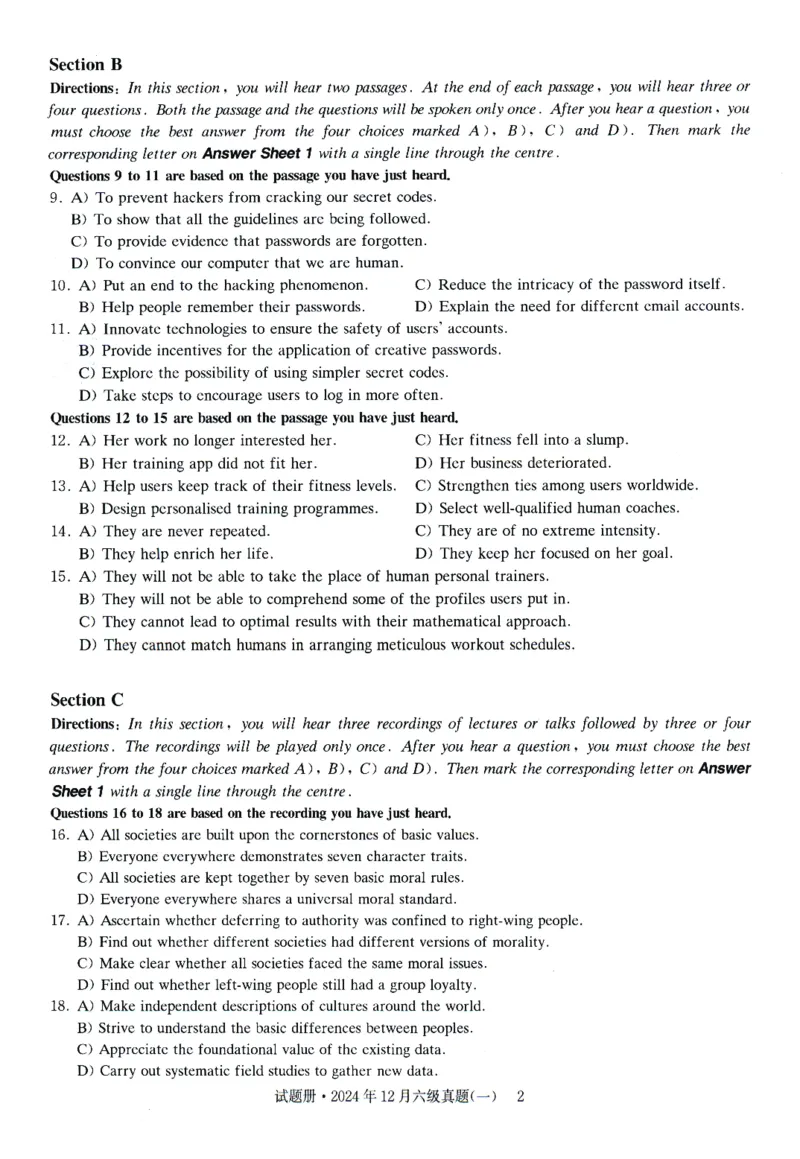
Directions : In this section, you will hear two passages. At the end of each passage, you will hear three or
four questions. Both the passage and the questions will be spoken only once. After you hear a question,you
must choose the best answer from the four choices marked A ), B), C) and D). Then mark the
corresponding letter on Answer Sheet 1 with a single line through the centre.
Questions 9 to 11 are based on the passage you have just heard.
9. A) To prevent hackers from cracking our secret codes.
B) To show that all the guidelines are being followed.
C) To provide evidence that passwords are forgotten.
D) To convince our computer that we are human.
10. A) Put an end to the hacking phenomenon. C) Reduce the intricacy of the password itself.
B) Help people remember their passwords. D) Explain the need for different email accounts.
11. A) Innovate technologies to ensure the safety of users5 accounts.
B) Provide incentives for the application of creative passwords.
C) Explore the possibility of using simpler secret codes.
D) Take steps to encourage users to log in more often.
Questions 12 to 15 are based on the passage you have just heard.
12. A) Her work no longer interested her. C) Her fitness fell into a slump.
B) Her training app did not fit her. D) Her business deteriorated.
13. A) Help users keep track of their fitness levels. C) Strengthen ties among users worldwide.
B) Design personalised training programmes. D) Select well-qualified human coaches.
14. A) They are never repeated. C) They are of no extreme intensity.
B) They help enrich her life. D) They keep her focused on her goal.
15. A) They will not be able to take the place of human personal trainers.
B) They will not be able to comprehend some of the profiles users put in.
C) They cannot lead to optimal results with their mathematical approach.
D) They cannot match humans in arranging meticulous workout schedules.
Section C
Directions: In this section, you will hear three recordings of lectures or talks followed by three or four
questions. The recordings will be played only once. After you hear a question, you must choose the best
answer from the four choices marked A ), B), C) and D). Then mark the corresponding letter on Answer
Sheet 1 with a single line through the centre.
Questions 16 to 18 are based on the recording you have just heard.
16. A) All societies are built upon the cornerstones of basic values.
B) Everyone everywhere demonstrates seven character traits.
C) All societies are kept together by seven basic moral rules.
D) Everyone everywhere shares a universal moral standard.
17. A) Ascertain whether deferring to authority was confined to right-wing people.
B) Find out whether different societies had different versions of morality.
C) Make clear whether all societies faced the same moral issues.
D) Find out whether left-wing people still had a group loyalty.
18. A) Make independent descriptions of cultures around the world.
B) Strive to understand the basic differences between peoples.
C) Appreciate the foundational value of the existing data.
D) Carry out systematic field studies to gather new data.
试题册・2024年12月六级真题(一)2Questions 19 to 21 are based on the recording you have just heard.
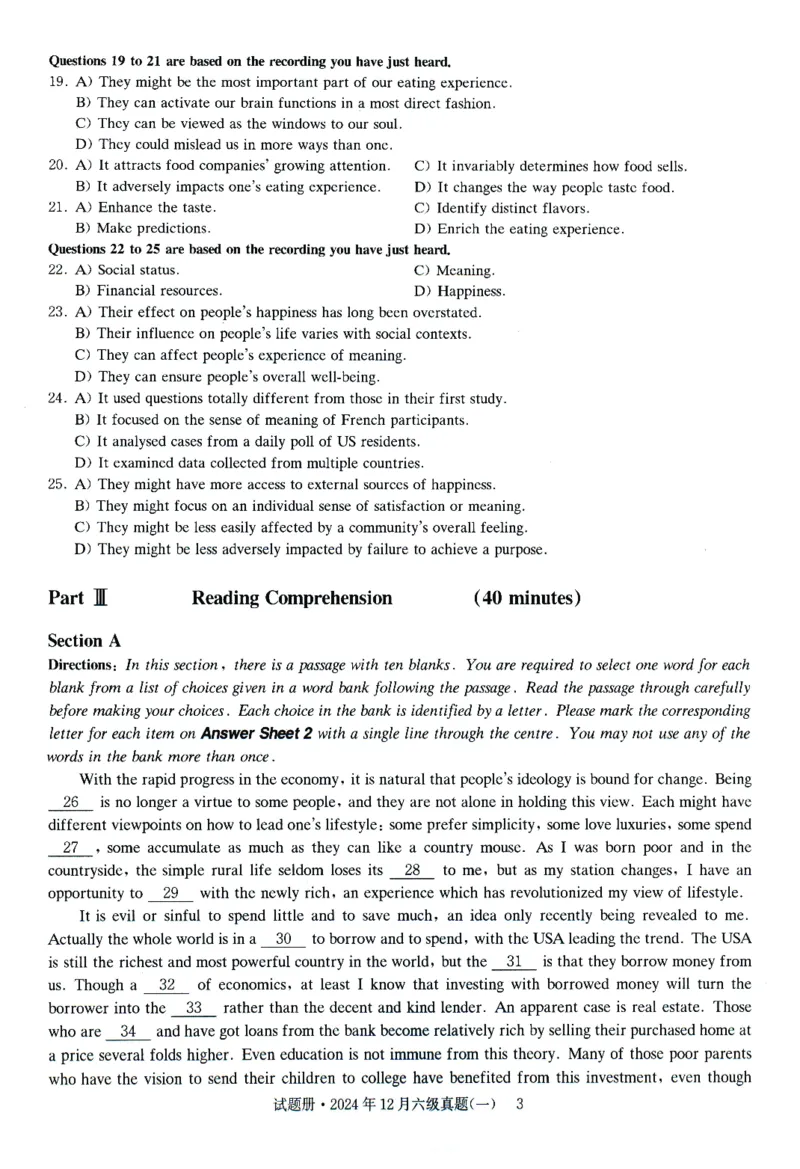
19. A) They might be the most important part of our eating experience.
B) They can activate our brain functions in a most direct fashion.
C) They can be viewed as the windows to our soul.
D) They could mislead us in more ways than one.
20. A) It attracts food companies5 growing attention. C) It invariably determines how food sells.
B) It adversely impacts one's eating experience. D) It changes the way people taste food.
21. A) Enhance the taste. C) Identify distinct flavors.
B) Make predictions. D) Enrich the eating experience.
Questions 22 to 25 are based on the recording you have just heard.
22. A) Social status. C) Meaning.
B) Financial resources. D) Happiness.
23. A) Their effect on people's happiness has long been overstated.
B) Their influence on people's life varies with social contexts.
C) They can affect people's experience of meaning.
D) They can ensure people's overall well-being.
24. A) It used questions totally different from those in their first study.
B) It focused on the sense of meaning of French participants.
C) It analysed cases from a daily poll of US residents.
D) It examined data collected from multiple countries.
25. A) They might have more access to external sources of happiness.
B) They might focus on an individual sense of satisfaction or meaning.
C) They might be less easily affected by a community's overall feeling.
D) They might be less adversely impacted by failure to achieve a purpose.
Part M Reading Comprehension (40 minutes)
Section A
Directions: In this section, there is a passage with ten blanks. You are required to select one word for each
blank from a list of choices given in a word bank following the passage. Read the passage through carefully
before making your choices. Each choice in the bank is identified by a letter. Please mark the corresponding
letter for each item on Answer Sheet 2 with a single line through the centre. You may not use any of the
words in the bank more than once.
With the rapid progress in the economy, it is natural that people's ideology is bound for change. Being
26 is no longer a virtue to some people, and they are not alone in holding this view. Each might have
different viewpoints on how to lead one's lifestyle: some prefer simplicity, some love luxuries, some spend
27 , some accumulate as much as they can like a country mouse. As I was born poor and in the
countryside, the simple rural life seldom loses its 28 to me, but as my station changes, I have an
opportunity to 29 with the newly rich, an experience which has revolutionized my view of lifestyle.
It is evil or sinful to spend little and to save much, an idea only recently being revealed to me.
Actually the whole world is in a 30 to borrow and to spend, with the USA leading the trend. The USA
is still the richest and most powerful country in the world, but the 31 is that they borrow money from
us. Though a 32 of economics, at least I know that investing with borrowed money will turn the
borrower into the 33 rather than the decent and kind lender. An apparent case is real estate. Those
who are 34 and have got loans from the bank become relatively rich by selling their purchased home at
a price several folds higher. Even education is not immune from this theory. Many of those poor parents
who have the vision to send their children to college have benefited from this investment, even though
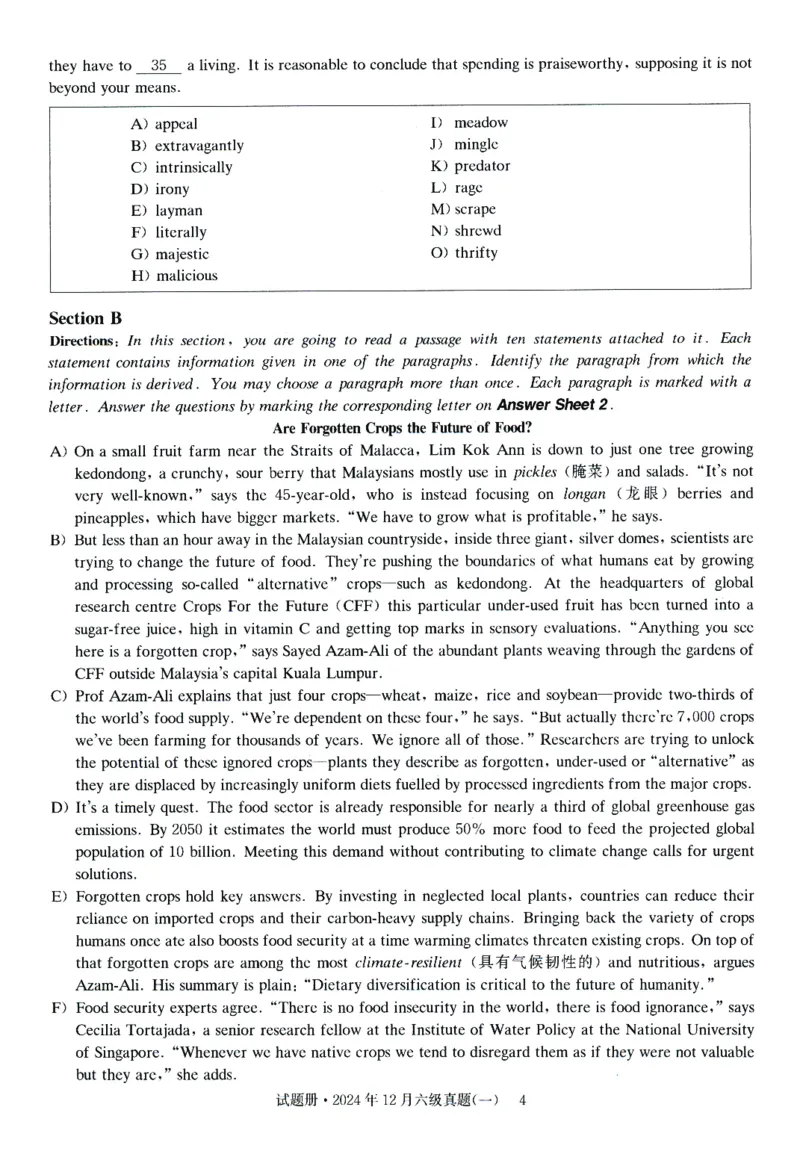
试题册-2024年12月六级真题(一)3they have to 35 a living. It is reasonable to conclude that spending is praiseworthy, supposing it is not
beyond your means.
A) appeal I) meadow
B) extravagantly J) mingle
C) intrinsically K) predator
D) irony L) rage
E) layman M) scrape
F) literally N) shrewd
G) majestic O) thrifty
H) malicious
Section B
Directions: In this section, you are going to read a passage with ten statements attached to it. Each
statement contains information given in one of the paragraphs. Identify the paragraph from which the
information is derived. You may choose a paragraph more than once. Each paragraph is marked with a
letter. Answer the questions by marking the corresponding letter on Answer Sheet 2.
Are Forgotten Crops the Future of Food?
A) On a small fruit farm near the Straits of Malacca, Lim Kok Ann is down to just one tree growing
kedondong, a crunchy, sour berry that Malaysians mostly use in pickles (腌菜)and salads. "It's not
very well-known,“ says the 45-year-old, who is instead focusing on longan (龙眼)berries and
pineapples, which have bigger markets. "We have to grow what is profitable,“ he says.
B) But less than an hour away in the Malaysian countryside, inside three giant, silver domes, scientists are
trying to change the future of food. They're pushing the boundaries of what humans eat by growing
and processing so-called u alternativew crops一such as kedondong. At the headquarters of global
research centre Crops For the Future (CFF) this particular under-used fruit has been turned into a
sugar-free juice, high in vitamin C and getting top marks in sensory evaluations. uAnything you see
here is a forgotten crop,“ says Sayed Azam-Ali of the abundant plants weaving through the gardens of
CFF outside Malaysia's capital Kuala Lumpur.
C) Prof Azam-Ali explains that just four crops一wheat, maize, rice and soybean一provide two-thirds of
the world's food supply. "We're dependent on these four,“ he says. "But actually thereie 7,000 crops
we've been farming for thousands of years. We ignore all of those. M Researchers are trying to unlock
the potential of these ignored crops一plants they describe as forgotten, under-used or “alternative” as
they are displaced by increasingly uniform diets fuelled by processed ingredients from the major crops.
D) It's a timely quest. The food sector is already responsible for nearly a third of global greenhouse gas
emissions. By 2050 it estimates the world must produce 50% more food to feed the projected global
population of 10 billion. Meeting this demand without contributing to climate change calls for urgent
solutions.
E) Forgotten crops hold key answers. By investing in neglected local plants, countries can reduce their
reliance on imported crops and their carbon-heavy supply chains. Bringing back the variety of crops
humans once ate also boosts food security at a time warming climates threaten existing crops. On top of
that forgotten crops are among the most climate-resilient (具有气候韧'性 的)and nutritious, argues
Azam-Ali. His summary is plain: 44Dietary diversification is critical to the future of humanity. n
F) Food security experts agree. "There is no food insecurity in the world, there is food ignorance,“ says
Cecilia Tortajada, a senior research fellow at the Institute of Water Policy at the National University
of Singapore. 44Whenever we have native crops we tend to disregard them as if they were not valuable
but they are,“ she adds.
试题册-2024年12月六级真题(一) 4G) Azam-Ali knows that scepticism firsthand. He came across alternative crops in the 1980s through the
work of women farmers he met in Niger. The then-PhD student remembers marvelling at the crops
they grew in their backyards, without the benefits of technology, to feed their families when the big
crops failed. He saw a tremendous opportunity to build alternative food systems. But “the resistance
was enormous,“ he recalls.
H) Undeterred, he ploughed on. Project after project helped prove these crops were viable in different
environments as alternatives to the staple ones. But the question of whether these crops would be
marketable remained. "That's the critical thing,“ he says. In one of the centre's domes, food
technologist Tan Xinlin uses powdered moringa (辣木)leaves in place of some wheat flour to bake a
cake lower in gluten (谷胶)and higher in nutrients. Tan's job is to create recipes with these still-
unfamiliar ingredients that will appeal to both local and international tastes. In recent years she has
used some of the forgotten crops grown at CFF, such as moringa and bambara groundnut, to make
everything from instant soup to Indian snacks. "I try to modernise forgotten crops instead of using old
recipes.says Tan, who is also a trained chef. It's a strategy to appeal to the world's growing middle
classes who are increasingly turning to the fast and processed food industries. It's also a way to help
counter perceptions of local crops as “old or poor people's food” or as inferior “women's crops",adds
Tan.
I) The roots of these connotations about local foods can run deep. The bambara groundnut, a protein-rich
native crop of sub-Saharan Africa that is also grown in parts of southeast Asia, can trace its
marginalisation to colonial rule. "African women who grew bambara groundnut were actually punished
for growing it,“ says Azam-Ali. uColonial powers said you can't grow that because there's no oil. We
can't get a market for it. " But today the bambara murukku is one of CFF's best reviewed foods and
they are aiming to get it into grocery stores pointing to the success of crops like quinoa to potential
?
investors. Some 30 years ago, quinoa was virtually unheard of outside its native mountains in Bolivia
and Peru. Today the nutritious grain is found on the menus of lavish restaurants across the world.
J) Measuring crops by nutrition instead of yield is at the heart of the forgotten foods enterprise. Ever
since the “green revolution,, of the 1960s, high-yielding crops have dominated modern agriculture.
That was in part a crucial response to devastating famines at a time when the world needed to increase
its food supply. Today unutrition is becoming a time bomb",says Azam-Ali, as growing carbon dioxide
levels strip crops of their minerals. Instead of bio-fortifying major crops we should be investing in
those forgotten crops that are already more nutritious, he asserts.
K) In the bowels of CFF's third dome, lab manager Gomathy Sethuraman opens a window into the
centre's ucrown jewels",revealing vines of winged beans growing under a bright yellow light. It's one
of multiple chambers where scientists are studying the impact of higher temperatures and carbon
dioxide levels on the nutritional make-up of alternative crops. This research is uthe game changer”,
says Azam-Ali, ensuring that future crops“ are also the healthiest ones in warmer climates.
L) There is a growing global momentum around forgotten foods, says Danielle Nierenberg, president of
Food Tank, a US-based think tank. Other than CFF, which bills itself as the world's first research
centre dedicated solely to under-utilised crops, there are other key groups championing agricultural
diversity including Crop Trust, Slow Food, Icrisat and Bioversity International. Add to that more
middle-income consumers searching for nutritious foods and others eager to try the unprocessed foods
their grandparents once ate, she says.
M) But the rising interest in forgotten foods in some quarters is overtaken by the global spread of Western
style diets heavy in sugar, fat and processed foods in others.
N) A key obstacle to promoting fading local crops in Malaysia, for example, is “the obsession with
imported products",says Jenifer Kuah, co-founder of a restaurant that champions locally-sourced food
in an affluent suburb of Kuala Lumpur. Customers at Sitka, regarded as a pioneer in the country's
试题册-2024年12月六级真题(一)5small farm-to-table dining scene, still seek foreign ingredients as a ustatus symbol",she says.
O) The argument for forgotten foods feels intuitive. Some analysts say it is in fact inevitable. “Climate
change is going to mean almost certainly tastes are going to be forced to change,“ says Tim Lang,
professor of food policy at City, University of London. We “have to get used to eating other crops” as
yields of staple crops fall, he says.
36. According to a senior researcher, we will have secure food supply if we rid ourselves of ignorance
about native crops.
37. Most of the world's food supply comes from a tiny number out of thousands of crops that have been
grown for centuries.
38. To provide their family with food when the staple crops failed, some African women farmers grew
local crops in their backyards.
39. High-yielding crops have occupied a dominant position in modern agriculture since the green
revolution in the last century.
40. Growing alternative crops proved feasible in a variety of environments, but the critical question was
whether they would be marketable.
41. According to a professor, when the yields of staple crops fall, we will have to adapt to eating foods
from alternative crops.
42. Urgent measures have to be taken to provide food for the projected world population without
aggravating the climate.
43. Colonial rule marginalised local crops by punishing Africans who grew them.
44. As existing crops are endangered by global warming, we can increase food security by bringing back
the many forgotten food crops.
45. Researchers are trying to find out how higher temperatures and CO levels affect the nutritional
2
composition of alternative crops.
Section C
Directions : There are 2 passages in this section. Each passage is followed by some questions or unfinished
statements. For each of them there are four choices marked A), B), C) and D). You should decide on the
best choice and mark the corresponding letter on Answer Sheet 2 with a single line through the centre.
Passage One
Questions 46 to 50 are based on the following passage.
Imagine you're an alien sent to Earth to document the behaviour of the mammals inhabiting the planet.
You stumble into a movie theatre that's showing the latest Hollywood horror film.
Several dozen humans are gathered together in a dark, undecorated room. They're all staring at a
rectangular area on which patterns of light change rapidly.
They are clearly in a state of high arousal. Their heart rate is elevated, they occasionally glance around
nervously, and they sometimes jump collectively in their seats, and emit high-pitched warning calls.
Eventually, the lights come up and the rectangular screen goes black. The humans stand up and leave the
room, chatting and laughing, and showing signs of pleasure.
Why do these humans voluntarily expose themselves to what appears to be a deeply unpleasant experience?
And why do they react so strongly to those patterns of light on a screen?
I am fascinated with the paradox of horror一the strange fact that many people seek out scary
entertainment.
I think the answer to the puzzle lies in human nature.
My research suggests that we humans evolved to find pleasure in situations that allow us to experience
negative emotions in a safe context. You can see these elements of horror in children's games. Take hide-and-
seek for example, which is a simulation of a predator-prey interaction. The kid hides and the adult pretends to
be a predator, searching for the child while howling like a dangerous beast.
试题册-2024年12月六级真题(一)6This simulation gives the child crucial information about how to avoid becoming prey, and children tend to
find that kind of activity deeply satisfying, presumably because it gives them a safe experience of a potentially
catastrophic scenario.
They find it pleasurable, and pleasure is evolution's way of motivating us toward adaptive behaviour.
Horror is pleasurable to many people because it lets us play with negative emotions and develop coping
strategies. We learn what it feels like to be truly afraid, and we learn how to handle negative emotion.
How, then, does horror work? My research suggests that horror works by exploiting an ancient set of
biological defence mechanisms—an evolved fear system, which we share with other animals. But humans are
uniquely imaginative, and we use our evolved imagination to travel into virtual worlds that are full of danger.
There are good reasons for watching a horror film, even if you're not a loyal horror fan. If you make it
through the film in one piece, you511 probably experience a strong sense of mastery, a sense that you were able
to make it through an appalling experience. Anyway, watching a horror film makes you better at handling your
own fear, and who knows when that will become critically relevant?
46. The alien finds the audience in the movie theatre clearly in a state o f .
A) total mindfulness C) spiritual elevation
B) extreme excitement D) intense curiosity
47. Why do many people seek out scary entertainment, according to the author's research?
A) They gain experience in overcoming horror in real life.
B) They find joy in going through simulated horrible experiences.
C) They have learned from hide-and-seek as kids the thrill involved.
D) They have evolved to gain pleasure in escaping life-threatening situations.
48. What do children learn from hide-and-seek?
A) How to avoid falling prey to an attacker.
B) How to simulate a predator-prey interaction.
C) How to keep themselves from catastrophic errors.
D) How to turn a dangerous scenario into a safe one.
49. Why is horror gratifying to many people?
A) It reminds them of an ancient set of biological defence mechanisms.
B) It triggers their imagination to travel into dangerous virtual worlds.
C) It allows them to learn what fear feels like and how to tackle it.
D) It activates their evolved fear system and their unique fantasy.
50. What will one experience if they watch a horror film through without being hurt?
A) A strong sense of clear relevance. C) A profound sense of intense relief.
B) A profound sense of good fortune. D) A strong sense of being in control.
Passage Two
Questions 51 to 55 are based on the following passage.
An awakening has been taking place in the physical world against the beauty model that has been dictated
to us for years. But in the digital arena, social media determines what is considered beautiful.
The two opposing struggles are taking place in parallel. In the physical world, the struggle goes against the
underlying pressure exerted on women to conform to an unrealistic beauty ideal. As part of the struggle, various
media outlets have presented women whose bodies don't correspond to the so-called ideal. All those women who
had previously been excluded from the covers of magazines, television series and the public agenda, have
become “legitimate”. At the same time, a group of influencers have begun to upload to social media photos of
themselves without makeup, and even photos in which they highlight supposed flaws.
Technology has reshaped our beauty ideal and is doing a great job communicating that message to the
masses. One of the bizarre legacies of the past decade is the popularity of the “cyborg look",which illustrates
what Americans will look like in 2050.
The cyborg look spread rapidly. Today, however, the Instagram face has become the new beauty ideal.
The internalization of accepted beauty norms is much more effective when there is active involvement in
试题册-2024年12月六级真题(一)7the learning process. The active involvement of users is reflected in the gamified (游戏化的)interaction
offered by the social media platforms——the ability to like, write a comment, compare, share.
Once the desired beauty ideal has been internalized, users are given tools or features to change their
appearance to suit the accepted beauty ideal such as editing the image, choosing the ideal filter, the right
background.
A survey conducted in the United States revealed that more than 50% filter the images before posting
them. And you will not be surprised to hear that the majority of them are women. One of the significant
consequences of obsessive filtering is the emerging tendency to treat oneself as an object to be observed and
valued, in the same way another person observes and judges from the side.
The effect of the filters is already far beyond amiable amusement. The filters and the entire game played
on the networks affect the mental health of the users. According to a study, apps like Instagram, Snapchat and
FaceTune allow users to achieve a level of perfection that was previously only observed in beauty magazines.
Even though humanity has always cherished beauty, in the last decade our obsession with looks has reached
an unprecedented peak. The time spent on social media creates an urge to achieve an impossible beauty ideal so
powerful that the only thing that can fix it is not cosmetic intervention, but mental health care.
51. What do we learn about beauty in the digital arena?
A) It dictates the taste of digital media. C) It has ushered in a new awakening.
B) It has been in the making for years. D) It is defined by social media.
52. What does the passage say about beauty in the physical world?
A) Women are under constant pressure to keep up with beauty models.
B) Women are encouraged to pursue a beauty ideal that has never existed.
C) A fight is going on to remove pressure on women to conform to an absurd beauty ideal.
D) Media outlets have begun to present as beauty models trendy women without any makeup.
53. What do we learn from the passage about the Instagram face?
A) It is now regarded as the new beauty ideal.
B) It is what most women will go after in 2050.
C) It is being much talked about on social media.
D) It is a perfect illustration of the ultimate beauty.
54. What has obsessive filtering resulted in?
A) A good many women striving to reach an impossible level of perfection.
B) An urge to turn the entire game played on the network to one's advantage.
C) A tendency to regard one's body as an object of observation and judgment.
D) An increasing number of women filtering their images before uploading them.
55. What does the author want to emphasize at the end of the passage regarding Americans, obsession with
looks?
A) Cosmetic surgery should be made more accessible to the masses.
B) Psychological intervention should be introduced to alleviate it.
C) Their time spent on social media should be strictly controlled.
D) Its root cause should be meticulously examined and analyzed.
Part N Translation (30 minutes)
Directions: For this part, you are allowed 30 minutes to translate a passage from Chinese into English. You
should write your answer on Answer Sheet 2.
色d :(Beidou)卫星导航系统的成功研制是中国自改革开放以来取得的一项重大科技成就。研发人员
经过不懈努力,攻克了一系列技术难题,北斗系统最终实现了全球覆盖和高精度定位,使中国成为世界上
少数几个独立拥有全球卫星导航系统的国家之一。北斗系统已广泛应用于交通运输、灾害救援、天气预
报、公共安全等诸多领域。北斗系统现在已经在国际上得到广泛认可,开始为越来越多的国家和地区提供
优质服务。
试题册・2024年12月六级真题(一) 8