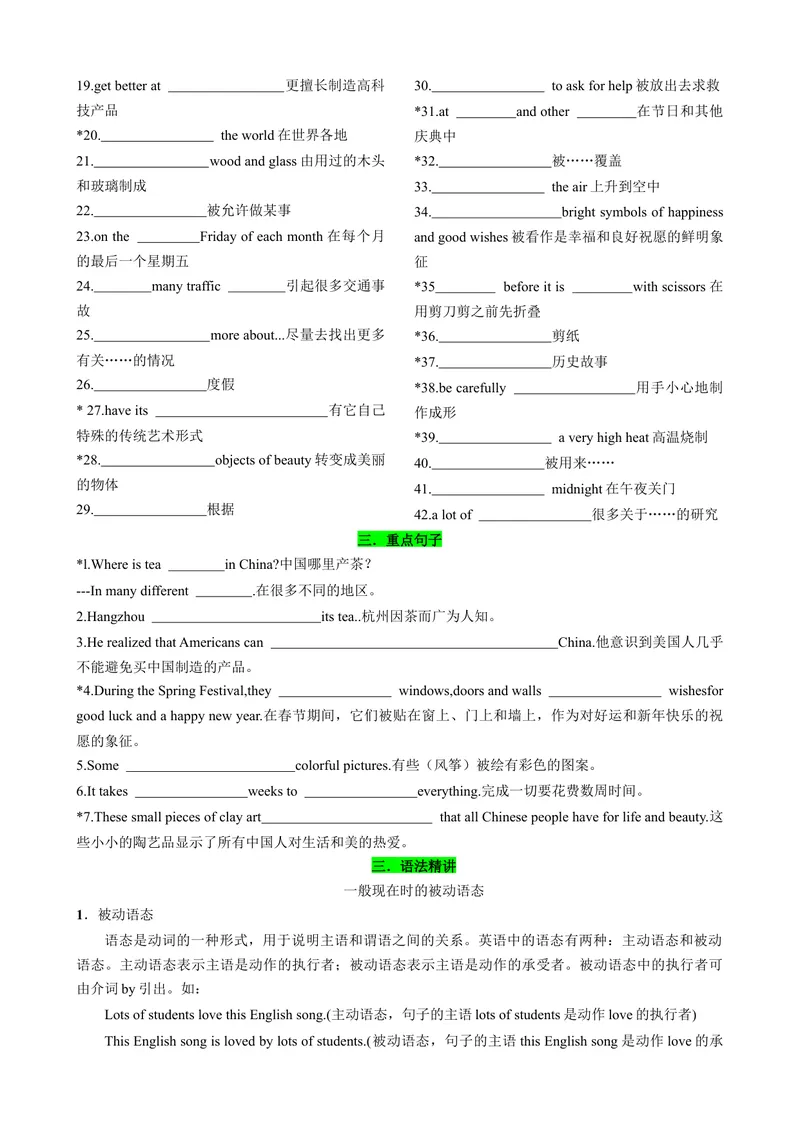
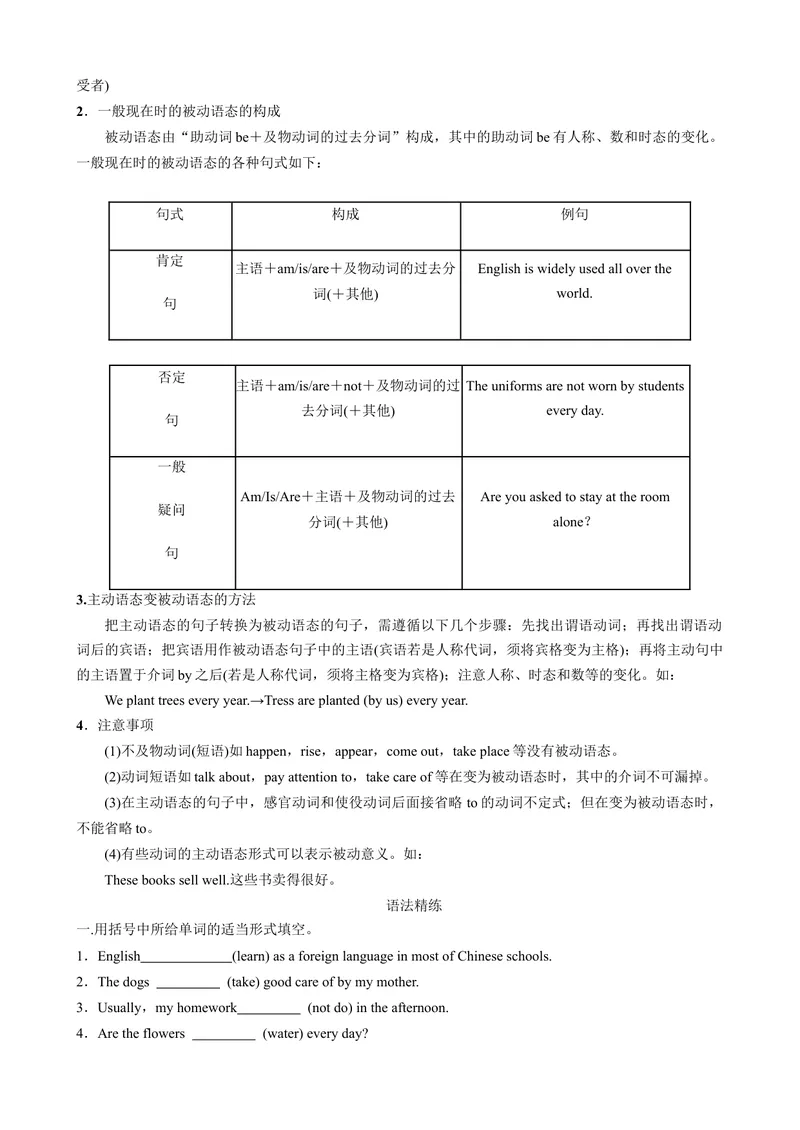
Unit4-Unit6(词汇,短语,句型,语法,写作复习+基础练习)
Unit 4
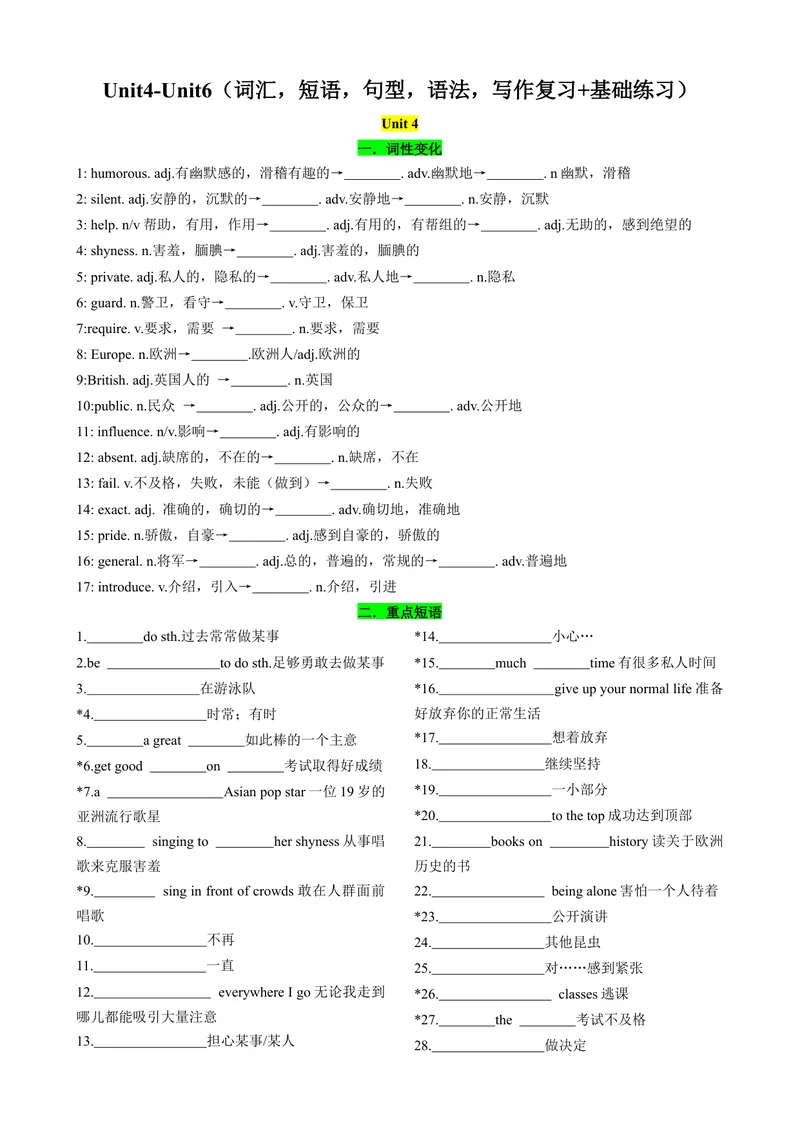
一.词性变化
1: humorous. adj.有幽默感的,滑稽有趣的→ . adv.幽默地→ . n幽默,滑稽
2: silent. adj.安静的,沉默的→ . adv.安静地→ . n.安静,沉默
3: help. n/v帮助,有用,作用→ . adj.有用的,有帮组的→ . adj.无助的,感到绝望的
4: shyness. n.害羞,腼腆→ . adj.害羞的,腼腆的
5: private. adj.私人的,隐私的→ . adv.私人地→ . n.隐私
6: guard. n.警卫,看守→ . v.守卫,保卫
7:require. v.要求,需要 → . n.要求,需要
8: Europe. n.欧洲→ .欧洲人/adj.欧洲的
9:British. adj.英国人的 → . n.英国
10:public. n.民众 → . adj.公开的,公众的→ . adv.公开地
11: influence. n/v.影响→ . adj.有影响的
12: absent. adj.缺席的,不在的→ . n.缺席,不在
13: fail. v.不及格,失败,未能(做到)→ . n.失败
14: exact. adj. 准确的,确切的→ . adv.确切地,准确地
15: pride. n.骄傲,自豪→ . adj.感到自豪的,骄傲的
16: general. n.将军→ . adj.总的,普遍的,常规的→ . adv.普遍地
17: introduce. v.介绍,引入→ . n.介绍,引进
二.重点短语
1. do sth.过去常常做某事 *14. 小心…
2.be to do sth.足够勇敢去做某事 *15. much time有很多私人时间
3. 在游泳队 *16. give up your normal life准备
*4. 时常;有时 好放弃你的正常生活
5. a great 如此棒的一个主意 *17. 想着放弃
*6.get good on 考试取得好成绩 18. 继续坚持
*7.a Asian pop star一位19岁的 *19. 一小部分
亚洲流行歌星 *20. to the top成功达到顶部
8. singing to her shyness从事唱 21. books on history读关于欧洲
歌来克服害羞 历史的书
*9. sing in front of crowds敢在人群面前 22. being alone害怕一个人待着
唱歌 *23. 公开演讲
10. 不再 24. 其他昆虫
11. 一直 25. 对……感到紧张
12. everywhere I go无论我走到 *26. classes逃课
哪儿都能吸引大量注意 *27. the 考试不及格
13. 担心某事/某人 28. 做决定29. him to a school把他送到寄宿 34. 在过去的几年里
学校 *35.have a great sb.对某人有很
30. sb. do sth.建议某人做某事 大的影响
*31 亲自 *36.give a in a job
32. a train ride坐24小时的火车 interview在工作面试中做一个大概的自我介绍
33. 对……感到骄傲 37. the basketball game在篮球比
赛中打得好
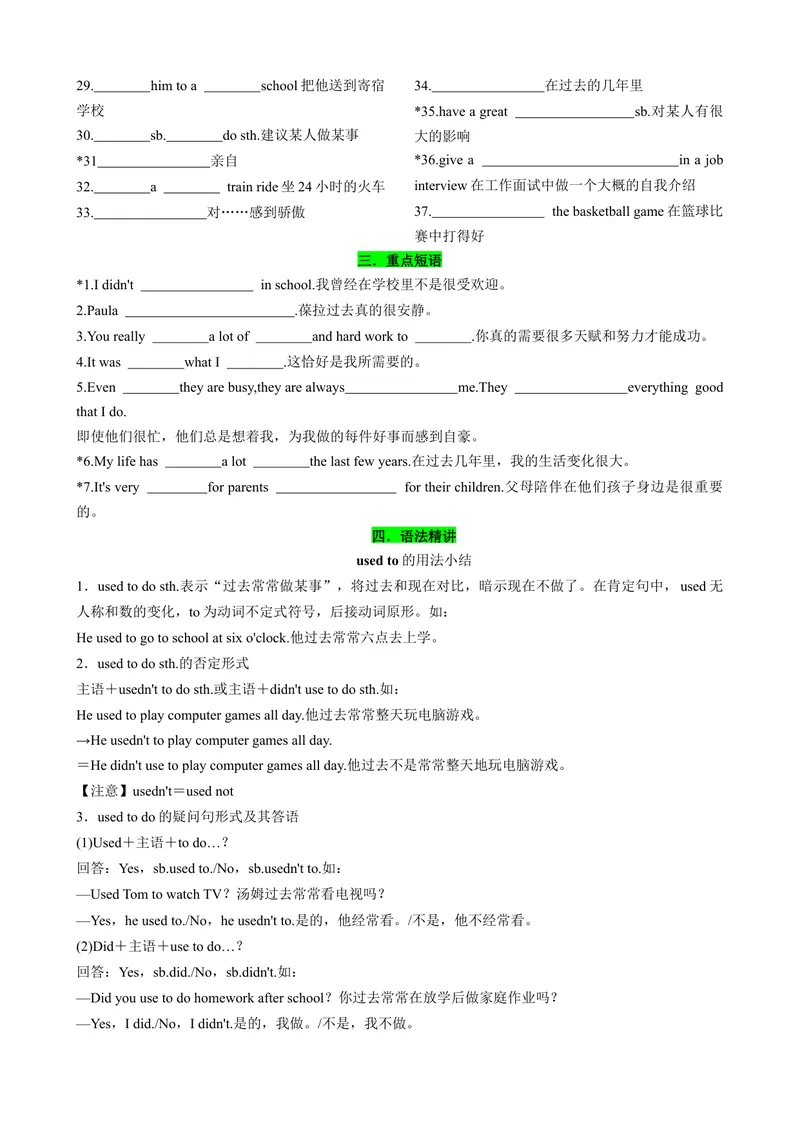
三.重点短语
*1.I didn't in school.我曾经在学校里不是很受欢迎。
2.Paula .葆拉过去真的很安静。
3.You really a lot of and hard work to .你真的需要很多天赋和努力才能成功。
4.It was what I .这恰好是我所需要的。
5.Even they are busy,they are always me.They everything good
that I do.
即使他们很忙,他们总是想着我,为我做的每件好事而感到自豪。
*6.My life has a lot the last few years.在过去几年里,我的生活变化很大。
*7.It's very for parents for their children.父母陪伴在他们孩子身边是很重要
的。
四.语法精讲
used to的用法小结
1.used to do sth.表示“过去常常做某事”,将过去和现在对比,暗示现在不做了。在肯定句中,used无
人称和数的变化,to为动词不定式符号,后接动词原形。如:
He used to go to school at six o'clock.他过去常常六点去上学。
2.used to do sth.的否定形式
主语+usedn't to do sth.或主语+didn't use to do sth.如:
He used to play computer games all day.他过去常常整天玩电脑游戏。
→He usedn't to play computer games all day.
=He didn't use to play computer games all day.他过去不是常常整天地玩电脑游戏。
【注意】usedn't=used not
3.used to do的疑问句形式及其答语
(1)Used+主语+to do…?
回答:Yes,sb.used to./No,sb.usedn't to.如:
—Used Tom to watch TV?汤姆过去常常看电视吗?
—Yes,he used to./No,he usedn't to.是的,他经常看。/不是,他不经常看。
(2)Did+主语+use to do…?
回答:Yes,sb.did./No,sb.didn't.如:
—Did you use to do homework after school?你过去常常在放学后做家庭作业吗?
—Yes,I did./No,I didn't.是的,我做。/不是,我不做。4.used to do的反意疑问句形式也有两种,类似于否定句形式。如:
—They used to see English movies on Sundays,usedn't they?/didn't they?他们过去常常在星期天看英文电
影,是吗?
—Yes,they used to./No,they usedn't to.或Yes,they did./No,they didn't.是的,他们过去常看。/不是,他
们过去不常看。
5.used to也可用于there be结构,表示“过去常有”。如:
There used to be a meeting every Monday morning last month.上个月每个星期一上午总要开会。
6.get/be used to (doing) sth.习惯于(做)某事;use sth.to do sth.用……做某事;be used to do sth.被用来做某
事;be used for (doing) sth.被用来做某事;be used by被……所用。
语法精练
一.用括号中所给单词的适当形式填空。
1.My little brother used (play) pingpong.
2.I'm used to (get) up early.
3.Wood is used (make)desks,chairs,tables and so on.
4. Did you (use) to be short?
5.Today,computers (use) in both cities and towns.
二.根据汉语提示完成句子,每空一词。
6.He (以前是) a history teacher in our school.
7.There (以前有) an old temple near the village.
8.She (习惯于散步) after supper.
9.Wood (被用来制造) paper.
10.Mrs.Black (已习惯于) eating with chopsticks.
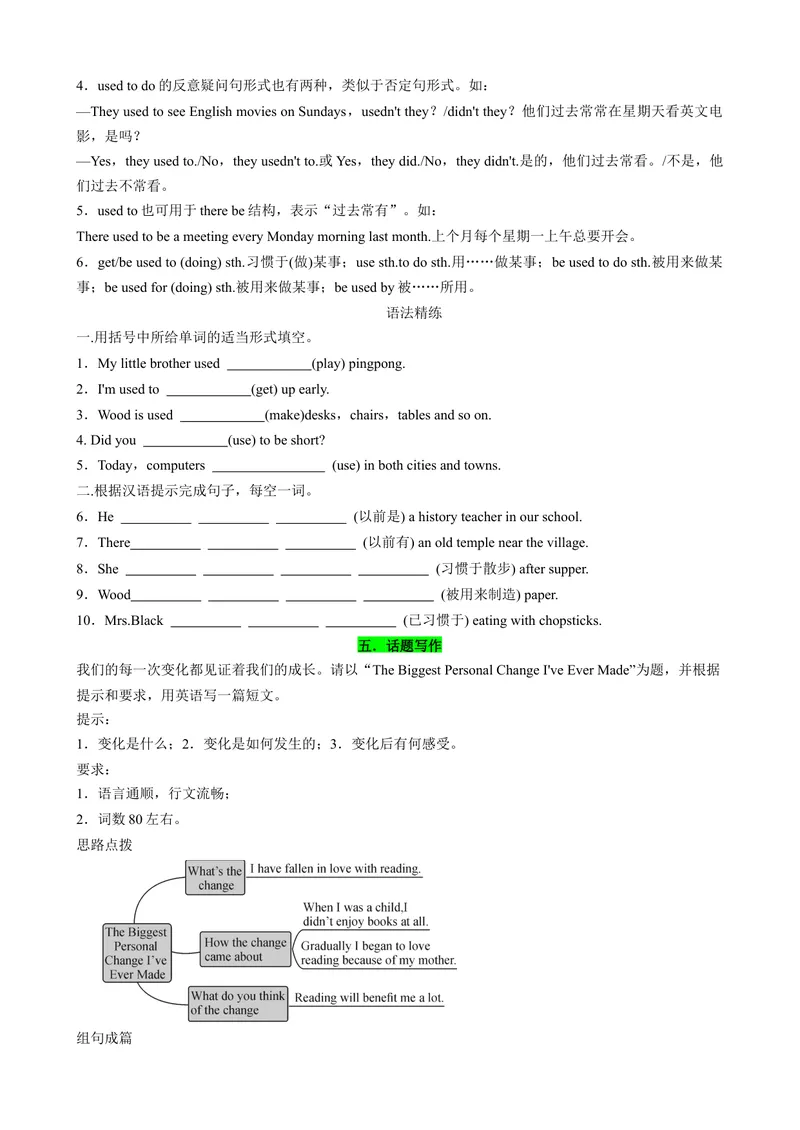
五.话题写作
我们的每一次变化都见证着我们的成长。请以“The Biggest Personal Change I've Ever Made”为题,并根据
提示和要求,用英语写一篇短文。
提示:
1.变化是什么;2.变化是如何发生的;3.变化后有何感受。
要求:
1.语言通顺,行文流畅;
2.词数80左右。
思路点拨
组句成篇The Biggest Personal Change I've Ever Made
The biggest personal change I have ever made is that I have __1__(爱上) reading.
When I was a child,I didn't enjoy books __2__(根本).Later,my mother always __3__(给我读故事) and
bought me books.Gradually I began to love reading.While reading,I __4__(感觉像) talking with a wise
man.Reading is also a fantastic way to __5__(打发我的闲暇时间).
Books are my friends.And they will benefit me a lot.
Unit5
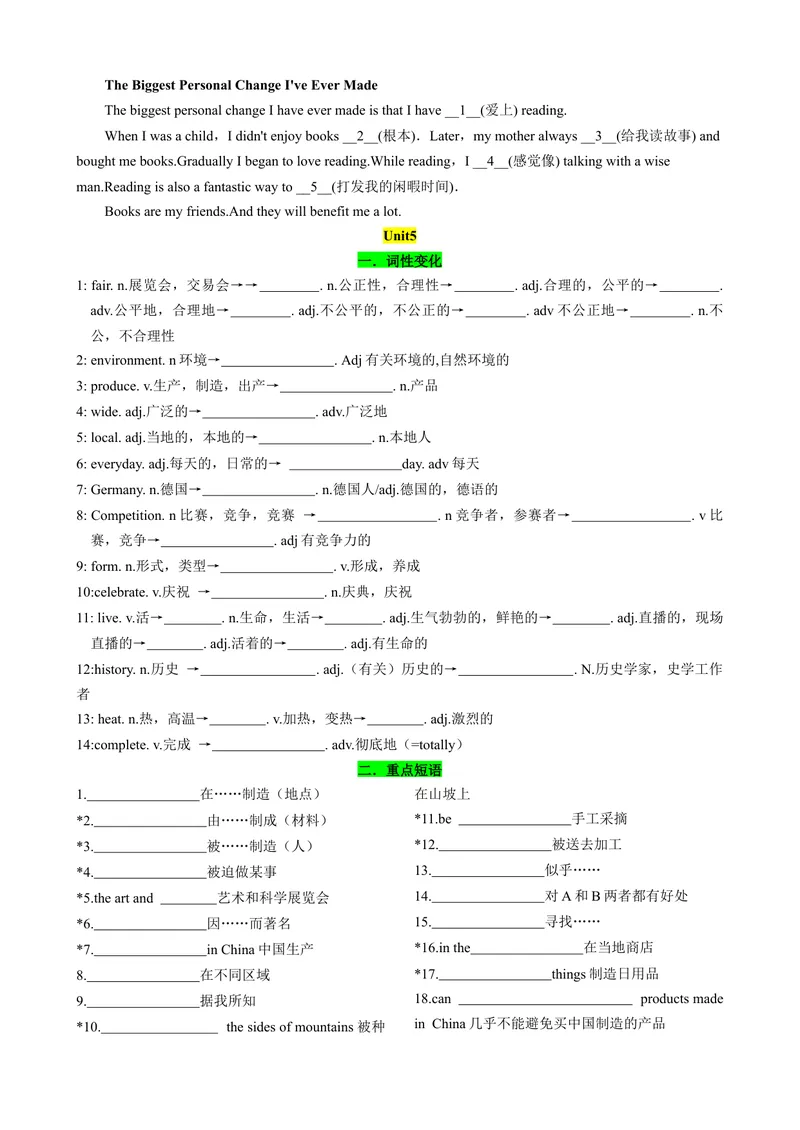
一.词性变化
1: fair. n.展览会,交易会→→ . n.公正性,合理性→ . adj.合理的,公平的→ .
adv.公平地,合理地→ . adj.不公平的,不公正的→ . adv不公正地→ . n.不
公,不合理性
2: environment. n环境→ . Adj有关环境的,自然环境的
3: produce. v.生产,制造,出产→ . n.产品
4: wide. adj.广泛的→ . adv.广泛地
5: local. adj.当地的,本地的→ . n.本地人
6: everyday. adj.每天的,日常的→ day. adv每天
7: Germany. n.德国→ . n.德国人/adj.德国的,德语的
8: Competition. n比赛,竞争,竞赛 → . n竞争者,参赛者→ . v比
赛,竞争→ . adj有竞争力的
9: form. n.形式,类型→ . v.形成,养成
10:celebrate. v.庆祝 → . n.庆典,庆祝
11: live. v.活→ . n.生命,生活→ . adj.生气勃勃的,鲜艳的→ . adj.直播的,现场
直播的→ . adj.活着的→ . adj.有生命的
12:history. n.历史 → . adj.(有关)历史的→ . N.历史学家,史学工作
者
13: heat. n.热,高温→ . v.加热,变热→ . adj.激烈的
14:complete. v.完成 → . adv.彻底地(=totally)
二.重点短语
1. 在……制造(地点) 在山坡上
*2. 由……制成(材料) *11.be 手工采摘
*3. 被……制造(人) *12. 被送去加工
*4. 被迫做某事 13. 似乎……
*5.the art and 艺术和科学展览会 14. 对A和B两者都有好处
*6. 因……而著名 15. 寻找……
*7. in China中国生产 *16.in the 在当地商店
8. 在不同区域 *17. things制造日用品
9. 据我所知 18.can products made
*10. the sides of mountains被种 in China几乎不能避免买中国制造的产品19.get better at 更擅长制造高科 30. to ask for help被放出去求救
技产品 *31.at and other 在节日和其他
*20. the world在世界各地 庆典中
21. wood and glass由用过的木头 *32. 被……覆盖
和玻璃制成 33. the air上升到空中
22. 被允许做某事 34. bright symbols of happiness
23.on the Friday of each month在每个月 and good wishes被看作是幸福和良好祝愿的鲜明象
的最后一个星期五 征
24. many traffic 引起很多交通事 *35 before it is with scissors在
故 用剪刀剪之前先折叠
25. more about...尽量去找出更多 *36. 剪纸
有关……的情况 *37. 历史故事
26. 度假 *38.be carefully 用手小心地制
* 27.have its 有它自己 作成形
特殊的传统艺术形式 *39. a very high heat高温烧制
*28. objects of beauty转变成美丽 40. 被用来……
的物体 41. midnight在午夜关门
29. 根据
42.a lot of 很多关于……的研究
三.重点句子
*l.Where is tea in China?中国哪里产茶?
---In many different .在很多不同的地区。
2.Hangzhou its tea..杭州因茶而广为人知。
3.He realized that Americans can China.他意识到美国人几乎
不能避免买中国制造的产品。
*4.During the Spring Festival,they windows,doors and walls wishesfor
good luck and a happy new year.在春节期间,它们被贴在窗上、门上和墙上,作为对好运和新年快乐的祝
愿的象征。
5.Some colorful pictures.有些(风筝)被绘有彩色的图案。
6.It takes weeks to everything.完成一切要花费数周时间。
*7.These small pieces of clay art that all Chinese people have for life and beauty.这
些小小的陶艺品显示了所有中国人对生活和美的热爱。
三.语法精讲
一般现在时的被动语态
1.被动语态
语态是动词的一种形式,用于说明主语和谓语之间的关系。英语中的语态有两种:主动语态和被动
语态。主动语态表示主语是动作的执行者;被动语态表示主语是动作的承受者。被动语态中的执行者可
由介词by引出。如:
Lots of students love this English song.(主动语态,句子的主语lots of students是动作love的执行者)
This English song is loved by lots of students.(被动语态,句子的主语this English song是动作love的承受者)
2.一般现在时的被动语态的构成
被动语态由“助动词be+及物动词的过去分词”构成,其中的助动词be有人称、数和时态的变化。
一般现在时的被动语态的各种句式如下:
句式 构成 例句
肯定
主语+am/is/are+及物动词的过去分 English is widely used all over the
词(+其他) world.
句
否定
主语+am/is/are+not+及物动词的过 The uniforms are not worn by students
去分词(+其他) every day.
句
一般
Am/Is/Are+主语+及物动词的过去 Are you asked to stay at the room
疑问
分词(+其他) alone?
句
3.主动语态变被动语态的方法
把主动语态的句子转换为被动语态的句子,需遵循以下几个步骤:先找出谓语动词;再找出谓语动
词后的宾语;把宾语用作被动语态句子中的主语(宾语若是人称代词,须将宾格变为主格);再将主动句中
的主语置于介词by之后(若是人称代词,须将主格变为宾格);注意人称、时态和数等的变化。如:
We plant trees every year.→Tress are planted (by us) every year.
4.注意事项
(1)不及物动词(短语)如happen,rise,appear,come out,take place等没有被动语态。
(2)动词短语如talk about,pay attention to,take care of等在变为被动语态时,其中的介词不可漏掉。
(3)在主动语态的句子中,感官动词和使役动词后面接省略 to的动词不定式;但在变为被动语态时,
不能省略to。
(4)有些动词的主动语态形式可以表示被动意义。如:
These books sell well.这些书卖得很好。
语法精练
一.用括号中所给单词的适当形式填空。
1.English (learn) as a foreign language in most of Chinese schools.
2.The dogs (take) good care of by my mother.
3.Usually,my homework (not do) in the afternoon.
4.Are the flowers (water) every day?5.Computers l(not sell) well in that shop.
6.Is our school (visit) by many people every day?
7.Three languages (use) in this country.
8.The workers (make) to work 12 hours every day.
9.Nowadays sky lanterns (see) as bright symbols of good luck.
10.Usually,shirts and ties (give) to fathers as gifts on Father's Day.
五.话题写作
山东潍坊以风筝闻名于世。假如你是潍坊人,本周你们学校英文报的“My City”栏目要介绍风筝,现面向
全校学生征稿。请你根据以下提示用英语写一篇介绍风筝的短文然后投稿。
提示:
1.材料:竹子、纸或布或塑料(plastic)、细绳;
2.用途:过去用于送信,现在用来娱乐和锻炼;
3.潍坊被誉为“世界风筝之都(the Kite Capital of the World)”,每年四月份会举办国际风筝节。
要求:
1.可适当增加细节以使行文通顺、连贯;
2.词数90左右,开头已给出,不计入总词数。
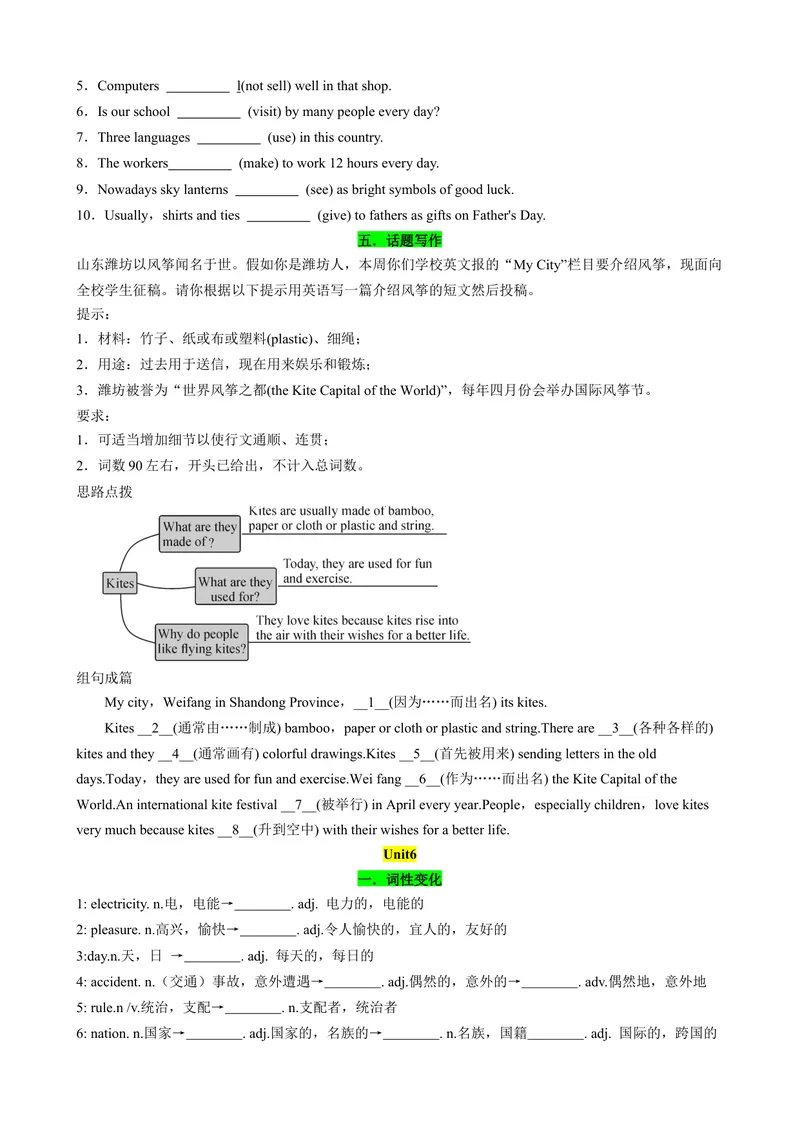
思路点拨
组句成篇
My city,Weifang in Shandong Province,__1__(因为……而出名) its kites.
Kites __2__(通常由……制成) bamboo,paper or cloth or plastic and string.There are __3__(各种各样的)
kites and they __4__(通常画有) colorful drawings.Kites __5__(首先被用来) sending letters in the old
days.Today,they are used for fun and exercise.Wei fang __6__(作为……而出名) the Kite Capital of the
World.An international kite festival __7__(被举行) in April every year.People,especially children,love kites
very much because kites __8__(升到空中) with their wishes for a better life.
Unit6
一.词性变化
1: electricity. n.电,电能→ . adj. 电力的,电能的
2: pleasure. n.高兴,愉快→ . adj.令人愉快的,宜人的,友好的
3:day.n.天,日 → . adj. 每天的,每日的
4: accident. n.(交通)事故,意外遭遇→ . adj.偶然的,意外的→ . adv.偶然地,意外地
5: rule.n /v.统治,支配→ . n.支配者,统治者
6: nation. n.国家→ . adj.国家的,名族的→ . n.名族,国籍 . adj. 国际的,跨国的7: trade. n.贸易→ . v.贸易,交易
8: popular. adj.流行的,受欢迎的→ . n.流行,受到欢迎,喜爱
9: doubt. n.疑问,疑惑,怀疑→ . v.怀疑
10: low. adj.低的,矮的→ . v.降低,减少
11: translate. v.翻译→ . n.翻译→ . n.翻译家,翻译官
12: lock. n.锁→lock. v.锁上,锁住→ . v.打开,解锁
13: sudden. adj. 突然的→ . adv突然地
14:music. n.音乐 → . adj.音乐的,有音乐天赋的→ . n.音乐家
15: salt. n.盐→ . adj.咸的
16: customer. n.顾客,客户→ . n.传统,习俗→ . n.海关
17:professional. adj.专业的,职业的 → . n.职业,专业
18: nearly.adv.几乎→ . adj.附近的,就近的
二.重点短语
*1. 被……发明 以作为一种饮料的人
2. 被……邀请 *22. 煮饮用水
*3. doing sth.被用来做某事 *23. 在户外的炉火上
*4. do sth.被用来做某事 24. 掉进水里
*5. 习惯于做某事 25.one of the world's 世界上最受
*6. 过去常常做某事 欢迎的饮料之一
7.shoes special 有着特殊鞋跟的 *26. 人们相信……
鞋子 27.in 100 years在不到100年的
*8. electricity靠电运行 时间里
*9.the for my school 我的学校 28.become the 成为一种全国性
项目的主题 饮料
*10. 在我们的日常生活中 29.the tea from China Western
countries从中国到西方各国的茶叶贸易
*1l. 很乐意
*30. 发生
*12. 被列出来
*31. the of tea传播茶的普及性
13.the pioneers of 不同发明的先
锋 *32. 毫无疑问
*14.an 一个偶然的发明 *33.best the of tea最了解茶的
*15. a nice 产生一种好闻的气味 本质
34. 以低价
*16. 意外地
*35. 把……翻译成……
*17. 错误地
*36. 突然
18. 犯错误
*37.work the of...从事……的发
19. 据说……
明工作
*20.a Chinese Shen Nong一位名
38. an instrument to a telephone
叫神农的中国统治者
通过类似于电话的工具
*21.the first to 第一个发现茶可39.be not 不够咸 己的篮筐
40.in 200 在200多个国家里 45. …的数量(谓语动词用单
41.a Canadian doctor ...一位名叫……的加 数)
拿大医生 *46. 一些……(谓语动词用复
*42. 把……分成…… 数)
43. 同时 47. to these basketball heroes钦佩这些篮
44. the competing team getting the
球英雄
ball into their own basket阻止对方球队把球扔人自 48. 想出
三.重点句子
*l.一When was the telephone invented?电话是什么时候被发明的?一It in1876.它是
1876年被发明的。
*2.-What are they (shoes with special heels) ?它们(带特殊后跟的鞋子)被用来做什么?
一You can the style of your shoes.你可以改变鞋的样式。
*3.一Who was it invented by?它是由谁发明的?
一It Whitcomb Judson.它是由惠特科姆·贾德森发明的。
4.Tea Korea and Japan during the 6th and 7th centuries.茶是在公元6至7世纪期间被带往
朝鲜和日本的。
*5.At the same time,they the competing team getting the ball
into their own basket.同时,他们需要阻止竞争球队把球投入他们自己的篮筐中。
*6.Players on the same team must work to the ball in the other team's basket.同组的队员必
须齐心协力把球扔进对方的篮筐。
7. foreign players, Chinese players,in the NBA has increased.在NBA,包
括中国球员在内的外国球员的数量增加了。
*8.These stars young people to their dreams.这些明星鼓励年
轻人努力工作来实现梦想。
*9.It is often to the of certain .关于某些
发明的发明者是谁经常是很难确定的。
四.语法考点
一般过去时的被动语态
1.一般过去时的被动语态的构成
一般过去时的被动语态表示在过去某一时间发生的被动性动作,由“was/were+及物动词的过去分词
+by+动作执行者”构成,无须说明动作的执行者时可省略“by+动作执行者”。如:
The flowers were watered by Lucy.这些花是露西浇的水。
The bridge was built in 1987.这座桥是在1987年建造的。
2.一般过去式的被动语态的基本句式
句式 构成 例句
肯定 主语+was/were+及物动词的过去分词 These cakes were made by my sister last night.这些蛋(+其他).
糕是我的姐姐昨晚做的。
句
主语+was/were+not+及物动词的过去
否定
分词(+其他). The watch was not found yesterday afternoon.那块手表
昨天下午没有被找到。
句
一般
Was/Were+主语+及物动词的过去分词 —Was the book written in English?这本书是用英语
(+其他)? 写的吗?
疑问
肯定回答:Yes,主语+was/were. —Yes,it was.是的,它是。
句及
否定回答:主语+wasn't/weren't. —No,it wasn't.不,它不是。
答语
特殊 When were the photos taken?这些照片是什么时候
拍的?
特殊疑问词+was/were+主语+及物动
疑问
词的过去分词(+其他)?
Where was the pet dog found?那个宠物狗是在哪儿
句 被发现的?
3.特殊形式的被动语态
(1)含有双宾语的被动语态
含有双宾语的主动句变被动句时,可以将其中任何一个宾语变为被动句的主语。一般是把主动句中指人
的间接宾语变为被动句的主语;若将指物的间接宾语变为被动句的主语,则间接宾语前要加上介词 to或
for。如:He lent me some money.→I was lent some money (by him).→Some money was lent to me (by
him).
(2)复合宾语的被动语态
若主动句为“主语+谓语+宾语+宾补”这种复合宾语结构时,则只将宾语变为被动句的主语,而宾语
补足语保留在谓语动词的后面成为主语补足语。如:
I found him lying on the floor.→He was found lying on the floor.
【注意】在主动语态中,用于watch,see,hear,notice,make等后面作宾语补足语的动词不定式都不带
to,但改成被动语态后要加上to。如:
We saw him enter the house.→He was seen to enter the house.
语法精练
一.用括号中所给单词的适当形式填空。
1.When the cat (find),it was very hungry.So we gave it some food.2.My father (buy) me a new car.It was my birthday gift.
3.It (say) that 4 is an unlucky number in China.
4.Paper was first (create) about 2,000 years ago in China.
5.The water (feel) cool when I jumped into the pool for morning exercises.
6.Sorry,train tickets to Shanghai (sell) out about half an hour ago.
7.The new school library t(not build) in September.
8.The little boy's left leg (break) in the basketball game yesterday.
9.All the problems (solve) by the famous engineer two days ago.
10.I (tell) to wait at the gate at 8 o'clock.But he didn't turn up at that time.
五.话题写作
以“I Want to Invent ________ ”为题,写一篇短文。
要求:1.将题目补充完整;2.条理清晰,逻辑合理;3.词数80左右。
思路点拨
组句成篇
I Want to Invent a__Fmaily__Doctor__Robort
I want to invent a family doctor robot,which __1__(能够被用于) cure the illness without going out of our
home.__2__(据我所知),it will be extremely helpful and useful because of the following reasons.
First,you can see the doctor immediately at home when you feel sick or get hurt.It can __3__(节约你大量
的时间),especially in emergency situations.
Second,hospitals today are always filled with patients;not everyone can be taken good care of.However,
with the help of our doctor robot,you can talk to your personal doctor __4__(面对面) whenever you want.
__5__(简而言之),family doctor robots can make a great contribution to our society.
综合训练一
一.用方框中所给词语的适当形式填空,每词仅用一次
speak silence humor help introduce
1.Our English teacher is a man.He always tells us funny things.
2.Mr.Du often begins his lessons with a simple
3.-Are you at home?- Yes.I always help with housework.
4.He is good at making in English.
5.He is always these days and no one knows what happened to him.
二、根据句意及汉语提示完成句子
1.The article can help us learn more about the (背景)of the music.
2.Could you give me some advice on how to do well in an online (面试)?
3.Miss Green would like to have a (私人的)discussion with Alice.
4.It's true that Lu Xun's writings have (影响)the lives of millions.
5.There is a well-known saying that“Many (蚂蚁)kill the horse'”
6.The patients in ICU (需要)special attention because they are still at death's door.
7.Mike (得分)l3 points in the basketball game yesterday.
8.My uncle has been to some (欧洲的)countries before.
9.Can you understand (英国的)English?
10.Is there a (公共的)restroom around here?
三、语法填空
阅读下面短文,在空白处填入一个适当的词,或填入括号中所给单词的正确形式。
Great changes 1 (take)place in people's life in the past 20 years.In the past,people kept in touch
with 2 (relative)or friends mainly by sending letters.They would listen 3 the radio for
news and other information.Children used4 (go)to school by bicycle.Big families 5
(have)to share small rooms.
Now people can talk to others by telephone 6 on the Internet at home.7 they are
free,they watch the news and other programs on TV.Some families are rich enough to send their children to
school in 8 (they)own cars.More and 9 (many)people live in big and bright apartments
with several rooms.
In 10 word,people live better than before.
综合训练二
一、根据汉语提示完成短文
The beautiful sound of bamboo xiao in China reminds people of a lonely moon.That's amoon hanging high in
the sky on a cold autumn night.It is the sound of nature.There are evensome xiao 1 (展览会)in China
every year.It's a traditional Chinese instrument.
Nowadays,it has become one of the 2 (国际的)instruments.
The earliest xiao was 3 (生产)during the Han Dynasty.And4 (它的)name was then
qiangdi,which was popular among the Qiang people in Sichuan and GansuProvinces.Qiangdi was a(n)5
(当地的)instrument then.In the first century B.C.,itbecame popular in the Yellow River area.Later,it was 6
(广泛地)used in Chinaand it developed into an instrument with six holes,which was extremely 7 (相
似的)to today's xiao.
Its structure is quite simple,very much like the flute(长笛),but it's longer.Its8 (材料)is usually
bamboo.There is a mouth on the top and five sound holes on the front side and one hole at the back.Besides,there
are other holes that are designed to adjust the tunes(曲调),smooth the tones(音调),and raise the volumed(音量).Xiao sounds soft and peaceful.
The performance 9 (形式)are mainly the same as those of the flute.However,it is less 10
(有生气的)than the flute.For that reason,it is only suitable to play slow and peaceful music,which expresses
people's feelings and draws a beautiful picture of nature.
二、语法填空
阅读下面短文,在空白处填入一个适当的词,或填入括号中所给单词的正确形式。
Considered as one of the national treasures of China,Peking Opera has 1 history of more than 200
years.It is one of China's major traditional art 2 (form).
It appeared in the late 18th century and 3 (become)fully developed in the mid-19th century.
Peking Opera shows rich Chinese culture,including wonderful stories,paintings and clothes.It
features(以……为特色)four main types of performers called sheng,dan,jing andchou.Sheng is the main male
role.For example,young male characters 4 (know)as xiaosheng.Laosheng is the older role.Dan is a
female role.Jing is a face-painted male role and chou is a male clown(小丑)role.
Peking Opera tells stories through movement,singing and dancing.Stories in 5 are very
interesting.Some of them are from history books,6 most of them are from famous novels.The stories
have been passed down for thousands 7 years in Chinese history.
So far,Peking Opera 8 (become)an important opera form for Chinese audiences(观众).It is even9
(wide)accepted by Western audiences.More and more Western fans begin to learn the art.Some even come to
China 10 (compete)and perform in popular talent shows on CCTV.
综合训练三
一.用方框中所给词语的适当形式填空,每词仅用一次
music rule please nation accidental
1.I hit Bob in the face when I turned around.
2.Born with a(n) talent,Danny loves singing very much.
3.Easter is not a(n) holiday in our country.
4.The white building was once used as a home for the of the area.
5.-Tom,could you help to take out the trash?
-With
二、根据句意及汉语提示完成句子
1.Miss Green finds it uncomfortable to wear shoes with high (鞋跟).
2.There is always interesting news on this (网站),so I often visit it.
3.Keeping the TV on without watching it will be a waste of (电).
4.They are trying to offer the best service to all their (顾客).
5.The 65-year-old lady is one of the (先锋)in the space research group.
6.Several new inventions were (提到)in the report yesterday.
7.The (曲奇饼)taste very nice.Would you like some?
8.The (受欢迎)of smartphones has risen in recent years.
9.I don't like the soup because it tastes too (咸的).10.It's very important to know what to do in a(n) (地震).
三、语法填空
阅读下面短文,在空白处填入一个适当的词,或填入括号中所给单词的正确形式。
How do you like chewing gum(口香糖)?It may be one of the children's favorite sweets.But do you know
how it was invented and 1 invented it?
The popular sweet was invented by an American scientist 2 (name)Thomas
Adams.And he invented it by mistake.It was 1869.3 (early)that year,one of
Adams's friends showed him an interesting kind of sap(树液).4 sap was very
elastic(有弹性的)、Ancient people in Central America liked to chew on it for fun.Adams was interested in
the sap.He wanted to use it to create some new 5 (product).
Adams,however,failed to create what he wanted.He felt so 6 (bore)and
angry that he chewed on the sap one day.To his surprise,the sap tasted great.Adams then added his own
flavoring(调味品)to the sap.Later in1869,he opened a factory7(produce)this delicious thing.
In 1888,Adams gave a name to the 8 (invent)-chewing gum.The sweet was available through
vending machines(自动售货机)at subway stations all over New York City.
Over the years,new flavors have been developed.Now chewing gum is popular 9 both children and
adults.But in fact few people know that this 10 (start)by a scientist from a mistake.
Do you know potato chips,cola,X-rays and microwaves were all invented or discovered by mistake?Choose
one that interests you most and learn more about it.