Unit11-Unit14(词汇,短语,句型,语法,写作复习+基础练习)
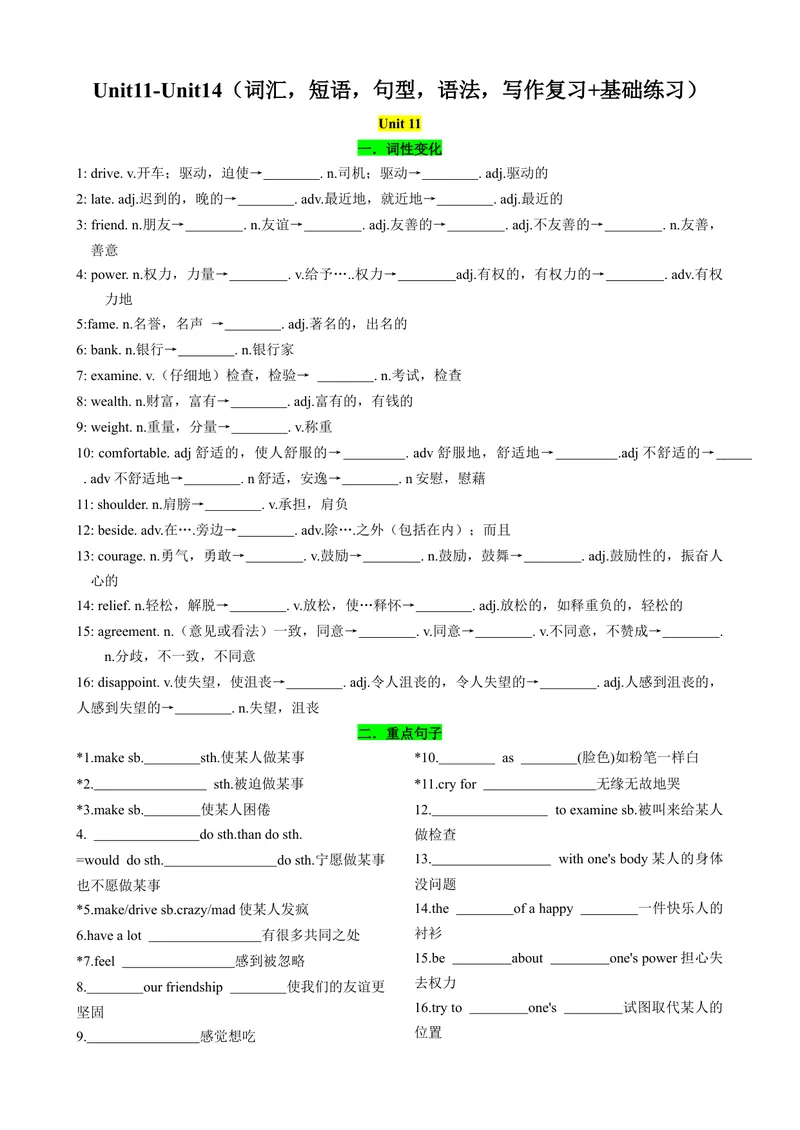
Unit 11
一.词性变化
1: drive. v.开车;驱动,迫使→ . n.司机;驱动→ . adj.驱动的
2: late. adj.迟到的,晚的→ . adv.最近地,就近地→ . adj.最近的
3: friend. n.朋友→ . n.友谊→ . adj.友善的→ . adj.不友善的→ . n.友善,
善意
4: power. n.权力,力量→ . v.给予…..权力→ adj.有权的,有权力的→ . adv.有权
力地
5:fame. n.名誉,名声 → . adj.著名的,出名的
6: bank. n.银行→ . n.银行家
7: examine. v.(仔细地)检查,检验→ . n.考试,检查
8: wealth. n.财富,富有→ . adj.富有的,有钱的
9: weight. n.重量,分量→ . v.称重
10: comfortable. adj舒适的,使人舒服的→ . adv舒服地,舒适地→ .adj不舒适的→
. adv不舒适地→ . n舒适,安逸→ . n安慰,慰藉
11: shoulder. n.肩膀→ . v.承担,肩负
12: beside. adv.在….旁边→ . adv.除….之外(包括在内);而且
13: courage. n.勇气,勇敢→ . v.鼓励→ . n.鼓励,鼓舞→ . adj.鼓励性的,振奋人
心的
14: relief. n.轻松,解脱→ . v.放松,使…释怀→ . adj.放松的,如释重负的,轻松的
15: agreement. n.(意见或看法)一致,同意→ . v.同意→ . v.不同意,不赞成→ .
n.分歧,不一致,不同意
16: disappoint. v.使失望,使沮丧→ . adj.令人沮丧的,令人失望的→ . adj.人感到沮丧的,
人感到失望的→ . n.失望,沮丧
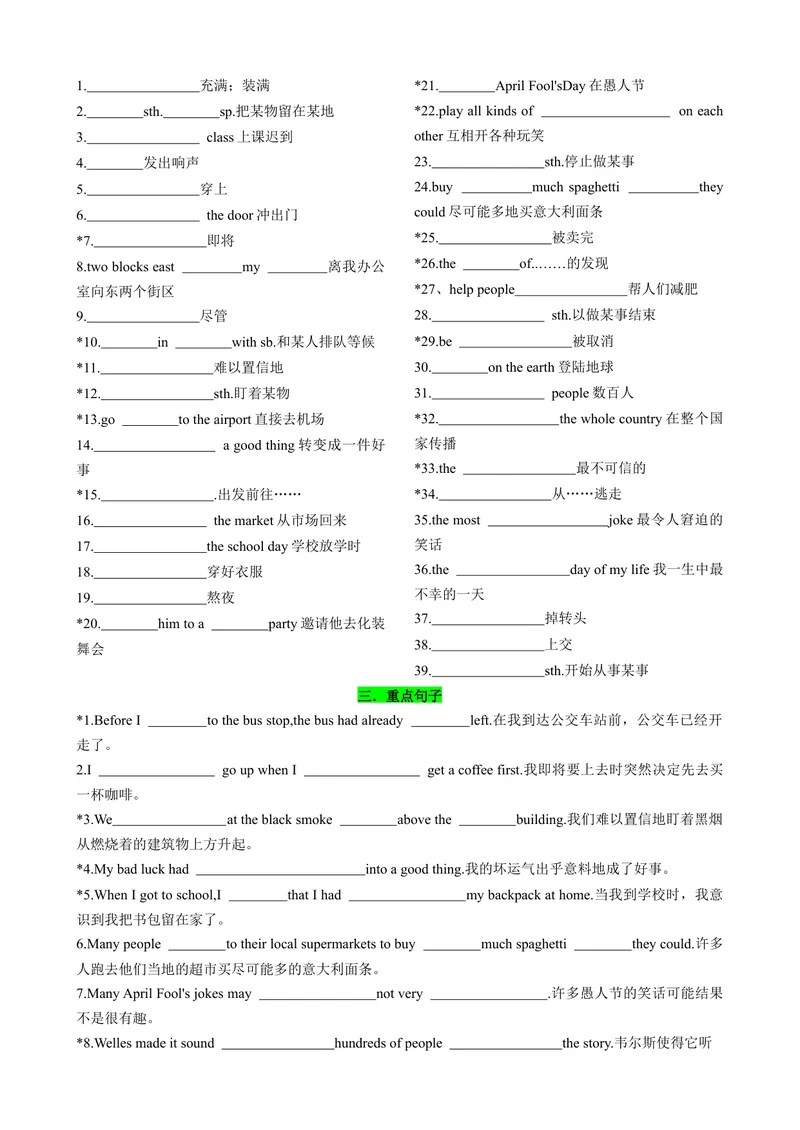
二.重点句子
*1.make sb. sth.使某人做某事 *10. as (脸色)如粉笔一样白
*2. sth.被迫做某事 *11.cry for 无缘无故地哭
*3.make sb. 使某人困倦 12. to examine sb.被叫来给某人
4. do sth.than do sth. 做检查
=would do sth. do sth.宁愿做某事 13. with one's body某人的身体
也不愿做某事 没问题
*5.make/drive sb.crazy/mad使某人发疯 14.the of a happy 一件快乐人的
6.have a lot 有很多共同之处 衬衫
*7.feel 感到被忽略 15.be about one's power担心失
8. our friendship 使我们的友谊更 去权力
16.try to one's 试图取代某人的
坚固
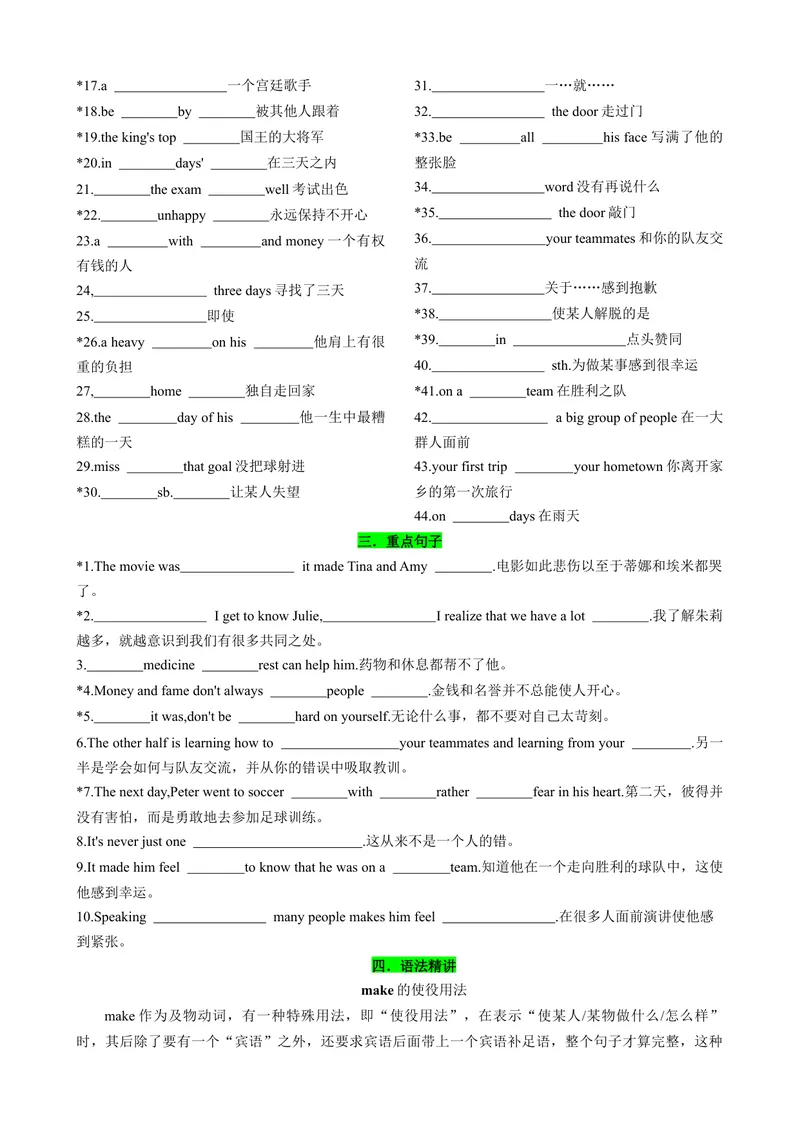
9. 感觉想吃 位置*17.a 一个宫廷歌手 31. 一…就……
*18.be by 被其他人跟着 32. the door走过门
*19.the king's top 国王的大将军 *33.be all his face写满了他的
*20.in days' 在三天之内 整张脸
21. the exam well考试出色 34. word没有再说什么
*22. unhappy 永远保持不开心 *35. the door敲门
23.a with and money一个有权 36. your teammates和你的队友交
有钱的人 流
24, three days寻找了三天 37. 关于……感到抱歉
25. 即使 *38. 使某人解脱的是
*26.a heavy on his 他肩上有很 *39. in 点头赞同
重的负担 40. sth.为做某事感到很幸运
27, home 独自走回家 *41.on a team在胜利之队
28.the day of his 他一生中最糟 42. a big group of people在一大
糕的一天 群人面前
29.miss that goal没把球射进 43.your first trip your hometown你离开家
*30. sb. 让某人失望 乡的第一次旅行
44.on days在雨天
三.重点句子
*1.The movie was it made Tina and Amy .电影如此悲伤以至于蒂娜和埃米都哭
了。
*2. I get to know Julie, I realize that we have a lot .我了解朱莉
越多,就越意识到我们有很多共同之处。
3. medicine rest can help him.药物和休息都帮不了他。
*4.Money and fame don't always people .金钱和名誉并不总能使人开心。
*5. it was,don't be hard on yourself.无论什么事,都不要对自己太苛刻。
6.The other half is learning how to your teammates and learning from your .另一
半是学会如何与队友交流,并从你的错误中吸取教训。
*7.The next day,Peter went to soccer with rather fear in his heart.第二天,彼得并
没有害怕,而是勇敢地去参加足球训练。
8.It's never just one .这从来不是一个人的错。
9.It made him feel to know that he was on a team.知道他在一个走向胜利的球队中,这使
他感到幸运。
10.Speaking many people makes him feel .在很多人面前演讲使他感
到紧张。
四.语法精讲
make的使役用法
make作为及物动词,有一种特殊用法,即“使役用法”,在表示“使某人/某物做什么/怎么样”
时,其后除了要有一个“宾语”之外,还要求宾语后面带上一个宾语补足语,整个句子才算完整,这种“宾语+宾语补足语”的结构是英语简单句的五种基本句型之一,其具体用法如下:
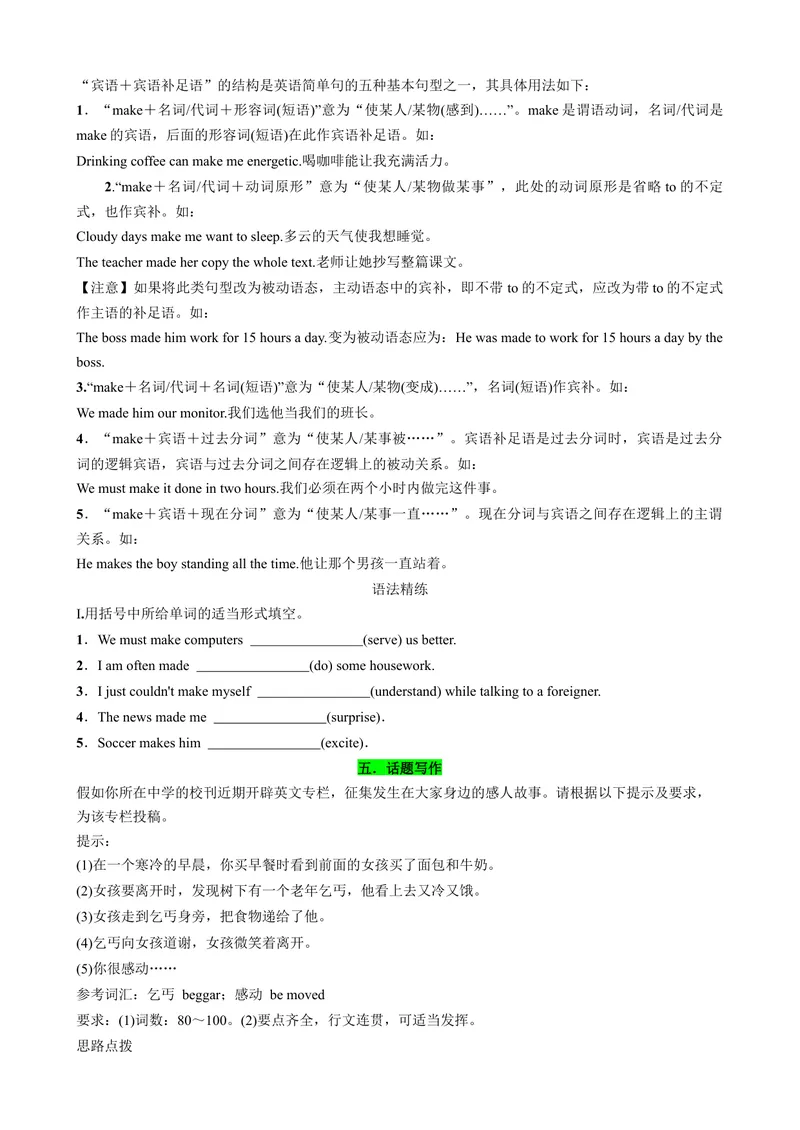
1.“make+名词/代词+形容词(短语)”意为“使某人/某物(感到)……”。make是谓语动词,名词/代词是
make的宾语,后面的形容词(短语)在此作宾语补足语。如:
Drinking coffee can make me energetic.喝咖啡能让我充满活力。
2.“make+名词/代词+动词原形”意为“使某人/某物做某事”,此处的动词原形是省略to的不定
式,也作宾补。如:
Cloudy days make me want to sleep.多云的天气使我想睡觉。
The teacher made her copy the whole text.老师让她抄写整篇课文。
【注意】如果将此类句型改为被动语态,主动语态中的宾补,即不带 to的不定式,应改为带to的不定式
作主语的补足语。如:
The boss made him work for 15 hours a day.变为被动语态应为:He was made to work for 15 hours a day by the
boss.
3.“make+名词/代词+名词(短语)”意为“使某人/某物(变成)……”,名词(短语)作宾补。如:
We made him our monitor.我们选他当我们的班长。
4.“make+宾语+过去分词”意为“使某人/某事被……”。宾语补足语是过去分词时,宾语是过去分
词的逻辑宾语,宾语与过去分词之间存在逻辑上的被动关系。如:
We must make it done in two hours.我们必须在两个小时内做完这件事。
5.“make+宾语+现在分词”意为“使某人/某事一直……”。现在分词与宾语之间存在逻辑上的主谓
关系。如:
He makes the boy standing all the time.他让那个男孩一直站着。
语法精练
Ⅰ.用括号中所给单词的适当形式填空。
1.We must make computers (serve) us better.
2.I am often made (do) some housework.
3.I just couldn't make myself (understand) while talking to a foreigner.
4.The news made me (surprise).
5.Soccer makes him (excite).
五.话题写作
假如你所在中学的校刊近期开辟英文专栏,征集发生在大家身边的感人故事。请根据以下提示及要求,
为该专栏投稿。
提示:
(1)在一个寒冷的早晨,你买早餐时看到前面的女孩买了面包和牛奶。
(2)女孩要离开时,发现树下有一个老年乞丐,他看上去又冷又饿。
(3)女孩走到乞丐身旁,把食物递给了他。
(4)乞丐向女孩道谢,女孩微笑着离开。
(5)你很感动……
参考词汇:乞丐 beggar;感动 be moved
要求:(1)词数:80~100。(2)要点齐全,行文连贯,可适当发挥。
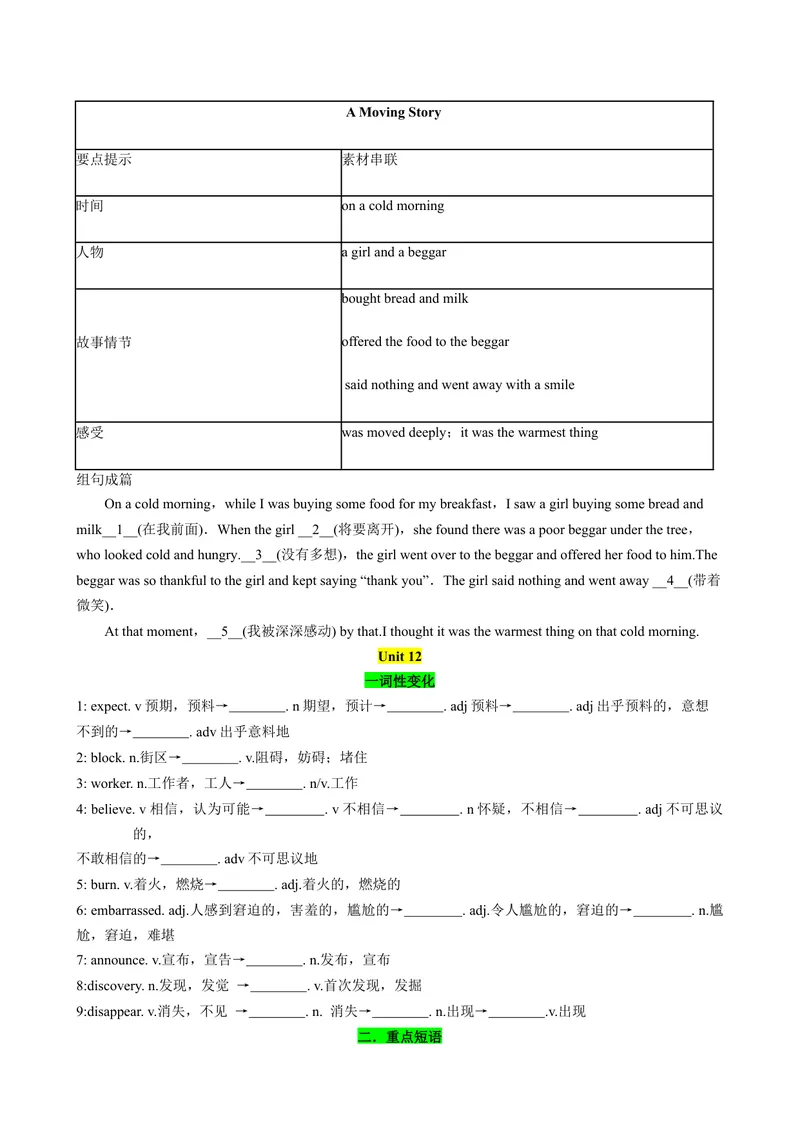
思路点拨A Moving Story
要点提示 素材串联
时间 on a cold morning
人物 a girl and a beggar
bought bread and milk
故事情节 offered the food to the beggar
said nothing and went away with a smile
感受 was moved deeply;it was the warmest thing
组句成篇
On a cold morning,while I was buying some food for my breakfast,I saw a girl buying some bread and
milk__1__(在我前面).When the girl __2__(将要离开),she found there was a poor beggar under the tree,
who looked cold and hungry.__3__(没有多想),the girl went over to the beggar and offered her food to him.The
beggar was so thankful to the girl and kept saying “thank you”.The girl said nothing and went away __4__(带着
微笑).
At that moment,__5__(我被深深感动) by that.I thought it was the warmest thing on that cold morning.
Unit 12
一词性变化
1: expect. v预期,预料→ . n期望,预计→ . adj预料→ . adj出乎预料的,意想
不到的→ . adv出乎意料地
2: block. n.街区→ . v.阻碍,妨碍;堵住
3: worker. n.工作者,工人→ . n/v.工作
4: believe. v相信,认为可能→ . v不相信→ . n怀疑,不相信→ . adj不可思议
的,
不敢相信的→ . adv不可思议地
5: burn. v.着火,燃烧→ . adj.着火的,燃烧的
6: embarrassed. adj.人感到窘迫的,害羞的,尴尬的→ . adj.令人尴尬的,窘迫的→ . n.尴
尬,窘迫,难堪
7: announce. v.宣布,宣告→ . n.发布,宣布
8:discovery. n.发现,发觉 → . v.首次发现,发掘
9:disappear. v.消失,不见 → . n. 消失→ . n.出现→ .v.出现
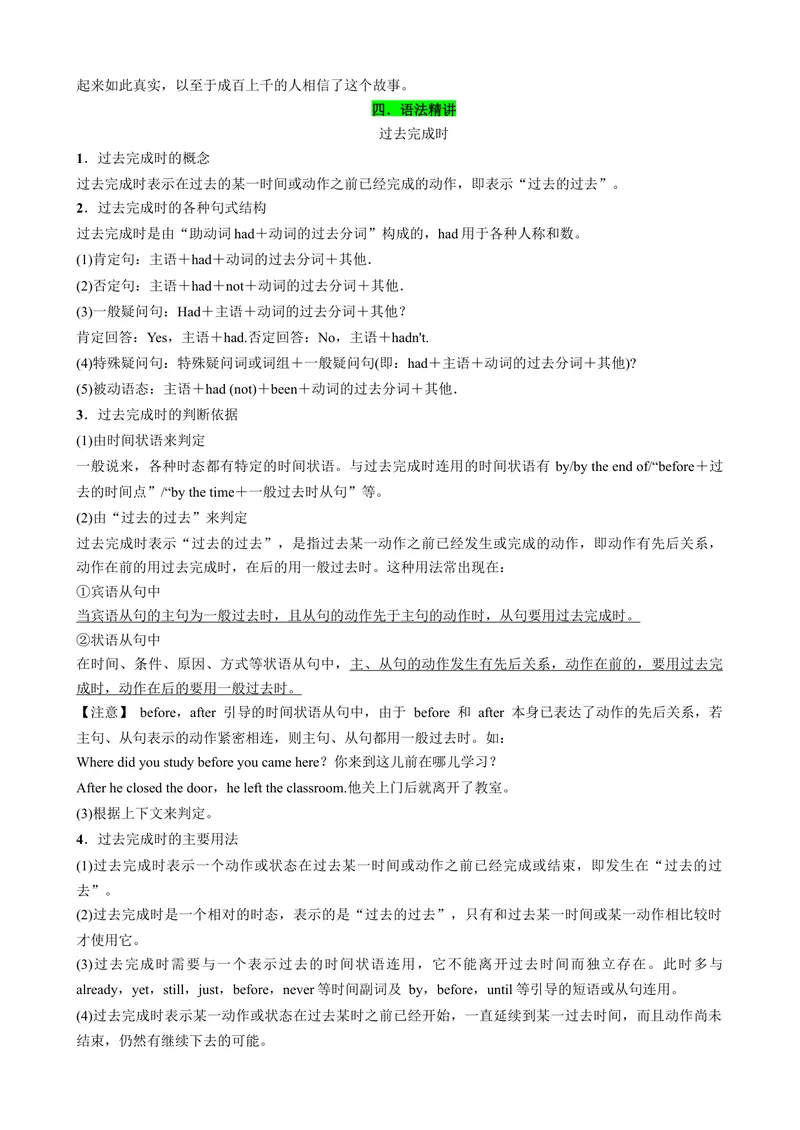
二.重点短语1. 充满;装满 *21. April Fool'sDay在愚人节
2. sth. sp.把某物留在某地 *22.play all kinds of on each
3. class上课迟到 other互相开各种玩笑
4. 发出响声 23. sth.停止做某事
5. 穿上 24.buy much spaghetti they
6. the door冲出门 could尽可能多地买意大利面条
*7. 即将 *25. 被卖完
8.two blocks east my 离我办公 *26.the of..……的发现
室向东两个街区 *27、help people 帮人们减肥
9. 尽管 28. sth.以做某事结束
*10. in with sb.和某人排队等候 *29.be 被取消
*11. 难以置信地 30. on the earth登陆地球
*12. sth.盯着某物 31. people数百人
*13.go to the airport直接去机场 *32. the whole country在整个国
14. a good thing转变成一件好 家传播
事 *33.the 最不可信的
*15. .出发前往…… *34. 从……逃走
16. the market从市场回来 35.the most joke最令人窘迫的
17. the school day学校放学时 笑话
18. 穿好衣服 36.the day of my life我一生中最
19. 熬夜 不幸的一天
37. 掉转头
*20. him to a party邀请他去化装
舞会 38. 上交
39. sth.开始从事某事
三.重点句子
*1.Before I to the bus stop,the bus had already left.在我到达公交车站前,公交车已经开
走了。
2.I go up when I get a coffee first.我即将要上去时突然决定先去买
一杯咖啡。
*3.We at the black smoke above the building.我们难以置信地盯着黑烟
从燃烧着的建筑物上方升起。
*4.My bad luck had into a good thing.我的坏运气出乎意料地成了好事。
*5.When I got to school,I that I had my backpack at home.当我到学校时,我意
识到我把书包留在家了。
6.Many people to their local supermarkets to buy much spaghetti they could.许多
人跑去他们当地的超市买尽可能多的意大利面条。
7.Many April Fool's jokes may not very .许多愚人节的笑话可能结果
不是很有趣。
*8.Welles made it sound hundreds of people the story.韦尔斯使得它听起来如此真实,以至于成百上千的人相信了这个故事。
四.语法精讲
过去完成时
1.过去完成时的概念
过去完成时表示在过去的某一时间或动作之前已经完成的动作,即表示“过去的过去”。
2.过去完成时的各种句式结构
过去完成时是由“助动词had+动词的过去分词”构成的,had用于各种人称和数。
(1)肯定句:主语+had+动词的过去分词+其他.
(2)否定句:主语+had+not+动词的过去分词+其他.
(3)一般疑问句:Had+主语+动词的过去分词+其他?
肯定回答:Yes,主语+had.否定回答:No,主语+hadn't.
(4)特殊疑问句:特殊疑问词或词组+一般疑问句(即:had+主语+动词的过去分词+其他)?
(5)被动语态:主语+had (not)+been+动词的过去分词+其他.
3.过去完成时的判断依据
(1)由时间状语来判定
一般说来,各种时态都有特定的时间状语。与过去完成时连用的时间状语有 by/by the end of/“before+过
去的时间点”/“by the time+一般过去时从句”等。
(2)由“过去的过去”来判定
过去完成时表示“过去的过去”,是指过去某一动作之前已经发生或完成的动作,即动作有先后关系,
动作在前的用过去完成时,在后的用一般过去时。这种用法常出现在:
①宾语从句中
当宾语从句的主句为一般过去时,且从句的动作先于主句的动作时,从句要用过去完成时。
②状语从句中
在时间、条件、原因、方式等状语从句中,主、从句的动作发生有先后关系,动作在前的,要用过去完
成时,动作在后的要用一般过去时。
【注意】 before,after 引导的时间状语从句中,由于 before 和 after 本身已表达了动作的先后关系,若
主句、从句表示的动作紧密相连,则主句、从句都用一般过去时。如:
Where did you study before you came here?你来到这儿前在哪儿学习?
After he closed the door,he left the classroom.他关上门后就离开了教室。
(3)根据上下文来判定。
4.过去完成时的主要用法
(1)过去完成时表示一个动作或状态在过去某一时间或动作之前已经完成或结束,即发生在“过去的过
去”。
(2)过去完成时是一个相对的时态,表示的是“过去的过去”,只有和过去某一时间或某一动作相比较时
才使用它。
(3)过去完成时需要与一个表示过去的时间状语连用,它不能离开过去时间而独立存在。此时多与
already,yet,still,just,before,never等时间副词及 by,before,until等引导的短语或从句连用。
(4)过去完成时表示某一动作或状态在过去某时之前已经开始,一直延续到某一过去时间,而且动作尚未
结束,仍然有继续下去的可能。语法精练
Ⅰ.用括号中所给单词的适当形式填空。
1.By the time I reached home,my mother (cook) supper already.
2.Catherine (finish) the letter before her mother came into her bedroom.
3.The train (leave) when I got to the station.
4.The little girl (lie) in bed for almost a month since she fell(fall) sick.
5.By the end of last year,he (learn) 3,000 English words.
6.It was the third time that the girl (invite) him.
7.I (not find) the dog until last night.
8.He told his mother that he (run) out of money to buy new clothes.
9.Tom said that he (keep) the book for two weeks.
10.I suddenly remembered that I (leave)the key in my classroom when I (get)
home yesterday.
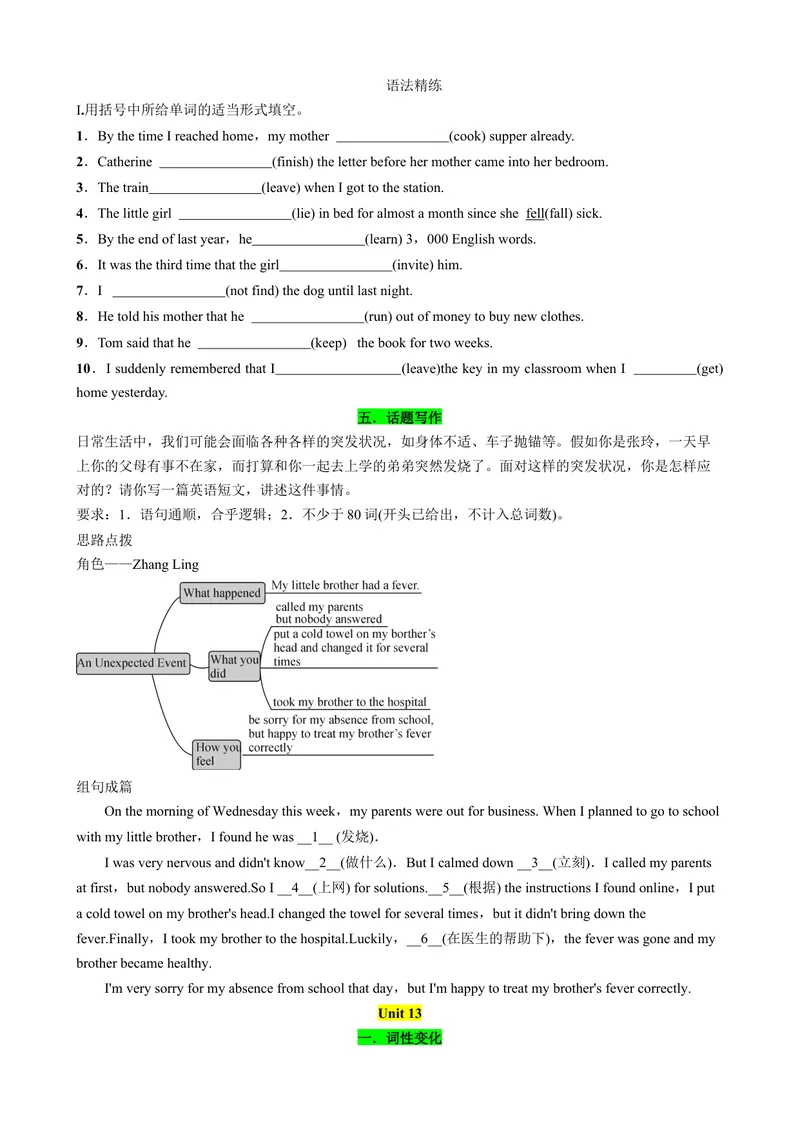
五.话题写作
日常生活中,我们可能会面临各种各样的突发状况,如身体不适、车子抛锚等。假如你是张玲,一天早
上你的父母有事不在家,而打算和你一起去上学的弟弟突然发烧了。面对这样的突发状况,你是怎样应
对的?请你写一篇英语短文,讲述这件事情。
要求:1.语句通顺,合乎逻辑;2.不少于80词(开头已给出,不计入总词数)。
思路点拨
角色——Zhang Ling
组句成篇
On the morning of Wednesday this week,my parents were out for business. When I planned to go to school
with my little brother,I found he was __1__ (发烧).
I was very nervous and didn't know__2__(做什么).But I calmed down __3__(立刻).I called my parents
at first,but nobody answered.So I __4__(上网) for solutions.__5__(根据) the instructions I found online,I put
a cold towel on my brother's head.I changed the towel for several times,but it didn't bring down the
fever.Finally,I took my brother to the hospital.Luckily,__6__(在医生的帮助下),the fever was gone and my
brother became healthy.
I'm very sorry for my absence from school that day,but I'm happy to treat my brother's fever correctly.
Unit 13
一.词性变化1: litter. n.垃圾,废弃物→ . v.乱扔
2: fisherman. n.渔夫→ . n.渔夫(复数)
3:advantage. n.优点,有利因素,有利条件 → . n.不利因素,劣势,不利条件
4: cost. n.花费价钱→ . v.花费,耗用
5: wood. n.木头→ . adj.木制的,木头的
6: cruel. adj. 残忍的,残酷的→ . adj.关键的,至关重要的,关键性的
7: harmful. adj.有害的→ . n.害处
8: scientific. adj.科学的,科学上的→ .n.科学→ . n.科学家
9: reuse. v.再次使用,再利用→ . adj.可重复使用的,可再次使用的
10: pay. v.付钱→ . n.付钱,费用
11: transportation. n.运输业,交通运输→ . n/v.运输,运送
12:recycle. v.回收利用,再利用 → . n.回收再利用
13: inspiration. n.灵感;鼓舞人心的人(或物) → . v.鼓舞→ . adj. 鼓舞人心的,鼓舞的
14: work. n/v.工作→ . n.作品,名著
15: creative. adj有创造性的→ . v创造→ . n创造者,造物主
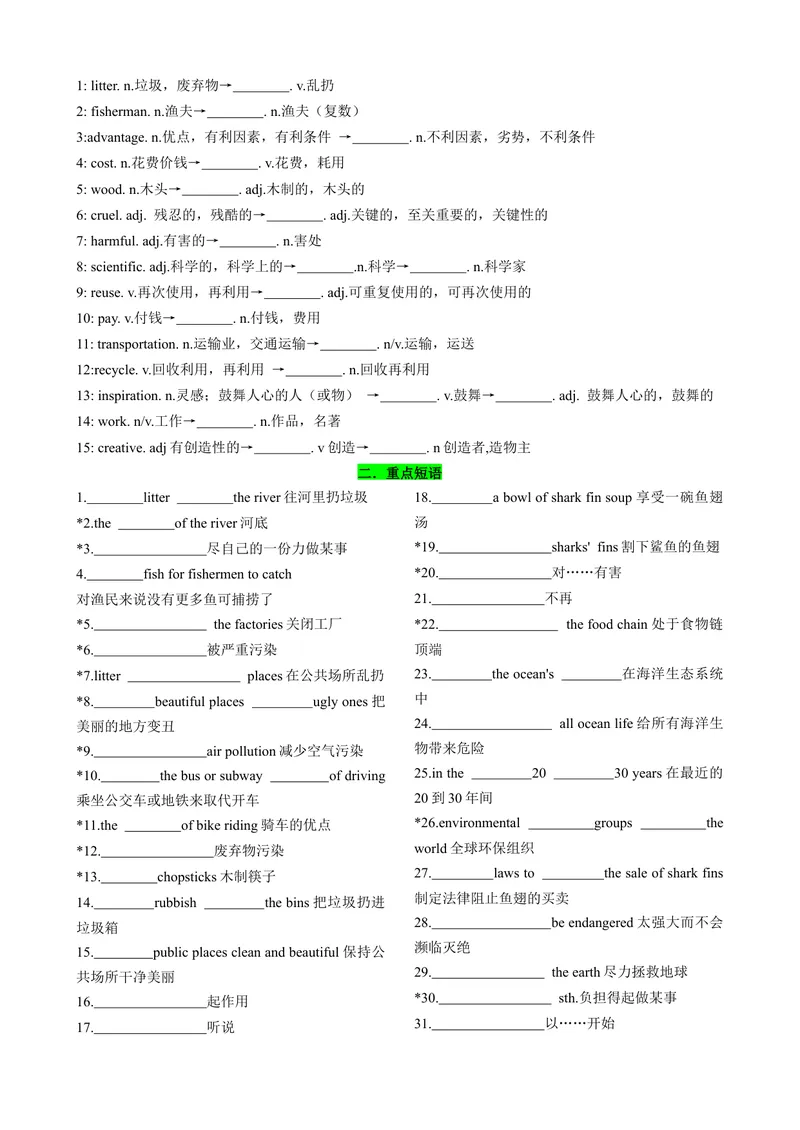
二.重点短语
1. litter the river往河里扔垃圾 18. a bowl of shark fin soup享受一碗鱼翅
*2.the of the river河底 汤
*3. 尽自己的一份力做某事 *19. sharks' fins割下鲨鱼的鱼翅
4. fish for fishermen to catch *20. 对……有害
对渔民来说没有更多鱼可捕捞了 21. 不再
*5. the factories关闭工厂 *22. the food chain处于食物链
*6. 被严重污染 顶端
*7.litter places在公共场所乱扔 23. the ocean's 在海洋生态系统
*8. beautiful places ugly ones把 中
美丽的地方变丑 24. all ocean life给所有海洋生
*9. air pollution减少空气污染 物带来危险
*10. the bus or subway of driving 25.in the 20 30 years在最近的
乘坐公交车或地铁来取代开车 20到30年间
*11.the of bike riding骑车的优点 *26.environmental groups the
*12. 废弃物污染 world全球环保组织
*13. chopsticks木制筷子 27. laws to the sale of shark fins
制定法律阻止鱼翅的买卖
14. rubbish the bins把垃圾扔进
28. be endangered太强大而不会
垃圾箱
濒临灭绝
15. public places clean and beautiful保持公
29. the earth尽力拯救地球
共场所干净美丽
16. 起作用 *30. sth.负担得起做某事
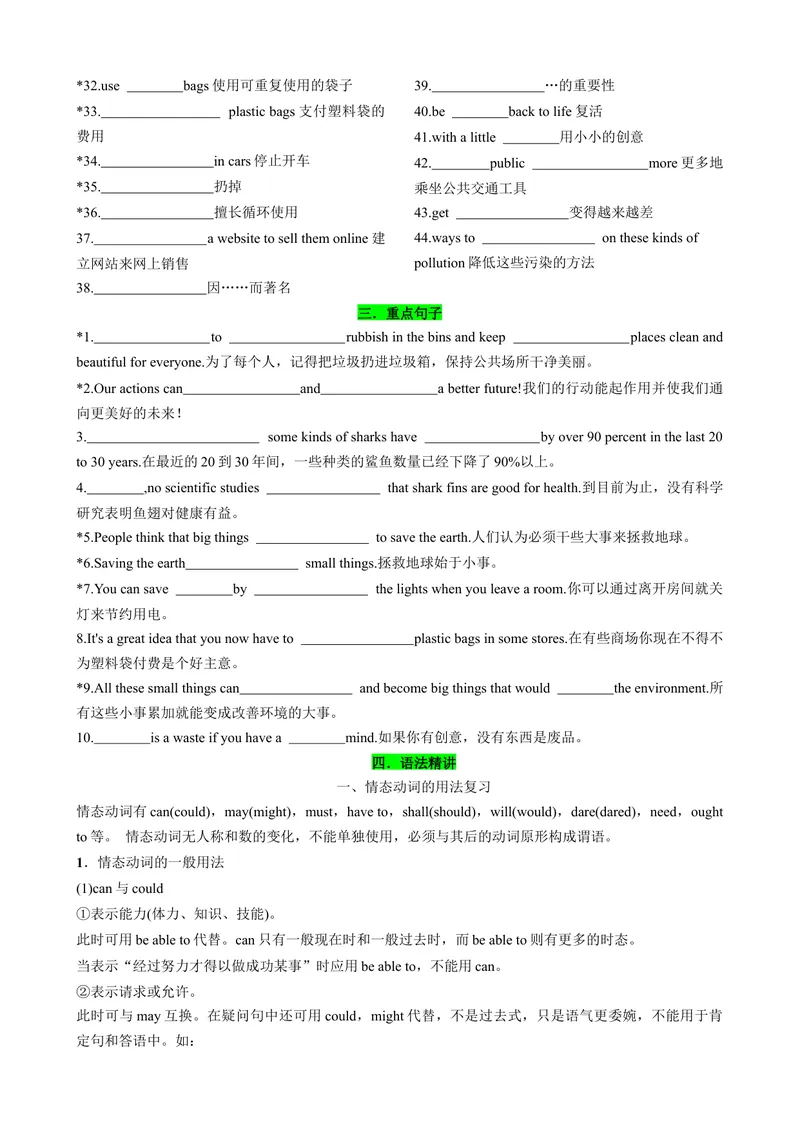
17. 听说 31. 以……开始*32.use bags使用可重复使用的袋子 39. …的重要性
*33. plastic bags支付塑料袋的 40.be back to life复活
费用 41.with a little 用小小的创意
*34. in cars停止开车 42. public more更多地
*35. 扔掉 乘坐公共交通工具
*36. 擅长循环使用 43.get 变得越来越差
37. a website to sell them online建 44.ways to on these kinds of
立网站来网上销售 pollution降低这些污染的方法
38. 因……而著名
三.重点句子
*1. to rubbish in the bins and keep places clean and
beautiful for everyone.为了每个人,记得把垃圾扔进垃圾箱,保持公共场所干净美丽。
*2.Our actions can and a better future!我们的行动能起作用并使我们通
向更美好的未来!
3. some kinds of sharks have by over 90 percent in the last 20
to 30 years.在最近的20到30年间,一些种类的鲨鱼数量已经下降了90%以上。
4. ,no scientific studies that shark fins are good for health.到目前为止,没有科学
研究表明鱼翅对健康有益。
*5.People think that big things to save the earth.人们认为必须干些大事来拯救地球。
*6.Saving the earth small things.拯救地球始于小事。
*7.You can save by the lights when you leave a room.你可以通过离开房间就关
灯来节约用电。
8.It's a great idea that you now have to plastic bags in some stores.在有些商场你现在不得不
为塑料袋付费是个好主意。
*9.All these small things can and become big things that would the environment.所
有这些小事累加就能变成改善环境的大事。
10. is a waste if you have a mind.如果你有创意,没有东西是废品。
四.语法精讲
一、情态动词的用法复习
情态动词有can(could),may(might),must,have to,shall(should),will(would),dare(dared),need,ought
to等。 情态动词无人称和数的变化,不能单独使用,必须与其后的动词原形构成谓语。
1.情态动词的一般用法
(1)can与could
①表示能力(体力、知识、技能)。
此时可用be able to代替。can只有一般现在时和一般过去时,而be able to则有更多的时态。
当表示“经过努力才得以做成功某事”时应用be able to,不能用can。
②表示请求或允许。
此时可与may互换。在疑问句中还可用could,might代替,不是过去式,只是语气更委婉,不能用于肯
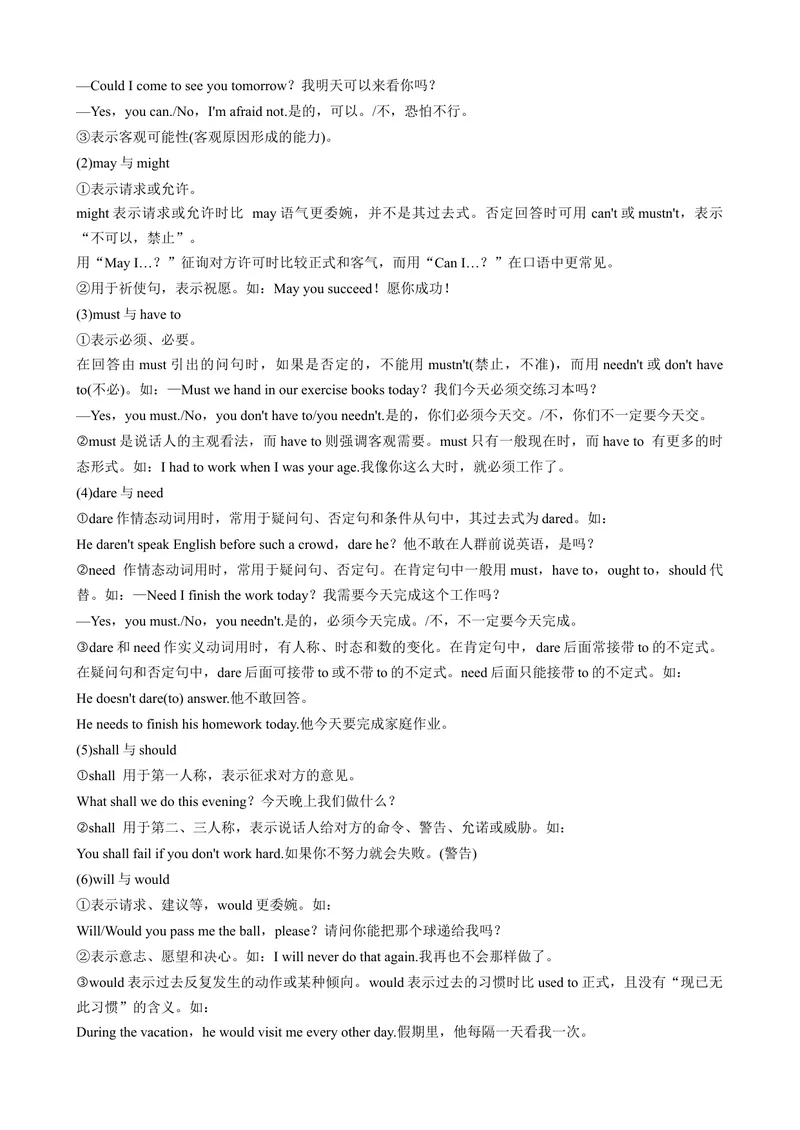
定句和答语中。如:—Could I come to see you tomorrow?我明天可以来看你吗?
—Yes,you can./No,I'm afraid not.是的,可以。/不,恐怕不行。
③表示客观可能性(客观原因形成的能力)。
(2)may与might
①表示请求或允许。
might表示请求或允许时比 may语气更委婉,并不是其过去式。否定回答时可用 can't或mustn't,表示
“不可以,禁止”。
用“May I…?”征询对方许可时比较正式和客气,而用“Can I…?”在口语中更常见。
②用于祈使句,表示祝愿。如:May you succeed!愿你成功!
(3)must与have to
①表示必须、必要。
在回答由must引出的问句时,如果是否定的,不能用 mustn't(禁止,不准),而用needn't或don't have
to(不必)。如:—Must we hand in our exercise books today?我们今天必须交练习本吗?
—Yes,you must./No,you don't have to/you needn't.是的,你们必须今天交。/不,你们不一定要今天交。
②must是说话人的主观看法,而have to则强调客观需要。must只有一般现在时,而have to 有更多的时
态形式。如:I had to work when I was your age.我像你这么大时,就必须工作了。
(4)dare与need
①dare作情态动词用时,常用于疑问句、否定句和条件从句中,其过去式为dared。如:
He daren't speak English before such a crowd,dare he?他不敢在人群前说英语,是吗?
②need 作情态动词用时,常用于疑问句、否定句。在肯定句中一般用must,have to,ought to,should代
替。如:—Need I finish the work today?我需要今天完成这个工作吗?
—Yes,you must./No,you needn't.是的,必须今天完成。/不,不一定要今天完成。
③dare和need作实义动词用时,有人称、时态和数的变化。在肯定句中,dare后面常接带to的不定式。
在疑问句和否定句中,dare后面可接带to或不带to的不定式。need后面只能接带to的不定式。如:
He doesn't dare(to) answer.他不敢回答。
He needs to finish his homework today.他今天要完成家庭作业。
(5)shall与should
①shall 用于第一人称,表示征求对方的意见。
What shall we do this evening?今天晚上我们做什么?
②shall 用于第二、三人称,表示说话人给对方的命令、警告、允诺或威胁。如:
You shall fail if you don't work hard.如果你不努力就会失败。(警告)
(6)will与would
①表示请求、建议等,would更委婉。如:
Will/Would you pass me the ball,please?请问你能把那个球递给我吗?
②表示意志、愿望和决心。如:I will never do that again.我再也不会那样做了。
③would表示过去反复发生的动作或某种倾向。would表示过去的习惯时比used to正式,且没有“现已无
此习惯”的含义。如:
During the vacation,he would visit me every other day.假期里,他每隔一天看我一次。(7)should与ought to
①should,ought to表示“应该”,ought to表示义务或责任,比should语气重。如:
I should help her because she is in trouble.我应该帮她,因为她陷入麻烦了。
You ought to take care of the baby.你应该照顾这个宝宝。
②表示劝告、建议或命令时should,ought to可通用,但在疑问句中常用should。如:
You should/ought to go to class right away.你应该马上去上课。
Should I open the window?我应该打开门吗?
2.情态动词表推测
(1)can表示推测(惊讶、怀疑、不相信的态度),用于疑问句、否定句和感叹句中。如:
Can this be true?这可能是真的吗?
This can't be done by him.这不可能是他做的。
How can this be true?这怎么可能是真的?
(2)may/might表示推测、可能性(不用于疑问句)。might不是过去式,它所表示的可能性比may小。如:
Your mother may/might not know the truth.你妈妈可能不知道真相。
(3)must表示推测、可能性(只用于肯定的陈述句)。如:
You're Tom's good friend,so you must know what he likes best.你是汤姆的好朋友,你一定知道他最喜欢什
么。
(4)should,ought to(客观推测),must(主观推测)。如:
He must be home by now.他现在一定回家了。(断定他已到家)
He ought to/should be home by now.他现在应该到家了。(按理应当,不太肯定)
二、used to “闯三关”
1.用法关
used to后接动词原形,表示过去经常性或持续性的动作或状态,意为“过去常常”。如:
I used to get up very early.我过去常常很早起床。
When I was young,it used to be very cold in winter.在我小的时候,冬天经常很冷。
2.句式关
其否定形式为didn't use to do sth.或usedn't to do sth.;一般疑问形式为Used sb.to do sth.?或Did sb.use to
do sth.?;附加疑问句式为use(d)n't sb.或didn't sb.。
3.辨异关
be/get used to后面接名词或动词ing形式时,表示“习惯于(做)某事”,其中to为介词;be used to后面接
动词原形时,表示“被用来做某事”。其中to是不定式符号。如:
I'm used to walking to school now.我现在习惯步行去学校。
The computer is used to store information.这台电脑被用来储存信息。
语法精练
根据汉语意思完成句子,每空词数不限。
1.这本书一定是汤姆的,他的名字在封面上。
This book Tom's.His name is on the cover.
2.他被一个5岁的小男孩愚弄了,这可能是真的吗?true that he was fooled by a fiveyearold boy?
3.你的车需要维修了。
Your car .
4.这种小刀是用来切东西的。
This kind of knife things.
5.当我年轻的时候,我常常打篮球。
I basketball when I was young.
6.他过去常花很多时间玩电脑游戏吗?
much time playing computer games?
五.话题写作
荣光学校九年级(2)班就“环境问题”召开了一次班会,并且以“Our Environment in Ten Years:for Better
or Worse?”为题进行了一次讨论。许多同学对未来表示乐观,但也有些同学对未来有些担心。请根据表
格中的内容提示,用英语写一篇短文。
1.越来越多的人将成为环保主义者(environmentalist);
乐观者的观点
2.政府将采取更多的措施改善环境
1.大量的树木仍将被砍伐;
担心者的观点
2.私家车将越来越多
你的观点及你的打算 自拟(至少两点)
要求:1.短文中应包含至少4个要点。
2.书写工整,语句通顺、连贯,词数不少于80。文章开头已给出,不计入总词数。
参考词汇:optimistic 乐观的;take measures to采取措施
思路点拨
组句成篇
Our Environment in Ten Years:for Better or Worse?
Many students are optimistic about our environment in ten years. They think that there will be more
environmentalists in the future.What's more,our government will ____1__(采取更多的措施) to protect theenvironment.So they __2__(确信) that our environment will be better in the future.
However,other students__3__(担心) the future.They think __4__(大量的) trees will still be __5__(砍倒).
Besides,__6__(随着我们社会的发展),there will be more private cars in our lives.So the environment will be
worse than it is now.
__7__(依我看),our environment in ten years will become better,because many of us have the knowledge
of protecting and improving our environment.I think we should plant more trees and pick up litter around us.We
work together to protect our environment.
Unit 14
一.词性变化
1: Instruction. n.指示,命令→ . v.指导→ . adj.指导性的
2: double. v.加倍,是……的两倍→ . adj.两倍的,加倍的
3: graduate. v.毕业,获得学位→ . n.毕业
4: care. n关心,关爱→ . v关心,关爱→ . adj小心的,细心的→ . adv.小心地,
细心地→ . adj粗心的,不小心的→ . adv粗心地,不仔细地→ . n粗心,大意
5: congratulate. v.祝贺,恭喜→ . n.祝贺,恭喜
6: thirsty. adj.渴望的,口渴的→ . n.口渴,渴望
7: thank. n/v.感谢,感激→ . adj.感激的,感谢的→ . adv.感激地
8: last. adj.最后的→ . adj.持续的,不间断的→ . adv.最后
9: responsible. adj. 有责任心的,有责任感的→ . n.责任感,责任
10: separate. adj. 单独的,分离的→ . adv.单独地,各自地→ . v分开,分离
二.重点短语
*1. .记得去做某事 14. for morning readings准时晨
*2. 记得做过某事 读
*3.do a 做一次学校调查 15. .为……做好准备
*4.meet the of a teacher符合严 *16. 弄得一团糟
师的标准 17. sth.做某事有乐趣
*5. two goals a row连续进两次 18. 在………(方面)帮助某人
球 19. sth.期待做某事
*6. the 弹键盘式电子乐器 *20.go to high school去上高中
7. sb.to a break from 建 21. the school swim team参加校游泳队
议某人暂停跑步休息一下 22. problems sth.在某事上有困难
*8.have a 有一个健康问题 23.have problems sth.做某事有困难
*9.give clear 给清晰的指示 24. the year在年末
*10. 对……有耐心 *25 信任
11. sb.to do sth.引导某人做某事 26 do sth.很高兴做某事
12. to do sth.花时间做某事 27.thank you for sth.因做某事而感谢你
*13. more effort付出更多的努 *28. the ceremony参加毕业典礼
力
*29. hope for the future对未来充满希望 *35. on your new journey开始你
30.the of a new life新生活的开始 的新旅程
31.have the to do sth.有能力做某事 36. to fly给某人飞翔的翅膀
*32. your own 做自己的选择 37. the first day of junior high在初中第一
*33.go your 各奔东西 天
*34 years’ time几年后 38. sth. sb.和某人分享某事
三.重点句子
1.She helped you to the answers yourself difficult they were.无论它们
有多难,她都帮助你自己找出答案。
*2. .该是毕业的时候了。
3.I and reading texts.我发音和朗读课文有困难。
4.You were all so full of and for .你们都是如此充满活力,如此渴求
知识。
5. you've all worked very hard over the last three years, of you did it .尽管在刚过去
的三年里你们所有人学习都很努力,但没有一个人是独自完成(学业)的。
6.Never to be to the people you.别忘了对周围的人表示感谢。
7.Along with ,there will also be many things for you.
伴随困难,也将有很多激动人心的事情在等着你们。
*8.It is always hard to from those whom you have so much time with for the past three
years.
要和你们在刚过去的三年中共度了如此多时光的人分离是件难事。
9.Since then,I have made so many good friends and I have so many good them.从
那时起,我已经交了如此多的好朋友,已和他们分享了如此多美好的回忆。
*10.I new in senior high!我期待高中的新体验!
四.语法精讲
一、动词的时态
根据最新教学大纲规定,初中阶段要求学生必须掌握的动词时态包括一般现在时、一般过去时、一般将
来时、现在进行时、过去进行时及现在完成时。
1.一般现在时
一般现在时表示现阶段经常发生的、习惯性的动作或存在的状态和客观真理,常用的时间状语有often,
usually,always,sometimes,every day(week,month)等。如:
He usually goes to school by bike.他通常骑自行车上学。
The sun rises from the east.太阳从东方升起。
【注意】在条件状语从句和时间状语从句中,用一般现在时表示将来。如:
If you don't go soon,you'll be late.如果你不快点去,你将会迟到的。
You mustn't eat anything until you see the doctor.看医生之前你不能吃东西。
2.一般过去时
一般过去时表示过去发生的动作或存在的状态,常用的时间状语有 yesterday,ago,last night(week,
month),just now,in 2000等。如:It snowed heavily last night.昨天晚上雪下得很大。
It was very cold yesterday.昨天非常冷。
3.一般将来时
一般将来时表示将来某个时间将要发生的动作或存在的状态,常用的时间状语有 tomorrow,next
week(year,month),in two days等。如:
Mr.Wu will teach us English this term.这学期吴老师将教我们英语。
I will go to my hometown next week.下周我要回老家。
【注意】(1)“be going to+动词原形”表示即将发生某事或者打算、计划要做某事。如:
I'm going to do my homework this evening.我打算今天晚上做作业。
(2)come,go,start,move,leave等动词常用进行时态表示按计划将要发生的事。如:
The whole family's going for two months.全家将要去两个月。
They are leaving for Beijing tomorrow.他们明天动身去北京。
4.现在进行时
现在进行时表示现在正在进行或发生的动作,常用的时间状语有now,at this moment等或句首有提示词
look,listen等。如:
I'm reading a book now.我现在正在读一本书。
Look! They are playing football on the playground.看!他们正在操场上踢足球。
5.过去进行时
过去进行时表示过去某一时刻或某一时段正在发生或进行的动作,常用时间状语有 at this(that) time
yesterday,at nine o'clock yesterday等。如:
They were working in class this time yesterday.昨天这个时候他们正在上课。
I was drawing a horse when the teacher came in.老师进来时,我正在画一匹马。
6.现在完成时
现在完成时表示过去发生的某个动作对现在造成的影响和结果,或表示过去已经开始并持续到现在的动
作或状态。常与already,never,ever,just,yet等时间状语或these days,for two years,“since+过去时
态”等连用。如:
I have already posted the photos.我已经把这些照片寄出去了。
He has taught at this school since 2000.他从2000年起一直在这所学校任教。
二、动词的语态
被动语态是指主语是动作的承受者。常考的动词的被动语态主要有:
1.一般现在时的被动语态
由“am/is/are+及物动词的过去分词”构成。如:
Computers are made in the USA.计算机是在美国被制造的。
Our classroom is cleaned every day.我们的教室每天都被打扫。
2.一般过去时的被动语态
由“was/were+及物动词的过去分词”构成。如:
This park was built in 1999.这个公园建造于1999年。
Last year many trees and flowers were planted in our school.去年我们学校种植了许多树和花。3.一般将来时的被动语态
由“will be+动词的过去分词”构成。如:
The classroom will be cleaned by Li Lei tomorrow.明天李磊将打扫教室。
The homework will be finished in ten minutes.作业将在10分钟内完成。
4.现在完成时的被动语态
由“has/have been+动词的过去分词”构成。 如:
The dirty clothes have been washed.这些脏衣服都已经洗了。
The child has been taken care of by her all these years.这些年来,这个孩子都由她照顾。
5.含有情态动词的被动语态
其结构为:情态动词+be+及物动词的过去分词。如:
The young trees should be planted in spring.应该在春天植树。
My homework can be finished in one hour today.今天我的家庭作业可以在一个小时内完成。
Ⅰ.用括号中所给单词的适当形式填空。
1.A serious car accident (happen) in this street last Sunday.
2.—What will the weather be like this coming Saturday?
—I hope it (be) a fine day for our picnic! I can't wait!
3.—Do you like junk food,Linda?
—That's my favorite.The more junk food I (have),the happier I (be).
4.—What did your mother say about this?
—She (say) that she (try) her best to help me with my English next term.
5.—Don't get off the bus until it (stop),Tom.
—I won't,Dad.Don't worry about me.
6.—Is your father a doctor?
—Yes,he is.He (work) in the Children's Hospital.
7.—I called you yesterday evening,but there was no answer.
—Oh,I'm sorry.I (have) dinner at my friend's house at that time.
8.—Is this jacket yours,Linda?
—No,I think it (belong) to Maria.She has a red one.
9.Bill is a good student.He always (finish) his homework on time.
10.I (not read) the book Little Women yet,but I'll let you read it first.
11.A talk on science (give) in our school next Sunday.
12.The letter (write) in Japanese.Can you read it for me?
13.Chinese (speak) by more and more people in the world now.
14.The magazines (must return) to the library in two weeks.
15.—What kind of rice do you think is the best to eat?
—I like to eat the rice that is (grow) in the south of China.
16.Something must (do) to make our city a better place to live in.
17.Three patients (operate) on by the famous doctor in the past 10 hours.18.We are (tell) not to play computer games at school.
19.The little boy was often seen to (read) books by the lake after school.
20.The phone (invent) by Bell.He is very great.
五.话题写作
时光飞逝,转瞬初中生活即将结束,你将离开你生活和学习了三年的校园了。在这三年里你与老师
和同学之间一定留下很多美好的回忆。请你用英语写一篇短文,与大家分享你最难忘的一件事。
要求:1.语言表达准确,短文连贯通顺;2.80词左右。
思路点拨
组句成篇
An Unforgettable Thing
One day,the teacher asked who had broken the window.I couldn't admit,__1__(否则我将有麻烦),I
thought.I didn't want to raise my hand,but something much stronger than me __2__(把它向上拉).The teacher
walked to me and __3__(抚摸我的头).__4__(代替) punishing me,he gave me a book and said he knew how
much I liked reading books.And it was only for my honesty.
I couldn't believe it!I wasn't punished and I got__5__(我最喜爱的书) Harry Potter.__6__ (直到现在),I
often __7__(回想起) what the teacher said,and I'll be an honest man forever.
综合训练一
一.用方框中所给词语的适当形式填空,每词仅用一次
comfortable weigh agree nod encourage
1.I have put on recently.
2.When I suggested a walk,Elena in agreement happily.
3.He didn't want to do this,but he had no to say that and was afraid that his father would be angry.
4.I couldn't sleep well,because the bed was so .
5.They hope they can reach an as early as possible.
二、根据句意及汉语提示完成句子
1.In the story,the (国王)wears nothing,but no one tells him the truth.
2.Lots of people begin to think health is more important than (财富).
3.The girl was badly ill and her face was as (苍白的)as chalk.
4.There are a number of patients waiting to get (检查).
5.You won't succeed unless you set yourself a (目标).
三、根据句意及首字母提示完成句子
1.It's all my f to make you sad.Sorry.2.-Which restaurant do you prefer?
I'd r go to Blue Ocean.
3.Leaning(靠)her head on my s she began to cry.
4.The rich man made his house simply like a p
5.He felt he was in the position of p
四、语法填空
阅读下面短文,在空白处填入一个适当的词,或填人括号中所给单词的正确形式。
As the English poet John Donne wrote,“No man is an island."Humans are social animals,and we all build
different relationships with others.
But 1 teenagers,we are going through a time of great changes.Our relationships with
parents,friends and teachers may also be changing.They might become 2 (close),more supportive or
more stressful.
During this period,3 is important to develop healthy relationships.That will make us 4
(believe)in our own abilities and give us the courage to try new things.
5 (beside),it will lead us to become better people when we grow up.
Forming and keeping good relationships are never easy,as there are lots of things that may go
wrong.Sometimes,neither our parents 6 our friends agree with our ideas.And
we don't know how to express our ideas which are different from our friends'.
Once in 7 while,we might care too much about others' thoughts and have 8 (difficult)in
saying no to them,because we don't want to feel 9(leave)out.
In these cases,we need to use some social skills.For example,we should learn to put ourselves in others'
shoes.Good communication is also helpful.10 (develop)
comfortable relationships,we can learn about other teenagers' stories in our everyday lives.After all,they
may be facing the same challenge as we are.
综合训练二
一.用方框中所给词语的适当形式填空,每词仅用一次
ring believe oversleep announce expect
1.-Bob,what happened to you?
—I and I was late for school.
2.All the students had arrived when the teacher the bell.
3.Police officers must be fully prepared for the
4.Just now the speaker from the government that the railway was going to be closed.
5.Her explanation certainly sounded .We all thought it was true.
二、根据句意及汉语提示完成句子
1.They have (取消)today's travel plan because of the rainstorm.
2.The sun (消失)behind the clouds and the wind became stronger.
3.Susan was (愚弄)into believing her brother's promise.
4.Everyone was excited about the (发现)of frozen water on the moon.
5.The two (女士)usually talk about their children in the evening.三、根据句意及首字母提示完成句子
1.To avoid missing the plane,I hurried to the a after packing clothes.
2.Lisa went to the m to buy something for dinner with her grandma.
3.The police stopped the man and then found a gun in his b
4.My brother agreed to give me a l to the science fair this afternoon.
5.The firemen tried their best to save more lives from the b building.
四、语法填空
阅读下面短文,在空白处填入一个适当的词,或填入括号中所给单词的正确形式。
As we all know,people play jokes on others on April Fool's Day.Sometimes,they use some joke tools.Soren
Sorensen Adams was an inventor of such tools.
Born in Denmark in 1879,Adams moved to the US with his family at age four and 1 (grow)up in
Perth Amboy, New Jersey.In 1904,Adams worked as a salesman for a dye(染料)company.One of the
2 (product)he sold caused people to sneeze(打喷嚏),and then Adams used it to create a new product
3 (call)Cachoo.He sold it as a tool 4 people could use to play jokes on others.Cachoo
achieved national 5 (popular)in a short time.More and more people began to ask him for this
product.So he decided 6 (start)the Cachoo Sneezing Powder Company.
To make his company more popular,Adams went on 7 (invent)many other amazing tools.In
1928,Adams invented the Joy Buzzer which could 8 (put)in one hand.People used it when shaking
hands with others.When shaking hands,they would feel the9 (expect)vibrations(振动)from the Joy
Buzzer.Adams continued to lead his company 10 his death in1963.He was widely known as“King of
the Pranksters(恶作剧者)”
综合训练三
一、根据句意及汉语提示完成句子
1.How much do you know about the (作品)of Mark Twain?
2.At the (底部)of the sea,you can also see some kinds of sea animals.
3.People won't be allowed to use (塑料)bags in this supermarket.
4. (煤)is one of the most important energy sources in the world.
5.I would rather cook by myself than order a (外卖食物)every day.
二、语法填空
阅读下面短文,在空白处填入一个适当的词,或填入括号中所给单词的正确形式。
One man's trash is another man's treasure.This is a well-known phrase,1 for Zhao Xiaoli,it is
also a guide to her work.She makes art out of rubbish.Different 2 (recycle)things,including a wooden
door,a chair with one leg missing,and a broken guitar,have provided inspiration for Zhao.
“Art should serve3 public,which needs us to think outside the box.Through the form of art,the
used objects can be reused,”says the30-year-old.
Zhao's interest in rubbish is known by many people,even cleaners in her community.When anyone throws
furniture out,like a door or a chair,Zhao is always the first 4 (know).
In a 30-second video posted(发布)on Sina Weibo,Zhao recycles a wooden door.After smoothing the surface
5 the door,she sweeps a brush in a wild style.Later,her reproduction of American painter CharlesCourtney Curran's By the Lily Pond 6 (appear)on the door.The video has been watched over 1
million times.
For Zhao,it seems that anything can be 7 (she)canvas(画布).Last year,a coffee store she often
visited was closed and the owner gave her a broken guitar.She created an oil painting 8 combined(结
合)works by two Dutch masters.When someone threw out a chair with one broken leg,Zhao took it.After 9
(clean),she turned it into Van Gogh's The Starry Night.
“Beauty is everywhere.Anything can 10 (change)into a work of art,”Zhao says.
综合训练四
一.用方框中所给词语的适当形式填空,每词仅用一次
separate we overcome manage double
1.My daughter's math exam scores have with the help of her math teacher.
2.Their classroom is next to
3.Raw(生的)meat must be from the cooked meat.
4.The asked the secretary to copy the document.
5.He lots of difficulties before he succeeded.
二、根据句意及汉语提示完成句子
1.The (调查)was carried out by some high school students.
2.This is the best (方法)of dealing with such arguments.
3.Maria (毕业)from the junior high school last summer.
4.My grandfather is a quiet but warm and (体贴人的)man.
5.In order to lower my blood sugar (水平),I have to change my eating habits.
三、语法填空
阅读下面短文,在空白处填入一个适当的词,或填入括号中所给单词的正确形式。
Every child has his own dream.Every child hopes to be 1 adult.However,is it really like what
they imagine?As a boy 2 lives in modern times and in a modern city,I feel greater pressure on me
with the city's 3 (develop).Although we seldom worry 4 money,we still have some
other 5 (problem),such as competitions among classmates and expectations(期望)from
parents.These experiences are very helpful to our future.But in fact they really give 6 (I)a lot of
pressure.I still clearly remember the happiness of my childhood.Unluckily,we have to face the fact with time
passing by.We begin 7 (feel)this invisible(无形的)pressure come upon us.We get up before sunrise
8 come back after sunset.We work and study like an adult,even 9 (hard).The purpose
of what we do is to get an excellent mark.Growing up is very boring,but we should try to find happiness while
growing up.I think friendship,the support from our parents and the encouragement from our teachers can help
us.Why not10 (enjoy)the pleasure of growing up and its delicious taste?