福建龙岩市非一级达标校2025-2026学年第二学期半期考
高二英语科试卷
一、听力选择题
1.What will the speakers most likely do after lunch?
A.Write a paper. B.Attend a workshop. C.Visit a store.
2.When will the woman pick up the man?
A.At 8:00. B.At 8:30. C.At 8:15.
3.How can the man’s recipe be described?
A.It’s a reward. B.It’s a success. C.It’s a problem.
4.What does the man have to do now?
A.Finish typing the paper. B.Put the material in order. C.Finish checking his reference.
5.What is the main topic of the conversation?
A.Gifts for a friend. B.A literature event. C.A going-away party.
听下面一段对话,回答以下小题。
6.Where does the conversation probably take place?
A.In a cafe. B.At a grocery. C.In a theatre.
7.How much should the man pay?
A.$5. B.$20. C.$25.
听下面一段对话,回答以下小题。
8.Which event impressed the woman most?
A.The dance party. B.The yard sale. C.The picnic.
9.What were the neighbors like before?
A.They held small events.
B.They seldom interacted.
C.They shared their belongings.
10.What are the speakers mainly talking about?
A.A regular activity. B.Weekend plans. C.Changes in the community.
听下面一段对话,回答以下小题。
11.Why did the officer want to see the man’s licence?A.Because he was speeding.
B.Because he was a stranger.
C.Because he took the wrong turn.
12.What’s the speed limit in business area of this city?
A.20 mph. B.25 mph. C.35 mph.
13.How does the woman probably feel about the man’s mistake?
A.Angry. B.Doubtful. C.Sympathetic.
听下面一段对话,回答以下小题。
14.Who is the pioneer of the Slow Food Movement?
A.An Italian. B.A Spanish. C.A Frenchman.
15.What caused the start of the Slow Food Movement?
A.The opening of a fast food restaurant.
B.An ad of a fast food company.
C.A meal eaten in Rome.
16.How does the man consider fast food?
A.Nutritious. B.Boring. C.Tasty.
17.What is the main aim of the Slow Food Movement?
A.To protect traditional dishes.
B.To promote better lifestyles.
C.To prevent eating fast food.
听下面一段独白,回答以下小题。
18.How can frozen food be kept cold at ordinary temperatures?
A.By using bags. B.By using water. C.By using paper.
19.What is advised to do when camping?
A.Use special dry foods. B.Never cook meat or eggs. C.Keep milk in a cooler box.
20.What is the passage mainly about?
A.How to pick up fresh food.
B.How to eat healthily in different weather.
C.How to keep food from going bad in summer.二、阅读理解
Immersive Van Gogh Exhibition Opens in SingaporeWhat is the exhibition about?
Van Gogh: The Immersive Experience is a large - scale digital art exhibition that brings the Post-Impressionist
master’s works to life through projections, sound and interactive technology. It returns to Singapore with a notable
new feature.What is the key new feature?
A dedicated AI Studio has been added. Visitors can type a text prompt, such as “sunflowers under a starry sky,” and
an artificial intelligence algorithm will instantly generate a unique digital image in Van Gogh’s distinctive style of
brushstrokes and colors. This image can then be projected alongside the artist’s classic works. “It’s about
participation, not just observation,” notes a curator (策展人).What are the main sections of the experience?
. Digital Galleries: Walk through rooms surrounded by animated projections of paintings like The Starry Night and
Sunflowers.
. AI Studio: Create and display your own AI-generated Van Gogh-style artwork.
. VR Journey: Use virtual reality headsets to explore the landscapes of Arles, France that inspired Van Gogh. Please
note: The VR section has a separate queue and may require additional waiting time.
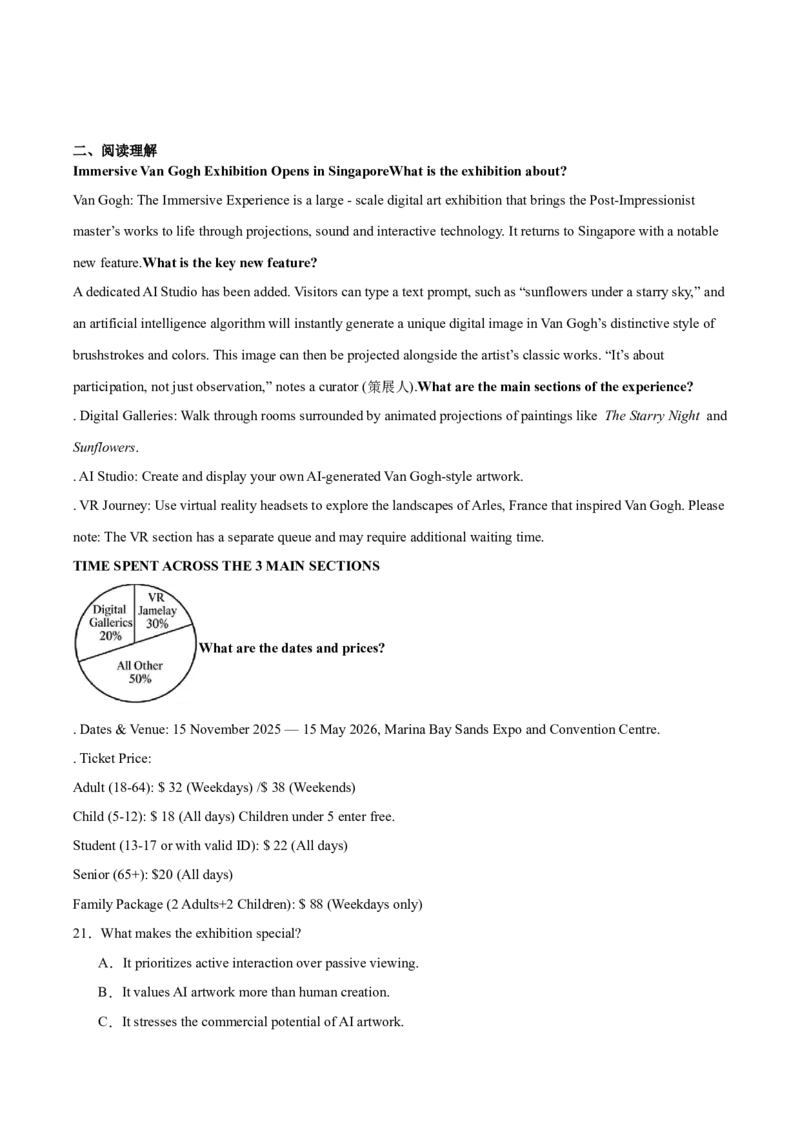
TIME SPENT ACROSS THE 3 MAIN SECTIONS
What are the dates and prices?
. Dates & Venue: 15 November 2025 — 15 May 2026, Marina Bay Sands Expo and Convention Centre.
. Ticket Price:
Adult (18-64): $ 32 (Weekdays) /$ 38 (Weekends)
Child (5-12): $ 18 (All days) Children under 5 enter free.
Student (13-17 or with valid ID): $ 22 (All days)
Senior (65+): $20 (All days)
Family Package (2 Adults+2 Children): $ 88 (Weekdays only)
21.What makes the exhibition special?
A.It prioritizes active interaction over passive viewing.
B.It values AI artwork more than human creation.
C.It stresses the commercial potential of AI artwork.D.It makes art appreciation accessible to children.
22.What can visitors do in the VR Journey?
A.Design original artworks in the style of Van Gogh.
B.Take a virtual tour of the scenery that influenced Van Gogh.
C.Appreciate lively pictures of Van Gogh’s well - known paintings.
D.Communicate with local artists in the city of Arles.
23.How much should a young couple with 4-year-old twins pay at least?
A.$82. B.$86. C.$88. D.$64.
Tuan Pham, a 47-year-old man, was feeling strong as he approached the 12-mile mark of the Long Beach
Half Marathon. It was his seventh race, and he looked forward to celebrating at the finish line with his teenage son,
who had run ahead. Suddenly, after taking another step or two, he collapsed, his memory cutting off entirely. He lay
motionless on the ground, his heart having stopped completely.
He had no pulse and wasn’t breathing. Three blocked arteries (动脉) had caused a sudden cardiac arrest (心
脏骤停) , leaving him clinically dead. According to the American Heart Association, the survival rate for an out-of-
hospital cardiac arrest is less than 12%. Pham’s situation seemed hopeless, and his only chance relied on a miracle
— like a heart doctor happening to be nearby.
At that very moment, Dr. Ryan Chiu, a heart doctor from a nearby hospital, happened to be just a few feet
away. He had finished a meal and was leaving a restaurant when his friend asked him to stay a few minutes for the
ocean view. This small delay proved to be fateful. Seeing Pham fall, Dr. Chiu rushed over, recognized the
emergency, and immediately began performing chest compressions.
Dr. Chiu handled the crisis well. He asked a bystander to continue compressions while calling his hospital to
prepare an operating room. Soon, an ambulance took Pham to the hospital, with Dr. Chiu driving behind. The
surgery to clear the blocked arteries was a total success. Pham not only survived but fully recovered — he even
planned to return to finish the last two miles.
Reflecting on the incredible series of events, Pham was filled with amazement. “I can’t believe the first guy
to see me fall and give me help was a cardiac surgeon,” he said. “What are the odds?” It was the perfect timing — a
friend’s casual suggestion, the surgeon’s delayed leave, and his immediate presence — that turned a near tragedy
into a miraculous survival story.
24.What happened to Tuan Pham during the marathon?
A.He fell and got his leg injured. B.He lost his memory after the race.C.He suffered a sudden heart failure. D.He felt too tired to finish the last two miles.
25.Why does the author mention “less than 12%” in paragraph 2?
A.To stress the urgency of Pham’s situation. B.To show the commonness of heart diseases.
C.To explain the importance of daily exercise. D.To criticize the slow response of ambulances.
26.What directly caused Dr. Chiu to be at the scene at the right time?
A.He was following the ambulance. B.He was participating in the marathon.
C.A friend asked him to stay to see the view. D.A bystander called him for immediate help.
27.What is the best title for the passage?
A.A Desperate Race. B.A Timely Rescue.
C.A Surgeon’s Quick Aid. D.A Marathon Misfortune.
At the foot of Yinhu Mountain in Shenzhen, the Yulong landfill — once the city’s largest waste site — is
busy in the early morning. After two decades undisturbed, the Yulong landfill’s 2.55 million cubic meters of waste
— a volume large enough to fill 1,000 swimming pools — is now undergoing the nation’s largest excavation (挖掘)
and relocation project, with dozens of excavators operating all out.
Located near the city center, the landfill long polluted the nearby neighborhoods with terrible smells and
dirty groundwater. Meanwhile, the increasing shortage of land resources has forced the city to fundamentally
explore new approaches to tackling this waste pile problem. Now, at the site, trucks transport different categories of
waste to sorting centers. After sorting, burnable materials of the household waste are transported to the energy
ecological park for incineration (焚烧), thus turning waste into resources.
In the incineration workshop, waste gas is kept above 850°C for at least two seconds to completely break
down dioxins, a harmful byproduct. After many steps of purification, the gas released meets higher standards than
those of the EU. The project can deal with 330,000 tons of burnable waste and produce 100 million kilowatt-hours
of electricity yearly, enough for 26,000 families.
Pan Gong, an expert in solid waste research, said China’s waste-to-energy technology is world-leading.
Chinese companies now lead the world in technology, cost control, and operational experience. Most equipment
and components have been domestically produced, achieving independent control over the entire industry chain
from waste collection and incineration to gas treatment.
China is also sharing its experiences and technologies with the world. Speaking at the launch ceremony of a
Chinese-funded waste-to-energy plant in Kyrgyzstan, Kyrgyz President Japarov said the factory would help solve
waste processing issues while generating electricity and creating jobs. As of May 2025, Chinese companies hadbeen involved in 79 overseas waste-to-energy projects. The “going global” of China’s waste-to-energy industry has
become a key component of China’s participation in global environmental governance.
28.What was a problem caused by the Yulong landfill before relocation?
A.It occupied too much farming land.
B.It led to shortage of natural resources.
C.It brought unpleasant smells and pollution.
D.It prevented the development of local tourism.
29.Why is the excavated waste from Yulong landfill burned at temperatures above 850°C?
A.To break down harmful substances. B.To burn the waste faster.
C.To reduce the volume of waste. D.To generate more electricity.
30.What is a feature of Chinese waste-to-energy technology according to Pan?
A.It adopts imported guidance. B.It remains under development.
C.It targets the domestic market. D.It proves self-sufficient in equipment.
31.What is the main purpose of the text?
A.To explain the working principle of a landfill.
B.To urge global cooperation on waste processing.
C.To compare waste processing technologies at home and abroad.
D.To show the advantages and global influence of China’s waste-to-energy technology.
Scientists in Australia have found strong evidence that long-term insomnia (失眠) may be caused by
problems in the brain’s natural 24-hour rhythm (节奏). This rhythm controls how active our minds are during the
day and night. The discovery helps explain why some people cannot “switch off” at night, even when their bodies
feel tired.
In a study published in Sleep Medicine, researchers from the University of South Australia studied how
thinking changes over a whole day. They compared 16 older adults with insomnia to 16 healthy sleepers. This was
the first time scientists carefully recorded daily changes in mental activity in this way.
Insomnia affects about 10% of people and is even more common among older adults. Many patients say
their minds feel too active at night. Doctors often call this “mental overactivity”, but the exact reason has not been
clear.
To find answers, the researchers carried out a 24-hour lab experiment. All 32 volunteers stayed awake in bed
under soft light. Food, movement, and outside time signals were strictly controlled. This allowed scientists to studyspecifically the brain’s natural rhythm.
Every hour, the participants described their thoughts, including how clear, emotional, or controllable they
were. Results showed that both groups had natural daily patterns: thinking was strongest in the afternoon and
weakest in the early morning.
However, people with insomnia showed important differences. Unlike healthy sleepers, their thinking did not
slow down strongly at night. Their thought patterns stayed more daytime-like in the nighttime hours when the brain
should be quietening. Their cognitive (认知的) peaks were also deferred by around six and a half hours, suggesting
that their internal (内在的) clocks may encourage attentive thinking well into the night.
The researchers say that current treatments only focus on behavioral strategies, but these findings suggest
that tailored approaches addressing circadian and cognitive factors could offer a solution.
32.What was the purpose of the lab experiment?
A.To explore the harms of insomnia in the elderly.
B.To study people’s internal daily brain rhythm.
C.To track emotional changes over time.
D.To measure light effects on sleep.
33.What were the participants required to do every hour?
A.Rate light levels. B.Measure brain waves.
C.Record sleep length. D.Report their ideas.
34.What does the underlined word “deferred” in paragraph 6 mean?
A.Examined. B.Given up.
C.Put off. D.Removed.
35.What do the researchers expect of the findings?
A.They will play a role in treating insomnia.
B.They will be applied to new medical fields.
C.They will help patients improve their lives.
D.They will bring about the change of traditional medicine.
How to stay healthy living in a city
Staying in a city is a great way to live a safer and more environmentally friendly lifestyle. City living
provides you with plenty of chances to stay healthy. You’re only a few steps away from being your healthiest self!
36 Invest (投资) in a bike to save time and money traveling. While cars seem faster, you can havemore mobility by riding a bike. Check and see if your city has any bike routes built into the street that allow you to
travel more safely.
37 Search online or look through your local newspaper advertisements to see if gym or fitness club
near you. While gyms are a bit more expensive, you can get special equipment. 38 If anything,
exercising in a busier place can help you feel more motivated (有动力的).
Run to stay in shape. 39 If you don’t feel like driving or biking, running can also be a great
choice for getting from place to place. Whenever you go out make sure that you’re running in comfortable shoes
and wearing a reflective shirt.
Plan healthy meals for each week. Create a calendar for mealtime, including breakfast, lunch, and dinner.
40 So you can shop for what you need early on. If you’re going to be busy on a certain day of the week,
choose a frozen meal instead.
A.Join a local gym to stay healthy.
B.Travel by bike instead of car to get places.
C.Don’t worry about the places being too crowded.
D.Check the area in walking distance from your home.
E.Order from healthier restaurants instead of going for fast food.
F.Decide ahead of time what you’d like to eat throughout the week.
G.Use the large number of sidewalks around you to get some exercise.
三、完形填空
My wife and I moved into our home two years ago. We had a yard with a lot of 41 . Very often
when we have flowers, Denise or I would plant some between the rocks, just to add some 42 to the area.
Last summer, I found a tiny little plant in the yard that I could not immediately identify. I knew I didn’t plant
it and Denise said she didn’t either.
We decided to let it 43 growing until we could find out what it was.
Weeks passed and as I made my way back to the 44 plant, it appeared to be a sunflower. I decided
to 45 the weeds (杂草) around it. As I pulled rocks from the area to get to the weeds, I noticed
something 46 .The sunflower had not 47 where I saw it begin. It actually had begun under a
big rock and grown under and around it to reach the 48 .
That’s when I 49 that if a tiny little sunflower didn’t let a big rock stand in its way of developing,we too have the ability of doing the same thing. If we 50 ourselves like that little sunflower, we can
reach where we 51 to go and get what we need for growth.
We need to believe in ourselves knowing we have the 52 to achieve our goals. Like the sunflower,
it knew it had the ability to get over the rocks because it had 53 in itself that it would succeed. Stand tall
like the sunflower and be 54 of who and what we are, and then the environment will begin to 55
us. We will find a way to go under or around any “rocks” in order to reach our goals.
41.A.flower B.insects C.vegetables D.rocks
42.A.water B.fertilizer C.color D.shape
43.A.stop B.continue C.improve D.escape
44.A.weak B.strange C.lonely D.pretty
45.A.collect B.tend C.remove D.watch
46.A.unusual B.wonderful C.terrible D.valuable
47.A.passed B.started C.left D.died
48.A.air B.top C.sun D.house
49.A.hoped B.realized C.doubted D.regretted
50.A.fill in B.put in C.worry about D.believe in
51.A.forget B.hate C.aim D.wait
52.A.wish B.plan C.ability D.idea
53.A.faith B.energy C.virtue D.courage
54.A.aware B.afraid C.proud D.tired
55.A.forgive B.support C.upset D.affect
四、语法填空
阅读下面短文,在空白处填入1个适当的单词或括号内单词的正确形式。
Lunyu, or the Analects of Confucius, is 56 fine example of world literature and the publication of
the Maltese version of the ancient Chinese book would further enhance cultural exchanges between China and
Malta, says Maltese Sinologist and translator of the book Salvatore Giuffre.
It is the first time that the book, which is a collection of ideas and sayings from the ancient Chinese
philosopher Confucius (551-479 BC), 57 (translate) into Maltese.
58 made us moved was that Giuffre spent around two years making the anthology accessible toMaltese readers, especially to young students, by translating it. 59 (current), the Maltese version is
available for local readers. The translated version is complete with an introduction to the life of Confucius, the era
he lived in, his teachings and the key concepts, terms, names and figures 60 (mention) in the book.
Giuffre says he added comments and explanations to make the text 61 (easy) for Maltese readers
to understand. “I tried to keep my Maltese version as understandable as possible to enable a larger circle of readers
to benefit 62 it,” Giuffre says. “I hope my translation will contribute to the spread of Chinese culture
63 knowledge of Chinese philosophy in Malta.”
Giuffre notes that Confucius not only teaches people how to become good rulers but also how to govern a
country. The Chinese initiative of building a community with a shared future clearly expresses the vision of today’s
China 64 (promote) a peaceful system of good global governance.
“Confucius’ idea of good governance would then be taken as a model for world harmony, 65
(cooperate) and governance,” he says.
五、书信写作
66.假定你是学生会主席李华。2026年我国正加速推进“碳达峰”(Carbon Peaking)进程,多地已宣布
提前达到峰值。作为新时代青年,你认为中学生在校园生活中能为“双碳”目标(碳达峰和碳中和Carbon
Peaking and Carbon Neutrality)做些什么。请你写一封英文倡议书,号召同学们践行低碳生活(low-carbon
life),助力国家实现“双碳”目标。内容包括:
1.指出校园中不符合低碳环保理念的现象;
2.校园低碳生活的具体建议;
3.发出倡议并呼吁行动。
注意:1.写作词数应为80左右;2.可以适当增加细节,以使行文连贯。
Dear fellow students,
____________________________________________________________________________________________
____________________________________________________________________________________________
____________________________________________________________________________________________
____________________________________________________________________________________________
____________________________________________________________________________________________
_________Yours sincerely,
Li Hua
六、书面表达
67.阅读下面材料,根据其内容和所给段落开头语续写两段,使之构成一篇完整的短文。
I was born and grew up in a small seaside town. In my childhood, I often played on the beach with my elder
sister, chasing (追逐) the waves and enjoying the seaside scenery.
One sunny summer afternoon, my sister and I were playing on a big rock. quite a distance from the beach.
We were so happy that we didn’t notice the water rising. When we decided to go back, we were shocked to find that
the rock had almost been covered by water and there was no way back to the shore. Meanwhile, the wind blew
harder and harder. We got into a panic, waving and shouting crazily towards the shore. Suddenly, I slipped (滑) and
fell into the sea. My sister stretched out her hand to catch hold of me. However, she could not stay still, and stay off
the rock into the sea, too.
“Help! Help!” We cried. I could feel my body tingling (酸麻) as I tried to breathe for air. I attempted to swim
back to the rock, but the water was too deep and the waves were too strong. What made things worse was that the
rough water made it almost impossible for anyone to hear our cries. Tears mixed with the water as I struggled in the
sea. My sister, although using all her strength, wasn’t able to pull me in. Instead, she was being pushed apart from
me by the big waves. The two of us, scared to death, kept crying.
Luckily, two boys playing on the beach happened to see us. They quickly found a stick nearby and
approached us cautiously, hand in hand. They tried to pull us ashore with the stick. But the stick was too short for
us to reach. Worse still, the wind was getting so strong that the two boys were rocked from side to side, unable to
stand steadily. Eventually, they had no choice but to go back to the shore to look for other people to help us.
注意:
1.续写词数应为150;
2.请按如下格式在答题卡的相应位置作答。
Another huge wave crashed over my head and pulled me under.
____________________________________________________________________________________________
____________________________________________________________________________________________
____________________________________________________________________________________________
________________________________________________________________________________________________________________________________________________________________________________________
__
When I finally opened my eyes, I was lying on the soft sand, surrounded by familiar faces.
____________________________________________________________________________________________
____________________________________________________________________________________________
____________________________________________________________________________________________
____________________________________________________________________________________________
____________________________________________________________________________________________
__参考答案
题号 1 2 3 4 5 6 7 8 9 10
答案 C C B B A C B B B C
题号 11 12 13 14 15 16 17 18 19 20
答案 A B C A A B B A A C
题号 21 22 23 24 25 26 27 28 29 30
答案 A B D C A C B C A D
题号 31 32 33 34 35 36 37 38 39 40
答案 D B D C A B A C G F
题号 41 42 43 44 45 46 47 48 49 50
答案 D C B B C A B C B D
题号 51 52 53 54 55
答案 C C A C B
1.C
【原文】M: I need to pick up some notebooks for my workshop this weekend. Could we drop by the bookstore
after lunch?
W: Sure, let’s head to Paper Plus. It’s not far from here.
M: Perfect.
2.C
【原文】W: I’m on my way to you now. I should be there in about half an hour.
M: Oh, don’t worry. Take your time. It’s only seven forty-five now.
W: Perfect! Then we can still leave your place before eight thirty, right?
3.B
【原文】W: I tried that new recipe you shared — the chocolate chip cookies. They were a hit with my family.
M: I’m glad you liked them. I’ve shared that recipe with so many people and they all say the same thing. Baking
can be so rewarding.
W: It certainly can.
4.B
【原文】M: How are you getting along with your research paper?
W: I’ve finished all my research, but I haven’t been able to organize it, so I haven’t begun the paper yet.
5.A
【原文】M: Have you heard about Angela’s farewell (告别)?
W: Oh yes, her desk is overflowing with presents. I got her a literary book.
M: How thoughtful! I’ll have to find something by the end of the day.
W: I’m sure you’ll find something perfect.
6.C 7.B【原文】M: Hi, I’d like 2 tickets for the 7:00 pm show. Can I have seats in the middle?
W: OK. Would you like any snacks with that?
M: Yes. Two cups of orange juice and a bag of French fries.
W: OK. It’s $25, but you can get 20% off if you have a membership card.
M: Sorry, I didn’t bring the card with me.
W: Do you remember your card number?
M: Sure. It’s 478.
8.B 9.B 10.C
【原文】W: Our new neighbors have really done a great job, haven’t they?
M: You’re not kidding. This whole area has taken on a new look since they moved in.
W: Totally. The community events they’ve organized have been a huge hit.
M: Yeah, everyone loved the dance party. And the picnic in the park last month was really fun too. People around
here seem much closer now.
W: I agree. But you know what I liked the most? The yard sale they arranged on weekends. It really got everyone
talking and trading stuff. In the past people mostly kept to themselves. That event really helped everyone“come out
of their shells”, you know?
M: Yes. It’s wonderful to see everyone coming together like this. We should suggest holding these kinds of things
more often.
11.A 12.B 13.C
【原文】W: Can I see your license, please?
M: What’s the matter ? Did I do something wrong?
W: You were speeding.
M: I’m not sure, but I think I was going about 35.
W: This street is a 25-mile-per-hour speed zone, you know. In this state, the speed limit in business area is 25. Did
you see the signs all along the street?
M: I’m sorry, officer. I guess I didn’t notice. I was busy thinking of my job interview. You see, it’s my first time
here.
W: Well, since it’s your first time in this city, I will just give you a warning this time, but be careful not to speed
again.
14.A 15.A 16.B 17.B
【原文】W: So, Mike, what is the Slow Food Movement?M: Well, it’s a reaction to fast food and fast modern lifestyles. The Movement was started by an Italian called Carlo
Petrini. He organized it because a McDonald’s had opened near the Spanish Steps in Rome. He felt it was the ruin
of many valuable traditional things and he tried to promote healthier ways of eating and living.
W: So, Slow Food just means healthier food, does it?
M: Not exactly. I think it’s more about our lifestyles. We’re always in such a hurry. We don’t have enough time to
enjoy our lives.
W: Fast Food companies advertise their food is healthy. How would you answer that?
M: It may be right in a way, but for me, the problem is that wherever you sit down for a meal, whether in France or
China, what you’re given is too similar. It makes eating and life boring. Traditional food isn’t going to be lost
completely, but we do want as many people as possible to enjoy it.
W: So, let’s see if I’ve understood you. The Movement’s main object is to improve the way we live, isn’t it?
M: Exactly that. It’s not just about food. It’s about how we live and finding time to enjoy our lives.
18.A 19.A 20.C
【原文】
W: During the summer, you should be even more careful than usual because food goes bad faster in hot
weather than in cold weather. When you buy frozen and refrigerated foods, don’t make long stops on your way
home because frozen foods could become soft or warm.
Using bags helps keep food cold until you can get home. Milk and milk products should be refrigerated
immediately. When camping or picnicking, or at any time when refrigeration can’t be made use of, use special dry
foods.
Don’t leave food in a hot car. Picnic favorites like meat, chicken, and eggs should be kept in a cooler box.
Above all, if the food doesn’t seem to be normal in smell or appearance, throw it away immediately. Don’t taste it.
36.B 37.A 38.C 39.G 40.F
41.D 42.C 43.B 44.B 45.C 46.A 47.B 48.C 49.B 50.D
51.C 52.C 53.A 54.C 55.B
56.a 57.has been translated 58.What 59.Currently 60.mentioned 61.easier
62.from 63.and 64.promoting 65.cooperation
66.【范文】
Dear fellow students,
Currently, there are some issues on our campus that contradict low-carbon principles. For example, some
classrooms are left empty with the lights and air conditioning still on. Disposable lunch boxes and plastic bottlesare also often found in rubbish bins, and many students choose to take the car instead of walking or cycling.
Small actions can make a big difference. We can start by turning off electrical devices when leaving
classrooms, reducing our use of single-use plastics and bringing our own water bottles. Walking, cycling or using
public transport to get to school also helps to reduce carbon emissions.
Let’s act now to support our national “Carbon Peaking and Carbon Neutrality” goals. Every small effort
counts. A greener campus depends on all of us. Together, we can create a more sustainable and beautiful school
environment.
Yours sincerely,
Li Hua
67.参考范文:
Another huge wave crashed over my head and pulled me under. I thought I was going to die. The cold water
filled my mouth, and I couldn’t breathe. Just then, I felt a strong hand grab my arm. It was a fisherman from the
village. He had heard the two boys shouting for help. With great effort, he pulled me up and held me against his
chest. I saw my sister was also being held by him. The waves were still strong, but he didn’t give up. Step by step,
he fought against the water and finally carried us to the shore. I fell onto the sand, coughing and shaking all over.