高 2026 届高考模拟考试(一)
英语试题
注意事项:
1.答卷前,考生务必将自己的姓名,准考证号等填写在答题卡和试卷指定位置上。
2.回答选择题时,选出每小题答案后,用铅笔把答题卡上对应题目的答案标号涂黑。如需改动,用橡皮擦干净
后,再选涂其他答案标号。回答非选择题时,将答案写在答题卡上。写在本试卷上无效。
3.试卷由圈”整理排版。考试结束后,将本试卷和答题卡一并交回。
第一部分:听力(共两节,满分30分)
注意,听力部分答题时,请先将答案标在试卷上。听力部分结束前,你将有两分钟的时间将答案转涂到
答题卡上。
第一节(共5小题;每小题1.5分,满分7.5分)
听下面5段录音,每段录音后有一个小题,从题中所给出的A、B、C三个选项中选出最佳选项。听完
每段录音后,你都有10秒钟的时间来回答相关小题和阅读下一小题。每段录音读两遍。
1.Whatistheweatherlikenow?
A.Rainy. B.Windy. C.Clear.
2.HowlongistherestaurantopenonSundays?
A.Abouttwohours. B.Aboutthreehours. C.Aboutsevenhours.
3.Whatdoesthewomanwanttodo?
A.Gototheperformanceherself.
B.Getalifttotheperformance.
C.DriveJohntotheperformance.
4.Whatdoesthemanmean?
A.Hecan'thelpthewoman. B.Heneedstoseeadoctor. C.Hewillgetoutofthelift.
5.Whatarethespeakerstalkingabout?
A.Projectopportunities. B.Workoutroutine. C.Heavyworkload.
第二节(共15 小题;每小题1.5分,满分22.5分)
听下面5 段录音。每段录音后有几个小题,从题中所给的A、B、C三个选项中选出最佳选项。听每段
录音前,你将有时间阅读各个小题,每小题5 秒钟;听完后,每小题都有5 秒钟的作答时间。每段录音播
放两遍。
听第6 段录音,回答第6、7题。
6.Wheredoestheconversationtakeplace?
A.Inalibrary. B.Inabookstore. C.Inaclassroom.
7.Whydidthemancomehere?
A.Tomeethisclassmate. B.Tofindaquietplaceforstudy. C.Tolookforreferencesforhispaper.
听第7段录音,回答第8、9题。
8.Whatdoesthemansayabouthistrip?A.He'llstartittomorrow.
B.Hedoesn'tmakeplansaboutit.
C.He'lltakeitwithatravelcompany.
9.Whatistherelationshipbetweenthespeakers?
A.Neighbors. B.Colleagues. C.Classmates.
听第8 段录音,回答第10 至13 题。
10.Whatwasthemainfocusofthesurvey?
A.Qualitiesofsportingequipment. B.Theaverageageofathletes. C.Sportingactivities.
11.Whichagegroupseemstobemostactiveinsports?
A.18-26. B.36-45. C.46-55.
12.Whatsportwasmostpopularamongthetwomostactivegroups?
A.Tennis. B.Jogging. C.Cycling.
13.Whydoesthemanwanttotargetthe46-55agegroup?
A.Theyareeasilypersuaded.
B.Theyhavemorebuyingpower.
C.Theypaymoreattentiontohealth.
听第9 段录音,回答第14 至17题。
14.WhatmadethecompanyapproachSally?
A.Heruncle'sintroduction.
B.Herextensiveworkexperience.
C.Herworkinglassmakingclasses.
15.WhatdoesSallylikebestaboutherjob?
A.Theflexibleworkinghours.
B.Thevarietyinherdailytasks.
C.Thechancetoexperimentwithdesigns.
16.WhatbothersSallyregardingherwork?
A.Highstudiorentalcosts. B.Lackofartisticinspiration. C.Errorsinfinalproductionstages.
17.WhatdoesSallyvaluemostaboutherbusinesspartner?
A.Hisphysicalassistance. B.Hiscreativesuggestions. C.Hisfinancialaid.
听第10 段录音,回答第18 至20 题。
18.HowdoesLovedBeforemakethetoysmoreappealingtoadopters?
A.Byofferingfreedelivery.
B.Byrepairingthemtolooknew.
C.Byattachingeachtoy'suniquehistory.
19.WhatdoestheagencydoonitswebsiteeveryMonday?
A.Releasenewadoptabletoys. B.Collectpeople'sdonations. C.Announcethesalesfigures.
20.WhatdoesLovedBeforeaimtodo?
A.Shiftpublicopinionaboutuseditems.
B.Launchastuffedtoyforallagegroups.C.Createanetworkoftoydonationcenters.
第二部分:阅读理解(共两节,满分50分)
第一节(共15小题;每题2.5分,满分37.5分)
阅读下列短文,从每题所给的A、B、C和D四个选项中,选出最佳答案。
A
NewScientististheworld'smostpopularweeklyscienceandtechnologypublication.Ourwebsite,appandprint
editionscoverinternationalnewsfromascientificstandpoint.
Highlights:
News&Features
Daily online updates and weekly magazine top picks bring you the latest scientific news, covering everything
from artificial intelligence to breakthroughs in health and quantum physics. Written by researchers and expert
journalists, feature articles separate fact from fiction and turn discoveries into easy-to-understand knowledge— no
sciencebackgroundneeded.
Culture
Thissectionexplorestheintersectionofscienceandculture,featuringreviewsofbooks,events,andexhibitions.
Ithighlightstheimpactofscienceonsocietyandthearts.
Views
We present readers’ letters, opinions, and articles by editors, offering in-depth analysis and diverse viewpoints
onscience,culture,andsocialissues.Thissectionencouragescriticalthinkinganddiscussion.
Subscriber-onlyBenefits
●Exclusive(专享的)accesstoarticleswithgreatcontent.
●Prioritytopaidtourstositesofscientificimportanceworldwide.
●Fourfreevirtualeventseachyear,includinglecturesandmasterclassesonsciencetopics.
●Newsletterswiththelatestnewsandinsights,sentdirectlytoyouremailordigitaldevices.
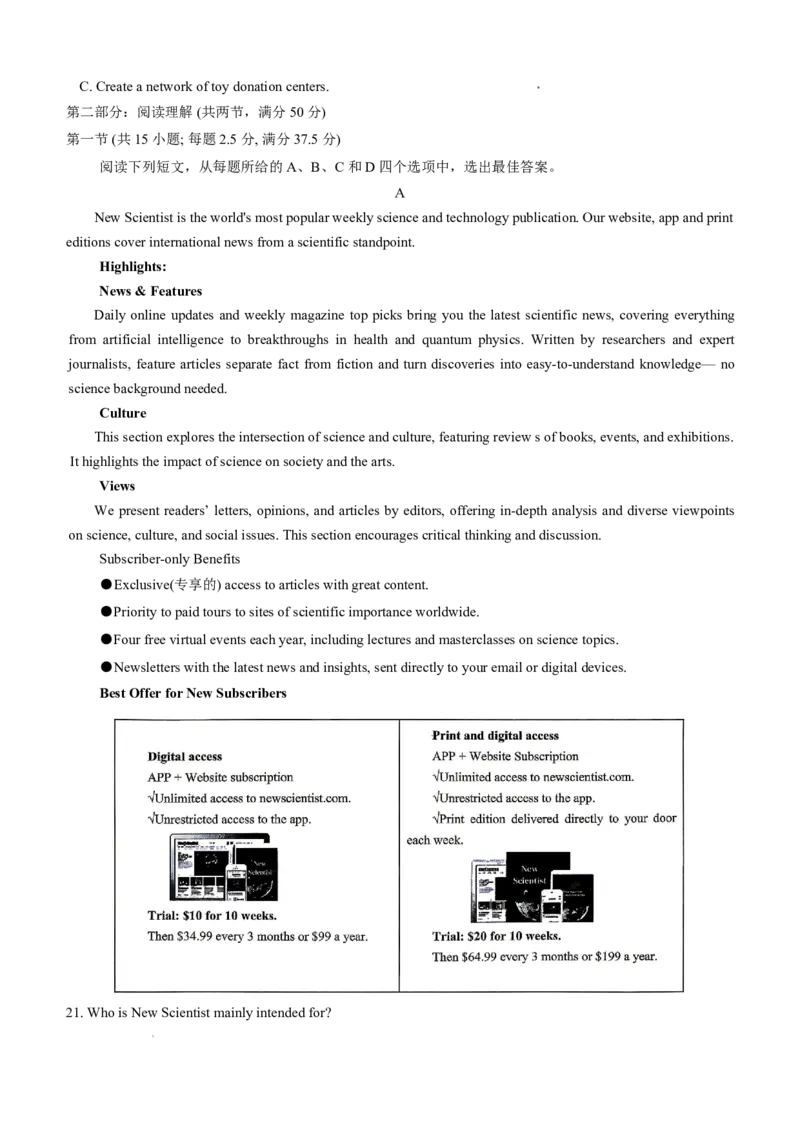
BestOfferforNewSubscribers
21.WhoisNewScientistmainlyintendedfor?A.Studentsmajoringinliterature. B.Scientistsdevotedtoresearch.
C.Journalistscoveringglobalevents. D.Generalreadersinterestedinscience.
22.Whatisanadvantageofbeingasubscriber?
A.Gettingfreereadingdevices. B.Stayinginformedofe-updates.
C.Takingdiscountedsciencetours. D.Attendinglecturesinuniversities.
23.Howmuchisprintanddigitalaccessannuallyafterthetrial?
A.$64.99. B.$99. C.$199. D.$298.
B
JenniferHodgesisathird-gradeteacher.Shesaysherstudentsdon'tjustsitatdeskseveryday.Theydoalotof
practical learning, such as raising coho salmon (银鲑) and then releasing them into a lake. It's through a program
calledSalmonintheClassroom,establishedbytheAlaskaDepartmentofFishandGame.
Coho salmon lay eggs in the fall, when many schools start. The eggs remain in the classroom for about six
months before they are released into lakes. Though many of her students often see salmon in their backyard, few are
familiar with them. Hodges says,“With this project, they have a whole different perspective because they know what
ittakestoactuallygothroughthelifestagesofasalmon.”
One of the biggest challenges in raising coho salmon, however, is their sensitivity to water temperature. With
globalwarmingbecomingincreasinglyserious,learningaboutclimatechangeismorecrucialnowthanever.In2025,
the Arctic had its warmest year on record. These concepts can seem abstract to third graders, but raising salmon
makesthemconcrete,sincesalmonrequirecoldwatertosurvive.
During the months when the salmon are in the classroom, students like to sit by the tank to observe, and
calculate when the eggs will turn into fry (鱼苗) based on the temperature of the tank. To them, it's not practicing
mathproblems;it'spredictingthefuture.
Each year in May, Hodges takes her students on the Salmon Field Trip, where they get to release the salmon
they've raised in class. This trip imparts wisdom about life and nature, helping them grasp vital lessons they can
neverlearnfromtextbooksalone.
“The most memorable part is getting to say goodbye. We release the salmon after watching them hatch from
eggsandgrowintofrywhiletakingcareofthem,”saysaboy,Fisher.“Ican'tbemoreexcitedatthatmoment.”
24.WhatisthemainpurposeofSalmonintheClassroom?
A.Togetsalmon'seggsforfood. B.Tokeepsalmoninthebackyard.
C.Toteachthesalmonlifecycleindepth. D.Toincreasethesalmonpopulationinlakes.
25.Whatdoesraisingsalmonmakestudentsawareof?
A.Theurgencyofunderstandingclimatechange. B.Theimportanceofobservingsalmonregularly.
C.Thedifficultyofpredictingclimateconditions. D.Thenecessityofmildweatherforsalmonsurvival.
26.Whatdoestheunderlinedword“imparts”inparagraph5mean?
A.Recalls. B.Conveys. C.Requires. D.Evaluates.
27.HowdoesFisherfindreleasingthefish?
A.Aneasyjob. B.Apainfulstory. C.Aworryingmoment. D.Afantasticexperience.
CMany leaders often confuse“niceness” with effective leadership. They avoid tough conversations and decisions
just to keep others from feeling uncomfortable. But in the end, this harms team performance and weakens
organizational value. A case inpoint: a leading electronicscompanyhad avery supportive,relationship-focused
culture. However, this led to underperforming employees getting the same rewards as top performers. As a result,
teammembersfeltunfairanddissatisfied,andoverallproductivitydroppedsharply.
Leaders who are too“nice” usually want to avoid conflicts. But they mix up two different ideas: being nice and
being kind. As a recent Harvard Business Review article points out, kindness means being firm when necessary and
giving honest response. In contrast, niceness only cares about avoiding discomfort at all costs. True leadership
requireskindness,notjustniceness,tobuildastrongandproductiveteam.
However, examples of good leadership instead of an overly nice one are not rare. Companies like Costco pair
high wages with strict performance standards, driving excellent results. One survey of 18,000 nonprofit employees
found that managers who always gave constructive advice could lift employees’ feedback-related satisfaction by 5
points in a year. A drug company invited staff to reapply for roles or take money to leave,resulting in a more
motivated team that accelerated clinical trial progress. Apple's Steve Jobs famously cut the company's annual
priorities to just three, and a tech company's R&D chief used clear rules to end unpromising projects, removing
resourcestoworkableinitiatives.
Transitioningfromnicetogoodleadershipdemandscourageandpersistence.Manyleadersavoidtoughchoices
tokeepharmony,buttrueleadershipmeansfacingdifficultdecisionshead-on.Thisshiftbenefitsbothindividualsand
theorganizationlong-term,creatingaculturewherepeoplefeelvaluedandmotivatedtodotheirbest.
28.WhatledtothedeclineinteamperformanceaccordingtoParagraph1?
A.Toughdecisions. B.Strictworkrules.
C.Leaders'confidence. D.Overlyniceleadership.
29.WhatisonefeatureoftrueleadershipaccordingtotheHarvardBusinessReviewarticle?
A.Tostayagreeable. B.Toescapediscomfort.
C.Toofferfrankfeedback. D.Toequalshallowniceness.
30.Whichofthefollowingcanbeclassifiedas“goodleadership”?
A.Encouragingstafftostayinroles.
B.Sayingnotolow-priorityprojects.
C.Motivatingcertainemployeestowork.
D.Cuttingannualprioritiestoexpandtheteam.
31.Whatcanbeasuitabletitleforthetext?
A.Nice,NotKind. B.Lead,NotPlease.
C.Avoid,NotFace. D.Strict,Notharmonious.
D
Illnesses caused by heat— dehydration, cramps(抽筋), and even strokes—— can come on quickly and
quietly.After10straighthourspickinggrapesonaburning105°Fday,53-year-oldAsunciónValdiviacollapsedand
died,avictimofheatstroke.Withoutmeaningfulaction,theU.S.couldsee450,000injuriesperyearby2050.
Scientistshavebeenresearchingwaystomeasureheatstresswithoutrelyingonindividualconsciousness.Forthe
public, widely- used wearable devices can detect skin temperature. But to determine if someone is at risk of heatstress, wearables need to measure core body temperature— a capability they lack. Core body temperature measures
the temperature of internal organs like the heart, liver and brain. An algorithm (算法 ) has been developed that
estimates heat- related illness risks by measuring heart rate, skin temperature and walking patterns.Zachary, a heat
stress researcher, says the most promising solutions are algorithms estimating internal body temperature, with the
corebodytemperaturealgorithmbeingthemostadvancedandintegratedintopublicproducts.
Early tests have shown some promise. A startup called VigiLife released a sensor, which measures heart
rate,core body and skin temperatures, and then uses wearable and environmental data to offer health and safety
insights. A construction firm adopted the technology and saw zero heat- related illnesses when it tried out VigiLife's
technologyfromMaytoSeptember2023.
However, some aren't convinced by wearable- only solutions. Jason Glaser, the CEO of an network
company,notes it's unclear whether, given access to wearable technology, workers would follow the alerts. Intense
manual labor and piece- rate payment systems encourage workers to overwork without adequate access to water,
shadeandbreaks.
In addition to personal risk alerts, wearable technology can also help scientists create algorithms that model
outdoor work risks. One Florida project uses biosensors on farm workers, feeding data to an AI algorithm to predict
heat illness. However, Schlader says it's hard to know when these technologies will have a true impact on working
conditionsandwhencoretemperaturemeasurementswillbeintegratedintowearabledevices.
32.WhydoestheauthormentionAsunciónValdivia'sstoryinParagraph1?
A.Toexplainfarmers'workingconditions. B.Toshowthreatsofheat-relatedillnesses.
C.Togiveatypicalexampleofheatstroke. D.Toproveoutdoorworkadangerousjob.
33.Whatdeterminestheeffectivenessofjudgingheatstressrisks?
A.Theaccesstocorebodytemperaturedata.
B.Thedetectionofhumanskintemperature.
C.Thechangeinheartrateandmovement.
D.Theresponseofworkerstohealthalerts.
34.WhatdoubtdoesJasonGlaserhaveaboutwearabletechnology?
A.Itcannotsolveworkers'overworkproblems.
B.Itseffectmaybereducedbystressfulwork.
C.Workersmayignoreitsalertsunderpressure.
D.Datafromthesensorsmaynotbeaccessible.
35.WhatdoesSchladersayaboutthefutureofwearabletechnology?
A.ItwillgainpopularityinFloridafarming.
B.Itwillreplacethetraditionalmonitoring.
C.Itsmedicalvaluewillreceiverecognition.
D.Itswideapplicationwillremaindistant.
第二节(共5小题:每小题2.5分,满分12.5分)
阅读下面短文,从短文后的选项中选出能填入空白处的最佳选项。选项中有两项为多余选项。
HowtoAppreciateAClassic
Classicsareoftenseenasbooksreadbyliteraturemajorsorintellectuals.Theyseemratherexclusiveanddistant.36 The classics and I began as acquaintances, grew to be friends, and finally became close confidantes (密友)
withprivatejokesbetweenus.Sohowdoesoneapproachaclassic?
Find your classic era. The term classic applies to a wide range of books across a long period of time. 37 Not
every classic is as thick as Tolstoy's Anna Karenina. Like all forms of literature, there are genres(类型)within the
classicsselectionofabookstore.Byfindingyourera,there'salwayssomethingthatmayappealtoyou.
Read slow and get immersed. Classics aren't written in our modern tongue. They bear clear traces of the time
when they were published. Given the challenges involved, I suggest reading your first classic slowly. 38 It's like
immersing yourself in a different world. It would take a few interactions to get the hang of it, but you do get it
eventually.
39 Once immersed, you rather get a hang of the language, and it is best to read another one. Maybe read a
book from the same author. In this way, the next book becomes easier to read. The ease in the language and the
contextisrewarditselfandmaymotivateyoutoreadmoreclassics.
Try again. If the first classic you got was a miss, find another one. You can even start with thinner books like
Peter Pan or a child's classic such as Alice in Wonderland or even Anne of Green Gables. Don't jump from“I don't
readclassics”to“BrotherKaramazov”alltoosuddenly.40
Once you employ the proper methods and proceed step by step, you will come to appreciate the joy of reading
classics.
A.Learnmoreabouttheauthor.
B.Readingclassicsrequirespacing.
C.Followthroughwithanotherclassic.
D.Myloveforclassicswasagradualaffair.
E.Manyclassicsalsoteachusvaluablelifelessons.
F.Allowyourselftoadapttothebookandthelanguage.
G.It'swrongtoassumethatallclassicsarecreatedequal.
第三部分:语言知识运用(共两节,满分30分)
第一节(共15小题:每小题1分,满分15分)
阅读下面短文,从短文后各题所给的A、B、C和D四个选项中,选出可以填入空白处的最佳选项。
At 42, I walked into a community college classroom for the first time, feeling like a fish out of water. I'd
droppedoutofhighschoolwhenIwas17,41 myselftoalifetimeoflow-wagelabor,convincedthatIwas“not 42
enough” for academic work. For decades, I had tried to avoid any situation that might 43 my lack of education,
buildingasmallbutsafelifearoundthat 44.
Itwasmydaughter'sstrugglewithdyslexia(读写困难)that 45 metostepoutofmycomfortzone.Watching
her 46 to learn in spite of constant setbacks, I felt ashamed of my own long-held 47 . I enrolled in a basic
Englishcourse,andthatfirstday,Isatintheback,myhands 48 ,certainI'dbefoundoutasan“impostor(骗子)”.
Instead,thatclassroombecameaspacewhereI 49 torewritemystory.Ididn'tjustlearngrammarandwriting;
I learned to 50 my own voice, to stop defining myself by my 51 decades earlier. Over three years, I worked
mywaythrougheverycourse, 52 myassociate'sdegreeattheageof45.
People often ask why I 53 so much stress to go back to school. The answer isn't just the degree. It'saboutlearningthatgrowthdoesn'thavea(n) 54 date,andthatyouarenevertoo 55 toreshapewhoyou
are.
41.A.adjusting B.restricting C.training D.devoting
42.A.intelligent B.ambitious C.wealthy D.mature
43.A.abandon B.cover C.expose D.justify
44.A.ambition B.fear C.strength D.principle
45.A.advised B.allowed C.reminded D.pushed
46.A.hesitate B.refuse C.fight D.pretend
47.A.self-doubt B.self-respect C.self-control D.self-discipline
48.A.waving B.shaking C.folding D.clapping
49.A.refused B.happened C.began D.failed
50.A.silence B.imitate C.hear D.claim
51.A.prejudice B.mistake C.achievement D.adventure
52.A.missing B.earning C.forgetting D.declining
53.A.putupwith B.madeupfor C.gotridof D.tookchargeof
54.A.possible B.early C.due D.abstract
55.A.old B.weak C.busy D.poor
第二节(共10小题:每小题1.5分,满分15分)
阅读下面短文,在空白处填入1个适当的单词或括号内单词的正确形式。
The peony, often referred to as the King of Flowers, holds a special place in Chinese culture, 56 vibrant colors
andelegantappearance symbolizeprosperity,honor,and beauty, making ita favorite among Chinesepeople,and
it 57(cultivate)widelyacrossthecountryuptonow.
ThehistoryofpeoniesinChinadatesbacktoancienttimes,withrecordsoftheircultivation 58(appear)asearly
as the Qin Dynasty (221–207 BC). During the Sui Dynasty (581–618), Emperor Yangdi established his capital in
Luoyang and issued 59 official order for exceptional flowers, including peonies, to be presented from all
corners of the country. This marked the flower's introduction into imperial gardens. By the Tang Dynasty(618–907),
Peonieshadplayedasignificantrole 60 bothliteratureandart,earningthetitle“nationalflower”duringthis
era. Hundreds of 61 (poem) celebrating the beauty of peonies emerged during this period, many of which remain
populartoday.Peonieswerecelebratednotonlyfortheiraestheticappealbutalsofortheir 62 (symbol)meanings.
Inrecentyears,thepeonyhasgainedoverwhelmingsupporttobe 63 (official)recognizedasChina'snational
flower.Anonlinepoll 64 (conduct)bytheChinaFlowerAssociationrevealedthatthepeonyreceivedmorethan90
percent of the votes among ten candidates. Its selection as the national flower 65 (reflect) its deep-rooted
culturalsignificanceandwidespreadpopularityin Chinanowadays.
第四部分:写作(共两节,满分40分)
第一节(满分15分)
假定你是社区志愿者李华,将为来访的外国学生代表介绍社区新落成的智慧图书馆,内容包括:
1.图书馆特色(结合智慧科技元素);2.借阅规则。
注意:1.写作词数应为80 个左右;
2.请按如下格式在答题卡相应位置作答。
Dearforeignstudentrepresentatives,
Welcometoourcommunity!
第二节(满分25分)
阅读下面材料,根据其内容和所给段落开头语续写两段,使之构成一篇完整的短文。
This time, Mira wasn't asking the AI to polish her essays. Instead, she typed a question that had been pressing
onherheartforweeks:“Whywon'tGrandmaeatproperly?”
It was early January. After finishing her exams, Mira had returned to her hometown to spend some quiet days
with her grandmother. The old woman had once been a legend—— she’ d worked as a tailor, made dresses for half
the village and saved enough to open her own shop. Mira still remembered sitting at her feet as a child, watching the
needle dance through fabric, listening to stories of each dress she made for weddings and festivals. Those memories
feltlikewarmsunlight,sodifferentfromtheheavysilencethatnowfilledthekitchen.
Timehadtakenitstoll.Nowhereyesighthaddimmed,herfingerstrembled.Maybeshewasstillthatlegendary
womanwholivedonherownterms,butdeepdown,Mirasensedthathergrandmothernolongersawherselfthatway.
Wheneversomeoneladled(用勺子舀)soupintoherbowl,shewouldpushitaway,murmuring,“Idon'tneedit.Save
itforyourselves.”Everymealplayedoutthesameway.ItbrokeMira'sheart.
Actually, the family was doing well. There was plenty of food, plenty of love. So why did eating——a
simple,everydayact——seemlikeaburdentoher?
Mira tried reasoning with her, but the more she talked, the more Grandma resisted. Until one day, in a moment
of frustration, she blurted out,“Grandma, you make me so sad when you act like this.” The old woman froze, then
sighed.“I'moverseventy.Iwon'tbearoundmuchlonger.Itdoesn'tmatterhowIeat.”
Thewordscutdeep.Mirathoughtabouttakinghertoapsychologistbutknewshe'drefuse.Sosheturnedto
anoldcompanion,theAI.
Theresponsecamequickly.Grandmawasrefusingfoodbecauseshefeltlikeshenolongerhadaplaceinthe
family.TheAIofferedsuggestions:Helpherfeelsecureandneeded.
注意:1. 续写词数应为 150左右;
请按如下格式在答题卡的相应位置作答。
2.
Paragraph1:WithAI'sassistance,Mirabeganherplan.
Paragraph2:Asmealsbecamelessofabattle,Miradecidedtorelightthesparkleingrandmother'seyes.