文档文本内容
第1 页共16 页
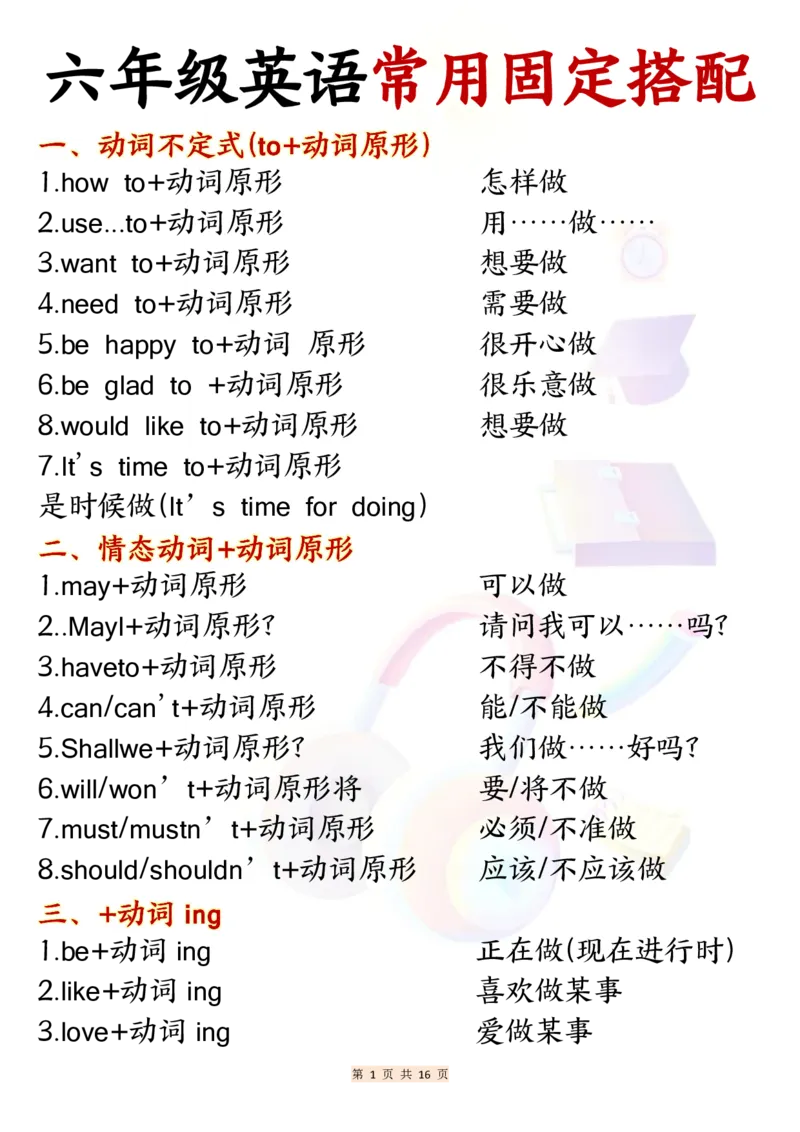
六年级英语常用固定搭配
1.how to+动词原形
怎样做
2.use...to+动词原形
用……做……
3.want to+动词原形
想要做
4.need to+动词原形
需要做
5.be happy to+动词原形
很开心做
6.be glad to +动词原形
很乐意做
8.would like to+动词原形
想要做
7.It's time to+动词原形
是时候做(It’s time for doing)
1.may+动词原形
可以做
2..Mayl+动词原形?
请问我可以……吗?
3.haveto+动词原形
不得不做
4.can/can't+动词原形
能/不能做
5.Shallwe+动词原形?
我们做……好吗?
6.will/won’t+动词原形将
要/将不做
7.must/mustn’t+动词原形
必须/不准做
8.should/shouldn’t+动词原形
应该/不应该做
1.be+动词ing
正在做(现在进行时)
2.like+动词ing
喜欢做某事
3.love+动词ing
爱做某事
第2 页共16 页
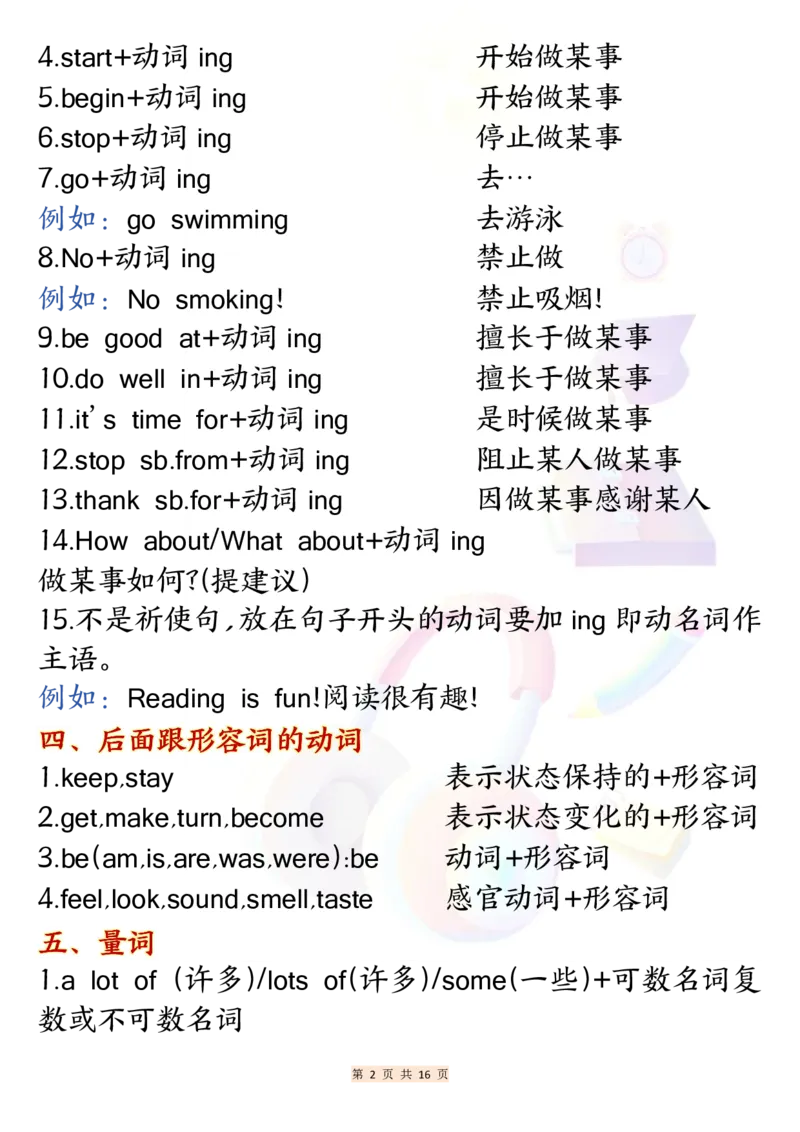
4.start+动词ing
开始做某事
5.begin+动词ing
开始做某事
6.stop+动词ing
停止做某事
7.go+动词ing
去…
例如:go swimming
去游泳
8.No+动词ing
禁止做
例如:No smoking!
禁止吸烟!
9.be good at+动词ing
擅长于做某事
10.do well in+动词ing
擅长于做某事
11.it's time for+动词ing
是时候做某事
12.stop sb.from+动词ing
阻止某人做某事
13.thank sb.for+动词ing
因做某事感谢某人
14.How about/What about+动词ing
做某事如何?(提建议)
15.不是祈使句,放在句子开头的动词要加ing 即动名词作
主语。
例如:Reading is fun!阅读很有趣!
1.keep,stay
表示状态保持的+形容词
2.get,make,turn,become
表示状态变化的+形容词
3.be(am,is,are,was,were):be
动词+形容词
4.feel,look,sound,smell,taste
感官动词+形容词
1.a lot of (许多)/lots of(许多)/some(一些)+可数名词复
数或不可数名词
第3 页共16 页
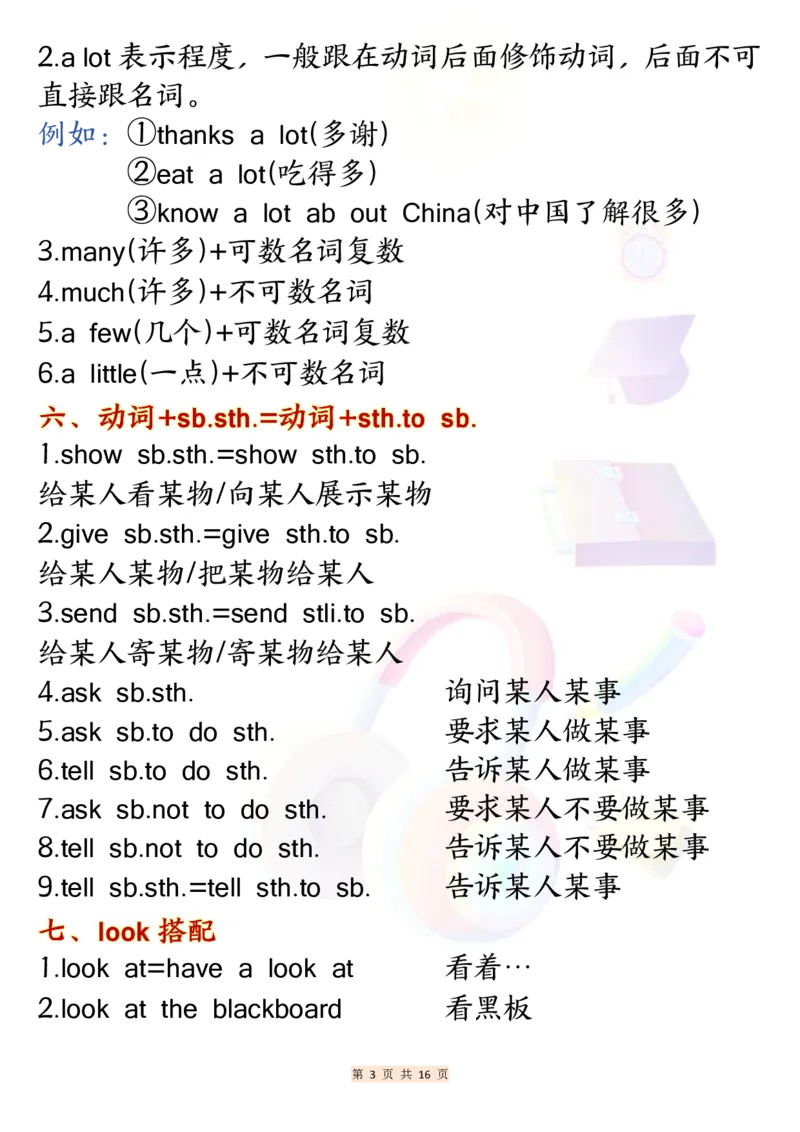
2.a lot 表示程度,一般跟在动词后面修饰动词,后面不可
直接跟名词。
例如:①thanks a lot(多谢)
如如:②eat a lot(吃得多)
如如:③know a lot ab out China(对中国了解很多)
3.many(许多)+可数名词复数
4.much(许多)+不可数名词
5.a few(几个)+可数名词复数
6.a little(一点)+不可数名词
1.show sb.sth.=show sth.to sb.
给某人看某物/向某人展示某物
2.give sb.sth.=give sth.to sb.
给某人某物/把某物给某人
3.send sb.sth.=send stli.to sb.
给某人寄某物/寄某物给某人
4.ask sb.sth.
询问某人某事
5.ask sb.to do sth.
要求某人做某事
6.tell sb.to do sth.
告诉某人做某事
7.ask sb.not to do sth.
要求某人不要做某事
8.tell sb.not to do sth.
告诉某人不要做某事
9.tell sb.sth.=tell sth.to sb.
告诉某人某事
1.look at=have a look at
看着…
2.look at the blackboard
看黑板
第4 页共16 页
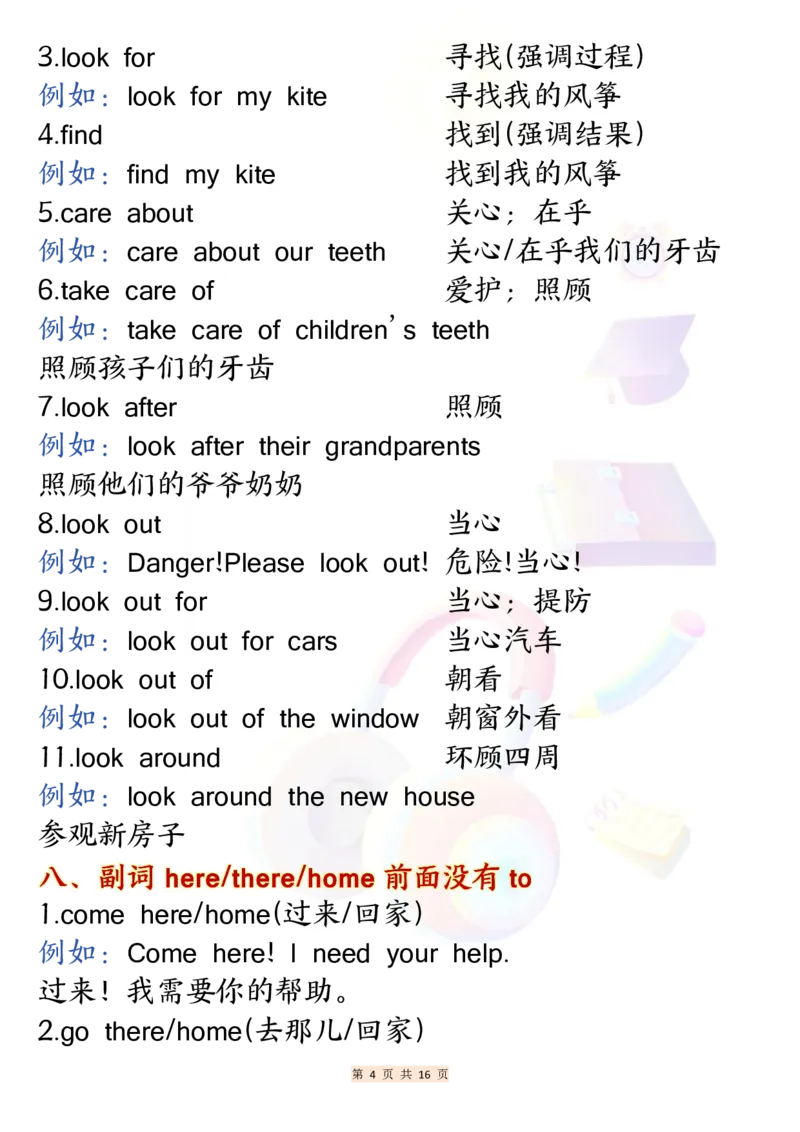
3.look for
寻找(强调过程)
例如:look for my kite
寻找我的风筝
4.find
找到(强调结果)
例如:find my kite
找到我的风筝
5.care about
关心;在乎
例如:care about our teeth
关心/在乎我们的牙齿
6.take care of
爱护;照顾
例如:take care of children's teeth
照顾孩子们的牙齿
7.look after
照顾
例如:look after their grandparents
照顾他们的爷爷奶奶
8.look out
当心
例如:Danger!Please look out! 危险!当心!
9.look out for
当心;提防
例如:look out for cars
当心汽车
10.look out of
朝看
例如:look out of the window
朝窗外看
11.look around
环顾四周
例如:look around the new house
参观新房子
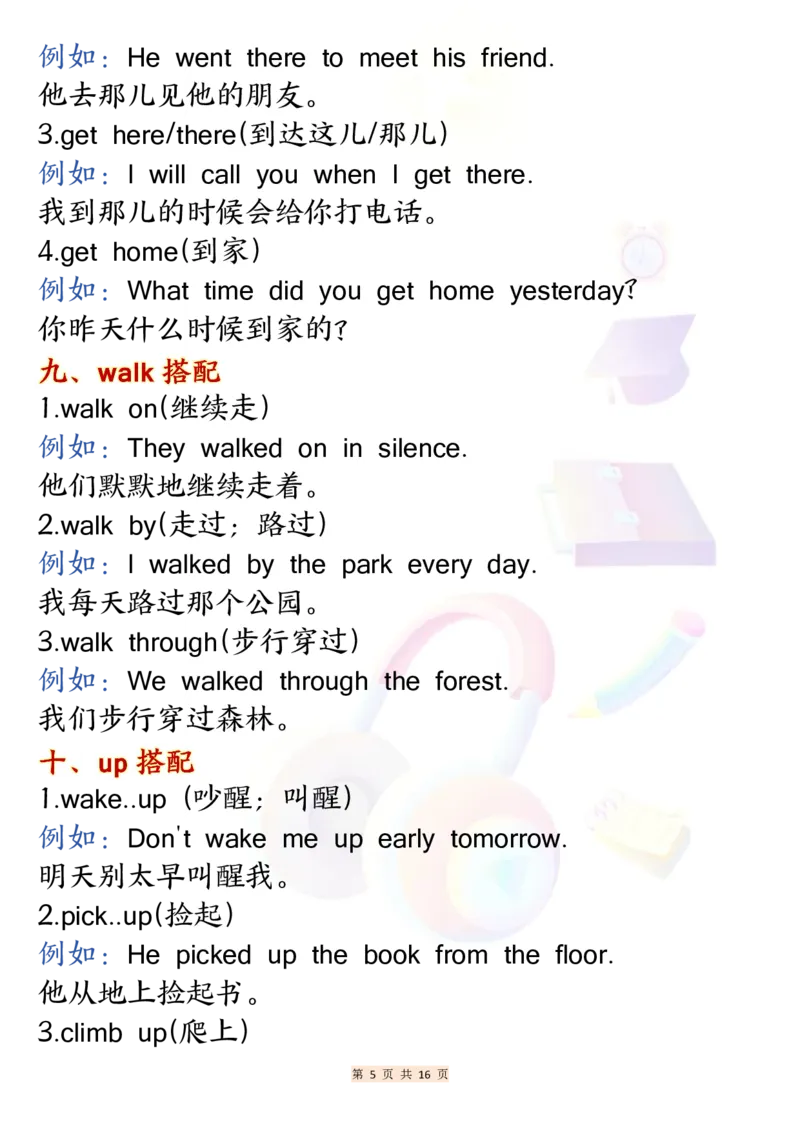
1.come here/home(过来/回家)
例如:Come here! I need your help.
过来!我需要你的帮助。
2.go there/home(去那儿/回家)
第5 页共16 页
例如:He went there to meet his friend.
他去那儿见他的朋友。
3.get here/there(到达这儿/那儿)
例如:I will call you when I get there.
我到那儿的时候会给你打电话。
4.get home(到家)
例如:What time did you get home yesterday?
你昨天什么时候到家的?
1.walk on(继续走)
例如:They walked on in silence.
他们默默地继续走着。
2.walk by(走过;路过)
例如:I walked by the park every day.
我每天路过那个公园。
3.walk through(步行穿过)
例如:We walked through the forest.
我们步行穿过森林。
1.wake..up (吵醒;叫醒)
例如:Don't wake me up early tomorrow.
明天别太早叫醒我。
2.pick..up(捡起)
例如:He picked up the book from the floor.
他从地上捡起书。
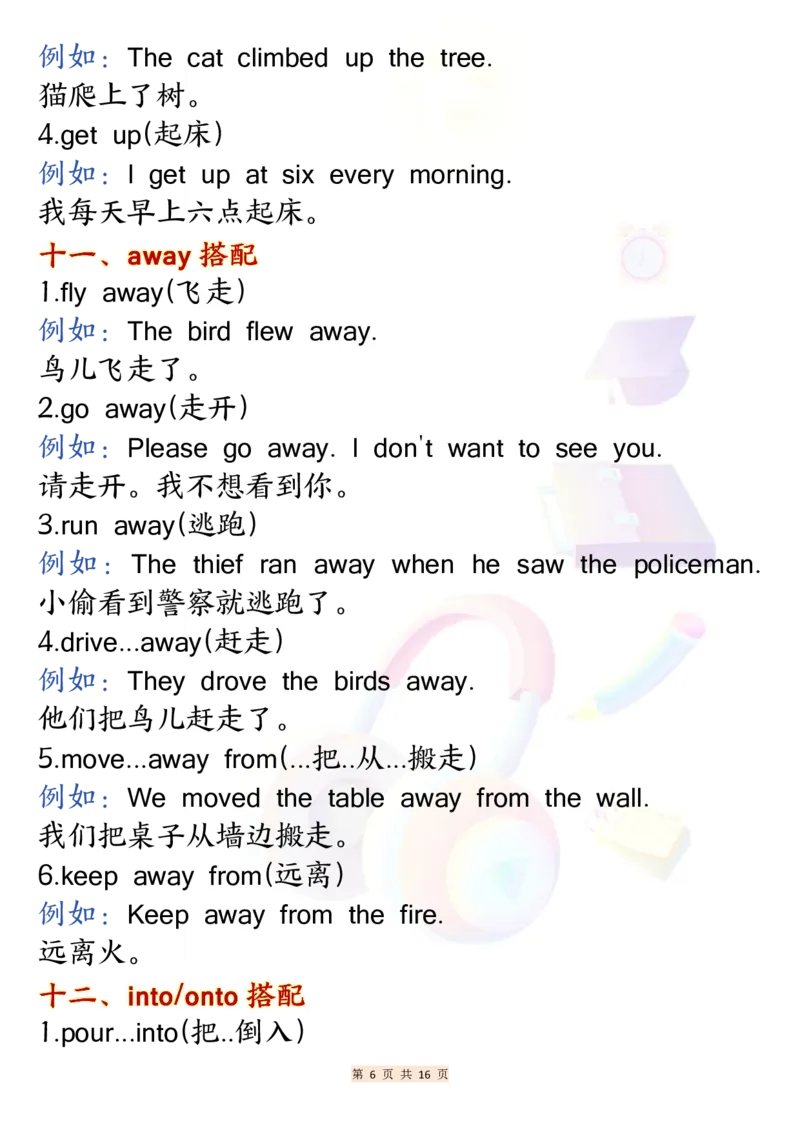
3.climb up(爬上)
第6 页共16 页
例如:The cat climbed up the tree.
猫爬上了树。
4.get up(起床)
例如:I get up at six every morning.
我每天早上六点起床。
1.fly away(飞走)
例如:The bird flew away.
鸟儿飞走了。
2.go away(走开)
例如:Please go away. I don't want to see you.
请走开。我不想看到你。
3.run away(逃跑)
例如:The thief ran away when he saw the policeman.
小偷看到警察就逃跑了。
4.drive...away(赶走)
例如:They drove the birds away.
他们把鸟儿赶走了。
5.move...away from(...把..从...搬走)
例如:We moved the table away from the wall.
我们把桌子从墙边搬走。
6.keep away from(远离)
例如:Keep away from the fire.
远离火。
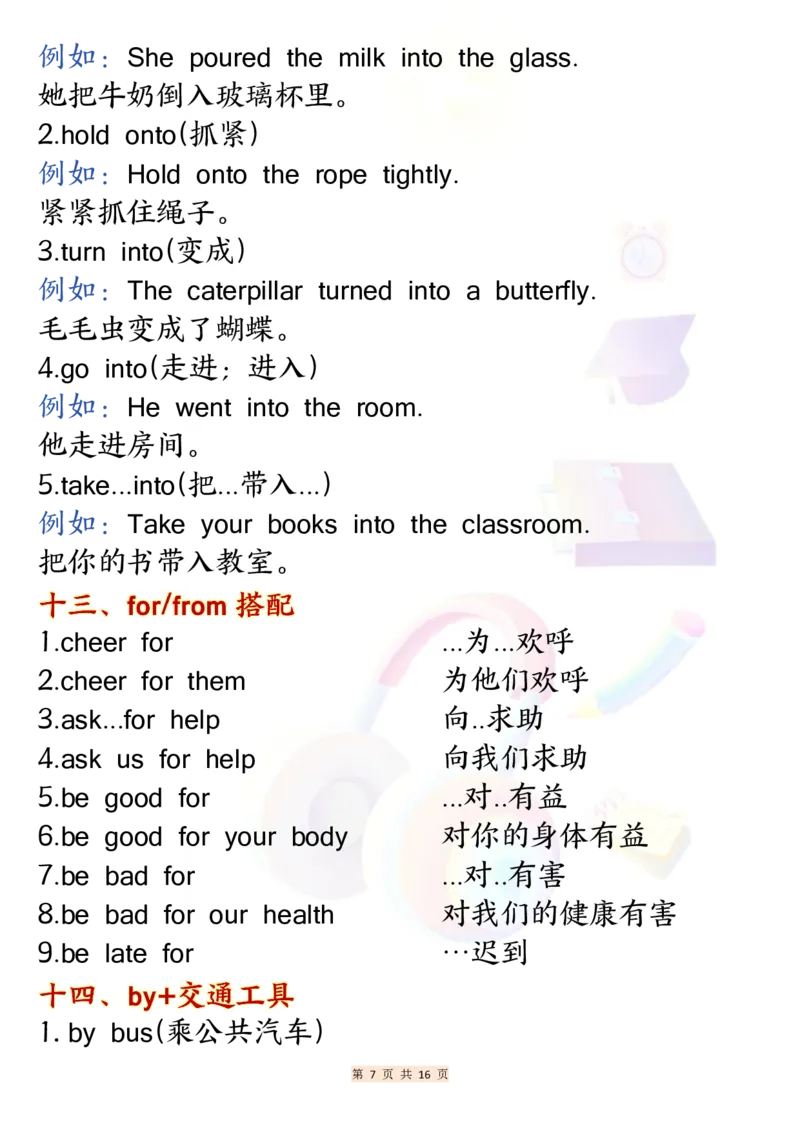
1.pour...into(把..倒入)
第7 页共16 页
例如:She poured the milk into the glass.
她把牛奶倒入玻璃杯里。
2.hold onto(抓紧)
例如:Hold onto the rope tightly.
紧紧抓住绳子。
3.turn into(变成)
例如:The caterpillar turned into a butterfly.
毛毛虫变成了蝴蝶。
4.go into(走进;进入)
例如:He went into the room.
他走进房间。
5.take...into(把...带入...)
例如:Take your books into the classroom.
把你的书带入教室。
1.cheer for
...为...欢呼
2.cheer for them
为他们欢呼
3.ask...for help
向..求助
4.ask us for help
向我们求助
5.be good for
...对..有益
6.be good for your body
对你的身体有益
7.be bad for
...对..有害
8.be bad for our health
对我们的健康有害
9.be late for
…迟到
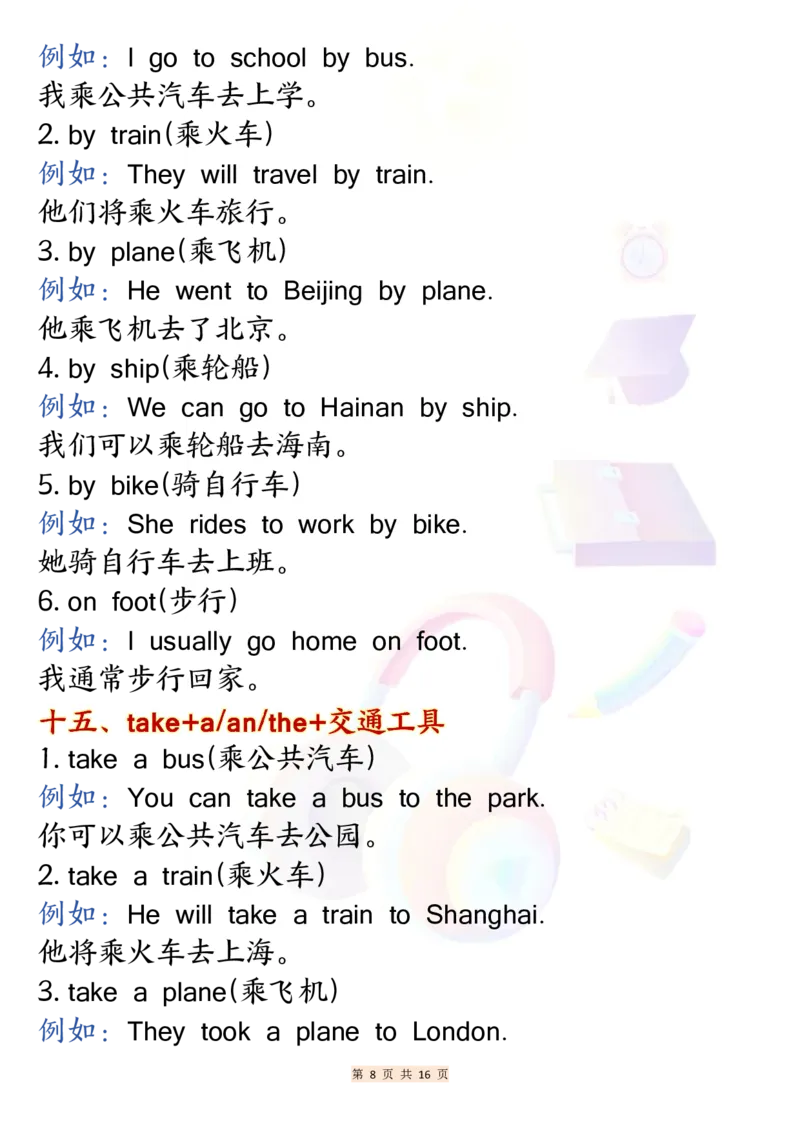
1.by bus(乘公共汽车)
第8 页共16 页
例如:I go to school by bus.
我乘公共汽车去上学。
2.by train(乘火车)
例如:They will travel by train.
他们将乘火车旅行。
3.by plane(乘飞机)
例如:He went to Beijing by plane.
他乘飞机去了北京。
4.by ship(乘轮船)
例如:We can go to Hainan by ship.
我们可以乘轮船去海南。
5.by bike(骑自行车)
例如:She rides to work by bike.
她骑自行车去上班。
6.on foot(步行)
例如:I usually go home on foot.
我通常步行回家。
1.take a bus(乘公共汽车)
例如:You can take a bus to the park.
你可以乘公共汽车去公园。
2.take a train(乘火车)
例如:He will take a train to Shanghai.
他将乘火车去上海。
3.take a plane(乘飞机)
例如:They took a plane to London.
第9 页共16 页
他们乘飞机去了伦敦。
4.take a ship(乘轮船)
例如:We took a ship to Japan.
我们乘轮船去了日本。
1.in the morning(在上午)
例如:I read books in the morning.
我在上午读书。
2.in the afternoon(在下午)
例如:We play basketball in the afternoon.
我们在下午打篮球。
3.in the evening(在晚上)
例如:They watch TV in the evening.
他们在晚上看电视。
1.on Monday(在星期一)
I have English class on Monday.
例如:我在星期一有英语课。
2.on June 1st(在六月一日)
We will have a party on June 1st.
例如:我们将在六月一日举行一个聚会。
1.at six o'clock(在六点钟)
例如:I get up at six o'clock.
我在六点钟起床。
2.at noon (在中午)
第10 页共16 页
例如:We have lunch at noon.
我们在中午吃午饭。
3.at night(在晚上)
例如:The stars are beautiful at night.
晚上的星星很漂亮。
1.in Beijing(在北京)
例如:He lives in Beijing
他住在北京。
2.in China(在中国)
例如:China is a beautiful country.
中国是一个美丽的国家。
1.at school(在学校)
例如:I study at school.
我在学校学习。
2.at home(在家)
例如:stay at home on weekends.
我周末待在家里。
1.under the bed(在床底下)
例如:My shoes are under the bed.
我的鞋子在床底下。
2.under the tree(在树下)
例如:We sit under the tree and read books.
我们坐在树下读书。
第11 页共16 页
1.near the park(在公园附近)
例如:My house is near the park.
我家在公园附近。
2.near the school(在学校附近)
There is a supermarket near the school.
例如:学校附近有一个超市。
1.next to the library(紧挨着图书馆)
例如:The bookstore is next to the library.
书店紧挨着图书馆。
2.next to the hospital(紧挨着医院)
例如:The hotel is next to the hospital.
酒店紧挨着医院。
1.in front of the building(在大楼前面)
例如:There is a statue in front of the building.
大楼前面有一座雕像。
2.in front of the classroom
在教室前面)
The teacher stands in front of the classroom.
例如:老师站在教室前面。
1.behind the house(在房子后面)
例如:There is a garden behind the house.
房子后面有一个花园。
2.behind the desk(在书桌后面)
第12 页共16 页
例如:My bag is behind the desk.
我的书包在书桌后面。
1.have breakfast(吃早餐)
例如:I have breakfast at seven o'clock.
我七点钟吃早餐。
2.have lunch(吃午餐)
例如:We have lunch at school.
我们在学校吃午餐。
3.have dinner(吃晚餐)
例如:They have dinner at six o'clock.
他们六点钟吃晚餐。
4.have English class(上英语课)
例如:I have English class on Monday.
我星期一上英语课。
5.have a picnic(去野餐)
例如:We will have a picnic this weekend.
我们这个周末去野餐。
6.have a party(举行聚会)
例如:They had a party last night.
他们昨晚举行了一个聚会。
1.go swimming(去游泳)
例如:I like going swimming in summer.
我喜欢在夏天去游泳。
2.go fishing(去钓鱼)
第13 页共16 页
例如:He often goes fishing on weekends.
他经常在周末去钓鱼。
3.go hiking(去远足)
例如:We will go hiking next Sunday.
我们下周日去远足。
4.go shopping(去购物)
例如:My mother goes shopping every weekend.
我妈妈每个周末都去购物。
1.do homework(做家庭作业)
例如:I do my homework after school.
我放学后做家庭作业。
2.do housework(做家务)
例如:She helps her mother do housework.
她帮妈妈做家务。
3.do sports(做运动)
例如:We should do sports every day.
我们应该每天做运动。
1.play basketball(打篮球)
例如:They play basketball after school.
他们放学后打篮球。
2.play football(踢足球)
例如:He likes playing football.
他喜欢踢足球。
3.play the piano(弹钢琴)
第14 页共16 页
例如:She can play the piano very well.
她弹钢琴弹得很好。
4.play the violin(拉小提琴)
例如:He is learning to play the violin.
他正在学习拉小提琴。
1.be good at English(擅长英语)
例如:She is good at English.
她擅长英语。
2.be good at swimming(擅长游泳)
例如:He is good at swimming.
他擅长游泳。
1.be interested in music(对音乐感兴趣)
例如:I am interested in music.
我对音乐感兴趣。
2.be interested in reading(对阅读感兴趣)
例如:She is interested in reading books.
她对读书感兴趣。
1.be busy with work(忙于工作)
例如:My father is busy with his work.
我爸爸忙于他的工作。
2.be busy with studying(忙于学习)
例如:We are busy with studying for the exam.
我们忙于为考试学习。
第15 页共16 页
1.be friendly to classmates(对同学友好)
例如:We should be friendly to our classmates.
我们应该对同学友好。
2.be friendly to strangers(对陌生人友好)
例如:We should also be friendly to strangers.
我们也应该对陌生人友好。
1.look at the blackboard(看黑板)
例如:Please look at the blackboard.
请看黑板。
2.look at the picture(看图片)
例如:She is looking at the picture.
她正在看图片。
1.listen to the teacher(听老师讲)
例如:We should listen to the teacher carefully.
我们应该认真听老师讲。
2.listen to music(听音乐)
例如:I like listening to music.
我喜欢听音乐。
1.talk about the weather(谈论天气)
例如:They are talking about the weather.
他们正在谈论天气。
2.talk about hobbies(谈论爱好)
例如:We can talk about our hobbies.
第16 页共16 页
我们可以谈论我们的爱好。
1.help me with my homework(帮我做家庭作业)
例如:She often helps me with my homework.
她经常帮我做家庭作业。
2.help him with his English(帮他学英语)
例如:I can help him with his English.
我可以帮他学英语。
1.be proud of my country(为我的国家感到骄傲)
例如:I am proud of my country.
我为我的国家感到骄傲。
2.be proud of my achievements(为我的成就感到骄傲)
例如:He is proud of his achievements.
他为他的成就感到骄傲。
1.be afraid of dogs(害怕狗)
例如:She is afraid of dogs.
她害怕狗。
2.be afraid of darkness(害怕黑暗)
例如:I am afraid of darkness.
我害怕黑暗。
1.on the table(在桌子上)
例如:There is a book on the table.
桌子上有一本书。
2.on the wall(在墙上)
例如:There is a picture on the wall.
墙上有一幅画。