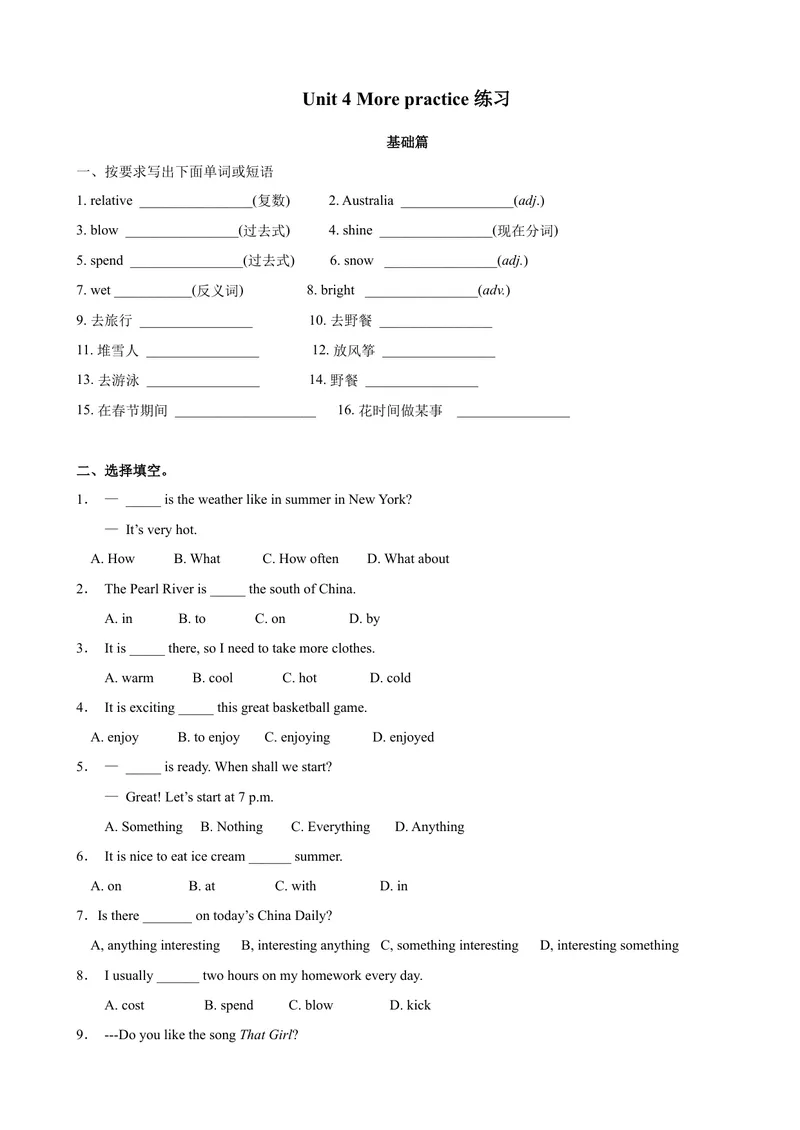
Unit 4 More practice 练习
基础篇
一、按要求写出下面单词或短语
1. relative ________________(复数) 2. Australia ________________(adj.)
3. blow ________________(过去式) 4. shine ________________(现在分词)
5. spend ________________(过去式) 6. snow ________________(adj.)
7. wet ___________(反义词) 8. bright ________________(adv.)
9. 去旅行 ________________ 10. 去野餐 ________________
11. 堆雪人 ________________ 12. 放风筝 ________________
13. 去游泳 ________________ 14. 野餐 ________________
15. 在春节期间 ____________________ 16. 花时间做某事 ________________
二、选择填空。
1. — _____ is the weather like in summer in New York?
— It’s very hot.
A. How B. What C. How often D. What about
2. The Pearl River is _____ the south of China.
A. in B. to C. on D. by
3. It is _____ there, so I need to take more clothes.
A. warm B. cool C. hot D. cold
4. It is exciting _____ this great basketball game.
A. enjoy B. to enjoy C. enjoying D. enjoyed
5. — _____ is ready. When shall we start?
— Great! Let’s start at 7 p.m.
A. Something B. Nothing C. Everything D. Anything
6. It is nice to eat ice cream ______ summer.
A. on B. at C. with D. in
7.Is there _______ on today’s China Daily?
A, anything interesting B, interesting anything C, something interesting D, interesting something
8. I usually ______ two hours on my homework every day.
A. cost B. spend C. blow D. kick
9. ---Do you like the song That Girl?---Of course. It’s really an_______ song and I’m very_______ in it.
A. interesting, interesting B. interested, interesting
C. interesting, interested D. interested, interested
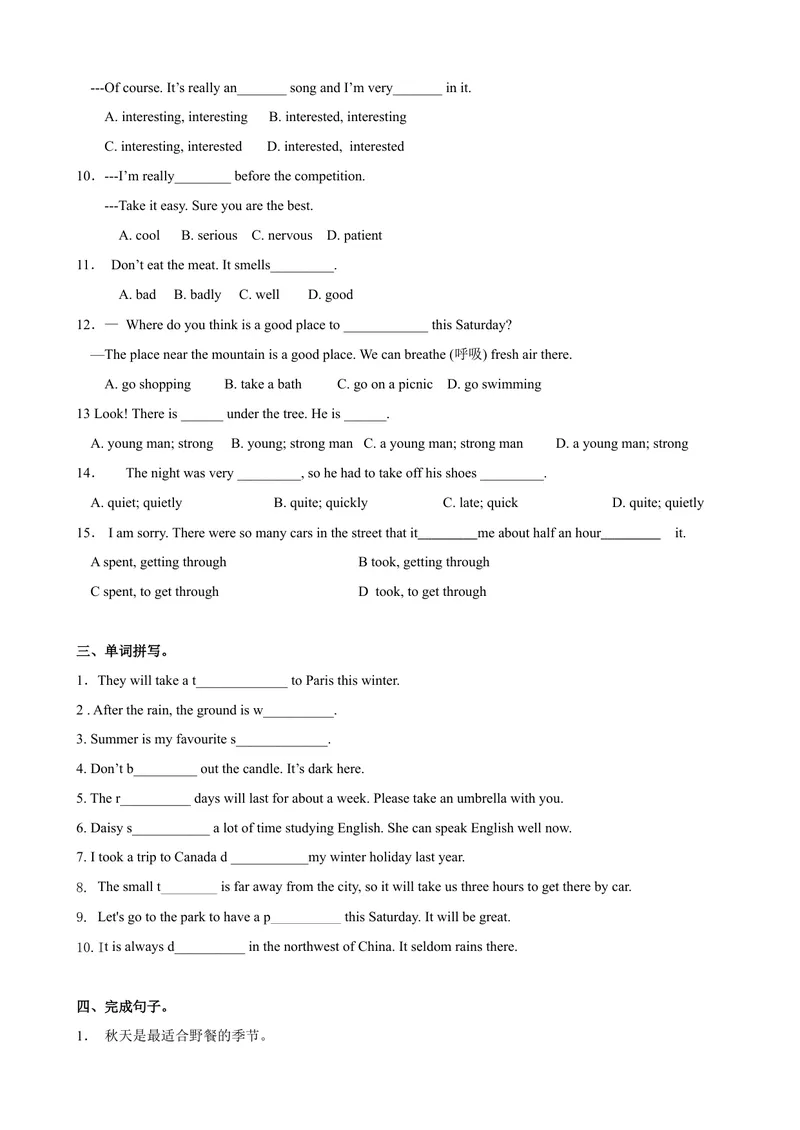
10.---I’m really________ before the competition.
---Take it easy. Sure you are the best.
A. cool B. serious C. nervous D. patient
11. Don’t eat the meat. It smells_________.
A. bad B. badly C. well D. good
12.— Where do you think is a good place to ____________ this Saturday?
—The place near the mountain is a good place. We can breathe (呼吸) fresh air there.
A. go shopping B. take a bath C. go on a picnic D. go swimming
13 Look! There is ______ under the tree. He is ______.
A. young man; strong B. young; strong man C. a young man; strong man D. a young man; strong
14. The night was very _________, so he had to take off his shoes _________.
A. quiet; quietly B. quite; quickly C. late; quick D. quite; quietly
15. I am sorry. There were so many cars in the street that it me about half an hour it.
A spent, getting through B took, getting through
C spent, to get through D took, to get through
三、单词拼写。
1.They will take a t_____________ to Paris this winter.
2 . After the rain, the ground is w__________.
3. Summer is my favourite s_____________.
4. Don’t b_________ out the candle. It’s dark here.
5. The r__________ days will last for about a week. Please take an umbrella with you.
6. Daisy s___________ a lot of time studying English. She can speak English well now.
7. I took a trip to Canada d ___________my winter holiday last year.
8. The small t________ is far away from the city, so it will take us three hours to get there by car.
9. Let's go to the park to have a p__________ this Saturday. It will be great.
10.It is always d__________ in the northwest of China. It seldom rains there.
四、完成句子。
1. 秋天是最适合野餐的季节。Autumn is the best season to __________ _________ ____________.
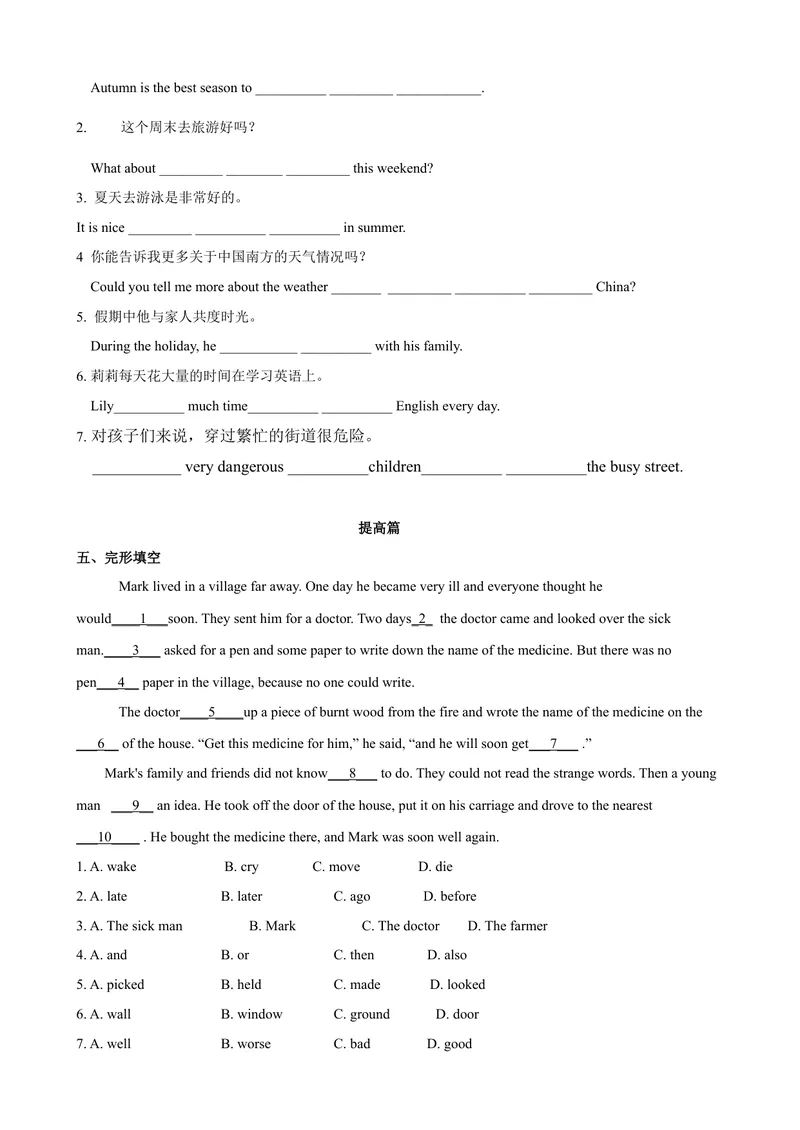
2. 这个周末去旅游好吗?
What about _________ ________ _________ this weekend?
3. 夏天去游泳是非常好的。
It is nice _________ __________ __________ in summer.
4 你能告诉我更多关于中国南方的天气情况吗?
Could you tell me more about the weather _______ _________ __________ _________ China?
5. 假期中他与家人共度时光。
During the holiday, he ___________ __________ with his family.
6. 莉莉每天花大量的时间在学习英语上。
Lily__________ much time__________ __________ English every day.
7. 对孩子们来说,穿过繁忙的街道很危险。
___________ very dangerous __________children__________ __________the busy street.
提高篇
五、完形填空
Mark lived in a village far away. One day he became very ill and everyone thought he
would____1___soon. They sent him for a doctor. Two days_2_ the doctor came and looked over the sick
man.____3___ asked for a pen and some paper to write down the name of the medicine. But there was no
pen___4__ paper in the village, because no one could write.
The doctor____5____up a piece of burnt wood from the fire and wrote the name of the medicine on the
___6__ of the house. “Get this medicine for him,” he said, “and he will soon get___7___ .”
Mark's family and friends did not know___8___ to do. They could not read the strange words. Then a young
man ___9__ an idea. He took off the door of the house, put it on his carriage and drove to the nearest
___10____ . He bought the medicine there, and Mark was soon well again.
1. A. wake B. cry C. move D. die
2. A. late B. later C. ago D. before
3. A. The sick man B. Mark C. The doctor D. The farmer
4. A. and B. or C. then D. also
5. A. picked B. held C. made D. looked
6. A. wall B. window C. ground D. door
7. A. well B. worse C. bad D. good8. A. when B. what C. where D. which
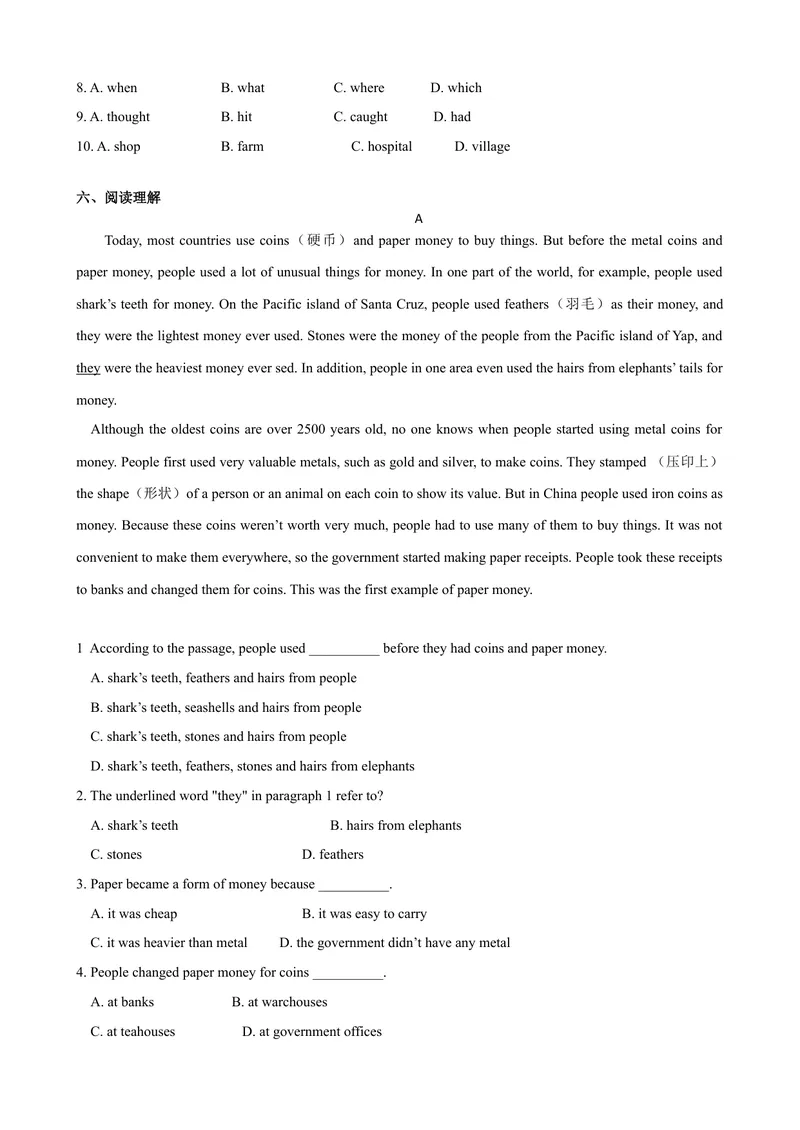
9. A. thought B. hit C. caught D. had
10. A. shop B. farm C. hospital D. village
六、阅读理解
A
Today, most countries use coins(硬币)and paper money to buy things. But before the metal coins and
paper money, people used a lot of unusual things for money. In one part of the world, for example, people used
shark’s teeth for money. On the Pacific island of Santa Cruz, people used feathers(羽毛)as their money, and
they were the lightest money ever used. Stones were the money of the people from the Pacific island of Yap, and
they were the heaviest money ever sed. In addition, people in one area even used the hairs from elephants’ tails for
money.
Although the oldest coins are over 2500 years old, no one knows when people started using metal coins for
money. People first used very valuable metals, such as gold and silver, to make coins. They stamped (压印上)
the shape(形状)of a person or an animal on each coin to show its value. But in China people used iron coins as
money. Because these coins weren’t worth very much, people had to use many of them to buy things. It was not
convenient to make them everywhere, so the government started making paper receipts. People took these receipts
to banks and changed them for coins. This was the first example of paper money.
1 According to the passage, people used __________ before they had coins and paper money.
A. shark’s teeth, feathers and hairs from people
B. shark’s teeth, seashells and hairs from people
C. shark’s teeth, stones and hairs from people
D. shark’s teeth, feathers, stones and hairs from elephants
2. The underlined word "they" in paragraph 1 refer to?
A. shark’s teeth B. hairs from elephants
C. stones D. feathers
3. Paper became a form of money because __________.
A. it was cheap B. it was easy to carry
C. it was heavier than metal D. the government didn’t have any metal
4. People changed paper money for coins __________.
A. at banks B. at warchouses
C. at teahouses D. at government offices5. What’s the best title for the passage?
A. The history of money B. The use of money
C. The importance of money D. Different countries’ people use different money.
B
At a school of Xi'an, 40 pupils were not Young Pioneers. They had to wear green scarves, because their
schoolwork was not good.
"Some classmates in my grade and all the pupils in higher grades wear red scarves, but I have to wear a green
one,” a grade-one pupil said. The parents thought it wasn't right to make some pupils wear green scarves. "After
wearing a green scarf, my child doesn't like to play with her friends," said a mother.
“We thought that it can make them study harder,” said Chen Hong, the school's principal (校长). “We did not
think some parents would dislike it. We let the better pupils wear red scarves first, and gave the others green ones
to encourage them to get a red scarf next time. We didn't want to let the students feel sad. ” Chen Hong said.
6.Why did some students wear green scarves at the school?
A. They were not the Young Pioneers. B. They didn't like to play with their friends.
C. They were not good at study. D. They were students in Grade One.
7.The second paragraph mainly tells us that ______.
A. we shouldn't be strict with the pupils
B. the school should look after the pupils well
C. wearing the green scarves isn't good for the pupils
D. the parents didn't know about the green scarves well
8.The underlined word “encourage” means“_______ ”.
A. make sb. feel brave B. make sb. feel sad
C. make sb. feel strong D. make sb. feel happy
9.Which of the following is NOT true?
A. The pupils didn't like to wear the green scarves.
B. The parents weren't happy that their children wore green scarves.
C. Chen thought wearing green scarves could help the pupils.
D. All the pupils wearing green scarves did better in lessons.