小学英语知识归纳总结(打印版)
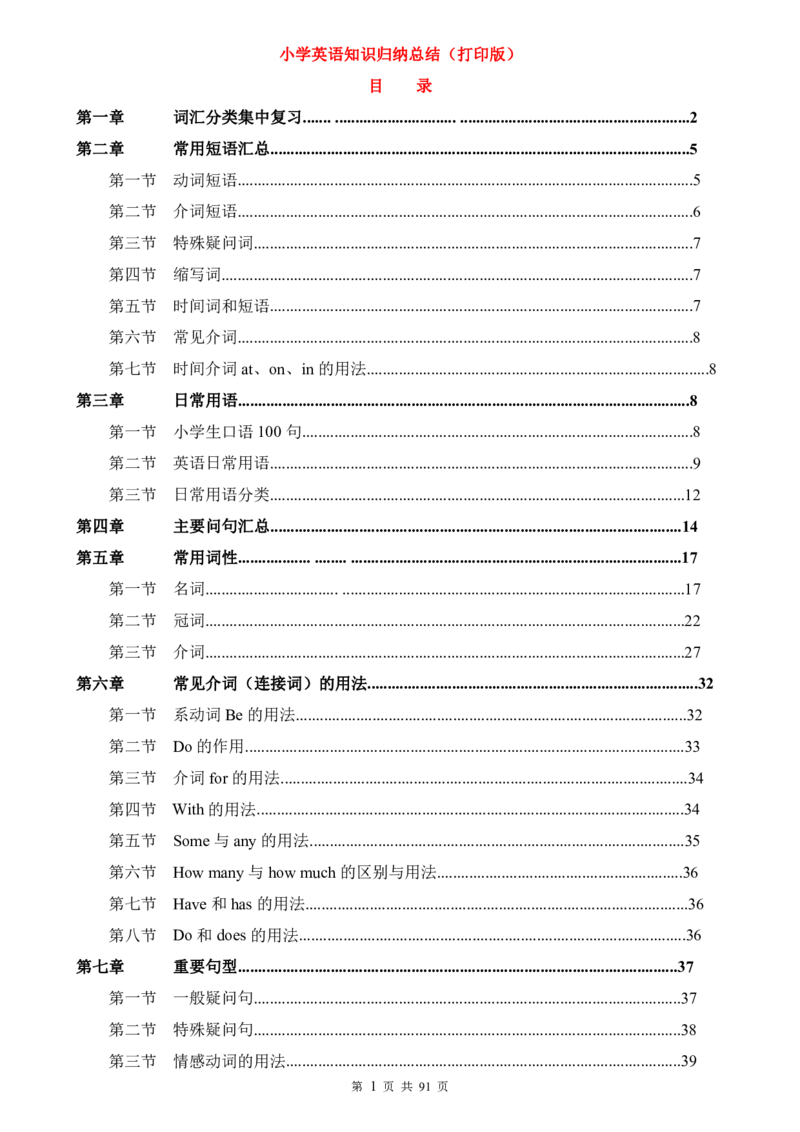
目 录
第一章 词汇分类集中复习..............................................................................................2
第二章 常用短语汇总........................................................................................................5
第一节 动词短语.................................................................................................................5
第二节 介词短语.................................................................................................................6
第三节 特殊疑问词.............................................................................................................7
第四节 缩写词.....................................................................................................................7
第五节 时间词和短语.........................................................................................................7
第六节 常见介词.................................................................................................................8
第七节 时间介词at、on、in 的用法.....................................................................................8
第三章 日常用语................................................................................................................8
第一节 小学生口语100句.................................................................................................8
第二节 英语日常用语.........................................................................................................9
第三节 日常用语分类.......................................................................................................12
第四章 主要问句汇总......................................................................................................14
第五章 常用词性............................................................................................................17
第一节 名词......................................................................................................................17
第二节 冠词.......................................................................................................................22
第三节 介词.......................................................................................................................27
第六章 常见介词(连接词)的用法..................................................................................32
第一节 系动词Be 的用法.................................................................................................32
第二节 Do 的作用.............................................................................................................33
第三节 介词for 的用法.....................................................................................................34
第四节 With的用法..........................................................................................................34
第五节 Some与any 的用法.............................................................................................35
第六节 How many 与howmuch 的区别与用法.............................................................36
第七节 Have 和has 的用法...............................................................................................36
第八节 Do和does 的用法................................................................................................36
第七章 重要句型.............................................................................................................37
第一节 一般疑问句..........................................................................................................37
第二节 特殊疑问句..........................................................................................................38
第三节 情感动词的用法..................................................................................................39
第 1 页 共 91 页第八章 五种语法汇总......................................................................................................40
第一节 现在进行时态.......................................................................................................40
第二节 一般现在时态.......................................................................................................40
第三节 一般将来时态.......................................................................................................42
第四节 一般过去时态.......................................................................................................43
第五节 小学英语不规则动词变化表...............................................................................45
第六节 形容词副词的比较级和最高级...........................................................................46
第七节 几种时态的构成汇总...........................................................................................47
第九章 方位的表达方式..................................................................................................48
第一节 交通工具及“规则” .........................................................................................48
第二节 英语中方位的表达方式......................................................................................49
第十章 句型转换方法归纳..............................................................................................50
第一节 改为一般疑问句.................................................................................................50
第二节 改为否定句.........................................................................................................50
第三节 对划线部分提问.................................................................................................51
第四节 肯定句、否定句、一般疑问句和特殊疑问句....................................................51
第五节 其它需要注意点.................................................................................................52
第十一章 小学英语谚语集锦..............................................................................................52
第十二章 写作......................................................................................................................55
第一节 分类写作指导....................................................................................................55
第二节 命题作文...............................................................................................................58
第三节 话题作文...............................................................................................................62
第 2 页 共 91 页小学英语知识点汇总
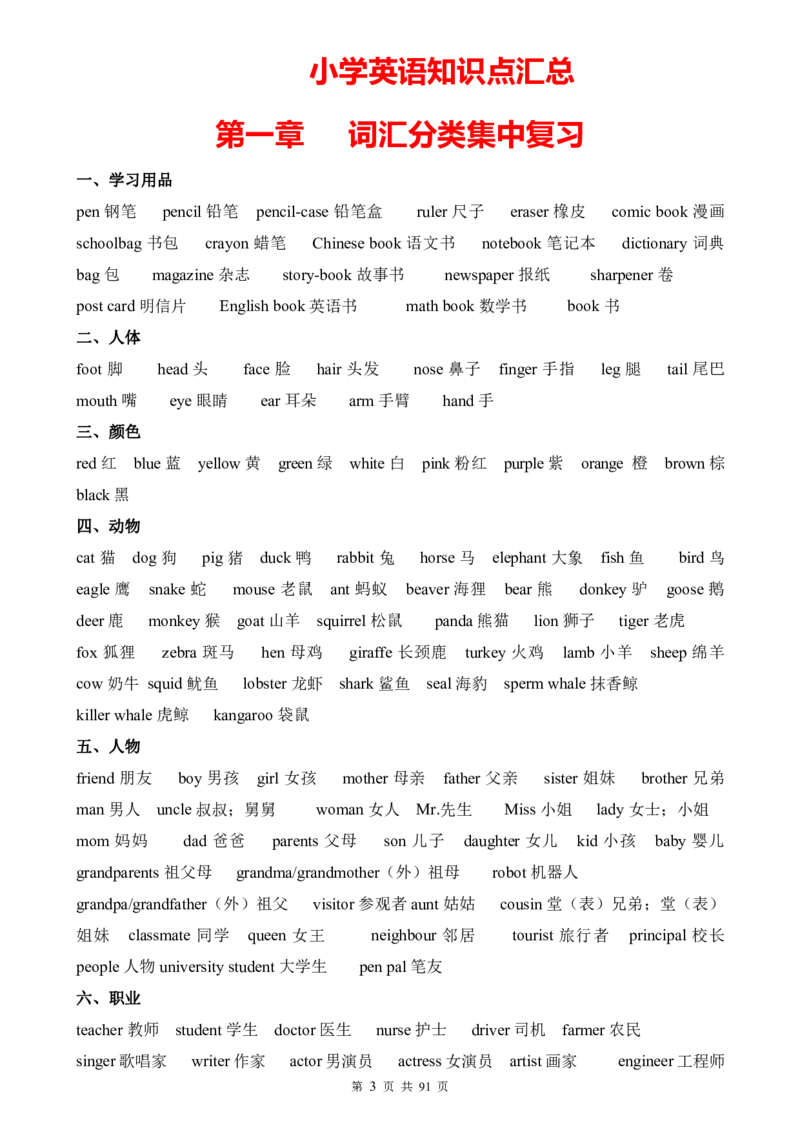
第一章 词汇分类集中复习
一、学习用品
pen 钢笔 pencil 铅笔 pencil-case 铅笔盒 ruler 尺子 eraser 橡皮 comic book 漫画
schoolbag 书包 crayon 蜡笔 Chinese book 语文书 notebook 笔记本 dictionary 词典
bag 包 magazine杂志 story-book 故事书 newspaper 报纸 sharpener卷
post card 明信片 English book英语书 math book数学书 book书
二、人体
foot 脚 head 头 face 脸 hair 头发 nose 鼻子 finger 手指 leg 腿 tail 尾巴
mouth 嘴 eye 眼睛 ear 耳朵 arm 手臂 hand 手
三、颜色
red 红 blue 蓝 yellow 黄 green 绿 white 白 pink 粉红 purple 紫 orange 橙 brown 棕
black黑
四、动物
cat 猫 dog 狗 pig 猪 duck 鸭 rabbit 兔 horse 马 elephant 大象 fish 鱼 bird 鸟
eagle 鹰 snake 蛇 mouse 老鼠 ant 蚂蚁 beaver 海狸 bear 熊 donkey 驴 goose 鹅
deer 鹿 monkey 猴 goat 山羊 squirrel 松鼠 panda 熊猫 lion狮子 tiger 老虎
fox 狐狸 zebra 斑马 hen 母鸡 giraffe 长颈鹿 turkey 火鸡 lamb 小羊 sheep 绵羊
cow 奶牛 squid鱿鱼 lobster 龙虾 shark 鲨鱼 seal 海豹 sperm whale 抹香鲸
killerwhale 虎鲸 kangaroo 袋鼠
五、人物
friend 朋友 boy 男孩 girl 女孩 mother 母亲 father 父亲 sister 姐妹 brother 兄弟
man 男人 uncle叔叔;舅舅 woman 女人 Mr.先生 Miss 小姐 lady 女士;小姐
mom 妈妈 dad 爸爸 parents 父母 son 儿子 daughter 女儿 kid 小孩 baby 婴儿
grandparents 祖父母 grandma/grandmother(外)祖母 robot 机器人
grandpa/grandfather(外)祖父 visitor参观者aunt 姑姑 cousin 堂(表)兄弟;堂(表)
姐妹 classmate 同学 queen 女王 neighbour 邻居 tourist 旅行者 principal 校长
people 人物university student大学生 pen pal 笔友
六、职业
teacher 教师 student 学生 doctor医生 nurse 护士 driver司机 farmer 农民
singer歌唱家 writer作家 actor男演员 actress女演员 artist画家 engineer工程师
第 3 页 共 91 页accountant 会计 cleaner 清洁工 salesperson 销售员 baseballplayer 棒球运动员
assistant 售货员 police警察 policeman(男)警察 policewoman(女)警察
TVreporter 电视台记者 weatherreporter 天气预报
七、食品、饮料
rice 米饭 bread 面包 beef 牛肉 milk 牛奶 water 水 egg 蛋 fish 鱼 tofu 豆腐
cake 蛋糕 cookie 曲奇 biscuit 饼干 jam 果酱 noodles 面条 tea 茶 meat 肉
chicken 鸡肉 pork 猪肉 salad 沙拉 soup 汤 Coke 可乐 mutton 羊肉 ice 冰
ice-cream 冰淇淋 juice 果汁 coffee咖啡 breakfast 早餐 lunch 午餐 vegetable 蔬菜
dinner/supper 晚餐 meal 一餐 hot dog 热狗 hamburger 汉堡包 French fries 炸薯条
八、水果、蔬菜
apple 苹果 banana 香蕉 pear 梨 orange 橙子 grape 葡萄 eggplant 茄子
green beans 青豆 tomato 西红柿 potato 土豆 peach 桃 strawberry 草莓 cucumber 黄瓜
onion 洋葱 carrot 胡萝卜 cabbage 卷心菜 watermelon 西瓜
九、衣服
jacket 夹克衫 pants 长裤 skirt 短裙子 dress 连衣裙 socks 袜子 jeans 牛仔裤
T-shirt 丅恤衫 shirt衬衫 shoes 鞋子 sweater 毛衣 coat 上衣 raincoat 雨衣
shorts 短裤 sneakers 网球鞋 slippers 拖鞋 sandals 凉鞋 boots 靴子 hat(有沿的)帽子
cap 便帽 cloth 布 sunglasses 太阳镜 tie领带 scarf 围巾 gloves 手套
trousers 裤子 clothes 衣服
十、交通工具
bike 自行车 bus公共汽车 train 火车 jeep 吉普车 ship 轮船 yacht 快艇
motorcycle 摩托车 boat 小船 car 小汽车 taxi出租车 van 小货车
plane/airplane 飞机 subway/underground 地铁
十一、杂物
window 窗户 door 门 desk 课桌 chair 椅子 computer 计算机 board 写字板 fan 风扇
light 灯 teacher’s desk 讲台 picture 图画;照片 wall 墙壁 floor 地板 curtain 窗帘
trash bin 垃圾箱 closet 壁橱 mirror镜子 end table 床头柜 present 礼物
walkman 随身听 lamp 台灯 sofa 沙发 football/soccer 足球 phone 电话 shelf 书架
fridge 冰箱 bed 床 table 桌子 TV 电视 air-conditioner 空调 key 钥匙 lock 锁
photo 照片 chart 图表 plate 盘子 knife 刀 fork 叉 spoon 勺子 chopsticks 筷子
pot 锅 gift 礼物 toy 玩具 doll洋娃娃 ball 球 balloon 气球 kite风筝
jigsaw puzzle 拼图游戏 box 盒子 umbrella 伞 zipper 拉链 violin 小提琴 tube 管子
yo-yo 溜溜球 nest 鸟窝 hole 洞 toothbrush 牙刷 menu 菜单 e-card 电子卡片
第 4 页 共 91 页money 钱e-mail 电子邮件 trafficlight 交通灯 medicine 药
十二、地点
home家 room房间 bedroom卧室 bathroom卫生间 living room起居室 kitchen厨房
classroom教室 school学校 park公园 library图书馆 post office邮局 policeoffice警
察局 hospital 医院 cinema 电影院 bookstore 书店 farm 农场 zoo 动物园 garden 花
园 study 书房 playground 操场 canteen 食堂 teacher’s office 教师办公室 library 图
书馆 gym体育馆 flat公寓washroom卫生间 art room绘画教室 computer room计算机
教室 music room 音乐教室 city 城市 TV room 电视机房 company 公司 factory 工厂
fruit stand 水果摊 pet shop 宠物商店 nature park 自然公园 theme park 主题公园
science museum科学博物馆 theGreat Wall 长城supermarket 超市 bank 银行
country 国家 village 乡村 hometown 家乡 bus stop公交车站
十三、课程
sports 体育运动 science 科学 Moral Education 思想品德课 Social Studies 社会
课 Chinese 语文 math 数学 PE体育课 English 英语课
十四、国家、城市
China/PRC 中国 America/USA 美国 UK 联合王国 England 英国 Canada/CAN 加
拿大 Australia 澳大利亚 New York 纽约 London 伦敦 Sydney 悉尼 Moscow 莫斯
科 Cairo 开罗
十五、气象
cold 寒冷的 warm 温暖的 cool 凉爽的 snowy 下雪的 sunny晴朗的
hot 炎热的 rainy 下雨的 windy 有风的 cloudy 多云的 weather report 天气预
报
十六、景物
river 河流 lake 湖泊 stream 河;溪 forest 森林 path 小道 road 公路
house 房子 rain 雨 cloud 云 bridge 桥 building 建筑物 sun 太阳
mountain 山 sky 天空 rainbow 彩虹 wind 风 air空气 moon 月亮
十七、植物
flower花 grass草 tree树 seed种子 sprout苗 plant植物 rose玫瑰 leaf叶子
十八、星期
Monday 星期一 Tuesday 星期二 Wednesday 星期三 Thursday 星期四
Friday 星期五 Saturday 星期六 Sunday 星期天 weekend 周末
十九、患病
have afever 发烧 hurt 疼痛 have acold 感冒 have atoothache 牙疼
第 5 页 共 91 页have aheadache 头疼 have asore throat 喉咙疼
二十、季节 spring 春 summer夏 fall/autumn 秋 winter 冬
二十一、方位 south南 north 北 east 东 west 西 left 左边 right 右边
二十二、月份
Jan. (January)一月 Feb.(February)二月 Mar.(March)三月 April 四月
May 五月 June 六月 July 七月 Aug.(August)八月 Sept.(September)九月
Oct.(October)十月 Nov.(November)十一月 Dec.(December)十二月
二十三、数词
one 一 two 二 three 三 four四 five 五 six六 seven 七 eight 八 nine九
ten 十 eleven 十一 twelve 十二 thirteen 十三 fourteen 十四 fifteen 十五
sixteen 十六 seventeen 十七 eighteen 十八 nineteen 十九 twenty 二十 thirty 三十
forty 四十 fifty 五十 sixty 六十 seventy 七十 eighty 八十 ninety 九十
forty-two 四十二 hundred 百 one/a hundred and thirty-six 一百三十六 first 第一
second 第二 third 第三 fourth 第四 fifth 第五 eighth 第八 ninth 第九
twelfth 第十二 twentieth 第二十 thirtieth 第三十 fortieth 第四十 fiftieth 第五十
sixtieth 第六十 seventieth 第七十 eightieth 第八十 ninetieth 第九十 fifty-sixth 第
五十六
二十四、形容词(adj)
big大的 small小的 long长的 tall高的 short短的;矮的 young年轻的 old旧的;
老的 strong 健壮的 thin 瘦的 active 积极活跃的 quiet 安静的 nice好看的
kind 和蔼亲切的 strict 严格的 smart 聪明的 funny 滑稽可笑的 tasty 好吃的
sweet 甜的 salty 咸的 sour 酸的 fresh 新鲜的 favourite 最喜爱的 clean 干净的
tired 疲劳的 excited 兴奋的 angry 生气的 happy高兴的 bored 无聊的 sad 忧愁的
taller 更高的 shorter 更矮的 stronger 更强壮的 older 年龄更大的 younger 更年轻的
bigger 更大的 heavier 更重的 longer更长的 thinner 更瘦的 smaller 更小的
good 好的 fine 好的 great 很好的 heavy 重的 fat 胖的 happy 快乐的 new 新的
right 对的 hungry 饥饿的 cute 逗人喜爱的 little 小的 lovely 可爱的 beautiful 漂亮的
colourful 色彩鲜艳的 pretty 漂亮的 cheap 便宜的 expensive 昂贵的 juicy 多汁的
tender 嫩的 healthy 健康的 ill有病的 helpful 有帮助的 high 高的
easy 简单的 proud骄傲的 sick 有病的 better 更好的 higher更高的
二十五、介词(prep)
in 在……里 on 在……上;在……时候 under在……下面 near 在……的旁边
behind 在……后边 next to 与……相邻 over在……上面 in front of在……前面
第 6 页 共 91 页二十六、代词(pron)
I 我 we我们 you 你;你们 he 他 she她 it 它 they 他(她,它)们
my 我的 our 我们的 your 你的;你们的 his他的 her 她的
二十七、动词(v)
play(.ed)玩;踢 swim(swam)游泳 kate 滑冰 fly(flew)飞 jump 跳 walk 走
run(ran)跑 climb爬 fight(fought)打架 swing(swung)荡 eat(ate)吃 sleep(slept)睡觉
like像,喜欢 turn 转弯have(had)有;吃 buy(bought)买 take(took)买;带 live居住
empty thetrash 倒垃圾 teach(taught)教 go(went)去study(studied)学习 learn 学习(learned)
sing(sang)唱歌 dance 跳舞 row划 do(did)做 dohomework 做作业
dohousework 做家务 watch TV看电视 read(read) books 读书 cook the meals做饭
water the flowers 浇花 sweep(swept) thefloor 扫地 clean thebedroom 打扫卧室
make(made) the bed 铺床 set(set) the table 摆饭桌 wash the clothes 洗衣服 put away the
clothes 收拾衣服 go tobed 上床睡觉 play computergames 玩电脑游戏
dothe dishes洗碗碟 usea computer使用计算机 go toschool上学 eat breakfast吃早饭
eat dinner 吃晚饭 do morning exercises 晨练;做广播操 have English class 上英语课
play sports进行体育运动 get(got)up起床 climb mountains 爬山 read amagazine阅读杂志
go shopping 买东西 play thepiano 弹钢琴 visit grandparents 看望(外)祖父母
go hiking 去远足 fly kites 放风筝 makea snowman 堆雪人 plant trees 种树 go home回家
draw(drew) pictures 画画 cook dinner做饭 read a book看书 play chess 下棋
answer thephone 接电话 listen to music听音乐 clean theroom 打扫房间 play chess 下棋
write(wrote) aletter 写信 writean e-mail 写电子邮件 drink(drank)water 喝水
take pictures照相 watch insects 观察昆虫 pickupleaves 采摘树叶 go to thecinema 去看电影
doan experiment 做实验 catch butterflies 捉蝴蝶 count insects 数昆虫 go straight 向前直走
collect insects收集昆虫 collect leaves收集树叶 write areport写报告 take atrip去旅行
have a picnic举行野餐 get to到达 ride(rode) a bike骑自行车 play theviolin拉小提琴
make kites 制作风筝 collect stamps 集邮 meet(met)见面 welcome 欢迎 thank 谢谢
love爱 work工作 drink(drank)喝 taste尝 smell闻 feed(fed)喂养 shear剪
milk 挤奶 look 看 guess 猜 help 帮助 pass 传递 how 展示 use 使用
clean 打扫 open 打开 close 关上 put 放 paint 绘画 tell(told)告诉 get off 下车
kick 踢 bounce 反弹 ride(rode)骑 stop(stopped)停 wait 等 find(found)寻找
到 drive(drove)驾驶 fold 折 send(sent)寄 wash 洗 shine 照耀 become 变成
feel(felt)感觉到 think(thought)思考 meet(met)遇见 fall(fell)落下 leave(left)离开
wake(woke) up醒来 puton穿上 take off脱掉 hang up挂起 wear(wore)穿
第 7 页 共 91 页第二章 常用短语汇总
第一次 动词短语
clean thefloor 扫地 go home 回家
clean thehouse 打扫房间 go onadiet 节食
collect stamps 集邮 go out 出去
come back 回来 go shopping 去购物
come from 来自…… go sightseeing 去观光
come here 来这里 go skating 去溜冰
come in 进来 go skiing 去滑雪
come on 过来/加油 go straight on 直走
come totea 来喝茶 go swimming 去游泳
cook the meal 煮饭 go tobed 去睡觉
crash into 撞向 go toschool 去上学
dig ahole 挖坑 go tothecinema 去看电影
dohousework 做家务 go towork 去上班
domorning exercises 晨练 havea bath 洗澡
doone’s homework 做作业 havea Chineselesson 上语文课
dosomereading 读点书 havea cold 感冒
dosports 做运动 havea fever 发烧
draw apicture 画画 havea good time 玩得开心
drink somewater 喝些水 havea headache 头痛
drive acar 驾车 havea look 看一看
fall over 跌倒 havea picnic 举行野餐活动工
fill theholewith earth 用泥土填坑 havea rest 休息
get off 下车 havea stomachache 胃痛
get out of 走出(……之外) havea tooth-ache 牙痛
go and have a look 去看一看 havea trip 去旅游
go back 回去 havea try 试一试
go boating 去划船 havebeen to 到过
go fishing 去钓鱼 havebreakfast 吃早餐
go for awalk 去散步 havefun 玩得开心
第 8 页 共 91 页have lunch 吃午饭 play tennis 打网球
have somecoke 喝些可乐 play theguitar 弹吉他
have supper/dinner 吃晚饭 play thepiano 弹钢琴
have time 有时间 putaway 放好
justa minute 等一下 puton 穿上
justnow 刚才 putthetree into thehole 把树放进洞里
keep adiary 记日记 rideabike 骑自行车
let mesee 让我想一想/让我看一看 seeafilm 看电影
listen tomusic 听音乐 surftheNet 上网
listen tothe CDs 听CD 碟 takea message 传递信息
listen tothe radio 听收音机 takeexercise 进行锻炼
make friends 交朋友 takemedicine 服药
make thebed 整理床铺 takeoff 脱下
mark thepupils’homework 批改作业 takephotos 照相
nextto 下一个 turn off 关闭
noproblem 没问题 turn on 打开
paint apicture 涂画 wait amoment 稍等一下
pick up 捡起 wait for 等候
plant trees 种树 wash clothes 洗衣服
play badminton 打羽毛球 wash dishes 洗碟子
play basketball 打篮球 watch a football match 看足球赛
play cards 打牌 watchTV 看电视
play football 踢足球 waterthe flower 浇花
play games 玩游戏 waterthe tree 浇树
play table tennis 打乒乓球 writealetter 写信
第二节 介词短语
aglass of 一杯…… amap of 一幅……的地图
alot of 许多…… apairof 一双……
第 9 页 共 91 页apicture of 一幅……的画 infront of 在……前面
aplate of 一碟…… intheafternoon 在下午
agree with 同意…… in the east / south / west /north 在东/南/西/北
all ofthem 他们大家 方
all ofus 我们大家 intheevening 在晚上
at first 首先 inthemiddle 在中间
at home 在家 inthemorning 在早上
at last 最后 inthesky 在空中
at night 在晚上 intime 及时
at school 在学校 introuble 遇到麻烦
at thetop of 在……顶部 It’s timeto 是该……的时候了。
at theweeken 在周末 latefor 迟到
begood at 擅长于…… lookfor 寻找
bemade of 由……制造 notat all 根本不
bytheroad 在路边 onfoot 步行
bytheway 顺便问问 onholiday 度假
close to 靠近…… onMonday 在星期一
different from 不同于 onSeptember1st 在九月一日
fall down 跌倒 onthefarm 在农场
far away from 远离 ontheleft 在左边
from then on 从那时起 ontheright 在右边
from…to… 从……到…… ontime 准时
full of 充满 play with 与……玩
get off 下车 puton 穿上
get on 上车 sitdown 坐下
get out of 走出……之外 stand up 起立
get to 到达 start for 出发前往
go on 继续 talkto 和……交谈
hand in 上交 Thank you for… 感谢你的……
help…with… 帮助某人做某事 wait for 等待
in English 用英语 wake up 醒来
第 10 页 共 91 页第三节 特殊疑问词
what 什么 what colour 什么颜色 howoften 多经常
where 哪里 what language 什么语言 howlong 多长时间
who 谁 what subject 什么科目 howold 多大
whose 谁的 what class 什么班 howtall 多高
when 什么时候 what day 星期几 howheavy 多重
how 怎样 what date 日期 why 为什么
which 哪一个 howmany 多少
what time 什么时候 howmuch 多少钱
第四节 缩写词
I’m= Iam aren’t =are not won’t = willnot
It’s =it is don’t =donot we’ll =wewill
he’s =he is doesn’t =does not who’s =who is
she’s = sheis wasn’t = was not what’s =what is
you’re =you are weren’t =were not let’s= let us
they’re=they are hasn’t =has not here’s =here is
that’s =that is haven’t =have not No.=number
isn’t =is not can’t =cannot
第五节 时间词和短语
year 年 afternoon 下午 theday after tomorrow 后天
month 月 evening 晚上 last year 去年
week 周 the day before yesterday 前 last month 上个月
date 日期 天 last week 上个星期
day 日 yesterday 昨天 nextyear 明年
hour 小时 today 今天 nextmonth 下个月
morning 早上 tomorrow 明天 nextweek 下周
第 11 页 共 91 页第六节 常见介词
(一)方位介词
in 在……里面 at 在……(小地方) on 在……上面 under 在……下面
behind 在……后面 nextto 紧挨着 near 在……附近 in front of 在……前面
over 在……上方 outside 在……外面 between…and… 在……与……之间
in themiddle 在中间 beside/ by 在……旁边
(二)其他介词
at… 在……点钟 for 给,为了,作为 to 到…… from…to… 从……到……
of ……的 by 乘(坐)……交通工具 with 用……,和……一起,带…… after 在…
into 进去 from 来自 out 外面 up 向上 down 向下 before 在……之前
第七节 时间介词 at,on,in 的用法
1、at 用在具体的时刻和中午前面。如:at 6:00, at seven thirty, at noon
2、on用在具体星期、日期前面。如:onMonday, onSeptember1st
3、in 用在年、月、季节或早上、下午、晚上的前面。如:
in 2008, in February, in spring, in themorning
时间的排列顺序:由小到大如:
at two intheafternoon 在下午2点。 onSeptember 1st ,2006 2006年9月1日。
第三章 日常用语
第一节 小学生口语 100 句
1.Hello, … 你好。
2.Hi, … 喂,你好。
3.Good morning/ afternoon/evening.早上/下午/晚上好。
4. Howare you(this morning/afternoon/evening)?你今天早晨/下午/晚上好吗?
5.Fine, thankyou/ thanks. 我很好,谢谢。
6.Not bad, thank you. 不错,谢谢。
7.Welcomeback toschool. 欢迎回到学校来。
8.Welcometo ourschool. 欢迎到我们学校来。
第 12 页 共 91 页9.Happy birthday! 生日快乐!
10.What’s your name, please? 你的名字是什么?
11.Yourname, please? 你叫什么名字?
12.My name is…/ I’m… 我的名字是…/我名叫…
13.ThisisMiss/Mr/Mrs…这位是…小姐/先生/女士。
14.This is my friend. 这是我的朋友。
15.Comeandmeetmyfriends. 过来见见我的朋友们。
16.Howdoyou do? 你好。
17.Nice to meet /see you. 很高兴认识/见到你。
18.Goodbye. 再见
19.Good night. 晚安。
20.Howold is he? 他多大了?
21.Thank you./Thanks. 谢谢。
22.You’rewelcome. 不用谢。
23.That’s all right. 没关系。
24.I’msorry. 对不起。
25.Sorry,Idon’tknow. 对不起,我不知道。
26.Excuseme. 对不起,打扰一下。
27.Comein, please. 请进。
28.Have somebananas, please. 请吃些香蕉。
29.It’s timeforthecakes. 该吃些蛋糕了。
30.May I comein? 我可以进来吗?
31.Comein, please. 请进。
32.May I haveyours? 我能吃你的吗?
33.Can Ihave two cakes? 我能吃两个蛋糕吗?
34.No, you can’t. 不,你不能。
35.Can Ihave one,please? 我能吃一个吗?
36.Yes./Allright. Here you are. 好的。给你。
37.Can Igo with you? 我能和你一起走吗?
38.Sure. 好的。
39.Do you knowhis telephone number?你知道他的电话号码吗?
第 13 页 共 91 页40.Are you sure? 你能确定吗?
41.Yes.I’msure. 是的,我肯定。
42.Maybe he’s in theteachers’office.可能他在老师办公室。
43.We’re about thesame age, Ithink.我想我们大概年龄相仿。
44.Yes,you’re right. 是的,你是对的。
45.You’rewrong. 你错了。
46.Ilike…very much. 我非常喜欢…
47.Iliketodrawpicturesthere.我喜欢在那儿画画。
48.Metoo. 我也是。
49.Can Ihelp you? 我能帮你吗?
50.Yes,adress formy daughter.是的,给我女儿买条裙子。
51.What doyou want, a dress ora skirt?你想要买什么?连衣裙还是短裙?
52.Howabout theblueone? 这条蓝色的如何?
53.Howmuch isit? 多少钱?
54.Fifty-nine yuan. 五十九元。
55.Excuseme, where’s thecinema? 请问,电影院在哪?
56.Where’s theteachers’office, please?老师办公室在哪?
57.Excuseme, howcan Iget tothepost office?请问,怎么走才能到达邮局?
58.Can you showmethe way to thebank, please? 你能告诉我去银行的路怎么走吗?
59.It’s over there, near theBank ofChina.就在那儿,中国银行的旁边。
60.This way,please. 请这边走。
61.Sorry,Idon’tknow.You maygo and ask him. 对不起,我不知道。你可以去问他。
62.What’s thetime? 几点了?
63.Excuseme, what’s thetime, please?请问,几点了?
64.It’s timetoget up/go to school…到了起床/去学校的时候了。
65.It’s timefor… 到了(做)…的时候了。
66.Look at the blackboard, please. 请看黑板。
67.Go and get him. 去把他找来。
68.Let me havea look, please. 让我看一看。
69.Let’splayagametoday. 今天我们来做个游戏。
70.Nowlisten to me, please. 现在请听我说。
第 14 页 共 91 页71.Can you look after mybag and clothes, please?你能帮我照看一下我的书包和衣服吗?
72.Yes./Allright./ OK./ Sure. 好的。
73.Look at his coat. 看他的外套。
74.Shall wego now? 我们现在可以走了吗?
75.Let’s go to school. 让我们去学校吧。
76.Yes,let’s. 好的,走吧。
77.Let’sgetsome(red)flowers.让我们来摘些(红)花。
78.Please don’t. 请不要。
79.Don’t turn offtheTV. 别关电视。
80.Very good. 很好。
81.Great!/That’s great. 太好了。/棒极了。
82.Hownice! 多漂亮啊!
83.Howbeautiful! 多美啊!
84.It’s lovely. 它真可爱。
85.Oh, dear! 哦,天啊!
86.Pardon? 对不起,请再说一遍。
87.Excuseme, would you please tell me…?对不起,你能告诉我…?
88.What can you see? 你能看见什么?
89.Where are theballs? 球在哪儿?
90.Look, they’rebetween thebags. 看,它们在书包中间。
91.What’s that onthewall? 墙上的那是什么?
92.It’s aphotoofmy family. 是我们家的全家福。
93.There are sometoy boats onthedesk.桌上有些玩具船。
94.Please give itto me. 请把它给我。
95.Whoare they? 他们是谁?
96.Their names are… 他们的名字是…。
97.What’s your telephone number?你的电话号码是什么?
98.Shall wecall her? 我们打电话给她好吗?
99.Whatacleverboyheis! 他是个多么聪明的孩子啊!
100.Howbeautifulthegirlsare!这些女孩多漂亮啊!
第 15 页 共 91 页第二节 英语日常用语
(一)Greetings 问候语
1.Hello! /Hi! 你好!
2.Goodmorning/afternoon/evening! 早晨(下午/晚上)好!
3.I'm Kathy King. 我是凯西·金。
4.Are you Peter Smith? 你是彼得·史密斯吗?
5.Yes,Iam./No,I'mnot. 是,我是。/ 不,我不是。
6.Howare you? 你好吗?
7.Fine, thanks.And you? 很好,谢谢,你呢?
8.I'm fine, too. 我也很好。
9.HowisAmy / your wife/ your husband?
爱米好吗?/你妻子好吗?/你丈夫好吗?
10.Sheis very well, thank you. 她很好,谢谢。
11. Good night, Jane. 晚安,简。
12.Good-bye, Mike. 再见,迈克。
13.Seeyou tomorrow. 明天见。
14.Seeyou later. 待会儿见。
15.Ihave togo now. 我必须走了。
(二 )Expression InClass 课堂用语
16.May I comein? 我能进来吗?
17.Comein, please. 请进。
18.Sitdown, please. 请坐。
19.It's timeforclass. 上课时间到了。
20.Open your books and turn to page 20.打开书,翻到第20页。
21.I'll call the rollbefore class. 课前我要点名。
22.Here! 到!
23.Has everybody got a sheet? 每个人都拿到材料了吗?
24.Any different opinion? 有不同意见吗?
25.Are you with me? 你们跟上我讲的了吗?
26.Have Imade myselfclear? 我讲明白了吗?
第 16 页 共 91 页27.Couldyou say it again? 你能再说一遍吗?
28.Any questions? 有什么问题吗?
29.That's allfor today. 今天就讲到这里。
30.Please turn inyour paper before leaving. 请在离开前将论文交上。
(三)Identifying Objects 辨别物品
31.What's this? 这是什么?
32.It's apen. 是支笔。
33.Is this your handbag? 这是你的手提包吗?
34.No,itisn't./Yes,itis. 不,它不是。/是的,它是。
35.Whosepenis this? 这是谁的笔?
36.It's Kate's. 是凯特的。
37.Is that a car? 那是一辆小汽车吗?
38.No, it isn't. It's a bus. 不,那是一辆公共汽车。
39.What doyou call this in English? 这个用英语怎么说?
40.What is thecolorofyour newbook? 你的新书是什么颜色的?
41.Howbig is your house? 你的房子有多大?
42.Howlong is thestreet? 这条街有多长?
43.What's thenameof thecat? 这猫叫什么名字?
44.Where's thecompany? 那个公司在哪儿?
45.Whichis theright size? 哪个尺码是对的?
(四)AboutBelongings 关于所有物
46.What's this? 这是什么?
47.It's an air-conditioner. 这是空调。
48.Is this yours? 这是你的吗?
49.Yes,it's mine. 是的,是我的。
50.Where are myglasses? 我的眼镜在哪儿?
51.Do you knowwhere I've put myglasses? 你知道我把眼镜搁哪儿了吗?
52.Over there. 在那边。
53.On thedesk. 在桌上。
54.Is this your pen? Ifoundit under thedesk. 这是你的笔吗?我在桌下捡的。
55.No. Mineis blue. 不是。我的是蓝的。
第 17 页 共 91 页56.Whichis your bag? 哪个是你的包?
57.The bigger one. 大些的那个。
58.The oneonyour right. 你右边的那个。
59.Are these books all yours? 这些书全是你的吗?
60.Someofthem are mine. 一部分是我的。
(五)Identifying People 辨别身份
61.Whoare you? 你是谁?
62.I'm Jim. 我是吉姆。
63.Whoisthe guy overthere? 那边那个人是谁?
64.He's Bob. 他是鲍勃。
65.Is that girl a student? 那个女孩是学生吗?
66.No, she isn't. 不,她不是。
67.What doyou do? 你是做什么的?
68.I'm a farmer. 我是个农民。
69.What does hedo? 他是干什么的?
70.He's amanager. 他是个经理。
71.Shemustbe amodel, isn't? 她一定是个模特,不是吗?
72.Ireally don't known. 我真不知道。
73.Ihave noidea about it. 我一点都不知道。
74.Can shebe adriver? 她可能是个司机吗?
75.Yes,Ithink so. 是的,我认为是。
(六)AboutIntroduction 关于介绍
76.What's your name? 你叫什么名字?
77.MayIhaveyourname? 能告诉我你的名字吗?
78.My name isThomas. 我叫汤姆斯。
79.Just call meTom. 就叫我汤姆吧。
80.What's your family name? 你姓什么?
81.MyfamilynameisAyneswonth. 我姓安尼思华斯。
82.Howdoyou spell it? 怎么拼?
83.Whoisthe lady in white? 穿白衣服的那位小姐是谁?
84.Couldyou introduce meto her? 你能把我介绍给她吗?
第 18 页 共 91 页85.Rose, let meintroduce my friend toyou. 罗斯,让我介绍一下我的朋友。
86.This isTom. He's myclassmate.这是汤姆。我的同学。
87.Nice to meet you. 很高兴认识你。
88.Nice to meet you, too. 认识你我也很高兴。
89.Let me introducemyself. 让我自我介绍一下。
90.Howdoyou do? 你好!
(七)Year,MonthAnd Day 年、月、日
91.What day is it today? 今天星期几?
92.It's Monday today. 今天是星期一。
93.What's thedatetoday? 今天是几号?
94.It'sJanuarythe15th,1999. 今天是1999年1月15日。
95.What monthis this? 现在是几月?
96.It's December. 现在是十二月。
97.What year is this? 今年是哪一年?
98.It's theyear of 1999. 今年是1999年。
99.What willyou doduring thisweekend? 这周末你干什么?
100.Does theshop open at 9am onweekdays? 这家店平日是早上9点开门吗?
101.Itopensat8amonweekdays,butat9atweekends.平日上午8点开,但周末9点开。
102.What willyou dotheday after onnext? 后天你干什么?
103.What did you dotheweek before last? 上上星期你干了什么?
104.I'll work for thenext 5days. 我要工作5天(从明天算起)
105.It's been 5years sinceI lastsaw you. 我已5年没见你了。
(八)TalkingAboutObjects 谈论事物
106.Do you have acomputer? 你有计算机吗?
107.Yes,Ido. 是的,我有。
108.Hehasthatbook,doesn'the? 他有那本书,是吗?
109.No, he doesn't. 不,他没有。
110. Do you haveany brothers or sisters? 你有兄弟或姐妹吗?
111. No,I'm asingle son. 没有,我是独生子。
112. Does your computer have amodem? 你的电脑有调制解调器吗?
113. Doyouhaveshampoohere? 这儿有香波卖吗?
第 19 页 共 91 页114.What a beautiful garden you have! 你的花园真漂亮。
115.Any tickets left? 有剩票吗?
第三节 日常用语分类
Ask(问语) Answer(答语)
Hello.What’s your name? My name isChen Jie./ I’m ChenJie.
This isSally. Howdoyou do,Sally.
Howdoyou do? Howdoyou do?
Howare you ? I’mfine, thanks.And you?/I’m OK.
Nice to meet you. Nice to meet you, too.
Seeyou tomorrow. Seeyou.
Wouldyou likesomething to drink? Yes, I’dlikesomecoffee.
May I comein ? Comein, please.
Hello, may I speaktoTom? Speaking.Who’s calling?
Help yourself tosomefish. Thank you.
Happy birthday,Dad. Thank you.
Happy NewYear! Happy NewYear!/The sameto you!
Don’t read in thesun. All right.Thank you .
Wouldyou liketo go shopping with me? Yes, I’dloveto./ I’dloveto.But I’m busy now.
Shall wego fishing? All right. / OK./ Good idea.
Thank you very much. You’rewelcome./ Not at all.
Can Ihelp you? Yes, please./ No,thanks.
May I havesome coke? Yes, ofcourse./ Sure, here you are.
Couldyou help me? Sure./Yes, ofcourse.
Whydon’t you cometo tea? It’s agood idea.
Please say hello to your father forme. Iwill, thank you.
Good luck. Thank you.
I’msorry. That’s all right./ It doesn’t matter.
May I useyour bike? Yes, please.
Let’s go to school together. OK./Great./Good idear.
第 20 页 共 91 页Howdoyou say that in English? It’s apicture.
1.问候、打招呼及回应
Good morning! Good morning!
Hello! Hello!
2.介绍
I’mMike. Thisis Jack.
3.问某物是什么及回答
What isthis /that/it? It isa duck.
What are these? They are pictures.
4.问某人姓名及回答
What’s your name? Myname is Mike.
5.问物或人在哪儿及回答
Where isthepen? It’s onthedesk.
Where ishe? Heis under thetree.
6.问年龄
Howold are you ? I’m ten.
Howold is she? She's five.
7.问数量及回答
Howmany desks are there? There are six.
8.问颜色及回答
What colouris it? It’s green.
9.说有
Have you got aruler? Yes,Ihave. / No, I haven’t.
Has shegot adress? Yes,shehas. / No, shehasn’t.
10.喜欢与不喜欢
Ilikemilk. Idon’t likecoffee.
He likes singing. Hedoesn’t likedancing.
Do you likecooking? Yes,Ido. / No, I don’t.
What’s your favouritecolour? Myfavourite colour isyellow.
11.问时间及回答
第 21 页 共 91 页What timeis it? It’s half past seven,
What day is (it)today ? It’sTuesday.
What isthe datetoday? It’s June 7th.
12.问某地有什么
What’s in thebag? There isa book,two pens, and a ruler.
13.问乘坐的交通工具及回答
Howdoyou go to school? Igo to school bybus.
Howdoes shego towork? Shegoes to work bybike.
14.问某人正在做什么及回答
What are you doing? Iam watchingTV.
What are they doing? They are playing games.
15.表示请求
Can Ihave somewater? Yes,ofcourse.
16.问能力及回答
Can you run fast? Yes,Ican. / No, I can’t.
Can he swim? Yes,hecan. / No, he can’t.
17.问某人要去哪里及回答
Where are you going? Iam going to go toschool.
18.提供、请求帮助
Let me help you.
Can Ihelp you ? Yes,please. / No, thanks.
Can you help me? Yes,ofcourse.
19.问打算做某事及回答
What are you going todo? Iam going to ….
What ishe/she going todo? Heis going to….
20.问某时做什么
What doyou often doonSunday? Ioften play basketball withmy friends.
What does heusually doat theweekend? Heusually goes swimming.
21.问路
Excuseme. Where's thepark,please? Go straight on . Turn right .
22.感情
第 22 页 共 91 页Howdoyou feel? Ifeel happy sad.
23.购物
Howmany pears doyou want? Twokilos.
Howmuch rice doyou want? Tenkilos.
Howmuch isit ? It istwo pounds.
24.询问物主
Whoseshirt isthis?
It’s Liming’s.
Whoseisthis shirt?
25.文明、规范
Youshould look ,then cross the road.
第四章 主要问句汇总
一、询问姓名、年龄。
1.----What’s your name? ----你叫什么名字?
----My name is________. ----我叫……。
2.----What’s hisname? ----他叫什么名字?
----His name is________. ----他叫……。
3.----What’s her name? ----她叫什么名字?
----Her name is ________. ----她叫……。
4.----How old areyou? ----你几岁了?
----I’m12. ----我十二岁。
二、询问颜色。
1.----What colouris it? ----它是什么颜色的?
----It’s yellowand white. ----黄白相间。
2.----What colourare they? ----它们是什么颜色的?
----They’re green.. ----绿色的。
三、询问数量或价钱。
1.----How manykites can you see? ----你可以看见几只风筝?
----I cansee 12. ----我可以看见十二只风筝。
2.----How manycrayons doyou have? ----你有多少支彩笔?
----I have16. ----我有十六支。
第 23 页 共 91 页3.----How manypeople are therein your family? ----你家有几口人?
----Three. ----三口人。
4.---- How manyhorses are there? ----那有多少匹马?
---- Twelve. ----十二匹。
5.----How muchis thisdress? ----这条连衣裙多少钱?
----It’s ninety-nine yuan. ----九十九元。
6.----How muchare theseapples? ----这些苹果多少钱?
----They’re thirty-five yuan. ----三十五元。
四、询问时间或日期。
1.----What timeis it now? ----现在几点钟?
----It’s nineo’clock.. It’s timefor English class. ----九点。该上英语课了。
(----It’s eight o’clock. It’s timeto go to bed.) (----八点。该上床睡觉了。)
2.----What day is it today? ----今天星期几?
----It’s Monday. ----星期一。
(----What do we have onMondays? (----我们星期一上哪些课?
----Wehave Chinese, English, math …) ----语文、英语、数学……)
3.---- What do you have forlunch onMondays? ----星期一你中餐吃什么?
----Wehave tomatoes, tofu and fish. ----我们吃西红柿,豆腐和鱼。
4.----When is your birthday? ----你的生日是什么时候?
----It’s October 1st, ourNational Day. ----十月一日,国庆节。
5.----When is your father's birthday? ----你爸爸的生日是什么时候?
----It’s in May. ----在五月。
6.----When is your mother's birthday? ----你妈妈的生日是什么时候?
----It’s July1st. ----七月一日。
7. ----When do you do morning exercises / get up…? ----你们什么时候做早锻炼/起
床…?
----I usuallydomorning exercises / get up…at 8:30 / 6:30….
----我们通常 8:30/6:30…做早锻炼/起
床…。
8.----What's thedate? ----几月几日?
----June9th. ----六月九日。
第 24 页 共 91 页五、询问方位或地方。
1.----Where is mytoy car? ----我的玩具汽车在哪儿?
----It’s here,under thechair. ----在这儿,在椅子下面。
2.----Where is thecanteen? ----餐厅在哪儿?
----It’s onthefirst floor. ----在一楼。
3.----Where are thekeys? ----钥匙在哪儿?
----They’re inthe door. ----在门上。
4.----Excuseme. Where isthelibrary, please? ----对不起,请问图书馆在哪儿?
----It’s near thepost office. ----在邮局附近。
5.----Where are you from? ----你从哪儿来?
----I’mfrom China. ----我从中国来。
6.----Where does therain/cloud… comefrom? ----雨/云…是从哪儿来的?
----It comes from the clouds/stream…. ----它是从云层里/由水蒸气…来的。
7.---- Where are you going this afternoon? ----下午你打算去哪?
----I'm going to thebookstore. ----我打算去书店。
8.----Where didyou go onyour holiday? ----假期你去了哪?
----I went to Xinjiang. ----我去了新疆。
9.---- Where does she work? ----她在哪工作?
---- Sheworks in ahospital. ----她在医院工作。
10.----Where is thecinema, please? ----请问电影院在哪?
----It's next tothe hospital. ----在医院旁边。
----How to go there? ----怎么去那里?
----Turn left at thecinema, then go straight. It's ontheleft.
----在电影那左转,然后直走。它在你的左边。
11.---- There are two bedrooms, akitchen, abathroom and aliving room.
----那有两个卧室,一个厨房,一个卫生间和一个客厅。
----There isamirror, abed and a bigcloset. ----那有一面镜子,一张床和一个大衣柜。
----The closet is near thetable. ----衣柜在桌子的附近。
----Many clothes are inthecloset. ---- 很多的衣服在衣柜里。
----The trash bin is behindthedoor. ----垃圾桶在门后。
六、询问想吃什么或学校食谱。
第 25 页 共 91 页1.----What would you likefor breakfast / lunch / dinner?
----你早餐/中餐/晚餐想吃点什么?
----I’dlikesomebread and milk/ rice and soup. ----我想吃面包和牛奶/米饭和汤。
2.----What’s forbreakfast /lunch /dinner? ----早餐/中餐/晚餐吃什么?
----Hamburgers and orange juice. ----汉堡包和橙汁。
七、询问天气状况。
1.----What’s theweatherlikeinBeijing? ----北京的天气如何?
----It’s rainy today. Howabout New York? ----今天是雨天。纽约呢?
----It’s sunny and hot. ----今天是晴天,天气很热。
2.----It's warm today. ----今天很暖和。
3.----It's cool. ----今天很凉爽。
八、询问身体状况或情绪。
1.----How do you feel? ----你感觉如何?
----I feel sick. ----我觉得不舒服。
2.----What’s thematter? ----怎么了?
----My throat is sore. / Ihave asorethroat. ----我的喉咙疼。
3. ----How are you, Sarah? You look so sad. ----你好吗,莎拉?你看起来这么伤
心。
----I failed the math test. ----我的数学考试没有通过。
----I am sorry to hear that! ----很抱歉听到这些。
九、询问体重、身高
1.---- How heavy are you? ----你多少重?
----I'm 48kg. ----我48公斤。
---- I'm thinner than you, and shorter. ----我比你瘦和矮。
2.---- How tallare you? ----你多高?
----I'm 164cm tall. ----我164厘米高。
---- You're shorter than me. ----你比我矮。
(----You're 4cm taller than me. ----你比我高四厘米。)
十、询问职业、身份或人物。
1.----What’s your father / mother? ----你的父亲 / 母亲是做什么的?
----He’s adoctor. / She’sa teacher. ----他是一名医生。/ 她是一名教师。
第 26 页 共 91 页2.----What does you mother /father do? ----你的母亲 / 父亲是做什么的?
----She’s aTVreporter. / He’s a teacher. He teaches English.
----她是一名电视台记者。/他是一名教师。他教英语。
3.----Who’s that man / woman? ----那位男士 / 女士是谁?
----He’s my father. /She’s mymother. ----他是我父亲。 / 她是我母亲。
4.----Who’s thisboy/ girl? ----那个男孩儿 / 女孩儿是谁?
----He’s my brother. / She’s mysister. ----他是我兄弟。 / 她是我姐妹。
5.----Who’s your art teacher? ----你们的美术老师是谁?
----Miss Wang /Mr Wu. ----王老师 / 吴老师。
----What’s she/helike? ----她/他长什么样儿?
----She's / He's young and thin. ----她/他很年轻、苗条。
十一、询问兴趣、喜好。
1.----What’s your favourite food / drink? ----你最喜欢的食物 / 饮料是什么?
----Fish /orange juice. ----鱼。 / 橙汁。
2.---- What's your favourite fruit? ----你最喜欢的水果是什么?
----I likeapples. They're sweet. ----我喜欢苹果。它们很甜。
(----I likefruit. But I don't likegrapes. They're sour.
----我喜欢水果。但我不喜欢葡萄。它们很酸。)
3.----What’s your favourite season? ----你最喜欢的季节是什么?
----Winter. ----冬天。
(----Which season doyou likebest? (----你最喜欢哪个季节?
----Winter.) ----冬天。)
----Why doyou likewinter? ----你为什么喜欢冬天?
----Because Ican makeasnowman. ----因为可以堆雪人。
4.----What’s your hobby? ----你的爱好是什么?
----I likecollecting stamps. ----我喜欢集邮。
----What’s hishobby? ----他的爱好是什么?
----He likes riding abike. ----他喜欢骑自行车。
5.----Do you likepeaches? ----你喜欢吃桃子吗?
----Yes, Ido./ No, Idon’t. ----喜欢。/ 不喜欢。
第 27 页 共 91 页第五章 常用词性
第一节 名 词
一、定义
名词是表示人或事物名称的词。它既可以表示具体的东西,也可以是表示抽象的东西。
二、分类
1. 名词可以根据意义分为普通名词和专有名词
如:John is a student。 这里student是普通名词,john是专有名词
普通名词前可以用不定冠词 a/an, 定冠词 the 或不加冠词,专有名词前一般不加冠词,
专有名词的首字母要大写。
2. 普通名词又可以分为个体名词、集体名词、物质名词和抽象名词,其中个体名词与集
体名词是可数名词,物质名词和抽象名称是不可数名词。
3. 专有名词
专有名词是表示人名、地名、团体、机构、组织等的专有名词,多为独一无二的事物。
三、名词的数
1、名词分为可数名词和不可数名词。
可数名词——可以数的名词
不可数名词——数不清(没有复数)
Drink:milk tea water orange juice coke coffee
Food:rice bread meat fish fruit cake tofu
2、可数名词与不定冠词a(an)连用有数数形式,不可数名词不能与不定冠词a(an)连用,
没有复数形式
many+可数名词复数
much/a little+不可数名词
some, any , a lot of (lots of) 两者都可以修饰。
3、可数名词可以直接用数词来修饰
不可数名词:数词 +量词 +of + 名词
对可数名词的数量提问用how many
对不可数名词的数量提问用 how much
4、不可数名词的量有以下两种表示方法:
第 28 页 共 91 页1) some, much ,a little ,a lot of ,a bit of , plenty of 用等表示多少。
注意既可以与可数名词复数,又可以与不可数名词连用的有:plenty of ,some ,a lot
of ,lots of ,most of 等。如 :
There is much water in the bottle .瓶中有很多水。
I'll tell you much good news.我要告诉你许多好消息。
2) 用单位词表示。 用a ... of 表示。
如 a cup of ( 一杯......),a bottle of (一瓶......)
a piece of ( 一张......),a pair of shoes(一双鞋)
如two cups of tea(两杯茶),five pieces of paper(五张纸)
注意单位词后的动词单复数形式往往取决于单位词的单复数形式;千、百等数词与名词
加用,表示复数时,数词仍保持单数,名词变复数。如 :
Two hundred students(200名学生)
Ten thousand trees(10000棵树)
5、可数名词分为单数和复数。
名词单数就是该词本身,在其前面加a或an。
1)单数
如:a desk(一张桌子)
an old desk(一张旧书桌)
2)复数:要表示一个以上概念时,要用名词复数形式
规则变化 :
1)一般情况下加-s
如book--books(书) desk--desks(书桌)
2)以s ,x ,ch , sh结尾加-es
如box--boxes(盒子) bus--buses(公共汽车)
注意①以 th 结尾加-s, month--months
②stomach--stomachs
3)以辅音字母+结尾,变y为i再加- es。
如city--cities(城市) country--countries(国家)
注意以元音+y,直接加s。如:day--days(天),boy--boys(男孩)
4)以f或fe结尾,复数变f或 fe 为v再加-es 。如:
knife-knives(刀) , half-halves(一半)
第 29 页 共 91 页(thief ,wife ,life ,shelf ,knife ,leaf ,self ,half ,wolf)
注意①有少数词后直接加s,如roof-roofs (屋顶)
5)以o结尾
(1)辅音字母加o结尾名词的加-es. 如
tomato-tomatoes(西红杮) potato-potatoes(土豆)
(2) 元音字母加o结尾名词的加-s
如piano-pianos (钢琴) zoo-zoos(动物园) kilo-kilos(千克)
photo-photos (照片) kangaroo-kangaroos(袋鼠)
注意zero 两种方式都可:zero-zeros或 zeroes(零)
不规则变化:
1)元音字母发变化。 如:
man--men(男人) woman--women(妇女) tooth--teeth(牙齿) foot--feet(脚)
mouse--mice(老鼠) policeman--policemen(警察)
policewoman--policewomen(女警察)
2) 词尾发生变化。如:
child--children(小孩) ox--oxen(公牛)
3) 单、复数形式相同。如:
fish--fish(鱼) sheep--sheep(绵羊) chinese--chinese(中国人) 等
注意 不说an english,要说an englishman.
①fish作鱼肉讲时不可数,没有复数。
②fishes指各种不同种类鱼或指几条鱼。
4) 形似单数,实为复数意义。如:
people(人,人们)these people (不说a people,可说a person)
police(公安,警察)ten police (不说a police,可说a policeman)
5) 由man和woman构成的合成名词,变复数将名词及man或woman都变成复数。如 :
a man driver-men drivers(男司机) a woman doctor-women doctors (女医生)
6) 合成名词变为复数时,通常只将里面所含的主体名词变为复数。如:
passer-by-passers-by(过路人) bus driver-bus drivers(汽车司机)
注意如果没有主体名词,就在最后一词上加-s。如:
grown-up-grown-ups(成年人) letter-box-letter-boxes (信箱)
注意①hair 和 fruit 通常作单数,表示总体。若表示若干根头发或若干种水果,则需
第 30 页 共 91 页用这两个词的复数形式。如 :
Would you like some more fruit? 你要不要再吃点水果?
We bought a lot of fruit from the market. 我们从市场上买了许多水果,
China has some good frits. 中国有一些好的水果。(指种类)
His black hair is going white. 他的黑发逐渐变成灰白色。
注意②wind,snow和rain这类词,有时也可以有复数形式,表示多次的风、雪或雨。
注意以boy 和girl开头的复合名词变成复数时,一般只把后一名词变成复数。如:
boy student-boy students(男学生) girlfriend--girlfriends(女朋友)
7) 有些名词只有作复数。如:
trousers(裤子) shorts(短裤) jeans(牛仔裤) sunglasses(太阳镜)
名词+man(woman)构成的复合名词,其复数形式通常与简单名词一样,即把man(woman)
改成men(women)。 如:
englishman--englishmen(英国人) frenchwoman--frenchwomen(法国妇女)
注意german不是复合词,它的复数是germans。
四、名词的所有格
有些名词的可以加来表示所有关系,带这种词尾的名词的形式称为该名词的所有格。
如:
Mary's father(玛丽的父亲) Jim's mother(吉姆的母亲)
与所有格相对来看,不带这种词尾的形式就称为普通格。
1.名词所有格的构成法
1)单数名词词尾加's复数名词词尾如没有s,也要加's。如:
Tom's knife(汤姆的小刀) Children's books(儿童书籍)
2)表示几个人共有一样东西,只需在最后一个人名字后加,如果表示各自所有,则需
在各个名字后加。如
Jim and mike's room吉姆和麦克(共用)的房间
Jim's and mike's rooms吉姆和麦克(各自)的房间
3)若名词已有复数词尾-s,只加"'"即可。如:
The students' reading-room(学生阅览室)
Everyone needs to have at least eight hours' sleep a night. 每个人每晚需要
至少8小时的睡眠。(新目标英语九年级)
注意①所有格的读音和名词复数的读音一样。
第 31 页 共 91 页②名词所有格主要用于表示有生命东西(特别是人或高级动物)的名词。如:
This is a woman's work. 这是女人干的工作。
This is a girls' school. 这是一所女子学校。
4)以-s 结尾的专有名词,构成所有格仍然加's,或只加',但读音都是/iz/。如:
Mr jones's(mr jones')book(琼斯先生的书)
(1)表示时间和距离的名词。如:
Where is today's newspaper? 今天的报纸在哪儿?
An hour's walk isn't far. 一小时的路程不远。
(1) 有些无生命东西的名词,如国家,城市季节,太阳,月亮,大地,江河,海洋,
船等名词也可用's,表示所有关系。如:
china's population(中国人口) the city's life(城市生活)
注意在表示店铺或某人家时,为避免重复(因前面已提到),名词所有格后面可省略它
所修饰的名词。
my uncle's(我叔叔家) the doctor's(医生的诊所)
2.短语所有格
有生命的名词,我们用's结构来表示所有关系,如果是无生命的,我们就要用"名词
+of+名词"的结构来表示。
The window of the house(这间房子的窗户)
注意当's所有格用来表示事物类别或属性时不可用of所有格。如:男式鞋应是men's,
而不是shoes of men。
3.of +名词所有格
of +名词所有称为双重所有格,使用时要注意以下几项。
1)表示部分时,前面的词一定要有 a ,an ,some ,any ,few ,two ,no ,several (几
个)之类有修饰语,不能是 one和the 。 如:
可说:A book of my brother's 我兄弟的一本书
不说:Books of my brother's或 book of my brother's .
2)当带有感情色彩时,可用 the ,this ,that ,these ,those于名词前。如 :
The pretty daughter of your sister's 你姐姐的漂亮的女儿
Did you read that book of lu xun's ? 你读过鲁迅的那本书吗?
3)of 前面的名词不能是专有名词。如
不说:This is john of his uncle's.
第 32 页 共 91 页4)of 后面的名词必须是特定的。如 :
These books of my friend's are good 我朋友的这些书很好。
5)of 后面的名词必须是指人的名词。
比较不说it is a leaf of the tree's.
A picture of my father指的是爸爸本人的照片。
注意of 所有格和双重所有格有时可以交替使用,意义无甚区别。如:
A friend of my brother→a friend of my brother's
测试点 a car of betty's cars ,不可换为 a car of betty.。jim's and tom's fathers
are in the same office now.吉姆的父亲的汤姆父亲目前在同一办公室。
常用口诀
表示民族的名词顺口溜
(1)“中、日、瑞”友好是一致。
(2)“英、法”联盟a变e。
(3)其他一律加 s 即 Chinese,Japanese 单复数同形;Englishman,Frenchman 的
复数为 Englishmen,Frenchmen;其他像 German,American,Australian 等的复数形式
是在后面加“s”。
o结尾的名词顺口溜
1)有生命的以o结尾的名词变复数时,词尾加es,凡无生命的以o结尾的名词变复
数时,词尾加s。
有生命:potato-potatoes, tomato-tomatoes, hero-heroes 等。
无生命:zoo-zoos, radio-radios, photo-photos, piano-pianos等。
2)两人两菜一火山。(+es)
小学—中学课本中以o结尾的名词构成复数时,加es的只有negro(黑人),hero(英
雄),potato(土豆),tomato(西红杮),volcano(火山),这就是“两人两菜一火山”。
(或:黑人和英雄吃土豆和西红柿egroes and heroes eat tomatoes and potatoes)
2)其余以o结尾的名词变复数时均加s。
图景:你在“zoo”里,看见一要“bamboo”,上面挂着一张“photo”,所照的是一架
“piano”,上面放着一台“radio”。
zoo-zoos photo-photos piano-pianos radio-radios等.
f、fe结尾的顺口溜
(1)以f(e)结尾的名词变为复数时,有的把 f(e)改为v(e)再加s,其他的以“f(e)”
第 33 页 共 91 页结尾的名词则直接加“s”。
妻子持刀去宰狼,小偷吓得发了慌;
躲在架后保己命,半片树叶遮目光。 wife(妻子),knife(刀子),wolf(狼)thief
(小偷),shelf(架子),life(生命)leaf(树叶),self(自己),half(一半),这9
个名词变复数时,都要改“f(e)”为“ve”再加“s”。
(2)以f结尾的名词,一般把把f改为ves,但也有特殊情况是直接加-s的,如:
gulf, roof, chief, serf, belief, proof, handkerchief。
巧记不规则名词单变复
man-men;woman-women;foot-feet;tooth-teeth goose-geese; mouse-mice;
第二节 冠 词
一、定义
冠词是一种虚词,本身不能单独使用,也没有词义,它用在名词的前面(相当于名词
的帽子),帮助指明名词的含义。
二、分类
共3类:定冠词(the definite article),不定冠词(the indefinite article)、
零冠词(zero article)。
三、用法
1、定冠词的用法
a 、an与数词one 同源,是"一个"的意思。a用于辅音音素前,而an则用于元音音
素前。
(1) 表示某一类人或某事物中的任何一个,经常用在第一次提到某人或某物时,用不
定冠词起介绍作用,表示一个。
I gave him a book yesterday .我昨天给了他一本书
I am reading an interesting story . 我在读一则有趣的故事。
(2) 表示人或事物的某一种类, 强调整体, 即以其中的一个代表一类。
A horse is useful to mankind. 马对人类有用。
(3) 不定冠词用在事物的"单位"前,如时间, 速度, 价格等意义的名词之前,表示 "
每一"。
We often go to school two times a day. 我们常常一天两次去学校。
第 34 页 共 91 页(4) 不定冠词用来指某人某物,但不具体说明任何人或任何物。
A boy came to see you a moment ago. 刚才有一个小孩来找你。
(5)在序数词前表示"又一;再一"时。如:
I want to read the story a second time 我想再读一遍这篇小说 。
(6) 表示不特定的"某一个"时。如:
A mr. smith is calling on the phone. 有一位史密斯先生来电话找你 。
(7)在特定的短语里表示特定的含义,与不可数名词连用,如:
Have a good time .过得高兴
(8) 一日三餐前有修饰语时。如:
-Mom, what shall we have for lunch?
-Jiaozi.
-Oh, what a wonderful lunch! I enjoy it very much.
(9) 在形容词最高级前表示"非常"时。如:
Lesson nine is a most difficult lesson, but it isn't the most difficult one.
(10)不定冠词用于某些词组中。
a little / a few / a lot / a type of / a pile / a great many / many a / as
a rule / in a hurry / in a minute / in a word / in a short while / after a while
/ have a cold / have a try / keep an eye on / all of a sudden
2.定冠词的用法
定冠词the与指示代词 this,that,these,those同源,有"那(这)个""这(那)些
"的意思,但较弱,可以和一个名词连用,来表示某个或某些特定的人或东西。以下为必
须加定冠词的情形:
(1)在表示双方都明白的人或物的名词之前:
take the medicine. 把药吃了。
(2)在上文提到过的人或事的名称之前:
He bought a house. i've been to the house.他买了幢房子。我去过那幢房子。
(3)在指世上独一无二的事物的名词之前:
the sun, the sky, the moon, the earth
(4)与单数名词连用表示一类事物,如:
The fox is cunning .狐狸是狡猾的。
(5)与形容词或分词连用,表示一类人:the rich 富人; the living 生者。
第 35 页 共 91 页(6)用在序数词和形容词最高级,及形容词only, very, same等前面:
Where do you live? I live on the second floor. 你住在哪?我住在二层。
That's the very thing that ineed 那正是我需要的东西。
(7)在表示"...世纪...年代"的结构之前
He began to learn russian in the 1950s. 他在20实际50年代开始学俄语 。
但注意:in one's 50s意为"在某人五十多岁时"。如:
He looked quite healthy though he was in his 80s.
(8)在比较级的两种句型中: ①表示"越 ......,就越......"时。如:
The lighter, the better. 越轻越好 。
② 表示"两者中比较......"时,用定冠词。如:
There are two books on the table. i like the thicker one.
(9)用在"动词+sb.+介词+the+身体部位名称"的结构中(注意:介词常用 in/on/by)。
如:
The ball hit me on the back. 球打中了他的头 。
(10) 在表示"计量单位"的可数名词前(注意:介词用by)。如:
The workers are paid by the hour/day/month. 按月付给工人工资 .
(11)用在某些由普通名词构成的专有名词前:the great wall(长城),the people's
park(人民公园)等。
The people's republic of china 中华人民共和国
The united states 美国
(12)用在表示乐器的名词之前:
She plays the piano. 她会弹钢琴.
The little girl likes to play the violin. 小女孩喜欢拉小提琴。
(13)定冠词用在文艺活动,运动场所的名称前。
They are going to the cinema tonight. 他 们 今 晚 要 去 影 院 看 电
影。
(14)用在姓氏的复数名词之前,表示一家人:
The greens 格林一家人 (或格林夫妇)
(15)在方位名词之前 ,如:in the west on the west
(16)在某些短语中 in the day, in the morning (afternoon,evening), the day
after tomorrow ,the day before yesterday, the next morning, in the sky (water,
第 36 页 共 91 页field,country) inthedark, in therain, inthedistance, inthemiddle (of),
in the end, on the whole, by the way, go to the theatre
3、零冠词(不用定冠词)
(1) 在物质名词前,如:
Water is very important . 水是非常重要的 。
(2) 在抽象名词前,如:
Failure is the mother of success. 失败乃成功之母。
(3) 复数名词表示人或物的种类时,如:
Doctors cure patients. 医生治病救人 .
Those people are teachers, not students. 这些人是老师,不是学生 .
(4) 在有关游戏的名词前,如:
Do you like to play chess? 你喜欢下棋吗 ?
(5) 在"by + 交通工具"的短语里,如:
Shall we walk or go by bus? 我们乘车还是步行 ?
(6) 在国名,人名和地名前通常不用定冠词,如 :
England,mary;
(7)在年份、季节、月份、节日、 假日、日期、星期等表示时间的名词之前,不加
冠词;
We go to school from monday to friday. 我们从星期一到星期五都上课。
(8)在称呼或表示官衔,职位的名词前不加冠词;
The guards took the american to general lee.
士兵们把这个美国人送到李将军那里。
(9)在三餐、球类运动的名称前,不加冠词 。如:
Have breakfast,play chess
(10) 在某些固定词组中,是否有冠词,意义不同。如:
In hospital住院,in the hospital在医院里 in bed在卧床 ,in the bed
在床上
In front of在......(外)前面,in the front of 在......(内)前部
Go to hospital 去医院看病 go to the hospital 去医院 (并不是去看病,
而是有其他目的)
口 诀
第 37 页 共 91 页泛指用a/ an,单数可数;特指用the,不特不the。
释:1)泛指用a/ an,单数可数——泛指的单数可数名词前要用a/ an。2)特指用
the——如果是特指,那么无论是可数名词单数、复数或不可数名词前均要用the。3)不
特不 the——不特指则不用 the,包括泛指的可数名词单数前用 a/ an,泛指的可数名词
复数前不用冠词,泛指的不可数名词前也不用冠词三种情况。
定冠词:特指双熟悉,上文已提及,世上独一无二,序数最高级,某些专有名,习语
及乐器。
(1)the用在“特指”谈话双方都知道的某个人或某些人或物前。如:
There is the teacher?老师在哪里?
(2)the用在上文已提到的人或事物前。如:
I can see a cat. the cat is lucy”s. 我能看见一只猫,那只猫是露茜的。
(3)the用在世界上独一无二的事物前。如:
The earth goes around the sun.地球围绕着太阳转。
(4)the用在序数词或形容词最高级前。如:
Mike is the tallest of the three boys. 迈克是三个男孩中最高的一个。
(5)the用在由普通名词构成的专有名词前。如:
the great wall(长城) the people”s park(人民公园 )等。
(6)the用在一些习惯用语中或乐器名词前。如:
in the day(在白天) play the piano(弹钢琴)等。
不用冠词:代词限定名词前,专有名词不可数,复数名词表泛指,学科球类三餐饭,
季节星期月份前,颜色语种和国名,称呼习语及头衔。
(1)名词前已有作定语用的 this, that, these, those, my, your, his, her, our,
their, some等限定词时,不用冠词。如:this eraser, her pencil-box, some boxes,
those women等。
(2)泛指的不可数名词前一般不用冠词。如:meat, rice, water, bread, tea, milk,
juice等。
(3)复数名词表示泛指时,不用冠词。如:
The people in the room are doctors. 房间里的那些人是医生。
(4)在表示学科的名词前一般不用冠词。如:chinese, english, maths, physics,
history 等。在三餐饭和球类运动名词前一般不加冠词。如:have breakfast/ lunch/
supper, play basketball/ football等。
第 38 页 共 91 页(5)在季节、节日、星期、月份前不用冠词。如:autumn, summer, winter, spring, sunday,
february等。
(6)在表颜色、语种和国家名词前不用冠词。如:white,brown,french,australia
等。
(7)在表示称呼语的名词之前,以及职务、头衔的名词前不用冠词。如:
Doctor green is a scientist. 格林博士是位科学家。
有水无湖、有球无星、有山无峰、有独无欧(二)、有(足)族无球(运动)、有文无章、
学而不专:
1)有水无湖:海、洋、海湾、河等,都用the;单个湖不用the,(但多个湖用the);
the red sea,the pacific ocean,the persian gulf, the yangtze river
the great lakes(五大湖);lake erie(伊利湖)
2)有球无星:地球,月亮用the;行星不用the: mars,venus;
3)有山无峰:the huangshan mountains(黄山); mount(or mt.) tai(泰山).
4)有独无欧(偶):独一无二的,the earth,the moon,the sun用the;欧洲等七大
洲不用the.
europe,africa,asia,north america,south america,antarctica,oceania
5)有(足)族无球(运动):种族用 the:the indians(印第安人);球类运动
baseball,basketball
6)有文无章:历史性的文件用the;小说等的章节不用the.r如:
the constitution(宪法) ;chapter one
7)学而不专:学校放在词组的前面时用the;专有名词放在词组的前面时不用the;
the university of FuDan; FuDan university
第三节 介词
一、定义
介词preposition缩写prep.,又叫前置词,表示其后的名词或代词(或是相当于名
词的其他短语或从句)与其他句子成分的关系。介词是一种虚词,不能单独在句中作成分。
二、介词的用法
1、表示时间的(at 、on、in、at、before ,after、by、 until、through、from、
since、within)
(1)at:用于表示时刻,时间的某一点。
第 39 页 共 91 页at noon在午时 at night在夜间 at present目前
(2)on:用于星期,某天,某一天的上午、下午、晚上(指具体的某一天时,一律用
on) 如:
on sunday 在星期天 on sunday morning 在星期天的上午 on march 8 在3月8
日
(3)in:用于表示周、月、季节、年、泛指上午、下午、晚上。
in 1999 在1999年 in november 在11月份
in summer 在夏季 in the afternoon在下午
过……后(未来时间)
I think he will be back in an hour .我想他一小时后就会回来。
I heard that she would be back in a month.我听说她一个月后回来的。
(4)before:在……之前
Wei hua got up before 7 o’clock this morning .今天早晨,魏华在 7 点之前起
床了。
(5)after:在……之后
Aafter that ,no noe should ever kill a seagull . 从那时起,任何人不得
捕杀海鸥。
(6)by:在……前(时间),截止(到)……
By the time i arrived ,she had already gone .在我到达之前,她已经走了。
(7)for:达……之久(表示过了多少时间),可以和一般现在时,过去时,将来时连用,
但是经常和完成时连用。
Florence often worked for twenty-four hours without rest .
弗洛沦斯常常工作 24小时而不休息。
(8)during:在……期间
During the lifetime of one man ,north america and europe will more further
apart by nearly two metres .
在一个人的一生期间,北美洲和欧洲由于漂移,其间的距离将要增加差不多两米。
(9)through:一直……(从开始到结束)
He ,who led the united states through these years ,was shot on april 14,
1865 ,at a theater in washington
领导美国度过了这些年代的他,于 1865年4月14日在美国华盛顿一家戏院里被人枪
第 40 页 共 91 页杀。
(10)from:从……起(时间)
The worders were made to work from 7 in the morning to 7 in the evening .
工人们被迫从早7点工作到晚7点。
(11)since:自从……以来(表示从以前某时一直到现在仍在继续)
Since that time ,my eyes had never been very good.从那时起,我的眼睛一直不
是很好。
(12)within:不……超过的范围
He will arrive within an hour .他一小时内就人到。
2、表示地点(at、in、on 、under、over、above、below、near、by、between、among、
around、around、infrontof、behind、in 、into、outof、along、across、,through、
to、for、from)
(1) at:在某地点(表示比较狭窄的场所).如:
at school上学 at home在家 at the station 在火车站
(2)in:在某地(表示比较宽敞的场所)
She will arrive in shanghai at ten .10点她将到达上海。
(3)表示地点方向的on ,under ,over ,above ,below
①on:在……上面,有接触面. 如:on the table 在桌子上面
②above:在……上方
Sometimes Amy could hear planes above the trees. 有时艾米能听到树林上空
的飞机声。
③over:在……正上方,是under的反义词
Over these tombs ,they built pyramids .在这些坟墓上,他们建起了金字塔。
④under:在……下面,在……之内
The twin sisters put the basket under the tree .这姐俩把篮子放到了树下。
⑤below:在……下方,(不一定是正下方)
Three thousand metres below her ,she could see nothing except the thick
jungle .
3000米以下,除了茂密的丛林之外,她什么也看不见。
(4)near ,by
①near:近的,不远的(=not far)是的反义词,near还可以指时间,in the near future
第 41 页 共 91 页在不远的将来。
Green’s lake was a small lake near his home .格林湖是他家附近的一个小湖。
②by:在……旁边,比的距离要近
Amy walked by the side of the river for six more long days .
艾米沿着河岸又走了足足6天。
(5)between ,among ,around
①between:在两者之间
The differences between american english and british english are not very
great .
美国英语和英国英语之间的差别不是很大。
②among:在三者或者更多的之中
There are some american students among us .在我们中间有几个美国学校。
③around:环绕,在…..的周围,在……的四周
They arrived at a valley with high mountains all around it .
他们到达了四周有高山环绕的山谷
(6)in front of ,behind
①in front of :在……的前面
There is a car in front of the house .房子前面有一辆小汽车。
②behind :在…..后边
Are there any cows behind the house ?房子后面有一些牛吗?
(7)in ,into ,out of
①in:在…..之内,用于表示静止的位置
There are four girls in the room.房间里有4个女孩。
②into:进入,用于表示有特定终点的运动方向,通常用于表示动作的动作之后。
如:come ,go ,walk ,jump ,run..
She took me from the hall into my classroom .她把我从门厅带进我的教室里
边去。
(8)along ,across ,through
①along:沿着
Go along zhongshan road and turn right at the second crossing .
沿着中山路走然后在第二个十这路口向右拐。
第 42 页 共 91 页②across:横过(平面物体)
Very slowly,the continents are moving across the face of the world .
各个洲在地球表面缓缓漂移。
③through:贯通,通过
The students walked through the gate with uncle wang .
学生们随着王叔叔通过大门。
(9)to ,for ,from
①到达……地点(目的地)或方向
Where’s jack? he has gone to london.杰克上哪了?他去伦敦了。
②for:表示目的,为了……
Do you know what he comes here for ? 你知道他为什么来这儿吗?
③from:从……地点起
How far is it from london to new york? 从伦敦到纽约有多远?
3、表示手段和材料的介词用
(1)with
①和……在一起
These plates keep moving ,like great ships ,carrying the continents with
them .
这些板块载着各个大陆,像航船一样不断地漂移。
②具有,带有
A person with good manners is always kind and polite.
有礼貌的人总是和和气气,彬彬有礼的。
③用某种工具或方法
He could swim with some special swimming shoes.
穿着一些特制的游泳鞋,他能游泳。
(2)in:表示用什么材料(例如:墨水,铅笔等)或用什么语言。表示衣着,声调特点
时,不用with而用in。
What’s this in english. 这个用英语怎么说?
(3)by:通过……方法,手段
What do you mean by the word“what”? “what”是什么意思
I prefer traveling by train .我更喜欢乘火车旅行。
第 43 页 共 91 页4、其他
(1)of , from
①of 属于)……的,表示…..的数量或种类
It was beginning of the term .这是学期开始的时候。
②from:来自(某地,某人),以….起始
She is a lady from canada .她是一位加拿大的女士。
(2)without ,like ,as
①without :没有,是with的反义词
She often worked for twenty-four without rest .她通常工作24小时而不休息。
②like:像……一样
like many children of her age ,ding fang is a young pioneer .
像很多同龄的孩子一样同,丁芳是个少先队员。
③as:作为
They are carrying us as passengers.它们把我们当作乘客运载着。
(3)against:反对。靠着
Everyone tried to fight against the locusts .所有的人奋力扑打蝗虫。
(4) about:
① 关于,各处,四周
Nightingale wrote a book about nursing .南丁格尔写了一部关于护理方面的书。
②询问某人,某物的情况或提出建议
what about your family ? 你家里人怎么样?
口诀
口诀 1: 年月周前要用 in,日子前面却不行。遇到几号要用 on,上午下午又是 in。
要说某日上下午,用on 换in才能行。午夜黄昏用 at,黎明用它也不错。 at也在时分前,
说“差”用to,说“过”用part。
口诀2: in在……里, out在……外,在旁边的是beside,靠近的为by 。 on
在……上,under在……下, above在上头, below在底下。
口诀 3: this、that、tomorrow,yesterday,next、last、one。接年、月、季、
星期、周,介词省略已习惯。 over、under 正上下,above、below 则不然,若与数量词
连用,混合使用亦无关。' beyond 超出、无、不能,against 靠着,对与反。besides,
except分内外,among之内along沿。
第 44 页 共 91 页口诀4: before、after表一点, ago、later表一段。 before能接完成时,ago过
去极有限。 since以来 during间,since时态多变换。 与之相比 beside,除了lastbut
one。
口诀5:
①早、午、晚要用in 例:in the morning 在早上 in the afternoon 在下午 in
the evening 在晚上 in the day 在白天
②黎明、午、夜、点与分用at 例: at daybreak 在黎明时候 at noon 在中午 at
night 在夜间 atmidnight 在午夜 atsixo'clock 在6点钟 at7:30(seventhirty)
在7点半 at half past eleven 在11点半 at nine fifteen 在9点15分 at ten
thirty a.m. 在上午10点30分 at the weekend 在周末
③年、月、年月、季节、周用in。 例;in1986 在1986年 inApril 在四月 in
July l983 1983 年 7 月 in spring 在春季 in summer 在夏季 in autumn 在秋
季 in winter 在冬季 in the fist week of this semester 这学期的第一周 in the
third week 在第三周
④阳光、灯、影、衣、冒 雨用in,在阳光下,在灯下,在树阴下,穿衣、着装、冒雨等
都要用in。
例:Don't read in dim light. 切勿在暗淡的灯光下看书。 They are reviewing
their lessons in the bright light. 他们在明亮的灯光下复习功课。 They are
sitting in the shade of a tree. 他们坐在树阴下乘凉。He went in the rain to meet
me at the station. 他冒雨到车站去接我。In the bright sunlight 在明亮的阳光下 The
woman in white 穿着白色衣服的妇女
⑤将来时态 in...以后 例: they will come back in 10 days. 他们将 10 天以后
回来。
I'll come round in a day or two. 我一两天就回来。 We'll be back in no time.
我们一会儿就回来。 Come and see me in two days' time. 两天后来看我。(从现在开
始)
after... (从过去开始)
⑥小处at大处in
I'm in liaoning, at anshan. 我住在辽宁省鞍山市.
有形with无形by,语言 、单位、材料in
例:the workers are paving a road with stone. 工人们正用石子铺路。(有形)
第 45 页 共 91 页The teacher is correcting the paper with a new pen.
这位教师正用一支新笔批改论文。(有形)
"Taking tiger mountain by strategy" is a good opera.
<<智取威虎山>>是-出好戏。(无形)
The product is separated by distilation into gasoline and gas oil. 这种产
品是用蒸馏分离出气油和粗柴油。 (表示方式、手段、方法--无形)
I really can't express my idea in english freely in-deed.
我确实不能用英语流利地表达我的思想。 (表示某种语言用in)
The kilometer is the biggest unit of length in the metric system.
公里是米制中最长的长度单位。 (表示度、量、衡单位的用in )
This board was cast in bronze not in gold. 这个牌匾是铜铸的,不是金铸的。
⑦特征、方面与方式、心情成语惯用in
还有一些心理短语也用in,如: in jest 诙谐地,in joke 开玩笑地,in spite 恶
意地, in fairness 公正地,in revenge 报复, in mercy 宽大,in sorrow 伤心地
等。
⑧介词at、to表方向,攻击、位置、善、恶、分"。
介词at和to都可以表示方向; 用at表示方向时,侧重于攻击的目标,往往表示恶
意;用to表示方向时,突出运动的位置或动作的对象,侧重表示善意。
She came at me. 她向我扑过来。 She came to me. 她向我走过来。
He shouted at the old man. 他大声喝斥那老人。
He shouted to the old man. 他大声向那老人说。
She talked at you just now. 她刚才还说你坏话呢。
She talked to you just now. 她刚才还同你谈话呢。
She threw a bone at the dog. 她用一块骨头砸狗。
She threw a bone to the dog. 她把一块骨头扔给狗吃。
第 46 页 共 91 页第六章 常见介词(连接词)的用法
第一节 系动词 Be 的用法
一、请记住以下口诀
我用am,你用are,is连着他,她,它; 单数名词用is,复数名词全用are。
变疑问,往前提,句末问号莫丢弃。 变否定,更容易,be后not莫忘记。
疑问否定任你变,句首大写莫迟疑。
二、Be动词在一般过去时中的变化
1.am 和is在一般过去时中变为was。(was not = wasn’t)
2.are在一般过去时中变为were。(were not = weren’t)
3.带有was或were的句子,其否定、疑问的变化和am,is, are一样,即否定句在
was或were后加not,一般疑问句把was或were调到句首。
三、Be动词的用法
1、be+现在分词,构成进行时态,例如:
They are havingameeting. 他们正在开会。
English isbecoming moreand moreimportant. 英语现在越来越重要。
2、be+ 过去分词,构成被动语态,例如:
The windowwas broken byTom.. 窗户是汤姆打碎的。
English istaught throughout theworld. 世界各地都教英语。
3、be+ 动词不定式,可表示下列内容:
A、表示最近、未来的计划或安排,例如:
Heis togo to NewYork nextweek.. 他下周要去纽约。
Weare toteach thefreshpersons. 我们要教新生。
说明: 这种用法也可以说成是一种将来时态表达法。
B、表示命令,例如:
You are toexplain this. 对此你要做出解释。
Heis tocome to theofficethis afternoon. 要他今天下午来办公室。
C、征求意见,例如:
Howam Ito answer him? 我该怎样答复他? Whois to go there? 谁该去那儿呢?
D、表示相约、商定,例如:
Weare to meet at the school gate at seven tomorrow morning. 我们明天早晨 7 点在校门
第 47 页 共 91 页口集合
第二节 的作用
Do
动词do 在句中的作用可以概述为四句十二字:"做"实义,助动词,替前文,强语气。
作用一:实义,动词 do
do作实义动词时,有do,does, did,done, doing 五种形式,还有及物、不及物之分。如:
1、"做;研究;整理;完成"。如:
①The old man does an hour of sport every day. ②She did her homework at
homelast night.
③Mother was doing the cooking when I reached home. ④Have you done the exercises
yet?
2、"行动;工作;进展;足够"。如:
①Kate does very well in her Chinese. ②How do you do? ③Well done! ④That
will do.
作用二:助动 do
do作助动词时,只有do,does,did 三种形式,无词义,限用于含行为动词的一般现在
时和一般过去时两种时态的否定句和疑问句中。如:
①They don't have any tickets for tonight's concert. ②Kate stayed at home last night,
didn't she?
③Howmany books does thelibrary have? ④Shedoesn't dothewashing in theevening.
作用三:替代 do
为避免动词的重复,使语言简练,常以do,does, did 替代前文所用的行为动词。如:
①Tomruns much faster than you do.
②-Lucy,can you get somemore tea, please? -Sure. I'll doit right away.
②-Who brokethe cup? -Mimidid. ③-I likebananas. -So does he.
作用四:语气 do
为突出感情色彩,do常用于祈使句、强调句和倒装句中,以加强语气。如:
①Do be careful. ②Don't tell a lie. ③He did come. ④-You often go to the park.
-So we do.
第 48 页 共 91 页第三节 介词 for 的用法
1. 表示“当作、作为”。如:
I like some bread and milk for breakfast. 我喜欢把面包和牛奶作为早餐。
What will we have for supper? 我们晚餐吃什么?
2. 表示理由或原因,意为“因为、由于”。如:
Thank you for helping me with my English. 谢谢你帮我学习英语。
Thank you for your last letter. 谢谢你上次的来信。
Thank you for teaching us so well. 感谢你如此尽心地教我们。
3. 表示动作的对象或接受者,意为“给……”、“对…… (而言)”。如:
Let me pick it up for you. 让我为你捡起来。
Watching TV too much is bad for your health. 看电视太多有害于你的健康。
4. 表示时间、距离,意为“计、达”。如:
I usually do the running for an hour in the morning. 我早晨通常跑步一小时。
We will stay there for two days. 我们将在那里逗留两天。
5. 表示去向、目的,意为“向、往、取、买”等。如:
Let’s go for a walk. 我们出去散步吧。
I came here for my schoolbag.我来这儿取书包。
I paid twenty yuan for the dictionary. 我花了20元买这本词典。
6. 表示所属关系或用途,意为“为、适于……的”。如:
It’s time for school. 到上学的时间了。
Here is a letter for you. 这儿有你的一封信。
7. 表示“支持、赞成”。如:
Are you for this plan or against it? 你是支持还是反对这个计划?
8. 用于一些固定搭配中。如:
Who are you waiting for? 你在等谁?
For example, Mr Green is a kind teacher. 比如,格林先生是一位心地善良的老师。
第四节 with 的用法
with 是介词,但其意义颇多,一时难掌握。为帮助大家理清头绪,这里以教材中的
句子为例,进行分类,并配以简单的解释
1. 带着,牵着……(表动作特征)。如:Runwith thekitelikethis.
第 49 页 共 91 页2. 附加、附带着……(表事物特征)。如:
Aglass ofapple juice, two glasses ofcoke, two hamburgers withpotato chips, rice and fish.
3. 和……(某人)一起。
a. 跟某人一起(居住、吃、喝、玩、交谈……) 。如:
NowI am in Chinawithmy parents. Sometimeswe go out toeat with ourfriends.
b. 跟go, come 连用,有 "加入"到某方的意思。如:Do you want to comewith me?
4. 和play 一起构成短语动词play
with 意为"玩耍……,玩弄……" 如: Twoboys are playing with theiryo-yos.
5. 与help 一起构成 help...with...句式,意为"帮助 (某人) 做 (某事)"。如:
On Monday andWednesday,hehelps hisfriends with theirEnglish.
6. 表示面部神情,有"含着……,带着……" 如:
"I'm latefor school," said SunYang, with tears in his eyes.
7. 表示 "用……" 如:You play it with your feet. What do the farmers do with your
machines?
8. 表示 "对……, 关于……"。如:What'swrongwithit? There'ssomethingwrongwith
mycomputer.
第五节 some 与 any 的用法
(一)some 的用法
some 一些,某些,某个。可代替名词和形容词。常用于肯定句。在句子中用作主语、
宾语、定语。作定语时,它可以修饰单数可数名词和复数可数名词,也可以修饰不可数名
词。
1. 用于肯定句
——Ask someboys to help you.(修饰复数可数名词)
——叫些男孩来帮助你。
——Please bring somecoffee.(修饰不可数名词)
——请拿些咖啡来。
——Ask somegirl to come here.(修饰单数可数名词)
——叫(某)个女孩来这儿。
2.some 用于疑问句时表示“请求、邀请或希望得到肯定的回答”。
——Wouldyou likesomecoffee?(表示请求、邀请)
第 50 页 共 91 页——请喝咖啡。
——Have you somestamps?(希望得到肯定的回答)
——你有邮票吧?
(二)any 的用法
any 一些,任何。可代替名词和形容词。常用于否定句或疑问句,也可以用于条件状
语从句。作定语时,它可以修饰复数形式的可数名词和不可数名词。
1. 用于疑问句或否定句
——Are there any cows inthe fields?(修饰复数形式的可数名词)
——田里有一些牛吗?
——There won't be anytrouble.(修饰不可数名词)
——没有任何麻烦。
2. 用于条件状语从句
——If there isany trouble, let meknow.
——如果有什么麻烦,要让我知道。
3.any 用于肯定句时,通常要重读,修饰单数可数名词和不可数名词。
——Any timeyou want me, justsend for me.
——什么时候你需要我,随时叫我来。
——Comeany day you like.
——只要你喜欢,随时可以来。
第 51 页 共 91 页第六节 How many 和 How much 的区别和用法
大家都知道how many和how much是用来提问多少,的意思,那么how many和
how much有什么区别吗?
1、所修饰词的不同
how many用来修饰可数名词的复数,它的句式是:How many+复数名词+ 一般疑问
句+
how much用来修饰不可数名词,表示数量,也可单独使用。
2、how many的用法
(1)对there be句型中主语的数量如:some, five, only one等提问时,如果主语
是可数名词,不管主语是单数还是复数一般都用复数形式提问,因为问话人不知道具体的
数量是多少,而且many只能接可数名词复数形式,所以be一定要用are.即用How many+
可数名词复数+are there+地点/时间状语 的句型结构.例如:
a.There is a book on the desk. (用how many改为特殊疑问句)
How many books are there on the desk
b.There are seven days in a week. (对划线部分进行提问)
How many days are there in a week
(2)记忆口诀
how many在句首,名词复数跟着走,一般问句紧相随,其它成分不要丢.
3、how much 的用法
(1)用来询问事物的数量,后接不可数名词。例如:
How much milk is there in the glass 玻璃杯里有多少牛奶?
(2)用来询问事物的重量。例如:
----How much does the pig weigh 这头猪多重?
----Eighty kilos.八十公斤。
(3)how much 意为“多少钱”时,可单独使用,也可构成词组how much money,
但英语中常省略money,用来询问某物的价钱、价格。
(注意:how much询问价格时,它的回答若是中国的货币单位应采用汉语拼音
yuan,fen来表示,几角常采用几十分来表示,字母用小写,且不用复数。例如:
-How much is the eraser 这块橡皮擦多少钱?-Ninety two fen.九角二
分。)
第 52 页 共 91 页(4)用来询问数字计算的结果,相当于what。例如:
-How much is three plus one 三加一等于多少? -It ’s four.等
于四。
第七节 have 和 has 的用法
have 和has 与主语搭配:
have:I、We、You 、They、Amy andTom has:He 、She 、It 、The boy、Amy
可见,主语为第三人称单数时用has,其余人称都用have。
have / has 的含义及用法:
1、作“有”讲。如: Ihave abag. 我有一个包。 Hehas a red cup. 他有一个红杯子。
2、作“吃、喝”讲。如:
have breakfast (吃早饭) have tea (喝茶) have adrink (喝点水)
3、作“拿、取得、得到”讲。如:CanIhave a toy? (我可以要一个玩具吗?)
注:somgthing,everything等用has,eachof加名词用has,复数主语开头加each如theyeach
仍旧用have.
第八节 do 和 does 的用法
do 这个词(does是第三人称单数形式),大体上从两方面来讲。
1.作为行为动词,跟其他动词一样,如study, play等。他的意思是“做”等。如:
We usually do our homework in the afternoon.
He does his homework in the evening.
2.作为助动词,也就是帮助主要动词构成否定和疑问等。
We don't like bananas. Do you like apples?
Does he like English? He doesn't like swimming.
上面有一句He does his homework in the evening.变成否定句是:
He doesn't do his homework in the evening.
这里加上了助动词doesn't,而原来的主动词does变成原形do了。
作为助动词的do和does是没有词义的,它们在句中的构成一般现在时的疑问句和否
定句.
Do 用于主语第一人称,第二人称和第三人称复数形式的句中,does 用于主语第三人
称单数的句中。
Do you want to be a teacher? 你想成为一个老师吗?
第 53 页 共 91 页I don’t like him. 我不喜欢他。
Where does Tom come from? 汤姆来自哪里?
I don’t know.我不知道。
He doesn’t live here. 他不住在这儿。
will/can/could/would/should/shall 等助动词后面加be
其他时候, 第一人称I后面用am,第二人称, 复数, 用are单数用is...
第七章 重要句型
第一节 一般疑问句
1. 概念
能用yes / no(或相当于yes / no)回答的问句叫一般疑问句。
2. 含系动词be的一般疑问句的构成
具体地说,就是当陈述句中有am /is / are时,可直接将它们提至主语前,但如遇第
一人称,最好将其置换成第二人称。如:
I'm in Class 2, Grade 1. →Are you in Class 2, Grade 1? 你是在一年级二班吗?
3. 含情态动词的一般疑问句的构成
一般疑问句面前人人平等:情态动词与am / is / are一样,也可直接将它们提至主语
前,所以问题迎刃而解了。如:
I can spell it. →Can you spell it? 你会拼写它吗?
4. 含实义动词的一般疑问句的构成
含实义动词的一般疑问句的构成稍微有点讲究,要在句首加do;如逢主语为第三人
称单数,谓语动词为一般现在时单数第三人称形式"v-(e)s"时,奉does 为座上宾并要变回
原形(如has→have,likes→like 等);有时陈述句中的 some还要变作any 等。如:
She lives in Beijing. →Does she live in Beijing? 她住在北京吗?
I like English. →Do you like English? 你喜欢英语吗?
There are some books on my desk.→Are there any books on your desk?
5. 少数口语化的一般疑问句
如问一个与前文相同的问句时,可省略成"Andyou?"或"What/ Howabout...?"等;甚
至只抓关键词,读作升调。如:Your pen? 你的钢笔?
6. 小插曲:一般疑问句的语调
第 54 页 共 91 页大部分的一般疑问句都应读作升调(↗),并落在最后一个单词身上。如:Is it aChinese
car↗?
7. 一般疑问句的应答
用yes / no(或相当于yes / no 的词)回答,并怎么问怎么答(句首为情态动词am / is /
are还是do/does),简略回答时要注意缩写(否定的n't)和采用相应的人称代词以避免重复:
即"Yes,主语(代词)+情态动词或am/ is / are或do/ does."表示肯定;"No,主语(代词)+
情态动词或am / is / are或者do / does not(n't)."表示否定。如:
① -Is Mary a Japanese girl? 玛丽是日本女孩吗?
-Yes, she is. / No, she isn't. 是的,她是。/不,她不是。
② -Can Lily speak Chinese? 莉莉会说中国话吗?
-No, she can't. / Sorry, I don't know. 不,她不会。/对不起,我不知道。
③ -Do you like English? 你喜欢英语吗?
-Yes, very much. 是的,非常喜欢。
第二节 特殊疑问句
1、定义
以特殊疑问词开头,对陈述句中的某一部分提出疑问 / 进行发问的句子叫特殊疑问
句。
2、特殊疑问词
一句话: wh-开头外加能与之结伴同行的名词; how 及它的形容词兄弟姐妹们,即
如:
what(什么),why(为什么),who(谁), where(哪里), which(哪一个), what class(什
么课), what time(什么时间), what number(什么号码); how(怎么样),how many(多少),
howold(多大), howmuch(多少)等。
3、特殊疑问句的构成特殊疑问句由"特殊疑问词+一般疑问句"构成:
Howold are you? 你多大了? What's this in English? 这个用英语怎么讲?
但特殊疑问句有时也要"特殊解":即如果问的是主语或主语的定语时,这时的特殊疑
问句看起来成了"特殊疑问词(+主语)+陈述句"。如:
Who's nothere today? 今天谁没来? Whichpen is red? 哪枝钢笔是红色的?
4、特殊疑问句的语调
第 55 页 共 91 页一般说来,特殊疑问句都要读成降调(↘),并往往让最后一个单词承担此重任。如:
What roware you in(↘)? 你在第几排? Where is"E" (↘)? "E"在哪里?
5、特殊疑问句的答复
回答特殊疑问句,不能用"yes / no";但可用"到什么山上唱什么歌"来形容对特殊疑问
句的应答--即问什么答什么(尤其是简略回答更明显)。如:
-How old isyour sister? 你妹妹今年多大了? -She's only five. / Only five. (她)才5岁。
英语中的疑问句有一种是以 what, who, where, how等开头的疑问句,这类疑问句便叫
做特殊疑问句,而这些表示疑问的词叫疑问词。为了掌握特殊疑问句,还是让我们一起来
勇闯三关吧!
第一关: 疑问词关
询问的内容不同,我们所使用的疑问词便不同。问物用what,问(电话)号码也用what,
问人用who,问地点用where,问年龄用how old,问身体情况用how,问年级则用what grade,
问为什么用 why 等。例如:
1.-What's that inEnglish? -It's abook. 2.-How old are you? -I'm fourteen.
第二关: 语序关
英语中疑问句一般应用倒装语序,即将动词 be(can 等)放在主语的前面。特殊疑问句
的语序还应注意将特殊疑问词放在句首。例如:
1. Where are you from? 你来自哪里/你从哪里来? 2. How is your father? 你的爸
爸怎么样儿?
如果疑问词在句中作主语,则其后直接跟上动词。例如: Whois LinYing? 谁是刘
芸?
第三关: 回答关
对特殊疑问句进行回答往往不可用yes或no,而应根据它所询问的内容直接作出回答。
例如:
-What class are you in? -I'm in ClassFive.
回答时,问句中的名词在答句中常用代词代替,this和that 指物常用 it来代替,these
和those指人或指物时常用 they 来代替。例如:
1. -Where is Mr Wang from? -He is from Beijing. 2. -What are these? -They are
boxes.
第 56 页 共 91 页第三节 情态动词的用法
一、情态动词的定义:情态动词有词义,但它不能单独作谓语,它必须和其他动词一起构
成谓语。情态动词没有人称和数的变化;它的后面必须跟动词原形。
二、情态动词的种类:
情态动词 词义 否定形式 词义
can 能够,会 can’t 不能,不会
could 能够,会 couldn’t 不能,不会
may 可以 / /
must 必须 mustn’t 不允许,不能
shall 将,要 / /
should 应该 shouldn’t 不应该
need 需要 needn’t 不必
would 将会,愿 wouldn’t 不会,不愿
三、情态动词的用法及主要句型:
1、Can Ihelp you? ——Yes, please. /No, thanks.
2、Can + 主语 + 动词原形? Yes, ~ can. No, ~ can’t.
3、Can I borrow your book?----Yes,of course.
4、Can I write on the book? ------No, you can’t\mustn’t.
5、Could \Can you help me?---- Yes,of course.\Certainly.\Sure.
6、Could \Can you tell me the way to the Zoo?
7、May I comein ?----- Comein, please.
8、May I sithere?-----Yes, please.\Sorry,please don’t.
9、May I havesome Coke?----Yes,ofcourse.
10、May/ Could / Can I speak toTom?-----Speaking.Who’s calling?
11、should 、shouldn’t 表示劝告:
1) He should get up early. 2) She shouldn’t play computer game too much.
12、Should +主语 +动词原形? Yes, ~ should.\ No, ~ shouldn’t.
13、表示建议“你愿意…吗”
Wouldyou liketo go shopping with me? -----Yes,I’dloveto. /I’dloveto. But I’m busy now.
14、就餐用语Wouldyou likesomething to eat\drink? ----Yes,I’dlike…
第 57 页 共 91 页15、shall用于第一人称(I, we), 可以表示“将”和表示建议 “……好吗?”
1) Where shall we have dinner? 2) Shall wego fishing? -----All right. \OK. \Good idea.
16、Must + 主语 + 动词原形? ---Yes,~ must.\No, ~ needn’t.
第八章 五种语法汇总
第一节 现在进行时态
一、概念
表示正在发生的事情或动作,常和 now,look,listen 连用。如:Weare listening to music
now. 我们现在正在听音乐。Listen! He isplaying thepiano. 听!他正在弹钢琴。
二、句子结构
1.be+ 动词现在分词(即:动词-ing 形式),be +doing 是一个整体,不能分开。
2.be 随着主语的变化而变化,doing 的变化规则根据现在分词的变化规律来定。
三、动词现在分词的构成规律
1.一般情况下,在动词原形后直接加-ing; 如:work→working do→doing play→
playing
2.以不发音字母e结尾的动词,先去掉e,再加-ing;如:dance→dancing come→coming
3.在重读闭音节(即:辅音+元音+辅音)的动词中,要先双写末尾的辅音字母,再加
-ing;
如:get→getting shop→shopping run→running swim→swimming
4.以ie结尾的重读闭音节词,将ie改成y再加ing。如:lie→lying die→dying
四、现在进行时的各种句式变化
1.否定句
方法:直接在be的后面加not。如: They are running. →They are notrunning.
2.一般疑问句
方法:直接把 be放在主语的前面,其余位置不变。如:They are running. →Are they runnin?
3.特殊疑问句
方法:如果就划线部分提问事情或动作时,用What…doing?
如:They are swimmingin theseanow. →What are they doing inthe seanow?
第 58 页 共 91 页第二节 一般现在时态
一、概念
1.表示经常性或习惯性的动作,常与表示频度的时间状语连用。如:always, usually,
often, sometimes, seldom(很少), never(决不), every day,at 8:30,on Sunday,in themorning
等。
如:Ialways get upat 6:00 in themorning.
2.表示现在时刻的状态、能力、性格、个性。
如:Sheloves English very much. My sistercanplay the piano very well.
3.表示客观的事实。 如:The sunrises in theeast. 太阳从东方升起。
4.格言或警句。 如:Pridegoes before afall. 骄者必败。
二、句子结构
1.如果句子主语的人称是I, we, you, they 或复数名词时,动词用动词原形。
如:Weoften go home bybus.
2.如果句子的主语是第三人称单数,即:he,she,it 或单数名词时,动词要用第三人称
的单数形式。
如:He often goes home bybus.
三、动词的第三人称单数构成规则
1.一般情况下在动词的后面直接加“s”;
如:work→works play→plays¬ rain→rains see→sees visit→visits
2.以o,x,s,sh, ch 结尾的动词,在后面加“es”;
如:do→does fix→fixes guess→guesses wash→washes teach→teaches
3.以辅音字母加y结尾的动词,先把 “y” 改为 “i”, 再加“es”;
如:fly→flies study→studies carry→carries
4.不规则变化。 如:have→has
四、注意
在一般现在时的句子中,如果前面使用了助动词 does, doesn’t, will,won’t,can, can’
t, would, wouldn’t, must, mustn’t 等,尽管主语是第三人称单数,后面的动词用动词原形。
如:He doesn’t want togo shopping. Hecan sing thesong.
五、一般现在时的一般疑问句
一般现在时的一般疑问句是把助动词do, 或does 放在句首来引导。
第 59 页 共 91 页1、如果句子的主语是 I, we, you, they 或复数名词时,用do来引导,其余句子的位置
不变。肯定回答:Yes, I/we/they do. 否定回答:No,I/we/they don’t.
如:They go toschool bybus everyday.
→Do they go to school bybus every day?
→Yes, they do.(肯定回答) →No,they don’t.(否定回答)
2、如果句子的主语是 he, she, it 或单数名词时,用 does 来引导,其余句子的位置不
变,但是要把原来句子中的动词第三人称单数形式,改为动词原形。肯定回答:Yes,he/she/it
does. 否定回答: No, he/she/itdoesn’t.
如:He often goes to school bybike. →Does he often go toschool bybike?
→Yes, hedoes. (肯定回答) →No,he doesn’t. (否定回答)
六、一般现在时的否定句
1.如果句子的主语是I, we, you, they 或复数名词时,则在主语的后面加don’t。
如: Wealways go toschool onfoot. →Wedon’t always go to school onfoot.
2.如果句子的主语是he, she, it或单数名词时,则在主语的后面加 doesn’t 。但是要
把原来句子中的动词第三人称单数形式,改为动词原形。
如:He often goes to school bybike. →Hedoesn’toften go to school bybike.
第三节 一般将来时态
一、概念
一般将来时表示将来某一时刻的动作或状态,或将来某一段时间内经常的动作或状态。
一般将来时由助动词shall(第一人称),will(第二、三人称)+动词原形构成。美国英语则
不管什么人称,一律用will。
二、一般将来时的形式
●will 常简略为 'll,并与主语连写在一起,如:I'll,he'll,it'll,we'll,you'll,they'll。
●一般疑问句如用 Will you…?其简略答语须是 Yes,I will 或 No,I will not;如用
Shall you…?(较少见)其简略答语须是 Yes,I shall.或 No, Ishall not.。
三、一般将来时的用法
1)表示将来的动作或状态
一般将来时常与一些表示将来的时间状语连用,如:tomorrow(明天), next week
(下周), from now on(从现在开始);inthe future(将来)等。
2)表示将来经常发生的动作。
第 60 页 共 91 页一般将来时表示将来某一时刻的动作或状态,其表达形式除了“shall(第一人称),
will(第二、三人称)+动词原形构成”外,还有以下几种形式。
1)“to begoing to+动词原形”表示即将发生的或最近打算进行的事。例如:
①It is going to rain. 要下雨了。 ②We are going to have a meeting today. 今天我们开
会。
2)go, come,start,move,sail,leave,arrive,stay 等可用进行时态表示按计划即
将发生的动作,例如: I'm leaving forBeijing. 我要去北京。
3)“beto+动词原形”表示按计划要发生的事或征求对方意见。例如:
①Are we togo onwith this work?我们继续干吗?
②The boyistogo to school tomorrow.这个男孩明天要去上学。
4)“beabout to+动词原形”表示即将发生的动作,意为:很快,马上。后面一般不跟
时间状语。例如: Weare about to leave.我们马上就走。
5)某些词,如 come, go, leave, arrive, start, get, stay 等的一般现在时也
可表示将来。
①The meeting starts at five o'clock.会议五点开始。 ②He gets off at the next stop.他下
一站下车
四、一般将来时特点
1)shall用于第一人称,常被will 所代替。will 在陈述句中用于各人称,在征求意见时常用
于第二人称。
Which paragraph shallI read first? Will you beat home at seven thisevening?
2)be going to+不定式,表示将来。
a. 主语的意图,即将做某事。What are you going to dotomorrow?
b. 计划,安排要发生的事。The play isgoing tobeproduced next month。
c. 有迹象要发生的事Look at thedark clouds, there isgoing to beastorm.
3)be +不定式表将来,按计划或正式安排将发生的事。 Weare to discuss thereport next
Saturday.
4)be about to +不定式,意为马上做某事。 He isabout to leave for Beijing.
注意:beabout to 不能与tomorrow,nextweek 等表示明确将来时的时间状语连用。
五、一般将来时常见用法
1、表示将要发生的动作。例如:Ishall go tosee afriend thisevening.
2、shall用于第一人称作主语的问句里,表示征求对方的意见或询问情况。例如:ShallIopen
第 61 页 共 91 页thedoor?
3、will 用于第二人称的问句里,征求对方是否愿意或表示客气的邀请或命令。例如:
Will you please read theword?
4、be going to 打算、准备做某事或即将发生的事。例如:Weare going to plant trees.
这种时态由be 的将来时形式+现在分词构成。如主语为第一人称,除在疑问句外will 要比
shall 更常用.可用做一般进行时;也可表示不含意图又未发生的动作。
5、beto do按计划安排要发生的事或征求对方意见。例如:When is theswimming pool
to open?
6、be going 在 go,come,leave,stay 等按计划安排要发生的事中。这些动词经常具有趋
向性。例如:They are leaving here tomorrow.
第四节 一般过去时态
一、概念
表示在的过去某个时间里所发生的动作或存在的状态。通常在句子里找到表示过去时
间的词或词组。如:yesterday,yesterday morning,yesterday afternoon,yesterday evening,
the day before yesterday(前天),last night,last week,last month, last year,amoment ago
(刚才),just now(刚才), two days ago,aweek ago,in 1990等。 如: I went to bed at
eleven last night. 昨晚我11:00睡觉。
二、动词过去式的构成规律
(一)规则动词的过去式
1、一般情况下,在动词原形后面加-ed;如:look→looked play→played;
2、以不发音e结尾的动词,在词尾直接加-d;如:live→lived use→used;
3、以“辅音字母+ y”结尾的动词,先将 y 改为i ,再加 –ed;如:study→studied, try→tried
fly→flied
4、以重读闭音节(即辅音+元音+辅音)或 r 音节结尾,末尾只有一个辅音字母的
动词,要先双写这个辅音字母后,再加 –ed。如:stop→stopped plan→planned;
(二)不规则动词的过去式(后附不规则动词变化表)
1、改变动词中的元音;
begin→began drink→drank come→came eat→ate grow→grew run→ran
know→knew win→won speak→spoke take→took write→wrote get→got
第 62 页 共 91 页2、变词尾的–d 为–t ; build→built lend→lent send→sent spend→spent
bend→bent
3、与动词原形一样; cut→cut put→put cost→cost hurt→hurt shut→shut
4、变-ay 为-aid (少数动词); say→said pay→paid lay→laid
5、采用不同词根;sell→sold teach→taught buy→bought
6、其他。如:am/is→was are→were have/has→had do→did
三、句式变化
(一)一般过去时的一般疑问句
1、把was, were 放在句首,其余位置不变。由Was…?引导的一般疑问句,肯定答为:
Yes,…was. 否定回答为:No,….wasn’t. 由Were…?引导的一般疑问句,肯定回答为:
Yes,…were. 否定回答为:No,…weren’t. 如:
(1)Iwas born inShanghai. →Were you born in Shanghai?
→Yes, Iwas. (肯定回答) →No, I wasn’t.(否定回答)
(2)They were in LiYan’s homelast night.
→Were they in LiYan’s homelast night?
→Yes, they were. (肯定回答) →No, they weren’t. (否定回答)
2、在行为动词的句子中,要用助动词词 did 来引导,其余的语序不变。要注意的是,
要把行为动词的过去式改为原形。肯定回答为:Yes, …did. 否定回答:No, …didn’t. 如:
John played computergames lastnight.
→Did John play computer games last night?
→Yes, hedid. (肯定回答) →No, hedidn’t. (否定回答)
(二)一般过去时的否定句
1、在表示过去存在的状态的句子中,相接在was, were 的后面加上not。
如:(1)He was in the park the day before yesterday. →He was not in the park the day
before yesterday.
(2)Wewere busy lastweek. →Wewere notbusy last week.
2、在表示过去的时间发生的动作的句子中,要在行为动词的前面加助动词 didn’t.然
后把过去式的行为动词改为动词原形。即:didn’t + 动词原形。如:
(1)Sheplayed theviolinlast night. →Shedidn’t play theviolin lastnight.
(2)They swam in thelakeyesterday. →They didn’tswim in thelakeyesterday.
(三) 一般过去式的特殊疑问句
第 63 页 共 91 页1.What did … ?(主要是询问过去发生了什么事情,注意要把过去式改为动词原形。)
WeateChinesefood last night. →What did weeat last night?
2.Where did ?( 主要是询问过去事情发生的地方。)
They sang and dance inthe musicroom yesterday morning.
→Where didthey singand dance yesterday morning?
3.Who+ 动词过去式 … ?( 主要是询问过去事情发生的人物。)
MikeandTom climbed mountainslast weekend.
→Whoclimbed mountainslast weekend?
四、句子结构
1、在表示某个时间里存在的状态的句子,系动词用过式 was,were 构成。如:
(1)Iwas at homeyesterday. 昨天我在家。 (2)Wewere inthe gym just now. 刚才
我们在体育馆。
2、在表示过去某个时间里发生的动作,用动词的过去式构成。如:
Ivisited my uncleyesterday. 昨天我拜访了我的叔叔。
3.各种句式
(1)一般过去时的肯定陈述句:
主语 + 动词过去式 + 宾语或表语。
He worked inShanghai ten years ago.
(2)一般过去时的否定句:
a.主语 + didn’t + 动词原形 + 宾语。 (did +not =didn't)
He didn't do morning exercises yesterday.
b.主语 + wasn’t/weren’t +表语。(was + not= wasn't were + not= weren't)
He wasn't an English teacher ten years ago.
(3)一般过去时的一般疑问句:
a.Did + 主语 + 动词原形 + 宾语 ?
Did you study English in1990?
b.Was/Were + 主语 + 表语 ?
Was he a pupil fiveyears ago?
(4)一般过去时的特殊疑问句:
a.特殊疑问词 + did + 主语 + 动词原形 + 宾语?
Where did your parents live fiveyears ago?
第 64 页 共 91 页What did you do last Sunday?
b.特殊疑问词 + were/was + 表语?
Who was at thezoo yesterday?
第五节 小学英语不规则动词变化表
1. am/is –was 动词“是” 26. feel—felt 触摸,感觉,觉得
2. are—were 动词“是” 27. find—found 寻找,发现,找到
3. become—became 变为,变成 28. give—gave 给,给予
4. begin—began 开始 29. go—went 去,离去,离开
5. buy—bought 买 30. get—got 开始,收到
6. bring—brought 拿来,带来 31. grow—grew 生长,成长
7. beat—beat 敲打,搅拌 32. have/has—had 拥有,取得,拿
8. blow—blew 吹,吹动 33. hurt—hurt 使受伤,使痛疼
9. break—broke 打破,打碎,折断 34. hit—hit 打,撞击,碰撞
10. build—built 建筑,建造 35. hang—hung 悬挂,吊
11. can—could 能,会,允许,可以 36. hear—heard 听,听见,收到
12. come—came 到,到来,来临 37. hold—held 抓住,握住,拿住
13. catch—caught 捕捉,抓住 38. know—knew 知道,了解
14. cut—cut 切,割 39. lose—lost 丢失,遗失
15. cost—cost 花费 40. lend—lent 借给,贷给
16. choose—chose 选择 41. learn—learnt/learned 学习,得知
17. do/does—did 干,做 42. let—let 放开,允许
18. drink—drank 喝 43. leave—left 离开,离别,离去
19. drive—drove 驾驶,驾驭,驱赶 44. lie—lay 躺,卧
20. draw—drew 画 45. make—made 制作,制造,整理
21. dig—dug 挖,掘,刨 46. meet—met 遇见,看见,引见
22. eat—ate 吃 47. may—might 可以,允许
23. fly—flew/flied 放(风筝) 48. mean—menat 意思是,决定做
24. forget—forgot 忘记,遗忘 49. put—put 放,安置
25. fall—fell 落下,掉下,跌倒 50. ride—rode 乘,骑,坐
第 65 页 共 91 页51. rise—rose 升起,出现 65. sell—sold 卖,出售
52. read—read 阅读,朗读 66. see—saw 看,看见,望
53. run—ran 跑,奔跑 67. say—said 说,说话
54. ring—rang 给…打电话,画图 68. stand—stood 站立,站起
55. shall—should 命令,允许 69. steal—stole 偷,盗取
56. swim—swam 游泳,游 70. think—thought 思考,考虑
57. sing—sang 唱,唱歌 71. teach—taught 教,教导,教授
58. sit—sat 坐,就坐 72. take—took 得到,拿走,抓住
59. send—sent 送,寄,递 73. throw—threw 扔,投,掷
60. spend—spent 花费(钱,时间) 74. write—wrote 写,书写,写字
61. sweep—swept 打扫,清理 75. win—won 获胜,赢得
62. smell—smelt 闻,嗅 76. wake—woke 醒,使活跃
63. sleep—slept 睡觉,睡 77. will—would 将要,可以,会
64. speak—spoke 说,说话,讲话 78. wear—wore 穿着,佩戴
第六节 形容词副词的比较级与最高级
一、形容词和副词的形式
形容词和副词有三种形式:原级、比较级、最高级。原级就是形容词和副词的原形,如
long;比较级就是在原形之后加上er,如longer;最高级就是在原形之后加上est,如longest。
二、形容词和副词比较级最高级的用法
1.形容词和副词的比较级用法:当两者人或者事物进行比较时,形容词和副词要用比较
级,也就是—er形式,比较级常常用than来连接被比较的两个人或事物。如:LiLeiistaller
than Wang Jun.。
2.形容词和副词的最高级用法:当三者或三者以上的人或事物进行比较时,形容词和副
词要用最高级,也就是—est 形式,最高级之后常常用of ,in 等短语来限定比较的范围。
如:Li Lei is the tallest of all /in our class。注意最高级之前一定要用the ,但副
词之前可以省略。如:Li Lei runs (the ) fastest of the three。
三、形容词副词的比较级最高级形式的变化规则
1.大多数形容词副词之后直接加-er –est ,如:short—shorter—shortest slow—
slower—slowest quick—quicker –quickest
第 66 页 共 91 页2.以e 结尾的形容词和副词加—r –st ,如:nice—nicer –nicest late—later
—latest
3.以辅音字母加y结尾的形容词副词变y为i再加--er ,--est,如:early—earlier
—earliest
4.以重读闭音节结尾,末尾只有一个辅音字母的形容词副词双写末尾的辅音字母再加
er,est,如:big—bigger—biggest (注:常用的有五个big fat hot thin red,可以这样
记:大胖子热瘦子是红色的)
5.规则的形容词副词的比较级最高级:many/much—more—most good/well—better
—best bad/badly—worse—worst little—less—least far—farther—farthest
6.多音节的形容词副词的比较级最高级加—more,--most,如:
beautiful—more beautiful—most beautiful
四、形容词副词比较级最高级的特殊用法
1.比较级之前用the 特指两个中的更……的一个,如:The older boy of the two boys is my
brother .
2. the 加比较级……,the 加比较级……表示“越……就越……”,如:The better the
environment will be,the more trees we plant every year.
3. 比较级加and 加比较级表示“越来越”,如:He walks faster and faster.
第七节 几种时态的构成汇总
一、名词复数的变化规律
1、规则变化
1) 一般情况直接在词尾加-s . 如:chair—chairs;apple—apples;grape—grapes;desk—desks
等。
2)以s、sh、ch、x等结尾的词加–es.如:bus—buses;watch—watches;box—boxes;brush—brushes
等。
3)以辅音字母+y 结尾的词,变y 为 i 再加es,baby—babies;city—cities;family—families
等。
4)以f 或fe 结尾的将f 或fe 直接换成 ves. 如:knife—knives;thief—thieves;shelf—shelves
等。
2、不规则变化
1)没有规律的变化。如:child—children;foot—feet;tooth—teeth;mouse—mice;woman—
women 等。
第 67 页 共 91 页2)单复同形。如:deer—deer;sheep—sheep;fish—fish;yuan—yuan;tofu—tofu;pork—pork
等。
3)以o结尾的名词有的加es有的加s. 如:potato—potatoes;tomato—tomatoes;Hero—heroes
等。
二、动词第三人称单数的变化规则
1)直接在动词后+s. 如:like—likes;play—plays;read—reads;get—gets;help—helps;ski
—skis 等。
2)以s,x,sh,ch, 接尾的动词:+es. 如:wash—washes;wacth—watches;teach—teaches;brush—
brushes等。
3)以辅音+o 接尾的动词:+es. 如:go—goes;do—does 等。
4)以辅音+y 接尾的动词:变 y为 i+es. 如:fly—flies;study —studies;carry—carries;sky
—skies 等。
末尾字母y前为元音字母的,直接在动词后面加-s. 如:play—plays;say—says 等。
5)特殊变化。如:be—is;have—has 等。这些没有规律,需要加强记忆。
三、动词现在分词-ing 形式的构成
1)一般情况在动词原形后加-ing . 如:go—going;stand—standing;climb—climbing等。
2)以不发音的e结尾的动词,去掉 e,再加-ing. 如:write—writing;hope—hoping;care—caring
等。
3)以-ie 结尾的动词应先将e去掉,将i 变成y然后再加-ing. 如:die—dying,tie—tying 等。
4)如果动词最后一音节为重读闭音节,最后一个字母需要重复. 如:run—running;
stop—stopping;hop—hopping;plan—planning;star—starring;get—getting 等. 但辅音 x
是个例外,无需重复(x其实起着两个辅音的作用)。如:tax—taxing,relax—relaxing 等。
5)以-ee,-oe,-ye 结尾的动词加-ing 时应保留词尾 e. 如:see—seeing;hoe—hoeing;eye—eyeing
等。
6)以-ue 结尾的动词大多应先去 e再加-ing. 如:sue—suing;imbue—imbuing;rue—ruing 等。
7)以-ic 结尾的动词应先在字母 c 后加一字母 k 再加-ing. 如:frolic—frolicking;
panic—panicking;mimic—mimicking;picnic—picnicking;traffic—trafficking 等。
第 68 页 共 91 页四、人称代词的变化形式
形容词性 名词性物
主格 宾格 反身代词
物主代词 主代词
单
I我 me我 my我的 mine我的 myself 我自己
第一 数
人称 复
we我们 us我们 our我们的 ours 我们的 ourselves 我们自己
数
单
you 你 you 你 your 你的 yours 你的 yourself你自己
第二 数
人称 复
you你们 you你们 your你们的 yours 你们的 yourselves 你们自己
数
he他 him他 his 他的 his 他的 himself他自己
第 单
she她 her 她 her她的 hers 她的 herself 她自己
三 数
it 它 it它 its它的 its它的 itself它自己
人
复 they(他/ them(他/ their(他/她/ theirs themselves
称
数 她/它)们 她/它)们 它)们的 (他/她/它)们的 他们自己
五、动词的过去式变化
1、规则变化
1)一般情况下,在动词词尾直接加-ed. 如:work—worked;piay—played;want—wanted;act—acted
等。
2)以不发音的-e 结尾动词,在动词词尾加-d. 如:live—lived;move—moved;decide—decided
等。
3)以辅音字母 + y结尾的动词,把-y 变为-i 再加-ed. 如:study—studied;try—tried;cry--cried
等。
4)以一个辅音字母结尾的重读闭音节动词,双写词尾辅音字母,再加 –ed, 如:stop—stopped;
beg—begged; fret—fretted;drag—dragged;drop—dropped;plan—planned;dot—dotted;
drip—dripped 等。
2、不规则变化的动词有很多,规律性不强,需要加强记忆。
第 69 页 共 91 页第九章 方位的表达方式
第一节 交通工具及 规则
“ ”
一、介词规则
(一)by条款:骑车、乘(驾)车、乘船、乘飞机可以使用介词by。
1、by 后跟"光棍"名词,即名词不加任何修饰。如:by
bike/bus/car/train/ship/boat/plane。
如:She is going to the Great Wall (长城) by car/ bus.
2、by ship 可用by sea表示;by plane 可以用by air 表示。如:
a. How long does it take by ship/sea? b. They often come back by plane/air.
(二)in/on条款:步行、骑车、乘车、乘船、乘飞机可以使用介词 in/on。
1.步行只可用on foot。(注意:步行不用by foot) 如:Sometimes I go to school on
foot.
2. 骑自行车须用介词 on :on a/ one's bike。
3. 乘车、乘船、乘飞机可用in也可用on: in/ on a bus/train/ship/boat/plane。
4. 乘坐小汽车应使用 in a car,不用 on a car。
条款说明(一)
1. "by +名词"短语,多可以用in/on 短语替换来表示"骑、乘"之意。如:
a. His father goes to work by bike. →His father goes to work on a bike.
b. They go to the railway station (火车站) by car. →They go to the railway station
in a car.
2. by sea,by air 是一种比较随便的口语结构,故不宜用 in 短语和on短语进行改写。
即:
by sea 不可用in/on the sea 替换;by air不可用 in/on the air 替换。
二、动词规则
以上出行活动皆可以选择性地用动词walk, ride, take, drive 来表示。
1. 步行用walk (to)。如:She walks home every day.
2. 骑车用ride a bike。如:Can you ride a bike to go there?
3. 乘车用 take a bus/train。如:I will take a bus/train to go to Beijing.
4. 乘飞机用 fly (to ) 或 take a plane。如:We are flying to England next week.
5. 乘(驾)小汽车用 drive a car。如:They will drive a car to go to the USA.
条款说明(二)
动词规则不能与介词规则相结合使用,尤其是动词walk, fly 。如:
第 70 页 共 91 页She walks home on foot every day. (×)
a. She goes home on foot every day. (√)
b. She walks home every day. (√)
He will soon fly to London by plane/air. (×)
a. He will soon fly to London. (√)
b. He will soon go to London by plane/air. (√)
第二节 英语中方位的表达方式
一、in, to, on 和off在方位名词前的区别
1. in表示A地在B地范围之内。如:Taiwan is in the southeast of China.
2. to表示A 地在B地范围之外,即二者之间有距离间隔。如:Japan lies to the east
of China.
3. on表示A地与B地接壤、毗邻。如:North Korea is on the east of China.
4. off表示“离……一些距离或离……不远的海上”。如:New Zealand lies off the
eastern coast of Australia.
二、 汉语里“东南西北”的先后顺序到英语里就变成了 north,south,east,west;
并由此有了下列中、英文表达上的差异。
东南方:southeast 西南方:southwest 西北方:northwest 东北方:northeast
如:十三陵位于北京西北50公里处。The Ming Tombs are located about 50 km to the
northwest of Beijing.
天津位于北京东南120公里处。Tiajin is situated l20 km southeast of Beijing.
三、 near, by, beside, at表示“在……附近”时的区别
1. near表示相对的近,实际距离可能还很远。如: Suzhou is near Shanghai.
2. by 和 beside 都表示靠近,实际距离不可能很远,但 beside 比 by 更具体地表示出
“在……旁边”的意思。如:He was sitting beside her.
3. at 也有“在旁边”的意思,但多表示有目的的行为所处的位置,而 by 和 beside 仅
表示位置关系。如:The students are sitting at the desks listening to the teacher.
四、at, in和on 表示地点时的区别
1、at表示地点:
(1)用于指较小的地方。如: I shall wait for you at the station.
(2)用于门牌号码前。如: He lives at 115 Zhongshan Road.
2、in表示地点:
第 71 页 共 91 页(1)用于指较大的地方。如: He lives in Shanghai.
(2)虽然是很小的地方,如果说话人住在那里,也可用 in。商店、学校、机关等,若
看作一个地点(point)用at,若看作一个场所(place)用in。如:
I met him at the post-office. I’m now working in the post-office.
3、on表示地点,一般指与面或线接触,意为“在……上;在……旁”。如:
The picture was hanging on the wall. New York is on the Hudson River.
五、above, over, on, up表示“在……上”之间的区别
1、 above指“……上方”,表示相对高度,不一定在正上方,其反义词为 below。如:
We’re flying above the clouds.
2、over指“在……正上方”,表示垂直上方,其反义词为under。 如: Thebridge
is over the river.
3、on表示“在……上面”,与物体表面接触,与 beneath相对。
如:There is a map on the wall. The earth felt soft beneath our feet.
4、up表示动作的方向往上,反义词为 down。 如: Please hang the picture up.
第十章 句型转换方法归纳
第一节 改为一般疑问句
1、先找 be 动词 am, is, are, was, were 或情态动词 can, may ,must, would,should ,could .
如果有这些词,直接把这些词放在句子最前面, some 改成any,句号改成问号!其余照抄;
(如果主语是第一人称则变成第二人称)
2、如果句子中没有 be动词或者是情态动词,要在句子最前面加助动词 do 、does 或者
是did。
首先判断句子时态,如果句子是过去式,则要在句最前面加 Did,后面动词用原型,some
改成any,句号改成问号,其余照抄;(如果主语是第一人称则变成第二人称)
如果句子不是过去式,则判断是否为第三人称单数,如果第三人称单数,要在句子最前
面前加助动词 Does,后面动词用原型,some 改成any,句号改成问号,其余部分照抄。(如果
主语是第一人称则变成第二人称)
其他情况均要在句子最前面加助动词do,some改成any,句号改成问号,其它部分照抄.
(如果主语是第一人称则变成第二人称)
第二节 改为否定句
1、先找 be 动词 am, is, are, was, were 或情态动词 can, may ,must, would,should ,could .
如果有这些词,直接在这些词的后面加 not, some 改成any,其余照抄;
第 72 页 共 91 页2、如果句子中没有be动词或者是情态动词,要在动词前面加don’t 、doesn’t或者是didn’t。
首先判断句子时态,如果句子是过去式,则要在动词前面加didn’t,后面动词用原型,some
改成any,其余照抄;
如果句子不是过去式,则判断是否为第三人称单数,如果第三人称单数,要在动词前面
前加doesn’t,后面动词用原型,some 改成any,其余部分照抄。
其他情况均要在句子动词前面加don’t,some改成any,其它部分照抄.
第三节 对划线部分提问
第一步:先把句子改成一般问句
第二步:把提问部分省略,在句子最前面加疑问词。(如果提问部分是动词词组,要把它
改成do;如果提问部分是动名词词组,要把它改成doing)
(注:如划线部分为主语,则用who 代替,其余照抄;如划线部分为动词或动词短语,
则用do代替,句前加what,再改为一般疑问句。
第四节 肯定句、否定句、一般疑问句与特殊疑问句
1、肯定句:是指用肯定的语气来陈述的句子,如:
I’m a student. She is a doctor. He works in a hospital. There are four fans in our
classroom..
2、否定句:含有否定词或表示否定意义词的句子,如:
I’m not a student. She is not (isn’t) a doctor. He does not (doesn’t) work in a hospital.
There are not(aren’t)four fans inour classroom.
☆注意小结:否定句主要是在肯定句的基础上加上了否定词 “not”。有动词 be 的句子则
“not”加在be 后面,可缩写成“isn’t,aren’t”,但am not 一般都分开写。没有动词 be的句子则
要先在主要动词的前面加上一个助动词(do,does,did),然后在它后面加上“not”,你也可
以把它们缩写在一起如“don’t ,doesn’t ,didn’t )。这三个助动词要根据人称和时态来选择,其
中“does”只用于一般现在时主语是第三人称单数的情况,而“did”只用于一般过去时,不论主
语是什么人称和数,都用“did” 。
3、一般疑问句:是指询问事实的句子,此类句子必须用“yes”,或“no”来回答。如:
Are you a student?Yes, Iam / No, I’m not.
Is sheadoctor?Yes, sheis. / No, sheisn’t.
Does hework ina hospital?Yes, hedoes. / No, he doesn’t.
Are there four fans inourclassroom?Yes, there are. /No, there aren’t.
☆注意小结:一般疑问句是在肯定句的基础上:①把动词be 调到首位,其他照写,末尾
标点符号变成问号即可。②没有动词 be的句子则要在句首加上一个助动词(do,does,did)
第 73 页 共 91 页再把紧跟在后面的动词变回原形,末尾标点符号变成问号即可。
这三个助动词也要根据人称和时态来选择,其中“does”只用于一般现在时主语是第三人
称单数的情况,而“did”只用于一般过去时,不论主语是什么人称和数,都用“did” 。一般疑
问句有个重要的原则就是问和答要一致,即问句里的第一个单词(助动词)和简略答句里的
这个词是一致的。
4、特殊疑问句:以特殊疑问词(what , where ,who ,which ,when ,whose ,why , how等)
开头引导的句子。此类句子应该问什么就答什么,不能用“yes 、no”来回答。如:
What isthis? It’s a computer. Whereare you going? I’m going toBeijing.
What does he do? He’s a doctor. Whichseason doyou likebest? Summer.
Whoplayed football with you yesterday afternoon? Mike.
When doyou usually get up? Iusually get upat 6:30.
Whydoyou likespring best? Because I can plant trees.
How did you go toXinjiang? Iwent to Xinjiang bytrain.
☆其中how 又可以和其他一些形容词连用组成特殊疑问词组用来提问,如:
how many(多少(数量)) howmuch(多少(钱)) how tall(多高)
how long(多长) how big(多大) how heavy(多重)
例句:How many pencils doyou have? I havethree pencils.
How many girls can you see? I can seefour girls.
How many desks are there in your classroom?There are 51.
☆小结:how many 用来提问可数名词的数量,主要有以上三种句式搭配,
How many + 名词复数 + doyou have? 你有多少……?
How many + 名词复数 + can you see? 你能看见多少……?
How many + 名词复数 + are there…? 有多少……?
第五节 其它需要注意点
一、学生易错词汇
1. a, an 的选择:元音字母开头的单词(名词)用 an,辅音字母开头的单词(名词)用
a.
2. am ,is,are 的选择: 单数用is , 复数用are. I 用 am ,you 用 are.
3. have ,has 的选择: 表示某人有某物。单数用has , 复数用have. I,you 用 have .
4. there is, there are 的选择:表示某地有某物,某人。单数用thereis , 复数用there are.
5. some, any 的选择:肯定句用some, 疑问句和否定句用any.
第 74 页 共 91 页6. 疑问词的选择:what (什么) who (谁) where (哪里) whose (谁的) why(为什么)
when(什么时候) which(哪一个)howold (多大)howmany (多少)how much(多少钱)
二、完全、缩略形式: I’m=I am he’s=he is she’s=she is they’re=they are
you’re=you are there’s=there is they’re=they are can’t=can not don’t=do not
doesn’t=does not isn’t=is not aren’t=are not let’s=let us won’t=will not I’ll=I will
wasn’t=was not
总结:通常情况下,'m 即am,'s 即i(s 但 let’s=let us),'re 即are ,n't 即not(但 can’t=can
not)
第十一章 小学英语谚语集锦
1. 眼见为实.Seeing is believing.
2. 人生短暂,学艺无穷。Art is long, lifeis short.
3. 三思而后行. Lookbefore you leap.
4. 有其父,必有其子。Like father,like son.
5. 再晚也不算迟。Better latethannever.
6. 条条大路通罗马。All roads lead to Rome.
7. 并非闪光的都是金子。All that glitters is notgold.
8. 种瓜得瓜,种豆得豆。As you sow,so shall you reap.
9. 物以类聚。Birds ofa feather flock together.
10.不劳无获。No pain,no gain.
11. 入乡随俗,When in Rome,do as theRomans do.
12.那恰是我所喜欢的。It's mycup of tea.
13.一日一苹果,医生远离我。An appleaday keeps the doctoraway.
14.患难见真情。Afriend inmeed is afriend indeed.
15.少壮不努力,老大徒伤悲。Ayoung idler; an oldbeggar.
16.熟能生巧。Practice makes perfect.
17.一分耕耘,一分收获。No sweet without sweat.
18.时间就是金钱。Timeis money.
19.欲速则不达。Haste makes waste.
20.说起来容易做起来难。Easier said than done.
21.人各有所好。Every manhas histaste.
22.物极必反。Extremes meet.
23.活到老学到老。Live and learn.
第 75 页 共 91 页24.事出必有因。Nothing comes of nothing.
25.隔墙有耳。Wallshave ears.
26.失败是成功之母。Failureis the motherof success.
27.江山易改,本性难移。Aleopard can not change hisspots.
28.好心有好报。Good mind,good find.
29.得饶人处且饶人。Forgive others whenever you can.
30.爱乌及乌。Love me,lovemy dog.
31.行动比语言有力。Actions speak louder than words.
32.年华不虚度,生命自悠长。Life islong,if itis full.
33.既来之。则安之。Takethings as they come.
34.岁月不待人。Timeand tidewait for noman.
35.美德胜于美貌Virtueisfairer than beauty.
36.活到老,学到老.Never tooold to learn.
37.礼尚往来.Give and take.
38.知足者常乐.Content is happiness.
39.言出必行 Sosaid ,sodone.
40.光阴似箭.Timeflies.
41.忍耐是美德.Patience is virtue.
42.天下无不散之筵席.The best of friends mustpart.
43.经一事,长一智.It is easy towise after theevent.
44.少说少错.Least said soonest mended.
45.少壮不努力,老大图伤悲.The young idler,an oldbeggar.
46.诚实为上策.Honesty is the best policy.
47.切莫半途而废.Never dothings byhalves.
48.积少成多.Many a littlemakes amickle.
49.人人为我,我为人人。All for me,onefor all.
50.思考就是明白。Tothink is tosee.
51.时间就是生命。Timeis life.
52.个人力量,微不足道。One man,noman.
53.学习时学习,娱乐时娱乐Study whileyou study,play whileyou play。
54.没有学识就是盲人。Without learning, withouteyes.
55.不能人人都第一。All men cannot befirst.
第 76 页 共 91 页56.一切皆有可能!Nothing is impossible!
57.让我们自己做。Let’s doit byourselves.
58.记住:面带微笑。Remember: Keep smileonyour face.
59.好书如挚友。Agood bookis agood friend.
60.良好的开端是成功的一半。Agood beginning is halfdone.
61.覆水难收Don’t cry overspiltmilk.
62.不要泄露秘密Don’t put thecat out ofthe bag.
63.爱屋及乌Love me, lovemy dog.
64.不要本末倒置Don’t put thecart before thehorse.
65.三个和尚没水吃Everybody’s business isnobody’s business
66.英雄所见略同Great minds think alike.
67.好事多磨难Good things never comeeasy.
68.胜者为王,败者为寇。Losers are always inthe wrong.
69.隔墙有耳Wallshave ears.
70.人无知如房无基Aman without knowledgeis likea housewithouta foundation.
71.今日事,今日毕Don’t put offtilltomorrow what shouldbedone today.
72.风暴使树木深深扎根Storms maketrees takedeeper roots
73.浅溪声喧, 静水流深Sallowstreams make most din;stillwaters run deep
74.困难像弹簧,你弱它就强Problems loom large when men don’t
75.知识就是力量Knowledge is power
76.脸红是美德的颜色Blushing is virtue’s color
77.好奇甚至比勇敢更能战胜恐惧 Curiosity will conquer fear even more than bravery
will
78.苦尽甘来No sweet without sweat
79.观察是最好的老师Observation is thebest teacher
80.离远而情疏Farfrom eye, far from heart
81.好书胜益友There is nofriend so faithful as a good book.
82.天网恢恢, 疏而不漏Justice has longarms.
83.样样皆通,样样稀疏Jack ofall trades, master ofnone
84.过去的就让它过去吧Let bygones bebygones
85.众口难调It’s hard toplease all
86.吃一堑, 长一智Wisdomcomes bysuffering
第 77 页 共 91 页87.千里之行始于足下The greatest things musthave the smallestbeginning.
88.诚实是最好的品德Honesty is the bestpolicy
89.病时才知健康好In sickness health is known
90.机不可失 失不再来Opportunity seldom knocks twice
91.不入虎穴,焉得虎子Nothing ventured, nothinggained
92.树大招风Talltrees catch muchwind
93.人多心不齐Several men, several minds
94.师傅引进门,修行在个人You can lead a horseto water,but you can’t make himdrink
95.物莫如新,友莫如故Everything isgood when new,but friends when old
96.江山易改,本性难移The fox changes his killbut not hishabits
97.杯满盈,须持稳Afull cup must becarried steadily
98.懒惰是万恶之源Idleness is theroot ofall evil.
99.流水不腐,户枢不蠹Drawn wellsare seldom dry.
第十二章 写作
第一节 分类写作指导
人物类作文一 我自己 Myself
要涉及的话题或句型:
一、姓名 My name isWang Xiaoming. /I’mWang Xiaoming. /This isWang Xiaoming.注意名
字有两个字时,要连在一起,只大写第一个字 如王小明 Wang Xiaoming
二、年龄 I’m twelve/I’m twelve years old.
三、喜欢的食物水果与运动/功课等等
My favourite fruit/food is …..Ilikeplaying badminton.Because it’sgood for mybody.
四 经常在何时做运动或爱好
Ioften playbadminton with my classmates after school.
五 家人
There are three people in my family:my father,motherand I.
六 家人职业及爱好(简略)
My father is an engineer.He likes reading books. He often asks me to go to the library with
him.
七 结束语
Ilove myfather.And I lovemy family.Thisisme.
第 78 页 共 91 页人物类作文二 我的朋友 My friend
与Myself的区别: 主语由I 变He/She.动词由动词原形变为动词第三人称单数形式.代词由my
变his/her
要涉及的话题或句型:开头句 Ihave a friend
一、姓名 His name isWang Xiaoming. /He’sWang Xiaoming. /注意名字有两个字时,要连
在一起,只大写第一个字 如王小明 Wang Xiaoming
二、年龄 He’stwelve/He’s twelve years old.
三、喜欢的食物水果与运动/功课等等
His favourite fruit/food is ….. He likes playing badminton. Because it’s good for his
body.
四、经常在何时做运动或爱好 He often plays badminton with meafter school.
五、家人 There are threepeople in his family:his father,mother and he.
六、家人职业及爱好(简略) His father is an engineer.He likes reading books.
七、结束语 Ilikemyfriend.
作文三 我的一天 My day
时态:一般现在时
重要句型:主语+动词原形+其它.
I get up at 6:00.Then I wash my face and brush my teeth.I eat breakfast at 7:00.Then I go to
school.I have seven classes every day.Classes begin at 8:00.School is over at 4:30.After school,I often
playtabletenniswith myfriends.Ieat dinnerat7:00.Then Ilistentomusic.Idomy homeworkat 8:00.I
gotobedat9:30.Thisismyday.
作文四 某人的一天 Tom’s day
时态:一般现在时
重要句型:主语(第三人称单词形式)+动词第三人称单词形式+其它.
注意与My day 的区别
一、主语由I 变为 He. 二、形容词性物主代词由my 变为his
三、动词由原形变为第三人称单数形式,简单记忆方法就是动词后加s 或es
Tom gets up at 6:00.Then he washes his face and brushes his teeth.He eats breakfast at
7:00.Then he goes to school.He has seven classes every day.Classes begin at 8:00.School is over at
4:30.After school, he often plays table tennis with his friends.He eats dinner at 7:00.Then he listens
to music.Hedoes hishomework at 8:00.He goes to bed at 9:30.This isTom’s day.
作文五 空间类 我的卧室 My bedroom
第 79 页 共 91 页时态:一般现在时
重要句型 :There be…..+介词词组(on,next to,behind,over,under 等) It’s…. The…is on
the…
注意主要物品是作为参照使用的。所以,我们一般先说 bed,desk,table之类的主要物品。
然后再说其它物品与其的位置关系。
I have my own room.It’s small but nice.There is a bed,a desk,a closet and a shelf.There are two
end tables near the bed.The computer is on the desk.The books are on the shelf.The trash bin is
behind thedoor.Ilikemy bedroom.
作文六 空间类 我的屋子
时态:一般现在时
重要句型:主语+动词原形+介词词组 There be…..+介词词组。 It’s….
注意不同的房间功能是不一样的。所以我们可以说经常在哪个房间做哪些事情。
I live in a small house.It’s a small green house.In the house we have a dining room,two
bedrooms,a living room and a kitchen.We watch TV in the living room.We have meals in the dining
room.Wesleep inthe bedroom.Wewash faces and have baths in thebathroom.
作文七 空间类 我的村庄/家乡 My village/hometown
时态:一般现在时
重要句型:主语+be+表语. There be…..
假设小鸟飞过时从天空上看到的主要情景,如果在农村的话,可以看到是山川河流,蓝
天白云。然后才是一些具体的情景。假如在城市的话,可能看到高楼大厦公路交通甚至工厂
等。
I live in a small village.It’s beautiful.The air is fresh.The water is clean.The counds are
white.There are many trees and flowers.There are many fish in the rivers.I often go fishing with my
parents onweekends.I likemyvillage/hometown.
作文八 动物类 一只小狗
时态:一般现在时
主要句子结构:主语+be+形容词 It’s got…. 由于主语是第三人称单数形式,因此,大部分
句子构成是 “主语+动词第三人称单数形式”
I have a pet dog.It’s cute and naughty.It’s my best friend.It’s got a black nose and a long
tail.It’s got orange hair and big eyes.It likes playing with balls.I often take it out for a walk.I like it
very much!
作文九 信件类
第 80 页 共 91 页给笔友的信
1、注意邮件格式
2、自我介绍作文加信件格式.
时态:一般现在时 主语+动词原形
(注意,当写家人如父亲时,使用 主语+动词第三人称单数形式)
重要句型:主语+be+表语 Ilikedoingsth. He likesdoing sth.
例文
To:Alice@penpal.com
From: LiuYun@ penpal.com
DearAlice,
I am happy to have a new pen pal. I live in Chinawith my mom and dad.I don’t have a sisteror
brother.My mom is a singer.She likes swimming.My dad is a TV reporter.He likes listening to
music.I likeplaying the violinand writing emails.
Yournew friend,LiuYu.
作文十 信件类
找路与邀请某人参加生日晚会
DearAmy,
Please come to my twelfth birthday party at 6 pm on Saturday.Now let me tell you how to
come:
1. Start from the bus stopin front of ourschool.
2. TaketheNo.17 bus.
3. Get offat thepostoffice.
4. Walk east for three minutes.
5. Find thewhitebuildingontheleft.
6. Lookfor menear thedoor.
Yours,
Sarah
作文十一 时态类 上周未是如何渡过的?
时态:一般过去时.
模板:I had a busy/happy/good timelast weekend.On Saturday morning,I ……..Then,I …….In
the afternoon,I ……OnSunday morning,I …..In theafternoon,I …..After that,I ……..
重要句型:主语+动词过去式+其它。 例文如下:
第 81 页 共 91 页I had a good time last weekend.On Saturday morning,I got up early and then I played
badminton with my mom.In the afternoon,I went swimming with my classmate.In the evening,I
watched TV with my family.On Sunday morning,I went to the library.I read an interesting
book.Then,I went shopping with myfriend.I bought a new CD.In theevening,I didmyhomework.
作文十二 时态类 下周末打算怎么渡过
时态:一般将来时
重要句型:主语+be+going to dosth. 主语+be+going to 地点.
模 板 : I am going to have a busy/happy weekend.On Saturday morning,I’m going
to….Then,…..In the evening,I….On Sunday morning,I…..In the afternoon,….In the evening…….
例文如下:
Hi,this is Liu Yun.I’m going to have a busy weekend!On Saturday,I’m going to the bookstore
by subway.I’m going to buy a new CD and some story-books.Then,I’m going to go home and read
the new books.On Sunday,I’m going to the supermarket with my mother.We’re going after
lunch.Then,in the evening,I’m going to visit my aunt.We are going to watch TV together.That will
be fun!
第二节 命题作文
My New EnglishTeacher
Miss Tang is my new English teacher. She’s very pretty. She is tall and thin. She has two big
eyes and a small mouth. Her hair is long. She likes singing and dancing. Her English is very good.
Weoften play games in English classes. Sheis very kindto us.Weall loveher.
My Days of theWeek
I’m a student and I am in Grade 5. I get up at six o’clock every day. I have classes from
Monday to Friday. On Saturday,I often play ping-pong and watch TV. On Sunday, I do my
homework and read books. I likeweekends very much.
My Favourite Food
Today is Wednesday. We have potatoes, pork, and green beans for dinner. Potatoes are my
mother,s food. But I don,t like potatoes. I like pork. It is tasty.And I like green beans, too. It is good
for me.After dinner,we eat someapples.Apples are my favourite fruit.They are healthy!
My Friend
I have a new friend. Her name isAmy. She is 12. She is beautiful. She has a round face and big
eyes.Shehaslonghair.Sheistallandthin.Shelikessinginganddancing.HerEnglishisverygood.We
第 82 页 共 91 页aregoodfriend!
AboutMe
My name is Chen jie. I am 12 years old. My favourite day is Monday. We have P.E.and
computer class and we have potatoer for lunch. Potatoes are my favourite food. My favourite fruit is
apple. It is good for me. Monday is a great day! My favourite teacher is Mr Li. He is our English
teacher.He is talland thin.He is very active.we all likehim!
I Can HelpDo Housework
I am a girl. My name is Li Ling. I’m 11. I’m helpful at home. I can water the flowers, empty
the trash and sweep the floor. After meals, I can help my mother do the dishes. On Sunday, I can
wash theclothes.What about you?Are you helpful, too?
My New Room
I have my own room now. It is small and nice. There is a bed, a desk, a big closet and a shelf.
There are two end tables near the bed. The computer is on the desk. The books are on the shelf. The
trash bin isbehindthedoor.Theclothes are in thecloset. I lovemy newroom very much!
MyVillage
Myvillageisverybeautiful.Therearemanyhousesinthevillage.Nearthevillage,thereisaforest.
Asmall river is in front of the village. The water in it is very clean. We can see some fish in the river.
Near the river, you can see a mountain. Some flowers and grass are on the mountain. I like my village.
Welcometomyvillage!
HowDoYou GoToSchool?
My home is far from the school. I usually go to school by bus,because it’s fast. Sometimes I
go to school on foot,it’s good for me.What about you? How doyou go to school ? Can you tell me,
please?
MyWeekend
Hi! I’m Amy. I’m going to have a busy weekend. On Saturday, I’m going to the bookstore by
bike. I’m going to buy some books. In the afternoon, I’m going to play football with my friends. On
Sunday morning, I’m going to do my homework. Then I’m going to clean my bedroom in the
afternoon. In the evening, I’m going to watch TV . What about you ? What are you going to do on
the weekend ?
MyTravel Plan
The weather is good, I will have a good trip with my family.First, we are going to Beijing park
by train. Then, we are going to see the Great Wall by bus. Finally,we are take the train back to
第 83 页 共 91 页Shiyan toclimbWudang Mountains.I believe,my journey willbe very happy!
My Pen Pal (My New Friend)
I have a pen pal (new friend). Her name is Amy. She is 12. She is beautiful. She has a round
face and big eyes. She has long hair. Amy lives in Beijing now. She goes to school on foot. She
likes music very much. She often plays the violin on the weekend. Amy studies very hard. She is a
good student.
My Family’s Hobby
There are 5 people in my family. I like flying kites. My father likes diving. My mother likes
playing the violin. My brother likes riding a bike. My sister likes listening to music. I have a happy
family.
My Family
I have a happy family.There are 3 people in my family. My father,my mother and I. My father
is adoctor.He works in a hospital.He goes to work bybus. He likes divingand playing football.
My mother is a teacher. She works in a school. She goes to work on foot. She likes listening to
musicand playing theviolin.
I’m a student. I’m 12. I go to school on foot. I like swimming and diving. I often play football
with myfriends onthe weekend.
Ihave a happyfamily .Myparents lovemevery much. Ilove them,too.
AboutMy Family(给笔友 Amy的信)
DearAmy,
My name is Sarah. I’m 13. I’m tall and thin. I like swimming.My father is 40. He is tall and
strong. He likes reading books.He is an engineer. He works in a car company.He goes to work by
car.My mother is 39. She is short and thin. She likes cooking.She is a salesperson. She works in a
bookstore. Shegoes towork onfoot.
Yours,
Sarah
My School
My school is very beautiful. It is in Guicheng, near the Qiandeng Lake. Do you know it? It is
Nanhai Experimental Primary School. Ilikemy school very much.
There is a big playground in my school. We have P.E. class on the playground and we often
play sports on it , too. Our teaching building has five floors. My classroom is on the fifth floor. It is
big and clean. The computer rooms are on the third floor. There is a library on the second floor.
第 84 页 共 91 页There are many books in the library. I often read books here. There are some music rooms and art
rooms in theteaching building, too.
The teachers in my school are very kind .The students are very polite and smart. I am happy in
my school.
AboutMe
My name is Sarah. I’m a student. I’m 13. usually I go to school on foot. Sometimes I go by
bike. I like playing football. My favourite teacher is Mr Li, he is our English teacher.I want to be an
engineer inthe future!
NextWeek
It's going to beSpring Festival nextweek.
Next Monday I am going to my cousin's house. He lives in a village. I am going by ship. Next
Tuesday I am going to have a picnic. Next Wednesday I am going to go shopping in Nanhai Plaza
and to have K.F.C. Next Thursday I am going to Jihuayuan to fly kites. In the evening I am going
to clean my room. Next Friday I am going to visit my uncle's family and my grandpa. Next
Saturday Iam going to play football at school. Next Sunday Iam going to hotspring in Kaiping.
Iam going tobe very happy.
My Good Friend
My name is ×××.I have a good friend . Her name is LiuYun. She lives in China . Her mather is
a singer. She likes swimming. Her father is a TV reporter. He likes listening to mnsic. Liu Yun likes
piaying the violin and riding her bike. Every morning , she goes to school on foot. Every evening,
shereads newspaper ai home.then shegoes to bed at nine.This ismy good friend LiuYun。
My FavouriteTeacher
Hello,my name is Steven. I have many good teachers, but my favourite teacher is Miss Li.
SWhe isa very good teacher.
She is very young, but her English is very good. She teaches us English every day. Her class
has so much fun.She sings songs with us, plays games with us. We are so happy . And we learn
English well. OurEnglish are very very good.So Ilikeher very much.
She likes reading books and playing sports.After class, Miss Li often plays sports with us.
Weare very happy.Weall loveher very much.
This is my favourite teacher.She is a good teacher .I like my English teacher very much. What
about you?Do you have agood teacher,too?
HappyFamily
第 85 页 共 91 页Everyone has a family. I have a family, too. I name it “Happy family”, because everyone in my
family is happy.
Come and meet my family, please! My mother is kind. I love her, and she loves me, too. My
mother is pretty. She likes beautiful clothes. I call her“Dressy Mum”. My father is a boss. He is tall
and thin. He has a small head. I give him a nickname“Small Head Father”. I am fat and lovely. I
have abighead. Igive myself anickname“Big Head Girl”.Istudyhard. Iam agood student.
Weare happy every day!
My Classroom
My classroom is nice and big.There are forty desks and chairs in the classroom.There are two
black boards on the walls. And there are two pictures, too.My classroom has eleven lights and twelv
e fans. Whatcolour are the fans?They are blue. At the coner,there is ashelf,many books are in the s
helf. I like the books very much.This is my classroom,it is verynice.I like my classroom very much.
Do you haveanice classroom, too?
I LoveSpring Best
Winter was gone,spring comes.I love spring best,because it's very beautiful.In spring,the
weather is aways sunny and rainy,it's not cold and not hot,it's warmer and warmer.The flowers
begin to open and the trees begin to turn green.The birds are singing in the sky,they are happy.The
animals will go out to play.Many people like to go out and enjoy the sunshine.I like wearing my
sweater and jeans, I like to fly kites,plant trees and see the beautiful flowers. Spring is colorful,I
think it's a wonderful season.What's your favourite season?Please tellme.
SpringOuting
Many students are going spring outing.Some students are boating.And some students are
having a picnic. The others are playing games. There is a girl siting on a chair reading a book.The
sky is blue. The trees are green. The flowers are red.It's a very beautiful park. They have a good
time!
Whatisfamily ?
Everybody has his own family. What is family ? I don’t think everyone really knows. There are
six letters in the word “ FAMILY ”. I think “ F ” means “father”, “A” means “and”, “ M ” means
“mother” , “ I ” means“ I”, “ L” means “ love” and “ Y ” means “you”. So “ FAMILY” is the short
form of “ Father and mother , I love you.” Don’t you think so ? Father and mother love us , and we
lovefatherandmother.That’sahappyfamily.
第 86 页 共 91 页My LovelyFather
Ihave a busyfather .Heworks in abig office.He has abig company.
He is busy every day . He has many thing to do.He has notimeto go home for lunch. He gets
home at 7:00 p.m.At homehedoes thehousework. He cooks nice dishes formother andme.
On weekends , he often goes to the park with me .Sometimes he goes to swim with me ,too. I
liketo stay with my father .Heis agood father ,heis also ahappy businessman .
第三节 话题作文
1、根据给出的材料,写一写 Mike这个周末的活动计划。
Saturday Sunday
buyabook
read a magazine
learn Kungfu
go tothezoo
watchTV
Mike is a student. He is my good friend. He is busy at the weekend. He is going to read a
magazine this Saturday morning. He is going to go to the zoo this Saturday afternoon. He is
going to buy a book this Sunday morning. He is going to learn Kungfu this Sunday afternoon.
He isgoing to watchTVthis Sunday evening.
2、根据下面提供的内容,写一篇英语短文。要求语句通顺,条理清楚,字数不少于
50个单词。
Mary 是个英国女孩,五年级学生,十二岁。她向别人自我介绍,并介绍她的家庭。
她有个双胞胎姐姐,爸爸是医生,妈妈是老师,她非常爱他们,他们也很爱她。
My name is Mary.I come from England. Iam an English girl. I am a student. I am in Grade
Five. I like my English teacher. Her English is good. There are four people in my family. I have
a twin sister. My father is a doctor. My mother is a teacher. I love them very much. They love
me, too.
3、题目: My net friend(我的网友)
要求:(一)条理清楚,意思连贯,语句通顺,标点正确,书写清晰、规范;
(二)要将提示词全部体现在作文中;不得少于50个单词。
提示词:(1)computer (2)net friend (3) talk with each other(互相交谈)(4) in thechat
room (在聊天室) (5)talk in English (用英语交谈) (6)good now
My net friend
I am Tony. I have a computer. I have a new friend. His name is Jack. He is 12 years old. He
is a student. He likes surfing the net. We often talk with each other in the chat room. We talk in
第 87 页 共 91 页English. My English is good now. He is a good boy. I like him very much. Do you want to have
anet friend?
4、根据给出的提示和要求,写一篇65个单词左右的短文。要求:写一封介绍你一家的电
子邮件给Jay。
Hello, Jay,
I am very happy to be your net friend. There are four people in my family. They are my
parents, my sister and I. My father is the oldest and the tallest. He can drive a car. He is a doctor.
My mother is a factory worker. She works hard. My sister is a student. She is the best in her
class. My hobby is playing basketball. My sister and I go to school on foot. I have a happy
family.Whatabout you?
Bye- bye,
Benson
5、根据提示,从表格中获取信息写一篇不少于60个单词的小作文,要求提示的内容要全
部体现在作文中。
Name Zhang Ping Jim
Age 年龄 12 15
Height 身高 150cm 162cm
Weight 体重 50kg 60kg
Nationality 国籍 Chinese Canadian
Address 地址 Xinhui Guangzhou
FavoriteColor 最喜欢的颜色 red blue
FavoriteSport最喜欢的运动 badminton swimming
MyFriends
I have two good friends. They’re Zhang Ping and Jim. Zhang Ping is 12. Jim is three years
older than her.He’s 15. Jim is heavier than Zhang Ping. He’s 60 kilograms. Jim is taller than her.
He’s 162cm. Zhang Ping is a Chinese girl. She lives in Xinhui. Jim is a Canadian boy. He lives
in Guangzhou now. Zhang Ping likes red. Her favorite sport is badminton. Jim likes blue. His
favorite sport is swimming. Ilikethem very much.
6、描写你的周末生活,注意用一般现在时。
MyWeekend
第 88 页 共 91 页Ihave happy weekend.
On Saturday morning I always have English classes at school. I study hard in the
classroom. In the afternoon I often play computer games. On Sunday morning I often draw
pictures. Sometimes I visit my grandmother and grandfather. Sometimes I listen to music. On
Sunday afternoon I often dohousework orgo shopping.
So Iloveweekends.
7、Jack 昨天跟他妈妈买东西,请根据下表的信息,写一篇不少于 60 个单词的小作
文。
Happy Shop:Somepieces ofcandy ¥4 Aroll oftoilet paper ¥5
Mr.Chen’sStore:Acarton of icecream¥15
Uncle Eddy’s Store:Abottleofshampoo¥45 Apairof socks¥8
Big Blue Department Store:Abag ofchips ¥9 Toycar ¥105
Yesterday was Jack’sshopping day.He went shopping withhis mother.
They went to the Happy Shop. They bought some pieces of candy. They are 4 Yuan. They
bought a roll oftoilet paper.They bought a carton of ice cream at Mr. Chen’s Store.They bought
a bottle of shampoo and a pair of socks at Uncle Eddy’s Store. They went to the Big Blue
Department Store.They bought a toy car.It’s 105Yuan.They were very happy.
8、昨天是3月20日,也是你的生日,请描写你的生日派对,注意用一般过去时。
My birthday
Yesterday was March 20th. It was my birthday. I had a party. I ate too much. Mike brought
a carton of ice cream. Jenny brought some candy. Mary brought a lot of cookies. My mom made
a cake. My dad bought a toy car for me. I was very happy.At the party we sang and danced. We
had a good time.
9、根据下面提供的信息,写一篇60字左右的作文。
Name:Bill Age: 13 Favorite sports: tennis, soccer,
basketball
Clothes: black,T-shirt, bluepants Phonenumber: 5352375
My Friend
I have a good friend. We are in the same class. His name is Bill. He is 13. He likes sports
very much. These sports are tennis, soccer and basketball. He plays tennis twice a week. He
第 89 页 共 91 页plays soccer twice a week. He plays basketball once a week. He often likes to wear black T-shirt
and blue pants. His phonenumber is5352375.Everyone likeshim.
10、写一个你最喜爱的人,请对他/她进行一定的外貌描写。
My FavoritePeople
Who is your favorite person? My favorite person is my mother. She is beautiful. She is 38
years old. She is tall and thin. She has big eyes and long hair. She likes cooking. Shecooks good
meals for us every day. And she always does all the housework. She looks after my father and
me. I lovemy mothervery much.
11、请描写一下你的房间,注意要使用“therebe ”句型。
My Bedroom
I have a nice and small bedroom. There is a beautiful bed and two small chairs. I also have
a big and tall closet because I have many clothes. There is a big desk next to the window. I
always do my homework at the desk. There is a family photo on the wall. We took this photo
thissummer holiday.I likemybedroom.
12、描写一种你最喜爱的动物,要对它进行外形描写。
MyFavoriteAnimal
My favorite animal is rabbit. Its name is Sweet. Sweet has long ears. It’s very small. It’s
white. It has a short tail. It has red eyes. It likes eating carrots. It likes jumping. It goes
jumping threetimes aday.I likeit very much. It’s lovely.It’s my best friend. I liketherabbit.
13、同学们,你一定有很多的爱好,请你写一个你的爱好,字数不少于60个单词。
My hobby
My hobby is collecting stamps(集邮).There are many stamps in my room. I like stamps
very much. There are many things on the stamps. They are colorful and beautiful.After school I
usually go to thepost officeand thereare manypeople there. Ilearn alot from collecting stamps.
Ilikecollecting stampsvery much.
14、寒假很快就要到了,请你为你的寒假写一个计划。快点把你的计划写出来吧!
MyWinterHoliday
It’s January. My winter holiday is coming. I am going to go to Thailand. I will go there by
plane. I like the food in Thailand. It’s spicy and tasty. In the winter holiday, I am going to play
basketball. I am going to paint pictures, too. I will help my mother do some housework. I will be
very happy inmy winterholiday.
第 90 页 共 91 页15、假设Jack 是10岁,短发,1.5m, 50kg; 而May 是 12岁,长发,1.6m,45kg。请运用学
过的句型介绍和比较一下他们的特征。
Jack andMay
I have two good friends. They are Jack and May. He is ten. He has short hair. He is 50kg
now.And May is a beautiful girl. She has long hair. She is two years older than Jack. She is 12
now. She is taller than Jack. She is 1.6m. But Jack is heavier than May. May is 45kg. They are
lovely students. Ilikethem.
此份复习资料,涵盖了小学三年级至五年级教材及小初衔接的所有词汇、短语、日常
用语、重点句型、语法、谚语、作文等知识点。内容丰富,设计合理,望同学们按要求认
真复习,争取考出优异成绩!
第 91 页 共 91 页