绝密★考试结束前
2026 年高考第二次模拟考试
英语
(考试时间:120 分钟  试卷满分:150 分)
注意事项:
1.本试卷分第Ⅰ卷(选择题)和第Ⅱ卷(非选择题)两部分。答卷前,考生务必将自己的姓名、准
考证号填写在答题卡上。
2.回答第Ⅰ卷时,选出每小题答案后,用2B 铅笔把答题卡上对应题目的答案标号涂黑。如需改动,
用橡皮擦干净后,再选涂其他答案标号。写在本试卷上无效。
3.回答第Ⅱ卷时,将答案写在答题卡上。写在本试卷上无效。
4.考试结束后,将本试卷和答题卡一并交回。
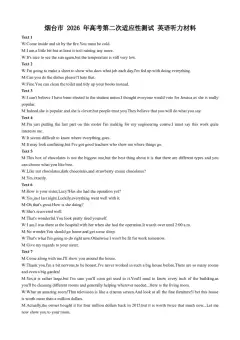
第一部分 听力(共两节,满分 30 分)
做题时,请先将答案标在试卷上。录音内容结束后,你将有两分钟的时间将试卷上的答案转涂到答
题卡上。
第一节(共5 小题;每小题1.5 分,满分7.5 分)
听下面5 段对话。每段对话后有一个小题,从题中所给的A、B、C 三个选项中选出最佳选项。听完每段
对话后,你都有10 秒钟的时间来回答有关小题和阅读下一小题。每段对话读两遍。
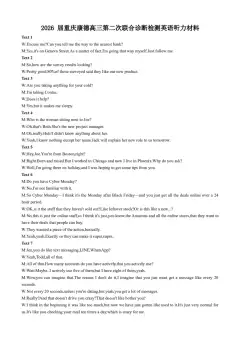
1.What are the speakers going to do?
A.Attend a dinner party.
B.Buy a phrase book.
C.Take a language class.
2.When was the parcel delivered?
A.On Monday.
B.On Wednesday.
C.On Friday.
3.What is the woman doing?
A.Making a shopping list. B.Doing some shopping.
C.Sorting household goods.
4.What does the man suggest the woman do?
A.Chat online.
B.Send an email.
C.Make a phone call.
5.What does the man mean?
A.The cat is poor.
B.He is frightened of the cat.
C.He is against keeping the cat.
第二节(共15 小题;每小题1.5 分,满分22.5 分)
听下面 5 段对话或独白。每段对话或独白后有几个小题,从题中所给的A、B、C 三个选项中选出最佳
选项,并标在试卷的相应位置。听每段对话或独白前,你将有时间阅读各个小题,每小题 5 秒钟;听完
后,各小题将给出 5 秒钟的作答时间。每段对话或独白读两遍。
听下面一段较长对话,回答以下小题。
6.Why doesn’t the woman watch the game with the man?
A.She doesn’t like watching it.
B.She is busy with her work.
C.She failed to book a ticket.
7.What do we know about the man?
A.He doesn’t get along with his son.
B.He got the tickets from his boss.
C.He has three children.
听下面一段长对话,回答以下小题。
8.What are the speakers talking about?
A.Choosing gifts.
B.Buying groceries.
C.Seeing friends.
9.Who is Clara?
A.The man’s wife.
B.The man’s sister.
C.The man’s daughter.
10.How much did the man spend on the city passes?
A.$36.
B.$50.
C.$150.
听下面一段长对话,回答以下小题。
11.Why is the man talking to the woman?
A.To change his major.
B.To apply to a college.
C.To have a job interview.
12.Which city has the man’s father moved to?
A.Ghaziabad.
B.Dehradun.
C.Delhi.
13.What can we learn from the conversation?
A.The woman refused the man’s application.
B.The man will be put on a waiting list.
C.The man has dropped out of school.
听下面一段长对话,回答以下小题。
14.What did Peter learn from his grandfather?
A.How to appreciate artworks. B.How to deal with artists.
C.How to run a museum.
15.What did Peter do in Chicago?
A.He studied at a college.
B.He served in the army.
C.He worked in a gallery.
16.Whose works did Peter like best?
A.Rembrandt’s.
B.Botticelli’s.
C.Rubens’.
听下面一段长对话,回答以下小题。
17.What does the speaker’s mother want her to be?
A.A confident person.
B.A warm-hearted person.
C.A humorous person.
18.Why did the speaker feel lonely in her childhood?
A.She often travelled by herself.
B.Her mother was very busy.
C.Her family moved frequently.
19.How does the speaker describe her mother?
A.She is carefree.
B.She treats her equally.
C.She tries to avoid mistakes.
20.What does the speaker mainly talk about?
A.Importance of homeschooling.
B.Mother-daughter relationship.
C.A role model in her family.
第二部分  阅读(共两节,满分50 分)
第一节(共15 小题;每小题2.5 分,满分37.5 分)
阅读下列短文,从每题所给的A、B、C、D 四个选项中选出最佳选项。
A
Albuquerque Museum
Admission & Ticketing
Admission is free every Sunday from 9:00 am to 1:00 pm and on the first Wednesday of every month.
Exception: No free admission during the Balloon Fiesta.
ALBUQUERQUE MUSEUM TICKETS
Albuquerque Museum Admission
Cost
Out-of-State Adults
$6
NM Resident Adults
$5
Seniors 65+
$4
Children 4 to 12 years old
$3
Children 3 years old and younger
Free
SNAP EBT Admission
Available to guests enrolled (登记) in New Mexico’s Supplemental Nutrition Assistance Program (SNAP) .
To be eligible (合格的) for free admission, guests must show their SNAP EBT card and a photo ID at the front
desk.
● Valid for up to 5 guests to each holder during regular business hours.
● Only New Mexico SNAP enrollees receive the discount at present.
Bank of America Discount: Museums on Us
For the past 25 years, Bank of America has offered their cardholders free general admission — during the first full
weekend of every month. Available to Bank of America, Merrill or Bank of America Private Bank credit
cardholders. Please review eligibility and terms prior to your visit.
Albuquerque Museum Foundation Membership
Become a member and receive a 10% discount in the Museum store, invitations to members-only events,
free general admission, and more. (Surcharge for special exhibitions may apply. )
21.How much should a young local couple with their 5-year-old kid pay for their tickets on Friday?
A.$15.
B.$13.
C.$11.
D.$10.
22.Which identity gets the greatest benefit in terms of admission?
A.A New Mexico SNAP enrollee.
B.A resident from New Mexico.
C.A Bank of America credit cardholder.
D.An Albuquerque Museum Foundation member.
23.What can you do as an Albuquerque Museum Foundation member?
A.See special exhibitions free of charge.
B.Visit the museum for free at all times.
C.Obtain a discount in the Museum store. D.Hold members-only events anytime.
B
Marianne North was an early female explorer, naturalist and painter. She traveled around the world,
painting plants, people and places. She left an extraordinary legacy behind.
Marianne looked after and traveled with her father for much of her life. After his death in1869, Marianne,
financially independent at the age of forty, set off alone to explore and paint the world.
During her long artistic journey around the world, Marianne displayed impressive courage and
determination. Faced with numerous challenges in her pursuits, Marianne proved unaffected and would laugh it
off. In Italy, when her landlord pretended he had no rooms for them except those on the fifth floor, Marianne
fearlessly responded with “so to the fifth we went, and gained all the better view”.
Marianne’s most famous supporter was Charles Darwin. Darwin’s power of bringing out other people’s best
points extended to Marianne whom he advised to see and paint the Australian vegetation (植被) which was unlike
that of any other country. Taking Darwin’s advice as a royal command, she went at once and eagerly returned in
1881 to sit with Darwin and his children under a shady tree to look closely at her paintings together.
Marianne’s paintings and writing give detailed information on the location, habitat and uses of many of the
plants she painted. On her travels, she collected and discovered plants that were new to botanical science at the
time. A pitcher plant she painted in Borneo, for example, was unknown to science at the time she painted it. When
botanists saw it, the painting caused great excitement. Through her art, she sought to inspire and educate people
about the natural world.
24.What made Marianne’s traveling around the world at forty possible?
A.Personal fame.
B.Family support.
C.Financial freedom.
D.Darwin’s advice.
25.What does the author show by mentioning the event in Italy?
A.Marianne’s painting skills.
B.Marianne’s sense of humor.
C.Marianne’s physical strength.
D.Marianne’s positive attitude.
26.How did Marianne react to Darwin’s suggestion?
A.She followed it immediately.
B.She considered it a great honor.
C.She discussed it with his children.
D.She improved her techniques first.
27.What can we infer about Marianne’s painting of the pitcher plant?
A.It was her most famous work.
B.It helped identify a new species.
C.It was painted to attract botanists.
D.It proved her exceptional painting skills.
C
The dawn chorus of birdsong has inspired poets and nature lovers for thousands of years, but the reason
why birds start the day this way is an enduring mystery. Now, a series of experiments on zebra finches (斑胸草雀)
suggests that while darkness holds back singing, birds build up a strong motivation to sing in the night that causes
them to burst into song at dawn.
Satoshi Kojima at the Korea Brain Research Institute and his colleagues studied lab-raised zebra finches in
carefully-controlled lighting conditions. When the team delayed sudden exposure to bright light until three hours
after actual dawn, the finches, which were awake, remained silent in the dark; once the light was turned on, they
sang more intensely than usual. However, when the lights came on three hours earlier than true dawn, the chorus
was less intense.
“The birds are already awake in the dark before the lights come on,” Kojima says. He notes that darkness
subdues their natural urge to sing, which in turn boosts their singing motivation, leading to a rebound of intense
singing when lights come on.
The researchers then administered the drug luzindole, which blocks the effects of melatonin (褪黑激素), a
hormone that helps regulate wakefulness cycles in many animals. Birds that were given this drug five hours before
the normal lights-on time woke up more quickly and began singing earlier than those in the control group.
Besides, analysis of the birds’ songs revealed rapid structural shifts in the first hour after dawn compared to the
second. “Due to the absence of singing during the night, the vocal motor system and song structure may slightly
suffer, and the dawn chorus serves to quickly restore or improve them,” says Kojima.
While this study examined only one species, similar drivers may apply to other bird species, he says. But
Diego Gil at the National Museum of Natural Sciences in Madrid, Spain, urges caution. There are “extensive
differences between species: how, when and what birds sing in the dawn chorus”, he says. “This explains why 11
different assumptions have been proposed to understand the phenomenon.”
28.What does Kojima’s experiment in Paragraph 2 mainly show?
A.Finches’ chorus strength relates to time staying in the dark.
B.Lab-raised zebra finches are more sensitive to light changes.
C.Earlier light exposure results in a more intense dawn chorus.
D.Earlier light exposure makes the birds’ dawn chorus last longer.
29.What does the underlined word “subdues” in Paragraph 3 probably mean?
A.Transforms.
B.Restricts.
C.Motivates.
D.Ignores.
30.What can we learn from the experiment with luzindole?
A.Luzindole improves birds’ vocal motor system.
B.Melatonin showed no effect on the control group.
C.Melatonin may prevent birds’ waking and singing.
D.Luzindole directly lifts birds’ dawn-singing motivation.
31.What do Diego Gil’s words imply?
A.More experiments are needed to confirm the assumption.
B.The findings on zebra finches may not fit all bird species.
C.All proposed assumptions about dawn chorus are unreliable.
D.Species differences have no impact on dawn chorus patterns.
D
“Ghost gear” refers to lost or abandoned fishing nets, a highly destructive pollutant in oceans. Each year,
approximately 1 million tons of such gear are discarded at sea, accounting for up to 86% of large marine floating
plastics. Unlike visible plastic waste like bottles, it sinks into the deep ocean, continuously trapping sea animals,
producing microplastics and endangering navigation.
To address this issue, organizations like Conservation International have launched programs worldwide. A
distinctive project in Mexico focuses on training female divers known as sirenas to clear away ghost gear and help
coastal communities gain a direct understanding of the pollution’s harm.
These female divers rely on commercial fishing as their primary income source but volunteer for the
cleanup. After professional training and certification, they start searching for and removing dangerous ghost gear.
The operation tests their physical limits and patience to the fullest. As many as 117 sailors once invested over 40
hours in clearing a massive 300-foot-long fishing net. Their diving experience has completely transformed their
perception of the ocean. By engaging with communities and fishing cooperatives, they have gradually gained
recognition, carving out a space for women in marine conservation within the male-dominated fishing industry.
Undoubtedly, prevention deserves the equal priority to cleanup. The Global Ghost Gear Initiative has
developed a reporting system for fishers to notify lost gear for timely recovery and provided them with region-
specific recommendations, such as avoiding operations in severe weather and storing gear properly.
In selected regions, fishing nets bear unique identifiers, enabling the precise tracking of their ownership by
individuals or commercial fisheries post-recovery and instantly locking down whoever is at fault. “Once your
fishing gear is attached to distinct identifiers, it facilitates a heightened sense of individual accountability, which
in turn generates a concrete effect on your behavioral approach to fishing practices,” notes Jimenez, a marine
biologist.
The governance of ghost gear demands cooperation among fishers, researchers and policymakers. By
changing mindsets and taking effective measures, this campaign against ocean “ghosts” is advancing steadily,
injecting hope for the sustainable future of marine ecosystems and coastal communities.
32.How does ghost gear differ from other marine plastics?
A.It’s harder to detect.
B.It’s distributed more extensively.
C.It takes longer to break down.
D.It floats evenly in shallower water.
33.Why does the author mention the 300-foot-long net removal example?
A.To showcase training effect.
B.To emphasize potential net risks.
C.To highlight work efficiency.
D.To demonstrate cleanup challenges.
34.What can we infer from Jimenez’s words?
A.Labels avoid fishing net loss.
B.Technology reshapes productivity.
C.Markings boost responsibility.
D.Identity validation guarantees security.
35.What can be the best title of the text?
A.Deep-sea Ghost Gear: Silent Killers.
B.Sirenas: Dedicated Ocean Guardians.
C.Multi-dimensional Actions: Tackling Marine Ghosts.
D.For Marine Conservation: Mind Your Fishing Gear.
第二节(共5 小题;每小题2.5 分,满分12.5 分)
阅读下面短文,从短文后的选项中选出可以填入空白处的最佳选项。选项中有两项为多余选项。
After three years without writing for my Psychology Today column, I return today to “The Memory
Factory” with the sense of opening a space that was never abandoned.
Writing is a developmental practice. Beyond improving style or clarity, it exercises core psychological
operations: attention, selection, organization, and meaning-making. To write is to work with memory,
transforming lived experience into narrative form.    36    Yet, strangely, stepping away can deepen it.
A long pause ( 暂停) acts as cognitive oxygenation ( 认知充氧). Freed from the demands of constant
production, ideas loosen their strict forms. Memory continues to operate in the background: reorganizing
experiences, reshaping meanings and building unexpected connections. What once seemed settled may return
transformed; what felt forgotten may reappear with new relevance.    37
Psychologically, there is something creative about absence. Imagination needs empty spaces to operate.
38    However, a long pause introduces a productive estrangement (疏离): On returning, we encounter our own
ideas as if they partly belonged to someone else. This pause allows memory and imagination to enter into
dialogue, not to reproduce the past, but to reshape it.
   39    Returning to this column only strengthens the view. My relationship with these themes has
changed because I have changed. New personal, academic, and professional experiences now feed the symbolic
raw material of this factory.
Coming back to “active mode” means recognizing that silence was productive, too. It is during the pause
that certain questions matured and imagination regained breath. If memory is a factory, it does not run endlessly at
industrial speed.    40    This text marks the opening of its doors, confirming that a long pause is not a failure,
but an essential part of the writing process.
A.Regular writing sharpens this capacity.
B.Continuous output can lead to repetition of arguments.
C.The pause does not stop thinking, but changes how thinking unfolds.
D.Returning to writing after a long pause does not feel like starting over.
E.At times, it must slow down, reorganize its machinery, and replace tools.
F.Writing after a long pause makes me feel more anxious and less reflective.
G.Throughout “The Memory Factory”, I have treated memory as an active process.
第三部分  语言运用(共两节,满分30 分)
第一节  (共15 小题;每小题1 分,满分15 分)
阅读下面短文,从每题所给的A、B、C、D 四个选项中选出可以填入空白处的最佳选项。
My sister and I recently travelled back from Portugal. Among our memories, one experience     41    .
As a literary     42    , I’d planned to visit a bookstore recommended by my favorite author. On our
first day, we searched through the winding lanes for hours     43     and a sudden downpour forced us to end
the     44    .
     45     to leave empty-handed, we made a final attempt on the last day. However, contradictory
directions from passers-by only deepened our     46    . As dusk fell, shopkeepers were packing up, streets
quieting, and hope fading. Wet from another shower and with a torn map, we felt even more     47    .
Then, a blind turn led us to a narrow street where a store drew our attention. My sister stopped to     48
the map, and I glanced at the signs — “That’s it” I     49    .
The owner looked up, smiled, and     50     us in. Inside, floor-to-ceiling bookshelves lined the walls.
As I ran my fingers along the bookshelves, a hardcover caught my eye. Just as I     51     for it, another hand
brushed against the cover. “You like it too?” a woman smiled. As the bookstore’s regular, she instantly     52
with me and I told her our     53     search. The owner, overhearing our story, stepped over and     54

us with two copies of the book, each signed by the author. “For those truly appreciating it,” he said. My sister
captured the moment as we exchanged email, promising to share reflections on the book later.
Detours didn’t ruin our trip; instead, they led us to the priceless     55     — the places and the people
we are meant to meet.
41.A.fell apart
B.stood out
C.carried on
D.came about
42.A.enthusiast
B.critic
C.genius
D.expert
43.A.casually
B.smoothly
C.briefly
D.fruitlessly
44.A.hunt
B.crisis
C.vacation
D.observation
45.A.Determined
B.Hesitant
C.Anxious
D.Unwilling
46.A.knowledge
B.relief
C.curiosity
D.confusion
47.A.bored
B.lost
C.hungry
D.curious
48.A.fold
B.mark
C.consult
D.fix
49.A.whispered
B.complained
C.cried
D.sighed
50.A.waved
B.followed
C.pushed
D.blocked
51.A.applied
B.paid
C.searched
D.reached
52.A.competed
B.bonded
C.quarreled
D.joked
53.A.comprehensiveB.patient
C.chaotic
D.thorough
54.A.equipped
B.awarded
C.presented
D.connected
55.A.encounters
B.appointments
C.gatherings
D.lessons
第二节(共10 小题;每小题1. 5 分, 满分15 分)
阅读下面材料,在空白处填入适当的内容(1 个单词)或所给单词的正确形式。
Nie Weiping, the legendary “Go Sage” (棋圣)of China, passed away on January 14, 2026, at the age of 74.
As a leading figure of China’s Go cause, he devoted his entire life to   56   (promote) this ancient intellectual
game.
In the 1980s, Nie achieved an    57   (amaze)11-game winning streak in the China-Japan Go Challenge
Match. His victories broke Japan’s long-term control in Go and sparked a nationwide “Go fever”,   58   greatly
inspired the national spirit. For his extraordinary contributions, he   59   (award) the title of “Go Sage” in
1988, an honor that remains unique in China’s Go history.
After retiring from competitive play, Nie became a dedicated coach. He trained numerous top players,
including world champions like Chang Hao and Gu Li, who benefited greatly   60   his guidance. In 2013,
when he was diagnosed with cancer, he faced the illness with optimism and fought it   61   (brave), eventually
overcoming it.
Even in his later years, Nie never stopped his efforts to popularize Go. He travelled around the country,
giving lectures and   62   (comment) on matches to share the charm of the game. He firmly believed that
humans still need Go in the AI era because it carries the    63    (wise) of ancient Chinese ancestors.
   64   he has left us, his spirit of perseverance and love for the country will continue to inspire     65
younger generation of Go players. His legacy will live on in the hearts of all those who love Go and the values it
represents.
第四部分 写作(共两节, 满分40 分)
第一节(满分15 分)
66.假定你是李华,外教Lisa 计划下周六上午在学校操场举行英语角活动,但是同学们参与积极性不高。
请你给她写一封邮件,内容包括:
1.分析问题;
2.提出建议。
注意:
1.写作词数应为80 左右;
2.请按如下格式在答题卡的相应位置作答。
Dear Lisa,
I’m Li Hua from Class 1. I’m writing to talk about our campus English Corner next Saturday morning.
___________________________________________________________________________________________
___________________________________________________________________________________________
___________________________________________________________________________________________
___________________________________________________________________________________________
_________________________
Yours,
Li Hua
第二节(满分25 分)
67.阅读下面材料,根据其内容和所给段落开头语续写两段,使之构成一篇完整的短文。
When Lily came home from school, she found her brother Tom sitting on the sofa,holding her precious
guitar. The guitar was a birthday gift from their late father, and Lily had always kept it carefully.
“Tom, what are you doing with my guitar?” Lily shouted, rushing over to take it back.Tom looked nervous.
“I just wanted to play it. I’ve been practicing secretly for weeks,” he said in a low voice. But Lily didn’t listen.
She grabbed the guitar and ran to her room, shutting the door.
That night, Lily couldn’t sleep, restless in bed, and memories of Tom flooded her mind. Last year, when she
wanted to join the school music club, Tom stayed up three nights in a row to help her copy music sheets and even
made a small stand for her guitar. But now, she couldn’t even allow him to touch the guitar. “How selfish I was!”
she said to herself.
The next morning, Lily noticed a note on the table, along with a bottle of her favorite blueberry jam. It was
from Tom: “Lily, I'm sorry. I know I should have asked first. I just love music like you do, and I  miss Dad too. I
made this jam last weekend, hoping it could make you feel better.” Lily picked up the bottle, her fingers brushing
the smooth glass. A feeling of guilt ran into her heart, but she still didn’t have the courage to talk to him.
After school, Lily walked past the music store where she used to go with Dad. She saw a little boy looking
at a guitar through the window, his eyes shining with longing — just like Tom had done a few months  ago.
However, she had ignored it at that time.
注意:1.续写词数应为150 个左右;
2.请按如下格式在答题卡的相应位置作答。
That evening, Lily gently pushed Tom's door open.
___________________________________________________________________________________________
___________________________________________________________________________________________
___________________________________________________________________________________________
___________________________________________________________________________________________
___________________________________________________________________________________________
Lily turned and fetched the guitar from her room.
___________________________________________________________________________________________
___________________________________________________________________________________________
___________________________________________________________________________________________
___________________________________________________________________________________________
___________________________________________________________________________________________