绝密★考试结束前
2026 年高考第二次模拟考试
英语
(考试时间:120 分钟  试卷满分:150 分)
注意事项:
1.本试卷分第Ⅰ卷(选择题)和第Ⅱ卷(非选择题)两部分。答卷前,考生务必将自己的姓名、准
考证号填写在答题卡上。
2.回答第Ⅰ卷时,选出每小题答案后,用2B 铅笔把答题卡上对应题目的答案标号涂黑。如需改动,
用橡皮擦干净后,再选涂其他答案标号。写在本试卷上无效。
3.回答第Ⅱ卷时,将答案写在答题卡上。写在本试卷上无效。
4.考试结束后,将本试卷和答题卡一并交回。
第一部分 听力(共两节,满分 30 分)
做题时,请先将答案标在试卷上。录音内容结束后,你将有两分钟的时间将试卷上的答案转涂到答
题卡上。
第一节(共5 小题;每小题1.5 分,满分7.5 分)
听下面5 段对话。每段对话后有一个小题,从题中所给的A、B、C 三个选项中选出最佳选项。听完每段
对话后,你都有10 秒钟的时间来回答有关小题和阅读下一小题。每段对话读两遍。
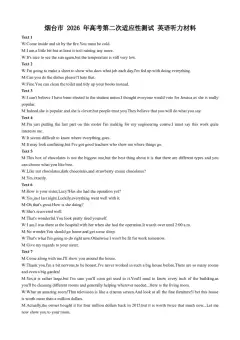
1.What is the man doing?
A.Looking for his car.
B.Jogging in a park.
C.Asking for directions.
2.where are the speakers probably now?
A.In a supermarket.
B.In a washing house.
C.At home.
3.what are the speakers mainly talking about?
A.A film.
B.A song.
C.A wedding.
4.Why does the woman apologize?
A.She broke the window.
B.She threw rubbish randomly.
C.She didn’t clean the street.
5.when will the speakers’ plane arrive at their destination?
A.At 4:30 pm.
B.At 6:30 pm.
C.At 9:30 pm.
第二节(共15 小题;每小题1.5 分,满分22.5 分)
听下面 5 段对话或独白。每段对话或独白后有几个小题,从题中所给的A、B、C 三个选项中选出最佳
选项,并标在试卷的相应位置。听每段对话或独白前,你将有时间阅读各个小题,每小题 5 秒钟;听完
后,各小题将给出 5 秒钟的作答时间。每段对话或独白读两遍。
听下面一段较长对话,回答以下小题。
6.What is the relationship between the speakers?
A.Teacher and student.
B.Co-workers.
C.Classmates.
7.What did the woman do in China?
A.she went travelling.
B.she landed a job.
C.she visited Lee.
听下面一段对话,回答以下小题。
8.How will the woman go to Seattle?
A.By train.
B.By car.
C.By plane.
9.What does the man ask the woman to do after she settles down?
A.Mail her package.
B.Contact him.
C.Volunteer in a company.
听下面一段对话,回答以下小题。
10.What does the woman probably think of Sarah’s performance?
A.Excellent.
B.Disappointing.
C.ordinary.
11.What does the man advise the woman to do?
A.Keep her weight backward.
B.Hire an experienced skier.
C.Stay focused.
12.What do the speakers agree to do next weekend?
A.Practice skiing together.
B.Meet a professional.
C.Join a skiing club.
听下面一段对话,回答以下小题。
13.What kind of room does the woman choose?
A.A themed room.
B.A standard room.
C.A family room.
14.What will be freely accessible to the woman as a room guest?
A.The massages.
B.The fitness center.
C.The facials.
15.How much will the woman pay?
A.$270.
B.$290.
C.$300.
16.What is the woman going to do?
A.Collect more information.
B.Check in earlier.
C.Confirm her reservation.
听下面一段独白,回答以下小题。
17.what is the speaker’s mother like?
A.she finds it hard to raise children.
B.she can balance work and family.
C.she isn’t a career-centered mother.
18.what are the speaker’s friends worrying about?
A.Inefficient ways to do housework.
B.pressure from staying at home alone.
C.Impacts of pursuing careers on their kids.
19.what do the speaker’s parents tend to do at home?
A.share responsibilities.
B.play traditional gender roles.
C.Talk about gender inequality.
20.what does the study suggest about having a working mother?
A.It is beneficial.
B.It is strange.
C.It is stressful.
第二部分  阅读(共两节,满分50 分)
第一节(共15 小题;每小题2.5 分,满分37.5 分)
阅读下列短文,从每题所给的A、B、C、D 四个选项中选出最佳选项。
A
LA Street Food & Photography Tour
Welcome to the authentic flavor of Los Angeles! Our experience mixes the city’s lively culinary (美食的)
scene with hands-on mobile photography instruction. Forget the tourist traps; we will guide you through the
historic Grand Central Market and the hidden treasures of the Arts District. You’ll not only taste 6-8 of LA’s best
street eats but also learn how to capture the perfect, professional-quality food and urban landscape photos using
just your smartphone. This is the most delicious and visually rewarding way to explore the real LA.
Experience Packages & Pricing
Package Name
Duration
Price per
Person
Key Inclusions
Standard Taste
2.5 hours
$85
6 tastings, Photography Basic Guide
Gourmet Lens
3.5 hours
$110
8 tastings, Advanced Photo Editing
Instruction, Free drinks
Private Group
4 hours
$450
Up to 6 guests, Customized route and start
time
Available Dates & Meeting Point
Date
Time
Meeting Location
Status
Sat, Mar 8
11:00 AM — 1:30 PM
Angels Flight
Entrance
SOLD OUT
Sun, Mar 9
11:30 AM — 2:00 PM
Angels Flight
Entrance
Available
Sat, Mar 15
1:00 PM — 4:30 PM
Grand Central
Market
Available
Sun, Mar 16
1:30 PM — 5:30 PM
Grand Central
Market
Available
What to Bring & Know Before You Go
● You must bring a fully charged smartphone with sufficient storage space for photos. Tripods (三脚架)
and professional cameras are discouraged as they slow down the group.
● The tour involves approximately 2 miles of walking. Please wear comfortable shoes and dress for the
weather.
● We can accommodate vegetarian and nut-free diets if reported at least 24 hours in advance.
● Participants must be 12 years or older. All participants under 18 must be accompanied by a paying adult.
21.What can people do during the tour?
A.Visit popular tourist sites.
B.Cook stylish street foods.
C.Identify common tourist traps.
D.Shoot appealing food photos.
22.Which date suits tourists who want free drinks?
A.March 8th.
B.March 9th.
C.March 15th.
D.March 16th.
23.What is a suggestion for the participants?
A.Preparing a portable charger.
B.Bringing professional cameras.
C.Purchasing outdoor equipment.
D.Stating dietary needs.
B
I’m James. Burned out from work, I found life had become flat and that I desperately needed something to
shift my focus. One night I came across a website recommending scuba ( 水肺) diving lessons. I hadn’t ever
thought much about the idea of diving before; but its complete unfamiliarity fueled my interest; I decided to give
it a shot! I had my training lessons at an indoor swimming pool. After completing the courses, I felt a sense of
great satisfaction and achievement for overcoming the initial fear and discomfort of breathing underwater.
Knowing I hadn’t yet experienced what real scuba diving is all about, I spent hours researching where the
best places to dive were. But before I knew it, I had been on an airplane to Belize. Less than 24 hours after my
arrival, and minutes into my first ocean dive, I was literally diving head first into the deep end, finding myself 80
feet underwater. It’s the kind of extraordinary water having such great visibility that you can see clearly for
hundreds of feet around you.
Within minutes our 4-person dive group was surrounded by numerous nurse sharks, a moray eel (海鳗),
large groupers and sea turtles. I was madly in love with scuba diving. As we reached the bottom a lone nurse shark
swam right under me. More started to arrive. Just as I was shooting pictures of the action and not paying attention
to anything or anyone else around, I looked up to see a bright green threatening face headed straight for me. He
wasn’t the least bit shy. He has apparently never heard of personal space. After he decided to swim by me without
causing any bodily harm, I was both relieved and excited.
This will always be that one special dive that changed everything and I get to watch it any time I find
myself missing the water.
24.What pushed James to try scuba diving?
A.Online low-price campaigns.
B.Love for underwater events.
C.Cut- throat career challenges.
D.Thirst for fresh experiences.
25.What do we know about James’s first ocean dive?
A.He didn’t adopt a gradual strategy.
B.He didn’t use former diving skills.
C.He found the best diving location.
D.He made friends with other divers.
26.Why did James mention sea animals?
A.To underline their diversity.
B.To introduce their wildness.
C.To demonstrate diving appeal.
D.To promote ocean exploration.
27.What is the suitable title for the text?
A.When to chase novelty?
B.What underwater thrill?
C.Why swim deep down?
D.How to overcome fear?
C
As cities expand rapidly, large areas of natural green land are replaced by concrete buildings and wide
roads. This has led to a sharp drop in urban insect populations over the past decade, breaking the natural balance
of the local ecosystem. Many insect species that were once common in cities have now become rare, and some
have even been listed as local endangered species. Insects like wild bees and ladybugs play a key role in
pollinating flowering plants and controlling harmful pests, and their decline will bring long-term harm to the
whole urban environment. Now, a simple eco-friendly solution is gaining popularity around the world: insect
hotels.
An insect hotel is a man-made structure made of natural materials, designed to provide refugia for insects
to live, breed and spend the cold winter. Unlike common single-function bee boxes, insect hotels are fit for
hundreds of different insect species. Different materials are designed for different insects: hollow bamboo sticks
are for solitary bees, while pine cones and straw are perfect for ladybugs and other small insects. They are usually
made of recyclable things like hollow bamboo sticks, pine cones, dry wood and straw, all easy to find in daily life.
Many cities in Europe and China have built insect hotels in community parks, school yards and office
rooftops. A 2025 study in Shanghai found that parks with insect hotels have 3 times more insect species than those
without, and the number of local flowering plants has also increased greatly. Some schools even use insect hotels
as a science education tool, letting students observe insects and learn about ecological protection.
Experts say insect hotels are a low-cost and highly effective way to improve urban biodiversity. They not
only help protect endangered local insect species, but also let people feel closer to nature in busy city life. Even a
small insect hotel on your balcony can make a difference to the local environment.
28.What problem does the first paragraph mention?
A.Urban insect populations drop sharply.
B.Concrete buildings are harmful to health.
C.There are too many pests in cities.
D.No green land is left in cities.
29.What does the underlined word “refugia” mean?
A.Food sources.
B.Breeding seasons.
C.Natural materials.
D.Safe shelters.
30.What is the function of the third paragraph?
A.To explain how to build insect hotels.
B.To show the application effect of insect hotels.
C.To put forward a new opinion on ecology.
D.To give a final conclusion of the text.
31.What do experts think of insect hotels?
A.They are only fit for big parks.
B.They cost too much money.
C.They help improve urban ecology.
D.They will replace natural green land.
D
Our Earth is located on the inner edge of a spiral (螺旋的) arm within the Milky Way, but this is not our
permanent address. When most dinosaurs went extinct, our solar system was in a completely different arm! Our
galaxy (星系) is in a state of constant evolution.
Thirteen billion years ago, the gas and dust particles (分子) that eventually became our Milky Way were
moving quickly in every direction. Despite the wild motion of its parts, the galaxy as a whole was spinning about
an axis (轴). While their individual motions were chaotic, the galaxy as a whole acquired all the particles and
circled around a common axis. Meanwhile, frequent crashes slowed the particles, allowing gravity to pull them
inward.
So, why is the Milky Way flat? The answer lies in the conservation of angular momentum (动量). In dense
(密度大的) objects like stars, internal pressure and gravity create a sphere. But in a low-density, high-momentum
system like a young galaxy, the spinning motion dominates. To conserve momentum, particles could not fall
directly inward but were forced to orbit, gradually collapsing into a single, spinning discover billions of years.
The Milky Way’s spiral arms are not rigid structures, but dynamic squeezing waves. As these waves travel
through the galaxy’s disc, they squeeze gas, starting the birth of bright young star groups that outline the arms.
The galaxy’s spin then winds these waves into grand spirals. Our solar system, orbiting faster than the wave
pattern, is currently diving deeper into our local arm — a journey through a single arm takes millions of years.
Recent observations even suggest spiral galaxies can host two or more crossing waves travelling at different
speeds. The result would be that spiral arms last for tens or hundreds of millions of years before breaking apart
and re-forming. When the Earth formed 4.5 billion years ago, our galaxy’s spirals may have looked entirely
different than today. And in about 5 billion years, the Milky Way will start to combine with the Andromeda galaxy
and disturb the conservation of angular momentum, thus creating an egg shape and giving rise to a new time in
our galaxy’s history.
32.What was the initial state of the particles that formed the Milky Way?
A.Flying around randomly.
B.Moving because of gravity.
C.Spinning around an axis rapidly.
D.Crashing to gain momentum.
33.What is the primary reason given for the Milky Way's flat, disc-like shape?
A.The high density of the Milky Way.
B.The need to maintain angular momentum.
C.The frequent crashes of gas and dust particles.D.The dominance of internal pressure and gravity.
34.What can be inferred about the Milky Way's spiral arms?
A.They are permanent features.
B.They have new stars born there.
C.They are directly caused by the spin.
D.They move faster than our solar system.
35.What is the passage mainly about?
A.The evolution of the Milky Way.
B.The crash between galaxies.
C.The formation of the solar system.
D.The characteristics of spiral galaxies.
第二节(共5 小题;每小题2.5 分,满分12.5 分)
阅读下面短文,从短文后的选项中选出可以填入空白处的最佳选项。选项中有两项为多余选项。
Last night, I heard a story that left me thinking: a friend was driving home late on a rainy day when a cat
suddenly dashed out from the shadows. Before he could put on the brakes, he hit the cat. As he stood by the side
of the road, shaken, his first thought was: “It was just an accident — I didn’t mean it.”     36     The question
has stuck with me like a fish bone in the throat.
Neuroscience offers a clue: our brains are wired to protect our sense of being a “good person.”     37

A similar phrase is “I had no choice”, which also allows us to avoid facing the complexity of our decisions.
    38     In the days that followed, he couldn’t shake the guilt. He replayed the drive endlessly in his
mind, and gradually, a different truth emerged: he had been tired, he’d taken a shortcut that he knew was poorly
lit, and he had been checking a text message just moments before.     39     In the end, he posted about the
incident online, no longer calling it an “accident”, and even made a donation to a local animal rescue.
His story reveals a crucial truth: accidents are often the result of a series of choices we make rather than
pure randomness. In our daily life, we use “it is an accident” constantly.     40     More often than not, we
cannot blame the rain, the cat’s sudden dash, or any other external factor — there are no real excuses. Instead, we
must separate choices from accidents. True responsibility lies in acknowledging our choices.
A.These set the stage for the tragedy.
B.How can we lighten our moral load?
C.We truly bear no responsibility for the outcome.
D.But the label “accident” offered him no real comfort.
E.Life may happen to us, but it doesn’t fully excuse us.
F.Why do we reach for the word “accident” so quickly?
G.Calling something an “accident” often serves this purpose.
第三部分  语言运用(共两节,满分30 分)
第一节  (共15 小题;每小题1 分,满分15 分)
阅读下面短文,从每题所给的A、B、C、D 四个选项中选出可以填入空白处的最佳选项。
When Sarah joined my third-grade class as an 8-year-old with dyslexia (阅读障碍), she’d sit at her desk
and avoid eye contact. I didn’t realize how her learning difference would     41     my teaching.
During each morning’s free writing period, she showed her     42    . She filled pages     43    ,
with her Pen moving fast, but her spelling was terrible. When I asked her to read, her whisper     44     a fine
tale, which amazed me. I saw a talented storyteller hidden behind her     45     writing. I began rethinking
priorities — was perfect spelling more important than     46    ?My answer was “no”. Then I encouraged
her to learn more about stories through audiobooks, asked her parents to record her tales, and even provided
voice-to-text tools, never letting spelling     47     her creative flow.
Sarah soon     48     searching for extra audio materials, growing into her own self-guidance. This
49     shook my teaching core: I left classroom life to work one-on-one as an educational specialist, trained in
multisensory approaches, and later     50     as a learning specialist bridging teachers, students and families.
Today, I help teachers avoid making judgments     51     — like I almost did with Sarah. I guide them
to look beyond     52     by sharing her story. Sarah went to an arts high school with a     53     on
creative writing and graduated from college last December. I hugged her tightly at the ceremony, feeling so     54
.
Teachers rarely know their impact, but I always know Sarah’s     55     influence on me.
41.A.mention
B.shape
C.prove
D.explain
42.A.calmness
B.management
C.passion
D.appearance
43.A.tirelessly
B.carelessly
C.helplessly
D.uselessly
44.A.revealed
B.broke
C.simplified
D.hid
45.A.slow
B.detailed
C.visible
D.messy
46.A.guidance
B.communication
C.creativity
D.participation
47.A.restore
B.disturb
C.track
D.replace
48.A.recommended B.postponed
C.avoided
D.began
49.A.invitation
B.anniversary
C.registration
D.shift
50.A.returned
B.apologized
C.waited
D.hesitated
51.A.in debt
B.in advance
C.in danger
D.in short
52.A.contributions
B.grades
C.exchanges
D.habits
53.A.focus
B.myth
C.lecture
D.debate
54.A.confident
B.curious
C.proud
D.secure
55.A.unknown
B.slight
C.lasting
D.mutual
第二节(共10 小题;每小题1. 5 分, 满分15 分)
阅读下面材料,在空白处填入适当的内容(1 个单词)或所给单词的正确形式。
From January 12 to 15, I joined a cultural tour in Sichuan, which was named “Mystical Shu Rhythm-Tianfu
Journey”. It was part of     56     international micro-drama competition. We     57     (primary)
explored how to present traditional culture through short video stories.
On the first day, we experienced both ancient and modern     58     (aspect) of Sichuan. We walked
through Jinli Ancient Street in Chengdu, visited Jianmen Pass and Cuiyun Corridor along the old Roads to Shu,
explored the mysterious (神秘的) Sanxingdui archaeological site,     59     paid respects to the famous
literary master Su Shi at Sansu Shrine.
During the trip, we discussed how traditional architecture, folklore, and local crafts could be presented with
creative micro-dramas that have much     60     (attract) for today’s audience. This process helped me
understand that storytelling is developing without a break. While once ancient tales     61     (share) around
campfires, they now take on new forms like digital series. Still,     62     the stories aim to connect people,
inspire thinking, and convey meaning remains unchanged.
Good stories aren’t limited to time and culture and even go     63    them. For us, the Sichuan trip was
a reminder that the stories we tell shape our understanding of ourselves and the world around us. They offer not
only a window into the past but also a blueprint for the future. By     64     (combine) tradition with
innovation, we can keep heritage alive and meaningful for generations     65     (come). As we creators, it is
our responsibility to preserve the integrity of cultural legacies in the context of today’s rapidly changing media
landscape.
第四部分 写作(共两节, 满分40 分)
第一节(满分15 分)
66.假设你是李华,你的外国朋友John 来信说想利用自己的假期来中国体验一下中国的传统节日。在端
午节、中秋节和春节中,你会建议他选择哪个呢?请你给他回信并说明推荐理由。
注意:
1.词数80 左右;
2.可以适当增加细节,以使行文连贯;
Dear John,
___________________________________________________________________________________________
___________________________________________________________________________________________
___________________________________________________________________________________________
___________________________________________________________________________________________
____
Yours,
Li Hua
第二节(满分25 分)
67.阅读下面材料,根据其内容和所给段落开头语续写两段,使之构成一篇完整的短文。
The old, leather-bound diary lay hidden at the bottom of a dusty box in the attic (阁楼). Fifteen-year-old
Mia was about to give up her search for Christmas decorations when her fingers brushed against its rough, grainy
surface. Curious, she opened it. The yellowish pages were filled with elegant handwriting that spoke of another
time. It was her grandmother’s diary, dating back to when she was a teenager herself.
Mia sat on the dusty floor and began to read, completely absorbed by the words. The entries vividly
described her grandmother Clara’s dreams of becoming a painter, a secret she had never shared with anyone in the
family. Clara wrote about her favorite hidden spot by the lake, where she would sketch for hours, and her fear that
her practical family would never understand her artistic passion. The last entry was particularly poignant: “I have
decided to hide my paintings and my dreams away. Perhaps one day, someone will find them and understand.”
Mia was deeply moved. She had always known her grandmother as a kind, quiet woman who had worked
in a bakery her whole life. The vibrant, ambitious girl in the diary was a stranger. A sharp, sweet ache filled Mia’s
chest. In the attic’s silent dust, the final diary entry felt like a direct, quiet call meant just for her. She closed the
diary gently, her mind already mapping the attic’s shadowy corners. At that moment, Mia knew what she had to do
next.
She spent the following two days turning the attic upside down — moved old boxes, checked behind
furniture, and looked through ever corner — determined to find Clara’s hidden paintings. The attic was full of
memories, and Mia felt as if she was getting close to her grandmother with every step she took.
注意:续写词数应为150 左右。
Paragraph 1:
Finally, behind a loose board in the attic wall, Mia discovered a stack of canvases.
___________________________________________________________________________________________
___________________________________________________________________________________________
___________________________________________________________________________________________
___________________________________________________________________________________________
___________________________________________________________________________________________
Paragraph 2:
On Christmas morning, the family gathered in the living room.
___________________________________________________________________________________________
___________________________________________________________________________________________
___________________________________________________________________________________________
___________________________________________________________________________________________
___________________________________________________________________________________________