绝密★考试结束前
2026 年高考第二次模拟考试
英语
(考试时间:120 分钟  试卷满分:150 分)
注意事项:
1.本试卷分第Ⅰ卷(选择题)和第Ⅱ卷(非选择题)两部分。答卷前,考生务必将自己的姓名、准
考证号填写在答题卡上。
2.回答第Ⅰ卷时,选出每小题答案后,用2B 铅笔把答题卡上对应题目的答案标号涂黑。如需改动,
用橡皮擦干净后,再选涂其他答案标号。写在本试卷上无效。
3.回答第Ⅱ卷时,将答案写在答题卡上。写在本试卷上无效。
4.考试结束后,将本试卷和答题卡一并交回。
第一部分 听力(共两节,满分 30 分)
做题时,请先将答案标在试卷上。录音内容结束后,你将有两分钟的时间将试卷上的答案转涂到答
题卡上。
第一节(共5 小题;每小题1.5 分,满分7.5 分)
听下面5 段对话。每段对话后有一个小题,从题中所给的A、B、C 三个选项中选出最佳选项。听完每段
对话后,你都有10 秒钟的时间来回答有关小题和阅读下一小题。每段对话读两遍。
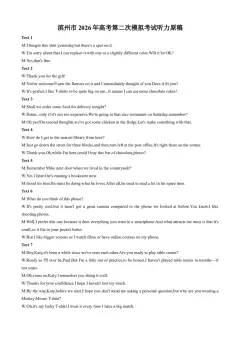
1.What stopped Helen from opening a restaurant downtown?
A.The high costs.
B.The intense competition.
C.The limited parking space.
2.What do we know about the woman?
A.She has been promoted.
B.She will leave the company.
C.She will move out of the finance office.
3.Why hasn’t Jim bought a dining table yet?
A.He is short of money.
B.He doesn’t need to buy one.
C.He is unsure about the style.
4.Which bus will the woman get on?
A.The 5:30 one.
B.The 6:00 one.
C.The 6:30 one.
5.What is the relationship between the speakers?
A.Husband and wife.
B.Schoolmates.
C.Colleagues.
第二节(共15 小题;每小题1.5 分,满分22.5 分)
听下面 5 段对话或独白。每段对话或独白后有几个小题,从题中所给的A、B、C 三个选项中选出最佳
选项,并标在试卷的相应位置。听每段对话或独白前,你将有时间阅读各个小题,每小题 5 秒钟;听完
后,各小题将给出 5 秒钟的作答时间。每段对话或独白读两遍。
听下面一段较长对话,回答以下小题。
6.What does the man want to do?
A.Study Education.
B.Change schools.
C.Find a job.
7.What should the man do before registering?
A.Fill out some forms.
B.Meet the woman.
C.Collect information about USU.
听下面一段对话,回答以下小题。
8.What are the speakers talking about?
A.A film.
B.A party.
C.A concert.
9.What did the man try to do during the event?
A.Have a dance.
B.See more clearly.
C.Get a better seat.
10.How did the man react to the hot environment?
A.He didn’t mind it.
B.He felt a little annoyed.
C.He considered it a major problem.
听下面一段对话,回答以下小题。
11.Why didn’t the woman learn driving?
A.She couldn’t spare the time on weekdays.
B.She was afraid of driving in urban areas.
C.She lives far from driving schools.
12.What does the woman think of the man’s driving teacher?
A.Strict.
B.Responsible.
C.Flexible.
13.Who will the woman call later?
A.The man’s mother.
B.Daniel Smith.
C.Alan Suckliff.
听下面一段对话,回答以下小题。
14.Where is the woman?
A.In Perth.
B.In Sydney.
C.In New York.
15.When can the man’s conference be held?
A.From January 21st to 22nd.
B.From January 28th to 29th.
C.From February 4th to 5th.
16.How many people can the Tesla room hold at most?
A.50.
B.60.
C.100.
17.What does the man request at last?
A.Internet access.
B.A projector.
C.Microphones.
听下面一段独白,回答以下小题。
18.What will the listeners do next week?
A.Visit a museum.
B.Work at a museum.
C.Attend a lecture.
19.Which door leads to Gallery 1?
A.The one behind the reception desk.
B.The one behind a statue of a horse.
C.The one behind a big donation box.
20.How does the speaker suggest having lunch?
A.Take their own lunch.
B.Order lunch at the cafe.
C.Make sandwiches in the kitchen.
第二部分  阅读(共两节,满分50 分)
第一节(共15 小题;每小题2.5 分,满分37.5 分)
阅读下列短文,从每题所给的A、B、C、D 四个选项中选出最佳选项。
A
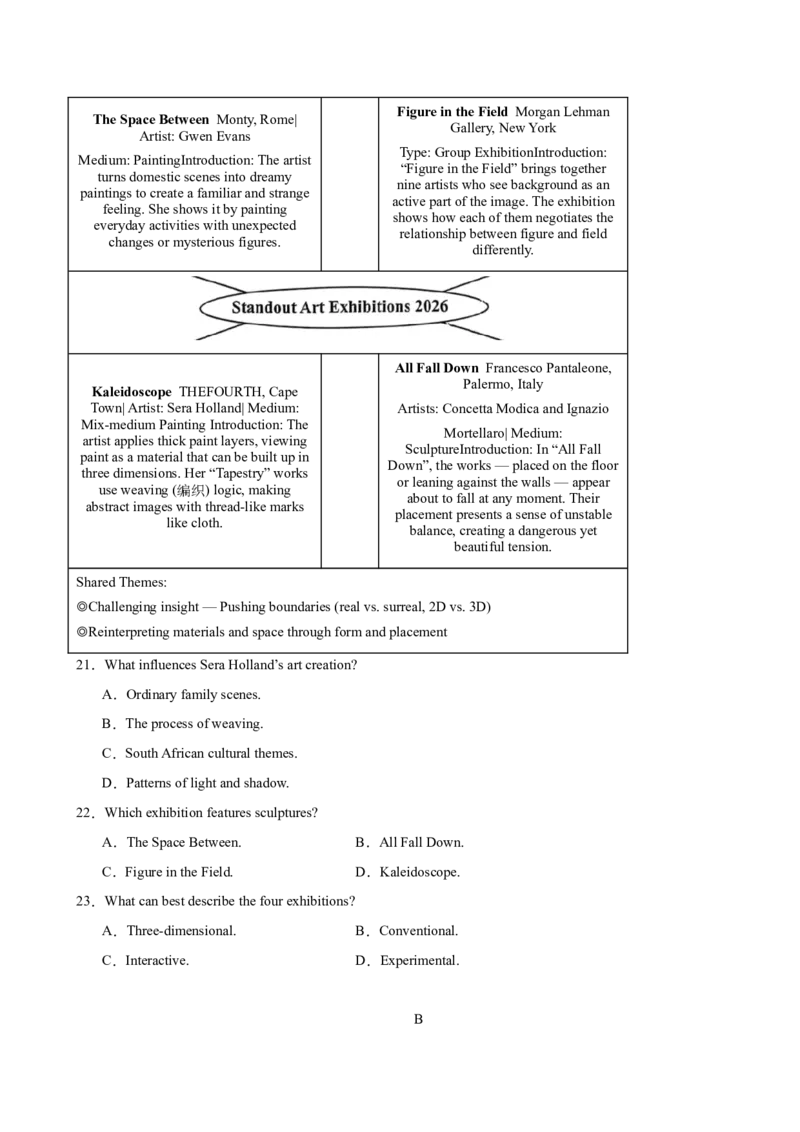
While artistic expression develops in countless forms, artists are still pushing boundaries. The new year has
brought a host of exciting and inventive exhibitions, including — but not limited to — the following four:
The Space Between Monty, Rome|
Artist: Gwen Evans
Medium: PaintingIntroduction: The artist
turns domestic scenes into dreamy
paintings to create a familiar and strange
feeling. She shows it by painting
everyday activities with unexpected
changes or mysterious figures.
Figure in the Field Morgan Lehman
Gallery, New York
Type: Group ExhibitionIntroduction:
“Figure in the Field” brings together
nine artists who see background as an
active part of the image. The exhibition
shows how each of them negotiates the
relationship between figure and field
differently.
Kaleidoscope THEFOURTH, Cape
Town| Artist: Sera Holland| Medium:
Mix-medium Painting Introduction: The
artist applies thick paint layers, viewing
paint as a material that can be built up in
three dimensions. Her “Tapestry” works
use weaving (编织) logic, making
abstract images with thread-like marks
like cloth.
All Fall Down Francesco Pantaleone,
Palermo, Italy
Artists: Concetta Modica and Ignazio
Mortellaro| Medium:
SculptureIntroduction: In “All Fall
Down”, the works — placed on the floor
or leaning against the walls — appear
about to fall at any moment. Their
placement presents a sense of unstable
balance, creating a dangerous yet
beautiful tension.
Shared Themes:
◎Challenging insight — Pushing boundaries (real vs. surreal, 2D vs. 3D)
◎Reinterpreting materials and space through form and placement
21.What influences Sera Holland’s art creation?
A.Ordinary family scenes.
B.The process of weaving.
C.South African cultural themes.
D.Patterns of light and shadow.
22.Which exhibition features sculptures?
A.The Space Between.
B.All Fall Down.
C.Figure in the Field.
D.Kaleidoscope.
23.What can best describe the four exhibitions?
A.Three-dimensional.
B.Conventional.
C.Interactive.
D.Experimental.
B
When Craig Miller moved to the Catskill Mountains in New York after retirement, the journalist wanted to
get away from traffic jams and enjoy a quieter pace of life. Yet, one year into his stay, he became his town’s
newest volunteer firefighter.
Driving around town and noticing recruitment signs, he decided to dig further. “Speaking to fire chiefs, I
realized they are in crisis since rural areas can’t get young people to join,” he says. “The chief was trying to
persuade me to join, saying that it didn’t matter about my age.” Miller signed up as he realized that volunteering
would be a good way to integrate into the community.
“The training owned my life for three months, with night classes and Saturday sessions covering everything
from operating a pump panel to throwing ladders,” he says. “We started every session with a ‘donning drill’,
racing to put 18 kilograms of equipment on in less than a minute. We sometimes had to do it four or five times and
I was moving unsteadily by the end. It immediately improved my fitness.”
Averaging 60 callouts a year, Miller has experienced his hair-raising moments. “I’ve been on car fires and
wildfires which are stubborn and difficult. Cars can also give off poisonous smoke when they are melting,” he
says. “The worst feeling is when you receive fire alarm notice from my pager (传呼机), show up and you’re the
only one at the station. That happened once when I was early into my training and it was terrifying thinking I
would have to lead the callout.”
The greatest impact has come from helping people during some of the worst moments of their lives. “It’s
massively rewarding to put yourself out there for strangers and they are so grateful for us, too,” he says. Despite
initially thinking he would stop volunteering at 70, Miller is now committed to carrying on. “One of the essential
things in life is to feel that your efforts have meaning and that you are making a difference. I’ll keep going as long
as I have the ability. It gets in your blood,” he says.
24.Why did Miller serve as a volunteer firefighter?
A.To become part of the local community.
B.To escape from traffic jams in the city.
C.To receive training and improve his fitness.
D.To experience an exciting and rewarding job.
25.What is paragraph 3 mainly about?
A.The routine of firefighters.
B.The firefighting training.
C.The way how he improved his fitness.
D.The introduction of their equipment.
26.What made Miller feel worst?
A.Burning cars gave off poisonous smoke.
B.The donning drills were too hard for him.
C.Car fires and wildfires are difficult to put out.
D.He had to deal with emergencies alone.
27.What motivates Miller to continue volunteering?
A.Earning extra income.
B.Strangers’ grateful thanks to them.
C.Finding a purpose in his life.
D.Obtaining ways to become healthy.
C
For decades, scientists have tried to build artificial copies of nature’s perfect molecular (分子的) machines:
enzymes (酶). The common belief was that to copy an enzyme’s function, one had to perfectly copy its difficult,
folded 3D structure. A recent breakthrough from a team led by Professor Ting Xu at the University of California,
Berkeley, has made this a big step forward.
Instead of perfectly copying a protein’s exact structure, the researchers focused on designing Random
Heteropolymers (RHPs). These are a variety of things made from a mix of different chemical building blocks. The
key design rule they discovered was that the polymer’s (多聚物) soft carbon “backbone” could bend to create the
right micro-environment for a chemical reaction,even without a perfect shape. In simple terms, it’s like creating a
functional workbench not by building a fixed tool box,but by having a self-adapting table that can arrange its tools
as needed.
Guided by computer analysis of over 1,300 natural metal-containing enzymes, the team programmed their
RHPs by including key functional monomers (the tools) and strictly controlling the chemical character of the parts
containing them. The result was amazing. These polymers formed pseudo-active sites that could successfully
speed difficult reactions, such as the oxidation (氧化) of a molecule. In some ways, they even perform better than
their natural counterparts.
This discovery opens a new path for functional material design. The researchers expect that this basic
knowledge could lead to new plastics designed to break down safely in the environment,or materials able to clean
up pollutants from waterways. It represents a change from trying to perfectly imitate nature’s blueprint to learning
its basic design means,enabling us to create materials that meet our own technological and environmental needs.
28.Why do scientists try to build artificial copies of enzymes?
A.To copy their functions.
B.To change their structures.
C.To prepare them for sale.
D.To make them easier to see.
29.What is the main difference between the new and traditional ways to build artificial enzymes?
A.The new way needs a fixed tool box to conduct.
B.The new way places functional ability over perfect structural copying.
C.The new way focuses on making the artificial enzyme more affordable.
D.The new way avoids using any chemical building blocks found in nature.
30.What does the underlined word “counterparts” in paragraph 3 probably mean?
A.Competitors.
B.Designers.
C.Equals.
D.Survivors.
31.What can we learn about the probable effect of this research according to the text?
A.It will soon replace natural enzymes.
B.It has had practical applications already.
C.It is changing the way we treat diseases.
D.It may lead to environmentally friendly materials.
D
Artificial intelligence inspires a mix of wonder and anxiety. It promises efficiency, creativity, and economic
growth. But as its use spreads, an uncomfortable truth emerges: AI systems may never be truly secure. Their
security weaknesses are not minor errors but the unavoidable consequence of how these technologies are built.
Traditional software has boundaries: defined inputs, formal reasoning, predictable outputs. Security relies
on spotting errors and fixing them. AI is different. Models learn from oceans of data, forming patterns even their
designers cannot fully trace. This cloudiness — praised as intelligence — also makes assurance impossible. What
cannot be understood cannot be secured.
Opponents thrive in that uncertainty. Slightly changed images fool facial recognition. A handful of
poisonous data points influence training results. Carefully crafted prompts ( 提示词) tempt systems to reveal
secrets. Unlike conventional attacks, these weaknesses cannot be patched away (补丁修复). They are woven into
the learning process itself, and therefore permanent.
The risks rise with adoption. A chatbot talking nonsense is an annoyance. An AI in charge of medical
diagnoses or financial trades is another matter. Imagine patient outcomes damaged by poisonous inputs, or stock
markets shocked by engineered algorithms. When fragile systems run critical infrastructure, fragility transforms
into systemic risk.
Defenders are not unoccupied. Opposing training, model monitoring, and data sanitation ( 净化) aim to
bounce back. Yet each solution has limits. Training against one attack leaves blind spots for another. Security
layers add costs and slow performance — burdens unwelcome in a global AI arms race that rewards speed over
caution.
Like nuclear power or aviation, AI may require ongoing monitoring, legal framework, and international
norms. Yet regulatory responses are often reactive, lagging far behind technological leaps.
History suggests severe lessons. The Internet was built without security at its core, and decades later society
still struggles with hacking, disinformation, and cybercrime. AI seems certain for the same path: constant security
weaknesses, partial fixes, and a permanent arms race between attackers and defenders. Perfection will remain out
of reach.
32.Why is AI security fundamentally different from traditional software?
A.AI systems use formal reasoning for reliable outputs.
B.Traditional software has much more minor errors to fix.
C.AI’s security weaknesses are easier to patch through updates.
D.Traditional software has predictable and traceable boundaries.
33.What does the author think of the current efforts to defend AI systems?
A.They are sufficient to address all potential threats.
B.They are the main driver of the global AI arms race.
C.They cannot be fully secured without a balancing act.
D.They have kept up with the speed of AI development.
34.Why does the author mention the history of the Internet?
A.To predict a future of perfectly secure AI.
B.To present a security model for AI to follow.
C.To claim regulation can easily prevent AI risks.
D.To imply AI security may be a lasting social issue.
35.Which of the following is the best title for the text?
A.The Bright Future of AI: Efficiency and Creativity
B.The Security Dilemma of AI: A Built-in Challenge
C.The Path to Perfect Security: Building Unbreakable AI
D.The Weaknesses of AI’s Security: A Temporarily Challenge
第二节(共5 小题;每小题2.5 分,满分12.5 分)
阅读下面短文,从短文后的选项中选出可以填入空白处的最佳选项。选项中有两项为多余选项。
At dawn and dusk, forests appear muted and nearly monochromatic (单色的) to human eyes. But white-
tailed deer might see a very different, aglow landscape.
Since the 1970s, biologists have understood that deer leave signposts — from rubbing antlers on trees or
scraping the ground — for scent-based communication.     36     The researchers scanned 146 such signposts
in Georgia using ultraviolet lights. They found that although the signposts look ordinary in daylight, they reemit
blue-green light when exposed to UV wavelengths common at dawn and dusk. This likely happens because antler
rubs strip away bark, revealing lignin-rich inner wood that fluoresces (散发荧光) in a way bark does not.
The visual contrast also intensifies as the breeding season approaches.     37
This shift in light is particularly relevant, the authors say, because the eyes of white-tailed deer have
enhanced sensitivity to short- and middle-wavelength colors in this stage, especially under low-light conditions.
Traditionally, mammalian (哺乳动物的) biofluorescence has been studied as a subject of the animal itself.
38
However, not all experts are convinced. One skeptic not involved in the study noted that if humans cannot
see the markings under natural light, deer likely cannot either.     39
The researchers describe the study as a first step.     40
A.But one group of researchers wondered whether these marks also provide visual messages.
B.Therefore, deer rely solely on scent for communication throughout the year.
C.In such period, marks are brighter because male deer antlers have fully hardened and their rubs can expose
more inner wood.
D.This discovery suggests that biofluorescence might also be embedded in the environment, adding a largely
unseen layer to how animals communicate.
E.This argument highlights a key limitation of the current study: its findings are based on technical
measurement, not observed animal behavior.
F.This means that deer are likely color-blind to red and orange hues.
G.Future research will need to confirm whether deer actually use these visual cues in their natural habitat.
第三部分  语言运用(共两节,满分30 分)
第一节  (共15 小题;每小题1 分,满分15 分)
阅读下面短文,从每题所给的A、B、C、D 四个选项中选出可以填入空白处的最佳选项。
I started law school in 1976. I was 17 and nursing a(n)     41     of my own. One day, our     42
asked everyone who had attended a private high school to raise their     43    . The sea of arms that shot up
44     that, in a class of 30 people, I was the only one who’d come from a state school. The lecturer didn’t do
this     45    — he was making a point about lawyers being an advantaged group, and how that     46

the legal system. But I felt     47     by how different the world of my peers was.
At one point in that class we had to do a moot court (模拟法庭) and were     48     to wear a suit. My
family wasn’t     49     but we certainly didn’t have the money lying around to buy me one for the     50
. My mother had the idea that we could look for a suit in a charity shop, where we successfully picked one up.
It was a nice suit but it hadn’t exactly been     51     to fit me properly. I was feeling self-conscious and
52     when I arrived wearing it that day at university. But a     53     from a woman in my class — only in
her mid-20s yet incredibly cool and mature —     54     everything. “Oh Brian, you look really smart,” she
said. Hearing that, I walked into class with     55     and did well in the moot court.
41.A.willingness
B.awareness
C.otherness
D.wildness
42.A.lawyer
B.coach
C.judge
D.lecturer
43.A.hand
B.voice
C.head
D.question
44.A.denied
B.revealed
C.predicted
D.strengthened
45.A.politely
B.cruelly
C.optimistically
D.regularly
46.A.promotes
B.clarifies
C.affects
D.destroys
47.A.exposed
B.distracted
C.abandoned
D.confused
48.A.encouraged
B.satisfied
C.instructed
D.transferred
49.A.poor
B.wealthy
C.stable
D.conventional
50.A.debate
B.occasion
C.competition
D.ceremony
51.A.donated
B.prepared
C.repaired
D.tailored
52.A.upset
B.shy
C.deserted
D.pressured
53.A.suit
B.reward
C.signal
D.remark
54.A.changed
B.struck
C.disturbed
D.aroused
55.A.patience
B.inspiration
C.confidence
D.expectation
第二节(共10 小题;每小题1. 5 分, 满分15 分)
阅读下面材料,在空白处填入适当的内容(1 个单词)或所给单词的正确形式。
Beyond their shiny surfaces and rough appearances, rocks and minerals hold the Earth’s deepest memories:
of stellar (恒星的) explosions, ancient oceans, and the forces     56     sculpted the continents. Having started
on Tuesday, an exhibition at the Natural History Museum of China in Beijing welcomes     57     (visitor) to
figure out these stories, displaying an amazing collection that     58     (map) out a journey from the planet’s
violent beginnings to the dawn of human civilization and beyond.
     59     (title) “Treasure of Earth: Exquisite Minerals and Rocks”, the exhibition presents more than
200 specimens (标本) and will run through Feb. 1, 2026. Supported by the Inner Mongolia Museum of Natural
History, it unfolds across four chapters     60     (explore) the science of minerals and the cycle of rocks,
inviting audiences on a journey     61     (uncover) the secrets of the Earth’s billion-year geological legends.
In her opening address, Xue Li, president of the Chinese Association of Natural Science Museums, said the
event is in line with the     62     (strategy) plan for “building a leading cultural powerhouse” outlined by the
central government.
“Museums, serving     63     great halls of national culture and key instruments for science
popularization,     64     (true) bear the mission of enriching the people through culture and education, ” Xue
says, adding that the exhibition is a good example of improving public scientific literacy and promoting      65
concept of ecological civilization.
第四部分 写作(共两节, 满分40 分)
第一节(满分15 分)
66.假定你是李华,你校英文报正在开展以“文字里的榜样”为主题的征文活动,要求结合你阅读过的
书中某一位给你深刻印象的人物,写一篇英文短文投稿,内容包括:
1. 简要介绍该人物及其可贵品质;
2. 结合自身经历谈谈他/她对你的启发。
注意:
1. 写作词数应为80 个左右;
2. 请按如下格式在答题卡的相应位置作答。
My Role Model from a Book
___________________________________________________________________________________________
___________________________________________________________________________________________
___________________________________________________________________________________________
___________________________________________________________________________________________
__________________________________________________________________________________________
第二节(满分25 分)
67.阅读下面材料,根据其内容和所给段落开头语续写两段,使之构成一篇完整的短文。
I was a 22-year-old medical student from Sri Lanka, studying in a quiet university town in Russia. For as
long as I could remember, becoming a doctor had been my greatest aspiration — one that had driven me to leave
my family and home behind, to brave the harsh Russian winters and endless hours of tiring study. I had always
believed that with hard work, I could heal the sick and make my parents proud.
But my financial situation took a sudden turn for the worse when my family back in Sri Lanka could no
longer send me money. With no savings left and bills piling up, I had no choice but to pack my bags and return
home, abandoning the dream I’d fought so hard for.
On the morning of my departure, I dragged my heavy suitcase to the bus stop, my steps slow and heavy.
The bus to Moscow was crowded and endless traffic jammed the roads for hours. By the time I finally reached the
city center, I could barely breathe from worry — I was already running late for my flight. I grabbed my suitcase
and rushed toward the underground station, my breath coming in short gasps ( 喘气) as I weaved through the
bustling crowds.
When I finally made it to the airport, my heart sank. The flight gate was shut tight. I approached the
counter, my voice trembling as I begged the staff for help. “You can take the standby flight 3 hours later, Miss,”
the staff lady said, “but you have to pay an extra one hundred dollars for the rebooking fee.”
I had used up all my savings on the journey to Moscow and had no financial support from home; I didn’t
have that money. For me, it was an impossible amount. I wanted to be strong, to hold back my tears, but I
couldn’t. I broke down and cried uncontrollably right there in front of the counter, my shoulders shaking as I
thought of my wasted efforts and the uncertain future waiting for me. People began to gather around me.
Suddenly, I felt a gentle touch on my shoulder.
注意:
(1)续写词数应为150 个左右;
(2)请按如下格式在答题卡的相应位置作答。
Through my tears, I noticed a hesitant old man watching me.
______________________________________________________________________________________
___________________________________________________________________________________________
___________________________________________________________________________________________
___________________________________________________________________________________________
_________________________________________________________
With his contact information in pocket, I watched him disappear in the crowd.
___________________________________________________________________________________________
___________________________________________________________________________________________
___________________________________________________________________________________________
___________________________________________________________________________________________
____________________________________________________