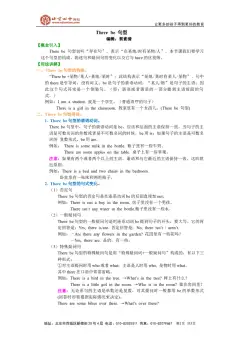
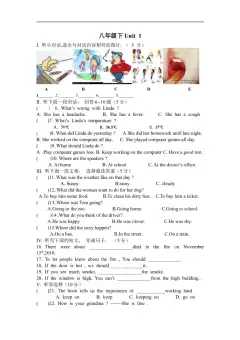
八年级期末考试卷
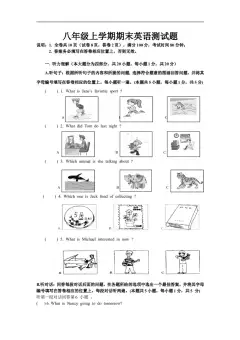
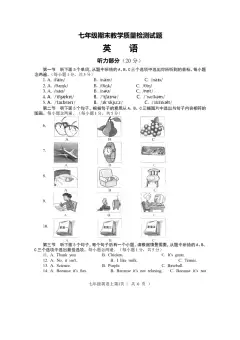
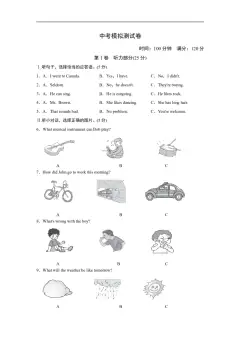
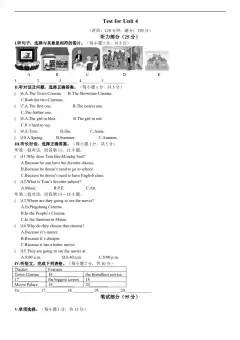
Ⅰ、听力部分(20 分,每小题1 分)
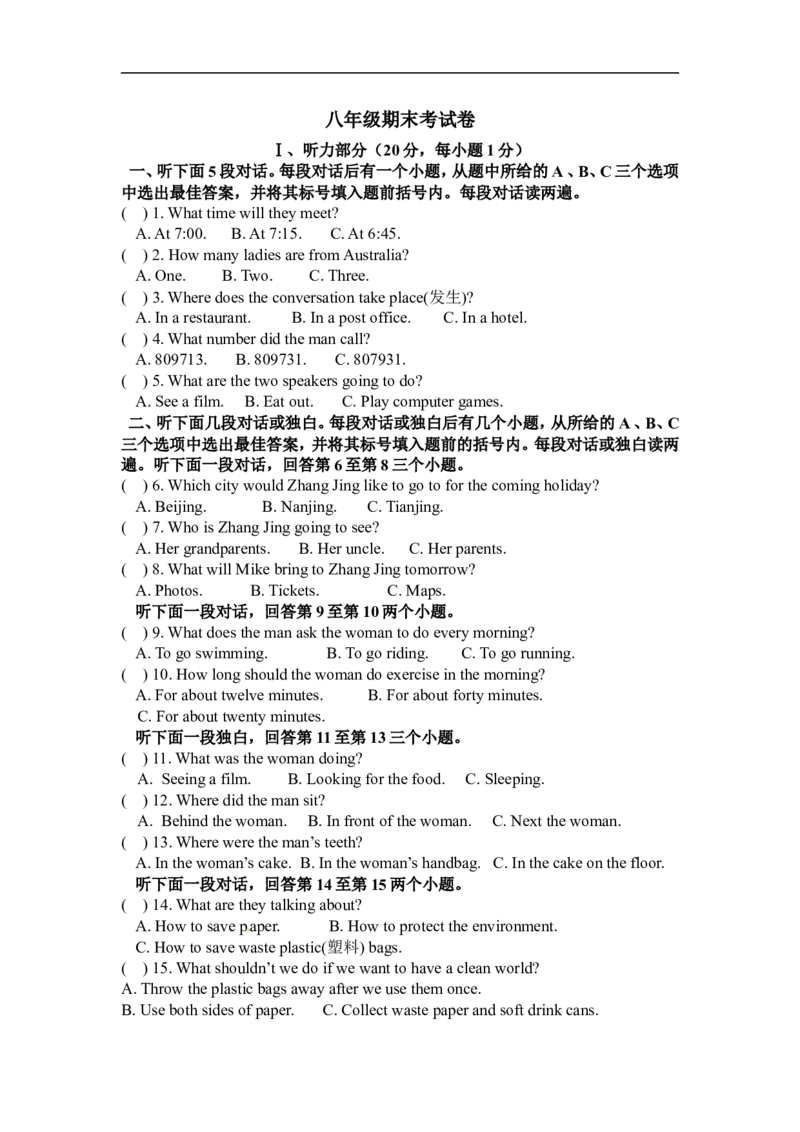
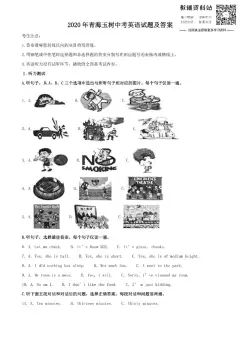
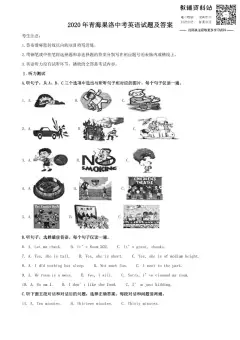
 一、听下面5 段对话。每段对话后有一个小题,从题中所给的A 、B、C 三个选项
中选出最佳答案,并将其标号填入题前括号内。每段对话读两遍。
(    ) 1. What time will they meet?
A. At 7:00.      B. At 7:15.       C. At 6:45.
(    ) 2. How many ladies are from Australia?
A. One.         B. Two.         C. Three.
(    ) 3. Where does the conversation take place(发生)?
A. In a restaurant.        B. In a post office.       C. In a hotel.
(    ) 4. What number did the man call?
A. 809713.       B. 809731.       C. 807931.
(    ) 5. What are the two speakers going to do?
A. See a film.     B. Eat out.       C. Play computer games.
二、听下面几段对话或独白。每段对话或独白后有几个小题,从所给的A 、B、C
三个选项中选出最佳答案,并将其标号填入题前的括号内。每段对话或独白读两
遍。听下面一段对话,回答第6 至第8 三个小题。
(    ) 6. Which city would Zhang Jing like to go to for the coming holiday?
A. Beijing.
B. Nanjing.     C. Tianjing.
(    ) 7. Who is Zhang Jing going to see?
A. Her grandparents.       B. Her uncle.      C. Her parents.
(    ) 8. What will Mike bring to Zhang Jing tomorrow?
A. Photos.
    B. Tickets.
   C. Maps.
听下面一段对话,回答第9 至第10 两个小题。
(    ) 9. What does the man ask the woman to do every morning?
A. To go swimming.
  B. To go riding.        C. To go running.
(    ) 10. How long should the woman do exercise in the morning?
A. For about twelve minutes.           B. For about forty minutes.
C. For about twenty minutes.
听下面一段独白,回答第11 至第13 三个小题。
(    ) 11. What was the woman doing?
A. Seeing a film.         B. Looking for the food.     C. Sleeping.
(    ) 12. Where did the man sit?
A. Behind the woman.     B. In front of the woman.     C. Next the woman.
(    ) 13. Where were the man’s teeth?
A. In the woman’s cake.  B. In the woman’s handbag.  C. In the cake on the floor.
听下面一段对话,回答第14 至第15 两个小题。
(    ) 14. What are they talking about?
A. How to save paper.            B. How to protect the environment.
C. How to save waste plastic(塑料) bags.
(    ) 15. What shouldn’t we do if we want to have a clean world?
A. Throw the plastic bags away after we use them once.
B. Use both sides of paper.       C. Collect waste paper and soft drink cans.
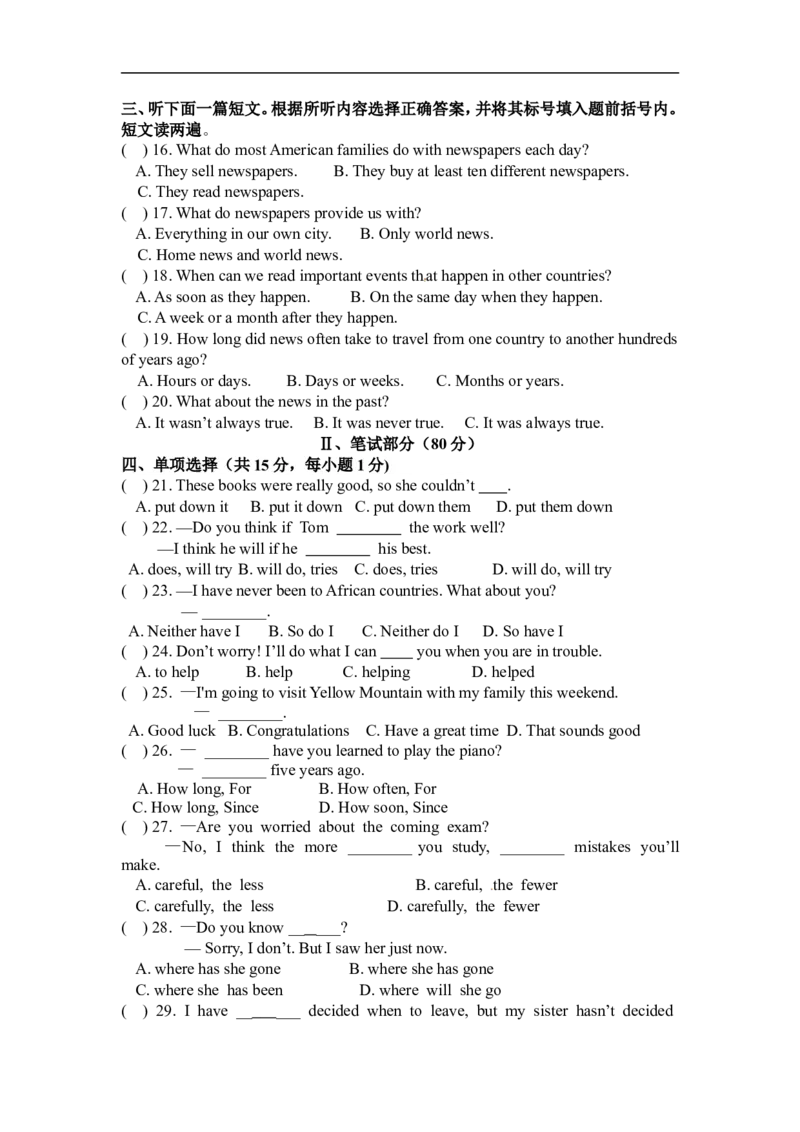
三、听下面一篇短文。根据所听内容选择正确答案,并将其标号填入题前括号内。
短文读两遍。
(    ) 16. What do most American families do with newspapers each day?
A. They sell newspapers.         B. They buy at least ten different newspapers.
C. They read newspapers.
(    ) 17. What do newspapers provide us with?
A. Everything in our own city.       B. Only world news.
C. Home news and world news.
(    ) 18. When can we read important events that happen in other countries?
A. As soon as they happen.          B. On the same day when they happen.
C. A week or a month after they happen.
(    ) 19. How long did news often take to travel from one country to another hundreds
of years ago?
A. Hours or days.        B. Days or weeks.        C. Months or years.
(    ) 20. What about the news in the past?
A. It wasn’t always true.     B. It was never true.     C. It was always true.
Ⅱ、笔试部分(80 分)
四、单项选择(共15 分,每小题1 分)
(    ) 21. These books were really good, so she couldn’t        .
A. put down it    B. put it down  C. put down them
  D. put them down
(    ) 22. —Do you think if Tom          the work well?
         —I think he will if he          his best.
  A. does, will try B. will do, tries    C. does, tries
 D. will do, will try
(    ) 23. —I have never been to African countries. What about you?
 — ________.
  A. Neither have I       B. So do I       C. Neither do I      D. So have I
(    ) 24. Don’t worry! I’ll do what I can          you when you are in trouble.
A. to help        B. help
      C. helping
   D. helped
(    ) 25. —I'm going to visit Yellow Mountain with my family this weekend.
         — ________.
  A. Good luck   B. Congratulations  C. Have a great time  D. That sounds good
(    ) 26. — ________ have you learned to play the piano?
         — ________ five years ago.
A. How long, For                B. How often, For
 C. How long, Since              D. How soon, Since
(    ) 27. —Are you worried about the coming exam?
      —No, I think the more ________ you study, ________ mistakes you’ll
make.
A. careful, the less
                B. careful, the fewer
C. carefully, the less
            D. carefully, the fewer
(    ) 28. —Do you know __   ___?
— Sorry, I don’t. But I saw her just now.
A. where has she gone                 B. where she has gone
C. where she has been                 D. where will she go
(    ) 29. I have __
  ___ decided when to leave, but my sister hasn’t decided
 __      ___.
A. yet, yet      B. already, already     C. already, yet      D. yet, already
(    ) 30. —I called you last night, but no one answered me.
—Oh, I________ a shower.
A. have taken
   B. was taking     C. took
   D. will take
(    ) 31. The policeman asked the child ________ cross the street ________ the
traffic lights turned green.
  A. not, when     B. not to, unti     C. didn't, before      D. not to, after
(    ) 32. —I ________ a new house recently.
—Great. When ________ you ________ it?
A. have bought, did, buy         B. have bought, have, bought
C. bought, did, buy             D. bought, have, bought
(    ) 33. Two thirds of the population of the village ________ farmers. The
number of them ________ about 2,000.
A. is, is
       B. is, are
      C. are, are
   D. are, is
(    ) 34. —I’m leaving for the exam. Bye, Mum.
—Well, make sure you’ve got ________ ready.
A. something       B. anything      C. everything
   D. nothing
(    ) 35. — ________ is your school?
—I can’t remember it well. I________ for ten years.
A. How big, have left
                B. What big, have been away
C. How big, have been away          D. What big, have left
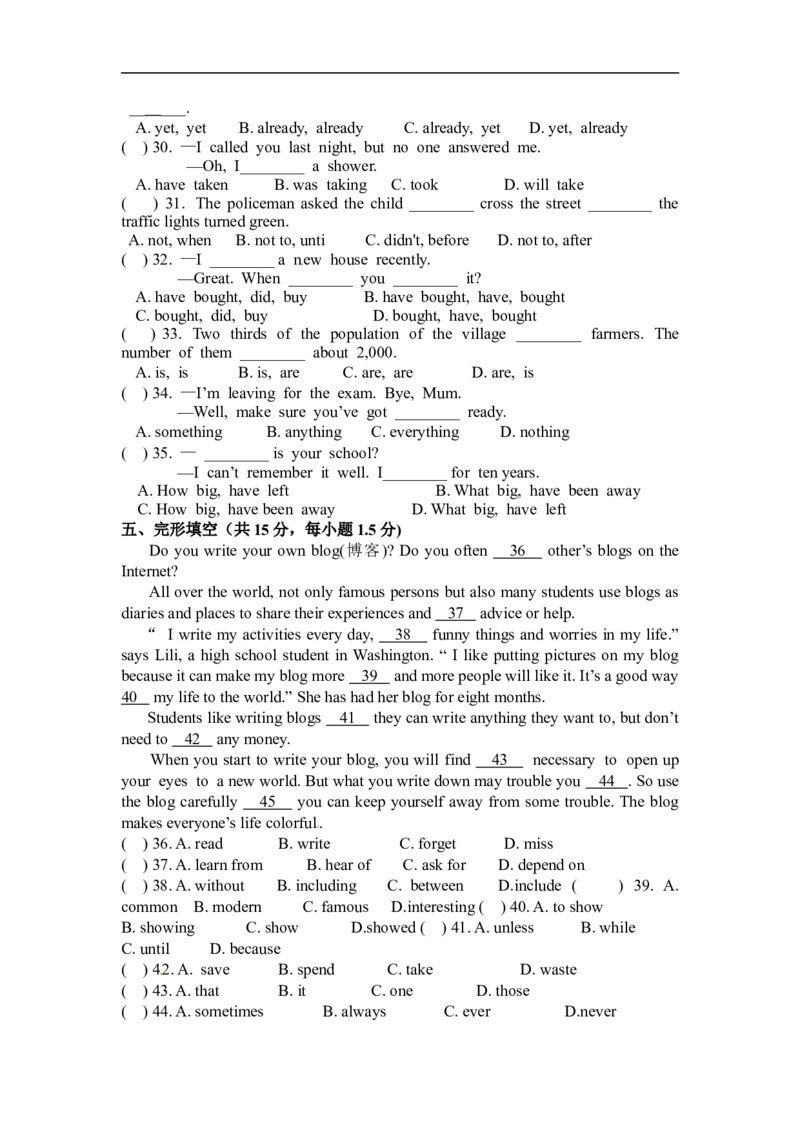
五、完形填空(共15 分,每小题1.5 分)
Do you write your own blog(博客)? Do you often    36    other’s blogs on the
Internet?
    All over the world, not only famous persons but also many students use blogs as
diaries and places to share their experiences and    37    advice or help.
   “ I write my activities every day,    38    funny things and worries in my life.”
says Lili, a high school student in Washington. “ I like putting pictures on my blog
because it can make my blog more    39    and more people will like it. It’s a good way
40    my life to the world.” She has had her blog for eight months.
    Students like writing blogs    41    they can write anything they want to, but don’t
need to    42    any money.
    When you start to write your blog, you will find    43    necessary to open up
your eyes to a new world. But what you write down may trouble you    44   . So use
the blog carefully    45    you can keep yourself away from some trouble. The blog
makes everyone’s life colorful.
(    ) 36. A. read
    B. write

      C. forget
    D. miss
(    ) 37. A. learn from
    B. hear of        C. ask for        D. depend on
(    ) 38. A. without        B. including     C. between    D.include (    ) 39. A.
common    B. modern
   C. famous    D.interesting (    ) 40. A. to show

B. showing
   C. show
        D.showed (    ) 41. A. unless        B. while


C. until        D. because
(    ) 42. A. save
    B. spend
   C. take
 D. waste
(    ) 43. A. that
    B. it          C. one
        D. those
(    ) 44. A. sometimes
 B. always
   C. ever
     D.never
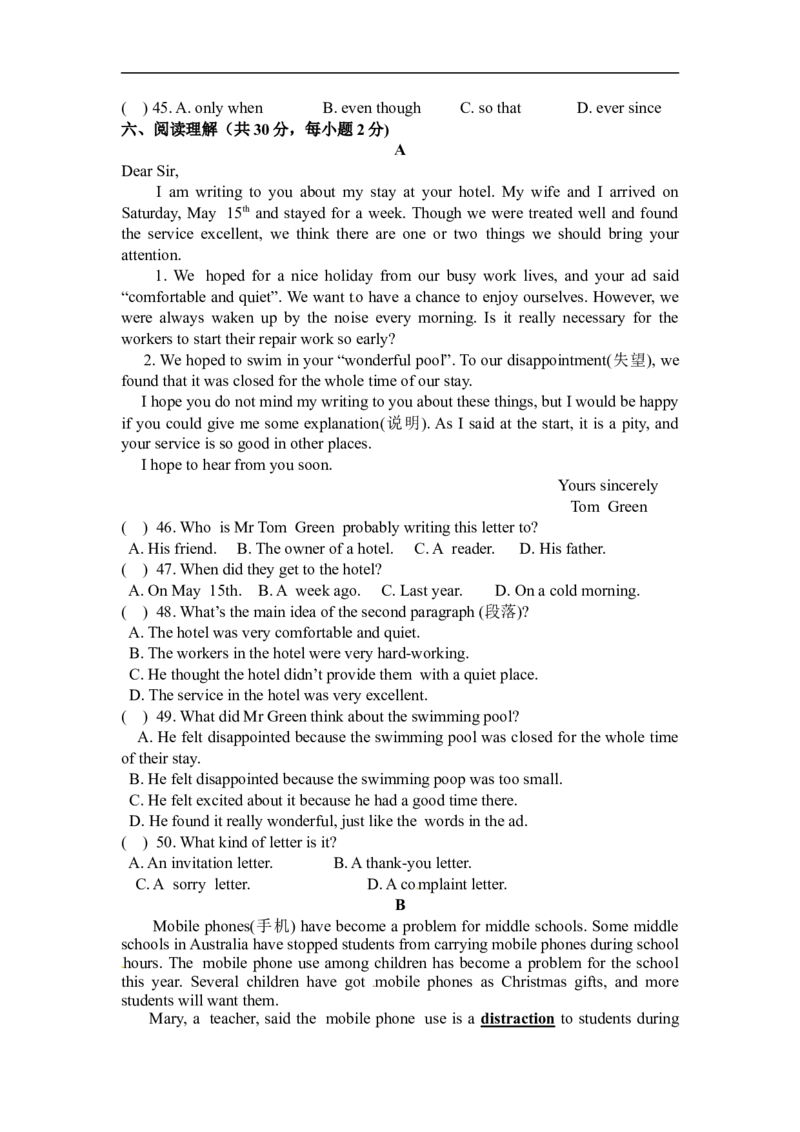
(    ) 45. A. only when
 B. even though
C. so that
 D. ever since
六、阅读理解(共30 分,每小题2 分)
A
Dear Sir,
I am writing to you about my stay at your hotel. My wife and I arrived on
Saturday, May 15th and stayed for a week. Though we were treated well and found
the service excellent, we think there are one or two things we should bring your
attention.
     1. We hoped for a nice holiday from our busy work lives, and your ad said
“comfortable and quiet”. We want to have a chance to enjoy ourselves. However, we
were always waken up by the noise every morning. Is it really necessary for the
workers to start their repair work so early?
     2. We hoped to swim in your “wonderful pool”. To our disappointment(失望), we
found that it was closed for the whole time of our stay.
     I hope you do not mind my writing to you about these things, but I would be happy
if you could give me some explanation(说明). As I said at the start, it is a pity, and
your service is so good in other places.
     I hope to hear from you soon.
Yours sincerely
Tom Green
(    ) 46. Who is Mr Tom Green probably writing this letter to?
  A. His friend.     B. The owner of a hotel.    C. A reader.      D. His father.
(    ) 47. When did they get to the hotel?
  A. On May 15th.   B. A week ago.   C. Last year.    D. On a cold morning.
(    ) 48. What’s the main idea of the second paragraph (段落)?
  A. The hotel was very comfortable and quiet.
  B. The workers in the hotel were very hard-working.
  C. He thought the hotel didn’t provide them with a quiet place.
  D. The service in the hotel was very excellent.
(    ) 49. What did Mr Green think about the swimming pool?
A. He felt disappointed because the swimming pool was closed for the whole time
of their stay.
  B. He felt disappointed because the swimming poop was too small.
  C. He felt excited about it because he had a good time there.
  D. He found it really wonderful, just like the words in the ad.
(    ) 50. What kind of letter is it?
  A. An invitation letter.               B. A thank-you letter.
C. A sorry letter.                    D. A complaint letter.
B
Mobile phones(手机) have become a problem for middle schools. Some middle
schools in Australia have stopped students from carrying mobile phones during school
hours. The mobile phone use among children has become a problem for the school
this year. Several children have got mobile phones as Christmas gifts, and more
students will want them.
Mary, a teacher, said the mobile phone use is a distraction to students during
school hours and it also gives teachers so much trouble in their classrooms. Teachers
also said that sometimes students might use phone messages to copy during exams.
She said some schools tried to stop mobile phones. Some parents felt unhappy
because they couldn’t get in touch with their children.
Many teachers said students should not have mobile phones at school, but if there
was a good reason, they could leave their phones at the school office. They also said
there were many reasons why the students should not have mobile phones at school,
they were easy to lose and were a distraction for studies.
Many people say that they understand why parents would want their children to
have phones, but they think schools should let the students know when they can use
their mobile phones.
(    ) 51. Some middle schools in Australia have stopped students from carrying
mobile phones        .
A. because they are students        B. when they are free
C. when they are at school         D. because they are children
(    ) 52. We know from the passage that some children get mobile phones from        .
A. the makers and sellers           B. the teachers
C. their parents and friends         D.some mobile phone users
(    ) 53. What does the underlined word mean in the passage?
A. 鼓舞        B. 分心        C. 奖励         D. 核对
(    ) 54. Some parents felt unhappy because they couldn’t _    __ during school
hours.
A. use their mobile phones       B. leave their mobile phones at the school
office
C. help the teachers with their work     D. get in touch with their children
(    ) 55. The passage mainly tells us that _    __.
A. students shouldn’t have mobile phones at school except(除…外) some special
reasons
B. it is impossible to stop students from using mobile phones at school
C. some parents felt unhappy because they couldn’t use their phones at school
D. parents should teach children how to use mobile phones during school hours
C
Hundreds of years ago, life was much harder than it is today. People didn’t have
modern machines. Life today has brought new problems. One of the biggest is
pollution. Water pollution has made our rivers and lakes dirty. It kills our fish and
pollutes our drinking water. Noise pollution makes us talk louder and become angry
more easily. Air pollution is the most serious kind of pollution. It’s bad to all living
things in the world.
Polluted air from cars, planes and factories is so thick that it is like a quilt(被子)
over a city. This kind of quilt is called smog(烟雾). Many countries are making rules
to fight pollution. Factories must now clean their water before it is thrown away. And
they mustn’t blow dirty smoke into the air. We need to do many other things. We can
put waste things in the dustbin and not throw it on the ground. We can go to work by
bus or with our friends in the same car. If there are fewer people driving, there will be
less pollution.
Rules are not enough, every person must help to fight pollution.
(    ) 56. Hundreds of years ago, life was much harder than it is today
because ___  __.
  A. there were fewer modern machines at that time than today
  B. people didn’t like to use modern medicines  [来源:学科网]
C. there were no modern machines at all
D. there was no pollution at all
(    ) 57. What is the biggest problem in today’s life?
  A. Dirty water.      B. Pollution.        C. Noise.     D. Too crowded
(    ) 58. The most serious kind of pollution is ___  ___.
  A. noise pollution    B. air pollution     C. water pollution    D. waste paper
(    ) 59. Factories must clean their water ___  ___.
  A. before they use it                   B. when they use it
C. before it is thrown away             D. whenever they use it
(    ) 60. From the passage we know that _    ___.
  A. a few years ago, there was no smog at all
B. today people don’t have to talk to each other in a loud voice
C. people are making rules in order to fight pollution
  D. people can only use rules to fight pollution
七、单词拼写(共5 分,每小题1 分)
61. People lived in bad c ____  __  (条件) in the past.
62. Our English teacher often e____  __  (鼓励) us to study English hard.
63. With the d__ ____  ( 发展) of the modern city, we need more living
abilities.
64. We should be honest students instead of c__ ____  (欺骗) our teachers.
65. The countryside is a p__ __  __(完美的) place to take a holiday.
八、补全对话(共5 分,每小题1 分)
请从A-G 中选出五个句子完成对话,其中有两项多余。
A: Hello, Helen. The happy summer vacation is coming.      66

B: Yes. I’m not busy at all. I’ve just finished my homework.
A:      67

B: I have no ideas. What about you?
A: Let me see. We’d better do something interesting and helpful.
68

B: Certainly. Where?
A: In the new museum.
B: Oh, I remember. I heard of it last week.

 69

IIwesfsufslfjklvmdklvdklv
A: By bike. It’s Saturday tomorrow. The traffic must be heavy, I think.学I]
B: I agree.      70

A: At the gate of our school at nine in the morning.
  B: OK. See you then.
A、What’s your name?
B、What color do you want
C、Here you are
D、Can I help you
E、What size do you like
F、How about this T-shirt
G、I’ll take it
A. Would you like to see some old things
with us.
B. I will help my parents do much
housework.
C. When and where shall we meet?
D. How shall we get there?
E. What are you going to do?
A
f
?
九、书面表达(10 分)
假如你是Sally,是个中学生,经常收听音乐节目(program),请你用英语给节
目主持人写一封信,信的要点如下:
1、你听这个节目已经3 年了,很喜欢这个节目, 特别(especially)是英文歌
曲节目,到目前为止已学了10 首英文歌曲;
2、当你学习繁忙或疲劳时,你常会打开收音机(recorder)去收听这个节目;
3、自己也已经写了1 首英文歌曲,并寄到了这个节目;
4、你最喜欢Yesterday Once More 这首歌,希望能得到歌词(lyrics);
5、你在英语学习上已经取得了巨大进步,感谢这个节目。
要求:语意连贯,语法正确,注意时态,80 词左右。
Dear sir,


Yours,
                                                                          Sally
淮南市2013~2014 学年度第二学期期终质量检测
八年级英语参考答案
I--III 听力部分(共20 分,每小题1 分)
1~5    C B C A A                    6~10    B A A C C
11~15   A C C B A                  16~20    C C B C A
IV 单项选择(共15 分,每小题1 分)
21~25  D B A A C        26~30  C D B C B       31~35  B A D C C
V 完形填空(共15 分,每小题1.5 分)
36~40  A C B D A          41~45  D B B A C
VI 阅读理解(共30 分,每小题2 分)
46~50  B A C A D         51~55  C C B D A       56~60  A B B C C
VII单词拼写(共5 分,每小题1 分)
61、conditions            62、encourages           63、development
64、cheating              65、perfect
VIII 补全对话(共5 分,每小题1 分)
66~70  F E A D C
IX 书面表达(共10 分)
参考范文:
Dir sir,
     I’m Sally. Now I’m studying in a high school. I often turn on the radio
to listen to your program when I am free or feel tired. I like your program so
much, especially the English songs. I’ve listened to the program for about 3
years. So far I have learned 10 English songs through the program.
     I like the song named Yesterday Once More best  and I expect to get
the lyrics of the song. I hope you can achieve my dream. I’ve already written
an English song and sent it to your program. Thanks to your program, I have
also made great progress in my Engl ish study. Wish your program more
excellent.
Yours
Sally