文档文本内容
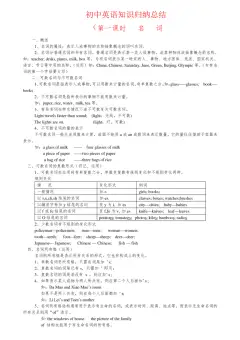
初中英语最全知识点解析
初中英语最全知识点
一、语法篇
This is the key to the door .这是开门的钥匙。
● ??
电话号码电话号码
at .sth .sb call call sb. = phone sb. = ring sb. up
please give me a call .请打电话给我
● family 指家庭时是单数,谓语动词用“is”,family 指家人时
是复数,谓语动词用“are”。 ● of 表示无生命物体的所有格,s 表示
有生命物体的所有格。有生命物体的所有格也可以用of ,但有生命物
体后要加“s”。
● 以副词there 或here 开头的句子常要倒装,以示强调。
● What’s your name, please? = Could you tell me your
name, please? = May I have your name, please?
● Nice to meet you. = Glad to meet you. = Pleased to meet
you.
●
写启示的方法: 1.启示的主题;2.描述细节;3.留下联系方式。
● 表示惊讶、忧伤、微怒、失望等,可以用dear 作感叹词。
● 名词如果有数量词修饰它,使用谓语动词适应看他的数量词,
如:
keys of sets two are here keys
of set a is here
● get to somewhere (get home 除外)到达……
● ?
)无生命物体的“有”( is there )有生命物体的“有”( have 有 ●
肯定:Let+宾语(人称代词的宾格或名词)+ V 原型+……
否定:Don’t let +宾语+V 原型+……/Let + 宾语 + not + V 原
型+……
● have 表示“有”时才可以用来提问或写成否定“haven’t”。
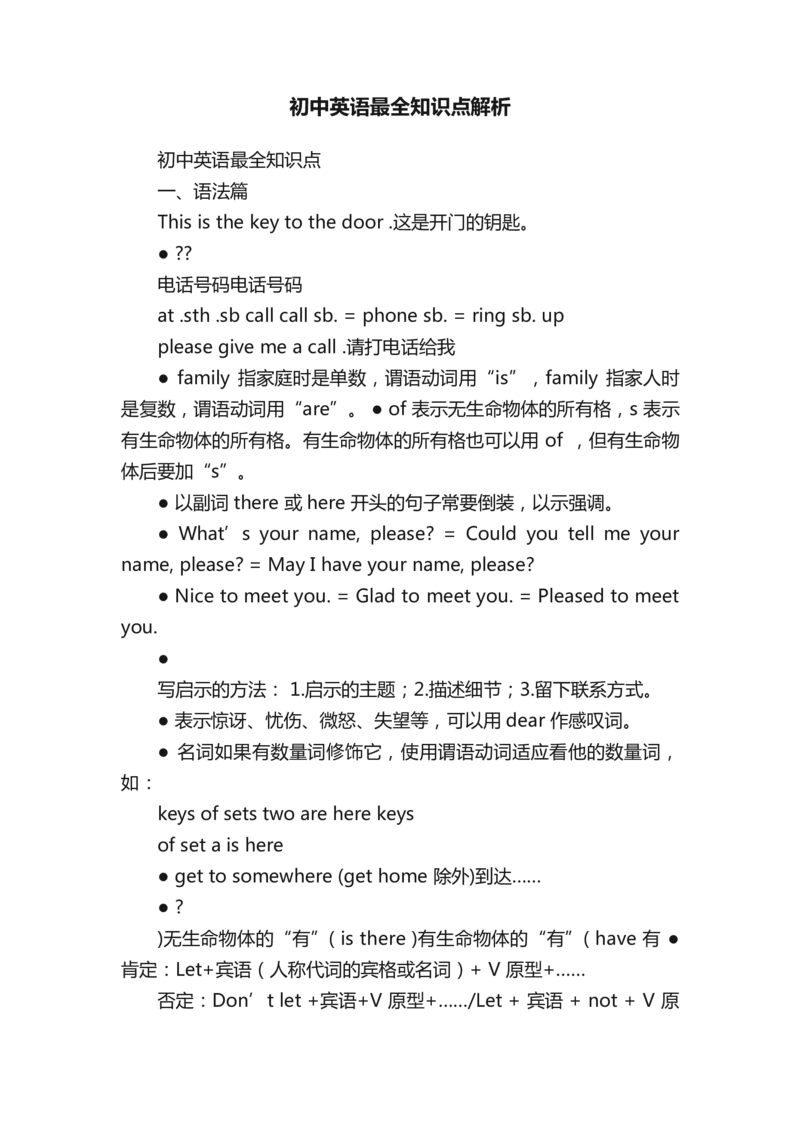
●
 you will 问: )
听话的人include 不(us Let ? we shall 问: )说话的人和听话的
人(include s Let' ●

● myself (我自己) yourself (你自己) himself (他自己)
herself (她自己) itself
(它自己)ourselves(我们自己)yourselves(你们自己)
themselves (他们自己)●How much + be + 商品?(答:
It’s/They’re……)= What is the price of……?(答:
It ’s……)
●cent 美分One dollar =100 cents
●other(两者中的另一个) another(三者中的另一个)
●越接近物品本身性质的形容词越靠近物品,如:big blue hat
●帮助某人做某事
help sb. (to) do sth.
help sb. with sth.
with the help (n.) of sb. e.g. He studies math well, with the
help of teacher.
●一般将来时的一般形式:主语+will+动词原形+……
●Can I help you? = What can I do for you? = (Is there)
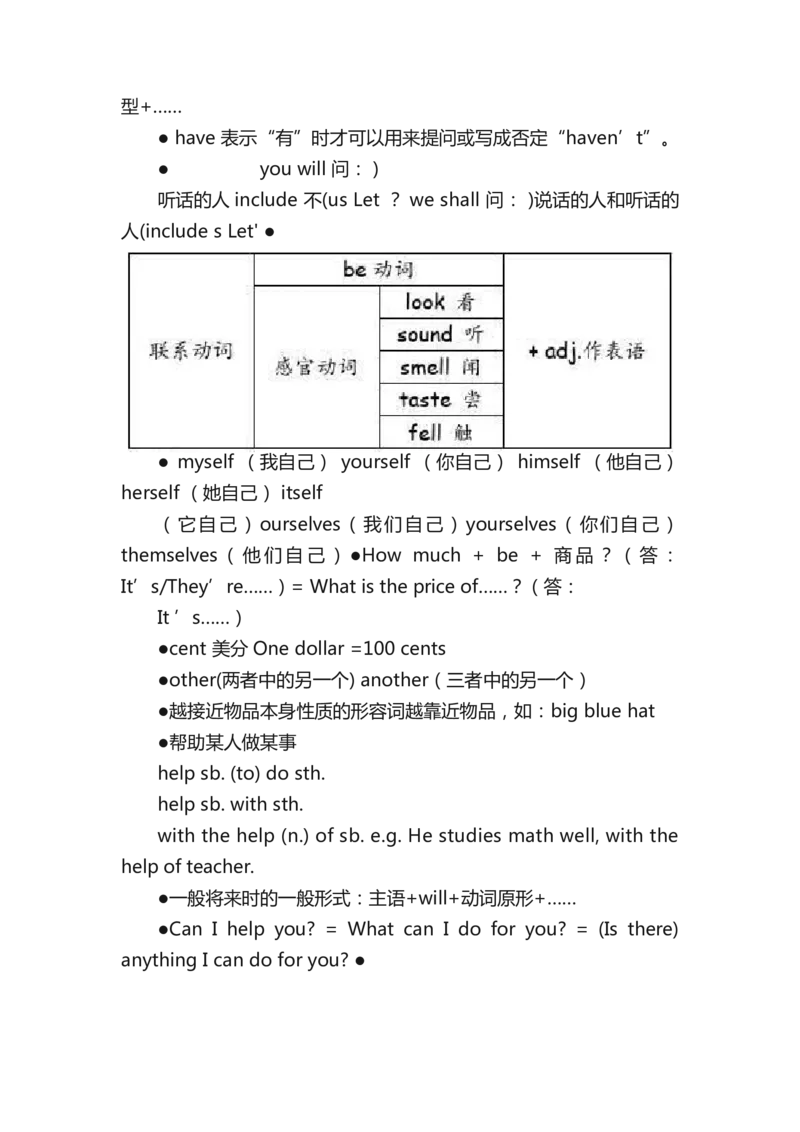
anything I can do for you? ●

●be 动词不加动词原形
●“hundred,thousand”与基数词一起表示具体数字时不加
“s”。
hundreds of 上百thousands of 上千
●buy sth. for sb. = buy sb.(间接宾语)sth.(直接宾语)为某
人买某物
●any body 在肯定句中表示任何人,在否定句和疑问句中不是。
●for 表示动词的对象或接受者,表示用途,表示目的,表示等价
交换或标注价格,表示
时间持续多久,表示距离,表示理由或原因。
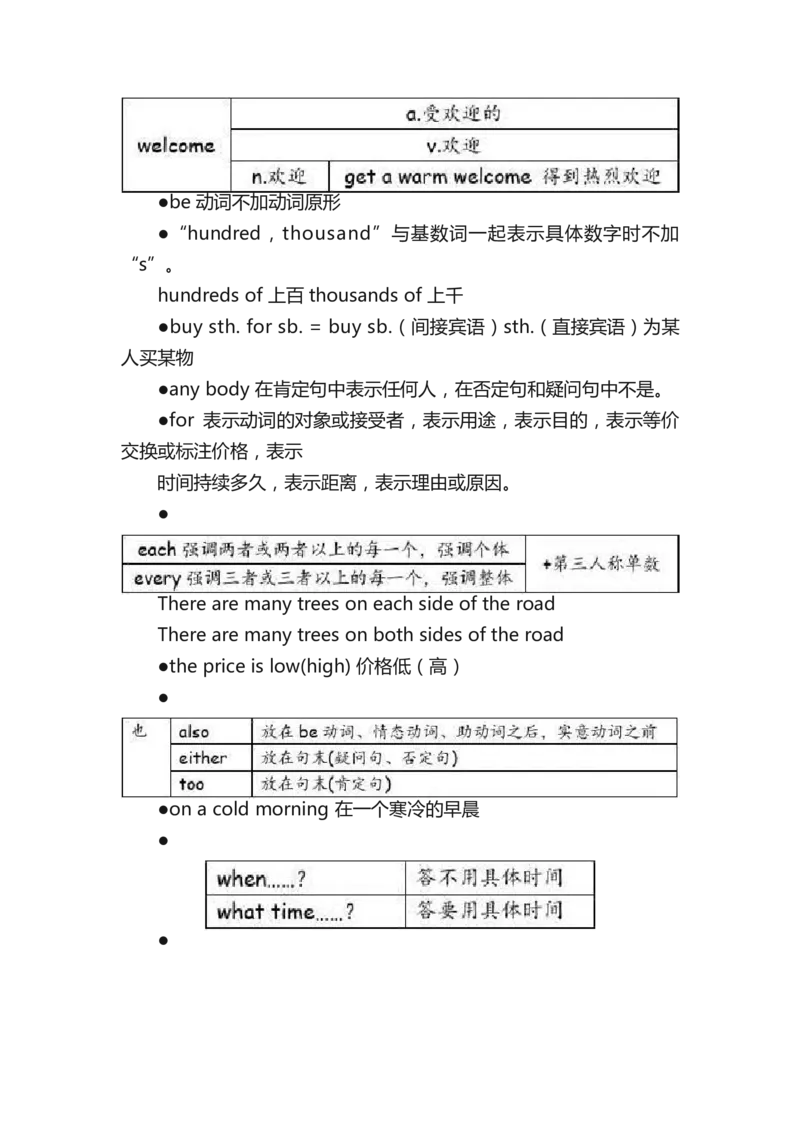
●

There are many trees on each side of the road
There are many trees on both sides of the road
●the price is low(high) 价格低(高)
●

●on a cold morning 在一个寒冷的早晨
●

●

●
●


●
●含有think 的宾语从句中如果从句中有否定,要否定前移,如:
She doesn’t think they
are boring.(她认为他们不无聊)
●问:How are you?
答:I’m fine. (我很好。)/Just so so.(一般般。)
●表示时间、价格、距离的名词作主语,谓语动词用单数。如:
Two dollars is enough(足
够)。
●怎么判断双音节单词中第一个音节是开音节还是闭音节:双音节
单词中的两个元音是两
个音节的中心,元音是由元音字母或元音字母组合发出的音,因
此,首先找到单词中的两个元音字母或元音字母组合,两个中心就清
楚了。两个中心之间的辅音字母(不是字母组合)则分别划归两个音
节,第一个音节即为闭音节,如果两个中心之间的辅音字母为双写字
母(包括“r”),分别划归前后,第一个音节按闭音节读音。如:
paper /’peip?/ (pa 为开音节) member /’memb?/ (mem 为
闭音节) happy /’h?pi/ (hap 为闭音节) sorry /’s?ri/ (sor 为闭音节)
certainly /’s?:tnil/
●I am sorry. I can’t go with you. (对不起。我不能和你一起
去。)
●Thanks. / Thank you. / Thank you very much. / Thank a lot.
/ Many thanks.
●You are welcom e. / That’s OK. / That’s all right.
●It’s my pleasure. / With pleasure. (这是我的荣幸。)
●make friend with sb. (和……交朋友)
●Thanks for + n. / v.ing = Thanks sb. for + n. / v.ing
●below 在……下方(非正下方)
反义词:above 在……上面(非正上方,没有接触面)
under 在……下面(正下方)
反义词:on(有接触面),over(没有接触面)在……上面(正
上方)
●keep + sth. + adj. 使某物保持某状态。
keep + adj. 保持某状态。
●表示请求、建议、希望得到对方肯定回答的疑问句用“some”。
●问:Let……
答:OK. / All right. / That’s a good idea. / That sounds good.
/ Sorry.
●sport 用来修饰名词要变为sports。
●play + the + 乐器Erhu 除外
●be 动词后叫表语,修饰名词叫定语,修饰动词叫状语,前后两
词对等叫同位语。
●人民币和日元变复数不变,其他要。
●be good with sb. = get on well with sb. 与某人相处的很好
●问:How often does Rick run on weekend?
答:Rick usually runs on weekend.
●always(总是)φusually(通常)φoften(经常)φsometime(有
时)φseldom(很少)
φnever(从不)
●频度副词放在be 动词或助动词之后,实意动词或行为动词之前。
●感叹句:
What + (a/an) + adj. + n. + (主) + (谓)!
如:What beautiful flowers they are!
How + adj. /adv. + (主) + (谓)!
如:How beautiful the flowers are!
●Can you think what his job is? 含有宾语从句的复合句,宾语
从句的从句必须是陈述
句。
●Start to do sth. 开始做某事
●be famous for…… 因……出名
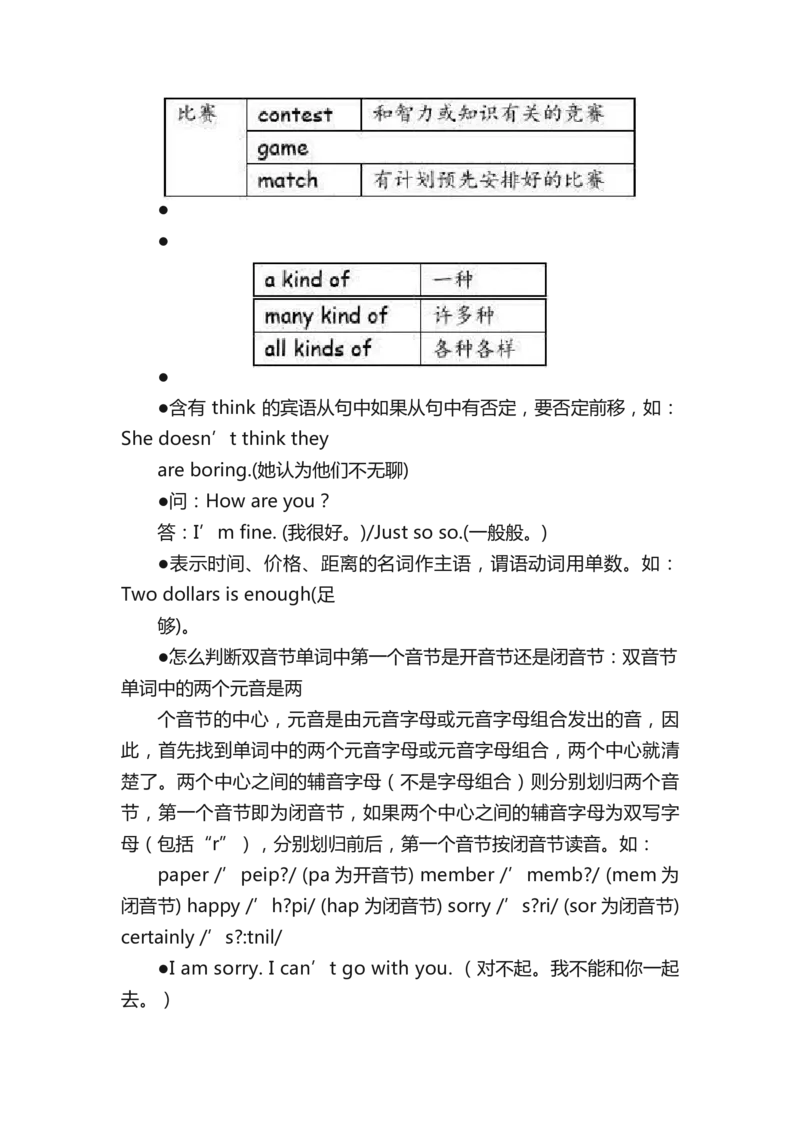
●

●

●
●for + 时间段……做某事持续多久
●问:How long do you have volleyball?
答:I have volleyball for two hours.
●ask sb. some questions. 问某人一些问题
ask sb. to do sth. 叫某人做某事
●no =not any
●because 不和so 同时使用,although(尽管)不和but 同时使用。
●

●either:两者中的任何一个都行。
neither:两者中的任何一个都不。
●用“may”提问的句子回答用can/can ‘ t 或must / mustn’
t;用“can”提问的句子回答用
can/can’t;用“must”提问的句子回答用need/needn’t.
如:1. May I park my car here?
Yes, you can / must. / No, you can’t / mustn’t.
2. Can I watch TV?
Yes, you can. / No, you can’t.
3. Must I clean the classroom this morning?
Yes, you need. / No, you needn’t.
●be afraid of doing sth. / be afraid of sth. 害怕做某事/某物
●be fond of = like
●make a continuation to sth. 对……有贡献
●do well in = be good at 擅长……
●比较级+ and + 比较级越来越……
●give back = return 归还
●法国人单数:Frenchman/Frenchwoman
英国人单数:Englishman/Englishwoman
Chinese 和Japanese 单复数同形 ●
in the world 在世界上 all over the world / around the world /
the whole word 全世界 ●
in the school 在学校里 in school 在学校学习 ●
outside 在……外面 outside the gate to the park 在公园门外 ●
turning 转角 ●
go down + …… 沿着 …… 路走 go straight down + …… 沿着 ……
路直走 ●
enjoy doing sth. 喜欢做某事 enjoy oneself = have a good time
= have fun ●
take a walk = go for a walk = have a walk ●
the beginning of ……的开始 at the beginning of 强调在……开
始的那一刻 in the beginning 起初,一开始 from the beginning 开
始时 from beginning to end 从开始到结束 ●
visit + 地点、参观某地 a visit to + 地点、参观某地 ●
have fun doing sth. 做……很开心 ●
地点 + is a great place to do sth. ……是一个做……的地方 ●
be busy with sth. 忙于某事 ● the way to ……去……的路
on the way to + 地点 在去……的路上
on one’s way to + 地点 某人在去……的路上 on my way to
home 在我回家的路上 ● 把某物递给某人sth. sb. pass sb. to sth.
pass ?
●
++++小地方at 大地方in arrive ● ??
school reach school to get school at arrive 到达学校
● 主语 + hope(that) + 从句
主语 + hope + to do sth.
● live on ……靠……为生