2025 年高考第一次模拟考试(新高考八省)02
英语
(考试时间:120 分钟  试卷满分:150 分)
注意事项:
1.答卷前,考生务必将自己的姓名、考生号等填写在答题卡和试卷指定位置上。
2.回答选择题时,选出每小题答案后,用铅笔把答题卡对应题目的答案标号涂黑。如需改动,用橡皮
擦干净后,再选涂其他答案标号。回答非选择题时,将答案写在答题卡上。写在本试卷上无效。
3.考试结束后,将本试卷和答题卡一并交回。
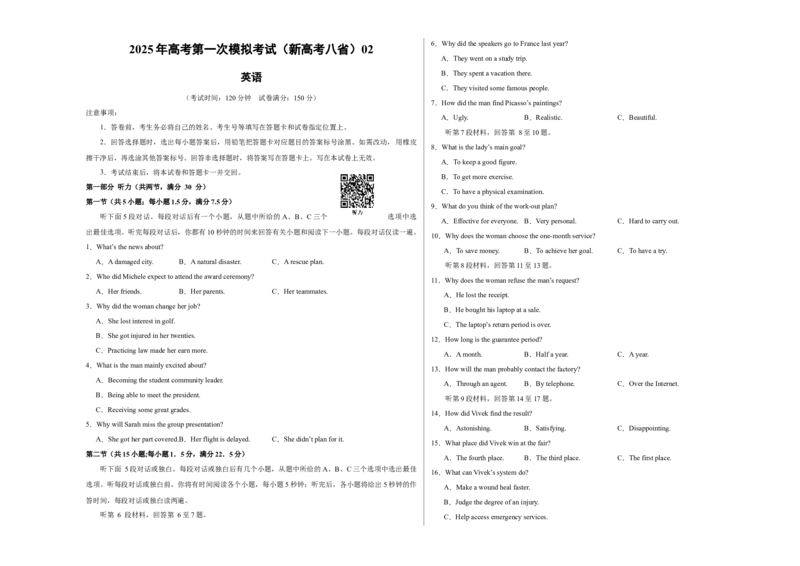
第一部分 听力(共两节,满分 30 分)
第一节(共5 小题;每小题1.5 分,满分7.5 分)
听下面5 段对话。每段对话后有一个小题,从题中所给的A、B、C 三个
选项中选
出最佳选项。听完每段对话后,你都有10 秒钟的时间来回答有关小题和阅读下一小题。每段对话仅读一遍。
1.What’s the news about?
A.A damaged city.
B.A natural disaster.
C.A rescue plan.
2.Who did Michele expect to attend the award ceremony?
A.Her friends.
B.Her parents.
C.Her teammates.
3.Why did the woman change her job?
A.She lost interest in golf.
B.She got injured in her twenties.
C.Practicing law made her earn more.
4.What is the man mainly excited about?
A.Becoming the student community leader.
B.Being able to meet the president.
C.Receiving some great grades.
5.Why will Sarah miss the group presentation?
A.She got her part covered.B.Her flight is delayed.
C.She didn’t plan for it.
第二节(共15 小题;每小题1.5 分,满分22.5 分)
听下面 5 段对话或独白。每段对话或独白后有几个小题,从题中所给的A、B、C 三个选项中选出最佳
选项。听每段对话或独白前,你将有时间阅读各个小题,每小题5 秒钟;听完后,各小题将给出5 秒钟的作
答时间,每段对话或独白读两遍。
听第 6 段材料,回答第 6 至7 题。
6.Why did the speakers go to France last year?
A.They went on a study trip.
B.They spent a vacation there.
C.They visited some famous people.
7.How did the man find Picasso’s paintings?
A.Ugly.
B.Realistic.
C.Beautiful.
听第7 段材料,回答第 8 至10 题。
8.What is the lady’s main goal?
A.To keep a good figure.
B.To get more exercise.
C.To have a physical examination.
9.What do you think of the work-out plan?
A.Effective for everyone.
B.Very personal.
C.Hard to carry out.
10.Why does the woman choose the one-month service?
A.To save money.
B.To achieve her goal.
C.To have a try.
听第8 段材料,回答第11 至13 题。
11.Why does the woman refuse the man’s request?
A.He lost the receipt.
B.He bought his laptop at a sale.
C.The laptop’s return period is over.
12.How long is the guarantee period?
A.A month.
B.Half a year.
C.A year.
13.How will the man probably contact the factory?
A.Through an agent.
B.By telephone.
C.Over the Internet.
听第9 段材料,回答第14 至17 题。
14.How did Vivek find the result?
A.Astonishing.
B.Satisfying.
C.Disappointing.
15.What place did Vivek win at the fair?
A.The fourth place.
B.The third place.
C.The first place.
16.What can Vivek’s system do?
A.Make a wound heal faster.
B.Judge the degree of an injury.
C.Help access emergency services.
17.What is the woman doing?
A.Hosting a program.
B.Conducting a ceremony.
C.Holding a press conference.
听第10 段材料,回答第18 至20 题。
18.What is the most attractive about the small towns?
A.A peaceful life.
B.Comfortable hotels.
C.Scenic places.
19.What did the speaker do during the trip?
A.He made many friends.
B.He tried different foods.
C.He took a lot of pictures.
20.What is the purpose of the talk?
A.To suggest a quick getaway.
B.To advertise a travel agency.
C.To introduce a way of socializing.
第二部分 阅读(共两节,满分50 分)
第一节  (共15 小题;每小题2.5 分,满分37.5 分)
阅读下列短文,从每题所给的A、B、C、D 四个选项中选出最佳选项。
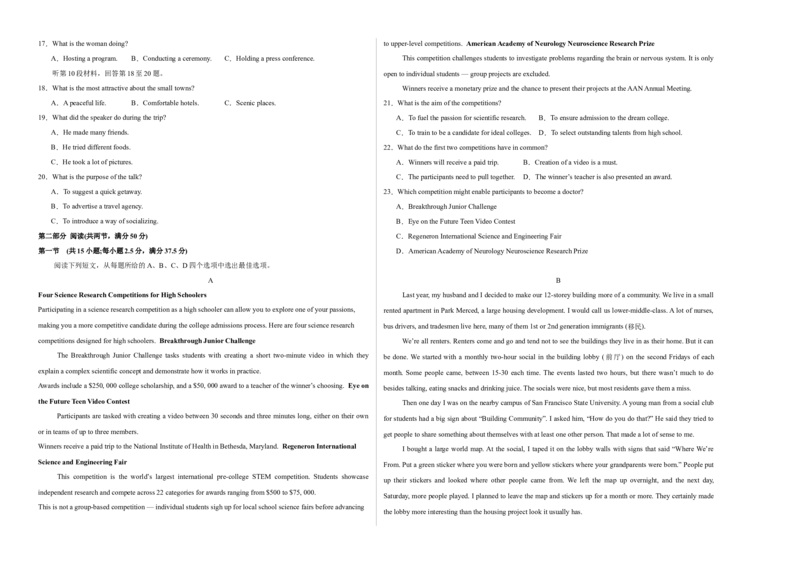
A
Four Science Research Competitions for High Schoolers
Participating in a science research competition as a high schooler can allow you to explore one of your passions,
making you a more competitive candidate during the college admissions process. Here are four science research
competitions designed for high schoolers. Breakthrough Junior Challenge
The Breakthrough Junior Challenge tasks students with creating a short two-minute video in which they
explain a complex scientific concept and demonstrate how it works in practice.
Awards include a $250, 000 college scholarship, and a $50, 000 award to a teacher of the winner’s choosing. Eye on
the Future Teen Video Contest
Participants are tasked with creating a video between 30 seconds and three minutes long, either on their own
or in teams of up to three members.
Winners receive a paid trip to the National Institute of Health in Bethesda, Maryland. Regeneron International
Science and Engineering Fair
This competition is the world’s largest international pre-college STEM competition. Students showcase
independent research and compete across 22 categories for awards ranging from $500 to $75, 000.
This is not a group-based competition — individual students sigh up for local school science fairs before advancing
to upper-level competitions. American Academy of Neurology Neuroscience Research Prize
This competition challenges students to investigate problems regarding the brain or nervous system. It is only
open to individual students — group projects are excluded.
Winners receive a monetary prize and the chance to present their projects at the AAN Annual Meeting.
21.What is the aim of the competitions?
A.To fuel the passion for scientific research.
B.To ensure admission to the dream college.
C.To train to be a candidate for ideal colleges.
D.To select outstanding talents from high school.
22.What do the first two competitions have in common?
A.Winners will receive a paid trip.
B.Creation of a video is a must.
C.The participants need to pull together.
D.The winner’s teacher is also presented an award.
23.Which competition might enable participants to become a doctor?
A.Breakthrough Junior Challenge
B.Eye on the Future Teen Video Contest
C.Regeneron International Science and Engineering Fair
D.American Academy of Neurology Neuroscience Research Prize
B
Last year, my husband and I decided to make our 12-storey building more of a community. We live in a small
rented apartment in Park Merced, a large housing development. I would call us lower-middle-class. A lot of nurses,
bus drivers, and tradesmen live here, many of them 1st or 2nd generation immigrants (移民).
We’re all renters. Renters come and go and tend not to see the buildings they live in as their home. But it can
be done. We started with a monthly two-hour social in the building lobby ( 前厅) on the second Fridays of each
month. Some people came, between 15-30 each time. The events lasted two hours, but there wasn’t much to do
besides talking, eating snacks and drinking juice. The socials were nice, but most residents gave them a miss.
Then one day I was on the nearby campus of San Francisco State University. A young man from a social club
for students had a big sign about “Building Community”. I asked him, “How do you do that?” He said they tried to
get people to share something about themselves with at least one other person. That made a lot of sense to me.
I bought a large world map. At the social, I taped it on the lobby walls with signs that said “Where We’re
From. Put a green sticker where you were born and yellow stickers where your grandparents were born.” People put
up their stickers and looked where other people came from. We left the map up overnight, and the next day,
Saturday, more people played. I planned to leave the map and stickers up for a month or more. They certainly made
the lobby more interesting than the housing project look it usually has.
I see that there will be challenges, but I also know that a strong community will help us live good lives. I have
the time and energy to do this work.
24.What trouble did the author have building a community?
A.The community was poor.
B.She lacked enough money.
C.Renters had no sense of belonging.
D.Her neighbors were all immigrants.
25.How did the author find her earlier events?
A.Fruitful.
B.Ordinary.
C.Inspiring.
D.Messy.
26.What did the author do in order to change the socials?
A.Adopt a sharing game.
B.Add foods and drinks.
C.Admit experienced locals.
D.Ask some students for support.
27.Which of the following best describes the author?
A.Responsible and strict.
B.Demanding and ambitious.
C.Knowledgeable and modest.
D.Insightful and determined.
C
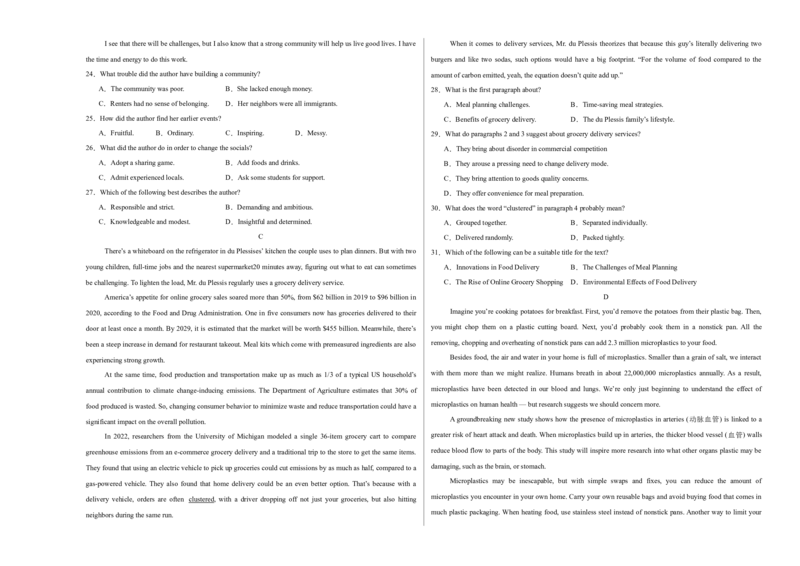
There’s a whiteboard on the refrigerator in du Plessises’ kitchen the couple uses to plan dinners. But with two
young children, full-time jobs and the nearest supermarket20 minutes away, figuring out what to eat can sometimes
be challenging. To lighten the load, Mr. du Plessis regularly uses a grocery delivery service.
America’s appetite for online grocery sales soared more than 50%, from $62 billion in 2019 to $96 billion in
2020, according to the Food and Drug Administration. One in five consumers now has groceries delivered to their
door at least once a month. By 2029, it is estimated that the market will be worth $455 billion. Meanwhile, there’s
been a steep increase in demand for restaurant takeout. Meal kits which come with premeasured ingredients are also
experiencing strong growth.
At the same time, food production and transportation make up as much as 1/3 of a typical US household’s
annual contribution to climate change-inducing emissions. The Department of Agriculture estimates that 30% of
food produced is wasted. So, changing consumer behavior to minimize waste and reduce transportation could have a
significant impact on the overall pollution.
In 2022, researchers from the University of Michigan modeled a single 36-item grocery cart to compare
greenhouse emissions from an e-commerce grocery delivery and a traditional trip to the store to get the same items.
They found that using an electric vehicle to pick up groceries could cut emissions by as much as half, compared to a
gas-powered vehicle. They also found that home delivery could be an even better option. That’s because with a
delivery vehicle, orders are often clustered, with a driver dropping off not just your groceries, but also hitting
neighbors during the same run.
When it comes to delivery services, Mr. du Plessis theorizes that because this guy’s literally delivering two
burgers and like two sodas, such options would have a big footprint. “For the volume of food compared to the
amount of carbon emitted, yeah, the equation doesn’t quite add up.”
28.What is the first paragraph about?
A.Meal planning challenges.
B.Time-saving meal strategies.
C.Benefits of grocery delivery.
D.The du Plessis family’s lifestyle.
29.What do paragraphs 2 and 3 suggest about grocery delivery services?
A.They bring about disorder in commercial competition
B.They arouse a pressing need to change delivery mode.
C.They bring attention to goods quality concerns.
D.They offer convenience for meal preparation.
30.What does the word “clustered” in paragraph 4 probably mean?
A.Grouped together.
B.Separated individually.
C.Delivered randomly.
D.Packed tightly.
31.Which of the following can be a suitable title for the text?
A.Innovations in Food Delivery
B.The Challenges of Meal Planning
C.The Rise of Online Grocery Shopping
D.Environmental Effects of Food Delivery
D
Imagine you’re cooking potatoes for breakfast. First, you’d remove the potatoes from their plastic bag. Then,
you might chop them on a plastic cutting board. Next, you’d probably cook them in a nonstick pan. All the
removing, chopping and overheating of nonstick pans can add 2.3 million microplastics to your food.
Besides food, the air and water in your home is full of microplastics. Smaller than a grain of salt, we interact
with them more than we might realize. Humans breath in about 22,000,000 microplastics annually. As a result,
microplastics have been detected in our blood and lungs. We’re only just beginning to understand the effect of
microplastics on human health — but research suggests we should concern more.
A groundbreaking new study shows how the presence of microplastics in arteries (动脉血管) is linked to a
greater risk of heart attack and death. When microplastics build up in arteries, the thicker blood vessel (血管) walls
reduce blood flow to parts of the body. This study will inspire more research into what other organs plastic may be
damaging, such as the brain, or stomach.
Microplastics may be inescapable, but with simple swaps and fixes, you can reduce the amount of
microplastics you encounter in your own home. Carry your own reusable bags and avoid buying food that comes in
much plastic packaging. When heating food, use stainless steel instead of nonstick pans. Another way to limit your
exposure is to filter (过滤) your tap water to reduce plastic fibers in the tap water.
Ultimately, plastic manufacturers and the companies that sell their products are responsible for the high
volume of plastic waste in our environments, and significantly reducing that plastic — and the microplastics that
come with it — will have to be at the policy level nationwide and worldwide.
32.What does the author try to convey by telling the cooking story?
A.Microplastics directly lead to diseases.
B.Nonstick pans are free of microplastics.
C.We consumed microplastics unknowingly.
D.Cooking is to blame for making microplastics.
33.How do microplastics affect our body according to the new study?
A.By damaging our brain.
B.By slowing blood flow.
C.By thickening our lungs.
D.By causing stomachache.
34.What does Paragraph 4 mainly talk about?
A.Tips for people to cut microplastics.
B.Proof of microplastics in our homes.
C.Presence of microplastics in packaging.
D.Exposure to microplastics via tap water.
35.What can be inferred from the last paragraph?
A.Plastic waste comes from microplastics on earth.
B.The amount of plastic waste is significantly large.
C.Relevant regulations are vital to contain plastic use.
D.Plastic makers and buyers answer for plastic waste.
第二节  (共5 小题;每小题2.5 分,满分12.5 分)
阅读下面短文,从短文后的选项中选出可以填入空白处的最佳选项。选项中有两项为多余选项。
Graffiti and Street Art
People have been painting and writing on walls throughout history. In prehistoric times, people in Africa and
Europe used to paint pictures of animals and people in caves.     36    . In the Roman town of Pompeii,
archaeologists have found numerous examples of graffiti written in Latin. These include religious, political and
romantic messages, and even some magic spells.
In the late twentieth century, graffiti and street art became an international phenomenon. In the 1970s, young
people in New York used pens to write their names, or “tags”, on walls around the city. One of the first taggers was
Demetrius. At first, he wrote his tag on walls in his neighborhood. Then he started tagging in subway stations on the
way to and from school. When the subway train stopped at a station, he would jump off, write his tag on the wall and
then jump back on before the doors closed. Other teenagers noticed Demetrius’s tag and started to write their own.
37    .
But is graffiti art or damage? American artist Elura Emerald organized a street art exhibition at a New York
Gallery in 2008. “Street artists and artists who paint on the street are merely expressing themselves, not hurting
anyone.     38    .” she defended.
    39    . In many countries, writing or painting on public or private property is considered illegal. Many
street artists have been stopped by the police and some have had to pay fines. Many city councils complain about the
high cost of cleaning graffiti off buildings, buses and trains.
However, some countries take a more tolerant attitude. In some countries, councils have tried to encourage
artists not to paint randomly on walls by allowing them to work in specific areas.     40    .
A.Policies also vary from region to region
B.They should be appreciated and celebrated
C.There are exhibitions of street art in major cities such as Paris
D.The city’s walls, buses and subway trains were covered with tags soon
E.In Greece and Italy, graffiti has been found on buildings at ancient sites
F.In Paris, there are “graffiti zones” where artists are free to paint and write
G.There has been a growing recognition of its value in the past few decades
第二部分 语言运用(共两节,满分30 分)
第一节  (共15 小题;每小题1 分,满分15 分)
阅读下面短文,从每题所给的A、B、C、D 四个选项中选出可以填入空白处的最佳选项。
The first class I went to in college was philosophy, and it changed my life. Our first assignment was to write a
response paper to an essay by Albert Camus.
I entered college     41     to get a degree in engineering. I always liked the way mathematics had clear
answers and was good at it. So when I received this, I was instantly nervous. Even more troubling was that the
professor     42     to give any guidelines; he gave us total     43    . Full of anxiety, I read Camus’ essay
multiple times but still felt unsure. Unlike math, there were no set answers here, and I was forced to     44

my own interpretation.
When I sat down to write, my notes and ideas were all     45    , but the words were lost. I tried various
strategies but nothing seemed to work.     46     , after a lot of stress, my ideas became more organized and the
words fell on the page. Still, I wondered if what I was saying made sense. Through all the     47     , I continued
writing the best I could and turned it in, simply hoping for the best.
Then came judgment day. The professor returned our papers with grades and     48     . He gave me an A,
suggesting that my essay was     49     overall and my reading of the essay was original. My relief and
newfound     50     upon reading his comments could not be overstated.
What I learned through this process     51     well beyond a college paper. I learned to be     52     to
new challenges. I left engineering and became a lawyer. Philosophy helped me     53     courage to try a new
career path. More importantly, I learned that education is not just a path to a career but a chance to     54    .
Philosophy taught me the value of learning for its own sake, and this lesson continues to     55     my life every
day.
41.A.intending
B.assuming
C.appealing
D.promising
42.A.agreed
B.volunteered
C.refused
D.hesitated
43.A.imagination
B.freedom
C.vision
D.assessment
44.A.reflect on
B.account for
C.submit to
D.figure out
45.A.present
B.familiar
C.unique
D.practical
46.A.Apparently
B.Eventually
C.Occasionally
D.Absolutely
47.A.delight
B.passion
C.uncertainty
D.disappointment
48.A.recognition
B.persuasion
C.notes
D.comments
49.A.brief
B.effective
C.abstract
D.critical
50.A.confidence
B.gratitude
C.energy
D.credit
51.A.anticipated
B.connected
C.extended
D.revealed
52.A.open
B.sensitive
C.loyal
D.subject
53.A.admire
B.seek
C.show
D.develop
54.A.adapt
B.grow
C.understand
D.succeed
55.A.transfer
B.appreciate
C.impact
D.determine
第二节  (共10 小题;每小题1.5 分,满分15 分)
阅读下面短文,在空白处填入1 个适当的单词或括号内单词的正确形式。
The Guanyin Hall Teahouse Conservation Project in the Shuangliu district of Chengdu, Sichuan province, was
granted an Award of Merit at the 2024 UNESCO Asia-Pacific Awards for Cultural Heritage Conservation on Dec 6.
UNESCO established the annual awards in 2000     56

  (recognize) the achievements of the private sector and
public-private initiatives in successfully conserving or restoring structures, places and properties of heritage value in
the region.
The Guanyin Hall Teahouse in the Shuangliu district's Pengzhen township    57

  (be) one of the oldest teahouses in
Sichuan.  58

   a history of over a century, it represents rich local culture and folk customs. However, with the
59

  (pass) of time, the teahouse's building structure and internal environment gradually fell into disrepair.
In November 2021, a conservation project 60

  (lead) by the Shuangliu district's culture, sports and tourism bureau
was    61

  (official )launched to address the safety hazards(隐患) of the teahouse's structure while preserving its
original building materials and construction techniques and to discover, protect and promote local tea culture through
the project. It     62

  (complete) in April 2023.
Having grown up in the teahouse, Li Qiang, keeper of the teahouse, took it over from his mother in 1995. He
considers the old patrons( 老主顾) as treasures, believing that both the teahouse     63
   (it) and its long-time
customers are the soul of this century-old establishment.
Zhang Chunyan, a professor of the School of Architecture at Tianjin University,     64

  once guided a research
team from the school to Pengzhen, said that while ancient towns across the country tend to have a uniform style,
Pengzhen, with its century-old teahouse, has maintained     65

  unique character.
第三部分 写作(共两节,满分40 分)
第一节  (满分15 分)
假定你是高中生李华,近期观看了关于当代中国杰出人物纪录片。请用英语写一篇观后感,向校英文报投
稿。内容包括:
1.让你印象深刻的人物;
2.观看纪录片后,你的感受和收获。
注意:
1.写作词数应为80 左右;
2.题目已为你写好,不计入总词数。
What I Learnt From the Outstanding Contemporary Figures
_____________________________________________________________________________________________
_____________________________________________________________________________________________
_____________________________________________________________________________________________
_____________________________________________________________________________________________
________________________________________________________________________________
第二节  (满分25 分)
阅读下面材料, 根据其内容和所给段落开头语续写两段, 使之构成一篇完整的短文。
The verbal conflict with my next-door neighbour, Pat, let me shocked. We had stayed a normal relationship as
neighbours since the day we moved in, but his accusation that summer morning was too much, especially when my
family had tried our best not to bother him.
I didn’t remember when he stopped being friendly. I could not understand it. He avoided every conversation
with us and even walked away when I approached! On that particular morning, I had been gardening out when I saw
Pat throw a large doggy waste from his garden onto ours. I was so upset, and I walked right over and faced up to
him. “Why would you do that?”
Folding his arms defensively, he claimed that our dog was the culprit (犯人). “I saw him do it,” Pat said. This
so-called neighbour was lying to my face! I tried to remain calm. “There is no way our dog did that.” Pat didn’t back
down. “Keep your dog off my yard,” he told me. My upset turned to anger and I let loose. “Pat, you are a real piece
of work!” I stormed in my front door and called my husband, Kevin, at work. I told him that Pat should accuse our
dog of making trouble in his yard. Our dog was a Chihuahua, too little to brave himself out of our house. His advice:
stay away from Pat. So I did. Pat returned the favour. If I saw him while we were both out walking, he’d cross to the
opposite side of the street. When I drove past his house, he’d turn his back to my car.
One morning, I glanced out upstairs and found Pat was already carefully tending his beautiful grapes. I had a
mixed feeling. On one hand, I couldn’t believe a man with so much care for a plant should be such an impolite
person; on the other hand, I still couldn’t understand why Pat treated us in such a manner.
注意:1. 续写词数应为150 左右;
2. 请按如下格式在答题卡的相应位置作答。
“Bad dog! How dare you come again to destroy my yard!”.
_____________________________________________________________________________________________
_____________________________________________________________________________________________
_____________________________________________________________________________________________
_____________________________________________________________________________________________
________________________________________________________________________________________
I heard the door knock and found it was Pat, with a handful of grapes.
_____________________________________________________________________________________________
_____________________________________________________________________________________________
_____________________________________________________________________________________________
_____________________________________________________________________________________________
________________________________________________________________________________________