绝密★启用前
2017-2018 学年第一学期期中考试
七年级英语试题卷
                                                                   2017.10
本试卷共4 页,68 小题,满分100 分.考试用时90 分钟.
注意事项:
1.答卷前,考生首先检查答题卷是否整洁无缺损,用0.5 毫米黑色字迹的签字笔在答题卷指定位置填写
自己的班级、姓名、学号和座位号。
2.选择题每小题选出答案后,用2B 铅笔把答题卷上对应题目的答案标号涂黑,如需改动,用橡皮擦干
净后,再选涂其它答案,答案不能答在试卷上。不按要求填涂的,答案无效。
3.非选择题必须用0.5 毫米黑色字迹的签字笔作答,答案必须写在答题卷各题目指定区域内相应位置
上,请注意每题答题空间,预先合理安排;如需改动,先划掉原来的答案,然后再写上新的答案;不准
使用铅笔和涂改液。不按以上要求作答的答案无效。
4.考生必须保持答题卷的整洁,考试结束后,将答题卷交回。
第一部分      听说题   (满分15 分).
I.听说部分  (共15 分)
i). 信息获取 (共10 小题, 每小题1 分)
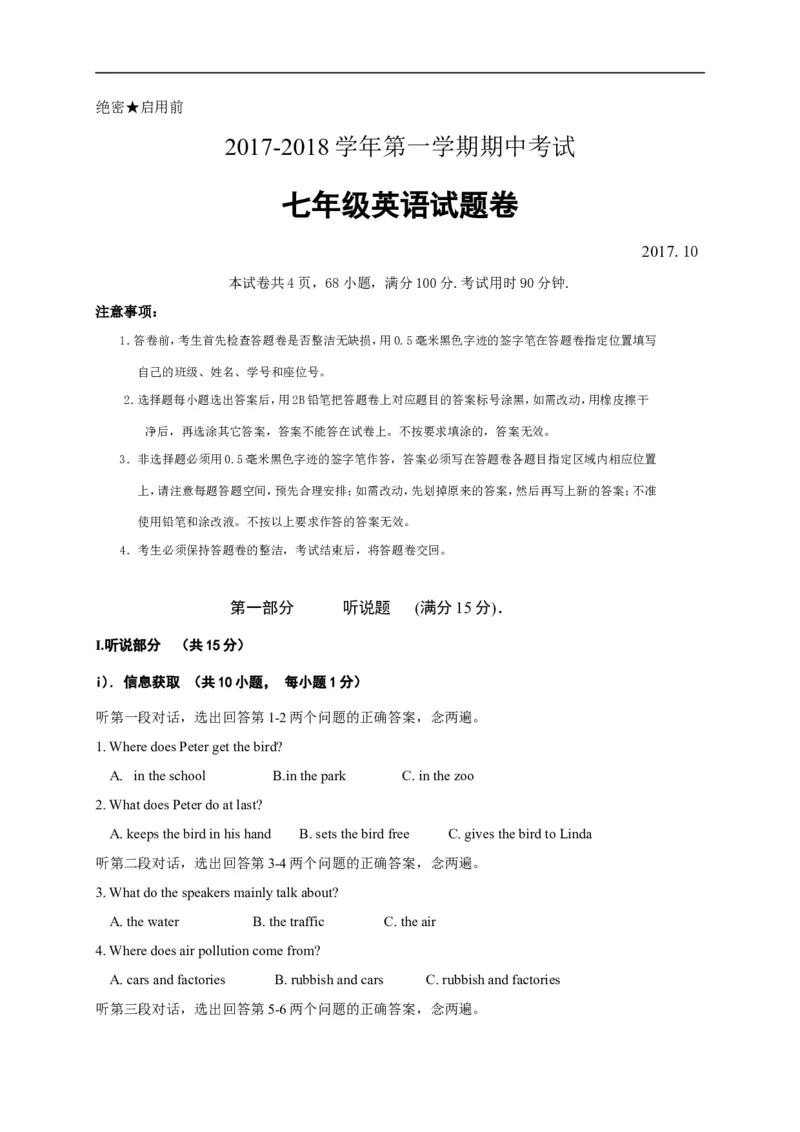
听第一段对话,选出回答第1-2 两个问题的正确答案,念两遍。
1. Where does Peter get the bird?
A. in the school                   B.in the park                C. in the zoo
2. What does Peter do at last?
A. keeps the bird in his hand        B. sets the bird free           C. gives the bird to Linda
听第二段对话,选出回答第3-4 两个问题的正确答案,念两遍。
3. What do the speakers mainly talk about?[来源:学科网]
A. the water                     B. the traffic                 C. the air
4. Where does air pollution come from?[来源:Zxxk.Com]
A. cars and factories              B. rubbish and cars            C. rubbish and factories
听第三段对话,选出回答第5-6 两个问题的正确答案,念两遍。
5. Who is Miss Smith?
A. Michael’s mother             B. Michael’s teacher           C. Michael’s classmate
6. What may Michael do next?
A. go to visit the teacher          B. leave the room             C. turn off the light
听一段独白,选出回答第7-10 四个问题的正确答案,念两遍。
7. What does the Earth provide us with?
 A. air, water and food            B. flowers and trees             C. rivers
8. How do we make energy?
A. From the air                 B. We burn things to make energy.  C. We use the fire to make
energy.[来源:学,科,网Z,X,X,K]
9. How many kinds of pollution does the speaker tell us?
 A. Two                       B. Three                     C. Four
10. What does the speaker think of protecting the Earth?
   A. impossible                B. important             C. useless
ⅱ).信息转述和询问(共3 小题, 共5 分)
  第一节  信息转述   (共1 小题, 共3 分)
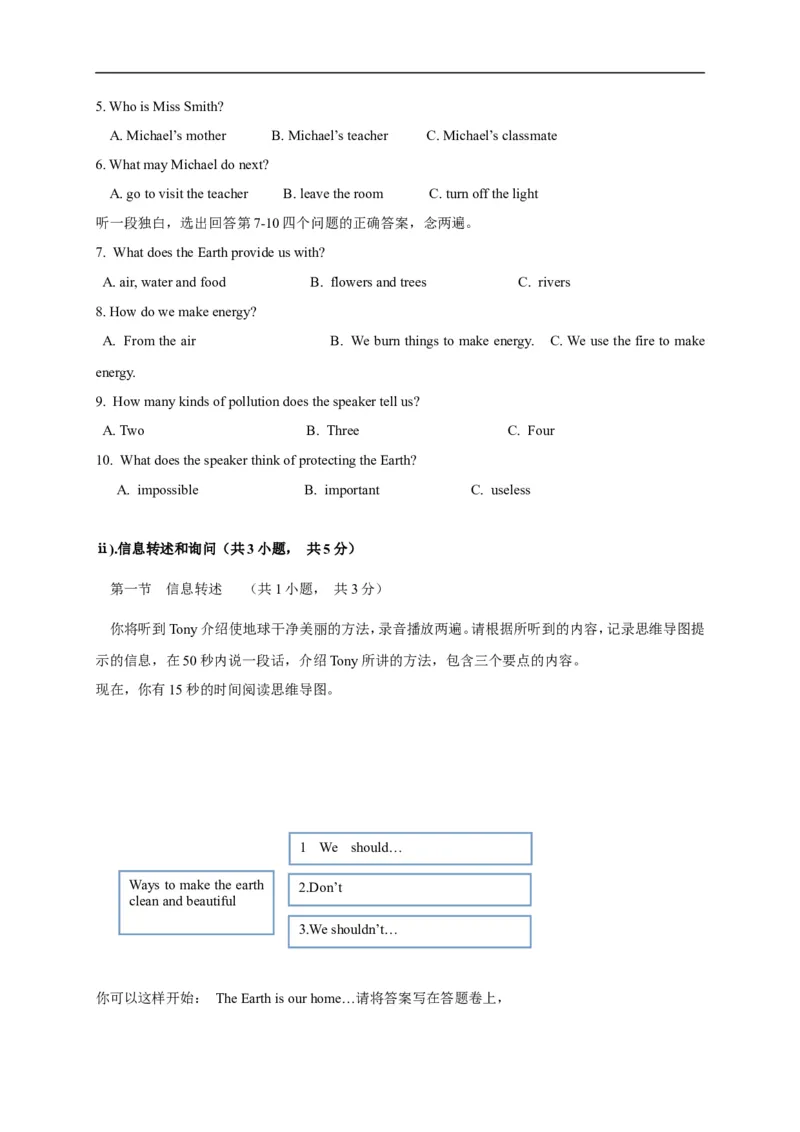
  你将听到Tony 介绍使地球干净美丽的方法,录音播放两遍。请根据所听到的内容,记录思维导图提
示的信息,在50 秒内说一段话,介绍Tony 所讲的方法,包含三个要点的内容。
现在,你有15 秒的时间阅读思维导图。


你可以这样开始: The Earth is our home…请将答案写在答题卷上,
1 We should…
Ways to make the earth
clean and beautiful
2.Don’t
3.We shouldn’t…
 11.
______________________________________________________________________________________
__________
______________________________________________________________________________________
______________________________________________________________________________________
______________________________________________________________________________________
__________________________________________
 第二节  询问信息    (共2 小题, 每小题1 分)
你希望了解更多关于Tony 使地球干净美丽的方法, 请根据以下提示向她提两个问题。
 12. 你想了解Tony 是否每天都在节约用水,你问:
______________________________________________________________________________________
______________
 13. 你想了解为什么我们要种更多的树,你问:

______________________________________________________________________________________
_____________
                            第二部分     笔试题          (85 分)
II 词汇测试   (15 分)
i). 从下面每小题的A、B、C 三个选项中选出可以替换划线部分的最佳选项,并在答题卷上将相应的
字母编号涂黑。(共8 小题,每小题1 分)
14. — What do you know about Germany?
   — It’s a beautiful country. I would like to go there.
   A. want to                 B. have to                C. hate to [来源:学_科_网Z_X_X_K]
15. — Many animals are in danger now. We should do something for them.
   —That’s true. They are our friends and we should protect them.
A. make... strong            B. make... safe             C. make ... happy
16. — Thank you for providing us with so much help.
  —You are welcome.
A. giving us                B. leaving us              C. making us
17. — The Sun shines brightly today.
—Yeah. It is really a good day.
A. goes down
           B. sends out light           C. takes in light
18. — We will take a trip to Sanya.
—Oh, that’s great. Have a good time.
A. leave
           B. travel
C. fly
19. — There is a large apple tree in the garden.
—Yes. We can pick up apples from it in autumn.
A. big
            B. small
               C. long
20. — Don’t throw the rubbish into the river. It will pollute the water.
—Oh, I am sorry. I won’t do it again.
A. make ... clean
   B. make ... dirty              C. make ... short
21. — What is your hobby, Jack?
   — Listening to music. I like rock music best.
  A. What do you like doing now                          B. What’s your dream in the future
  C. What do you like doing in your free time
ii). 根据句子意思,从下面每小题的A、B、C 三个选项中选出恰当的词语完成句子,并在答题卷上将
相应的字母编号涂黑。 ( 共7 小题,每小题1 分)
22. To ________ means to finish making or doing something.
  A. stop                  B. complete                 C. leave
23.— I would like to go to Germany for my holiday.
  — Then I hope you will ________.
  A. have a long journey     B. have a break              C. have a good time
24. ___________ are the people who are in the same family with you.
A. Friends             B. Neighbors                C. Relatives
25. — Don’t go out now. The wind ___________ hard outside.
—I see.
A. blows
         B. ends                   C. leaves
26. — Please don’t _____________ these old books. We can give them to other children.
—That’s a good idea.
A. throw away
     B. look for                C. get in
27. If people _____________ animals, they make them die.
A. kill
             B. follow             C. watch
28. — What about climbing the __________ this Saturday?
— That sounds a great idea.
A. street
     B. building

C. mountain
III、完形填空。(15 分)
阅读下面的短文,掌握其大意,然后从短文后各题所给的A、B、C 个选项中,选择最佳选项。
(共10 小
题,每小题1.5 分)
 I have three questions for you: Do you often see a ___29_____sky above our city? Is the air in our city
fresh? Is the water in our river ______30____? The answers to these questions are all “No!”
    My grandfather often tells ____31____interesting stories about his childhood. At that time, the sky was
blue, the air was fresh and the water was clean. When my grandfather and his friends played in the forest,
they could hear the _____32____sing. When they swam in their river, they could see many _____33____.
It was a happy time. But today the air and water are much ___34_____. Some animals and plants are now
disappearing. The Earth is in trouble.
I want you to join us by help___35_____our Earth, because it is our ____36_____. We do not need to
do ____37____things. We can start out small. Do not throw any rubbish onto the ground. Do not waste
water. Use ____38____sides of the paper when you write.
    This is our Earth. Let’s do our best to protect it.
29. A  dark              B blue                C green
30. A  dirty              B clean               C clear
31. A  many             B little                C much
32. A  flowers           B trees                C birds
33. A  trees             B fishes               C cats
34. A  dirtier            B cleaner              C darker
35. A  pollute           B protect              C produce
36. A  time             B chance              C home
37. A  small            B big                 C important
38. A  both             B one                 C all.[来源:学*科*网Z*X*X*K]
 IV、阅读理解(30 分)
   阅读下列短文,从下面每小题的A、B、C、D 四个选项中选择最佳选项,并在答题卷上将相应的字
母符号涂黑。
(共20 小题,每小题1.5 分)
                                              A
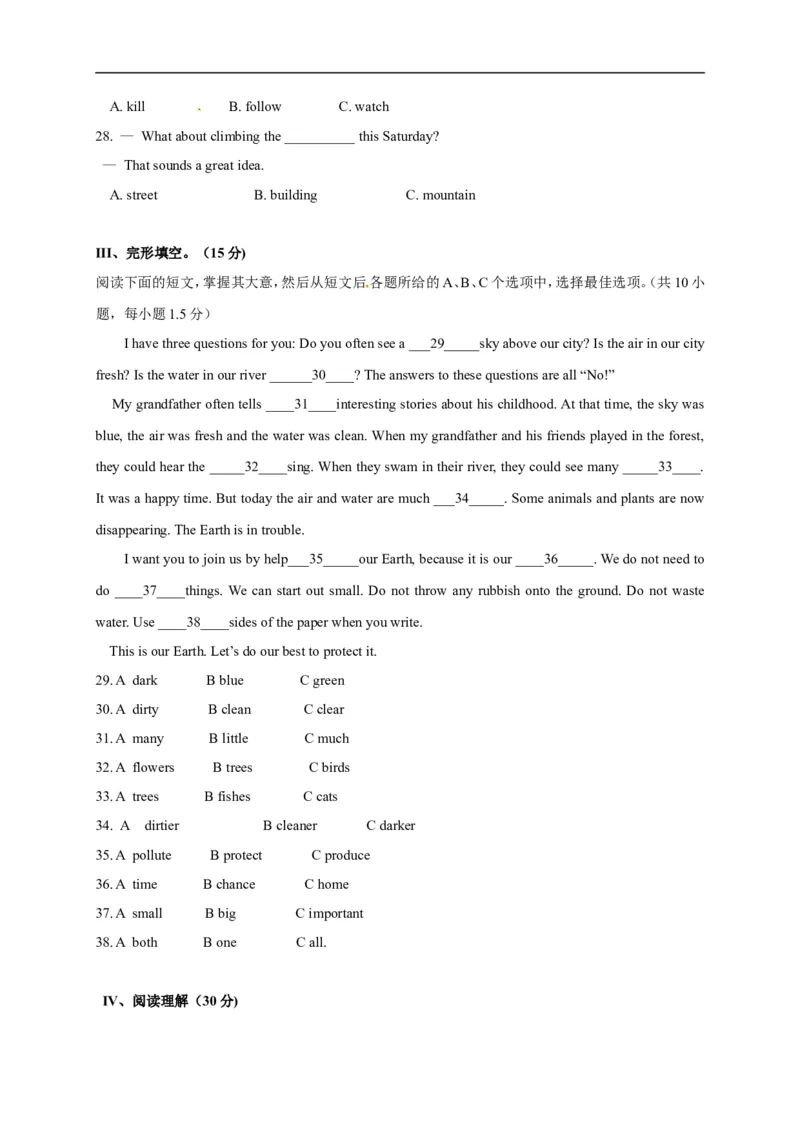
39. Which animals come from England?
A. The elephants.     B. The birds.         C. The monkeys.
  D. The giraffes.
40. If a mother wants to visit the zoo with her ten-year-old son, how much will she spend on tickets?
A. ¥20.
        B. ¥15.
           C. ¥ 10.
          D. Free.
41. Which of the following things can you do in the zoo?
A. Provide the animals with food.              B. Touch the elephants.
C. Go close to the giraffes.                    D. Pick up the rubbish.
42. How many kinds of animals are mentioned (被提及) in the passage?
A. Two.
       B. Four.               C. Six.
      D. Eight.

                                            B
    The Earth is very important to us. Most of us don’t want to pollute it, but we are polluting
it by not using the things on Earth correctly (正确地). Here are some easy things you can do to
protect the environment (环境) and the Earth. Choose ideas of the following or come up with a few
of your own.
● Plant flowers, grass or trees. The plants can make the environment around you become
beautiful. Also, more trees and plants can make the air clean.
● Whenever (无论何时) you visit a park or beach, take away what you bring there — keep
rubbish in a bag until you can throw it into a dustbin.
● Turn off the tap when you brush your teeth. You can save some water by not letting it run
all the time. Also, use a glass cup instead of (代替) a paper cup because this can protect forests.
● Stop putting dirty water into the rivers or lakes. In this way, you can protect plants and fish
in the rivers or lakes.
● Ask all your friends to do the same things to help protect the Earth. You don’t have to wait
for Earth Day to do these things. Make every day Earth Day.
If everyone does something good to protect the Earth, it will become much more beautiful.
43. What does the underlined part “come up with” mean?
A. think of.
B. look at            C. listen to.
D. take away.
44. Which way to protect the Earth is NOT mentioned in the passage?
A. Not throwing away rubbish everywhere.
B. Saving water in daily life.
C. Asking your friends to protect the Earth together.
D. Turning off the light when you don’t use it.
45. What’s the main idea of the passage?
A. The importance of the Earth.            B. How to protect the Earth.
C. People are polluting the Earth.          D. How to make our friends protect the Earth.
46. Where may the passage come from?
A. From a storybook.                    B. From a magazine.
C. From a travel guide.                   D. From a cookbook.
                                                C
Life is like the four seasons. Now I am very old, but when I am young, it is the spring of
my life. I play a lot, and then I start school. I learn many new things. Like a flower, I grow
bigger and bigger day by day. There are happy days and heartbroken (心碎的) days. Some days
the Sun shines, and other days it rains.
When I am twenty years old, I have a good job. I am strong and happy. Then I marry (结
婚) and have a child. In those days, I don’t have much time to think or to play. Every day I
am busy and work hard. I start to get some white hair. It’s the summer of my life and it passes
quickly.
Then the days get shorter. Leaves fall down from the trees. My child is a university student
and then an engineer. My home is much quieter (更安静的). I start walking more slowly. One day
I stop working, and I retire (退休). I have more time. I know this is my autumn, a beautiful time
when the trees change color and give people delicious fruit.
But the days keep getting shorter and colder. Winter comes. I am older and weaker. I know I do not
have many days, but I will enjoy them to the end.
47. How does the writer feel in the spring of his life?
A. Both happy and sad.                  B. Both angry and sad.
C. Both happy and excited.               D. Both tired and bored.
48. Which age is during the autumn of the writer’s life?
A. 15.
     B. 28.             C. 50.
         D. 87.
49. How is the writer now?
A. Healthy and young.      B. Sad and weak.       C. Weak and old.        D. Old and quiet.
50. Which of the following is the best title for the passage?
A. My favorite season.      B. My happy life.     C. Four seasons in a year.   D. Four seasons in
my life.
                                              D
Tom was eight years old. He was a good boy. But he could not get up early. He slept until nine or ten
o’clock in the morning. He was often late for school.
Tom’s mother didn’t want him to be late for school. So she bought him an alarm clock(闹
钟). She said to Tom, “You must get up when you hear the clock ring.”
“Yes, Mum,” said Tom. After that Tom got up at seven thirty when he heard the clock ring.
One day his mother forgot to make the clock get ready to ring. And the next morning Tom didn’t get
up at seven thirty. It was time for breakfast. Mother went to see him. Tom was in bed and his eyes were
open.
“Why didn’t you get up?” Mother was angry.
 “You told me to get up when I heard the clock ring. So I am waiting for the bell.”
51. Tom’s mother bought him a clock because _________ .
A. he couldn’t get up on time                 B. it was very beautiful
C. it was Tom’s birthday that day              D. it was cheap
52.The clock rang at _______ .
A. 6:30           B. 7:00           C. 7:30       D. 6:00
53. What happened that day?
A. The clock was broken.      B. Tom was ill.     C. The clock didn’t ring.   D. Tom needn’t go to sch ool.
54. Tom didn’t get up on time that day because he ________ .
A. was waiting for the bell in bed            B. didn’t want to go to school
 C. didn’t want to have breakfast               D. was ill

 E
German children usually begin school at six. On the first day of school, parents or friends give the
child a big colorful gift (礼物) . It usually has candy, a pencil case and a fountain pen (钢笔) in
it. Most German children learn to write with a fountain pen.
The school day starts at about 8:00 in the morning and ends at 2:00 in the afternoon. Students have a
short break at around 10:00. After school, they go home for lunch. It is the biggest meal of the day.
Although pupils get out of school early in Germany, they do a lot of homework. In some states in
Germany, kids also have school on Saturdays!
German classes are like the ones in China, but some of the subjects are different. Children study math,
science, literature (文学), music and art, history and geography. They also have PE classes. In
Grade 3, they start foreign language study. All students learn English, but in Grades 5 and 7, they can take
up other languages such as French, Latin, Spanish or Russian.
After school and homework, teens usually meet their friends and go out to the movies, cafes
(咖啡馆) or shops. They usually spend the weekends with families.
55. What do German children get on their first school day?
A. New books.     B. A school timetable.   C. Candy and a pen.    D .Rulers
56. What is Paragraph 2 mainly about?
A. German students’ school time.       B. How German students eat and play.
C. Activities on Saturdays.            D. German students’ hobbies.
57. When did German students begin to learn a foreign language?
A. At the age of six.   B. In Grade 3.      C. In Grade 5.          D. Grade 7
58. What can we know from the passage?
A. German students do not have much homework.
B. Chinese students have the same subject as German students.
C. German students are usually with their families on Saturdays.
D. German students like Chinese.
V. 语法填空   (10 分)
   阅读下面短文,按照句子结构的语法性和上下文连贯的要求,在空格处填入一个适当的词或使用
括号中词语的正
确形式填空,并将答案填写在答题卷标号为59-68 的相应位置上。(共10 小题,每小题1 分)
Mr Green works in a hospital. He’s very good  _____59______ his work. Many people enjoy
___60________ (see) him when they don’t feel well, so he is always very busy. His wife
____61_____(work) in a school near London, and she needs ____62______ (do) the housework every day.
Ann, their girl, is eight _____63______ (year) old this year. Some of her friends often go travelling,
_____64_____ her parents don’t have much time.
This summer Mrs Green’s summer holiday begins, and Mr Green has nothing much to do, so she
asks___65____(she) husband to take the family to Iceland. Mr Green agrees with her. Ann and her mother
are very  ___66________ (happily). So Ann tells her friends that her father would like to take the family to
Iceland.
“ ___67________ are you going to travel to Iceland, Ann?” asks a girl, one of her friends.
___68________ little girl doesn’t know how to answer the question. She thinks for a few minutes
and says, “We’re going to see it before it melts (溶化)”.
VI.书面表达 (15 分)
   假如你是陈浩,你居住在北京。请你按照下面所给出的提示信息,向大家介绍一下北京四季的气
候变化以及每个季节你喜欢的户外活动。
提示:
1. 春天的北京干燥多风,你喜欢放风筝;
2. 夏天的北京炎热多雨,你喜欢游泳和读书;
3. 秋天的北京秋高气爽,你喜欢爬山;
4. 冬天的北京寒冷千燥,你喜欢滑雪。
写作要求: 1.  60 词以上;
       2. 文中不得出现真实姓名和校名;
       3. 条理清楚,意思连贯,语句通顺,标点正确,书面整洁。
______________________________________________________________________________________
______________
______________________________________________________________________________________
______________
______________________________________________________________________________________
______________
______________________________________________________________________________________
______________
______________________________________________________________________________________
______________
______________________________________________________________________________________
______________
______________________________________________________________________________________
______________
.
2017-2018 学年第一学期期中考试答案
                               七年级答案 2017 10
一、听力部分 (共15 分)
1-5BBCAB   6-10 CABAB
11. The Earth is our home. We should do our best to make it clean and beautiful. First, we should plant
more trees. Second, don’t waste water. Third, we shouldn’t throw rubbish everywhere. We should protect
the Earth every day.
评分标准:
第一档:2.5-3分,内容叙述或描述具体、丰富、正确,并能适当发挥。
第二档:1.5-2分,内容叙述或描述简单,语言表达比较单一,意思不够连贯。
第三档:0.5-1分,内容叙述或描述简单,语言比较单一,意思不够连贯,有较多的语言错误。
第四档:0分,内容叙述或描述脱离主题,说明不了内容。语言不规范,错误很多。
12. Do you save water every day?
13. Why should we plant more trees?
二、 笔试部分 (共85 分)
II 词语释义 (15 分) (共15 小题,每小题1 分)
14-18ABABB   19—23 ABCBC    24-28  CAAAC
III、完形填空。 (15 分) (共10 小题,每小题1.5 分)
29-33BBACB    34—38  ABCBA
IV、阅读理解(30 分)   (共20 小题,每小题1.5 分)
39-43 BADCA  44-48DBBAC  49-53 CDACC  54-58 ACABC
 V. 语法填空   (10 分)(共10 小题,每小题1 分)
59 at         60 seeing       61 works      62 to do        63 years
64 but       65 her         66 happy        67 Why     68 The
VI.书面表达 (15 分)
Hello, everyone. My name is Chen Hao. I live in Beijing. The weather in Beijing is different in
different seasons. In spring, it is dry and windy. I like flying kites in spring. In summer, it is hot and rainy. I
often go swimming in the pool on hot days. I do some reading at home on rainy days. I like autumn in
Beijing best. It is cool. I enjoy climbing mountains with my parents on weekends. In winter, it is cold and
dry. I often go skiing with my friends in this season.