1
大招课内部资料
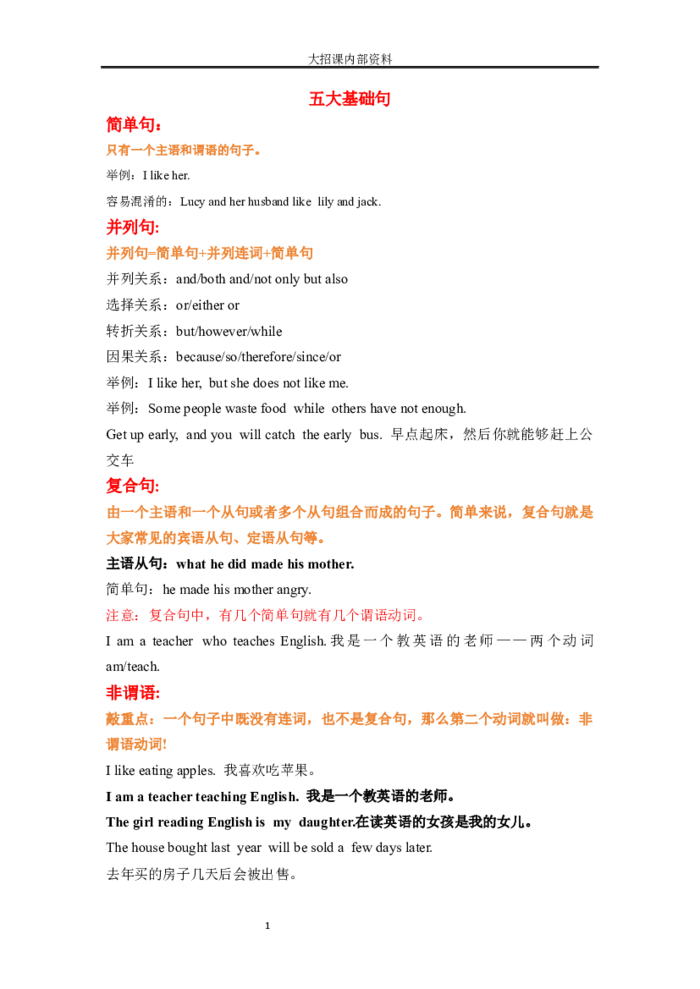
五大基础句
简单句:
只有一个主语和谓语的句子。
举例:I like her.
容易混淆的:Lucy and her husband like lily and jack.
并列句:
并列句=简单句+并列连词+简单句
并列关系:and/both and/not only but also
选择关系:or/either or
转折关系:but/however/while
因果关系:because/so/therefore/since/or
举例:I like her, but she does not like me.
举例:Some people waste food while others have not enough.
Get up early, and you will catch the early bus. 早点起床,然后你就能够赶上公
交车
复合句:
由一个主语和一个从句或者多个从句组合而成的句子。简单来说,复合句就是
大家常见的宾语从句、定语从句等。
主语从句:what he did made his mother.
简单句:he made his mother angry.
注意:复合句中,有几个简单句就有几个谓语动词。
I am a teacher who teaches English. 我是一个教英语的老师— — 两个动词
am/teach.
非谓语:
敲重点:一个句子中既没有连词,也不是复合句,那么第二个动词就叫做:非
谓语动词!
I like eating apples. 我喜欢吃苹果。
I am a teacher teaching English. 我是一个教英语的老师。
The girl reading English is my daughter.在读英语的女孩是我的女儿。
The house bought last year will be sold a few days later.
去年买的房子几天后会被出售。
2
大招课内部资料
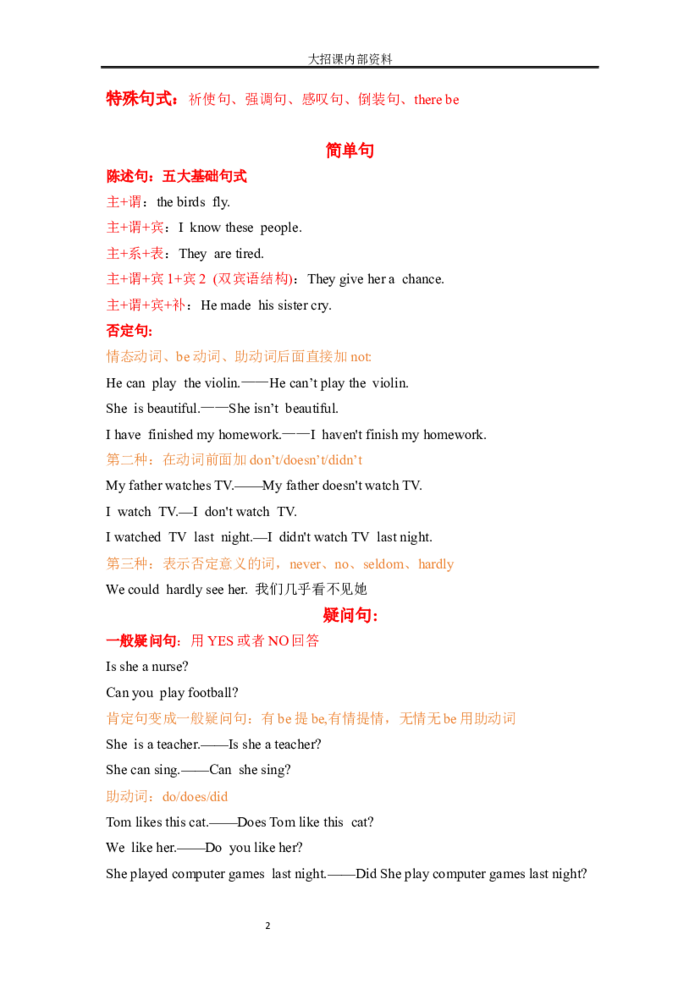
特殊句式:祈使句、强调句、感叹句、倒装句、there be
简单句
陈述句:五大基础句式
主+谓:the birds fly.
主+谓+宾:I know these people.
主+系+表:They are tired.
主+谓+宾1+宾2 (双宾语结构):They give her a chance.
主+谓+宾+补:He made his sister cry.
否定句:
情态动词、be 动词、助动词后面直接加not:
He can play the violin.——He can’t play the violin.
She is beautiful.——She isn’t beautiful.
I have finished my homework.——I haven't finish my homework.
第二种:在动词前面加don’t/doesn’t/didn’t
My father watches TV.——My father doesn't watch TV.
I watch TV.—I don't watch TV.
I watched TV last night.—I didn't watch TV last night.
第三种:表示否定意义的词,never、no、seldom、hardly
We could hardly see her. 我们几乎看不见她
疑问句:
一般疑问句:用YES 或者NO 回答
Is she a nurse?
Can you play football?
肯定句变成一般疑问句:有be 提be,有情提情,无情无be 用助动词
She is a teacher.——Is she a teacher?
She can sing.——Can she sing?
助动词:do/does/did
Tom likes this cat.——Does Tom like this cat?
We like her.——Do you like her?
She played computer games last night.——Did She play computer games last night?
3
大招课内部资料
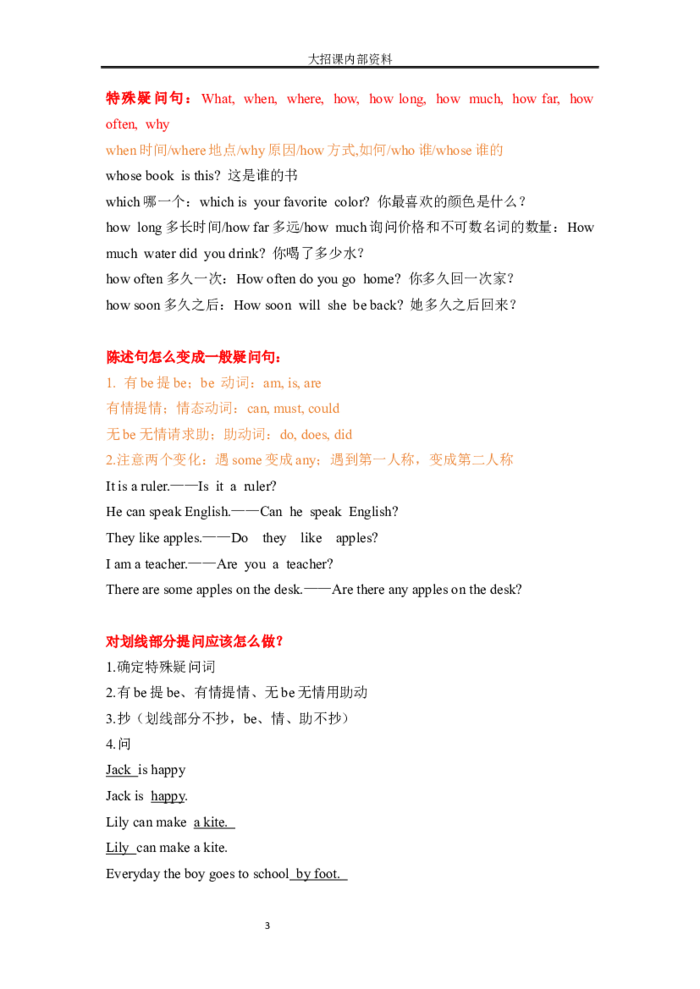
特殊疑问句:What, when, where, how, how long, how much, how far, how
often, why
when 时间/where 地点/why 原因/how 方式,如何/who 谁/whose 谁的
whose book is this? 这是谁的书
which 哪一个:which is your favorite color? 你最喜欢的颜色是什么?
how long 多长时间/how far 多远/how much 询问价格和不可数名词的数量:How
much water did you drink? 你喝了多少水?
how often 多久一次:How often do you go home? 你多久回一次家?
how soon 多久之后:How soon will she be back? 她多久之后回来?
陈述句怎么变成一般疑问句:
1. 有be 提be;be 动词:am, is, are
有情提情;情态动词:can, must, could
无be 无情请求助;助动词:do, does, did
2.注意两个变化:遇some 变成any;遇到第一人称,变成第二人称
It is a ruler.——Is it a ruler?
He can speak English.——Can he speak English?
They like apples.——Do they like apples?
I am a teacher.——Are you a teacher?
There are some apples on the desk.——Are there any apples on the desk?
对划线部分提问应该怎么做?
1.确定特殊疑问词
2.有be 提be、有情提情、无be 无情用助动
3.抄(划线部分不抄,be、情、助不抄)
4.问
Jack is happy
Jack is happy.
Lily can make a kite.
Lily can make a kite.
Everyday the boy goes to school by foot.
4
大招课内部资料
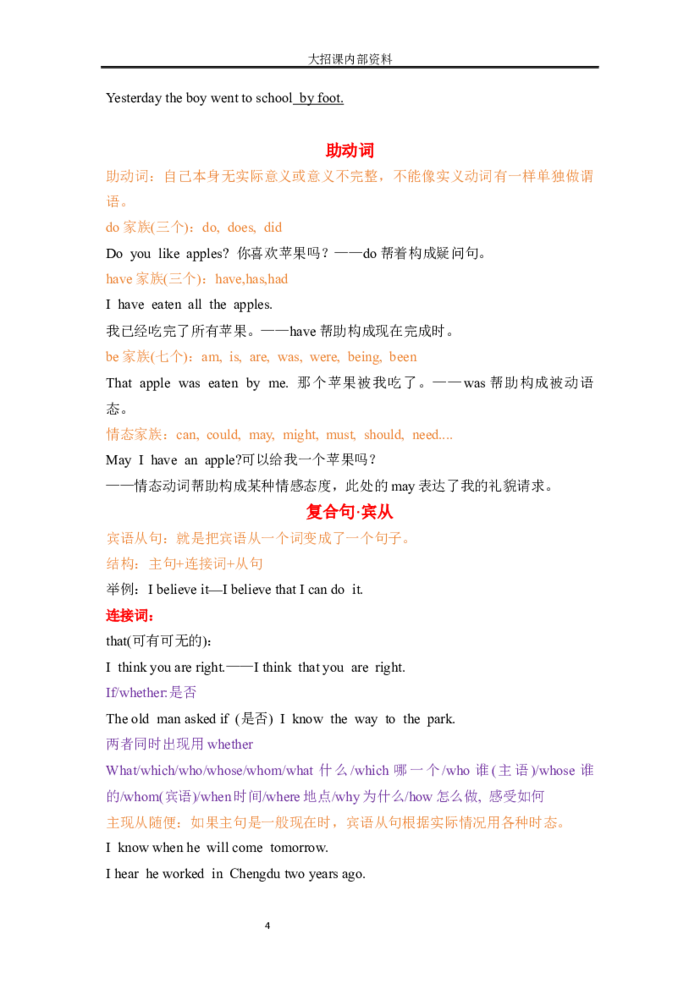
Yesterday the boy went to school by foot.
助动词
助动词:自己本身无实际意义或意义不完整,不能像实义动词有一样单独做谓
语。
do 家族(三个):do, does, did
Do you like apples? 你喜欢苹果吗?——do 帮着构成疑问句。
have 家族(三个):have,has,had
I have eaten all the apples.
我已经吃完了所有苹果。——have 帮助构成现在完成时。
be 家族(七个):am, is, are, was, were, being, been
That apple was eaten by me. 那个苹果被我吃了。——was 帮助构成被动语
态。
情态家族:can, could, may, might, must, should, need....
May I have an apple?可以给我一个苹果吗?
——情态动词帮助构成某种情感态度,此处的may 表达了我的礼貌请求。
复合句·宾从
宾语从句:就是把宾语从一个词变成了一个句子。
结构:主句+连接词+从句
举例:I believe it—I believe that I can do it.
连接词:
that(可有可无的):
I think you are right.——I think that you are right.
If/whether:是否
The old man asked if (是否) I know the way to the park.
两者同时出现用whether
What/which/who/whose/whom/what 什么/which 哪一个/who 谁(主语)/whose 谁
的/whom(宾语)/when 时间/where 地点/why 为什么/how 怎么做, 感受如何
主现从随便:如果主句是一般现在时,宾语从句根据实际情况用各种时态。
I know when he will come tomorrow.
I hear he worked in Chengdu two years ago.
5
大招课内部资料
主过从也过:如果主句是一般过去时,宾语从句用相应的过去时态。
She told me that she liked running.
真理不改变:如果宾语从句是表示客观真理和规律的句子时,用一般现在时。
She told me that light travels faster than sound. 她告诉我光的速度快于声音。
否定要转移:主句如果是I think/ believe/ imagine/ suppose/ guess/ expect 等,
从句的否定一般要转移到主句中,其反意疑问句与从句一致。
I think you are right.
I don't think you are right.
复合句·状从
从句:就是把一个句子的成分从词变成了句子。
状语:表示动作发生的时间、地点、原因、结果、目的和让步的词,就叫做状
语.
I play basketball.
I play basketball everyday.——时间状语
I play basketball on the play ground.——地点状语
状语从句:就是把一个句子中的状语从一个词,变成了一个句子。
I play basketball everyday.—状语:everyday
I play basketball when I finish my homework.
—when I finish my homework.时间状语从句
时间状语从句:
When/as/while:当…的时候
As years go by, China is getting stronger and richer. 随着时间的流逝,中国变得
更加富强。
I was watching TV while/when my wife was reading the newspaper. 当我的妻子
在读报纸的时候,我在看电视。(都出现时选when)
before:在…之前;after:在……之后;since:自从;till/until:直到
I will stay here and watch the baby until you return.我会待在这里看着宝宝,直到
你回来。
原因状语从句:
because/since/as/for:因为
She can't travel by herself, for she is too young. 她不能独自旅行,因为她太小
6
大招课内部资料
了。
As it was raining, the match was canceled. 因为下雨,那场比赛被取消了。
Since everyone is here, let's tart.既然每个人都到了,我们就开始吧!
结果状语从句:
so/such...that:如此……以至于
so……that 使用范围更大,两个都出现就选它
The boy ran so fast that I can't catch him. 这个男孩跑太快了,以至于我追不上
他。
They are such good students that the teacher likes him.她们都是如此好的学生,
以至于老师都喜欢她们。
让步状语从句:
although/though/even if/even though:尽管
Although he is rich, his life is not happy.
no matter who/how/when:无论是谁/无论怎样/无论什么时候
No matter when I call him, he won’t answer the phone. 无论我什么时候给他打
电话,他都不接。
地点状语从句:
Where:在……的地方
We must camp where we can get water. 我们必须在能找到水的地方露营。
条件状语从句:
if 如果/unless 除非/as long as:只要
You can't learn English well unless you study hard. 除非你努力学习,否则是学
不好英语的。
As long as you come, I am happy. 只要你来,我就高兴。
目的状语从句:
so that /in order that:为了
Speak clearly so that everybody can understand you. 为了大家都能理解你,说得
清楚点。
复合句·定从
句子:有主语和谓语的就叫做句子。她喝水—你们吃饭;你们——跳舞了
从句:就是把一个句子的从词成分变成了句子。
7
大招课内部资料
定语:修饰的名词的,就叫做定语。可以把定语理解为形容词,比如:美丽的
公主、认真听课的学生、上课摸鱼的学生。
定语从句:把一个句子中的定语从词变成了句子。
公主吃了苹果
公主吃了红红的苹果。——红红的:red
公主吃了王后给她的苹果   —王后给她的:the queen give her.
Snow White ate the apple + that + the queen give her.
定语从句的结构
主句—Snow White ate the apple —the apple 叫做先行词。(先行词就是后面会继
续介绍的词)
关系词——that/which/who/whom/whose/when/where\why
从句——the queen give her
例句:
Is there anything that

   you want to know?
This is the dictionary that I want to buy.
Nobody knows the reason why

   he is late for school.
关系词:
关系代词:从句中缺少名词或者代词的时候就用关系代词。
关系代词:who\which\that\whom\whose
例: Yesterday I helped an old man who lost his way.从句缺少一个代词,用关系
代词。
that 人和物, 主语和宾语:
which 物, 主语和宾语——This is the toll that he bought yesterday.
who 人, 主语和宾语/whom 人, 宾语— — This is the old man whom I helped
yesterday.
that 使用范围是最广的,当that 和其他词一起出现时,就选that
whose 人和物, 定语:
He is the man whose car is stolen.
He likes the house whose window was broken.
注意啦:先行词和从句的主语是从属关系的时候,用whose
8
大招课内部资料
关系副词:从句中缺少时间、地点、原因的时候,就用关系副词。
关系副词:where\when\why
例:Nobody knows the reason why he is always late for school.
从句不缺代词或者名词,但是缺原因,用why。
When——先行词常常是time/day/week
This was the time he arrived.
He remembers the day when he joined the club.
where——先行词是地点,比如:place/town/house
This is the place where he works.
why —先行词是reason
Nobody knows the reason why he is always late for school.
why 可以替换为for which——Nobody knows the reason for which he is always
late for school.
定语从句中谓语动词的单复数形式与先行词一致!
Guilin is a city that has the history of over 2000 years. 桂林,是一个拥有2000
年历史的城市。a city—has
The

   students

 that laugh at the disabled are
   not good students.那些嘲笑残疾人的学
生不是好学生。the students—laugh at
祈使句
祈使句:表示命令、建议、请求和禁止—认真吃饭、小心地滑、禁止吸烟
主语被省略掉,动词是原形
肯定形式:
Be quite please.安静点
Put away your things. 把你的东西收起来
let's try again.我们再试试吧。
如果特别想要强调,两种办法:
1. 加上主语—You, close the door. 你,关上窗户
2. 在谓语动词前面加Do —Do be careful! 一定要小心
否定形式,就在前面加don't 或者never:
Don't eat in the classroom. 不要在教室里吃东西
Never be late for school! 不要迟到
9
大招课内部资料
No smoking. 不准吸烟
回答用一般将来时—Yes/OK/of course, I will —NO/sorry, we won't...
两个句式:
Let us try again, will you?
Let’s try again, shall we?
and 和or:
Hurry up, and you will catch the train. 快点,那么你才能赶得上火车
Take the chance, or you will regret. 抓住机会,否则你会后悔的
感叹句
感叹句的结构:
What+名词或者名词性短语—what a clever girl she is!
How+加形容词或者副词—how clever she is!
例:
what a beautiful girl she is! 她是多么美丽的女孩啊!
What brave students they are! 多么勇敢的学生啊!
How tall the boy is!
How lovely a girl she is!
how lovely a girl she is!= what a lovely girl she is!
做题口诀:
去主谓,定末尾;名词what, 形副how; a ,an 出现要注意,形名相连用what, 形
名相隔用how。
Big tree it is!—____big the tree is!
A beautiful flower it is!—_____beautiful flowers!
a clever boy he is!—____clever a boy he is!
陈述句变感叹句:一断,二加,三换位
1.陈述句:
It is/a big classroom. 一断:在谓语动词后断,将句子分为两部分。It is 是的一部
分,a big classroom 是第二部分。
It is/what a big classroom. 二加:在第二部分前加what/how (断线后的中心词为
名词/名词词组用what,形副用how)
10
大招课内部资料
What a big classroom (it is)!三换位:一、二部分换位置,句号变感叹号,主谓
可省略
2.陈述句:
The picture is/very beautiful. 一断:在谓语动词后断开,The picture is 是的一部
分,very beautiful 是第二部分。
The picture is/very beautiful. 二加:在第二部分前加what/how,有very 要去
掉,避免重复
How beautiful the picture is!三换位:一、二部分换位置,句号变感叹号
what/how 引导的感叹句可以互相转换
练一练
一.选用 what, what a(an), how 填空。
1. Look!

  fast the boy is running!
2.__

 _   cold day it was yesterday!
3.      heavy the box is! I can’t carry it.
4.

  interesting story it is!
5.

 nice the mooncakes are!
6.

  bad weather it is!
7.

  clever child you are!
8.      important news that is!
二.选择题。
1.
   nice watch it is!
A. How
B. What
C. what a
D. How a
2.    bright girls they are!
A. what
B. what a
C. How
D. How a
3.    interesting the film is!
A. What
B. What an
C. How
D. How a
4.    sunny day! Let’s go out for a walk.
A. How a
B. How
C. what a
D. what
5.    hard work it is!
A. How
B. What
C. what a
D. what an
11
大招课内部资料