2026年
Text 1
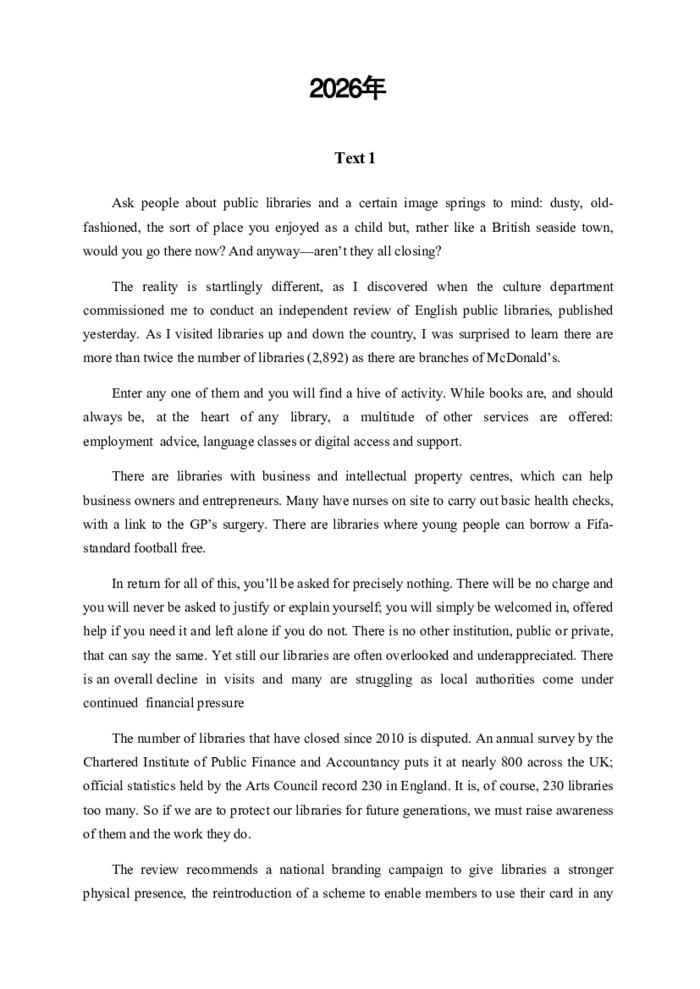
Ask people about public libraries and a certain image springs to mind: dusty, old-
fashioned, the sort of place you enjoyed as a child but, rather like a British seaside town,
would you go there now? And anyway—aren’t they all closing?
The reality is startlingly different, as I discovered when the culture department
commissioned me to conduct an independent review of English public libraries, published
yesterday. As I visited libraries up and down the country, I was surprised to learn there are
more than twice the number of libraries (2,892) as there are branches of McDonald’s.
Enter any one of them and you will find a hive of activity. While books are, and should
always be,
at the
heart
of any
library,
a
multitude
of other
services
are
offered:
employment advice, language classes or digital access and support.
There are libraries with business and intellectual property centres, which can help
business owners and entrepreneurs. Many have nurses on site to carry out basic health checks,
with a link to the GP’s surgery. There are libraries where young people can borrow a Fifa-
standard football free.
In return for all of this, you’ll be asked for precisely nothing. There will be no charge and
you will never be asked to justify or explain yourself; you will simply be welcomed in, offered
help if you need it and left alone if you do not. There is no other institution, public or private,
that can say the same. Yet still our libraries are often overlooked and underappreciated. There
is an overall decline in visits and many are struggling as local authorities come under
continued financial pressure
The number of libraries that have closed since 2010 is disputed. An annual survey by the
Chartered Institute of Public Finance and Accountancy puts it at nearly 800 across the UK;
official statistics held by the Arts Council record 230 in England. It is, of course, 230 libraries
too many. So if we are to protect our libraries for future generations, we must raise awareness
of them and the work they do.
The review recommends a national branding campaign to give libraries a stronger
physical presence, the reintroduction of a scheme to enable members to use their card in any
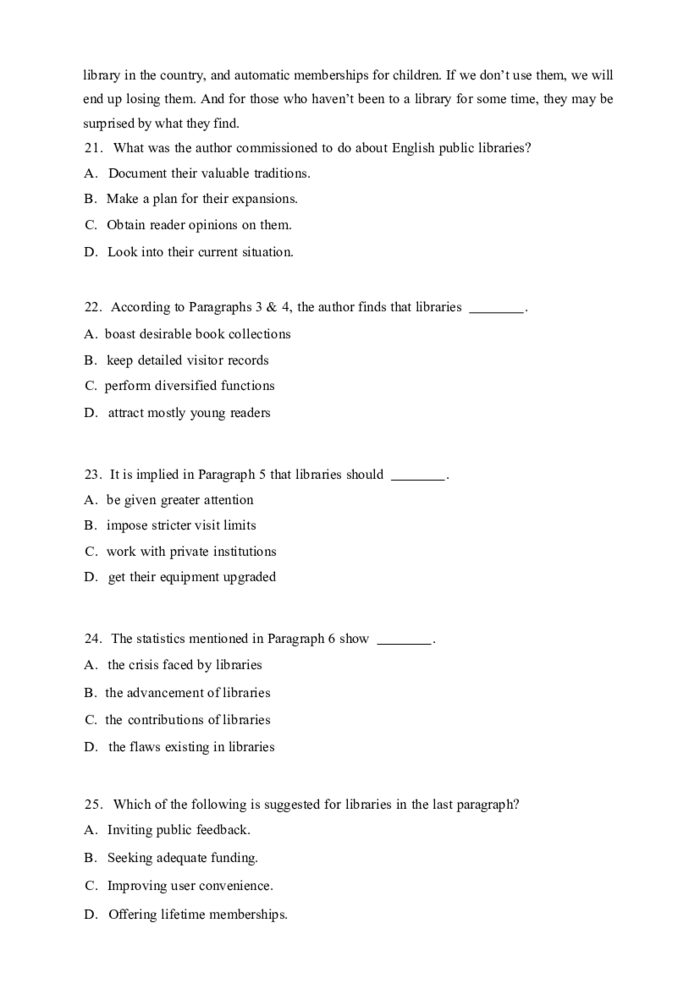
22. According to Paragraphs 3 & 4, the author finds that libraries
library in the country, and automatic memberships for children. If we don’t use them, we will
end up losing them. And for those who haven’t been to a library for some time, they may be
surprised by what they find.
21. What was the author commissioned to do about English public libraries?
A. Document their valuable traditions.
B. Make a plan for their expansions.
C. Obtain reader opinions on them.
D. Look into their current situation.
.
A. boast desirable book collections
B. keep detailed visitor records
C. perform diversified functions
D. attract mostly young readers
23. It is implied in Paragraph 5 that libraries should
.
A. be given greater attention
B. impose stricter visit limits
C. work with private institutions
D. get their equipment upgraded
24. The statistics mentioned in Paragraph 6 show
.
A. the crisis faced by libraries
B. the advancement of libraries
C. the contributions of libraries
D. the flaws existing in libraries
25. Which of the following is suggested for libraries in the last paragraph?
A. Inviting public feedback.
B. Seeking adequate funding.
C. Improving user convenience.
D. Offering lifetime memberships.
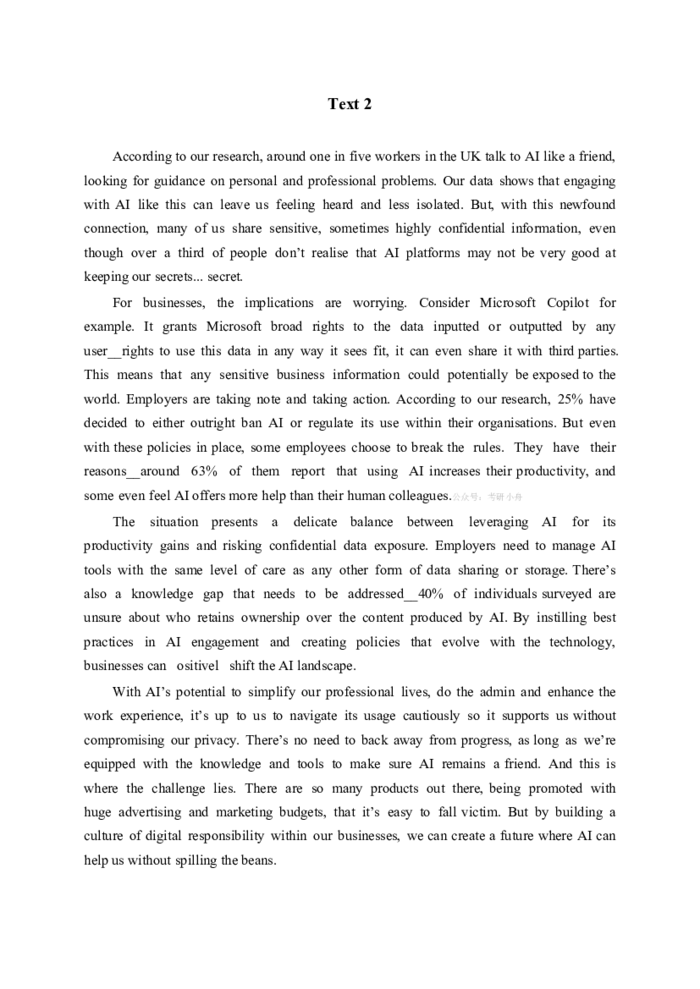
Text 2
According to our research, around one in five workers in the UK talk to AI like a friend,
looking for guidance on personal and professional problems. Our data shows that engaging
with AI like this can leave us feeling heard and less isolated. But, with this newfound
connection, many of us share sensitive, sometimes highly confidential information, even
though over a third of people don’t realise that AI platforms may not be very good at
keeping our secrets... secret.
For businesses, the implications are worrying. Consider Microsoft Copilot for
example. It grants Microsoft broad rights to the data inputted or outputted by any
user__rights to use this data in any way it sees fit, it can even share it with third parties.
This means that any sensitive business information could potentially be exposed to the
world. Employers are taking note and taking action. According to our research, 25% have
decided to either outright ban AI or regulate its use within their organisations. But even
with these policies in place, some employees choose to break the rules. They have their
reasons__around
63%
of them
report
that using AI increases their productivity, and
some even feel AI offers more help than their human colleagues.公众号:考研小舟
The
situation
presents
a
delicate
balance
between
leveraging
AI
for
its
productivity gains and risking confidential data exposure. Employers need to manage AI
tools with the same level of care as any other form of data sharing or storage. There’s
also a knowledge gap that needs to be addressed__40% of individuals surveyed are
unsure about who retains ownership over the content produced by AI. By instilling best
practices in AI engagement and creating policies that evolve with the technology,
businesses can ositivel shift the AI landscape.
With AI’s potential to simplify our professional lives, do the admin and enhance the
work experience, it’s up to us to navigate its usage cautiously so it supports us without
compromising our privacy. There’s no need to back away from progress, as long as we’re
equipped with the knowledge and tools to make sure AI remains a friend. And this is
where the challenge lies. There are so many products out there, being promoted with
huge advertising and marketing budgets, that it’s easy to fall victim. But by building a
culture of digital responsibility within our businesses, we can create a future where AI can
help us without spilling the beans.
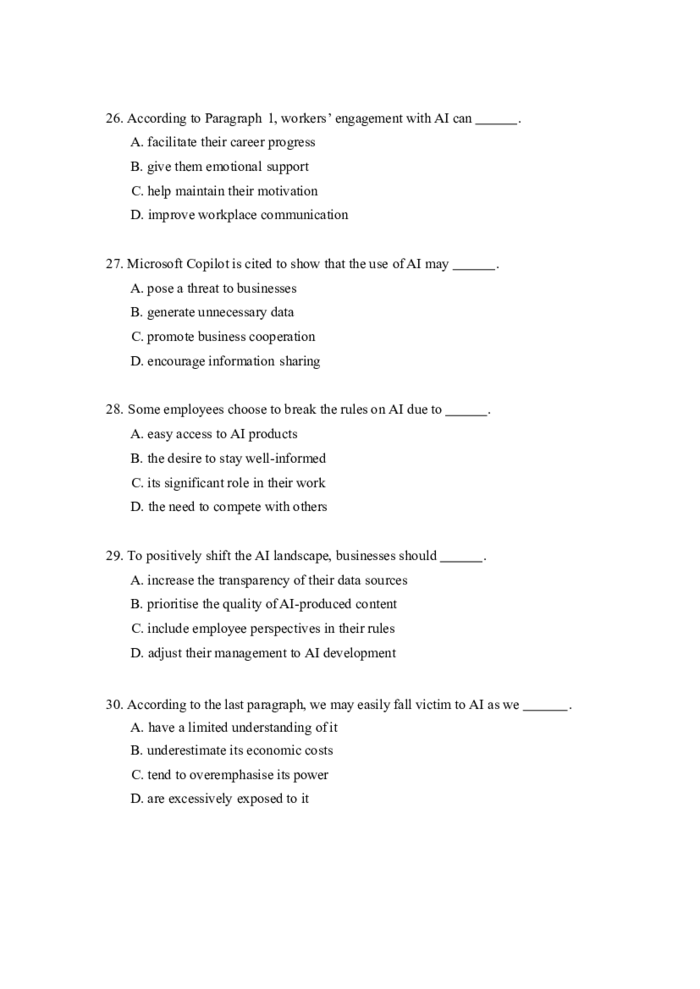
26. According to Paragraph 1, workers’ engagement with AI can
.
A. facilitate their career progress
B. give them emotional support
C. help maintain their motivation
D. improve workplace communication
27. Microsoft Copilot is cited to show that the use of AI may
.
A. pose a threat to businesses
B. generate unnecessary data
C. promote business cooperation
D. encourage information sharing
28. Some employees choose to break the rules on AI due to
.
A. easy access to AI products
B. the desire to stay well-informed
C. its significant role in their work
D. the need to compete with others
29. To positively shift the AI landscape, businesses should
.
A. increase the transparency of their data sources
B. prioritise the quality of AI-produced content
C. include employee perspectives in their rules
D. adjust their management to AI development
30. According to the last paragraph, we may easily fall victim to AI as we
.
A. have a limited understanding of it
B. underestimate its economic costs
C. tend to overemphasise its power
D. are excessively exposed to it
Text 3
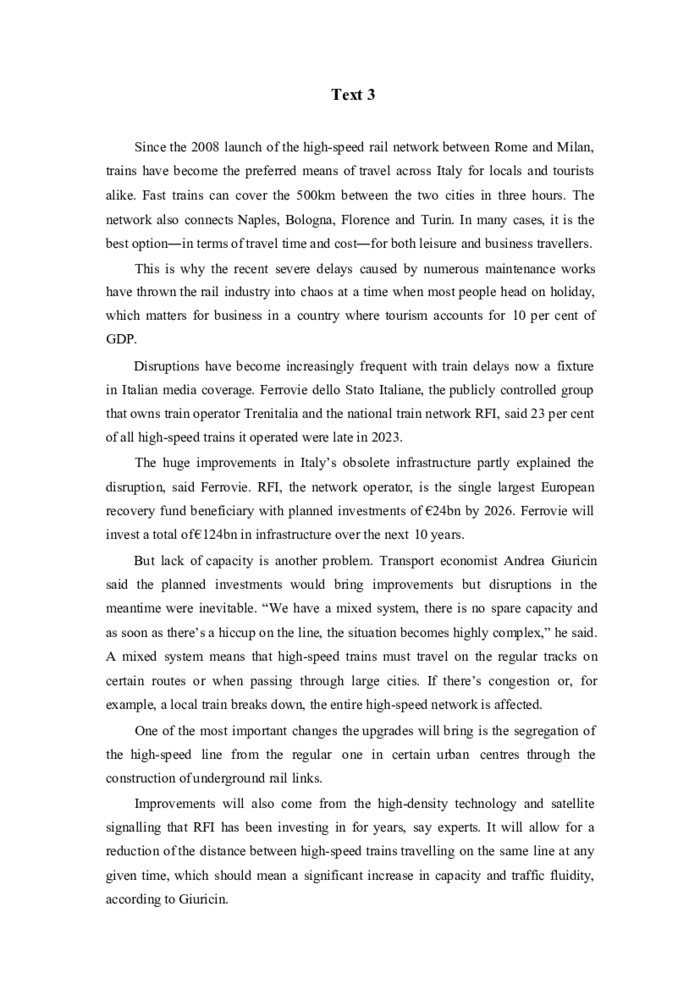
Since the 2008 launch of the high-speed rail network between Rome and Milan,
trains have become the preferred means of travel across Italy for locals and tourists
alike. Fast trains can cover the 500km between the two cities in three hours. The
network also connects Naples, Bologna, Florence and Turin. In many cases, it is the
best option―in terms of travel time and cost―for both leisure and business travellers.
This is why the recent severe delays caused by numerous maintenance works
have thrown the rail industry into chaos at a time when most people head on holiday,
which matters for business in a country where tourism accounts for 10 per cent of
GDP.
Disruptions have become increasingly frequent with train delays now a fixture
in Italian media coverage. Ferrovie dello Stato Italiane, the publicly controlled group
that owns train operator Trenitalia and the national train network RFI, said 23 per cent
of all high-speed trains it operated were late in 2023.
But lack of capacity is another problem. Transport economist Andrea Giuricin
said the planned investments would bring improvements but disruptions in the
meantime were inevitable. “We have a mixed system, there is no spare capacity and
as soon as there’s a hiccup on the line, the situation becomes highly complex,” he said.
A mixed system means that high-speed trains must travel on the regular tracks on
certain routes or when passing through large cities. If there’s congestion or, for
example, a local train breaks down, the entire high-speed network is affected
The huge improvements in Italy’s obsolete infrastructure partly explained the
disruption, said Ferrovie. RFI, the network operator, is the single largest European
recovery fund beneficiary with planned investments of €24bn by 2026. Ferrovie will
invest a total of€124bn in infrastructure over the next 10 years.
.
One of the most important changes the upgrades will bring is the segregation of
the high-speed line from the regular one in certain urban centres through the
construction ofunderground rail links.
Improvements will also come from the high-density technology and satellite
signalling that RFI has been investing in for years, say experts. It will allow for a
reduction of the distance between high-speed trains travelling on the same line at any
given time, which should mean a significant increase in capacity and traffic fluidity,
according to Giuricin.
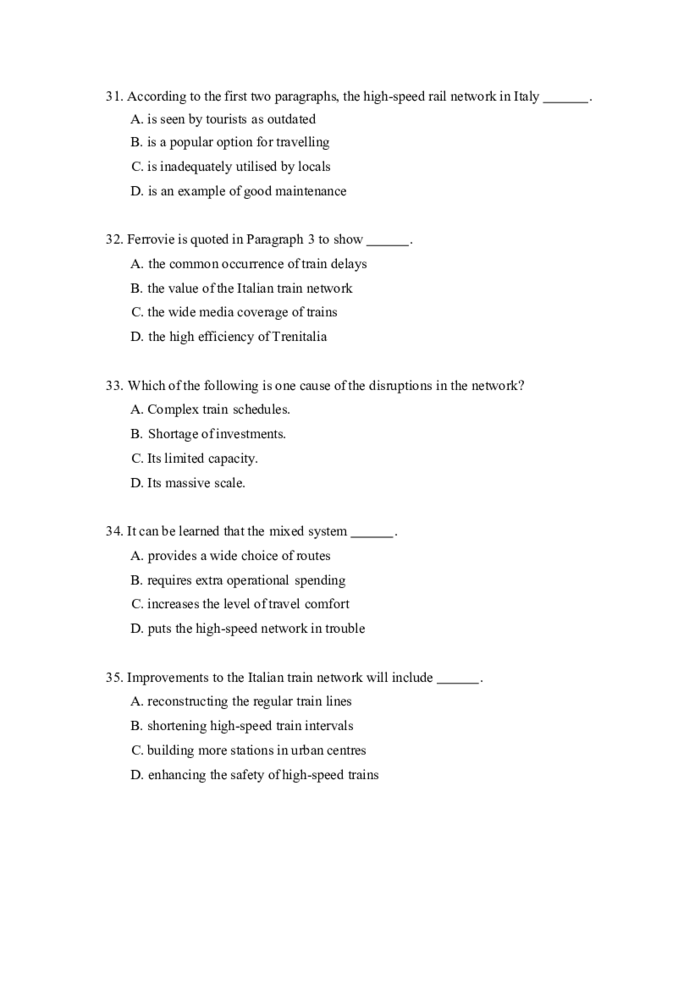
31. According to the first two paragraphs, the high-speed rail network in Italy
.
A. is seen by tourists as outdated
B. is a popular option for travelling
C. is inadequately utilised by locals
D. is an example of good maintenance
32. Ferrovie is quoted in Paragraph 3 to show
.
A. the common occurrence of train delays
B. the value of the Italian train network
C. the wide media coverage of trains
D. the high efficiency of Trenitalia
33. Which of the following is one cause ofthe disruptions in the network?
A. Complex train schedules.
B. Shortage of investments.
C. Its limited capacity.
D. Its massive scale.
34. It can be learned that the mixed system
.
A. provides a wide choice of routes
B. requires extra operational spending
C. increases the level of travel comfort
D. puts the high-speed network in trouble
35. Improvements to the Italian train network will include
.
A. reconstructing the regular train lines
B. shortening high-speed train intervals
C. building more stations in urban centres
D. enhancing the safety ofhigh-speed trains
Text 4
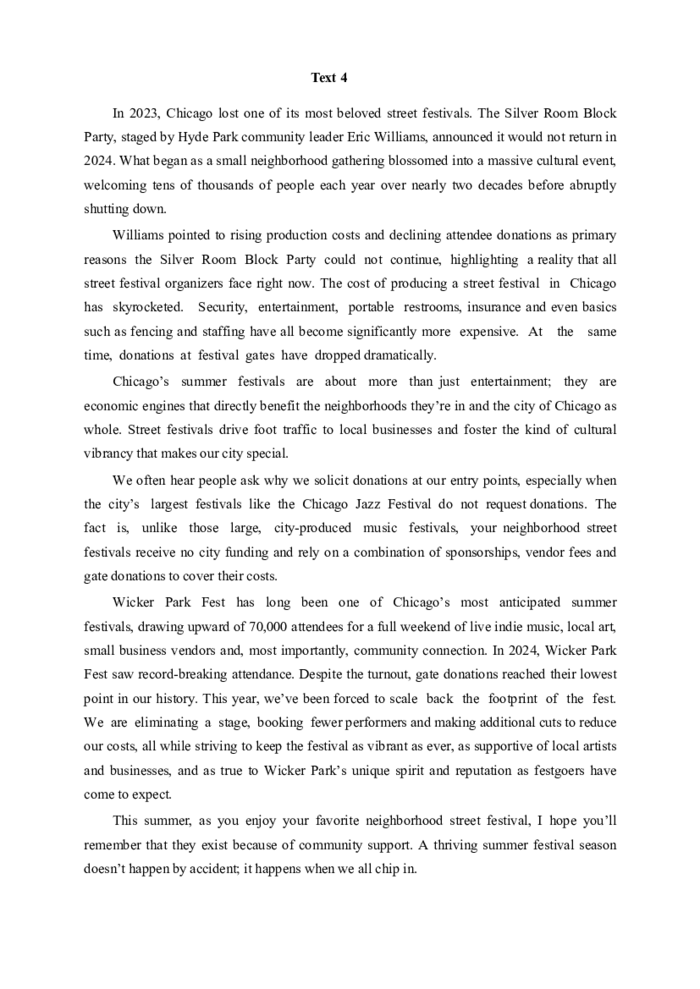
In 2023, Chicago lost one of its most beloved street festivals. The Silver Room Block
Party, staged by Hyde Park community leader Eric Williams, announced it would not return in
2024. What began as a small neighborhood gathering blossomed into a massive cultural event,
welcoming tens of thousands of people each year over nearly two decades before abruptly
shutting down.
Williams pointed to rising production costs and declining attendee donations as primary
reasons the Silver Room Block Party could not continue, highlighting a reality that all
street festival organizers face right now. The cost of producing a street festival in Chicago
has skyrocketed.
Security, entertainment, portable restrooms, insurance and even basics
such as fencing and staffing have all become significantly more expensive. At
the
same
time, donations at festival gates have dropped dramatically.
Chicago’s
summer
festivals
are
about
more
than just
entertainment;
they
are
economic engines that directly benefit the neighborhoods they’re in and the city of Chicago as
whole. Street festivals drive foot traffic to local businesses and foster the kind of cultural
vibrancy that makes our city special.
We often hear people ask why we solicit donations at our entry points, especially when
the city’s largest festivals like the Chicago Jazz Festival do not request donations. The
fact
is,
unlike
those
large,
city-produced
music
festivals,
your neighborhood street
festivals receive no city funding and rely on a combination of sponsorships, vendor fees and
gate donations to cover their costs.
Wicker Park Fest has long been one of Chicago’s most anticipated summer
festivals, drawing upward of 70,000 attendees for a full weekend of live indie music, local art,
small business vendors and, most importantly, community connection. In 2024, Wicker Park
Fest saw record-breaking attendance. Despite the turnout, gate donations reached their lowest
point in our history. This year, we’ve been forced to scale back the footprint of the fest.
We are eliminating a stage, booking fewer performers and making additional cuts to reduce
our costs, all while striving to keep the festival as vibrant as ever, as supportive of local artists
and businesses, and as true to Wicker Park’s unique spirit and reputation as festgoers have
come to expect.
This summer, as you enjoy your favorite neighborhood street festival, I hope you’ll
remember that they exist because of community support. A thriving summer festival season
doesn’t happen by accident; it happens when we all chip in.
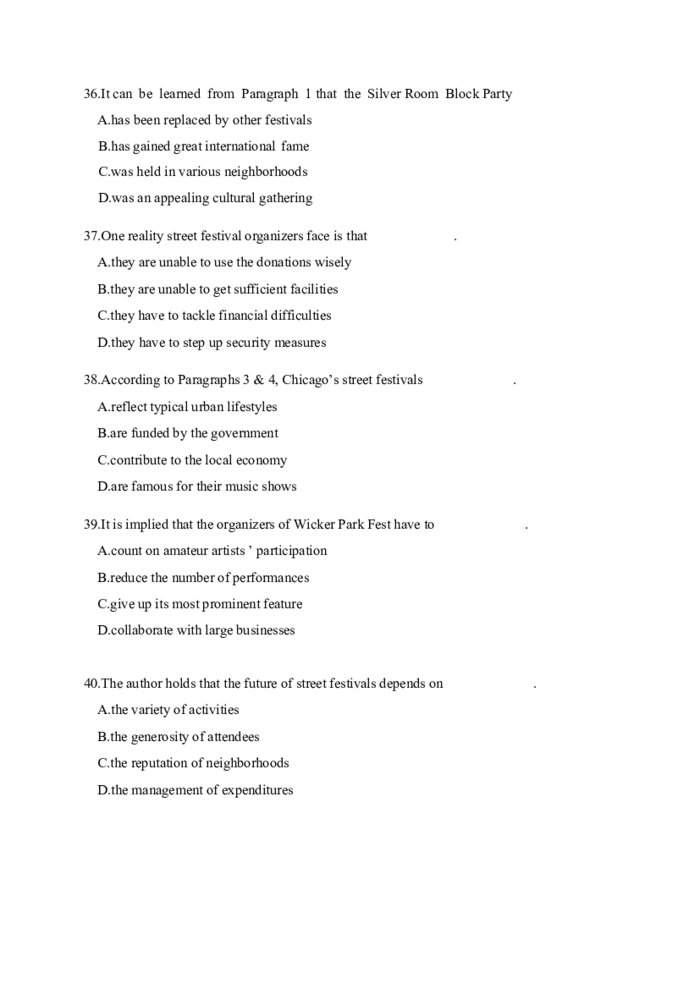
36.It can be learned from Paragraph 1 that the Silver Room Block Party
A.has been replaced by other festivals
B.has gained great international fame
C.was held in various neighborhoods
D.was an appealing cultural gathering
37.One reality street festival organizers face is that
.
A.they are unable to use the donations wisely
B.they are unable to get sufficient facilities
C.they have to tackle financial difficulties
D.they have to step up security measures
38.According to Paragraphs 3 & 4, Chicago’s street festivals
.
A.reflect typical urban lifestyles
B.are funded by the government
C.contribute to the local economy
D.are famous for their music shows
39.It is implied that the organizers of Wicker Park Fest have to
.
A.count on amateur artists ’ participation
B.reduce the number of performances
C.give up its most prominent feature
D.collaborate with large businesses
40.The author holds that the future of street festivals depends on
.
A.the variety of activities
B.the generosity of attendees
C.the reputation of neighborhoods
D.the management of expenditures
2025年