Tiger Times
01
被美国炸死的伊朗头号军事人物:他本是一代枭雄(三)
讲师丨林伯虎
来源丨New York Times
日期丨2020.1.14  Tue.
课程导读
▶  苏莱马尼的世界观和对待伊拉克的观点,和他早年投身两伊战争
有何关系
▶   苏莱马尼的性格特点,从跟美国人打交道的过程中如何显现?
▶   苏莱马尼在伊朗国内的政治对手是谁?他们如何批评其政策?
▶  苏莱马尼的出身有何特点?他为什么走上了革命的道路?
扫码听课
听课笔记
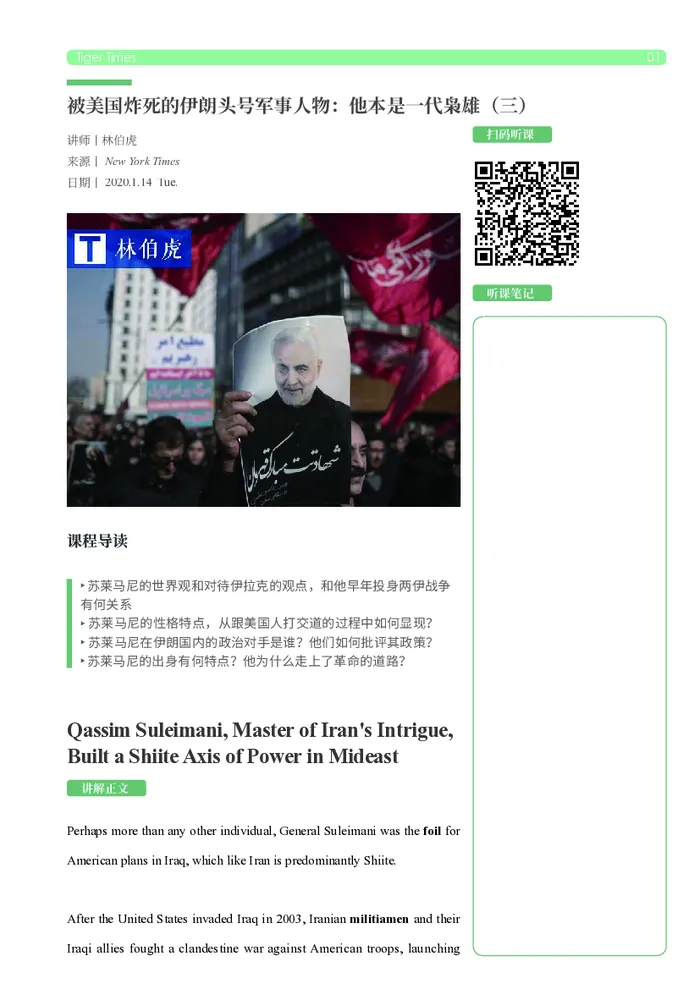
Qassim Suleimani, Master of Iran's Intrigue,
Built a Shiite Axis of Power in Mideast
讲解正文
Perhaps more than any other individual, General Suleimani was the foil for
American plans in Iraq, which like Iran is predominantly Shiite.
After the United States invaded Iraq in 2003, Iranian militiamen and their
Iraqi allies fought a clandestine war against American troops, launching
Tiger Times
02
rockets at bases and attacking convoys. The militias also played a large part
in inflaming sectarian tensions that led to Iraq's civil war in 2006 and 2007
between Shiites and Sunnis, leading President George W. Bush to order a
troop surge there.
General Suleimani and other leaders of his generation were shaped by the
brutal war between Iran and Iraq in the 1980s, a conflict so cruel, with
trench warfare and chemical weapons, that some compared it to the
devastation of World War I. Nearly a million people died on both sides, and
General Suleimani spent much of that war on the front lines.
For him and his fellow soldiers, the war was a "never again" moment.
Ensuring that Iraq was weak and unable to again pose a threat to Iran
became the primary goal of Iran's policy toward Iraq after the overthrow
of Saddam Hussein, whom the United States supported during its war with
Iran in the 1980s.
"For Qassim Suleimani, the Iran-Iraq war never really ended," Ryan C.
Crocker, a former American ambassador to Iraq, once said in an interview.
"No human being could have come through such a World War I-style
conflict and not have been forever affected. His strategic goal was an
outright victory over Iraq, and if that was not possible, to create and
influence a weak Iraq."
Sometimes, American officials secretly communicated with General
Suleimani in an effort to ease tensions in Iraq. In 2008, the American
general, David Petraeus, was trying to find a truce in a fight that American
forces and the Iraqi Army were waging against Shiite militias loyal to Iran.
In Mr. Petraeus's telling of the story, he was shown a text message directed
to him: "General Petraeus, you should know that I, Qassim Suleimani,
Tiger Times
03
control the policy for Iran with respect to Iraq, Lebanon, Gaza and
Afghanistan."
Years later, General Suleimani personally, and mockingly, addressed
another American leader: President Trump, who in July 2018 warned Iran's
president not to threaten the United States.
"It is beneath the dignity of our president to respond to you," General
Suleimani declared in a speech in western Iran. "I, as a soldier, respond to
you."
"We are near you, where you can't even imagine," he added. "We are ready.
We are the man of this arena."
For years after the American invasion of Iraq in 2003, Iran railed against
what it saw as American aggression in the region, worried that the United
States would turn its attention to regime change in Iran after Mr. Hussein
was gone.
American officials have blamed Iran for killing hundreds of American
soldiers during the war, many with sophisticated, shaped-charge bombs that
could slice through American armored vehicles.
As the United States sought to negotiate a deal with Iraq that would allow
American forces to stay in the country past a 2011 deadline, it was General
Suleimani who relentlessly pushed Iraqi officials to refuse to sign, using
a mixture of threats and the promise of more financial and military aid,
American and Iraqi officials say.
Tiger Times
04
On his orders, Iraqi construction crews in 2014 began building a roadway
for Iranian supplies and militiamen, a small piece of what was perhaps the
general's most important project: establishing a land route from Tehran to
the Mediterranean, across Iraq and Syria to Lebanon, where Iran has long
supported Hezbollah, a primary threat to Israel.
One telling episode that illustrated the depth of Iranian control came in
2014, when the Islamic State was rampaging across Iraq. General Suleimani
paid a visit to Bayan Jabr, then the country's transportation minister.
According to a collection of Iranian intelligence cables published recently
by The Intercept and The New York Times, General Suleimani came to Mr.
Jabr with a demand: He needed to use Iraqi airspace to fly planeloads of
military supplies to support the Syrian government of Mr. Assad. Despite
lobbying by the Obama administration to close Iraq's airspace to the flights,
Mr. Jabr quickly said yes.
"I put my hands on my eyes and said, 'On my eyes! As you wish!'" Mr. Jabr
told an Iranian Intelligence Ministry officer, according to one of the cables.
"Then he got up and approached me and kissed my forehead."
The same trove of documents contains evidence that General Suleimani is
not universally admired within Iran.
A bitter rivalry between his Quds Force and the other main Iranian
intelligence agency, the Ministry of Intelligence, played out over the course
of the cables. Many criticized General Suleimani's proxy campaign in
Iraq, and the way his militia allies abused the Sunni population there, as
weakening Iran's long-term interests in the region.
Tiger Times
05
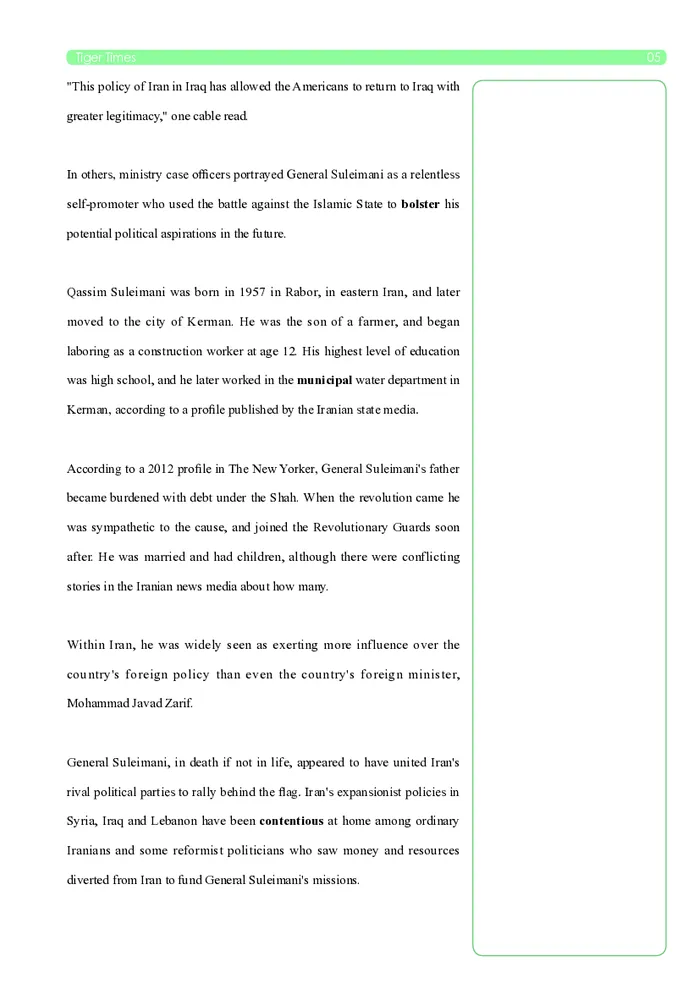
"This policy of Iran in Iraq has allowed the Americans to return to Iraq with
greater legitimacy," one cable read.
In others, ministry case officers portrayed General Suleimani as a relentless
self-promoter who used the battle against the Islamic State to bolster his
potential political aspirations in the future.
Qassim Suleimani was born in 1957 in Rabor, in eastern Iran, and later
moved to the city of Kerman. He was the son of a farmer, and began
laboring as a construction worker at age 12. His highest level of education
was high school, and he later worked in the municipal water department in
Kerman, according to a profile published by the Iranian state media.
According to a 2012 profile in The New Yorker, General Suleimani's father
became burdened with debt under the Shah. When the revolution came he
was sympathetic to the cause, and joined the Revolutionary Guards soon
after. He was married and had children, although there were conflicting
stories in the Iranian news media about how many.
Within Iran, he was widely seen as exerting more influence over the
country's foreign policy than even the country's foreign minister,
Mohammad Javad Zarif.
General Suleimani, in death if not in life, appeared to have united Iran's
rival political parties to rally behind the flag. Iran's expansionist policies in
Syria, Iraq and Lebanon have been contentious at home among ordinary
Iranians and some reformist politicians who saw money and resources
diverted from Iran to fund General Suleimani's missions.
Tiger Times
06
But on Friday, there was only praise and grief. Iranian officials across the
political spectrum issued statements of condolences and condemned the
United States.
"He was so big that he achieved his dream of being martyred by America,"
wrote a reformist politician and former vice president, Mohammad Ali
Abtahi.
Ayatollah Khamenei pinned the medal on General Suleimani's chest last
February, and in remarks that now seem prophetic, said: "The Islamic
Republic needs him for many more years. But I hope that in the end, he dies
as a martyr."
Tiger Times
07
foil /fɔɪl/ n. 挫折,挫败
 ○ a setback in an enterprise, a defeat
 ○ e.g.The only possible foil: Twins.
militiaman /mɪˈlɪʃəmən/ n. 民兵,国民自卫队成员
 ○ a member of a militia
 ○ e.g. The militiaman walked the spy off.
sectarian /sekˈteəriən/ adj. 宗派的,教派的
 ○ supporting a particular religious group and its beliefs
 ○ e.g. a sectarian school 宗派学校
trench warfare 壕沟战
trench /trentʃ/ n. 壕沟;沟渠
 ○ a long narrow hole dug into the surface of the ground
 ○ e.g. Workers dug a trench for gas lines.
warfare /ˈwɔːfeə(r)/ n. 战争〔尤指作战的方式〕
 ○ the activity of fighting in a war – used especially when
talking about particular methods of fighting
 ○ e.g. the realities of modern warfare
overthrow /əʊvəˈθrəʊ/ n.〔尤指用武力对某领导或政府的〕
打倒,推翻
 ○ the defeat and removal from power of a leader or
government, especially by force
 ○ e.g. The organization was dedicated to the overthrow of
capitalism.
truce /truːs/ n. 休战,停战(协定);停止争辩(协议);
停战期
 ○ an agreement between enemies to stop fighting or arguing
for a short time, or the period for which this is arranged
 ○ e.g. They agreed to call a truce.
mockingly /ˈmɒkɪŋli/ adv. 嘲弄地; 取笑地
 ○ e.g. The North Korean leader mockingly described the
missile test as a gift to the Americans on their Independence
Day.
rail /reɪl/ v. 怒斥;抱怨
 ○ to complain angrily about something, especially something
that you think is very unfair
 ○ e.g. Consumers rail against the way companies fix prices.
relentlessly /rɪˈlentləsli/ adv. 无情地;残酷地
 ○ e.g. The African sun beat relentlessly down on his aching
head.
trove /trəʊv/ n. 有价值(或令人喜爱)的藏品
 ○ a store of valuable or delightful things
 ○ e.g. the museum's trove of antique treasure.
bolster /ˈbəʊlstə(r)/ v. 支撑;加固
 ○ to support and strengthen
 ○ e.g. He bolstered his plea with new evidence.
词汇
municipal /mjuːˈnɪsɪpl/ adj. 市政府的,市的,市办的
 ○ relating to or belonging to the government of a town or
city
 ○ e.g. the municipal waste dump
contentious /kənˈtenʃəs/ adj. 引起争论的;有争议的
 ○ causing a lot of argument and disagreement between
people
 ○ e.g. Animal welfare did not become a contentious issue
until the late 1970s.
condolences /kənˈdəʊləns/ n.〔尤指有人去世时所表示的〕
同情,吊唁
 ○ sympathy for someone who has had something bad happen
to them, especially when someone has died
 ○ e.g. a letter of condolence 吊唁信
martyr /marti:r/ v.〔因宗教信仰〕被处死,使殉教
 ○ if someone is martyred, they are killed because of their
religious beliefs
 ○ e.g. Catherine was martyred for her faith.
pin /pɪn/ v. 把… 别住,把… 钉住;固定住
 ○ to fasten something somewhere, or to join two things
together, using a pin
 ○ e.g. Can you pin this to the notice board?
prophetic /prəˈfetɪk/ adj. 预见正确的,有先见之明的
 ○ correctly saying what will happen in the future
 ○ e.g. It turned out to be a prophetic piece of journalism.
Tiger Times
08
今日习题
1. 根据英文释义写出文中出现的对应单词
______: a setback in an enterprise, a defeat
______: an agreement between enemies to stop fighting or arguing for a short time, or the period for
which this is arranged
2. 一词多义
Which of the following underlined word is closest in meaning to the one in the sentence "Iran railed
against what it saw as American aggression in the region, worried that the United States would turn its
attention to regime change in Iran after Mr. Hussein was gone."?  ____
A. The goods train left the rails.
B. The police railed off the area where the accident happened.
C. She railed against the injustice of it all.
D. Chocolates were trucked and railed into Manhattan.
3. 翻译:根据给定中文回译英文
确保伊拉克处于弱势,不能再次对伊朗构成威胁,成为萨达姆· 侯赛因(Saddam Hussein)被推翻
后伊朗对伊拉克政策的首要目标。
_____________________________________________________________________________________
_____________________________________________________________________________________
_____________________________________________________
Tiger Times
09
习题答案
1. foil; truce
2. C
3. Ensuring that Iraq was weak and unable to again pose a threat to Iran became the primary goal
of Iran's policy toward Iraq after the overthrow of Saddam Hussein.
编辑丨贝贝 小萝卜
剪辑丨Anchor 倩云
美编丨凤阙龙城
责编丨小萝卜 Anchor