A nuanced account of the complicated role the fast-food industry
plays in African-American communities, a portrait of race and
capitalism that masterfully illustrates how the fight for civil rights
has been intertwined with the fate of Black businesses.
INTRODUCTION: From Sit-In to Drive-Thru
Fast food restaurants were, and are, able to expand quickly because
of the franchising model, which draws upon an old business practice
and adapts it for a modern world. Most business scholars believe
that the roots of franchising can be traced to the Catholic Church in
the Middle Ages, when tax collectors were allowed to keep a portion
of revenues retrieved from citizens. Fast forward several hundred
years to the late nineteenth century, when the current practice of
franchising began with Coca-Cola. First made in 1888, Coca-Cola
(the franchisor) licensed businesses (franchisees) to mix, bottle,
and sell their refreshing sugary beverage in drugstores, and later
restaurants, across the country. Environmental historian Bart Elmore
has called this method Coca-Cola capitalism, in which a company
relies on a massive "outsourcing strategy to build a mass marketing
giant." This form of commercial development allows corporations
to pass on their liabilities to third-party suppliers, franchisees, and
to some degree, local governments. Cities eager to attract businesses
subsidize business growth through the preparation of land, by
Tiger Times 01
2021 普利策最佳历史书:麦当劳与美国黑人的
相爱相杀(1)
讲师丨林伯虎 来源丨Franchise: The Golden Arches in Black America 日期丨2021.06.22 Tue.
▶ 今年的普利策奖有什么特色?
▶ 什么是franchise 的商业模式?
▶ 汉堡是如何从低端食品翻身?麦当劳靠什么超越前辈、成为业界翘楚?
扫码听课
听课笔记
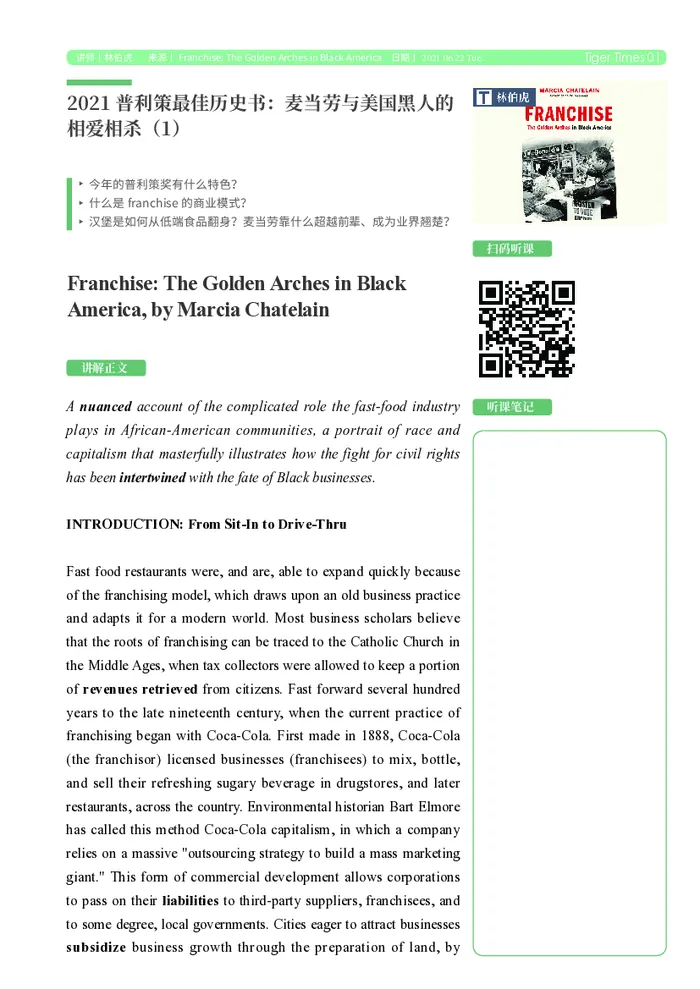
Franchise: The Golden Arches in Black
America, by Marcia Chatelain
讲解正文
providing increased policing, and by offering tax breaks. Franchising
is big business in America because it may be the most American idea
in the world. An individual with no formal training or education can
become a business owner—maybe even a millionaire—with only
an owner's manual and sheer will. Franchising was the channel for
converting a couple of ice-cream parlors or a few hot dog outfits into
multibillion-dollar businesses, with the power to influence supply
chains, workers' wages, and global tastes.
The fast food family tree reads like the book of Genesis, with
businesses begetting other businesses in rapid succession. Although
not the oldest member of the family, McDonald's looms as an
ambitious offspring who managed to outpace and outshine its elders.
Fast food's mainstay, the hamburger, was once considered a low-
quality food product designed to nourish workers and the poor.
Cash-strapped laborers could purchase these sandwiches from carts
and stands in urban centers, near work sites and bustling downtowns.
White Castle helped popularize, and perhaps dignify, the burger with
signature "thin, one-inch-square patties," which came to be known
as sliders. In the pioneering era of fast food, corporate marriages
reconfigured the blood lines that fueled the franchise race. In 1919,
Lodi, California's A&W root beer entered the beverage franchising
game, alongside Coca-Cola, and would later try its hand at burgers
and other fare. The partnership of Allen and Wright—the A and the
W—inspired one of their franchisees, J. Willard Marriott, to strike
out on his own and establish a national hotel chain.
Burgers paved the way for the expansion of other brands that started
in small towns before setting up shop along highway exits or in
newly built suburban plazas. The first national burger chain, Billy
Ingram and Walt Anderson's White Castle—inspired by Chicago's
iconic Water Tower building—was established in 1921. White Castle
innovated many of the practices that would be revolutionized by
McDonald's, including streamlining and centralizing their supplies in
warehouses, creating assembly-line consistency across its locations,
and defending its corporate identity.
Tiger Times
02
Tiger Times
03
franchise /ˈfræntʃaɪz/ n. 特许经销权;选举权
○ permission given by a company to someone who wants to
sell its goods or services
○ e.g. a franchise holder 拥有特许经销权者
○ the legal right to vote in your country's elections
○ e.g. American women worked for decades to win the
franchise. 经过数十年的抗争,美国妇女赢得了选举权。
arch /ɑːtʃ/ n. 拱门
○ a structure with a curved top and straight sides that
supports the weight of a bridge or building
○ e.g. Passing through the arch, you enter an open courtyard.
穿过拱门,你就到了天井中。
nuanced /'njuːɑːnst/ adj.(在外表、意义、声音等上)有細
微差別的
○ made slightly different in appearance, meaning, sound, etc.
○ e.g. His London accent is very slightly nuanced by an
occasional Russian pronunciation. 他的伦敦口音因而时而
夹杂的俄语发音而略显不同。
intertwine /ˌɪntəˈtwaɪn/ v.(使)缠结;(使)紧密关联
○ if two situations, ideas etc. are intertwined, they are closely
related to each other
○ e.g. The problems of crime and unemployment are closely
intertwined. 犯罪和失业问题是紧密联系在一起的。
revenue /ˈrevənjuː/ n. 收益
○ money that a business or organization receives over a
period of time, especially from selling goods or services
○ e.g. advertising revenue 广告收入
retrieve /rɪˈtriːv/ v. 找回,取回
○ to find something and bring it back
○ e.g. We taught our dog to retrieve a ball. 我们教狗捡球。
liability /ˌlaɪəˈbɪləti/ n. 责任,义务
○ legal responsibility for something, especially for paying
money that is owed, or for damage or injury
○ e.g. e.g. He denies any liability for the damage caused. 他
对造成的损失拒绝承担任何责任。
subsidize /ˈsʌbsədaɪz/ v. 给予… 津贴(或补贴);资助
○ if a government or organization subsidizes a company,
activity etc., it pays part of its costs
○ e.g. Farming is heavily subsidized by the government. 农
业得到政府的大量补贴。
sheer /ʃɪə/ adj. 完全的,彻底的
○ complete and not mixed with anything else
○ e.g. I'll never forget the look of sheer joy on her face. 我永
远不会忘记她脸上那纯粹快乐的表情。
beget /bɪˈɡet/ v. 成为…的父亲
○ to become the father of a child
○ e.g. In the Bible it says that Adam begat Cain and Abel. 《圣
经》中说亚当生了该隐和亚伯。
loom /luːm/ v. 赫然耸现;(尤指)令人惊恐地隐现
词汇
○ to appear as a large unclear shape, especially in a
threatening way
○ e.g. Suddenly a mountain loomed up in front of them. 突
然他们面前隐隐约约出现一座山。
mainstay /ˈmeɪnsteɪ/ n. … 的支柱;… 的主要依靠
○ an important part of something that makes it possible for it
to work properly or continue to exist
○ e.g. Agriculture is still the mainstay of the country's
economy. 农业仍然是这个国家的经济支柱。
nourish /ˈnʌrɪʃ/ v. 养育;滋养
○ to give a person or other living thing, the food and other
substances they need in order to live, grow, and stay healthy
○ e.g. Children need plenty of good fresh food to nourish
them. 孩子们需要大量的新鲜食物来提供营养。
cash-strapped /ˈkæʃ stræpt/ adj. 缺钱的,财政困难的
○ not having enough money
○ e.g. cash-strapped universities 财政困难的大学
bustling /ˈbʌsəlɪŋ/ adj. 熙熙攘攘的;热闹的
○ a bustling place is very busy
○ e.g. The flower market was bustling with shoppers. 花市上
挤满了购物的人。
Tiger Times
04
今日习题
1. 根据英文释义写出文中出现的对应词
______: the most important part of something, providing support for everything else
______: to be or become very closely connected with sth./sb. else
2. 一词多义
Which of the following underlined word is closest in meaning to the one in the sentence "An individual
with no formal training or education can become a business owner—maybe even a millionaire—with only
an owner's manual and sheer will." ____
A. Outside there was a sheer drop down to the sea below.
B. The sheer size of the country makes communications difficult.
C. I only agreed out of sheer desperation.
D. I thought the boats were going to collide, but one sheered off at the last second.
3. 翻译:根据给定中文回译英文
这种商业发展形式允许企业将其责任转嫁给第三方供应商、被授权的特许经销商,在某种程度上,
也包括地方政府。
_____________________________________________________________________________________
_________________________________________________________________
习题答案
1. mainstay; intertwine
2. C
3. This form of commercial development allows corporations to pass on their liabilities to third-par
ty suppliers, franchisees, and to some degree, local governments.
编辑丨焰妮