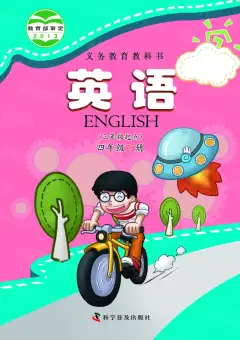
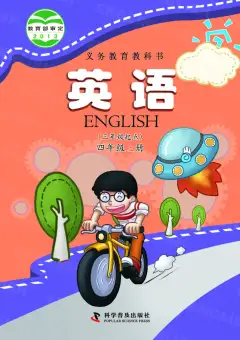
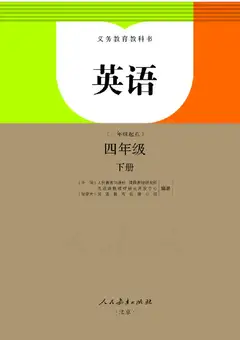
( 一年级起点)
四

年

级
下册
主  编:范文芳
副主编:宗  燕	 Faridah Pawan
——致同学

同学们,欢迎你们使用由清华大学“大、中、小学一条龙英语教学”研究
与实践项目组编写的《英语》课本!

我们为什么要学习英语呢?

你们肯定知道,这是因为英语很重要。英语像汉语一样,能够描述丰富多
彩的世界,表达各种各样的思想。通过英语,我们可以更多地了解奇妙的世界,
了解世界上更多的人,同时也可以把中国介绍给世界上更多的人,让世界上更多
的人了解我们的祖国,了解我们自己。

在21世纪全球化的国际舞台上,英语已经成为国际交流中的一种重要工
具,因此,我们都要学好英语。但是,学好一门语言却不是一朝一夕的事情,而
是需要多年的努力。你们年纪小,模仿力强,记忆力好,正是学习英语的最佳时
期。希望你们努力学好英语,为长大成材打下基础。

我们要学习英语还有另外一个原因,那就是英语非常有趣!英语可以像积
木、玩具汽车、布娃娃、拼图、动画片一样,给我们带来无穷的乐趣!

翻开清华大学“大、中、小学一条龙英语教学”研究与实践项目组为你们
编写的这套《英语》课本,你们肯定会被那令人赏心悦目的图画所吸引;听听课
文录音,你们也一定会喜欢那纯正的英语和优美的歌曲。
这套教材以你们感兴趣的话题为中心,选取的是与你们日常生活息息相关
的内容。教材中安排了你们喜欢的动物、食物以及你们喜欢的活动如游泳、踢
足球等,还有许多生动有趣的故事,相信你们会喜欢这套教材。在老师的指导
下,在听、说、唱、动、读、写中学会用英语说自己想说的话,写出自己的
心声。
英语很重要!英语很有趣!让我们共同努力,把英语学好!


作者


于清华园


2012年12月
UNIT 1
HOME SWEET HOME................ 1
UNIT 2
GOING SOMEWHERE...............17
UNIT 3
WHEN I GROW UP...................33
UNIT 4
SEASONS AND MONTHS
OF THE YEAR.......................49
FUN READING
WHO IS THE STRONGEST?.......65
VOCABULARY.......................73
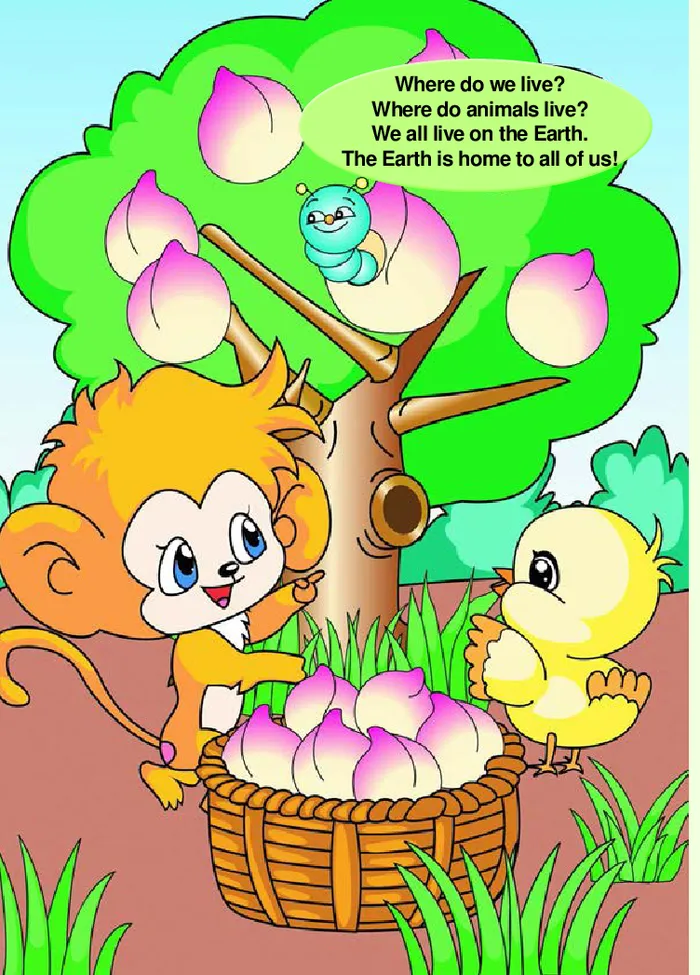
Where do we live?
Where do animals live?
We all live on the Earth.
The Earth is home to all of us!
U N I T 1
HOME
SWEET HOME
HOME
SWEET HOME
1
UNIT
1
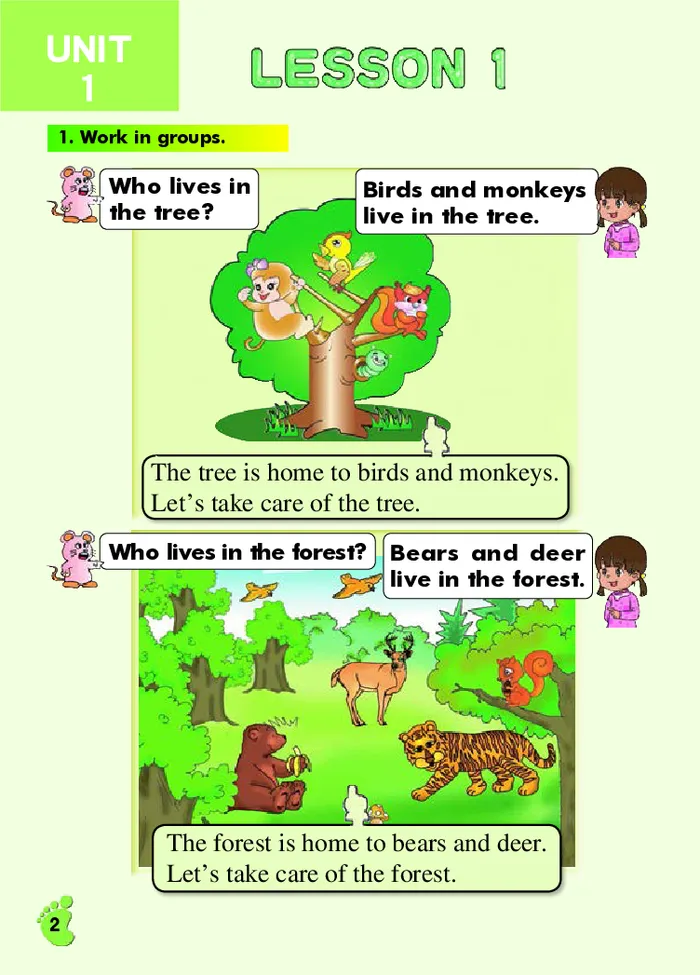
1. Work in groups.
The tree is home to birds and monkeys.
Let’s take care of the tree.
Who lives in
the tree?
Birds and monkeys
live in the tree.
The forest is home to bears and deer.
Let’s take care of the forest.
Who lives in the forest?
Bears and deer
live in the forest.
2
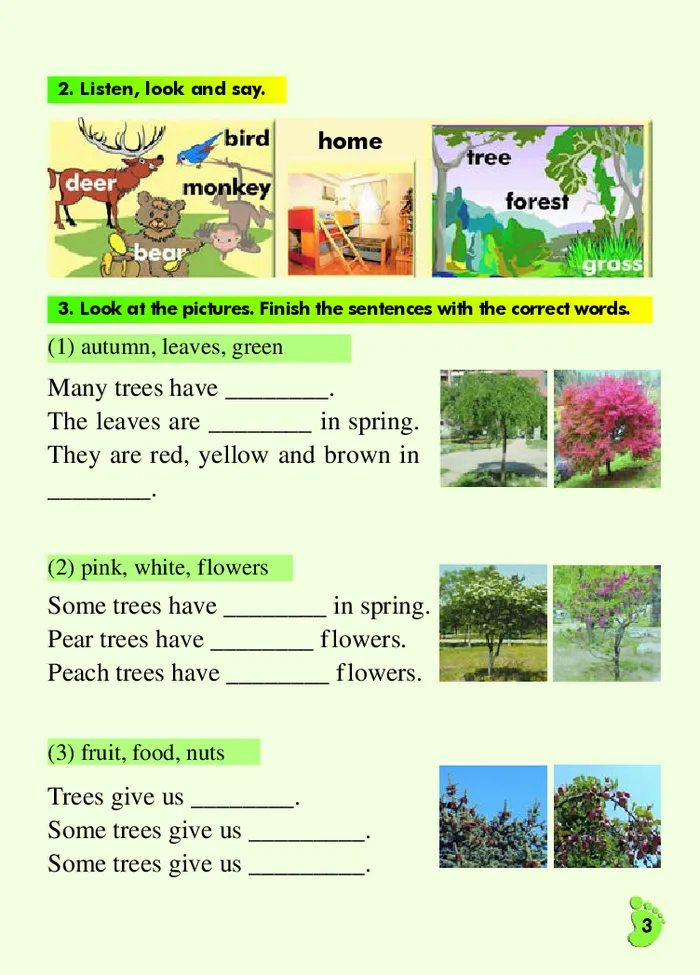
2. Listen, look and say.
3. Look at the pictures. Finish the sentences with the correct words.
forest
(2) pink, white, flowers
Some trees have ________ in spring.
Pear trees have ________ flowers.
Peach trees have ________ flowers.
(3) fruit, food, nuts
Trees give us ________.
Some trees give us _________.
Some trees give us _________.
(1) autumn, leaves, green
Many trees have ________.
The leaves are ________ in spring.
They are red, yellow and brown in
________.
home
3
UNIT
1
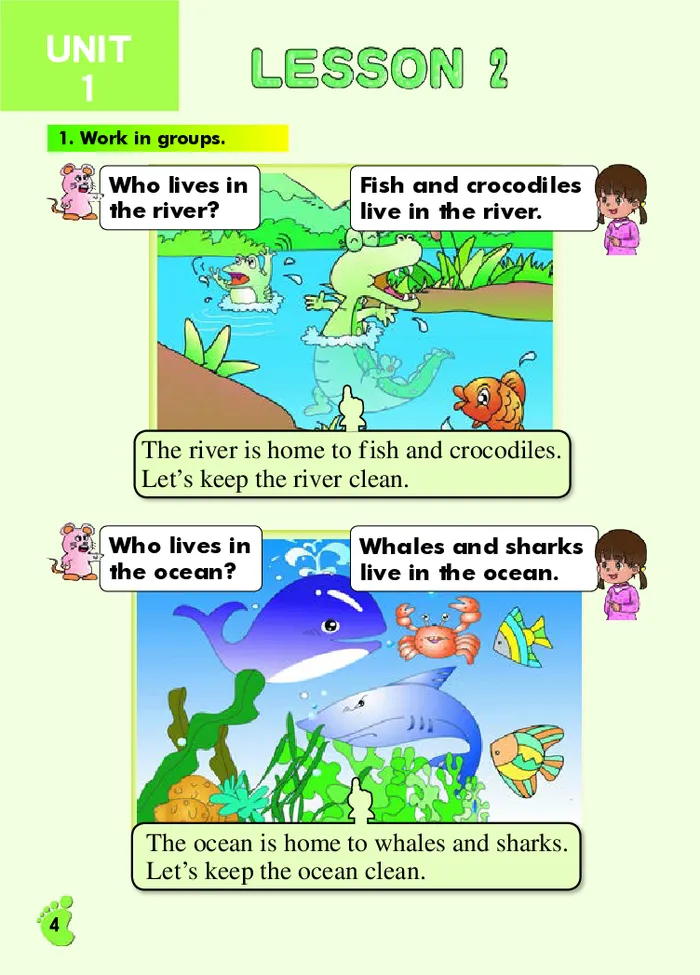
1. Work in groups.
Who lives in
the river?
Fish and crocodiles
live in the river.
Who lives in
the ocean?
Whales and sharks
live in the ocean.
The river is home to fish and crocodiles.
Let’s keep the river clean.
The ocean is home to whales and sharks.
Let’s keep the ocean clean.
4
2. Listen, look and say.
crocodile
shark
whale
ocean
3. Use the words in the (  ) to answer the question.
4. Listen to the text. Write T or F after each sentence.
(1) Who lives in Shanghai? (My grandma)

Sharks are fish. They live in the ocean.
Sharks are different from other
animals. They do not eat every day.
They eat every two or three days! Do
you know how sharks sleep? They
sleep when they are swimming !
(2) Who will take care of your pet dogs

when you go to Shanghai? (My mother)

 (1) Sharks eat every day.
 (2) Sharks do not sleep.
5
UNIT
1
1. Work in groups.
Who lives in the pond?
Ducks and frogs
live in the pond.
Who eats worms?
Who eats insects?
Ducks eat worms.
Frogs eat insects.
The pond is home to ducks and frogs.
Let’s keep the pond clean.
6
2. Listen, look and say.
insects
worm
duck
frog
3. Write the name of each place under the correct picture.
4. Write the name of each animal under the correct picture.
ocean              river              lake              pond
duck
fish
shark
crocodile
insects
frog
whale
butterfly
___________
___________
___________
___________
___________
___________
___________
___________
___________
___________
___________
___________
7
UNIT
1
1. Work in groups.
Who lives in the
grassland?
Lions and giraffes live
in the grassland.
Who lives in
the jungle?
Tigers and elephants
live in the jungle.
The jungle is home to tigers and elephants.
Let’s take care of the jungle.
UNIT
1
The grassland is home to lions and giraffes.
Let’s take care of the grassland.
8
2. Listen, look and say.
tiger
 lion
giraffe
elephant
3. Look at the picture. Read the sentence. Tick the correct picture
and word. Write the word on the line.
(1) A _______ is big.

(fish, whale)
(2) A _______ is strong.
     (lion, monkey)
(3) A _______ is a big fish.
      (frog, shark)
(4) An _______ has six legs.
      (elephant, insect)
(5) Butterflies are _______.
                     (birds, insects)
9
UNIT
1
1. Work in groups.
Who lives in the
countryside?
Farmers live in the
countryside. Farmers
grow crops in the
countryside.
Who lives in
the city?
Workers, doctors and
teachers live in the city.
The city is home to workers, doctors and teachers. Many
of us live in the city, too. Let’s keep the city clean.
The countryside is home to farmers and crops.
Let’s take care of the countryside.
10
2. Listen, look and say.
3. Finish the sentences with the words from the word box.
the city
farmer
crops
city    Workers    countryside    crops    doctor    school
(4) Beijing is a big ________. Shanghai is
a big city, too. _______ live in the city.
(1) Farmers live in the ___________.
      They grow _______ in the fields.
(2) My father is a _______.

My mother is a teacher.
(3) I am a student in a big __________.
      There are 85 teachers in my school.
the countryside
11
UNIT
1
1. Work in groups.
Who lives on
the Earth?
People, animals and plants
live on the Earth.
Who needs air?
People, animals and
plants need air.
The Earth is home to all of us.
Let’s take care of the Earth.
Air is important to all of us.
Let’s keep the air clean.
12
2. Listen, look and say.
3. Read about the food chain. Then draw a picture to finish each
food chain. Write the name of the picture on the line.
people
animals
the Earth
plants
air
Animals eat to live. Some animals eat plants. Some
animals eat other animals. For example, grass grows.
Rabbits eat the grass. Foxes eat the rabbits.
nuts
mouse
___________
grass
rabbit
fox
___________
carrots
pig
___________
13
UNIT
1
1. Listen, look and say. Fill in the missing letters.
__i__y
countrys__d__
wor__ __ __
__ar__er
the Ear__ __
__ __r
__or__
__ __sects
__cea__
__ __ark
wh__l__
c__ __co__ __le
__rass__and
jun__ __ __
gi__ __ffe
__ __er
工人
14
Bears and deer live in the forest.
Let’s take care of the forest.
2. Circle the word in each group that does not belong.
3. Write two sentences to tell about each picture. The first one is
done for you.
(1) animals
plants
people
the Earth
(2) giraffe
forest
jungle
grassland
(3) lion
insect
tiger
giraffe
(4) whale
shark
worm
crocodile
(5) farmer
worker
countryside
teacher
(6) river
city
ocean
pond
_______________________________
_______________________________
(2) whales and sharks, ocean
_______________________________
_______________________________
(3) people, animals and plants, the Earth
_____________________________
_________________________
(1) bears and deer, forest
15
UNIT
2
16
16
Everyone may lose their way.
You may, too.
Do you know how to ask for and
Give directions?
Let’s see...
U N I T 2
GOING SOMEWHERE
GOING SOMEWHERE
17
UNIT
2
1. Listen, look and say.
2. Act it out.
bookstore
street
right
Go down this street for five minutes.
The bookstore is on the right.
Can you tell me how to get to the bookstore?
Tom wants to go to
the bookstore, but he
cannot find it.
18
3. Fun with words.
4. Draw a line from the sentence to the picture that tells about it.
(1) Find a short word in the longer word. Write it on the line.
    	   street             welcome         bookstore          minute

(2)	Change one letter to make a new word. Write it on the line.
  	     but              go             right            bell           kind

(1) There is a big bookstore on
      Apple Street.
(2) Please ride on the right side
      of the street.
(3) I use my right hand to draw.
(4) The park is on the right side
      of the river.
19
UNIT
2
1. Listen, look and say.
library
图书馆
left
2. Act it out.
Can you tell me how to get to the library?
Go down this street for 100 meters.
The library is on the left.
Tom wants to go
to the library, but
he cannot find it.
20
3. Listen to the story. Then tick the correct answer.
My grandpa is in the garden.
A  man comes to him and asks, “I’m going to walk
to the library. Can you tell me how much time I need?”
“No,” says my grandpa.
The man walks away. My grandpa looks at him for
one minute. Then he says, “Come back, please.”
The man comes back. He asks, “Why?”
“I need to know how fast you walk,” says my
grandpa. “You walk 80 meters in one minute. You need
20 minutes to walk to the library.”
(1) My grandpa is _______.

A. at home           B. in the garden
C. in the street
(2) It is __________ meters from the garden to the library.

A. 400                  B. 1000
C. 1600
21
UNIT
2
1. Listen, look and say.
bus stop
traffic lights
corner
2. Act it out.
Go straight. Turn right when you get to the traffic
lights. The bus stop is not far from the corner.
Can you tell me the way to the bus stop?
Tom comes out of the
library. He is going home.
He needs to take a bus
first, but he cannot find
the bus stop.
22
3. Follow the directions.
(1) Draw a line to match the opposites.
come           yes            new             boy              left
     right            girl              go                no                old
(2) Change one letter to make a new word. Write it on the line.
    see
bus
take
home
day

(3)	Circle the word which does not have the long i sound.
      library          find          officer          right          light
4. Read the story. Write the number under each picture to
show the correct order of the story.
(1) Jane is going to take a bus. It begins to rain.
(2) Jane sees a small shop at the corner of the street. She
is going to buy an umbrella there.
(3) Jane buys an umbrella. She is walking out of the shop.
(4) Jane is waiting for the bus at the bus stop.
SHOP
SHOP
23
UNIT
2
1. Listen, look and say.
subway
post office
2. Act it out.
Go straight. Turn left at the second traffic
lights. The subway is beside the post office.
Can you tell me the
way to the subway?
Tom gets off the bus.
He needs to take the
subway now, but he
cannot find it.
24
3. Look at the picture. Finish the sentence with the words from
the word box.
(5) ______________ to the traffic
lights. Then ___________.
(1) ___________ the street for 60
meters. Then ___________.
(2) ___________ are red, yellow
and green.
(3) I _____________ home after
school every day.
(4) There is a post office ______
the bookstore.
 go straight      go down       turn left      traffic lights
 beside             take the subway              turn right
坐地铁
25
UNIT
2
1. Listen, look and say.
supermarket
cinema
2. Act it out.
Yes, there is. Go straight and turn left
at the first corner. The supermarket is
beside the cinema.
Is there a supermarket near here?
Tom is hungry. He wants
to buy some snacks, but he
cannot find a supermarket.
26
We buy vegetables in the supermarket.
4. Match the question to its answer.
I walk to school.
Is there a school near here?
Yes, there is.
Where do you buy food?
Where do you live?
How do you go to school?
In the supermarket.
vegetables
 fruit
clothes
3. Listen and number.
supermarket
library
cinema
post office
5. Ask and answer.
Where do you buy vegetables?
I live near my school.
27
UNIT
2
1. Listen, look and say.
toilet
bank
2. Act it out.
Yes, there is. Turn right at the corner.
There is a toilet beside the bank.
Is there a toilet near here?
Tom needs to use
the toilet, but he
cannot find one.
28
3. Fun with words.
(2) Find a short word in the longer word. Write it on the line.
beside
corner
subway
near
bookstore

(1) Circle the pair of words whose red letters have the
 same sound.
bus
subway	 yes
get
bank	 cake
Tom
boat
supermarket	use
need	 street
minute	light
cinema          corner
toilet	 boy
4. Ask and answer.
Yes. Turn right at the corner. The
cinema is beside the bookstore.
Is there a cinema near here?
bank
toilet
cinema
supermarket
29
UNIT
2
1. Listen, look and say. Fill in the missing letters.
__ __brary
c__n__m__
b__ __kst__ __e
t__ __le__
cor__ __ __
sub__ __ __
__ __ __k
__ __st office
__ _per__ __ __ket
30
2.	Look at the picture. Use the words to answer the question.
The first one is done for you.
(2) turn right, not far from the corner
Lily: Can you tell me how to
         get to the supermarket?
Tom:


(1) go straight, on the right
Jane: Can you tell me how to

 get to the bank?
Tom: Go straight.

 The bank is on the right.
Peter: Can you tell me the way

  to the library?
Tom:


(4) go straight for five minutes, beside the cinema
Sam: Is there a toilet near here?
Tom:


(3) go straight and turn left, on the left
31
UNIT
3
What does your father do?
What does your mother do?
What do you want to be
When you grow up?
32
U N I T 3
WHEN I GROW UP...
WHEN I GROW UP...
33
UNIT
3
1. Work in pairs.
I want to be a doctor or
a nurse. I want to work
in the hospital.
What do doctors or nurses do?
What do you want
to be when you
grow up?
Nurses take your
temperature.
Doctors listen to your heart.
Doctors give you medicine.
Nurses give you a shot.
34
2. Listen, look and say.
3. Let’s play!
My baby is well now.
Thank you.
temperature
heart
shot
medicine
My baby is ill.
What can I do?
I’ll take her temperature.
I’ll listen to her heart.
I’ll give her a shot.
I’ll give her some medicine.
35
UNIT
3
What do firefighters do?
1. Work in pairs.
I want to be a firefighter.
I like the firefighter uniform.
What do you want to be when you grow up?
Firefighters put out fires.
Firefighters save people
from danger.
36
3. Look at the picture. Finish the sentence with the correct word
from the word box.
2. Listen, look and say.
fire
firefighter
firefighter uniform
(1) The child is in _________.

 She is yelling for help.
(2)	A frog is coming to eat the butterfly.
     Who will _________ it from danger?
(3)	Firefighters wear uniforms.

They _________  out fires.
(4)	I like my school_________ .

I wear it to school.
save       danger       uniform      put
37
UNIT
3
What do police officers do?
1. Work in pairs.
I want to be a police officer.
I like the police uniform. I like the police car.
What do you want to be when you grow up?
Police officers
direct traffic.
Police officers
catch thieves.
38
3. Fill in the missing words. Then read the pairs.
2. Listen, look and say.
thief
police officer
police car
police dog
one
more than one
officer
  officers
uniform

leaf
  leaves
thief

foot
  feet
tooth

man
  men
woman

snowman

fish
  fish
sheep

deer

mouse

child

mice
39
UNIT
3
Farmers grow crops.
What do farmers do?
I want to be a farmer. I like the fields and
farm animals. I like to live on the farm.
What do you want to be when you grow up?
1. Work in pairs.
Farmers raise animals.
40
2. Listen, look and say.
3. Listen to the text. Then find a sentence in the text that tells
about each picture. Write it under its picture.
farm
farmer
crops
fields
农场
农民
庄稼
Farmers raise animals on the farm. Much of our food
comes from farm animals.
Farmers raise pigs for their meat. Farmers raise
chickens and ducks for their eggs. Meat and eggs are
important food.
Farmers raise cows for their milk. We drink milk. We
make cheese and yogurt from milk.
______________
______________
______________
______________
______________
______________
______________
______________
______________
41
UNIT
3
What teacher do you want to be?
1. Work in pairs.
I want to be a Chinese
teacher.
I want to be a
P.E. teacher.
I want to be an
art teacher.
I want to be a teacher.
I love children.
I love to teach.
What do you want to be
when you grow up?
I want to be a
math teacher.
数学
42
2. Listen, look and say.
3. Finish the puzzle with the words from the word box.
Chinese
English
math
P.E.
art
music
汉语课
teacher   Chinese   English   math   P.E.   art   music
m
t
C
h
g
s
n
n
e
e
t
r
a
s
e
h
s
P
c
43
UNIT
3
1. Work in pairs.
I want to be a pilot.
I want to fly a plane.
What do you want to be when you grow up?
What do you want to be when you grow up?
I want to be an astronaut.
I want to travel to the moon.
44
3. Listen to the story. Finish the sentences with words from the
story to answer the questions.
I’m an astronaut. I’m traveling to the moon.
Now I’m on the moon. I feel so light. Look, I can
jump so high!
“Wake up, Mike. It’s time for school,” says Mom.
I open my eyes. I find I’m in my bed. My mother is
looking at me.
“Mom, it’s fun to be on the moon,” I say.
(3) Where is Mike?

Mike is in his _______.
2. Listen, look and say.
pilot
plane
moon
astronaut
(2) How does Mike feel on the moon?


Mike feels _______.
(1) Where is Mike going?

Mike is going to the _______.
45
UNIT
3
1. Listen, look and say. Fill in the missing letters.
__ __ __pital
m__dic__ __e
__ __t
___. ___.
__ __lot
 pl__n__
__ __tronau__
__ __ __n
__ __re
firefigh__ __ __ police offic__ __
__ __ie__
f__ __ __
far__ __ __
c__ __ps
__ __ __lds
46
2.  Draw a line from the picture to its words.
3. Write two sentences to tell about each picture. The first one is
done for you.
school uniform
firefighter uniform
police uniform
(1) listen to your heart, give you medicine

Doctors listen to your heart.

Doctors give you medicine.
(4)	 grow crops, raise animals

_______________________________

_______________________________
(3)	 direct traffic, catch thieves

_______________________________

_______________________________
(2) put out fires, save people from danger

_______________________________

_______________________________
47
UNIT
4
48
Three months make a season.
Four seasons make a year.
Year in, year out.
We live in a changing world.
48
U N I T 4
SEASONS
AND MONTHS
OF THE YEAR
SEASONS
AND MONTHS
OF THE YEAR
49
UNIT
4
1. Talk about the four seasons.
There are four seasons in a year.
They are spring, summer, autumn and winter.
spring
summer
autumn
winter
Four seasons make a year.
50
2. Talk about the months.
There are twelve months in a year.
Here are the names of the months:
Twelve months make a year.
January
February
March
April
May
June
July
August
September
October
November December
51
UNIT
4
1. Act it out.
2. Listen to the story. Then answer the questions.
My name is Autumn.
My name is Winter.
My name is Spring.
My name is Summer.
I’m the King. My name is Year.
I have four sons. They are Spring,
Summer, Autumn and Winter.
The king asked, “What will you do if you become the
new king?”
Spring said, “I’ll plant seeds.” Summer said, “I’ll
water the crops and make them grow.” Autumn said, “I’ll
cut the crops and carry them home.” Winter said, “I’ll
store the crops.”
52
3. Look at the pictures. Finish the sentences.
The king was very happy. He said, “You all have good
ideas. You’ll take turns to be king. Spring will be king in
March, April and May. Summer will be king in June, July
and August. Autumn will be king in September, October
and November. Winter will be king in December, January
and February.”
(1) People ___________ in spring.
(2) People ___________ and make them grow in summer.
(3) People ___________ and carry them home in autumn.
(4) People ___________ the crops in winter.
(1) What was the name of the king?
      __________________________
(2) What were the names of his four sons?
      ______________________________
Read it.
ask — asked
say — said
is    — was
53
UNIT
4
1. Act it out.
How many days are
there in a year?
There are 365 or 366
days in a year.
Some months have 31 days. These months
are: January, March, May, July, August,
October and December.
Some months have 30
days. These months are:
April, June, September
and November.
February has 28 or 29 days.
How many days are there in a month?
How many days are
there in a month?
54
3. Write the name of the month that answers the question.
2. Learn it: The vowel letter o can sound like the o in coat, box
or sport. Read the sound at the beginning of each group.
Circle the word in each row whose red letter does not make
that sound.
(1) New Year’s Day is in the first month.

What month is it?
(2) Teacher’s Day is in the month after August.
What month is it?
(3) Christmas is in the month after November.

What month is it?
4. Let’s say it!
Thirty days has September
April, June and November
All the rest have thirty-one
Except for February
Which has 28 or 29
4:  November
October
grow
home
cold
6:  October
crop
do
hot
doctor
o:  morning
so
for
floor
four
55
UNIT
4
1. Act it out.
When is your National Day?
When is your
birthday?
Our National Day is
the First of October.
My birthday is
on May 16!
When is your Chinese
New Year?
Our Chinese New
Year is in January
or February.
56
Jan. 1
first
second
third
sixth
fourth
fifth
Mar. 8
May 12
Dec. 25
2. Listen, look and say.
3. Let’s say it!
4. Read the question. Write the answer on the line.
Color the first, the third and the sixth apples red.
Color the second and the fourth apples yellow.
Color the fifth apple green.
When is your birthday?
_____________________
2013
57
UNIT
4
1. Talk about it.
Spring is the season between winter and
summer. It is the beginning of the year.
Summer is the season between spring and
autumn. Summer days are long and hot.
It is April. It is spring.
I wear a shirt, trousers
and spring shoes.
It is July. It is summer. I wear
a T-shirt and shorts.
58
2. Look at the pictures. Finish the sentences.
3. Write a sentence to tell about each picture. The first one is
    done for you.
(1) There are three months in spring.
     They are ___________________.
(2) There are three months in summer.
     They are _____________________.

Spring begins from the third month.
     It is __________.

Summer begins from the sixth month.
     It is __________.


The ball is between
the shoes.
ball
shoes
between
teddy bear
box
in
teddy bear
box
on
teddy bear
two boxes
between
59
UNIT
4
1. Talk about it.
Autumn is the season between summer and
winter. It is the best season to get pumpkins.
Winter is the season between autumn and
spring. Winter nights are long and cold.
It is October. It is autumn.
I wear a sweater, trousers
and sports shoes.
It is December. It is winter.
I wear a hat, a scarf and
warm clothes.
60
2. Answer the question.
(1) There are three months in autumn.
     They are ____________________.
(1) Farmers take care of the crops
      in the day.
(2)

(3)

(2) There are three months in winter.
     They are ___________________.
(3) What is the name of the tenth month?
     It is _________________________.
3. Look at the picture. Write a sentence to tell whether the activity
    happens in the day or at night. The first one is done for you.
61
UNIT
4
1. Listen, look and say. Fill in the missing letters.
__ __nu__ry __ __ __ru__ry
Mar__ __
__ __ril
__ __y
__ __ne
__ __ly
Au__ __ __ __
__ __ __tember
__ __tober
__ __vember De__ __ __ber
62
2. Listen to the sentences. Fill in the missing words.
3. Write some sentences to tell about each picture. The first one is
done for you.
(1)	August, a T-shirt and a skirt, go swimming
It’s August. It’s summer.
I wear a T-shirt and a skirt.
I go swimming.


(2)	October, a sweater and trousers, pick apples
(3)	January, warm clothes, go skating
(1)	There are ________ months in a year. Twelve ________
make a year. There are ________ seasons in a year.
Four ________ make a year. There are ________ months
in a season. Three ________ make a season.
(2)	There are ________ hours in a day. There are ________
minutes in an hour.
63
Strong, stronger, strongest!
Who is the strongest in the world?
Is it you? Or is it me?
That is the question!
64
FUN READING
WHO IS THE
STRONGEST?
WHO IS THE
STRONGEST?
65
The sun shone and shone.
The man was very hot. He
took off his coat.
I think the sun is the
strongest. He can shine
over the world.
Who is the strongest in the world?
I am the strongest in
the world. Look at that
man. I can make him
take off his coat.
All the mice, except
the second one, sang
and danced.
The four mice were
happy that they found
the answer.
The strongest, the strongest! The sun is the
strongest in the world.
66
I think the cloud is the
strongest. He can cover
up the sun.
I am the strongest.
Look at the sun.
I can cover it up.
The second mouse
did not agree.
The cloud moved and moved. The sun became smaller
and smaller. At last, the mice could not see the sun.
What a surprise! The
cloud is stronger than
the sun! All the mice,
except the third one,
sang and danced.
The four mice were
happy that they found
the answer.
The strongest, the strongest! The cloud
is the strongest in the world.
67
I think the wind is the strongest.
He can blow the cloud away.
The strongest, the strongest! The
wind is the strongest in the world.
I am the strongest.
Look at the cloud.
I can blow it away.
The third mouse did not agree.
The wind blew and blew. The cloud became smaller
and smaller. At last, there was no cloud left. What a
surprise! The wind was stronger than the cloud! All
the mice, except the fourth one, sang and danced.
The four mice were
happy that they found
the answer.
68
I think the wall is the strongest.
He can stop the wind.
I am the strongest. Look at the wind. I can stop it.
The strongest, the strongest!
The wall is the strongest in the world.
The four mice were
happy that they found
the answer.
The fourth mouse did not agree.
The wind moved and moved. It was very tired, but it
still could not pass the wall. The wall stopped the wind.
What a surprise! The
wall is stronger than
the wind! All the mice,
except the fifth one,
sang and danced.
69
Who is stronger
than the wall?
Look here, everyone.
The fifth mouse did
not answer. He went
over to the wall.
The four mice looked at the wall. What did
they see? They saw a big hole in the wall!
The fifth mouse did not agree.
I do not think the wall is the
strongest in the world.
70
What a surprise! The mouse
can make a hole in the wall!
I am the strongest. Look at the
wall. I can make it fall.
The mice went into the hole. They saw a big
mouse busy working. He was making the hole
bigger and bigger.
The big mouse worked and worked. The hole became
bigger and bigger. At last, the wall fell down.
71
Now I see.
The mouse is the strongest in the world!
That night, the five mice had a big dinner to celebrate.
They were happy that, at last, they found the right answer.
Just then, a cat came and all the mice ran away.
agree (agreed) 同意
(67)
answer
答案
(66)
blow (blew)
刮
(68)
busy
忙
(71)
celebrate
庆祝
(72)
can (could)
能够
(67)
everyone
每个人
(70)
except
除了
(66)
find (found) 找到
(66)
just then
就在那时 (72)
move (moved) 行进,移动 (67)
shine (shone) 照耀
(66)
surprise
惊讶
(67)
think (thought) 认为
(66)
wall
墙
(69)
wind
风
(68)
world
世界
(66)
Who is the strongest in the world?
72
A
air 空气
(12)
all 全部的,所有的
(12)
April (Apr.) 四月
(51)
art 艺术
(42)
*astronaut 宇航员
(44)
August (Aug.) 八月
(51)
B
back 回原处,向后
(21)
*bank 银行
(28)
become (became) 成为
(52)
beginning 开始
(58)
beside 在……旁边
(24)
best 最,最好的
(60)
between 在……之间
(58)
bookstore 书店
(18)
C
care 关心,关怀
(2)
  take care of 爱护,照料
(2)
catch 抓,抓住
(38)
cinema 电影院
(26)
city 城市
(10)
corner 拐弯,角落
(22)
countryside  农村
(10)
crocodile 鳄鱼
(4)
crop 庄稼
(10)
D
danger 危险
(36)
direct 指挥,指导
(38)
down 沿着;向下
(18)
E
Earth (the Earth) 地球
(12)
example 例子,案例
(13)
  for example 例如
(13)
F
far 远的
(22)
farmer 农夫
(10)
February (Feb.) 二月
(51)
feel 感觉,觉得
 (45)
fifth  第五
 (57)
fire 火
(36)
first 第一的
(22)
fun 乐趣, 有趣的
(45)
G
*grassland 草原
(8)
 grow up 长大
(34)
H
heart 心,心脏
(34)
him 他
(21)
hospital  医院
(34)
I
insect 昆虫
(6)
J
January (Jan.) 一月
(51)
July (Jul.) 七月
(51)
June (Jun.) 六月
(51)
*jungle 丛林
(8)
VOCABULARY
73
注释:带* 的单词不要求掌握,只需

要在上下文中理解。
K
king 国王
 (52)
know 知道,了解
(5)
L
left 左边的
(20)
library 图书馆
(20)
M
March (Mar.) 三月
(51)
math (maths) 数学
(42)
May 五月
(51)
medicine 药
(34)
meter 米
(20)
month 月份
(51)
moon 月亮,月球
(44)
N
near 在……附近
(26)
November (Nov.) 十一月
(51)
O
ocean 海洋
(4)
October (Oct.) 十月
(51)
P
P.E. (PE) 体育课
(42)
post office 邮局
(24)
pumpkin 南瓜
(60)
R
raise 饲养,养育
(40)
right 右边的,正确的
(18)
S
save 救助,挽救
(36)
second 第二的
(24)
*seed 种子
(52)
September (Sep.) 九月
(51)
shark 鲨鱼
(4)
*shot 打针,注射
(34)
side 边,旁边
(19)
sixth 第六的
(57)
son 儿子
(52)
*store 储存,储藏
(53)
straight 直的
(22)
subway 地铁
(24)
supermarket 超市
(26)
sweater 毛衣
(60)
T
teach 教,讲授
(42)
temperature 温度
(34)
tenth 第十
 (61)
then 然后
(21)
thief (thieves) 贼
(38)
toilet 厕所
(28)
traffic 交通,车辆
(22)
U
*uniform 制服
(36)
W
well  治愈的,健康的
(35)
whale 鲸鱼
(4)
worker 工人
(10)
74
  清华版小学《英语》(一年级起点)教材是由清华大学大、中、小学“一
条龙英语”项目组编写的。
  清华大学大、中、小学“一条龙英语”教学研究与实践项目开始于1998 年,
至今已历时十多个年头。在这个项目的研究进程中,先后受到国家社会科学基
金项目、教育部高教司英语教学改革项目和清华大学985 项目等多个项目的支
持。经过十多年的教学与研究,这个项目取得了许多重要成果,赢得了有关专家、
教师、家长和学生们的广泛好评,在全国基础英语教育界享有很高的声誉。中
央电视台、北京电视台、清华大学电视台、《北京日报》、
  本套教材力求体现世界先进的教育思想、新的语言观和外语学习观,突出
语言的交际功能及其人文性特点,以发展语言实践能力为主线,以培养学生用
英语进行交际的能力为最终目标,同时注重培养学生的学习兴趣,提高学生的
综合人文素养,从根本上体现了教育部制定的义务教育《英语课程标准》的基
本教育理念和教育思想。过去十多年的英语教学实验证明,完成本教材学习的
学生,能够对英语学习产生强烈的兴趣,习得良好的英语语感,具备较高的听、
说能力和初步的读、写能力,进入中学后在英语学科上具有明显的优势。
  本套教材的研究与实践,是在清华大学“一条龙英语”项目领导小组的领
导下,在专家顾问委员会的指导下,在小学英语教材编写委员会全体成员的共
同努力下完成的。参加本次义务教育教科书编写的人员,除主编和副主编外,
还有清华附小的马艳红、范敏、王洁、陈新蕾、张美新、芦荣、俞琨、王奇志、
黄耀华、蔡建敏、赵若冰、任丹,和北大附小的范冰、朱晓媛、李瑜、刘桂红。
另外,国内外许多教育教学专家、学科专家、教研人员、一线教师,以及家长
和学生,都对本套教材的编写与实践提出了许多宝贵的建议。特此一并致谢。
清华大学大、中、小学“一条龙英语”项目组
2013年12月
于清华园
后  记
China Daily


       、《外语
教学与研究》《中小学外语教学》《人民教育》等多种媒体先后报道、刊登该
项实验的有关成果,在社会上引起了较大反响。清华大学于2006年授予这个项
目“清华大学教学成果奖”一等奖。清华版小学《英语》(一年级起点)教材
是该项目的重要研究成果之一。
定价:5.30 元