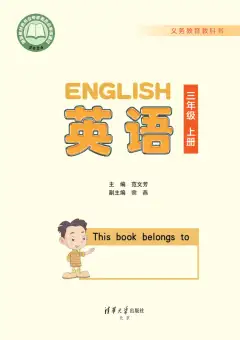
主 编:范文芳
副主编:宗 燕 Faridah Pawan
下册
( 一年级起点)
五
年
级
——致同学
同学们,欢迎你们使用由清华大学“大、中、小学一条龙英语教学”研究
与实践项目组编写的《英语》课本!
我们为什么要学习英语呢?
你们肯定知道,这是因为英语很重要。英语像汉语一样,能够描述丰富多
彩的世界,表达各种各样的思想。通过英语,我们可以更多地了解奇妙的世界,
了解世界上更多的人,同时也可以把中国介绍给世界上更多的人,让世界上更多
的人了解我们的祖国,了解我们自己。
在21世纪全球化的国际舞台上,英语已经成为国际交流中的一种重要工
具,因此,我们都要学好英语。但是,学好一门语言却不是一朝一夕的事情,而
是需要多年的努力。你们年纪小,模仿力强,记忆力好,正是学习英语的最佳时
期。希望你们努力学好英语,为长大成材打下基础。
我们要学习英语还有另外一个原因,那就是英语非常有趣!英语可以像积
木、玩具汽车、布娃娃、拼图、动画片一样,给我们带来无穷的乐趣!
翻开清华大学“大、中、小学一条龙英语教学”研究与实践项目组为你们
编写的这套《英语》课本,你们肯定会被那令人赏心悦目的图画所吸引;听听课
文录音,你们也一定会喜欢那纯正的英语和优美的歌曲。
这套教材以你们感兴趣的话题为中心,选取的是与你们日常生活息息相关
的内容。教材中安排了你们喜欢的动物、食物以及你们喜欢的活动如游泳、踢
足球等,还有许多生动有趣的故事,相信你们会喜欢这套教材。在老师的指导
下,在听、说、唱、动、读、写中学会用英语说自己想说的话,写出自己的
心声。
英语很重要!英语很有趣!让我们共同努力,把英语学好!
作者
于清华园
2012年12月
UNIT I
WELCOME TO MY SCHOOL! .......1
UNIT 2
WHAT’S YOUR HOBBY?........ 17
UNIT 3
THE ENVIRONMENT AND US ...... 33
UNIT 4
BILLY’S ADVENTURES......... 49
FUN READING
SNOW WHITE AND
THE SEVEN DWARFS............ 65
VOCABULARY..................... 73
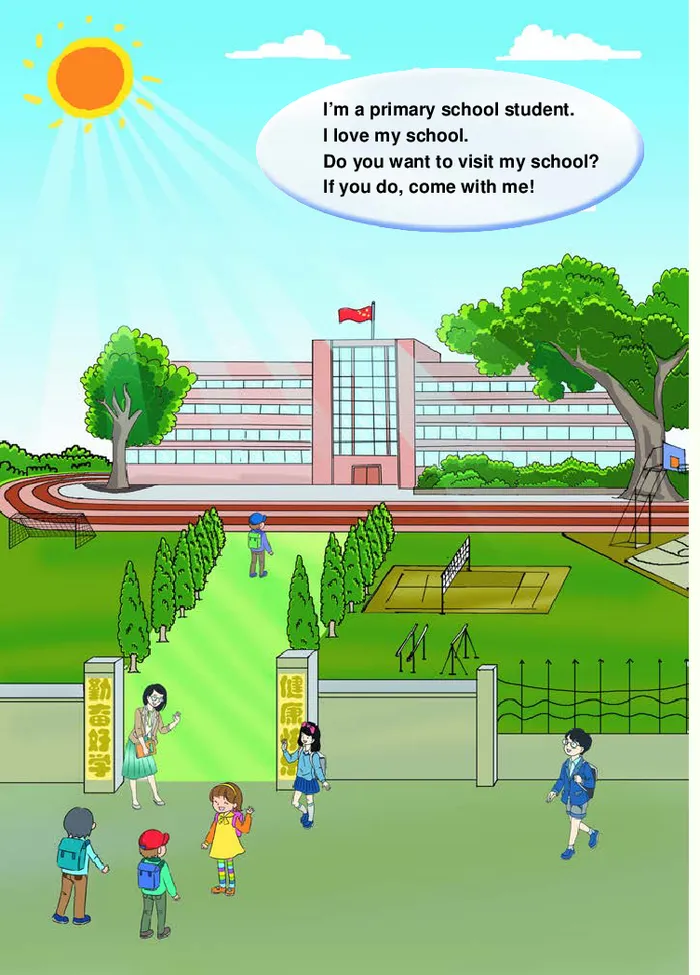
I’m a primary school student.
I love my school.
Do you want to visit my school?
If you do, come with me!
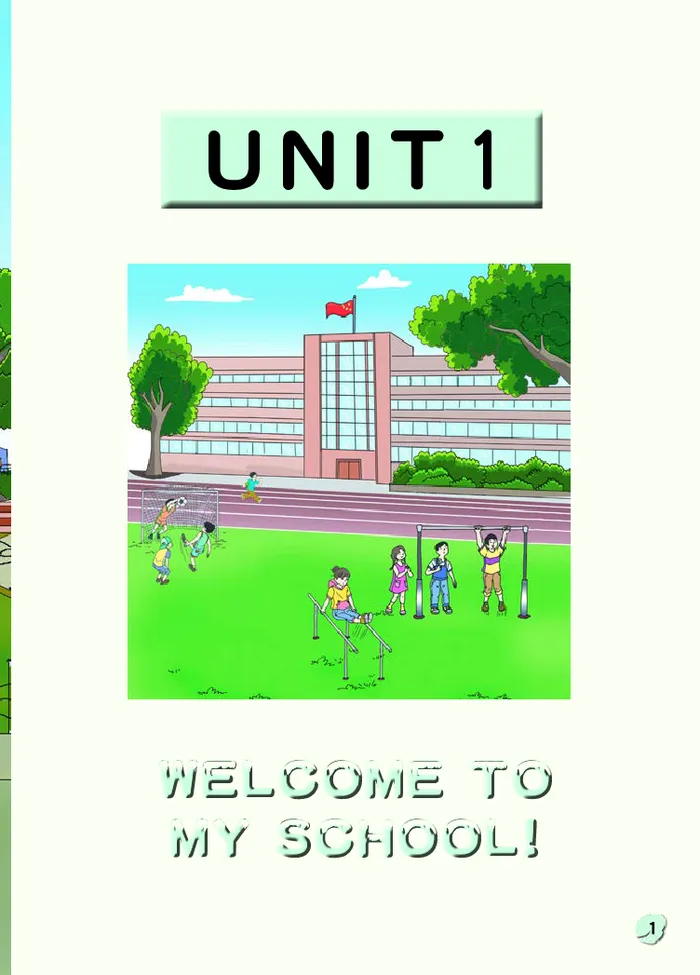
U N I T 1
WELCOME TO
MY SCHOOL!
WELCOME TO
MY SCHOOL!
1
1. Listen to the text. Then read it aloud.
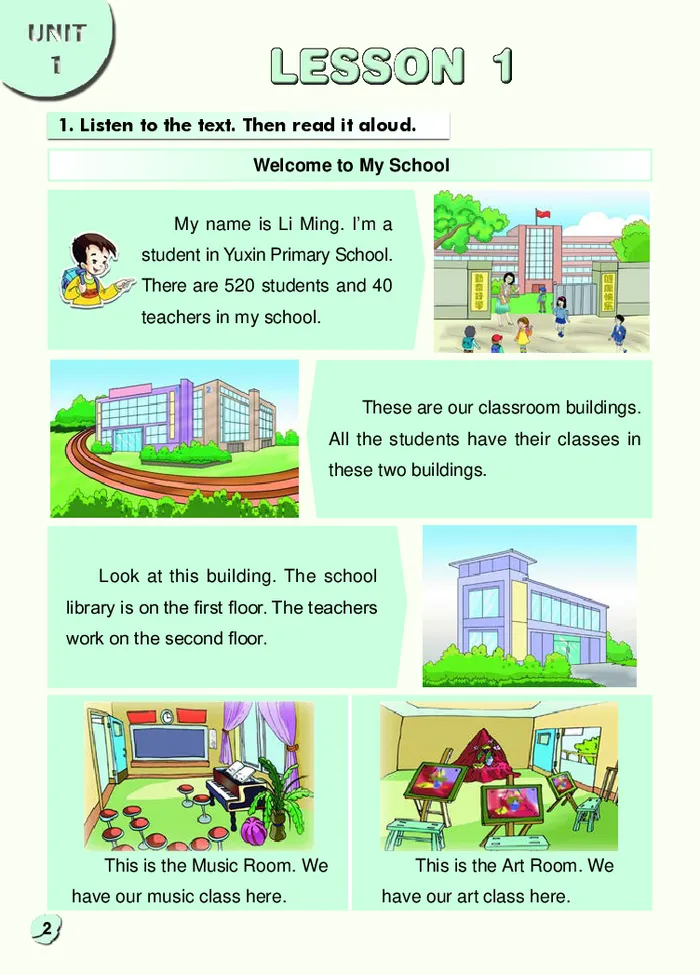
My name is Li Ming. I’m a
student in Yuxin Primary School.
There are 520 students and 40
teachers in my school.
画:两栋教学楼
These are our classroom buildings.
All the students have their classes in
these two buildings.
Look at this building. The school
library is on the first floor. The teachers
work on the second floor.
This is the Art Room. We
have our art class here.
This is the Music Room. We
have our music class here.
Welcome to My School
2
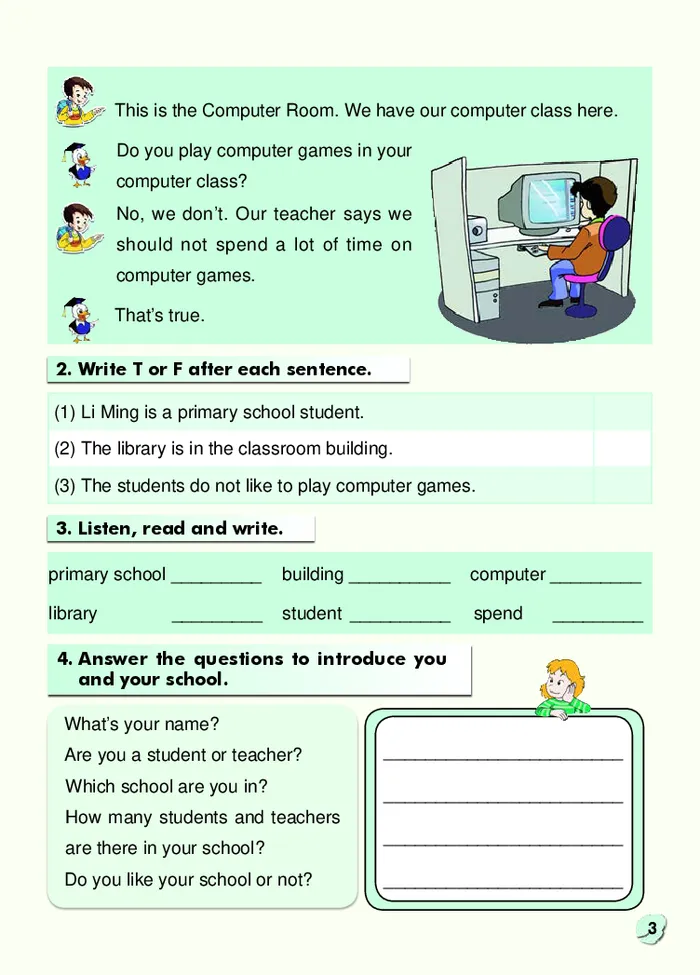
This is the Computer Room. We have our computer class here.
Do you play computer games in your
computer class?
That’s true.
No, we don’t. Our teacher says we
should not spend a lot of time on
computer games.
primary school _________ building __________ computer _________
library
_________ student __________ spend _________
3. Listen, read and write.
2. Write T or F after each sentence.
4. Answer the questions to introduce you
and your school.
(1) Li Ming is a primary school student.
(2) The library is in the classroom building.
(3) The students do not like to play computer games.
_______________________
_______________________
_______________________
_______________________
What’s your name?
Are you a student or teacher?
Which school are you in?
How many students and teachers
are there in your school?
Do you like your school or not?
3
How do you use the classroom bulletin board?
That’s interesting.
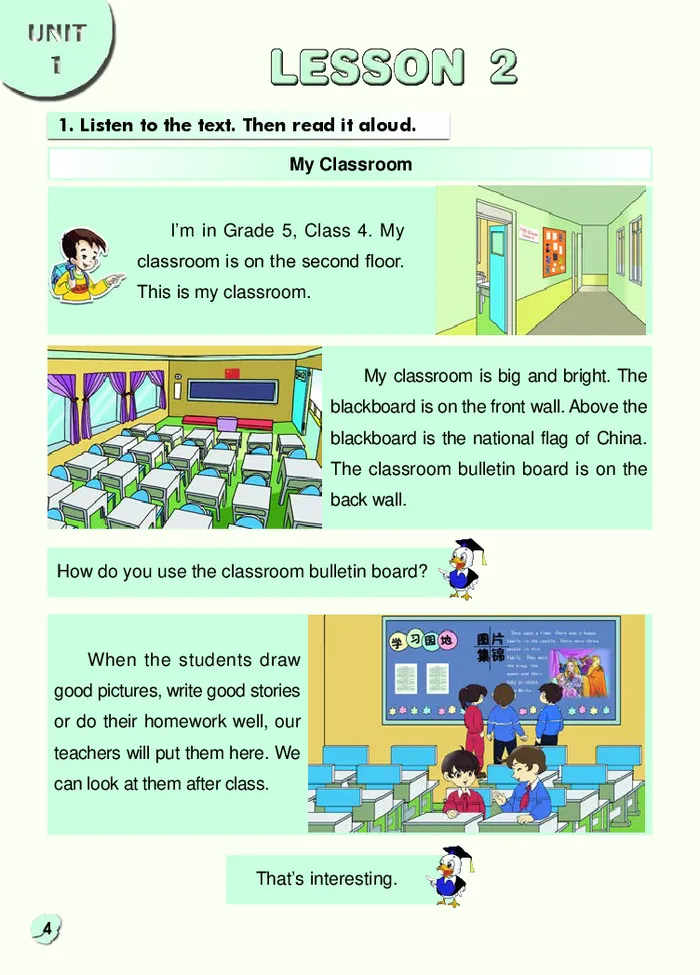
I’m in Grade 5, Class 4. My
classroom is on the second floor.
This is my classroom.
My classroom is big and bright. The
blackboard is on the front wall. Above the
blackboard is the national flag of China.
The classroom bulletin board is on the
back wall.
When the students draw
good pictures, write good stories
or do their homework well, our
teachers will put them here. We
can look at them after class.
My Classroom
1. Listen to the text. Then read it aloud.
4
2. Finish the sentences with words from the text.
4. Finish the puzzle with the words from the word box.
(1) Li Ming’s classroom is on the ________ floor.
(2) The classroom has large windows. It is big and ________.
(3) The blackboard is on the ________ wall. Above the blackboard is the
national flag of ________. The classroom bulletin board is on the
________ wall.
bright __________
flag
__________
national flag __________
write __________
China __________
bulletin board __________
3. Listen, read and write.
Across: class
floor
grade
classroom
Down:
school
blackboard
door
window
b
c
c
k
f
l
g
d
d
s
l
s
s
m
w
w
5
Every student brings a book to the library. You can see
different kinds of books: picture books, storybooks and science
books. Look, this is a science book. It is about plants.
This book is interesting. Who brought it to the library?
Oh, you have a nice
class library. Where do
the books come from?
Ma Li brought it to the library. He likes plants very much.
Growing plants is fun. You dig a hole
in the ground and put seeds in the hole.
Then you cover the seeds with earth.
Then the plants begin to grow. They
come out of the earth. Leaves grow and
flowers open.
My Class Library
1. Listen to the text. Then read it aloud.
6
(2) When you finish your homework,
I’ll take you to the library.
(1) When I go to the park with my
mom, I bring an umbrella.
(3) Many plants grow from seeds.
(1) The teachers buy the books for the class library.
(2) There are science books and storybooks in the class library.
(3) Ma Li likes growing plants in the garden.
5. Match each sentence to the correct picture.
2. Write T or F after each sentence.
bring __________ brought ___________
library __________
science __________ seed ___________ interesting __________
3. Listen, read and write.
4. Write the three steps to grow plants.
(1) ________________________________________________________
(2) ________________________________________________________
(3) ________________________________________________________
7
We take turns being the monitor.
Zhao Xiaomei is our monitor this month.
I’ll be the monitor next month.
Who is your monitor?
I sit in the second row. In front of
me is Chen Xi. To my left is Li Kuan.
To my right is Gao Xiaoqiang. Behind
me is He Yan.
Where do you sit?
There are forty-two students
in my class, twenty girls and
twenty-two boys.
About My Class
1. Listen to the text. Then read it aloud.
8
2. Answer the questions.
4. Listen to the story. Then tick the correct answer.
(1) What’s a good name for the story?
A. My Uncle and His Family B. Fun with My Cousin C. Good Friends
(2) Why did Susan run after the boy?
A. She wanted to play with the boy. B. She ran slower than the boy.
Mom said that my uncle and his family were coming to visit us.
One sunny day, they came in a big red car. My
uncle and aunt got out of the car. Then a girl got out.
Mom said she was my cousin, Susan. Susan saw me.
“Hi,” she said. “Let’s play.”
“No,” I said. I began to run. She
ran after me.
I climbed up the tree. She was behind me.
“Hello,” I said to her.
“Hi,” she said with a smile.
We played together. We had a lot of fun.
in front of __________
behind __________
left
__________
right
__________
monitor __________
take turns __________
3. Listen, read and write.
(1) Who sits in front of Li Ming?
________________________________________________________
(2) Who is the monitor of Li Ming’s class this month?
________________________________________________________
9
We run and jump. We do the long jump and the high
jump. We also do sit-ups.
What’s your favorite subject?
What do you do in your P.E. class?
We study Chinese, math, English
and many other subjects. We
have six classes every day.
What subjects do you study
at school?
Mon.
Tues.
Wed.
Thurs.
Fri.
8:00-8:40
Chinese
Math
Chinese
Reading
Math
8:50-9:30
Math
Chinese
Math
Math
Chinese
10:10-10:50
P.E.
Art
English
English
Health
11:00-11:40
English
English
P.E.
Society
P.E.
Lunch Break
1:30-2:10
Science
Writing
P.E.
Music
Writing
2:30-3:10
Class Meeting
Music
Computer
Art
Music
My School Subjects
1. Listen to the text. Then read it aloud.
My favorite subject is P.E.
We play basketball, football, table tennis and badminton.
10
(1) Li Ming studies Chinese, math, English and many other _________.
(2) Li Ming’s favorite subject is _________.
(3) In the P.E. class, the students do the long jump and the _________ jump.
2. Finish the sentences with words from the text.
5. Listen to the dialogue. Then work in pairs.
I study in Yuxin Primary School.
Yes, we do.
Four times. What about you?
I’m a student in Chenhui Primary School. Where do you study?
Do you study English?
Four times, too.
How many times each week do
you have English class?
subject __________
study
__________ P.E. class __________
high jump __________
long jump __________ sit-up
__________
3. Listen, read and write.
(1) How many sit-ups can you do in one minute?
________________________________________________________
(2) Do you like to do the high jump? What about the long jump?
________________________________________________________
4. Answer the questions.
11
We kick the shuttlecock, play with
yo-yos, jump rope and play games.
We play many different kinds of games.
Many students like to throw beanbags.
We throw beanbags in different ways. One way is this: Some children
stand somewhere. Another child throws the beanbag and tries to hit one of
them. We also play it this way: We draw some circles on the ground. We
try to throw the beanbag into the circles.
No, we don’t. Our teacher says
chasing each other in the schoolyard is
dangerous. Our school rule says, “Don’t
chase each other in the schoolyard.”
Do you play tag?
That’s true.
What do You Do Between Classes?
1. Listen to the text. Then read it aloud.
What games do you play?
How do you throw beanbags?
What do you do between classes?
12
5. Look at the following signs. They are park rules. Write a sentence
to tell what each sign says. The first one is done for you.
Tag is a children’s game. Some
children run. One child chases them
and tries to touch one of them.
4. Listen to the text. Then answer the questions.
(1) Do you play tag with your friends? ____________________________
(2) Where do you think you can play tag? _________________________
Don’t skate in the park.
game __________
beanbag
__________
tag __________
chase __________
schoolyard __________
rule __________
3. Listen, read and write.
(1) The teachers tell the students what to do between classes.
(2) Some students throw beanbags between classes.
(3) Children chase each other when they play tag.
2. Write T or F after each sentence.
___________________
___________________
___________________
___________________
13
1. Write a sentence for each picture with the correct word or group
of words from the word box. The first two are done for you.
on beside up in front of under between down behind
The ball is going
down the slide.
_____________
_____________
_____________
_____________
The ball is behind
the chair.
_____________
_____________
_____________
_____________
_____________
_____________
_____________
_____________
_____________
_____________
_____________
_____________
14
2. Listen to the story. Tick the word in the ( ) to finish each sentence.
Then answer the questions.
3. Let’s sing!
The Hokey Pokey
Hey, you put your right hand in;
You put right hand out;
You put your right hand in,
And you shake it all about.
You do the Hokey Pokey,
And you turn yourself around.
That’s what it’s all about.
Do you like _________ (reading, writing)? I do.
When you read, do you want a _________ (friend, pet) with you? I
do. I read to my _________ (pet, little) dog, Browny.
Browny is my _________ (good, great) friend. He always has
_________ (time, money). When I say, “Browny, it’s story time,” Browny
will run to me, sit beside me and wait for me to
begin. When I _________ (begin, finish) reading,
he will look at me and smile. He wants to say, “I like
your _________ (story, reading).”
I love reading. I love my pet dog, too.
(1) When the girl reads a story, who listens to her?
________________________________________________________
(2) What does Browny do when the girl finishes reading a story?
________________________________________________________
15
16
My hobby is playing the violin.
His hobby is playing badminton.
Her hobby is swimming.
Their hobby is painting.
What’s your hobby?
U N I T 2
WHAT’S YOUR HOBBY?
WHAT’S YOUR HOBBY?
17
18
1. Listen to the text. Then act it out.
It is evening. Wei Fang and her family are having dinner. She is talking
about her school.
In my Chinese class today, my teacher asked us to talk about
our hobbies. My classmates had so many different kinds of hobbies.
What were they?
Some students liked sports, music and art. Some liked to take
care of animals. Some liked to watch the stars.
That was a lot.
Did you talk about your hobby?
No. My teacher asked us to write about our hobbies after class.
She also asked us to interview our family members.
Are you going to interview us?
Yes, Grandpa. Can I begin with you?
Sure.
Talking About Hobbies
Wei Fang:
Grandma:
Wei Fang:
Mother:
Father:
Wei Fang:
Grandpa:
Wei Fang:
Grandpa:
19
3. Learn them.
hobby — hobbies family — families party — parties
baby — babies
teach — teacher
sing — singer
dance — dancer write — writer
chair
classmate schoolyard
about
many
_________
_________
_________
_________
_________
chair watch
beach
Christmas teacher
5. Fun with words.
(1) Find a short word in the longer word. Then write it on the line.
(2) Put the two short words together to make a longer word.
(3) Circle the word whose letter group ch does not sound like the ch in peach.
class + room = ______________
star + fish = _________________
bean + bag = _______________
black + board = _____________
(1) Wei Fang and her family are talking about their hobbies.
(2) Some of Wei Fang’s classmates like art.
(3) Wei Fang’s grandpa asked Wei Fang to interview him first.
4. Finish the sentences with the words from the word box.
2. Write T or F after each sentence.
hobby classmates interview members begins
(1) My __________ is reading. What’s your hobby?
(2) The driver saved the kid. Many reporters wanted to __________ him.
(3) Lions are __________ of the cat family.
(4) My English teacher often __________ her
class with an English song.
(5) Jane is nice. All my __________ like her.
20
My grandpa loves growing flowers. He grows flowers in his garden.
Today I interviewed him about flower growing.
Wei Fang: Grandpa, why do you love growing flowers?
Grandpa: I love flowers. I love to see the different shapes, colors and
sizes of the flowers. I love to smell the flowers, too. I love to see
butterflies flying around the flowers. I love to hear the buzzing
sound of bees.
Wei Fang: But growing flowers is a lot of work. You need to plant seeds
and water them.
Grandpa: That’s true. But I love the work. I stay outside. I get fresh air and
sunlight. I get good exercise, too.
Wei Fang: That’s great!
Grandpa and Flower Growing
1. Listen to the text. Then act it out.
21
hear __________ smell __________
sunlight __________
garden __________ size __________
exercise __________
3. Listen, read and write.
2. Write T or F after each sentence.
(1) Grandfather likes to work in his garden.
(2) There are different kinds of flowers in Grandfather’s garden.
(3) Grandfather does exercise in his garden every day.
bee
hear
crow
like
need
_________
_________
_________
_________
_________
(1) Change one letter to make a new word. Then write it on the line.
welcome
work
butterfly
grow
begin
_________
_________
_________
_________
_________
(2) Find a short word in the longer word. Then write it on the line.
5. Fun with words.
4. Finish the sentences with the words from the word box.
exercise sunlight seeds see hear smell
(1) He saw the bear ________ the man and leave.
(2) Farmers plant _______ in spring.
(3) We do morning ________ every day.
(4) I listened, but I did not _________ any sound.
(5) It’s important to get enough fresh air and ________ every day.
(6) Tigers come out to find food at night. They can ________ well in the dark.
22
My grandma loves sewing. She sews many different kinds of things.
Today I interviewed my grandma about sewing.
Wei Fang: Grandma, why do you love sewing?
Grandma: Sewing is great! It allows me to do many wonderful things. I can
sew bags, gloves and clothes. I can make new things with old
things. I can make my clothes bigger or smaller. I can also make
a piece of art.
Wei Fang: That’s wonderful! Do you use a sewing machine, or do you sew
by hand?
Grandma: I love sewing by hand and I use a sewing machine, too.
Wei Fang: I want to learn sewing, too!
Grandma and Sewing
1. Listen to the text. Then act it out.
23
4. Look at the picture. Read the sentence. Tick the choice that best
follows the sentence.
5. Learn the proverb. Then translate it into Chinese.
sew __________ allow __________ sew by hand __________
machine __________ learn __________ sewing machine __________
3. Listen, read and write.
(1) Grandma can make a pair of trousers shorter.
(2) Grandma loves sewing because sewing is good exercise.
2. Write T or F after each sentence.
(2) My grandmother can sew by hand.
A. She can also use a sewing machine.
B. She is 70 years old.
(1) A robot is a machine.
A. It can do many different things.
B. Look at the robot.
(3) We wash big things with a washing machine.
A. I do not like washing clothes.
B. We wash small things by hand.
It’s never too late to learn.
______________________
24
My Father and Bird Watching
My father loves bird watching. He reads a lot about birds. He goes
to many places to watch birds. I interviewed my father about bird
watching today.
Wei Fang: Father, why do you go bird watching?
Father:
Birds are beautiful and I love to watch them. I love to travel, too. I
love to go to the fields, forests and lakes. I can watch birds and
see great places of our country.
Wei Fang: Bird watching is interesting. What do you need to go bird watching?
Father:
Not much. All I need is a good pair of binoculars, a notebook and
a pencil. I have a good camera, too.
Wei Fang: Bird watching is a great hobby. Can I go with you next time?
Father:
Sure!
1. Listen to the text. Then act it out.
25
begin
pair
pencil
notebook
good
_________
_________
_________
_________
_________
3. Finish the sentences with the words from the word box.
(1) China is a big and beautiful ___________.
(2) We listen to our teachers and write important things in our ___________.
(3) Winter is a good time for bird ___________.
(4) Bob used his ___________ to look at the moon.
(5) A ___________ is a kind of machine. People use it to take photos.
2. Finish the sentences to answer the questions.
watching country binoculars camera notebooks
(1) Find a short word in the longer word. Then write it on the line.
4. Fun with words.
about
outside
country
cow
mouth
(2) The letter group ou or ow can sound like the ou in house. Circle the
word whose letter group ou or ow does not sound like the ou in house.
(1) What hobby does Wei Fang’s father have?
His hobby is _____________________________________________.
(2) Where does Wei Fang’s father go to watch birds?
He goes to the __________, __________ and __________.
(3) Why does Wei Fang’s father go bird watching?
Because he loves to __________ birds, and he loves to __________, too.
(4) What do we need to go bird watching?
We need a pair of __________, a __________ and a __________.
26
Many people like walking. Hiking is a long walk. My mother loves
hiking. I interviewed my mother about hiking today.
My Mother Loves Hiking
Wei Fang: Mom, why do you love hiking?
Mom:
Hiking is great exercise. It is easy, too. You put on your hiking
shoes, take a bottle of water and go outside. You can hike in
the forests and in the countryside. You can climb over a rock
and jump across a small river.
Wei Fang: Do you like to hike alone or with a group?
Mom:
Both. Hiking alone is great. You feel free to do a lot of things. You
can stop and take photos. You can sit down and rest. I like hiking
with a group, too. You can talk with people and make friends.
Wei Fang: Hiking is a great hobby!
1. Listen to the text. Then act it out.
27
(1) Why does Wei Fang’s mother like to hike?
________________________________________________________
(2) What do we need to go hiking?
________________________________________________________
(3) Does Wei Fang’s mother like hiking alone or with a group?
________________________________________________________
3. Finish the sentences with the words from the word box.
group alone hiking free easy
(1) It is ________ to ride a bike.
(2) I do not like to stay ________ at home.
(3) Every student in my ________ had a good time.
(4) Autumn is the best season to go ________.
(5) I have no homework today. I am ________ to do what I want to.
lot
hike
good
man
walk
_________
_________
_________
_________
_________
mother gloves alone love some
(1) Change one letter to make a new word. Then write it on the line.
(3) The letter o can sound like the u in bus. Circle the word whose letter o
does not sound like the u in bus.
bowl dish chopsticks bird glass
(2) Circle the word that does not belong.
4. Fun with words.
2. Answer the questions.
28
My hobby is swimming. I go swimming three times a week.
I love swimming for three reasons.
First, swimming is great exercise. When you swim, you need to use
different parts of your body. You use your hands, arms, legs, neck and feet.
When you feel tired after working or studying, you can go swimming.
You will feel good after you swim.
Second, I like the different ways to swim. The butterfly is my favorite. It is
difficult to learn, but it is beautiful and it can be very fast.
Third, swimming is fun. I love swimming on hot summer days. I like to
jump into the water and cool down. I love swimming on cold winter days,
too. I feel great when I jump into the cold water.
My Hobby is Swimming
1. Listen to the text. Then act it out.
29
(1) When you swim, you use different parts ________ your body.
(2) I love swimming ________ both hot days and cold days.
(3) I love swimming ________ three reasons.
(4) I feel good ________ I swim.
(5) I feel great when I jump ________ the cold water.
4. Answer the questions to introduce your hobby.
What’s your hobby?
When do you do it?
For how many reasons do you like it?
What are the reasons you like it?
hobby reason part neck learned difficult
(1) The giraffe has a long ________.
(2) I don’t want to go to her party. What’s a good ________ to say no?
(3) I _______ to ride the bike when I was eight years old.
(4) Swimming is my favorite ________.
(5) It is _______ to write a good story.
(6) Leaves are an important _________ of a tree.
2. Finish the sentences with words from the text.
3. Finish the sentences with the words from the word box.
__________________________________________________
__________________________________________________
__________________________________________________
30
1. Fill in the information about Wei Fang and her family.
People
Hobby
Reasons for Having the Hobby
Grandpa
Grandma
Father
Mother
Wei Fang
2. Suppose you are a reporter. Interview a person about his or
her hobby.
(1) Answer the questions.
a. Who did you interview?
_________________________________________________________
b. What’s his or her hobby?
_________________________________________________________
(2) Use the questions to interview the person. Write your interview on the lines.
What’s your hobby?
_____________________________________________________
That’s great!
Why do you love it ?
_____________________________________________________
_____________________________________________________
31
3. Finish the sentences with the words from the word box.
exercises garden reason allow learn begin
(1) Walking, running and jumping are all good ________ for our health.
(2) Bad weather was the ________ why we did not have school yesterday.
(3) It’s eight o’clock. Let’s ________ our class.
(4) We have a nice vegetable ________ in front of our house.
(5) My parents do not ________ me to eat a lot of candy.
(6) I began to ________ to play the piano when I was five years old.
4. Finish the puzzle with the words from the word box.
neck
reason
hobby
notebook classmate free
schoolyard member
interview alone
smell
study
part
camera
country
exercise
machine
group
allow
interesting
Across:
Down:
n
n
e
x
c
f
i
n
a
t
s
m
s
y
i n
m
p
r
h
g
r
32
What do you see in the picture?
It’s pollution.
Our environment is badly polluted.
To save the Earth,
Let’s protect our environment.
32
32
U N I T 3
THE ENVIRONMENT
AND US
THE ENVIRONMENT
AND US
33
34
The Earth is where we live. There
are many things on the Earth.
Our environment is all the things
around us. People, animals and plants
are parts of our environment. Air, water
and soil are also parts of our environment.
Environments are different. Some
environments are hot and others are
cold. Different animals live in different
environments. Penguins live on ice
and camels live in deserts.
Some environments are wet and
others are dry. Many plants grow in
wet environments, and some plants
grow in dry environments.
1. Listen to the text. Then read it aloud.
Our Environment
34
(1) Our environment is all the things ________ us.
(2) Penguins live ________ ice. Camels live ________ deserts.
(3) People, animals and plants are parts _________ our environment.
thing __________
environment __________
part
__________
ice
__________
penguin __________
camel __________
3. Listen, read and write.
2. Finish the sentences with words from the text.
I am a large animal.
I have long legs and a long neck.
I live in the desert. I carry people
and things across the desert.
What am I?
I am a _____________________.
5. Work out the riddle. Write the answer on the line. Then tick
the picture.
4. Listen to the dialogue. Then work in pairs.
Jane: Hello, Tom. Do you like your home environment?
Tom: Yes, I do. I have a great home environment. I have a beautiful
garden. There is a big supermarket near my home. I live near my
school. I walk to school every day.
Jane: Do you have a cinema near your home?
Tom: No, I don’t. I don’t often see films.
Jane: I like to see films. I have a cinema near my home.
Tom: Good for you!
35
36
What is AIR?
We cannot see it, smell it or
touch it, but it is all around us.
We can feel it when it moves. Blow up a
balloon and tie it with a string. Then open it
and let its mouth face you. What do you feel?
Air is important. People and
animals need air to breathe.
Plants need air to grow.
Sadly, some air is not clean.
People make the air dirty when
they drive cars. They make the
air dirty when they throw trash on
the ground.
Dirty air is bad for the environment.
It can make people and animals ill. It can
also kill plants. Let’s keep the air clean!
Yes. You feel air — fast moving air!
Air
1. Listen to the text. Then read it aloud.
36
3. Listen, read and write.
blow __________
balloon __________ string __________
move __________
sadly __________
kill
__________
(1) Air is important. People and animals need air to _________. Plants
need air to _________.
(2) Dirty air is _________ for the environment. It can _________ people
and animals ill. It can also _________ plants.
4. Write a few sentences for each picture to tell how to take care
of the air.
_______________________________
_______________________________
_______________________________
_______________________________
_______________________________
_______________________________
_______________________________
_______________________________
_______________________________
2. Finish the sentences with words from the text.
Cars make the air dirty. To help keep the
air clean, we should share cars. We
should take buses, ride bikes or walk.
37
38
Water is important. People and
animals need water to live. Plants
need water to grow.
Sadly, people waste a lot of
water. They waste water when they
keep water running. They waste
water when they water plants.
People make water dirty, too. They
make water dirty when they throw
trash into rivers and lakes.
Water
There is salt water and fresh water
on the Earth. Salt water is water from
seas and oceans. Fresh water is water
from rivers and lakes.
We can only use fresh
water, but there is not much fresh water on the Earth.
Water is important.
Let’s save water! Let’s keep water clean!
1. Listen to the text. Then read it aloud.
38
a.
b.
3. Listen, read and write.
salt __________ fresh __________
waste
__________
sea __________ ocean __________ environment __________
(1) What is fresh water?
Fresh water is ___________________________________________.
(2) What are the two ways people waste water?
a. ________________________________________________________.
b. ________________________________________________________.
(3) How do people make water dirty?
_______________________________________________________.
4. Fun with words.
lake
waste
water
make
name
sadly
bag
trash
salt
animal
c__ __ f__ __l w__ __l sh__ __k s__ __t f__ __mer t__ __l
ar words: _____________________ al words: ____________________
a. We talked about pandas in our Chinese class today.
b. I can’t find my ball and my balloon. Who took them?
c. People throw away a lot of things every day.
(1) Circle the word whose red letter a does not make the same sound.
(2) Finish the word with the letter group ar or al. Then write the words on the
correct lines.
(3) Read the sentences. Circle the words whose letter a in red sounds like the
a in allow.
2. Finish the sentences to answer the questions.
39
40
Most trash comes from our home. We can keep our environment
clean by throwing away fewer things.
One way to throw away fewer things is to reuse them. We do not
throw away our old things. We give our old books to students at a lower
grade. We give our old clothes to younger children. We can also use old
things to make new things.
We throw away a lot of trash every day and
make our environment dirty. People get ill in a
dirty environment. Animals and plants cannot
live in a dirty environment.
Another way to throw away fewer things is to recycle. We put bottles and
other things in the right places. Then we recycle them and use them again.
Reuse and Recycle
Let’s reuse and recycle!
Let’s keep our environment clean!
1. Listen to the text. Then read it aloud.
40
(1) Where does most trash come from?
Most trash ______________________________________________.
(2) What are the three ways we can do to throw away fewer things?
a. _______________________________________ at a lower grade.
b. _______________________________________ to younger children.
c. _______________________________________ to make new things.
(3) How do we recycle?
________________________________________________________
(4) What old things do you have? What do you want to do with them?
________________________________________________________
________________________________________________________
3. Finish the sentences with the words from the word box.
(1) Old things, empty bottles and waste food are all
________.
(2) Oh, the chair is too _________ for the high desk.
We need a higher chair.
(3) Children are _________ people. Grandpas and
grandmas are old.
(4) We should all reuse and _________ to help save
our environment.
2. Finish the sentences to answer the questions.
young low recycle trash
41
42
Trees are important in many ways.
Trees are important to animals.
Monkeys and squirrels spend much
of their time in trees. Birds make their
homes in trees. Cats climb up trees
when dogs chase them.
Trees are important to the environment.
They clean the air and water. They give us
shade and keep the Earth cool. They help slow
down the wind and stop sand from moving.
Sadly, people cut down many trees
in the forests. They use the land to grow
crops. This is bad for our environment. It
hurts the animals and the environment.
Let’s Protect the Trees
Trees are important. Let’s protect the trees!
1. Listen to the text. Then read it aloud.
42
4. Listen, read and write.
protect __________
land
__________
environment __________
chase __________
shade __________
important
__________
3. Write two ways of your own to show trees are important.
________________________________________________________
________________________________________________________
Miss Ma: Hello, class. Can you tell me what we can do
with ____________?
Li Ming: We can make ____________ and ____________
with trees.
Jane:
We can make ___________ with trees.
Cathy: We can build ___________ with trees.
Miss Ma: Yes. We can use trees to do a lot of things.
But should we cut down a lot of trees in the
____________?
Li Ming: No, we shouldn’t. We should ____________ the trees.
Miss Ma: You’re right. Trees are ____________ to the environment. We
should protect the trees!
2. Write T or F after each sentence.
5. Listen to the dialogue. Fill in the missing words.
(1) Some animals climb up trees when they are in danger.
(2) Trees keep the Earth cool because they give shade.
(3) People should cut down trees and use the land to grow crops.
43
44
People destroy the environment
and kill animals. Many animals are
in great danger.
Pandas live in the bamboo forests.
Bamboo is their favorite food. Sadly,
people cut down bamboo trees. Pandas
cannot find safe places to live. They
cannot find enough food to eat. They
are in danger.
Elephants are great animals. Some
people kill them for their teeth. They use
the teeth to make many things. Elephants
are in danger.
Let’s Save the Animals
1. Listen to the text. Then read it aloud.
Many animals are in danger.
Let’s save the animals!
44
3. Listen, read and write.
destroy __________
safe __________
in danger
__________
panda __________
save __________
bamboo forest __________
Farm animals: _______________________________________________
Wild animals: _______________________________________________
(1) Why are some animals in danger?
_________________________________________________________
(2) Where do pandas live? What’s their favorite food?
_________________________________________________________
5. Project: We can help to save animals that are in danger. Choose
your favorite animal. Make a poster and tell people to save the
animal. The first one is done for you.
4. Read the words in the word box. Write them on the correct lines.
shark
elephant
cow
tiger
penguin
camel
chicken
crocodile
lion
sheep
panda
rooster
2. Answer the questions.
Pandas are great animals.
Let’s save our pandas!
HELP OUR PANDAS
45
46
1. Listen, look and say. Fill in the missing letters.
2. Match the opposites.
dry
dirty
bad
old
high
dangerous
good
young
safe
wet
clean
low
3. Finish the sentences with the words from the word box.
blows cut kill move protect recycle save waste
(1) Trash in the water can __________ fish.
(2) Don’t __________ money. Don’t waste time.
(3) When the wind __________, the temperature is low. When the sun is
out, the temperature is high.
(4) People __________ down the trees in the forests. Some animals have
no place to live.
(5) People and animals can __________. Plants cannot move.
(6) Some animals are in danger. What can we do to __________ them?
(7) One way to throw away fewer things is to __________.
(8) Trees are very important. Let’s __________ the trees and keep our
environment green.
__ __ __guin
re__ __ __
en__ __ __onment
__ __sert
__ __ __mal
recy__ __ __
__ __ __da
__ __ __est
destr__ __
__ __ve
__ __ll
pro__ __ __ __
46
4. Look at the picture. Write two sentences to tell whether it helps
or hurts the environment.
5. Let’s sing!
Cars make the air dirty.
They hurt the environment.
______________________
______________________
______________________
______________________
______________________
______________________
______________________
______________________
___________________
______________________
Edelweiss, edelweiss, every morning you greet me.
Small and white, clean and bright,
You look happy to meet me.
Blossom of snow, may you bloom and grow,
Bloom and grow forever.
Edelweiss, edelweiss, bless my homeland forever.
Edelweiss
47
I have a good friend.
His name is Billy.
He is a lot of fun.
He always makes me laugh.
Do you want to read about Billy?
If you do, let’s begin now.
48
49
U N I T 4
BILLY’S ADVENTURES
BILLY’S ADVENTURES
49
50
1. Listen to the story. Then read it aloud.
Billy waited. Many fish came: big fish
and little fish, fat fish and thin fish, red
fish and yellow fish. They looked at the
food on the hook and then swam away.
Billy put more food on the hook. “Come
here, Fish. Come eat the food, please.” Billy
saw a big fish near the hook. He put his paw
into the water to catch it.
SPLASH! Billy fell into the lake! The
water was cold. Billy was cold, too.
Billy Went Fishing
It was a nice autumn day. Billy
the Cat went fishing in a lake. Billy sat
down. He put some food on the hook,
and then put the line into the water.
51
3. Listen, read and write.
hook __________ line __________ more
__________
paw __________ splash __________ go fishing __________
5. Listen to the story. Then finish the sentences.
There are many different kinds of fish in the world. All fish live in water.
We can see fish in lakes, rivers, seas and oceans.
Many animals like to eat fish, but different animals catch fish in different
ways. Sharks like to eat fish. This is how they catch fish.
Some sea birds like to eat fish. This is how they catch fish.
Crocodiles like to eat fish. This is how they catch fish.
People like to eat fish, too. Do you know how people catch fish?
(1) Fish live in _________, _________, _________ and _________.
(2) Different animals _________ fish in different _________.
4. Match the verbs with their past tense. Then read them.
waited fell put saw came went was sat looked swam
is wait look put go come sit swim fall see
2. Write T or F after each sentence.
(1) Billy went fishing in a lake.
(2) Billy jumped into the water to catch a big fish.
52
1. Listen to the story. Then read it aloud.
Billy the Cat went to fly a kite. It was windy. That
was great! Billy let the string of the kite go little by
little. The wind took the kite up, up and up.
Billy was so happy that he clapped his
hands. The string of the kite flew out of his
hands. Billy jumped up to catch the string.
“Hooray, I got it!” Billy
caught the string. Then he
felt light. What happened?
The kite carried Billy into
the sky!
Billy and the kite flew
high up in the sky. They
flew so high that Billy was
very afraid.
Billy Went to Fly a Kite
53
Jenny, look here. There will be a kite
day in the Children’s Park this Saturday.
That’s interesting. Can we buy a kite?
We can take the kite to the park.
We can make a kite.
Really? When can we begin?
Right now.
4. Listen to the dialogue. Then work in pairs.
2. How can Billy return to the ground?
Write a few sentences to solve the problem.
3. Match the verbs with their past tense. Then read them.
clapped felt let got took carried flew happened caught
happen clap let carry take catch feel get fly
______________________________________________
______________________________________________
______________________________________________
______________________________________________
______________________________________________
______________________________________________
54
1. Listen to the story. Then read it aloud.
Billy put up his tent and went
inside. He wanted to take a rest. Then
he heard the buzzing sound of bees
outside the tent. Billy liked bees. He
got up and went out to look.
Billy the Cat went camping in a field.
He saw a lot of flowers: pink flowers,
yellow flowers and red flowers. Bees and
butterflies were flying around the flowers.
It was a good place for camping!
“Hooray, I got it!” Billy caught
the string. Then Billy felt light.
What happened?
Billy and the kite flew up, up
and up. They flew so high in the
sky. Billy was scared.
Billy Went Camping
Billy saw many bees making
honey in the hole in a tree. He put
his paw into the hole.
“Oh, no,” Billy began to scream.
The bees stung him on his right
arm. His arm was red and hurt a lot.
55
(1) Billy went camping and slept in the tent.
(2) Billy saw some bees making honey in the hole in a tree.
(3) Billy got some honey from the tree.
(4) The bees stung Billy on his arm.
3. Listen, read and write.
inside ____________ camp ____________ go camping ___________
outside ____________ sting ____________ scream ___________
4. Match the verbs with their past tense. Then read them.
was got were put liked stung saw heard went began
like is are go see put hear get begin sting
inside
outside
yellow
happen
tent
_________
_________
_________
_________
_________
earth
heard
bird
hurt
bear
cat
tent
then
camp
take
_________
_________
_________
_________
_________
5. Fun with words.
(1) Change one letter to make a new word. Then write it on the line.
(2) Find a short word in the longer word. Then write it on the line.
(3) Letter groups ear, ir and ur can all sound like the letter group ear in early.
Circle the word whose letter group in red does not make that sound.
2. Write T or F after each sentence.
56
1. Listen to the story. Then read it aloud.
Billy the Cat was watching TV.
A magician was doing magic tricks.
Billy saw the magician put a knife into his
mouth and swallow it.
Billy was afraid, but the magician was
not. The magician coughed, and the knife
came out.
“That’s wonderful!” Billy wanted to do
magic tricks, too.
Billy picked up a building block. He put it
in his mouth and swallowed it. Then he began
to cough, but the block did not come out.
Billy felt very ill. He went to
see a doctor. The doctor pulled
out the block with a hook.
“Don’t try magic tricks again,”
said the doctor. “It’s dangerous.”
“I see,” said Billy. “Thank
you, Doctor.”
Billy Tried to Do Magic Tricks
57
3. Listen, read and write.
magician __________ magic trick __________
knife __________
swallow __________ building block __________
cough __________
4. Write numbers for the sentences to show the correct order of
the story.
Billy felt very ill. ________
Billy was watching TV. ________
Billy swallowed a building block. ________
Billy saw a magician doing tricks. ________
Billy saw the man swallow a knife. ________
Billy wanted to do magic tricks, too. ________
A doctor pulled out the building block for Billy. ________
The man coughed a little and the knife came out. ________
Teachers: Teachers teach at school.
Magicians: ____________________
Doctors: ______________________
Farmers: ______________________
5. Write a sentence to tell about the job. The first one is done for you.
2. Write T or F after each sentence.
(1) The magician swallowed a knife and coughed it out.
(2) Billy swallowed a building block.
(3) Billy went to see a doctor because he had a cough.
_____________________
58
1. Listen to the story. Then read it aloud.
Billy the Cat went to visit his
friend, Rover.
Rover kept some pet dogs. Billy loved
dogs. He wanted to play with them.
Billy saw three little dogs in the basket:
a little brown dog, a little black dog and a
little white dog.
Billy liked the little white dog, Snowy.
He pulled its tail. Snowy yelped. The mother
dog was angry. She bit Billy’s arm and took
Snowy away.
Billy Went to Visit His Friend
“Oh, no!” screamed Billy.
“My arm hurts!”
“Don’t pull a dog’s tail,”
said Rover. “It’s dangerous.”
59
(1) How many dogs are in the basket?
A. Two. B. Three. C. Four.
(2) Which is Snowy?
A. The brown dog.
B. The black dog.
C. The white dog.
visit ____________
bite ____________
bit
____________
pull ____________
yelp ____________
basket ____________
3. Listen, read and write.
2. Tick the correct answer.
Tina: Hello, Lily. Look at my ___________ dog.
Lily: Oh, no. Don’t come near me. I’m ___________
of dogs.
Tina: Why? Dogs are good pets. I ___________ dogs.
Lily: You know, dogs ___________, don’t you?
Tina: Yes. Some dogs bite.
Lily: My mom says I should ___________ away from dogs.
You don’t know which dog bites.
Tina: That’s true.
Let sleeping dogs lie.
_________________
4. Listen to the dialogue. Fill in the missing words. Then work in pairs.
5. Learn the proverb. Then translate it into Chinese.
60
1. Listen to the story. Then read it aloud.
Billy the Cat had a bike. He could
ride well. He delivered newspapers to
people’s homes every day.
One day, Billy rode past a river. There
was a lot to see. Ducks were swimming. A
man was fishing. A boy was playing with
his toy boat on the water.
“It’s fun to play with a boat on the
water,” thought Billy. Billy got off his
bike. He took out a newspaper from
his bag and made a boat. He put the
boat on the water. The boat began
to move!
Billy got on his bike. He watched
his boat moving on the water. He did
not see a rock in front of him. His bike
hit the rock.
Billy Delivered Newspapers
61
______________________________________
______________________________________
______________________________________
4. Listen to the text. Fill in the missing words. Then answer the questions.
3. Finish the sentences with the words from the word box.
2. Write a few sentences to finish the story.
delivers newspapers past begins move
(1) The film _____________ at seven. We have 10 minutes left.
(2) My father reads _____________ in the evening.
(3) The man _____________ milk to my home every morning.
(4) He ran _____________ me and waved to me.
(5) Boats and ships _____________ on water. Cars run on land.
(1) What is in a newspaper?
_______________________________________________________
(2) How can we get newspapers to read?
________________________________________________________
A ________ is a few large pieces of ________. It has news, stories,
pictures and some other things in it.
Many people like to ____________
newspapers. They buy newspapers in a
________, or they let people ________
newspapers to their homes. They read
newspapers in the library, too.
62
1. Follow the directions.
2. Write a riddle for each picture. The first one is done for you.
(1) What things did Billy do?
________________________________________________________
________________________________________________________
(2) What things do you like to do?
________________________________________________________
(3) What do you like to do best?
________________________________________________________
I live in water. I can swim. Many animals like
to eat me. People like to eat me, too.
What am I?
62
63
3. Let’s sing!
The Grand Old Duke of York
The grand old Duke of York,
He had ten thousand men,
He marched them up to the top of the hill,
And he marched them down again!
And when they were up they were up,
And when they were down they were down,
And when they were only halfway up,
They were neither up nor down.
63
64
Are you kind to other people?
Do you help people in trouble?
Snow White is kind to people.
The Seven Dwarfs help people in trouble.
Let’s read the story of Snow White
and the Seven Dwarfs.
64
65
FUN READING
SNOW WHITE AND
THE SEVEN DWARFS
SNOW WHITE AND
THE SEVEN DWARFS
65
“Then I will do it myself,” said the farmer.
He planted the wheat all by himself.
Once upon a time, there lived a
happy family in a castle. There were
three people in this family. They were
the king, the queen and their baby
princess, Snow White.
Snow White was a very beautiful
girl. Her hair was curly and black. Her
eyes were big and bright. There were
two dimples in her cheeks when she
smiled. The king and the queen loved
her very much.
Sadly, the queen fell ill and
soon she died. The king and
Snow White cried and cried.
66
When Snow White was seven
years old, the king married again.
The new queen was tall and
beautiful, but she was not kind.
She did not want a little girl to live
in the castle. She was not kind to
Snow White.
Snow White was sad. In the daytime,
she had no friends to play with. At night,
she stayed in her room alone. She looked
at the sky, the moon and the stars. “Oh,
mother, where are you?” She often dreamed
of her mother.
67
Snow White grew up. She was very
beautiful. She was very kind, too. Everyone
in the castle loved her.
One day, the queen asked her magic
mirror. “Mirror, mirror on the wall, who’s
the most beautiful of all?” Her magic
mirror said, “Snow White is the most
beautiful of all.”
The queen was very angry. She shouted at
her servant, “Servant, take Snow White to the
forest and kill her.”
The servant took Snow White
to the forest, but he did not want
to kill her. “Hurry, Snow White.
Run away!”
Snow White thanked the
man and ran deep into the forest.
68
68
It was getting dark. Snow White was
very tired and afraid. She felt so sad that
she began to cry. “Where can I go? Who
will help me?” Suddenly, Snow White
saw a little white house in the forest.
Snow White walked to the house.
She knocked at the door. “Hello,” she
said. “May I come in?”
No one answered the door. Snow
White opened the door and went inside.
There were seven little beds in the
house. There were seven towels and
seven pieces of soap in the sink. There
were seven bowls and seven spoons
on the dinner table.
“The house is so dirty. I’ll clean it
up.” Snow White cleaned the house.
“Oh, I’m so tired. I’ll rest in
the beds.” Soon she fell asleep.
69
69
Some time later, the
seven dwarfs came home.
They found that the door
was open and the house
was clean. They were
surprised and afraid.
They began to search
the house and saw Snow
White in their beds.
Come here, everyone!
A girl is sleeping in our beds.
The seven dwarfs felt sorry
for Snow White. They asked
her to stay with them. They said
that she could clean their house
and cook for them. Snow White
said yes.
Snow White woke up. She
saw the seven dwarfs looking
at her. She was very afraid. She
told the seven dwarfs the story
about the bad queen. Then she
began to cry.
70
70
There was a big party in the forest
to welcome Snow White. Many animals
came to the party. The seven dwarfs,
the animals and Snow White sang and
danced. They were all very happy.
Snow White lived happily with
the seven dwarfs. The seven dwarfs
went out to work in the fields in the
daytime. Snow White cleaned the
house and did the cooking. They ate
and played together. They slept in
the same little house.
One day, the queen found out that Snow
White was not dead. She was very angry. “I’ll
kill Snow White!” she shouted.
The queen poisoned some apples. She
put them in her basket and went to sell them
near the home of the seven dwarfs.
Snow White bought a big red apple. She
took a bite. Suddenly she became very ill.
She fell down to the ground and died.
Apples, apples!
Red and sweet apples!
71
71
72
A handsome prince came. He saw Snow
White. He felt very sorry. He held Snow White
in his arms and shook her. Suddenly Snow
White coughed. When she coughed, the
piece of the apple came out of her throat!
Snow White and the prince got
married. They held a wonderful
wedding party to celebrate.
Everyone was happy except the
bad queen. The bad queen was so
angry that a fire broke out in her hair.
She was burned to death.
Snow White opened her eyes. She saw
the prince. The prince smiled at her, “I’m a
prince. I love you!”
answer
回答
(69)
broke out 失火
(72)
burn
烧
(72)
castle
城堡
(66)
celebrate
庆祝
(72)
cheek
面颊
(66)
curly
卷曲的
(66)
daytime
白天
(67)
death
死,死亡 (72)
deep
深
(68)
dimple
酒窝
(66)
dream
梦
(67)
dwarf
矮人
(69)
except
除了
(72)
found
找到
(71)
grew
生长
(68)
happily
幸福地
(71)
held
抓住
(72)
kind
和蔼的
(67)
knock
敲
(69)
later
后来
(70)
loudly
高声地
(69)
married
结婚
(67)
poison
放毒于
(71)
prince
王子
(72)
princess
公主
(66)
search
搜索
(71)
sell
卖
(71)
servant
仆人
(68)
shook
摇动
(72)
sink
洗手池
(69)
slept
睡觉
(71)
wedding 婚礼
(72)
72
A
above 在...... 上方
(4)
across 越过,穿过
(26)
allow 允许
(22)
alone 独自,独自地
(26)
another 另一个,再一个
(12)
B
balloon 气球
(36)
*beanbag ( 玩游戏用的) 沙包 (12)
*binoculars 望远镜
(24)
bite (bit) 咬
(58)
*block 大块
(56)
building block 积木
(56)
both 两个都;两(个、本等)
(26)
breathe 呼吸
(36)
bright 明亮的
(4)
bring (brought) 带来
(6)
*bulletin board 板报,公告牌
(4)
*buzz 嗡嗡声
(20)
C
camel 骆驼
(34)
camera 照相机
(24)
camp 露营
(54)
chase 追赶
(12)
classmate 同学
(18)
computer 计算机
(3)
cough 咳嗽
(56)
country 国家
(19)
D
deliver 投递,运输
(60)
desert 沙漠
(34)
destroy 毁坏
(44)
difficult 困难的
(28)
E
easy 容易的
(26)
environment 环境
(34)
exercise 锻炼,练习
(20)
F
free 自由的
(26)
fresh 新鲜的,淡的
(20)
G
group ( 小)组,群
(26)
H
happen 发生
(52)
hear (heard) 听,听见
(20)
*hike 徒步旅行,远足
(26)
*hook 勾
(50)
hooray (喝彩声)好哇
(52)
I
ice 冰
(34)
inside 在里面,里面的
(54)
interview 采访
(18)
K
kill 杀死
(36)
knife 小刀,匕首
(56)
L
low 低的
(40)
M
machine 机器
(22)
magic 有魔力的,神奇的;魔法(56)
VOCABULARY
73
magic trick 魔术
(56)
*magician 魔术师
(56)
member 成员
(18)
monitor 班长
(8)
N
neck 脖子
(28)
*news 新闻,消息
(61)
notebook 笔记本
(24)
P
past 过,经过 (60)
*paw ( 动物的) 爪子
(50)
penguin 企鹅
(34)
primary school 小学
(2)
protect 保护
(42)
R
really ( 表示兴趣、惊讶等) 当真 (53)
reason 理由
(28)
recycle 回收利用
(40)
reporter 记者
(19)
reuse 再使用
(40)
robot 机器人
(23)
row 排,行
(8)
rule 规定,规则
(12)
S
sadly 伤心地,悲伤地
(36)
salt 盐,咸的
(38)
schoolyard 校园
(12)
*sew 缝纫
(22)
sewing machine 缝纫机
(22)
shade 荫,荫凉处
(42)
should 应该
(3)
smell (smelt) 闻……味道
(20)
soil 土壤
(34)
somewhere 在某处,到某处
(12)
sound 声音
(20)
spend (spent) 花( 时间,钱)
(3)
*splash 扑通( 象声词)
(50)
*sting (stung) 刺,刺痛
(54)
string 细绳,带子
(36)
study 学习,研究
(10)
subject 课程
(10)
sunlight 阳光,日光
(20)
*swallow 咽下,吞下 (56)
T
*tag 儿童捉人游戏
(12)
tent 帐篷
(54)
than 比
(9)
think (thought) 认为,想 (13)
*trick 花招,诡计 (56)
true 真的,真实的
(3)
try (tries) 努力,试图
(12)
W
wall 墙
(4)
waste 浪费;废物
(38)
week 星期,周
(11)
world 世界
(51)
Y
*yelp ( 因疼痛等) 叫喊
(58)
yesterday 昨天
(31)
young 年轻的,幼小的
(40)
注释:带* 的单词不要求掌握,只需
要在上下文中理解。
74
清华版小学《英语》(一年级起点)教材是由清华大学大、中、小学“一
条龙英语”项目组编写的。
清华大学大、中、小学“一条龙英语”教学研究与实践项目开始于1998 年,
至今已历时十多个年头。在这个项目的研究进程中,先后受到国家社会科学基
金项目、教育部高教司英语教学改革项目和清华大学985 项目等多个项目的支
持。经过十多年的教学与研究,这个项目取得了许多重要成果,赢得了有关专家、
教师、家长和学生们的广泛好评,在全国基础英语教育界享有很高的声誉。中
央电视台、北京电视台、清华大学电视台、《北京日报》、
本套教材力求体现世界先进的教育思想、新的语言观和外语学习观,突出
语言的交际功能及其人文性特点,以发展语言实践能力为主线,以培养学生用
英语进行交际的能力为最终目标,同时注重培养学生的学习兴趣,提高学生的
综合人文素养,从根本上体现了教育部制定的义务教育《英语课程标准》的基
本教育理念和教育思想。过去十多年的英语教学实验证明,完成本教材学习的
学生,能够对英语学习产生强烈的兴趣,习得良好的英语语感,具备较高的听、
说能力和初步的读、写能力,进入中学后在英语学科上具有明显的优势。
本套教材的研究与实践,是在清华大学“一条龙英语”项目领导小组的领
导下,在专家顾问委员会的指导下,在小学英语教材编写委员会全体成员的共
同努力下完成的。参加本次义务教育教科书编写的人员,除主编和副主编外,
还有清华附小的马艳红、范敏、王洁、陈新蕾、张美新、芦荣、俞琨、王奇志、
黄耀华、蔡建敏、赵若冰、任丹,和北大附小的范冰、朱晓媛、李瑜、刘桂红。
另外,国内外许多教育教学专家、学科专家、教研人员、一线教师,以及家长
和学生,都对本套教材的编写与实践提出了许多宝贵的建议。特此一并致谢。
清华大学大、中、小学“一条龙英语”项目组
2013年12月
于清华园
后 记
China Daily
、《外语
教学与研究》《中小学外语教学》《人民教育》等多种媒体先后报道、刊登该
项实验的有关成果,在社会上引起了较大反响。清华大学于2006年授予这个项
目“清华大学教学成果奖”一等奖。清华版小学《英语》(一年级起点)教材
是该项目的重要研究成果之一。