普通高中教科书
英 语
普
通
高
中
教
科
书
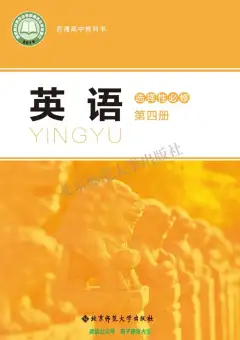
选择性必修
第四册
英
语
选
择
性
必
修
第
四
册
定价:9.70 元
普通高中教科书
英 语
选择性必修
第四册
主    编    田贵森
副 主 编    杨永军  付晓丽  Guo Yangsheng
编    者    张敬彩  曹九珍  苏丽平  王显志  杨  琳  周  红
            Ingrid Johnston  Leonard Judge  Naama Bar-David  Anja Pujic
责任编辑    孙中华  李  超  李  蘅
美术编辑    张尧杰
绘    画    李  奥  李  楠
书    名    普通高中教科书 · 英语  选择性必修  第四册
出  版
http://www.hbep.com
        ( 石家庄市联盟路705 号,050061)
发  行    河北省新华书店
印  刷    河北省新华联合印刷有限公司
开  本    890×1240 1/16
印  张    8.25
字    数    210 千字
版  次    2020 年4 月第1 版
印  次    2020 年4 月第1 次印刷
印  数   1-3,000
书  号    ISBN 978-7-5545-5746-4
定  价   9.70 元
版权所有·请勿擅用本书制作各类出版物·违者必究
如有印刷质量问题,请与本社出版部联系调换,电话:18603114066
购书电话:0311-88643600
    图书在版编目(CIP)数据
    普通高中教科书. 英语 : 选择性必修. 第四册 / 田
贵森著. -- 石家庄 : 河北教育出版社, 2020.4
    ISBN 978-7-5545-5746-4
    Ⅰ. ①普… Ⅱ. ①田… Ⅲ. ①英语课-高中-教材
Ⅳ. ①G634
    中国版本图书馆CIP数据核字(2020)第053926号
出版者的话
亲爱的同学们:
欢迎使用冀教版高中英语教科书。这套教材由国内外富有英语教育经验的学者、科研人员
及一线教师根据2017 版《普通高中英语课程标准》编写。
本套教材必修阶段共3 册,满足高中毕业基本要求;选择性必修阶段有4 册,满足高考升
学要求;提高类阶段有3 册,满足有意继续提高英语能力的发展需求。
让我们了解一下教材的结构。每册教材有5 个单元,每个单元包括4 个板块。第1 板块
(Reading for Meaning)为同学们提供了地道、优美的语篇,文章体裁丰富多样、内容有趣且
富有时代特色;第2 板块(Learning through Practice)提供了有意义的语言探究和语言实践活动,
同学们通过完成任务可以体验语言并归纳知识,提高语言运用能力;第3 板块(Using English
in Context)设计有专题调查、访问纪实、讨论汇总、活动设计等多种形式的项目活动,帮助同
学们发展听、说、读、看、写等语言技能,为真实语言交际打下基础。第4 板块(Expanding
Our Horizons)为同学们提供了更多与单元主题相关的经典、有趣的文章。
另外,教材中的评价部分(Evaluate yourself)可以帮助同学们积极反思学习过程,及时调
整学习策略,提高学习效率;单元反思(Unit Reflection)帮助同学们对整个单元进行回顾;链
接部分(More Connections)便于同学们拓展相关主题知识。
本套教材内容涉及人文、社会、自然、科学等多个领域,注重中外文化的介绍与比较。通
过学习本套教材,同学们会在提高语言能力的同时,增强对中华优秀传统文化、革命文化和社
会主义先进文化的认识,成长为新时代有文明素养和社会责任感的人。
同学们,中学时代是人生美好的一段时光,相信在使用这套教材的过程中,你们通过自
己不懈的努力和老师的正确引导,能够顺利完成教科书中的学习任务,为终身学习打下良好
基础。
愿同学们在英语学海中徜徉,感受英语学习带给你们的新奇、充实与快乐。
Contents
1
UNIT
SECTION 1  READING FOR MEANING
The Story of Caring


2
SECTION 2  LEARNING THROUGH PRACTICE
Task One  Giving Suggestions for Caring

6
Task Two  Sharing Stories of Care


8
      (Grammar: the past participle as predicative)
SECTION 3  USING ENGLISH IN CONTEXT
Project  Designing a Special Issue of School
      Newspaper on Caring for Each Other

10
SECTION 4  EXPANDING OUR HORIZONS
Core Values of a Caring Community

14
Bai Fangli, a Common but Caring Old Man
15
The Echo of Life


17
2
UNIT POETRY —
CALLING FORTH
THE RICHES OF
LIFE
SECTION 1  READING FOR MEANING
How to Read a Poem


20
SECTION 2  LEARNING THROUGH PRACTICE
Task One  Presenting a Poem


24
Task Two  Practicing English Rhymes in Pairs
25
      (Grammar: appositive clauses)
SECTION 3  USING ENGLISH IN CONTEXT
Project  Making a Booklet on the Power and
      Beauty of Poetry


28
SECTION 4  EXPANDING OUR HORIZONS
Why You Should Read Poetry


32
Roadmap for Writing a Poem


33
Recommendation of Leaves of Grass
      by Walt Whitman


35
CARING
FOR EACH
OTHER
3
UNIT CHINESE
PAINTING
AND
ARTISTS
SECTION 1  READING FOR MEANING
The Artist Qi Baishi


38
SECTION 2  LEARNING THROUGH PRACTICE
Task One  Presenting the Art of Chinese Paintings
42
Task Two  Introducing Chinese Paintings

44
     (Grammar: inversion)
SECTION 3  USING ENGLISH IN CONTEXT
Project  Making an Information Brochure for
     a Painting Exhibition


46
SECTION 4  EXPANDING OUR HORIZONS
Chinese Artists


50
Traditional Chinese Painting


52
4
UNIT
RULES
ARE
RULES!
SECTION 1  READING FOR MEANING
Rule of Law, Rules of Life


56
SECTION 2  LEARNING THROUGH PRACTICE
Task One  Making Rules for Your Class

60
Task Two  Talking about the Purpose of School Rules	62
     (Grammar: emphasis)
SECTION 3  USING ENGLISH IN CONTEXT
Project  Making a Group Presentation about
     Differences of Traffic Rules in Different Countries
64
SECTION 4  EXPANDING OUR HORIZONS
“The Rules Are the Rules”


68
Tougher Rules for Drunk Driving


69
Funny International Laws You’d Never Know
     Are Real


71
5
UNIT
HUMANKIND
AND NATURE
SECTION 1  READING FOR MEANING
One Man’s Dream


74
SECTION 2  LEARNING THROUGH PRACTICE
Task One  Summarizing the Benefits of Being
     Out in Nature


78
Task Two  To Ban, or Not to Ban? Stating
     Your Reasons


80
     (Grammar: the subjunctive mood)
SECTION 3  USING ENGLISH IN CONTEXT
Project  Holding an Online Forum on How Humans
     Can Better Interact with Nature


82
SECTION 4  EXPANDING OUR HORIZONS
What Can I Do?


86
World Environment Day


88
A Chinese Fable about Humankind
     and Nature


89
APPENDICES
WRAP IT UP!


91
VOCABULARY (I)


106
VOCABULARY (II)


111
LIST OF PROPER NAMES


117
GRAMMAR


119
1
UNIT
CARING FOR EACH
OTHER
If you have a friend from afar who knows your heart, distance
can’t keep you two apart.
– Wang Bo, Chinese poet
We are at our finest when we take care of each other.
– Katherine Center, American writer
The greatest wisdom of all is kindness.
– Hebrew proverb
1
READING FOR MEANING
1
The Story of Caring
BEFORE YOU READ
1	 What does it mean to care for others? How do you understand the phrase “Caring for Each Other”?
2	 Do you have experiences of giving care to other people? Or of receiving care from other people? Why
do you think giving/receiving care is important?
3	 What do you expect to read in “The Story of Caring”?
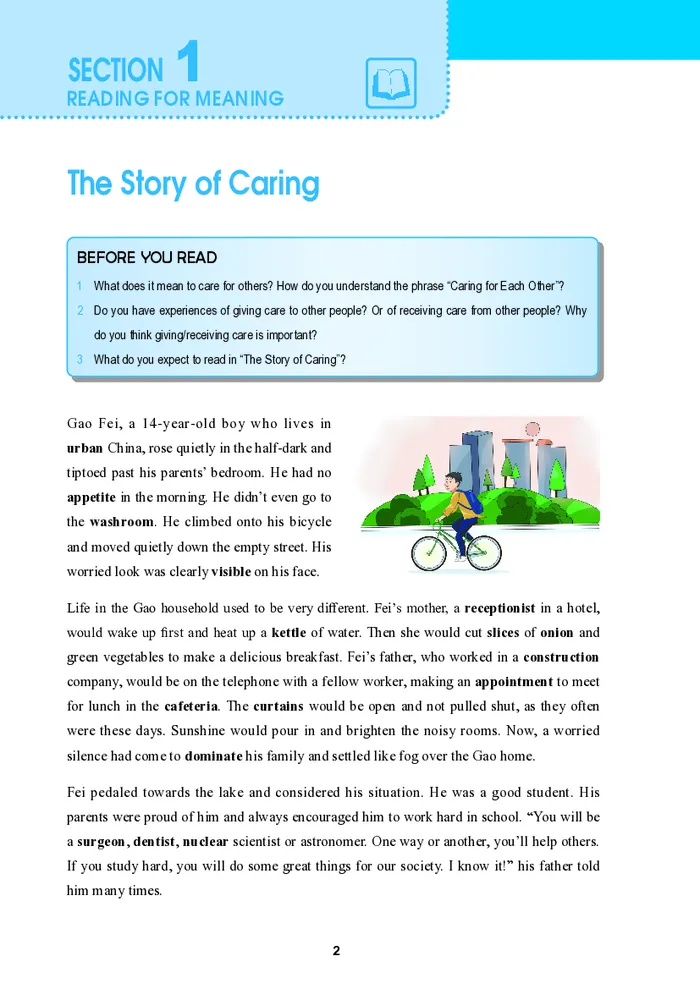
Gao Fei, a 14-year-old boy who lives in
urban China, rose quietly in the half-dark and
tiptoed past his parents’ bedroom. He had no
appetite in the morning. He didn’t even go to
the washroom. He climbed onto his bicycle
and moved quietly down the empty street. His
worried look was clearly visible on his face.
Life in the Gao household used to be very different. Fei’s mother, a receptionist in a hotel,
would wake up first and heat up a kettle of water. Then she would cut slices of onion and
green vegetables to make a delicious breakfast. Fei’s father, who worked in a construction
company, would be on the telephone with a fellow worker, making an appointment to meet
for lunch in the cafeteria. The curtains would be open and not pulled shut, as they often
were these days. Sunshine would pour in and brighten the noisy rooms. Now, a worried
silence had come to dominate his family and settled like fog over the Gao home.
Fei pedaled towards the lake and considered his situation. He was a good student. His
parents were proud of him and always encouraged him to work hard in school. “You will be
a surgeon, dentist, nuclear scientist or astronomer. One way or another, you’ll help others.
If you study hard, you will do some great things for our society. I know it!” his father told
him many times.
2
 UNIT 1
CARING FOR EACH OTHER
Then, his father fell ill and needed surgery. The
atmosphere in the family subsequently changed.
Everything centred on the change. The doctor said his
father might never work again. The family had few
savings. Fei’s mother became depressed. The sudden
change made Fei a bit desperate.
At school that day, his friend and chairman of the student
council, Liu Yan, stopped him on the playground. “I
haven’t seen you for a few days,” she said. “You looked
worried. Is everything okay?”
Fei lowered his eyes. He didn’t want to discuss his
problems with Liu Yan, even though she had been a
loyal friend for years. He whispered something and
moved away.
That afternoon, Mr. Lin asked Fei to stay for a minute after
class. When the rest of the class had left the room, Mr. Lin
said, “Fei, I talked to Liu Yan today. She’s worried about
you. Is everything going okay in your life? At home?”
Showing
concern
● What’s wrong/the
matter/the problem?
● What’s on your
mind?
● What’s the story
with you?
● Is there anything
wrong?
Fei wanted to say nothing, or to say as little as possible. He wanted to deny that he was
struggling and leave his problems behind the drawn curtains. His father didn’t want others to
know their story, who felt guilty for dragging the family into this situation.
Mr. Lin said, “I can tell you’re struggling. I bet you haven’t slept well lately. Is there
anything I can do?”
Fei suddenly realized that he had been bottling up his sorrow regarding his father’s
condition, his inability to help, and the dreams he would have to sacrifice by leaving
school to work. It was all beginning to depress him deeply.
“I’m sorry,” he said in a low voice. “My father is ill and my family is struggling financially.
We couldn’t get any loans. My mother can’t work because she has to look after my father.
I have no choice but to quit school and find some work,” he admitted, edging towards the
3
 UNIT 1
CARING FOR EACH OTHER
door. “I have a job interview this afternoon at the bowling lanes in my neighbourhood.”
Mr. Lin moved in front of the door. He spoke with sympathy. “You have a difficult
problem,” he said, “but you do not have to deal with it all alone. I am here for you. Your
schoolmates will help out too. I can talk to the school about scholarships and about teaching
assistant opportunities. There are many younger students who could benefit from your help.”
Then, Mr. Lin asked if Fei had any relatives living nearby.
Fei looked at Mr. Lin as though he were a lifebuoy. He was overcome with relief but hardly
dared to believe a solution could be found.
“My mother’s family lives in a village a few hundred miles away. As for my father… his
nieces and nephews may help,” Fei hesitated.
“Let’s call your cousins,” said Mr. Lin. “They might even come by for a while to help your
mother. Also, let me talk to Liu Yan. We’ll see what we can do.”
In the following days, the school and community responded with waves of sympathy to
the crisis in Fei’s home. The women in the neighbourhood scheduled visits and meals so
Fei’s mother could concentrate on tending to her sick husband. Fei’s father’s co-workers
reported the story to their boss who promised to keep his job open, and the whole community
contributed to a fund to help Fei’s family get by. At school, Fei’s classmates overwhelmed
him with warmth and concern. In the evenings, they took turns visiting him, and inquired
after his father. Besides, the family received free consultation with a herb doctor from a
community clinic. Once again, the curtains were open in the Gao household.
One morning, a few weeks later, Fei was cycling to school and stopped to watch a mother
duck leading her ducklings towards the middle of the lake. The ducklings were all lined up
in a row. “I thought I had to handle everything by myself,” Fei thought, “but I was wrong.
If I’m a good student, it’s because I’m blessed to have a good community offering its
support. I hope to have the opportunity to care for others, too.”
4
 UNIT 1
CARING FOR EACH OTHER
AFTER YOU READ

Reading Comprehension
1	 What is the major theme of the story? What message does the author want to convey?
2	 What were Gao Fei’s parents’ hopes for Fei’s future achievements? What happened to Gao Fei’s
father? How did the situation affect Gao Fei?
3	 What does “the opening and the shutting of the curtains” signify in the story?
4	 Why didn’t Gao Fei want to tell anyone about what his family was going through? What should we
do when we go through difficult times in life?
5	 What did Mr. Lin plan to do for Gao Fei? How did Gao Fei’s community help him?
6	 Gao Fei said, “If I am a good student, it’s because I’m blessed to have a good community…” What does
he mean? Do you think Gao Fei has learned something about his community? What did he learn?

Post-reading Activities
1	 Reread the two sentences in the text:
● ...he had been bottling up his sorrow regarding his father’s condition, his inability to
help, and the dreams he would have to sacrifice by leaving school to work.
● Once again, the curtains were open in the Gao household.

How do you understand the words, “bottling up” and “the curtains were open” in the two sentences?
Do you have more examples of metaphorical use of language in English? Share your examples and
ideas with a partner.
2	 Some people prefer to “deal with it all alone” when they face difficulties in life. Others think that
we should ask our friends for help. What would you do if you were in a tough situation? In groups,
share and discuss your thoughts and opinions.
3	 Help from a caring community has helped make Gao Fei a good student. With what other
positive values or social functions do you think a caring community can make significant
contributions to our lives? In groups, make a list and then share your list with other groups in
the class.
4	 What does it mean to be a caring person? Work in groups and brainstorm a list of do’s and don’ts for
caring, for instance: treat people with kindness and generosity; help people in need; think about how
your actions will affect others; never be mean or hurtful. Share your list with the class.
5
LEARNING THROUGH PRACTICE
2
Task One  Giving Suggestions for Caring
Caring about the people you love can make life happier and a lot more meaningful. But how
do you care? In this task, you’ll figure out how to be caring and make a caring card to present
to the class.
Step 1  Pre-task Resources
Read the passage and learn more ways you can be caring in your everyday life.
How to Be Caring
There are many ways to show that you care about others! Some are as simple as listening,
while others are more involved.
Be Selfless and Sensitive
Empathetic people notice when someone is upset and try to help. Pay attention to
classmates’, friends’, and family members’ emotional state.
Selfish people don’t tend to care when others are upset, even if they caused it. Be aware of
how others react to your words and actions. If you hurt someone, apologize. It may take
practice, but being a good person is worthwhile.
Think before You Act
Small actions can have great and terrible impacts. Ask
yourself how you’d react to being ignored when you call
before hanging up on your friend. If your behaviour is selfish,
rude, or unpleasant, consider changing your actions.
Appreciate Others
Be thankful for family members, friends, or anyone else who
makes your life more meaningful and positive. Let them
know their presence matters.
Don’t underestimate the power of a written “thank you”
note. We so rarely take the time to truly appreciate and thank
people these days. It’s important to let people know they are
appreciated.
6
 UNIT 1
CARING FOR EACH OTHER
Pay Attention
Focus on your conversations and remember what people tell you. Facial expressions, gestures,
clothes, and even simple comments can help explain someone’s thoughts and emotions.
If your roommate hasn’t eaten in a day because she is stressed about an upcoming exam,
buying her dinner shows that you notice and care.
Step 2   Exploring the Language
Read and observe the headings of the passage in Step 1. Discuss in groups to discover
what they have in common with regard to the sentence structure and functions.
● Be Selfless and Sensitive
● Think before You Act
● Appreciate Others

● Pay Attention
The subjects of the sentences are “you”, referring to those who read the passage, which are
often omitted in imperative sentences. Imperative sentences are used to give suggestions or
advice. List more sentences giving advice from the passage.
Sometimes imperative sentences sound a little more impolite. Can you think of other ways to
give suggestions? Take the following as examples.
● You’d better…

● You should…

● Why not…?
●	If I were you, I would…
● How about…?
Step 3   Task Cycle
1
View the two caring cards below.
Show that
you care
Forgive others
Help people
in need
Be kind to
everyone
1  Be considerate and kind in all your actions
2  Lend a helping hand to those around you
3  Say nice things, and share compliments with others
4  Be the person others can count on
Caring
2
In groups of four, discuss what make up the basic components of a caring card.
3
Make your own caring card. Be sure to include a title and some suggestions.
7
 UNIT 1
CARING FOR EACH OTHER
Task Two  Sharing Stories of Care
As human beings, we usually need care and often give care to others as well. There are
many stories about caring people, whose love and kindness make the world a better place.
In this task, share a story of caring from your own life with your classmates and see what you
can learn from each other.
Step 1   Pre-task Resources
Read the two stories below and think about how care is given to others.
“I Just Helped Him Cry”
There was once a competition to find the most caring
child. The winner was 4-year-old Adam, whose next-door
neighbour was an elderly man. After the passing of his
wife, the elderly man always sat alone in his doorway.
Adam climbed onto his lap and sat. The gentleman’s eyes
were filled with tears.
When Adam’s mother asked him what he said, the little boy replied, “Nothing! I just
helped him cry.”
Too often, we underestimate the power of a touch, a smile, kind words, honest
compliments, or other small acts of caring. Any of these could turn a life around.
Caring for a Caretaker
When we left the hospital this morning, the doctor warned my husband and me that my
5-year-old daughter was still rather weak from a bad flu virus.
My father-in-law was no better from a heart attack, and my husband had not found a job
after quitting his job two weeks ago. Anyhow, I had to face the music.
But when I opened the front door, I was shocked. It was incredibly tidy! I found a note on
the table:
Dear Jasmine,
I know the last weeks have been tough. You could have told me about your daughter’s
cold! Don’t worry. Everything will be OK. I put some pie and soup in the fridge.
Take care!
Jing
8
 UNIT 1
CARING FOR EACH OTHER
I was swept with emotion; I hated depending on others, but at the same time, I was
deeply moved by my neighbour’s actions. Jing was taking care of my whole family.
I was always the care-giver, not the care-receiver. Such care from a friend is unexpected
in my culture, but my eyes watered because of her concern. She showed her love
through simple actions. I want to do the same for others from now on, I think.
Step 2  Task Cycle
Step 3  Language Focus
Some past participles of the verbs, like “bored”, can be used as adjectives, which are often used
to talk about how someone feels. They often serve as the predicative following the link verbs.
	 ● I’m very satisfied that I managed to order the meal in French.
	 ● David’s too tired to come to the cinema tonight.
These past participles have a passive relationship with the subjects, usually people. But
different from the passive voice, which indicates a passive action, the past participles as the
predicative only indicate a state of mind just like a normal adjective.
	 ● I was deeply moved by my neighbour’s actions.
	 ● Such care from a friend is unexpected in my culture, ...
These participle adjectives make use of the comparative by using “more” (not -er) and their
superlative by using “most” (not -est).
	 ● John is frightened of spiders.
	 ● I was more frightened of dogs than spiders when I was a child.
1
3
2
4
Talk with your partner about how
characters in the two stories show
they care.
From your life, recall a story of caring
that has moved you and share your
story with a partner.
Work out the outline of your story
with the help of your partner.
Finish writing the story after class and submit
it to your school magazine.
9
3
USING ENGLISH IN CONTEXT
Project  Designing a Special Issue of School Newspaper on Caring
                for Each Other
In this project, you are going to design and make a special issue of your school newspaper
reporting your understanding of the theme “Roses Given, Fragrance in Hand” for the
School Culture Festival this year. Complete the project in groups of four or five.
Step 1  View, Discuss and Identify
View the following pictures and then discuss what they mean. Then in pairs, identify
what kinds of caring these pictures show. Could you make a list of the different kinds of
consideration that people give and receive on a day-to-day basis?
Step 2  Read, Learn and Discuss
Let’s begin with caring about the elderly. Nowadays as the number of the elderly population
continues to grow, taking care of them requires more attention and efforts of society. Read
the passage and learn more about taking care of the elderly in today’s society. Then discuss
in pairs what the main idea of the passage is and how this idea is presented.
10
 UNIT 1
CARING FOR EACH OTHER
Care about the Elderly
The Chinese society is aging rapidly. According to a survey, the number of people aged
60 or above reached more than 220 million at the end of 2015, accounting for close
to 16 percent of the country’s population. This figure is expected to increase to 25
percent by 2030 and, by 2050, 500 million Chinese citizens will be elderly. That’s larger
than the entire estimated population of the United States for 2050! It proves that the
rapidly expanding number of elderly people is becoming a major social issue.
Recent research found that nearly 40 percent of elderly people living in Chinese cities
are suffering from loneliness. How can China care for so many seniors?
To solve the problem, China should offer various types of care to the elderly. This would
include not only financial support but also psychological help.
On one hand, the government should increase investments in basic services, public
facilities, and health and cultural services. Communities, on the other hand, should
offer services for the elderly, including providing meals, house cleaning, medical care,
and first aid; all should be available with a simple phone call. Finally, private capital
plays an important role in providing professional nursing rather than home-care. The
government should encourage the development of eldercare facilities. Building elder
communities will provide them with the company of friends they need. Volunteers from
every corner of society would come to help ease their loneliness. However, time spent
with family and friends is the best way to keep seniors happy. A loving attitude from
their children, even just through a phone call, can make a dramatic difference.
All in all, the government should help encourage a social environment in which the
elderly are respected, cared for, and can live happily while receiving integrated care and
professional medical services.
11
 UNIT 1  CARING FOR EACH OTHER
Step 3  Listen, Fill in Blanks and Learn
How are the elderly living in the care centre? Listen to the story of an elderly person who
lives in the care centre. According to her story, how can an elderly person live a happy life?
While listening, write down the secrets of her happiness.
Secrets of Gao Lanzhi’s happiness:
1
To have _____________ such as singing, photography, and baking that keep me busy
every day.
2
The nursing home provides me a _____________ and _____________ place to do what I
like and to meet peers.
3
The best way to end loneliness is to _____________ it with something else.
4
Social networking makes me feel closer to my children, so never _____________
_____________ learning new things.
5
As for the elderly, _____________ and engagement in life are very important. Being
kept at home will make people feel lonely and depressed. We should also get outside and
_____________ _____________ _____________ social activities.
Step 4  Plan and Write
In groups, make a plan for the major contents of your newspaper. The school
newspaper has four editions (pages). The theme of this special issue is “Roses
Given, Fragrance in Hand”. Your newspaper will mainly include:
●	 a very brief introduction to the issue at the very beginning;
●	 stories about caring between different groups of people; (Each group member will
contribute one story. The story could be either from your own experience of giving or
receiving care, or stories that happened around you. You can also retell or rewrite a
touching story you have read elsewhere)
●	 some famous quotes about caring for others.
1
12
 UNIT 1
CARING FOR EACH OTHER
Step 5  Revise, Design and Share
When you finish the first draft, all group
members will work together to revise and edit
the stories. Try to arrange the order of the
stories in a way that is best according to their
length and content. Use pictures and diagrams
to make your newspaper easy to read and
attractive. Proofread it, print it, and then share
it with others in your class.
Compare your stories and select two that you think are inspiring, touching and
encouraging. Write the first draft, and share in groups for comments and feedback.
3
Recall stories from your own life, or find stories on the Internet or at the library.
Your stories could be about caring for the elderly/peers/patients, or other people
who are in need.
2
Evaluate yourself!
Can you infer speaker’s attitude and intention according to his tone or words he used?
Can you follow the steps and write for a newspaper?
How well have you done with the following? Tick the circles that best reflect your performance.
Organizing my stories about caring into a
logical and easy-to-read order
Giving advice on caring for others based
on my real life experience
Willing to improve my performance by
correcting mistakes
Excellent    Very Good    Good    Needs Improvement
13
EXPANDING OUR HORIZONS
4
Core Values of a Caring Community
When we care for people, we want good things for them. We want them to be safe, happy,
and successful. We want to help and support them as they flourish and reach their fullest
potential. Like sowing the seeds of care and love, the more we care for others, the more
people are willing to do for others. A caring community, then, is simply a group of people who
are concerned about one another and who want to help each other out. Caring communities
highlight the following five core values: family, caring, responsibility, respect, and trust.
Family
Our families share their values with us as we grow, which we share with our own families
later. Although all families differ and value different things, they have been called the “school
for character”: the place where morals are taught and learned. Family stability, responsibility
between family members, mutual respect, trust, and care are essential components of healthy
families and, subsequently, societies.
Caring
Caring is the opposite of both indifference and hate. Caring challenges us to help others and
to respect ourselves. Without caring, nothing matters. Sometimes, people care for the wrong
things, or care too much about something or someone. Everyone should demonstrate that
they care, especially about each other.
Responsibility
People who care must be willing to take responsibility instead of accusing others of their
own mistakes. That means they must hold themselves responsible for their actions and be
willing to receive praise when things go well or blame when things go wrong. Accepting
14
 UNIT 1
CARING FOR EACH OTHER
responsibility is a sign of being mature: taking criticism well, standing up for others, and
shouldering the consequences of your actions are all ways to demonstrate responsibility.
Respect
Being responsible also shows others that they should be respectful. It teaches you to respect
those who stand up for what they believe is right. Mutual respect allows for a moral, caring
community. Self-respect and respect for others go together, and both are essential. To respect
others means to see them as valuable in their own right; you should listen and give space
when needed. Self-respect means realizing that you matter and that how you see yourself is
just as important as how others see you.
Trust
When people care for and respect each other, trust takes root and grows. If you trust
someone, you acknowledge that you need them and their support. Trusting people means
depending on them and expecting them to deliver on their promises, while you do the
same for them. Communities cannot exist without a certain level of trust. Like other
values, trust can be foolish or misplaced, but a whole life without trust is impossible.
Thus, trust requires knowledge and shared understanding in order to form bonds
between different people.
POST-READING QUESTIONS
1	 What do caring and responsibility mean?
2	 What does a caring community look like?
3	 What other values do you think are essential to a caring community?
Bai Fangli, a Common but Caring Old Man
Is it possible to live a meaningful life after retiring? Typically,
retirement means life is calming down. However, this was not the
case for the “Virtuous” Mr. Bai Fangli. At the age of 74, he decided
to continue his job as a pedicab driver, not to make money to
survive, but to finance poor students’ education. Once he started,
it lasted more than ten years. He donated all of his earnings to
children who could not afford an education. By the time he was 90,
15
 UNIT 1
CARING FOR EACH OTHER
he had donated more than 350,000 yuan and paid for school for over 300 students. It has been
calculated that, over the years, Bai has peddled the equivalent of going around the Earth’s
equator 18 times. He never anticipated being recognized or rewarded for his work, anyhow.
“I really want them to study hard and I sincerely want them to get a good job. I hope they
become honest people and are able to give back to the country.”
In 1987, at the age of 74, Bai finally returned to his hometown after retiring from his job. When
he arrived, he saw children working in the surrounding fields because they were too poor to
afford school fees. Bai decided to sacrifice his retirement for these children and their future.
Regardless of his old age and failing bones, he made the decision to return to work and use the
money he earned for these children’s education. His sons and daughters tried to persuade him
to change his mind as they wanted him to enjoy a relaxing life, but he rejected their opinion.
Life as a pedicab driver is not easy. It is physically demanding and pays very little. Bai
worked consistently until 2001. He took no significant breaks. For two decades, Bai hardly
bought any clothes or a pair of shoes for himself. He ate simple food and saved as much as he
could to pay the school fees and purchase an education for more children.
“I can hardly remember buying myself any clothes. I’m sure you can tell these are thrown-
away clothes! My shoes are different and the socks I wear don’t match! Even my hat was
collected from a dump site.”
“He went out at dawn and wouldn’t return until darkness fell. Every day, after returning home,
he carefully stored his earnings,” said his daughter, Bai Jinfeng.
Bai had always regretted being illiterate and hoped the next generation could change their
destiny with education.
One winter, he handed 500 yuan he kept in a lunch box to a teacher and said, “I cannot work
anymore; I can no longer donate money to others.”
This long journey of supporting students lasted two decades. In 2005, he was diagnosed with
lung cancer. Bai Fangli passed away on September 23, 2005, at the age of 93, but he will
never be forgotten. Hundreds of people showed up to pay their respects at his funeral. Due to
his huge contributions to society, Bai is remembered in China as a virtuous man who worked
hard to provide education in his society. In 2004, he was chosen by China Central Television
16
 UNIT 1
CARING FOR EACH OTHER
(CCTV) as one of the 20 candidates for the “10 people who touched China’s heart”.
Bai Fangli proved that your grit determines what you can do; age is no barrier to make an
impact. He touched millions of hearts with his story of selfless giving and devotion, his
wisdom, and his sympathy towards hundreds of poor children.
You don’t need to be rich to help those in need. If a retired old man with no formal education
could realize the dream of 300 children to go to school, imagine the positive changes you
could bring to the world with the resources you have! Love and sympathy are the greatest
motivation to change. You should all try to inspire others the way Bai Fangli inspired us.
POST-READING QUESTIONS
1	 When did Mr. Bai Fangli return to his hometown?
2	 What is Mr. Bai’s contribution to society?
3	 Why was he chosen by China Central Television (CCTV) as one of the 20 candidates for the “10 people
who touched China’s heart”?
The Echo of Life
A son and his father were walking on a mountain. Suddenly, the
son fell. He hurt himself and screamed, “AAAhhhhhhhhhhh!!!”
To his surprise, he heard his voice repeated somewhere,
“AAAhhhhhhhhhhh!!!”
Curious, he shouted, “Who are you?”
The voice answered, “Who are you?”
Angered by the response, the boy screamed, “Coward!”
Then, he heard the voice yell, “Coward!”
He looked at his father and asked him what was happening. His
father smiled and told him to pay attention.
Then, his father screamed to the mountain, “I admire you!”
The voice replied, “I admire you!”
Again, the father screamed, “You are a champion!”
17
 UNIT 1
CARING FOR EACH OTHER
Unit Reflection
Review the whole unit and reflect on what you have learned.
1	 What does “caring for each other” mean to human beings? What have you learned about
the roles and power of “caring for each other” from this unit? And its social functions?
2	 Do you have any experiences of giving care to or receiving care from other people? How
does “caring for each other” affect students’ learning in school? What should we do to
make our class and our school a caring community?
3	 Do you use the past participle as predicative in a sentence? What have you learned about
the meaning and use of the past participle as predicative from this unit?
The voice didn’t hesitate before saying, “You are a champion!” The boy arched his
eyebrows in surprise, but did not understand.  Then, the father explained, “People might call
this an echo, but I think it’s really just life. It takes everything you say or do and throws it
back at you. Our lives are simply a reflection of our actions.”
If you want more love in the world, create more love in your heart. If you want your team to
increase their competence, improve your own skills. If you want to see people care more,
act on the empathy you feel for others. This relationship applies to everything, in all aspects
of life. Your life is not a coincidence. It is a reflection of you!
POST-READING QUESTIONS
1	 What is the theme of the story? How does it relate to “caring for each other”?
2	 What is the literal meaning of the word “echo”? What is its metaphorical meaning?
3	 Do you understand the message that the father is passing on to his son? What is it? Do you agree with him?
More Connections
●	 Every time you surf the Internet, you can find numerous news, stories, events and poems,
etc. about people caring for each other. The following are some key words you may search
with: care, help, support, volunteer, etc.
●	 Professor Li Baoguo from Hebei Agricultural University devoted 35 years of his life and
wisdom to lifting the rural population out of poverty in Taihang Mountains. His stories are
presented in the Hebei opera, movies and TV series.
18
2
UNIT
POETRY — CALLING FORTH
THE RICHES OF LIFE
Poems express aspirations deep in one’s heart, whereas songs are verses for
chanting.
 – The Book of History
Poetry is when an emotion has found its thought and the thought has found
words.
– Robert Frost, American poet
Poetry gives most pleasure when only generally and not perfectly understood.
– Samuel Taylor Coleridge, English poet
19
READING FOR MEANING
1
How to Read a Poem
BEFORE YOU READ
1	 Do you enjoy reading poems? Have you ever read a poem that touched or inspired you? What is it?
2	 How do you understand “Poetry – Calling Forth the Riches of Life”? What does “the Riches of Life”
mean to you?
3	 What do you expect to read in “How to Read a Poem”? What do you usually do when you have
difficulties in understanding a poem?
Poetry is a premier genre of literature. For many, it is the most powerful and most
influential of all genres of literature. Poetry describes and presents images of life in its
eternal forms. It is the expression of the imagination and creativity. Poetry is always written
using the best words precisely in an order that favours poetic or musical cadence.
Reading and writing poetry is a rewarding experience that will benefit our lives. Reading
poetry requires both a good attitude, such as curiosity, and a good technique to draw you into
a conversation with the poem.
        POEM
Dreams
By Langston Hughes
Hold fast to dreams
For if dreams die
Life is a broken-winged bird
That cannot fly.
Hold fast to dreams
For when dreams go
Life is a barren field
Frozen with snow.
To begin, read the poem aloud. Read it more than once.
Listen to your voice, to the sounds the words make. Do you
notice anything special about the language used? Do any
of the words rhyme? Is there a group of sounds that seem
the same or similar? Is there a section of the poem that has
a rhythm that’s distinct from the rest of the poem? Don’t
worry about why the poem might use these devices. The
first step is to assess what is going on in the poem.
To get a good understanding of a poem, you need
to learn to ask questions. These questions provide an
effective point of entry for interpretation. Here are a few
20
 UNIT 2
POETRY — CALLING FORTH THE RICHES OF LIFE
general questions that you might ask when approaching a poem for the first time:
● What circumstances influenced the poet to choose this topic?
● How would you describe the sounds and the tone of the poem?
    Are they important in this poem?
● What form does the poem take and how does it relate to the content?
● Does the poem spring from a historical moment or specific culture?
● What kind of figurative language does the poem use?
● Does the poem use unusual words or order words in an unusual way?
If necessary, seek the aid of background
knowledge. Some poems are open to
interpretation without the aid of historical
events or knowledge about the author’s life.
Other poems, however, have rich historical
backgrounds. Without using external sources,
readers will miss out on the sense of the poems.
Recognizing some of the poets’ techniques
helps you further your understanding. Poems
speak to us in many ways. Sometimes, the job of
the poem is to come closer to saying what cannot be
discussed in other forms of writing. The techniques
of word and line arrangement, sound and rhythm,
add to – and in some cases, multiply – the meaning
of words to go beyond the words literally, giving
you an impression of an idea or feeling, an
experience that you can’t quite put into words
but that you know is real.
Some poets use techniques drawn from music,
and others, from painting. If you find more
in a poem than what the words alone convey,
something larger is at work. A poem is more
than the sum of its parts.
        POEM
The Road Not Taken
By Robert Frost
Two roads diverged in a yellow wood,
And sorry I could not travel both
And be one traveller, long I stood
And looked down one as far as I could
To where it bent in the undergrowth;
Then took the other, as just as fair,
And having perhaps the better claim,
Because it was grassy and wanted wear;
Though as for that the passing there
Had worn them really about the same,
And both that morning equally lay
In leaves no step had trodden black.
Oh, I kept the first for another day!
Yet knowing how way leads on to way,
I doubted if I should ever come back.
I shall be telling this with a sigh
Somewhere ages and ages hence:
Two roads diverged in a wood, and I –
I took the one less travelled by,
And that has made all the difference.
21
 UNIT 2
POETRY — CALLING FORTH THE RICHES OF LIFE
The best way to discover and learn about a poem is through discussion. Although
your first experience with the poem may be private and personal, talking about the poem is
a natural and important next step. Discussions often begin with a focus question about the
poem, and later address possible answers that reshape and clarify both the question and the
poem along the way.
Embrace ambiguity. The task of reading a poem is to grasp, connect, and understand. But
such a task is to some degree impossible. A poem that reveals itself completely in one or
two readings will, over time, seem less meaningful than one that constantly unrecognized
meanings. If a poem yields new interpretations each time you read it, it is a great poem.
        POEM
Shall I Compare Thee to a Summer’s Day?
By William Shakespeare
Shall I compare thee to a summer’s day?
Thou art more lovely and more temperate.
Rough winds do shake the darling buds of May,
And summer’s lease hath all too short a date.
Sometime too hot the eye of heaven shines,
And often is his gold complexion dimmed;
And every fair from fair sometime declines,
By chance, or nature’s changing course, untrimmed.
But thy eternal summer shall not fade,
Nor lose possession of that fair thou ow’st;
Nor shall death brag thou wanderest in his shade,
When in eternal lines to time thou grow’st.
So long as men can breathe or eyes can see,
So long lives this, and this gives life to thee.
There are fourteen lines in a
Shakespearean sonnet. The first
twelve lines are divided into three
quatrains with four lines each.
In the three quatrains the poet
establishes a theme or problem
and then resolves it in the final two
lines, called the couplet.
The rhyme scheme of the quatrains
is abab cdcd efef. The couplet
has the rhyme scheme gg. This
sonnet structure is commonly
called the English sonnet or the
Shakespearean sonnet.
DO YOU KNOW?
22

Reading Comprehension
1	 This text gives us six suggestions about how to read a poem. How do you like them? Which one
impresses you most? How does it help?
2	 What is the rhyme scheme of Hughes’ Dreams? What is the theme of the poem?
3	 What do you feel if you read Hughes’ Dreams aloud? What do you learn if you read it aloud more than once?
4	 What is the rhyme scheme of Frost’s The Road Not Taken? What is the major theme of the poem?
How do you interpret the poem?
5	 What are the major techniques used in English poetry? Can you list some of them with examples
from the three poems in this text?
6	 What is the rhyme scheme of Shakespeare’s sonnet, Shall I Compare Thee to a Summer’s Day?
What is the theme of the sonnet? What techniques did Shakespeare use to sharpen the theme?

Post-reading Activities
1	 Read the text and pay attention to the sentences in blue. Have a discussion with your group
members about why they’re put at the beginning of the paragraphs and what the relationship
between these sentences and the rest of the paragraphs is.
2	 Playing with letters (Acrostic Poem). The most common and simple form of an acrostic poem is where
the first letters of each line spell out the word or phrase. Here is one example on the word, TREE.


Think it’s fun to be up high?


Rise until you touch the sky!


Everyone who loves to climb


Enjoys the topic of this rhyme.

Now work in groups. Each member chooses a word, or a name for the topic of your poem. Use
each of the letters to begin a line of your poem.
3	 Many people believe that reading poetry has an impact on one’s life. In groups, share your stories
and tell how poetry has helped you make sense of yourselves and life.
4	 Some people think that poetry is culture specific and it is hard to translate from one language to
another. Others have a different opinion and think that translators are intelligent enough to translate
poetry from different languages. Read one Chinese poem with its English translation, and an
English poem with its Chinese translation. Discuss in groups and share your opinions.
AFTER YOU READ
 UNIT 2
POETRY — CALLING FORTH THE RICHES OF LIFE
23
LEARNING THROUGH PRACTICE
2
Task One  Presenting a Poem
You will participate in an English poem recitation contest in your school soon. In the contest,
you are expected to present one poem. First you will recite your poem aloud clearly, and then
you will explain the meaning of the poem in your own words. The major goal of this task is to
ensure that you are all ready for the contest.
Step 1  Pre-task Resources
Listen to the poem and then read it. Pay attention to the stress and rhythm of it.
In the poem from Step 1, “make” is a key word, which occurs twice in the last stanza
(paragraph) of the poem. Please look at the various uses of another key word “dream”:
Make your dream a reality.
Make your dreams successful one day.
Did you notice the repetition here?
You must have a clear dream in life,
Do search and seek your dream,
Make it a reality one day,
Seek and learn new knowledge and skills.
Never cease to learn each day,
Learning never stops,
Do what you have to do today,
So you can do what you want to do tomorrow.
Follow your heart,
Make and choose good friends or buddies,
They may help you along the way,
You have to have passion and determination.
Successful Dreams
To learn new things and put in best effort,
Do not lower your dreams to the level of your abilities,
Instead, raise your abilities to the height of your dreams,
Each successful person must have a dream.
Success never comes to those who sit and stare,
It comes to those only who act and dare,
Make your dream a reality,
Make your dreams successful one day.
Step 2  Exploring the Language
24
 UNIT 2
POETRY — CALLING FORTH THE RICHES OF LIFE
Repetition of a sound, syllable, word, phrase, line, stanza, or metrical pattern is a
basic literary device in all poetry. The repetition of a word or a phrase in poetry is
very common. Take the opening lines of T. S. Eliot’s Ash-Wednesday for example:
● Because I do not hope to turn again
● Because I do not hope
● Because I do not hope to turn...
Read the poems you have learned so far. Can you find more words or phrases that are
repeated? Two examples are already shown here.
Word repetition: dream(s);
Phrase repetition: one day;
Step 3  Task Cycle
1
Try to recite the poem on your own. Here are some tips on reciting a poem.
● Relax and be natural. Enjoy the poem.
● Make sure you know how to pronounce every word in your poem.
● With rhymed poems, be careful not to recite in a sing-song manner.
● Decide whether a break requires a pause and, if so, how long to pause.
● Avoid monotone delivery. Avoid too much enthusiasm.
2
Introduce the poem in your own words. Briefly explain the theme, major imagery, rhyme, and
how you like the poem. Add missing elements (e.g. subject) whenever you think necessary.
3
Practice recitation in groups and then give a performance in front of your class.
Task Two  Practicing English Rhymes in Pairs
Poets use many poetic techniques to make their poems lively, engaging and memorable.
Rhyme is one of these techniques although it is not used in all poems. In this task, you
will first read an English poem to appreciate the beauty and function of rhymes in poems
and then try your hand at this technique in writing an Alphabet Poem.
25
Step 1  Pre-task Resources
Read the following passage and appreciate the poem. Pay attention to the sentences and
the words in blue.
Many language teachers hold the common belief that poems are intended to be read
aloud. That is because poets have their own techniques to make their poems speak for
themselves.
The next time you encounter a poem, try reading it aloud. Feel the shapes of the words in
your mouth. Enjoy the beautiful sounds. Appreciate the way the sentences flow, the rhythms
and the rhymes that are so easy to miss when we speed through a poem with our eyes alone.
If this still doesn’t give you the answer to the question why you need to read a poem aloud,
just try doing so. Read aloud the poem below and see how this helps you appreciate it.
O, my love is like a red, red rose,
That is newly sprung in June.
O, my love is like the melody,
That is sweetly played in tune.
As fair are you, my bonnie lass,
So deep in love am I,
And I will love you still, my dear,
Till all the seas go dry.
A Red, Red Rose
By Robert Burns
 UNIT 2
POETRY — CALLING FORTH THE RICHES OF LIFE
Step 2  Task Cycle
1
Learning about rhymes in English.
Rhyme is the repetition of the same sounds in the final syllables of words. Rhymes are
usually put at the end of the lines of poems. Rhyming words are words that sound the
same at the ends, such as cat/hat, or jumping/bumping. When a poem has rhyming words
at the ends of lines, these are called “end rhymes”. Here is an example of end rhyme: My
cat is nice. My cat likes mice.
Till all the seas go dry, my dear,
And the rocks melt with the sun!
I will love you still, my dear,
While the sands of life shall run.
And fare you well, my only love,
And fare you well a while!
And I will come again, my love,
Although it were ten thousand mile!
26
 UNIT 2
POETRY — CALLING FORTH THE RICHES OF LIFE
2
Looking at rhymes in A Red, Red Rose by Robert Burns.
The poem is in the form of a ballad (set to dancing music). It is divided into four stanzas
with four lines in each stanza. The rhyme scheme is quite regular. It is abcb in the first
half of the poem, and abab in the second half. This rhyme scheme automatically links the
reader to concepts of love and emotion. Through rhyme scheme, repetition, metaphor,
Burns created a work that dives into the heart of the narrator’s affection.
3
Writing an Alphabet Poem.
The Alphabet Poem is an elementary exercise practicing rhymes in English. The first four lines
are listed below for your reference. Write a poem beginning with English alphabet from A to Z
and make your poems rhyme in pairs, i.e. in each pair of lines, the last words should rhyme.


A is for apple, shiny and red,


B is for baby, lying in bed.


C is for cabbage, big and green,


D is for dishes, all washed and clean.


E … Z.
Step 3  Language Focus
Read the two sentences taken from the passage in Step 1 and pay attention to the use of
appositive clauses.
● Many language teachers hold the common belief that poems are intended to be
read aloud.
● If this still doesn’t give you the answer to the question why you need to read a
poem aloud, just try doing so.
Appositive clauses actually refer to the same thing that comes before them. In the first
sentence, the word “that” acts as a connector connecting the main clause and the appositive
clause. This connector bears no meaning. However in the second sentence, the connector is
“why” and it bears meaning.
“Noun + that-clause” structure is also commonly used in academic writing to evaluate an
idea. In this case, the noun expresses the author’s attitude or evaluation, and the idea is
expressed in the “that-clause”.
● The fact that so many people made the same mistake deserves some explanation.
● There is a possibility that some errors could occur.
27
3
USING ENGLISH IN CONTEXT
Project  Making a Booklet on the Power and Beauty of Poetry
Literature, and poetry in particular, are the mirror of our world. Reading, learning and writing
poems will help us find new meaning through new ideas and insights; express ourselves
better on paper; and develop creativity, self-expression, and greater self-esteem. In this
project, you will explore and learn the impact and influences that poems bring people. You
will make a booklet to demonstrate the power and beauty of poetry.
Step 1  Listen, Fill in Blanks and Discuss
Listen to the story of Bai Ruyun, fill in the blanks and answer the following questions.
Bai Ruyun, a farmer from Nanhe County in Hebei Province, has won great recognition
and
(1)__________ from the public for her touching stories and
(2)__________
performance in the second season of Chinese Poetry Conference, a televised Chinese
poetry
(3)__________ on China Central Television.
In her
(4)__________, Bai had to take care of her little brother, who had a tumour
in his head and suffered great
(5)__________. Bai comforted her brother by reading
(6)__________ to him and that is how Bai remembered the lines of poems by heart.
At the age of 34, Bai was diagnosed with cancer. She read poems in
(7)__________ beds
while going through
(8)__________. Now she knows more than 10,000 classical poems
by heart and the philosophy conveyed in the lines helps her cope with
(9)__________
life throws at her. Bai’s
(10)__________ attitude towards life can be best described by
Zheng Banqiao’s poem:


From whichever direction the winds leap,


I remain strong,


Though dealt many a blow.
28
 UNIT 2
POETRY — CALLING FORTH THE RICHES OF LIFE
1	 When Bai Ruyun was diagnosed with cancer, what did she do while going
through treatments?
2	 How many classical poems does she know by heart and how do the poems
affect her?
3	 Why has she won great recognition and praise from the public?
4	 What kind of person do you think Bai Ruyun is?
Step 2  Read and Discuss
The following short poems are about two different subjects. Read them first and try to get the
message. Then read them aloud to get the emotions they convey. Which one touches you
more? Why? Which one means more to you? How? Have you ever felt the beauty of poems
while reading them aloud? Discuss with your group members.
The Power of a Smile
By Tupac Shakur
The power of a gun can kill
And the power of fire can burn.
The power of wind can chill
And the power of a mind can learn.
The power of anger can rage
Inside until it tears you apart,
But the power of a smile
Especially yours can heal a frozen heart.
A Grain of Sand
By William Blake
To see a world in a grain of sand,
And a heaven in a wild flower,
Hold infinity in the palm of your hand,
And eternity in an hour.
29
 UNIT 2
POETRY — CALLING FORTH THE RICHES OF LIFE
Long yearning,
To be in Chang’an.
The grasshoppers weave their autumn song
by the golden railing of the well;
Frost coalesces on my bamboo mat,
changing its colour with cold.
My lonely lamp is not bright,
I’d like to end these thoughts;
I roll back the hanging, gaze at the moon,
and long sigh in vain.
The beautiful person’s like a flower
beyond the edge of the clouds.
Above is the black night of heaven’s height;
Below is the green water billowing on.
The sky is long, the road is far,
bitter flies my spirit;
The spirit I dream can’t get through,
the mountain pass is hard.
Long yearning,
Breaks my heart.
Long Yearning
By Li Bai
Step 3  Read, Paraphrase and Discuss
The following poem by Li Bai is an English version of a Tang poem translated from Chinese.
Read this poem in English first and then read the Chinese original. Please paraphrase the
poem in English in your own words. Discuss with your classmates about the major theme
and emotion.
30
 UNIT 2
POETRY — CALLING FORTH THE RICHES OF LIFE
Step 4  Recall, Write and Make a booklet
■
Have you ever come across a poem that inspired you? Or a poem that once touched your
heart? Recall the poem and your experience. Share the poem and your experience with your
group members. Then write down your story in English.
■
In writing your story with poetry, make sure that your writing has three parts. In the first part,
briefly introduce and present your poem; in the second part, explain the meaning, theme
and main features of the poem; finally, describe how this poem touches your heart, helps or
inspires you, and how you enjoy the power and beauty of this poem.
■
When you finish your stories, work with your group members to edit all your stories, and put
them together into a booklet. You may include some pictures and quotes so that all your
stories start on a new page. Design a poetic and creative front cover for your booklet and
include a table of contents page to go at the start.
Evaluate yourself!
Can you tell and explain in English the major poetic techniques you have learned when reading poems?
Can you give advice in English on reciting a poem?
How well have you done with the following? Tick the circles that best reflect your performance.
Understanding a poem by analyzing the
connection between its form and content
Writing and revising my own poems
Having more interest in reading and
writing poems
Excellent    Very Good    Good    Needs Improvement
31
EXPANDING OUR HORIZONS
4
Why You Should Read Poetry
“If your daily life seems poor, do not blame it; blame
yourself that you are not poet enough to call forth its
riches.”
— Rainer Maria Rilke
Does your life ever feel dull? How often do you listen to
the way you talk? What words do you use most? Are words
often repeated? Are all good things described as “awesome”
or “great”? When was the last time you described a sunset
with more than one or two words? “Beautiful” and “breath-taking” are all well and good, but
what else can you tell me? I want to experience what you felt when you saw the orange sun
slowly shining its light behind the wooded edge of the far-off horizon, its rays fading out
across the beach, gradually giving way to the glowing purples of the night.
Poetry is not the domain of the wealthy. It costs you nothing but time. All it asks of you is
a little effort, and in return, it can take up residence inside your mind. We all possess poetic
capacity. At its heart, poetry is the expression of more than just the words used. Mentally,
we live in that area. We live in figurative language, thrive there, and we use it daily. Poetry
is another philosophy of life, a means of experiencing things that cannot be expressed
otherwise. Just as the philosophic mind never stops questioning, the poetic mind never stops
expressing or seeking means of expression.
Reading poetry daily is about making your life richer, and it only takes a few minutes. There
is a near inexhaustible amount of poetry in the world, produced by all cultures for thousands
of years. I encourage each of you to find poems that you love, and also to find poems that
make you angry. Find poems that challenge your worldview, that expand your vocabulary,
that give you new ways to express what you have always felt but did not have the words to
explain. The only thing standing between you and reading some poetry daily is the effort to
do it. Eventually, you will become fluent in the language of poetry.
If you describe someone or something
as dull, you mean they are not
interesting or exciting.
QUICK CHECK!
32
POST-READING QUESTIONS
1	 How do a poetic mind and a philosophic mind focus on?
2	 What does reading poetry daily take?
3	 How does reading poetry benefit you?
 UNIT 2
POETRY — CALLING FORTH THE RICHES OF LIFE
Roadmap for Writing a Poem
Choose Your Topic
You might think that poets write only about life’s major
themes. But that is not necessarily the case. Sure some of
the greatest poems are about the issues of life and death,
pain and suffering, but there are many great poems that
deal with the lighter side of life. The main thing to keep in
mind as you begin to write a poem is that everything in life
is a possible theme or subject for a poem. You could write
about the exam you took last week, a funny conversation
you had with your friend, or the sadness you felt when your
best friend moved to another province.
Write from Your Own Experience
You do not have to restrict yourself to writing
only about things that you have experienced
personally, but it helps. Poems come from the
heart, and it will be easier to create a poem if
you have actually experienced that about which
you are writing. This is not to say that you could
not write a great poem describing the suffering
you have heard about in poverty-stricken areas
around the world, but it will be harder for you to
make your poem “ring true” in that situation.
33
 UNIT 2
POETRY — CALLING FORTH THE RICHES OF LIFE
Make Your Poem Sing Like a Song
You have listened to many songs. Did you know that a song is
simply a poem set to music? It has beat and rhythm. The words
of the song tell the story, but the music helps us to feel it in our
heart. When you write your poem, you should keep this idea
in mind. Try to choose words that go together, not only for
meaning, but that go together to create a beat when read aloud.
Read your poem aloud as you write it, and ask yourself: Can
I hear its beat? Will my readers feel its rhythm? If so, you are
well on the way to creating a good poem.
Observe
Your job as a poet is to be aware of the world around you. The
best poems come from the minds of those who make it their
business to study the world, to observe, and to be open to all
the experiences, sights, and sounds that they encounter in their
world. Before you begin to write, take the time to pause, listen
carefully, feel and touch, see and observe. Your job as a poet is
to record the world as you find it, or as you imagine it might be.
Keep a Pen Handy
How many poems never get written because the person with
the great poem never puts pen in hand? Don’t be afraid to
write your poem. The world needs more poems, for they are
the deepest way of communicating with each other. When the
idea strikes you, get out your pen and get writing. You may be
surprised with the result. You may even be the next Li Bai.
POST-READING QUESTIONS
1	 What topics does the author advise you to write about in your poetry? Why?
2	 What does the phrase “ring true” mean in the text? What can make your poem ring true?
3	 Why does the world need more poems? What’s your opinion?
Li Bai and his friend Du Fu
were the two most prominent
figures in the flourishing of
Chinese poetry in the Tang
Dynasty, which is often called
the “Golden Age of Chinese
Poetry”.
DO YOU KNOW?
34
 UNIT 2
POETRY — CALLING FORTH THE RICHES OF LIFE
Recommendation of Leaves of Grass
by Walt Whitman
Ralph Waldo Emerson issued a call for a great poet to capture
and immortalize the unique American experience. In 1855, an
answer came with Leaves of Grass.
Today, this masterful collection remains not only influential
in American literature but also ranks as the most impressive
achievement of one of America’s greatest poets – a man who
loved his country with passion and as no other has ever done.
Walt Whitman was a singer, thinker, and citizen extraordinaire.
Henry David Thoreau called Whitman “probably the greatest
democrat that ever lived”, and Emerson judged Leaves of Grass
as “the most extraordinary piece of wit and wisdom America
has yet contributed”.
The text presented here is a part taken from the “Deathbed” or
ninth edition of Leaves of Grass, published in 1892. The content
and grouping of poems is the version authorized by Whitman
himself for the final and complete edition of his masterpiece.
…
O Captain! my Captain! rise up and hear the bells;
Rise up – for you the flag is flung – for you the bugle trills;
For you bouquets and ribbon’d wreaths – for you the shores a-crowding;
For you they call, the swaying mass, their eager faces turning;
Here Captain! dear father!
This arm beneath your head;
It is some dream that on the deck,
You’ve fallen cold and dead.
Walt Whitman
(1819–1892)
“O Captain! My Captain!”
is an extended metaphor poem
about the death of American
president Abraham Lincoln.
It was included in Whitman’s
comprehensive collection Leaves
of Grass.
DO YOU KNOW?
O Captain! My Captain!
35
Unit Reflection
Review the whole unit and reflect on what you have learned.
1	 Does this unit get you more interested in poetry? What have you learned about poetry in
English? Its purpose? Its forms?
2	 Do you agree that reading poetry can have positive affects on us and our lives? What have
you learned about the function and role that reading and writing poetry can play in our lives?
3	 How does an appositive clause function in a sentence? What have you learned about the
function and use of appositive clauses in English?
 UNIT 2
POETRY — CALLING FORTH THE RICHES OF LIFE
POST-READING QUESTIONS
1	 How did Leaves of Grass come into being? What did Emerson think of Walt Whitman’s poems?
2	 Why was the ninth edition of Leaves of Grass called “Deathbed” edition?
3	 How do you feel while reading the poem O Captain! My Captain!?
My Captain does not answer, his lips are pale and still;
My father does not feel my arm, he has no pulse nor will;
The ship is anchor’d safe and sound, its voyage closed and done;
From fearful trip, the victor ship, comes in with object won;
Exult, O shores, and ring, O bells!
But, I with mournful tread,
Walk the deck my Captain lies,
Fallen cold and dead.
More Connections
●	 Are you curious about what traditional Chinese poems are like if they are translated into
English? Go to the library or surf the Internet for such books by Xu Yuanchong, professor
of Peking University, such as My Most Beloved: Tang & Song Verses, Selected Poems and
Pictures of Song Dynasty, Classic of Poetry, Chu Ci (Qu Yuan).
●	 Do you wish to be well-versed in both Chinese and Western poetry? Go to the library or
surf the Internet for Qian Zhongshu’s book On the Art of Poetry. Qian Zhongshu is one of
the best known Chinese authors in the Western world.
36
3
UNIT
CHINESE PAINTING
AND ARTISTS
The only time I feel alive is when I’m painting.
                         – Vincent Van Gogh, Holland artist
The painting has a life of its own.
                         – Jackson Pollock, American painter
The magic of painting is to paint something realistic with unique
inner essence of the object.
 – Qi Baishi, Chinese artist
37
READING FOR MEANING
1
The Artist Qi Baishi
BEFORE YOU READ
1	 What do you know about Chinese painting?
2	 Can you list some famous painters in Chinese history?
3	 Look at the pictures and the title of the text. What would you expect to read?
Qi Baishi was one of the greatest Chinese painters of modern
times. He contributed to the rebirth of traditional Chinese
painting, and has been regarded as “the Picasso of China”.
Qi Baishi, who was also known as Chunzhi and Weiqing,
was born into a poor family in a small village near
Xiangtan, Hunan Province, on January 1, 1864. As a child,
he was unable to obtain a formal education. When he was
6 years old, his grandfather started to teach him to read and
write Chinese characters. It is said that by age 7, Qi had
learned about 300 Chinese characters.
Aware of his desire to go to school, Qi’s mother carefully
saved every penny she could and managed to send him to
the village school. In less than a year, however, Qi had to
leave school to help the family with sowing and harvesting.
In order to continue his studies, Qi would hang a book from
the horns of the water buffalo he was tending and read in
the fields. Later it became clear that the boy was too weak
for farming.
When Qi was about 15 years old, he began to help in a
carpenter’s shop. He worked as a carpenter for fifteen
Picasso  (1881 – 1973) was a
Spanish painter, sculptor, printmaker,
stage designer, poet and playwright
who spent most of his adult life in
France. Regarded as one of the
most influential artists of the 20th
century, he is known for co-founding
the Cubist movement, the invention
of constructed sculpture, the co-
invention of collage, and for the
wide variety of styles that he helped
develop and explore.
DO YOU KNOW?
38
 UNIT 3
CHINESE PAINTING AND ARTISTS
years. He learned to paint in order to decorate the woodwork he had created. He realized that
he was fond of the artistic and decorative work more than making furniture. He decided to
switch to art.
First, he learned to paint insects in a detailed manner. In his search for designs, he discovered
the Mustard Seed Garden, a picture copybook. It included a comprehensive series of flowers,
trees, rocks and other samples selected and printed for student artists. Qi fell madly in love
with it. He copied and recopied the entire series.
Having thus been introduced to Chinese painting, he spent many years practicing the gongbi
style of painting. At the same time, he studied classical literature. His love for literature was
so strong that he organized a poetry society with his friends. In fact, he wrote over 3,000
poems characterized by simplicity and humour.
From 1902 to 1909, Qi travelled much. He made five major trips to Xi’an, Beijing, Guilin,
Qinzhou, Guangzhou, Hong Kong, Shanghai, Suzhou, and Nanjing. He even travelled to
Vietnam. He managed to visit most of the famous mountains, lakes and rivers throughout the
country and painted numerous landscapes.
Seal carving, also seal cutting,
or zhuanke in Chinese, is a traditional
form of art that originated in China and
later spread to East Asia. It refers to
cutting a design into the bottom face
of the seal.
DO YOU KNOW?
Those trips made it possible for Qi to come in contact
with many important figures in literature and art of his
time. Qi’s vision of art widened. However, his paintings
did not sell well, and he lived mainly on seal carving,
for which he is also well known.
As his painting skills progressed, his fellow artists,
recognizing his natural talent, encouraged him to develop
his own painting styles. In 1919, Qi moved to Beijing
and started to concentrate on birds, flowers, fish, shrimps,
cabbage, eagles, bats, and many other objects. He began
to establish himself as a great artist.
In 1922, his works were shipped to Japan for an
exhibition. His paintings were greatly appreciated and
sold for a good price. In 1927, he was invited to teach
at the Beijing Art Academy and later the Faculty of Art,
39
 UNIT 3
CHINESE PAINTING AND ARTISTS
Peking University. It was around this time
that Qi began to use the name Baishi on his
paintings.
Qi’s career as an artist was strongly shaped
by his constant search for new forms of
expression. He was always looking for a new
angle from which to explore life. He once
said of himself, “I learned finger painting in
my youth. I turned to landscape painting after
30. And I specialized in flowers, insects and
birds after 40.” He dreamed of painting “all
the insects and birds in the whole world”.
During his lifetime Qi painted countless
flowers and birds.
As a great artist with a high profile, Qi well
represents the Chinese tradition of painting,
which places nature and spirit over and above
simple faithfulness to the appearance of things.
Simplicity characterizes Qi’s paintings. Simple
composition, economy of brush strokes and
bold contrasts in colour make his style unique
and easily recognizable.
40
AFTER YOU READ

Reading Comprehension
1	 Who is Qi Baishi? What contributions has Qi Baishi made to Chinese painting?
2	 What made Qi change from a carpenter to an artist?
3	 How did the book, the Mustard Seed Garden, help Qi in his Chinese painting?
4	 How did Qi benefit from the trips he made from 1902 to 1909?
5	 What are the major characteristics of Qi’s paintings? What’s Qi’s most significant accomplishment
as a painter?
6	 How is the text organized? What are the major events or turning points in Qi’s life? How are they
presented coherently in the text?

Post-reading Activities
1	 Simplicity is the major characteristic of Qi’s paintings. Look at the word “simplicity” (simple + ity).
The suffix -ity is added to adjectives to form nouns. Some words ending with -ity can have plural
forms. For example: possible – possibility – possibilities, able – ability – abilities. Other words
ending with -ity are uncountable nouns, which often refer to a state or quality. Change the following
adjectives into nouns using suffix -ity. Pay attention to their pronunciation.

creative __________	      original __________	      popular __________	     practical __________

potential __________     probable __________     real  __________          relative __________
2	 Recall an experience you’ve had of drawing a picture, or going to an art gallery which impressed
you most. Choose one topic and share it with your partner.
3	 Besides being a major painter, Qi Baishi is also an important poet in Chinese literature. Plutarch
once said, “Painting is silent poetry, and poetry is painting that speaks.” Similarly, there are many
world-famous artists who have made great achievements in other fields. Work in groups and find
more examples like Qi Baishi and try to find connections in their careers which contribute to their
achievements.
4	 It is argued that art is an important part of a society as well as an expression of its culture. Some
people think it is as important as other subjects for students, especially for all-round development.
Discuss this issue in groups and share your opinions.
 UNIT 3
CHINESE PAINTING AND ARTISTS
41
LEARNING THROUGH PRACTICE
2
Task One  Presenting the Art of Chinese Paintings
The history of painting in China dates back to the second century BCE. Painting in the traditional
style is known today in Chinese as guo hua, meaning “national or native painting”. In this task,
you will focus on the essential elements used in the creation of Chinese paintings and the steps
of drawing. Then present the process of drawing a Chinese painting in front of the class.
Step 1  Pre-task Resources
Read a passage about basic tools used to draw Chinese water-ink paintings.
Chinese Painting: A Medium for Expression
The most popularly known form of Chinese painting
is “water-ink” painting, where water-ink is the
medium. Some of the basic things required for the
Chinese painting include: paper, brush, ink or ink
stick, ink stone and colour.
Brush: The Chinese brush is a necessary element
for Chinese painting. The brush should be strong and
flexible. Two types of brushes are used. The softer
brush is made from white sheep hair. This brush should be wet first, and then dried to
prevent curling. The second one is made from fox or deer fibers, which are very tough,
and tend to paint better. The way the brush is used depends on the different attributes of
brush strokes one wants to achieve, such as weight, lightness, gracefulness and fullness.
Ink Stick: Ink stick is a type of solid ink used traditionally for calligraphy and brush
painting.
Paper: The most commonly used paper is Xuan paper, which absorbs the colour or ink
the moment the brush stroke is laid.
Colour: The earliest Chinese paintings employed mo, a type of natural ink, to produce
representations of nature or day-to-day life, which are called shui-mo-hua. Shui-mo is the
mix of shui and mo.
42
 UNIT 3
CHINESE PAINTING AND ARTISTS
Step 2  Task Cycle
1
The following pictures show the steps of drawing a Chinese water-ink painting. View the
pictures and put the letters below in the proper position of the flow chart.


2
Describe the steps of drawing a Chinese water-ink painting to your partner in plain language.
3
Organize your thoughts in a clear way and present the steps in front of the class. Remember
to use proper discourse markers in your presentation as well as these new words and
expressions you have learned from Step 1 & 2.
Step 3  Language Focus
While giving a speech about a process, you can use some discourse markers to make your
speech more coherent and logical. There are many discourse markers which serve a wide
variety of functions. They can generally be put into the following categories.
Structuring: to show the order or organization of what is being said
first... secondly... lastly...; to start with... another thing... last of all...
Adding: to introduce additional information
in addition; besides; on top of that; what’s more
Giving examples: to introduce examples to illustrate what has been said
for example; for instance; such as; in particular
Summing up: to summarize what has been said earlier with a statement
in conclusion; in summary; in short; to sum up
A
E
D
C
B
Finish
Prepare materials
Choose a style
Make ink
Start painting
43
 UNIT 3
CHINESE PAINTING AND ARTISTS
Task Two  Introducing Chinese Paintings
Have you ever known any famous Chinese painter and his/her paintings? In this task, you’ll
read a short introduction to Zhu Da, a famous painter in the Qing Dynasty and then introduce
some Chinese paintings.
Step 1  Pre-task Resources
Read an introduction and notice a special sentence structure for emphasis.
Zhu Da
Zhu Da, known as Bada Shanren, was a famous painter
in the early days of the Qing Dynasty. He was born
in Nanchang, Jiangxi Province, in 1626. He lived a
peaceful life until the war broke out when the Ming
Dynasty was replaced by the Qing Dynasty. His father,
wife and son died soon after the Qing army took
over Nanchang in 1645. Under such heavy blows, he
became a monk at the age of 23. Not until he was 62
did he decide to return to a secular life.
He earned his living by painting. Seldom would he
paint for officials or rich people, although he made
little money. Zhu Da was a master of traditional Chinese painting. Never did he follow
the tradition blindly, however. He tried new ways of expression and formed his unique
style. Not only did his style make him an outstanding painter of landscapes, flowers and
birds, but it has also greatly influenced later artists.
Step 2  Exploring the Language
Here are some sentences from the passage above. What do they have in common?
● Not until he was 62 did he decide to return to a secular life.
● Seldom would he paint for officials or rich people, although he made little money.
44
 UNIT 3
CHINESE PAINTING AND ARTISTS
In the previous sentences, we come across inversion. We use it to emphasize the adverbial
phrase in a sentence and to add variety to a text. Inversion is the reversal of the normal word
order in a sentence or phrase. There are two types of inversion:
●
Subject-verb inversion, where the subject and the main verb switch positions and the word
order becomes verb + subject:
On the top of the hill stood an old oak tree.
●
Subject-auxiliary inversion, where the subject and the auxiliary switch positions and the word
order becomes auxiliary + subject (+ verb):
When does the bus leave?
They are having a meeting, aren’t they?
Hardly had I arrived home when my phone rang.
Step 3  Task Cycle
1
View the following Chinese paintings. Seek more information about the painters and the
paintings.


2
Write brief introductions to these paintings. Your introductions should include (1) the identity
of the painter; (2) the major achievement of the painter; (3) the symbolic meanings of the
painted object. The first one is done for you.
3
Share your introductions with your partner. Revise them together to make sure that they are
clear and concise.
Zheng Xie (1693 – 1765), commonly known as Zheng Banqiao, was a
Chinese painter from Jiangsu. His painting was done with a unique technique
combining painting and calligraphy. He was particularly adept at drawing
bamboos. Bamboo is symbolic of longevity, youth, strength, flexibility, good
luck, prosperity, virtue and traditional values in Chinese culture.
45
3
USING ENGLISH IN CONTEXT
Project  Making an Information Brochure for a Painting Exhibition
People think highly of going to a gallery, meeting an artist and experiencing a work of art.
In this project, we will learn to make an information brochure for a painting exhibition. An
information brochure is a leaflet or a document that gives brief information about something
with texts and pictures. It could be a booklet or a single sheet of paper commonly folded into
two or three parts.
Step 1  View, Read and Discuss
View the following leaflet, read the text, and learn about its content and design. Please pay
attention to how the leaflet focuses on the information about the art history.
THE METROPOLITAN MUSEUM OF ART PRESENTS A
TIMELINE OF ART HISTORY
Generously funded by Robert and Harriet Heilbrunn
Explore prehistory to the present
Timeline of Art History
Now featuring art history from prehistory to the present
The Timeline of Art History is a chronological, geographical, and thematic
exploration of the history of art from around the world, as illustrated
especially by the Metropolitan Museum of Art’s collection. The Museum’s
staff – perhaps the largest single crew of art experts anywhere in the world
– research and write the Timeline, which is an invaluable reference and
research tool for students, educators, scholars, and anyone interested in the
study of art history and related subjects.
The Timeline will continue to grow in range and depth and also reflect current
scholarship. Visit the Timeline of Art History on the Museum’s website.
46
 UNIT 3
CHINESE PAINTING AND ARTISTS
1
What is the main focus of Timeline of Art History?
2
What does the leaflet say about the value and quality of the exhibition?
3
How do you feel after reading this leaflet?
4
What does the leaflet say about the future of the exhibition?
5
Can we contact the museum for more information? How?
Step 2  View, Compare and Discuss
View and read one more leaflet below about the Hispanic Society of America, compare
this leaflet with the one in Step 1, and learn more about the information given here in this
leaflet. Please discuss with your classmates and see what other information you can get
from this leaflet.
The Hispanic Society of America was founded as a
free museum and research library in 1904 to promote
the study of the rich artistic and cultural traditions
of Spain and Portugal and their influence in America
and throughout the world. The Museum and Library
possesses the most extensive collection of Hispanic art
and literature outside of Spain and Latin America.
Among the many treasures on view, the Museum
offers a whole survey of Spanish painting dating from
the Middle Ages up to the early 20th century, with
particular strength in the Golden Age (1550 – 1700) and the 19th century.
Tours at Two: Throughout the course of this exhibition and beyond, the Hispanic Society offers
free 45-minute tours of the building and collections given by Museum Curators or the Education
Department. Tours will be given at 2:00 p.m. on Saturdays. For more information or to schedule a
group visit to the museum, please visit our website.
Entrance: Enter through the museum terrace, from Broadway between 155th and 156th Streets.
Tube Directions: Take the 1 train to 157th Street or the C train to 155th Street.
Parking: Free parking is available on 155th Street west of Broadway near the Hispanic Society’s
                buildings. The closest parking garage is west of Broadway at 614 West 153rd Street.
Open Hours: Tuesday – Saturday	 10:00 a.m. – 4:30 p.m.
                     Sunday

1:00 p.m. – 4:00 p.m.
THE HISPANIC SOCIETY OF AMERICA
613 West 155th Street, New York, NY 10032
47
 UNIT 3
CHINESE PAINTING AND ARTISTS
Admission
Admission is _______________.
Opening times
Friday: _______________
The other days of the week: _______________
Food & Drink
Visitors have a choice of _______________ places for food and drink.
Toilet facilities
Toilets on levels _______________.
Disabled access toilets on levels _______________.
Baby facilities on levels _______________________________________.
Cloakrooms
All large bags and wheeled cases must be _________________________.
Address
Victoria and Albert Museum, Cromwell Road, London, SW7 2RL
Telephone number
+44 (0)20 7942 2000
Step 3  Listen, Fill in Blanks and Learn
Listen to an introduction to the Victoria and Albert Museum, fill in the blanks and learn how
the information for visitors is organized and presented.
Step 4  Plan and Prepare
We have viewed two leaflets about art exhibitions. Now it is your turn to make your own
leaflet for a painting exhibition. Below are some suggested steps for your group project.
Form a group of four or five people first. Discuss with group members and choose
a specific topic for your project. You may work on a painting exhibition of: history
of traditional Chinese painting; contemporary Chinese painting; paintings of one
or some famous artists; paintings on a chosen theme; or paintings by teachers or
students from your school.
Next discuss in your group and decide whether
you would like to make a brief leaflet of one sheet
of paper folded into two parts. It will be helpful
for you to choose a place for your exhibition.
You could make it at your own school, museum
in your hometown, or a tour exhibition in
English-speaking countries as a part of China’s
international culture and art exchange program.
1
2
48
 UNIT 3
CHINESE PAINTING AND ARTISTS
Step 5  Typeset, Proofread and Share
When you finish collecting information, pictures and photographs, and are writing the first
draft, you need to work together to typeset and edit your brochure. To create a well-written
information brochure, check the following aspects before you print:
●
Present the most concise information regarding your focus. Do not include recycled content.
●
Make sure that your information is accurate and up-to-date.
●
Organize your information into sections; use subtitles to label its content and make it easy to
read. Do not make pages too crowded.
●
Choose a layout and design that is suitable for your topic and your audience. Use pictures,
photographs, quotes, and diagrams to support and illustrate your points. Don’t be too wordy.
●
Write concise sentences that are easily and clearly understood. Use the present tense when
providing factual and current information. Avoid language and spelling errors.
●
When you finish the first draft, proofread it twice, print it, and then share it with others in your class.
Then make an action plan for your project. It is also helpful if you decide now that
your information brochure will contain: title and front cover; brief introduction;
introduction to selected artists and/or paintings; information for visitors and other
information you would like to include. Assign each member some tasks and you
could start to prepare. You may search the Internet and in libraries or museums for
relevant information.
3
Evaluate yourself!
Can you use connectives in English to make a text or your writing more coherent?
Can you introduce some Chinese painters and their paintings in English?
How well have you done with the following? Tick the circles that best reflect your performance.
Collecting more accurate information about
Chinese paintings from various sources
Understanding and using inverted sentences
in writing and speech
Communicating with others in English with
the help of body language
Excellent    Very Good    Good    Needs Improvement
49
EXPANDING OUR HORIZONS
4
Chinese Artists
Zhang Daqian
Zhang Daqian was born on May 10, 1899 in Neijiang, Sichuan
Province, into a wealthy family. He opposed his family’s efforts
to push him into a business career. At the age of 19, he began to
seriously study Chinese calligraphy and painting.
In 1917, Zhang went to study in Japan. In 1919, he returned
to his homeland and settled in Shanghai to study with some of
the most famous artists. In a training method typical among art
students in China at that time, Zhang made many copies of artistic
masterpieces, and developed his extraordinary ability to recreate
works from different periods.
Zhang extended his career to the north in the late 1920s, when
he became active in the cultural circles of Beijing. He began to
cooperate with the well-known Beijing painter Pu Xinyu. Together,
they later became known as “South Zhang and North Pu”.
In 1939 he found refuge in the remote desert of Dunhuang,
where he spent more than two years with a group of artists
copying the famous primitive images in the caves.
Inspired by works from the Tang-Song era, Zhang became
particularly well-known during this period for his lotus paintings.
Zhang suffered from eye problems in the late 1950s. As his
eyesight became worse, he developed his unique style – splashed-
colour (pocai). His works in this style fetched the highest market
prices for contemporary Chinese paintings at that time.
Zhang passed away in 1983.
50
 UNIT 3
CHINESE PAINTING AND ARTISTS
Pan Tianshou
Pan Tianshou was born in 1897 in a mountain village in Ninghai, Zhejiang Province.
His father managed to send him to school. Interested in painting, Pan began by copying
illustrations from popular novels.
At the age of 14, Pan progressed to the Mustard Seed Garden. At 19, he became a student
at Zhejiang First Normal College, where he studied sketching, life drawing, and Chinese
painting. After he got his certificate, he returned to teach in
a primary school in his native village, using his spare time to
study calligraphy, seal carving, poetry, and art theory.
In 1923, Pan moved to Shanghai and became a teacher at
Shanghai Academy of Fine Arts. For the next two years he did
research on the history and theories of Chinese painting. He
wrote A History of Chinese Painting.
Pan Tianshou was an educator, calligrapher and painter. He
was admired for his landscape, bird-and-flower and occasional
figure paintings. He was also famous for his calligraphy.
Pan died in 1971.
POST-READING QUESTIONS
1	 Who spent more than two years copying the images in the caves of Dunhuang?
2	 Who wrote the book A history of Chinese Painting?
3	 Compare the life stories of Zhang Daqian and Pan Tianshou. Can you find some similarities?
51
 UNIT 3
CHINESE PAINTING AND ARTISTS
Traditional Chinese Painting
In ancient times, painting was mainly done with practical
intentions, such as decorations for clothing, buildings and
furniture. Though some of earliest works are still admired
today, sadly, the painters’ names were never known, as they
were but craftsmen.
The first painter mentioned in historical works was perhaps
Mao Yanshou, who was ordered by an emperor of the
Western Han to paint portraits of the women in the palace.
This event of about 2,000 years ago showed that figure
painting started very early in China.
QUICK CHECK!
A portrait is a painting, drawing, or
photograph of a particular person.
During the Han, Wei and Jin periods, many names of painters and the names of their
paintings were recorded in various books, but none of their works exist today except one
by Gu Kaizhi of the Eastern Jin. Gu was born in Wuxi, Jiangsu, and was said to be good
at painting many things, including figures. One of his paintings was called “Admonitions
to the Court Ladies”, in which there were several persons, all vividly done. It was one of
the rare objects owned by the Qing royal family. In the war of 1900, when western armies
invaded Beijing, it was seized by the British navy, and today it is in the British Museum in
London. This painting is the earliest one that can be found today.
52
 UNIT 3
CHINESE PAINTING AND ARTISTS
In the period of the Southern and Northern Dynasties, as
Buddhism was widely spread in North and South China,
Buddhist sculpture and painting developed in many places.
In Yungang near Datong, Shanxi, and Longmen near
Luoyang, Henan, a series of caves were built with hundreds
of stone images of Buddhist gods carved in them. They
are all excellent sculptures. As for Buddhist painting, the
largest treasure house was in Dunhuang, Gansu.
In those early periods, landscapes were also painted, but
they mainly served as the backgrounds of figures. It was in
the Sui and Tang times that landscape painting gradually
became independent. The famous poet Wang Wei, who was
also a good painter, painted all kinds of things, including
landscapes. Of his achievement, Su Shi, the great Song
poet, said that there was painting in Wang Wei’s poetry,
and there was poetry in his painting.
DO YOU KNOW?
Buddhism is a religion which
teaches that the way to end suffering
is by overcoming your desires. It
is originated in Ancient India and
spreads through much of Asia.
In the Song, Yuan, Ming and Qing periods, landscape painting was far more important than the
other types. This had something to do with the part played by the scholar-officials, or literary
men, who took painting as their pastime or means of expressing their vision and personality. In
painting landscapes, they did not try to reproduce faithfully what they saw in nature. Instead,
they often changed the real scenery or highlighted some aspects of it to show their emotions or
ambitions. In such landscapes, human beings are usually not an important part. If there were
human beings in a painting, they were generally very small in contrast with huge mountains
and rivers. They are in perfect harmony with nature, or rather they have become part of nature.
This perhaps shows the influence of Taoist philosophy on those scholar-official painters.
Traditional Chinese painters form pictures mainly with lines, and often in one colour – black. In
one-coloured painting there was often one major colour to highlight its main part, and there
might be other vague colours to strengthen the effect.
One unique feature of traditional Chinese painting was inscription. When a painting was
completed, the artist himself, or a friend of his, or a later owner, might write comments on the
work, usually on its theme or significance, in beautiful handwriting. Such comments were
53
 UNIT 3
CHINESE PAINTING AND ARTISTS
often written in verse. They made the work enjoyable in three ways: as a painting, as a literary
work, and as a calligraphic achievement.
Then there was the artist’s personal seal, which was imprinted in special red paste on the
painting below his name. A well-designed seal was a precious work of art. Many painters
were also good at designing and carving seals. So the traditional Chinese artist might be a
master of four arts: painting, calligraphy, poetry and seal making.
POST-READING QUESTIONS
1	 Who was the first painter mentioned in historical works and what did he paint?
2	 Why did landscape painting become more important than other paintings in the Song, Yuan, Ming and
Qing periods?
3	 What are the four arts the traditional Chinese artist might excel in?
Unit Reflection
Review the whole unit and reflect on what you have learned.
1	 What did you know about Qi Baishi and traditional Chinese paintings? What have you
learned about his life and his contributions to Chinese paintings from this unit? What can
we learn from Qi Baishi?
2	 What do you think of the role and contributions of Qi Baishi as a painter? Do you know
the major similarities and differences between Chinese paintings and Western paintings?
What do you think about the future development of cultural exchange between Chinese
and Western artists?
3	 What have you learned about “inverted sentence order”? Its function and use in
communication? Do you think you can understand it and use it freely in speech and writing?
More Connections
●	 If you are interested in Chinese painting and you want to know more about it, you may
turn to the following books, Chinese Painting, How to Read Chinese Paintings or you can
search the Internet for more information. Here are some key words for your reference:
Chinese painter, traditional Chinese painting, Chinese calligraphy.
54
4
UNIT
RULES ARE RULES!
 Law is order, and good law is good order.
                           – Aristotle, Ancient Greek philosopher
Nothing can be accomplished without norms or standards.
 – Chinese proverb
The safety of the people shall be the highest law.
                            – Marcus Tullius Cicero, Roman philosopher
55
READING FOR MEANING
1
Rule of Law, Rules of Life
BEFORE YOU READ
1	 Give some examples of laws and rules in our daily life.
2	 What are the major functions of the rule of law in life?
3	 What do you think about the relationship between freedom and rule of law?
The rule of law means that everyone is subject to the law:
no one, no matter how important or powerful, is above the
law. The idea behind “the rule of law” is that laws are never
subjective, and must be applied objectively and equally to
all people no matter who they are.
The law is a system of rules that a country or society
develops to regulate the actions of its members and to
govern social life. Laws are normally formalized in a
country’s legal constitution. We can find laws and rules
everywhere. For instance, we obey traffic laws like speed
limits. Restaurants follow laws regarding food preparation
and storing. There are rules of games (football, basketball,
chess and card games, etc.) and rules of behaviour in
dealing with others.
“Rules and Laws” or “Freedom and Liberty”
The terms “freedom” and “liberty” usually imply living in
total freedom without rules and restrictions. The idea of
having laws means living with restrictions. These concepts
seem to contradict each other.
But could people behave properly without laws? Could
contradict: to be so different from
each other that one of them must be
wrong
QUICK CHECK!
56
 UNIT 4 RULES ARE RULES!
society still function without rules? Just think of what it would be
like out on the road if there were no traffic regulations. What would
life be like in a country without laws?
Laws and rules help outline what a person can or cannot do. They
act as consistent guidelines for acceptable behaviour, and should
always ensure equality within communities and social groups.
Major Functions of Rules and Laws
Rules and laws serve many necessary purposes within society
including the punishment of wrongdoers, the resolution of
disputes, and the promotion of the common good.
Rules and laws primarily protect people from harm caused by
crime and evil. They punish those who commit offenses like
theft or murder and send people who break the law to prison.
Rules and laws create frameworks for reducing crime rates and
wrongdoings. They define proper and improper human conduct
and punish criminals as retribution for their actions and as a
warning to other would-be lawbreakers. They also establish
law enforcement mechanisms, such as police forces and judicial
systems, which both prevent crime and take punitive measures.
Rules and laws provide for the peaceful resolution of disputes.
Without legal processes for settling differences, people would
act against one another directly. The legal system provides
solutions for many different types of disputes and conflicts.
Laws guide the court in its decisions regarding everything from
minor misbehaviours  to serious crimes.
Rules and laws promote the common good. There are cases
in which everyone benefits by pursuing a shared interest. For
instance, limiting the amount of waste individuals or groups are
allowed to produce is in the interest of preserving a clean and
healthy environment from which we will all benefit.
QUICK CHECK!
mechanism: a method or a
system for achieving sth.
57
 UNIT 4 RULES ARE RULES!
Rules and laws help people develop good behaviour. Often, people will initially obey rules
due to fear of punishment. However, consistent lawful behaviour helps increase lawfulness
within a society; the population would generally follow the law and allow the justice system
to address unjust and dangerous situations accordingly.
Law and Society
Every society has rules and laws for interpreting how life should be lived. By providing
regulations for what citizens can and cannot do, laws play a big part in defining the cultural
expectations of a society. These rules and laws reflect the needs and values of that society
and should work in the best interests of the citizens. However, laws are not only a reflection
of the society, but also a strong influence on the society that created them.
Law and society are closely linked. A law would be useless with the absence of a society
in which to put it into practice. Laws serve as a guide for citizens to live in a peaceful and
civilized manner. It should be the ultimate goal of any country to promote well-being and
unity within their borders. Laws and rules exist so communities can operate in a cooperative
manner, and all the people may be free to live without fear of harm, injury or injustice.
AFTER YOU READ

Reading Comprehension
1	 This text discusses the rule of law. What does the rule of law mean? What is the major theme of the
text?
2	 What is the relationship between freedom and living by laws?
3	 What are the major functions of rules and laws? Can you imagine what would happen in a country
without laws? Or what would happen in a school without rules?
4	 The author has used the words “rule” and “law” in different places in the text. Do they have similar
meanings?
5	 What is the relationship between law and society?
6	 How do you like the rule of law? Recall your experiences with “rule of law”. Does the “rule of law”
bring you benefits and help protect your freedom, or limit your freedom?
58
             SONG
Rules are rules and laws are laws.
They have their purpose, they have their cause.
They help us live secure and free.
They help us live in harmony.
Imagine how the world would be
If you did just what you wish
If you cheated on your homework
And fished too many fish.
Rules Are Rules
 UNIT 4 RULES ARE RULES!

Post-reading Activities
1	 The title of this unit uses tautology “Rules are rules!”. Tautology refers to the perceived needless
repetition of an idea, especially in words. It means something more than saying “A is A”. Another
example is “Boys will be boys”. Words repeated like this may have different meanings according
to the context. Collect five examples of tautology in English and five in Chinese and explain the
meaning for the tautology you have collected.
2	 The text in this unit talks about the functions and benefits of making and obeying rules of law. Work
in pairs and make a list of major benefits the rules of law could bring to our family, our class and
every one of us as an individual.
3	 Whenever we hope to do things nicely with a group, an important first step is to have some
guidelines or rules everyone agrees to follow. These guidelines, often referred to as “ground rules”,
will provide everyone in the group some very basic rules of “dos & don’ts” to ensure efficient group
activities. Suppose your group is organizing a weekend training course for primary school pupils on
“Learning English in Middle Schools”. Work together and make some ground rules for the training
course.
4	 Some people think that making and obeying rules or laws will make our life easy and our freedom
guaranteed. Others have different opinions and think that too many rules or laws will spoil our
freedom, or make our life complicated. What is your opinion? Discuss this issue in groups and
share your opinions.
 So listen to your parents
And follow what they say.
They set the rules to teach you
And lead you on your way.
59
LEARNING THROUGH PRACTICE
2
Task One  Making Rules for Your Class
Rules are important and even a must for a society to go smoothly. They must be made as
clear as possible and easy for people to understand and obey. In this task, you’ll read some
rules and learn to make rules for your class.
Step 1  Pre-task Resources
1
View the video and learn to make rules for your class.
2
Read two sets of rules and figure out their similarities.
● Stay in your seat with your feet on the floor while the bus is in motion.
● Treat your fellow riders with kindness and respect.
● Keep your hands and feet inside the bus at all times.
● No harmful objects (drugs, alcohol, tobacco, weapons) are allowed on the bus.
● No eating or drinking on the bus.
Bus Riding Rules
Rules to Stay Safe Online
● Never give out personal information to a stranger.
● If any online conversation makes you uncomfortable, stop the conversation and tell a
grown-up.
● Never agree to meet strange people.
● Never send pictures of yourself to someone you don’t know.
● Do not take part in online bullying. If someone says something mean online, tell a
grown-up.
● Treat people online the way you would want to be treated.
● Check before you download anything.
● Don’t share confidential information (like a password) with anyone online.
60
 UNIT 4 RULES ARE RULES!
Step 2  Exploring the Language
Negative imperatives are used to express advice or order in making rules.
1
don’t/do not + verb
● Don’t share confidential information (like a password) with anyone online.
2
never + verb
● Never give out personal information to a stranger.
3
no + noun/v-ing
● Danger! No entry.
● No eating or drinking on the bus.
4
sentences with “mustn’t” or “not allowed to”
● The children are not allowed to watch violent TV programmes.
● The doctor must not allow the patient to leave without permission.
Step 3  Task Cycle
1
Talk with your partner about what you should and should not do in class.
2
View the picture below. Take it as an example. List your suggestions titled “Rules in Class”.
3
Make your own “Rules in Class” and post them on the wall of your classroom.
Rules in Class
Raise
Your
Hand
Be
Friendly
Help
Clean
Up
Listen
61
 UNIT 4 RULES ARE RULES!
Task Two  Talking about the Purpose of School Rules
Rules are important because people may be injured if the rules are broken. Rules must
also be obeyed to avoid injustice and chaos. But what are the purposes of rules for school
students? In this task, you’ll read something on this subject and then talk about the purposes
of school rules.
Step 1  Pre-task Resources
View the following rules and get a general idea about the purposes of school rules.
Can you match up these school rules with their purposes?
Rules help to make school a safe place where everyone can learn happily together.
We should treat
others as we
would like to be
treated. It is nice
to share and
take turns.
So we understand
what it is that we
have to do and
make the most of
our learning
at school.
So the teacher can
listen to what we
have to say, one
at a time and not
everyone shouting
out together.
To keep the
school neat and
tidy and keep it
a nice place for
everyone.
So as to prevent
accidents. We
could bump into
others or fall and
hurt ourselves.
School Rules
School Rules
Put up our hands
before we speak
in class.
Put rubbish
in the bin.
Don’t run
in the corridor!
Listen to our
teachers.
Be nice to
each other.
62
 UNIT 4 RULES ARE RULES!
Step 2  Task Cycle
1
Talk with your partner about the rules and their purposes in Step 1.
2
Make a list of your own school rules and the purpose of obeying them.
3
Present your school rules in class and emphasize the purpose of obeying them.
4
Rules for your dormitory are also suggested for you to make if you like.
Step 3  Language Focus
Emphasis is used to draw people’s attention to important things. In English, there are
different ways of adding emphasis to a sentence or part of it.
● Stress auxiliaries like do (does, did, is, are, am, was, has, etc.):
– You didn’t see us.
– I did see you. You were at home.
● Noun clause or attributive clause:
Where she wants to live is in a quiet village.
● It is (was)... that (who)... :
It was John who (that) broke the window.
It is next month that he has decided to return to China.
● Negative adverbial at the beginning of a sentence:
Never had he eaten such a huge meal.
Hardly had the two strangers arrived when the majority of the guests left.
● Only+ adverbial + inversion:
Only when I myself became a parent did I realize the value of my parents’ advice.
● In a conditional sentence of the subjunctive mood, the auxiliaries like had
(should, were) is put at the beginning:
Should you ever come to London, come to visit me.
Were he to realize the danger he was in, he would not proceed with his plan.
● What (who, whom, which; when, where, how, etc. ) + ever:
Take whichever you want.
Come and visit me whenever you want.
63
3
USING ENGLISH IN CONTEXT
Project  Making a Group Presentation about Differences of Traffic
                Rules in Different Countries
Every country has its own traffic rules and regulations for the safety and best interests of its
citizens. Traffic rules in different countries are slightly different from each other. It is essential
and useful to be familiar with these differences. In this project, you will investigate and
compare the major differences of traffic rules in some foreign countries, and then deliver a
presentation to your class.
Step 1  View and Discuss
View the following traffic signs, and talk with your group members about what they indicate.
Step 2  Listen and Answer
Listen to the passage about right-hand traffic and left-hand traffic, and answer the following
questions.
What is right-hand traffic?
What is left-hand traffic?
How many countries follow
the right-hand drive rule?
According to the left-hand traffic rules,
from which side should the cars overtake?
Based on Leeming’s
research, what
countries have a
lower collision rates?
What should a driver from a right-hand driving country
do when in a left-hand driving country?
STOP
SLOW
40
MPH
65
km/h
64
 UNIT 4 RULES ARE RULES!
Step 3  Read and Discuss
Read the passage and get to know some uncommon driving rules. Then complete the table.
Uncommon Driving Rules across the Globe
Top up Your Tank
For safety reasons, drivers in Croatia are banned from having a full petrol can in the car. A
spare set of headlights is a legal requirement. The same law applies in the Czech Republic.
Insurance against Nature
Volcanoes and hot springs make Iceland a popular travel destination, especially for road
tripping. But half of the island is only accessible by four-wheel drive and the weather can
be unpredictable. Local car hire agencies recommend taking out insurance for potential
damage from volcanic ash or extreme wind.
Speeding Tickets in Austria
In speed zones of 30 km/h or less, traffic police in Austria use their own judgment to
estimate the speed of a car. Their “trained speeding eye” means drivers may be at risk
of a speeding ticket even if there is no speed camera in sight. Depending on the officer’s
guess, the driver may receive a ticket even if they are travelling under the posted limit.
No Clothes, No Problem
Those who enjoy feeling the wind in their hair may want to head to Germany, where a car
counts as a “private space”. That means undressed driving is permitted by law. However,
drivers run the risk of losing their insurance coverage if they are involved in a crash
while driving barefoot.
Hold on When Nature Calls
Drivers in England who can’t make it to the next service station when they need to use
the toilet can relieve themselves at the roadside without punishment. But there’s a catch.
They can only do that on the side of the road if they are beside the car’s rear tire and have
their right hand touching the car.
65
 UNIT 4  RULES ARE RULES!
Step 4  Explore and Compare
Country
Rules
Croatia
 Drivers are prohibited from having a full petrol can in the car.
1
2
To compare the differences among traffic rules in various countries, planning
ahead is helpful and important. It is suggested that each group member surf
the Internet or do some library research for traffic rules first. Then, the group should
work together to locate some interesting points in traffic rules. For instance, there are
differences between right-hand traffic and left-hand traffic rules, requirements for
drivers’ qualification (driving license, age), requirements for using seatbelts, speed limits,
requirements for parking, fines for drunk driving or other traffic rule violations.
It is suggested that each group member should focus on one or two of the
focus points and then survey traffic rules in some (5 – 6) countries. The group
leader should make sure that group members will work on different focus points. Each
group member will keep notes and
record the similarities and differences
in these countries. Pay attention to how
the rules are different and how they
manage traffic safety. It will be useful to
copy photos in the exploring process and
make diagrams in the period of analysis
for the presentation.
66
 UNIT 4 RULES ARE RULES!
Step 5  Prepare and Present
1
When you finish the exploration and comparison of traffic rules, all group members will
sit together and put all your findings into a coherent set of PPT for presentation. Your
presentation should include:
● greeting and introducing the topic (major contents);
● giving a description of your research methods;
● presenting your research findings with supporting examples;
● highlighting the most interesting or surprising findings in your research;
● concluding your presentation with your opinions and significance of your research.
2
Can you explain and emphasize in English the importance of following laws and rules?
Learning tips
It is suggested that you rehearse with your group beforehand;
make sure that you do not speak too fast; you use eye contact
with your audience; you maintain pleasant facial expressions; and
you stand up and talk with confidence, and clear voice.
Evaluate yourself!
Can you analyze and comment on the structure of the text in Section 1? Is it logical and coherent?
Can you explain and emphasize in English the importance of following laws and rules?
How well have you done with the following? Tick the circles that best reflect your performance.
Generalizing about the different structures
of emphasis
Identifying words that reinforce or weaken
the tone or attitude in discourse
Finding out the cause of anxiety in English
learning and adjusting accordingly
Excellent    Very Good    Good    Needs Improvement
67
EXPANDING OUR HORIZONS
4
“The Rules Are the Rules”
David, Jerry and Wang Wei were hurrying back to school to make in time for their chemistry
exam. But David got caught speeding and was issued a speeding ticket. The traffic ticket has
delayed them even further, and on the way back, David is extra careful not to drive too fast. By
the time they get back to school, they are half an hour late for their exam. The three students
race down the hall to the chemistry classroom. Mr. Shaw is sitting at his desk, marking tests.
Jerry: Excuse me, Mr. Shaw. Can we talk to you?
Mr. Shaw: Yes, sure Jerry. You missed your chemistry final. Where were you guys? I was
really worried about you.
Jerry: Oh we’re really sorry, Sir. We didn’t mean to miss our exam. You have to believe us!
We just ran into a problem.
Wang Wei: Yeah, a really big problem.
David: Really, Sir. We tried our best to get back in time for the exam but we couldn’t. Please
let us take the test tomorrow. Please, oh, please!
Mr. Shaw: Well, David, you know it as well as I do. The rules are the rules. If a student
misses an exam he gets a zero. Rules need to be straight as an arrow. There is no room
for deviance from them. There’s nothing I can do.
Wang Wei: No, please sir. We’re sorry. We didn’t actually
miss the exam. We were just late and we do have a
good reason.
David: Yes, we tried to get back in time, but we got a... a
flat tire, yeah that’s it... a flat tire.
Jerry: Yeah, that’s right. And we had so much trouble
changing the tire. The rubber was shredded on the
road, and that made us late. It wasn’t our fault, really.
Mr. Shaw: Okay. I’m not supposed to do this, but in your
case I’m going to bend the rules. I’m going to let you
all write the exam tomorrow morning at nine o’clock
sharp. Rules are rules, but sometimes a person has to
Making
apologies
● I’m really sorry.
● I’m terribly sorry
about...
● I didn’t mean to...
● I deeply regret...
● May l offer my
sincere apologies for...
68
 UNIT 4 RULES ARE RULES!
consider the circumstances and have a little sympathy. But don’t be late this time because
this is your last chance.
Wang Wei: Thank you so much, Sir. We won’t be late this time.
Jerry, Wang Wei, and David all arrive at the exam 15 minutes early. Yesterday they were
confident about writing the exam. Today they were nervous. Mr. Shaw enters.
Mr. Shaw: Okay. This is the deal. You are each going to write the exam in a separate room
and there is only one question on the exam. If you all get the right answer, you will pass
your chemistry course.
The students look very serious as they proceed to their examination rooms. Each one opens
the exam booklet and sees the single question on the final exam.
The question: Which tire was flat?
POST-READING QUESTIONS
1	 What does the title “The Rules Are the Rules” mean?
2	 How did they explain to their teacher for being late? Is it true?
3	 Were they allowed to do their chemistry final? What does the single question on the final exam mean?
Tougher Rules for Drunk Driving
May 9, 2010 was just another day on Beijing’s busy roads
until a black car travelling at 120 kilometres per hour
crashed into another car, killing a 33-year-old father and his
6-year-old daughter. The driver of the black car was drunk.
Later, after being arrested, he said, “There’s nothing I can
do to fix what I have done to the victims and their family.
The damage is permanent. I’m just a criminal.”
This is just one report of the many drunk driving accidents that happen yearly across the
country. A government report recorded over 40 thousand drunk driving cases nationwide in
2009. Between 2006 and 2010, 3,500 people were killed and 9,000 injured due to drinking-
related motor vehicle accidents in China.
69
 UNIT 4 RULES ARE RULES!
The government hoped it could reduce these figures through new, tougher laws. Under the
old law drunk drivers risked losing their licenses for just 3 – 6 months. Now, it is classed as a
criminal offense, even if no accident is caused.
“In the past, drunk driving was considered a minor offense. The local police could deal with
the problem and offenders would lose freedom for just 15 days. But now drunk driving is a
criminal charge that prohibits driving for a long while,” said one of the officials. “A criminal
punishment recorded on your personal files can have a huge impact. If an applicant has a
criminal record, doors to government jobs are completely shut.”
Those caught driving drunk will have their licenses withdrawn. And they’ll have to wait at
least five years before applying for a new one. In the worst cases, drunk drivers will have
their licenses withdrawn for life.
The number of cars in China is growing. More vehicle operators mean more traffic
accidents. The severity of accidents caused by drunk driving has become impossible to
ignore by Chinese civilians and lawmakers.
In China, drinking is deeply rooted in the culture. As the saying goes, “A thousand cups of
wine are not too much when close friends get together.” Before the new law was introduced
in May 2011, many believed drunk driving was not a major offence and held on to the idea
that drinking large amounts of alcohol was a way to show warmth.
But the new law is helping to change those attitudes. “I used to drink a little in the pub, but
not now. I’m afraid the alcohol could still be detected the next day,” said one driver. And
another driver, who works as a mechanic, said, “I agree with the new law because drinking
driving is not only harmful to yourself, it also puts others in danger. These days, if I drink, I
don’t drive.”
The new law was introduced on May 1, 2011 and is already seeing results. The first two
weeks saw the number of drunk driving cases fall 35 percent compared with the year before.
China’s roads are getting busier. The new drunk driving law is designed to make them a little
safer too.
70
70
 UNIT 4 RULES ARE RULES!
POST-READING QUESTIONS
1	 Why do you think a traffic accident is mentioned in the first paragraph?
2	 Mr. Zhao caused a death after drunk driving. What would this mean to him?
3	 What’s the attitude of Chinese people towards the new law?
Funny International Laws You’d Never
Know Are Real
You might want to remember these four surprising and strange laws next time you’re
travelling to avoid embarrassment, fines, or worse!
Don’t Eat on Church Steps in Italy
Be careful where you consume a relaxing lunch or refreshing drink in Italy. It’s an
offense in Florence to eat or drink while sitting on church steps or within a church yard.
The same law applies to eating near public buildings or institutions. Snack elsewhere
and avoid the fine.
Feed the Pigeons and You’ll Break the Law in San Francisco
It’s illegal to feed pigeons on the streets of San Francisco.
The city famous for the Golden Gate Bridge blames the
birds for spreading disease and damaging property. If
you’re caught providing food to San Francisco’s pigeons,
you could face a fine. Citizens are even encouraged to
report pigeon feeders to the city’s police department.
Watch Your Camera in Kazakhstan
Want to take a picture of your family in the airport
before you board the plane? In Kazakhstan, it’s against
the law. Photography in and around airports is illegal,
and taking pictures of military and official buildings is
not allowed either.
71
 UNIT 4 RULES ARE RULES!
Pack a Breathalyzer in France
In France, drivers are legally required to carry a small Breathalyzer in their vehicle. If you’re
caught without it in your car, expect to be fined. Tourists behind the wheel, this law applies
to you too.
Unit Reflection
Review the whole unit and reflect on what you have learned.
1	 How do you understand “Nothing can be accomplished without norms or standards”?
What have you learned about major functions of rules and laws from this unit?
2	 What do you think about the relationship between freedom and living by laws? What is
your attitude towards rules and laws? Are you aware that there are rules in our school and
in everything we do? What should we do?
3	 What are the major emphatic patterns in English? What have you learned about the
function and use of “emphasis” in speech and writing?
POST-READING QUESTIONS
1	 Do you find any of these laws funny? Please give your reasons.
2	 Have you ever seen or experienced that in some area people follow some funny rules or laws?
3	 As the world is becoming more global, what would you predict will be the future of these funny laws? Why?
More Connections
●	 Rules and laws are the core contents of this unit and they are of vital importance to
everyone in daily life. Surf the Internet and explore more deeply in the areas of rules and
law. Here are some key words for reference: integrity, rules and law.
●	 What is law? What’s the relationship between law and creativity? Lawrence Lessig, an
outstanding American lawyer, delivered a speech entitled Laws That Choke Creativity,
which gives us a new insight into the relationship between law and creativity.
72
5
UNIT
HUMANKIND AND
NATURE
Human beings transform the world and enrich the nature.
—Chinese proverb
Deviation from nature is deviation from happiness.
– Samuel Johnson, English writer
We won’t have a society if we destroy the environment.
– Margaret Mead, American anthropologist
73
One Man’s Dream
BEFORE YOU READ
1	 What are the problems with nature? Which is the most serious?
2	 How do you feel about protecting the environment? And what do you think will happen to the
environment in the future?
3	 Have you ever planted trees? Why do people plant trees?
It has been my habit to put a couple hundred seedlings in the
ground each year. I feel great when I do it, knowing that long
after I am gone, these trees will tower high above the land. As I
plant, I am comforted by memories of my grandfather. It was he
who taught me about the trees.
When I was a boy, my grandfather and I would spend many
days walking through the forest, enjoying the sunshine and
the shade of the beautiful oak trees. Often we would stop by
a stream to have lunch and my grandfather would tell me
random stories of years past.
“Back in the early 1900s, in the mountains in the south of
France, there lived a man,” he would begin, his eyes taking
on a dreamy look, as if he were remembering a good friend
READING FOR MEANING
1
– Inspired by an Original Story “The Man Who Planted Trees”
QUICK CHECK!
Seedling is a young plant
that has grown from a seed.
Can you guess the meaning of
“duckling”?
74
 UNIT 5 HUMANKIND AND NATURE
who had passed away. “He lost his wife and daughter to a
terrible disease which passed through that area. Filled with
sadness and loneliness, he decided to sell his estate, leave
the town and take up the lonely occupation of a shepherd
in the dry and barren hills that overlooked a distant canal.
He was about 55 years old and didn’t correspond with
any of his friends after his sudden departure. And as he
tended his goats, he looked around and found that as far
as he could see there were no trees but only some weeds
growing. He felt he needed to do something to help the
land recover, for he knew that it had once been a splendid
green forest with open grass lands and flowing streams of
water. No one knew why it had dried up, but that did not
matter to the shepherd. One year, he found a lonely oak
tree that had managed to survive in that area. He climbed
it and gathered the acorns, which are the seeds from which
new trees might grow.
If a hill is barren, it is not good
enough for plants to grow on it.
QUICK CHECK!
“He planted these seeds in a small garden near the stone house where he lived. He lovingly
watered the seeds and cared for the seedlings that shot up through the ground the next year.
About 100 of these young trees survived, and when they were a couple of years old, the
shepherd took a stick and began walking along his circuit of trees, punching a hole in the
earth every now and then and carefully planting the trees one by one. He gathered more acorns
and soon, every year, he had a few hundred new trees to plant.
“In a few years, the first trees had stretched to over ten feet tall. A few years after that,
they were old enough to have acorns of their own, and as these acorns got ripe and fell to
the ground, new trees sprung up with no intervention from the man. Still he continued to
raise his seedlings and plant a few hundred trees each spring. His personal tree planting
enterprise continued, and in time, he had planted more than 20,000 trees.
“The shepherd grew older. His walk slowed and his back bent under the weight of old age,
yet he continued to plant. As the trees grew, they attracted birds to nest again in the area. As
the trees got taller, they provided shade from the hot summer sun. Along the dried out river
75
 UNIT 5 HUMANKIND AND NATURE
beds, thin streams of water began to appear. Then, more water,
until the rivers came back, and with the rivers came fish, frogs
and insects.
“Two wars spread through Europe, but the old man did not
notice as he spent his days alone, slowly making his way out
each day to put a few more trees into the earth. After the Second
World War, progress came to the area. A road was built. Then a
rail line was laid down in the valley, and people began to visit
that part of the country. They were amazed at how the land had
changed. They would ask, ‘Wasn’t this a dry and awful place
only a few decades ago?’ No one knew about the work of the
old shepherd. They only knew that where there once had been
nothing, but now, a thick green forest, filled with singing birds
and animals of all kinds, spread out as far as they could see.
The Second World War
was a global war that lasted
from 1939 to 1945. It was the
most global and the deadliest
war in human history, marked
by 50 to 85 million deaths,
most of whom were civilians in
the Soviet Union and China.
DO YOU KNOW?
“One day, a government forestry officer was conducting a tree inspection in the forest, trying
to figure out how such a wonder of nature had come to be, when he ran into the old man. He
was almost 90 years old at that time, yet he continued to plant, perhaps only five trees a day. It
was not easy for such an old man to make his way over the rocky field, bent under the weight of
all those years alone in the high hills with the trees and his memories. When the ranger learned
that it was the old man who had been planting those trees, he was amazed. The ranger, too, was
a lover of trees and had made it his life’s occupation to see the land renewed after the wars. He
asked if it would be okay if the government declared the forest a natural reserve where no tree
cutting would be allowed, so that future generations could enjoy the brilliant beauty of the forest.
The old man smiled and nodded in agreement.
“The ranger became a good friend to the old man, visiting him
when he could. They would sit together in front of the old man’s
stone house, breathing in the clear air and looking out over the
trees that now went on for miles. The gentle old man lived until
the age of 95, going out each day, one step at a time, planting
perhaps only one tree each day. On his last visit to the old man,
the forest ranger found him lying in the forest, his planting stick
76
AFTER YOU READ

Reading Comprehension
1	 Why does the narrator plant trees each spring? What is the main idea of the story?
2	 What was the mountain area like when the old man started planting trees? What was it like at the
end of his life? Could you describe its change?
3	 In Paragraph 4, it says “…the shepherd took a stick and began walking...” What can you tell from
this sentence according to the context?
4	 How many years had the old man been planting trees there? Can one person make a difference?
What can we learn from the old man?
5	 Why did the forest ranger want to declare the forest a natural reserve?
6	 What is the “great truth” mentioned in the last paragraph? What does this paragraph tell us about
the narrator’s character?

Post-reading Activities
1	 In the story, there are many sentences using v-ing forms making the scenes vividly rise before our
eyes. For example:

… (we) would spend many days walking through the forest, enjoying the sunshine…

Find more sentences with the same structure and share in your group.
2	 Recall your own childhood. Is there any person who has greatly influenced you or helped you learn
something like the narrator’s grandfather? Share your story in your group.
3	 Work in groups and make a list of things we can do in our life to protect our environment.
4	 Should recycling be made compulsory for all households in China? Discuss this issue in groups and
share your opinions.
 UNIT 5 HUMANKIND AND NATURE
by his side, a six-inch seedling beginning its growth towards the sun.”
Yes… I think of this story every spring when I plant trees here on this farm. Now I know that
my grandfather was passing a great truth to me in the tale of the old man. I wish I had the
selfless dedication of that old man. And though I may never be him, I will go on planting trees
each year in honour of him. I believe he watches over me from a forest somewhere in eternity.
I also believe, that if my grandfather were around to see it, it would make him proud.
77
LEARNING THROUGH PRACTICE
2
Task One  Summarizing the Benefits of Being Out in Nature
In this task, you will first listen to a passage on the benefits of being out in nature. Then you
will read a summary based on the passage. Study the structure and language of the summary
and write your summary about 80 words on a passage about humankind and nature.
Step 1  Pre-task Resources
Listen to the passage carefully and fill in the blanks. Pay attention to how benefits of being out
in nature are presented in the passage and be ready to discuss the major benefits in groups.
Why Getting Outside Is So Good for You
It seems that just being out in nature does your body, mind and soul some good.
According to a study, the closer you
(1)__________ to nature, the healthier you’re likely
to be. The study showed people who lived within 1 kilometre of a
(2)__________ or a
wooded area experienced less anxiety and depression than those who lived farther away
from green spaces. Other studies by
(3)__________ have found that joggers who exercise
in a natural green setting with trees and landscape views, feel more restored, and less
anxious, angry and depressed than those
(4)__________ who burn the same amount of
calories in gyms or other
(5)__________ settings. So even if you have to drive a few miles
to find a little green, it’s worth it!
One leading
(6)__________ says that being outside increases our vitamin D intake.
Sunlight is a natural source of vitamin D, so the theory seems logical. Being in a natural
setting can help increase your quality of sleep, as studies
(7)__________ that natural
sunlight helps set the body’s internal clock that tells us when to eat and sleep. Enjoying
the outdoors also gives us a
(8)__________ from technology and the on-the-run lifestyle.
When we’re outside, we have a clearer, more focused mindset to hang out with friends, or
spend some quiet time alone or even play with a pet. And perhaps most important of all,
we get a chance to really unplug from our devices and from our daily stress.
78
 UNIT 5 HUMANKIND AND NATURE
Step 3  Task Cycle
1
Choose a passage in Unit 5 and read it carefully with your group members.
2
Underline the main idea and key points of the passage, or write down a list of key points.
3
Write the first draft of your summary. Please use the third person point of view and try to use
your own words.
4
Revise your summary and check if all the major points are included and if they are organized
logically and coherently.
5
Share your summaries in groups.
Step 2  Exploring the Language
Read the following summary based on the passage in Step 1. Discuss in groups how
benefits of being out in nature are summarized. Examine and explore the language used in
the summary.
In this passage the author lists the major benefits of being out in nature based on
research findings. It is said in the passage that people living closer to nature have
less anxiety, and jogging in a natural setting is much better than running in gyms.
The author also explains that outdoor activities will help take in more vitamin D and
improve the quality of sleep. Finally, the author concludes that being outdoors will
give people a break from technology or stress in life.
1
How many major benefits are mentioned in the summary? Please compare how these
benefits are presented in the passage and in the summary. Where did you see detailed
explanations and examples? Where did you see brief and short phrases?
2
Compare the different points of view used in the passage and in the summary. Are they the
same or different?
3
Compare the order or sequence of major benefits in the passage and in the summary.
4
What connectives are used in the summary? How are the key points listed in the summary?
A summary is a shortened version of a text or a passage. It gives only the main idea and
key points of the original text, not the details. It should be short and brief. It is written in the
third person point of view, and is written as much as possible in your own words. Do not
include information in the summary that is not contained in the text.
79
 UNIT 5 HUMANKIND AND NATURE
Task Two  To Ban, or Not to Ban? Stating Your Reasons
In this task, you will first read a summary of a lecture, where you will learn about the link
between human behaviour and climate change. You will next use your imagination to
consider what would happen if people stopped using plastic bags. Then you will write a short
passage to state your reasons.
Step 1  Pre-task Resources
Here is a summary of a lecture. Read it carefully and pay close attention to the sentences in blue.
The Earth’s climate is changing rapidly. The
primary cause of that change is the release
of carbon dioxide from burning coal, oil and
natural gas. This energy increases the average
temperature of the Earth’s surface, heats the
oceans and melts polar ice, which is the
habitat of the polar bears. As a consequence,
sea level rises and weather changes.
What would happen to the climate if we were to stop emitting carbon dioxide today?
Would we return to the climate of our elders? The simple answer is no.
The already vast amounts of carbon dioxide that have been released would remain in
the atmosphere for thousands of years. So even if carbon emissions stopped completely
right now, as the oceans catch up with the atmosphere, the Earth’s temperature would
rise about another 1.1°F (0.6°C). Scientists refer to this as committed warming. Ice, also
responding to increasing heat in the ocean, would continue to melt.
However, this is not a reason to continue on the path that we have been on. Rather than
trying to recover the past, we need to be thinking about what we can do differently today
to ensure the best possible future.
Step 2  Task Cycle
1
Read the passage in Step 1 again. Make sure that you understand every word.
2
In your group, discuss the possible consequences of stopping using plastic bags.
80
 UNIT 5 HUMANKIND AND NATURE
3
Here are some arguments found online. Use the arguments (If you are for them) and
detailed information in your writing when necessary. Remember to use “What would
happen... if we were/did” sentence structure and other forms of subjunctive mood as many
as possible.
● Plastic bags are permanent. Most plastic bags are just used once, maybe twice if you
line your trash cans with them. Yet it takes 500 to 1,000 years for plastic to degrade.
● We do share this world with other species. Generally, more than 260 species of
marine animals are affected by plastic debris in the ocean. Sea turtles, whales and
many species of fish have been found with large amounts of plastic in their stomachs.
● Their production is wasteful and contributes to climate change. Plastic production
worldwide uses around 8% of the world’s oil production.
● They make our world ugly. Even when properly disposed of, plastic bags are easily
windblown and find their way into the landscape or waterways.
● They are a public health threat. These plastic bags make our world unhealthier
too. The chemical components of the plastic bags will ultimately degrade soil and
water quality.
4
Share your writing with your partner and revise it together.
Step 3  Language Focus
The subjunctive is a grammatical mood that allows people to express their attitude towards
what they are saying. The verbs are typically used to express various states of unreality such
as wish, emotion, possibility or action that have not yet occurred.
In unreal conditional sentences we can use were after any subject in if-clause, including
singular first and third person subjects (e.g. I/she/he/it).
● If your mother were here, I’m sure she wouldn’t let you eat all those chocolates.
● My job would not exist if it were not for government funding.
Was can be used instead of were with the same meaning, but informally. However, we prefer
were rather than was when we give advice with If I were you...
● If I were you, I’d take it back to the shop. It’s got a hole in it.
   (rather than If I was you...)
81
3
USING ENGLISH IN CONTEXT
Project  Holding an Online Forum on How Humans Can Better
               Interact with Nature
Human beings are part of nature. It’s very important for people to have a better
understanding of the relationship between humankind and nature. In this project, you will
participate in an online forum on “How Humans Can Better Interact with Nature”.
Step 1  View and Discuss
Below is a webpage of an online forum on “Citizens’ Efforts to Improve the Environment”.
View the webpage, complete the table and discuss with your classmates.
Every household must learn to become conscious and conservative energy
users. That means shutting off the light when you’re not using it and saving
water wherever you can. If there are any pipes that leak in your house,
fix them right away.
Reduce your consumption and recycle goods when you can. It might be
something as simple as bringing your own bag to the grocery store and
reducing the number of plastic bags you use.
In the work place, I print on both sides of the paper to maximize usage. I never
waste food, especially at buffets. I only take what I can eat. I think this is also a
way to love the Earth.
Building a greater awareness around producing less waste is vital to our future.
As a small food shop owner, I made a note on the receipt reminding my
customers to sort their waste.
John
shop owner
Tom
bus driver
Air pollution, partly caused by vehicle emissions, must be reduced. Promoting
green travel, like carpooling and bike riding, is the surest and easiest way to
reduce our carbon footprint.
Susan
housewife
Lily
clerk
May
salesgirl
82
 UNIT 5 HUMANKIND AND NATURE
Names
Environmental problems
Ideas/Efforts to protect the environment
John
waste
remind customers to sort waste
Tom
Susan
May
Lily
Step 2  Listen and Learn
Listen and learn about different ways to keep the environment clean, green and healthy.
While listening, complete the chart below. When you finish, look at the chart again, and learn
about the major problems and some major conservation methods.
________ ________ the lights and
appliances when not in ________ is one
of the best ways to ________ electricity.
Paper can be recycled ________
________ being disposed off. You can
also use ________ towels and bags.
There are many ways to ________
________ carbon footprints ________
excess air pollution.
Any excess air or ________
pollution can ________ you and
your family’s health.
_______ other means of
transportation.
Make your own ________ for
cleaning purpose.
1. Reduce the ________ of
your electrical appliances.
2. Drive your car less.
3. Reduce the usage of
________ and pesticides.
4. ________ the waste
products.
5. Reduce carbon footprints.
6. ________ the pollution.
How to
keep the
environment
clean,
green and
 healthy
83
 UNIT 5  HUMANKIND AND NATURE
Step 3  Explore, Investigate and Interview
Surf the Internet, or do research in the library. Try to learn more information
in English on the relationship between humans and nature, and how people
in different countries try to better interact with nature.
Explore
1
Continue surfing the Internet, or reading local newspapers, and try to learn
more about what is going on in your hometown:
● What major environmental problems are there in your city?
● What measures are being taken to improve the situation?
If possible, you may go and visit the place to see how things are there.
Investigate
2
After you finish investigating, interview five or six
people in your neighbourhood (different ages and
genders). In your interview, try to get their opinions
about major local environmental problems (such
as resource shortages, environmental pollution
or ecological damage), suggested methods or
measures for improvements, and how they view the
environment and related issues. Make notes and get
ready for your online forum when you will need to
refer to the situation in your hometown.
Interview
3
84
 UNIT 5 HUMANKIND AND NATURE
Step 4  Process, Organize and Participate
1
Review and process all the information you have read and collected. Choose a topic you think
you know more about and you have an interest in. It is better to choose a problem in your
hometown that requires an immediate solution. Organize your ideas and write a draft for your
online forum discussion. You may share it in your group to get comments for improvement.
2
When you are ready and online, read the previous posts (messages in online forum) first.
Then you write a response to a post that interests you and put your post online. When you
finish your post, you stay online and be ready to answer responses from others and exchange
posts with them.
Evaluate yourself!
Can you tell the genre of a text or a passage from its title and structure?
Can you monitor the appropriate use of language in communication and make adjustments accordingly?
How well have you done with the following? Tick the circles that best reflect your performance.
Collecting related words for the topic of
“humankind and nature”
Using appropriate English and body language
in the debate and the forum
Analyzing problems in English learning and
finding effective methods
Excellent    Very Good    Good    Needs Improvement
85
What Can I Do?
EXPANDING OUR HORIZONS
4
An adorable little boy walked down the sidewalk. His backpack
was heavy with books and his lunch kit, and his feet were slow.
He stuck to his path, pausing every now and then only to pick up
a can or piece of paper he found as he went along his way. When
he looked around at all the garbage on the street, his heart felt as
heavy as his backpack.
As he opened the door to his house and went inside, his mother could infer that something
was wrong. “John, what happened? Is everything okay?” she asked.
“Nothing is okay, Mom. Nothing will ever be okay again.” John stood in the middle of the
kitchen as his mother came over to the kitchen table. “Sounds like you had a difficult day,
John. Is there anything I can do to help?”
“That’s just the thing, Mom. We can’t help. We can’t batten down the hatches.” He sat down
at the table and put his head in his hands. His mother sat down and waited a moment until
John began to speak again.
DO YOU KNOW?
Industrial waste is the waste
produced by industrial activity which
includes any material that becomes
useless during a manufacturing
process. Industrial wastes
containing poisonous pollutants
require specialized treatment
systems.
“Today, in science class, the teacher was talking about World
Environment Day. World Environment Day is supposed to be
a day when every person promises to do something to help
take care of our environment. Mr. Robinson was telling us how
many corporate companies are not careful about how they
get rid of their industrial acid waste. He said that our world is
getting dirtier and that many animals and plants are dying. He
wants us to think of something we can do to help, and I thought
all the way home and there is nothing I can do. I can’t stop the
companies from polluting our air and water, and I can’t save
all of the animals! There is nothing that I can do to make a
concrete difference.”
86
 UNIT 5 HUMANKIND AND NATURE
His mother sat for a minute, thinking, “You sound like this really concerns you and that you
have put a lot of thought into it, John.” John nodded.
“Let me tell you a story that your grandfather told me. I think it might help,” she began.
“One morning a man was walking down a salty beach that was covered in dying starfish. The
tide the night before had been especially strong and thousands of starfish had been washed
up on shore, too far up for them to make it back into the water by themselves.
“The man shook his head as he walked along with slow heavy steps thinking what a shame it
was that all of those starfish would die on the beach. He came upon a boy who was throwing
starfish back into the ocean as fast as he could. He was out of breath and it was obvious that
he had been at this task for a while.
“‘Son,’ the man said, ‘you might as well quit. There are thousands of them. They are washed
up all over the beach. There is no way you can make any sort of difference.’
“The boy, not stopping, took no notice of the man’s words and continued what he was doing.
One at a time, the boy knelt down, picked up each starfish and threw it back into the ocean.
Then he looked up at the man and said, ‘I can make a difference to this one, and this one, and
this one...’ The man, having no response, knew the boy was right. He began to help return
the animals to their home, smiling at how life’s biggest lessons sometimes came from the
smallest people.”
John stared intently at his mother. “But he did make a difference, didn’t he? To every starfish
that he insisted on throwing back in?” His mother nodded, smiling.
POST-READING QUESTIONS
1	 Why did John feel down after school?
2	 Why did John’s mother tell him the story?
3	 What can you do to protect the environment?
87
 UNIT 5 HUMANKIND AND NATURE
World Environment Day
World Environment Day (WED) is a day of activities held every
year on June 5 to emphasize the importance of the environment,
advertise worldwide awareness of environmental factors, and
support the protection of the environment. It is also known
as Environment Day or Eco Day. World Environment Day
was formally designated by the United Nations Environment
Programme on June 5, 1972, the opening day of the first
World Environment Conference in Stockholm. The first World
Environment Day was held in 1974. Since then, nearly 150
countries have been involved every year, with activities that
range from raising awareness for environmental conservation to
promoting recycling, sustainable development and consumption,
fighting global warming, and cleaning up pollution, among others.
World Environment Day can be celebrated in many amusing
ways, including bicycle parades, green concerts, essay and
poster competitions in schools, tree planting, recycling efforts,
clean-up campaigns, and many more. It is one of the principal
vehicles through which the United Nations promotes worldwide
awareness of the state of the environment and enhances political
attention and corresponding actions.
Each year, the celebrations are planned according to the
particular theme and slogan of the year to increase the
effectiveness of the advertisement worldwide. For instance, the
theme for 2017 was “Connecting People to Nature – In the City
and on the Land, from the Poles to the Equator”. The host nation
was Canada. The theme for 2018 was “Beat Plastic Pollution”.
India hosted it this year.
88
 UNIT 5 HUMANKIND AND NATURE
A Chinese Fable about Humankind
and Nature
POST-READING QUESTIONS
1	 When is World Environment Day?
2	 Where was World Environment Day held in 2017? What was the theme?
3	 Suppose your city is going to hold World Environment Day next year, what theme and activities would
you like to design for it?
Ever since ancient times, the relationship between nature
and human beings has been an important part of Chinese
culture. Evidence of this can be found in representative
Chinese paintings, poetry, proverbs, historical records,
folk stories as well as fables.
Here is a Chinese fable, which recites how a farmer helps
his crops grow in the State of Song during the Spring and
Autumn Period. The story goes like this:
Once upon a time, an old farmer planted a plot of rice.
Every day he went to the field to watch the seedlings grow.
He saw the young shoots break through the soil and grow
taller each day. But still, he thought they were growing too
slowly. He was quite disturbed. “How could the plants grow
faster?” He tossed and turned all night and could not sleep.
Suddenly he came upon an idea. He jumped out of bed and
rushed to the field. By the moonlight, he began working on
the rice seedlings in the mud. One by one, he pulled up the
young plants by half an inch. When he had finished pulling
each one, it was already morning. Straightening his back,
he said to himself, “What a wonderful idea! Look, I have
DO YOU KNOW?
A fable is a fictional story, which
usually features animals, legendary
creatures, plants, inanimate objects,
or forces of nature (given human
qualities, such as the ability to
speak human language) and leads to
a particular moral lesson.
89
Unit Reflection
Review the whole unit and reflect on what you have learned.
1	 What have you learned about “our relationship with natural world” in this unit? What is
the Chinese traditional view of human beings and nature?
2	 What are the major problems affecting our environment currently? What should humans
do to realize sustainable development in terms of the human-nature relationship? Can we
do anything as high school students? What can we do?
3	 What does the subjunctive mood mean? What have you learned about the structure and
use of the subjunctive mood from this unit?
 UNIT 5 HUMANKIND AND NATURE
POST-READING QUESTIONS
1	 Where can we find examples of the relationship between nature and human beings as part of Chinese culture?
2	 What is the moral of the story behind the idiom ba miao zhu zhang?
3	 What is important in learning and using Chinese fables?
given them a boost. See how much they have grown in one night!” With great satisfaction, he
went back home. He told his family what he had done. His wife and his son were shocked. Now
the sun had risen. The family was heart-broken to see all the pulled-up young plants dying.
This fable is called ba miao zhu zhang in Chinese, which means “to pull up the seedlings to
help them grow” in English. The moral behind the story is that we should follow the rules
about the way crops grow. Being too eager to help something may lead to greater loss.
You may think the fable is about a silly amateur farmer but if we ignore the rules of the
natural environment, we can be just as silly as the man in the fable.
More Connections
●	 Have you heard about Saihanba in Hebei Province? It is one of the green miracles China
has created after three generations’ efforts. If you want to know more about the harmony
between humans and nature China has achieved, surf the Internet for more information.
Here are some key words for your reference: grow trees, protect the forests, and improve
the environment.
90
WRAP IT UP!
 Build Your Vocabulary
A 	Choose the correct answers.
1
With so much evidence against him, he had to __________ his error.

A acknowledge
B accept

C receive

D recognize
2
Although it is hard to __________ the cost of the journey, I will try.

A take


B calculate

C spend

D manage
3
Many of my neighbours have dropped in to __________ after my father’s health.

A require

B request

C demand

D inquire
4
We are glad to __________ you on the progress you have made.

A congratulate

B greet

C celebrate

D appreciate
5
Can you __________ your brother in this picture?

A know


B identify

C realize

D notice
B 	Fill in the blanks with the correct forms of the given words in brackets.
1
He caused his parents great anxiety by ____________ (cycle) long distances alone.
2
They received a poor return on their ____________ (invest).
3
They have built up a home for the ____________ (elder).
4
I ____________ (sincere) wish you happiness, cheerfulness and success.
5
He was ____________ (blame) for no manners.
6
There is no doubt of his ____________ (competent) for the task.
7
My new ____________ (curtain) have a pretty blue and red pattern.
UNIT 1  CARING FOR EACH OTHER
APPENDICES
91
WRAP IT UP!
C Complete the passage with proper words. The first letter is given.
What are friends for? A kid may say they are for playing together; a teenager may
say they are for hanging out and having fun. But when you are
(1)m_ _ _ _ _ enough,
your answer may be that friends are those who are here with you whenever you
feel
(2)u_ _ _ _, and help you
(3)h_ _ _ _ _ your problems when you are in trouble.
When I was in high school, I caught a serious
(4)f_ _, but with the mid-term exam
coming, I had to stay in school. Unfortunately, I was suffering from a high fever
when I was taking the exam and what was worse, I passed out just before the math
exam. My friend, Eric, took me on his back, rushing me to the nearest hospital next
to our school. He paid the medical
(5)f_ _ ahead and when I woke up, he was smiling
at me, joking, “We were lucky to escape the math exam.”
From that day on, our
(6)b_ _ _ deepened, and I took my friend Eric as someone
(7)w_ _ _ _ _ _ _ _ _ to care for the rest of my life.
Grammar Grammar Makes Sense
A 	Fill in the blanks with the proper forms of the given words in brackets.
1
Please remain ____________ (seat). The winner of the prize will be announced soon.
2
After the heavy rain, many cars got ____________ (catch) in the mud.
3
What an ____________ (excite) game! I’m really ____________ (excite) about it.
4
The ground is ____________ (cover) with the ____________ (fall) leaves after the
heavy rain.
5
We are all ____________ (please) to see that ____________ (smile) kid.
6
Eric got ____________ (worry) about losing his passport.
7
When the teacher came into the classroom, the students were ____________ (absorb) in
a heated discussion.
8
It’s ____________ (know) that travelling is ____________ (interest) but we often feel
____________ (tire) when back from travels.
9
I think there is a cat ____________ (hide) in that bush. Let’s go and see.
10	 Newton’s head was usually so full of ideas that he was quite ____________ (lose) in
thought.
92
B 	Make as many sentences as possible referring to the given words.
Example: Jack wants to get married and settle down.
C 	Complete the passage with the correct forms of the words in brackets.
There was once a boy who was very rich and clever. He was only
(1)____________
(interest) in the most rare and curious objects.
One day, he convinced his parents to buy an old mirror from a mysterious old man.
When the mirror arrived, the boy went to see his reflection in it. His face looked very
(2)____________ (upset) indeed. He tried smiling, but his reflection remained the
same. He bought all kinds of toys and old junk, but forever looked
(3)____________
(disappoint) in that mirror.
(4)____________ (Feed) up, the boy stuck the mirror in a
corner.
The other day, he went to buy a few toys, but on his way, he saw a little boy
(5)____________ (cry) his heart out. The rich boy went over to see what had
happened. The little one told him that he got
(6)____________ (lose). The rich boy
spent his money
(7)____________ (buy) him sweets to cheer him up and helped him
find his parents who were out looking for him, very
(8)____________ (worry).
Getting home, he went to his room and noticed a
(9)____________ (shine) light in
the corner, the same corner he had left the mirror in. He went over to the mirror, and
realized that the light was coming from his own body, so radiant with happiness he
had become.
And then he understood the mystery of that mirror, which could reflect the true joy of
its owner. He realized it was true: he felt
(10)____________ (delight) at having helped
that little boy.
WRAP IT UP!
become
get
seem
remain
be
stay
feel
…
Subject
married
ashamed
recovered
devoted
dressed
disappointed
embarrassed
…
…
93
UNIT 2  POETRY — CALLING FORTH THE RICHES OF LIFE
 Build Your Vocabulary
A 	Replace the blue part in each sentence with a proper word in this unit.
1
True innovation occurs at the margins of any area of knowledge. (              )
2
Reading a variety of different books can help you learn some new words. (              )
3
When you add all the figures together, the total is 125. (              )
4
The power of a leader does not come from title but from intellect and perseverance. (              )
5
People here take their family traditions as the most valuable belongings. (              )
B Complete the sentences with the proper words. The first letter is given.
1
If you’re ready to forgive me, then nothing can tear us a_ _ _ _, I promise.
2
Don’t cheat in an exam under any c_ _ _ _ _ _ _ _ _ _ _.
3
I’ve lost the key to my house, so I’ll have to force an e_ _ _ _.
4
Our captain is a man of e_ _ _ _ _ _ _ _ _ _ _ _ will power.
5
When we f_ _ _ _ _ water, it turns into ice.
6
In my grandma’s days people use oil l_ _ _s to light up the room at night.
7
The person who holds the position of head of the government in England is

the P_ _ _ _ _ _.
8
Rose and nose may r_ _ _ _, but that is not their only correlation.
9
Taking advantage of his f_ _ _ _ _ English, he find a position in a joint-venture.
C 	Fill in the blanks with the correct forms of the given words in the box.

My friend Wang Qian is the poetess of my class. She knows thousands of Chinese poems
and
(1)____________ first in a recent provincial poetry contest. Having an extremely large
(2)____________ in Chinese and being
(3)____________ in English, Wang Qian writes both
WRAP IT UP!
circumstance     fluent     vocabulary     freeze
restrict     rank     lamp
94
WRAP IT UP!
Chinese poems and English poems. She uses poems to describe all
(4)____________ in life
and express her feelings about them. Even the simple things like a
(5)____________ river
or
(6)____________ lights shining through a farm house window can bring out the poetess
in her. She believes poems should not be
(7)____________ to poets and anybody can write
poems of his/her own.
Grammar Grammar Makes Sense
A 	Combine the sentences using the appositive clause.
Example:
The news is that a stray dog visits the police station each noon to seek shelter from the hot weather.
The news is interesting.
The news that a stray dog visits the police station each noon to seek shelter from the hot
weather is interesting.
1
It’s unwise to make friends online.

People believe this.
People hold the belief ____________________________________________________.
2
The truth is he left us.

We have to accept the truth.
We have to accept the truth ________________________________________________.
3
Patients welcome the opportunity for humour and laughter during their hospital stay.
There is evidence.
There is evidence ________________________________________________________.
4
The fact is that half the population of the world live on one or two dollars a day.

We need to start thinking about the fact.
We need to start thinking about the fact _______________________________________.
5
Due to the use of the Internet, newspapers in many parts of the world are having a hard time.

There is no doubt.
There is no doubt ________________________________________________________.
6
A typhoon had hit several cities along the coast.

Word came.
Word came _____________________________________________________________.
95
WRAP IT UP!
7
People’s question is where the new technologies will lead us.

The question is hard to answer.
People’s question __________________________________________ is hard to answer.
8
No matter how hard you try something goes wrong.

There is always possibility.
There is always possibility _________________________________________________.
9
My neighbour died last night.

We have no idea why he died.
We have no idea _________________________________________________________.
10	 His suggestion is that I should wear strong shoes for the outing.

I will follow his suggestion.
I will follow his suggestion ________________________________________________.
B 	Complete each sentence by providing the main clause using the given word in
brackets.
1
__________________ (belief) that men’s role is to provide daily necessities and
women’s role is to take care of family and children.
2
__________________ (evidence) that cell phones might in fact cause cancer.
3
__________________ (doubt) that when people are physically fit, they are at their best.
4
__________________ (idea) what I should buy for my friend as a birthday gift.
5
__________________ (word) that the Chinese Women Football Team won the second
prize in the World Cup.
C 	Fill in the blanks with a noun, that or a wh word.
Word came
(1)____________ Mr. Zhang is retiring at the end of this year. I find it
hard to believe the
(2)____________ that he is reaching the age of retirement. He is
always just as sharp, energetic and enthusiastic as any young teacher is. Having Mr.
Zhang as my Chinese teacher makes me believe in the magic of language and the
(3)____________ that poetry is the language of a young heart.
Mr. Zhang is a teacher and poet. Listening to him talking to us is like reading a
poetry book. In his poems we can find
(4)____________ that they are filled with
wisdom, passion and positive energy. Serving as an example, he gives the answer to
the question
(5)____________ one can stay young forever.
96
WRAP IT UP!
UNIT 3  CHINESE PAINTING AND ARTISTS
 Build Your Vocabulary
A 	Look at the pictures and complete the words according to the given letters.

B 	Replace the blue part in each sentence with a proper word from this unit.
1
The invention of the computer marks the beginning of a new period of time in human
history.


  (                )
2
Shannon went upstairs and brought back some blankets.


  (                )
3
There are plans to make the no-smoking area larger.


  (                )
4
I strongly disagree with his plan.


  (                )
5
If you look at the silk under a microscope, you will see its natural thin thread.  (                )
6
The wood had been cut into the shape of a flower.


  (                )
7
The enemy took control of the airport in a surprise attack.


  (                )
C 	Fill in the blanks with the correct forms of the given words in the box.
Any artist who has
(1)___________ may dream of holding an art
(2)___________. It is
an enriching experience, but also a challenge. Here are some tips that may help you.
 seize     parking     exhibition     educator     ambition
cooperate      department
h_ _ _ _ _ _ _ _ _ _
c_ _ _ _ _ _
s_ _ _ _ _ _ _ _
e_ _ _ _
97
WRAP IT UP!
First, you should choose a theme for your exhibition and pick out a few of your
best or most recent pieces to put on display. Second, contact other artists or
(3)___________ in your area and see whether they would be interested in your
exhibition.
(4)___________ with them can result in a more diverse display. Third, set
a time and a place. If possible, choose a date near the weekend and
(5)___________
the chances when more people will be off from work and looking for things to do
in town. You can rent out studio or gallery space; you can also take
(6)___________
stores, restaurants, cafés, and churches into consideration. Finally, print posters that
briefly describe the exhibition and the kind of artwork that can be seen there. Be sure
to include key details like the time and date, place,
(7)___________ and entrance cost.
Grammar Grammar Makes Sense
A 	Fill in the blanks with the proper words from the box.
1
_____________ he rushed.
2
_____________ comes the bus.
3
_____________ are the good old days.
4
_____________ had Tom gone out when it began to rain.
5
_____________ have I seen such a big campus.
6
_____________ has Trevor had dinners outside in the restaurant.
7
_____________ did I know about France, for I had never been there before.
8
_____________ is Jerry good at playing football, he also plays badminton very well.
B 	Change the sentence pattern into inversion by using the given words in brackets.
1
Although he is old, he works like a young man. (as)

____________________________________________________________________
2
I didn’t realize how much time I had wasted until I began to work. (not until)

____________________________________________________________________
3
He realized what had happened when he returned home. (only)

____________________________________________________________________
Gone     Little     Hardly     Never     Rarely

Here     Out     Not only
98
WRAP IT UP!
4
They ate so much that they could not move for the next hour. (so)

____________________________________________________________________
5
He seldom works at home. (seldom)

____________________________________________________________________
C 	Underline the inversion part in the following passage and translate the sentences
into Chinese.
Never before had I experienced such an exciting school sports meet. We fought for honour,
as well as for fun. Inside of us was the same dream, and that was to show our best in the
game. We arrived early at the camp for the preparation work and around 9:30 the sports meet
started. There were many moments of excitement. Our 400-metre runner impressed us all.
Small as he was, he overran several other runners. Not only was this game a delightful game,
but also a meaningful one. Only then did we realize that our class is a family, and we would
fight together for better.
1	 _________________________________________________________________
2	 _________________________________________________________________
3	 _________________________________________________________________
4	 _________________________________________________________________
5	 _________________________________________________________________
6	 _________________________________________________________________
99
UNIT 4  RULES ARE RULES!
 Build Your Vocabulary
A Complete the sentences with the proper words. The first letter is given.
1
In the a_ _ _ _ _ _ of any evidence, the police had to let Myers go.
2
He consulted a travel a_ _ _ _ _ before he decided to travel abroad.
3
Heat the glass tube on an alcohol lamp to the point that it can b_ _ _.
4
They will get married in the c_ _ _ _ _ next week and some guests will be invited to the
wedding.
5
He is well worth our trust because his actions are always c_ _ _ _ _ _ _ _ _ with his words.
6
More satellites are needed to provide Internet c_ _ _ _ _ _ _ in remote areas.
7
It’s my f_ _ _ _ for not making your new job clearer. I’ll explain it again to you later.
8
We need to rethink the way we consume energy. Take, for i_ _ _ _ _ _ _, our approach to
transport.
9
Slaves took up arms and fought for their faith and l_ _ _ _ _ _.
10	 The British government taxes t_ _ _ _ _ _ and alcoholic drinks heavily.
B 	Fill in the blanks with the correct forms of the words in the box.
Alcohol plays a large role in criminal activities and violence. Over the past several
decades, researchers have examined the relationship between
(1)____________, drugs
and crime. Giving in to the
(2)____________ effects of alcohol can change your
life in an instant. Not only are you harming your future, you are also putting others
in danger. A number of people that serve time in prison have committed alcohol-
related crimes, which range from
(3)____________ to serious and include property
crime, public-order incidents, drunk driving and even murder. On average, roughly
40 percent of people serving a sentence in a
(4)____________ who are punished for
violence were under the influence of alcohol during the time of their crime. Many of
these criminals had an estimated blood alcohol content level of more than three times
crime     harm     illegal     license     alcohol     minor     prison
property     warning     withdraw
WRAP IT UP!
100
do     did     does     shall     not     only
 what     who     that     where     when     why
WRAP IT UP!
the
(5)____________ limit at the time of their arrest.
There are a variety of other offenses that can result from alcohol abuse.
Alcohol can strengthen a robber’s feelings of desperation and cause them
to steal someone’s money or
(6)____________. Extreme mood swings are a
common
(7)____________ sign of alcohol abuse. Because of this, some people turn
violent after heavy drinking, causing serious injury, such as bodily harm to another
person. It not only affects an individual, it impacts family members and friends,
including children.
In fact, about 40 percent of convicted murderers had used alcohol before or during
the
(8)____________. There are strict legal punishments in place besides driving
(9)____________ being
(10)____________, which can land you in prison for years, or
even the rest of your life.
If you’re ready to quit drinking and put the harm of alcohol abuse behind you, it’s
time to seek professional care.
Grammar Grammar Makes Sense
A 	Complete the sentences with the words in the box.
1
If he ______________ decide to come, let me know, will you?
2
She ______________ seem to be trying.
3
______________ come in, please.
4
Never ______________ we forget the beauty of that lake.
5
______________ not get off the bus until it has stopped.
6
______________ when I read her letter did I realize what was happening.
7
All I ______________ was to touch the window, and it broke.
8
______________ until we are parents ourselves did we realize what our parents did for
us, what their lives were like.
B 	Complete the sentences with the proper words in the box.

1
______________ I need is a good rest.
2
It was John ______________ paid for the drinks.
3
Mary is the person ______________ keeps a pig in the garden shed.
4
A pig is ______________ Mary keeps in the garden shed.
101
WRAP IT UP!
5
The garden shed is the place ______________ Mary keeps a pig.
6
Tuesday was ______________ Jake went to London to see Colin.
7
The reason ______________ Jake went to London on Tuesday was to see Colin.
8
It was the students ______________ were angry.
9
That’s ______________ we lived decades ago when we were young.
10	 My first journey abroad is ______________ I shall never forget.
C 	Read the passage “Rules to Keep Kids Safe and Dogs Happy”. In each section a
word is missing. Fill in the blanks to complete the passage.
Rules to Keep Kids Safe and Dogs Happy
3
4
Teach your child to be kind and
polite to dogs.
(3)__________
let your child climb on dogs,
pull their ears or do anything
you wouldn’t allow them to do
to another child.
Teach your child
(4)__________
to forget to play nicely with
your dog. For example, your
child can teach your dog
some really fun tricks like
shaking a paw, playing dead,
or rolling-over.
5
6
Supervise your child when
they’re with your dog – if your
dog
(5)__________ look happy,
let him/her go somewhere they
feel safe and happy.
Never allow your child
to approach a dog they
(6)__________ know, for
example, when out in the park.
1
2
(1)__________ leave your child
alone in the same room as a
dog, even your own.
Teach your child
(2)__________
to approach dogs when they:
● are eating or have a treat.
● have a toy or something else
    they really like.
● are sleeping.
● are unwell, injured or tired.
● are blind or deaf.
102
WRAP IT UP!
internal     intervention     occupation     inch     splendid     restore
UNIT 5  HUMANKIND AND NATURE
 Build Your Vocabulary
A 	Look at the pictures and complete the words according to the given letters.

B 	Complete the sentences with the words in the box.
1
The candle grew down until only an ____________ was left.
2
I suppose I was looking for an ____________ which was going to be an adventure.
3
For two decades the country has been destroyed by civil war and foreign ____________.
4
We’ve all had a ____________ time.
5
Some of the ____________ walls of my house are made of plasterboard.
6
We will ____________ her to health but it may take time.
s_ _ _ _ _
v_ _ _ _ _
f_ _ _
r_ _ _ _ _ _
g_ _ _ _ _ _
Could you put the above words into one sentence (using at least three of them)? Have a try!
103
WRAP IT UP!
C 	Read the following paragraph and try to use the words learned in this unit to
rewrite the underlined parts.
This weekend I plan to invite my best friend Lily to
a Chinese restaurant where you can serve yourself
and enjoy various delicious Chinese foods. You know
Chinese cooking is both low in energy and healthy,
so you don’t worry about gaining weight. After the
restaurant has been repaired and decorated, it looks
excellent! Besides, in order to be environmentally
friendly, the restaurant advocates “Can we reuse what we have instead of dumping it?” I am
sure eating here must be an enjoyable experience.
Grammar Grammar Makes Sense
A 	Complete the sentences with the correct forms of the words in brackets.
1
If you ______________________ every day, you would be healthier. (run)
2
If I ______________________ you, I would feel satisfied with the result. (be)
3
If I ______________________ her address, I would have posted the book to her. (know)
4
I ______________________ him about you if I had met Mr. Smith. (tell)
5
I would ask him for help if I ______________________ him tomorrow. (see)
6
He would be here on time if he ______________________ my advice yesterday. (take)
7
______________________ I in Australia, I would visit the University of Sydney. (be)
8
Our city ______________________ a better one to live in without pollution. (be)
9
But for her help, he ______________________ the task on time. (not finish)
10	 He worked very hard, otherwise he ______________________. (not succeed)
104
WRAP IT UP!
B 	Complete the following sentences with your own ideas and compare notes with
your partners.
Example:
●	 If I were an engineer, I would design a special bus with less pollution.
●	 If I had seen the film yesterday, I could write a comment now.
1
If I were a fish, __________________________________________________________.
2
If I were a tree, __________________________________________________________.
3
If I were a student in Beijing University, ______________________________________.
4
If I had planted trees yesterday, _____________________________________________.
5
If I had got a car last Sunday, _______________________________________________.
C 	Ask your classmates questions “What would you do if...?” and “What would you
have done if...?” and then write down the questions and answers.
Example:
Q: What would you do if you lived on the moon?
A: I would help Chang’e raise the jade rabbit if I lived on the moon.
Q: What would you have done if you had been the first one to come to the classroom yesterday?
A: I would have opened all the windows for fresh air if I had been the first one to come to the
classroom yesterday.
1	 Q: _______________________________________________________________

A: _______________________________________________________________
2	 Q: _______________________________________________________________

A: _______________________________________________________________
3	 Q: _______________________________________________________________

A: _______________________________________________________________
4	 Q: _______________________________________________________________

A: _______________________________________________________________
5	 Q: _______________________________________________________________

A: _______________________________________________________________
105
VOCABULARY
Unit 1
106
Unit 2
VOCABULARY
107
Unit 3
VOCABULARY
Unit 4
108
VOCABULARY
Unit 5
109
VOCABULARY
110
VOCABULARY
111
VOCABULARY
112
VOCABULARY
113
VOCABULARY
114
VOCABULARY
115
VOCABULARY
116
LIST OF PROPER NAMES
117
LIST OF PROPER NAMES
118
GRAMMAR
过去分词作表语
the past participle as predicative
一、概念
过去分词具有形容词的特征,在句中可以充当表语。过去分词表示已完成的动作或被动
的含义,描述主语所处的状态或主观心理感受。
二、用法
1 及物动词的过去分词作表语,与主语为被动关系,说明主语所处的状态,既表示被动,也表示
完成。例如:
Amy looked disappointed.
The door remained closed.
The window of my room is broken.
He seemed so embarrassed.
2 不及物动词的过去分词作表语,说明主语所处的状态,只表示动作的完成。例如:
He is retired and travels a lot.
同位语从句
noun clause as appositive
一、概念
同位语从句是用来表示主句中名词具体内容的从句,是名词性从句的一种。
注意
被动语态和过去分词作表语的区别:
被动语态强调动作,重点说明动作由谁完成、怎样完成;而过去分词作表语通常
用来描述主语的特点或所处的状态。例如:
The glass is broken.(系表结构)
The glass was broken by my sister.(被动语态)
The bridge is completed.(系表结构)
The bridge was completed last year.(被动语态)
119
二、构成


          that 引导的同位语从句


名词+           whether 引导的同位语从句


          “wh”词引导的同位语从句
三、用法
1 that引导同位语从句时,这个引导词没有意义,不作句子成分,不能省略。例如:
My decision that we start before the rainy season stands.
We’re all excited about the news that our team won the football match.
What annoys me is the problem that I can’t get access to the Internet.
2 whether引导同位语从句时,引导词的意思为“是否”,不能用if替换。例如:
The question whether students should be allowed to bring their phones to school is under
heated debate.
I have no idea whether I will be offered the position.
What makes us anxious is our doubt whether the airline company can arrange another
flight to get us to our destination.
3 “wh”词引导同位语从句时,引导词的意思是该疑问词的词义。例如:
Your concern who will be the new manager will be responded to soon.
I’m writing this e-mail in reply to your question how you can learn Chinese more efficiently.
What confuses me is the question why he keeps lying to me.
注意
定语从句和同位语从句的区别:
that引导同位语从句时,没有意义,不作句子成分,不能被which代替, 不能省略;
that引导定语从句时意义相当于先行词,在从句中作主语或者宾语,在很多情况下可以
被which代替,引导词在从句中作宾语时可以省略。例如:
The news that he told me is exciting.(定语从句)
The news that our team won the match is exciting.(同位语从句)
The question that he asked is confusing.(定语从句)
The question why he keeps lying to me is confusing.(同位语从句)
所有的“wh”词都可以引导同位语从句,其意义相当于该疑问词的词义;可以
引导定语从句的“wh”词有关系代词which、who、whom(其意义相当于先行词)和
whose(其意义相当于先行词的所有格),以及关系副词when、where、why (其意义
相当于介词+先行词)。例如:
The host is a friend of mine whom I first met at a medical conference.(定语从句)
Can you answer my question whom you turn to when you meet with difficulties?(同位
语从句)
GRAMMAR
120
GRAMMAR
倒装
inversion
一、概念
为了强调句子结构的需要把谓语的一部分或全部放在主语之前,主语和谓语倒置就是倒
装结构。把谓语的全部放在主语之前称为全部倒装;把谓语中的一部分,如be动词、助动词或
情态动词放在主语前称为部分倒装。
二、构成

全部倒装:实义动词+主语
倒装

部分倒装:be动词/助动词/情态动词+主语+实义动词
三、用法
1 全部倒装
(1) 表方位、时间的副词here、there、now、then等标志词放在句首,句子用全部倒装。例如:
Here comes the bus.
There goes the bell.
(2) 表示方向的副词out、in、up、down、away等放在句首,句子用全部倒装。例如:
Up went the arrow into the air.
Away went the boy.
(3) 表示地点的介词短语(on the wall、under the tree、in front of the house、in the middle of
the room等)放在句首时,句子用全部倒装。例如:
On the top of the hill stands a pine tree.
In front of the classroom is a playground.
After graduation, the young man returned to the village where he was born and brought
up.(定语从句)
They can’t agree with each other about the question where the new library should be
built.(同位语从句)
注意
当主语是人称代词时,主谓语序不变。例如:
There he is.
Here you are.
121
2 部分倒装
(1) only修饰副词、介词短语或状语从句,且放在句首时,句子用部分倒装。例如:
Only on Sundays can he watch TV.
Only by learning to live in harmony with nature can we save the earth.
(2) 含有否定意义的副词或连词hardly、never、not、not only、little、not until等放在句首
时,句子用部分倒装。例如:
Never have I realized that water is so precious.
Not until we know more will we be able to improve the situation.
Not only does he teach Chinese, but also he writes novels.
(3) 在so… that和such… that结构中,将so+adj.和such+n.提到句首时,句子用部分倒装。
例如:
So terrible was the storm that the whole roof was blown off.
(4) as引导的让步状语从句,用部分倒装。例如:
Child as he is, he knows a lot.
(5) so+be/助动词/情态动词+主语,表示前面所说的肯定情况也适用于另一人或物;
neither/nor + be/助动词/情态动词+主语,表示前面的否定内容也适用于另一人或物,用部分倒
装。例如:
 I used to like skiing. So did John.
 He didn’t know the news. Neither/Nor did I.
(6) 在虚拟语气条件句中,从句谓语有助动词were、had、should时,可将if省略,把
were、had、should移到句首, 用部分倒装。例如:
Were I you, I would be very glad to do that.
强调
emphasis
一、概念
英语中,为将注意力吸引到重点内容上来,使焦点更加突出,经常会通过重读、增加词
汇或调整句子结构来达到目的,这种现象称为强调。
二、用法
1 重读单个或多个重点词汇,常见的有重读简略答语中需要强调的词汇或重读助动词、情态动词
或系动词来表示对比。例如:
A: Do you study English here?
B: Yes, I do.
A: Are you interested in literature?
B: Yes, I am.
GRAMMAR
122
注意
在强调句型中,如果被强调的部分是人,可以用that或who引导其他部分,其他则
用that引导,不用when、where、why、how等。强调句型不能强调谓语动词。
A: Mary doesn’t speak German.
B: Mary does speak German! She lived in Germany for 10 years.
A: You weren’t working last night.
B: I was working last night. Ask Mom.
2 肯定句中,用do、does、did来强调谓语动词,而谓语动词使用原形。例如:
They did go to meet you at the airport but failed to see you yesterday!
He does like reading novels and other literary works.
Do be careful next time!
3 使用强调句型:It is (was)… that (who)… 例如:
It is his showing off that annoys me.
It was John who (that) broke the window.
It is next month that he has decided to return to China.
4 否定副词作状语,置于句首,谓语动词使用倒装结构,表示强调。例如:
Rarely do I go to the cinema.
Little did we realize the seriousness of the situation.
No sooner had we sat down to dinner than there was an explosion from the kitchen.
Not until I reached home did I allow myself to consider the issue.
Nowhere will you come across a more hospitable nation.
5 only修饰状语,置于句首,谓语动词使用倒装结构,表示强调。例如:
Only when I myself became a parent did I realize the value of my parents’ advice.
Only after her father was imprisoned did Mary admit that she had stolen the jewelry.
6 虚拟语气的非真实条件句,将were、should、had等提前,构成倒装,同时省略if,从而达到强
调非真实条件句的目的。例如:
Had you arrived a minute earlier, you would have seen a most remarkable sight.
Should you ever come to London, come to visit me.
Were he to realize the danger he was in, he would not proceed with his plan.
7 疑问词what(who、whom、which、when、where、how)+ ever(on earth),强调语气。例如:
Give this to Mary, or Marie, whatever her name is.
However did you manage to save so much money so quickly?
Whatever did you do that for?
GRAMMAR
123
8 使用名词性从句或定语从句进行强调。例如:
Who I saw last night was John.
Who I would like to marry is a woman who is sincere.
All I did was (to) push this button.
What the government does not realize is the fact that many people are starving.
Listening to the radio is what entertains me.
Helen is the person who works in a bookstore.
虚拟语气
the subjunctive mood
一、概念
虚拟语气表示假想情况或主观愿望。
二、构成和用法
1 虚拟语气用在含有条件状语从句的复合句中,这时说话者明知条件是假的或者条件存在的可能
性不大。可以把虚拟条件句理解为“假如”。
(1) 与现在事实相反。从句谓语动词用过去时形式,be动词一般都用were;主句谓语动词
用would/could/might/should+动词原形。例如:
If he had time, he could help you.
If I were a bird, I should fly in the sky.
If Confucius were alive today, he would be surprised at the development of the Chinese
language.
(2) 与过去事实相反。从句谓语动词用had+过去分词;主句谓语动词用would/could/might/
should+have+过去分词。例如:
If I had come earlier, I would have cleaned the classroom.
She would have come to the party if she had been invited.
If they had known the truth, they couldn’t have met him.
(3) 与将来事实相反。从句谓语动词有三种形式:一般过去时;should +动词原形;were to
+动词原形;主句谓语动词用would/could/might/should+动词原形。例如:
If he did it, he would do it better.
If he should come tomorrow, we would have the party.
If they were to act like that again, they should be fined.
GRAMMAR
124
注意
错综时间条件句。条件状语从句和主句谓语动词的时间不一致时,动词的形式依
据上述规则分别作出相应的变化。例如:
If it had not rained heavily last night, the street would be in use now.
省略if的条件句。如果条件句中含有were、had、should 或could时,在书面语中
可以把if省略,并将were、had、should 或could放在句首构成倒装句。例如:
Were I not so tired, I would go shopping with you.
Had you made enough preparations, you might have passed the examination.
含蓄条件句。有时假设的情况通过介词短语或上下文其他方式表现出来, 而if并不
出现。
Without water, the world would be a desert.
But for you, my English would not have improved so fast.
I was absent that day. Otherwise I would have seen her.
I would have done it earlier, but I have been busy.
2 虚拟语气在名词性从句中的应用。
(1) 主语从句。在It is +某些名词/某些形容词/某些动词的过去分词+that从句中,that 后面
的从句中的谓语动词用should+动词原形(should可以省略)。常见的名词、形容词和过去分词
有a pity、a shame、no wonder、necessary、important、strange、suggested、desired、requested
等。例如:
It is a great pity that he (should) be so impolite.
It is necessary that we (should) prepare everything in advance.
It is suggested that you (should) guess the meaning of a new word before you turn to a
dictionary.
(2) 宾语从句。在某些动词后的宾语从句中用虚拟语气。
在wish后的宾语从句中,谓语动词分别用were(第一人称、第三人称单数口语中也用was)
+过去式表示目前不太可能实现的愿望;用had +过去分词或would/could/might have +过去分词
表示过去不太可能实现的愿望;用were(第一人称、第三人称单数口语中也用was)+过去式或
would/could/might +动词原形表示将来不太可能实现的愿望。例如:
I wish I were (was) a bird.
I wish you had told me about it yesterday.
I wish he would try once more.
在suggest、insist、desire、request、command、order等动词后的宾语从句中,谓语动词用
should + 动词原形(should可以省略)。例如:
GRAMMAR
125
I suggest we (should) go right now.
He insisted that we (should) use dictionaries often.
(3) 表语从句和同位语从句。在suggestion、proposal、order、recommendation、plan、idea
等后面的表语从句或同位语从句中,谓语动词用should+动词原形(should可以省略)。例如:
My suggestion is that we (should) limit the time of using Wechat.
He made the suggestion that I (should) learn a second foreign language as a student in an
international school.
GRAMMAR
126