文档文本内容
第1页
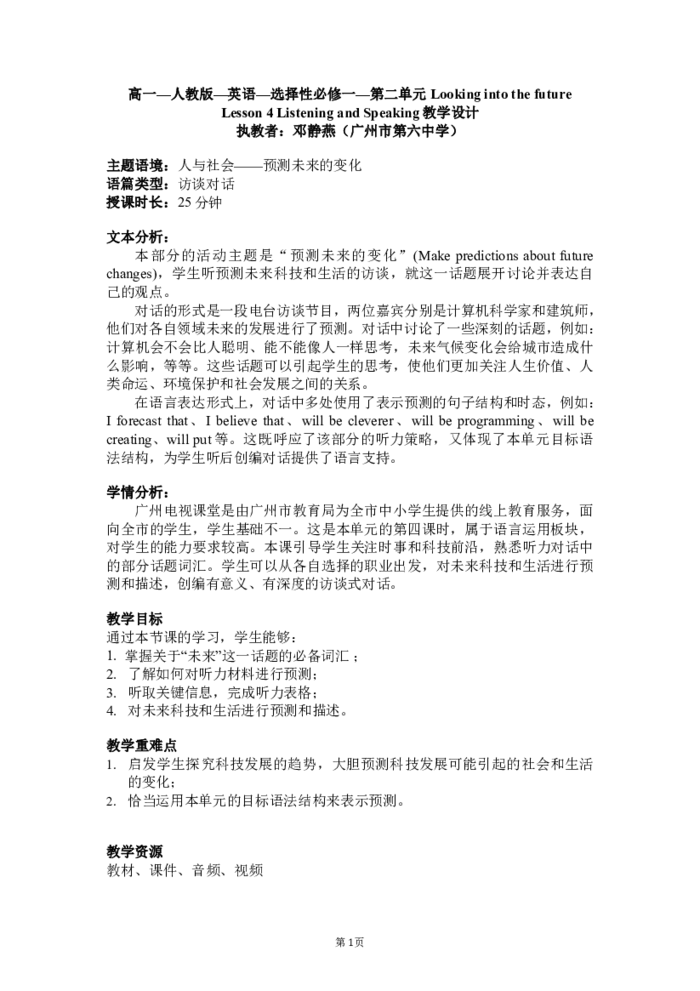
高一—人教版—英语—选择性必修一—第二单元Looking into the future
Lesson 4 Listening and Speaking 教学设计
执教者:邓静燕(广州市第六中学)
主题语境:人与社会——预测未来的变化
语篇类型:访谈对话
授课时长:25 分钟
文本分析:
本部分的活动主题是“预测未来的变化”(Make predictions about future
changes),学生听预测未来科技和生活的访谈,就这一话题展开讨论并表达自
己的观点。
对话的形式是一段电台访谈节目,两位嘉宾分别是计算机科学家和建筑师,
他们对各自领域未来的发展进行了预测。对话中讨论了一些深刻的话题,例如:
计算机会不会比人聪明、能不能像人一样思考,未来气候变化会给城市造成什
么影响,等等。这些话题可以引起学生的思考,使他们更加关注人生价值、人
类命运、环境保护和社会发展之间的关系。
在语言表达形式上,对话中多处使用了表示预测的句子结构和时态,例如:
I forecast that、I believe that、will be cleverer、will be programming、will be
creating、will put 等。这既呼应了该部分的听力策略,又体现了本单元目标语
法结构,为学生听后创编对话提供了语言支持。
学情分析:
广州电视课堂是由广州市教育局为全市中小学生提供的线上教育服务,面
向全市的学生,学生基础不一。这是本单元的第四课时,属于语言运用板块,
对学生的能力要求较高。本课引导学生关注时事和科技前沿,熟悉听力对话中
的部分话题词汇。学生可以从各自选择的职业出发,对未来科技和生活进行预
测和描述,创编有意义、有深度的访谈式对话。
教学目标
通过本节课的学习,学生能够:
1. 掌握关于“未来”这一话题的必备词汇;
2. 了解如何对听力材料进行预测;
3. 听取关键信息,完成听力表格;
4. 对未来科技和生活进行预测和描述。
教学重难点
1.
启发学生探究科技发展的趋势,大胆预测科技发展可能引起的社会和生活
的变化;
2.
恰当运用本单元的目标语法结构来表示预测。
教学资源
教材、课件、音频、视频
第2页
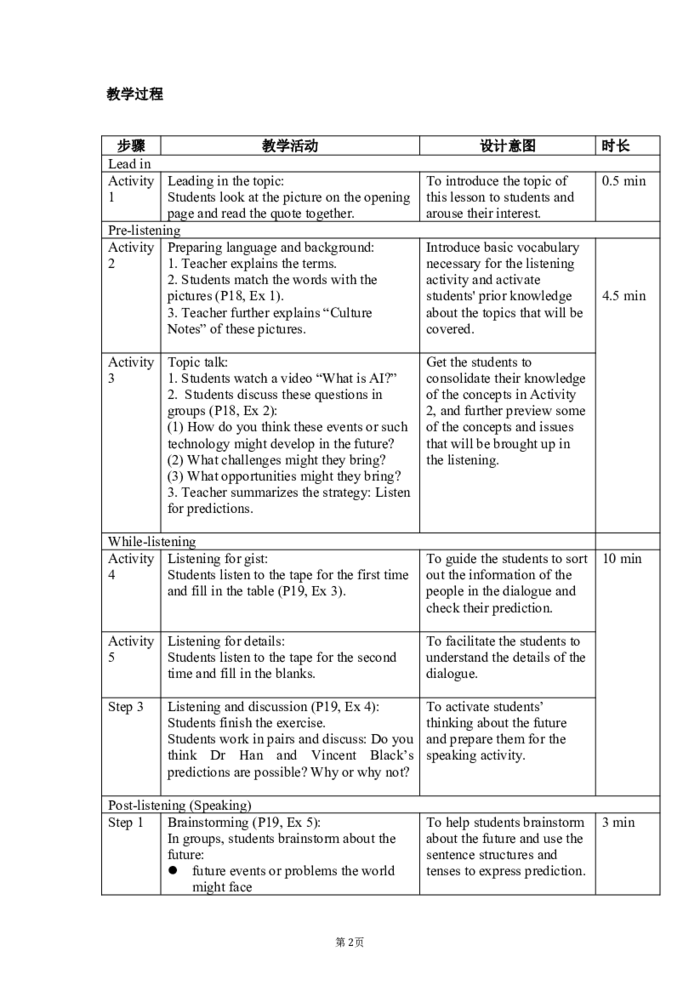
教学过程
步骤
教学活动
设计意图
时长
Lead in
Activity
1
Leading in the topic:
Students look at the picture on the opening
page and read the quote together.
To introduce the topic of
this lesson to students and
arouse their interest.
0.5 min
Pre-listening
Activity
2
Preparing language and background:
1. Teacher explains the terms.
2. Students match the words with the
pictures (P18, Ex 1).
3. Teacher further explains “Culture
Notes” of these pictures.
Introduce basic vocabulary
necessary for the listening
activity and activate
students' prior knowledge
about the topics that will be
covered.
4.5 min
Activity
3
Topic talk:
1. Students watch a video “What is AI?”
2. Students discuss these questions in
groups (P18, Ex 2):
(1) How do you think these events or such
technology might develop in the future?
(2) What challenges might they bring?
(3) What opportunities might they bring?
3. Teacher summarizes the strategy: Listen
for predictions.
Get the students to
consolidate their knowledge
of the concepts in Activity
2, and further preview some
of the concepts and issues
that will be brought up in
the listening.
While-listening
Activity
4
Listening for gist:
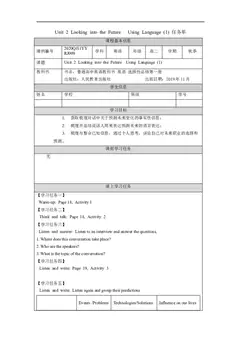
Students listen to the tape for the first time
and fill in the table (P19, Ex 3).
To guide the students to sort
out the information of the
people in the dialogue and
check their prediction.
10 min
Activity
5
Listening for details:
Students listen to the tape for the second
time and fill in the blanks.
To facilitate the students to
understand the details of the
dialogue.
Step 3
Listening and discussion (P19, Ex 4):
Students finish the exercise.
Students work in pairs and discuss: Do you
think
Dr
Han
and
Vincent
Black’s
predictions are possible? Why or why not?
To activate students’
thinking about the future
and prepare them for the
speaking activity.
Post-listening (Speaking)
Step 1
Brainstorming (P19, Ex 5):
In groups, students brainstorm about the
future:
future events or problems the world
might face
To help students brainstorm
about the future and use the
sentence structures and
tenses to express prediction.
3 min
第3页
future technologies
how these things will change the way
we live
the challenges and opportunities these
things might bring
Step 2
Pair work (P19, Ex 6):
1. Students make an interview in pairs:
Imagine that you have a job that makes
you an expert in the future. In pairs,
interview each other about your jobs and
predictions.
2. Teacher shows a sample dialogue.
To enable students to talk
about their future jobs and
predictions.
6 min
Summary and homework
T summarizes what has been taught in the lesson.
To summarize what students
have learned in this lesson.
0.5 min
T assigns homework:
1. Finish the “Listening and Speaking” exercises
in the workbook (Ex 1-5, P70).
Provide students extra
opportunities to practise
listening and speaking about
the theme of this unit.
0.5 min