高一—人教版—英语—选择性必修一—第二单元
Looking into the future
Lesson 4 Using Language:
Make predictions about future changes
广州市第六中学   邓静燕
After this lesson, you will be able to
1. know the basic vocabulary about “future”;
2. summarize the gist of an interview;
3. tell how to listen for predictions;
4. predict and describe technology and life in the
future.
Learning objectives
PART
01
Pre-listening
___ automation
___ nanobots
___ global warming
___ artificial
       intelligence (AI)
___ cloning
⑤
④
③
①
②
P19, Ex1. What do these pictures show? Match the words
with the pictures.
Term explanation
automation: the technique of making a device, a process, or a system operate
automatically.
nanobot: a machine or robot built on the nanoscale(纳米级), still in the research-
and-development stage, with potential applications in medicine and industry.
global warming: the increase in temperature of the earth’s atmosphere,
which is caused by the increase of particular gases, especially carbon dioxide.
artificial intelligence (AI): the ability of a digital computer or computer-
controlled robot to perform tasks commonly connected with intelligent beings.
cloning: the process of generating a genetically(基因地) identical(相同的) copy of a
cell(细胞) or an organism(有机体).
___ automation
___ nanobots
___ global warming
___ artificial
       intelligence (AI)
___ cloning
⑤
④
③
①
②
③
②
⑤
①
④
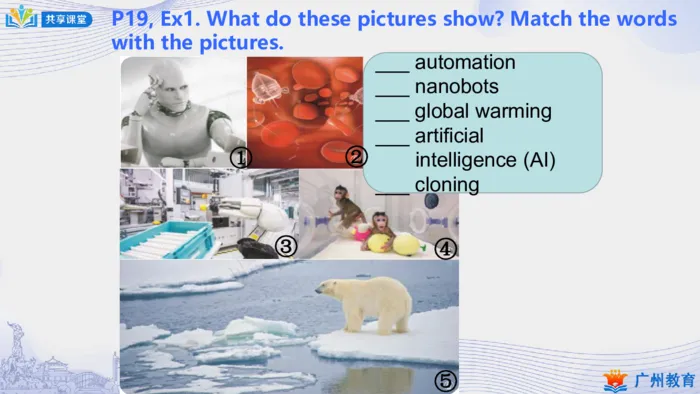
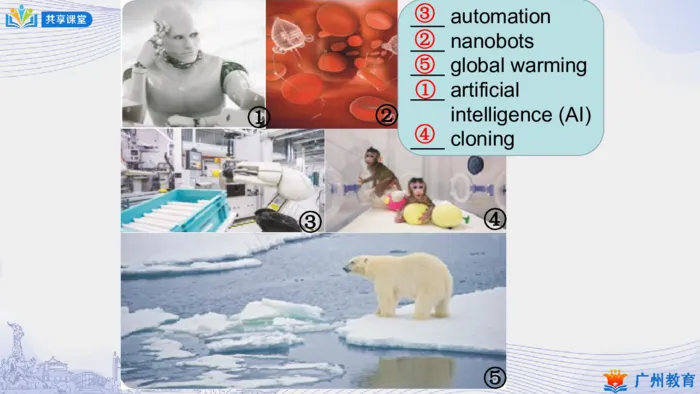
While most often when people think of a robot, they think
of the android (human-like robot) in Picture 1, actually the
vast majority of robots are like that in Picture 3, which is
a robot arm used to assemble (组装) parts in a factory. In
this activity, the robot arm in Picture 3 represents
automation. Since an android is meant to be like a human
in every way, the android in Picture 1 is being used to
represent artificial intelligence (AI).
③
①
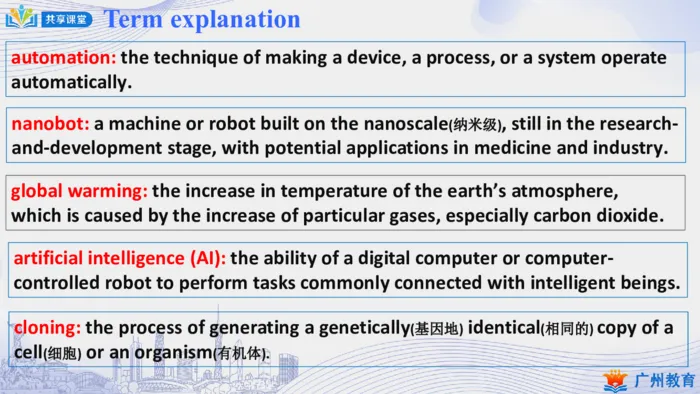
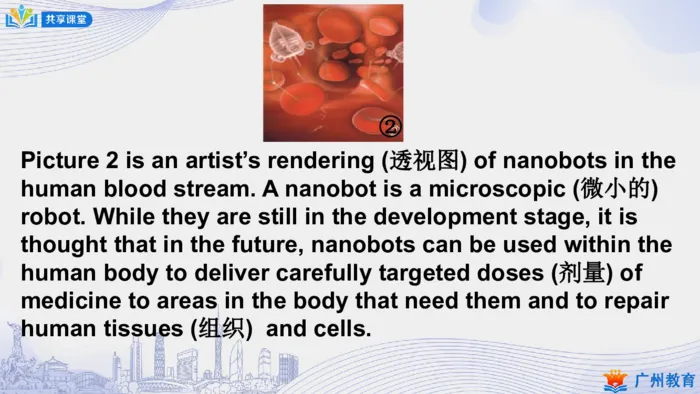
Picture 2 is an artist’s rendering (透视图) of nanobots in the
human blood stream. A nanobot is a microscopic (微小的)
robot. While they are still in the development stage, it is
thought that in the future, nanobots can be used within the
human body to deliver carefully targeted doses (剂量) of
medicine to areas in the body that need them and to repair
human tissues (组织)  and cells.
②
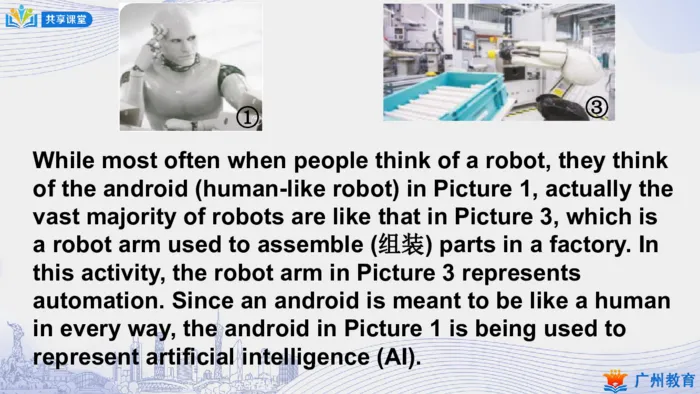
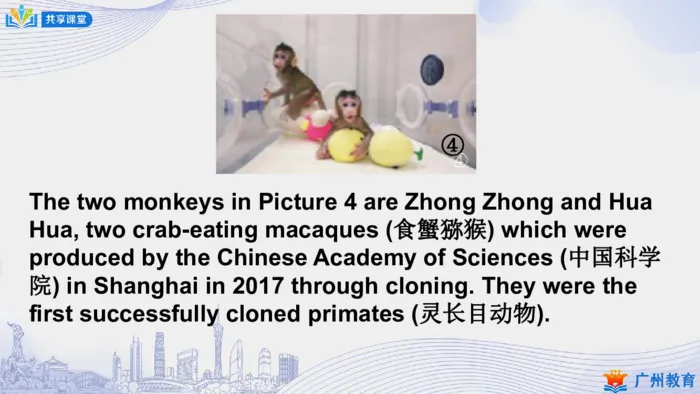
The two monkeys in Picture 4 are Zhong Zhong and Hua
Hua, two crab-eating macaques (食蟹猕猴) which were
produced by the Chinese Academy of Sciences (中国科学
院) in Shanghai in 2017 through cloning. They were the
first successfully cloned primates (灵长目动物).
④
Watch a video  “What is AI?” and prepare for the discussion.
(视频源自网络)
(1) How do you think
these events or such
technology might
develop in the future?
(2) What challenges
might they bring?
(3) What opportunities
might they bring?
2. Discuss these questions in groups. (P18, Ex 2)
(1)How do you think these events or such technology
might develop in the future?
No doubt, AI will develop to the point that humans
and computers will be able to interface effortlessly.
2. Discuss these questions in groups.
(2) What challenges might they bring?
With the development of AI, there may come a time
when it becomes a real issue as to whether a
computer or machine has in fact achieved
consciousness, and whether, as a conscious being, it
deserves the same rights as a human being.
2. Discuss these questions in groups.
(3) What opportunities might they bring?
Al may help us solve problems that are currently too
big and overwhelming for us to solve on our own.
For example, complex AI models may be able to use
given data to develop a workable solution to global
warming.
Listening strategy — Listen for predictions
If you make a prediction
about something, you say
what you think will
happen.
(Collins Dictionary)
The Simple
Future tense
一般将来时
Future
continuous tense
将来进行时
v.预测
n.预测
v.&n.预测
PART
02
While-listening
Listening for gist
(P19, Ex 3) Listen to the radio interview with Dr Han and Vincent Black giving
their predictions about the future, and then fill in the table below.
Name
Occupation
Prediction
Dr Han
Vincent
Black
computer
scientist
architect
Computers will be cleverer than us;
we’ll be programming them to not think
in ways that may harm humans;
we’ll also be creating machines to help
people internally.
There will be cities floating on water and
people could move into housing in cities
that float.
people will be programming computers
to think like humans;
Host: On today's episode of "Future Changes", we talk with two experts from
different fields, Dr Han and Vincent Black, to hear their                                        the
future.  First, Dr Han, could you please tell our audience what you do?
Dr Han:  Certainly. I'm a computer scientist.
Host: And could you please tell us your prediction?
Dr Han: Yes, well,                                computers will be cleverer than us in the future.
____________________ people will also be programming computers to think like humans.
Host: That's very interesting, but aren't you worried that such computers would be
dangerous?
Dr Han: Not at all. This is because ___________________________ them to not think in
ways that may                             . In fact,                                            machines to help
people internally. For example, I think scientists will put some small
                                                , called nanobots, inside our bodies to increase our
abilities.
Listening for details
Listen to the tape for the second time and fill in the blanks.
predictions about
I forecast that
I think that
harm humans
we'll also be creating
 intelligent machines
we'll be programming
Host: Wow! That would make each one of us superhuman! And Vincent,
could you please tell us about your job?
Vincent Black: Certainly. I'm an architect. I                                    .
Host:  And what is your _______________________ the buildings of the future?
Vincent Black: It's about the cities of the future, actually. I believe that
cities ______________________ are part of the world's future.
Host: Oh, really? What might make us want to do that?
Vincent Black: Yes. With global warming causing _______________________, the
sea level rising by many metres is a very                                       . Instead of
moving people away from the sea, ___________________ people could move
into housing in cities that float.
Host: That sounds very                    . Could you please give us more details?
Vincent Black: Sure. Well, I've developed a plan by _____________________ that
borrows many ideas from the giant water lily,  a flower
that___________________. Moreover ...
design buildings
floating on water
realistic prospect
innovative
prediction about
polar ice to melt
I think that
designing a city
floats on water
Discussion
P19, Ex 4. Work in pairs. Discuss whether you think Dr Han and
Vincent Black’s predictions are possible. Why or why not?
Tips:
Sentence patterns used to express predictions:
I forecast that …/ I think that …/ I believe that …
Tenses used to express predictions:
will be doing …/ will do …
Possible answers:
l agree on Dr Han's idea that computers will be cleverer than us
in the future. Actually there are already computers, like
AlphaGo, that are smarter than most people.
l don't agree on Vincent Black's idea about floating cities,
because I doubt that sea levels will rise that much.
PART
03
Post-listening
(P19, Ex 5) In groups, brainstorm about the future. Discuss
these points.
•
future events or problems the world might face
•
future technologies
•
how these things will change the way we live
•
the challenges and opportunities these things might bring
(P19, Ex 6) Imagine that you have a job that makes you an
expert in the future. In pairs, interview each other about your
jobs and predictions.
Sample Dialogue
A: Good afternoon, Ms Zhang. Thank you for agreeing to do this interview.
B: I'd love to.
A: First, could you please tell our audience what you do?
B: Certainly. I'm a doctor. I perform transplant surgery every week.
A:That sounds like a very high-tech job. How do you think the surgery will be operated in the
future? Do you have any predictions about that?
B: Yes, well, I believe that doctors in the future will have much better means to help people. I
can imagine that nanobots will be put in patients’ body to detect the illness. And in the future,
there will be adequate supply of organs for patients who need transplant.
A: Well, that would be really good news for all of us. Could you please explain how this will be
possible?
B: It will be possible because of special 3D printers. In the future, doctors will be using them in
hospitals regularly to create healthy copies of people's organs. Then they will replace the
unhealthy organs with the healthy copies.
Thank your for inviting me. / It’s my pleasure.
In this lesson, we have learned:
1. the basic vocabulary about “future”;
2. to summarize the gist of an interview;
3. how to listen for predictions;
4. to predict and describe technology and life in the future.
Summary
Finish the “Listening
and Speaking”
exercises in the
workbook (Ex 1-5,
P70).
高一—人教版—英语—选择性必修一—第二单元
Looking into the future
Lesson 4 Using Language:
Make predictions about future changes
答疑课
广州市第六中学    邓静燕
(P70, Ex 1) Look at the photos and the captions. Discuss
what you think is happening.
Picture A. Garry Kasparov feels disappointed after he lost his chess
match to a computer.
Picture B. An android is playing the winning move in a game of chess.
Picture C. Ke Jie is thinking hard as his computer opponent is winning.
            (P70, Ex 2)
Listen to this conversation from the future between Yueyue
and Huimin, an android that uses AI (artificial intelligence).
Order the pictures above (A-C) according to when the events
occurred by writing 1-3 in the blanks.
A _____________ B _____________ C _____________
1
2
3
                     (P70, Ex 3)
Listen to the conversation again and write down the dates when the
following events occur. They are having this conversation in the year
2310.
1. Al research begins                                           _____________________
2. Garry Kasparov defeated by Deep Blue     _____________________
3. Ke Jie defeated by AlphaGo                          _____________________
4. Al computers put into androids      ___________________________
5. First novel written by an android   ___________________________
6. First android president of a country__________________________
in 1956
in 1997
in 2017
in the mid-21st  century
in the mid-22nd century
in the mid-23rd  century
                     (P70, Ex 4)
Listen to the conversation again and answer the questions.
1. What are Yueyue and Huimin doing while they are talking?
2. What does Yueyue want Huimin to do differently?
3. What does Huimin offer to do for Yueyue while she is thinking?
4. What happens in the end?
5. What does Yueyue ask Huimin to do when they are finished?
They are playing chess.
To make the game easier.
To offer some tea for her.
Huimin wins the game.
Let her win the next game.
                     (P70, Ex 5)
What do you think AI will be able to do in the future? How will it affect
humans? Discuss your predictions about AI and other future technologies.
AI is able to understand and manipulate data so much faster that it
can help us to spot patterns more quickly. Thus, in the future, AI will
help us to solve problems that we consider too complex to solve now.
It is already helping us in a wide variety of fields such as medicine
and human-to-machine communication. The effect of this is that we
can more easily communicate with our devices such as smartphones,
and better organise our time. I think in the future many devices will
work automatically, like cars will be self-driving and safe, which gives
us more time to focus on other important things in life.