ARTICLE · 1108574
把AI反馈变成中文学习:一份作业的三次修改 Turning AI Feedback into Mandarin Learning
中文教学 × AI · 2026.09.30

AI生成主题配图,人物与场景为虚构。
从“改好了”到“我知道为什么这样改”
AI可以很快给出一段流畅的中文。中文老师更想知道的是:学生读懂了哪些建议?保留了哪些自己的想法?下次遇到类似的表达,能不能自己处理?
今天分享一份围绕短写作设计的活动:先自改,再借助反馈修改,最后检查和说明。把一次作业留下的几个版本,变成师生讨论语言的材料。
这是一份教学设计示例,并非已实施的课堂记录。适合已经能写出几句相连中文的学习者;初学者可以缩小到一句话。
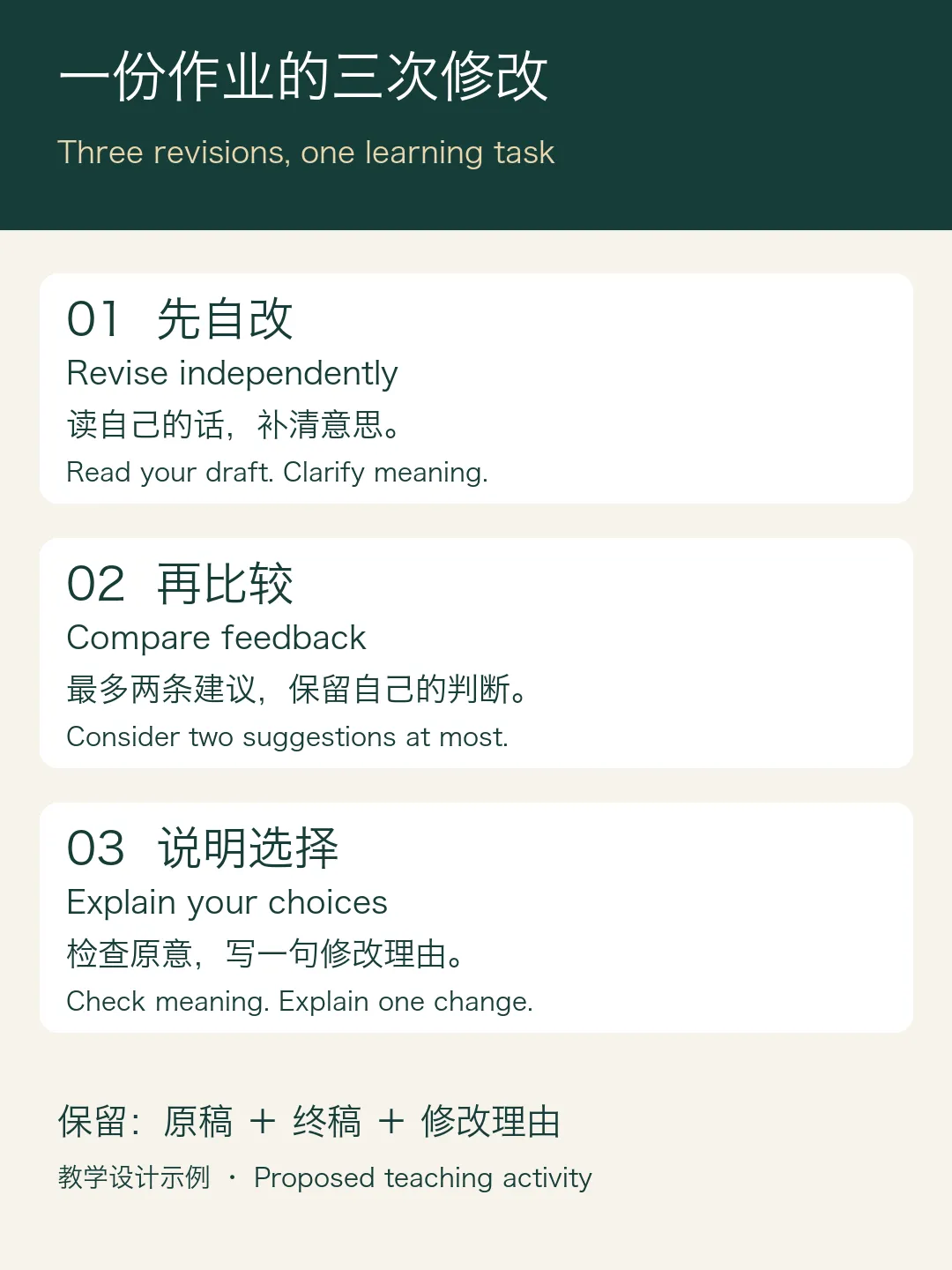
教学流程图|先自改,再比较,说明选择。
01|第一次修改:先让学生读自己的话
任务可以很小:用三到五句话,向同学介绍一次周末活动。先写原稿,再圈出时间、地点和一处最想表达的细节。
请学生先读一遍:“读者能知道发生了什么吗?我有没有把自己的意思写清楚?”教师只给一个本课目标,例如用“先……再……”说明顺序。
虚构示例原稿:“周末我去公园。我朋友。我们打球。很开心。”第一次自改:“周末,我和朋友去公园。我们打球。我很开心。”这一步先补清人物关系,不要求同时解决所有问题。
02|第二次修改:让AI提供问题和选项
教师可以用学校批准的工具演示,只输入虚构文本,不输入学生姓名或私人经历。请AI围绕一个目标给两条以内的建议,并把需要补充的信息写成问题。教师先检查建议,再给学生使用。
例如,教师可预设这条讨论建议:“你们打了什么球?如果你记得,可以写得更具体。”如果作者原本想表达的是篮球,就可以改成:“我们打篮球。我很开心。”
如果AI写出“我们打了两个小时,最后赢得了比赛”,学生可以拒绝:原稿没有这些信息。这个例子是预设讨论材料,不代表某次实际模型输出。
03|第三次修改:检查意思,说明选择
学生把建议放到一边,再读自己的版本。检查三个问题:有没有改变原意?有没有加入不真实的细节?有没有一句自己还解释不清的话?
最后一次修改可以只是调整标点、补一个词,或把不理解的表达换回熟悉的说法。随后写一句说明:“我把______改成______,因为______。”
教师可以追问:“不用看建议,你能换一个例子说出这个表达吗?”回答可以帮助教师决定下一步支持,但一次回答不能证明学生已经长期掌握。
一段可以直接改用的提示词
你是中文学习反馈助手。学习者正在练习【本课目标】,已学过【词语或句型】。请保留原意,不重写全文,不增加经历。最多提出两条与目标有关的建议。每条先指出原文位置,再用简单语言说明;缺少信息时先提问。把“需要修改”和“可选表达”分开。
工具有时不会完全遵循这些要求。教师仍需检查是否准确、是否符合学生水平,以及建议是否真的服务于本课目标。
怎样安排进一节课?
可先按20分钟试排:写原稿4分钟,自改4分钟,讨论反馈5分钟,最后修改与说明5分钟,同伴分享2分钟。这只是备课时的时间参考,可按班级情况调整。
初学者:一句话、一条建议,允许口头说明。进阶学生:一段话、两条建议,附修改理由。没有AI工具时:用教师准备的反馈卡或同伴问题完成相同流程。
教师可以收原稿、终稿和一句修改理由,分别看意思是否清楚、本课目标是否达成、学生能否解释选择。无需把修改数量当作进步的指标。
让反馈有下一步
英国教育捐赠基金会(EEF)的反馈指导强调,要安排学生理解和使用反馈的机会。UNESCO的生成式AI教育指导强调以人为本,并关注学习者自主性与数据隐私。这些原则为活动提供参考,但并不证明本文的三次修改流程已有实验验证。
你可以从下一次三句话的小作业开始:保留原稿,留出修改时间,再听学生说一句“我为什么这样改”。
你最希望学生在修改中文作业时学会什么?是表达更清楚,还是更能解释自己的选择?
Turning AI Feedback into Mandarin Learning
Three revisions of one writing task
From a better draft to an understood revision
AI can quickly produce fluent Chinese. A Mandarin teacher also needs to know which suggestions students understand, which ideas they choose to keep, and what they can do independently next time.
This activity uses a short writing task: students revise independently, consider feedback, and then review and explain their final choices. Their drafts become material for a conversation about language.
This is a proposed teaching design, not a report of classroom results. It suits learners who can write a few connected sentences. Beginners can work with a single sentence.
01 | First revision: read your own words
Keep the task small: write three to five sentences about a weekend activity for a classmate. Students draft first, then identify the time, place, and one detail they want to communicate.
Ask: “Can a reader understand what happened? Is my meaning clear?” Give one lesson-specific target, such as sequencing actions with 先……再…… (first…then…).
In a fictional draft, “周末我去公园。我朋友。我们打球。很开心。” becomes “周末,我和朋友去公园。我们打球。我很开心。” The first revision clarifies who went to the park. It does not need to fix every issue.
02 | Second revision: use AI for questions and options
The teacher can demonstrate with a school-approved tool and fictional text, without student names or private experiences. Request no more than two suggestions tied to one goal. Ask for questions wherever information is missing, and review the output before sharing it.
A teacher-prepared discussion prompt might be: “What kind of ball game did you play? If you remember, you could be more specific.” If the writer intended basketball, the sentence could become “我们打篮球。我很开心。”
If an AI suggestion adds two hours of play and winning a match, students can reject it because those details were not provided. This is a planned discussion example, not a record of an actual model response.
03 | Third revision: check meaning and explain choices
Students put the suggestions aside and reread their own version. Has the meaning changed? Have unsupported details appeared? Is there a sentence they cannot explain?
The final revision may adjust punctuation, add a word, or replace an unfamiliar expression with one the student understands. Students then complete: “I changed ___ to ___ because ___.”
A teacher might ask: “Can you use this expression in a different example without looking at the suggestion?” The response can inform the next teaching step; one response does not establish lasting mastery.
A prompt to adapt
You are a Mandarin learning feedback assistant. The learner is practising [lesson goal] and has learned [words or structures]. Preserve the intended meaning. Do not rewrite the whole text or invent experiences. Offer at most two goal-related suggestions. Identify the relevant wording and explain simply. Ask a question when information is missing. Distinguish necessary corrections from optional alternatives.
A tool may not follow every instruction. The teacher still checks accuracy, language level, and alignment with the lesson goal.
How might this fit into a lesson?
A possible 20-minute plan is four minutes to draft, four for self-revision, five to discuss feedback, five for the final revision and explanation, and two for partner sharing. These are planning estimates, not validated timings.
Beginners can work with one sentence and one suggestion, explaining orally. More advanced students can revise a paragraph using two suggestions and written reasons. Teacher-prepared feedback cards or peer questions provide a non-AI route through the same process.
Collect the original, the final draft, and one revision explanation. Consider clarity, the lesson goal, and the student’s explanation separately. The number of edits need not serve as a measure of progress.
Give feedback a next step
The Education Endowment Foundation’s feedback guidance recommends planning opportunities for pupils to understand and use feedback. UNESCO’s guidance on generative AI emphasises a human-centred approach, learner agency, and data privacy. These principles inform the activity; they do not establish experimental evidence for this three-revision routine.
Start with a three-sentence task: keep the draft, allow time for revision, and invite each learner to explain one decision.
What would you most like students to learn through revision: clearer expression, a stronger explanation of their choices, or both?
参考资料 / References
EEF — Teacher Feedback to Improve Pupil Learning
UNESCO — Guidance for generative AI in education and research