ARTICLE · 1271519
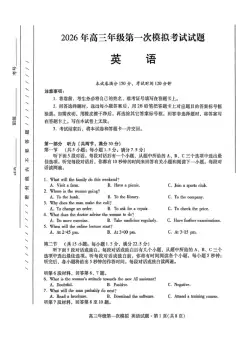
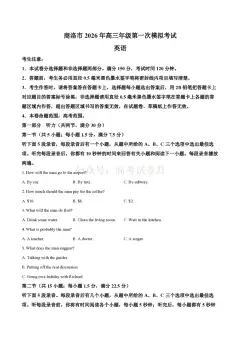
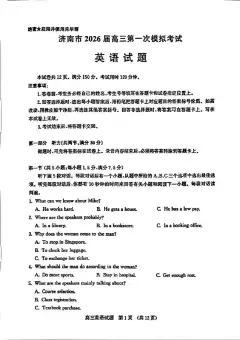
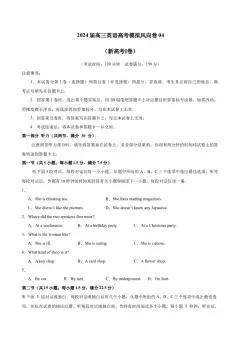
“小喵喵”2027届高三第一次模拟考试英语试题(新高考I卷)
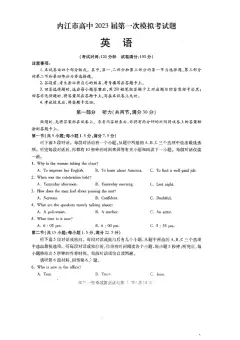
英语试题(新高考I卷)
注意事项
1. 答卷前,考生务必将自己的姓名、准考证号填写在答题卡上。
2. 回答选择题时,选出每小题答案后,用铅笔把答题卡对应题目的答案标号涂黑。如需改动,用橡皮擦干净后,再选涂其他答案。回答非选择题时,将答案写在答题卡上,写在本试卷上无效。
3. 考试结束,将本试卷和答题卡一并交回。
说明:提供听力题干,附听力原文,无音频。
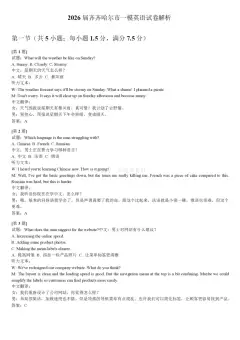
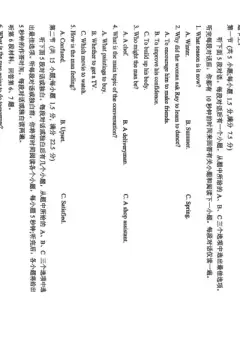
第一节(共5小题;每小题1.5分,满分7.5分)
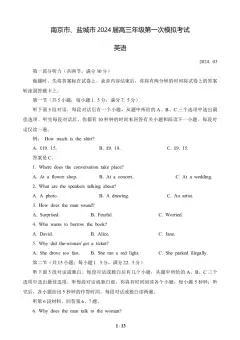
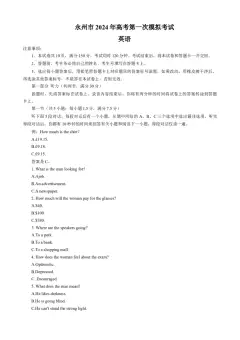
听下面5段对话。每段对话后有一个小题,从题中A、B、C选出最佳选项。听完每段对话,你有10秒答题并阅读下一小题。每段对话仅读一遍。
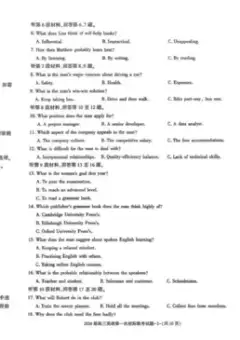
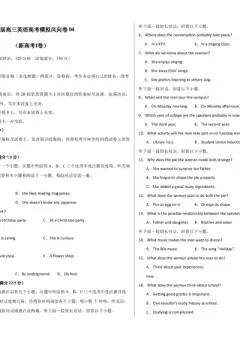
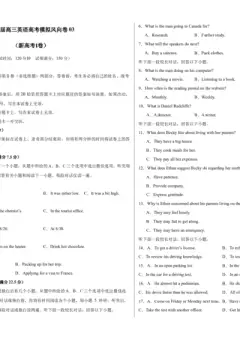
1. What will the woman do this weekend?
A. Go hiking B. Visit her grandma C. Prepare for an exam
2. How much should the man pay?
A. $12 B. $24 C. $30
3. Where does the conversation take place?
A. In a bookstore B. In a restaurant C. In a clothing store
4. What’s the weather like now?
A. Rainy B. Sunny C. Cloudy
5. Why is the man late?
A. He missed the bus. B. His bike broke down. C. He got stuck in traffic.
听下面5段对话或独白。每段对话或独白后有几个小题,从A、B、C选出最佳选项。听前,你有时间阅读各个小题;听完后,各小题将给出5秒作答时间。每段对话或独白读两遍。
听第6段材料,回答6、7题。
6. What sport does the girl prefer?
A. Swimming B. Running C. Cycling
7. When will they meet?
A. At 8:00 am B. At 8:30 am C. At 9:00 am
听第7段材料,回答8、9题。
8. What problem does the woman have?
A. Her laptop crashes often. B. Her phone screen is broken. C. Her camera can’t focus.
9. What suggestion does the man give?
A. Repair it at the shop. B. Buy a new one. C. Restart the device.
听第8段材料,回答10~12题。
10. What is the woman’s major?
A. Chemistry B. Computer science C. Medicine
11. What does the man plan to do in summer?
A. Do a part-time job. B. Travel abroad. C. Take training courses.
12. How does the woman feel about her major?
A. Bored B. Challenging C. Relaxed
听第9段材料,回答13~16题。
13. Where is the museum?
A. Next to the park. B. Opposite the library. C. Beside the subway station.
14. What is the exhibition about?
A. Traditional Chinese art. B. Space technology. C. Wildlife protection.
15. How much is the ticket for students?
A. Free B. 15 yuan C. 30 yuan
16. When will they visit the museum?
A. This Saturday morning. B. This Saturday afternoon. C. This Sunday morning.
听第10段独白,回答17~20题。
17. What is the speaker mainly talking about?
A. Tips for reading. B. Benefits of reading aloud. C. Ways to choose books.
18. What is the first advantage of reading aloud?
A. Improving pronunciation. B. Saving reading time. C. Making more friends.
19. How often does the speaker suggest reading aloud?
A. Every day. B. Twice a week. C. Once a month.
20. What should listeners do when meeting new words?
A. Skip them. B. Look them up. C. Mark and guess first.
听力原文
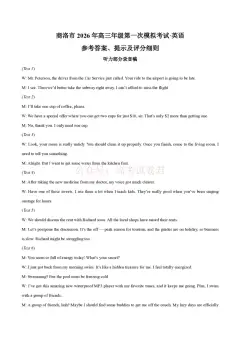
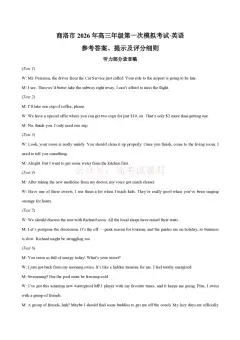
(Text 1)
M: Would you like to go hiking with me this weekend?
W: I’d love to, but I have to go back to my hometown to visit my grandma.
(Text2)
M: Two tickets, please. How much?
W: 12 dollars each.
(Text3)
W: Can I try this shirt on?
M: Sure, the fitting room is over there.
(Text4)
M: It was raining heavily this morning.
W: Yeah, but look, the sun has come out now.
(Text5)
W: You are late again. What happened?
M: Sorry. There was a heavy traffic jam on the road.
(Text6)
M: Let’s do some exercise this weekend. Do you like running?
W: Not really. I prefer cycling.
M: OK. Let’s meet at the gate of the park at 8:30 on Saturday morning.
W: Sounds good.
(Text7)
W: My laptop keeps crashing these days. I don’t know what to do.
M: You’d better take it to the repair shop and have it checked.
(Text8)
M: What’s your major in college?
W: Medicine. It’s really hard. What about you?
M: Computer science. I plan to take some programming courses this summer vacation.
(Text9)
M: There is a new exhibition in the city museum. Want to go?
W: What’s it about?
M: Traditional Chinese paper cutting and paintings. It’s opposite the city library. The ticket is 30 yuan, students half price.
W: Great! Let’s go there on Saturday morning.
(Text10)
Reading aloud brings many benefits. First, it helps us improve pronunciation and intonation. Second, it helps us understand the text better. It’s suggested that we read aloud for 15 minutes every day. When you meet new words, don’t look up the dictionary at once. Try to guess their meanings first and mark them down.
听力答案:
1.B 2.B 3.C 4.B 5.C
6.C 7.B 8.A 9.A
10.C 11.C 12.B
13.B 14.A 15.B 16.A
17.B 18.A 19.A 20.C
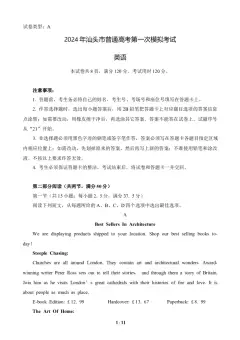
第一节(共15小题;每小题2.5分,满分37.5分)
阅读下列短文,从每题A、B、C、D四个选项中选出最佳选项。
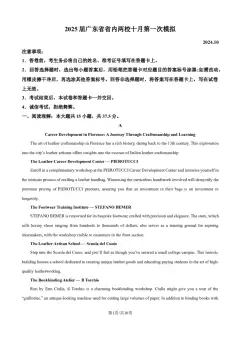
A
If you are looking for a meaningful volunteer project during vacation, community garden work is a great choice.
Community gardens are shared green spaces managed by local volunteers. People grow vegetables, herbs and flowers here. For beginners, volunteers will receive simple training about soil care, watering and plant protection. You do not need rich gardening experience.
Working in the garden brings multiple rewards. You get close to nature and take regular exercise. Besides, you can communicate with neighbours of different ages. Many volunteers say they have made new friends and learned practical growing skills. The fresh produce grown in the garden will be shared among volunteers or donated to local families in need.
Volunteer time: 3 hours every Saturday morning.
Requirements: Wear comfortable clothes and gloves. No previous experience required.
Sign-up: Send an email to communitygarden@shturl. before July 10.
21. What is the text mainly about?
A. An advertisement for a gardening volunteer project.
B. Introduction of different kinds of community plants.
C. Tips for beginners to learn gardening.
D. Ways to share fresh vegetables.
22. Which of the following is one benefit of the project?
A. Free gardening tools.
B. Chances to make new friends.
C. Free accommodation.
D. Professional gardening certificate.
23. What do volunteers need to prepare?
A. Gardening seeds. B. A training notebook.
C. Comfortable clothes. D. A working email address.
B
When 16-year-old Lina first joined the school newspaper team, she was shy and afraid of interviewing strangers. Her first interview task was to talk with an old teacher about school history. She prepared questions for three days, but still felt nervous when standing in front of the teacher.
To her surprise, the teacher was warm and patient. He shared many interesting old stories. Gradually, Lina calmed down and asked questions smoothly. After the interview, she finished her article and it was published.
That experience changed Lina. She realized courage does not mean having no fear. It means moving forward even when you feel afraid. Later, she took more interview tasks, and finally became the chief editor of the school newspaper.
Lina’s story tells us: growth often starts when we step out of our comfort zone.
24. Why was Lina nervous before her first interview?
A. She disliked the old teacher.
B. She was shy and unused to interviewing strangers.
C. She forgot her prepared questions.
D. She worried about her article being refused.
25. What can we infer from paragraph 2?
A. The teacher refused to be interviewed.
B. Lina finished the interview successfully.
C. Lina’s article was full of mistakes.
D. The teacher told Lina to give up.
26. What does Lina learn from the experience?
A. Never trust strangers easily.
B. It is impossible to beat fear.
C. Courage means acting despite fear.
D. Practice makes perfect in writing.
27. What is the best title of text B?
A. Step out of the comfort zone
B. How to be a newspaper editor
C. A warm old teacher
D. Ways to prepare interviews
C
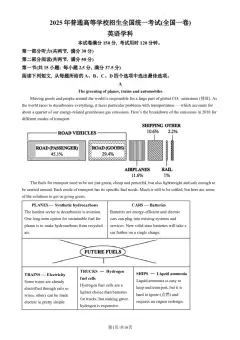
Many people believe multitasking can save time. However, scientific studies show the opposite. When our brain switches between different tasks, it produces switching cost. The brain needs extra energy and time to shift attention. As a result, the work becomes slower and less accurate.
For example, if a student does homework while chatting online, it will take much longer to finish exercises. More mistakes will appear in answers. Even if you think you can handle two things at once, your brain cannot focus fully on both tasks.
Researchers suggest single-tasking as a better habit. Set a period of time to focus on only one task. Turn off notifications on your phone. After finishing one job, move to the next one. This method improves efficiency and reduces errors.
28. What does “switching cost” in paragraph 1 refer to?
A. Money spent on electronic devices.
B. Time and energy lost when changing tasks.
C. Cost to buy study materials.
D. The price of changing plans.
29. What will happen if students multitask while doing homework?
A. They finish homework faster.
B. They make more mistakes.
C. They can memorize knowledge better.
D. They can improve communication skills.
30. What is the author’s advice?
A. Try to do many tasks together.
B. Chat online to relax while studying.
C. Focus on one task at a time.
D. Use phones to record study progress.
31. What is the author’s attitude towards multitasking?
A. Supportive. B. Doubtful. C. Neutral. D. Unconcerned.
D
Traditional paper books still hold strong charm in the digital age. Although e-readers and mobile reading are convenient, paper books offer unique reading experience.
Paper books allow readers to easily flip pages, mark lines and write notes. The smell of paper and ink creates a quiet reading atmosphere. Studies show people tend to remember information better after reading printed materials.
However, paper books also have weaknesses. They are heavy to carry and take much storage space. Printing paper consumes natural resources. E-books are cheap, portable and eco-friendly in production.
There is no absolute winner between them. Many readers choose both: e-books for short reading on trips, paper books for deep reading at home. The point is to enjoy reading itself, no matter what form we choose.
32. What advantage do paper books have?
A. Easy to carry around.
B. Save storage space.
C. Help readers remember information better.
D. Cost less money.
33. What is the disadvantage of paper books?
A. Readers cannot take notes.
B. They are heavy and occupy space.
C. They cannot provide quiet atmosphere.
D. They can’t be kept for long.
34. What can we infer from the last paragraph?
A. E-books will replace paper books completely.
B. People should only read paper books at home.
C. We can combine two reading forms.
D. Deep reading can only be done with paper books.
35. What is the text mainly about?
A. Comparison between paper books and e-books.
B. The history of printed books.
C. How to form good reading habits.
D. New digital reading technologies.
第二节(七选五,共5小题;每小题2.5分,满分12.5分)
How to keep motivation for long-term learning
It is easy to start learning something new, but hard to keep going for months. Here are practical tips.
36. ________. Setting huge goals often makes you discouraged. Divide the big goal into small daily tasks. Finishing small tasks gives you a sense of achievement.
Track your progress. Keep a simple learning journal. Write down what you finish each day. 37. ________. You will clearly see your growth when looking back.
Reward yourself properly. After finishing a weekly task, give yourself a small reward, such as listening to your favorite song or taking a short walk. 38. ________.
Find a partner. Studying alone can be boring. 39. ________. You can encourage each other and check progress together.
Accept slow days. Some days you feel tired and make little progress. It is normal. Don’t blame yourself. 40. ________. Just keep moving slowly.
A. Set small and clear daily goals
B. Big goals are always easy to achieve
C. Small rewards keep your energy up
D. A learning partner helps you stick to your plan
E. Record progress so you won’t forget your efforts
F. If you fall behind, you must restart from zero
G. Progress does not grow at the same speed every day
阅读答案
21.A 22.B 23.C
24.B 25.B 26.C 27.A
28.B 29.B 30.C 31.B
32.C 33.B 34.C 35.A
36.A 37.E 38.C 39.D 40.G
阅读简要解析
21.A:文章介绍假期园艺志愿者招募,属于广告。
22.B:原文you can communicate with neighbours...made new friends。
23.C:原文Wear comfortable clothes and gloves。
24.B:第一段she was shy and afraid of interviewing strangers。
25.B:她完成采访,文章发表,采访顺利完成。
26.C:原文courage does not mean having no fear. It means moving forward even when you feel afraid。
27.A:文章主旨走出舒适区获得成长。
28.B:任务切换时大脑消耗额外时间精力,即切换成本。
29.B:原文More mistakes will appear in answers。
30.C:研究者推荐一次只专注一件事single-tasking。
31.B:作者不认可多任务,持质疑态度。
32.C:studies show people tend to remember information better after reading printed materials。
33.B:原文They are heavy to carry and take much storage space。
34.C:很多人两种方式结合使用。
35.A:全文对比纸质书与电子书优缺点。
七选五:
36.A 总起,把大目标拆成小目标;
37.E 记录进度,看见自己的付出;
38.C 小奖励维持学习动力;
39.D 学习伙伴互相督促;
40.G 进步速度不是一成不变,接纳低效的日子。
第三部分 语言运用(共两节,满分30分)
第一节 完形填空(共15小题;每小题1分,满分15分)
Last summer, I volunteered in a mountain primary school. The school was small and simple. Most students lived in nearby villages.
On my first day, I stood in the classroom and felt nervous. I worried the kids would be quiet or uninterested. 41, they were warm and active. They raised hands eagerly and asked many curious questions about the outside world.
One girl named Xiao Yue caught my attention. She was quiet in class, but loved drawing. She drew mountains, birds and her family. Her drawings were full of life. I often talked with her and praised her works. Slowly, she became more confident and started sharing her pictures with classmates.
Before I left, Xiao Yue gave me a painting. In the picture, there was a teacher and many kids standing under a big tree. On the back, she wrote: Thank you for bringing light to our world.
That summer volunteer experience taught me: 42 is not one-way giving. When we give care to others, we also receive warmth and 43.
41. A. Therefore B. However C. Besides D. Otherwise
42. A. volunteering B. travelling C. studying D. painting
43. A. pressure B. pride C. darkness D. warmth
44. A. simple B. modern C. huge D. noisy
45. A. tired B. excited C. nervous D. relaxed
46. A. sadly B. coldly C. eagerly D. secretly
47. A. caught B. lost C. hurt D. saved
48. A. hated B. loved C. stopped D. forgot
49. A. boring B. empty C. alive D. strange
50. A. argued B. fought C. talked D. lied
51. A. slowly B. hardly C. nearly D. suddenly
52. A. bought B. lent C. sent D. gave
53. A. behind B. under C. above D. beside
54. A. bringing B. taking C. pushing D. pulling
55. A. refuse B. receive C. lose D. miss
41.B 42.A 43.B 44.A 45.C
46.C 47.A 48.B 49.C 50.C
51.A 52.D 53.B 54.A 55.B
41.B 转折。我担心孩子冷淡,然而他们热情积极。
42.A 全文讲志愿活动,志愿不是单向付出。
43.B 付出善意,收获温暖与自豪感pride。
44.A 小学校简陋simple。
45.C 第一天站教室感到紧张nervous。
46.C 急切举手eagerly。
47.A catch one’s attention 吸引某人注意。
48.B 热爱画画love drawing。
49.C full of alive 充满生机。
50.C talk with her 和她交流。
51.A slowly 慢慢地她变得自信。
52.D give sb sth 送给我一幅画。
53.B under a big tree 在大树下。
54.A bring light 带来光亮。
55.B receive warmth 收获温暖。
第二节 语法填空(共10小题;每小题1.5分,满分15分)
Reading poetry is a wonderful way to feel beauty of language. Chinese ancient poems 56.(pass) down for thousands of years. Many poems describe natural scenes and express deep feelings.
When you read a poem, read it aloud. It helps you feel its rhythm. Try to understand the background 57.the poet lived. You will know better why he wrote the lines.
Li Bai is one of the greatest poets in Tang Dynasty. His poems are 58.(full) of imagination and freedom. Many students enjoy 59.(read) his works.
Poetry is not only for great scholars. Ordinary people can also find comfort and joy 60.poems. If you meet a poem you like, write down your own thoughts. It is 61.meaningful way to communicate with the poet across time.
Every time we read poems, we connect with the past. Words carry feelings and wisdom. They remind us 62.(notice) small beautiful moments in daily life.
If you have trouble 63.(understand) difficult poems, do not give up. Keep reading and you 64.(find) more fun little by little. Poetry can enrich 65.(we) inner world.
语法填空答案
56. have been passed
57. where
58. full
59. reading
60. in
61. a
62. to notice
63. understanding
64. will find
65. our
语法填空解析
56. 被动+现在完成时:古诗被传承千年 have been passed
57. 定语从句,先行词background表地点,用where
58. be full of 固定搭配,充满
59. enjoy doing sth 喜欢做某事 reading
60. find joy in poems 在诗歌中找到乐趣
61. a meaningful way 一种有意义的方式
62. remind sb to do sth 提醒某人做某事
63. have trouble (in) doing 做某事有困难 understanding
64. 条件状语从句,主将从现 will find
65. 形容词性物主代词our,修饰inner world
第四部分 写作(共两节,满分40分)
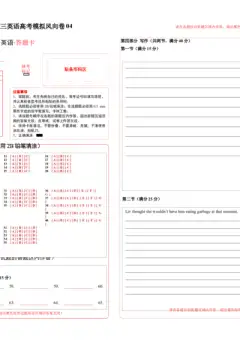
第一节 应用文写作(满分15分)
假定你是李华,你的英国笔友Peter计划暑假来中国研学,来信询问如何体验中华传统文化。请写一封回信,内容包括:
1. 推荐一项传统文化活动;
2. 简单介绍活动内容;
3. 表达期待。
注意:词数80左右;可以适当增加细节,使行文连贯。
参考范文
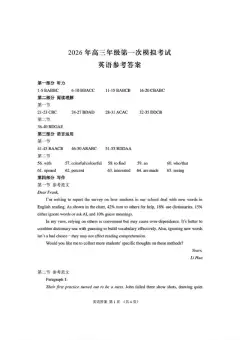
Dear Peter,
I’m glad to hear you will come to China for summer study. I strongly recommend paper-cutting experience.
Paper-cutting is a traditional Chinese folk art. We cut colorful paper into animals, flowers or Chinese characters with scissors. During the activity, you can watch local artists demonstrate and try cutting by yourself. You can even take your works home.
I’m looking forward to exploring traditional culture with you.
Yours,
Li Hua
评分要点解析
要点齐全,推荐剪纸、介绍活动、表达期待;句式多样,语法准确,词数达标。一类档12–15。
第二节 读后续写(满分25分)
阅读下面短文,根据所给情节进行续写,使之构成完整故事。词数150左右。
Tom loved hiking. One weekend, he went to a forest alone. He enjoyed the fresh air and beautiful trees. Unluckily, he walked too far and got lost.
The sun began to go down. Tom felt afraid. His phone had no signal. He tried to calm down and remembered survival tips he had learned before. He found a small stream and followed the water.
注意:
1. 续写两段,每段开头已给出;
2. 词数150左右。
Paragraph 1:
As darkness fell, Tom stopped to make a simple shelter.
Paragraph 2:
Early the next morning, Tom heard voices not far away.
参考范文
As darkness fell, Tom stopped to make a simple shelter. He piled dry branches and leaves to build a small shelter against the cold wind. He collected dry wood and lit a small fire carefully to keep warm and scare wild animals. He drank clean stream water and rested, trying to save energy. Though lonely and scared, he kept telling himself to stay calm.
Early the next morning, Tom heard voices not far away. He shouted loudly and waved his jacket. A group of forest rangers noticed him. They came over and helped Tom walk out of the forest. Tom thanked them sincerely. This experience taught Tom never to hike alone without full preparation.
紧扣原文逻辑,保持人物心理变化,情节合理;动作细节丰富,语法准确,情绪自然,符合高考读后续写评分标准。