ARTICLE · 1334434
小学英语阅读课笔记(2026.11.9)
初中英语阅读分析专项网课报名
时间:每周一,二,三,四,晚上21:00(定于2026.1.26号开始)
形式:腾讯会议直播(课后有回看视频)
内容:选自中考,一模,二模,外刊篇目,上海学生英文报(SSP)等,每次讲解一篇,说完结束(大概30分钟以内),可参考公众号内2024.2.13号推文或者公号内关于阅读分析的推文。
题型:完形填空,回答问题,阅读理解,选词填空(小猫钓鱼),选句填空(七选五),首字母填空,读后续写,语法填空,名校试题(独家资源库)等
费用:一周一付:一周80元(有缺席的,会发笔记,无退费,看清要求再报),每周五续费
目标:增加词汇量,养成阅读习惯
报名可扫以下二维码:

小学英语阅读分析专项网课报名:
对象:小学
时间:每周一,二,三,四,晚上20:35分开始(2025.9.1号开始,有回放视频。)
形式:腾讯会议直播(有回放视频)
内容:名校试题(独家资源库),ssp(上海学生英文报),时文阅读(当下热点事件),学乐小学英语分级阅读等,每次讲解一篇,说完结束(半小时以内结束,可参考2025.1.18号推文)
题型:选择题,判断题,回答问题,完形填空,语法填空,选词填空,思维导图等
考点和阅读策略:主旨与细节,上下文线索,预测,推断,事实与观点,比较与对比,角色,背景,关键事件与细节,事件的顺序,问题和解决方案
费用:一周一付:一周80元(有缺席的,会发笔记,无退费,看清要求再报),每周五续费
目标:增加词汇量,养成阅读习惯
线下需要有介绍人(请找到你的组织),网课不需要
可自行组团的课:
1 牛津提高,新教材提高 (课内提高)(网课或线下)
2 新概念课(第一,二册,三册)(网课或线下)
3 牛津自然拼读课(网课或线下)
4 1000词,2000词,4000词(网课或线下)
5 国际音标课 (网课或线下)
线下需要有介绍人(请找到你的组织),网课不需要
小学英语阅读课笔记(2026.11.9)
take care of是一个高频固定短语,核心意思是“照顾、照料”,但也可引申为“处理、负责、对付”。在课文The Dog中:
I willtake good care of a dog.
意思是:我会好好照顾一只狗。其中good 放在 care 前,不是修饰 dog,而是修饰 care。
一、主要用法
1. 照顾、照料(人、动物、物品)
- She takes care of her little brother.她照顾她弟弟。
- I will take care of the dog.我会照顾这只狗。
- Please take care of your books.请保管好你的书。
2. 处理、应付(事情、问题、工作)
- Don’t worry. I’ll take care of it.别担心,我来处理。
- She took care of all the paperwork.她处理了所有文书工作。
- Who will take care of the problem?谁来处理这个问题?
3. 负责、承担(费用、账单等)
- The company will take care of your travel expenses.公司会负责你的差旅费。
- Let me take care of the bill.让我来买单。
4. 对付、收拾(某人)
这一用法语气较强,有时带有威胁意味:
- I’ll take care of him.我会收拾他。
5. 照顾自己
- Take good care of yourself.好好照顾自己。
- You should take care of yourself first.你应该先照顾好自己。
二、结构要点
1. take + (形容词) + care + of
形容词放在care前:
- take good care of
- take better care of
- take excellent care of
✅ I will take good care of the dog.❌ I will take care good of the dog.
2. 代词放在 of 后面,用宾格
- take care of me / him / her / us / them / it
✅ She takes care of him.❌ She takes care ofhe.❌ She takes carehim.
3. 可用于被动语态
- The children are taken care of by their grandparents.孩子们由祖父母照顾。
- The dog is well taken care of.这只狗被照顾得很好。
4. 时态、情态变化
- I take care of my dog every day.
- I will take care of your dog tomorrow.
- You should take care of your health.
- Can you take care of the baby?
5. 后接名词、代词或名词性短语
常见接名词或代词:
- take care of the baby
- take care of the house
- take care of business
- take care of what needs to be done
三、与近义表达的区别
表达 | 主要意思 | 例句 |
take care of | 照顾;处理;负责 | I take care of my dog. |
look after | 照顾,英式常用 | She looks after her sister. |
care for | 照顾;喜欢;想要 | He cares for his old parents. |
take care | 保重;小心 | Take care! / Take care not to fall. |
注意:
- take care of后面必须接宾语。
- take care通常不接宾语,表示“保重”或“小心”。
- Take care! 保重!
- Take care not to fall. 小心别摔倒。
四、易错点
- ❌ take care him✅ take care of him
- ❌ take care of good the dog✅ take good care of the dog
- ❌ Take care yourself.✅ Take care of yourself.✅ Take care!(保重!)
- take care of表“照顾”时,通常不接 to do:
- ❌ take care of to walk the dog
- ✅ take care of the dog
- ✅ walk the dog
- take care to do sth是另一个结构,意思是“务必做某事、小心做某事”:
- Take care to lock the door.务必锁门。
五、在课文中的用法
课文里:
I willtake good care of a dog.
这是 Molly 对父母的承诺。后面几句是她对“take care of”的具体说明:
I willwalk him and feed him.I will brush him and make sure he always has clean water.
也就是说:
- take care of 是概括性表达;
- walk / feed / brush / give clean water 是具体行动。
这种写法在写作中很值得借鉴:先用 take care of 概括,再用具体动词展开。
词汇表:
编号 | 汉语 | 英语 | 百度英式音标 |
1 | 狗 | dog | /dɒɡ/ |
2 | 莫莉 | Molly | /ˈmɒli/ |
3 | 想要(过去式) | wanted | /ˈwɒntɪd/ |
4 | 胜过一切 | more than anything | /mɔː(r) ðən ˈeniθɪŋ/ |
5 | 每天晚上 | every night | /ˈevri naɪt/ |
6 | 问(过去式) | asked | /ɑːskt/ |
7 | 可以;可能 | may | /meɪ/ |
8 | 得到 | get | /ɡet/ |
9 | 必须 | have to | /ˈhæv tuː; həv tə/ |
10 | 好好照顾 | take good care of | /teɪk ɡʊd keə(r) ɒv/ |
11 | 遛;散步 | walk | /wɔːk/ |
12 | 喂;喂养 | feed | /fiːd/ |
13 | 刷;梳 | brush | /brʌʃ/ |
14 | 新鲜的水 | fresh water | /freʃ ˈwɔːtə(r)/ |
15 | 干净的水 | clean water | /kliːn ˈwɔːtə(r)/ |
16 | 父母 | parents | /ˈpeərənts/ |
17 | 悲伤的 | sad | /sæd/ |
18 | 从不 | never | /ˈnevə(r)/ |
19 | 七岁生日 | seventh birthday | /ˈsevnθ ˈbɜːθdeɪ/ |
20 | 吠叫(过去式) | barked | /bɑːkt/ |
全文翻译:
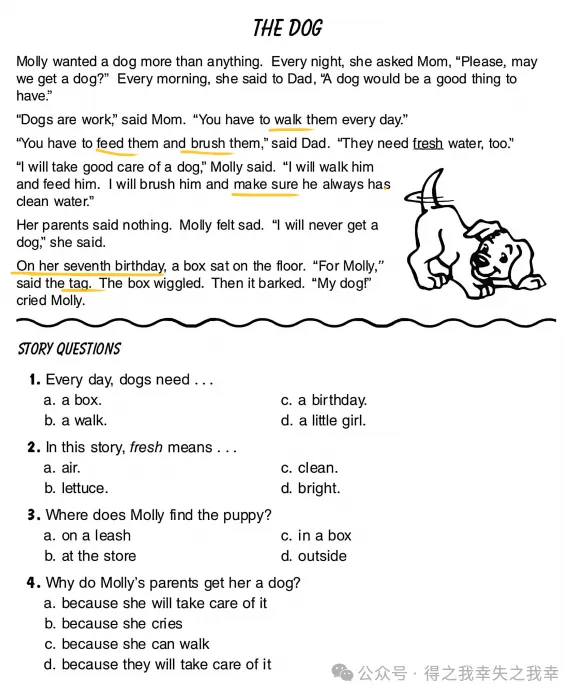
莫莉最想要的就是一只狗。每天晚上,她都问妈妈:“求求您,我们可以养一只狗吗?”每天早上,她都跟爸爸说:“养一只狗会是件好事。”
“狗很费事,”妈妈说,“你得每天遛它们。”
“你得喂它们,还要给它们刷毛,”爸爸说,“它们也需要干净的水。”
“我会好好照顾一只狗的,”莫莉说,“我会遛他,喂他。我会给他刷毛,还要保证他总有干净的水喝。”
她的父母什么也没说。莫莉很难过。“我永远也养不成狗了。”她说。
在她七岁生日那天,地板上放着一个盒子。标签上写着:“给莫莉。”盒子动了动,接着叫了一声。“我的狗!”莫莉喊道。
语篇分析:
下面按 What—Why—How 框架分析,并尽量引用原文句子说明。
一、What:主题语境与内容信息
1. 主题语境
本文属于课标三大主题语境中的交叉主题:
- 人与社会:家庭生活、亲子沟通。父母与 Molly 围绕“是否养狗”展开对话。
- 人与自我:成长、责任、承诺与愿望实现。Molly 说:“I will take good care of a dog.”
- 人与自然:宠物饲养与动物关怀。父母提出:“You have to walk them every day.” “You have to feed them and brush them.”
核心主题是:想要养宠物,就要承担照顾宠物的责任;爱与责任相伴。
2. 内容信息
文本可按叙事链概括为:
- 愿望:Molly 非常想要一只狗。“Molly wanted a dog more than anything.”
- 阻力:父母强调养狗很费事。“Dogs are work.” “You have to feed them and brush them.”
- 承诺:Molly 表示自己会照顾狗。“I will walk him and feed him. I will brush him and make sure he always has clean water.”
- 低谷:父母沉默,Molly 失望。“Her parents said nothing. Molly felt sad.”
- 惊喜结局:七岁生日,她收到一只会动、会叫的盒子里的狗。“On her seventh birthday, a box sat on the floor.” “My dog!” cried Molly.
二、Why:写作目的与育人价值
1. 写作目的
作者以儿童视角讲述一个“愿望—考验—实现”的小故事,目的是:
- 让儿童读者产生共鸣:想要宠物是许多孩子的共同愿望。
- 传递责任意识:养宠物不是只享受陪伴,还要 walk、feed、brush、给 clean water。
- 制造叙事悬念与惊喜:盒子“wiggled”“barked”,最后揭示是狗。
- 表现家庭之爱:父母并非简单拒绝,而是通过条件引导,最后以生日礼物回应。
2. 育人价值
- 责任感:Molly 的承诺“I will take good care of a dog.”是责任宣言。
- 承诺与行动:她不仅说“I will walk him”,还说“I will feed him”“I will brush him”,体现具体行动。
- 坚持与希望:即使她说“I will never get a dog”,结局仍出现转机。
- 感恩与家庭之爱:父母用“For Molly”的礼物表达爱。
- 动物关怀:强调狗需要“fresh water”“clean water”,培养爱护动物的意识。
三、How:语篇类型、体裁、结构、语言特征与衔接手段
1. 语篇类型
- 从表达方式看:记叙文,以事件发展为主线。
- 从真实性看:虚构故事。
- 从媒介看:书面语篇。
- 从功能看:文学性叙事语篇,兼具教育功能。
2. 语篇体裁
属于儿童故事 / 微型记叙文 / 绘本式叙事。语言简单,对话多,情节集中,结尾有反转。
3. 篇章结构
按时间顺序线性展开,呈“起—承—转—合”结构:
部分 | 内容 | 原文依据 |
起 | Molly 渴望养狗 | “Molly wanted a dog more than anything.” |
承 | 父母提出养狗条件 | “Dogs are work.” “You have to feed them and brush them.” |
转 | Molly 承诺照顾,父母沉默,她失望 | “I will take good care of a dog.” “Her parents said nothing.” |
合 | 七岁生日收到狗 | “On her seventh birthday, a box sat on the floor.” “My dog!” cried Molly. |
时间衔接非常明显:“Every night”“Every morning”“On her seventh birthday”。
4. 语言特征
- 词汇简单、具体:围绕养狗责任展开:dog, walk, feed, brush, fresh water, clean water。
- 句式简短,口语化:如“Dogs are work.” “The box wiggled. Then it barked.”
- 对话推动情节:父母的话引出责任主题,Molly 的话表达承诺与失望。
- 情态动词丰富:
- “may we get a dog?” 表礼貌请求;
- “A dog would be a good thing to have.” 中 would 表委婉愿望;
- “You have to walk them” 中 have to 表客观必要;
- “I will take good care” 中 will 表承诺。
- 重复与排比:“Every night... Every morning...”以及“I will... I will...”增强节奏和情感。
- 拟人、拟声与悬念:“The box wiggled. Then it barked.” 盒子会动、会叫,暗示里面有狗。
- 标点表达情感:问号、感叹号突出请求、惊喜。“My dog!” cried Molly.
5. 衔接手段
- 指代照应:
- “Molly”后用“she”“her”回指;
- “a dog”后用“him”回指;
- “dogs”后用“them”“they”回指;
- “a box”后用“the box”“it”回指。
- 词汇衔接:
- “dog”反复出现,形成核心词汇链;
- “walk / feed / brush / water”构成宠物照料语义场;
- “box / tag / wiggled / barked”构成悬念语义场。
- 连接与时间衔接:
- “Every night”“Every morning”“On her seventh birthday”标明时间推进;
- “Then it barked.”中 then 表示先后顺序。
- 逻辑衔接:
- “Her parents said nothing. Molly felt sad.”形成因果/情感推进;
- “The box wiggled. Then it barked.”与“My dog!”形成揭示关系。
- 省略:
- “make sure he always has clean water”中 make sure 后省略了 that,实际为 make sure (that) he always has clean water。
四、长难句解析
- Molly wanted a dog more than anything.
- 结构:主语 Molly + 谓语 wanted + 宾语 a dog + 比较状语 more than anything。
- 含义:Molly 想要一只狗,胜过一切。
- 功能:开篇点题,强烈表达愿望。
- Every night, she asked Mom, “Please, may we get a dog?” Every morning, she said to Dad, “A dog would be a good thing to have.”
- 结构:时间状语前置;asked/said 后接直接引语。
- 语言点:may 表礼貌请求;would 表委婉愿望;to have 作后置定语修饰 thing。
- 功能:通过“每晚问妈妈、每早对爸爸说”表现 Molly 的坚持。
- “I will take good care of a dog,” Molly said. “I will walk him and feed him. I will brush him and make sure he always has clean water.”
- 结构:三个“I will...”排比;walk/feed/brush 为并列谓语;make sure 后接省略 that 的宾语从句。
- 语言点:will 表承诺;him 指 dog;always 位于 has 前。
- 功能:这是全文的责任宣言,回应父母提出的养狗条件。
- “Dogs are work,” said Mom.
- 结构:引语前置,主谓倒装,正常语序为 Mom said, “Dogs are work.”
- 含义:养狗不是玩玩而已,而是一件费心费力的事。
- 功能:用极短句点明主题冲突。
- On her seventh birthday, a box sat on the floor. “For Molly,” said the tag. The box wiggled. Then it barked.
- 结构:时间状语开头;a box 首次引入,the box 回指;said the tag 为引语后倒装。
- 修辞:wiggled、barked 拟人/拟声,制造悬念。
- 功能:从失望转向惊喜,是全文高潮。
- “My dog!” cried Molly.
- 结构:直接引语前置,cried Molly 为倒装。
- 功能:以感叹句和倒装突出 Molly 的惊喜与激动,收束全文。
五、总体评价
这是一篇典型的儿童微型叙事文本:以“想要狗—父母提责任—Molly 承诺—失望—生日惊喜”为线索,语言浅显,对话自然,衔接紧密,结尾有反转。教学中可重点抓三点:责任主题、情态动词、时间顺序与指代衔接。
答案:
bcca