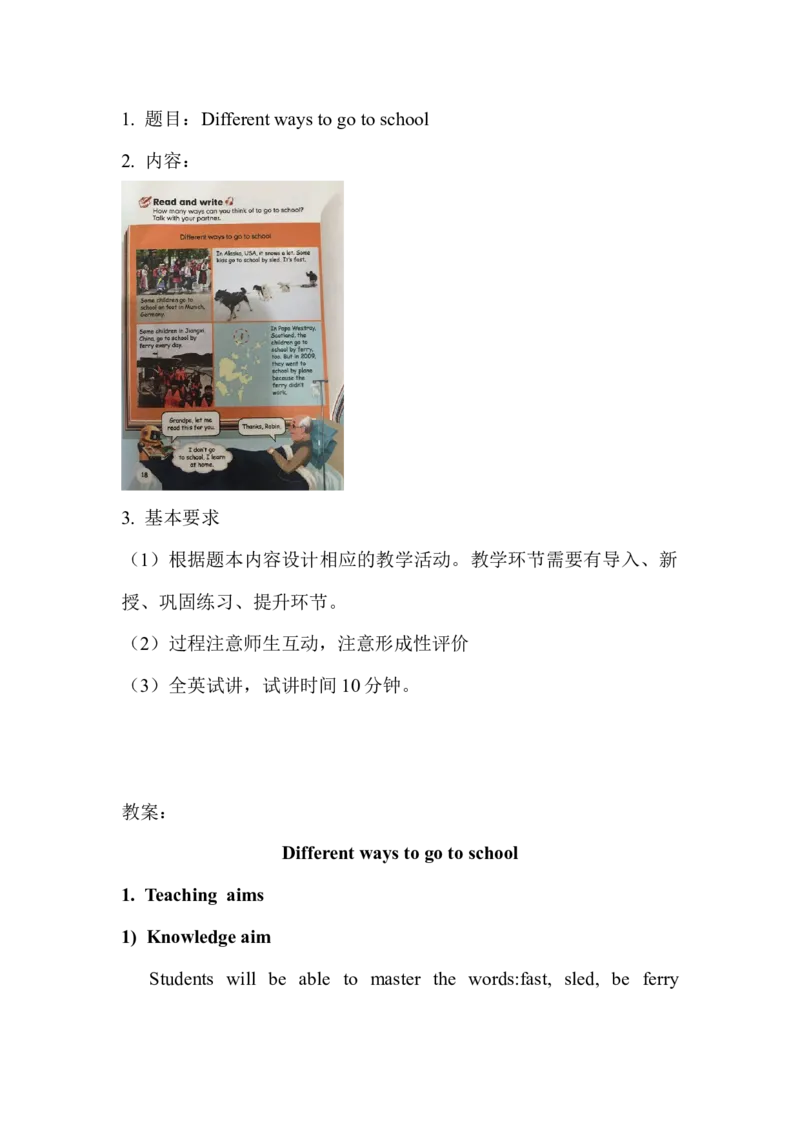
1. 题目:Different ways to go to school
2. 内容:
3. 基本要求
(1)根据题本内容设计相应的教学活动。教学环节需要有导入、新
授、巩固练习、提升环节。
(2)过程注意师生互动,注意形成性评价
(3)全英试讲,试讲时间10分钟。
教案:
Different ways to go to school
1. Teaching aims
1) Knowledge aim
Students will be able to master the words:fast, sled, be ferryand so on.
Students will be able to get the meaning:“Some kids go to
school by sled.”
2) Ability aim
Students can train their reading skills by reading to the key words
and understand different countries have different ways to go to
school.
3) Emotional aim
Students can realize their own ways to go to school by cosidering
many elements.
2. Important and difficult points
1) Important point
Students will be guided to master many ways and countries in
English.
2) Difficult point
Students will improve their reading skills as well as the ability to use
the new words and sentences to communicate freely.
3. Teaching and learning methods
Situational teaching method; communicative teaching method; task-
based teaching method ; group work method; cooperation study
method; independent study method
4. Teaching proceduresStep 1: Lead in
Sing a song
I will present some pictures with music to help them review the
words they learned before. Such as: by bus,by car, on foot, traffic
lights...
Step 2: Pre-reading
Showing pictures. Talk about the picture of“Robin and grandpa
”they will answer many questions as follows:Q1:Who is he ?How
is he?Q2:What does Robin want to do ? Q3:What’s the text
about ? That’s our topic today:Different ways to go to school
Step3 while-reading
First reading:Find the key words.Q1:How many countries can you
find ? They are ....
Learn the new/key words T: I have so many beautiful pictures
about these countries .Now let’s learn the new words about it .
The second reading :Read the text quickly and underline the places to
go to school with “__”,the ways with “ ___ ” Q1.T: How many ways
to go to school? Can you find ?Present the main text.Travel the
four places one by one. Q2: Does everyone go to school? Why?
The third time, reading and listening.
Step 4: post-reading
1.Listen and imitate.(work in groups)
2.report3.Writing (fill in the blanks)
Step5 Summary
1) Different places have different ways to go to school
2) We should enjoy our own ways to school ; enjoy our
beautiful life .
Step6 Homework
(1) Retell the text.and know the meaning.
(2)Tell your parents what we have learned before.
Step 7 Blackboard design
Different ways to go to school
Munick Germany on foot G1
G2
Alaska USA sled
Jiangxi China by ferry
Papa Westray Scotland by ferry /by plane
试讲稿:
Different ways to go to school
1.Greeting and warming up
Good morning, guys! How are you today?You are fine? You are
ok? You are just so so? Ok, I’m so glad to be here! What’s the
weather like today? Is it cold? Ok, show me your hands ! let’ssing a song and have a relax. Let’s go. Oh, you like it. Most of you are
interested in it.
2. Pre-reading
OK, now boys and girls,Tomorrow is Sunday, do you want to have a
trip? Today we’ll travel around the world. Look at the picture .Where is
it ?Yeah,Haha ,here,our school.How do your come to school ?S1: By
bus S2: By car. S3: By bike...Wow, there are many traffic tools.
Hey, guys, do you remember traffic rules? You are so cool! There
are all kinds of transportation in our life in the world. Please look
at this picture first:“Robin and grandpa ”
Q1:Who is he ?How is he?
(He’s WuYifan’s grandpa. He’s ill.)
Q2:What does Robin want to do ?
(He wants to read a text to grandpa)
Q3:What’s the text about ? That’s our topic today.Read the
topic together“Different ways to go to school.”Do you want toknow ?I think it’s a very interesting text .
3.While-reading
Turn your book to P18 .Read silently and underline the answer .
Q:How many countries can you find ?
But before reading, can you remember the reading skills we have
learned before? Wow, Maria, you please. Do you agree with her? Yes,
perfect good. When we read a passage, there are some words, phrases or
sentences you don’t know. It doesn’t matter. Don’t focus on them. You
can pass them or guess the meaning from the passage. Maria, thank you ,
you have a good memory. Now, guys, let’s read quickly with the skills.
Begin. Time’s up. Oliver, you please.Oh,You can find four
countries .They are Germany, USA, Scotland and China. Have you
underlined? Yes, you are a good reader!
I have so many beautiful pictures about these countries .Now let’s
learn the new words about it .The first one, Munich , where is it? It’s
in Germany. Read after me :Munich Germany The next, Alaska,where is it? It’s in USA, right? Read after me: Alaska The
USA...
Good job. Hey, everybody, look at the PPT ! There are 2
questions
Q1:How many ways to go to school can you find in the text?
Underline them.
Q2: Does everyone in the text go to school?
Read the dialogue carefully and finish the questions. This time you
can focus on the details. Let’s begin. Three minutes later, I will choose
some of you to share your answer. Let’s start. Have you got the answer?
Wow, so many hands. Who should I choose? How about “ Hot potato
game?” pay attention to the potato is very hot. Please pass it quickly one
by one. Let’s go! Tom, you are so lucky. Can you give me the answer?
Yes, Tom. You are so clever! “Four” “ on foot, by sled, by
ferry, by plane” Do you know sled? When it snows, may be wecan go to school by sled! Look at me, “ sled” can you do the
actions just like me? “ By sled, by sled” There is a map of
China and here is JiangXi. JiangXi is very beautiful .There are
many mountains and rivers in front of people’s house .How do the
children go to school ? Which one? Jack, you please. “ by ferry”
you are so cool! Do you know ferry! Yeah, I think it’s an
interesting way to go to school. What about Papa Westray
Scotland? By ferry ,too? The girl in yellow~You haven’t got the
answer. It doesn’t matter. Now, please read the passage carefully
again and find the answer. Let’s go. Boys and girl, have you got
the answer. Yes, you got it. Oliver, you please. Wonderful! “ The
children go to school by ferry, too. But in 2009 , they went to
school by plane because the ferry didn’t work” Have you got the
sentence. Do you want to go to school by plane ?Maybe one day
we can go to school or work by plane. How about the students inthe Munich?Yes, they go to school on foot! Good. Hey, guys.In the
passage, the writer told us different places have different ways.
Look at the question 2, who can tell me? What about you Jack?
“ No. Robin doesn’t go to school” Why? Who can try? David?
Enh, Grandpa is ill ,right? Now, look at the text.Let’s listen to the
tape carefully! Ready? Go!
4.Post-reading
Before practicing, I will divide you into 2 groups: G1 and G2.
you are G1 and you are G2. Hello, G1! Hello, G2! We’ll have a
PK! The better group will get the magic box.
Task 1: reading and imitate
Please work in pair and read your favorite paragraph.If you like
to go to school on foot , Please read this paragraph .If you like go
to school by ferry ,You can read here. I will choose several pairs
to show us. 5 minutes for you . Let’s go. OK, time’s up!Which pair want to show? Lucy and your partner please. Wow,
perfect, good acting. But pay attention to the word “sled”, yeah,
this time is better. You are in G2, so G2 get 1 point. Lily and
Jane, how about you? Wow, wonderful, boy and girls, give them a
big hands.The G1 get 1 point. Now, boys and girls, which way do
you like? I think you have different opinions .Let’ s make a
survey and make a survey in your group. 5 minutes later, the
group leader can give a report. OK? OK. Let’s go. Have you
finish it? Yes, Eric, you please. Ok, Eric, from your report, we
know the members who like by ferry and who like by plane. Very
clear. Let me see, you are in G1 right? So G 1 get 1 point. Let’s
do some writing . Take out your paper and fill in the blanks. 3
minutes for you. Here we go! Have you finish it? Mike? Perfect!
You are good reader! Content:In Munich Germany .Some children
go to school In Alaska, some students go to school by sled. InJiang Xi , Some children go to school by ferry... yeah, you are in
G1 so G1 get one point.
5.Summary and homework
How time flies. Who can sum up what we have learned today? Susan,
you please. Yes the differences ways to go to school. Children are in
poor areas and mountains areas .They are difficult to walk to go to
school . Think about ourselves, from kindergarten to primary school
.We go to school with our father 、 mother and partners .We
harvest the family love and friendship . We are lucky and happy
.Please enjoy your ways to school. Who is the winner? G1 ? right?
Clap hands for them!Now, boys and girls, here comes today’s
homework:
(1) Retell the text.and know the meaning.
(2)Tell your parents what we have learned before.
OK,class over,see you.