ARTICLE · 1349325
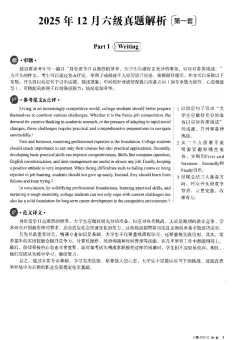
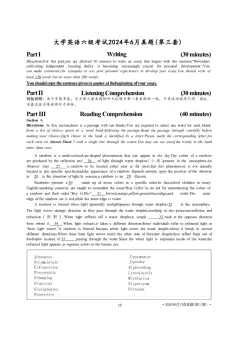
2026年6月大学英语六级真题(匹配阅读 第2套)
Section B
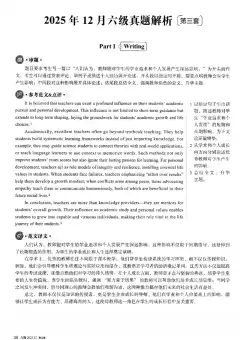
A) Five hundred years ago, forests covered much of the Iberian peninsula. But that soon changed. Centuries ofwars and invasions, agricultural expansion and woodcutting for firewood and shipping wiped out most of thewoods and transformed places like Matamorisca, a small village in northern Spain, into degraded landscapes.
B) The region's dry climate and depleted soils would be a recipe for disaster in your average program to replanttrees, but for the Amsterdam-based Land Life Company it' an ideal place. “"We typically operate where naturedoes not come back by itself,” says Jurrian Ruys, its CEO. “We go where there are rougher conditions in terms of weather, with rough or very hot summers." In Matamorisca, they intervened in 17 barren hectaresowned by the regional government and peppered them with their signature device: a biodegradable (可生物降解的)cardboard container they call the cocoon which can hold 25 litres of water underground to aida seedling's first year. Around 16,000 trees, including oaks, ashes, walnuts, rowans, and whitebeams, wereplanted in May 2018, and the company reports that 96% of them survived that year's burning hot summerwithout extra irrigation, a critical milestone for a young tree.
C) “Does nature return by itself?" asks Arnout Asjes, Land Life Company's chief technology officer, whooversees a mix of drone (无人机) and satellite imagery, big data analysis, soil enhancement, QR (二维码)tagging and site-specific tree configuration designs. "Probably, but it can take decades or hundreds of years,so we are speeding things up."
D) His company belongs to a global movement of organisations trying to save degraded or deforested areas,ranging from fertile tropical lowlands to dry hills in temperate (温带的) regions. Spurred by global biodiversity loss and climate change, these groups are pushing the boundary of how to revive forest cover.“It's not a theoretical proposition,” says Walter Vergara, a forest and climate specialist at the World ResourcesInstitute (WRI). “It requires the right incentives, the right stakeholders, the right analysis and sufficient capital, but it can happen."
E) How these factors come together for a particular project-—-and whether saving destroyed woods is even possible—depends on what kind of ecosystem you have in mind. Secondary forests in the Amazon aredifferent from Texas pines recovering after wildfires or the Arctic timber woods that cover much of Sweden.Each provides different reasons for reforestation programs and each has particular needs. In the dry conditionsaround Matamorisca and similar areas in Spain, Land Life Company worries about rapid desertification (沙漠化). As its focus is on restoring an ecosystem, it works with organisations that don't expect their moneyback.
F) With around 600 hectares replanted around the world since 2015 and another 1,100 planned for this year, thecompany's drive fits into the Bonn Challenge, a global effort to restore 150 million hectares of the world's deforested and degraded land by 2020. That's an area roughly the size of Iran or Mongolia. By 2030, the goalis to reach 350 million hectares—20% more land than India. These targets include both the rehabilitation offorested areas that have lost density or look a bit weak (a process known as ‘restoration' in forestry jargon)and the recovery of forest cover in areas where it was completely cleared (what's known as *reforestation').
G) That global target is broken into smaller pieces and takes shape in Latin America as the 20x20 Initiative, an effort to contribute 20 million hectares to the overall goal by initiating small to medium projects with thepolitical backing of governments. Unlike Land Life Company, this region-wide project makes the economicand business case for reforestation, even though they are after biodiversity conservation. “You need to bring in private sector money,”says WRI's Vergara, who leads the initiative, “and that capital needs to see a return on their investment." A study he led predicts Latin America would see an estimated net present value of about S2 3bn over a 50-year period if it reaches its goal.
H) Money can come from timber sales in sustainably managed forests or from harvesting 'non-wood products' like nuts, oils and fruits from the trees. You can take note of how much carbon dioxide your forest is capturing and sell carbon credits to companies keen to offset their emissions. Or you can even grow the forest hoping that biodiversity will attract ecotourists who'd pay for lodging, birdwatching tours and meals.
I1)Still, these backers are not your high-street bank. Money for the 20x20 Initiative comes mostly from financial organisations with triple goal—a modest return on their investment, environmental benefits and social gainsknown as impact investors. Take the German fund 12Tree for instance, one of the 20x20 partners. It put $9.5 million into Cuango, a 1,455-hectare property on the Caribbean coast of Panama that combines a commercial cocoa tree plantation with timber extraction from a sustainably managed secondary forest. With their money, they reforested a former cattle ranch, provided high-quality jobs for the surrounding communities and made a return on their investment.
J)Even on land cleared decades ago and currently used by farmers, some crops can coexist with the forest, ifyou find the right balance. Although not technically reforestation, agroforestry (a system of land use in whichharvestable trees or shrubs are grown among or around crops or on pasture land, as a means of preservingor enhancing the productivity of the land) provides an opportunity for small-holder farmers to sustain theirlivelihoods while adding some forest cover to their farms.
K) A global project called Breedcafs is studying how trees behave in coffee farms, hoping to find crop varietiesthat manage to grow under the shade of trees. Coffee grows naturally in such forests, so copying that in farmsis taking the crop back to its roots. “By reintroducing trees in the landscape, we impact positively humidity,rain capture, soil conservation and biodiversity preservation,” says coffee expert Benoit Bertrand, wholeads the project from the French Agricultural Research Centre for International Development. Bertrand isanalysing which of dozens of coffee varieties fits better for this system. A similar approach can be applied toland with cocoa,vanilla and fruit trees.
L) Not every piece of land is fit for reforestation. Vergara's partners look for safe investments, and even LandLife Company only runs major projects in what they consider "low-risk" countries. “We tend to avoidlarge-scale operations in countries in some parts of the Middle East or Africa where the permanence is not secured," says Ruys.
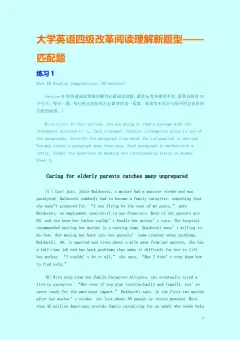
M) But in the right location, perhaps all you need is time. In the Central Pacific of Costa Rica, the330-hectare National Wildlife Refuge Baru looks nothing like the cattle ranch it was before 1987, whenJack Ewing decided to turn this large estate into an ecotourism destination. Instead of intervening, afriend told him to let nature have its way. Baru's former grazing lands are now thriving woods and theproperty boasts over 150 hectares of secondary forests with no intervention from humans. In the past 10years, animals such as howling monkeys, scarlet macaws and even migratory cougars have returned tothe refuge's land, boosting tourism and revitalising the ecosystem. Ewing, now 75, explains this successusing the words his friend chose three decades ago: “In Costa Rica, when you stop managing the shrubs,the jungle comes back for its revenge."
36. Land Life Company's efforts fit into the global goal to restore millions of hectares of the world's deforestedand degraded land.
37. Planting trees or shrubs together with crops can help improve the yield of the land, while offering small-scalefarmers a chance to make a living.
38. One reforestation project bases its argument on economic benefits and investment returns.
39. With time, nature may return to its original state without human intervention if the location is appropriate.
40.According to a forest and climate expert, the revival of forest cover can take place under the necessaryconditions.
41. One company runs its major operations exclusively in countries where risks are not high.
42. Left alone, nature may take scores of years or even centuries to repair itself.
43. Economic returns can be derived from selling timber and non-wood products as well as carbon credits.
44.A study is under way across the world to look for crops that can grow among trees
45. Land Life Company's operations are usually located where reforestation is impossible without humanintervention.