ARTICLE · 1353429
某高新一中高一11月期中英语试卷


2026年11月高新一中高一期中英语试卷
学校:___________姓名:___________
一、听力选择题
1.(25-26高一下·江苏南通·期末)Where is the man going next week?
A.Australia.
B.America.
C.Canada.
2.(25-26高一下·江苏南通·期末)What did the man do just now?
A.He entered a competition.
B.He wrote a thank-you note.
C.He thanked his parents in a speech.
3.(25-26高一下·江苏南通·期末)How many cups of coffee will Vivian prepare?
A.10.
B.11.
C.12.
4.(25-26高一下·江苏南通·期末)What is the weather like now?
A.Windy.
B.Sunny.
C.Rainy.
5.(25-26高一下·江苏南通·期末)How is the woman feeling?
A.Annoyed.
B.Satisfied.
C.Hopeful.
(25-26高一下·江苏南通·期末)听下面一段对话,回答以下小题。
6.What is James’s current dream job?
A.A writer.
B.A footballer.
C.A scientist.
7.What will the woman probably buy for James?
A.A football.
B.A chemistry set.
C.A book.
(25-26高一下·江苏南通·期末)听下面一段对话,回答以下小题。
8.What do “smart homes” and “digital homes” have in common?
A.They make life more comfortable.
B.They can be controlled from far away.
C.They use AI technology.
9.Why is the man doubtful about “smart homes”?
A.They look ugly.B.There are safety risks.C.The technology is expensive.
(25-26高一下·江苏南通·期末)听下面一段对话,回答以下小题。
10.Where did Lee receive his college education?
A.In London.
B.In Beijing.
C.In New York.
11.Why did Anne move to the UK?
A.To be with her husband.
B.To learn the language.
C.To get a better job.
12.Where does the conversation take place?
A.In a cafe.
B.In a conference room.
C.In a garden.
(25-26高一下·江苏南通·期末)听下面一段对话,回答以下小题。
13.Why does the man congratulate Julie?
A.She’s won a special prize.
B.She’s been made student body president.
C.She’s published a poem in the school newspaper.
14.How does Julie get to school?
A.By car.
B.By bike.
C.On foot.
15.What does the man promise to do?
A.Pay for the cycling course.
B.Put forward the idea at a meeting.
C.Carry out a survey for the school newspaper.
16.What is the probable relationship between the speakers?
A.Classmates.
B.Coworkers.
C.Teacher and student.
(25-26高一下·江苏南通·期末)听下面一段对话,回答以下小题。
17.What is the main topic of the talk?
A.Time management.
B.Stress and anxiety.
C.Work-life balance.
18.What is the second step according to the speaker?
A.Learning to say no.
B.Learning new skills.
C.Learning to focus.
19.What does the speaker think of doing two things at a time?
A.It saves time.
B.It doesn’t work well.
C.It improves working efficiency.
20.What does the speaker suggest listeners do in the morning?
A.Take a short break.
B.Deal with messages.
C.Make a plan for the day.
二、阅读理解
A(25-26高一上·浙江·期中)
The British coastline has a wild beauty in the colder months but still offers amazing wildlife, views and fresh air. Our guide looks at the best beaches from some counties in the UK to visit in the winter months.
Hauxley Bay, Northumberland
When freezing Scandinavian winds blow across the North Sea, Hauxley Beach can be bleak (荒凉的) indeed. Waves beat the sand, uncovering 8000-year-old remains of trees that grew well in the Doggerland forest that once linked Britain with Europe.
Robin Hood’s Bay, Yorkshire
Robin Hood’s Bay is a hidden bit of history, with its raw cliffs (悬崖), red-roofed cottages and unusual architecture. The beach itself is one of the UK’s best spots for fossil (化石) hunting. Perfect to visit in winter, you can enjoy a walk along the cliffs or beach to take in the historical village and impressive views and end in one of the many cosy bars.
Embleton Bay, Northumberland
A beautiful long stretch of beach overlooked by the impressive ruins of Dunstanburgh Castle, Embleton Bay is a perfect winter beach. On a clear cold morning the ruins can be seen perfectly from the beach and the beach itself backs onto sand hills, famous for the flowers, grasses and birds.
Heysham, Lancashire
The village of Heysham has some wonderful views to enjoy this winter. The town backs directly onto the cliffs and beaches creating some different beautiful views. The famous graves in the ruins of St. Patrick’s Chapel are also worth a visit and look particularly ghostly covered in a winter mist.
For more beach walks, you can click Guide to best places to coastal walks.
21.Which one would you like to choose if you prefer to have a drink?
A.Hauxley Bay
B.Robin Hood’s Bay
C.Embleton Bay
D.Heysham
22.What do Hauxley Bay and Embleton Bay have in common?
A.They are in the same county.
B.They are covered with colorful flowers.
C.They are famous for red-roofed cottages.
D.They are famous for the forests and grasslands.
23.Where can you read the passage?
A.Geography textbook.
B.Travel magazine.
C.Tourist website.
D.Science report.
B(26-27高二上·湖南长沙·开学考试)
I started my first sewing class when I was 10 years old. Despite the fact that I grew up sewing with family members, it was left on the sidelines as my life took on new interests and challenges. I didn’t own a sewing machine (缝纫机), so my sewing ideas and projects got filed under “when I have time and a sewing machine in the future”. I rarely got around to them.
Years ago, I decided that I would do my best not to buy new things, especially clothes. What started as a no-buy challenge led to finding the joy and excitement again, which I experience when I engage in crafts like darning (缝补).
While I had sewing experience, darning was new to me. I got my first darning needles at a local shop called Spun to practise darning some old socks with holes. The people working there told me about community meetings that they host for people who like darning. A few days later, I came back because I was eager to show someone how my first darning project turned out. They gave me the biggest smile and praise for what I achieved.
What I discovered was not just a way to save my clothes or a new skill, but a community of darning lovers who are excited to welcome new people so they can experience darning and crafting together. The interest alone was enough for one to gain access and many were eager to help out beginners and share the joy, driving away the loneliness and anxiety about lacking skills.
I have darning projects that I am embarrassed about, but the quality does not matter, especially for a beginner. You can always begin with small tasks on clothes you only wear at home, not forcing yourself to complete them without faults. It’s all about taking a moment to think about the objects you own and adopting a practice of not throwing something away without considering a way of darning creatively.
24.What made the author start darning?
A.Experiences in a sewing class.B.The access to a sewing machine.
C.Memories of family members.D.The determination to stop purchases.
25.Why did the author return to Spun?
A.To learn darning from others.
B.To get more darning tools.
C.To present her darning progress.
D.To join a darning community.
26.What does the author think of the darning lovers according to paragraph 4?
A.Friendly and enthusiastic.
B.Inspiring but lonely.
C.Creative and hardworking.
D.Professional but modest.
27.What does the author advise beginners to do?
A.Focus on the quality.
B.Reuse clothes cautiously.
C.Practise darning at home.
D.Accept the imperfections.
C(26-27高一上·云南昆明·期中)
What you do after studying could have a big impact (影响) on how well you learn and remember. Today on Education Tips, we will study two no-cost ways that can help you improve your learning: wakeful rest and sleep.
When many students finish studying, they often go to another activity. Perhaps they look at their phone or computer. They might even play a video game or watch television. But research suggests that resting after your study may help you remember what you have studied.
The reason is this: by stopping your activity after the study, your brain gets a chance to rest. Resting is difficult when you are playing computer games. A 2019 study found that both young and older adults can better remember information they learned after doing wakeful rest.
If you want to try “wakeful rest”, here are a few simple things to do. Rest quietly for five to ten minutes. Do not look at your phone, read stories or play games. It is really that easy!
Besides wakeful rest, sleep is also important for learning. The Division of Sleep Medicine at Harvard Medical School (HMS) says that “Sleep itself helps us to memorize and memorizing is very important for learning new information, which improves learning efficiency.”
The National Sleep Foundation (NSF) suggests that adults between the ages of 20 and 64 get about between 6 and 7 hours of sleep per day. Teenagers may need a little bit more. Try to get some “wakeful rest” after a study. Then try to get a good night’s sleep. That’s it — a simple, no-cost way to help you remember what you learn.
28.According to the research, shortly after studying students are recommended ______
A.To take a wakeful rest.
B.To play a video game.
C.To have a nice sleep at night.
D.To read a newspaper.
29.What’s paragraph 3 mainly about?
A.The importance of sleep.
B.The reason for having a rest.
C.The good ways to get a rest.
D.The types of resting activities.
30.How long should teenagers sleep each day according to NSF?
A.Less than 6 hours.
B.No more than 7 hours.
C.Around 8 hours.
D.Just 7 hours.
31.What can be a suitable title for the text?
A.Low-cost Tips on Working
B.Good Things to Do After Your Study
C.Why Do We Need to Have a Good Sleep
D.How Long Should We Rest After Learning
D(24-25高一上·福建福州·期中)
To know parents’ influence on students learning, researchers studied 438 kids and their parents. Before a school year started, the researchers asked parents to write down how anxious they would feel in different situations connected with math — like planning their money spending or checking their house size. They also checked their children’s math ability and math anxiety in a school year.
The study found kids whose parents were anxious about math learned less math over the school year. And these kids didn’t perform as well on the tests as those who didn’t have math anxiety. Besides, these kids also were more likely to become nervous about math themselves. But these kids only “caught” that anxiety if their parents had often tried to help with their homework. This is an example of good purposes having a bad result.
The study’s result appeared in Psychological Science. Erin Maloney led the study. As someone who has personally experienced math anxiety, she says, “I was always very nervous about math, not only taking tests but also learning the new concepts (概念). So I really tried to balk at math, including finding excuses to miss math tests and not wanting to do math homework.” It was only after she saw how math could be applied to her interest that she started to enjoy math.
Parents with math anxiety should still support their kids as the kids work on math homework, though. But they should know helping kids with schoolwork requires more than just going over facts and concepts. Parents should help kids look for ways to have fun with math, like playing math-based games. When kids have difficulty in learning, encourage them to bravely face it—but don’t make them nervous.
What can students do if they’re already nervous about math? Maloney says, “My earlier study showed that students who wrote about their fears of math for 7 to 10 minutes before taking a math test performed better on that test. After the writing process, many students said their fears weren’t such a big deal.”
32.The 438 kids’parents were asked to present ________.
A.their attitudes to school education
B.their opinions on kids’math ability
C.their ways to solve kids’math anxiety
D.their math anxiety levels in their daily life
33.What result did Maloney’s team report in Psychological Science?
A.Kids are more likely to be afraid of math.
B.Some parents pay little attention to their kids’study.
C.Kids can pick up negative thoughts about math from their parents.
D.Parents should help with their kids’homework as little as possible.
34.What does the underlined phrase “balk at” in Paragraph 3 probably mean?
A.Enjoy
B.Avoid
C.Teach
D.Understand
35.What advice would Maloney probably give to students on their math anxiety?
A.Working closely with their math teachers.
B.Seeking help during their learning process.
C.Sparing some time to go over their notes daily.
D.Removing math anxiety by recognizing it.
七选五(23-24高二上·江苏苏州·期末)
Making friends as an adult can be tough, but it isn’t impossible. 36
According to psychologist and friendship expert Dr Marisa G Franco, there is a necessary element for starting a friendship: continuous unplanned interactions (being in the same place and the same time, again and again). When we’re younger and at school or university, this is much easier as we’re automatically placed within a wide network of people who are all going through the same thing. 37 Unless we make the effort to put ourselves in situations where we’ll be among others, we probably won’t meet anyone new. So, your first step should be going to places where you can meet people.
38 You also have to make the effort to engage with them. Introduce yourself and try to strike up a conversation. 39 This is fine: just keep at it until you find someone that you click with. Interestingly, a study by Cornell University found that most people underestimate how much people like them when they meet new people. So even if you feel a bit awkward, chances are that other people won’t see you in this way.
Once you’ve built up a friendly connection with someone, you need to give that relationship time to develop. Keep showing up and be intentional about the effort you put in with that person, while having enough confidence in the relationship to not be too demanding of them. 40
A.Friends, like books, should be few but good.
B.Sometimes it will go well, sometimes it won’t.
C.But as we get older, we have less time to just hang out.
D.It’s not enough to just be in the room with these folks, though.
E.Nevertheless, making friends with right people is full of benefits.
F.Unfortunately, though, there’s no way around the time and effort it takes.
G.Over time, your shared experiences will bring the two of you closer together.
三、完形填空(25-26高一上·山东济南·期中)
As a child, I often visited Calvin’s Hamburger Haven, half a block from my residence. It was an old diner repurposed from a trailer (拖车), where Mr. Calvin 41 .
Mr. Calvin was a thin man who wasn’t very 42 . Most of the time, he just focused on his business. But unlike many business owners, he didn’t 43 kids hanging around his diner. On the walls of the diner were the glassine envelopes of stamps, which 44 me. When I asked about them, he took time to 45 tell me about the different kinds and the stories behind them. With his advice and information, I became a 46 .
One day, at his invitation, I went to a(n) 47 of his stamp club. Among the middle-aged, rich men, I was the only child. Mr. Calvin let me look after myself, but very quickly, I found myself in 48 about stamps, being shown specialized collections and given practical advice, which really 49 my eyes.
Many years later, I 50 the place I used to live in. Still there, to my 51 , was Calvin’s Hamburger Haven, but there was a heavy man there. I approached and 52 Mr. Calvin and learned Mr. Calvin had been dead for a long time and that he had advised the new owner to 53 the name, because many nostalgic (怀旧的) visitors would come back to look for their childhood.
At that moment, I really knew some people are 54 , but they uplift others in a quiet way just like Mr. Calvin, and they should be 55 for what they have done for others.
41.A.livedB.arrivedC.workedD.survived
42.A.honestB.talkativeC.friendlyD.thoughtful
43.A.noticeB.catchC.imagineD.mind
44.A.attractedB.remindedC.comfortedD.inspired
45.A.formallyB.publiclyC.carefullyD.normally
46.A.businessmanB.collectorC.postmanD.diner
47.A.gatheringB.introductionC.courseD.game
48.A.challengesB.argumentsC.conversationsD.emergencies
49.A.relaxedB.freedC.movedD.broadened
50.A.rememberedB.describedC.revisitedD.rebuilt
51.A.surpriseB.anxietyC.satisfactionD.disappointment
52.A.greetedB.reportedC.gave backD.asked about
53.A.designB.keepC.spreadD.update
54.A.ordinaryB.strictC.curiousD.positive
55.A.celebratedB.honoredC.treatedD.proved
四、语法填空
(25-26高一上·浙江·期中)阅读下面短文,在空白处填入1个适当的单词或括号内单词的正确形式。
The Xunpu floral headdress, also 56 (call) “zanhua” in Chinese, is a cultural treasure from a fishing village in Quanzhou, Fujian province. Local women grow their hair long enough 57 (put) it back in a bun and tie it using a red ribbon. Then, flowers are chosen 58 arranged carefully in different layers(层次). Each headdress is 59 unique work of art, reflecting the skill and creativity of the maker.
Xunpu Village once served as a key port on the Maritime Silk Road, which made 60 a mix of different cultures. These cultures influenced the village’s customs, including the floral headdress. The headdress isn’t just pretty; it represents the beauty and strength of local women. In 2008, this tradition was recognized 61 a form of national intangible cultural heritage, highlighting its historical and cultural value.
The Xunpu floral headdress is 62 (traditional) worn during important events such as weddings, festivals, and religious ceremonies 63 the community comes together, seeking blessings and good fortune. In recent years, simplified versions of the Xunpu floral headdress 64 (design) to suit diverse hairstyles and personal 65 (prefer). These changes are gaining popularity, allowing tourists to easily try them on at any time.
第三节(共15小题;每小题1分,满分15分)
注意:用必修一Welcome Unit、Unit1-3的单词或括号内所给单词的正确形式填空。
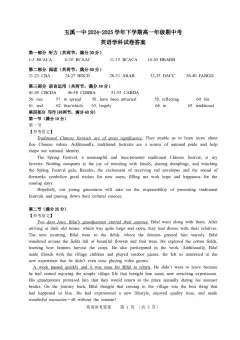
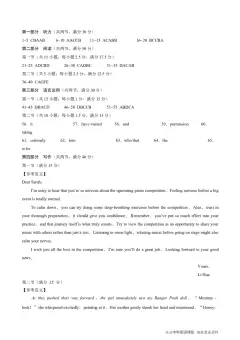
66. Several government(official) from the local education department will come to
visit our school and talk with students next week.
67. Based on my interest and reading level, your practical (recommend) help me
choose books for the holiday season.
68. (quit) the competition without trying your best is never a wise choice for those
who are èager to realize their sports dreams.
69. When we reached the top of the mountain at sunrise, the golden view spreading before us was
really (impress).
70. The whole team will work together to work out a clear and (strategy) plan for the
coming national English competition.
71. If you take time to explore the old town, you will be surprised to discover a number of
little-known cultural (attract) hidden in narrow lanes.
72. The noisy group kept talking loudly during the lecture, and it(恼怒)the professor greatly and made him pause to remind them of the class rules.
73.Everyathlete must be (适合) dressed before entering the sports field.
74. Lost in his own thoughts, he sat quietly by the bright window, (假装)reading a thick storybook.
75. After sticking to a balanced diet and taking regular exercise for nearly half a year, she looks
much (苗条的) than she was last spring.
76.Anumber of(申请者) from different high schools have handed in their forms for the wildlife protection summer camp.
77. Basic (住处) for our mountain hiking trip is included in the total cost of the whole
project.
78. It is wise for(毕业生)to stay calm and make careful plans instead of blindly
following others when facing various career choices.
79. Tourists are advised to read the brochure carefully to gain(详细的) descriptions
of its local customs and history.
80. If athletes wish to win prizes in national contests, they must keep training hard, adjust their
strategies and remain (有竞争力的).
第四部分读后续写(满分20分)
阅读下面材料,根据其内容和所给段落开头语续写两段,使之构成一篇完整的短文。
Our school's autumn sports meeting was drawing near. When our PE teacher asked who would sign up for the 1500-meter race, the whole class fell silent. Most of us considered long-distance running a big challenge. It required patience and a strong will, and few students were willing to risk failing in front of the whole school, Just as the teacher was going to give up, my best friend Ethan raised his hand. He volunteered for the race.
I was greatly surprised. Ethan loved sports, but he seldom took regular running training. Most of his spare time was spent reading books. He was not confident about his speed or strength. I pulled him aside and reminded him of the difficulty of the race. He smiled and told me that he did not aim for a prize. He just wanted to challenge himself.
During the following two weeks, Ethan made a simple training plan. Every afternoon after school, he went to the playground to practise running. Tired as he felt after long hours of study, he stuck to his plan. Sometimes he was out of breath and wanted to stop, but he encouraged himself to keep going. I often went to the playground to keep him company and cheer him on. Slowly, he made small progress.
The big day finally arrived. The playground was filled with excited students. When Ethan stepped onto the starting line, I could see a mix of nervousness and determination on his face. The whistle sounded, and all runners rushed out. Ethan kept up with others at first. But after two laps, his energy ran out. His legs became heavy, and his pace slowed down greatly. He was falling far behind other runners. Many classmates noticed and began to shout his name.
注意:
1.续写词数应为150个左右;
2.请按如下格式在答题卡的相应位置作答。
Paragraph 1: Hearing our loud cheers, Ethan lifted his head.
Paragraph 2: When Ethan crossed the line. we rushed straight to him immediately.