 夜雨聆风
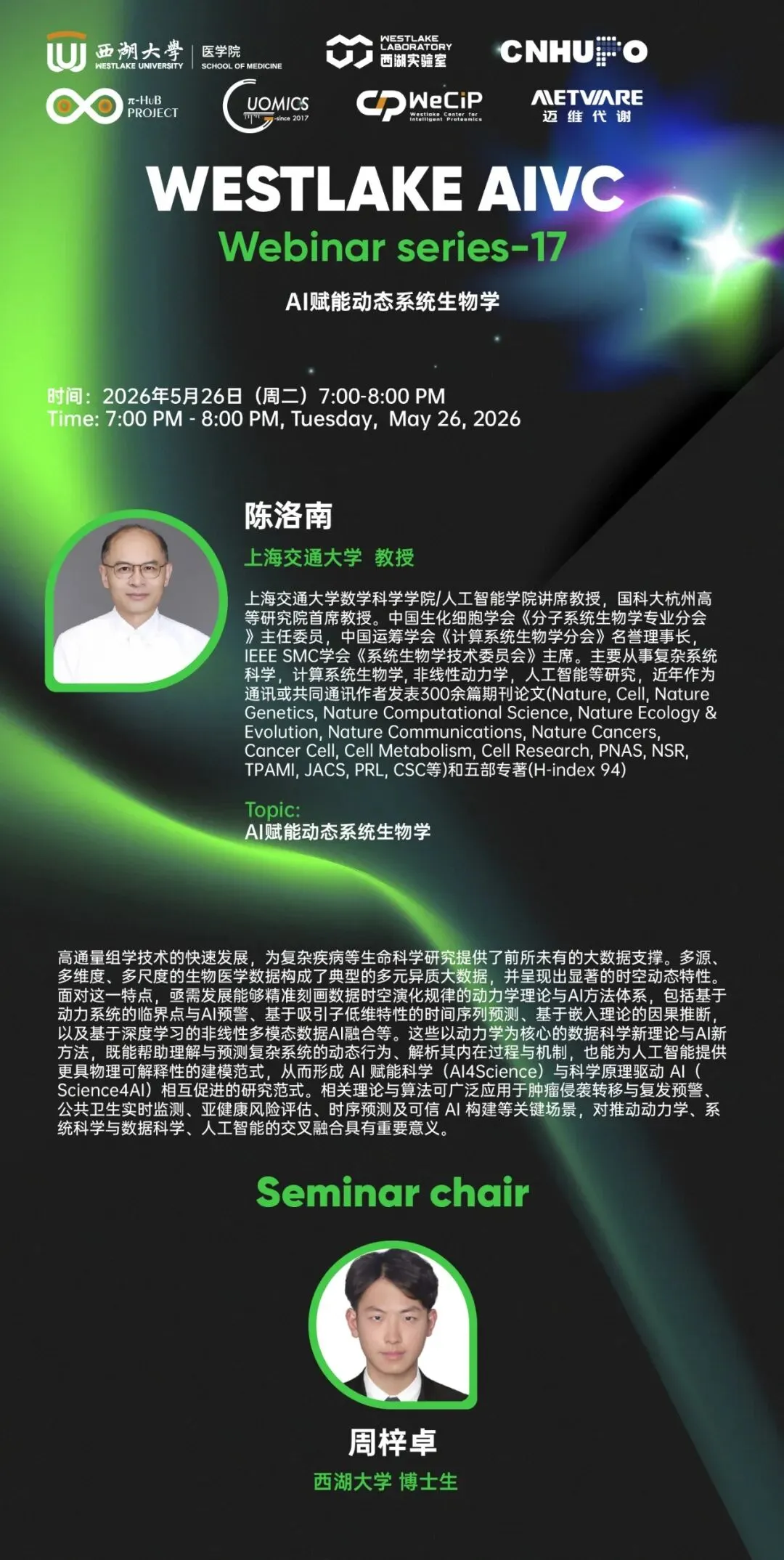
夜雨聆风直播时间:2026年5月26日(周二)7:00-8:00 PM
👆 点击卡片,预约直播
周梓卓,西湖大学 博士生
Speaker:
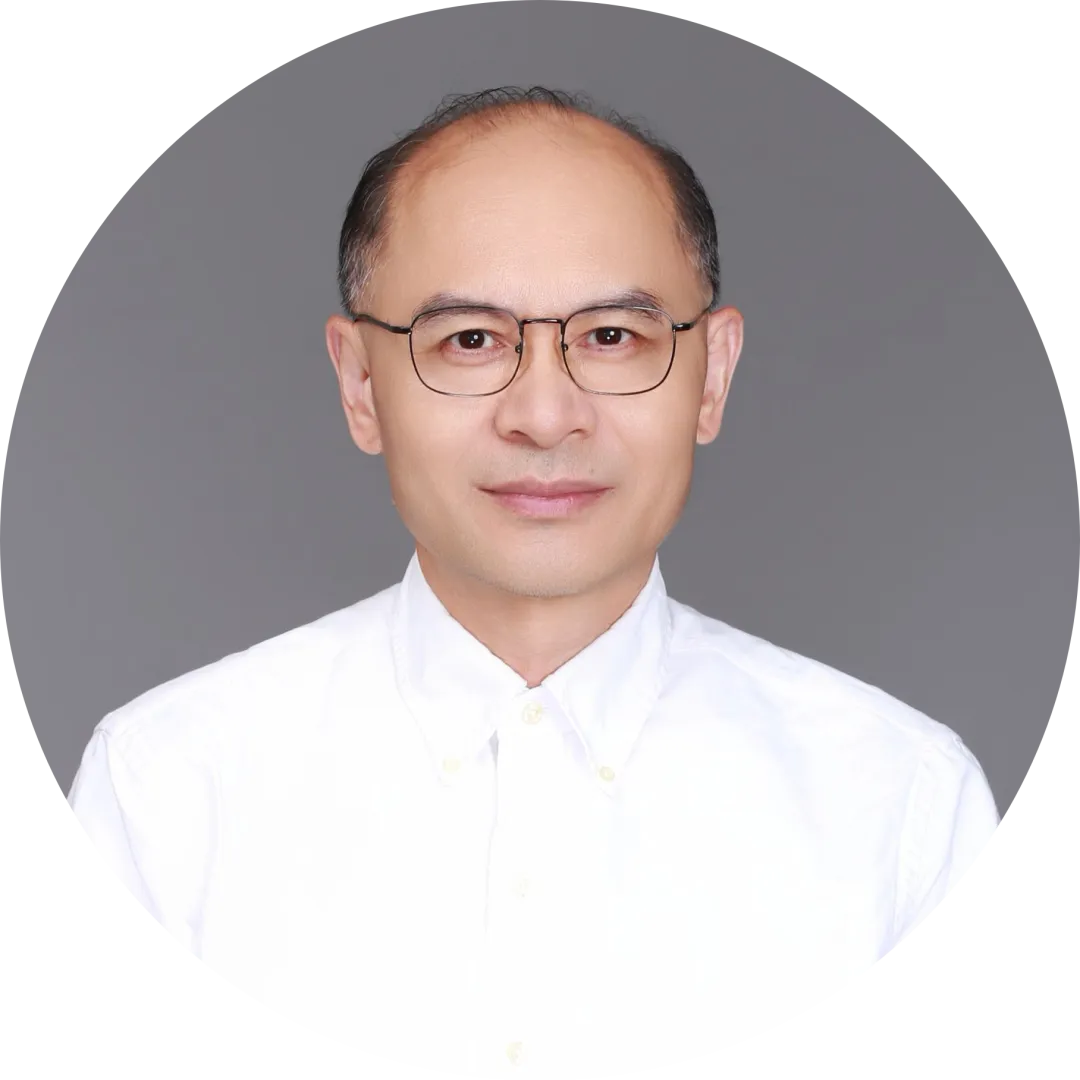
上海交通大学 教授
Luonan Chen is a Chair Professor in School of Mathematical Sciences and School of AI, Shanghai Jiao Tong University. He was elected as the founding president of Computational Systems Biology Society of OR China, and Chair of Technical Committee of Systems Biology at IEEE SMC Society. In recent years, he published over 300 journal papers and four monographs (books) in the area of bioinformatics, nonlinear dynamics and AI with H-index 94, including Nature, Cell, Nature Genetics, Nature Computational Science, Nature Ecology & Evolution, Nature Communications, Nature Cancers, Cancer Cell, Cell Metabolism, Cell Research, PNAS, NSR, TPAMI, JACS, PRL, CSC.
Talk title:
AI赋能动态系统生物学
Talk abstract:
高通量组学技术的快速发展,为复杂疾病等生命科学研究提供了前所未有的大数据支撑。多源、多维度、多尺度的生物医学数据构成了典型的多元异质大数据,并呈现出显著的时空动态特性。面对这一特点,亟需发展能够精准刻画数据时空演化规律的动力学理论与AI方法体系,包括基于动力系统的临界点与AI预警、基于吸引子低维特性的时间序列预测、基于嵌入理论的因果推断,以及基于深度学习的非线性多模态数据AI融合等。这些以动力学为核心的数据科学新理论与AI新方法,既能帮助理解与预测复杂系统的动态行为、解析其内在过程与机制,也能为人工智能提供更具物理可解释性的建模范式,从而形成 AI 赋能科学(AI4Science)与科学原理驱动 AI(Science4AI)相互促进的研究范式。相关理论与算法可广泛应用于肿瘤侵袭转移与复发预警、公共卫生实时监测、亚健康风险评估、时序预测及可信 AI 构建等关键场景,对推动动力学、系统科学与数据科学、人工智能的交叉融合具有重要意义。
The rapid development of high-throughput omics technologies has provided unprecedented big data support for life science research. Biomedical data from multiple sources, dimensions, and scales constitute typical multi-source heterogeneous big data, exhibiting significant spatiotemporal dynamic characteristics. In response to this feature, there is an urgent need to develop a system of dynamic theories and AI methods that can accurately characterize the spatiotemporal evolution rules of data, including tipping point detection and early warning prediction based on dynamic systems and AI, time series prediction based on the low-dimensional characteristics of attractors, causal inference based on embedding theory, and AI-enabled nonlinear multimodal data fusion based on deep learning. These new data science theories and AI methods centered on dynamics can not only help understand and predict the dynamic behaviors of complex systems and analyze their intrinsic processes and mechanisms but also provide a more physically interpretable modeling paradigm for artificial intelligence. Thus, they form a mutually promoting research paradigm of AI for Science (AI4Science) and Science-driven AI (Science4AI). The relevant theories and algorithms can be widely applied to key scenarios such as early warning of tumor invasion, metastasis and recurrence, real-time monitoring of public health, sub-health risk assessment, time series prediction, and trusted AI construction, which is of great significance for promoting the interdisciplinary integration of dynamics, systems science, data science, and artificial intelligence.
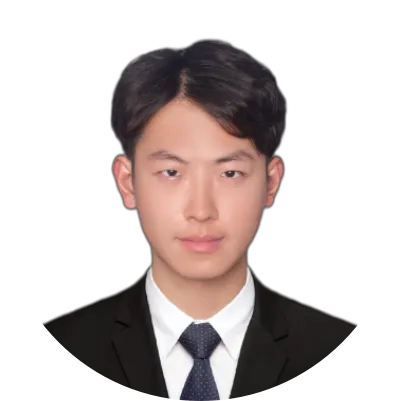
西湖大学 博士生
往期 AIVC Webinar 直播回顾
Guomics
西湖大学蛋白质组复杂科学实验室(Guomics)是依托西湖大学、西湖实验室(生命科学和生物医学浙江省实验室)和医学蛋白质组全国重点实验室成立的一个多学科交叉的AI蛋白质组学实验室。实验室长期从事蛋白质组学相关研究,联合人工智能,构建虚拟细胞,解析生物过程的原理,助力疾病诊疗。团队诚邀有志于虚拟细胞研究的优秀本科生、研究生及博士后研究人员加盟!实验室官网:guomics.com
 点击视频号卡片,预约直播。