UNIT
TOPIC AREAS
FUNCTIONS
Language Learning
Transportation
Space
Hobbies and Interests
Sightseeing - A Tour of London
Music
Emergency
Keep Fit
Manners
Words and Expressions in Each Unit ( PP163-168 )
Vocabulary Index ��PP169-180 )
( PP1-16 )
( PP17-35 )
( PP36-51 )
( PP52-66 )
( PP67-81 )
( PP82-100 )
( PP101-115 )
( PP116-130 )
( PP131-147 )
( PP148-162 )
English language
Language learning (Experiences and strategy)
Language difficulties in communication
Differences between British English
and American English
Means of transport
History of transport
The Earth
The Sun
The Moon
Fable
Fairy tale
Story
Hobbies
(Collections, games, handicrafts and arts)
Interests and pastimes
Introduction to London
Scenic spots
Places of historic interest
Musical instruments
Music
Classical music
Rock and roll
Emergencies
Accidents
Safety rules and warnings
Physical fitness and exercise
Healthy diet
Social behaviours
Eating customs
Talking about languages
Talking about learning a language
Expressing conditions
Describing means of transport
Attitude
Preference and comparison
Talking about going to places
Measurement
(Size)
Position and distance
Duration and frequency
Possibility and impossibility
Intentions and plans
Hopes
Talking about hobbies and interests
Preference
Likes and dislikes
Talking about cities
Asking for and giving suggestions
Talking about travel and tourism
Likes and dislikes
Preference
Cause and effect
Intentions and plans
Asking for permission
Getting information
Talking about emergencies
Giving advice
Reminding
Talking about fitness
Certainty and uncertainty
Asking for permission
Talking about manners
Possibility
1
2
3
4
5
6
7
8
9
10
Telling Tales
STRUCTURES
CHAT ROOM
PROGRAMME
Conditional clause (1)
Prepositions: with, in
Noun clause (1)
(Object clause introduced by subordinate con-
junctions that, whether, if and omission of that)
intend to do, think of doing
Noun clause (2)
(Object clause introduced by conjunctive
pronouns and adverbs; subject clause and
predicative clause)
Adverbial clause introduced by when, as
Prepositions: for, from, round, towards, without
Noun clause (3)
(Revision)
Past perfect (1)
Past future (1)
Modal verbs: may, can
Direct and indirect speech (1)
(say, tell and other introductory verbs; tense
and other changes when reporting statements)
prefer
Direct and indirect speech (2)
(Questions in indirect speech: the introductory
verbs; with whether, if or retaining question
words; necessary changes in reporting ques-
tions) be worth doing
Direct and indirect speech (3)
(Commands, requests, advice in indirect
speech: a verb of command / request / advice
+ object + infinitive) dislike / hate doing
would rather…(than)
The passive voice (1)
(Form, use and by in mentioning the doer)
Gerunds after prepositions
Modal verb: may
The passive voice (2)
Active tense and their passive equivalents
Phrasal verbs used in the passive remember /
forget + infinitive
make sure
The passive voice (3)
(Modal verb + passive infinitive)
seem / sound / taste / feel / smell + adj.
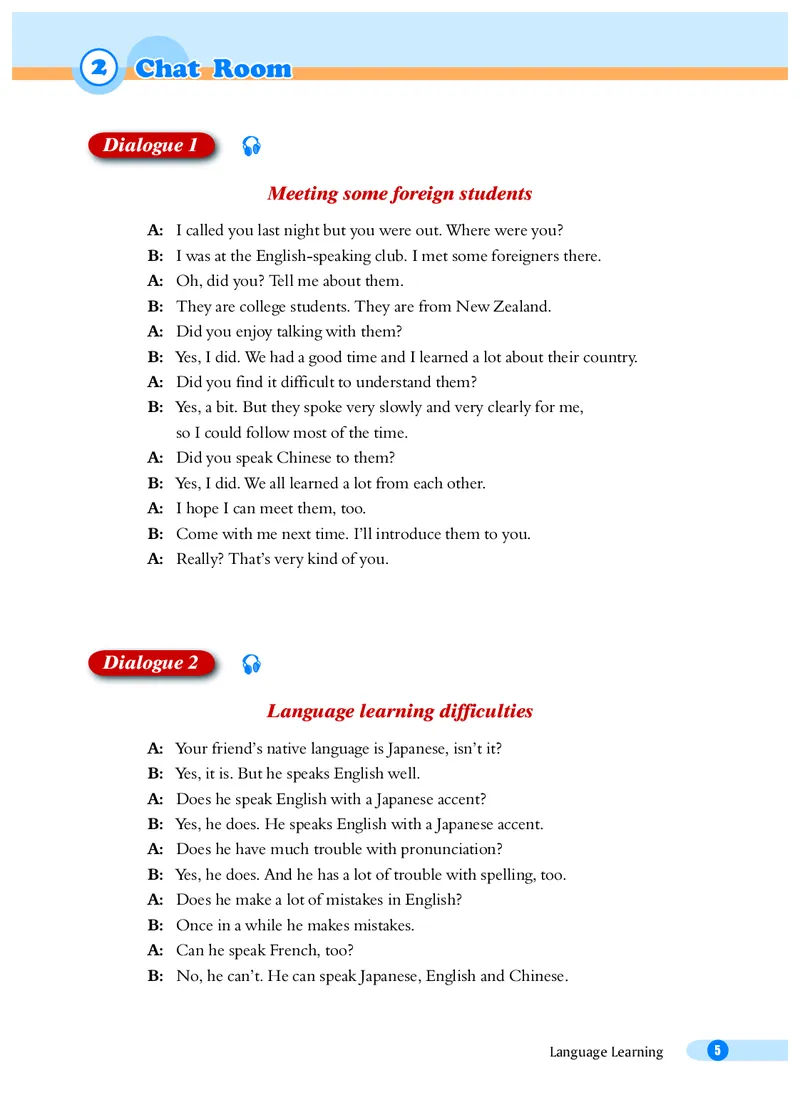
Dialogue 1
Meeting some foreign students
Dialogue 2
Language learning difficulties
Dialogue 1
Do you like to travel by plane?
Dialogue 2
Going for a drive
Dialogue 1
Exercise or go to the movie?
Dialogue 2
My most memorable journey
Dialogue 1
Fables and fairy stories
Dialogue 2
Tom Thumb
Dialogue 1
A hobby makes our life colourful
Dialogue 2
What other interests have
you got?
Dialogue 1
What should I see?
Dialogue 2
Getting back from the holiday
Dialogue 1
How did you like the band?
Dialogue 2
Exchanging lessons
Dialogue 1
A telephone call
Dialogue 2
The little boy rescued
Dialogue 1
Physical training
Dialogue 2
Go on a diet or exercise more?
Dialogue 1
A birthday souvenir
Dialogue 2
A noisy party
Item 1 Some facts about English
Item 2 The secret of language
learning
*Item 3 British English and
American English
Item 1 Travelling in London
Item 2 Transportation
*Item 3 Early boats and ships
Item 1 The Earth
Item 2 The Sun
*Item 3 The Moon
Item 1 The crafty fox
Item 2 Ma Liang
*Item 3 The rain angel
Item 1 Taking stamps off
envelopes
Item 2 When an interest becomes
an obsession…
*Item 3 Are you a couch potato?
Item 1 DAY ONE: A bus tour
around London
Item 2 DAY TWO: An amazing
experience at Madame Tussaud’s
*Item 3 DAY THREE: Head off
to the Tower today
Item 1 Living for music
Item 2 Classical music
*Item 3 Rock and roll
Item 1 A brave boy
Item 2 At the safari park
*Item 3 How to stay safe in a
thunderstorm
Item 1 Who is the fittest? (1)
Item 2 Who is the fittest? (2)
*Item 3 How Okinawans live
long and healthily
Item 1 Manners are important DOS
and DON’TS in England
Item 2 When in Rome, do as the
Romans do
*Item 3 Manners in different countries
Unit
Unit
Language Learning
Language Learning
1
Topic Areas
English language
Language learning
(Experiences and strategy)
Language diffi culties in communication
Differences between British English and American English
Functions
Talking about languages
Talking about learning a language
Expressing conditions
Structures
Conditional clause (1)
Prepositions: with, in
Highlights
Highlights
Chat Room
Dialogue 1 Meeting some foreign students
Dialogue 2 Language learning diffi culties
Programme
Item 1 Some facts about English
Item 2 The secret of language learning
Item 3 British English and American English
*
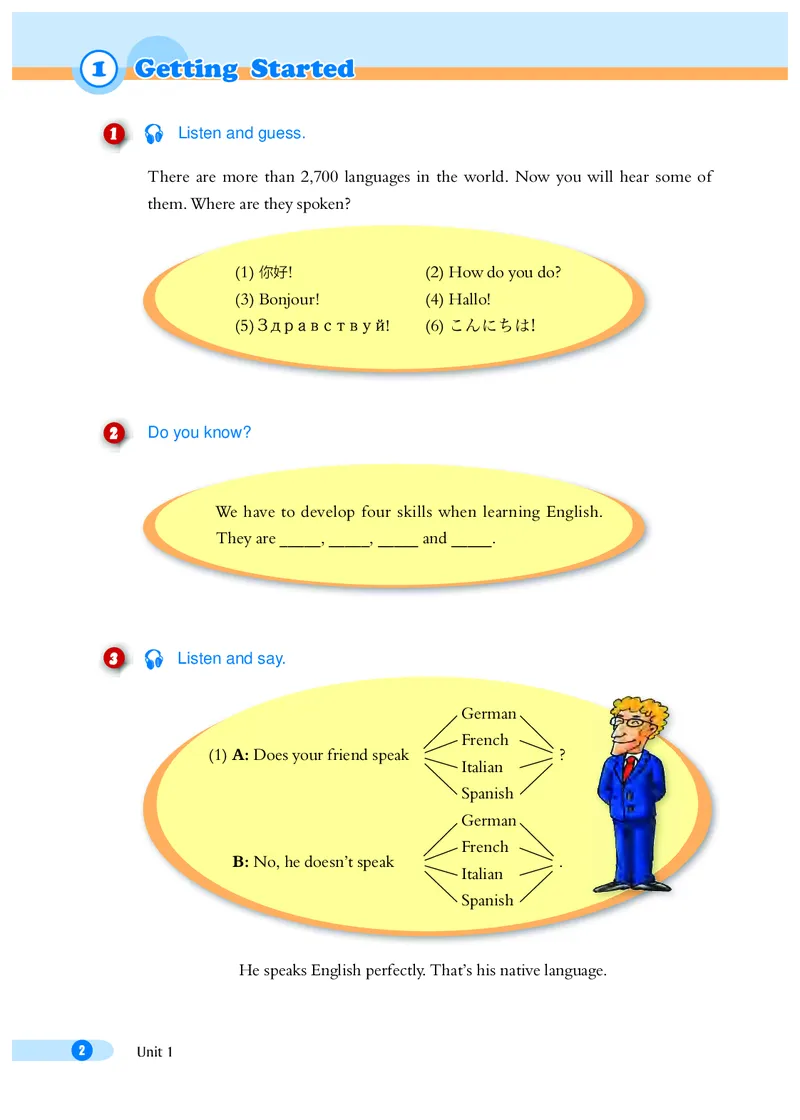
1 � Listen and guess.
There are more than 2,700 languages in the world. Now you will hear some of
them. Where are they spoken?
2
Do you know?
3 � Listen and say.
Getting Started
Getting Started
1
(1) ҍສ!
(2) How do you do?
(3) Bonjour!
(4) Hallo!
(5)
(6) こんにちは!
We have to develop four skills when learning English.
They are _____, _____, _____ and _____.
German
(1) A: Does your friend speak
French
?
Italian
Spanish
German
B: No, he doesn’t speak
French
.
Italian
Spanish
He speaks English perfectly. That’s his native language.
2
Unit 1
4 � Listen and learn.
If you have any language difficulties in communication, you can say:
1
Getting Started
Getting Started
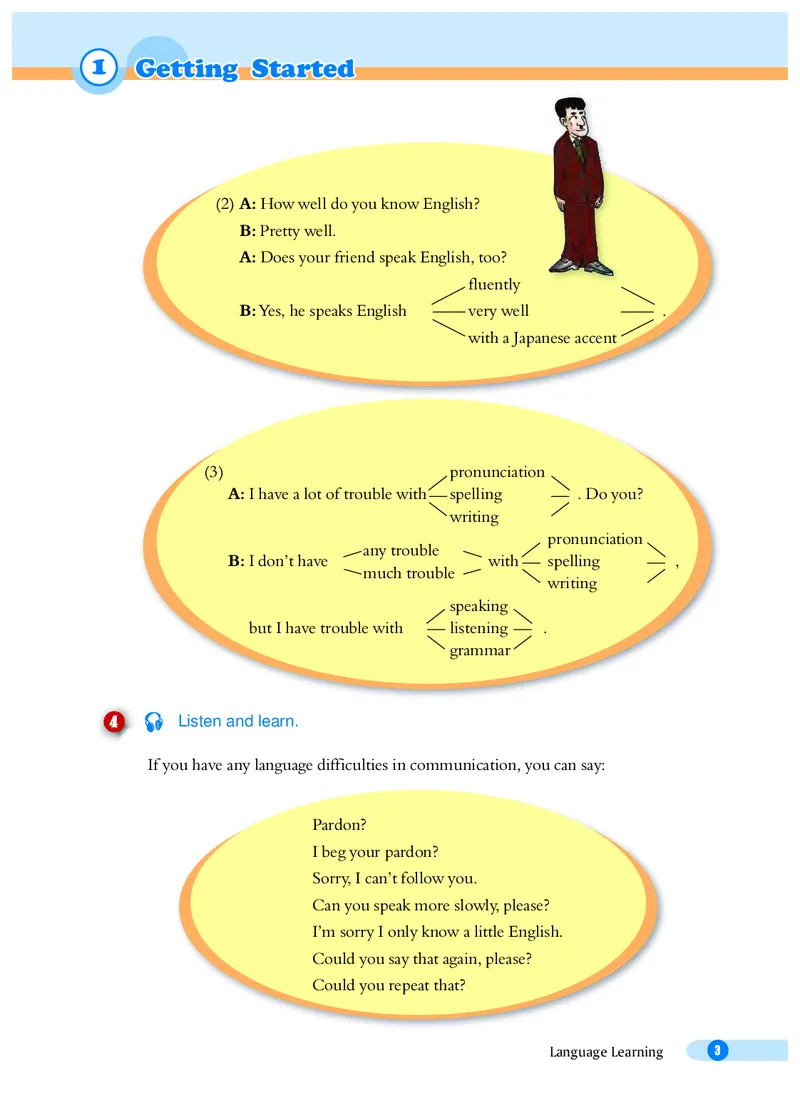
(2) A: How well do you know English?
B: Pretty well.
A: Does your friend speak English, too?
fluently
B: Yes, he speaks English
very well
.
with a Japanese accent
(3)
pronunciation
A: I have a lot of trouble with
spelling
. Do you?
writing
any trouble
pronunciation
B: I don’t have
much trouble
with
spelling
,
writing
speaking
but I have trouble with
listening .
grammar
Pardon?
I beg your pardon?
Sorry, I can’t follow you.
Can you speak more slowly, please?
I’m sorry I only know a little English.
Could you say that again, please?
Could you repeat that?
3
Language Learning
Getting Started
Getting Started
1
5 � Listen and repeat.
6 � Listen and learn.
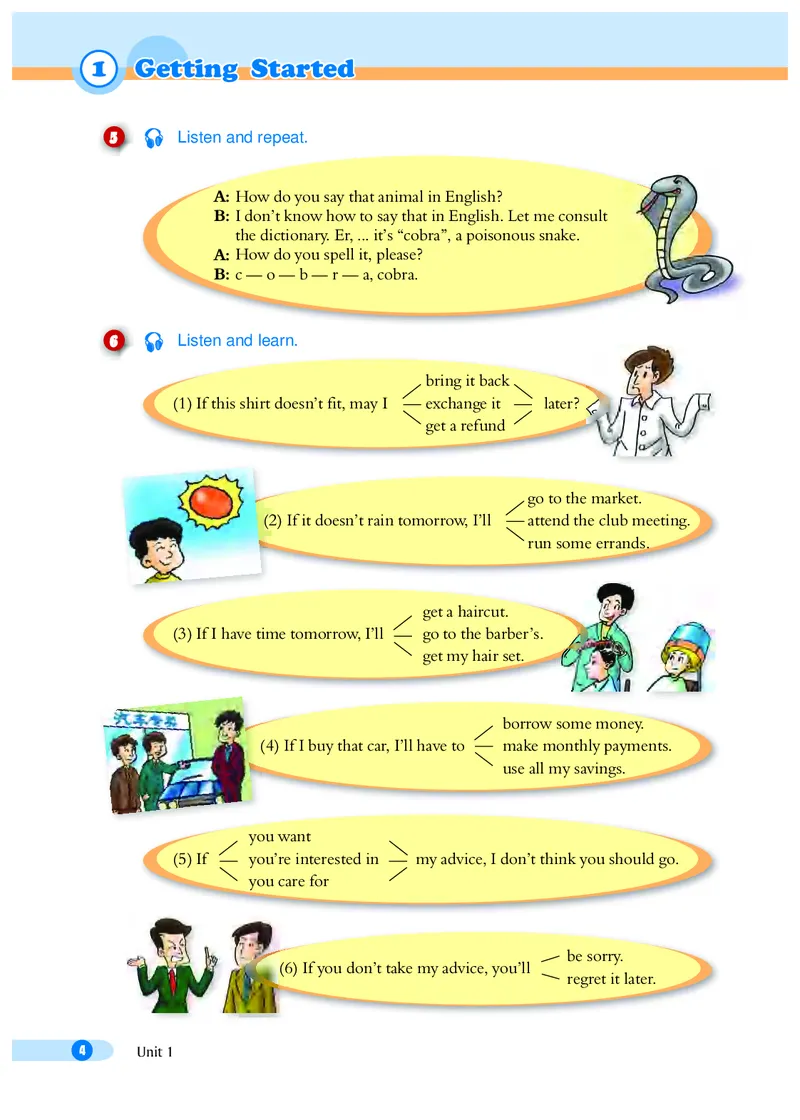
A: How do you say that animal in English?
B: I don’t know how to say that in English. Let me consult
the dictionary. Er, ... it’s “cobra”, a poisonous snake.
A: How do you spell it, please?
B: c — o — b — r — a, cobra.
bring it back
(1) If this shirt doesn’t fit, may I
exchange it later?
get a refund
you want
(5) If
you’re interested in my advice, I don’t think you should go.
you care for
go to the market.
(2) If it doesn’t rain tomorrow, I’ll
attend the club meeting.
run some errands.
(2
get a haircut.
(3) If I have time tomorrow, I’ll
go to the barber’s.
get my hair set.
borrow some money.
(4) If I buy that car, I’ll have to
make monthly payments.
use all my savings.
(
(6) If you don’t take my advice, you’ll
be sorry.
regret it later.
(6
(6
4
Unit 1
2
Chat Room
Chat Room
Dialogue 1 �
Meeting some foreign students
A: I called you last night but you were out. Where were you?
B: I was at the English-speaking club. I met some foreigners there.
A: Oh, did you? Tell me about them.
B: They are college students. They are from New Zealand.
A: Did you enjoy talking with them?
B: Yes, I did. We had a good time and I learned a lot about their country.
A: Did you find it difficult to understand them?
B: Yes, a bit. But they spoke very slowly and very clearly for me,
so I could follow most of the time.
A: Did you speak Chinese to them?
B: Yes, I did. We all learned a lot from each other.
A: I hope I can meet them, too.
B: Come with me next time. I’ll introduce them to you.
A: Really? That’s very kind of you.
Dialogue 2 �
Language learning difficulties
A: Your friend’s native language is Japanese, isn’t it?
B: Yes, it is. But he speaks English well.
A: Does he speak English with a Japanese accent?
B: Yes, he does. He speaks English with a Japanese accent.
A: Does he have much trouble with pronunciation?
B: Yes, he does. And he has a lot of trouble with spelling, too.
A: Does he make a lot of mistakes in English?
B: Once in a while he makes mistakes.
A: Can he speak French, too?
B: No, he can’t. He can speak Japanese, English and Chinese.
5
Language Learning
3
Programme
Programme
Item 1
Some facts about English
1 � You are going to hear some facts about English. Supply the missing
information.
(1) For quite some time since the modern age, English has been the most
widely used language in the world.
(2) Over _____ _____ people speak English. That’s
_____ _____ of the world’s population. _____
_____ _____ people speak English as their fi rst
language. For the other _____ _____ _____ it’s
either a second language or a foreign language.
(3) Almost all international conferences and com-
petitions are held in English. For example, the
_____ and the _____ _____ _____. English is the main language of orga-
nizations like the _____ _____.
(4) _____ _____ _____ of the world’s tech-
nical and scientific periodicals are in
English.
(5) English is the medium for _____ of the
information stored in world’s computers.
(6) You can buy English-language _____ and _____ in every part of the world.
You can also watch _____ and _____ everywhere
in the world.
world’s population
6
Unit 1
3
Programme
Programme
2
Read the text and check your answers.
For quite some time since the modern age, English has been the most widely
used language in the world.
Over one billion people speak English. That’s 20 percent of the world’s
population. Four hundred million people speak English as their first lan-
guage. For the other seven hundred million it’s either a second language or a
foreign language.
Almost all international conferences and competitions are held in Eng-
lish. For example, the Olympics and the Miss World Contest. English is the
main language of organizations like the United Nations.
English is the key to the world of science. More than half of the world’s
technical and scientifi c periodicals are written in English. English is the me-
dium for 80% of the information stored in the world’s computers.
You can buy English-language magazines and newspapers in every part
of the world. You can also watch CNN and NBC everywhere in the world.
3
Could you add more examples?
(1) English-speaking nations
Britain, America, New Zealand, __________, __________
(2) International conferences and competitions
the Olympics, the Miss World Contest, __________, __________
(3) International organizations
the United Nations, __________, __________
(4) English-language magazines and newspapers
Saturday’s Review, Washington Post, __________, __________
(5) TV and radios
CNN, BBC, __________, __________
4
Discussion
Why do we say English is an international language?
7
Language Learning
2
Read the text and check your answer.
What’s the secret of successful language learning?
We ask two experienced teachers of English for their opinions.
Alastair Banton is a teacher at a language school in the UK. He also taught
English in Japan.
You must really want to learn the language. It is the most important thing.
You also believe in yourself. Imagine yourself using the language confi dently,
and think “Yes, I can do that.”
Then there are other things. You need to work hard, but at the same time
you need to enjoy it. Using English is fun. And you have to be realistic. Learn-
ing a language takes time, and you can’t expect to know everything in a few
weeks.
Teresa Pelc is a teacher of English in Poland. She has taught English in a
secondary school for a number of years.
3
Programme
Programme
Item 2
The secret of language learning
1 � Alastair Banton and Teresa Pelc are both teachers of English. Listen and
decide who made each of the following statements.
Alastair Banton
Teresa Pelc
Alastain Banton _________________________
Teresa Pelc _____________________________
ü Imagine yourself using the language confi dently.
ý� I praise my students for everything they do well.
þ Learning a language takes time.
ÿ Many students are very successful and speak
English better than I.
Ā Motivation is the most important thing.
ā That’s why we need a teacher to push us sometimes.
Ă Using English is fun.
ă According to Banton, you must really want to learn
the language.
8
Unit 1
3
Some of the following words are taken from the text. Some are not. They are
in groups. Try to learn them.
(1) experience, experienced
He has much experience in teaching.
He is an experienced teacher.
(2) confi dence, confi dent, confi dently
Be full of confi dence and don’t lose it.
He is confi dent of victory.
We should use English confi dently.
(3) real, reality, realistic
Tell me the real reason.
Her dream became a reality.
It is a realistic plan.
(4) enjoy, enjoyable
I enjoy going to the movies.
I had an enjoyable time at the party.
(5) succeed, success, successful
Did he succeed in the examination?
I wish you a success.
The performance was successful.
4
Read the text again and retell it with the help of the diagram.
3
Programme
Programme
Alastair Banton
Teresa Pelc
want to learn
motivation
believe in yourself
be ready to
imagine and think
need a teacher
work hard
enjoyable
enjoy it
praise
be realistic
successful
Teresa Pelc says that motivation is the most important thing. You have to
be ready to read a lot, to listen to the radio, and to watch TV. It is so easy to
forget new words and new patterns. That’s why we need a teacher to push
us sometimes. Even the most motivated students need that extra push some-
times. However, learning a language is also very enjoyable — I praise my
students for everything they do well. Many students are very successful and
speak English better than I.
9
Language Learning
3
Programme
Programme
*Item 3
British English and American English
1
Match the British English words with the American English words below.
American English
British English
bill
bank note
cookie
biscuit
elevator
car park
French fries
chips
gas
lift
pants
petrol
parking lot
state school
public school
traffi c lights
stop lights
trousers
subway
Underground
5
Group work
Do you enjoy learning English? What do you think is the secret of successful
language learning?
10
Unit 1
3
Programme
Programme
2 � Listen to the text. Give some examples to show the difference in spelling
between British and American English.
3
The pronunciation of some words in British English is different from that in
American English. Give more examples to show the difference.
glass
dance
plant
__________ ___________
shop
opera
fog
__________ ___________
work
far
sister
__________ ___________
4
Read the text and decide if the following statements are true (T) or false (F).
Do you know the difference in vocabulary between British and American
English? Most British people are familiar with many American equivalents for
British terms, e.g.
Some common words have different meanings in British and American English.
British English
American English
long sticks of potato you eat hot
with a meal
chips
thin slices of potato you eat cold
as a snack
something you wear under your
trousers and next to the skin
pants
trousers
a private school for free-paying
pupils
public
school
a free local school
an underground pass tunnel under
a busy street
subway
a railway under the ground
cookie
elevator
gas
biscuit
lift
petrol
11
Language Learning
The difference in spelling between British and American English is well
known. For example, British people write colour and dialogue while Ameri-
cans write color and dialog.
Besides there are some differences in pronunciation. The diagram shows
some features of American pronunciation.
However, the differences between British and American English are minor.
You can usually understand what words mean from the context.
______ (1) Some words in American English have the exact equivalents of
the words in British English.
______ (2) Some words have different meanings in British and American
English.
______ (3) The difference in spelling between British and American English
is great and complicated.
______ (4) British English and American English are two very different lan-
guages.
______ (5) If you don’t understand a word, you can guess the meaning from
the context.
3
Programme
Programme
ɑ� – �
glass
dance
plant
ɔ – ɒ
shop
dollar
opera
r (sounded)
work
burn
car
12
Unit 1
Box 2
Box 4
If I have time, I’ll visit her.
If she said that, she was really angry.
If you mix yellow and blue paint, you get green paint.
If you have a ticket, you can go in.
If you’re tired, go to bed.
Do you see a fi lm in English?
Do you keep a diary in English?
Most of her paintings are done in watercolour.
He always talks in a whisper.
I bought him a book for Christmas, but he didn’t give me anything in return.
Box 1
Box 3
4
Message Box
Message Box
If you ask, he’ll help you.
You will fail unless you work harder.
You can go out so long as you promise to be back before eleven o’clock.
He speaks English with a Japanese accent.
He left school with no degree.
Two coffees please, one with milk and one without.
I have a lot of trouble with pronunciation.
This hasn’t got anything to do with you.
He’s very careless with his money.
13
Language Learning
5
Data Bank
Data Bank
1
Presentation
Give a speech on how to enjoy learning a language.
If you know English, you can do many wonderful things.
(1) Watch the original British and American fi lms.
(2) Read books from classic plays like Hamlet to modern thrillers like Jurassic
Park.
(3) Listen to English songs.
(4) Communicate with foreigners.
6
DIY Lab
DIY Lab
smart cards
tapes and a tape recorder
DVD
TV and radio
audiovisual aids
an electronic dictionary
a language laboratory
14
Unit 1
6
DIY Lab
DIY Lab
2
Survey
Ask your classmates the following questions about learning English. Then re-
port the result of the survey to the other members of your group.
A questionnaire on English learning after class
(1) Do you see fi lms in English often? At the cinema or on video at home?
(2) Do you watch TV programmes in English or listen to English radio pro-
grammes?
(3) Have you joined an English-speaking club?
(4) Do you go to events in English at your school (a play, a talk, a debate)
often?
(5) Do you like to start up a conversation with English-speaking tourists?
(6) Do you read English newspapers or magazines? Name one or two of
them.
(7) Do you sing English songs? Do you learn the words by heart?
(8) Do you keep a diary in English?
(9) Do you often send and receive e-mail in English?
(10) Do you use the Internet to fi nd information in English?
(1) publishers and compilers
(2) English-English dictionary or English-Chinese dictionary
(3) number of entries
(4) defi nitions and examples
3
Problem solving
Your friend is going to buy a dictionary. Give him some advice so that he may
get the right one. You should consider:
4
Topic discussion
English — a means of communication
15
Language Learning
In many cultures, people have special ways of calling their family members. In Eng-
lish-speaking cultures, most people call their grandparents by their title only, such as
Grandfather and Grandmother. Aunts and uncles are usually called by their names
and titles, such as Aunt Kathy or Uncle John. Brothers and sisters are called by their
names, not by a title.
How about things in your culture? How do you call different members of your family?
7
Culture Corner
Culture Corner
8
Game Zone
Game Zone
1 � A rhyme.
Friendship
I met a little friend
Who came from another land.
I couldn’t speak his language,
But I took him by the hand.
We sang together
And had a lot of fun!
Singing is a language
You can speak with anyone.
2
Trick questions
(1) Which is the longest word in the English language?
(2) Which word is shorter if you put another syllable at the end?
(3) What kind of phone makes music?
(4) Why are movie stars cool?
(5) What is easy to get into but hard to get out of?
16
Unit 1
17
. 17 .
Unit
Unit
Transportation
Transportation
2
Topic Areas
Means of transport
History of transport
Functions
Describing means of transport
Attitude
Preference and comparison
Talking about going to places
Structures
Noun clause (1)
(Object clause introduced by subordinate conjunctions
that, whether, if and omission of that)
intend to do
think of doing
Highlights
Highlights
Chat Room
Dialogue 1 Do you like to travel by plane?
Dialogue 2 Going for a drive
Programme
Item 1 Travelling in London
Item 2 Transportation
Item 3 Early boats and ships
*
1
Match the pictures and their descriptions.
2 � Listen and practise.
Getting Started
Getting Started
1
(1) It has two wheels and an engine.
(3) It transports heavy goods on roads.
(2) It transports a large number of
people long distances on roads.
(5) It transports people between two
ports continuously.
(4) It is used by workers to transport
their goods or tools.
A: Where are you going this year?
B: I’m going abroad.
A: How are you going? Are you going by
ship
?
plane
train
bus
van
truck, lorry
motorbike
ferry
coach
18
Unit 2
3
Here are some sentences from conversations talking about different transport.
Where does each take place?
1
Getting Started
Getting Started
(1) Can you take us to Piccadilly Circus?
(2) We had a rough crossing from Dover to Calais.
(3) Two to the British Museum, please.
(4) I’ll get a couple of coffees from the buffet car.
(5) Excuse me, can we take off despite the fog?
(6) Which line is it for Oxford Circus?
(7) Be careful when you turn that corner.
air.
flying.
B: I’m going by
sea.
I like
going by ship.
rail.
riding the train.
car.
driving.
19
Transportation
Getting Started
Getting Started
1
4 � Listen and repeat.
(1) A: How long does it take to get to the Yangtze Hotel?
B: I think (that) it takes about 30 minutes.
(2) A: Have you got anything to declare?
B: No, I don’t think (that) I have got anything to declare.
(3) A: Who is going to meet you at the airport?
B: I expect that Tom will meet me there.
(4) A: Will he come here on time?
B: I’m afraid that there will be a delay as it is the rush hour.
5
Try to make more sentences.
I hope
it stays fine
I believe
he will go there by train
I don’t believe
(that)
they will win the game .
I know
there is a garage nearby
I mean
there should be no argument
I guess
you’re right
ī
ī
ī
20
Unit 2
1
Getting Started
Getting Started
6
Make the following sentences more polite by using “Do you think ... ?”.
Example
Can you help me?
Do you think you can help me?
7
Answer the following questions by beginning your statements with the phrase
in brackets. Follow the example.
Example
Will he learn to drive quickly?
(I’m confident)
I’m confident he’ll learn to drive quickly.
(1) Should we give them a hand?
(2) Can I get there by bus?
(3) Is he having a driving test now?
(4) Can you write to me more often?
(5) Will they have to come?
(1) Did she make the right choice? (I’m satisfied)
(2) Will she get married next year? (I’m sure)
(3) Is it the same to her? (I’m sorry … not)
(4) Has he decided to study English? (I’m pleased)
(5) Can you help me? (I’m afraid … not)
(6) Is it going to rain? (I’m afraid)
21
Transportation
Getting Started
Getting Started
1
8 � Listen and make more sentences.
9 � Listen and learn.
A: I want to know whether I can make a reservation to
Beijing for next Monday.
B: There is a flight leaving at 9:25. I doubt if it is possible
for you to start so early.
A: I think that’s OK.
Tom did his homework yesterday.
whether
she has been to England.
I want to know
he works hard.
if
you are going to see him.
they are still living there.
(1) A: What’s your plan for the summer vacation?
B: I’m thinking of going to Beijing.
A: Haven’t you been there before?
B: Yes. But I want to go there for a second time.
There are so many beautiful places to see.
I intend to go to as many places as I can.
(2) A: What will you do after school?
B: I’m thinking of visiting the Ice-Carving Festival in Harbin.
22
Unit 2
Dialogue 1 �
Do you like to travel by plane?
A: Do you like to travel by plane?
B: Oh no, not at all.
A: Flying is quick, isn’t it?
B: Yes. But you have to wait for hours before the plane takes off. What’s more,
it’s often delayed and always crowded.
A: But it’s convenient and comfortable.
B: I don’t think so. While aboard the plane, you can’t walk around or open the
windows. By the way, the seats are uncomfortable. There is not much choice of
food and there are not enough toilets.
A: What happens when the plane lands?
B: It’s even worse. It takes hours to get out of the airport and into the city.
A: Then you prefer travelling by train, don’t you?
B: Yes. Trains are much better than planes. They are cheaper, safer and more
comfortable. If you miss a train, you can always catch another one later.
A: But trains are much slower than planes.
B: I don’t think that speed is everything. Besides, today’s high-speed rail is almost
as fast as planes and much more comfortable.
Dialogue 2 �
Going for a drive
A: It’s a beautiful evening, Rudy. Why don’t we drive out to the airport?
B: That’s a great idea. I enjoy walking around the airport.
A: Let’s go down to the pier, too. We can watch the big ships docking. Some day I
want to take a trip by ship.
B: I’d rather fly. It’s the quickest and most comfortable way to travel.
A: But travelling by ship is leisurely and more restful.
B: That may be right, but a trip by plane is exciting, and you have more time for
sightseeing after you arrive.
A: It’s difficult to make a decision. Here we are at the airport.
B: Look! There’s a plane landing right now.
A: It’s moving so fast. Do you think it’s going to crash?
B: No, it won’t crash. Watch how carefully the pilot brings the plane down.
Travelling by plane is quite safe.
A: Good. Then we’ll take a plane instead of a ship on our trip. We can buy our
tickets right here.
B: What are you talking about? What trip? We’re not going anyplace. We’re just out
for a drive, remember?
2
Chat Room
Chat Room
23
Transportation
3
Programme
Programme
Item 1
Travelling in London
1 � Listen to the text and match.
3
Read the text and answer the questions.
The tube is London’s underground railway. A journey by tube is quick and
easy. But you do not see very much. The trains run under the streets.
Some of the tube lines are very old. The oldest line in the world, the
Metropolitan line, opened in 1863. The Docklands Light Railway is the new-
est railway line in London. The trains have no drivers. It opened in 1991.
You see much more of London from a bus. From the top of a red London
(1) tube
a. not to travel
(2) red London bus
b. special travel tickets
(3) rush hour
c. no drivers
(4) taxi drivers
d. get a good view of London
(5) information centre e. friendly and helpful
(6) oldest tube line f. quick and easy
(7) newest tube line g. opened in 1863
2 � Listen again and decide whether the following statements are true (T) or
false (F).
______ (1) You can never see an underground train in London because it
runs under the streets.
______ (2) Some tube lines are old but some are new.
______ (3) You can see a lot from a London taxi.
______ (4) There are some special buses for tourists.
______ (5) The buses and the tube are very busy in the morning.
24
Unit 2
3
Programme
Programme
4
Pair work
Talk with your partner about London’s tube and buses.
(1) Why don’t we see much on the tube?
(2) Can a train go without a driver?
(3) How can we get a good view of London?
(4) What can we get when we visit an information centre?
(5) When are the buses and the tube very busy?
(6) Will you take a taxi if you are a tourist in London? Why?
bus, you get a good view of the city.
London Transport has special buses for tourists. A tourist bus takes visi-
tors to some of the famous places in London. Visit an information centre to
fi nd out about special travel tickets to use on the tube and on the buses.
The buses and the tube are very busy in the morning between eight
o’clock and ten o’clock. They are also busy in the evening between fi ve o’clock
and half past six. It is better not to travel at these times.
There are lots of taxis in London. Taxi drivers are usually friendly and
helpful.
25
Transportation
2
Listen and read the text.
Transportation takes us anyplace and
brings us nearly everything. Day and
night, swift planes speed passengers
through the sky. Long trains roar
across the countryside carrying pas-
sengers, mail, and such products as food, livestock, and coal. Automobiles,
buses, and huge trucks rumble along the streets and highways. Ships steam
across oceans and along lakes and rivers. Pipelines carry petroleum and natu-
ral gas across thousands of miles.
Developments in transportation have cut travel time greatly in the past
200 years. In 1800, it often took a businessman a month to travel by sailing
ship from London to New York City. Today, he can fl y this distance by plane in
only a few hours.
Modern transportation also makes it possible to travel in comfort. The
pioneers jolted westward over rough trails in springless wagons with wood-
en wheels. Today, tourists ride on paved roads in cars and buses with wheels
that have soft, air-filled tires. Passengers on the first trains sat on hard
wooden seats and often choked in clouds of smoke and dust. Food could be
3
Programme
Programme
Item 2
Transportation
1 � Listen and complete the passage.
Wherever we want to go, we can take planes, trains, buses or ships. Trans-
portation brings us nearly everything. In the past it took us a ________ to
travel by ship from ________ to ________, but today, planes enable us to eat
________ in New York City and have ________ in London.
We can travel in ____________ nowadays but passengers on the fi rst
________ sat on __________ wooden seats and often choked in clouds of
________.
Transportation would not be possible ________ communication. Cars
and trucks depend on traffic ________ and traffic ________. Automatic
block signals and other means of communication enable railroads to operate
________. Airplanes could not ________ or ________ ________ safely with-
out ________, ________ and other electronic communication ________.
26
Unit 2
3
Match the words in Column A with their meanings in Column B.
4
Many communication devices are mentioned in the text.
Can you write them down?
3
Programme
Programme
obtained only at wayside stations. Many of today’s trains have soft, reclining
seats. Air conditioning keeps the air clean and cool, and dining cars serve
tasty meals.
Transportation would not be possible without communication. Automo-
biles and trucks could not travel on crowded streets and highways without
traffi c signs and traffi c lights. Automatic signals and other means of com-
munication enable railroads to operate safely. Lighthouses, lightships, buoys,
and radio compasses provide information for ships at sea. Airplanes could
not land or take off safely without radio, radar, and other electronic commu-
nication devices.
A
B
(1) speed
a. make a deep, heavy, continuous sound
(2) roar
b. move under the power of steam
(3) rumble
c. move along quickly
(4) steam
d. move along by jerks
(5) jolt
e. make loud, deep sounds
(1) __________
(2) __________
(3) __________
(4) __________
(5) __________
(6) __________
27
Transportation
3
Programme
Programme
7
Read the text again and answer the questions.
(1) Why do we say transportation is very important?
(2) Can you tell the journey time from London to New York 200 years
ago and today?
(3) Have any changes taken place since the pioneers jolted westward?
(4) What’s the difference between the fi rst trains and today’s trains?
(5) Would transportation be possible without communication?
Show some examples.
5
Make a comparison between the pioneers and tourists today.
The pioneers
Tourists today
jolted
ride
over rough trails
on paved roads
in springless wagon with
wooden wheels
in cars and buses with wheels that have soft,
air-fi lled tires
6
Fill in the diagram according to the text.
The fi rst trains
Today’s trains
seats
air
food
(7) __________
(8) __________
(9) __________
28
Unit 2
3
Programme
Programme
*Item 3
Early boats and ships
1 � Listen and decide whether the following statements are true(T) or false(F).
_____ (1) Early man might cross a stream with the help of a log.
_____ (2) It was not diffi cult for early man to pole upstream on a raft.
_____ (3) Early man hollowed out a log to make it lighter.
_____ (4) Boats with oars and sails could move faster than canoes.
_____ (5) Early people developed a craft with four rows of oars on each side.
2
Can you name them? You can fi nd the words in the text.
(1) __________
(2) __________
(3) __________
(4) __________
(5) __________
(6) __________
(7) __________
(8) __________
(9) __________
3
Read the text and fi ll in the blanks with verbs from the text.
The fi rst boat was probably a fallen log. It ferried early man across a stream.
He paddled with his hands or pushed the log through the water with a pole.
29
Transportation
3
Programme
Programme
(1) A fi re was _____ brightly in the fi replace.
(2) Newton _____ gravity when an apple fell on his head.
(3) The aircrafts _____ cars and people between England and France.
(4) We should _____ these poles together with a rope.
(5) Sometimes ants will _____ out a tree trunk leaving just the bark.
(6) We take turns to _____ the little boat.
(7) Wind power _____ the ship across the Pacifi c Ocean.
(8) He _____ out his arms to embrace the little girl.
4
Read the text again and answer the questions.
(1) How did early man use a log to cross a stream?
(2) How did early man make a raft?
(3) What did early man do when he found it diffi cult to go upstream on a log?
(4) How did early men make a canoe later?
(5) How many people were needed to pull the oars of a boat with three rows
of oars?
(6) Did these crafts have sails and masts?
5
Writing
Write a short passage about early boats. The following words may help you.
log ī raft ī canoe ī boat with a row of oars ī boat with two rows of
oars ī boat with three rows of oars ī boat with sails
Then man learned how to lash logs together to make rafts. Such rafts were
often too heavy to go upstream against current. In time man discovered how
to hollow out logs. He burned out the inside of the log or hollowed it out
with stone axes. Later men stretched bark over a light framework of wood to
make a still lighter canoe.
The next big step was the development of boats and ships propelled
by oars and sails. This came about the same time as the wheel. The ancient
Egyptians developed a craft made of planks much like the ships of today.
Those boats had a row of oars extending from front to back on each side.
Later people built ships with two rows of oars on each side, one above the
other. Finally, early boat builders developed a craft with three rows of oars
on each side. They were much faster than any earlier ships, but it took as
many as 200 people to pull the oars. These early crafts also had a sail and a
mast. Some even had three masts and sails.
30
Unit 2
Box 1
4
Message Box
Message Box
I
agree(s)
argue(s)
learn(s)
that
he is right.
he didn’t do it.
she left home early.
You
We
They
He
She
Box 5
I
You
We
They
He
She
ask(s)
fi nd(s) out
know(s)
wonder(s)
doubt(s)
whether (if)
he is late for school.
you can give him a hand.
I
don’t doubt
that
Box 3
I don’t
think
he can do it better than me.
expect
believe
Box 4
I’m
afraid
that
I’ve got a cold.
(not) sure
sorry
Box 2
I
You
We
They
He
She
know(s)
say(s)
hear(s)
(that)
he has come back home.
think(s)
believe(s)
he is right.
31
Transportation
5
Data Bank
Data Bank
1
Presentation
Tell the class what you think is the best means of transport and why.
2
Survey
Ask at least 10 students from your school the following questions and then fi ll
in the form.
(1) How often do you go home (go to see your grandparents, go back to
your hometown)?
(2) What means of transport do you usually take?
6
DIY Lab
DIY Lab
platform
ticket office
footbridge
harbour
dock
lighthouse
terminal
departure lounge
d
l
i k
ffi
l
f
l h h
d
k
i
l
f
tb id
32
Unit 2
6
DIY Lab
DIY Lab
3
Topic discussion
How to ease traffi c jams in large cities?
5
Internet surfi ng
Find out on the Internet all the possible ways of travelling from San Francisco
to Los Angeles.
4
Problem solving
You are going to attend an English contest in Beijing, and you have 2,000
yuan in hand. You will be in Beijing for three days. How will you spend your
money? Fill in the form below and try to explain it in English.
Tickets
Hotel
Meals
Fare
(3) How long does it take and how much does it cost?
(4) Which is the quickest way?
(5) Which is the cheapest way?
Name
The cheapest way
The quickest way
Where to
How often
How
How long
How much
33
Transportation
America has a car culture. Except in New York and other large cities, you will abso-
lutely need a car to get around. Car insurance and a valid driver’s license, as well as
car registration papers, are necessary to drive in the United States.
Public transportation is available in most large cities. The subway system in
each city is different. Some are very modern: they use cards as tickets and are very
clean and comfortable. Other cities have older systems. They often use tokens,
which look like coins.
Buses are less crowded than the subway and are often a very convenient way
to travel between large cities and their suburbs. But buses are often caught in huge
traffi c jams especially during the rush hours. Often there is a long wait between bus-
es. Buses and subways in most cities run 24 hours a day.
Taxis are something of a luxury in most cities. They are quite expensive. On the
other hand, taking buses or subways late at night can be a safety risk. This makes
taking a taxi late at night a good idea even if it is expensive.
8
Game Zone
Game Zone
1
A word game
7
Culture Corner
Culture Corner
At New Year, lots of people drink
.
There is a big
display.
At midnight, people play the
.
Another popular drink is
.
34
Unit 2
2 � A rhyme
Over the mountains,
Over the plains,
Over the rivers,
Here come the trains.
Carrying passengers,
Carrying mails,
Bringing their precious loads
In without fail.
Thousands of freight cars
All rushing on
Through day and darkness,
Through dusk and dawn.
Over the mountains,
Over the plains,
Over the rivers,
Here come the trains.
8
Game Zone
Game Zone
Edinburgh is famous for its
.
It is lucky to take a piece of
to your friend’s
house.
People like to
.
Everybody goes to a
on New Year’s Eve.
Trains
35
Transportation
Getting Started
1
Unit
Unit
Space
Space
3
Topic Areas
The Earth
The Sun
The Moon
Functions
Measurement
(Size)
Position and distance
Duration and frequency
Structures
Noun clause (2)
(Object clause introduced by conjunctive pronouns and
adverbs; subject clause and predicative clause)
Adverbial clause introduced by when, as
Prepositions: for, from, round, towards, without
Highlights
Highlights
Chat Room
Dialogue 1 Exercise or go to the movie?
Dialogue 2 My most memorable journey
Programme
Item 1 The Earth
Item 2 The Sun
Item 3 The Moon
*
1
Getting Started
Getting Started
1 � Listen and practise.
2 � Listen and practise.
How long did you stay in Shanghai?
I stayed in Shanghai for three years.
How long does it take you to get to school by bike?
It takes twenty minutes.
live in London
five years
study English
a year or two
listen to the tapes
about an hour
review the lessons
two days
3 � Listen and practise.
A: We’ll go to the Summer Palace tomorrow.
How long will it take us to get there?
B: That depends on how you go.
It’ll take about one hour if you go by bus.
go there by train
walk from here to the station
three hours
half an hour
37
Space
5 � Listen and repeat.
(1) How far is your school from here?
4 � Listen and say.
Getting Started
Getting Started
1
40 minutes by bike
It’s about
6 kilometres away
.
4 miles from here
flew
flight
My father
drove
to France. It was a six-hour
drive .
rode
bus ride
took a train
train ride
the railway station / half an hour / on foot
the airport / 40 minutes / by bus
the wharf / an hour / by car
Beijing / 2 hours / by air
38
Unit 3
1
Getting Started
Getting Started
6 � Listen and say.
7 � Listen and practise.
(2) How far is it to the post office? Can you tell me?
long way
It’s a
short walk
long drive
short distance
Does he often go to the library?
Yes, he does. He often goes there.
No, he doesn’t. He
seldom
goes there.
never
A: How often do you go to the movies?
B: I go to the movies once a week.
write home
go to the library
go out for lunch
twice a month
three times a week
every other day
from here to
the post office.
39
Space
Getting Started
Getting Started
1
9 � Listen and practise.
8 � Listen and practise.
10
10 Answer the question.
A: Wang Dong is easy to get on with.
B: That’s why we have made him our monitor.
how
breathe
A: Do you know
where
snails
live
?
when
sleep
what
eat
B: Yes, I do. (No, I don’t.)
A: How can we improve our English?
B:
suggestion
we should use English as
point
much as possible.
My idea
is that we’d better have a foreign friend .
opinion
we must practise it more
we can sing more songs
keen on football
trustworthy
strong in maths
our captain
our leader
the maths rep of the class
40
Unit 3
2
Chat Room
Chat Room
Dialogue 1 �
Exercise or go to the movie?
Marie: You’re really fit, Paul. Do you exercise very much?
Paul: Well, I always get up very early, and then I lift weights for an hour.
Marie: You’re kidding!
Paul: No. And I often go roller-skating.
Marie: Wow! How often do you exercise like that?
Paul: About five times a week. What about you?
Marie: Oh, I hardly ever exercise. I just watch TV at home.
I sometimes go to the movies.
Paul: Do you go to the movies a lot?
Marie: Yes, I do. I go to the movies about once a week.
Paul: Do you listen to the radio very much?
Marie: Yes, I do. I listen to the radio every day.
I usually sit quietly. It is my way to keep in good health.
Dialogue 2 �
My most memorable journey
Pat:
So, what was your most memorable journey, Sarah?
Sarah: Well, I took a trip across America with a friend.
Pat:
How long did it take?
Sarah: It took nine days in all. It was great fun!
Pat:
That was a long trip indeed.
Sarah: About 2,500 miles. We set off from New Orleans and took No.
10 Highway. It runs all the way from Florida to Los Angeles.
We picked it up just outside the city, and we drove through Louisiana
as far as San Antonio in Texas.
Pat:
Was it a tiring trip?
Sarah: Oh no, it was very exciting. The first day we
did 550 miles.
41
Space
Programme
Programme
3
Item 1
The Earth
1
Look up the following words and expressions in a dictionary and explain to
your partner what they mean:
3 � Read the text after the tape. Pay attention to the adverbial clauses.
The Earth takes 24 hours to spin around once. We call this period of time a day.
The Earth’s spinning makes day and night. Each part of the Earth spins
towards the Sun and then away from it every day. When a part of the Earth
is facing the Sun it is day-time there. When that part is facing away from the
Sun it is night-time. In other words, as one part of the Earth turns into sun-
light, another turns into darkness. It is morning and people see sunrise when
a part turns into sunlight. It is evening and people see sunset when the part
turns into darkness.
spin around
face away from
spin towards
move around
spin away from
lean towards
face
2 � Listen to the tape and put a tick or a cross in the boxes.
(1) The Earth turns round once a day.
(2) As the Earth turns some people see sunrise and night comes to
their houses.
(3) Some people see sunset and it is night-time there.
(4) When one half of the Earth leans towards the Sun, it is summer
on that part of the Earth.
(5) When a part of the Earth is farther away from the Sun,
it has its winter.
(6) When both halves are the same distance from the Sun, they both
have either winter or summer.
42
Unit 3
3
Programme
Programme
The Earth moves around the Sun in an orbit. It takes a year to make this
journey. In that time it spins 365 and a quarter times. For some months of
the year, one half of the Earth leans towards the Sun. It is summer on that
part of the Earth. Half a year later, the Earth moves round to the other side
of its orbit. That part of the Earth is now farther away from the Sun and has
its winter, and the other part has its summer. In between summer and winter,
both halves of the Earth are the same distance from the Sun. Then they have
spring and autumn.
4
Give a presentation.
The Earth’s spinning makes day and night.
5
How do we have four seasons?
Have group discussions. Each group will present its answers to the class.
43
Space
3
Programme
Programme
Item 2
The Sun
1 � Listen to the text and put the eight planets in order according to their dis-
tances from the Sun.
Earth
Jupiter
Mars
Mercury
Neptune
Saturn
Uranus
Venus
1. Mercury.
2. __________
3. __________
4. __________
5. __________
6. __________
7. __________
8. __________
2
Read the text and fi ll in the form. Compare your answers with those of your
classmates.
The Sun is our nearest star. It is a giant ball of super hot gases. It gives us
light and heat. Without the Sun the Earth would be cold and dark. Without
the Sun nothing could live on the Earth.
44
Unit 3
3
Programme
Programme
The Sun is surrounded by a family of planets. We call it the solar system.
There are eight planets in the Sun’s family. They are all different. Mercury,
the nearest planet to the Sun, is small and hot. Venus is hotter than Mercury,
although Mercury is closer to the Sun. Earth and Mars are rocky and cooler.
Beyond them, Jupiter, Saturn, Uranus and Neptune are large and cold. These
four planets are made of gas and liquid.
Size
Temperature
Components (Rock, gas or liquid)
Mercury
Venus
Earth
Mars
Jupiter
Saturn
Uranus
Neptune
3
Can you answer these questions with your books closed?
(1) What is the Sun?
(2) What does it give us?
(3) What would the Earth be like without the Sun?
(4) Could anything on the Earth live without the Sun?
(5) What surrounds the Sun?
(6) What is the solar system?
(7) Which planet is nearest to the Sun?
(8) Is Mercury hotter than Venus because it is closer to the Sun?
(9) Which planets are rocky and cooler?
(10) Which planets are large and cold?
45
Space
3
Programme
Programme
*Item 3
The Moon
1 � After listening to the text, look up the underlined words in a dictionary and
try to fi ll in the blanks.
2
Read the text and fi ll in the chart.
The Moon is the Earth’s satellite. It is our next-door neighbour in space. It is
only 240,000 miles away, so it looks as big as the Sun. Its diameter is 2,100
miles, about one fourth that of the Earth.
There is no air on the Moon. So nothing softens the Sun’s rays. At mid-
day, the temperature on the Moon is raised by the Sun’s rays to over 100°C.
At night, however, the temperature falls to –150°C.
(1) The Earth’s ________ joins the North and South Poles.
(2) The pond is six feet in ________.
(3) On Wednesday there will be a total ________ of the Sun.
(4) ________ makes something fall if you drop it.
(5) The Sun’s ________ fell through the gaps in the clouds.
(6) Jamie followed his mother like a ________.
The moon is the Earth’s satellite.
Its diameter is 2,100 miles.
So nothing softens the Sun’s rays.
The Moon’s gravity is only 1/6 the gravity of the Earth.
The Moon rotates on its axis.
When the Moon casts a shadow on the Earth,
there is an eclipse of the Sun.
46
Unit 3
3
Programme
Programme
The Moon’s gravity is only about 1/6 the gravity of the Earth. A 200-pound
man weighs only 33 pounds on the Moon. When he walks, he can leap along
easily.
The Moon revolves around the Earth, and rotates on its axis as it re-
volves. It takes about 28 days to revolve, and it takes the same length of time
to rotate. So a day on the Moon is nearly a month on the Earth.
Every so often, the Sun, the Moon and the Earth line up in space. The
Moon comes directly between the Earth and the Sun. This stops the sunlight
from reaching an area on the Earth. When the Moon casts a shadow on the
Earth, there is an eclipse of the Sun.
The Moon
distance from the Earth
diameter
temperature at night
gravity
time taken to revolve
time taken to rotate
3
Give a presentation about an eclipse of the Sun with the help of the picture.
4
Discussion
(1) An eclipse of the Moon
(2) A total or a partial eclipse of the Sun
47
Space
4
Message Box
Message Box
Box 1
S
V
O
I
have heard
the news.
that you are a teacher.
We
noticed
their nervousness.
that they were nervous.
Box 2
That cats can’t swim is true.
It is true that cats can’t swim.
I know that it’s late.
I know it’s late.
The problem is that we have no money.
Box 3
Do you know how a snail breathes?
That’s why I left.
It depends on how you go there.
Box 4
for
Tom set out for home.
This parcel isn’t for you; it’s for your sister.
We walked for about ten miles.
What’s this money for?
We could not sleep for joy.
from
The train starts from London.
from twelve o’clock to two
It is far away from here.
a letter from my sister
round
The Earth moves round the Sun.
They were sitting round the table.
towards
She was walking towards town when I met her.
He is friendly towards me.
towards the end of the 19th century
without
We couldn’t have done it without John.
as
As the Sun was rising, the birds began to sing.
when
It was raining when we arrived.
48
Unit 3
5
Data Bank
Data Bank
MOON DATA
Diameter at equator: 3,476km
Minimum distance from Earth: 356,000km
Time to circle Earth: 27.3 Earth-days
Surface temperature: -170°C to 110°C
EARTH DATA
Diameter at equator: 12,756km
Average distance from Sun: 149.6 million km
Day length: 23 hours 56 minutes
Year length: 365.25 days
Surface temperature: -89°C to 58°C
Satellites: 1 (the Moon)
1
Presentation
Find a picture of the solar system. Say something about it, including the Sun,
the planets, the comets, and asteroids.
2
Pair work
Have a debate with your partner.
Mars seems to have had rivers and seas long, long ago. Astronomers can see
dry river beds and ocean shores on Mars. You think some life lived there.
There could be living creatures on Mars. Your partner speaks against you.
Mars might be warm and wet long ago. Now it is very cold and dry with no
sign of life.
6
DIY Lab
DIY Lab
49
Space
6
DIY Lab
DIY Lab
5
Internet surfi ng
Find something on the Internet about Liu Yang, China’s fi rst female astronaut
in space.
3
Topic discussion
7
Culture Corner
Culture Corner
People have been interested in the stars for hundreds of years. Long, long ago peo-
ple identifi ed some patterns of stars. They named these patterns after persons and
creatures from their myths and legends. Some patterns are quite easy to see, but
others require a great deal of imagination. One of the patterns is easiest to recog-
nize. It is Orion. It represents a hunter.
What are star signs? The above
patterns of stars are called constella-
tions. During the year, the Sun appears
to move through the space. The Sun
seems to pass through 12 main con-
stellations, called the constellations
of the zodiac. They are also called star
signs, and are important in astrology.
Astrologers believe that the star signs
affect human lives.
On June 29, 2012 the returning cap-
sule of Shenzhou-9 spacecraft touched
down in north China’s Inner Mongolia
Autonomous Region as planned. Three
astronauts who carried out China’s fi rst
manned space docking safely returned to
the Earth. China’s manned space docking
mission between Shenzhou-9 spacecraft
and Tiangong-1 lab module achieved a
complete success. What do you think of
the event? Talk about it in your group.
50
Unit 3
8
Game Zone
Game Zone
1
A quick fi re quiz
(1) How far away is the Earth from the Sun?
A. 1.5 million km.
B. 15 million km.
C. 150 million km.
(2) How many known planets are in orbit around the Sun?
A. Ten.
B. Eight.
C. Seven.
(3) How many years old is the Solar System?
A. 50 million.
B. 500 million.
C. 5,000 million.
(4) How many years old is the Earth?
A. 4 million.
B. 4,600 million.
C. 6,000 million.
(5) How long does it take the Earth to circle the Sun?
A. 265.25 days.
B. 365.25 days.
C. 465.25 days.
(6) What is the Earth?
A. A star.
B. A meteorite.
C. A planet.
(7) What causes the seasons?
A. Tilting Earth.
B. Tilting Sun.
C. Tilting Moon.
(8) How many planets are bigger than the Earth?
A. Two.
B. Three.
C. Four.
2 � A rhyme
Otherwise
THERE must be magic,
Otherwise,
How could day turn to night,
And how could sailboats,
Otherwise,
Go sailing out of sight,
And how could peanuts,
Otherwise,
Be covered up so tight?
Aileen Fisher
51
Space
Getting Started
1
Unit
Unit
Telling Tales
Telling Tales
4
Topic Areas
Fable
Fairy tale
Story
Functions
Possibility and impossibility
Intentions and plans
Hopes
Structures
Noun clause (3)
(Revision)
Past perfect (1)
Past future (1)
Modal verbs: may, can
Highlights
Highlights
Chat Room
Dialogue 1 Fables and fairy stories
Dialogue 2 Tom Thumb
Programme
Item 1 The crafty fox
Item 2 Ma Liang
Item 3 The rain angel
*
1
Getting Started
Getting Started
1
Give a presentation.
2 � Listen and practise.
A: What did Linda say she would do?
B: She said that she would read Aesop’s Fables.
A: Which fable do you think she probably likes best?
B: The Fox That Could Not Reach the Grapes.
A: Hi. How are you?
B: Fine. How are you?
A: Very well, thank you. I’ve got a couple of tickets for the
opera. I wondered if you’d like to come along?
a.
b.
A: You know we arranged to play football this evening?
B: Oh, you’re not going to say you can’t come, are you?
Grimm’s Fairy Tales
tale
Snow White and the Seven Dwarfs
Andersen’s Fairy Tales
tale
The Red Shoes
Arabian Nights
story
Ali Baba
53
Telling Tales
4
Pair work
Student A reads out a statement from Column A.
Student B answers Student A with a correct response from Column B.
3 � Look, listen and learn.
Getting Started
Getting Started
1
When Jane got home, her parents
had already gone to bed.
When he turned on the TV,
the programme had finished.
When she got to the airport,
the plane had taken off.
When the waitress finally brought the change,
the couple had already left.
A
I went to the airport but I couldn’t catch the plane.
I was homesick while I was in New York.
I met my penpal’s parents last Sunday.
I told everyone the good news.
54
Unit 4
1
Getting Started
Getting Started
5 � Listen and rearrange the sentences to make a conversation.
6 � Listen and practise.
B
Hadn’t they heard about it before they saw it?
Oh dear! Had you forgotten your passport until I reminded you?
Oh! Hadn’t you met them before last year?
Poor you! Had you never lived abroad
before your stay in the UK?
Lisa:
About a week. How about you?
Henry: Are you going anywhere over the break?
Henry: Oh, I don’t really have any plans.
Lisa:
Yes, we’re going to the beach.
Henry: How long are you staying there?
a. Do you think you’ll ever be a hero?
I hope so.
I might one day.
It’s possible, but I doubt it.
I’m sure I will.
I’m sure I won’t.
b. Are you going out tonight?
Yes, I am.
I think so, but I’m not sure.
I might be.
c. Do you think the world’s climate will change
dramatically in the next fifty years?
I don’t think so.
I hope not.
Who knows? Maybe.
55
Telling Tales
Getting Started
Getting Started
1
7 � Listen and learn.
8
Read the newspaper headlines. What has happened to the man? Guess!
“Excuse me? I’ve just jumped off the Empire State Building! ”
— Now, you’re going to take the exam in June,
aren’t you? How will you feel if you pass?
— Well, I suppose I’ll feel very pleased.
— And what will you do when you hear you’ve passed?
— I think I’ll throw a party – I’ll invite all my friends to celebrate.
— OK. But you might be unlucky. You might fail the exam.
How will you feel if you fail?
— Well, I suppose I’ll be very disappointed.
— And what will you do if you fail? Give up learning?
— No, I’ll take the exam again next year.
(1) He must be a superman!
(2) He can’t be serious. He must be joking!
(3) He might be a bungee-jumper.
(4) He may be acting in a film.
(5) His story will be in all the newspapers.
(6) He may become famous.
56
Unit 4
2
Chat Room
Chat Room
Dialogue 1 �
Fables and fairy stories
A: What is a fable? Do you know?
B: A fable is a short tale about animals or objects. They have human powers and
faults. They can talk. Fables teach moral lessons.
A: Does the reader of the fable have to figure out the moral?
B: No, he doesn’t. It is often given at the end of the fable. Every man tries to
convince himself that the thing he cannot have is of no value. This is the moral
of Sour Grapes.
A: And what are fairy stories?
B: They are stories about fairies. One of the earliest collections of fairy stories is Tales
of Mother Goose by Charles Perrault. It was published in France in 1697.
A: Can you tell me something about myths?
B: People have always asked questions about the things around. They have
always wanted to know why the Sun seems to rise in the morning and set in
the evening. The people of long ago did not have scientists. They had no books
to search for answers. So they made up their own answers to the questions and
wove them into beautiful stories.
Dialogue 2 �
Tom Thumb
Jane:
What are you reading, Richard?
Richard: Tom Thumb.
Jane:
What’s the beginning of the story?
Richard: Well, there lived a man and a woman in a cottage. They were not happy be-
cause they hadn’t got any children. A magician gave them a little child after
he heard about it. The child was five centimetres tall, named Tom Thumb.
Jane:
Did he live with them?
Richard: I’m afraid not. One day a big black raven picked up Tom Thumb from a
field but dropped him into the waves.
Jane:
Did a fish eat him?
Richard: Yes. A big fish swallowed Tom. He went into the stomach of the fish.
Jane:
What happened to him then?
Richard: The king’s cook bought the fish and cut it open. There was Tom!
Jane:
I think the king would ask him to stay with them.
Richard: Yes, you are right. In the night Tom slept in a snail shell. In the morning
he caught a butterfly and rode on her back. One day a large spider attacked
Tom. Tom fought with his sword but the spider bit him and he died!
Jane:
Poor thing!
57
Telling Tales
Programme
Programme
3
Item 1
The crafty fox
Do you know about Aesop? You know what a fable is. It is a short story not based
on fact, often with animals as characters. It conveys a moral. You must have
read Aesop’s fables.
1 � Listen to the text and answer the questions.
(1) What are the characters in the fable?
(2) What happened when the crow was ready to eat the cheese?
(3) Did the crow feel happy when she heard the fox’s praise?
(4) Was the crow happy in the end?
3
Read the text and guess what the following new words mean. Match them
with proper explanations.
One day a crow was sitting on a branch of a tree holding a piece of cheese
in her beak. She was just getting ready to eat the cheese when a hungry fox
looked up and saw her. The fox put on his best smile and said, “Hello Mrs
Crow. How lovely you look today.” The crow was very pleased and nodded
her head but said nothing.
“Oh my! I bet you are a beautiful singer. I am so tired that I would like
to rest under your tree. Can you sing me to sleep?” Now when the crow
heard the fox’s praise she was fl attered. As she began to sing she let go of
the cheese and it fell to the ground. The fox immediately jumped on it and
gobbled it up. He smiled up at the crow and said politely, “Thank you!” The
hungry crow was annoyed with herself for being so silly.
Moral: Beware of fl attery. It may not be meant.
Aesop’s Fables
2 � Listen again and complete the sentences.
(1) She was just getting ready to eat the cheese when a hungry fox
_______________.
(2) The crow was very pleased and _______________ but _______________.
(3) _______________ I would like to rest _______________.
(4) As she began to sing she _______________ the cheese and it fell to the
ground.
58
Unit 4
3
Programme
Programme
Item 2
Ma Liang
1
Look at the pictures. They tell the story of a boy called Ma Liang. What can
you see? What do you think the story is about?
crow
made angry
beak
eat something fast, noisily and greedily
nod
be very certain
be fl attered
make a quick movement of your head to show
agreement
gobble something up
a large black bird
annoyed
the hard, pointed part of a bird’s mouth
bet
be pleased because someone has shown you that
they admire you
4
Answer the questions after reading the fable again.
(1) What did the fox do when it looked up and saw the crow?
(2) How did the crow feel when she heard “How lovely you look today” ?
(3) Why did the fox say “I bet you are a beautiful singer”?
(4) When was the crow fl attered?
(5) Why was the crow annoyed with herself?
5
Role play
Work in groups of three. One acts Narrator, another Fox and the other Crow.
6
Discussion
What is the lesson we should learn?
2 � Close your books and listen to the story. Have you predicted the story
correctly?
59
Telling Tales
3
Programme
Programme
3 � Listen to the story and put the following pictures in order.
ŝ
ŗ
Ř
ř
Ś
ś
Ŝ
4 � Listen again and complete the sentences.
Once upon a time there was a boy who liked drawing but he was too poor to
buy a brush. One night he said to himself, “If only I had a brush, I could draw
pictures for the poor people in my village.”
Suddenly an old man with a long white beard appeared. “Don’t be fright-
ened,” he said. “Here’s a brush for you. But you must only draw pictures for
poor people with it.”
Ma Liang began to draw a hen, and as he did so it changed into a real
hen. “Wow!” he said. “This brush must be magic!”
Then he saw a poor woman cutting wood. “You need an axe,” he said.
So he drew an axe and it changed into a real one.
Next he saw a poor farmer plough. “You need a buffalo to pull your
plough,” Ma Liang said. So he drew a buffalo and it changed into a real buf-
falo.
“Thank you. You are very kind,” the farmer said to Ma Liang.
Soon the king heard about Ma Liang’s magic brush. “Draw me a tree
with gold coins hanging on it,” he ordered.
“You have plenty of gold. You don’t need any more,” Ma Liang replied.
The king was very angry. “Throw him in prison!” he cried. His soldiers caught
hold of Ma Liang, threw him in prison and locked the door.
60
Unit 4
3
Programme
Programme
*Item 3
The rain angel
1
Can you answer the questions?
(1) Is the rain important for our life?
(2) What makes it rain?
“If I had a key I could unlock the door,” Ma Liang said. So he drew a
key and it changed into a real key. He opened the door quietly and escaped.
When the king discovered that Ma Liang had got away, he got on his horse
and chased him with his soldiers.
Ma Liang said, “I need a horse.” So he drew one and it changed into a
real horse. He jumped on it and galloped away.
A traditional story from China
5
Can you answer the questions with your books closed?
(1) What did the boy like doing?
(2) Could he afford a brush?
(3) Who appeared?
(4) What did he draw fi rstly?
(5) Why did he draw an axe?
(6) Did he draw a buffalo for a farmer?
(7) What did the king ask Ma Liang to do?
(8) What did the king tell his soldiers to do?
(9) How did Ma Liang escape?
(10) What did the king do when he discovered that Ma Liang had got away?
(11) Did the king and his soldiers catch him?
2 � Listen and read the text.
Chrissy, a new angel, was in charge of the rain. Every
week, on Monday and Thursday, she had to be sure
that the clouds opened up and spread their raindrops
all over the world, because every living thing on the
Earth needed rain. But no one had told Chrissy how to
61
Telling Tales
3
Programme
Programme
make it rain, and she didn’t know what to do.
Chrissy asked one of the older angels if he could help her. “The angel that
had the job before you used to tell sad stories to the clouds, and that made
them cry.” But Chrissy was a very happy little angel and she didn’t know any
sad tales.
She fl ew up to see the Man in the Moon and asked him if he knew how
to make it rain. “You might try pinching the clouds to see if that would make
them cry.” But Chrissy didn’t want to hurt the clouds and so she decided that
was not a good idea.
The next morning, as the little angel was walking around Heaven, skip-
ping from cloud to cloud, she heard someone giggling. It was the little cloud
she was walking on! She bent down and asked the fl uffy white cloud what was
so funny.
“It’s your toes,” replied the soft one. “They tickle us when you walk!” “Oh,
I’m sorry,” said Chrissy, “I shall try to be more careful.” “No, no, please don’t,”
said the cloud, “We love to be tickled. It makes us laugh so hard we almost
cry!” Well, that gave Chrissy an idea! She bid the cloud goodbye and went off.
The next day was Monday, and it was raining all over the world! Little Chris-
sy was running and skipping and wiggling her toes across all the clouds in the
sky. The clouds were giggling and laughing so hard that tears were coming to
their eyes! And the tears were falling to the Earth and making a wonderful rain.
3
Read the story again and ask the questions in direct speech.
(1) Chrissy asked one of the older angels if he could help her.
“______________________________” she asked.
(2) Chrissy fl ew up to see the Man in the Moon to ask him if he knew how
to make it rain. “______________________________”
(3) Chrissy bent down and asked the fl uffy white cloud what was so funny.
“______________________________”
4
Read the story again and ask the questions in direct speech.
(1) What was Chrissy in charge of?
(2) What did she have to do on Monday and Thursday?
(3) Had anyone told her how to make it rain?
(4) Did she know what to do?
(5) Did anyone give her any suggestions? What were they?
5
Have you read any other stories of the rain? Tell them in your group if you have.
62
Unit 4
Box 1
He can speak French.
Can I have one of these?
Can you see me?
You can watch TV for half an hour.
Can they be in the kitchen?
It can’t be true.
Box 3
I had worked.
Had you worked?
He had not worked.
Box 5
She realized she would fail.
He promised that he would telephone me next Friday.
Box 2
Ask Mary – she may know.
That may be true after all.
Act now so that everything may be arranged in time.
May I look at the picture again?
You may go now.
Box 4
I had known him only a week and he tried to borrow money from me.
He had died before his son was born.
The goalkeeper had injured his leg, and couldn’t play.
When we bought it, the house had been empty for several years.
When I met him, John had lived in Paris for ten years.
4
Message Box
Message Box
63
Telling Tales
5
Data Bank
Data Bank
A fi ction is a story which has not really happened. It is made up.
Non-fi ctions are books about things that are true.
Characters are the names of people or animals that appear in stories.
A fable is a story with a moral. It tries to teach us something. Animals are
often used in fables.
A moral is a kind of lesson we can learn. It teaches us how to behave. Fa-
bles often have a moral.
A narrator is someone who tells a story.
A plot is what happens in a story.
A setting is where a story takes place.
1
Pair work
List ten fairy tales or stories both you and your partner have read.
6
DIY Lab
DIY Lab
3
Problem solving
Create a fox fable with your partner!
Choose one of the sayings below. Make up a foxy fable to illustrate it.
Look before you leap.
A stitch in time saves nine.
Too many cooks spoil the broth.
2
Topic discussion
A tiger in tow
A tiger, on the hunt for animals to devour, caught a fox.
“You cannot be so bold as to eat me,” said the fox, “I am sent by the
heavenly god to rule over the animal kingdom. If you eat me you will be
going against a heavenly mandate. Do you think I am lying? Let me go
fi rst and you follow behind. We’ll see whether any animal is so brave as
not to fl ee when they see me.”
The tiger agreed to the plan and accordingly went with the fox. All the
animals that saw them fl ed. The tiger, under the impression that they were
afraid of the fox, was unaware that he himself was the cause of the fl ight.
You must be familiar with the story. What did the writer hope to tell
us by writing this story?
64
Unit 4
7
Culture Corner
Culture Corner
Sometimes people ask questions that we do not want to answer, because they are
too personal -- questions about age or income, for example. People have different
ways of dealing with personal questions. Some people change the topic of conversa-
tion, some laugh to show they’re embarrassed or nervous, while others may just say
directly they’d prefer not to answer.
What questions are considered too personal in your culture?
How do people avoid answering these questions?
8
Game Zone
Game Zone
1
A game
Some people are talking about the bad things they did last year.
Put the verbs into past tense and write them in the grid.
1. I ______ (drink) some beer at a friend’s party.
2. I ______ (draw) a funny picture of my teacher.
3. I ______ (eat) my brother’s sweets and 4. ______ (say) it 5. ______ (be) my sister.
6. I ______ (break) my dad’s computer and didn’t tell him.
7. I ______ (wear) my brother’s jumper without asking his permission.
8. I ______ (hide) my sister’s favourite T-shirt when she was going to a party.
9. I ______ (hit) my little brother when he annoyed me.
10. I ______ (forget) my best friend’s birthday.
11. I ______ (keep) some money that was supposed to be for charity.
12. I ______ (throw) my friend’s homework in the bin.
13. I ______ (put) a spider in my sister’s hair.
14. I ______ (swear) at my dad.
15. I ______ (spend) my school lunch money on crisps and sweets.
16. I ______ (hurt) my friend’s feelings by saying she was fat.
17. I ______ (sell) my brother’s Walkman to my friend because I needed some money.
18. I ______ (steal) five pounds from my mum’s purse.
19. I ______ (go) to my friend’s house instead of doing my homework.
20. I ______ (tell) mum a lie.
Bad things
65
Telling Tales
8
Game Zone
Game Zone
I met a Horse as I went walking;
We got talking,
Horse and I.
“Where are you going to, horse?” I said
(I said to the Horse as he went by).
“Down to the village to get some hay.
Will you come with me?” “No, not I.”
I met some Rabbits as I went walking;
We got talking,
Rabbits and I.
“Where are you going to, Rabbits?”
I said
(I said to the Rabbits as they went by).
“Down to the village to get some oats.
Will you come with us?” “No, not I.”
2 � A rhyme
66
Unit 4
Unit
Unit
Hobbies and Interests
Hobbies and Interests
5
Topic Areas
Hobbies
(Collections, games, handicrafts and arts)
Interests and pastimes
Functions
Talking about hobbies and interests
Preference
Likes and dislikes
Structures
Direct and indirect speech (1)
(say, tell and other introductory verbs; tense and other
changes when reporting statements)
prefer
Highlights
Highlights
Chat Room
Dialogue 1 A hobby makes our life colourful
Dialogue 2 What other interests have you got?
Programme
Item 1 Taking stamps off envelopes
Item 2 When an interest becomes an obsession…
Item 3 Are you a couch potato?
*
1
Imagine you have a whole evening alone to do what you like. Number these
activities 1 to 10 to show which you’d prefer to do:
Getting Started
Getting Started
1
2 � Listen and talk.
_____ watch television
_____ read a magazine or newspaper
_____ listen to music
_____ sit alone and think
_____ play a computer game
_____ surf the Internet
_____ play a musical instrument
_____ watch a video or DVD
_____ read a book
_____ write letters or e-mail to friends
A: Do you have any hobbies?
B: Yes. I enjoy collecting coins.
A: But I prefer collecting stamps.
B: So you prefer stamps to coins.
A: That’s right!
A
B
A
B
A
swim
fish
cycle
hike
68
Unit 5
1
Getting Started
Getting Started
3 � Listen and practise.
4
Read and do the same.
A: What’s your hobby?
B: I like playing chess. What do you do for recreation?
A: I like outdoor activities very much. I hate to stay
at a place for very long.
A: I’m interested in photography. I began to take
pictures when I was in primary school.
B: It’s a little expensive. I am fond of playing computer
games. I find it great fun.
doing needlework going on an outing making pottery skating
painting
chatting on the Net
cooking
climbing
creative
great fun
boring
good exercise
69
Hobbies and Interests
Getting Started
Getting Started
1
6
Learn the following and do the same.
(1) A: I want to buy some new stamps.
B: What did he say?
C: He said that he wanted to buy some new stamps.
(2) A: We’re watching a football match.
B: What did they tell you?
C: They told me that they were watching a football match.
(3) A: I’ve finished my homework.
B: What did she tell you?
C: She told me that she had finished her homework.
(4) A: I’ll play tennis with Jane.
B: What did she say?
C: She said that she would play tennis with Jane.
I’m ill.
She is reading
We’ll go on an
He has collected
a novel.
excursion.
many coins.
5 � Listen and learn.
(1) A: What’s his hobby?
B: He says that he enjoys collecting stamps.
(2) A: What does he do in his spare time?
B: He says that he likes swimming.
(3) A: What’s the matter with her?
B: She says that she has got a cold.
(4) A: What do they want?
B: They say that they want to go to the park.
70
Unit 5
1
Getting Started
Getting Started
8
Work in pairs and complete the conversation.
7
Report what the girl and the boy said.
(1) A: He loves living in London.
B: But he told me ___________! (hate)
(2) A: He’s moving to Canada.
B: But he told me ____________! (Australia)
(3) A: His girl friend hasn’t got a letter from him.
B: But he told me ___________! (he / get / her)
(4) A: He’ll be thirty next week.
B: But he told me _________! (thirteen)
(5) A: He went to Amsterdam for his last holiday.
B: But he told me __________! (Barbados)
(6) A: He can’t give up smoking.
B: But he told me __________! (three years ago)
(7) A: He was given the sack last week.
B: But he told me ___________! (promotion)
(8) A: He’s fallen in love with a French girl.
B: But he told me ___________! (with me)
“I’m going to see you this evening,” she said.
She said ...
“I’ve never felt like this before,” she said.
She said ...
“I enjoyed meeting you tonight,” he said.
He said ...
“I’ll ring you tomorrow,” he said.
He said ...
71
Hobbies and Interests
Dialogue 2 �
Chat Room
Chat Room
2
Dialogue 1 �
A hobby makes our life colourful
A: Do you have any hobbies?
B: No. I don’t have time for hobbies. I’m always very busy.
A: But you should learn how to play. In my opinion, a person without hobbies can
never have a perfect life.
B: What do you mean by a hobby, then?
A: A hobby is something that makes your life colourful.
B: What’s your hobby?
A: Cooking. I am now a pupil of an excellent chef.
B: Cooking is a real chore. Why are you learning it?
A: No, it isn’t a chore. It is an art. It helps to mould a good character. When I learn to
cook a new dish, I often invite my friends to taste it. I feel satisfied when
they enjoy it.
B: I’ll be glad to taste your delicious dishes.
A: You are welcome, but you said you did not have time.
What other interests have you got?
A: Have you got any hobbies?
B: Yes, I’m fond of fishing and I’m very keen on making home movies.
A: I like taking photographs but I haven’t got a movie camera.
B: I take a lot of photographs too, but I’m interested in the history of the cinema,
so I really enjoy using a film camera.
A: What other interests have you got? Do you collect anything?
B: Yes, I collect stamps and I’ve got quite a big collection of records and tapes,
but I don’t buy many now.
A: If you had more time, what new hobby would you like to take up?
B: I’d like to have some creative hobbies – making things.
72
Unit 5
3
Programme
Programme
Item 1
Taking stamps off envelopes
1 � Stamp collecting is the collecting of postage stamps and related objects. It
is one of the world’s most popular hobbies. Many casual stamp collectors
accumulate stamps for sheer enjoyment and relaxation without worrying
about the tiny details. But do you know how to remove a stamp from its
envelope? Listen and put the following expressions in the correct order.
3
Read and decide whether the following statements are true (T) or false (F).
2 � Listen again and answer the questions.
(1) Washing off any traces of gum.
(2) Spreading the stamp on a piece of clean paper.
(3) Peeling the paper from the stamp.
(4) Floating the stamp in a bowl of water.
(5) Cutting neatly around the stamp.
(1) Do we remove stamps from a fi rst day cover?
(2) Can we tear stamps off an envelope?
(3) Do we peel the stamp from the paper after stamps are fl oated?
(4) What do we wash off then?
(5) Can we dry stamps in sunlight?
(1) Start by cutting neatly around the stamp. If a stamp has an interest-
ing postmark, either leave it on its envelope or cut out the stamp and
postmark together and put them in your album like that. Never remove
stamps from a fi rst day cover.
(2) Don’t tear stamps off an envelope. Float them face up in a bowl of clean
water for about 20 minutes. Try not to let water get on the face of
the stamps because the ink on some stamps may run. Float stamps on
coloured envelopes separately. Thus the colour won’t run or spoil the
others.
(3) Gently peel the paper from the stamp, not the stamp from the paper. If
the two don’t come apart easily, fl oat them for a while longer. This is the
only time you should use your hands.
73
Hobbies and Interests
3
Programme
Programme
4
Pair work
Tell each other how to take stamps off envelopes in your own words:
5
Choose a topic you are interested in (how to plant a tree, how to make pottery,
etc ... ) and discuss it. Then tell your classmates.
(4) Wash off any traces of gum with a paintbrush, or an old toothbrush, in
clean water.
(5) Spread the stamp, face down, on a piece of clean paper to dry. To stop
them curling up, put another piece of paper on top and a heavy book on
top of that. Never dry stamps in sunlight or near heat: they will curl up.
_____ (1) Cut neatly around the stamp fi rst.
_____ (2) Water can’t get on the face of the stamps when you fl oat them
in clean water.
_____ (3) If the stamp and paper come apart easily, fl oat them a little longer.
_____ (4) An old toothbrush can be used to wash off traces of gum.
_____ (5) To stop stamps curling up, dry them in sunlight.
(1) how to cut
(2) how to fl oat
(3) how to peel
(4) how to wash
(5) how to dry
The following words can be used:
fi rst, second, then, after that, next, fi nally, …
74
Unit 5
3
Programme
Programme
2
Read and answer the questions.
Many people have _____ kind of hobby. Some like collecting coins. Others
_____ just like shopping. When Colin Duffy was _____, his father took him
to see his local _____, Liverpool. Since then he has seen _____ matches.
Colin and his wife spent their _____ in Leeds _____ Liverpool was playing
that weekend.
_____ children are interested in collecting _____ or _____ at some time,
but few _____ as far as Tony Mattie. He _____ his house with thousands of
Barbie dolls. He spends _____ every day combing their _____ and changes
all their clothes _____ a month.
Item 2
When an interest becomes an obsession…
1 � Listen and fi ll in the missing words.
Most people have some kind of hobby. Some like collecting coins. Some are
keen on supporting their favourite football teams. Others even just like shop-
ping. But what happens when that interest becomes the most important thing
in one’s life?
When Colin Duffy was six, his father took him to see his local football
team, Liverpool. Since then, Colin, now thirty-six, has seen a total of 1,729
matches, and has travelled 75,000 miles to watch his team. Colin and his wife
spent their honeymoon in Leeds because Liverpool was playing that weekend.
Most children are interested in collecting stamps or dolls at some time,
but few go as far as twenty-eight year old Tony Mattie. He fi lls his house with
thousands of Barbie dolls. He spends hours every day combing their hair and
changes all their clothes once a month.
75
Hobbies and Interests
3
Programme
Programme
3
Pair work
Retell the two stories with the help of the clues:
4
Speaking
An interesting story about hobbies.
Colin’s story: six → saw a football match → a total of 1,729 matches
→ 75,000 miles → honeymoon
Tony’s story: 28 years old → house → comb hair → change clothes
1 Read the text about leisure activities and choose
the best defi nition for a couch potato.
*Item 3
Are you a couch potato?
Centuries ago, people didn’t have much free time, because everybody was
working too hard. In Britain in the nineteenth century, people had more spare
time, but because the Victorians hated relaxing and doing nothing, they in-
vented football, rugby and cricket. People took up more gentle activities too,
like gardening and bird-watching, and it was even possible simply to watch
a sport and give the impression that you were actually doing something.
Gradually, leisure activities have become less and less demanding, and most
(1) What do people do for pleasure during their free time?
(2) How long has Colin been a football fan?
(3) Why did he and his wife spend their honeymoon in Leeds?
(4) What does Tony fi ll his house with?
(5) What does he spend hours doing?
(6) How often does he change the dolls’ clothes?
76
Unit 5
3
Programme
Programme
2
What do you think of a couch potato? Are you for or against the lifestyle?
Hold a debate.
(1) Someone who enjoys energetic sports and active hobbies.
(2) Someone who takes little or no exercise, and who spends their free
time doing very little.
(3) Someone who doesn’t like doing sports but is active in other ways.
(4) Someone who likes indoor gardening.
Sides
Points
For a cough potato
Against a cough potato
people have a variety of more or less energetic interests and hobbies. But
now there is a new type of person who thinks that lying on the sofa watch-
ing television on Sunday afternoon or reading the whole newspaper is the
most exciting activity they can manage. This is the twentieth-century couch
potato. For them, every activity is too much trouble, and laziness is an art
form! So how do you spend your free time? Are you a couch potato?
77
Hobbies and Interests
4
Message Box
Message Box
Box 5
Prefer
Which would you prefer, tea or coffee?
I prefer walking to cycling.
She prefers to be alone.
I prefer my coffee black.
Box 2
Box 4
Box 3
He said, “Sandra enjoys her job in the city.”
He said that Sandra enjoyed her job in the city.
“I like your tie,” she told John.
She told John that she liked his tie.
“You know my husband,” she said to Tom.
She said to Tom that he knew her husband.
“You are too noisy,” Pamela told them.
Pamela told them that they were too noisy.
“You are beautiful,” he whispered.
He whispered that she was beautiful.
this
these
that
those
now
today
this week (month, etc)
then
that day
that week (month, etc)
yesterday
last week (month, etc)
3 days (a year, etc) ago
tomorrow
next week (month, etc)
the day before
the week (month, etc) before
3 days (a year, etc) before
the next (following) day
the next (following) week (month, etc)
here
come
there
go
“I am tired,” she complained.
She complained that she was tired.
“The exhibition fi nished last week,”
explained Pamela.
Pamela explained that the exhibition had
fi nished the week before.
“I’ve won the match already,” shouted
our friend.
Our friend shouted that he had won the
match already.
“I’ve been waiting over an hour for you,”
she told him.
She told him that she had been waiting over an
hour for him.
“I had studied English for four years at
school before I worked as a teacher,” he
said.
He said that he had studied English for
four years at school before he worked as a
teacher.
Box 1
He said, “My friend’s
name is Smith.”
He said / told her that his
friend’s name was Smith.
78
Unit 5
5
Data Bank
Data Bank
gardening play the guitar go boating make pottery
play bridge collect badges do aerobics do needlework
6
DIY Lab
DIY Lab
1
Presentation
(1) How did you fall into your hobby? How obsessed are you with it?
(2) Tell an interesting experience in having a hobby.
2
Pair work
Find some envelopes with stamps on them and some necessary tools and try
to take the stamps off the envelopes. As you do it, you may ask questions like
this: What do I do fi rst? What’s the next step? … Your partner may answer
these questions. And then change roles.
3
Topic discussion
Why are some students around you obsessed with playing computer games
and how can we solve this problem?
79
Hobbies and Interests
6
DIY Lab
DIY Lab
7
Culture Corner
Culture Corner
4
Problem solving
Make a survey among your classmates and fi nd what their hobbies are.
Design a questionnaire or a form.
5
Internet surfi ng
Find someone with interesting hobbies on the Internet and fi ll in the form.
Name
Sex
Profession or status
Hobby
Things he (she) does
Result
Imelda
Marcos
F
Wife of
ex-president of
Philippines
Buying
shoes
She bought more than
3000 pairs of shoes,
1000 packets of tights.
Champion
shopper
A hobby is something people do for fun and not because they have
to. In prehistoric times people were too busy fi nding food and shelter
to have hobbies. When survival became easier and people had time
to spare, hobbies and pastimes developed. Early pastimes included
drawing, sewing, riding and dancing. Today people fill their leisure
time with fi shing, cycling, collecting things, making models, playing
computer games and Internet surfi ng.
80
Unit 5
8
Game Zone
Game Zone
1
A game.
START
HERE
How long
have you
been learn-
ing English?
Where?
How?
Go forward
3 spaces
Which
English pop
singers do
you like?
Do you like
learning
English? Why?
Why not?
Talk about
yourself for
one minute.
How do you
like travelling?
a by plane
b by car
c by coach
Why?
Count from
990 to 1030
It’s my
teacher’s fault
when I don’t
learn. Do you
agree with
this? Why?
Why not?
Who is the best
British sports
personality in
your opinion?
What sport do
they play?
Do you
listen to the
BBC World
Service on
the radio?
Tell us about
it.
Sorry!
Go back
6 places
How do you
say …?
a photograph
b photographer
c photographic
What’s the
difference?
You’re go-
ing too fast!
Go back 2
spaces
How many
times have
you been to
England?
What did you
see?
You’re too
near the
end!
Go back 2
spaces
How many
languages do
you speak?
How did you
learn them?
Do you like
working
in groups
or on your
own? Why?
Finished!
You are the
WINNER
Are there any
words in your
language
which are the
same in English?
(e.g. television)
Tell us one
thing you
hate doing,
or you dislike
other people
doing.
Who’s been
studying
English the
longest in
your group?
Which do you
prefer and why?
a a monolingual
dictionary
b a bilingual
dictionary
Have you
seen a fi lm
in English?
Talk about it.
Find the
meaning of
assimilate
as quickly as
possible.
Which country
would you like
to visit most?
What language
do people
speak there?
How often did
you speak
English last
week — out-
side class!
How do you try
to remember
new English
words?
Say three
adjectives
that describe
your
personality.
You’re
sleepy!
Miss a turn!
Describe
someone in
the class (the
others must
guess who it
is).
Say the
alphabet a,
b, c ...
Tell everyone
why you
want to learn
English.
How many
English or
American TV
programmes
do you watch
in your
country?
Do you like
reading in
English? Why?
Why not? Tell
us about an
English book
you have read.
Where are you going, my little cat?
I’m going to town to buy a new hat.
What? A hat for a cat? A cat to buy a hat?
Your head is too round, and your face is too flat
To wear a hat.
Who ever heard of a cat with a hat?
Where are you going, my little cat?
2 � A rhyme
81
Hobbies and Interests
Unit
Unit
Sightseeing —
Sightseeing —
A Tour of London
A Tour of London
6
Topic Areas
Introduction to London
Scenic spots
Places of historic interest
Functions
Talking about cities
Asking for and giving suggestions
Talking about travel and tourism
Structures
Direct and indirect speech (2)
(Questions in indirect speech: the introductory verbs;
with whether, if or retaining question words;
necessary changes in reporting questions)
be worth doing
Highlights
Highlights
Chat Room
Dialogue 1 What should I see?
Dialogue 2 Getting back from the holiday
Programme
Item 1 DAY ONE: A bus tour around London
Item 2 DAY TWO: An amazing experience at Madame Tussaud’ s
Item 3 DAY THREE: Head off to the Tower today
*
1
Getting Started
Getting Started
1 � Listen and make similar dialogues with your partner.
2 � Listen and practise.
A: Have you ever been to London?
B: Yes. I went there last summer.
A: What’s it like?
B: It’s a really nice place.
A: Is the British Museum worth visiting?
B: Yes, definitely.
magnifi cent attractive traditional exciting wonderful fascinating impressive
Places
Time
Impressions
Toronto
Sidney
New York
Big Ben
Westminster Abbey
the Tower of London
the Tate Gallery
the Forbidden City
the Great Wall
the Summer Palace
83
Sightseeing — A Tour of London
Getting Started
Getting Started
1
3 � Listen and have similar dialogues with your partner.
5 � Listen and practise.
A: Bob, where do you want to go for holiday?
B: I’m thinking of a trip to London.
A: What’s it famous for?
B: It is famous for the Tower of London.
A: Are there many students in the library?
B: What did he say? It’s too noisy. I can’t hear him.
C: He asked if there were many students in the library.
A: Is London famous for its historic monuments?
B: Sorry. I don’t know if it is famous for its
historic monuments.
Paris
Eiffel Tower
Washington D.C.
White House
Moscow
Red Square
4
Change the questions into statements, using if or whether.
The hints may help you.
Do you sing in English? (we, sang)
Have you made model planes? (we, had made)
Can I come to join you? (he, could, us)
Are they still working? (were working)
84
Unit 6
1
Getting Started
Getting Started
6 � Listen and follow the example.
A: Do the red buses travel around the City of London?
B: I beg your pardon?
A: Sorry, I wonder if the red buses travel around
the City of London.
7
Complete the sentences.
Is Big Ben the famous tall clock?
Is Trafalgar Square in the centre of London?
Is the London Eye the best sight in London?
Is there a pay phone in this building?
Are all the telephone booths red?
Are there many museums in London?
Do the Beefeaters look after the Tower?
Do the English speak English?
Do many visitors use a One Day Travel card in London?
Does that store accept credit cards?
(1) Do you need any help?
Please tell me ____________________.
(2) Do you know the height of Big Ben?
I wonder ____________________.
Example
Are you hungry?
I want to know if you are hungry.
What is the Tower famous for?
Please tell us what the Tower is famous for.
85
Sightseeing — A Tour of London
Getting Started
Getting Started
1
(3) Are the “Beefeaters” taking care of the Tower now?
Do you know ____________________?
(4) Does the London Eye attract many visitors?
I want to know ____________________.
(5) What do you prepare for a birthday party?
Can you tell us ____________________?
(6) Where are the Crown Jewels displayed?
I want to know ____________________.
8 � Listen and practise.
A: Excuse me, how much does a One Day Travel card cost?
B: Sorry, I can’t follow you.
A: I don’t know how much a One Day Travel card costs.
How long does it take to fl y the London Eye?
Where is the Speakers’ Corner?
What is the Tower of London famous for?
Who lives at No. 10 Downing Street?
When are you going to buy a computer?
Pardon?
Sorry, I don’t
understand you.
Sorry, could you
speak up a bit,
please?
I don’t know
I want to know
I wonder
Tell me
86
Unit 6
2
Chat Room
Chat Room
Dialogue 1 �
What should I see?
David: Could you tell me a little about London? I’ll go on a trip there.
Mary:
Sure. What would you like to know?
David: Well, what time should I choose for the visit?
Mary:
The weather is nice now in May. It’s neither too hot nor too cold.
David: Oh, good! What should I see?
Mary:
The Tower of London, the Tower Bridge, the British Museum, Big Ben,
and don’t forget to visit Hyde Park.
David: Thanks a lot.
Dialogue 2 �
Getting back from the holiday
A: I’ve got back from my holiday last week.
B: Where have you been?
A: London.
B: Really? What was it like?
A: It was fantastic. I love the museums.
B: How long was your holiday?
A: Three weeks altogether — I wanted to stay longer!
B: What about the public transport?
A: Well, it is convenient to get about by Underground.
B: Underground?
A: Yes, it is known as “the tube”. Perhaps it’s the quickest and most efficient
means of transport.
B: Is it expensive?
A: Not really. It’s even cheaper to buy a travel card.
87
Sightseeing — A Tour of London
Programme
Programme
3
Item 1
DAY ONE: A Bus Tour Around London
1
Look at the pictures and match them with the descriptions.
Tower Bridge
Tower of London
Trafalgar Square
St Paul’s Cathedral
Hyde Park
Buckingham Palace
Westminster Abbey
The Houses of Parliament
No.10 Downing Street
Piccadilly Circus
88
Unit 6
3
Programme
Programme
2 � Listen and understand.
3
Match the words in Column A with the explanation in Column B.
Home to the largest indoor entertainment centre in Europe _____
A church built in the 7th century _____
A large park famous for its Speakers’ Corner _____
A historic castle which was used as a prison _____
London’s most famous square built in the early 19th century _____
The royal palace in London _____
A church where English Kings and Queens are crowned _____
The offi cial residence of the British Prime Minister _____
A symbol of London over the River Thames _____
The meeting place of the two houses of the Parliament of the UK _____
Hello, everybody! Welcome to Tony’s Tour!
I’ll show you around London. We are starting at the Houses of Parliament.
The famous clock, Big Ben, hangs up in a tower of the building. Londoners
set their clocks by Big Ben.
Our second stop is the Tower Bridge. Your tour guide will take you for
a walk over the bridge and around the outside of the Tower of London. You
can take photographs of the Tower Bridge, the Beefeaters and the Tower of
London. The walk will take about one hour.
We will then get back on the bus to continue our sightseeing tour of
London. You will see St Paul’s Cathedral. Prince Charles was married to Lady
Diana Spencer there in 1981.
And the next will be Buckingham Palace. The Queen’s sons, Princes
Charles, Andrew and Edward, were all born there.
Have a nice day with Tony’s Tour!
offi cial
go on doing
continue
public amusement
sight
the place where one lives
entertainment
of authority
royal
something worth seeing
residence
belonging to a king or queen
A
B
89
Sightseeing — A Tour of London
3
Programme
Programme
5
Group work
Work in small groups and give a presentation on one of the sights in London.
4
Complete the following sentences with the above words.
(1) The news is not _____. Let’s watch the CCTV news report tonight.
(2) Buckingham Palace is a _____ _____.
(3) It’s a quiet small town. There’s no big _____ centre, so young people
don’t like to live there.
(4) The sunrise is a wonderful _____ in nature.
(5) Tom hopes to _____ his study in Cambridge, for he loves everything
here in the small town.
Item 2
DAY TWO: An Amazing Experience at Madame Tussaud’ s
1 � Listen and match.
A. The Garden Party
B. The Grand Hall
C. The Chamber of Horrors
D. The Spirit of London
1
2
3
4
90
Unit 6
3
Programme
Programme
2
Read the text.
3
Complete the sentences with the words in the box.
(1) _______ is an object or the form of human being made in wax.
(2) To _______ means “to start or establish a business, a shop, etc”.
(3) _______ means “very much like a real person”.
(4) A _______ is a person who kills a human being unlawfully and on purpose.
(5) He was an only child and the _______ of his parents.
(6) He collects a lot of _______ planes.
waxwork model idol found murderer lifelike
Madame Tussaud’s is a waxwork museum
in central London. There you can see
wax models of famous people: kings and
queens, fi lm stars, sport stars, politicians,
pop idols and murderers and so on. This
waxwork museum is London’s most popu-
lar paying tourist attraction.
It was founded by Madame Tussaud. She came to London from Paris in
1802 and set up the museum in 1835. It has four main sections: the Garden
Party shows models of film, pop and sport stars. Politicians from around
the world are in the Grand Hall. The Chamber of Horrors is the home for
infamous murderers. Finally, the Spirit of London will give you a short tour
through London’s history.
How do the sculptors work at Madame Tussaud’s? They do not work fast
but they do their job well, and the models are amazingly lifelike. Believe it or
not, human hair is put into the wax, one hair at a time.
91
Sightseeing — A Tour of London
3
Programme
Programme
1
Match the words with the pictures.
4
Retell the text with the help of the diagram.
fi lm stars,
sport stars, pop idols
Madame
Tussaud’s
murderers
London’s history
politicians
kings and queens
Garden Party
Chamber of Horrors
Spirit of London
Grand Hall
*Item 3
DAY THREE: Head off to the Tower today
1
2
3
4
A
Beefeater Crown Jewels raven armour
B
92
Unit 6
3
Programme
Programme
4
Read the text.
2 � Listen to the text and decide whether each of the statements is true (T)
or false (F).
3 � Listen again and give a short answer to each question.
_____ (1) The Tower is famous for its long history.
_____ (2) The Tower is well-known for four things.
_____ (3) The “Beefeaters” like eating beef.
_____ (4) The “Beefeaters” used to be bodyguards of kings and queens.
_____ (5) The Royal Armouries is a museum of weapons and armour.
_____ (6) The Ravens are large, black birds.
_____ (7) Visitors can see crown jewels kept at the Tower.
(1) What is the Tower of London famous for?
______________________________________________________.
(2) What did the Tower use to be?
______________________________________________________.
(3) Who became the bodyguards of Henry VII?
______________________________________________________.
(4) What do “Beefeaters” do now?
______________________________________________________.
(5) What is the old idea about the Tower?
______________________________________________________.
(6) Where are the crowns and jewels displayed?
______________________________________________________.
The Tower of London is the oldest major building in London. The Tower is
famous for four things: the “Beefeaters”, the collection of medieval armour,
the ravens and the Crown Jewels. It used to be a palace and a prison.
The “Beefeaters” have guarded the Tower since 1485 when they became
Henry VII’s bodyguards. They now take care of the Tower and show visitors
around. They are happy to answer questions and to be photographed. People
believe that they had to taste the king’s food to make sure that it was not
poisoned.
93
Sightseeing — A Tour of London
3
Programme
Programme
The Royal Armouries is the national museum of weapons and armour. It
is one of the greatest collections in the world.
Large, black birds called ravens have lived at the Tower for centuries.
There is a popular old idea that the Tower will fall if the ravens ever leave.
The Crown Jewels have been kept at the Tower for a long time. They are
displayed in the Jewel House, along with crowns and jewels from royal fami-
lies all over the world.
The Tower of London was built 1,000 years ago. It is very big!
The Tower used to be a castle, palace and a prison. We heard myths and
legends about the Tower. The Tower is beside the River Thames and the pris-
oners came by boat. We saw soldiers called Beefeaters in old uniforms.
We saw ravens, too. In the 17th century, Charles II decided there should
be at least six ravens at the Tower. There is an old idea that the Tower will
fall without the ravens.
I will show you my postcards and photos.
5
Match each word in Column A with the proper word(s) in Column B to form a
reasonable phrase.
6
Pair work
Tell each other the four things about the Tower.
7
Read the e-mail. Find out something new or not mentioned in the text about
the Tower. Tell what you fi nd to the class.
A
B
collection
apple
medieval
castle
guard
handicrafts
poisoned
of foreign stamps
display
party
royal
the prison
94
Unit 6
Box 1
“Are you ready?” asked John.
John asked me whether I was ready.
“Is your son going to Shanghai today?”
he asked.
He asked me if my son was going to Shanghai
that day.
He asked me, “What’s your name?”
He asked me what my name was.
“Who has taken away my umbrella?” the
student said.
The student asked who had taken away his
umbrella.
“When will the plane leave?” I wondered.
I wondered when the plane would leave.
He said, “Where have you been?”
He asked me where I had been.
“Why did she refuse to go there?” the
teacher asked.
The teacher asked why she had refused to go
there.
“Which is stronger, a horse or an elephant?”
he asked his little son.
He asked his little son which was stronger, a
horse or an elephant.
“How are you getting on with your
classmates?” Mother asked me.
Mother asked me how I was getting on with
my classmates.
“Where are you going?”
He asked where she was going.
“Where have you been playing?”
She asked where they had been playing.
“Will you be playing tomorrow?”
She asked if they would be playing tomorrow.
“Where have you been?”
She asked where he had been.
“I must go there.”
She said she had to go there.
be worth doing …
The top-quality tea is worth buying.
Box 2
Box 3
Box 4
4
Message Box
Message Box
95
Sightseeing — A Tour of London
5
Data Bank
1 Presentation
Read the advertisement and give a presentation to attract tourists to
the London Eye.
king
queen prince
princess
crown kingdom Beefeater
palace castle
6
DIY Lab
“Fly the Eye!”
The London Eye is 135 metres high.
Standing in a capsule, just 30
minutes, you will see an
exciting London!
96
Unit 6
6
DIY Lab
DIY Lab
2
Pair work
Choose one situation and relationship from the list at a time. Spend a few min-
utes preparing your roles and then act out the conversation. Use some of the
expressions below to start and end the conversation.
• At an airport
• In a café or bar
• At a famous tourist attraction
• In a hotel lounge
• In someone’s offi ce
A. Nice to meet you. Did you have a comfortable fl ight?
B. Hi! What are you doing here?
C. Excuse me. I wonder if you could help me?
D. Hello! What a surprise to see you here!
E. Welcome to London. Is this your fi rst visit to England?
F. Well, I’d better be off.
G. Right. I’d better get back to work.
H. Leave me alone, will you?
• Old friends who haven’t met each other for a long time
• Neighbours who don’t know each other very well and meet unexpectedly
• Strangers
• A new comer and a veteran employee in an offi ce
Situation
Expressions
Relationship
97
Sightseeing — A Tour of London
6
DIY Lab
The zoo: The Edinburgh Zoo is a non-profit zoo in Edinburgh, Scotland. The zoo was
founded in 1913 and located in the Costofina Mountains. The Edinburgh Zoo re-
ceives more than 600,000 visitors per year.
The pandas: Two giant pandas, Tian Tian and Yang Guang, arrived at The Edinburgh
Zoo at the end of December 2011. With the arrival of the giant pandas, the zoo’s an-
nual income rose by 200 percent to about 15 million pounds from 5 million pounds
in 2012. Tian Tian was even voted British Woman of the Year in December 2011.
Panda Zoo in the UK – the Edinburgh Zoo
7
Culture Corner
3
Topic discussion
Rank the following places in order of their attraction for you.
4
Problem solving
Some English friends tell you that they are going to spend a week in your
town / city in the summer. Discuss with your partners:
a. somewhere of natural beauty
b. somewhere famous for its food and drink
c. somewhere you can buy interesting souvenirs
d. somewhere connected with a famous person: musician, poet, writer, etc
e. somewhere of great historic interest
f. somewhere you can really relax
g. ...
(1) what they should bring with them and why
(2) what they should do / what they must do
(3) what they should eat / drink (local specialty, etc)
(4) what souvenirs they should buy
98
Unit 6
1
A game
8
Game Zone
Game Zone
Who likes winter?
Some of these six people like winter and some don’t.
Choose the answer to each question to find out who likes winter
and who doesn’t.
No, he doesn’t.
No, he isn’t.
No, she doesn’t.
No, he won’t.
No, he wouldn’t.
Yes, she can. Yes, she is.
Yes, she will. Yes, he has.
Yes, he can. Yes, she would.
Yes, she has.
(1) It’s very foggy this morning and the school
bus might be late. Does Eleanor go to school?
No, she doesn’t.
(2) Is Eleanor going to stay at home all day?
(5) Mike’s class is going skiing. Can Mike ski?
(6) Has Mike got some skis?
(3) Ian is reading about the North Pole. Would
he like to go to the North Pole?
(4) Ian is playing football tomorrow. But it is
going to snow tonight.
Will he still play?
99
Sightseeing — A Tour of London
2 � A rhyme
This is the key of the kingdom
8
Game Zone
Game Zone
This is the key of the kingdom,
In that kingdom there is a city,
In that city there is a town,
In that town there is a street,
In that street there is a lane,
In that lane there is a yard,
In that yard there is a house,
In that house there is a room,
In that room there is a bed,
On that bed there is a basket,
In that basket there are some flowers.
Basket on the bed,
Bed in the room,
Room in the house,
House in the yard,
Yard in the lane,
Lane in the street,
Street in the town,
Town in the city,
City in the kingdom.
Of that kingdom this is the key.
(7) Catherine’s mum wants her to take the dog
for a walk. It’s windy and rainy.
Will Catherine take the dog for a walk?
(8) Has Catherine got an umbrella and a raincoat?
(9) The pond froze last night. Can Angela skate?
(10) Would Angela like a pair of skates for Christmas?
(11) It’s been snowing and Paul is going to school.
Is he good at walking in the snow?
(12) Does Paul like playing in the snow?
100
Unit 6
Unit
Unit 7
Topic Areas
Musical instruments
Music
Classical music
Rock and roll
Functions
Likes and dislikes
Preference
Cause and effect
Intentions and plans
Structures
Direct and indirect speech (3)
(Commands, requests, advice in indirect speech:
a verb of command / request / advice + object + infi nitive)
dislike / hate doing would rather…(than)
Highlights
Highlights
Music
Music
Chat Room
Dialogue 1 How did you like the band?
Dialogue 2 Exchanging lessons
Programme
Item 1 Living for music
Item 2 Classical music
Item 3 Rock and roll
*
2
Look at the pictures in Exercise 1 and make similar sentences.
Getting Started
Getting Started
1
1 � Listen to the music and match the words with the musical instruments.
I dislike/hate playing the violin because it’s difficult to play.
(1) piano / hard / play
(2) saxophone / boring / practise
(3) cello / difficult / learn
(4) flute / hard / learn
(5) country and western music / difficult / understand
violin
drum
piano
cello
guitar
flute
saxophone
102
Unit 7
3
Do you know the music?
4
Answer the questions as shown in the example.
1
Getting Started
Getting Started
rap
rock
heavy metal
blues
country and western
folk
classical
opera
pop
jazz
A: Are you going swimming this afternoon or shopping with me?
B: I’d rather go shopping with you.
(1) _____________
(2) _____________
(3) _____________
(4) _____________
(5) _____________
(6) _____________
(1) A: Would you like to go skating or fi shing with me?
B: __________________________________.
(2) A: Are you going camping this Sunday or climbing with us?
B: __________________________________.
(3) A: Do you want to have a rest this afternoon or go riding with me?
B: __________________________________.
(4) A: Would you like to stay at home next month or go camping with us?
B: __________________________________.
5
Talk about the music you prefer using would rather…than.
blues
heavy metal
dull
pop
opera
difficult
classical music
jazz
strong
folk
country and western
local
I would rather listen to rap than rock because rock is too loud.
103
Music
Getting Started
Getting Started
1
6
Look at the pictures and make similar sentences.
A: Open the door please, John.
B: What did he say?
C: He asked John to open the door.
told
She
asked
me to sing loudly.
ordered
Example
Be quiet in the library, please.
Take good care of your grandma, please.
Take her to hospital immediately, please.
7 � Listen and follow the example.
Read the dialogue.
Sorry, I didn’t catch that.
Come early tomorrow.
Sorry, I wasn’t listening.
Turn off the radio.
Sorry, I missed that.
Wait for a few minutes.
What did he ask John to do?
104
Unit 7
1
Getting Started
Getting Started
8
Look at the pictures and make similar sentences.
A: Tell John to stop talking.
B: Stop talking, John.
C: What did he say?
D: He told John to stop talking.
told
He
ordered
me not to make much noise.
asked
to come to class on time
to hand in homework right now
not to be late for class
not to wait for us
Don’t make a noise when the
baby is asleep, please.
Don’t make silly spelling mistakes again!
Don’t be afraid of the monkey.
9 � Listen and practise.
105
Music
Dialogue 2 �
Chat Room
Chat Room
2
Dialogue 1 �
How did you like the band?
A: How did you like the band?
B: I didn’t think much of that.
A: No, it wasn’t too good. Pity, because they are a good group.
B: I couldn’t hear the singer at all.
A: Me, either. The guitars and drums were too loud.
B: Still, it got better near the end.
A: I bet they sound much better on their records.
B: I enjoy rock music. Tell me what kind of music you like.
A: Well, I like jazz and rock. I’m bored with classical music.
B: Country western is my favourite.
A: Do you know there’s a new band playing at the Country Western Restaurant?
A group of us are going there on Friday night. Do you want to go?
B: Sure, I’d love to!
Exchanging lessons
(At the Country Western Restaurant)
A: Who’s that guy playing the guitar? He’s very good. He plays with so much feeling.
B: Oh, yeah, that’s Robert. Can you believe that he also plays classical music?
He also sings and plays the trumpet. Robert really loves both classical and
country music.
A: Oh really? Classical music and country music are so different.
He’s very talented to be able to play both.
B: Do you play any instruments?
A: I used to play the piano. But I am out of practice on it now.
B: I play the guitar, but I’m not any good. I only play to relax myself.
A: Well, I’d like to learn the guitar.
B: And I’ll learn how to play the piano.
A: So we can exchange lessons.
B: OK, that sounds great.
106
Unit 7
3
Programme
Programme
Item 1
Living for Music
1 � Listen to the text and decide whether each of the following statements is
true (T) or false (F).
_____ (1) Tommy’s parents were millionaires.
_____ (2) His mother liked both singing and dancing.
_____ (3) One day he felt embarrassed because he was late again.
_____ (4) He got his guitar for his thirteenth birthday.
_____ (5) He became famous in South Africa.
2
Read the text and learn the words connected with music.
I was born near New York City. My parents weren’t rich
but there was always music in our home: classical music,
folk music, jazz and, most of all, pop music. I remember my mother used to
listen to pop music on the radio while she cooked in the kitchen. Once she
stopped what she was doing, dried her hands and started dancing with me.
At night, she used to play records by The Beatles and sing along with them.
By the time I was 12, I knew the words of hundreds of songs. I used to
stand in front of my bedroom mirror and pretend that I was playing the gui-
tar. One day my father came in, seeing me and laughing. I felt embarrassed.
A few weeks later, however, father came home with a large parcel under his
arm. “It’s for you, Tommy,” he said. “It’s a special present for your 13th birth-
day.” That was my fi rst electric guitar. I took it out of the parcel slowly, with
a big smile on my face.
By the time I was 15, I was playing in a rock band. I left school and start-
ed working in night clubs as a cloakroom attendant because in these clubs
I could hear lots of different bands. Later, I got a job at a dance club called
Nell’s. I worked there for two years. I was writing my own songs then but no
one was paying any attention. One night, I decided to try something. I gave
a tape of my songs to the man in charge of the music. He liked it and started
playing it. After a while, people started to ask him to play my songs. Then,
a recording company offered me a contract to record an album. One of the
songs, “Turning Me On”, became a hit in China, Japan and Singapore.
I don’t know why but I became a star in Southeast Asia.
classical music
band
record
folk music
The Beatles
album
pop music
recording
hit
jazz
company
rock
star
107
Music
3
Programme
Programme
Item 2
Classical music
1 � Listen to the text and answer the questions.
2 � Listen again and fi ll in the blanks with the words from the text.
3
Read the following sentences and put them in the correct order.
4
Discuss.
(1) I knew the words of hundreds of pop songs.
(2) I left school.
(3) I got a contract to record an album.
(4) I was born near New York.
(5) My father gave me a guitar for my birthday.
(6) I became popular in Southeast Asia.
(7) I played in a rock band.
(8) My father saw me pretending to play the guitar.
(9) I danced in the kitchen with my mother.
(10) I worked at a dance club called Nell’s.
(1) Is classical music easy to describe?
(2) Did composers show strong emotions?
(3) Did composers compose music for holidays?
(4) Do people close their eyes to listen to classical music?
(1) Some famous classical composers were Bach, Vivaldi, Haydn and _____.
(2) In their music, they wanted to make beautiful music with lovely _____.
(3) Then composers told stories about _____ and _____.
(4) Sometimes they composed music for _____.
(5) Classical music has been popular for hundreds of years. Bach wrote
about _____ years ago. Beethoven wrote about _____ years ago.
And Tchaikovsky wrote over _____ years ago.
How do you understand living for music?
108
Unit 7
3
Programme
Programme
3
Read the text and make comparison between the two groups of composers.
All over the world people listen to classical music. Classical music is diffi cult
to describe. It means different things to different people.
Some famous classical composers were Bach, Vivaldi, Haydn and Mozart.
In their music, they did not tell a story or show strong emotions. They want-
ed to make beautiful and interesting music with lovely sounds.
Then composers started to express ideas. They told stories about love
and war. They also wrote about religion. Sometimes they composed music
for holidays. Through their music composers showed strong emotions. Some
of these composers were Beethoven, Schumann, Chopin, Mendelssohn, Wag-
ner and Tchaikovsky.
Classical music has been popular for hundreds of years. Bach wrote
about 300 years ago. Beethoven wrote about 200 years ago. And Tchaikovsky
wrote over 100 years ago.
Sometimes people close their eyes while listening to classical music. It is
diffi cult to understand sometimes. When they close their eyes they have to
think about the music. However, we can all learn to enjoy classical music.
Bach, Vivaldi, Haydn, Mozart
Beethoven, Schumann, Chopin,
Mendelssohn, Wagner, Tchaikovsky
did not tell a story
did not show strong emotions
beautiful and interesting music
lovely sounds
told stories about love and war
about religion
for holidays
showed strong emotions
4
Fill in the blanks with the words from the box.
(1) Ali is a Muslim. This is his _____. Maria is a Christian.
(2) We can make rubber from petroleum. _____, we cannot use it for all
kinds of tires.
(3) Some people enjoy themselves by closing their eyes when they hear
_____ music.
(4) Leonard Bernstein wrote a lot of popular music. He was a famous _____.
(5) Love and hate are _____.
religion however emotions classical composer
109
Music
3
Programme
2
Read the text.
Rock and roll came from jazz and blues during the1950s. One of the first rock
and roll songs was Bill Haley’s “Rock Around the Clock”. One of the first popu-
lar rock and roll singers was Elvis Presley. Others were Buddy Holly and Chuck
Berry. Now, almost every country has many rock and roll bands and singers.
Sometimes performers call their music by different names, like “rap” and
“punk”. They sing and play mixtures of rock and roll and talking or other
sounds. “Rap” and “punk” both came from rock and roll or “rock music.”
Many fans play rock music very loudly. They forget about the people who
enjoy soft music. Loud music can make some people nervous.
*Item 3
Rock and roll
5
Read again and discuss the questions.
1 Listen to the text and fill in the blanks.
(1) Almost every country has rock and roll _____ and singers.
(2) Sometimes _____ call their music by different names, like “rap” or “punk”.
(3) They sing and play _____ of rock and roll and talking or other sounds.
(4) Some _____ play rock music very loudly.
(5) They forget about the people who enjoy _____ music.
(6) Loud music can make these people _____.
(7) When rock and roll was new, people had only _____ to play at home.
(8) We listen to music on compact _____.
(9) Most modern bands and singers ask companies to make _____
of their songs.
(1) Name two composers who told stories and showed strong emotions
in their music.
(2) Why do people sometimes close their eyes when they listen to
classical music?
110
Unit 7
3
Programme
Programme
3
Fill in the blanks with the words given.
4
Read and answer the questions.
soft
company
nervous
boring
mixture
records
cassettes
compact discs
raise
baskets
band
videos
performer
fan
ago
listen
(1) Hot chocolate is a ____________ of chocolate, sugar, and milk.
(2) Ahmed works for a large ____________ in Riyadh.
(3) Students are usually ____________ before a big test.
(4) You can rent ____________ at some stores and watch them at home.
(5) Are you a ____________ of rock and roll or classical music?
(6) A famous ____________ played at Laura’s wedding.
(7) ____________ are more expensive than cassette tapes.
(8) Before cassette tapes were used, people could only play _____ at home.
(9) The Beatles was a wonderful ____________.
(10) Loud music is not good for our ears, but ___________ music is better.
(1) Where did rock and roll come from?
(2) Can you name one of the fi rst rock and roll songs?
(3) What are “rap” and “punk”?
(4) Some people don’t like loud music. Why?
(5) Why do some fans like videos better than cassettes or compact discs?
When rock and roll was new, people had only records to play at home.
After that, cassette tapes were used. Now, we listen to music on compact
discs. Most modern bands and singers ask companies to make videos of
their songs. Making videos is very expensive. However, with videos, fans can
watch the performers at the same time they listen to the music.
111
Music
4
Message Box
Message Box
Box 2
Box 3
I dislike playing tennis.
I hate cooking dinner.
I would rather have tea than coffee.
He would rather have the small one than the large one.
Mary would rather work in the garden than in class.
Box 1
I don’t enjoy books.
I don’t enjoy reading books.
He doesn’t enjoy music.
He doesn’t enjoy listening to music.
They don’t enjoy drinks.
They don’t enjoy having drinks.
“Wait, please,” I said to him.
I told him to wait.
I said, “Don’t do that.”
I told you not to do that.
“Don’t destroy the wild plants,” the
scientists said to them.
The scientists asked them not to destroy the
wild plants.
“Go to the front at once!” the offi cer said to
the soldiers.
The offi cer ordered the soldiers to go to the
front at once.
Box 4
112
Unit 7
5
Data Bank
Data Bank
Strings
violin
viola
cello
bass
Brass
trombone French horn tuba trumpet
Woodwinds
fl ute recorder oboe clarinet
Percussion
cymbal drum xylophone
Other instruments
piano accordion harmonica
113
Music
6
DIY Lab
DIY Lab
3
Topic discussion
What kind of music do you like, classical, pop or rock ‘n’ roll music? Why?
5
Internet surfi ng
Go online and get information of the latest GRAMMY AWARDS.
4
Problem solving
Uncle Tom has been sick in hospital for a few weeks. His nephew wants to
see him. He wants to bring his uncle some CDs. Now he is at a shop, but he
doesn’t know what to buy. How can you help him? What music do you
recommend to him?
7
Culture Corner
Culture Corner
Music is international. No matter what country you are in, you can understand music
all over the world, for music comes from human life. But musical instruments are
obviously different. In China, there are many different folk musical instruments, such
as Chinese violin, 4-stringed Chinese lute, 3-stringed Chinese guitar, 4-stringed full-
moon-shaped Chinese mandolin, 8-holed bamboo fl ute, Chinese wind pipe, dulcimer,
Chinese zither, and waist drum. All these are only for traditional music.
In America and Canada, popular musical instruments are the clarinet, harp,
French horn, tuba, fl ute, which are all for classical music. The piano and drum are for
all types of music. The trumpet, trombone and saxophone are both for classical and
jazz. The electric guitar is for rock and pop. Cymbals are for classical, rock and jazz.
1
Class concert
2
Pair work
Composers told stories about love and war in their music. Tell each other
one of the stories.
Organize a class concert
(1) Ask your classmates to bring their musical instruments, get together and
play music in the classroom.
(2) Ask your classmates to bring their records, CDs or cassettes and listen
to some of them.
114
Unit 7
8
Game Zone
Game Zone
1
A game
2 � A rhyme
Work in groups of four. The teacher will play a piece of music. Name what kind
of music it is. Whenever someone gives a name of a piece of the music before
the others, he or she gets one point. Go on naming the pieces of music played.
In the end, the one that gets the most points is the winner of the game.
When the big bell rings,
You go to the table,
You see the same old things.
Not much food on the table,
Just some bread in a pan.
If you say anything about it,
You get in trouble with the man.
Every Monday morning
classical music
light music
dance music
folk music
pop music
jazz
rock and roll
Tune 1 _________ music
Tune 2 _________ music
Tune 3 _________ music
Tune 4 _________ music
Tune 5 _________ music
Tune 6 _________ music
Tune 7 _________ music
115
Music
Getting Started
1
Unit
Unit
Emergency
Emergency
8
Topic Areas
Emergencies
Accidents
Safety rules and warnings
Functions
Asking for permission
Getting information
Talking about emergencies
Structures
The passive voice (1)
(Form, use and by in mentioning the doer)
Gerunds after prepositions
Modal verb: may
Highlights
Highlights
Chat Room
Dialogue 1 A telephone call
Dialogue 2 The little boy rescued
Programme
Item 1 A brave boy
Item 2 At the safari park
Item 3 How to stay safe in a thunderstorm
*
1
Getting Started
Getting Started
1 � Listen and say.
2 � Listen and say.
A: May I pack my school bag during the fire drill?
B: Yes, you may. (No, you can’t.)
A: What has happened to your car?
B: It was stolen.
run downstairs
(not) stay in our classroom
turn off the lights and fans
(not) meet in the playground
our house / burgle
the waste paper / throw away
117
Emergency
Getting Started
Getting Started
1
the sign / knock down
the airport / enlarge
the woman / interview
the train / cancel
3
Read the chart and then make sentences.
Buick cars
Champagne
Coffee
Nikon cameras
Pineapples
Rice
Whisky
is
are
made in
grown in
Brazil
China
France
Hawaii
Japan
Scotland
USA
4 � Listen and read.
Bread is not made from rice.
Tea is not grown in the north.
Cotton is not planted in the south.
These cars are not produced in this factory.
The clothes are not made by the tailor.
The lake is not surrounded with trees and flowers.
118
Unit 8
1
Getting Started
Getting Started
6 � Listen and read these pairs of sentences. In each pair, which do
you think is better?
5
Complete the sentences (passive voice).
speak steal design smash found write hit kill
(1) English _____ in many countries.
(2) His bike has _____.
(3) The window _____ yesterday.
(4) Our school _____ in 1963.
(5) This church _____ by Wren.
(6) The man _____ by a falling tree.
(7) The novel _____ by Jack London.
(8) The rat _____ by Tom with a stick.
(1) a. Somebody invented the compass in China.
b. The compass was invented in China.
(5) a. Somebody broke the window last night.
b. The window was broken last night.
(3) a. A thief stole my watch.
b. My watch was stolen.
(2) a. They export Scotch whisky all over the world.
b. Scotch whisky is exported all over the world.
(4) a. They sell TVs in that shop.
b. TVs are sold in that shop.
119
Emergency
Getting Started
Getting Started
1
7 � Listen and say.
8 � Listen and practise.
(7) a. The workers built the house last year.
b. The house was built last year.
(6) a. The farmers make very good wine in France.
b. Very good wine is made in France.
A: Excuse me, is an eraser sold at the hardware?
B: No, it’s not sold there. It’s sold at the supermarket.
A: Thanks.
B: You are welcome.
an axe / open the door(s) or
the window(s)
a hosepipe / put out a fire
a long ladder / rescue people
from a tall building
a mask / protect
firemen from smoke
A: What is a fire extinguisher used for?
B: It is used for putting out a fire.
(1) his schoolbag / fi nd / at home / at the school
(2) the car/ repair / at the bar / in a garage
(3) CDs / sell / the supermarket / Auto Supplies
120
Unit 8
2
Chat Room
Chat Room
Dialogue 1 �
A telephone call
A: Emergency. Which service, please?
B: Ambulance.
A: Hold on please. I’ll put you through.
C: Ambulance Service. Can I help you?
B: My son has fallen off a wall, and I think his leg is broken.
C: Your name and address, please?
B: Smith Jackson, five Maple Street.
C: All right, Mr Jackson, we’ll be right there. You can cover your son to keep
him warm, but don’t move him.
B: Thank you.
Dialogue 2 �
The little boy rescued
A: What happened?
B: Well, I was lying on the beach, when suddenly I heard someone
shouting for help.
A: So what did you do?
B: I jumped up, looked out toward the ocean, and saw a little boy waving
his arms in the air.
A: What did you do next?
B: I took off my shirt and watch and jumped into the water.
A: Did you save the boy?
B: I swam out to the little boy, held him so his head stayed above water,
and brought him back to the shore.
A: Well, that sounds quite an experience!
B: It sure was!
121
Emergency
3
Programme
Programme
Item 1
A brave boy
1 � Listen and decide whether each of the following statements is true (T) or
false (F).
_____ (1) Father was in the kitchen.
_____ (2) Mother started the fi re.
_____ (3) Mother ran into the boys’ bedroom.
_____ (4) John shouted for help.
_____ (5) John broke the window with a large stone.
_____ (6) The elder boy carried John down the ladder.
3
Read the text and answer the questions.
A fi re started at about two o’clock yesterday afternoon. Two little boys, Tom,
3 and Sam, 7, were in their bedroom on the fi rst fl oor. Their mother was
in the kitchen. She was cooking some food with some cooking oil. The fi re
started when she dropped some of the oil on the cooker. She tried to put out
the fi re, but she couldn’t. The boys’ father was at work.
There was a lot of smoke. The mother tried to get the two boys out of
their bedroom, but she could not get through the smoke. She ran down the
stairs, into the street and shouted for help.
John was walking in the street when he heard her cry for help. He
looked at the building and saw the smoke. There were no other people in
the street at that time. The two little boys couldn’t get to the stairs because
2 � Listen again and fi ll in the blanks.
(1) _______________ started at about two o’clock yesterday afternoon.
(2) The mother ran into the street and _______________.
(3) John was walking in the street and _______________.
(4) John put up _______________ by the boy’s window.
(5) John _______________ Sam out of the window and _______________
Tom down the ladder.
122
Unit 8
3
Programme
Programme
(1) How did the fi re start?
(2) Could the mother put out the fi re?
(3) What did John hear and see?
(4) How did John open the window?
(5) Did the two boys climb down the ladder?
4
Tell the story with the help of the pictures.
there was a lot of smoke. The bedroom window was shut. Sam tried to open
the window, but he could not.
John came to the boys’ building. He looked around. He saw a ladder. He
ran and picked it up. He put it up by the boys’ window. He climbed up the
ladder. But he couldn’t open the window.
He went down the ladder and looked around again. He found a large
stone. He picked it up and quickly ran up the ladder again. He told the boys
to keep back, and then he broke the glass with the stone. He put his hand in
carefully, and opened the window.
He helped Sam to get out of the window. Then he climbed down the
ladder. Tom couldn’t climb down the ladder. He was too small. So John car-
ried him down the ladder.
123
Emergency
3
Programme
Programme
Item 2
At the safari park
1 � Listen and put the events in the right order.
(1) The dad and mum had a huge glass of brandy and calmed down.
(2) The dad tried to close the window.
(3) The elephant started kicking the car.
(4) The huge elephant put his trunk through the window.
(5) The little boy wanted to give the elephant a bit of sandwich.
(6) The police stopped their car.
(7) The policeman gave the dad the test.
(8) They were brought to the main offi ce.
2
Read the text.
Now they were at the safari park — the kids and their mum and dad. They
drove through the woods where the elephants were, and they stopped to
take some photos. The little boy pressed the button to open the window
because he wanted to give the elephant a bit of sandwich. Anyway this el-
ephant came right up and suddenly put his trunk through the window. The
dad tried to close the window. But it got worse. The elephant panicked and
started kicking the car.
Luckily one of the guards saw what was happening on a video monitor
and they drove to the woods, and rescued them, and then took them back
to the main offi ce. The kids and their parents were pretty shocked and of
course the car looked a bit of a mess.
Anyway, the guards gave the kids some lemonade and their mum and
dad a glass of brandy to calm them down, and then they set off home.
When they were about halfway back, a policeman stopped their car and
asked the dad what had happened. He told them all about the elephant. The
policeman just looked at him and said, “An elephant? Excuse me, sir? Have
you been drinking? Would you mind breathing into this, sir?” They gave him
the breath test for alcohol. And of course he’d had that huge glass of brandy
at the safari park, so he came out positive. Now he’s going to get a big fi ne
and he’s probably going to lose his driving license for a year.
124
Unit 8
3
Programme
Programme
3
Match the words in Column A with their meanings in Column B.
4
Answer the questions.
5
Retell the text according to the pictures.
A
safari
woods
button
trunk
monitor
alcohol
positive
fi ne
B
a screen on which information is shown
a small object that you press to start a machine
an area covered with trees
an overland journey of visiting wild animals
money paid as a penalty
showing presence of a disease
the long nose of an elephant
the pure liquid in beer, wine, brandy, whisky
(1) Where did they stop to take some photos?
(2) Why did the little boy open the window?
(3) Why did the elephant kick the car?
(4) What did the guards give the kids and their parents in the main offi ce?
(5) What did the policeman do when the dad told him about the elephant?
125
Emergency
3
Programme
Programme
*Item 3
How to stay safe in a thunderstorm
1 � Listen and decide whether the following statements are true (T) or false (F).
_____ (1) Only severe thunderstorms can be very dangerous.
_____ (2) If you are caught outdoors in a thunderstorm, stand under a tree.
_____ (3) Don’t take a bath during a thunderstorm.
2
Read the text and match the words with the defi nitions.
Thunderstorms occur all over the world, and they can be very dangerous.
Here are some important rules for you to follow during a thunderstorm.
First, be aware of the weather. Always check the weather forecast before
beginning any outdoor activities. Second, if you are caught outdoors, take
shelter. Don’t use land-line phones, because electricity can pass through the
wires. Try to get into a building or a car. Don’t stand under a tree, because
lightening usually hits the highest target. Third, be careful indoors during
a thunderstorm. Avoid taking a bath or shower until the storm has passed.
Stay away from big metal objects such as your refrigerator. If you follow
these rules, you can stay safe in any thunderstorm.
(1) occur
a. knowing about a situation or a fact
(2) severe
b. a person, building, or area to be attacked
(3) aware
c. to happen, especially unexpectedly
(4) shelter
d. to try to prevent something from happening
(5) target
e. serious and dangerous
(6) avoid
f. a place where people are protected from bad
weather or from danger
3
Make a pamphlet with pictures to tell people:
(1) what a thunderstorm is;
(2) do’s during a thunderstorm;
(3) don’ts during a thunderstorm.
126
Unit 8
Box 3
Do people speak English in many countries?
Is English spoken in many countries?
Yes, it is. / No, it isn’t.
Did Wren design the church?
Was the church designed by Wren?
Yes, it was. / No, it wasn’t.
Box 2
People don’t produce oil in America.
Oil is not produced in America.
They don’t sell oranges in the shop.
Oranges are not sold in the shop.
Box 6
Are you interested in going to the show?
The children are fond of reading picture books.
Box 4
How does she make the doll?
How is the doll made?
How many chairs have they repaired today?
How many chairs have been repaired today?
When can they make roads safe?
When can roads be made safe?
Box 5
may
You may go now.
May I look at the picture again?
That may be true after all.
Ask Mary — she may know.
Act now so that everything may be arranged in time.
4
Message Box
Message Box
Box 1
Printing was introduced into Europe from China.
My watch was stolen.
Colour TVs are sold in that shop.
The house is being built.
It was made in Portugal.
127
Emergency
5
Data Bank
Data Bank
first-aid kit
emergency exit
ambulance
stretcher
life buoy
life boat
life jacket
lifeguard
fire engine
fire brigade
fire hydrant
fire extinguisher
128
Unit 8
6
DIY Lab
7
Culture Corner
In many countries abroad, people can now call the number 911 for any major emer-
gency. The number is used to reach the police, the fire department, or an ambu-
lance. An operator asks the caller for details of the emergency. The operator then
sends the appropriate help. Many of the operators are trained to give some help over
the phone until the ambulance arrives. Some 911 operators can identify the address
even when the caller is unable to speak.
In China, if a building is on fire, dial 119. If you need the police, dial 110. You
can dial 120 when an ambulance is needed. Do you know when people dial 122?
1 Presentation
Look at the pictures. Describe a fire. You may talk about the pictures one by one.
2 Role play
Students should form groups of three, then act out the following story. The
roles are: Li Na, the man, and the elderly woman.
One afternoon, while Li Na was walking home, she wanted to call her mother.
When she was dialing the number, a car stopped and out came a man. She was
shocked to find the man running toward an old woman, who was lying on the
ground. The man happened to be a doctor. How could Li Na help the old wom-
an? She used her cellphone to call the first-aid center. When the ambulance ar-
rived, the old woman had come round with the help of the man and Li Na.
3 Internet surfing
Go online and get some information about Red Cross or other international orga-
nizations that look after victims of war, famine and earthquake etc.
129
Emergency
2 � A rhyme.
8
Game Zone
Game Zone
1 � A tongue twister
A bad day
I overslept and missed my train,
Slipped on the sidewalk
In the pouring rain,
Sprained my ankle,
Skinned my knees,
Broke my glasses,
Lost my keys,
Got stuck in the elevator,
It wouldn’t go,
Kicked it twice and stubbed my toe.
Bought a pen that didn’t write,
Took it back and had a fight.
Went home angry,
Locked the door.
Crawled into bed,
Couldn’t take any more.
A flea and a fly were trapped in a flue.
And they tried to flee for their life.
The flea said to the fly “let’s flee!”
And the fly said to the flea “let’s fly!”
Finally both the flea and fly managed to
flee through a flaw in the flue.
130
Unit 8
Unit
Unit
Keep Fit
Keep Fit
Topic Areas
Physical fi tness and exercise
Healthy diet
Functions
Giving advice
Reminding
Talking about fi tness
Certainty and uncertainty
Structures
The passive voice (2)
Active tense and their passive equivalents
Phrasal verbs used in the passive
remember / forget + infi nitive
make sure
Highlights
Highlights
Chat Room
Dialogue 1 Physical training
Dialogue 2 Go on a diet or exercise more?
Programme
Item 1 Who is the fi ttest? (1)
Item 2 Who is the fi ttest? (2)
Item 3 How Okinawans live long and healthily
*
9
1 � Listen and practise.
Getting Started
Getting Started
1
take a yoga class
join a gym
stop staying up too late
A: What can I do if I want to keep fit and healthy?
B: I think you should eat good healthy food.
A: Thank you.
A: I always feel tired these days.
I really want to relax myself.
B: Why don’t you have a walk after dinner every day?
y?
(2)
(1)
take regular exercise
take part in sports
reduce your weight by dieting
not drink alcohol
stop smoking
have regular health checkups
132
Unit 9
You need to take some medicine.
Make sure that you have a good rest.
Be sure to go to the hospital and have a check.
Don’t forget to close the window next time before you sleep.
2 � Listen and repeat.
3 � Listen and say.
1
Getting Started
Getting Started
Mother: You don’t look well, Tom.
Tom:
Maybe, I’ve got a cold, Mum. I slept
with the window open last night.
Mother: You should go to see the doctor.
(1) A: Mind your head, please. See the
building is being repaired.
B: Thank you.
(2) A: Mind your step, please.
See the road is being mended.
B: Thank you.
sunglasses
some snacks
a big hat
an umbrella
A: I’m going hiking tomorrow.
B: Oh, great! Remember to wear strong shoes.
A: Yes, I will.
B: And don’t forget to take enough water in your bag.
A: No, I won’t. Thanks.
(3)
133
Keep Fit
Getting Started
Getting Started
1
(2) A: Is there anything interesting on the news this evening?
B: Yes. A new railway will be built.
(3) A: Have you been to the site for the new school?
B: Yes, I have. I am just back from there.
A: How are things going there?
B: Excellent. A new building has been set up.
(4) A: A new building is being put up there, isn’t it?
B: Yes, it is.
A: How long will it take to finish it?
B: About eight months.
school
set up
hospital
found
car factory
build
road
complete
gymnasium
build
cable
lay
cable
lay
gymnasium
build
canal
dig
4 � Listen and say.
(1) A: It’s a nice laboratory. When was it built?
B: It was built last year.
computer
install
a few days ago
programme
design
last month
metre
import
in 2002
134
Unit 9
2
Chat Room
Chat Room
Dialogue 1 �
Physical training
A: You look so strong, Peter. Do you often take part in physical training?
B: Yeah, I do. I often go to the gym after work.
A: What do you do there?
B: I practise running. And I like playing tennis, you know.
A: How often do you go there?
B: Nearly every day.
A: I see. I like tennis, too.
B: Oh, then we can go and
play together sometime.
A: Yes, but I’m not very good at it.
A: No problem. I won’t play too hard.
Dialogue 2 �
Go on a diet or exercise more?
A: Oh, Lily. My weight has gone up again.
B: I’m not surprised. You eat too much, Lucy.
A: And I think it’s not good to sit for hours at a desk in the classroom.
B: I can’t agree more.
A: I really wish I could lose weight.
B: Well, why don’t you go on a diet?
A: I’ve tried diets before, but they’ve never worked.
B: Perhaps you should exercise more. Why don’t you go to an exercise class?
A: Yes. Maybe I should.
B: And remember to eat more vegetables and fruit and avoid food with
too much fat.
A: Yes, I will. Thank you.
135
Keep Fit
3
Programme
Programme
Item 1
Who is the fittest? ( 1 )
1
Do you like these sports?
3
Read the text and check your answers.
When you walk into the house, you should take care that you don’t fall over.
There are mountain bikes, sports bags and various pieces of sports equip-
ment all over the hall. The house is occupied by fi ve sports science students
from University College, Chester. They eat, live and breathe sport. They work
hard to keep fi t. Karl, the canoeist, describes a typical day: “In the morning,
we go for a run before breakfast, and then we have classes at college. Then
we go running again or swimming, and then a quick lunch. In the afternoons,
a canoeist
a footballer
a tennis player
a runner
a shot putter
2 � Listen to the text and answer the questions.
(1) Who lives in the house?
(2) How many times a day do they do sports?
(3) How do they earn extra money?
136
Unit 9
3
Programme
Programme
we do coaching to earn some extra money, and evenings are spent in the
gym or playing football.”
All the five boys are obviously fit. But who is the fittest? They will be
asked to do some tests. Read on and the answer will be found.
1
Pair work
In pairs, guess the answers before you read the texts. Choose from:
a. the footballer
b. the tennis player
c. the canoeist
d. the runner
e. the shot putter
Item 2
Who is the fittest? (2)
2
Read the text.
(1) Who was the fattest?
__________
(2) Who was the thinnest?
__________
(3) Who was the strongest in the test of strength?
__________
(4) Who could keep running the longest time?
__________
(5) Who was the most fl exible?
__________
(6) Who jumped the highest?
__________
(7) Who was the fastest sprinter?
__________
(8) Who was the slowest?
__________
(9) Who could do the most sit-ups?
__________
(10) Who was the fi ttest?
__________
The fi ve sports science students were asked to do some physical tests a few
days ago.
(1) Body fat
They began the test by measuring body fat.
The one with the most body fat was the
shot putter. The thinnest was the tennis
player.
137
Keep Fit
3
Programme
Programme
(2) Endurance ( the ability to keep doing something diffi cult )
The next test was running. The fi rst who got tired was
the shot putter. He was followed by the canoeist. The
runner was, not surprisingly, the last to get tired.
(4) Strength
The next test was lifting weights to test the
strength of their arms. The shot putter was obvi-
ously the strongest. A high-jump test was used to
test the leg strength, and the runner jumped the
highest, one centimetre more than the canoeist.
(3) Flexibility
Then they were asked to do stretching, that is,
they were told to put out their arms, legs, etc,
as far as possible. This time the shot putter be-
came the winner. The second was the runner.
(5) Speed
This test was to measure the sprinting speed. The
tennis player was the fastest, just ahead of the
footballer, and the shot putter was the last.
(6) Abdominal muscles
Last, their abdominal muscles were tested by
doing continuous sit-ups. The footballer only
managed two minutes, and after fi ve minutes
the only one left was the tennis player. He
lasted the full eight minutes.
138
Unit 9
3
Match the words with their defi nitions.
3
Programme
Programme
(1) measure
a. fi nd the size or amount of
(2) endurance
b. cause to become longer than usual
(3) fl exibility
c. run a short distance at full speed
(4) stretch
d. the ability to bend easily
(5) sprint
e. the ability to keep doing something diffi cult
4
Read the conclusion and check your answer.
A system of points was used and the result was as follows:
The shot putter was in the last place, then the canoeist, and then the foot-
baller. The second place was the tennis player, and the winner was Robert,
the runner!
*Item 3
(1) Chiako is _____ years old.
(2) Although she is old, she is still _____ and _____.
(3) Okinawa is a group of _____.
(4) She gets up at _____ in the morning and then _____ a brisk _____.
She goes to the beach to watch the _____ every day.
(5) _____ percent of her food is plant food.
(6) Besides walking and playing gate-ball, she also likes _____ and _____.
(7) She _____ slim because she eats a low-calorie _____.
(8) _____ is in a hurry.
1 � Listen and fi ll in the blanks with the words
you hear in the story.
How Okinawans live long and healthily
139
Keep Fit
3
Programme
Programme
2 � Listen again and decide whether the following statements are true (T) or
false (F).
_____ (1) Okinawa is an island in the Pacifi c Ocean.
_____ (2) There are one hundred people who are over 100 years old in Okinawa.
_____ (3) The old woman, Chiako, feels lonely because she is too old.
_____ (4) Chiako takes a brisk walk three times a week.
_____ (5) Chiako is interested in gate-ball and swimming.
_____ (6) Chiako eats a low-calorie diet because of her health problem.
_____ (7) Chiako does everything that she likes.
_____ (8) Chiako eats both plant food and animal food.
_____ (9) She says that she was a child when she was 80 years old.
_____ (10) She thinks good friends should take care of each other.
3 � Listen and read the text.
Chiako is active and healthy. She gets up at 7am every day, takes a brisk
30-minute walk and plays gate-ball with her friends three times a week. There
is nothing unusual, except that she is 102 years old. She is not alone — there
are hundreds of healthy centenarians who lead similar lives in Okinawa.
Okinawa is a group of islands in the Pacifi c Ocean. Near a beach, there is
a large stone with the following words: “At 70 you are still a child, at 80 you
are just a youth, and at 90, if the ancestors invite you to heaven, ask them to
wait until you are 100, and then you might consider it.”
Okinawans manage to stay slim in old age by eating a low-calorie diet
which consists of three quarters plant food and one quarter animal food.
They eat seven servings of fruit and vegetables every day and they stop eat-
ing when they are 80% full.
They also keep active by dancing, walking and gardening. In other words,
they do things they enjoy.
They have developed a stress-resistant personality. Nobody is in a hurry,
timetables are nonexistent and there is always tomorrow. Hundreds of peo-
ple, old and young, go to the beach to watch the sunset.
As well as large extended families, Okinawans have strong networks of
friends. When someone is ill and doesn’t come to work, a neighbour will al-
ways knock on the door to fi nd out how he (or she) is.
There’s no magic pill. If you have friends, a healthy diet and a stress-free
lifestyle, you will live longer. It is as simple as that!
140
Unit 9
3
Programme
Programme
4
Choose the right word for each of the following explanations.
A
B
(1) lead
a. a member of a family who lived a long
time ago
(2) centenarian
b. someone who is 100 years old or older
(3) ancestor
c. live
(4) serving
d. relaxed or not worried
(5) stress-resistant
e. keep attractively thin
(6) non-existent
f. an amount of food that is enough for one person
(7) magic
g. not existing
(8) stay slim
h. having special power
(9) extended
i. someone’s character
(10) personality
j. made bigger
5
Match the words or phrases in Column A with the explanations in Column B.
live
to a
great
age
eat a low-calorie diet
keep active
develop a stress-resistant personality
have a lot of friends
6
Tell the class how to live longer. The following chart may help you.
(1) _____ ( A: important B: active )
energetic
(2) _____ ( A: brisk
B: dancing ) quick and full of energy
(3) _____ ( A: beach
B: island )
an area of sand or small stones next
to the sea or a lake
(4) _____ ( A: diet
B: plant )
the kind of food that someone
usually eats
(5) _____ ( A: healthy
B: slim )
attractively thin
141
Keep Fit
Remember to lock the door.
Remember to post these letters.
Don’t forget to feed the cat.
He forgot to pay me.
They’re going to build a new school.
A new school is going to be built.
They’ll clean the classroom after class.
The classroom will be cleaned after class.
They discussed the problem at the meeting.
The problem was discussed at the meeting.
My father has repaired the watch.
The watch has been repaired.
They were making a new type of machine.
A new type of machine was being made.
I had fi nished the work when he came to
see me.
The work had been fi nished when he came
to see me.
He writes a letter once a week.
A letter is written once a week.
The teacher is criticizing Tom.
Tom is being criticized.
4
Message Box
Message Box
We must look after the children.
The children must be looked after.
You can play with the dog quite safely.
The dog can be played with quite safely.
I can’t put up with the noise.
The noise can’t be put up with.
I think he’s coming, but I’m not quite sure.
I’m not sure when I saw her last.
Are you sure of your facts?
I think the door’s locked, but I’d better go and make sure it is.
It seemed like a disaster at the time.
We paint the house every year.
The house is painted every year.
We painted the house last week.
The house was painted last week.
We’ll paint the house next week.
The house will be painted next week.
We are painting the house now.
The house is being painted now.
We are going to paint the house.
The house is going to be painted.
We have painted the house.
The house has been painted.
We had painted the house by then.
The house had been painted by then.
We were painting the house when he came.
The house was being painted when he came.
Box 1
Box 2
Box 3
Box 4
Box 5
142
Unit 9
(2) Go on a diet.
5
Data Bank
Data Bank
Some ways to keep fi t and healthy.
(1) Eat good healthy food.
(3) Keep to the stress-free lifestyle.
(4) Make regular health check-ups.
(5) Keep away from the drugs.
(7) Don’t skip breakfast.
(6) No smoking.
(8) Avoid over surfi ng the Internet.
143
Keep Fit
5
Data Bank
Data Bank
1
Take a fi tness test.
(9) Regular exercise and sport.
(10) Make friends.
6
DIY Lab
DIY Lab
(1) On an average day, do you …
A. climb more than 100 stairs?
Yes. / No.
B. do at least one hour housework?
Yes. / No.
C. walk or cycle to school?
Yes. / No.
(2) How often do you walk 5 kilometres or more?
A. Once a month.
B. Once a week.
C. Never.
(3) How much sport do you do every month?
A. More than ten hours.
B. 2 – 9 hours.
C. Less than 2 hours.
(4) How often do you spend 20 minutes or more doing an activity that
makes you hot or sweaty?
A. Three or more times a week.
B. Once or twice a week.
C. Not at all.
(5) How long does it take you to walk a kilometre?
A. Less than ten minutes.
B. 10 – 20 minutes.
C. I can’t walk that far.
Are you dangerously unfit?
144
Unit 9
6
DIY Lab
DIY Lab
(6) Do you do the following activities once a week? Do you …
A. go for a run?
Yes. / No.
B. play a ball game?
Yes. / No.
C. do some aerobic exercises?
Yes. / No.
(7) Tick the following activities you often do when you’re on holiday.
a. Go hiking.
b. Go swimming.
c. Go sightseeing.
d. Go dancing.
e. Sleep or rest.
f. Eat or drink.
(8) Do you smoke?
Yes. / No.
Use the following “How to score” to check your partner’s answers and see
what score you and your partner have got.
How to score:
(1) A. Yes: 5 / No: 0
B. Yes: 5 / No: 0
C. Yes: 5 / No: 0
(2) A. 3
B. 5
C. 0
(3) A. 5
B. 3
C. 0
(4) A. 5
B. 3
C. 0
(5) A. 5
B. 3
C. 0
(6) A. Yes: 5 / No: 0
B. Yes: 5 / No: 0
C. Yes: 5 / No: 0
(7) a. 5
b. 5
c. 3
d. 3
e. 0
f. 0
(8) Yes:-10/No:0
a. 20 or less: Your health and your life are in danger. You must do more exercise.
b. 21 ~ 30:
Could be worse, but not much worse. But you need exercise, too.
c. 31 ~ 40:
Not bad, but could be better. Your exercise should be
increased a bit.
d. 41 ~ 50:
You are healthier than the average person. Keep on!
e. 51 or more: You are super-fi t. Are you a professional athlete?
(Or are you a liar?)
2
What’s your partner’s score?
3
Read the following conclusion and advice, and then fi nd out what you should
do to keep fi t.
145
Keep Fit
The power of a good night’s sleep
There’s plenty of advice out there about what to do to get to sleep but what about
what not to do? Next are some of the pre-bedtime activities that could be hurting
your chance at getting a good night’s sleep.
1. Exercise
Exercise is a vital activity for your health, and can actually contribute to getting bet-
ter-quality sleep. The problem, though, is that exercising within three hours of bed-
time can raise your body temperature, and make dozing off more diffi cult.
2. Watch TV / Surf the Web
Studies have shown that pre-slumber screen time can impede your body’s ability to
fall asleep. So close that laptop and turn off that TV about an hour before bed.
3. Drink too many fl uids
Caffeine, of course, and alcohol both make it diffi cult to get a good night’s rest. You
shouldn’t go to bed thirsty, however, as you’ll likely wake up in the middle of the
night to get a drink of water. Balance is key here.
4. Work
Whatever work or school issue it is, it can certainly wait until morning. Getting work
done stimulates your brain and can cause you unneeded stress — pretty much the
opposite of what you want to feel if you’re trying to fall asleep!
5. Read interesting stories
Many of us have done this: you’re reading a really interesting novel and you tell your-
self, “Oh just one more page!” Suddenly, it’s 2:00 am and you have to be awake in
four hours. Reading a really interesting book, essay or novel before bed will make it
diffi cult to get to sleep. Perhaps you can remedy it by fi nding the most boring thing
imaginable to read!
6. Have serious conversations
You’ve probably heard the phrase, “Don’t go to bed angry.” And, as it turns out, it’s
totally accurate! Research has shown that sleeping directly after a fi ght or unpleas-
ant experience will effectively preserve your emotions until you awake. Thus, you’ll
have a much harder time falling asleep after a serious conversation.
7
Culture Corner
Culture Corner
146
Unit 9
8
Game Zone
Game Zone
1
A joke
Monday’s child is fair of face,
Tuesday’s child is full of grace,
Wednesday’s child is full of woe,
Thursday’s child has far to go,
Friday’s child is loving and giving,
Saturday’s child works hard his living,
And the child that is born on the Sabbath day
Is bonny and blithe, and good and gay.
(Anonymous)
One day, a wife asked her husband: “Would you please
sweep the leaves on the ground? You often say that we
are equal and we should take care of each other.” The
husband said: “Well, darling. The leaves on the ground
are all yours. You see, mine are still on the tree.”
Monday’s child
2 � A rhyme
147
Keep Fit
Getting Started
1
Unit
Unit
Manners
Manners
10
10
Topic Areas
Social behaviours
Eating customs
Functions
Asking for permission
Talking about manners
Possibility
Structures
The passive voice (3)
(Modal verb + passive infi nitive)
seem / sound / taste / feel / smell + adj.
Highlights
Highlights
Chat Room
Dialogue 1 A birthday souvenir
Dialogue 2 A noisy party
Programme
Item 1 Manners and important DOS and DON’TS in England
Item 2 When in Rome, do as the Romans do
Item 3 Manners in different countries
*
1
Getting Started
Getting Started
1 � Listen and practise.
dictionary
cell phone
close the window
open the door
stay here for a while
do me a favour
come and join us
clean the blackboard
litter everywhere
spit in public
bounce a ball in the classroom
A: Would you mind if I sit here?
B: No, not at all.
A: Thanks.
A: I wonder if you could make
some room for me?
B: Yes, no problem.
A: Thank you.
A: Excuse me. It’s a mistake to
take the magazines
out of the reading-room.
B: I’m sorry.
A: I came to return your bike yesterday, but you were out.
B: Well, you didn’t have to. I don’t use it now.
(1)
(2)
(3)
(4)
149
Manners
A:
Look at that girl. She looks very beautiful.
B:
Oh, yes. She is really beautiful.
2 � Listen and learn.
3 � Listen and say.
Getting Started
Getting Started
1
She looks very beautiful.
The cloth feels very soft.
The dish tastes nice.
The roast duck smells wonderful.
His voice sounds very nice.
She seems very angry.
(1) A: Must I return the book today?
B: Yes, it must be returned today.
(2) A: How long will it take to finish the work?
Can it be done in three days?
B: No, it can’t be done in such
a short time.
renew the magazine
fi nish the work
hand in the essay
in two days
tomorrow
by Tuesday
solve the problem
fi x the radio
work out the plan
in an hour
in one day
in a couple of days
150
Unit 10
1
Getting Started
Getting Started
4 � Listen and repeat.
(1) A: When do you think the work can be finished?
B: I’m afraid it can’t be finished until Sunday.
(3) A: Take care! It may be broken.
B: Yes, I will.
(2) A: The work must be finished today.
B: OK. We’ll do our best to finish it today.
(3) A: What are they busy doing?
B: They are busy painting the rooms.
A: When should they finish it?
B: It should be finished in a day or two.
(4) A: May I use your watch?
B: Yes, but you’ve got a watch yourself.
A: It needs to be repaired.
solve the problem
fi x the radio
work out the plan
in an hour
in one day
in a couple of days
radio
camera
bike
fi x
load
mend
151
Manners
Chat Room
Chat Room
2
Dialogue 1 �
A birthday souvenir
Jack:
Hi, Miss Wang. Lanlan has invited me to
her home for dinner this evening.
Today is her birthday.
Wang: Oh, it sounds very nice.
Jack:
Yes, but what do you do when you’re invited
to someone’s house for dinner here?
Wang: Well, we usually bring a small gift.
Jack:
Like what?
Wang: Anything like a gift. I think you can bring a bunch of flowers, or a small
handcraft as a birthday souvenir.
Jack:
Thank you. Is it all right if I bring a friend along?
Wang: Well, you are expected to call first and ask if it’s OK.
Dialogue 2 �
A noisy party
May:
Tom, you don’t look well today.
Tom: I didn’t sleep well last night.
May:
Oh, I see. I thought you were ill.
What happened?
Tom: Remember the girl I told you about?
May:
The one who moved in next door a few days ago?
Tom: Yes. She held a birthday party last night. A lot of people were
invited to her home, and they kept singing and dancing until midnight.
May:
Did you go and stop them?
Tom: No. I was kept awake until two o’clock.
May:
I think you can go to talk to her and tell her not to disturb
people like that again.
?
152
Unit 10
3
Programme
Programme
A
B
(1) manner
a. not special; ordinary
(2) common
b. happening by chance, not planned
(3) generation
c. social behaviours
(4) disgusted
d. a quick hit on one’s back
(5) backslapping
e. all the people who were born at about
the same time
(6) private
f. feeling of dislike for sth unpleasant
(7) accidental
g. only for use by one particular person or
group, not for everyone
Item 1
Manners and important DOS and DON’TS in England
1 � Listen to the text and fi ll in the blanks with the words you hear in the story.
In England…
(1) It is impolite for men to __________ especially in churches.
(2) When yawning or coughing, __________ with your hand.
(3) Men and women both __________ for each other.
(4) If your nostrils need de-bugging, __________.
(5) If you want to pass wind, __________.
3
Read the text and make up the sentences according to the text and
the words given.
2
Match the words in Column A with the explanations in Column B.
Good manners are very important in our life. It is easy for people with good
manners to get on well with others. Nobody likes those who have bad man-
ners. But what are good manners or bad manners? They are different in dif-
ferent regions or countries. Here are some dos and don’ts in England.
In England…
153
Manners
3
Programme
Programme
(1) Do take your hat off when you go indoors (men only).
(2) Do cover your mouth.
When yawning or coughing, always
cover your mouth with your hand.
(3) Do open doors for other people.
Men and women both hold open the door for each other,
and it depends on who goes through the door fi rst.
(6) Do not pass wind in public.
Now how can we say this politely? Let’s say
that you want to pass wind. What do you do?
Go somewhere private and let it out. If you ac-
cidentally pass wind in company, say pardon me.
It is still seen as being impolite for men to wear
hats indoors especially in churches. Nowadays, it is
becoming more common to see men wearing hats
indoors. However, this is still seen as being impolite,
especially to the older generations.
(4) Do not pick your nose in public.
We are disgusted by this. If your nostrils
need de-bugging, use a handkerchief.
(5) Avoid doing gestures such as
backslapping and hugging.
This is only done among close friends.
154
Unit 10
3
Programme
Programme
What will you say to Tom when you fi nd that he ……
(1) is wearing a hat in the church
___________________________________ (should)
(2) is coughing in front of you
____________________________________ (had better)
(3) is walking in front of others and will pass through the door fi rst
_____________________________________ (remember)
(4) wants to pick his nose in the public
_____________________________________ (not forget)
(5) wants to hug with a new comer
_____________________________________ (had better not)
(6) accidentally passes wind in the class
____________________________________ (should)
1 � Listen and fi ll in the chart.
Item 2
4
Discussion
It is easy for people with good manners to get on well with others.
Can you give more dos and don’ts in England?
We have a meeting at four o’clock.
What time will they arrive?
Germans
Americans
The British
Italians
When in Rome, do as the Romans do
155
Manners
prefer not to work while eating and
consider lunch a time to relax
like to talk business before dinner
are happy to have a business lunch
and discuss matters over a drink
3
Read the text.
3
Programme
Programme
the British
the Germans
the French
the Japanese
like to eat fi rst and talk afterwards
Travelling gets easier and easier. We live in a global village. But how do we
know and understand each other?
Here is a simple test. Imagine you have a meeting with foreign visitors at
four o’clock. What time will your guests probably arrive? If they are German,
they will be bang on time. If they are American, they will probably be 15
minutes early. If they are British, they will be 15 minutes late, and you should
allow up to an hour for Italians.
English is widely understood. But it is not necessarily the same with Eng-
lish customs. For example, the British are happy to have a business lunch and
discuss matters with a drink during the meal. The Japanese, however, prefer
not to work while eating. Lunch is thought, in Japan, to be a time to relax
and to get to know one another, and the Japanese rarely drink at lunchtime.
Germans like to talk business before dinner while the French like to eat fi rst
and talk afterwards. The French think they have to be well fed before they
discuss anything.
So it is important for us to know the saying: When in Rome, do as the
Romans do.
Adapted from World Guide to Good manners By Norman Ramshan
2 � Listen and match the people with their attitude.
156
Unit 10
3
Programme
Programme
*Item 3
Manners in different countries
1
� Read and listen to the following paragraphs carefully and pay attention
to manners in different countries.
4
Can you explain the following sentences?
5
Answer the questions.
(1) In my country, men usually go to restaurants
on their own. They always take off their shoes
before they go in. Then they usually sit down
on the fl oor around a small, low table. In the
evening they often sing songs.
(1) We live in a global village.
(2) They will be bang on time.
(3) Lunch is thought to be a time to relax.
(4) The Japanese rarely drink at lunchtime.
(5) The French think they have to be well fed before they discuss anything.
(1) Suppose you invite some friends to a party. They are from America,
Britain, Germany and Italy. Who will probably come fi rst? Who might be
the second? Who would be the last to arrive?
(2) Do Japanese like to work while eating? Why? Do you agree with them?
(2) We always offer our guests something to
drink when they arrive, usually tea, boiled
water, or perhaps coffee or soft drinks. We
think it is polite to accept a drink even if
you are not thirsty. When you have had
enough to drink, you put your hand over
your cup. Your host may insist that you have
more to drink.
157
Manners
3
Programme
Programme
(6) In my country, the left hand should never be
used for greeting, eating, drinking or smoking.
And you should take care not to admire any-
thing in your host’s home. They may feel they
have to give it to you.
(4) If the invitation says eight o’clock,
then we arrive exactly at eight. With
friends we know well, we sometimes
arrive fi fteen minutes before.
(3) People’s private lives are very important, so
they never ask you personal questions about
your age, income, family or your job. They usu-
ally stay with safe subjects like the weather,
fi lm, and restaurants.
(5) In my country you shouldn’t sit down in
a café until you have shaken hands with
everyone you know. And we like to eat
fi rst and talk business afterwards.
2
Role play
Have a role play in your group. Act each paragraph of the text.
Cast yourselves in the following roles.
(1) four Japanese young men
(2) a Chinese couple and some foreign guests
(3) two Englishmen
(4) an American couple and a Chinese couple and their children
(5) a few Frenchmen and Frenchwomen
(6) a few Arabians and a few Chinese
158
Unit 10
4
Message Box
Message Box
Our tent was blown down by a gust of wind.
The shop was broken into.
The old rules have been done away with.
The children are taken good care of by the nurses.
The house / houses
must
be painted.
can’t
may
needn’t
doesn’t / don’t need to
has to / have to
doesn’t / don’t have to
had to
didn’t have to
Box 1
Box 2
She has to leave.
We had to pay.
I lost it so I’ll have to buy a new one.
You’ll have to wait if we arrive late.
Box 3
He looks sad.
The music sounds bad.
The meal tastes good.
The fl owers smell sweet.
These sheets feel soft.
Box 4
seem
She seems happy (to me).
Do whatever seems best.
It seems (to me) (to be) the best solution.
It seemed like a disaster at the time.
It seems that she’s right.
Box 5
159
Manners
make noise in public
blow one’s nose
5
Data Bank
Data Bank
2
Pair work
Ask each other the following questions:
1
Presentation
Make a short speech about:
(1) It is bad manners to lean over the table to get food.
(2) It’s considered good manners in some regions to leave a little food
on your plate.
6
DIY Lab
DIY Lab
slap backs (shoulders)
shake hands
embrace (hug)
litter
spit
Some words and expressions used for manners.
160
Unit 10
In China, when you meet people and say “Have you eaten?”, it is consid-
ered polite and acceptable. But in the Western countries, it is thought to be
funny or ridiculous. In Britain or America it’s considered impolite to ask how
much money one earns, yet in China people ask this question quite often. In
China, when you hear people say “Your English is very good”, most probably
you will say “No, not so good” and you think you’re modest. But American or
British people would say “Thank you!” with a big smile.
When the Chinese have friends over for dinner, the hosts often get food
for the guests with chopsticks to show their hospitality. Westerners, instead,
say “Help yourself.” or “Make yourself at home.” In many countries, people
are taught table manners in their childhood. Meals can be made very enjoy-
able by people with good table manners.
6
DIY Lab
DIY Lab
7
Culture Corner
Culture Corner
3
Internet surfi ng
Go online and search for some manners of Maori, the aboriginal race of
New Zealand.
(1) It’s late and your neighbours are playing very loud music.
What do you say to them?
(2) You meet Ms Esther Craig for the fi rst time.
You don’t know how to address her. What would you say?
(3) You’d like to borrow a book from one of your friends.
What would you say?
(4) Your host serves you food that you don’t like. You eat it,
but then the host offers you more. What would you say?
(5) When you’re leaving a shop, the shop assistants says,
“Have a nice day!” What do you say?
161
Manners
8
Game Zone
Game Zone
1
A game
2 � A rhyme
How do you like to go up in a swing,
Up in the air so blue?
Oh, I do think it the pleasantest thing
Ever a child can do!
Up in the air and over the wall,
Till I can see so wide,
Rivers and trees and cattle and all
Over the countryside –
Till I look down on the garden green,
Down on the roof so brown –
Up in the air I go flying again,
Up in the air and down!
– Robert Louis Stevenson
The swing
Ball relay
Divide the class into smaller groups where they must ar-
range themselves into lines, with an average of about 6
children per line. Each line is given a ball and the group
must pass the ball from one end of the line to the other
without the ball touching the floor. This can be done in
a number of ways, using their backs, from side to side,
through their legs, from chest to chest, or giving the
group an opportunity to make up their own way.
162
Unit 10
Words and Expressions in Each Unit
163
Words and Expressions in Each Unit
Words and Expressions in Each Unit
pattern /�p�tən/ n. छྠ
motivated /�məυtiveitid/ adj. Ⴝ֭ࠗļႽ
ࠚࠦྦྷ֭
�enjoyable /in�d�ɔiəbəl/ adj. ਿಮბঁ֭
�praise /preiz/ v. ᄩဠ
* Item 3
vocabulary /və�k�bjυləri/ n. ՕࠀļႰՕ
equivalent /i�kwivələnt/ n. ཕֱ༆ļၴՕ
diagram /�daiə r�m/ n. ўĭྡ
minor /�mainə/ adj. ࢨུ֭ĭࢨՙ္֭
context /�kɒntekst/ n. ഐ༷
�
Unit 2
Getting Started
transport /�tr�nspɔ�t/ v. ᄖඃ
rough /r�f/ adj. ఐᖷҊ֭ĭᲪ֭
buffet /�bυfei/ n. ঁҜļሹሁҜ
take off గٮ
declare /di�kleə/ v. ĩཧݢܹĪഫЙ
delay /di�lei/ n. ငԆļຈင
give a hand Ђሁ
reservation /
rezə�veiʃən/ n. ჯׯ
Ice-Carving Festival Ѫךࢳ
Chat Room
Dialogue 2
pier /piə/ n. ચ
dock /dɒk/ v. ĩ൘ĪԷĩ൚ĪԷ༂
leisurely /�le�əli/ adj. Ⴓཅ֭ĭҊߢҊળ
�restful /�restfəl/ adj. Ⴓཅ֭ĭυໟ֭
Programme
Item 1
�underground /��ndə raυnd/ adj. ׁ༷֭
Item 2
anyplace /�enipleis/ adv. ᄥĩ֦Īಱލׁ٢
�speed /spi�d/ v. ĩ൘Īঁූྣ࣑
Unit 1
Getting Started
�perfectly /�p��fiktli/ adv. ຣ્ׁ �
native /�neitiv/ adj. Яݛ֭
accent /��ksənt/ n. ९ႃ
�pronunciation /prə
n�nsi�eiʃən/ n. هႃĭნႃ
cobra /�kəυbrə/ n. ဌ࣬ഠ
�fi t /fit/ v. ൩ގĭ൩ၚ
� refund /�ri�f�nd/ n. ຄঃ
errand /�erənd/ n. ҽൡļ൘ଉ
�set /set/ v. ൘ĩهĪतӶྠ
� payment /�peimənt/ n. ᆮڹļЙԗ
� savings /�seiviŋs/ n. ԭ࿁ࣉĭձঃ
�care for ࡁࢨļᅾܬļᄃၱ
�regret /ri� ret/ v. ၔݵĭ߷
Chat Room
Dialogue 2
� once in a while அقĭࠏ
Programme
Item 1
billion /�biljən/ n. ്ၩ
�either...or ĩᆈᆵᇗĪrrࠏrr
conference /�kɒnfərəns/ n. ߾ၸ
�hold /həυld/ v. ऐྣ
the United Nations ৻ގݛ
periodical /
piəri�ɒdikəl/ n. ఁॄĭᄞᇅ
medium /�mi�diəm/ n. ࣂĭ܅ख
�store /stɔ�/ v. ሃձ
� Item 2
�secret /�si�krit/ n. ૩ļम
experienced /ik�spiəriənst/ adj. ھႽࣤယ֭
confi dently /�kɒnfidəntli/ adv. ሹׁ
�realistic /riə�listik/ adj. ཋൔ֭ļൔൡ౸൦֭
motivation /
məυti�veiʃən/ n. ৷ļࠟهࠚ
ࠦྦྷ
ŜሇĻћΔ֎Օແ{ၴ༈ࢥცႏნॣӹћሡ|ĩ����୕ϹĪu࠱Օࠀўvᇗ֭֎ՕŞ
Words and Expressions in Each Unit
164
livestock /�laivstɒk/ n. ࡍ࿆ĭഽ࿆
rumble /�r�mbəl/ v. ྣ࣑
pipeline /�paiplain/ n. ܽ֩
� sailing ship վྠِԷ
�pioneer /
paiə�niə/ n. ຑߡᆈĭ༽ڋ
jolt /d�əυlt/ v. Ც
trail /treil/ n. ུ੦
springless /�spriŋləs/ adj. ֘ߦ֭
wagon /�w� ən/ n. ĩ୬gજঠ֭ĪࠒӢ
pave /peiv/ v. ௳ĩ੦Ī
air-fi lled /�εəfild/ adj. ԑట֭
choke /tʃəυk/ v. ൘ᇖ༗
obtain /əb�tein/ v. ࠎ֬
reclining seat ࠋ॔Ф໒
air conditioning ४נ�
�communication /kə
mju�ni�keiʃn/ n. ৻
༪ļੈ
enable /i�neibəl/ v. ൘େܜ
lighthouse /�laithaυs/ n. ֯
lightship /�lait
ʃip/ n. ֯Է
buoy /bɔi/ n. ڤћ
device /di�vais/ n. ഩЩĭሕᇊ�
* Item 3
ferry /�feri/ v. ၣԷؐĩಮֱĪ
paddle /�p�dl/ v. ႰࢉߋĩԷĪ
pole /pəυl/ n. Їĭێ
lash /l�ʃ/ v. ႰിঙІ
upstream /
�p�stri�m/ adv. ੈĭཧഐႻ
current /�k�rənt/ n. ණੈ
hollow /�hɒləυ/ v. ຓ४
bark /bɑ�k/ n. ඖோ
canoe /kə
nu�/ n. ؇ᇢ
propel /prə�pel/ v. ࣑
oar /ɔ�/ n. ࢉ
craft /krɑ�ft/ n. Է
plank /pl�ŋk/ n. ϸ
extend /ik�stend/ v. ഭԣĭᅢि
mast /mɑ�st/ n. ຽێ
Unit 3
Getting Started
�depend on भׯჇĭ൲rrؿׯ
wharf /wɔ�f/ n. ચ
fli ht /flait/ n. ٮྣļٮ֭ࠗݼӹ
keen on ༧ߓĭಫᇛჇ
rep /rep/ n. օў
Chat Room
Dialogue 1
�weight /weit/ n. ĩ۟ਸ਼֭Ī۟ਸ਼
Programme
Item 1
spin /spin/ v. ࿐ሏ
in other words ߘछߍ
orbit /�ɔ�bit/ n. ݍ֩
lean /li�n/ v. ౨྄
Item 2
Jupiter /�d�u�pitə/ n. ྚ
Mars /mɑ�z/ n. ࠍྚ
Mercury /�m��kjυri/ n. ණྚ
Neptune /�neptju�n/ n. ݢຮྚ
Saturn /�s�tən/ n. ྚ
Uranus /�jυərənəs/ n. ็ຮྚ
Venus /�vi�nəs/ n. ࣉྚ
giant /�d�aiənt/ adj. कվ֭
surround /sə�raυnd/ v.
solar system ฆဥ༪
liquid /�likwid/ n. ၉เ
* Item 3
satellite /�s�tilait/ n. ໗ྚ
diameter /dai��mitə/ n. ᆸ࣭
�soften /�sɒfən/ v. ĩ൘Ī�ѕೄ�
gravity /� r�viti/ n.�ᇟ৷ĭႌ৷
revolve /ri�vɒlv/ v. ĩ൘Ī࿐ሏļሏļĩ็
เĪ܌ሏ
rotate /rəυ�teit/ v. ĩ൘Ī࿐ሏ
axis /��ksis/ n. ᇨ
cast /kɑ�st/ v. ഥ
� eclipse /i�klips/ n. ಸļᄍ
Words and Expressions in Each Unit
165
Unit 4
Getting Started
fable /�feibəl/ n. ჭစ
fairy tale /�feəri teil/ n. ലߍܫൡ
dwarf /dwɔ�f/ n. ೈ
Arabian /ə�reibiən/ adj. εঠѽ֭
homesick /�həυmsik/ adj. ඹཛྷ֭ļའࡍ֭
�anywhere /�eniweə/ adv. ઊލԱ
dramatically /drə�m�tikli/ adv. ༬ञྦྷׁ
�suppose /sə�pəυz/ v. འĭࡔഩ
�invite /in�vait/ v. ာ
celebrate /�selibreit/ v. ለ
superman /�sju�pəm�n/ n. әಮ
bungee /�b�nd�i/ n. еࠦ
Chat Room
Dialogue 1
power /�paυə/ n. େ৷ļ৷
� fault /fɔ�lt/ n. ݞո
� moral /�mɒrəl/ adj. ֩֫ĩഐĪ֭
� fi gure out ߾֦
convince /kən�vins/ v. ൘ڣ
sour /saυə/ adj. ෞ֭
fairy /�feəri/ n. ༾୷
myth /miθ/ n. ലߍ
�search for Ҹĭ෴
Dialogue 2
thumb /θ�m/ n. ଟᆿ
magician /mə�d�iʃən/ n. ඔ
raven /�reivən/ n. վ
� spider /�spaidə/ n. ᆰᇲ
� attack /ə�t�k/ v. ܆ࠔ
Programme
Item 1
character /�k�riktə/ n. ำྦྷĭำᆠ
� convey /kən�vei/ v. ϴᄖļԶպ
crafty /�krɑ�fti/ adj. ࢟ᅒ֭
beak /bi�k/ n. ଡ଼ቑ
� fl atter /�fl�tə/ v. ړӽ
� gobble /� ɒbəl/ v.
� beware /bi�weə/ v. ུྗ
� fl attery /�fl�təri/ n. ፀ
Item 2
beard /biəd/ n. ྾
� frighten /�fraitn/ v. ࣡५
�magic /�m�d�ik/ adj. ඔ֭
� plough /plaυ/ n.
� buffalo /�b�fələυ/ n. ĩႎ؏ĭ٬ᇥֱ֭Īණ
୬ļŜ્Ş્ᇥဿ୬
�order /�ɔ�də/ v. ଉਿ
unlock /�n�lɒk/ v. िrr
escape /i�skeip/ v. ฮຊ
� chase /tʃeis/ v. ሜے
� gallope /� �ləp/ v. ٮԈ
* Item 3
angel /�eind�əl/ n. ็൘
� in charge of ᅯܽļᅾܬ
�spread /spred/ v. ഭᅢ
raindrop /reindrɒp / n. თַ
bend /bend/ v. ຝ౿
� fl uffy /�fl�fi/ adj. ುસස֭ļஷෆ֭
tickle /�tikəl/ v. ۯᆲĭ൘هဨ
bid /bid/ v. ԣࡖļћļለᄃ
� wiggle /
wi əl/ v.�ĩ൘ĪԙԦĭϭ
Unit 5
Getting Started
�coin /kɔin/ n. ႟у
recreation /
rekri�eiʃən/ n. ზ
needlework /�ni�dlw��k/ n. ྸĭڑವ
�photography /fə�tɒ rəfi/ n. തႝ
Barbados /bɑ��beidɒs/ n. ϠϠاබ
sack /s�k/ n. ࢻܮ
promotion /prə�məυʃən/ n. ϡĭ࣓ാ
Chat Room
Dialogue 1
chef /ʃef/ n. ԥ
chore /tʃɔ�/ n. ࡍ༈ᄞൡ
mould /məυld/ v. ෙᄷ
�satisfi ed /�s�tisfaid/ adj. ۓ֦ၱ֭
Dialogue 2
Words and Expressions in Each Unit
166
be keen on ؛rrሪૡļ༧ρ
movie camera אႝതႝࠗ
take up /teik�p/ v. ମగ
Programme
Item 1
postage /�pəυstid�/ n. Ⴗሯ
�related /ri�leitid/ adj. Ⴝܹ֭ļཕܹ֭
�object /�ɒbd�ikt/ n. ༆เ
casual /�k��uəl/ adj. அಞ֭ļҊࣤၱ֭
accumulate /ə�kju�mjυleit/ v. ࠚऒĭؘࠚ
sheer /ʃiə/ adj. Պխ֭ļय؛֭
relaxation /
ri�l�k�seiʃən/ n. ෆԇĭߗތ
trace /treis/ n. ޚࠞ
gum / �m/ n.
�spread /spred/ n. ഭᅢĭᅢि
peel /pi�l/ v. Бĭཬ
neatly /�ni�tli/ adv. ᆤࢹׁ
postmark /�pəυstmɑ�k/ n. ႷՌ
album /��lbəm/ n. ĩႷֱ֭Īᅜ๔ҍ
spoil /spɔil/ v. ෭ߒļನઁ
apart /ə�pɑ�t/ adv. ٻሪ
paintbrush /�peintbr�ʃ/ n. ߊл
curl /k��l/ v. ĩ൘Īत౿
* Item 3
couch potato /kaυtʃpə�teitəυ/ n. ᇜಸೣᄥ
ࡍ֭ಮ
Victorian /vik�tɔ�riən/ n. ໃا৮୷ຮօ
֭ᇿଈಮ༆
�invent /in�vent/ v. ه
cricket /�krikit/ n. ŜঘŞ᱔᱘ļŜᄖŞϸ౷
gentle /�d�entl/ adj. ໙ތ֭
demanding /di�mɑ�diŋ/ adj. ॖ౸֭
more or less ࠏاࠏച
energetic /
enə�d�etik/ adj. ԑࠋ৷֭ļࠚ
֭ࠦ
Unit 6
Getting Started
beefeater /�bi�f
i�tə/ n. આ؟֭໗ѩ
attract /ə�tr�kt/ v. ༓ႌĭႌగrr֭ሇၱ
jewel /�d�u�əl/ n. ЗൎļЗൎ൭༆
Chat Room
Dialogue 2
effi cient /i�fiʃənt/ adj. ེ֭ۢ
Programme
Item 1
residence /�rezidəns/ n. ሆԱļሆᅕ
entertainment /
entə�teinmənt/ n. ზ
Item 2
waxwork /�w�ksw��k/ n. ঢᇍĭঢས
wax /w�ks/ n. ঢ
idol /�aidl/ n. அསĭൻԔϰ֭ಮࠏ༆
politician /
pɒli�tiʃən/ n. ᆧᇕࡍ
chamber /�tʃeimbə/ n. ൱ĭ٤
infamous /�infəməs/ adj. Ԡظ֭ļԡଈᅺᇿ֭
murderer /�m��dərə/ n. ଜೲٝĭྪ൵
amazingly /ə�meiziŋli/ adv. ਿಮׁ࣡
lifelike /�laiflaik/ adj. зᆏ֭ĭᢐᢐೊ഻֭
* Item 3
medieval /
medi�i�vəl/ adj. ᇗൟࡈ֭
bodyguard /�bɒdi ɑ�d/ n. Дᬊļࣦ໗ჼ
armoury /�ɑ�məri/ n. ळྈॷ
�collection /kə�lekʃən/ n. ൴ࠪļ൴ҧ
display /di�splei/ n. v. ӯਡĭᅢ
poison /�pɔizən/ n. & v. Ⴝļᄥrrᇗ٪
Unit 7
Getting Started
cello /�tʃeləυ/ n. վ�
�guitar / i�tɑ�/ n. ཇĭࠥ
fl ute /flu�t/ n. ӑֺ
saxophone /�s�ksə
fəυn/ n. ॠබܽ�
rap /r�p/ n. ӗ�
�rock /rɒk/ n. ူݗ
heavy metal վႃਐᇟࣉඓĩאሸĪူݗ
blues /blu�z/ n. נļѹබĩగჿჇ્ݛ
٢֭၊ᇝߗબ્֭ݛޙಮ૾۫Ī
classical /kl�sikəl/ adj. ܦ֭ĭԶ֭
jazz /d��z/ n. फ൞ႃ
Chat Room
Words and Expressions in Each Unit
167
Dialogue 1
�record /�rekɔ�d/ n. ӗ
Programme
Item 1
�embarrassed /im�b�rəst/ adj. ᓁᓀ֭ĭࣴ௯֭
cloakroom /�kləυkrυm/ n. ၑા
�hit /hit/ n. ဎԣ֭Ӷ܇ļޣ၊֭ಮ༆ļ
ڌྣ၊֭ײ༎
Item 2
composer /kəm�pəυzə/ n. ቜ౿ࡍ
emotion /i
məυʃən/ n. ౮ۓĭ౮࿊ĭۓ౮
religion /ri�lid�ən/ n. ሿࢥĭဧ
* Item 3
� performer /pə�fɔ�mə/ n. ဎቅᆈĭўဎᆈ
cassette /kə�set/ n. ޏ൜Րփ
compact disc ݃கļࠟ݃ӗ
Unit 8
Getting Started
fi re drill ٥ဎ༥
Hawaii /hə�waii�/ n. ༹ືၓ
Whisky /�wiski/ n. ື൞ࡄࣽ
smash /sm�ʃ/ v. ս෦
extinguisher /ik�stiŋ wiʃə/ n. ૽ࠍఞ
put out ૽ࠍ
rescue /�reskju�/ v. ႗ࣿĭࣿჹ
hosepipe /�həυzpaip/ n. ཥܽ
Chat Room
Dialogue 1
emergency /i�m��d�ənsi/ n. ࣍ࠬ౮ঋĭه
ൡࡹ
ambulance /��mbjυləns/ n. ࣿ߁Ӣ
Programme
Item 1
�cooker /�kυkə/ n. #ႏ%ਫ਼ᄹ
Item 2
trunk /tr�ŋk/ n. 1. ඖی 2. ཨи
panic /�p�nik/ v. ۓ֦࣡ߢļ൘࣡ߢെն
calm /kɑ�m/ adj. ᆛׯ֭ĭྗటތ֭
alcohol /��lkəhɒl/ n. ࣽļݫ֭ࣽႊਠ
positive /�pɒzitiv/ adj. ဥྦྷ֭
* Item 3
occur /ə�k��/ v. ه഻
severe /si�viə/ adj. ࠦແظਤ֭ļ്ٻကᇟ֭
aware /ə�weə/ adj. ၱൕ֦֭ļᆱ֭֩
shelter /�ʃeltə/ n. э଼ļф߁
target /�tɑ� it/ n. ପћļĩ܆ࠔ֭Ī؛ཨ
Unit 9
Getting Started
regular /�re jυlə/ a. ݇ᄽ֭ļׯఁ֭
checkup /�tʃek�p/ n. ࡧҸ
mind /maind/ v. ሇၱ��n.�ିļའٍ
install /in�stɔ�l/ vt. υሕĭυᇊ
site /sait/ n. ໒ᇊļӎĭׁ٢
gymnasium /d�im�neiziəm/ n. เცܾļࡺമ٤
Chat Room
Dialogue 1
physical /�fizikəl/ adj. മเ֭
Programme
Item 1
canoeist /kə�nu�ist/ n. ߋோߋ֭ಮ
various /�veəriəs/ adj. Ҋ֭ĭۺᇝۺဪ֭
occupy /�ɒkjυpai/ v. ሆļᅥႰ
coach /kəυtʃ/ v. ਈĭᆿ֥
obviously /�ɒbviəsli/ adv. ཉׁļཉؿၦࡶׁ
Item 2
fl exible /�fleksibəl/ adj. Ⴝ֘ྦྷ֭ĭೄರ֭ļ
ࠋ֭
measure /�me�ə/ n. ٻਐĭԌղļұਐ�v. ұ
ਐļޡਐ
endurance /in�djυərəns/ n. ԃࣺ�৷�ĭସࣺ
�ྦྷ�
fl exibility /
fleksibiliti/ n. ࠋྦྷĭೄರྦྷļ
൩႓ྦྷ
sprint /sprint/ v. ࠭
abdominal /��bdəmənl/ adj. ڼҎ֭
sit-up ဧగቝ
* Item 3
brisk /brisk/ adj. ౦ঁ֭
Words and Expressions in Each Unit
168
centenarian /
senti�neəriən/ n. Ϭ෧ಮ
ancestor /��nsəstə/ n. ቋሿĭቋ༽
serving /�s��viŋ/ n. ၊ڂ༆
stress-resistant /stres-ri�zistənt/ adj. ସ֭
�personality /
p��sə�n�liti/ n. ಮ۴ļ۹ྦྷ
timetable /�taim
teibəl/ n. ў
nonexistent /
nɒni �zistənt/ adj. Ҋձᄥ֭
extended family վࡍ
network /�netw��k/ n. ܹ༪ັĭಮࡅັ
stress-free /stres-fri�/ adj. ૈႽ৷֭
lifestyle /�laifstail/ n. ഻ࠋ٢൜
Unit 10
Getting Started
�litter /�litə/ v. ઁಶײ༎
renew /ri�nju�/ v. ࿋ࣁ
Chat Room
Dialogue 2
�awake /ə�weik/ adj. ྤሪ֭
disturb /di�st��b/ v. սನĭ٦π
Programme
Item 1
�wear /weə/ v. மւĭԴւ
church /tʃ��tʃ/ n. ࢥพ
yawn /jɔ�n/ v. սݟ఼
be disgusted with ؛rrۓ֦ظྗ֭ĭဒظ֭
gesture /
d�estʃə/ n. ሰĭ൵
accidentally /
�ksə�dentlli/ adv. ၱׁ
Item 2
global /� ləυbəl/ adj. ಎ౷֭ĭൟࣀ֭
�travel /�tr�vəl/ v. ੲྣĭੲႻ
�imagine /i�m�d�in/ v. འཨ
�widely /�waidli/ adv. ׁ݄ٟ
custom /�k�stəm/ n. ༥ු
be well fed ԁЖ֭
* Item 3
insist /in�sist/ v. ԃ
169
Vocabulary Index
Vocabulary Index
Vocabulary Index
bend /bend/ v. ຝ౿ 4
� beware /bi�weə/ v. ུྗ 4
bid /bid/ v. ԣࡖļћļለᄃ 4
billion /�biljən/ n. ്ၩ 1
blues /blu�z/ n. נļѹබĩగჿჇ્ݛ
٢֭၊ᇝߗબ્֭ݛޙಮ૾۫Ī 7
bodyguard /�bɒdi�ɑ�d/ n. Дᬊļࣦ໗ჼ 6
brisk /brisk/ adj. ౦ঁ֭ 9
� buffalo /�b fələυ/ n. ĩႎ؏ĭ٬ᇥֱ֭Īණ
୬ļŜ્Ş્ᇥဿ୬ 4
buffet /�bυfei/ n. ঁҜļሹሁҜ 2
bungee /�b nd�i/ n. еࠦ 4
buoy /bɔi/ n. ڤћ 2
C
calm /kɑ�m/ adj. ᆛׯ֭ĭྗటތ֭ 8
canoe /kə
nu�/ n. ؇ᇢ 2
canoeist /kə�nu�ist/ n. ߋோߋ֭ಮ 9
�care for ࡁࢨļᅾܬļᄃၱ 1
cassette /kə�set/ n. ޏ൜Րփ 7
cast /kɑ�st/ v. ഥ 3
casual /�k��uəl/ adj. அಞ֭ļҊࣤၱ֭ 5
celebrate /�selibreit/ v. ለ 4
cello /�tʃeləυ/ n. վ 7�
centenarian /
senti�neəriən/ n. Ϭ෧ಮ 9
chamber /�tʃeimbə/ n. ൱ĭ٤ 6
character /�k�riktə/ n. ำྦྷĭำᆠ 4
� chase /tʃeis/ v. ሜے 4
checkup /�tʃek p/ n. ࡧҸ 9
chef /ʃef/ n. ԥ 5
choke /tʃəυk/ v. ൘ᇖ༗ 2
chore /tʃɔ�/ n. ࡍ༈ᄞൡ 5
church /tʃ��tʃ/ n. ࢥพ 10
classical /kl�sikəl/ adj. ܦ֭ĭԶ֭ 7
cloakroom /�kləυkrυm/ n. ၑા 7
A
abdominal /��bdəmənl/ adj. ڼҎ֭ 9
accent /��ksənt/ n. ९ႃ 1
accidentally /
�ksə�dentlli/ adv. ၱׁ 10
accumulate /ə�kju�mjυleit/ v. ࠚऒĭؘࠚ 5
air conditioning ४נ 2
air-fi lled /�εəfild/ adj. ԑట֭ 2
album /��lbəm/ n. ĩႷֱ֭Īᅜ๔ҍ 5
alcohol /��lkəhɒl/ n. ࣽļݫ֭ࣽႊਠ 8
amazingly /ə�meiziŋli/ adv. ਿಮׁ࣡ 6
ambulance /��mbjυləns/ n. ࣿ߁Ӣ 8
ancestor /��nsəstə/ n. ቋሿĭቋ༽ 9
angel /�eind�əl/ n. ็൘ 4
anyplace /�enipleis/ adv. ᄥĩ֦Īಱލׁ٢ 2
�anywhere /�eniweə/ adv. ઊލԱ 4
apart /ə�pɑ�t/ adv. ٻሪ 5
Arabian /ə�reibiən/ adj. εঠѽ֭ 4
armoury /�ɑ�məri/ n. ळྈॷ 6
� attack /ə�t�k/ v. ܆ࠔ 4
attract /ə�tr�kt/ v. ༓ႌĭႌగrr֭ሇၱ 6
�awake /ə�weik/ adj. ྤሪ֭ 10
aware /ə�weə/ adj. ၱൕ֦֭ļᆱ֭֩ 8
axis /��ksis/ n. ᇨ 3
B
Barbados /bɑ��beidɒs/ n. ϠϠاබ 5
bark /bɑ�k/ n. ඖோ 2
be disgusted with ؛rrۓ֦ظྗ֭ĭဒظ
֭ 10
be keen on ؛rrሪૡļ༧ρ 5
be well fed ԁЖ֭ 10
beak /bi�k/ n. ଡ଼ቑ 4
beard /biəd/ n. ྾ 4
beefeater /�bi�f
i�tə/ n. આ؟֭໗ѩ 6
ŜሇĻћΔ֎Օແ{ၴ༈ࢥცႏნॣӹћሡ|ĩ����୕ϹĪu࠱Օࠀўvᇗ֭֎ՕļՕ๐ଔ້
ගሻў൝ۆՕ๐ᄥ֭֎ჵගŞ
170
Vocabulary Index
coach /kəυtʃ/ v. ਈĭᆿ֥ 9
cobra /�kəυbrə/ n. ဌ࣬ഠ 1
�coin /kɔin/ n. ႟у 5
�collection /kə�lekʃən/ n. ൴ࠪļ൴ҧ 6
�communication /kə
mju�ni�keiʃn/ n. ৻
༪ļੈ 2
compact disc ݃கļࠟ݃ӗ 7
composer /kəm�pəυzə/ n. ቜ౿ࡍ 7
conference /�kɒnfərəns/ n. ߾ၸ 1
confi dently /�kɒnfidəntli/ adv. ሹׁ 1
context /�kɒntekst/ n. ഐ༷ 1
� convey /kən�vei/ v. ϴᄖļԶպ 4
convince /kən�vins/ v. ൘ڣ 4
�cooker /�kυkə/ n. #ႏ%ਫ਼ᄹ 8
couch potato /kaυtʃpə�teitəυ/ n. ᇜಸೣᄥ
ࡍ֭ಮ 5
craft /krɑ�ft/ n. Է 2
crafty /�krɑ�fti/ adj. ࢟ᅒ֭ 4
cricket /�krikit/ n. ŜঘŞ᱔᱘ļŜᄖŞϸ
౷ 5
curl /k��l/ v. ĩ൘Īत౿ 5
current /�k rənt/ n. ණੈ 2
custom /�k stəm/ n. ༥ු 10
D
declare /di�kleə/ v. ĩཧݢܹĪഫЙ 2
delay /di�lei/ n. ငԆļຈင 2
demanding /di�mɑ�diŋ/ adj. ॖ౸֭ 5
�depend on भׯჇĭ൲rrؿׯ 3
device /di�vais/ n. ഩЩĭሕᇊ 2�
diagram /�daiə�r�m/ n. ўĭྡ 1
diameter /dai��mitə/ n. ᆸ࣭ 3
display /di�splei/ n. v. ӯਡĭᅢ 6
disturb /di�st��b/ v. սನĭ٦π 10
dock /dɒk/ v. ĩ൘ĪԷĩ൚ĪԷ༂ 2
dramatically /drə�m�tikli/ adv. ༬ञྦྷׁ 4
dwarf /dwɔ�f/ n. ೈ 4
E
� eclipse /i�klips/ n. ಸļᄍ 3
effi cient /i�fiʃənt/ adj. ེ֭ۢ 6
�either...or ĩᆈᆵᇗĪrrࠏrr 1
embarrassed /im�b�rəst/ adj. ᓁᓀ֭ĭࣴ௯
֭ 7
emergency /i�m��d�ənsi/ n. ࣍ࠬ౮ঋĭه
ൡࡹ 8
emotion /i
məυʃən/ n. ౮ۓĭ౮࿊ĭۓ౮ 7
enable /i�neibəl/ v. ൘େܜ 2
endurance /in�djυərəns/ n. ԃࣺ�৷�ĭସࣺ
�ྦྷ� 9
energetic /
enə�d�etik/ adj. ԑࠋ৷֭ļࠚ
֭ࠦ 5
�enjoyable /in�d�ɔiəbəl/ adj. ਿಮბঁ֭ 1
entertainment /
entə�teinmənt/ n. ზ 6
equivalent /i�kwivələnt/ n. ཕֱ༆ļၴՕ 1
errand /�erənd/ n. ҽൡļ൘ଉ 1
escape /i�skeip/ v. ฮຊ 4
experienced /ik�spiəriənst/ adj. ھႽࣤယ֭ 1
extend /ik�stend/ v. ഭԣĭᅢि 2
extended family վࡍ 9
extinguisher /ik�stiŋ�wiʃə/ n. ૽ࠍఞ 8
F
fable /�feibəl/ n. ჭစ 4
fairy /�feəri/ n. ༾୷ 4
fairy tale /�feəri teil/ n. ലߍܫൡ 4
� fault /fɔ�lt/ n. ݞո 4
ferry /�feri/ v. ၣԷؐĩಮֱĪ 2
� fi gure out ߾֦ 4
fi re drill ٥ဎ༥ 8
�fi t /fit/ v. ൩ގĭ൩ၚ 1
� fl atter /�fl�tə/ v. ړӽ 4
� fl attery /�fl�təri/ n. ፀ 4
fl exibility /
fleksibiliti/ n. ࠋྦྷĭೄರྦྷļ
൩႓ྦྷ 9
fl exible /�fleksibəl/ adj. Ⴝ֘ྦྷ֭ĭೄರ֭ļ
ࠋ֭ 9
171
Vocabulary Index
fli�ht /flait/ n. ٮྣļٮ֭ࠗݼӹ 3
� fl uffy /�fl fi/ adj. ುસස֭ļஷෆ֭ 4
fl ute /flu�t/ n. ӑֺ 7
� frighten /�fraitn/ v. ࣡५ 4
G
� gallope /���ləp/ v. ٮԈ 4
gentle /�d�entl/ adj. ໙ތ֭ 5
gesture /
d�estʃə/ n. ሰĭ൵ 10
giant /�d�aiənt/ adj. कվ֭ 3
give a hand Ђሁ 2
global /��ləυbəl/ adj. ಎ౷֭ĭൟࣀ֭ 10
� gobble /��ɒbəl/ v. 4
gravity /��r�viti/ n.�ᇟ৷ĭႌ৷ 3
�guitar /�i�tɑ�/ n. ཇĭࠥ 7
gum /� m/ n. 5
gymnasium /d�im�neiziəm/ n. เცܾļࡺമ
٤ 9
H
Hawaii /hə�waii�/ n. ༹ືၓ 8
heavy metal վႃਐᇟࣉඓĩאሸĪူݗ 7
�hit /hit/ n. ဎԣ֭Ӷ܇ļޣ၊֭ಮ༆ļ
ڌྣ၊֭ײ༎ 7
�hold /həυld/ v. ऐྣ 1
hollow /�hɒləυ/ v. ຓ४ 2
homesick /�həυmsik/ adj. ඹཛྷ֭ļའࡍ֭ 4
hosepipe /�həυzpaip/ n. ཥܽ 8
I
Ice-Carving Festival Ѫךࢳ 2
idol /�aidl/ n. அསĭൻԔϰ֭ಮࠏ༆ 6
�imagine /i�m�d�in/ v. འཨ 10
� in charge of ᅯܽļᅾܬ 4
in other words ߘछߍ 3
infamous /�infəməs/ adj. Ԡظ֭ļԡଈᅺ
ᇿ֭ 6
insist /in�sist/ v. ԃ 10
install /in�stɔ�l/ vt. υሕĭυᇊ 9
�invent /in�vent/ v. ه 5
�invite /in�vait/ v. ာ 4
J
jazz /d��z/ n. फ൞ႃ 7
jewel /�d�u�əl/ n. ЗൎļЗൎ൭༆ 6
jolt /d�əυlt/ v. Ც 2
Jupiter /�d�u�pitə/ n. ྚ 3
K
keen on ༧ߓĭಫᇛჇ 3
L
lash /l�ʃ/ v. ႰിঙІ 2
lean /li�n/ v. ౨྄ 3
leisurely /�le�əli/ adj. Ⴓཅ֭ĭҊߢҊળ 2
lifelike /�laiflaik/ adj. зᆏ֭ĭᢐᢐೊ഻֭ 6
lifestyle /�laifstail/ n. ഻ࠋ٢൜ 9
lighthouse /�laithaυs/ n. ֯ 2
lightship /�lait
ʃip/ n. ֯Է 2
liquid /�likwid/ n. ၉เ 3
�litter /�litə/ v. ઁಶײ༎ 10
livestock /�laivstɒk/ n. ࡍ࿆ĭഽ࿆ 2
M
�magic /�m�d�ik/ adj. ඔ֭ 4
magician /mə�d�iʃən/ n. ඔ 4
Mars /mɑ�z/ n. ࠍྚ 3
mast /mɑ�st/ n. ຽێ 2
measure /�me�ə/ n. ٻਐĭԌղļұਐ�v. ұ
ਐļޡਐ 9
medieval /
medi�i�vəl/ adj. ᇗൟࡈ֭ 6
medium /�mi�diəm/ n. ࣂĭ܅ख 1
Mercury /�m��kjυri/ n. ණྚ 3
�mind /maind/ v. ሇၱ��n.�ିļའٍ 9
minor /�mainə/ adj. ࢨུ֭ĭࢨՙ္֭ 1
172
Vocabulary Index
� moral /�mɒrəl/ adj. ֩֫ĩഐĪ֭ 4
more or less ࠏاࠏച 5
motivated /�məυtiveitid/ adj. Ⴝ֭ࠗļႽ
ࠚࠦྦྷ֭ 1
motivation /
məυti�veiʃən/ n. ৷ļࠟهࠚ
ࠦྦྷ 1
mould /məυld/ v. ෙᄷ 5
movie camera אႝതႝࠗ 5
murderer /�m��dərə/ n. ଜೲٝĭྪ൵ 6
myth /miθ/ n. ലߍ 4
N
native /�neitiv/ adj. Яݛ֭ 1
neatly /�ni�tli/ adv. ᆤࢹׁ 5
needlework /�ni�dlw��k/ n. ྸĭڑವ 5
Neptune /�neptju�n/ n. ݢຮྚ 3
network /�netw��k/ n. ܹ༪ັĭಮࡅັ 9
nonexistent /
nɒni��zistənt/ adj. Ҋձᄥ֭ 9
O
oar /ɔ�/ n. ࢉ 2
�object /�ɒbd�ikt/ n. ༆เ 5
obtain /əb�tein/ v. ࠎ֬ 2
obviously /�ɒbviəsli/ adv. ཉׁļཉؿၦࡶ
ׁ 9
occupy /�ɒkjυpai/ v. ሆļᅥႰ 9
occur /ə�k��/ v. ه഻ 8
�once in a while அقĭࠏ 1
orbit /�ɔ�bit/ n. ݍ֩ 3
�order /�ɔ�də/ v. ଉਿ 4
P
paddle /�p�dl/ v. ႰࢉߋĩԷĪ 2
paintbrush /�peintbr ʃ/ n. ߊл 5
panic /�p�nik/ v. ۓ֦࣡ߢļ൘࣡ߢെն 8
pattern /�p�tən/ n. छྠ 1
pave /peiv/ v. ௳ĩ੦Ī 2
� payment /�peimənt/ n. ᆮڹļЙԗ 1
peel /pi�l/ v. Бĭཬ 5
�perfectly /�p��fiktli/ adv. ຣ્ׁ 1 �
� performer /pə�fɔ�mə/ n. ဎቅᆈĭўဎᆈ 7
periodical /
piəri�ɒdikəl/ n. ఁॄĭᄞᇅ 1
�personality /
p��sə�n�liti/ n. ಮ۴ļ۹ྦྷ 9
�photography /fə�tɒ�rəfi/ n. തႝ 5
�physical /�fizikəl/ adj. മเ֭ 9
pier /piə/ n. ચ 2
�pioneer /
paiə�niə/ n. ຑߡᆈĭ༽ڋ 2
pipeline /�paiplain/ n. ܽ֩ 2
plank /pl�ŋk/ n. ϸ 2
� plough /plaυ/ n. 4
poison /�pɔizən/ n. & v. Ⴝļᄥrrᇗ٪ 6
pole /pəυl/ n. Їĭێ 2
politician /
pɒli�tiʃən/ n. ᆧᇕࡍ 6
positive /�pɒzitiv/ adj. ဥྦྷ֭ 8
postage /�pəυstid�/ n. Ⴗሯ 5
postmark /�pəυstmɑ�k/ n. ႷՌ 5
power /�paυə/ n. େ৷ļ৷ 4
�praise /preiz/ v. ᄩဠ 1
promotion /prə�məυʃən/ n. ϡĭ࣓ാ 5
�pronunciation /prə
n nsi�eiʃən/ n. هႃĭნ
ႃ 1
propel /prə�pel/ v. ࣑ 2
put out ૽ࠍ 8
R
raindrop /reindrɒp / n. თַ 4
rap /r�p/ n. ӗ 7�
raven /�reivən/ n. վ 4
�realistic /riə�listik/ adj. ཋൔ֭ļൔൡ౸൦֭ 1
reclining seat ࠋ॔Ф໒ 2
�record /�rekɔ�d/ n. ӗ 7
recreation /
rekri�eiʃən/ n. ზ 5
� refund /�ri�f nd/ n. ຄঃ 1
�regret /ri��ret/ v. ၔݵĭ߷ 1
regular /�re�jυlə/ a. ݇ᄽ֭ļׯఁ֭ 9
�related /ri�leitid/ adj. Ⴝܹ֭ļཕܹ֭ 5
�relaxation /
ri�l�k�seiʃən/ n. ෆԇĭߗތ 5
religion /ri�lid�ən/ n. ሿࢥĭဧ 7
173
Vocabulary Index
renew /ri�nju�/ v. ࿋ࣁ 10
rep /rep/ n. օў 3
rescue /�reskju�/ v. ႗ࣿĭࣿჹ 8
reservation /
rezə�veiʃən/ n. ჯׯ 2
residence /�rezidəns/ n. ሆԱļሆᅕ 6
�restful /�restfəl/ adj. Ⴓཅ֭ĭυໟ֭ 2
revolve /ri�vɒlv/ v. ĩ൘Ī࿐ሏļሏļĩ็
เĪ܌ሏ 3
�rock /rɒk/ n. ူݗ 7
rotate /rəυ�teit/ v. ĩ൘Ī࿐ሏ 3
rough /r f/ adj. ఐᖷҊ֭ĭᲪ֭ 2
rumble /�r mbəl/ v. ྣ࣑ 2
S
sack /s�k/ n. ࢻܮ 5
� sailing ship վྠِԷ 2
satellite /�s�tilait/ n. ໗ྚ 3
�satisfi ed /�s�tisfaid/ adj. ۓ֦ၱ֭ 5
Saturn /�s�tən/ n. ྚ 3
� savings /�seiviŋs/ n. ԭ࿁ࣉĭձঃ 1
saxophone /�s�ksə
fəυn/ n. ॠබܽ 7
�search for Ҹĭ෴ 4
�secret /�si�krit/ n. ૩ļम 1
serving /�s��viŋ/ n. ၊ڂ༆ 9
�set /set/ v. ൘ĩهĪतӶྠ 1
severe /si�viə/ adj. ࠦແظਤ֭ļ്ٻကᇟ
֭ 8
sheer /ʃiə/ adj. Պխ֭ļय؛֭ 5
shelter /�ʃeltə/ n. э଼ļф߁ 8
sit-up ဧగቝ 9
site /sait/ n. ໒ᇊļӎĭׁ٢ 9
smash /sm�ʃ/ v. ս෦ 8
�soften /�sɒfən/ v. ĩ൘Ī�ѕೄ 3�
solar system ฆဥ༪ 3
sour /saυə/ adj. ෞ֭ 4
�speed /spi�d/ v. ĩ൘Īঁූྣ࣑ 2
� spider /�spaidə/ n. ᆰᇲ 4
spin /spin/ v. ࿐ሏ 3
spoil /spɔil/ v. ෭ߒļನઁ 5
�spread /spred/ v. ഭᅢ 4
�spread /spred/ n. ഭᅢĭᅢि 5
springless /�spriŋləs/ adj. ֘ߦ֭ 2
sprint /sprint/ v. ࠭ 9
�store /stɔ�/ v. ሃձ 1
stress-free /stres-fri�/ adj. ૈႽ৷֭ 9
stress-resistant /stres-ri�zistənt/ adj. ସ֭ 9
superman /�sju�pəm�n/ n. әಮ 4
�suppose /sə�pəυz/ v. འĭࡔഩ 4
surround /sə�raυnd/ v. 3
T
take off గٮ 2
take up /teik p/ v. ମగ 5
target /�tɑ��it/ n. ପћļĩ܆ࠔ֭Ī؛ཨ 8
the United Nations ৻ގݛ 1
thumb /θ m/ n. ଟᆿ 4
tickle /�tikəl/ v. ۯᆲĭ൘هဨ 4
timetable /�taim
teibəl/ n. ў 9
trace /treis/ n. ޚࠞ 5
trail /treil/ n. ུ੦ 2
transport /�tr�nspɔ�t/ v. ᄖඃ 2
�travel /�tr�vəl/ v. ੲྣĭੲႻ 10
trunk /tr ŋk/ n. 1. ඖی 2. ཨи 8
U
�underground /� ndə�raυnd/ adj. ׁ༷֭ 2
unlock / n�lɒk/ v. िrr 4
upstream /
p�stri�m/ adv. ੈĭཧഐႻ 2
Uranus /�jυərənəs/ n. ็ຮྚ 3
V
various /�veəriəs/ adj. Ҋ֭ĭۺᇝۺဪ֭ 9
Venus /�vi�nəs/ n. ࣉྚ 3
Victorian /vik�tɔ�riən/ n. ໃا৮୷ຮօ
֭ᇿଈಮ༆ 5
vocabulary /və�k�bjυləri/ n. ՕࠀļႰՕ 1
174
Vocabulary Index
W
wagon /�w��ən/ n. ĩ୬gજঠ֭ĪࠒӢ 2
wax /w�ks/ n. ঢ 6
waxwork /�w�ksw��k/ n. ঢᇍĭঢས 6
�wear /weə/ v. மւĭԴւ 10
�weight /weit/ n. ĩ۟ਸ਼֭Ī۟ਸ਼ 3
wharf /wɔ�f/ n. ચ 3
Whisky /�wiski/ n. ື൞ࡄࣽ 8
�widely /�waidli/ adv. ׁ݄ٟ 10
� wiggle /
wi�əl/ v.�ĩ൘ĪԙԦĭϭ 4
Y
yawn /jɔ�n/ v. սݟ఼ 10
���ࡂ
ഐݢປნࢥცԣϹന{ၴ༈ࢥცࢥज़ඈ�ႏნ|ĩఆ୕࠱ഐҰeࣼ୕࠱༷ҰĪۼऔݛࡍࢥცҎቓྕϷҋ
֭{ၴ༈ࢥცႏნॣӹћሡ|ĩ����୕ϹĪྱװؿӶĭ܊ࣼ୕ၴ༈ࢥცఆ୕࠱ᇈࣼ୕࠱൘Ⴐh
ЯҰࢥғ܊ࣼ୕ၴ༈ࢥცϞ୕࠱׃م࿘ఁ൘ႰhЯҰࢥғ֭ё྇ಮჼႽĻ
ቁᇾёĻႾھ����
ᇾ����ёĻထ߇ྞ�����
ڴᇾёĻຮ����৩����ᅮՅ
ё����ᆈĻĩχྨ൮лߊஎਡĪ
� �
જ����ᶐ����ຮ����翀����ۍ����্����ৡࣉڔ����ৡឥឥ����ආड����
� �
ထ߇ྞ
ЯҰඈ׃၊Ϲё྇ಮჼແĻ
ቁᇾёĻւ᧕����Ⴞھ�����
ᇾ����ёĻထ߇ྞ�����
ڴᇾёĻ಼ྕ૾
ё����ᆈĻĩχྨ൮лߊஎਡĪ
� �
ຮ৩ႏ����ಠഝॊ����ৡӑ࣑����ආड����ᅮՅ����ᇣࣉᐕ����
� �
ߣുᆓ����״ቖཞ����ထ߇ྞ
ߓႚ݄վ഻ধאধݮᆿԣࢥғ֭ҽոތҊቈĭԣЗݔၱࡶh
ഐݢປნࢥცԣϹനࠖԬࢥცҎ
ׁᆾĻഐݢ൯վ৽༎੦���ބഐݢປნࢥცԣϹന���൱
ႷᆧёચĻ������
৻༪אߍĻ��������ሏ����
ഺ��χᅾᇗ߇ಮ૾ܓތݛuᇿቜಋٍv׃م്ೠ๐ᇗܹჇuແൔൈࣼ୕ᇍၴ༈ࢥცތݛࡍࢥც݇ߋؿ
ё྇ԣϹࢥज़ඈĭԪቜᆈൡ༽ഺҊ࿀൘Ⴐ֭ປĭफ़ၣҊࣤᇿቜಋಮ࿀फ़ĭᄥࢥज़ඈᇗࠀёၠࣤهў֭ቜ
ؕࠏᆈུ֭ؓሻቜgႃቜࠏ֎ڞ્֭ඔቜgതႝቜĭ֔႓֚χᅾ݇ׯᆮڹЙԗĭᆿቜ
ᆈྨଈgቜଈӳv֭Ⴝܹ݇ׯĭၠࣘਐᅻჸቜᆈᆮڹЙԗhჸቜᆈೊႽܹჇᆮڹЙԗൡၚफ़ࠫ
იԣϹന৻༪h
ᮑ㤉
ࡵ
�
9.98
11.25
ISBN 978-7-5446-4589-8 G • 1493
ກሞӲՊణ!(CIP)!ຕ
ᆈᇕ/!ӗप/!ူ֩0ᄊࣀ႗ዷՊ/
Ċฉ࡛ǖฉ࡛ྔᇕঞᇣӲมLj2016
ᅭခঞᇣঞກ
ISBN 978-7-5446-4589-8
I. Ɨᆈč II. Ɨᄊč III. ƗᆈᇕੜĊ؛ዐĊঞ
IV. ƗG634.411
ዐࡔӲԨກ࠷CIPຕࢃጴDŽ2016Džڼ292612ࡽ
201