(cid:31)(cid:30)(cid:31)(cid:31)(cid:30)(cid:29)(cid:28)(cid:29)
(cid:28)(cid:27)(cid:26)(cid:31) (cid:25)(cid:24)(cid:23)(cid:30)(cid:27)(cid:26)(cid:25)(cid:24)(cid:22)(cid:21)(cid:20)(cid:29)(cid:19)(cid:23)(cid:22)(cid:25)(cid:23)(cid:26) (cid:18)(cid:17)(cid:16)(cid:15)(cid:31)(cid:31)(cid:30)(cid:29)(cid:28)(cid:27)G&’H’("332?IJK3’,$%L?K2?GMN-&L?O(’P%&,’#2?Q&%,,?R!$’("S)T’5’#%L)
!)GMN-&L)O(’P%&,’#2)Q&%,,)977.
U$’,)%L’#’-()!)V&’#’(H?W&-JI?-N?!"#$%&’>?GMN-&L?O(’P%&,’#2?Q&%,,?R!$’("S?T’5’#%L?"(L?X’3’(?Q&%,,?97.=
"GMN-&L# ’,?"?&%H’,#%&%L?#&"L%5"&Y?-N?GMN-&L?O(’P%&,’#2?Q&%,,
*+,-./0$12&3456'/
!?GMN-&L?O(’P%&,’#2?Q&%,,?977.
(cid:155)/! “%7« ):‹› *+,-./0$12&3456fijk./097.=
GMN-&L?fl*+,-./0(cid:176)–†‡£·
/(cid:181)¶3• ‚„/(cid:181)¶3”¥»[…‰ (cid:190)¿(cid:192)^Ay`´^Aˆ˜› ^A(cid:144)¯› ^Aq˘
˙(cid:138)› ¨(cid:201)˚¸(cid:204)(cid:155)¥(cid:176)˝˛› q˘˚oˇ•
!"#$%&’()
! " # !"#$%&’(%)*"+,-($) %&
%’() *+,-./0$12&3456%789):;<=
1’() >?@ A B
C ( ) D E FGH
) : IJK L-M N O IPQ RST U V W X Y Z [\\
]^)_ IJK ‘ab c d
efgh *+,-./0$12&3456 ghi
jk./0 l m
n o pqr stu vwx
. / jk./0
y z {|}~{(cid:127).(cid:128)/(cid:129)
(cid:130) (cid:131) 0’"-1"’!2’3’(41-5
(cid:132)(cid:133)(cid:134)(cid:135) 677(cid:136)89:(cid:136)87;8
89(cid:134)(cid:135) 79<(cid:136):=;<:=68>?:=;@9::8
(cid:137) (cid:138) (cid:139)(cid:140)(cid:141)(cid:142)./(cid:143)(cid:144)(cid:145)(cid:146)3456
(cid:147) (cid:148) (cid:139)(cid:140)(cid:141)(cid:142)./(cid:143)(cid:144)(cid:145)(cid:146)3456
(cid:138) (cid:149) (cid:139)(cid:140)(cid:141)(cid:142)(cid:150)(cid:151)(cid:152)(cid:153)(cid:138)(cid:149)3456
(cid:154) (cid:155) @:@(cid:156)(cid:157)!.789(cid:156)(cid:157) .A.;
(cid:138) (cid:158) :B@<
/ (cid:159) 97.=(cid:160) ;¡¢ 9/
(cid:138) (cid:159) 979.(cid:160) <¡¢ 8(cid:159)(cid:138)(cid:149)
£⁄¥(cid:128) CDEF?8@:(cid:136)@(cid:136)<66@(cid:136)=:<<(cid:136)9
ƒ § :B@=?¤
!"#$!%"&’
()*+, -./012 3456789:; <=> 677?:9:@..=9Eddie Hobo
Comic
strip
Welcome to the unit
Reading
DIY
Grammar
Integrated skills
Study skills
Task
Self-assessment
ProjectUnit Reading Grammar
Appendices: Irregular verbs (pp. 106–107) Notes (pp. 108—116) Grammar check (pp. 117—124)
efil
eganeeT
1
eludoM
tnemnorivne
eht
dna
erutaN
2
eludoM
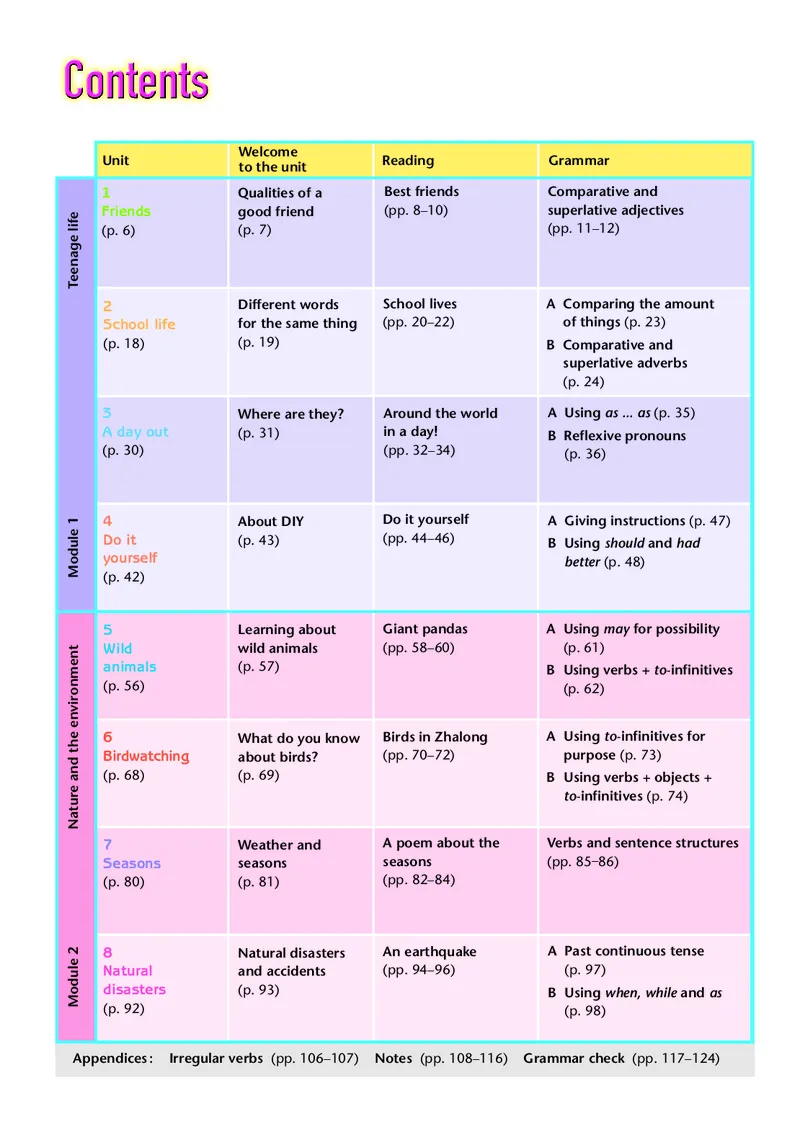
Welcome
to the unit
1 Qualities of a Best friends Comparative and
Friends good friend (pp. 8—10) superlative adjectives
(p. 6) (p. 7) (pp. 11—12)
2 Different words School lives A Comparing the amount
School life for the same thing (pp. 20—22) of things (p. 23)
(p. 18) (p. 19) B Comparative and
superlative adverbs
(p. 24)
3 Where are they? Around the world A Using as ... as(p. 35)
A day out (p. 31) in a day! B Reflexive pronouns
(p. 30) (pp. 32—34) (p. 36)
4 About DIY Do it yourself A Giving instructions (p. 47)
Do it (p. 43) (pp. 44—46) B Using shouldand had
yourself better(p. 48)
(p. 42)
5 Learning about Giant pandas A Using mayfor possibility
Wild wild animals (pp. 58—60) (p. 61)
animals (p. 57) B Using verbs+ to-infinitives
(p. 56) (p. 62)
6 What do you know Birds in Zhalong A Using to-infinitives for
Birdwatching about birds? (pp. 70—72) purpose (p. 73)
(p. 68) (p. 69) B Using verbs+ objects+
to-infinitives (p. 74)
7 Weather and A poem about the Verbs and sentence structures
Seasons seasons seasons (pp. 85–86)
(p. 80) (p. 81) (pp. 82—84)
8 Natural disasters An earthquake A Past continuous tense
Natural and accidents (pp. 94—96) (p. 97)
disasters (p. 93) B Using when, whileand as
(p. 92) (p. 98)tcejorP
)501—401
.pp(su
dnuora
dlrow
ehT
2
tcejorP
Wordlists (pp. 125—138) Proper nouns (p. 139)
)55—45
.pp(
telkoob
emoclew
A
1
tcejorP
Integrated skills Study skills Task Self-assessment
A Future plans (p. 13) How to remember My best friend (p. 17)
B Speak up: What’s he like? (p. 14) words (pp. 16—17)
(p. 15)
A Comparing schools (p. 25) The suffix -ly My ideal school (p. 29)
B Speak up: Simon spends the most (p. 27) (pp. 28—29)
time on his hobbies. (p. 26)
A The basketball final (p. 37) The suffixes -fuland A big day out (p. 41)
B Speak up: Where are we going -less (pp. 40—41)
tomorrow? (p. 38) (p. 39)
A How to make a fruit salad (p. 49) The prefixes un-, A DIY story (p. 53)
B Speak up: Let’s make some in-and im- (pp. 52—53)
sandwiches. (p. 50) (p. 51)
A Helping wild animals (p. 63) The suffixes -ing, -ness A report on an (p. 67)
B Speak up: It’s a great pity! (p. 64) and -ion animal in danger
(p. 65) (pp. 66—67)
A Yancheng Nature Reserve (p. 75) The suffixes -er, -or Making an (p. 79)
B Speak up: What should we take and -ist application
with us? (p. 76) (p. 77) (pp. 78—79)
A Weather in different seasons and The suffix -y My favourite (p. 91)
places(p. 87) (p. 89) season
B Speak up: How’s the weather in (pp. 90—91)
Nanjing?(p. 88)
A Away from danger (p. 99) Creating new words A natural disaster (p. 103)
B Speak up: What should we do first? (p. 101) (pp. 102—103)
(p. 100)Unit 1
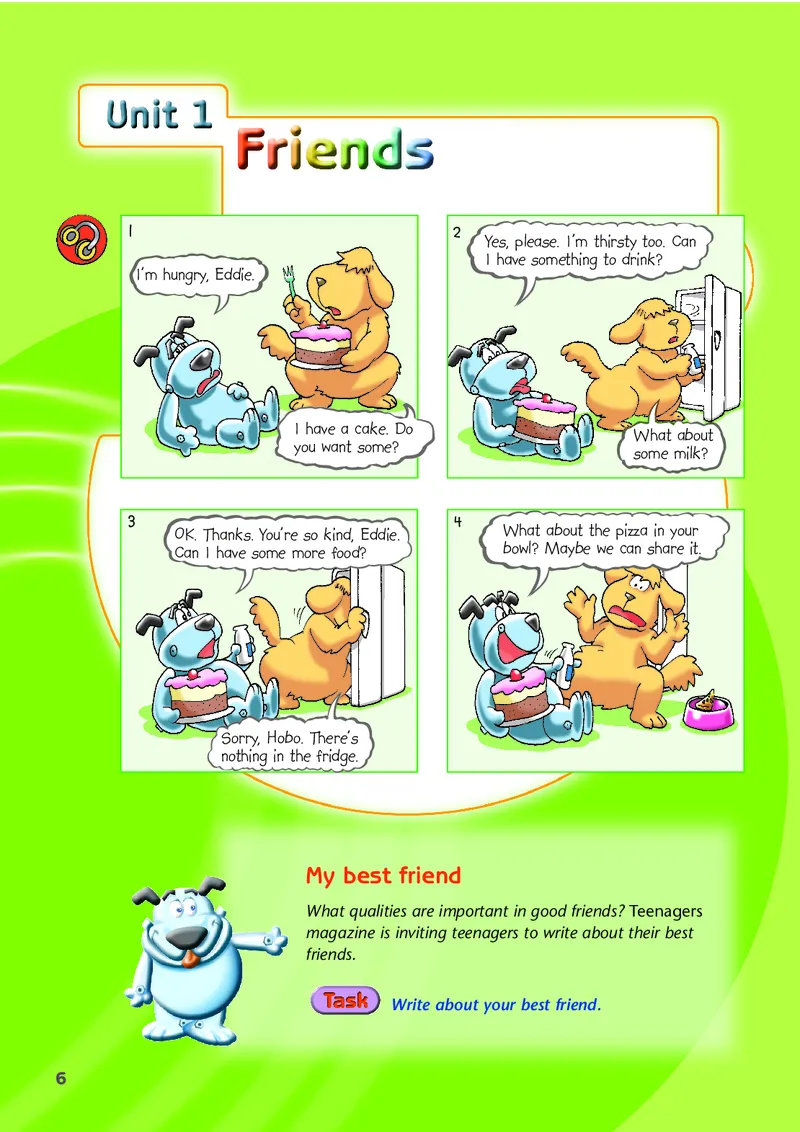
1 2
Yes, please. I’m thirsty too. Can
I have something to drink?
I’m hungry, Eddie.
I have a cake. Do
What about
you want some?
some milk?
3 4
OK. Thanks. You’re so kind, Eddie. What about the pizza in your
Can I have some more food? bowl? Maybe we can share it.
Sorry, Hobo. There’s
nothing in the fridge.
My best friend
What qualities are important in good friends? Teenagers
magazine is inviting teenagers to write about their best
friends.
Write about your best friend.
6Unit 1
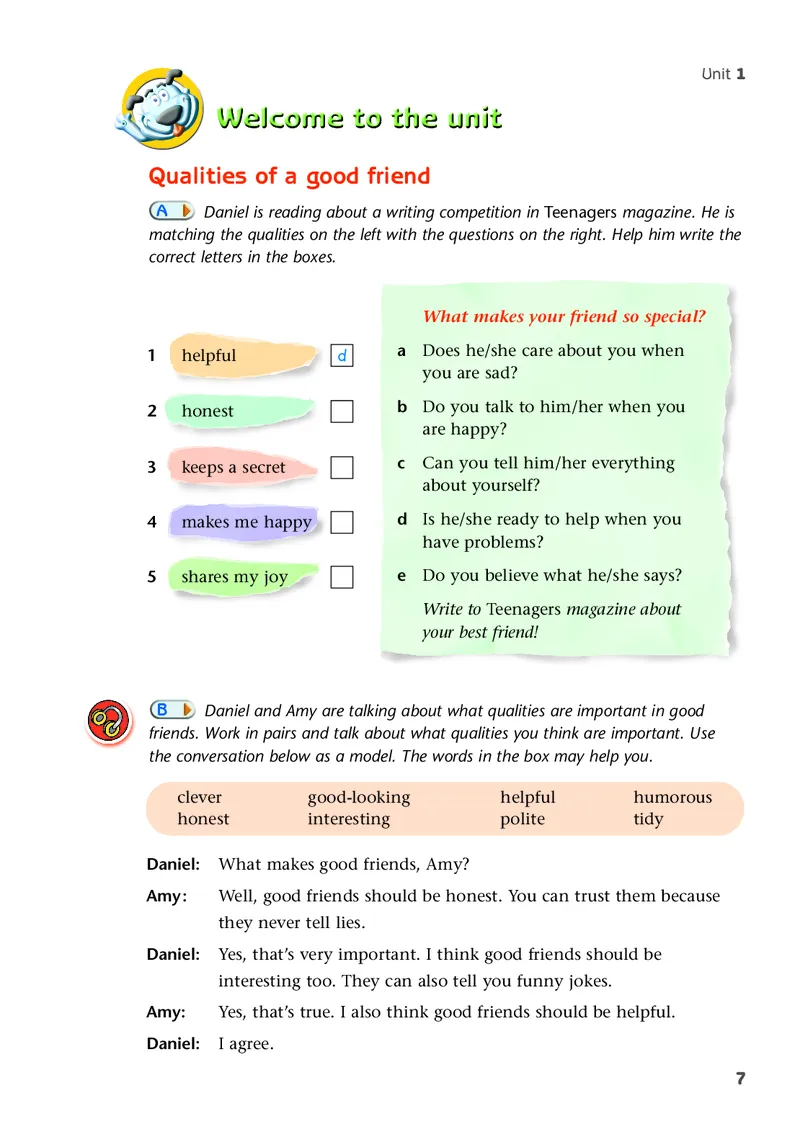
Qualities of a good friend
Daniel is reading about a writing competition in Teenagers magazine. He is
matching the qualities on the left with the questions on the right. Help him write the
correct letters in the boxes.
What makes your friend so special?
1 helpful d a Does he/she care about you when
you are sad?
b Do you talk to him/her when you
2 honest
are happy?
3 keeps a secret c Can you tell him/her everything
about yourself?
4 makes me happy d Is he/she ready to help when you
have problems?
5 shares my joy e Do you believe what he/she says?
Write to Teenagers magazine about
your best friend!
Daniel and Amy are talking about what qualities are important in good
friends. Work in pairs and talk about what qualities you think are important. Use
the conversation below as a model. The words in the box may help you.
clever good-looking helpful humorous
honest interesting polite tidy
Daniel: What makes good friends, Amy?
Amy: Well, good friends should be honest. You can trust them because
they never tell lies.
Daniel: Yes, that’s very important. I think good friends should be
interesting too. They can also tell you funny jokes.
Amy: Yes, that’s true. I also think good friends should be helpful.
Daniel: I agree.
7Unit 1
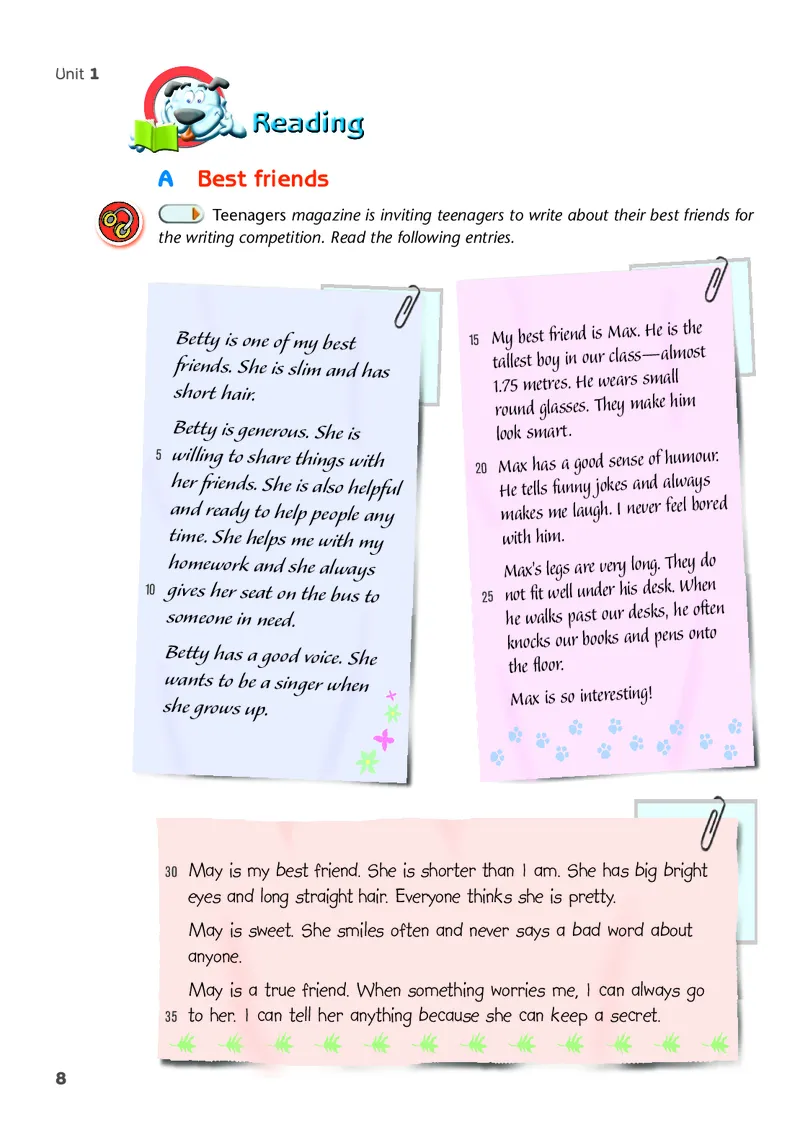
A Best friends
Teenagers magazine is inviting teenagers to write about their best friends for
the writing competition. Read the following entries.
Betty is one of my best 15 My best friend is Max. He is the
friends. She is slim and has t
1
a
.7
l
5
le s
m
t
e
b
t
o
r
y
e s
i
.
n
H
o
e
u r
w
c
e
l
a
a
r
s
s
s —
sm
a
a
l
l
m
l
ost
short hair.
round glasses. They make him
Betty is generous. She is look smart.
5 willing to share things with Max has a good sense of humour.
20
her friends. She is also helpful He tells funny jokes and always
and ready to help people any makes me laugh. I never feel bored
time. She helps me with my with him.
homework and she always Max’s legs are very long. They do
10 gives her seat on the bus to 25 not fit well under his desk. When
someone in need. he walkspast our desks, he often
knocks our books and pens onto
Betty has a good voice. She
the floor.
wants to be a singer when
Max is so interesting!
she grows up.
May is my best friend. She is shorter than I am. She has big bright
30
eyes and long straight hair. Everyone thinks she is pretty.
May is sweet. She smiles often and never says a bad word about
anyone.
May is a true friend. When something worries me, I can always go
to her. I can tell her anything because she can keep a secret.
35
8Unit 1
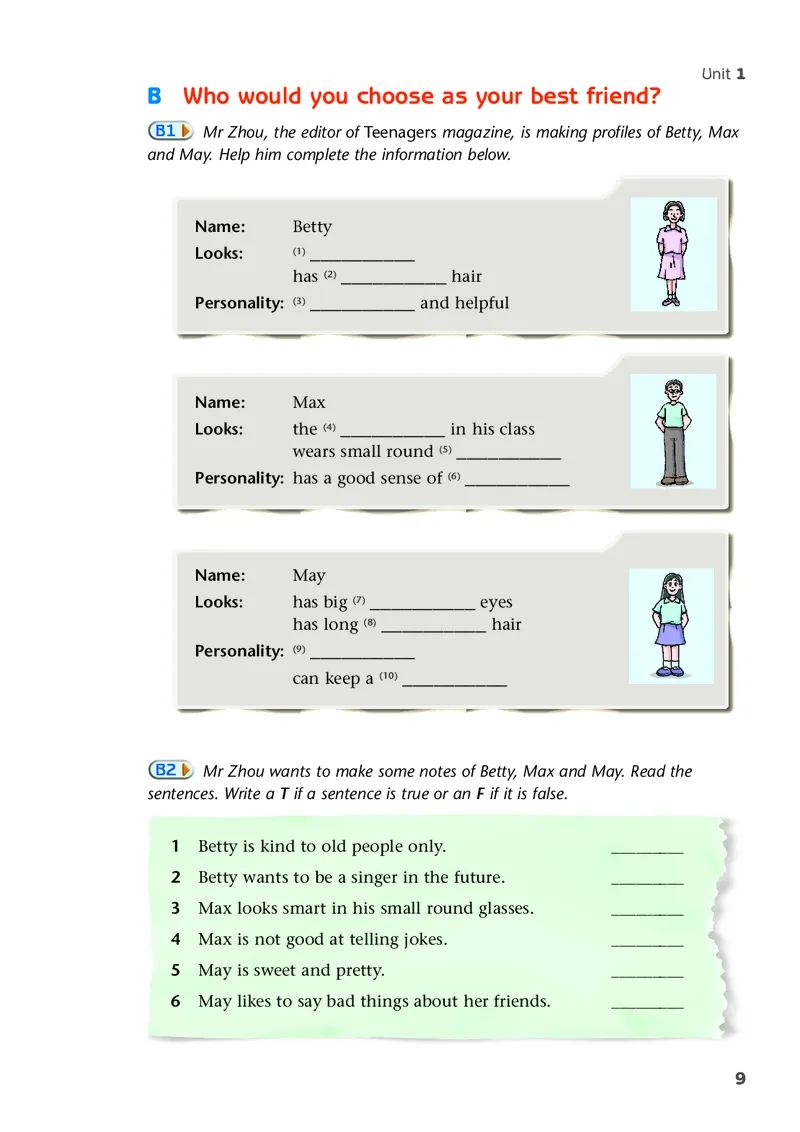
B Who would you choose as your best friend?
Mr Zhou, the editor of Teenagers magazine, is making profiles of Betty, Max
and May. Help him complete the information below.
Name: Betty
Looks: (1)__________
has (2)__________ hair
Personality: (3)__________ and helpful
Name: Max
Looks: the (4)__________ in his class
wears small round (5)__________
Personality: has a good sense of (6)__________
Name: May
Looks: has big (7)__________ eyes
has long (8)__________ hair
Personality: (9)__________
can keep a (10)__________
Mr Zhou wants to make some notes of Betty, Max and May. Read the
sentences. Write a T if a sentence is true or an F if it is false.
1 Betty is kind to old people only. _________
2 Betty wants to be a singer in the future. _________
3 Max looks smart in his small round glasses. _________
4 Max is not good at telling jokes. _________
5 May is sweet and pretty. _________
6 May likes to say bad things about her friends. _________
9Unit 1
Mr Zhou is writing about Betty, Max and May. Help him write the correct
names in the boxes and find some related details in the three entries.
1
is sweet. _________________________________________________
___________________________________________________________________
2
is humorous. _____________________________________________
___________________________________________________________________
3
is helpful. _______________________________________________
___________________________________________________________________
Mr Wu is asking the students who they would choose as their best friends.
Complete the conversation with the words in the box.
feel bored keep a secret ready to help
share tell funny jokes worries
Mr Wu: Who would you choose as your best friend, Suzy?
Suzy: I’d choose May. I can go to her when something (1)_____________
me. I can tell her anything because she can (2)_____________.
Mr Wu: Yes, she’s kind and sweet. And you, Simon?
Simon: I’d choose Max. He can (3)_____________, so I’ll never
(4)_____________ with him.
Mr Wu: Yes, Max is interesting. And how about you, Sandy?
Sandy: I’d choose Betty. She’s willing to (5)_____________ things with her
friends and is (6)_____________ people any time.
10Unit 1
Short adjectives
are adjectives
with one or two
syllables, e.g.
clean, heavy.
Long adjectives
are adjectives
with three or
more syllables,
e.g. beautiful,
interesting.
We form comparative and superlative adjectives like this:
Adjective Comparative Superlative
Most short adjectives + er + est
long ➜ longer ➜ longest
small ➜ smaller ➜ smallest
Short adjectives ending
+ r + st
in e
fine ➜ finer ➜ finest
nice ➜ nicer ➜ nicest
Short adjectives ending
– y + ier – y + iest
in a consonant + y
easy ➜ easier ➜ easiest
pretty ➜ prettier ➜ prettiest
Short adjectives ending double the consonant double the consonant
in a vowel + a consonant + er + est
big ➜ bigger ➜ biggest
slim ➜ slimmer ➜ slimmest
Long adjectives more + most +
beautiful ➜ more beautiful ➜ most beautiful
important ➜ more important ➜ most important
Irregular adjectives replace the word replace the word
good ➜ better ➜ best
bad ➜ worse ➜ worst
PIT
Comparative and superlative adjectives
We use comparatives + than to compare two people or things. We usually
add -er to short adjectives and use more with long adjectives to form
comparatives.
She is shorter than I am.
My book is more interesting than his.
We use the + superlatives to compare three or more people or things. We
usually add -est to short adjectives and use most with long adjectives to
form superlatives.
He is the tallest boy in our class.
This is the most expensive computer in the shop.
11Unit 1
A class profile
Daniel is writing about his classmates. Help him complete the following table
with the correct adjectives.
We can add
Adjective Comparative Superlative
-er, -estor
more, mostto clean cleaner cleanest
the following
adjectives with
short
two syllables.
clever cute
handsome
polite happy
simple
stupid lazy
big
Daniel has made a profile of his classmates. Read the profile and complete his
notes.
Millie Sandy Amy Peter Kitty Simon
Height (cm) 157 170 160 173 155 171
Weight (kg) 45 50 44 55 40 53
50 m swimming (sec.) 40 38 30 34 36 35
Drawing competition 9/10 10/10 9/10 5/10 6/10 8/10
English test 10/10 8/10 9/10 6/10 8/10 7/10
taller than
1 Simon is ______________________ (tall) Sandy.
2 Peter is ______________________ (tall) of the six students.
3 Sandy is ______________________ (heavy) Millie.
4 Peter is ______________________ (heavy) of the six students.
5 Among the six students, Millie is ______________________ (slow) swimmer.
6 Amy is ______________________ (fast) swimmer of the six students.
7 Millie’s drawing is ______________________ (beautiful) Peter’s.
8 Sandy’s drawing is ______________________ (beautiful) in her class.
9 Millie’s English is ______________________ (good) Simon’s. Millie’s English
is ______________________ (good) in her class.
We put than ________________ (before, after) comparatives.
We put the ________________ (before, after) superlatives.
12
PIT Adjective Comparative Superlative
thin
sad
difficult
interesting
good
badUnit 1
A Future plans
Nora is talking to Amy about her future plans. Listen to their conversation.
Help Nora put a tick (✓) in the correct boxes in the table below.
I would like to …
be an artist
be famous
meet different people
make friends
listen to people carefully
help people with their problems
make people happy
travel around the world
Nora is writing about her future plans in her diary. Look at the table in
Part A1. Help Nora complete her diary entry.
Dear Diary,
Today Amy and I talked about our future plans.
I would like to be a social worker when I grow up.
I am always kind to people. I have many friends at school. I like to
(1)_____________ a lot of people and make (2)_____________
with them. I can (3)_____________ to people carefully and help
them with their (4)_____________. I will be happy if I can
make other people (5)_____________.
13Unit 1
Sandy is writing about her future plans in her diary too. Listen to her
conversation with Daniel. Help Sandy complete her diary entry.
Dear Diary,
I love drawing and I would like to be (1) _____________ when I
grow up.
Among all the Chinese artists, I like (2) _____________ best.
His pictures of (3) _____________ are beautiful works of art.
I want to be as (4) _____________ as he is.
I want to travel around the world and learn more about
(5) _____________ some day.
B Speak up: What’s he like?
Sandy is telling her neighbour Helen about her friends. Work in pairs and
tell your partner about your friends. Use the conversation below as a model.
Helen: Who’s the boy on the left?
Sandy: Oh, this is Peter. He’s the tallest in my class.
Helen: What’s he like?
Sandy: He’s clever and humorous. He often tells us funny jokes.
Helen: Who’s the girl next to Peter?
Sandy: She’s Lucy. She’s a small girl with a ponytail.
Helen: What’s she like?
Sandy: She’s shy and quiet.
14Unit 1
How to remember words
Can you remember new words quickly? A vocabulary tree can help you.
• Put the words into different groups, e.g. jobs, looks and feelings. Then
write the group names on the branches.
• Write down the words on the leaves of each branch.
• Draw pictures of the words to help you remember their meanings if
necessary.
Look at the vocabulary tree below. Complete it by writing the words on the
correct leaves.
afraid angry bored cook cute
doctor excited lovely nurse policeman
pretty slim tall tired waiter
strong
teacher
happy
looks
sad
jobs
feelings
people
15Unit 1
My best friend
Daniel is going to take part in the writing competition. Here is a list of words
that he can use to describe different people. Read the list.
Words about people
Face long, round, square, small
Eyes big, small, round, bright, smiling
Nose big, small, long, short, straight
Hair black, dark brown, long, short, straight
Looks beautiful, pretty, good-looking,
handsome, lovely, cute, short, tall, fat,
slim, smart, strong
Personality clever, smart, polite, friendly, kind,
generous, hard-working, helpful,
honest, humorous, patient
You also want to write an article about your best friend. Prepare some notes
of him or her. Then use the outline below to help you organize your ideas.
Introduction
Say who your best friend is.
Main body
Describe his/her looks and
personality.
Conclusion
Write about his/her future plans.
16Unit 1
Read Daniel’s article about his best friend Kate.
Kate is both my neighbour and my best friend.
I first met her five years ago.
Kate is tall and slim. She has long hair. She
has a round face and a small nose. I like her
bright smiling eyes. They make her look really
pretty and kind.
Kate is a friendly girl. She always has a smile on her face and looks
happy. She likes to help people. She helps me with my homework and she
is very patient. When I feel bored or unhappy, I often go to her. She will
talk to me and tell me interesting things.
Kate wants to work with children. She would like to be a teacher when
she grows up. I think she will make an excellent teacher.
Now write your own article about your best friend. Use your notes and the
outline on page 16 to help you.
I have learnt Details Result
1 three passages about friends.
2 to use the new words to
describe my friends.
3 to use comparative and
superlative adjectives.
4 to use a vocabulary tree to
remember new words.
Result: Excellent! Good! Not bad!
I need to spend more time on ___________________________________.
171 2
Why don’t dogs go Because we’re cleverer than people.
to school, Eddie? They have to work harder.
3 4
What’s school like? It’s like watching TV, but there
are fewer advertisements.
Ideal schools
The Class 1, Grade 8 students are learning about
schools around the world. They are also writing
about their ideal school.
Complete a questionnaire and write
about your ideal school.
18Unit 2
Different words for the same thing
People in the UK and the USA sometimes use different words to refer to the
same thing. Match the words on the left with the words on the right. Write the
correct letters in the blanks. Then write the correct words under the pictures below.
British English American English
1 biscuit ___d____ a eraser
2 autumn _______ b soccer
3 lorry _______ c vacation
4 film _______ d cookie
5 football _______ e fall
6 holiday _______ f store
7 garden _______ g truck
8 rubber _______ h yard
9 shop _______ i movie
_________ _________ _________ _________ _________
_________ _________ _________ _________ _________
It is Friday afternoon. Daniel and Simon are chatting after school. Read their
conversation. Underline the British words and write the American words above them.
Daniel: Hi, Simon. Where are you going?
Simon: I’m going to buy a toy lorry for my cousin in the shop near our
school.
Daniel: I’ll go with you. I’d like to buy some
biscuits.
Simon: Do you have any plans for the weekend?
Daniel: I want to see a film. Shall we go together?
Simon: I’d love to, but the school football team
will practise this Saturday. We have an
important match this autumn.
19Unit 2
A School lives
Daniel is visiting an online club called Schools Around the World. Here are
two articles on the website about different school lives.
Life in a British school
Hi, everybody.
My name is Nancy. I am in Year 8 at Woodland School
near London. It is a mixed school. Boys and girls have
lessons together. Among all my subjects, I like French
5 best. Learning foreign languages is fun.
Our school has a Reading Week every year. During the week, we can
borrow more books from the school library. We can also bring in books
and magazines from home. I often read more books than my classmates.
Near the end of the week, we discuss the books with our classmates in
10 class. Time seems to go faster when we are reading interesting books.
Life in an American school
Hi guys.
I’m John and I’m 14 years old. I’m in the 8th grade at Rocky Mountain
High School near Denver.
Every Monday, I go to the Buddy Club. In the club,
15 older students help new students learn more about the
school. My friend Tony is in the 12th grade. He often
listens carefully to my problems and offers me help. He
is my hero.
We have different classes every day. On Friday afternoon,
20 our school ends earlier than usual. My friends and I
often do sports together.
Twice a week, I play baseball after school. I love this
game and practice hard every time. Our team won two games last month.
20Unit 2
B Schools in different countries
Daniel does not know the meanings of some words in the articles. Help him
match the words on the left with the meanings on the right. Write the correct letters
in the blanks.
1 foreign (line 5) _________ a talk about something
2 language (line 5) _________ b give something to someone
3 discuss (line 9) _________ c be best or first in a competition
4 offer (line 17) _________ d not in or from your own
country
5 win (line 23) _________ e words used in speaking and
writing
Daniel found some pictures of Nancy’s and John’s schools. First, help him
complete the description of each picture. Then put an N in the box if the picture
shows Nancy’s school and a J if it shows John’s school.
1 2
3 4
1 In a ________________ school, boys and girls study ________________.
2 In the ________________, older students help new students learn more
about ________________.
3 During ________________, students can _____________________ from the
library and can bring in _____________________ from home.
4 Some students ________________ after school and they ________________
every time.
21Unit 2
Daniel wrote about schools in the two countries. However, he made some
mistakes. Write a T if a sentence is true or an F if it is false.
1 Both Nancy and John are Grade 8 students. ________
2 Nancy’s favourite subject is English. ________
3 There is a Reading Week at Nancy’s school every year. ________
4 Nancy always brings in more books than her classmates. ________
5 The classes at John’s school are not the same every day. ________
6 John and his friends often go shopping on Friday afternoon. ________
On the way home, Daniel tells Kitty about John’s school life. Complete their
conversation with the words in the box.
baseball ends hero offers sports twice won
Daniel: I read an article by a boy from the USA. His name is John. He’s in
the 8th grade.
Kitty: Really? What’s his school life like?
Daniel: Every Monday, he goes to the Buddy Club. His friend Tony is in the
12th grade. Tony listens to John’s problems and (1) ________________
him help. He’s John’s (2) ________________.
Kitty: What else do you know about John?
Daniel: On Friday afternoon, their school (3) ________________ earlier than
usual. They often do (4) ________________ together.
Kitty: Does John like sports?
Daniel: Yes. His favourite sport is
(5) ________________. He plays it
(6) ________________ a week. Their
team (7) ________________ two games
last month.
22Unit 2
A Comparing the amount of things
We can compare the amount of things using more ... than, fewer ... than
We use fewer
and the fewest and less ... than. We use the most for the largest amount and the
with countable fewest/the least for the smallest amount.
nouns, and less
and the least
with uncountable
nouns. We use
moreand the
mostwith both
countable and
uncountable
nouns.
Comparing school lives
Daniel wants to compare his school life with Nancy’s and John’s. Look at the
table below. Help Daniel complete his sentences.
23
PIT
Millie Daniel Kitty
Millie has more tomatoes than Daniel. Kitty has the most eggs.
Millie has less rice than Daniel. Daniel has the fewest tomatoes.
Millie has fewer bananas than Kitty. Millie has the least juice.
Nancy John Daniel Me
Subjects 6 8 12
Clubs 3 2 4
Free time each day 4 hours 3 hours 1 hour
1 John studies __________ subjects than Nancy, but he studies __________
subjects than me. I study the __________ subjects among the three of us.
2 Nancy is in __________ clubs than John, but she is in __________ clubs
than me. John is in the __________ clubs among the three of us.
3 I have __________ free time than John, but Nancy has __________ free
time than John. Among the three of us, I have the __________ free time
and Nancy has the __________ free time.
What is your school life like? Complete the last column in Part A1 with your
own information. Make sentences to compare your school life with Nancy’s, John’s
and Daniel’s.Unit 2
B Comparative and superlative adverbs
We can form comparative and superlative
The following
adverbs have the adverbs in the same way we form
same form as the comparative and superlative
adjectives.
adjectives.
early far fast
hard high late Millie came third in the race. She ran fast.
long near
Sandy came second in the race. She ran
faster than Millie.
Amy came first in the race. She ran the fastest.
Adverb Comparative Superlative
Most short adverbs + er + est
hard ➜ harder ➜ hardest
high ➜ higher ➜ highest
Long adverbs more + most +
quickly ➜ more quickly ➜ most quickly
carefully ➜ more carefully ➜ most carefully
Irregular adverbs replace the word replace the word
well ➜ better ➜ best
badly ➜ worse ➜ worst
far ➜ further/farther ➜ furthest/farthest
My classmates
Daniel is writing about his classmates. Help him complete his sentences with
the correct forms of the words in brackets.
1 Sandy draws ______________ (well). She draws _______________ (well) than
any other student in my class. She draws ______________ (well) of us all.
2 David jumps ______________ (high). He jumps ______________ (high) than
any other of my classmates. He jumps ______________ (high) in my class.
3 Amy swims ______________ (fast). She swims ______________ (fast) than all
my other classmates. She swims ______________ (fast) in my class.
4 Millie writes ______________ (quickly). She writes ______________ (quickly)
than the other students in my class. Millie writes ______________ (quickly)
of us all.
24
PIT
We form comparative and superlative adverbs like this:Unit 2
A Comparing schools
Daniel is writing an article about different schools. Listen to him introducing
Sunshine Middle School and complete the first column in the table below.
Sunshine Woodland Rocky Mountain
Middle School School High School
Number of students
Number of teachers 66
How long is the summer holiday?
How much time do students
spend on homework every day?
Do students wear uniforms? /
Do students do morning
yes / no
exercises?
Sandy is helping Daniel collect information on the Internet about other
schools. Listen to their conversation and complete the rest of the table above.
Help Daniel complete his article with the information in Part A1.
Woodland School is smaller than Rocky Mountain High School. There are
(1) _______________ (more/fewer/less) teachers and (2) _______________
(more/fewer/less) students at Woodland School than at Rocky Mountain High
School. Sunshine Middle School has (3) _______________ (more/fewer/the most)
teachers and students of the three.
Chinese students have(4) _______________ (more/fewer/less) weeks off for
the summer holiday than British students. British students spend
(5) _______________ (more/fewer/less) time doing homework than Chinese
students. Among the three schools, American students spend (6) ______________
(the least/few/less) time on homework, and they have (7) ______________
(long/longer/the longest) summer holiday. Chinese students spend
(8) _______________ (the most/the fewest/the least) time on homework. They
work (9) _______________ (hard/harder/the hardest).
25Unit 2
Daniel, John and Nancy are chatting online about their schools. Match
the sentences with the correct people. Use the information in Part A1 on page
25 to help you.
Nancy
1 _________: My school has fewer weeks off for the summer
holiday than Daniel’s.
2 _________: Students at my school do not wear uniforms.
3 _________: I spend less time doing homework than Nancy.
4 _________: My school has the most students.
5 _________: My school has the fewest teachers.
Daniel John Nancy
B Speak up: Simon spends the most time on his hobbies.
The Class 1, Grade 8 students are talking about the time they spend on
their hobbies. Work in groups and talk about your hobbies. Use the conversation
below as a model.
Millie: How much time do you spend on your hobbies every day, Daniel?
Daniel: About one hour. Half an hour for playing computer games and
another half an hour for playing chess.
Millie: Really? I have only half an hour for my hobbies at most. I often do
some reading. How about you, Simon?
Simon: About two hours for sports. And you, Amy?
Amy: Usually I go swimming for about half an hour.
Millie: OK. Among the four of us, Simon spends the most time on his
hobbies, and Daniel spends more time on his hobbies than Amy
and I.
26Unit 2
The suffix -ly
A suffix is a letter or a group of letters that we add to the end of a word to
form a new word. We can add -ly to some adjectives to form adverbs. We
can also add -ly to some nouns to form adjectives.
For some Adjective Adverb Noun Adjective
adjectives
ending in y, we real really friend friendly
change the y
to ilyto make bad badly day daily
adverbs.
happy➝happily usual usually week weekly
Add -ly to each of the words in the box on the left. Then put them in different
groups. You may use a dictionary.
careful day
Adjective➝Adverb Noun➝Adjective
easy love
month quick
slow usual
week year
Millie is writing in her diary. Complete her entry with the correct forms of the
words in brackets.
27
PIT The following
words are also
adverbs.
daily
weekly
monthly
Today we had an English test. We have a (month)
(1) ________________
test on each subject. I looked through the questions
(quick). I could (easy) answer
(2) ________________ (3) ________________
all of them.
To me, learning foreign languages is (real) fun.
(4) ________________
I read English newspapers and magazines every day. I read very
(slow) at first, but I am doing better now. I also
(5) ________________
keep writing in English about my (day) life. I learn
(6) ________________
to use English better this way. (usual) I watch
(7) ________________
English videos at weekends. I always have a (love)
(8) ________________
time!
PITUnit 2
My ideal school
What do you like or dislike about your school? Read the questionnaire below
and write your answers.
1 What time does your school start? ________________
2 Do you think this is too early or too late? ________________
3 When do you finish school? ________________
4 Do you think this is too early or too late? ________________
5 How long is lunchtime at your school? ________________
6 Do you like your school uniform? Why or why not?
___________________________________________________________________
7 Below are some subjects, sports and after-school activities. Put a tick (✓) in
the box next to the ones you like.
Subjects Sports Clubs
Chinese Badminton Art Club
English Basketball Chess Club
Geography Football Dance Club
History Table tennis English Club
Maths Tennis Reading Club
Physics Volleyball Singing Club
______________ ______________ ______________
8 How often do you go on school trips? __________________________________
9 Do you think your school is a good one? Why or why not?
_____________________________________________________________________
My ideal school starts at ... and finishes at ....
We have an hour for ....
I have ... because I think ... is very interesting.
I love ..., so I have ... every day.
There is ....
We have lots of ....
Every ..., we go on a school trip.
28Unit 2
Read Daniel’s article about his ideal school.
My ideal school
My ideal school starts at 9 a.m. and finishes at 3 p.m. We do not need to
get up early, and we have lots of time for after-school activities. We only
have an hour of homework every day.
We have an hour for lunch. There is a big clean dining hall. We have lunch
and chat there. We listen to music at lunchtime. We wear school uniforms,
but we do not wear ties.
Our classes are quite small. There are about 20 students in each class.
We can choose subjects to study. I have Maths
because Maths is very interesting. I love
computers, so I have computer lessons
every day.
There is a big library, a football field and a
swimming pool. We have lots of clubs and
after-school activities. Every month, we go
on a school trip. We always have fun.
Write an article about your ideal school. Use the information in Part A to help
you. Then read your article to your partner.
I have learnt Details Result
1 about different school lives.
2 to use the new words to talk about
my school life.
3 to compare the amount of things.
to use comparative and superlative
adverbs.
4 the suffix --llyy.
Result: Excellent! Good! Not bad!
I need to spend more time on ___________________________________.
291 2
What are you going to Are you going to climb a hill?
I’m going
do, Eddie?
to exercise.
Yes.
3 4
Come on, Hobo. Let’s
That’s good. You need to
enjoy ourselves!
exercise and keep fit.
Well, this hill isn’t as
high as a real one!
Let’s go!
Kitty’s cousin Linda is visiting Sunshine Town. Find out
where Linda, Kitty and her classmates went and what
happened there.
Make a plan for a day trip and write an
invitation letter to your classmates.
30Unit 3
Where are they?
Amy and Simon are reading some postcards from their friends. Read the
back of the postcards and match them with the correct pictures. Write the correct
letters in the boxes.
1
3
2
Hi Amy,
Yesterday I took a boat trip Hi Amy, Hi Simon, Simon
u B S I A T n ’ y m r a u d i d d k s e n h e g t r e r a e c y a t v a h a l i i O r e n n a e p g d ! f ! a e a r w m a e g o n H r u e t s o a p u t H a s t s e a i . m t r b t e h o u e in r A T t R c l o W o l o i w v t e f t e e h f ’ h r r r e e e e e S t b t h s e s o e i i i h t s n p s t o t e i a , o p n . f f g W t b t e y i e h r n ’ n e t r h a o e E e o i g l f n i o t f ! t i e n l l e g I t b g T U o s u a h d a S r i e a w l A d d y P e i . l t n n r i I h v e t g a e e s i s w i n s W d d t i a e h t h n h m e b i t r t e a a e e o a . n f b H u y t i t g o h i t u f e r u s e l e es. F C N S B l i a u t i e n t y n i j t 0 i s G h n h 1 a g , i S n r 6 t 1 d e / r 0 e e F 0 T n e o , 0 t w B 0 n 0 lock 3
Nick Leo See you soon, China
Jane
a
b
c
Simon searched on the Internet for some information about places of interest
around the world. He is answering Amy’s questions. Work in pairs and talk about the
places you are interested in. Use the conversation below as a model.
We use How Amy: How long is the Golden Gate Bridge?
tall/highto
ask about Simon: It’s very long, about 1.7 miles.
height.
Amy: How wide is the bridge?
Simon: It’s 90 feet wide.
Amy: The bridge is made of steel, isn’t it?
Simon: Yes, and it weighs over 100,000 tons.
31
PITUnit 3
A Around the world in a day!
Linda comes from the USA. She is visiting her cousin Kitty. She went to the
World Park with the Class 1, Grade 8 students yesterday. Here is Linda’s email to
her parents about the trip.
Dear Mom and Dad,
I’m doing fine here. Yesterday Kitty’s teacher Mr Wu invited me to join
their school trip to the World Park.I enjoyed myself!
It was a fine warm day. The sun was shining in a clear blue sky. The World
5 Park is quite far away.It took us about two hours to get there by bus.There
was a lot of traffic on the way and the journey was a little boring.
We finally arrived at the park.All of us couldn’t wait to get off the
bus.Soon the whole world was there in front of us!There are models
of more than a hundred places of interest from all over the world.
10 They are small but wonderful.
We became very excited when we saw the model Eiffel Tower. It is
made of steel and is really tall. The model Golden Gate Bridge looked
as great as the one back home. I couldn’t believe my eyes.
It was an amazing day because we saw the main sights of the world
15 in just one day.The song and dance shows were also wonderful. We
learnt a lot about different cultures.
You can see some photos of the trip on the Internet.Kitty’s classmate
Daniel put them on his home page.Go and see for yourselves!
Love,
Linda
20
32Unit 3
B A fun day out
Kitty wants to know the meanings of some words in Linda’s email. Help Kitty
match the words on the left with the meanings on the right. Write the correct letters
in the blanks.
1 join (line 2) _________ a full
2 journey (line 6) _________ b get to a place
3 boring (line 6) _________ c places of interest
4 finally (line 7) _________ d take part in
5 arrive at (line 7) _________ e not interesting
6 whole (line 8) _________ f a long trip
7 main (line 14) _________ g after a long time
8 sights (line 14) _________ h most important
Kitty is trying to make some notes of the trip. Help her complete the notes
below.
Our school trip
Date: (1) ______10_ _O_c_t_o_b_e_r_____
Place: (2) ___________________
Weather: (3) ___________________ warm day
(4) ___________________ sun and
(5) ___________________ blue sky
How to go: by (6) ___________________
About the park: models of more than (7) ___________________
places of interest from all over the world
(8) ___________________ shows
33Unit 3
Here are some descriptions of the school trip. Write a T if a sentence is true
or an F if it is false.
1 Linda and Kitty went to the World Park by themselves. _________
2 Linda did not enjoy the day very much. _________
3 It took the students half an hour to get to the park. _________
4 The models in the park are small but wonderful. _________
5 The model Eiffel Tower is made of wood. _________
6 The model Golden Gate Bridge looked just like the real one
in the USA. _________
Kitty and Daniel are chatting online. Complete their conversation with the
words from Linda’s email on page 32.
Kitty: It was a great day yesterday. Linda really (1) _______________. :-)
Daniel: But the journey was a little (2) _______________, and there was
too much (3) _______________ on the way. :-(
Kitty: True, but when we saw the models, we became (4) ______________.
Linda couldn’t (5) _______________ when she saw the model
Golden Gate Bridge. It looked (6) _______________ the one in
her country.
Daniel: Yes. It was amazing to see the (7) _______________ of the world
in a day, and it was also great to learn a lot about different
(8) _______________.
Kitty: Did you take any photos, Daniel?
Daniel: Yes, I took some. You can see them on my (9) _______________.
Kitty: Great. So Linda’s parents can see them too. :-)
34Unit 3
A Using as ... as
not as ... as We use as ... as to say that people or things are the same in some ways.
= not so ... as
Mr Wu is as happy as the two girls.
We use not as ... as to say that people or things
are not the same in some ways.
The two girls are not as tall as Mr Wu.
The two girls are shorter than Mr Wu.
Linda is sending some pictures to her parents via email. Complete her
sentence under each picture with as ... as or not as ... as.
1 2
The bus is ___________________ Mr Wu is ___________________ (kind)
(comfortable) those in the USA. a friend.
3 4
The journey is ___________________ The model Eiffel Tower is
(not interesting) the visit. ___________________ (not tall) the
real one in France.
5 6
The model Sydney Opera House The song and dance shows are
looks ___________________ ___________________ (good) the
(wonderful) that in Australia. models in the park.
35
PIT
=Unit 3
B Reflexive pronouns
We use reflexive pronouns when the subject and the object are the same
person or thing.
Linda enjoyed herself in the park.
Linda’s parents will go and see the photos for themselves.
Note the spellings
of the singular
form -selfand
the plural form
-selves.
36
PIT
Singular Plural
myself ourselves
yourself yourselves
Reflexive
pronouns himself
herself themselves
itself
What happened at South Hill?
The students are at South Hill. Read about Linda and Simon’s secret.
Complete the sentences with the correct reflexive pronouns.
1 You can go and enjoy 2 Oh no! Simon is trying to 3 Luckily, some
climbers
(1) now. pull (2) up
helped Simon.
the rocks.
Help!
4 Please don’t tell anybody 5 Later ... 6 Simon and Linda
looked at each other.
about this, Linda.
Did you all have a good time?
They kept the secret
to (5) .
OK, I won’t. You’re lucky
you didn’t hurt Yes, we did. We really
(3) ! enjoyed (4) !Unit 3
A The basketball final
The Sunshine Middle School basketball team is in the final of this year’s
basketball competition. Listen to the chairperson of the Students’ Union and help
Kitty complete the poster.
Sunshine Middle School
gets to the final!
Our school basketball team needs your support! It is in the
final of the basketball competition! The match takes place on
(1) ________________, 17 October, at the
(2) ________________ in Moonlight Town.
Come and cheer for our team!
Don’t forget to bring your friends!
With your support, we will win!
Listen to the chairperson giving more information about the day of the final.
Help Kitty complete the notes below.
The day of the final
9:30 a.m. Meet at(1)______________________.
(2)__________ Bus leaves.
(3)__________ Reach the Sports Centre.
10:30 a.m. (4)________________.
(5)__________ Half-time.
11:30 a.m. (6)_________________.
(7)__________ Bus leaves from the centre.
Have lunch at Moonlight Restaurant.
1:00 p.m. Get on the bus (8)_________________ the restaurant.
1:30 p.m. Back to our school.
Cost of the trip ¥(9)_____ per student.
37Unit 3
Read Kitty’s notes and check if there are any mistakes. Write a T if a sentence
is true or an F if it is false.
1 Our school baseball team is in the final. _________
2 The match will take place at Moonlight Middle School in
Moonlight Town. _________
3 We will go there by underground. _________
4 It will take us about half an hour to reach the Sports Centre. _________
5 Half-time is a 20-minute period for the players to rest. _________
6 We can buy food and drinks during half-time. _________
7 The match will finish before noon. _________
8 We will go back to our school after lunch. _________
B Speak up: Where are we going tomorrow?
Daniel and Kitty are planning a trip for Linda. Work in pairs and plan a
day out for a visiting friend. Use the conversation below as a model.
Daniel: Where are we going tomorrow? Shall we take Linda to the
Summer Palace?
Kitty: I don’t think that’s a good idea. She went there yesterday.
Daniel: Well, what about the Great Wall?
Kitty: That sounds good, but it’s too far away.
Daniel: Why don’t we go to the China Science and Technology Museum?
It’s free for groups of 30 or more students.
Kitty: Great! Let’s go to the museum. See you tomorrow.
38Unit 3
The suffixes -ful and -less
We can add -ful or -less to some nouns to form adjectives. The suffix -ful
means “full of”. The suffix -less means “without”.
Not all words
have both -ful
and -lessas
suffixes.
noiseful(✗)
noiseless(✓)
Work in pairs and complete the table below. If you cannot add -ful or
-less to a word, put a cross (✗) in the box. You may use a dictionary.
Complete what Kitty said about her trip to the World Park with the words
in the box below.
beautiful cheerful colourful useless wonderful
We went to the World Park the day before yesterday. The models
in the park were (1) . The song and dance shows
were also amazing. Their (2) clothes were from
different countries and looked very (3) . All of us felt
excited and (4) . It was really a great day. My ticket
is (5) now, but I’ll keep it!
39
PIT
Noun Adjective (with -ful) Adjective (with -less)
care careful careless
help helpful helpless
use useful useless
Adjective (with -ful) Adjective (with -less)
cheer
end
hope
meaning
sleep
tasteUnit 3
A big day out
Kitty and Daniel want all their classmates to go for a day out with Linda
before she goes back to the USA. They are planning their trip now. Take a look at
their plan.
Time Place Activity
7:30 a.m. Sunshine Underground Station Meet everyone
by underground
8:30 a.m.–9:00 a.m. Tian’anmen Square See the biggest city square
on foot
in the world
9:30 a.m.–12:30 p.m. The Palace Museum Visit the museum
on foot
1:30 p.m.–4:30 p.m. Beihai Park Visit the garden and row boats
by bus
4:45 p.m.–6:30 p.m. Wangfujing Street Go shopping
by underground
Sunshine Town
We are planning a day out on ....
This is the plan for the day.
We will meet at ....
We will take the underground/bus to ....
It will take about ... minutes/hour(s).
We will walk to ....
We will see/visit ....
We will go back to ... by underground/bus.
The cost is about ... per student.
We hope you can join us.
40Unit 3
Help Kitty and Daniel complete their letter to their classmates. Use the
information from their plan in Part A on page 40.
Date 11 October
Dear classmates,
Name of receiver
Linda will go back to the USA soon. We are planning a day out on Saturday,
Purpose of this letter
16 October.
Here is our plan.
We will meet at (1)_______ a.m. at Sunshine (2)____________. It will
take about (3)_________ to get to (4)____________, the biggest city
square in the world. Then we will go to the Palace Museum (5)_________.
plan After that, we will have lunch. Next, we will walk to (6)____________. We
will be there for about (7)_______ hours. We can (8)__________ there.
We will leave the park at 4:30 p.m. and go shopping in (9)____________. At
6:30 p.m., we will take the underground and go back to (10)____________.
The cost is about =Y50 per student.
Instructions It will be a great day. We hope you can join us.
Closing Best wishes,
Signature(s) Kitty Daniel
Write a letter to invite your classmates to go on a day trip with you and your
friend. Use the plan in Part A and the letter in Part B as a model.
I have learnt Details Result
1 about a day out.
2 to use the new words to
talk about a day trip.
3 to use aass ...... aass.
to use reflexive pronouns.
4 the suffixes --ffuull and --lleessss.
Result: Excellent! Good! Not bad!
I need to spend more time on ___________________________________.
411 T h a t ’ s y o u r n e w 2 Here are clear instructions.
Read them first.
house, Hobo.
Great. What should we do?
All right. What's next?
3 Y o u ’d b e t t e r g e t s o m e t o o l s . 4
Shall we start?
No. I can’t help you. It
No problem!
says, “Do it yourself.”
Do it yourself
DIY is popular among young people. Suzy and her
classmates are talking about DIY and writing about
their DIY stories.
Write about a DIY job you did.
42Unit 4
About DIY
Here are some tools for DIY. Look at the picture and match the words in the
box with the tools.
brush glue rope scissors tape
4
1
2
5
3
Millie and Suzy are talking about DIY. Work in pairs and talk about something
you would like to do. Use the conversation below as a model.
Millie: What’s DIY exactly, Suzy?
Suzy: It stands for “do-it-yourself”. When you do DIY, you make, repair or
decorate things yourself instead of paying someone to do it.
Millie: What are you going to do then?
Suzy: I’m going to make some paper roses.
Millie: It sounds lovely. What do you need for that?
Suzy: I need some paper, glue and a pair of scissors.
Millie: Do you like DIY?
Suzy: Yes, I do. I enjoy making something new. That’s fun.
43Unit 4
A Do it yourself
Suzy’s cousin Andrew is crazy about DIY. Read Suzy’s article about him.
My cousin and DIY
My cousin Andrew is crazy about DIY. He loves to repair things
and decorate his house. But when he finishes, the house always
looks terrible!
He once tried to put in a brighter light in
5 his bedroom, but he made a mistake. Then
his whole house had a power cut. Another
time, he wanted to put up a picture on his
bedroom wall, but he hit a pipe and filled
the room with water.
10 Last month, he thought the living room in his house was boring,
so he painted it blue. His mum said, “Stop it.” But he kept on
painting. Now the living room has not only blue walls but also a
blue ceiling and floor. Even his cat is blue now!
When I wanted a shelf above my bed, he said, “No problem!” He
15 then spent five hours putting up the shelf on the wall. Then I put
my books on the shelf. Whoops! They couldn’t stay there because
one end of the shelf was much higher than the other!
I bought some books about DIY for him and I also advised him to
take a course in DIY. But this just made him angry—he says he
20 already knows everything about it. So instead, I am reading all the
books myself and attending lessons every Saturday. Now I know
much more about DIY than my cousin!
44Unit 4
B How to do it
Suzy is telling Millie about her cousin and his DIY. Help Millie match the
words on the left with the meanings on the right. Write the correct letters in the
blanks.
1 be crazy about (line 1) _________ a very bad
2 repair (line 1) _________ b make something full of
something else
3 terrible (line 3) _________ c go to
4 fill (line 8) _________ d like something very much
5 advise (line 18) _________ e fix
6 attend (line 21) _________ f tell someone what you think
he/she should do
Suzy’s cousin is not very good at DIY. Match the jobs he did with the
problems he caused.
1 Putting in a brighter light a No books could stay on it.
b He hit a pipe and filled the
2 Putting up a picture
room with water.
c The whole house had a power
3 Painting the living room
cut.
4 Putting up a shelf d The cat is blue now.
45Unit 4
Millie wants to retell Suzy’s story about DIY. Read the following sentences.
Write a T if a sentence is true or an F if it is false.
1 Suzy’s cousin loves doing DIY. ________
2 Suzy’s cousin failed to put in a new light in his bedroom. ________
3 Suzy’s cousin put a picture on a pipe. ________
4 Suzy’s cousin thought the cat was boring, so he painted
it blue. ________
5 It took Suzy’s cousin only a few minutes to put up the shelf
on the wall. ________
6 Suzy’s cousin wants to get better at DIY. ________
Suzy is talking with Kitty about her cousin and his DIY. Complete their
conversation with the information on page 44.
Suzy: My cousin Andrew is (1)_______________ about DIY. He loves to
(2)_______________ things and decorate his house.
Kitty: What kind of things does he do?
Suzy: He once tried to put in a brighter light in his bedroom, but he made
a (3)_______________, and his house had a (4)_______________.
Kitty: Oh dear!
Suzy: And last month, he thought the living room was (5)_______________,
so he painted the walls (6)_______________. But he also painted the
ceiling, the floor and even the cat!
Kitty: Oh no!
Suzy: He once spent five hours putting up a (7)_______________ on the
wall for me, but my books couldn’t stay there because one end of
the shelf was much (8)_______________ than the other.
Kitty: He should take a (9)_______________ in DIY.
Suzy: But he says he already knows (10)_______________ about it!
46Unit 4
A Giving instructions
We start a sentence with the base form of a verb when we want to tell
people what to do.
Put up a picture on the wall.
Paint the walls blue.
We add do not/don’t in front of a verb when we want to tell people not to
do something.
Don’t paint the cat.
We often add please in a sentence to make an instruction more polite.
Please fix the shelf for me.
Don’t touch the wet paint, please.
How to make cards
Millie is teaching her classmates how to make cards to help them remember
things better. Look at the pictures and help Millie complete the instructions.
cut draw give keep look try write
1 (1)_____________ 2 (2)_____________
out pieces of some words or a
card with a pair sentence on
of scissors. each card.
3 (3)_____________ 4 (4)_____________
a picture about at the picture and
the words or (5)_____________
sentence on the to say what is on
other side of the the other side.
card.
Please (6)_____________(not) up. (7)_____________trying and you will find
you can remember things better.
47Unit 4
B Using should and had better
The modal We use should and had better when giving advice and telling people what
verbs should we think is the best or right thing to do. The tone of had better is stronger
and had
betterdo not than should.
change their
forms. You should know a little about DIY.
You should not put so many books on the shelf.
Your watch is broken. You had better buy a new one.
You had better not be late for school.
DIY advice
Suzy is giving DIY advice to her classmates. Read the advice below. Help Suzy
make sentences with should (not) or had better (not).
a begin your work without reading them
b join a DIY club to learn more about it
c be patient
d buy some to learn more about it
e play with them when you do DIY jobs
1 There are many useful books about DIY.
2 DIY is not easy.
3 Instructions are important.
4 Scissors can be dangerous.
5 Sometimes it’ll take time to do a DIY job.
48
PITUnit 4
A How to make a fruit salad
Amy and Suzy are making a fruit salad. Listen to their conversation and
tick (✓) the things they need.
1 2 3
a watermelon grapes strawberries
4 5 6
a bowl a spoon apples
7 8 9
salad cream plates bananas
Read Amy’s notes of how to make a fruit salad. Put her notes in the
correct order. Write the numbers 1–4 in the boxes.
Wash the fruit.
Mix them together. Add some salad cream if you like.
Cut some of the larger fruit into small pieces.
Choose your favourite fruit.
49Unit 4
Listen to Suzy giving Amy some tips for making a fruit salad. Help Amy
complete her notes with the correct words.
Tips for making a fruit salad
• Choose your favourite fruit. Use fruit (1)______________. Make
sure it is (2)______________.
• Use fruit of (3)______________ colours and try to make your
fruit salad look (4)______________ it tastes. For example, mixing
red apples, green (5)______________, purple grapes and
(6)_______________ together will make the salad look very
colourful.
• Prepare the fruit salad (7)______________ you are going to eat it.
Some of the fruit will quickly (8)______________ when you leave it
(9)______________ for some time.
B Speak up: Let’s make some sandwiches.
Sandy and her mum are talking about what to eat for lunch. Work in pairs
and talk about what you can make for lunch. Use the conversation below as a
model.
Sandy: It’s time for lunch, Mum. Can we stop cleaning the house and make
some food? I’m hungry.
Mum: OK. Let’s make some sandwiches.
Sandy: Are they quick and easy to make?
Mum: Sure. Look at me. First, pick a piece of bread. Then put some tomato
sauce on it.
Sandy: Next, we can put some ham and
vegetables on it.
Mum: That’s correct.
Sandy: Is that all right?
Mum: Well, just put another piece of bread
on top of it. Finished!
50Unit 4
The prefixes un-, in- and im-
A prefix is a letter or a group of letters that we add to the front of a word to
form a new word. One of the most common prefixes for adjectives is un-.
It means “not”. We add it to some adjectives to give them the opposite
meaning.
More examples:
certain uncertain
able➝unable
fair➝unfair
comfortable uncomfortable
friendly➝unfriendly
happy➝unhappy
important unimportant
healthy➝unhealthy
kind➝unkind
interesting uninteresting
lucky➝unlucky
pleasant➝unpleasant
tidy➝untidy
We can also use some other prefixes, such as in- and im-, to form new
usual➝unusual
words with opposite meaning.
active inactive
correct incorrect
patient impatient
possible impossible
Read the conversations below. Add the correct prefixes to some of the
adjectives so that all the sentences make sense.
51
PIT
More examples:
complete➝incomplete
direct➝indirect
polite➝impolite
proper➝improper
PIT
1 Annie: Do you spend a lot of time doing outdoor sports?
Simon: Sure. It’s usual for me to stay at home all day.
2 Sandy: Our neighbour next door is putting something on the wall.
Mum: It’s possible to sleep with all that noise.
3 Millie: Do you know how to fix the bicycle, Andy?
Andy: Sorry, I’m certain about how to do that.
4 Mum: Suzy, your room is really tidy—things are all over the floor.
Suzy: Sorry, Mum. I’ll tidy up right now.Unit 4
A DIY story
Suzy did a DIY job at the weekend. Read her diary entry.
Saturday, 30 October
Mum’s birthday is coming, so I decided to make her a birthday card by
myself. I went to Sandy’s home to make the card because I wanted to
keep it secret.
I planned to make the card with some roses on it. Sandy helped me
with the drawing. We had fun working together. It took me two hours
to finish. Lots of things went wrong during that time. I made some
mistakes when I wrote the sentence “Happy Birthday, Mum”. I kept
spelling the words wrong. I was too excited!
Finally, I coloured the roses red, blue and pink. I also
cut out a picture of colourful balloons and stuck it on
the cover. When I completed the card, there was paint
on everything: the table, Sandy’s books, my clothes, my
hands and face!
This is the first card I made for Mum. I hope she will
like it.
I decided to ... by myself.
I ... because ....
... helped me with ....
We had fun working together.
It took me ... minutes/hours to finish.
I made some mistakes when ....
Finally/In the end, ....
When I completed ..., ....
52Unit 4
Write your own diary entry about a DIY job you did. Use the diary entry in
Part A as a model. The ideas below may help you.
Making your mum/dad a card
Painting a room
Fixing a bicycle
Making things from old clothes
Making biscuits, cakes or a pizza
Repairing a computer
Putting together a piece of furniture
I have learnt Details Result
1 about DIY.
2 to use the new words to
talkabout a DIY job I did.
3 to give instructions.
to use sshhoouulldd and hhaadd bbeetttteerr.
4 the prefixes uunn--, iinn-- and iimm--.
Result: Excellent! Good! Not bad!
I need to spend more time on ___________________________________.
53Unit 4
A welcome booklet
The Class 1, Grade 8 students are designing an information booklet for the
new Grade 7 students. The booklet will help the new students learn more
about their school.
A Planning and preparing
1 Work in groups of four. Think about the things the new students want to
learn at a new school.
2 Think about the differences between middle schools and primary
schools. You can compare them in the booklet.
3 Look at your school guide or booklet. Note
down the useful information that you
cannot find in it.
4 Talk to other students and teachers to find
out what they know about your school.
5 Find or take photos for the booklet.
Topics Details
Compare them with primary school subjects.
School subjects
What are the differences?
Homework How much homework do students have?
What clubs are there at the school?
Clubs
What are they for?
Places at the school Classrooms, library, hall, playground, etc.
School rules Dos and don’ts
How often do you have school trips?
School trips
Where do you go?
Other information Anything else the new students should know about
54Unit 4
B Steps for making the booklet
1 Work in groups. Each group member should write a part of the booklet.
Think about different ways of presenting your information.
• Use maps, lists, diagrams and charts to show facts clearly.
• Use drawings, cartoons, photos, etc. to make your booklet more
interesting.
• Use your own stories to give examples and opinions.
2 Design the booklet.
• How many pages?
• What size? A4, A5 or some special shape?
3 Remember to check your work.
• Divide the text into paragraphs.
• Make sure the headings are clear.
• Choose the most suitable words and sentences.
• Match the words or sentences with the correct pictures/photos.
• Check for grammar, spelling and punctuation mistakes.
4 Make the front and back covers of the booklet. Give the booklet a title
and make a contents page.
55Unit 5
1 2
Why not? Wild animals
Would you like to live
are free and happy.
in the wild, Eddie?
I don’t think so. They may become
No.
dishes on the table any time.
3 S o c o u ld y o u p le a s e 4
Please have pity on them, Eddie.
not eat them?
I may die without them. In fact,
No way!
these are not wild animals, Hobo.
Animals in the wild
Many wild animals are in danger. Simon is writing a
report for the Wild Animals Club newsletter.
Write a report on an animal in danger.
56Unit 5
Learning about wild animals
The Wild Animals Club is doing a quiz on wild animals. How much do you
know about them? Write the correct names under the pictures.
bear dolphin giant panda squirrel tiger zebra
1 2 3
____________________ ____________________ ____________________
4 5 6
____________________ ____________________ ____________________
Millie and her classmates are talking about their favourite wild animals. Work
in groups and talk about the wild animals you like best. Use the conversation below
as a model.
Millie: What wild animal do you like best, Kitty?
Kitty: I like monkeys best. They’re so clever and funny. What about you,
Simon?
Simon: I like lions best. They’re strong and they can run very fast.
Millie: They’re the kings of the animal world.
Simon: Yes, they are. What wild animal do you like best, Peter?
Peter: I like pandas best. They look so cute.
Millie: Pandas are my favourite animals too.
57Unit 5
A Giant pandas
Millie found a report on giant pandas in a magazine. Here is the report.
The story of Xi Wang
I first saw the baby panda when she was only ten days old. We called
her Xi Wang. This means “hope”.
When Xi Wang was born, she weighed just
100 grams and looked like a white mouse.
5 At four months old, she weighed about eight
kilograms and started to go outside for the
first time. Eight months later, she was not a
small baby any more and weighed over 35 kilograms.
In the beginning, Xi Wang drank her mother’s milk. When she was six
10 months old, she began to eat bamboo. When she was 20 months old,
she learnt to look after herself.
Sadly, giant pandas face serious problems in the wild. For example, it
is very difficult for pandas to have babies, and many baby pandas die
when they are very young. Also, giant pandas live mainly on a special
15 kind of bamboo. However, the bamboo forests are becoming smaller
and smaller. As a result, pandas may not have a place to live or food
to eat.
Giant pandas are now in danger. We
should take action right away. Here
20 are some ideas.
• help pandas have more babies
• build more panda reserves
• make laws to protect pandas
There are now only about 1,600 pandas in the wild. If we do nothing,
25 soon there may be none left! However, we do believe that where
there is Xi Wang, there is hope.
58Unit 5
B Knowing about giant pandas
Millie does not know the meanings of some words in the report. Help her
match the words on the left with the meanings on the right. Write the correct letters
in the blanks.
1 be born (line 3) _______ a do something
2 in the beginning (line 9) _______ b not any
3 serious (line 12) _______ c bad or dangerous
4 mainly (line 14) _______ d at first
5 take action (line 19) _______ e more than anything else
6 none (line 25) _______ f come into the world as a
baby
Millie is making a growth chart for Xi Wang. Help her match the sentences
with the pictures. Use the information in the report on page 58 to help you. Write
the correct letters in the boxes.
1 2 3 4
1 day e 10 days 4 months 6 months
5
a She learnt to look after herself.
b She was about eight kilograms and
started to go outside.
c She looked like a white mouse. 12 months
d She began to eat bamboo.
6
e She weighed 100 grams.
f She weighed over 35 kilograms.
20 months
59Unit 5
Millie is telling Amy about the serious problems that giant pandas are facing.
Complete what she says with the words in the box.
as a result in danger in the wild live on take action very young
We need to do something for giant pandas. They’re now (1) .
For example, giant pandas do not have many babies during their lives, and it’s
easy for baby pandas to get sick and die when they’re (2) .
Also, giant pandas mainly (3) a special kind of bamboo, so
the bamboo forests are very important to them. However, the bamboo forests
are becoming smaller and smaller. (4) , giant pandas may not
have a place to live or food to eat. There are now only about 1,600 pandas
(5) . We should (6) to protect them
right away.
Millie’s classmates are asking her some questions about Xi Wang. Help Millie
answer their questions.
Kitty: What did Xi Wang eat when she was born?
Millie: She (1) ________________ in the beginning, but half a year later, she
began to (2) ________________.
Simon: Did Xi Wang grow very quickly after she was born?
Millie: Yes. She weighed only (3) ________________ at birth, but she weighed
over (4) ________________ when she was one year old.
Sandy: Is it easy for giant pandas to live in the wild?
Millie: No, it isn’t. They face (5) ________________.
Daniel: So what should we do?
Millie: We should help pandas (6) _______________________________, build
more (7) _________________________ and (8) _________________________
to protect them.
60Unit 5
A Using may for possibility
We use may to say that something is possible.
If we do nothing, soon there may be none left!
The bamboo forests are becoming smaller and smaller. As a result, pandas may
not have a place to live or food to eat.
In the zoo
Millie is in the zoo. She is telling Sandy on the phone about what happens.
Complete what Millie says using may with the words in brackets.
• The elephant is going towards the water.
It (1) ____________ (need) a bath.
• The little boy is crying because he saw the tigers.
He (2) ____________ (be) afraid of them.
• I cannot go near the lions and tigers.
They (3) ____________ (hurt) me.
• The baby panda is not drinking its mum’s milk.
It (4) ____________ (not be) hungry.
• The monkeys are jumping around.
They (5) ____________ (be playing) with each other.
• The horse is standing with its eyes closed.
It (6) ____________ (be sleeping).
61Unit 5
B Using verbs + to-infinitives
We can use verbs and to-infinitives together.
At four months old, she started to go outside for the first time.
When she was six months old, she began to eat bamboo.
When she was 20 months old, she learnt to look after herself.
We often use to-infinitives after these verbs.
agree begin decide fail
forget hope learn plan
prepare remember try want
More about wild animals
Amy’s dad is asking Amy some questions about animals. Complete their
conversation with the words in brackets.
Dad: Do you know anything special about wild animals?
Amy: Yes, Dad. For example, dolphins are clever. They can
(1)_____________________ (learn, work out) easy maths problems.
Dad: What do you know about bats?
Amy: Bats can’t see, but they can(2)_____________________ (decide, fly) the
right way with the help of their mouth and ears.
Dad: Did you know that bees never get lost?
Amy: Yes. Bees always (3)_____________________ (remember, come back)
the same way as they went.
Dad: What do you know about squirrels?
Amy: They always(4)_____________________ (begin, save) some food before
winter comes.
Dad: Yes, but sometimes they forget where to find the food.
62Unit 5
A Helping wild animals
Millie and Daniel want to help wild animals. They are reading a book
about animals. Listen to their conversation. Help them complete the fact sheets.
Tigers
Looks Qualities
• big and strong • like to live (6)___________
• (1) ___________ eyes
Food
• (2)___________ fur
with (3)______________ • animals
stripes
Danger
Abilities • hunters catch tigers
• can (4)_______________ fast, for their fur, bones
but only for a short while or other parts of the
body
• able to (5)_______________ and
climb
Wolves
Looks Food
• not very(7)______________ • animals
• thick (8)______________ • sometimes (12)______________
Abilities Danger
• can see, hear and (9)______________ • losing living areas
things far away • people kill wolves
• can run for (10)______________ because they think
without stopping wolves are dangerous
to humans
Qualities
• often work as a team
• never kill for (11)______________
63Unit 5 Help Millie and Daniel write a letter to tell people why it is important to
protect tigers and wolves. Use the fact sheets in Part A1 on page 63 for information.
Dear Sir or Madam,
We are writing to tell you about some wild animals in danger.
Tigers are big and (1)_________________. They have very (2)________________
eyes. Tigers like to live (3)_________________. There are not many tigers in
the world now. Tigers are in danger because people catch them for their
fur, (4)_________________ or other parts of the body.
Wolves are not very big. They can see, (5)_________________ and
(6)_________________ things far away. They often work as a
(7)_________________. Sadly, they have fewer and fewer living areas, and
people kill them because they think wolves are (8)_________________ to
humans. They are now in danger.
We think we should help these animals.
Yours sincerely,
Millie Daniel
B Speak up: It’s a great pity!
Millie is talking to her mum about how to protect wild animals. Work in pairs
and discuss the topic with your partner. Use the conversation below as a model.
Millie: Mum, I read a book about wild animals today. Some of them are
now in danger.
Mum: I’m sorry to hear that. It’s a great pity!
Millie: Yes. Many animals lose their lives because people hunt them. They
sell the animals’ fur, bones or other parts of the body.
Mum: What a shame! We shouldn’t buy fur coats any more.
Millie: Right. I think everybody should act to protect wild animals.
64Unit 5
The suffixes -ing, -nessand -ion
We can add -ing, -ness and -ion to some verbs and adjectives to form nouns.
Sometimes we need to change
the ending of the verb/adjective
when we add the suffix.
shop shopping
happy happiness
decide decision
invite invitation
65
PIT Verb/Adjective + Suffix ➜ Noun
mean + ing ➜ meaning
ill + ness ➜ illness
act + ion ➜ action
Change the following verbs and adjectives into nouns by adding the correct
suffixes. You may use a dictionary to help you.
1 discuss ________________ 6 celebrate ________________
2 collect ________________ 7 begin ________________
3 kind ________________ 8 dark ________________
4 sick ________________ 9 meet ________________
5 feel ________________ 10 invite ________________
Fill in the blanks with the words in brackets. Change each word into a noun
by adding a suffix. Use the plural form if necessary.
Dear all,
We are members of the Wild Animals Club. Many wild animals are
now in danger because of (1)___________ (hunt). They need our
(2)___________ (protect).
Wild animals are our friends. Some famous artists have wonderful
(3)___________ (paint) of them. Wild animals also have their own
families. They have (4)___________ (feel) of (5)___________ (happy) and
(6)___________ (sad). We should not kill them for any reason.
We hope you can accept our (7)___________ (invite) and join us. Thank
you for your (8)___________ (kind).Unit 5
A report on an animal in danger
Simon wants to write a report on bears for the Wild Animals Club. Read
his notes below.
A report on bears
Looks
• big and heavy, large body, short and strong legs, large paws, short tail
Food
• most eat meat and fish, some also eat plants and insects
Abilities
• can run very fast, good at climbing and swimming
Qualities
• move around slowly in the daytime, sleep through the winter,
seldom hurt people
Danger
• hunters catch them for their fur and paws
... are big and heavy/strong/small/lovely/cute.
They have ....
Their ... are ....
They eat meat/fish/plants/insects.
They can ....
They are good at ....
They seldom/often ....
People catch/hunt ... for ....
We should take action to ....
66Unit 5
Help Simon complete his report using his notes in Part A.
Bears are in danger!
Bears are big and (1)_____________________ . They have large bodies, short
and (2) _____________________ legs and large paws. Their tails are
(3) _____________________ .
Most bears eat meat and (4)_____________________ , but some also eat plants
and(5)_____________________ .
Bears can (6)_____________________ . They are good at (7)_____________________
and (8)_____________________ .
Bears move around slowly in the daytime. They sleep through
(9)_____________________ . They (10)_____________________ hurt people.
Sadly, many hunters catch bears for their (11)_____________________ and
(12)_____________________ . We should take action to stop this. Otherwise, there
may be no bears left in the world.
You also want to write a report on an animal in danger. Discuss your ideas
with your partner. Then write the report. Use Simon’s notes and report as a model.
I have learnt Details Result
1 about some wild animals.
2 to use the new words to talk
about a wild animal.
3 to use mmaayy for possibility.
to use verbs + ttoo-infinitives.
4 the suffixes --iinngg, --nneessss and
--iioonn.
Result: Excellent! Good! Not bad!
I need to spend more time on ___________________________________.
67Unit 6
1 2
Do you like birdwatching, Eddie? Sure. I often go to the market
to watch the birds.
3 4
Yeah. I like the birds at the market.
The market? Hens and ducks ... Yummy!
Joining the Birdwatching Society
The science teacher encourages the Class 1, Grade 8
students to join the Birdwatching Society to learn more
about birds in the wetlands.
Write an application letter to join the
Birdwatching Society.
68Unit 6
What do you know about birds?
The science teacher is showing the students some pictures of birds. She is
also giving them descriptions of the birds. Match the pictures with the descriptions.
Write the correct letters in the boxes.
Crane
1
a
tall
b
long legs
long thin neck
c
Sparrow
2
small
brown and grey feathers
d
Swan
3
long thin neck
white feathers
d
Eagle
4
broad wings
brown feathers
Annie is asking Simon about birds. Work in pairs and talk about the birds
you like. Use the conversation below as a model. The information in Part A may
help you.
Annie: What’s your favourite bird, Simon?
Simon: I like cranes.
Annie: What do cranes look like?
Simon: Cranes are tall. They have long legs and a long thin neck.
Annie: How many types of cranes are there in the world?
Simon: There are only 15 types of cranes. They’re rare birds.
69Unit 6
A Birds in Zhalong
Sandy joined the Birdwatching Society. She is reading an article in the
society newsletter. Here is the article.
Zhalong—a special place
Zhalong Nature Reserve is in Heilongjiang Province in North-east
China. It is one of the world’s most important wetlands. The area
provides food and cover for a lot of wildlife. It is a perfect place for
some rare birds.
5 Many birds live in Zhalong all year round, while some go there
only for a short stay. Most birds are active in the daytime, so you
can easily watch them there. There are not many cranes left in the
world, and 40 per cent of them live in Zhalong.
Some people want to make the wetlands smaller in order to have
10 more space for farms and buildings. This will lead to less and less
space for wildlife. Moreover, fishermen keep fishing there. As a
result, the birds do not have enough food to eat. Now the Chinese
government has made laws to prevent all these things in Zhalong.
Once a year, the members of our Birdwatching Society go to study
15 the birds in Zhalong. We record their types and changes in
their numbers.
Every year, a lot of tourists go to Zhalong to watch the birds. We
are now inviting them to help us. We need more people to count
and describe the birds. We hope this will help people understand
20 the importance of the wetlands.
70Unit 6
B What do birdwatchers do?
Sandy does not know the meanings of some words in the article. Help her
match the words on the left with the meanings on the right. Write the correct
letters in the blanks.
1 provide (line 3) _______ a stop something from
happening
2 perfect (line 3) _______ b know
3 lead to (line 10) _______ c a person who is travelling or
visiting a place
4 prevent (line 13) _______ d give something to someone or
something else
5 tourist (line 17) _______ e the best
6 understand (line 19) _______ f have something as a result
Sandy wants to tell her classmates about the article. She wrote down
some important information. Can you find it in the article on page 70? Help her
fill in the blanks with the correct letters.
a About birds in Zhalong
b What the Birdwatching Society members do
c More people can help count and describe the birds
d Birds in Zhalong are in danger
e About Zhalong Nature Reserve
Paragraph 1 _________
Paragraph 2 _________
Paragraph 3 _________
Paragraph 4 _________
Paragraph 5 _________
71Unit 6
Daniel wants to send an email about Zhalong to his friend in the UK. Help
him check for mistakes. Write a T if a sentence is true or an F if it is false.
1 Zhalong is an important wetland in the world. _______
2 Birds can find food and cover in Zhalong. _______
3 The birds in Zhalong live in large cages. _______
4 Most birds are active at night. _______
5 Forty per cent of cranes live in other parts of the world. _______
6 The Chinese government has made laws to protect wildlife. _______
7 Zhalong needs more people to feed the birds. _______
8 Studying Zhalong helps us learn about protecting wildlife. _______
Daniel is asking Sandy some questions about Zhalong. Complete their
conversation with the words in the article on page 70.
Daniel: Where’s Zhalong Nature Reserve, Sandy?
Sandy: It’s in (1) ________________ Province in North-east China.
Daniel: Do you know the importance of the reserve for wildlife?
Sandy: Yes. It provides food and (2) ________________ for wildlife. It’s a
(3) ________________ place for some (4) ________________.
Daniel: Do lots of birds go there?
Sandy: Yes. Many birds live there (5) ________________, while some go there
only for a (6) ________________.
Daniel: Are the birds there facing any problems?
Sandy: Yes, but our government has made
(7) ________________ to protect them.
Daniel: What do members of the Birdwatching
Society do?
Sandy: They (8) ________________ the birds in
Zhalong once a year. Now they’re inviting
some tourists to (9) ________________ and
(10) ________________ the birds.
72Unit 6
A Using to-infinitives for purpose
We can use to-infinitives to express purpose.
I often go to the market to watch the birds.
Now the Chinese government has made laws to prevent all these things.
We can also use in order to to express purpose. This is more formal than
using to-infinitives.
Some people want to make the wetlands smaller in order to have more space
for farms and buildings.
Take a notebook with you in order to write down what you see.
What people do in Zhalong
Amy is thinking about the things people do in Zhalong Nature Reserve.
Match the first parts of the sentences on the left with the second parts on the right.
Write the correct letters in the blanks.
1 People go to Zhalong ___ a to take photos
of the birds.
2 They should read about the ___ b to study the birds in
birds first the wetlands.
3 Most people take a camera ___ c to watch the birds.
4 The Birdwatching Society goes ___ d to learn more about them.
73Unit 6
B Using verbs + objects + to-infinitives
We can use some verbs with objects and to-infinitives.
We often use
We are now inviting them to help us. these verbs in
this structure.
We need more people to count and describe the birds. advise ask
invite order
We add not before to-infinitives to express a negative teach tell
meaning.
We ask people not to catch birds for any reason.
We can use some verbs in this structure with infinitives without to.
make or let + object + infinitive without to
Max tells funny jokes and often makes me laugh.
Mr Wu agreed to let me join their school trip.
see or hear + object + infinitive without to
She saw a baby panda drink her mother’s milk.
Millie and Amy heard someone sing in the park.
help + object + infinitive with or without to
This will help people (to) understand the importance of the wetlands.
Going birdwatching
The Class 1, Grade 8 students went to Zhalong Nature Reserve. Sandy is
writing about their trip. Help her complete the sentences with the correct forms of
the verbs in brackets.
• Mr Wu (1) ________________us ________________a pair of comfortable shoes
because we would have to walk a long way. (ask/wear)
• We (2) ________________some birds ________________in the trees.
(hear/sing)
• Mr Wu (3) ________________us ________________the birds carefully.
(tell/watch)
• He also (4) ________________us ________________the birds. (want/describe)
• He (5) ________________us ________________in the wetlands.
(advise/not shout)
• The cold weather (6) ________________some birds ________________south
for the winter. (make/fly)
• The trip (7) ________________us ________________more about wildlife.
(help/learn)
74
PIT
•
•
•Unit 6
A Yancheng Nature Reserve
Daniel found a quiz about the wetlands in Jiangsu Province on the website
of the Birdwatching Society. Read the quiz below and help him choose the correct
answer to each question.
Facts about
Yancheng Nature Reserve
1 Yancheng Nature Reserve is in _______ Province in _______ China.
a Heilongjiang, North-east
b Hainan, South
c Jiangsu, East
2 Yancheng Nature Reserve is a perfect place to _______.
a buy the birds b hunt the birds c watch the birds
3 The reserve covers an area of over _______ square kilometres.
a 453 b 4,530 c 45,300
4 Yancheng is the _______ home to red-crowned cranes in China.
a largest b second largest c third largest
5 About _______ red-crowned cranes fly to Yancheng Nature Reserve
every year to spend the winter.
a 100 to 300 b 300 to 1,000 c 1,000 to 3,000
6 In _______, Yancheng Nature Reserve became one of the world’s
most important wetlands.
a 1997 b 2002 c 1992
The Class 1, Grade 8 students are now listening to the first part of a radio
programme. Check whether you chose the correct answers in Part A1.
75Unit 6
Daniel is writing a report on Yancheng Nature Reserve. Listen to the whole
radio programme and help him complete the report.
Yancheng Nature Reserve is in Jiangsu Province in (1)________________
China. It covers an area of over (2)________________ square kilometres.
It became one of the world’s most important wetlands in
(3)________________.
Yancheng Nature Reserve is home to different kinds of plants and rare
birds.There are not many (4)________________in the world, but there
are some in Yancheng Nature Reserve. It is a perfect place to go
(5)________________.
People celebrate World Wetlands Day on (6)________________ each year.
We should protect the wetlands not only because they are home to many
plants, birds and (7)________________, but also because they
are important to the (8)________________ of people all over
the world.
B Speak up: What should we take with us?
Daniel is asking Sandy for some advice before going birdwatching. Work
in pairs and ask for advice on an activity. Use the conversation below as a
model.
Daniel: What should we take with us when we go birdwatching, Sandy?
Sandy: You’d better take a pair of binoculars. They’ll
help you see the birds more clearly.
Daniel: OK. What else should we take?
Sandy: You should take some water. Usually it
takes hours to watch the birds. You
may get thirsty.
Daniel: All right. Anything else?
Sandy: Take a notebook with you to write down what you see.
Daniel: OK. Thanks, Sandy.
76Unit 6
The suffixes -er, -or and -ist
We can add -er, -or and -ist to some words to form nouns for people.
Verb/Noun Suffix ➜ Noun Sometimes we need to
change the ending of
the verb/noun when we
speak er ➜ speaker add the suffix.
dance dancer
visit or ➜ visitor win winner
piano pianist
tour ist ➜ tourist science scientist
Change the following words into nouns for people by adding the correct
suffixes. You may use a dictionary to help you.
1 act ________________ 6 play ________________
2 art ________________ 7 report ________________
3 drive ________________ 8 science ________________
4 farm ________________ 9 work ________________
5 paint ________________ 10 write ________________
Complete the following sentences with the correct nouns of the words in
brackets. Use the plural form if necessary.
Birds are (1)_____________ (sing). They can make beautiful sounds.
Some (2)_____________ (act) can make different bird sounds. It is very
interesting.
A lot of (3)_____________ (tour) go to the wetlands to watch the birds
every year. There are many (4)_____________ (visit) at bird shows too.
Some (5)_____________ (art) like to paint birds. The birds in their
pictures are really beautiful. Some (6)_____________ (write) like to
include birds in their poems too.
Birds are part of our lives. They are our friends.
77
PITUnit 6
Making an application
You want to join the Birdwatching Society. Here is an application form.
Complete it with your own information.
Birdwatching Society
Application form
Name: ___________________________ Date of birth: ____________________
Address: ______________________________________________________________
Telephone number: __________________________________________________
Email: ______________________________________________________________
School: __________________________ Grade: __________________________
Favourite subject(s): ________________________________________________
Interests and hobbies: _______________________________________________
Activities to protect wildlife: _________________________________________
____________________________________________________________________
Free time: __________________________________________________________
I am a student at ... and I am in Grade ....
My favourite subject(s) is/are ....
I am very interested in ....
I would like to be a member of/join ....
I think it is important for me to ....
I can take part in activities from ... to ... on ....
I will be very happy if I can become a member of ....
You can call me on ... or email me at ....
78Unit 6
Read Amy’s application letter below.
Dear Chairperson,
I would like to join the Birdwatching Society.
First, let me introduce myself. I am a Grade 8 student at Sunshine
Middle School. My favourite subject is Biology. I am very interested
in learning about different kinds of plants, birds and animals. I
enjoy the natural world.
I would like to become a member of the Birdwatching Society and
take part in activities. I want to know more about birds, and
I think it is important for me to do something to protect them.
I can take part in activities from 2 p.m. to 5 p.m. on Sundays.
I will be very happy if I can become a member of the Birdwatching
Society. You can call me on 010–5558 6390 or email me at
amy@sunshine.com.
Yours sincerely,
Zhao Mei
You also want to join the Birdwatching Society. Write your own application
letter. Use Amy’s letter as a model.
I have learnt Details Result
1 about birdwatching.
2 to use the new words to talk about
birds and birdwatching.
3 to use ttoo-infinitives for purpose.
to use verbs + objects + ttoo-infinitives.
4 the suffixes --eerr, --oorr and --iisstt.
Result: Excellent! Good! Not bad!
I need to spend more time on ___________________________________.
791 2
It’s too cold. Bring me
my clothes, Hobo. Is this one OK?
3 G o o d . D o I l o o k c o o l ? 4
I bet you’ll look cool and
feel cool with nothing on!
Which season do you like best?
The Class 1, Grade 8 students are discussing seasons
of the year. They want to share what they do in the
different seasons.
Write about your favourite season.
80Unit 7
Weather and seasons
Simon is talking to his friends about the weather. Look at the words in the
box and match them with the pictures.
cloudy foggy rainy snowy sunny windy
1 2 3
__________________ __________________ __________________
4 5 6
__________________ __________________ __________________
Amy and Simon are talking about their favourite seasons. Work in pairs and
talk about which season you like best. Use the conversation below as a model.
Amy: Which season do you like best, Simon?
Simon: I like autumn.
Amy: Why do you like it?
Simon: Because it’s always sunny. It’s the best time to play football outside.
Which is your favourite season?
Amy: I like summer.
Simon: Why? Summer is so hot.
Amy: In summer, I can go swimming and enjoy ice cream every day!
81Unit 7
A A poem about the seasons
Millie is reading a poem about the seasons of the year. Here is the poem.
Seasons of the year
Winter days are full of snow,
When trees and flowers forget to grow,
And the birds fly far away
To find a warm and sunny day.
5 The days of spring are windy and bright.
What a perfect time to fly a kite!
Bees and butterflies play among flowers,
Then hide from the April showers.
Those sweet memories of summer days
10 Are about quiet streams and trees and shade,
And lazy afternoons by a pool,
Eating ice cream to feel cool.
Then autumn leaves turn brown,
Fall into piles upon the ground.
15 Farmers work to harvest crops,
As the days are shorter and the temperature drops.
Soon the snowy season will begin,
And it will be a new year once again.
82Unit 7
B Changing seasons
Some of the words in a poem often rhyme. Help Millie complete the
sentences.
1 Snow rhymes with _____________________.
2 Away rhymes with _____________________.
3 Bright rhymes with _____________________.
4 Flowers rhymes with _____________________.
5 Days rhymes with _____________________.
6 Pool rhymes with _____________________.
7 Brown rhymes with _____________________.
8 Crops rhymes with _____________________.
9 Begin rhymes with _____________________.
Millie is drawing pictures of the four seasons. Help her write the correct
seasons in the blanks. Then match each season with the descriptions in the poem.
Write the correct letters in the boxes.
1 a
quiet streams, trees and shade
__________ eat ice cream
2 b
full of snow
__________ birds fly far away
3 c
a perfect time to fly a kite
__________ bees and butterflies play among flowers
4 d
brown leaves fall on the ground
__________ farmers harvest crops
83Unit 7
Amy’s cousin Shirley wrote down her conversation with Amy about the seasons,
but she made six mistakes in Amy’s answers. Help her underline the mistakes and write
the correct word above each one.
Shirley: Why do we seldom see birds in winter, Amy?
Amy: Because most of them fly away to a warm and windy place.
Shirley: Can you describe the weather in spring?
Amy: Yes. It’s cloudy and bright, and in April, the wind may come
suddenly.
Shirley: How do people feel on a hot summer afternoon?
Amy: They feel busy and like to eat ice cream.
Shirley: How does the weather change when autumn comes?
Amy: The leaves turn green and the temperature rises quickly.
Millie is writing about seasons of the year. Help her complete her article
with the words in the poem on page 82.
Seasons of the year
In winter, white (1) _____________ covers the whole earth. It is often
very cold and the (2) _____________ can drop below zero.
The weather is nice in spring. A windy day is (3) _____________ for
flying a kite. (4) _____________ and butterflies play among flowers.
Then they (5) _____________ away when the April showers come.
People often have sweet (6) _____________ of summer days. They
go swimming and eat (7) _____________. They like to play by
quiet (8) _____________ or under the (9) _____________ of trees.
When autumn comes, the (10) _____________ turn brown and
(11) _____________ into piles upon the ground. Farmers are busy
harvesting (12) _____________. Soon it will be a new year once again.
84Unit 7
Verbs and sentence structures
The basic parts of a sentence are the subject (S), the verb (V) and the object
(O). Usually a statement begins with the subject and the verb. We divide
verbs into three kinds: intransitive verbs (vi.), transitive verbs (vt.) and
linking verbs (linking v.).
An intransitive verb does not take an object. The sentence structure is like
this:
S V
S + V The temperature drops.
A transitive verb takes an object. The verb tells us what the subject does to
something else (the object). The sentence structure is like this:
S V O
S + V + O Farmers harvest crops.
A linking verb links the subject and the adjective phrase or noun phrase that
describes it.
A word or a group of words that follows a linking verb is the predicative (P).
The sentence structure is like this:
S V P
S + V + P Autumn leaves turn brown.
Writing about the seasons
Millie is writing about the seasons. Help her underline the verb in each
sentence and write down the main structure of the sentence.
85
⎩ ⎪ ⎪ ⎪ ⎨ ⎪ ⎪ ⎪ ⎧ ⎩ ⎨
⎩
⎧
⎨ ⎧ ⎩ ⎨ ⎧
The subject and
object can be a
pronoun or a
noun phrase.
1 We have four seasons. _________________
2 They are quite different. _________________
3 Spring is warm and sunny. _________________
4 We fly kites. _________________
5 We like summer. _________________
6 Ice cream tastes nice. _________________
7 Autumn arrives. _________________
8 Snow falls. _________________
PIT
Common linking
verbs are:
be become
feel get
grow look
seem smell
sound stay
taste turn
PIT
⎩
⎩
⎨
⎪
⎧
⎪ ⎨
⎩
⎪ ⎪
⎨
⎧
⎧ ⎩ ⎨ ⎧Unit 7
Some transitive verbs can take two objects, the direct object (DO) and the
indirect object (IO). The sentence structure is like this:
S V IO DO
S + V + IO + DO Hobo brought Eddie his clothes.
We can change the structure S + V + IO + DO with to.
Hobo gave Eddie some ice cream.
Hobo gave some ice cream to Eddie.
We can change the structure S + V + IO + DO with for.
Hobo built Eddie a tent.
Hobo built a tent for Eddie.
The complement can also follow a direct object to rename or describe it. In
this case, it is called the object complement (OC). The sentence structure is
like this:
S V DO OC
S + V + DO + OC Eddie is watching Hobo work.
We can add an adverbial to each of the above five main structures. We use
an adverbial to show when (adverbial of time), where (adverbial of place) or
how (adverbial of manner) an action is done.
Hobo built Eddie a tent with sticks at the beach yesterday.
Amy keeps a weather diary. Read the sentences from her diary entries and
describe the main structures of the underlined sentences.
1 It was a perfect day today. There was not a cloud in the sky. Mum was
making breakfast for me when I woke up this morning.
2 The clouds became dark. They covered the sun. Luckily, it didn’t rain.
3 It was New Year’s Day. Mum and Dad gave me nice presents, but I was
not happy. The rain was falling from morning till night. I hate rainy days.
4 The sun was shining. I saw some kids kicking the ball in the park. I caught
a bad cold. I had a high fever and coughed a lot, so Mum took me to the
hospital. It was an awful day!
86
⎩
⎩
⎨
⎨
⎧
⎧
⎩ ⎪
⎩
⎪
⎪
⎨ ⎪
⎪
⎪
⎨
⎧
⎪
⎩
⎪
⎨
⎧
⎧
⎩
⎩
⎨
⎪
⎧
⎪ ⎨ ⎪ ⎪ ⎧
Verbs can be
used with to:
bring give
hand lend
offer pass
pay post
read sell
send show
take teach
tell write
PIT
Verbs can be
used with for:
bring build
buy cook
find get
leave make
order pick
save
PIT
➜
➜
⎩ ⎨ ⎧Unit 7
A Weather in different seasons and places
Mr Wu is giving the students the weather reports for different seasons in Beijing.
Help them write the possible season under each report.
“-10˚C” reads 1 2
as “minus ten Snowstorms from the It will be mainly dry and
degrees
(Celsius)” or north will arrive in the sunny today, but it will
“ten degrees late afternoon. The wind turn more cloudy in the
(Celsius)
will be stronger and the evening. The temperature
below zero”.
temperature will drop will be around 9°C during
below zero, to -10°C. the day and 4°C at night.
3 4
It will be a beautiful, hot There will be a few
day again today, with showers today, but it will
temperatures in the be warm, with daytime
thirties. Sunshine and blue temperatures around 18
skies will stay with us for or 19 degrees.
the rest of the week.
Simon is listening to the weather report on the radio. Help him complete the
table below.
Place Weather Temperature (highest) Temperature (lowest)
Beijing -2°C
New York 5°C
London -1°C
Sydney showers
87
PITUnit 7
Annie is writing about the weather in different places in her diary entry.
Listen to her conversation with Simon. Help her complete her diary entry.
Today I learnt more about weather. It can be so different in
We often use
these different places.
expressions in
a weather There will be a (1) ______________ in Beijing tomorrow. The
report.
a high of lowest temperature will be -9˚C. It will be (2) ______________ in
a low of
stay above New York and (3) ______________ in London. The temperature in
fall below
New York will stay above zero, between (4) ______________ and
rise to
drop to
5˚C, but it will be colder in London. The lowest temperature will be
chance of
below zero, at (5) ______________.
It is always so snowy and cold in Beijing during this time of year,
but Sydney is quite different. When it is winter in China, it is
(6) ______________ in Australia. Tomorrow there will be
(7) ______________ in Sydney and the temperature will be
between (8) ______________ and 21˚C.
B Speak up: How’s the weather in Nanjing?
Daniel is talking about the weather on the phone with his aunt in Nanjing.
Work in pairs and talk about the weather. Use the conversation below as a model.
Aunt: Hi, Daniel. This is Aunt Jane speaking.
Daniel: Hi, Aunt Jane.
Aunt: How are you doing?
Daniel: I’m fine, but it’s really cold. There was a strong snowstorm here in
Beijing yesterday. How’s the weather in Nanjing?
Aunt: It’s a bit cold and dry, but there are no snowstorms here.
Daniel: Sorry, I can’t hear you. The wind is blowing hard. Can you speak
louder please?
Aunt: That’s OK. I’ll ring you later. Take care. Bye-bye.
Daniel: Bye.
88
PITUnit 7
The suffix -y
We can add the suffix -y to some nouns to form adjectives. The suffix -y
means “having the quality of”.
Noun + Suffix ➜ Adjective Noun + Suffix ➜ Adjective
cloud + y ➜ cloudy luck + y ➜ lucky
wind + y ➜ windy health + y ➜ healthy
rain + y ➜ rainy sleep + y ➜ sleepy
snow + y ➜ snowy shine + y ➜ shiny
sun + y ➜ sunny noise + y ➜ noisy
fog + y ➜ foggy fun + y ➜ funny
Millie is writing about the weather in Beijing. Complete her article with the
help of the pictures and the correct forms of the words in the box.
fun health luck noise sleep
It is so (1) ______________ in spring. Many people in the street
haveto cover their faces with scarves. It makes them look (2) ______________.
Summer is usually very hot. The high temperature makes people
(3) ______________ in the afternoon. Sometimes it is (4) ______________
. The sudden heavy rain causes a lot of problems.
Autumn is the best season of the year. People are (5) ______________ to
enjoy many (6) ______________ days. They like to have a short trip
around the city at the weekend.
Most children like winter. They are happy and (7) ______________ on
(8) ______________ days. They like snowball fights.
It is sometimes (9) ______________ in autumn and winter. Heavy
fog is not (10) ______________ for people.
89Unit 7
My favourite season
Simon is reading an article about the winter in Harbin on the Internet.
I love winter
Winter is my favourite season. It is very cold and everyone has to wear
thick warm clothes, but I always enjoy the winter here in Harbin.
The temperature is usually below zero and it is often snowy. Everything
is covered in deep white snow, and the lakes and rivers are frozen.
During this season, you cannot see beautiful flowers or green trees, but
the land is quiet and beautiful.
My friends and I love playing outside in winter. It is exciting to have
big snowball fights. We throw snowballs at each other, screaming and
laughing. We also make snowmen and use
carrots for their noses. They look funny.
Moreover, I enjoy the Ice Festival each year.
There are beautiful ice lanterns everywhere.
It is really wonderful.
Winter is great!
... is my favourite season.
I always enjoy ....
I love spring/summer/autumn/winter because ....
The temperature is usually ....
It is often sunny/windy/rainy ....
During this season, you can/cannot ....
My friends and I often ....
90Unit 7
Answer the questions below about your favourite season.
1 Which is your favourite season?
2 What is the weather like then?
3 What does your city look like then?
4 Why do you like this season?
5 What activities do people enjoy doing in this season?
Write an article about your favourite season. Use the article on page 90 as
a model. The questions above may help you.
I have learnt Details Result
1 about the four seasons.
2 to use the new words to
talk about the four seasons.
3 different kinds of verbs
and sentence structures.
4 the suffix --yy.
Result: Excellent! Good! Not bad!
I need to spend more time on __________________________________.
91Unit 8
1 2
It’s raining. My house is I was sleeping when
all wet. Can I come in, it started to rain.
Eddie?
Sure, come in.
3 4
Didn’t you hear the rain?
Why?
No. When I woke up, there was water Who will mop up the water
everywhere! Come with me, Eddie. if I go home without you?
Learning about natural disasters
The geography teacher wants the Class 1, Grade 8
students to write an article on natural disasters for
the school newsletter.
Write about a natural disaster for your
school newsletter.
92Unit 8
Natural disasters and accidents
Sandy is reading some newspaper headlines. Look at them. Which are about
natural disasters? Put a tick (✓) in the correct boxes.
In newspaper 1 S c h o o l f o o t b a l l t e a m 5 Flood washes away
headlines,
loses final village
the simple
present tense
is used and 2 6
Earthquake kills thousands Lightning starts big fire
words like a,
of people in classroom building
an, theand
the verb be
are often left
3 7
out. Car accident kills three Young boy falls from
men tree and hurts legs
4 8
Coach crashes into tree Big storm kills 20 people
Sandy and Millie are chatting online about natural disasters and accidents.
Work in pairs and discuss the topic with your partner. Use the conversation below
as a model.
Sandy: Did you hear about the fire at a school in the UK last week?
Millie: No. What happened?
Sandy: It was at my friend Vivien’s school. She told me about it.
There was a heavy storm with thunder and lightning.
Millie: Oh, really?
Sandy: Yes. It was terrible. Lightning hit a classroom building and
it caught fire.
Millie: Was anyone hurt?
Sandy: No. Nobody was hurt. It happened at night.
93
PITUnit 8
A An earthquake
There was an earthquake in Taiwan in 1999. Timmy survived. Read Timmy’s
story and find out what happened to him.
The Taiwan earthquake
It was about two o’clock in the early morning. I was sleeping when the
earthquake started. At first, I felt a slight shake. Then I heard a loud noise
like thunder.
Soon the real noise came, like bombs under the ground. The earth started
5 to shake. People screamed in fear. Some ran out of the building. I tried my
best to run out too, but I could not. Outside, people were running in all
directions while pieces of glass and bricks were falling down. Then the
walls began to come down too!
Finally, the noise and shaking ended. It was dark and silent around me.
10 I could not see anything at all, and I did not know if anyone else was near
me. I felt nervous and my heart was beating fast. “I’m trapped,” I said to
myself. A moment of fear went through my mind, but I told myself to
calm down since I was still alive.
I shouted for help, but no one came. I started to pull myself slowly
15 through the dark. Luckily, there was just enough space for me to move.
Hours later, as I was trying to find my way out,
I suddenly heard some noise above me. I screamed,
“Help! Please help! I’m here!” Then I heard shouts
from excited people. They quickly moved away the
20 bricks. At last, I saw the bright daylight. I was safe.
94Unit 8
B Timmy and the earthquake
Sandy does not know the meanings of some words in the story. Help her
match the words on the left with the meanings on the right. Write the correct letters
in the blanks.
1 shake (line 5) _________ a finally
2 scream (line 5) _________ b fall to the ground
3 come down (line 8) _________ c give a loud high cry
4 silent (line 9) _________ d not in danger
5 at last (line 20) _________ e move quickly from side to side,
up and down, etc.
6 safe (line 20) _________ f quiet
Timmy put some pictures he drew on his web page. Help Sandy write the correct
caption in the blank under each picture. Then put the pictures in the correct order.
I saw the bright daylight. I screamed for help.
I was trapped. Some people ran out of the building.
The walls came down. The earth started to shake.
_____________________ _____________________ _____________________
_____________________ _____________________ _____________________
95Unit 8
Sandy is telling her classmates about Timmy’s story. Check whether she
remembers everything correctly. Write a T if a sentence is true or an F if it is false.
1 Timmy was asleep when the earthquake started. _______
2 At first, Timmy heard a loud noise like thunder. _______
3 People ran in the same direction in the street. _______
4 Timmy was trapped in a dark place after the
earthquake stopped. _______
5 There was not enough space for Timmy to pull
himself through. _______
6 People found Timmy soon after he was trapped. _______
Sandy is writing about what happened to Timmy in her diary. Help her
complete her diary entry with the words in the box.
beating bricks calm fear mind nervous
pulled safe saved sleeping thunder trapped
When the earthquake hit Taiwan in 1999, Timmy
was (1)_____________. He heard a loud
noise like (2)_____________. Then the noise
became louder, like bombs under the ground.
People screamed in (3)_____________. Then
pieces of glass and (4)_____________ fell
down.
When the noise and shaking stopped, Timmy
was (5)_____________ and could not get
out. He felt (6)_____________ and his heart
was (7)_____________ fast. A moment of
fear went through his (8)_____________.
Then he tried to (9)_____________ down and
(10)_____________ himself slowly through
the dark. Finally, people came and heard his cry
for help. They moved away the bricks and
(11)_____________ him. Timmy was
(12)_____________ at last.
96Unit 8
A Past continuous tense
We use the past continuous tense to talk about things that were happening
at a particular time in the past.
I was (not)
You/We/They were (not) sleeping at 10 p.m. last night.
He/She/It was (not)
Was I
Were you/we/they sleeping at 10 p.m. last night?
Was he/she/it
I was. I wasn’t.
Yes, you/we/they were. No, you/we/they weren’t.
he/she/it was. he/she/it wasn’t.
A snowstorm hit Sunshine Town
A snowstorm hit Sunshine Town. Mr Wu is asking the students about it.
Complete their conversation with the correct forms of the verbs in brackets.
Mr Wu: What a terrible snowstorm! It started at about seven this morning.
I (1) __________________ (read) the newspaper then. What
(2) ____________ you ____________ (do), Simon?
Simon: I (3) __________________ (have) breakfast.
Mr Wu: What about you, Millie?
Millie: I (4) __________________ (walk) to the bus stop. Sandy, I saw you
and your parents standing on the side of the road. (5) ____________
you ____________ (wait) for a taxi?
Sandy: Yes. My dad’s car broke down
because of the cold weather. He
(6) __________________ (ring)
someone to come and help
when you saw us.
97Unit 8
B Using when, while and as
When, while and as can be used as conjunctions of time. They all mean
“during the time that”.
I was sleeping when the earthquake started.
We use a
comma to People were running in all directions while pieces of glass and bricks were
separate the
falling down.
two clauses
ifwhen, As I was trying to find my way out, I suddenly heard some noise above me.
whileoras
comes at the Note: When a shorter action happened at the same time as a longer action, we
beginning of
use the past continuous tense for the longer action and the simple past tense
the sentence.
for the shorter action. When there are two long actions, we often use while.
Whenthe
earthquake
If the shorter action is in the main clause, we can use when, while or as to
started,most
people were join them.
sleeping.
When/While/As Millie was watching TV, Andy came into the room.
If the longer action is in the main clause, we often use when to join them.
Millie was watching TV when Andy came into the room.
98
PIT
Playing in the snow
Some Class 1, Grade 8 students went to play in the snow. Complete the
sentences with the correct forms of the verbs in brackets. Use when, while or as
to connect the sentences.
1 __________________ Simon __________________ (arrive), Amy
__________________ (get) some snow from the ground.
2 __________________ Suzy and Kitty __________________ (build) a
snowman, Millie __________________ (take) photos.
3 Daniel __________________ (fall) over __________________ he
__________________ (make) a big snowball.
4 Peter __________________ (hide) behind a tree __________________ a
snowball __________________ (hit) him.
5 __________________ Millie and her classmates __________________ (play)
in the snow, Andy __________________ (run) towards them.Unit 8
A Away from danger
Which telephone numbers should you dial in the following situations? Write the
correct telephone number under each picture. The information in the box may help you.
110—Police 119—Fire 120—Hospital 122—Traffic
1 2 3 4
The students are attending a talk called “Away from danger” at Sunshine
Hall. Listen to the talk and help Simon complete his notes.
Danger Tips
Fires Try to get out as soon as possible.
Cover your mouth and nose with a wet towel to protect
yourself from (1) ________________.
Stay (2) ________________ to the ground.
Never (3) ________________ into the building on fire.
Floods Get to (4) ________________ ground and stay there.
Do not (5) ________________ through the flood water.
Earthquakes (6) ________________ under a strong desk or table to
protect yourself.
Do not stand near a (7) ________________.
Traffic Always (8) ________________ traffic rules.
accidents
Look (9) ________________, right and then left when you
cross the road.
Do not sit, (10) ________________ or ride your bicycle on
railways.
99Unit 8
Simon’s cousin Annie is asking Simon about the talk. Help him answer
Annie’s questions. Listen to the talk again and check your answers.
Annie: What did you learn from yesterday’s talk, Simon?
Simon: We learnt a lot about keeping ourselves safe from fires, floods,
______________
earthquakes and (1) .
Annie: Really? What should we do if our building is on fire?
______________
Simon: We should try to (2) as soon as possible.
Annie: How can we protect ourselves from thick smoke?
______________
Simon: We should use a (3) to cover our mouth and nose
______________
and stay (4) to the ground.
Annie: Well, what should we do when there’s a flood?
______________
Simon: We should get to (5) . Remember that we shouldn’t
______________
(6) through the flood water.
Annie: I see. What should we do when an earthquake happens?
______________
Simon: Hide under a (7) desk or table. Stay away from a
______________
(8) .
Annie: What should we do to protect ourselves from traffic accidents?
______________
Simon: We should always follow (9) . Moreover, it’s
______________
dangerous to sit, walk or ride a bicycle on (10) .
B Speak up: What should we do first?
Millie and Daniel are talking about first aid. Work in pairs and discuss
what we should do first to deal with some accidents. Use the conversation below
as a model.
Millie: We may burn our hands when we cook at home. Do you know
what to do first if I burn myself?
Daniel: Sure. First, you should keep your hand in cold water for about
ten minutes.
Millie: I see. What should I do after that?
Daniel: Cover the burn with a clean towel.
Millie: Should I put any cream on it?
Daniel: No, you shouldn’t. You should go and see the doctor.
Millie: All right. Thanks.
100Sometimes we need to add
a hyphen (-).
north + east ➝ north-east
part + time ➝ part-time
PIT
Unit 8
Creating new words
We can put two words together to create new words. They are called
compound words.
rail + way ➜ railway earth + quake ➜ earthquake
pan + cake ➜ pancake snow + ball ➜ snowball
Look at the following words and see how they form new words. Write the
correct words in the blanks.
1 daughter ➜ granddaughter
son ➜
grandson
2
black ➜
board
notice ➜
3 ➜ weekday
week
➜ weekend
4
head ➜ headache
➜
tooth toothache
Sometimes we can remember words more easily by separating the
compound words into two words. Divide these words.
1 bookshop = ___b_o_o_k_ _ + _ _s_h_o_p___ 5 housework = ________ + ________
2 classroom = ________ + ________ 6 newspaper = ________ + ________
3 countryside = ________ + ________ 7 pancake = ________ + ________
4 gentleman = ________ + ________ 8 supermarket= ________ + ________
101Unit 8
A natural disaster
Sandy wants to write about the snowstorm that hit Beijing this week. Read
her notes below.
A snowstorm
When: Friday, 5 January
What: snowstorm hit Beijing
During the storm:I was doing my homework in the classroom when
Mr Wu came in and told us to go home early.
I shared an umbrella with Millie.
The snowstorm was terrible.
The snow kept falling.
I could hear the wind blowing.
I lost my umbrella in the wind.
I nearly fell over.
Many people were waiting at the bus stop.
After the storm: I stayed at Millie’s home.
I heard the noise of traffic the next morning.
People were trying to clear the snow from the streets.
An earthquake/A flood/A snowstorm/... hit ....
I was doing ... when ....
... because of the heavy rain/snow ....
We could only hear/see ....
... kept falling.
Suddenly, ....
... had to walk slowly/pull oneself through ....
... was really terrible.
102Unit 8
Sandy is writing an article for the school newsletter. Help her complete her
article using the notes in Part A.
Snowstorm hit Beijing
A snowstorm hit Beijing on Friday, 5 January.
I was doing my (1) ________________ in the classroom when Mr Wu came
in and told us to (2) ________________. My parents could not get home that
night because of the heavy snow, so Millie asked me to go to her home.
I (3) ________________ an umbrella with her while we were walking to the
bus stop. The weather was really terrible. The (4) ________________ kept
falling around us. We could hear the (5) ________________ blowing.
Suddenly, a strong wind came from behind. I lost my (6) ________________
in the wind and I nearly (7) ________________ over. We had to walk slowly
in the deep snow. When we arrived at the bus stop, we saw many people
(8) ________________ there. At last, we got on a bus to Millie’s home.
I stayed at Millie’s home that night. I heard the noise of
(9) ________________ the next morning. People were trying to
(10) ________________ the snow from the streets.
You also want to write an article about a natural disaster for your school
newsletter. First, make some notes. Then write your article.
I have learnt Details Result
1 about a person surviving an
earthquake.
2 to use the new words to talk
about a natural disaster story.
3 to use the past continuous tense.
to use wwhheenn, wwhhiillee and aass.
4 to create compound words.
Result: Excellent! Good! Not bad!
I need to spend more time on ___________________________________.
103The world around us
The Class 1, Grade 8 students at Sunshine Middle School are designing a
web page about the natural world.
A Planning and preparing
1 Work in groups of four. Think about the natural world. Look at the list of
topics below to get some ideas. Then choose a topic.
2 Search for information about your topic. Use the library and the Internet.
We learnt
how to
3 Make notes on your topic. You may divide your search into different
search for
sections.
information
in Grade 7.
4 When you have enough information, discuss with the members of your
group how you will present the information. You may use charts,
pictures or some other ways to present it.
Topics
Disasters and accidents:
• earthquake • sandstorm
• flood • snowstorm
• rainstorm • typhoon
• fire • car crash
Actions which do harm to wild animals:
• cutting down forests
• hunting wild animals
• taking away wild animals’ food
• taking baby animals away from their
mothers
PIT
104B Tips for designing web pages
Planning and drafting
• Read through your notes carefully.
• Make a plan before you write.
• Keep your text short and interesting.
• Remember to divide your text into paragraphs.
• Write a heading for each paragraph, for example, “Before the earthquake”.
• Put all related ideas in one paragraph.
• Use facts to support your ideas.
• Write your first draft.
Checking
• Check for spelling and grammar mistakes.
• Make sure your punctuation is correct.
• Check each other’s work.
Artwork
• Use pictures and photos.
• Use colours to make your web page more attractive.
105106
sbrev
ralugerrI
Irregular verbs
Base form Simple past Past participle Base form Simple past Past participle
be was/were been feel felt felt
bear bore born fight fought fought
beat beat beaten find found found
become became become fly flew flown
begin began begun forget forgot forgotten
blow blew blown get got got
break broke broken give gave given
bring brought brought go went gone
build built built grow grew grown
burn burnt burnt hang hung hung
burned burned have had had
buy bought bought hear heard heard
catch caught caught hide hid hidden
choose chose chosen hit hit hit
come came come hold held held
cost cost cost hurt hurt hurt
cut cut cut keep kept kept
deal dealt dealt know knew known
dig dug dug lay laid laid
do did done lead led led
draw drew drawn learn learnt learnt
dream dreamt dreamt learned learned
dreamed dreamed leave left left
drink drank drunk lend lent lent
drive drove driven let let let
eat ate eaten lie lay lain
fall fell fallen light lit lit
feed fed fed lighted lighted107
Irregular
verbs
Base form Simple past Past participle Base form Simple past Past participle
lose lost lost sleep slept slept
make made made smell smelt smelt
mean meant meant smelled smelled
meet met met speak spoke spoken
mistake mistook mistaken speed speeded speeded
pay paid paid sped sped
put put put spell spelt spelt
read /ri(cid:2)d/ read /red/ read /red/ spelled spelled
ride rode ridden spend spent spent
ring rang rung spread spread spread
rise rose risen stand stood stood
run ran run steal stole stolen
say said said stick stuck stuck
see saw seen swim swam swum
sell sold sold take took taken
send sent sent teach taught taught
set set set tell told told
shake shook shaken think thought thought
shine shone shone throw threw thrown
show showed shown understand understood understood
showed showed wake woke woken
shut shut shut wear wore worn
sing sang sung win won won
sit sat sat write wrote written108
setoN
Notes
Unit 1
1 Can I have something to drink? (page 6, Picture 2)
have something to drink to drink
something
If you are thirsty, have something to drink.
have something to eat
Do you want to have something to eat?
2 What makes good friends, Amy? (page 7, Part B )
make
She will make an excellent teacher.
3 She is willing to share things with her friends. (page 8, lines 4–6)
be willing to do something
I am willing to work with her.
4 She is also helpful and ready to help people any time. (page 8, lines 6–8)
any time anytime
at
Call me any time.
5 ... she always gives her seat on the bus to someone in need. (page 8, lines 9–11)
someone in need
Project Hope helps those children in need.
6 Max’s legs are very long. They do not fit well under his desk. (page 8, lines 24–25)
7 She smiles often and never says a bad word about anyone. (page 8, lines 32–33)
word
Mr Wu wants to have a word with my dad.
8 What’s he like? (page 14, Part B)
What’s ... like?
What’s school like?109
Notes
Unit 2
1 It’s like watching TV, but there are fewer advertisements. (page 18, Picture 4)
2 Time seems to go faster when we are reading interesting books. (page 20, line 10)
are reading
3 I’m in the 8th grade at Rocky Mountain High School near Denver. (page 20, lines 12–13)
4 Every Monday, I go to the Buddy Club. (page 20, line 14)
buddy Buddy Club
5 I love this game and practice hard every time. (page 20, lines 22–23)
practice practice
practice practise
6 My school has fewer weeks off for the summer holiday than Daniel’s.
(page 26, Part A4)
have (some time) off
have two weeks off
take (some time) off
take two weeks off
7 My ideal school starts at 9 a.m. and finishes at 3 p.m. We do not need to get up early,
and we have lots of time for after-school activities. (page 29, Part B)
have time for something
How much time do you have for sports each week?
8 Every month, we go on a school trip. We always have fun. (page 29, Part B)
go on a trip
They went on a trip to Hong Kong last week.
Unit 3
1 Yesterday I took a boat trip under the famous Harbour Bridge and went past the Sydney
Opera House. (page 31, Part A)110
setoN
the Sydney Opera House
1959 1973
2 We’re going to the top of the Eiffel Tower this afternoon! (page 31, Part A)
the Eiffel Tower 320 1887 1 1889 3 31
3 I saw the White House today. (page 31, Part A)
the White House
1600 1792 1800
4 I’m doing fine here. (page 32, line 2)
fine
Things are going fine.
5 All of us couldn’t wait to get off the bus. (page 32, lines 7–8)
can’t wait +
I can’t wait to go on holiday with my family.
The children can’t wait for their Christmas presents.
6 There are models of more than a hundred places of interest from all over the world.
(page 32, lines 8–9)
place of interest interest interest
show/take/have (an) interest in (doing) something
Daniel shows great interest in computers.
Daniel takes (an) interest in working on his web pages.
interesting interested
The trip to the World Park was very interesting.
I am very interested in learning about different cultures.
7 The model Golden Gate Bridge looked as great as the one back home.
(page 32, lines 12–13)
the Golden Gate Bridge 1933 1937
2 737 67 227111
Notes
8 The match takes place on ... in Moonlight Town. (page 37, Part A1)
take place
When and where will the wedding take place?
9 Come and cheer for our team! (page 37, Part A1)
cheer
We all cheered as the team came on to the field.
The crowd cheered the President as he drove slowly by.
10 It’s free for groups of 30 or more students. (page 38, Part B)
30
free free free
Unit 4
1 Here are clear instructions. Read them first. (page 42, Picture 2)
instructions
Follow the instructions and do it carefully.
2 ... but he hit a pipe and filled the room with water. (page 44, lines 8–9)
fill fill ... with ...
Smoke filled the room.
That little boy filled the hole with earth.
3 Now the living room has not only blue walls but also a blue ceiling and floor.
(page 44, lines 12–13)
floor
He lives two floors above me.
4 Whoops! They couldn’t stay there because one end of the shelf was much higher than
the other! (page 44, lines 16–17)
much + much bigger ( )
much more ( ) much more beautiful ( )
5 So instead, I am reading all the books myself and attending lessons every Saturday.
(page 44, lines 20–21)
read attend112
setoN
6 Sometimes it’ll take time to do a DIY job. (page 48, Part B)
take time take a long time
7 I kept spelling the words wrong. (page 52, Part A)
keep doing something
Keep trying and you will find you can remember things better.
Unit 5
1 This means “hope”. (page 58, line 2)
mean
What does this sentence mean?
The sign means “No parking”.
2 When Xi Wang was born, she weighed just 100 grams and looked like a white mouse.
(page 58, lines 3–4)
be born
Linda was born in the USA.
The twins were born on 1 December.
3 In the beginning, Xi Wang drank her mother’s milk. (page 58, line 9)
in the beginning at first later at
the beginning (of)
Our summer holiday starts at the beginning of July.
He was a little shy in the beginning.
4 Sadly, giant pandas face serious problems in the wild. (page 58, line 12)
face face
Most of the rooms face south.
5 However, the bamboo forests are becoming smaller and smaller. As a result, pandas
may not have a place to live or food to eat. (page 58, lines 15–17)
smaller and smaller more and more
The prices are getting higher and higher.
place to live food to eat
6 If we do nothing, soon there may be none left! (page 58, lines 24–25)
left leave113
Notes
Is there any coffee left?
7 However, we do believe that where there is Xi Wang, there is hope. (page 58, lines
25–26)
do
where there is Xi Wang, there is hope where there is a will, there
is a way
Xi Wang
All work and no play makes Jack a dull boy.
8 It’s a great pity! (page 64, Part B)
pity
What a pity!
What a shame!
Unit 6
1 Hobo: Do you like birdwatching, Eddie? (page 68, Picture 1)
Eddie: Sure. I often go to the market to watch the birds. (page 68, Picture 2)
birdwatching
2 Zhalong Nature Reserve is in Heilongjiang Province in North-east China.
(page 70, lines 1–2)
Zhalong Nature Reserve
3 It is one of the world’s most important wetlands. (page 70, line 2)
wetland
4 The area provides food and cover for a lot of wildlife. (page 70, lines 2–3)
provide something for somebody/something else
provide somebody/something with something else
Our school plans to help the students in poor areas by providing some stationery for them.
= Our school plans to help the students in poor areas by providing them with some stationery.114
setoN
5 Many birds live in Zhalong all year round, while some go there only for a short stay.
(page 70, lines 5–6)
all year round
The weather here is very comfortable all year round.
all day long ( )
The dog kept barking all day long.
6 There are not many cranes left in the world, and 40 per cent of them live in Zhalong.
(page 70, lines 7–8)
40%
per cent
Forty per cent of the students in my class are girls.
Simon spends eighty per cent of his pocket money on computer games.
7 We need more people to count and describe the birds. (page 70, lines 18–19)
8 Yancheng Nature Reserve is home to different kinds of plants and rare birds.
(page 76, Part A3)
home
Dafeng in Jiangsu Province is home to a rare animal called Milu.
9 I will be very happy if I can become a member of the Birdwatching Society.
(page 79, Part B)
Unit 7
1 I bet you’ll look cool and feel cool with nothing on! (page 80, Picture 4)
cool
2 And the birds fly far away
To find a warm and sunny day. (page 82, lines 3–4)
3 The days of spring are windy and bright.
What a perfect time to fly a kite! (page 82, lines 5–6)115
Notes
4 Bees and butterflies play among flowers,
Then hide from the April showers. (page 82, lines 7–8)
shower shower
5 It was an awful day! (page 86, Part B)
awful
The weather is really awful today.
6 Everything is covered in deep white snow, and the lakes and rivers are frozen.
(page 90, Part A)
be covered in/with something
The mountain is covered with trees now.
7 We throw snowballs at each other, screaming and laughing. (page 90, Part A)
screaming and laughing
Unit 8
1 It’s raining. My house is all wet. (page 92, Picture 1)
2 Lightning hit a classroom building and it caught fire. (page 93, Part B)
hit
A strong earthquake hit Taiwan in 1999.
catch fire
Nobody knows how the house caught fire last night.
fire fire
There was a big forest fire last year.
They picked up sticks to make a fire.
Paper catches fire easily.
3 People screamed in fear. (page 94, line 5)
fear
The child is crying with fear.
He lives in fear of losing his job.
4 Outside, people were running in all directions while pieces of glass and bricks were
falling down. (page 94, lines 6–7)
while116
setoN
5 A moment of fear went through my mind, but I told myself to calm down since I was
still alive. (page 94, lines 12–13)
6 I started to pull myself slowly through the dark. (page 94, lines 14–15)
pull
Tom pulled himself free and ran off.
7 Then I heard shouts from excited people. (page 94, lines 18–19)
excited exciting
The children were very excited when they opened their Christmas presents.
The end of the story about the Taiwan earthquake is really exciting.
8 Try to get out as soon as possible. (page 99, Part A2)
as soon/quickly/much as possible
Please write back to me as quickly as possible.117
Grammar
check
Grammar check
Unit 1
My cousin is taller than I am.
the
This is the most interesting story in the book.
•
great greater greatest
er est near nearer nearest
young younger youngest
large larger largest
e r st
late later latest
hot hotter hottest
thin thinner thinnest
er est
+ y early earlier earliest
y ier iest busy busier busiest
beautiful more beautiful most beautiful
more most
careful more careful most careful
er est [R] [Ist]
r er est r [r] clear clearer clearest
[N] er est [N] [G] long longer longest
•
good better best
well better best
bad worse worst
ill worse worst
many more most
much more most
little less least118
kcehc
rammarG
clever—cleverer/more clever—cleverest/most clever old—older/elder—oldest/eldest
far—farther/further—farthest/furthest
•
1. + than
This picture is more beautiful than that one.
2. Which ... + , ... or ...?
Which is bigger, the sun or the moon?
3. a little much even
China is much larger than Japan.
4. + and +
The boys are stronger and stronger.
•
1. +
Peter is his oldest son.
the
2. the + + of
among in
I am the tallest of/among the three.
Russia is the largest country in the world.
3.
In the USA, the second largest city is Los Angeles.
Unit 2
• more ... than fewer/less ... than
He has more books than me.
Tom is in fewer clubs than Jack.
We drink less coffee than tea.
more
fewer less
• the most the fewest/least
Simon drinks the most milk.
She can sing the fewest songs in our class.
He finishes the least homework of us three.
most
fewest least
Daniel drives faster than me.119
Grammar
check
She plays volleyball (the) best in her class.
the
•
low lower lowest
er est
fast faster fastest
more beautifully more beautifully most beautifully
most quickly more quickly most quickly
• well—better—best badly—worse—worst
far—further/farther—furthest/farthest
• far fast hard high late long well
Unit 3
as ... as
as ... as not as ...
as
Mary is as careful as Linda.
He does not run as fast as Tom.
1. as ... as not as ... as
2. A is not as ... as B A B
This book is not as interesting as that one.
= This book is less interesting than that one.
= That book is more interesting than this one.
• not so ... as
This desk is not as heavy as that one.
= This desk is not so heavy as that one.
= This desk is lighter than that one.
•
✗
Her ruler is as long as me.
✓
Her ruler is as long as mine.
Mike cannot look after himself.
The children enjoyed themselves very much in the park.
They kept the secret to themselves.120
kcehc
rammarG
•
myself ourselves
yourself yourselves
himself
herself themselves
itself
self selves
self selves
•
✗
Myself can finish my homework.
✓
I can finish my homework myself.
Unit 4
Be quiet, please!
Don’t be late again!
• do not/don’t
• please please
Please pass me the ball.
Open the window, please.
should had better
had better should
had better should
You had better water the flowers as soon as possible.
All of us should take part in this activity.
had better should
• had better had ’d
We’d better leave before it rains.
• had better should had better not should not/shouldn’t
You had better not play computer games now.
He shouldn’t be late for school again.121
Grammar
check
Unit 5
may
may
You may be right.
He is away on business. He may not come to the party this evening.
may possibly perhaps maybe
to +
He wants to play football after class.
My mother forgot to turn off the lights yesterday.
afford agree choose decide expect forget hope
learn manage like offer plan prepare promise
refuse remember try want wish
I decided to visit my grandparents this weekend.
not to +
You must promise not to be late again.
Unit 6
He stopped to ask the way.
He stayed at the school to clean the classroom.
in order to
She is running quickly in order to catch the first bus.
I will sit in the front in order to hear more clearly.
in order to
They started early in order to get there in time.
In order to get there in time, they started early.
I want you to sing a song for us.
My father asked me to post a letter.122
kcehc
rammarG
to to
The teacher asked us to read English every day.
My mother made me clean my bedroom.
• to ask tell order invite get allow
wish want encourage advise warn like love hate
The policeman told the boys not to swim in the river
What do you want me to buy for you?
• to hear feel see watch
notice let make have
I saw her open the door.
You can let the boy go first.
• help to to
She often helps me (to) do the housework.
We helped him (to) fix his bike
Unit 7
S V O
be look sound feel smell taste
become get grow turn
• S + V + P
He is a teacher.
She looked tired.
The story sounds very interesting.
Her face turned red.
• +
We all laughed.
Peter is swimming in the pool now.
• + +
His mother cooks dinner every day.
Kitty will watch a film this Sunday.
•
+ + IO + DO
to/for123
Grammar
check
He gave me some food. = He gave some food to me.
I will buy Mum a present. = I will buy a present for Mum.
to bring feed give hand lend offer pass pay post read
sell send show take teach tell write
for bring build buy cook find get leave make order
pick save
•
+ + DO + OC
I saw him crossing the street.
Unit 8
I was doing my homework at 8 p.m. last night. 8
What were you doing last month?
• was/were + was/were + not
+
The boy was cleaning the house.
We were not shopping at this time yesterday.
•
1. love hate like know
2. seem appear
3. see hear feel smell sound taste
4. decide stop
when, while as
• when while as
There were fewer sandstorms when my grandparents were young.
While Millie was watching TV, her mum was sleeping.
I saw a traffic accident as I was riding to school this morning.
• when as
while
when while as when as while
✓
When/As he woke up, it was eight o’clock.
✗
While he woke up, it was eight o’clock.
✓
When/While/As I was waiting for a bus, I met her.124
kcehc
rammarG
• when while as
When he finished his homework, he played the computer games for a while.
finished
When I got to the museum, the door was closed.
got to
While/As I was sleeping, the telephone rang.
was sleeping rang
• when while as
When/While/As she was making a phone call, I was writing an email.
make
When/While/As we were reading, a stranger came in.
read
• + while +
They were rowing boats while we were climbing the hill.
• + while +
It began to rain heavily while we were having dinner.
• + when +
I was walking in the street when he called me.
•
as as
As years go by, China is getting richer and stronger.
The little girls sang as they played.125
Wordlist
Wordlist (by unit)
(Project)
Oxford
Advanced Learner’s Dictionary (7th Edition) /I/ /W/ /IR/ /WR/ /i/
/u/ /iR/ /uR/
Unit 1
onto/3BntR; 3Bntu/ prep. (8)
thirsty/3PF(cid:2)sti/adj. (6) straight/streIt/ adj. (8)
sweet/swi(cid:2)t/ adj. (8)
honest/3BnIst/adj. (7)
secret/3si(cid:2)krRt/n. (7) smile/smaIl/ vi. (8)
personality/4pF(cid:2)sR3nClRti/ n. (9)
keep a secret (7)
choose/Tu(cid:2)z/ vt. & vi. (10)
joy/JOI/n. (7)
worse/wF(cid:2)s/ adj. bad
care/keR(r)/vi. & vt. (7)
(11)
care about (7)
yourself/jO(cid:2)3self/ pron. (7) worst/wF(cid:2)st/ adj. bad
teenager/3ti(cid:2)neIJR(r)/n. (11)
height/haIt/ n. (12)
13 19 (7)
magazine/4mCGR3zi(cid:2)n/n. (7) weight/weIt/ n. (12)
sec./sek/ abbr. = second (12)
good-looking/4GWd3lWkIN/adj. (7)
humorous/3hju(cid:2)mRrRs/ adj. (7) competition/4kBmpR3tISn/ n. (12)
test/test/ n. (12)
polite/pR3laIt/adj. (7)
swimmer/3swImR(r)/ n. (12)
tidy/3taIdi/adj. (7)
plan/plCn/ n. (13)
make/meIk/ linkingv. (7)
social/3sRWSl/ adj. (13)
trust/trVst/vt. (7)
social workern. (13)
lie/laI/n. (7)
ponytail/3pRWniteIl/ n. (14)
joke/JRWk/ n. (7)
true/tru(cid:2)/ adj. (7) shy/SaI/ adj. (14)
square/skweR(r)/ adj. (16)
generous/3JenRrRs/ adj. (8)
smiling/3smaIlIN/ adj. (16)
willing/3wIlIN/ adj. (8)
handsome/3hCnsRm/ adj. (16)
any time/3eni taIm/adv. = anytime
fat/fCt/ adj. (16)
(8)
hard-working/4hA(cid:2)d3wF(cid:2)kIN/ adj.
voice/vOIs/ n. (8)
(16)
singer/3sINR(r)/ n. (8)
almost/3O(cid:2)lmRWst/ adv. (8) patient/3peISnt/ adj. (16)
smile/smaIl/ n. (17)
round/raWnd/ adj. (8)
unhappy/Vn3hCpi/ adj. (17)
sense/sens/ n. (8)
humour/3hju(cid:2)mR(r)/ n. < > (8) excellent/3eksRlRnt/ adj. (17)
= < >humor
Unit 2
bored/bO(cid:2)d/ adj. (8)
fit/fIt/ vi. (8) advertisement/Rd3vF(cid:2)tIsmRnt/ n. = ad (18)
knock/nBk/ vt. (8)126
tsildroW
British/3brItIS/ adj. (19) real/3ri(cid:2)Rl; rIRl/ adj. (27)
biscuit/3bIskIt/ n. < > (19) at first (27)
lorry/3lBri/ n. < > (19) keep (on) doing sth (27)
rubber/3rVbR(r)/ n. < > (19) finish/3fInIS/ vi. & vt. (28)
American/R3merIkRn/ adj. (19) lunchtime/3lVntStaIm/ n. (28)
eraser/I3reIzR(r); I3reIsR(r)/ n. < > (19) physics/3fIzIks/ n. (28)
soccer/3sBkR(r)/ n. < > (19) badminton/3bCdmIntRn/ n. (28)
vacation/vR3keISn/ n. < > (19) ideal/aI3di(cid:2)Rl/ adj. (29)
cookie/3kWki/ n. < > (19)
fall/fO(cid:2)l/ n. < > (19) Unit 3
store/stO(cid:2)(r)/ n. < > (19)
come on (30)
truck/trVk/ n. < > (19)
ourselves/4aWR3selvz; A(cid:2)3selvz/ pron. (30)
yard/jA(cid:2)d/ n. < > (19)
enjoy oneself (30)
movie/3mu(cid:2)vi/ n. < > (19)
Australia/B3streIliR/ n. (31)
mixed/mIkst/ adj. (20)
take care (31)
French/frenT/ n. (20)
coffee/3kBfi/ n. (31)
foreign/3fBrRn/ adj. (20)
top/tBp/ n. (31)
language/3lCNGwIJ/ n. (20)
president /3prezIdRnt/ n. (31)
during/3djWRrIN/ prep. (20)
wide /waId/ adj. (31)
discuss/dI3skVs/ vt. (20)
steel/sti(cid:2)l/ n. (31)
in class (20)
ton/tVn/ n. (31)
guy/GaI/ n. < > (20)
fine/faIn/ adv. (32)
buddy/3bVdi/ n. < > (20)
join/JOIn/ vt. & vi. (32)
offer/3BfR(r)/ vt. (20)
myself/maI3self/ pron. (32)
end/end/ vi. & vt. (20)
shine/SaIn/ vi. (32)
baseball/3beIsbO(cid:2)l/ n. (20)
clear/klIR(r)/ adj. (32)
win/wIn/ vt. & vi. (20)
sky/skaI/ n. (32)
least/li(cid:2)st/ adj. (23)
journey/3JF(cid:2)ni/ n. (32)
further/3fF(cid:2)QR(r)/;farther/3fA(cid:2)QR(r)/ adv.
boring/3bO(cid:2)rIN/ adj. (32)
far (24)
finally/3faInRli/ adv. (32)
furthest/3fF(cid:2)QIst/;farthest/3fA(cid:2)QIst/ adv.
arrive/R3raIv/ vi. (32)
far (24)
arrive at/in (32)
spend/spend/ vt. (25)
can’t wait (32)
spend time on/doing sth (25)
get off (32)
uniform/3ju(cid:2)nIfO(cid:2)m/ n. (25)
interest/3IntrRst; 3Intrest/ n.
chess/Tes/ n. (26)
(32)
at most (26)
place of interestn. (32)
daily/3deIli/ adj. (27)
not believe one’s eyes
weekly/3wi(cid:2)kli/ adj. (27)
(32)
quick/kwIk/ adj. (27)
main/meIn/ adj. (32)
through/Pru(cid:2)/ prep. (27)
sights/saIts/ n. (32)
look through (27)127
Wordlist
culture/3kVlTR(r)/ n. (32) rope/rRWp/ n. (43)
Internet/3IntRnet/ n. (32) scissors/3sIzRz/ n. (43)
page/peIJ/ n. (32) tape/teIp/ n. (43)
home pagen. (32) DIY/4di(cid:2)aI 3waI/ n. (43)
yourselves/jO(cid:2)3selvz/ pron. (32) exactly/IG3zCktli/ adv. (43)
themselves/QRm3selvz/ pron. (34) stand for (43)
by oneself (34) repair/rI3peR(r)/ vt. (43)
itself /It3self/ pron. (36) decorate/3dekRreIt/ vt. (43)
pull/pWl/ vt. & vi. (36) instead/In9sted/ of (43)
rock/rBk/ n. (36) rose/rRWz/ n. (43)
luckily/3lVkIli/ adv. (36) crazy/3kreIzi/ adj. (44)
climber/3klaImR(r)/ n. (36) be crazy about (44)
final/3faInl/ n. (37) terrible/3terRbl/ adj. (44)
support/sR3pO(cid:2)t/ n. (37) once/wVns/ adv. (44)
take place (37) put in (44)
cheer/TIR(r)/ vi. & vt. (37) mistake/mI3steIk/ n. (44)
reach/ri(cid:2)tS/ vt. (37) make a mistake (44)
half-time/4hA(cid:2)f3taIm/ n. (37) power cut/3paWR kVt/ n. (44)
get on (37) pipe/paIp/ n. (44)
cost/kBst/ n. (37) fill/fIl/ vt. (44)
rest/rest/ vi. (38) fill ... with ... (44)
free/fri(cid:2)/ adj. (38) not only ... but (also)
helpless /3helplRs/ adj. (39) (44)
useful/3ju(cid:2)sfl/ adj. (39) ceiling/3si(cid:2)lIN/ n. (44)
useless/3ju(cid:2)slRs/ adj. (39) shelf/Self/ n. (pl.shelves)
cheer/TIR(r)/ n. (39) (44)
hope/hRWp/ n. (39) whoops/wWps/ excl. (44)
meaning/3mi(cid:2)nIN/ n. (39) advise/Rd3vaIz/ vt. & vi. (44)
taste/teIst/ n. (39) course /kO(cid:2)s/ n. (44)
cheerful/3TIRfl/ adj. (39) already/O(cid:2)l3redi/ adv. (44)
colourful/3kVlRfl/ adj. (39) instead/In3sted/ adv. (44)
ticket/3tIkIt/ n. (39) attend/R3tend/ vt. & vi. (44)
keep/ki(cid:2)p/ vt. (39) cut/kVt/ vt. (47)
square/skweR(r)/ n. (40) sentence/3sentRns/ n. (47)
grape/GreIp/ n. (49)
Unit 4 strawberry/3strO(cid:2)bRri/ n. (49)
spoon/spu(cid:2)n/ n. (49)
instruction/In3strVkSn/ n. (42)
salad/3sClRd/ n. (49)
had better = ’d better (42)
cream/kri(cid:2)m/ n. (49)
tool/tu(cid:2)l/ n. (42)
mix/mIks/ vt. & vi. (49)
brush/brVS/ n. (43)
add/Cd/ vt. & vi. (49)
glue/Glu(cid:2)/ n. (43)
tip/tIp/ n. (50)128
tsildroW
example/IG3zA(cid:2)mpl/ n. (50) beginning/bI3GInIN/ n. (58)
for example (50) in the beginning (58)
leave/li(cid:2)v/ vt. (50) sadly/3sCdli/ adv.
sauce/sO(cid:2)s/ n. (50) (58)
ham/hCm/ n. (50) face/feIs/ vt. (58)
correct/kR3rekt/ adj. (50) serious/3sIRriRs/ adj. (58)
finished/3fInISt/ adj. (50) live on (58)
certain/3sF(cid:2)tn/ adj. (51) mainly/3meInli/ adv. (58)
active/3CktIv/ adj. (51) however/haW3evR(r)/ adv. (58)
possible/3pBsRbl/ adj. (51) result/rI3zVlt/ n. (58)
tidy/3taIdi/ vi. & vt. (51) as a result (58)
tidy up (51) danger/3deInJR(r)/ n. (58)
secret/3si(cid:2)krRt/ adj. (52) in danger (58)
keep it secret (52) action/3CkSn/ n. (58)
wrong/rBN/ adv. (52) take action (58)
go wrong (52) right away (58)
spell/spel/ vt. & vi. (52) reserve/rI3zF(cid:2)v/ n. (58)
cut out (52) law/lO(cid:2)/ n. (58)
balloon/bR3lu(cid:2)n/ n. (52) none/nVn/ pron. (58)
stick/stIk/ vt. & vi. (52) at birth (60)
cover/3kVvR(r)/ n. (52) closed/klRWzd/ adj. (61)
complete/kRm3pli(cid:2)t/ vt. (52) bat/bCt/ n. (62)
paint/peInt/ n. (52) bee/bi(cid:2)/ n. (62)
furniture/3fF(cid:2)nITR(r)/ n. (53) lost/lBst/ adj. (62)
get lost (62)
Unit 5
the same ... as (62)
save/seIv/ vt. & vi. (62)
wild/waIld/ adj. (56)
stripe/straIp/ n. (63)
n. (56)
while/waIl/ n. (63)
free/fri(cid:2)/ adj. (56)
quality/3kwBlRti/ n. (63)
dish/dIS/ n. (56)
hunter/3hVntR(r)/ n. (63)
no way < > (56)
catch/kCT/ vt. (63)
pity/3pIti/ n. (56)
wolf/wWlf/ n. pl.wolves (63)
have/take pity on (56)
thick/PIk/ adj. (63)
die/daI/ vi. (56)
lose/lu(cid:2)z/ vt. (63)
in fact (56)
living/3lIvIN/ n. (63)
dolphin/3dBlfIn/ n. (57)
kill/kIl/ vi. & vt. (63)
giant panda /4JaIRnt 3pCndR/ n. (57)
human/3hju(cid:2)mRn/ n. (63)
squirrel/3skwIrRl/ n. (57)
yours sincerely
zebra/3zebrR; 3zi(cid:2)brR/ n. (57)
(64)
mean/mi(cid:2)n/ vt. (58)
sorry/3sBri/ adj. (64)
be born (58)
pity/3pIti/ n. (64)129
Wordlist
sell/sel/ vt. & vi. (64)
per centn. < > (70)
shame/SeIm/ n. (64)
= < >percent
act/Ckt/ vi. & vt. (64)
in order to (70)
illness/3IlnRs/ n. (65)
space/speIs/ n. (70)
because of (65)
lead/li(cid:2)d/ vi. & vt. (70)
accept/Rk3sept/ vt. & vi. (65)
lead to (70)
report/rI3pO(cid:2)t/ n. (66)
less and less (70)
tail/teIl/ n. (66)
moreover/mO(cid:2)r3RWvR(r)/ adv. (70)
insect/3Insekt/ n. (66)
fisherman/3fISRmRn/ n. (pl.fishermen)
move/mu(cid:2)v/ vi. & vt. (66)
(70)
slowly/3slRWli/ adv. (66)
fish /fIS/ vi. (70)
daytime/3deItaIm/ n. (66)
government/3GVvRnmRnt/ n. (70)
otherwise/3VQRwaIz/ adv. (67)
prevent/prI3vent/ vt. (70)
Unit 6 society/sR3saIRti/ n. (70)
record /rI3kO(cid:2)d/ vt. (70)
birdwatching/3bF(cid:2)dwBTIN/ n. (68)
change /TeInJ/ n. (70)
market/3mA(cid:2)kIt/ n. (68)
tourist/3tWRrIst; 3tO(cid:2)rIst/ n. (70)
yeah/jeR/ excl.< > (68)
count/kaWnt/ vt. & vi.
hen/hen/ n. (68)
(70)
yummy/3jVmi/ adj. < > (68)
describe /dI3skraIb/ vt. (70)
crane/kreIn/ n. (69)
understand/4VndR3stCnd/ vt. & vi. (70)
sparrow/3spCrRW/ n. (69)
feather/3feQR(r)/ n. (69)
importance/Im3pO(cid:2)tns/ n. (70)
swan/swBn/ n. (69) write down (73)
eagle/3i(cid:2)Gl/ n. (69) cover/3kVvR(r)/ vt. (75)
broad/brO(cid:2)d/ adj. (69) red-crowned/4red3kraWnd/ cranen. (75)
wing/wIN/ n. (69) binoculars/bI3nBkjRlRz/ n. (76)
type /taIp/ n. (69) clearly/3klIRli/ adv. (76)
rare/reR(r)/ adj. (69) speaker/3spi(cid:2)kR(r)/ n. (77)
nature/3neITR(r)/ n. (70) tour/tWR(r); tO(cid:2)(r)/ n. (77)
wetland/3wetlRnd/ n. application/4CplI3keISn/ n. (78)
(70) form/fO(cid:2)m/ n. (78)
provide/prR3vaId/ vt. (70)
address/R3dres/ n. (78)
cover/3kVvR(r)/ n. (70) chairperson/3TeRpF(cid:2)sn/ n. (79)
wildlife/3waIldlaIf/ n. (70)
introduce/4IntrR3dju(cid:2)s/ vt. (79)
perfect /3pF(cid:2)fIkt/ adj. (70)
natural/3nCTrRl/ adj. (79)
round/raWnd/ adv. (70)
all year round (70)
Unit 7
while/waIl/ conj. (70)
stay/steI/ n. (70) bet/bet/ vt. & vi. (80)
easily/3i(cid:2)zRli/ adv. (70) foggy/3fBGi/ adj. (81)
cent/sent/ n. (70) rainy/3reIni/ adj. (81)130
tsildroW
snowy/3snRWi/ adj. (81) exciting/Ik3saItIN/ adj. (90)
butterfly/3bVtRflaI/ n. (82) throw/PrRW/ vt. (90)
shower/3SaWR(r)/ n. (82) scream/skri(cid:2)m/ vi. & vt. (90)
memory/3memRri/ n. (82) snowman/3snRWmCn/ n.(pl.snowmen) (90)
stream/stri(cid:2)m/ n. (82) ice/aIs/ n. (90)
shade/SeId/ n. (82) everywhere/3evriweR(r)/ adv. (90)
pile/paIl/ n. (82)
Unit 8
upon/R3pBn/ prep. = on (82)
harvest/3hA(cid:2)vIst/ vt. & vi. (82) disaster/dI3zA(cid:2)stR(r)/ n. (92)
crop/krBp/ n. (82)
mop/mBp/ vt. (92)
as/Rz; Cz/ conj. (82)
up/Vp/ adv. (92)
temperature/3temprRTR(r)/ n. (82) earthquake/3F(cid:2)PkweIk/ n. (93)
drop/drBp/ vi. & vt. (82)
thousands of (93)
rise/raIz/ vi. (84)
accident/3CksIdRnt/ n. (93)
cloud/klaWd/ n. (86)
coach/kRWT/ n. (93)
kick/kIk/ vt. (86)
crash/krCS/ vi. & vt. (93)
fever/3fi(cid:2)vR(r)/ n. (86)
flood/flVd/ n. (93)
cough/kBf/ vi. (86)
wash away (93)
awful/3O(cid:2)fl/ adj. (86)
village/3vIlIJ/ n. (93)
snowstorm/3snRWstO(cid:2)m/ n. (87)
lightning/3laItnIN/ n. (93)
wind/wInd/ n. (87) storm/stO(cid:2)m/ n. (93)
around/R3raWnd/ adv. (87)
thunder/3PVndR/ n. (93)
sunshine/3sVnSaIn/ n. (87)
catch fire (93)
rest/rest/ n. (87)
slight/slaIt/ adj. (94)
degree/dI3Gri(cid:2)/ n. (87)
shake/SeIk/ n. (94)
bit/bIt/ n. (88)
loud/laWd/ adj. (94)
a bit (88)
bomb/bBm/ n. (94)
blow/blRW/ vi. & vt. (88)
shake/SeIk/ vi. & vt. (94)
loud/laWd/ adv. (88)
fear/fIR(r)/ n. (94)
ring/rIN/ vt. & vi. (88)
direction/dR3rekSn; dI3rekSn; daI3rekSn/ n. (94)
fog/fBG/ n. (89)
in all directions (94)
sleepy/3sli(cid:2)pi/ adj. (89)
while/waIl/ conj. (94)
shine/SaIn/ n. (89)
brick/brIk/ n. (94)
shiny/3SaIni/ adj. (89)
come down (94)
sudden/3sVdn/ adj. (89)
shaking/3SeIkIN/ n. (94)
cause/kO(cid:2)z/ vt. (89)
silent/3saIlRnt/ adj. (94)
snowball/3snRWbO(cid:2)l/ n. (89)
not ... at all (94)
fight/faIt/ n. (89)
if/If/ conj. (94)
deep/di(cid:2)p/ adj. (90) nervous/3nF(cid:2)vRs/ adj. (94)
frozen/3frRWzn/ adj. (90) heart/hA(cid:2)t/ n. (94)
land/lCnd/ n. (90)131
Wordlist
beat/bi(cid:2)t/ vi. & vt.
towel/3taWRl/ n. (99)
(94) rule/ru(cid:2)l/ n. (99)
trapped/trCpt/ adj. (94)
railway/3reIlweI/ n. (99)
mind/maInd/ n. (94) burn/bF(cid:2)n/ vt. & vi. (100)
calm/kA(cid:2)m/ vi. & vt. (94) daughter/3dO(cid:2)tR(r)/ n. (101)
calm down (94) granddaughter/3GrCndO(cid:2)tR(r)/ n. (101)
since/sIns/ conj. (94)
son/sVn/ n. (101)
still/stIl/ adv. (94)
grandson/3GrCnsVn/ n. (101)
alive/R3laIv/ adj. (94) board/bO(cid:2)d/ n. (101)
dark/dA(cid:2)k/ n. (94) weekday/3wi(cid:2)kdeI/ n.
find one’s way out (94)
(101)
shout/SaWt/ n. (94)
headache/3hedeIk/ n. (101)
at last (94) toothache/3tu(cid:2)PeIk/ n. (101)
daylight/3deIlaIt/ n. (94)
countryside/3kVntrisaId/ n. (101)
safe/seIf/ adj. (94) housework/3haWswF(cid:2)k/ n. (101)
asleep/R3sli(cid:2)p/ adj. (96)
pancake/3pCnkeIk/ n. (101)
after/3A(cid:2)ftR(r)/ conj. (96)
nearly/3nIRli/ adv. (102)
break/breIk/ vi. (97)
clear/klIR(r)/ vt. (102)
break down (97)
behind/bI3haInd/ adv. (103)
as ... as possible (99)tsildroW
Wordlist (in alphabetical order)
(Project)
Oxford
Advanced Learner’s Dictionary (7th Edition) /I/ /W/ /IR/ /WR/ /i/
/u/ /iR/ /uR/
A balloon/bR3lu(cid:2)n/ n. (52)
baseball/3beIsbO(cid:2)l/ n. (20)
accept/Rk3sept/ vt. & vi. (65)
bat/bCt/ n. (62)
accident/3CksIdRnt/ n. (93)
be born (58)
act/Ckt/ vi. & vt. (64)
beat/bi(cid:2)t/ vi. & vt.
action/3CkSn/ n. (58)
(94)
take action (58)
because of (65)
active/3CktIv/ adj. (51)
bee/bi(cid:2)/ n. (62)
add/Cd/ vt. & vi. (49)
beginning/bI3GInIN/ n. (58)
address/R3dres/ n. (78)
in the beginning (58)
advertisement/Rd3vF(cid:2)tIsmRnt/ n. = ad (18)
behind/bI3haInd/ adv. (103)
advise/Rd3vaIz/ vt. & vi. (44)
bet/bet/ vt. & vi. (80)
after/3A(cid:2)ftR(r)/ conj. (96)
binoculars/bI3nBkjRlRz/ n. (76)
alive/R3laIv/ adj. (94)
birdwatching/3bF(cid:2)dwBTIN/ n. (68)
almost/3O(cid:2)lmRWst/ adv. (8)
biscuit/3bIskIt/ n. < > (19)
already/O(cid:2)l3redi/ adv. (44)
bit/bIt/ n. (88)
American/R3merIkRn/ adj. (19)
a bit (88)
any time/3eni taIm/adv. = anytime
blow/blRW/ vi. & vt. (88)
(8)
board/bO(cid:2)d/ n. (101)
application/4CplI3keISn/ n. (78)
bomb/bBm/ n. (94)
around/R3raWnd/ adv. (87)
bored/bO(cid:2)d/ adj. (8)
arrive/R3raIv/ vi. (32)
boring/3bO(cid:2)rIN/ adj. (32)
arrive at/in (32)
break/breIk/ vi. (97)
as ... as possible (99)
break down (97)
as/Rz; Cz/ conj. (82)
brick/brIk/ n. (94)
asleep/R3sli(cid:2)p/ adj. (96)
British/3brItIS/ adj. (19)
at birth (60)
broad/brO(cid:2)d/ adj. (69)
at first (27)
brush/brVS/ n. (43)
at last (94)
buddy/3bVdi/ n. < > (20)
at most (26)
burn/bF(cid:2)n/ vt. & vi. (100)
attend/R3tend/ vt. & vi. (44)
butterfly/3bVtRflaI/ n. (82)
Australia/B3streIliR/ n. (31)
by oneself (34)
awful/3O(cid:2)fl/ adj. (86)
C
B
calm/kA(cid:2)m/ vi. & vt. (94)
badminton/3bCdmIntRn/ n. (28)
calm down (94)
132133
Wordlist
can’t wait (32)
crash/krCS/ vi. & vt. (93)
care/keR(r)/vi. & vt. (7)
crazy/3kreIzi/ adj. (44)
care about (7)
be crazy about (44)
catch/kCT/ vt. (63) cream/kri(cid:2)m/ n. (49)
catch fire (93)
crop/krBp/ n. (82)
cause/kO(cid:2)z/ vt. (89)
culture/3kVlTR(r)/ n. (32)
ceiling/3si(cid:2)lIN/ n. (44)
cut/kVt/ vt. (47)
cent/sent/ n. (70)
cut out (52)
certain/3sF(cid:2)tn/ adj. (51)
chairperson/3TeRpF(cid:2)sn/ n. (79) D
change/TeInJ/ n. (70)
daily/3deIli/ adj. (27)
cheer/TIR(r)/ vi. & vt. (37)
danger/3deInJR(r)/ n. (58)
n. (39)
in danger (58)
cheerful/3TIRfl/ adj. (39)
dark/dA(cid:2)k/ n. (94)
chess/Tes/ n. (26)
daughter/3dO(cid:2)tR(r)/ n. (101)
choose/Tu(cid:2)z/ vt. & vi. (10)
daylight/3deIlaIt/ n. (94)
clear/klIR(r)/ adj. (32)
daytime/3deItaIm/ n. (66)
vt. (102)
decorate/3dekRreIt/ vt. (43)
clearly/3klIRli/ adv. (76)
deep/di(cid:2)p/ adj. (90)
climber/3klaImR(r)/ n. (36)
degree/dI3Gri(cid:2)/ n. (87)
closed/klRWzd/ adj. (61)
describe /dI3skraIb/ vt. (70)
cloud/klaWd/ n. (86)
die/daI/ vi. (56)
coach/kRWT/ n. (93)
direction/dR3rekSn; dI3rekSn; daI3rekSn/ n. (94)
coffee/3kBfi/ n. (31)
in all directions (94)
colourful/3kVlRfl/ adj. (39)
disaster/dI3zA(cid:2)stR(r)/ n. (92)
come down (94)
discuss/dI3skVs/ vt. (20)
come on (30)
dish/dIS/ n. (56)
competition/4kBmpR3tISn/ n. (12)
DIY/4di(cid:2)aI 3waI/ n. (43)
complete/kRm3pli(cid:2)t/ vt. (52)
dolphin/3dBlfIn/ n. (57)
cookie/3kWki/ n. < > (19)
drop/drBp/ vi. & vt. (82)
correct/kR3rekt/ adj. (50)
during/3djWRrIN/ prep. (20)
cost/kBst/ n. (37)
cough/kBf/ vi. (86)
E
count/kaWnt/ vt. & vi.
(70) eagle/3i(cid:2)Gl/ n. (69)
countryside/3kVntrisaId/ n. (101) earthquake/3F(cid:2)PkweIk/ n. (93)
course /kO(cid:2)s/ n. (44) easily/3i(cid:2)zRli/ adv. (70)
cover/3kVvR(r)/ n. (52) end/end/ vi. & vt. (20)
n. (70) enjoy oneself (30)
vt. (75) eraser/I3reIzR(r); I3reIsR(r)/ n. < > (19)
crane/kreIn/ n. (69) everywhere/3evriweR(r)/ adv. (90)134
tsildroW
G
exactly/IG3zCktli/ adv. (43)
excellent/3eksRlRnt/ adj. (17)
generous/3JenRrRs/ adj. (8)
exciting/Ik3saItIN/ adj. (90)
get off (32)
example/IG3zA(cid:2)mpl/ n. (50)
get on (37)
for example (50)
giant panda /4JaIRnt 3pCndR/ n. (57)
glue/Glu(cid:2)/ n. (43)
F
good-looking/4GWd3lWkIN/adj. (7)
face/feIs/ vt. (58) government/3GVvRnmRnt/ n. (70)
fall/fO(cid:2)l/ n. < > (19) granddaughter/3GrCndO(cid:2)tR(r)/ n. (101)
fat/fCt/ adj. (16) grandson/3GrCnsVn/ n. (101)
fear/fIR(r)/ n. (94) grape/GreIp/ n. (49)
feather/3feQR(r)/ n. (69) guy/GaI/ n. < > (20)
fever/3fi(cid:2)vR(r)/ n. (86)
H
fight/faIt/ n. (89)
fill/fIl/ vt. (44)
had better = ’d better (42)
fill ... with ... (44)
half-time/4hA(cid:2)f3taIm/ n. (37)
final/3faInl/ n. (37)
ham/hCm/ n. (50)
finally/3faInRli/ adv. (32)
handsome/3hCnsRm/ adj. (16)
find one’s way out (94)
hard-working/4hA(cid:2)d3wF(cid:2)kIN/ adj.
fine/faIn/ adv. (32)
(16)
finish/3fInIS/ vi. & vt. (28)
harvest/3hA(cid:2)vIst/ vt. & vi. (82)
finished/3fInISt/ adj. (50)
headache/3hedeIk/ n. (101)
fish /fIS/ vi. (70)
heart/hA(cid:2)t/ n. (94)
fisherman/3fISRmRn/ n. (pl.fishermen)
height/haIt/ n. (12)
(70)
helpless /3helplRs/ adj. (39)
fit/fIt/ vi. (8)
hen/hen/ n. (68)
flood/flVd/ n. (93)
honest/3BnIst/adj. (7)
fog/fBG/ n. (89)
hope/hRWp/n. (39)
foggy/3fBGi/ adj. (81)
housework/3haWswF(cid:2)k/ n. (101)
foreign/3fBrRn/ adj. (20)
however/haW3evR(r)/ adv. (58)
form/fO(cid:2)m/ n. (78)
human/3hju(cid:2)mRn/ n. (63)
free/fri(cid:2)/ adj. (38)
humorous/3hju(cid:2)mRrRs/ adj. (7)
adj. (56)
humour/3hju(cid:2)mR(r)/ n. < > (8)
French/frenT/ n. (20)
= < >humor
frozen/3frRWzn/ adj. (90)
hunter/3hVntR(r)/ n. (63)
furniture/3fF(cid:2)nITR(r)/ n. (53)
further/3fF(cid:2)QR(r)/;farther/3fA(cid:2)QR(r)/ adv. I
far (24)
furthest/3fF(cid:2)QIst/;farthest/3fA(cid:2)QIst/ adv. ice/aIs/ n. (90)
ideal/aI3di(cid:2)Rl/ adj. (29)
far (24)135
Wordlist
if/If/ conj. (94)
lightning/3laItnIN/ n. (93)
illness/3IlnRs/ n. (65)
live on (58)
importance/Im3pO(cid:2)tns/ n. (70)
living/3lIvIN/ n. (63)
in class (20)
lorry/3lBri/ n. < > (19)
in fact (56) lose/lu(cid:2)z/ vt. (63)
in order to (70)
lost/lBst/ adj. (62)
insect/3Insekt/ n. (66)
get lost (62)
instead/In3sted/ adv. (44)
loud/laWd/ adv. (88)
instead/In9sted/ of (43)
adj. (94)
instruction/In3strVkSn/ n. (42)
luckily/3lVkIli/ adv. (36)
interest/3IntrRst; 3Intrest/ n.
lunchtime/3lVntStaIm/ n. (28)
(32)
place of interestn. (32) M
Internet/3IntRnet/ n. (32)
magazine/4mCGR3zi(cid:2)n/n. (7)
introduce/4IntrR3dju(cid:2)s/ vt. (79)
main/meIn/ adj. (32)
itself /It3self/ pron. (36)
mainly/3meInli/ adv. (58)
J make/meIk/ linkingv. (7)
market/3mA(cid:2)kIt/ n. (68)
join/JOIn/ vt. & vi. (32) mean/mi(cid:2)n/ vt. (58)
joke/JRWk/ n. (7) meaning/3mi(cid:2)nIN/ n. (39)
journey/3JF(cid:2)ni/ n. (32)
memory/3memRri/ n. (82)
joy/JOI/n. (7)
mind/maInd/ n. (94)
mistake/mI3steIk/ n. (44)
K
make a mistake (44)
keep/ki(cid:2)p/ vt. (39) mix/mIks/ vt. & vi. (49)
keep (on) doing sth (27) mixed/mIkst/ adj. (20)
kick/kIk/ vt. (86) mop/mBp/ vt. (92)
kill/kIl/ vi. & vt. (63) moreover/mO(cid:2)r3RWvR(r)/ adv. (70)
knock/nBk/ vt. (8) move/mu(cid:2)v/ vi. & vt. (66)
movie/3mu(cid:2)vi/ n. < > (19)
L myself/maI3self/ pron. (32)
land/lCnd/ n. (90)
N
language/3lCNGwIJ/ n. (20)
law/lO(cid:2)/ n. (58) natural/3nCTrRl/ adj. (79)
lead/li(cid:2)d/ vi. & vt. (70) nature/3neITR(r)/ n. (70)
lead to (70) nearly/3nIRli/ adv. (102)
least/li(cid:2)st/ adj. (23) nervous/3nF(cid:2)vRs/ adj. (94)
leave/li(cid:2)v/ vt. (50) no way < > (56)
less and less (70) none/nVn/ pron. (58)
lie/laI/n. (7) not ... at all (94)136
tsildroW
not believe one’s eyes Q
(32)
quality/3kwBlRti/ n. (63)
not only ... but (also)
quick/kwIk/ adj. (27)
(44)
R
O
railway/3reIlweI/ n. (99)
offer/3BfR(r)/ vt. (20)
rainy/3reIni/ adj. (81)
once/wVns/ adv. (44)
rare/reR(r)/ adj. (69)
onto/3BntR; 3Bntu/ prep. (8)
reach/ri(cid:2)tS/ vt. (37)
otherwise/3VQRwaIz/ adv. (67)
real/3ri(cid:2)Rl; rIRl/ adj. (27)
ourselves/4aWR3selvz; A(cid:2)3selvz/ pron. (30)
record /rI3kO(cid:2)d/ vt. (70)
P red-crowned/4red3kraWnd/ cranen. (75)
repair/rI3peR(r)/ vt. (43)
page/peIJ/ n. (32) report/rI3pO(cid:2)t/ n. (66)
home pagen. (32) reserve/rI3zF(cid:2)v/ n. (58)
paint/peInt/ n. (52)
rest/rest/ vi. (38)
pancake/3pCnkeIk/ n. (101)
n. (87)
patient/3peISnt/ adj. (16)
result/rI3zVlt/ n. (58)
per centn. < > (70)
as a result (58)
= < >percent
right away (58)
perfect /3pF(cid:2)fIkt/ adj. (70)
ring/rIN/ vt. & vi. (88)
personality/4pF(cid:2)sR3nClRti/ n. (9)
rise/raIz/ vi. (84)
physics/3fIzIks/ n. (28)
rock/rBk/ n. (36)
pile/paIl/ n. (82)
rope/rRWp/ n. (43)
pipe/paIp/ n. (44)
rose/rRWz/ n. (43)
pity/3pIti/ n. (56)
round/raWnd/ adj. (8)
have/take pity on (56)
adv. (70)
n. (64)
all year round (70)
plan/plCn/ n. (13)
rubber/3rVbR(r)/ n. < > (19)
polite/pR3laIt/adj. (7) rule/ru(cid:2)l/ n. (99)
ponytail/3pRWniteIl/ n. (14)
possible/3pBsRbl/ adj. (51) S
power cut/3paWR kVt/ n. (44)
sadly/3sCdli/ adv.
president /3prezIdRnt/ n. (31)
(58)
prevent/prI3vent/ vt. (70)
safe/seIf/ adj. (94)
provide/prR3vaId/ vt. (70)
salad/3sClRd/ n. (49)
pull/pWl/ vt. & vi. (36)
sauce/sO(cid:2)s/ n. (50)
put in (44)
save/seIv/ vt. & vi. (62)
scissors/3sIzRz/ n. (43)137
Wordlist
scream/skri(cid:2)m/ vi. & vt. (90) society/sR3saIRti/ n. (70)
son/sVn/ n. (101)
sec./sek/ abbr. = second (12)
secret/3si(cid:2)krRt/n. (7) sorry/3sBri/ adj. (64)
space/speIs/ n. (70)
keep a secret (7)
sparrow/3spCrRW/ n. (69)
adj. (52)
speaker/3spi(cid:2)kR(r)/ n. (77)
keep it secret (52)
spell/spel/ vt. & vi. (52)
sell/sel/ vt. & vi. (64)
spend/spend/ vt. (25)
sense/sens/ n. (8)
spend time on/doing sth (25)
sentence/3sentRns/ n. (47)
spoon/spu(cid:2)n/ n. (49)
serious/3sIRriRs/ adj. (58)
square/skweR(r)/ adj. (16)
shade/SeId/ n. (82)
n. (40)
shake/SeIk/ n. (94)
squirrel/3skwIrRl/ n. (57)
vi. & vt. (94)
stand for (43)
shaking/3SeIkIN/ n. (94)
stay/steI/ n. (70)
shame/SeIm/ n. (64)
steel/sti(cid:2)l/ n. (31)
shelf/Self/ n. (pl.shelves)
stick/stIk/ vt. & vi. (52)
(44)
still/stIl/ adv. (94)
shine/SaIn/ vi. (32)
store/stO(cid:2)(r)/ n. < > (19)
n. (89)
storm/stO(cid:2)m/ n. (93)
shiny/3SaIni/ adj. (89)
straight/streIt/ adj. (8)
shout/SaWt/ n. (94)
strawberry/3strO(cid:2)bRri/ n. (49)
shower/3SaWR(r)/ n. (82)
stream/stri(cid:2)m/ n. (82)
shy/SaI/ adj. (14)
stripe/straIp/ n. (63)
sights/saIts/ n. (32)
sudden/3sVdn/ adj. (89)
silent/3saIlRnt/ adj. (94)
sunshine/3sVnSaIn/ n. (87)
since/sIns/ conj. (94)
support/sR3pO(cid:2)t/ n. (37)
singer/3sINR(r)/ n. (8)
swan/swBn/ n. (69)
sky/skaI/ n. (32)
sleepy/3sli(cid:2)pi/ adj. (89) sweet/swi(cid:2)t/ adj. (8)
swimmer/3swImR(r)/ n. (12)
slight/slaIt/ adj. (94)
slowly/3slRWli/ adv. (66)
T
smile/smaIl/ vi. (8)
n. (17) tail/teIl/ n. (66)
smiling/3smaIlIN/ adj. (16) take care (31)
snowball/3snRWbO(cid:2)l/ n. (89) take place (37)
snowman/3snRWmCn/ n.(pl.snowmen) (90) tape/teIp/ n. (43)
snowstorm/3snRWstO(cid:2)m/ n. (87) taste/teIst/ n. (39)
snowy/3snRWi/ adj. (81) teenager/3ti(cid:2)neIJR(r)/n.
soccer/3sBkR(r)/ n. < > (19) 13 19 (7)
social/3sRWSl/ adj. (13) temperature/3temprRTR(r)/ n. (82)
social workern. (13) terrible/3terRbl/ adj. (44)138
tsildroW
test/test/ n. (12) W
the same ... as (62)
wash away (93)
themselves/QRm3selvz/ pron. (34)
weekday/3wi(cid:2)kdeI/ n.
thick/PIk/ adj. (63)
(101)
thirsty/3PF(cid:2)sti/adj. (6)
weekly/3wi(cid:2)kli/ adj. (27)
thousands of (93)
weight/weIt/ n. (12)
through/Pru(cid:2)/prep. (27)
wetland/3wetlRnd/ n.
look through (27)
(70)
throw/PrRW/ vt. (90)
while/waIl/ n. (63)
thunder/3PVndR/ n. (93)
conj. (70)
ticket/3tIkIt/ n. (39)
conj. (94)
tidy/3taIdi/adj. (7)
whoops/wWps/ excl. (44)
vi. & vt. (51)
wide /waId/ adj. (31)
tidy up (51)
wild/waIld/ adj. (56)
tip/tIp/ n. (50)
n. (56)
ton/tVn/ n. (31)
wildlife/3waIldlaIf/ n. (70)
tool/tu(cid:2)l/ n. (42)
willing/3wIlIN/ adj. (8)
toothache/3tu(cid:2)PeIk/ n. (101)
win/wIn/ vt. & vi. (20)
top/tBp/ n. (31)
wind/wInd/ n. (87)
tour/tWR(r); tO(cid:2)(r)/ n. (77)
wing/wIN/ n. (69)
tourist/3tWRrIst; 3tO(cid:2)rIst/ n. (70)
wolf/wWlf/ n. pl.wolves (63)
towel/3taWRl/ n. (99)
worse/wF(cid:2)s/ adj. bad
trapped/trCpt/ adj. (94)
(11)
truck/trVk/ n. < > (19)
worst/wF(cid:2)st/ adj. bad
true/tru(cid:2)/ adj. (7)
(11)
trust/trVst/vt. (7)
write down (73)
type /taIp/ n. (69)
wrong/rBN/ adv. (52)
U go wrong (52)
understand/4VndR3stCnd/ vt. & vi. (70) Y
unhappy/Vn3hCpi/ adj. (17)
yard/jA(cid:2)d/ n. < > (19)
uniform/3ju(cid:2)nIfO(cid:2)m/ n. (25)
yeah/jeR/ excl.< > (68)
up/Vp/ adv. (92)
yours sincerely
upon/R3pBn/ prep. = on (82)
(64)
useful/3ju(cid:2)sfl/ adj. (39)
yourself/jO(cid:2)3self/ pron. (7)
useless/3ju(cid:2)slRs/ adj. (39)
yourselves/jO(cid:2)3selvz/ pron. (32)
V yummy/3jVmi/ adj. < > (68)
vacation/vR3keISn/ n. < > (19) Z
village/3vIlIJ/ n. (93)
zebra/3zebrR; 3zi(cid:2)brR/ n. (57)
voice/vOIs/ n. (8)139
Proper
nouns
Proper nouns
Betty /3beti/ (8)
Max /mCks/ (8)
May /meI/ (8)
Nora /3nO:rR/ (13)
Helen /3helRn/ (14)
Kate /keIt/ (17)
Nancy /3nCnsi/ (20)
Tony /3tRWni/ (20)
Nick /nIk/ (31)
Leo /3li:RW/ (31)
Jane /JeIn/ (31)
Linda /3lIndR/ (32)
Andrew /3Cndru(cid:2)/ (44)
Vivien /3vIviRn/ (93)
Timmy /3tImi/ (94)
Woodland /3wWdlRnd/School (20)
Rocky /3rBki/Mountain /3maWntRn/High School (20)
Denver /3denvR(r)/ (20)
Harbour /3hA(cid:2)bR(r)/ Bridge (31)
Sydney /3sIdni/ (31)
Sydney Opera House (31)
Australia /B3streIliR/ (31)
River Seine /seIn/ (31)
Golden /3GRWldRn/Gate Bridge (31)
World Park (32)
Summer Palace (38)
Great Wall (38)
China Science and Technology /tek3nBlRJi/Museum (38)
Tian’anmen Square (40)
Wangfujing Street (40)
Zhalong Nature Reserve (70)
Yancheng Nature Reserve (75)
World Wetlands Day (76)
Ice Festival (90)(cid:31)(cid:30)(cid:31)(cid:31)(cid:30)(cid:29)(cid:28)(cid:29)
(cid:28)(cid:27)(cid:26)(cid:31) (cid:25)(cid:24)(cid:23)(cid:30)(cid:27)(cid:26)(cid:25)(cid:24)(cid:22)(cid:21)(cid:20)(cid:29)(cid:19)(cid:23)(cid:22)(cid:25)(cid:23)(cid:26) (cid:18)(cid:17)(cid:16)(cid:15)(cid:31)(cid:31)(cid:30)(cid:29)(cid:28)(cid:27)